Get in touch with UD Packaging Company


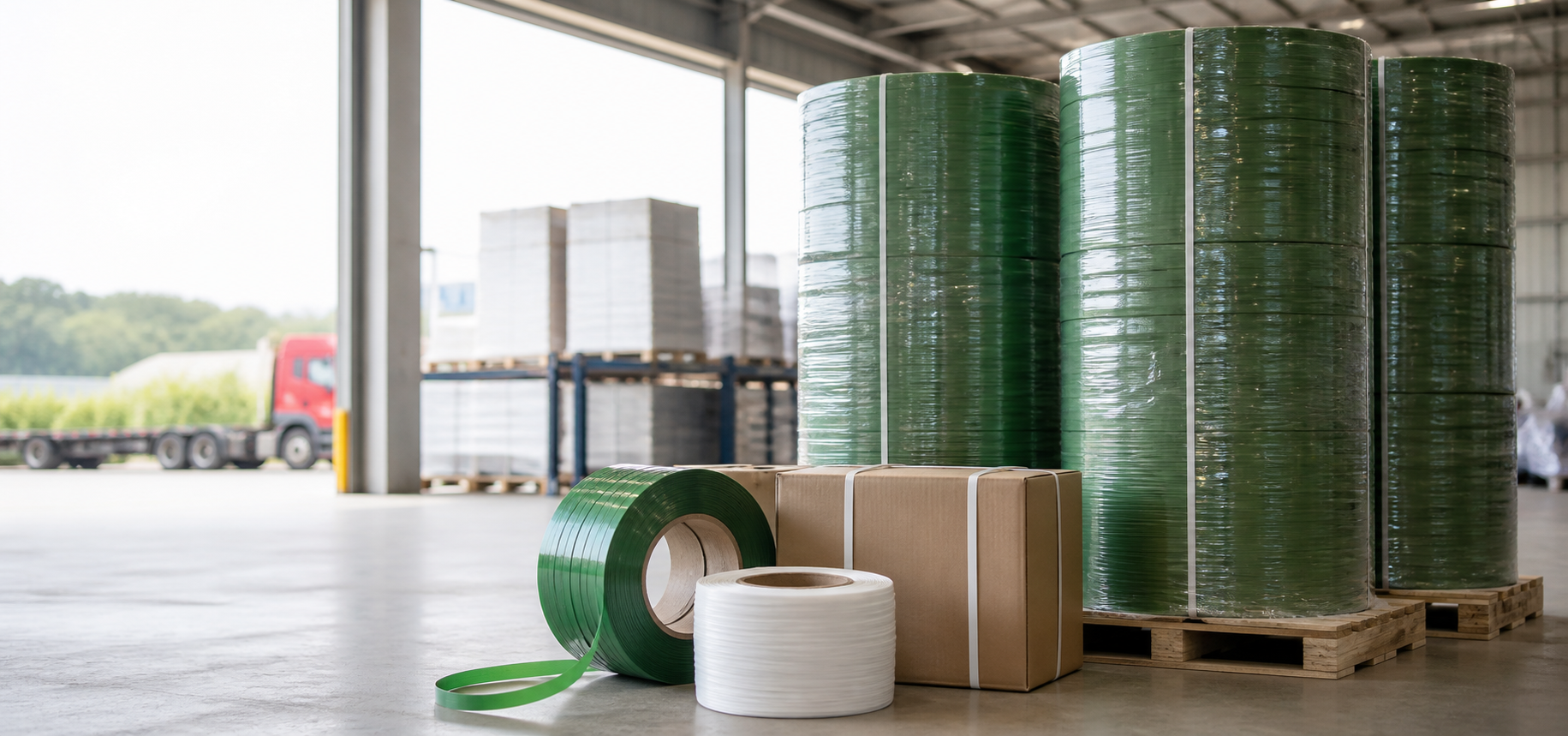

Industrial Strapping Supplier and Manufacturer
Send the load, not a part number.
UD Packaging is an industrial strapping supplier that extrudes its own polyester at a production base in Jiangyin, Wuxi, Jiangsu, and supplies the stretch film, seals, buckles and strapping machines that go around it. One enquiry covers all four supply lines against one set of load data.
Two things on this page do the work. The One-Order Supply Span sets out what each of the four lines controls and, more usefully, what it does not. The Granulation-to-Coil Control Points set out the six points at which an enquiry becomes a locked, repeatable specification.
Check your size against the published range. Load drawings, pack patterns and shipment photographs you send us are used only to build your specification review.
Request a Specification-Matched QuoteCore Parameters
- Six published polyester strap models, 12 to 19 mm
- Published tensile force 2,600 to 6,800 N
- 1,000 kg initial RFQ planning quantity
- FOB, CIF, FCA or CIP shipping terms
Minimum order
1,000 kg as the initial RFQ planning quantity; the final minimum order quantity is confirmed in the written quotationTrade terms
FOB, CIF, FCA or CIP; the final term is confirmed in the quotationSamples
Samples and trial coils are available on request, screened against your named tool or machine before they shipTested to
QB/T 4010-2010, with tensile properties to GB/T 1040.1-2018 and GB/T 1040.3-2006Strapping, Film, Closures and Machines Behind One Purchase Order
Four supply lines sit behind a UD Packaging order. Buying them together means the strap, the film, the closure and the machine are specified against the same load data instead of four separate purchase orders, which is what we mean by packaging systems rather than packaging solutions as a phrase.
Each line controls a different part of the unit load.
Each line also has a boundary, and we publish it, because a buyer who knows what a line does not cover can plan around it.
The strapping industry usually sells these as separate categories of strapping products, which is how a coil arrives that will not run on the tool already bought for it.
The One-Order Supply Span
Read the span carefully: understand what you are buying, and explicitly what that item will not solve for you on the unit load.
Polyester strapping
✓ Controls
Structural restraint. Holds the stack together and keeps clamping force on the pack after it settles.
✕ Does Not Control
Surface protection and lateral creep of individual cartons.
Industrial stretch film
✓ Controls
Unitizing and reinforcing (ASTM D4649-20(2025)), plus surface containment.
✕ Does Not Control
Outdoor exposure and the hard-cornered heavy pack.
Seals and buckles
✓ Controls
How much of the strap’s published force actually reaches the load.
✕ Does Not Control
Anything about the strap itself.
Strapping machines
✓ Controls
Repeatability. Feed, retract, tension, seal and cut run under a fixed cycle.
✕ Does Not Control
Downstream performance or pallet release behaviour.

Supply Lines Setup
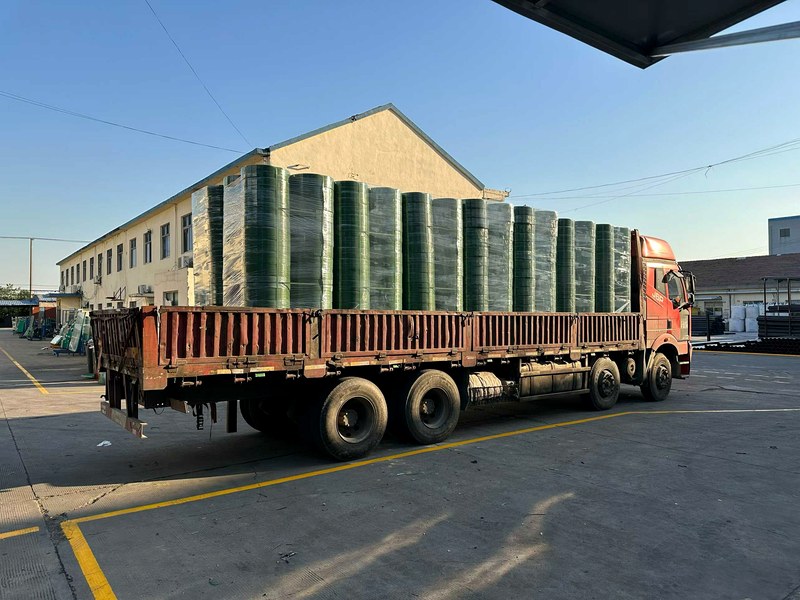
Polyester strapping, granulation to finished coil
Our automated production lines cover the chain from prepared PET material through extrusion, orientation, winding and labelling. Six models are published, spanning 12, 16 and 19 mm nominal widths.
Recycled-content grades are produced on the same lines.
- Reprocessed polyester, as published patent literature defines it, is reclaimed inside a production facility as off-specification material.
- Recycled polyester is reclaimed after final use, from sources such as water and detergent bottles.
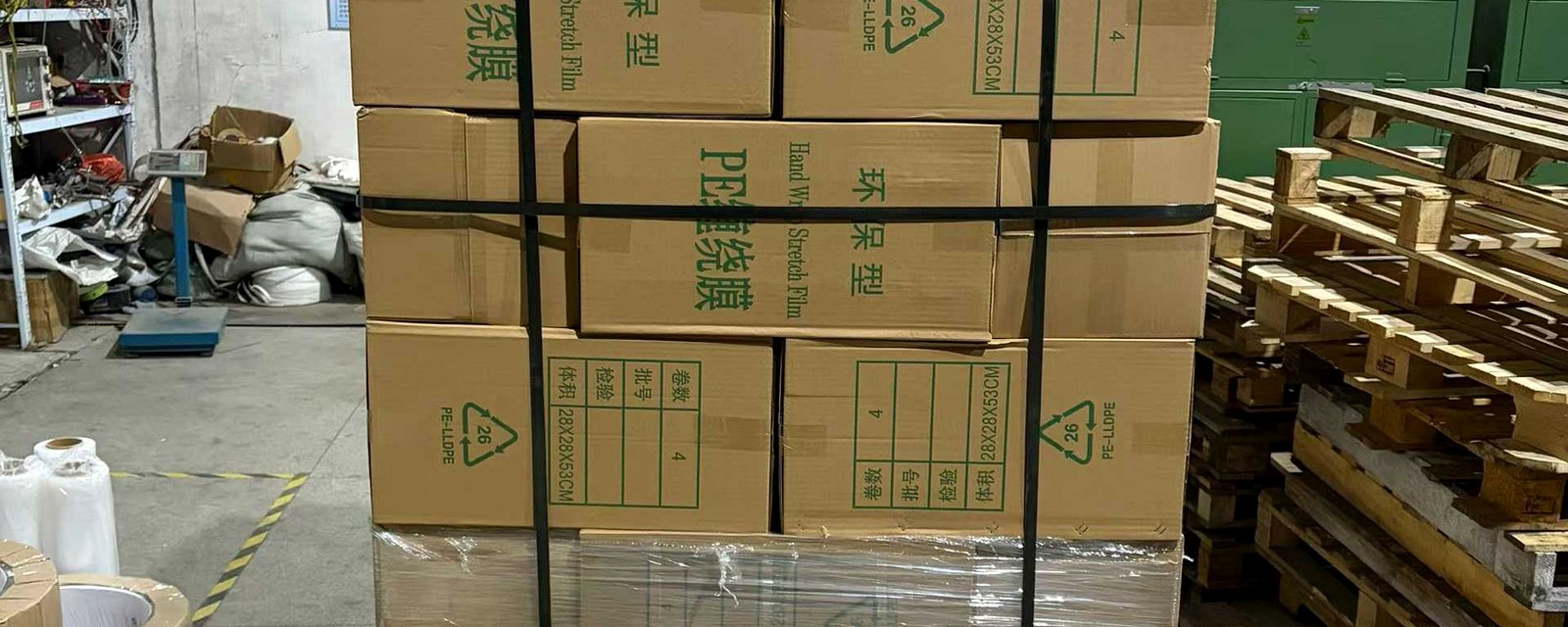
Industrial stretch film
We supply industrial stretch film with high stretch rate and puncture resistance for palletised goods. Tell us whether it runs by hand or through a turntable or rotary-arm stretch wrapper, because film and strap are quoted against the same unit-load data.
- ASTM D4649-20(2025) scopes stretch film to unitizing, reinforcing and palletizing in indoor environments, so film is part of the restraint system rather than a wrapper around it.
- What actually holds the load is containment force on the finished pack, measured on the pack rather than read off a stretch wrap machine’s pre-stretch setting.
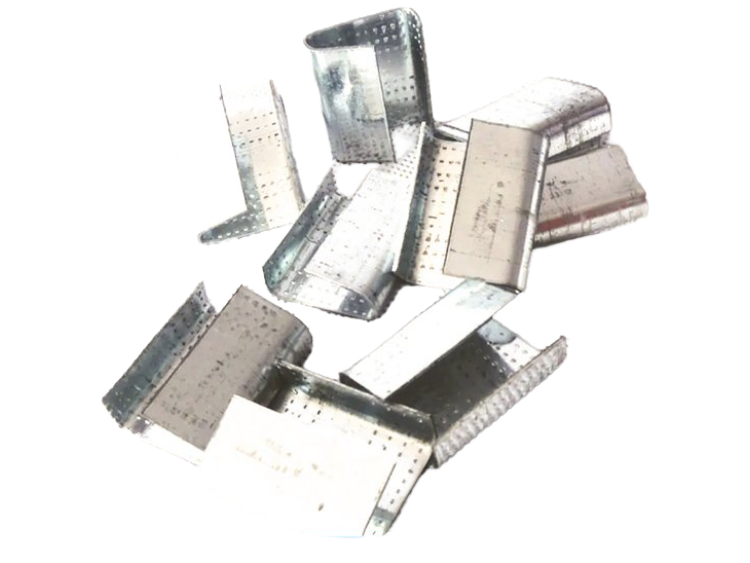
Seals, buckles and closures
We supply strapping seals and buckles for compatible applications.
- Seal strength is expressed as a percentage of a reference break load, not as an absolute force.
- Published patent literature records that seal strength tracks the blend composition of the strap itself rather than its bare force.
- That is why the closure and the strap have to be qualified as one route, never separately, and why the joint efficiency calculator on our industries hub works in percentage of break load rather than in newtons.
- Weak straps or faulty seals can collapse pallets in transit, and the post-incident argument is almost always about which of the two gave way first.

Manual, semi-automatic and fully automatic machines
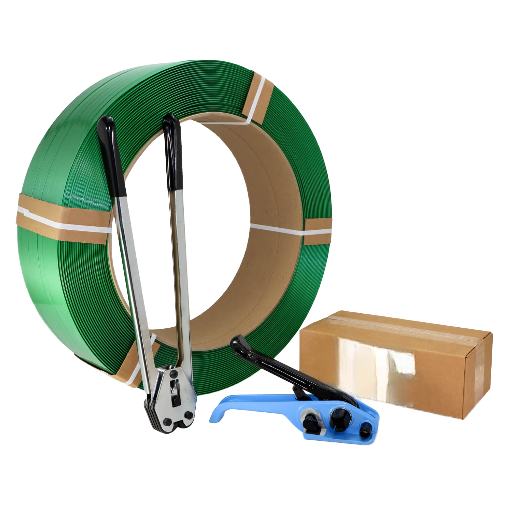
Manual tensioners and sealers, semi-automatic strappers and fully automatic strapping machines are supplied alongside the consumables. Name the tool or machine model on the enquiry and the strapping equipment is quoted against the coil it will actually run.
- Hand application depends on the operator holding consistent tension and forming a repeatable closure.
- A powered tool applies tension under control and forms the joint on a fixed cycle.
- Automation raises repeatability, not strap performance, which is why we quote strapping systems as strap plus closure plus machine rather than as three separate line items.
Product lines and where each one is specified
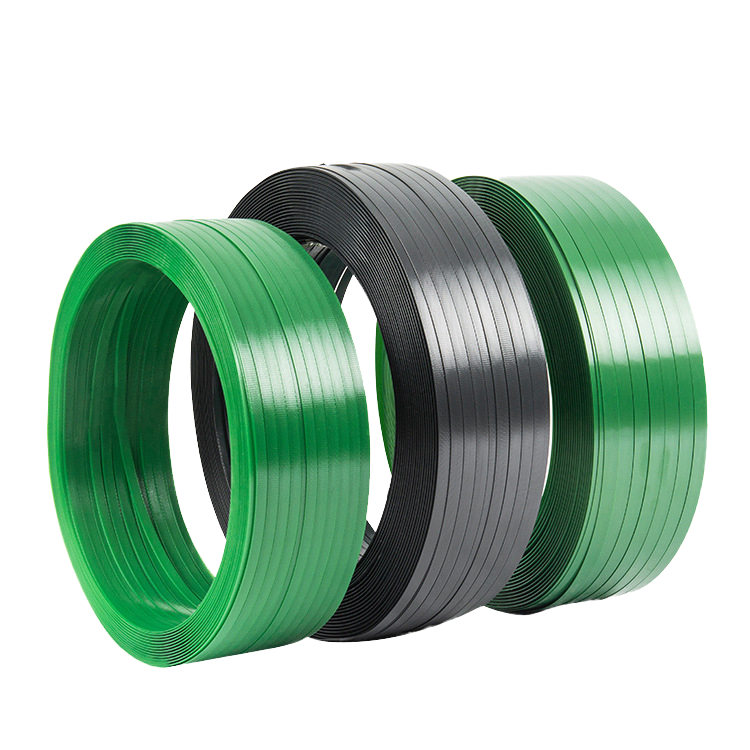
PET strapping
The parent line: six published models, coil formats, surface options and recycled-content grades. Start here when the buying job is the strap itself.
View PET Specifications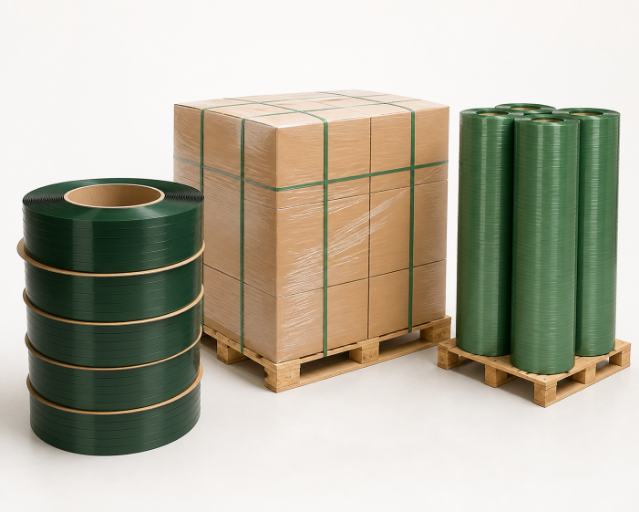
Plastic strapping
The material-route entry point. Use it when the open question is still PP against PET on a given pack rather than which coil to order.
Explore Materials
Strapping tools and machines
Handheld strapping tensioners and sealers, semi-automatic strappers and fully automatic machines. The joint route lives here, and the joint route sets usable load, so plastic strapping tools are specified with the coil rather than after it.
Browse Equipment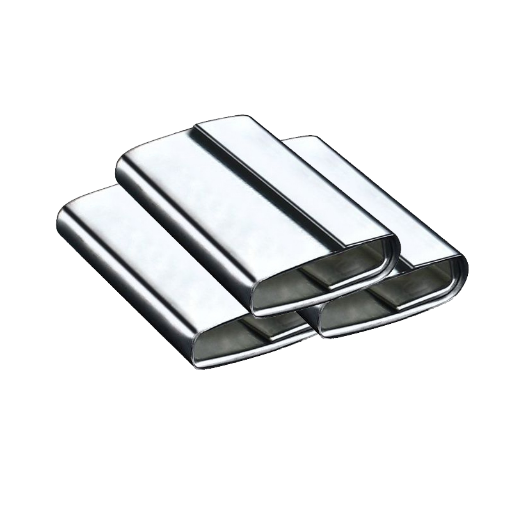
Strapping accessories
Seals and metal buckles. Worth opening before the strap row is fixed, because a closure that gives away force pushes you into a heavier model for the same load.
View Accessories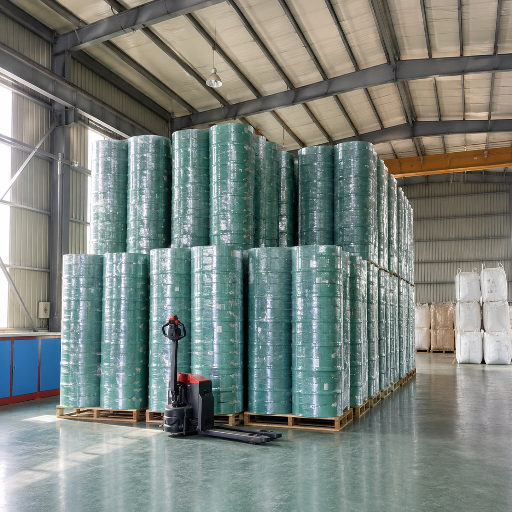
Industries
Eleven sectors routed by load signature rather than by sector name, with per-industry worksheets for logistics and for construction materials. Explore how each load family is matched to a published row.
Explore Industries| Material Family | Behaviour Under Sustained Load | Where It Belongs |
|---|---|---|
| Polyester (PET) — what we manufacture | Retains tension longest of the nonmetallic straps and recovers after impact, so a pack that settles stays held. | Medium-duty and heavy loads, palletised and bundled, on export routes and in the harsh environments of outdoor staging. |
| Polypropylene (PP) | Highest elongation and the weakest tension retention of the plastics; recovers well from small shifts. | Light cased and cartoned work with short transit, where low cost per metre wins. |
| Steel | Very high initial force and outstanding creep resistance, but poor elongation recovery once a pack settles. | Hot product, extreme duty and carrier-specified loads. Governed by ASTM D3953-15(2022). |
| Nylon strapping | The highest tension retention of the nonmetallic types, but it absorbs moisture and its behaviour shifts with humidity. | Niche high-value work where the humidity case is controlled. Outside our production scope. |
| Composite strapping and woven cord | High usable load with a buckle closure and no sharp edges, at a higher consumable cost. | Container lashing and specialist heavy securement, applied with cord strapping tools. Outside our production scope. |
ASTM D3950-23 is the specification that governs the nonmetallic side of that table. It classifies nonmetallic strapping into five types by material and sets conformity on breaking strength and elongation, transverse strength and joint strength.
We manufacture one of those five types and say so plainly, as a manufacturer and supplier of polyester rather than a catalogue reseller of all of them.
Half the enquiries that reach a strapping supplier use a word for something other than what the buyer needs. The mapping below is the disambiguation we run before quoting anything.
| The Search Term | What It Usually Means In Practice | Where It Lands Here |
|---|---|---|
| Polyester strapping manufacturers, polyester strap suppliers | A buyer looking for the extruder rather than a reseller, usually because a specification or a recycled-content declaration has to be traceable. | This is us. Six published models, extruded at our own base. |
| Plastic strapping supplier, plastic pallet strapping, poly strapping | The material question is still open between polypropylene and polyester, and the pack is palletised. | The material table above. We extrude polyester only. |
| Polypropylene strapping manufacturers | Light cased work with short transit, where cost per metre wins. | Not our production scope, and we will say so rather than sell you a heavier polyester row that costs you more for no gain. |
| Steel strapping supplier, metal strapping, metal strapping supplier | Hot product, extreme duty, or a carrier that specifies steel. | The boundary block below. Polyester is not a substitute in those three cases. |
| Heavy duty strapping supplier | Almost always a load-signature question, not a product question: high top load, hard corners, or a pack that settles. | The load families block. Send the pack and we place it against a published row. |
| Pallet banding strap, industrial banding tools, banding strap tool, banding strap kit | Banding is the retail and maintenance word for the same physical job. Search results for it are dominated by general distributors selling small quantities. | Same product family. If you are buying at industrial release quantities, the strapping terms above will get you a better-scoped quotation. |
| Automatic banding machine for pallets, strapping machine suppliers | The equipment question, usually raised after a hand-applied joint has proved unrepeatable. | The machines line. Name the model and the coil is screened against it. |
| Packaging strap suppliers, strapping material suppliers, banding tools | A consolidation enquiry: one vendor for consumables, closures and equipment. | The One-Order Supply Span at the top of this page. |
Another size or grade
Send the width, thickness and coil format your line runs and we confirm availability against the published range in the quotation.
Request a Specification-Matched QuotePublished Polyester Strap Specifications and Order Fields
Six models are published with dimensions, linear mass, coil length, tensile force and net coil weight. Every figure below is product data you can screen against your tool and your coil-change interval before you contact anyone.
Open the strap specification unit converter to move any row between metric and imperial before it goes on an order.
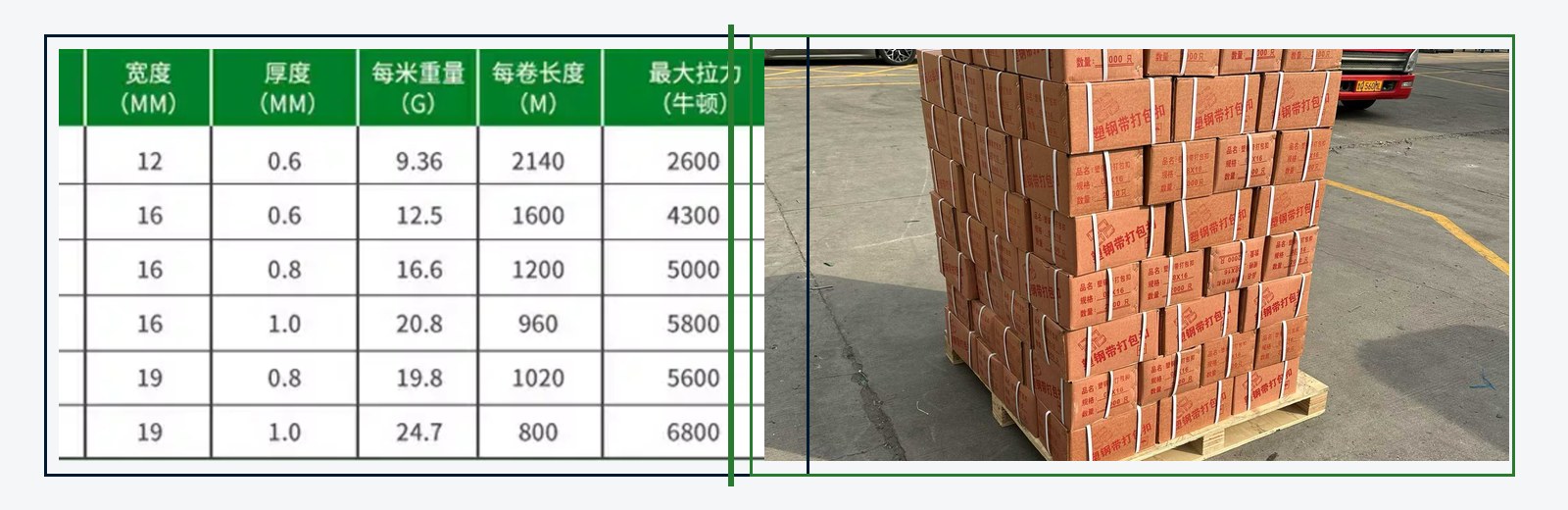
| Model | Nominal size | Linear mass | Coil length | Published tensile force | Net coil weight |
|---|---|---|---|---|---|
| 1206 | 12 × 0.6 mm (0.47 × 0.024 in) | 9.36 g/m | 2140 m (7021 ft) | 2600 N (585 lbf) | 20 kg (44 lb) |
| 1606 | 16 × 0.6 mm (0.63 × 0.024 in) | 12.48 g/m | 1600 m (5249 ft) | 3900 N (877 lbf) | 20 kg (44 lb) |
| 1608 | 16 × 0.8 mm (0.63 × 0.031 in) | 16.64 g/m | 1200 m (3937 ft) | 4600 N (1034 lbf) | 20 kg (44 lb) |
| 1610 | 16 × 1.0 mm (0.63 × 0.039 in) | 20.8 g/m | 960 m (3150 ft) | 5600 N (1259 lbf) | 20 kg (44 lb) |
| 1908 | 19 × 0.8 mm (0.75 × 0.031 in) | 19.76 g/m | 1010 m (3314 ft) | 5800 N (1304 lbf) | 20 kg (44 lb) |
| 1910 | 19 × 1.0 mm (0.75 × 0.039 in) | 24.7 g/m | 800 m (2625 ft) | 6800 N (1529 lbf) | 20 kg (44 lb) |
Request a Specification-Matched Quote
Get Started NowStrap Surface, Coil Format and Identification Options
Two coils can carry the same width, thickness and force and still behave differently in a tensioner or an automatic head. The variables below are order fields, not preferences.
Every strapping manufacturer publishes width, thickness and force. These are the fields that decide whether the coil actually runs on your line.
Option
What to state on the order
What it changes on the floor
Surface profile
Smooth or embossed, or an approved reference sample
Contact area, feed behaviour and the friction-weld setting window
Surface treatment
Any wax or handling requirement, stated explicitly
Friction against the guide path, tooling wear and cycle repeatability
Colour
The required colour and the acceptable visual range
Product identification and goods-in checking speed
Printing
Text, artwork, repeat interval and contrast requirement
Turns branding into an inspectable order field instead of a request
Winding
Direction, traverse pattern and roll orientation
Whether the coil feeds a dispenser or a machine head without twisting
Core and outside diameter
Core dimensions, roll outside diameter and pallet pattern
Whether the coil physically fits the dispenser you already own
Edges and straightness
Visual acceptance criteria and machine-trial criteria
Tracking through the head, and splitting and snagging risk
Why splitting is a geometry problem, not a quality complaint
Heavy-duty polyester is more prone to longitudinal splitting than light gauges, and the mechanism is published. Patent application WO2013059555A1 records that strapping stretched only in the longitudinal direction tends to split along its length when pulled tight, compared with strapping stretched in two dimensions.
The property that behaviour falls under has a name and a conformity requirement: transverse strength, one of the four properties ASTM D3950-23 sets conformity on. That is why a splitting complaint is answered with geometry, edge condition and guide path rather than with a different resin.
Split complaints on a wide, thick coil usually point at edge condition and guide path, not at the polymer
- An unprotected sharp corner cuts a strap before its published force is ever reached
- A coil that tracks off-centre through a head loads one edge and finds the same weakness
Machine grade and hand grade are operating requirements rather than product grades. Give us the equipment model, the current coil label and the joint method, and we screen surface, width, thickness, core, winding and splice restrictions before recommending a trial coil.
Pricing Mechanism, Minimum Order and Trade Terms
There is no published price per kilogram for industrial strapping, and the reason is arithmetic rather than secrecy: none of the variables that set the number is fixed across buyers. Price follows the PET input, strap geometry, mechanical requirement, surface and printing, coil format, order quantity, packing and destination.
The only non-seller comparison we could find, and why we date-stamp it
Almost every steel-to-polyester savings percentage in circulation is published by a company that sells polyester strapping. One exception exists, and it sits inside a European Commission merger decision rather than a brochure.
That investigation ran in 1997 and 1998. Treat those percentages as evidence that the substitution economics were real a generation ago, not as a price you can quote today. Resin and steel have both moved since, and neither we nor anyone else can honestly restate that figure as current.
What survives from it is the method, not the number. Compare quoted systems on your own pack, at the configuration each material actually needs, rather than comparing price per metre at equal dimensions.
Price, minimum order quantity, production timing, payment arrangement and trade terms are confirmed in the written quotation.
Substitution economics analysis
Commission’s official findings
- The Commission’s own finding on comparability. Decision 98/666/EC of 6 May 1998, case IV/M.970, paragraph 31: it is difficult to make a direct comparison of prices for the various types of strapping…
- The one independent figure recorded there. The same paragraph cites VDI Richtlinienarbeit Nr. 3968… stating that at equal dimensions polyester strapping was 20 percent and polypropylene strapping 40 percent cheaper than steel.
- The Commission’s finding on substitution. Paragraph 26 of the same decision records that polyester strapping provides characteristics comparable to those of steel strapping…
What moves your number
Strap cross-section
Effect on cost
Material per lineal metre moves with linear mass, which runs 9.36 to 24.7 g/m across the published range — a factor of 2.6 between the lightest and heaviest row.
How to control it
Qualify the lowest row that clears your joint and your pack, rather than defaulting to the top of the range.
Coil format
Effect on cost
Coil length runs 800 to 2140 m while net coil weight stays 20 kg, so a 1910 coil is exhausted in roughly a third of the run length of a 1206 coil.
How to control it
Count changeovers per shift before comparing coil prices. Labour and line stops move with changeover count, not with price per kilogram.
Joint route
Effect on cost
A closure that gives away more of the strap’s force pushes you into a heavier row for the same load, and the heavier row costs more per metre.
How to control it
Qualify the joint first. The strap row often drops once the closure is settled.
Surface and identification
Effect on cost
Embossing, colour and printing add processing steps and order complexity to every coil in the release.
How to control it
Standardise colour and print only where they add real control value at goods-in.
Package failure cost
Effect on cost
Rework, downtime, damaged goods and rejected loads land outside the packaging budget and are rarely counted against the strap that caused them.
How to control it
Validate the worst-case load before a volume release, not the average one.
Release quantity & destination
Effect on cost
Packing method, documentation and the trade term all sit inside the delivered cost.
How to control it
State release size, destination and required documents up front so they are priced once.
Minimum order and trade terms
Use 1,000 kg as the initial RFQ planning quantity; the final minimum order quantity is confirmed in the written quotation.
It is a planning figure for the enquiry, not an unqualified stock promise.
We ship FOB, CIF, FCA or CIP; the final term is confirmed in the quotation. Naming the term you want quoted changes the number that comes back, because the eleven Incoterms 2020 rules allocate cost, risk and obligation differently.
Open the Incoterm mode validator to check which of these four terms fits your actual routing.
- Any mode of transport, including air and multimodal: FCA and CIP. The International Trade Administration groups seven of the eleven rules this way.
- Sea and inland waterway only: FOB and CIF. These are port-to-port rules, so asking for an FOB price on an air shipment is a mismatch we will flag back rather than quote around.
What the term does not decide: the contract price, the method or timing of payment, and when title passes. Those are separate lines in the quotation and the sales contract.
Open the coil consumption and changeover planner to turn your pallet count into metres, kilograms and coil changes per shift.
Compare cost per accepted pallet, not cost per coil
- Lineal metres consumed per load, which follows strap count and pack geometry
- Failed joints and re-strapped pallets, which consume material twice
- Coil changes and machine stops per shift
- Edge protection, damaged goods and buffer stock carried against failure risk
The lowest price per coil loses its advantage when the system consumes more material or creates more interruptions. Published trade coverage of one steel-to-polyester conversion is instructive on the size of the prize: Modern Materials Handling reported in June 2024 that a steel manufacturer moving ship-borne coil securement from steel to polywoven strapping cut strapping cost by 25 percent and securing time by 10 percent. That case used composite polywoven strap rather than extruded polyester, so read it as the direction of the change and not as a figure for your own pack.
Ask for tensile report SUZIN2605001676PL07_CN by number — a narrower first request than a full quotation, and it tells you what our evidence actually looks like.
Quality Control and Named Third-Party Test Evidence
Two kinds of evidence travel with industrial strapping and buyers routinely conflate them.
A laboratory test report says what a submitted specimen did under stated conditions.
A product certification says a scheme has assessed a product line against specified requirements.
We publish the first kind by report number, with the scope each report actually carries.

What to ask us for, and what you will actually get
Data Delivery StandardsBuyer guidance in this category converges on one checklist. We have set it out below with our own answer against each line, so nothing has to be discovered after an order.
What we return
The published row for your model: nominal size, linear mass, coil length, tensile force, net weight, surface and core.
What we return
Samples and trial coils are available on request, screened against your named tool or machine before they ship.
What we return
The two SGS reports on this page by number, with the scope each one actually carries, and any further report we hold for your model.
What we return
All three confirmed in the written quotation against your release size and destination.
What we return
Stated for the grade you specify, with the reprocessed-versus-recycled distinction named rather than blurred. We do not issue what we do not hold.
What we return
Batch identification back to the production record. Where a scheme certificate does not exist for a line, we say so instead of substituting a test report for it.
Deep Dive: Production, Standards & Testing
How every order is checked
- Incoming specification review against the purchase record: model, nominal width and thickness, linear mass, coil length, net weight, surface, colour and core
- In-process checks on the automated production lines at the Jiangyin base, against the approved row rather than against a general tolerance
- Finished-strap testing of the relevant tensile properties by the specified method, on the finished product and not on the input resin
- Pre-despatch check of coil format, identification and pallet requirements against the quoted item
- Change control: the approved row, tool setting and joint route stay together, and the pack is rechecked whenever strap, tool, pallet, protector, film or pattern changes

Standards we test to
QB/T 4010-2010 — dimensional and tensile requirements for the product class
GB/T 1040.1-2018 and GB/T 1040.3-2006 — tensile properties of plastics, general principles and film and sheet conditions. These are the editions named in our own quality documentation.
Edition status, stated plainly. GB/T 1040.1-2018 was abolished on China’s SAMR standards registry with effect from 1 October 2025 and replaced by GB/T 1040.1-2025, and GB/T 1040.3-2026 becomes effective on 1 December 2026. Ask which edition a quoted test result actually used, because a report can be perfectly valid against the edition in force when it was issued.
The edition that applies to your order is confirmed in writing rather than assumed.
Separately, ASTM D3950-23 is the reference frame this page uses for nonmetallic strapping and its joining methods, and ASTM D3953-15(2022) is the corresponding flat steel specification. Both are published specifications we cite, not tests we run.

Everything below is produced under the same sequence: The Granulation-to-Coil Control Points decide what gets recorded, and these reports are what a third party recorded independently of us.
Third-party test reports, by number and scope
Issued 2026-06-02 by SGS-CSTC Standards Technical Services Co., Ltd., Suzhou branch, on a green PET strap submitted as model 1910. The cut specimen measured 16.022 × 1.058 mm and returned 4,860 N tensile force with 21 percent elongation at break.
That figure belongs to the specimen described in the report. It is not a release value for the published range.
Dated 2026-06-12 by SGS-CSTC Standards Technical Services (Shanghai) Co., Ltd., under SGS work number SUZIN2606001815PL09. A green PET strap specimen returned non-detect for all ten substances restricted by EU Directive 2011/65/EU.
The result covers the identified submitted specimen, which makes it material-level evidence for a buyer’s file.
Both reports name our Jiangyin manufacturing entity as the client. Ask for either by number and we send the report as issued, with its scope intact.

Ordering, Production and Shipment Sequence
An enquiry becomes a locked specification in six control points. Each one records something, and the record is what makes the next order repeatable.
The Granulation-to-Coil Control Points
1 Load data in
Dimensions, gross weight, pack form, base, edge condition, route and the failure you are seeing now. Name the equipment and materials already on your floor, including whether the tensioner, sealer or cutter is handheld, battery-powered or pneumatic, and whether an inline head runs a high-speed cycle. A coil-label photograph beats a part number.
2 Row screening
Width, thickness, linear mass, coil length and tensile force screened against your named tool, core and guide path, and the joint route agreed with the tool or machine named. Say so at this point if your line needs a jumbo coil format or a core the published rows do not carry.
3 Written quotation
The point at which price, minimum order quantity, production timing, payment arrangement and trade terms stop being estimates.
4 Production and in-process control
PET input through extrusion, orientation and winding on our own automated strapping production lines, checked against the approved row on the line rather than at the end.
5 Finished-strap inspection and labelling
Dimensions, mechanical requirement, surface, coil format and identification verified before packing, and if a batch misses the written criteria we hold it rather than ship it.
6 Packing, documents and despatch
Coil format, pallet pattern and the documents your entry needs, prepared under the trade term agreed in the quotation.
The Granulation-to-Coil Control Points are numbered because the order matters. Points one and two are yours to supply, point three is where estimates stop, and points four to six are ours to record against your approved row.
How a packed load is actually proven
ASTM D4675-14a(2022) treats strapping selection guidance as a starting point followed by user testing. Published methods exist for that step, and a buyer can ask for them by name.
If a trial result misses the written acceptance criteria, we go back to the joint route with you rather than raising applied tension until the symptom disappears. Over-tensioning trades package protection for a reading on a gauge.
A pack that arrives safely is a durable joint plus retained tension, not a high number on the tensioner at the moment of application.
Loose straps allow loads to shift during transit, and a strap goes loose by settlement long after the tool has left it. That is why retained tension after settlement, not first tension, is the property we screen your row against.
Industries &
Load Families
Sector name is a poor router across the range of industries we supply. Load signature — the physical behaviour that decides the strapping answer — is what actually changes the specification.
Securing heavy palletised goods well in one sector tells you almost nothing about the right answer in another.
Technical Model Specs
- Model 1206, 12 × 0.6 mm, the longest coil in the published range at 2140 m
- The 16 mm face carries three thicknesses on one guide path: 1606, 1608 and 1610
- Model 1910 sits at the top of the published range on both width and thickness
Logistics and warehousing
Mixed box, cased and palletised loads seeing repeated forklift handling. The signature is settlement after packing, fork contact at the strap line, and a strap path that must not run with the deck boards.
Construction & Building Materials
Brick, block, paver and panel packs coming off a kiln or press line. The signature is abrasive hard corners, gaps in the stack, and outdoor staging before despatch.
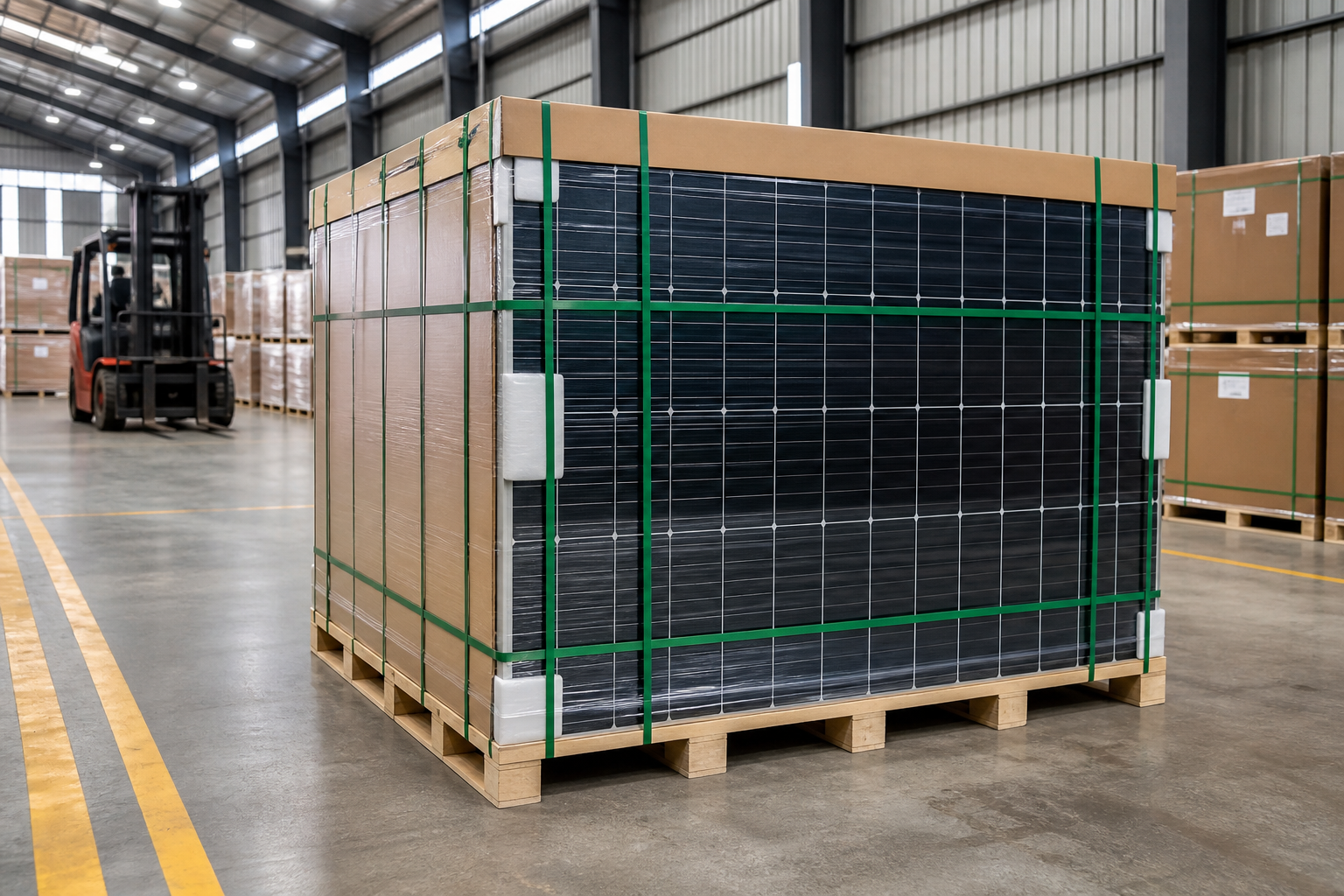
Metals, new energy & solar
Steel coils, aluminium ingots and cartoned photovoltaic modules. Concentrated edges and top-load pressure decide strap path and corner protection before width is even discussed.
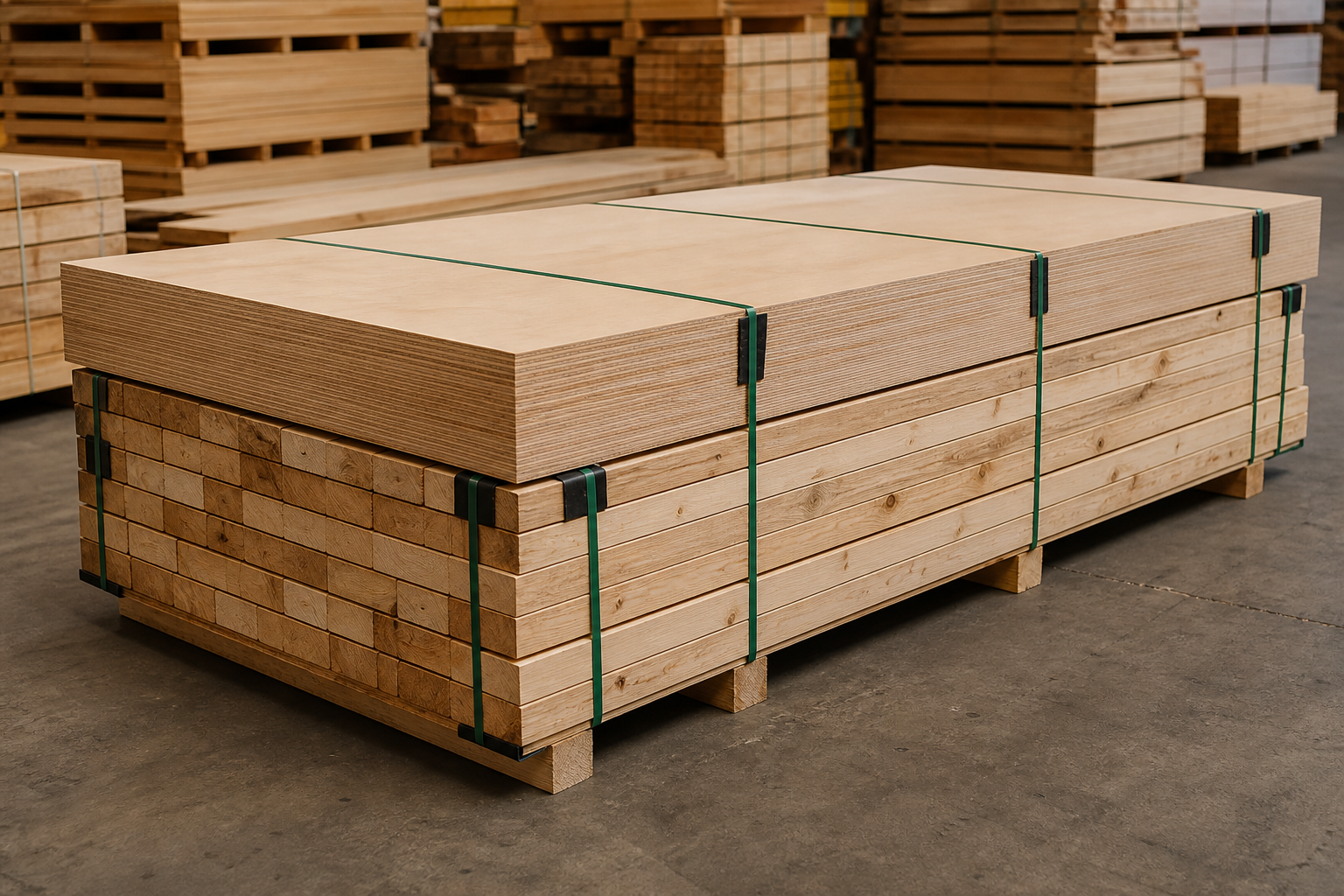
Timber, paper and textiles
Lumber bundle dimension moves with moisture in storage, paper reels and corrugated stacks mark under contact pressure, and a pressed cotton bale pushes back against the joint continuously.

Food, agriculture and tobacco
Bag stacks and cased goods facing cold-chain temperature swings, hygiene rules on what may touch the pack, and buyers who expect documentation to arrive with the delivery.

Electronics and export cartons
Corrugated export cartons with low tolerance for pack deformation, multi-leg routes, and a supply chain that pushes a substance declaration down to packaging materials.
Logistics & Warehousing
Construction Materials
Metals & Solar
Timber & Textiles
Food & Agriculture
Electronics Cartons
Export packaging & EU market rules
Regulation (EU) 2025/40 on packaging and packaging waste entered into force on 11 February 2025 and applies generally from 12 August 2026. It covers all packaging regardless of material or origin, and the obligations fall on the economic operators placing packaging on the EU market.
Commission Delegated Decision (EU) 2026/429 of 25 February 2026, in force from 26 May 2026, exempts operators using pallet wrappings or straps for stabilisation and protection from the 100 percent re-use requirements of Article 29(2) and (3).
That runs against the direction most buyers expect, so it is worth reading before you plan an EU packaging change. The recitals state that reusable pallet wrappings and straps are already commercially available, but that exclusive use of them would bring disproportionate adaptation costs.
They record that the shift would need automated solutions for reusable packaging “which are not sufficiently developed yet”. The overall 40 percent re-use target under Article 29(1) still applies from 1 January 2030, and operators may compensate a low-re-use format with a high-re-use one.
The European Commission describes the exemption as the first application of a Delegated Act under the Regulation. We supply the product data your compliance file needs, quoted with the order and carrying the report scope with every figure we release. We do not act as your EU economic operator and we make no representation about your own registration or reporting position.
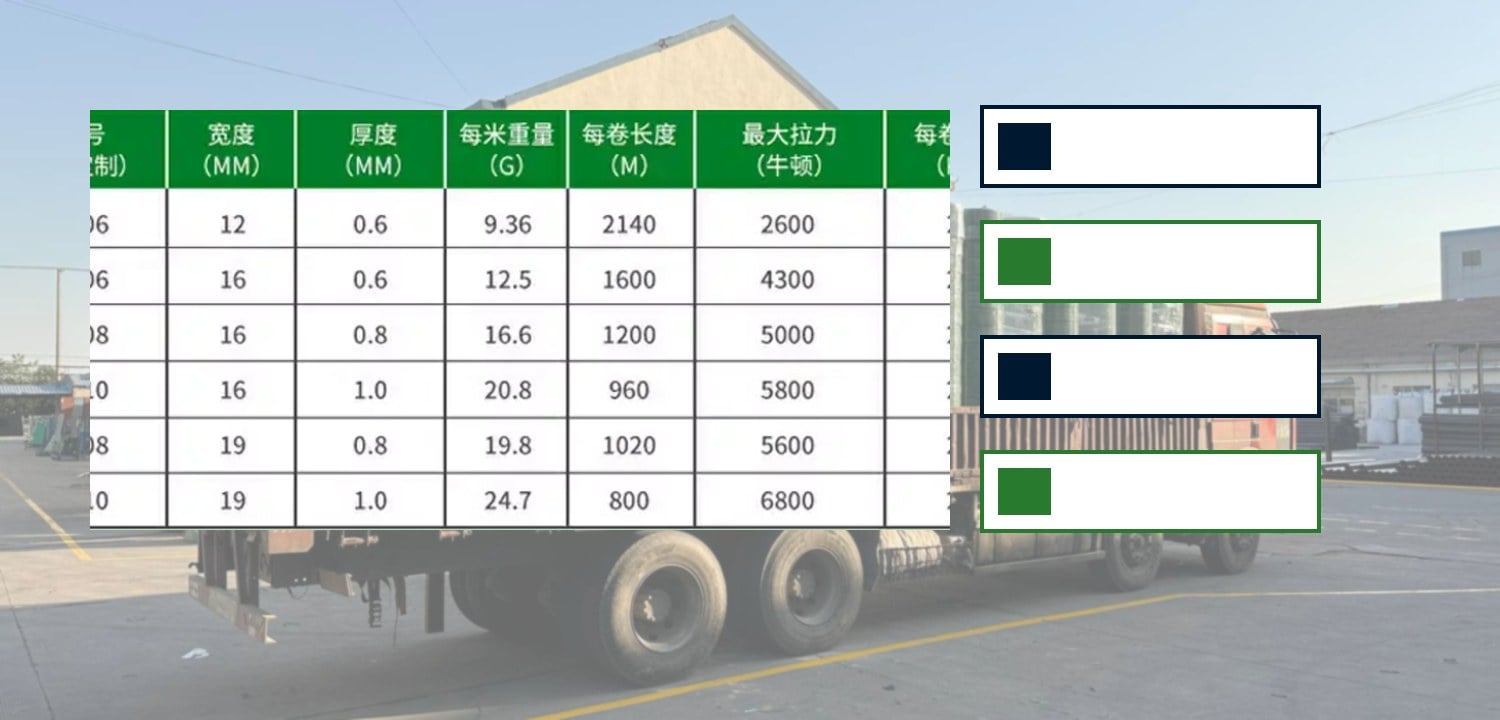
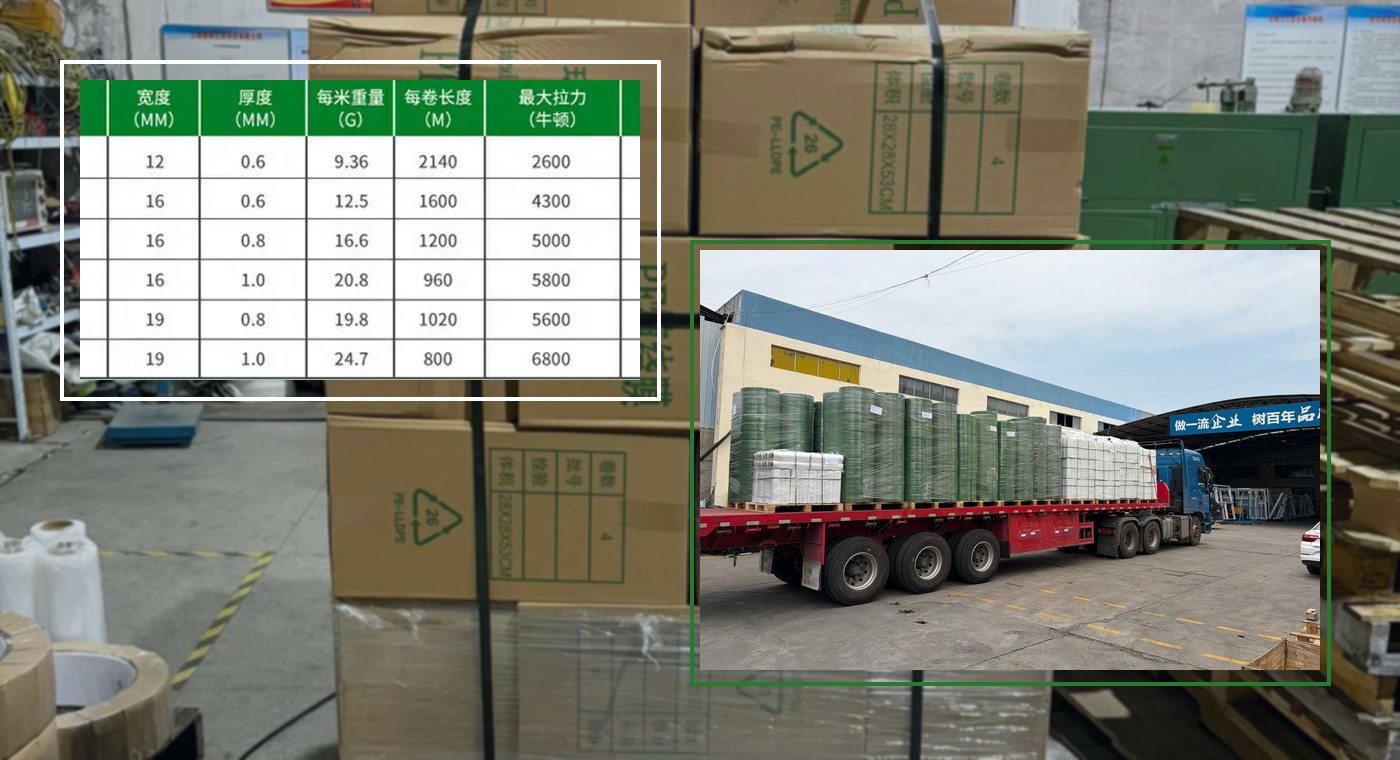
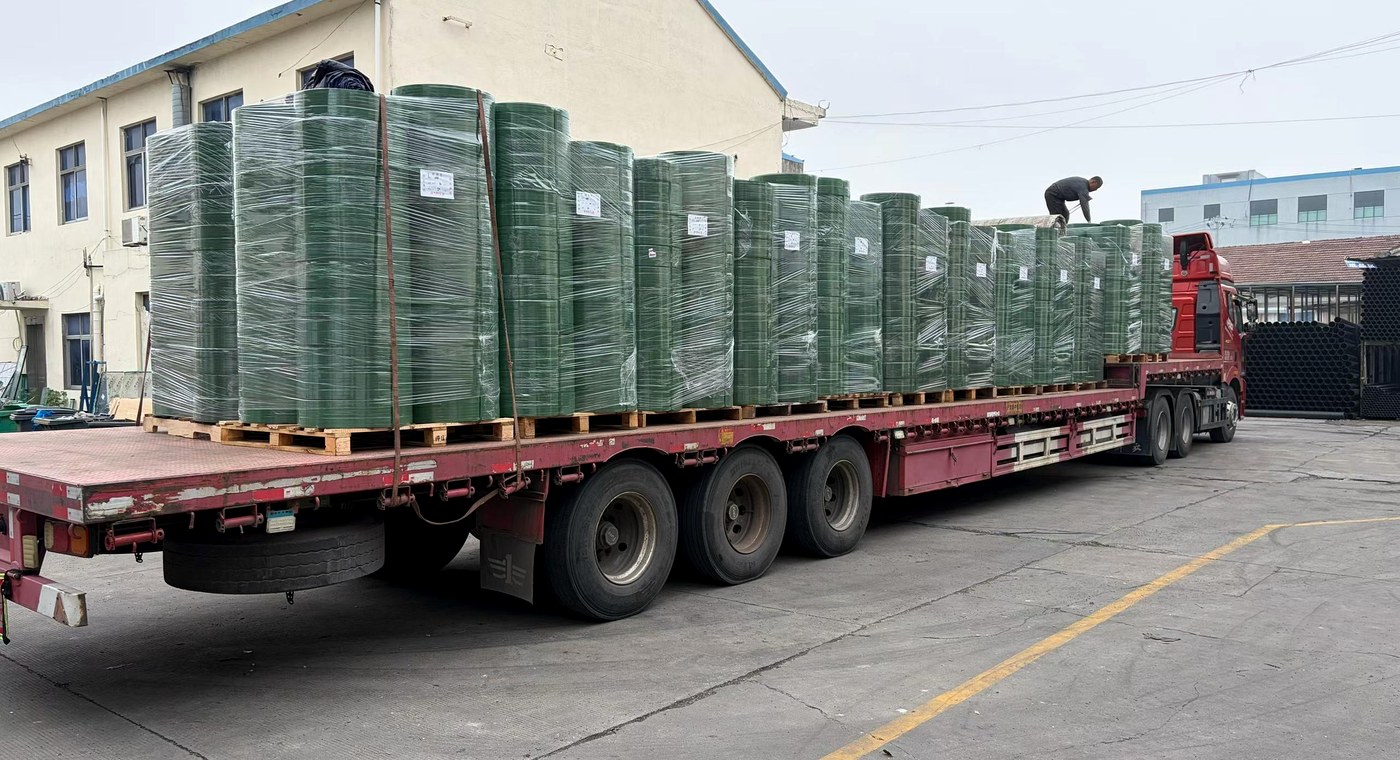
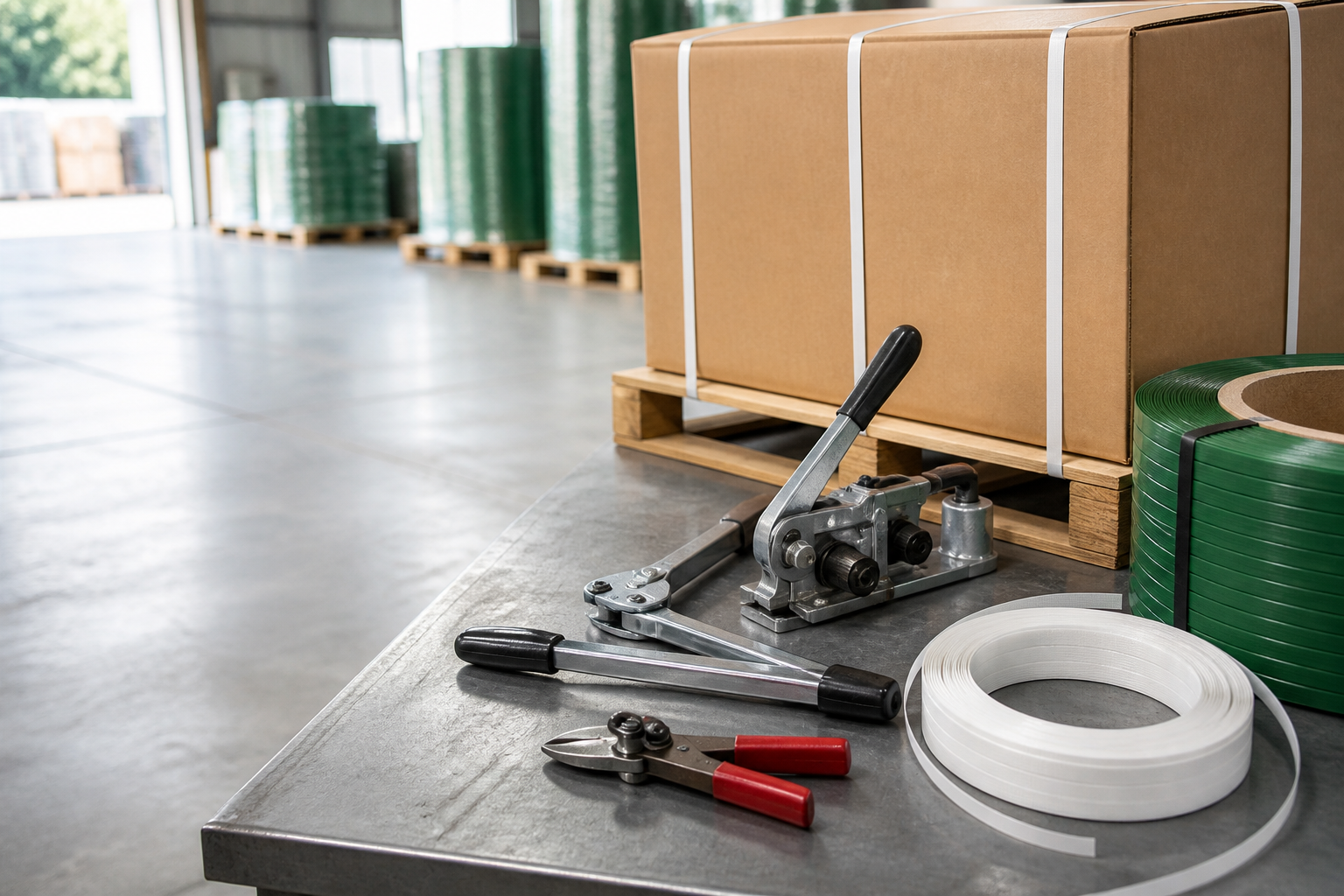
Coils prepared for despatch under the trade term agreed in the quotation
Send a coil-label photo for a specification review and we place your load against the published rows before anyone talks about price.
SYSTEM ONLINE
Industrial Strapping Optimization Suite
Empowering your packaging line with precision data. Eliminate quotation errors, validate shipping logistics, and perfectly calculate coil consumption with our advanced utility suite.
[ 01 ] CONSUMPTION
Coil Consumption & Changeover Planner
Two numbers decide whether a coil price is actually the cheaper one: how much strap a load consumes, and how often the line stops to change coils.
Access Tool[ 02 ] INTEGRITY
Coil Integrity Cross-Check
Multiply linear mass and coil length to land on net weight. Where they do not agree, one of them is wrong, and it is usually the one you were quoted on.
Access Tool[ 03 ] LOGISTICS
Incoterm Mode Validator
FOB and CIF are sea and inland waterway rules. Pick your routing and this tells you which of the four terms actually apply to your shipment.
Access Tool[ 04 ] SPECIFICATION
Strap Specification Unit Converter
A buyer comparing a metric datasheet against an imperial one is doing arithmetic in the middle of a decision. These are the five conversions needed.
Access ToolPurchasing and Specification Questions
They name the same product family. Strapping, banding, strapping band, packing strap and plastic steel belt are naming variants used in different markets, not different specifications. Order against a polymer, a nominal width, a nominal thickness and a joint route so the published rows can be matched.
Prepared PET material is melted and forced through a die into a rectangular section, then molecularly oriented by stretching under heat and tension, which is what gives the finished strap its strength along its length. Winding, surface treatment and labelling follow. Our production covers that chain from granulation to finished coil at the Jiangyin base.
Published patent literature draws the line precisely.
Reprocessed polyester
is reclaimed inside a production facility from material scrapped for not meeting quality control or specification targets.
Recycled polyester
is reclaimed after final use, from sources such as water bottles and detergent bottles.
If your specification says recycled content, state which one you mean and what evidence you need with it.
Width is chosen for contact pressure and tool fit before it is chosen for force. A 19 mm face spreads pressure across a compressible pack, while 12 and 16 mm faces thread more easily through a tight guide path. For metal work the corner radius and edge protection usually decide the answer before width does.
On many palletised and bundled loads it can, because polyester retains tension after a pack settles while steel loses it. Steel stays the correct route for hot, sharp-edged, extreme-duty, lifting, lashing or rule-specific applications, governed by ASTM D3953-15(2022).
Check width and thickness consistency, surface condition, dust or moisture, head wear, pressure, heating or friction time and cooling. Seal strength is expressed as a percentage of a reference break load and tracks the strap's own composition, so an unstable joint is rarely fixed by raising tension. Find the joint cause first.
Use 1,000 kg as the initial RFQ planning quantity; the final minimum order quantity is confirmed in the written quotation. Send the selected width, thickness, coil format and destination and the quotation translates that into the applicable coil and pallet plan.
We ship FOB, CIF, FCA or CIP; the final term is confirmed in the quotation.
FCA and CIP work for any transport mode, while FOB and CIF are sea and inland waterway rules, so an air or rail routing points to FCA or CIP rather than FOB. The Incoterm does not set the price, the payment method or the payment timing.
Yes, and The One-Order Supply Span is where we set out the boundary of each line.
Polyester strapping, industrial stretch film, seals and buckles, and manual through fully automatic machines are specified against one set of load data rather than four separate purchase orders. Each line still has a job it does not do, and we publish that column too, because a buyer who knows what a line does not cover can plan around it.
Judge the closure and the coil together, never the seal on its own.
Check the coil label against the purchase record: model, nominal width and thickness, linear mass, coil length, net weight, surface, colour and core. Check seal gauge and width against the order line, because a seal thinner than specified is the most common way force is quietly lost at the joint.
Look at edge condition and straightness, then form a joint on your own tool and pull it, since seal strength is a percentage of a reference break load rather than an absolute force.
This argument is the real cost of a strapping failure, and it is usually settled by what was recorded before despatch rather than by what happened on the road.
Packaging unitization and vehicle cargo securement are separate duties. A securement system is judged on aggregate working load limit under 49 CFR 393.106 and on tiedown count under 49 CFR 393.110, neither of which a packaging strap's breaking force answers.
A unit load that arrives deformed but intact points at retained tension and closure; a unit load that moved inside the trailer points at the securement system holding it down.
Six control points, published on this page as The Granulation-to-Coil Control Points.
Load data in, then row screening against your named tool, core and guide path. The written quotation, which is the point at which price, minimum order quantity, production timing, payment arrangement and trade terms stop being estimates. Production and in-process control, finished-strap inspection and labelling, then packing, documents and despatch under the agreed trade term.
Tensile test report SUZIN2605001676PL07_CN and substance screening report SHAPH26016440501 are available by number, as issued, with their scope intact. We test to QB/T 4010-2010 with tensile properties to GB/T 1040.1-2018 and GB/T 1040.3-2006, which are the editions named in our quality documentation.
No, and it is answered per specimen for exactly that reason. The 2026 SGS Shanghai result covers one submitted green PET strap specimen and returned non-detect for the ten substances restricted under EU Directive 2011/65/EU as amended by (EU) 2015/863. That makes it material-level evidence for a buyer's file.
It does not, and the most recent movement went the other way. Commission Delegated Decision (EU) 2026/429, in force 26 May 2026, exempts operators using pallet wrappings or straps for stabilisation and protection from the 100 percent re-use requirements of Article 29(2) and (3) of Regulation (EU) 2025/40.
Four groups. Product inputs such as nominal width, thickness and coil format; process inputs such as the tool or machine model and the joint route; load inputs such as dimensions, gross weight, base and edge condition; and delivery inputs such as release quantity, destination, documents and the trade term you want quoted.