Get in touch with UD Packaging Company

Industries
Strapping Solutions for 11 Industries
UD Packaging supplies PET strapping and the seals, tools and strapping machines that go with it to eleven industries, from steel and aluminium ingots to solar photovoltaics, timber, papermaking, cotton textiles, food and tobacco. Every figure on this page comes from our own published product data, from a named public standard, or from a named third-party patent or laboratory report you can look up. Pick your industry below, check your load against the published envelope, and send us the load data rather than a part number.
Six published PET strap models, 12 to 19 mm nominal width
Published tensile force 2600 to 6800 N
Strap, stretch film, closures and machines from one supply route
Third-party test reports available by report number on request
Request a Specification Review
Load drawings, pack patterns and shipment photographs you send us are used only to build your specification review.
Industries We Supply at a Glance
Explore our core sector focus and specialized packaging routes designed for heavy-duty industrial application.
Additional Sectors
Metals, new energy and solar photovoltaics, timber and wood products, papermaking, chemical fibres and cotton textiles, agriculture, food, electronics and tobacco — routed through the register below.

01
see logistics packaging solutions →
Logistics & Warehousing
02
see construction packaging solutions →
Construction & Materials
Industrial Strapping, Film, Closures and Machines from One Supply Route
Four supply lines sit behind every industry card on this page. Stretch film selection sits under ASTM D4649, strapping under ASTM D3950. Buying them from one route means the strap, the film, the closure and the tool are specified against the same load data instead of four separate purchase orders.
01
PET strapping
Six published models covering 12, 16 and 19 mm nominal widths. Our PET manufacturing scope covers PET granulation through finished strapping, so material preparation and finished output sit inside one process.
02
Industrial stretch film
We supply industrial stretch film with high stretch and puncture resistance. Film controls surface and lateral movement; strap holds structure. Film is not a substitute for a qualified strap and joint, and neither is specified without the other.
03
Seals, buckles and closures
We supply strapping seals and buckles. Usable load is won or lost at the closure, which is why it gets its own section further down this page.
04
Tools and strapping machines
We supply manual, semi-automatic, and fully automatic strapping machines, plus the tensioner and sealer combinations that go with hand application. Matching the strapping equipment to the strap row is part of the quotation, not an afterthought once the coil arrives.
Where the Strap Is Made
UD Packaging manufactures PET strapping at its Jiangyin, Wuxi, Jiangsu production base.
Load Families Inside the Published Envelope
Steel coils, sheet bundles, wire rod and aluminium ingots
Brick, block and paver packs off the kiln line
Dimensional timber, plywood, particleboard and panel stacks
Paper reels, board bundles and baled recovered fibre
Chemical fibre and cotton bales
Photovoltaic module cartons on pallets
Cased food, beverage and tobacco loads
Cartoned electronics on pallets for export
Six Published PET Strap Models and Matched Consumables
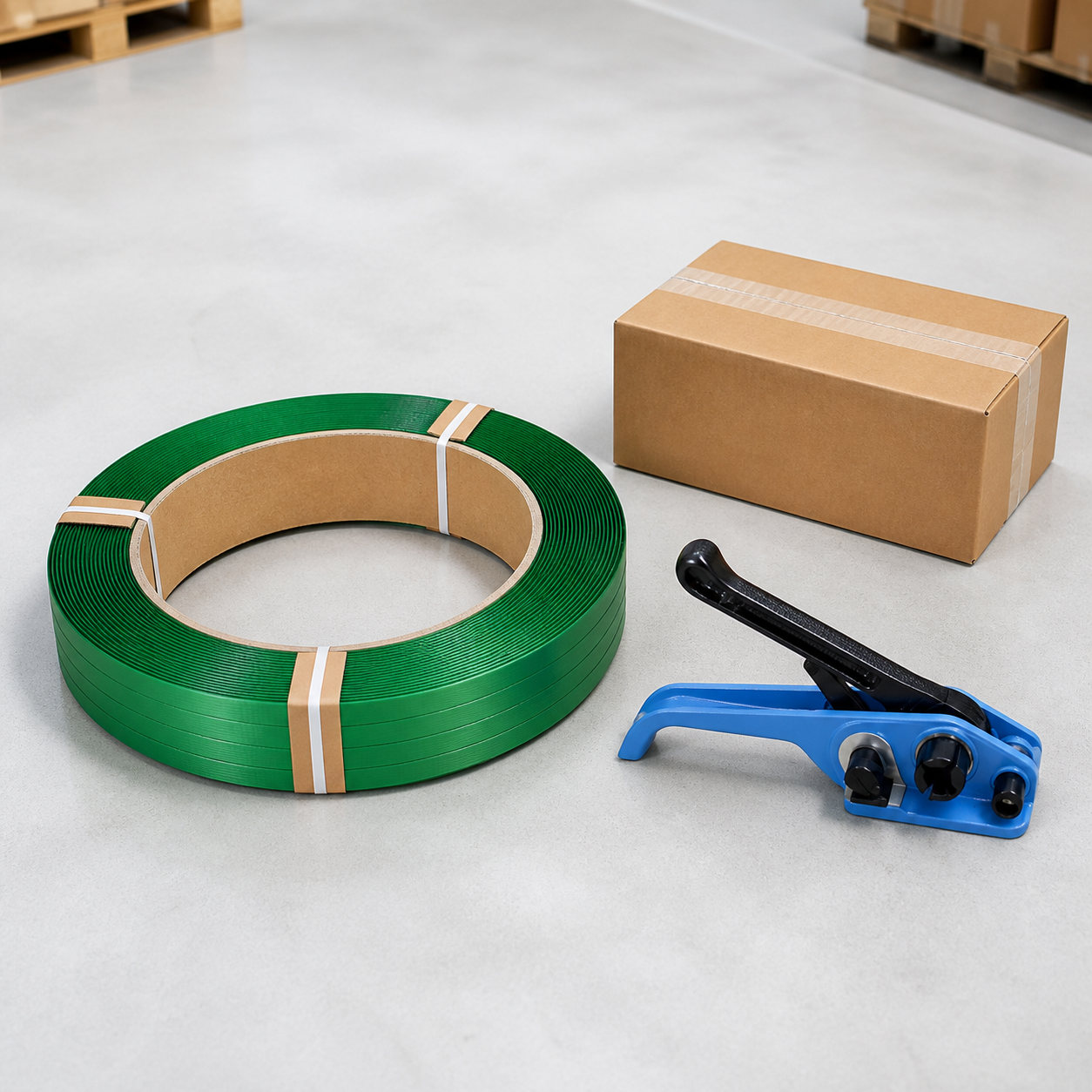
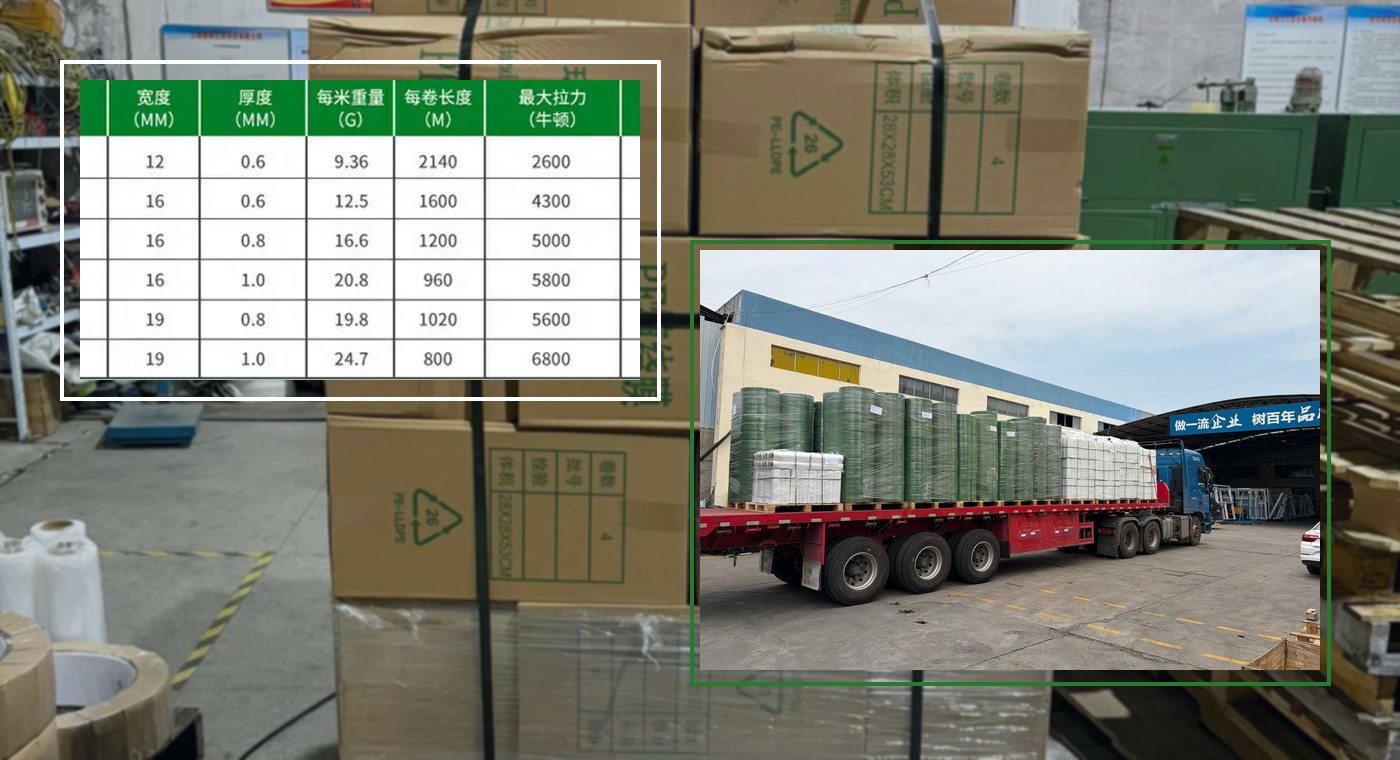
Our PET strapping range covers six published models from 12 mm to 19 mm nominal width. Each row below is product data you can screen against your tool and your coil change interval before you talk to anyone, and the full range sits on our PET strapping hub. Seals and buckles are the joining methods ASTM D3950 covers alongside the strap itself, which is why they are quoted with the row rather than after it.
12
16
19
Stretch film and closures alongside the strap
Film and closures are quoted against the same unit-load data as the strap row itself, so they are never sized independently. That is what stops a qualified strap arriving with a seal that gives away a third of it.
seals and bucklesAnother size or a recycled-content grade
Send the width, thickness and coil format your line runs and we will confirm availability against the published range in the quotation. Recycled-content grades are handled on a separate page.
Strap Width, Thickness, Linear Mass and Published Tensile Force
A 1998 US patent held by Samuel Manu-Tech, US 5,772,944, sets out the clearest illustration of why bare tensile force is the wrong number to shop on. In its comparison table, a high-strength PET strap of 145 KSI with no surface treatment reached a break load of 2175 lbs but held only 32 % of that at the joint, or 700 lbs, while a lower-rated 130 KSI surface-treated strap held 85 %, or 1660 lbs. That weaker strap carried well over twice the usable load.
| Model | Nominal size | Linear mass | Coil length | Published tensile force | Net coil weight |
|---|---|---|---|---|---|
| 1206 | 12 × 0.6 mm (0.47 × 0.024 in) | 9.36 g/m | 2140 m (7021 ft) | 2600 N (585 lbf) | 20 kg (44 lb) |
| 1606 | 16 × 0.6 mm (0.63 × 0.024 in) | 12.48 g/m | 1600 m (5249 ft) | 3900 N (877 lbf) | 20 kg (44 lb) |
| 1608 | 16 × 0.8 mm (0.63 × 0.031 in) | 16.64 g/m | 1200 m (3937 ft) | 4600 N (1034 lbf) | 20 kg (44 lb) |
| 1610 | 16 × 1.0 mm (0.63 × 0.039 in) | 20.8 g/m | 960 m (3150 ft) | 5600 N (1259 lbf) | 20 kg (44 lb) |
| 1908 | 19 × 0.8 mm (0.75 × 0.031 in) | 19.76 g/m | 1010 m (3314 ft) | 5800 N (1304 lbf) | 20 kg (44 lb) |
| 1910 | 19 × 1.0 mm (0.75 × 0.039 in) | 24.7 g/m | 800 m (2625 ft) | 6800 N (1529 lbf) | 20 kg (44 lb) |
What This Table Does Not Carry
ASTM D3950 evaluates nonmetallic strapping on breaking strength, elongation, transverse strength and connection strength. Our table above carries one of those four.
Transverse strength
resistance to splitting along the strap, which governs behaviour over a sharp corner
Joint strength
the percentage that survives the closure route, set out in the section above
Elongation
under applied tension — how much the strap gives while the tool is pulling
Retained tension
after settlement — what is still holding the pack after the load has compressed and travelled
Those four are answered by a controlled trial on your own pack, not by a specification sheet. That is why the sequence further down this page ends in a trial rather than in a recommendation.
Request a Specification Review
Methodology Overview
Quote Inputs and
Quote Inputs and
What Moves the Price
Price follows nominal size, coil format, order volume, colour, surface, printing, machine compatibility, packing method, destination and delivery schedule. There is no published price per kilogram for industrial strapping because none of those variables is fixed across buyers.
Why the Figures Arrive in a Quotation
A quotation is also not a contract on its own. Under US federal acquisition rules a quotation is not an offer and cannot itself form a binding agreement; the subsequent order carries the terms. We follow the same discipline: figures reach you in a written quotation, and values published by unrelated suppliers are never adopted as ours.

What Moves Your Price
Specification mix
Effect on costSix rows carry six different linear masses, from 9.36 to 24.7 g/m. Material cost per metre moves with mass, not with the model number.
How to reduce it
Qualify the lowest row that clears your joint and pack, rather than defaulting to the top of the range.
Coil format
Effect on costCoil length runs from 800 to 2140 m while net coil weight stays 20 kg. Shorter coils mean more changes per shift.
How to reduce it
Count changeovers per shift before comparing coil prices.
Material & Logistics
Variables impacting final delivered cost
Joint route
Effect on costA closure route that loses more of the strap strength pushes you into a heavier row for the same load.
How to reduce it
Qualify the joint first; the strap row often drops afterwards.
Release quantity and destination
Effect on costPacking method, documentation and the trade term all sit inside the delivered cost.
How to reduce it
State release size, destination and required documents up front so they are priced once.
Inputs That Make the Quotation Right the First Time
US federal ordering rules list the information an order has to fix: item description, quantity, unit and total price, delivery time, delivery point, inspection points, packaging requirements and discount terms among others. Our quotation input list is built on the same categories.
01
Product inputs — nominal width and thickness, coil length or core format, colour, surface, printing, estimated annual usage
02
Process inputs — tensioner, sealer, tool or strapping machine model, joint route, line speed, coil-change constraints
03
Load inputs — product and pack form, unit-load dimensions and gross weight, pallet or base, edge condition, current strap and the failure you are seeing
04
Delivery inputs — quantity per release, destination, packing expectations, required documents and the trade term you want quoted
Incoterms 2020 sets out eleven trade terms that allocate cost, risk and obligation between buyer and seller, so naming the term you want quoted changes the number you get back. Price, minimum order quantity, production timing, payment arrangement and trade terms are all confirmed in the quotation.
Test Standards and the Scope of Each Report
Two kinds of evidence travel with industrial strapping, and buyers routinely confuse them. A laboratory test report says what a submitted specimen did under stated conditions; a product certification says a scheme has assessed a product line against specified requirements.
How Every Order Is Checked
- Incoming specification review against the purchase record: model, nominal width and thickness, linear mass, coil length, net weight, surface, colour and core
- In-process checks on the automated PET strapping production lines at the Jiangyin base
- Finished-product inspection before packing, with the tested properties checked against the applicable standard
- Change control: the approved row, tool setting and joint route stay together, and the pack is rechecked whenever strap, tool, pallet, protector, film or pattern changes
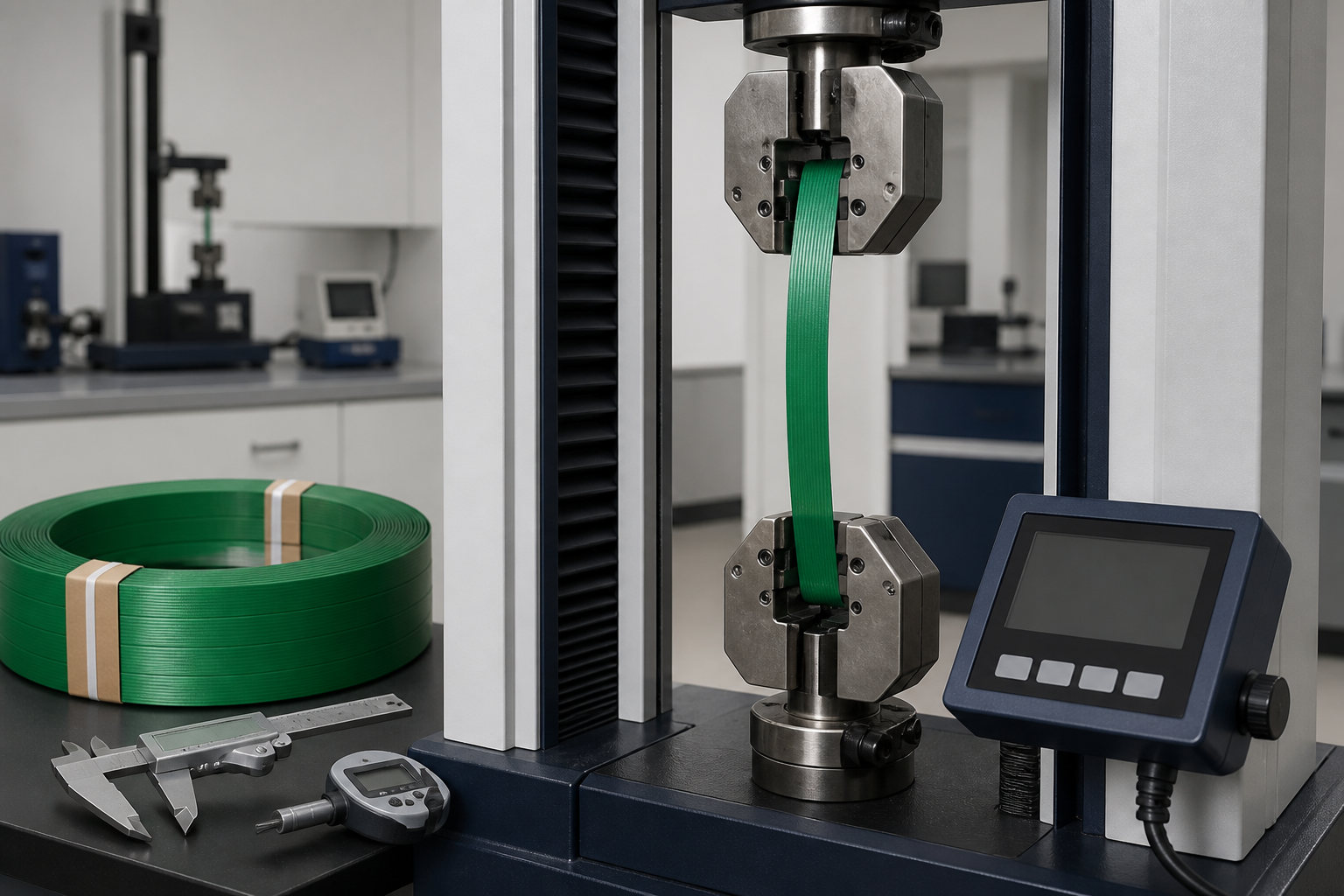
Standards We Test To
- QB/T 4010-2010 — dimensional and tensile requirements for the product class
- GB/T 1040.1-2018 and GB/T 1040.3-2006 — tensile properties of plastics, general principles and film and sheet conditions. GB/T 1040.1 has since been reissued, so the edition that applies to your order is confirmed in writing rather than assumed
Separately, ASTM D3950 is the reference frame this page uses when it talks about nonmetallic strapping and its joining methods. It is a published specification we cite, not a test we run.
The Substance-Declaration Ask
For most industries the enquiry stops at dimensional and mechanical data. A second group asks for something else entirely, because their own finished product is regulated and the requirement travels down the supply chain to incoming materials including packaging.
- Mechanical evidence is the gate — logistics and warehousing, construction and building materials, timber, papermaking, agriculture
- A substance declaration is also asked for — electronics, solar photovoltaics, and parts of the food and tobacco supply chains
The Substance-Declaration Ask is a purchase-order requirement rather than a rule that governs the strap itself. The EU RoHS Directive applies to electrical and electronic equipment, so a substance result on a strap specimen is material-level test data for the buyer’s file, not evidence that a strap is a regulated product.
SGS Report
Restricted by EU Directive 2011/65/EU
What the substance report covers
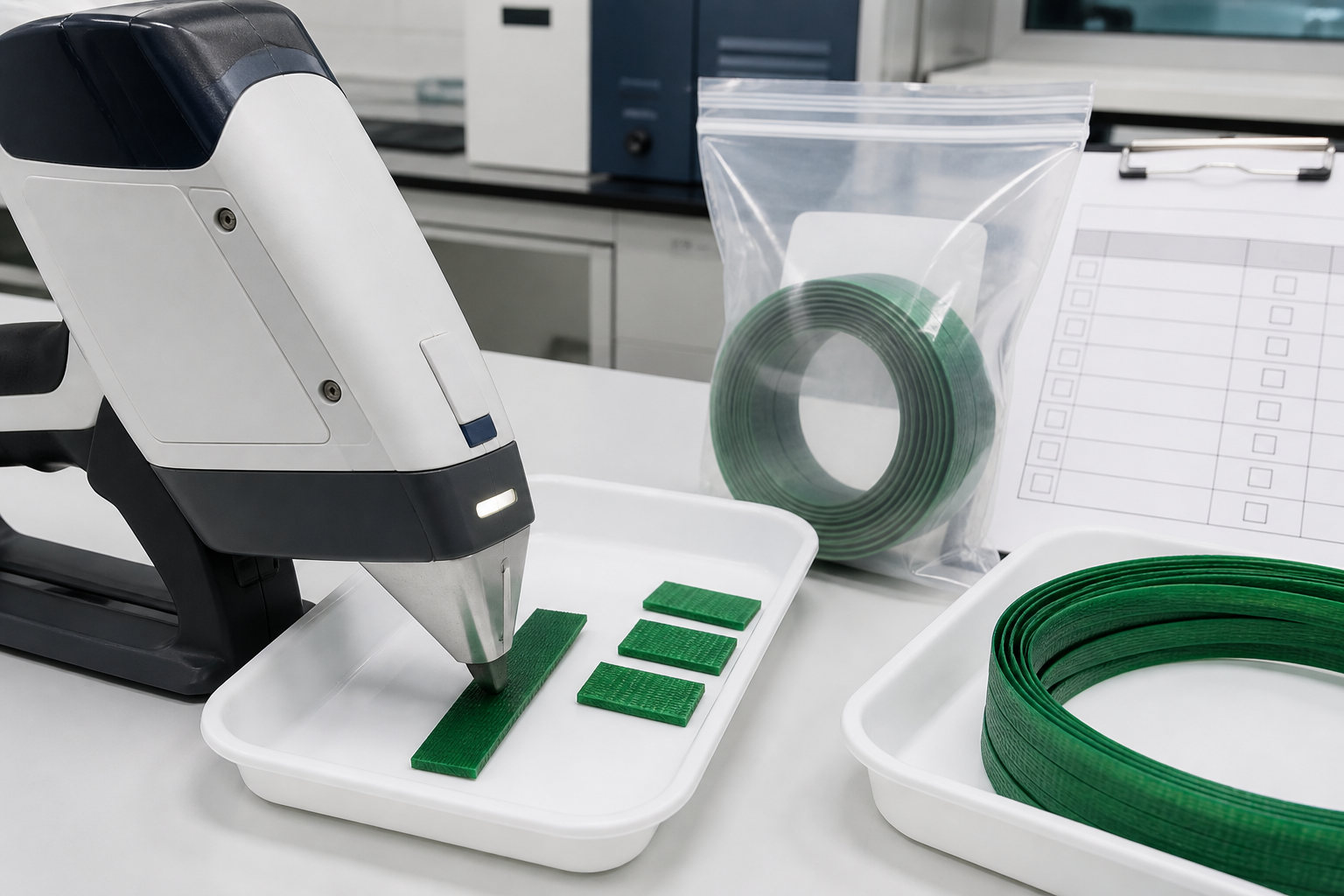
A 2026 SGS Shanghai test on a submitted green PET strap specimen returned non-detect for all ten substances restricted by EU Directive 2011/65/EU as amended by (EU) 2015/863 — lead, mercury, cadmium, hexavalent chromium, PBB, PBDE, DEHP, BBP, DBP and DIBP. That result covers the identified submitted specimen and is reported by number on request.
Where a Test Report Stops
ISO/IEC 17025 sets out the competence, impartiality and consistent operation required of a testing laboratory, and naming it describes what a laboratory has to be rather than claiming any particular report was issued under accreditation. ISO/IEC 17065 covers bodies that certify products, and product certification needs a scheme with specified requirements, sampling criteria, evaluation, review, a certification decision and documentation.
SGS tensile test evidence and a listed-substance screening report are available for the identified tested green PET strap specimens.
SGS testing of the identified cut specimen measured 16.022 × 1.058 mm and returned 4860 N tensile force with 21 % elongation at break.
Laboratory conditions were 23 ± 2 °C and 50 ± 5 % relative humidity, at a 100 mm gauge length and 100 mm/min test speed.
That figure belongs to the specimen described in the report and is not a release value for the published range.
Packaging Regulation in the EU Market
Regulation (EU) 2025/40 on packaging and packaging waste entered into force on 11 February 2025 and applies generally from 12 August 2026. It covers all packaging and packaging waste regardless of material or origin, and the obligations fall on the economic operators placing packaging on the EU market.
Straps named in EU delegated law
Commission Delegated Decision (EU) 2026/429 of 25 February 2026 is worth reading if you ship into the EU.
- Its first recital states that pallet wrappings and straps are transport packaging formats covered by the re-use targets in Article 29(1), (2) and (3).
- That same recital records an overall 40 % re-use target under Article 29(1).
- Its operative article exempts economic operators using pallet wrappings or straps for stabilisation and protection of products put on pallets from the 100 % re-use requirements in Article 29(2) and (3) only.
Industries We Supply
The Industry Load-Signature Register below is how we route an enquiry. Each industry has a load signature — the physical behaviour that decides the strapping answer — and the signature, not the sector name, is what changes the specification.
01
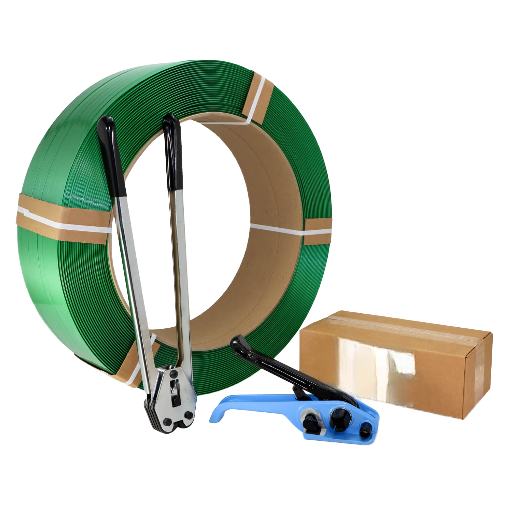
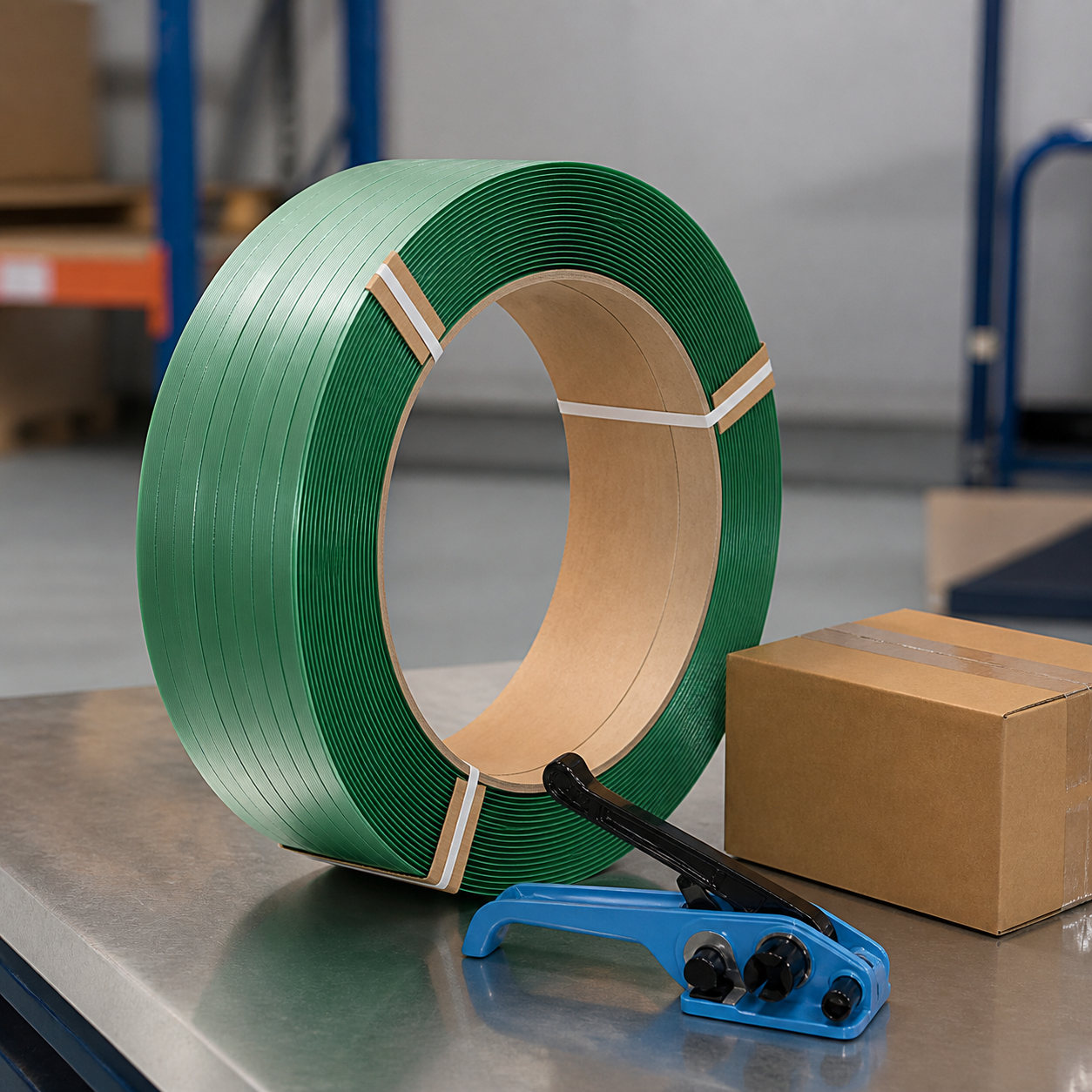
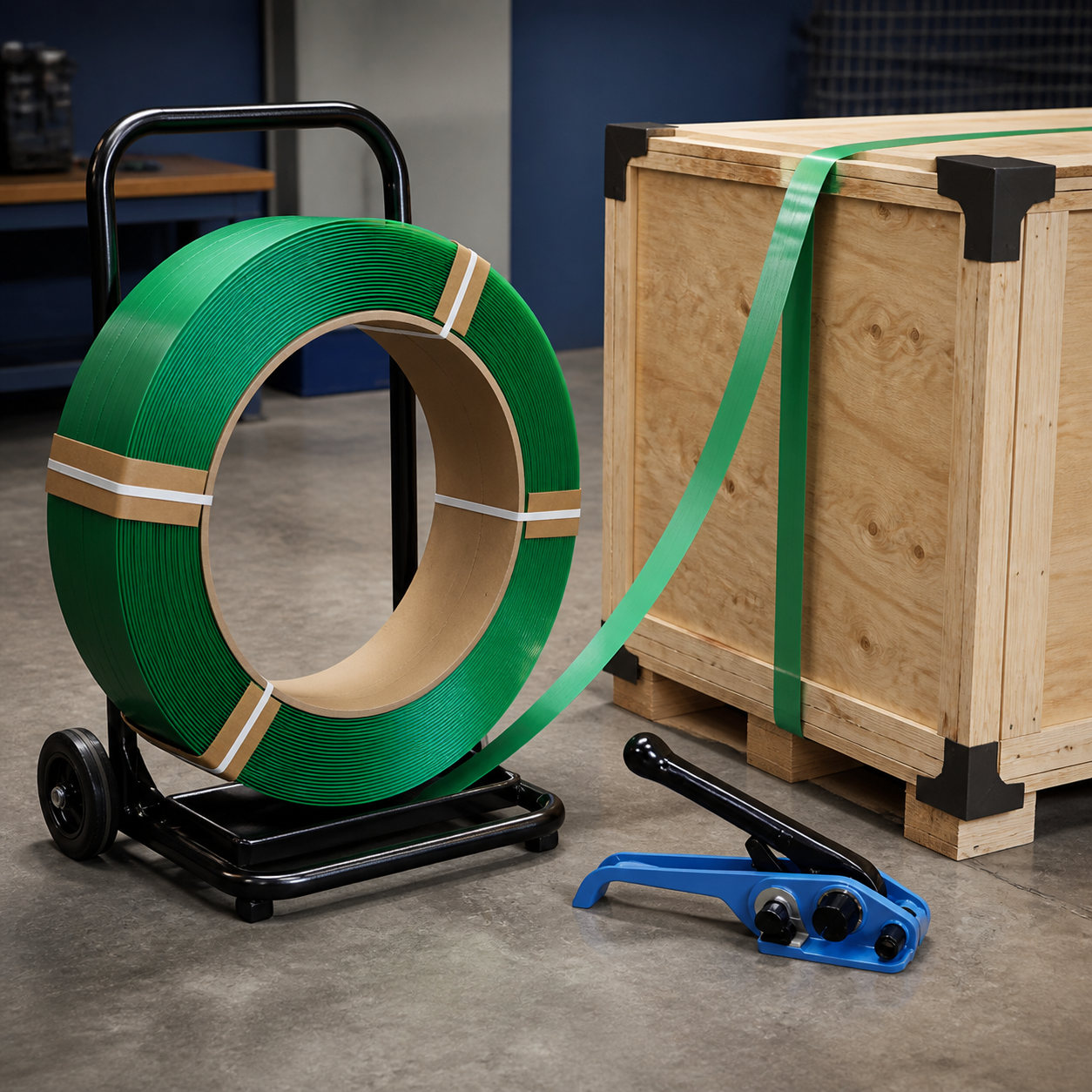
Published coil formats, 20 kg net across the range.
02
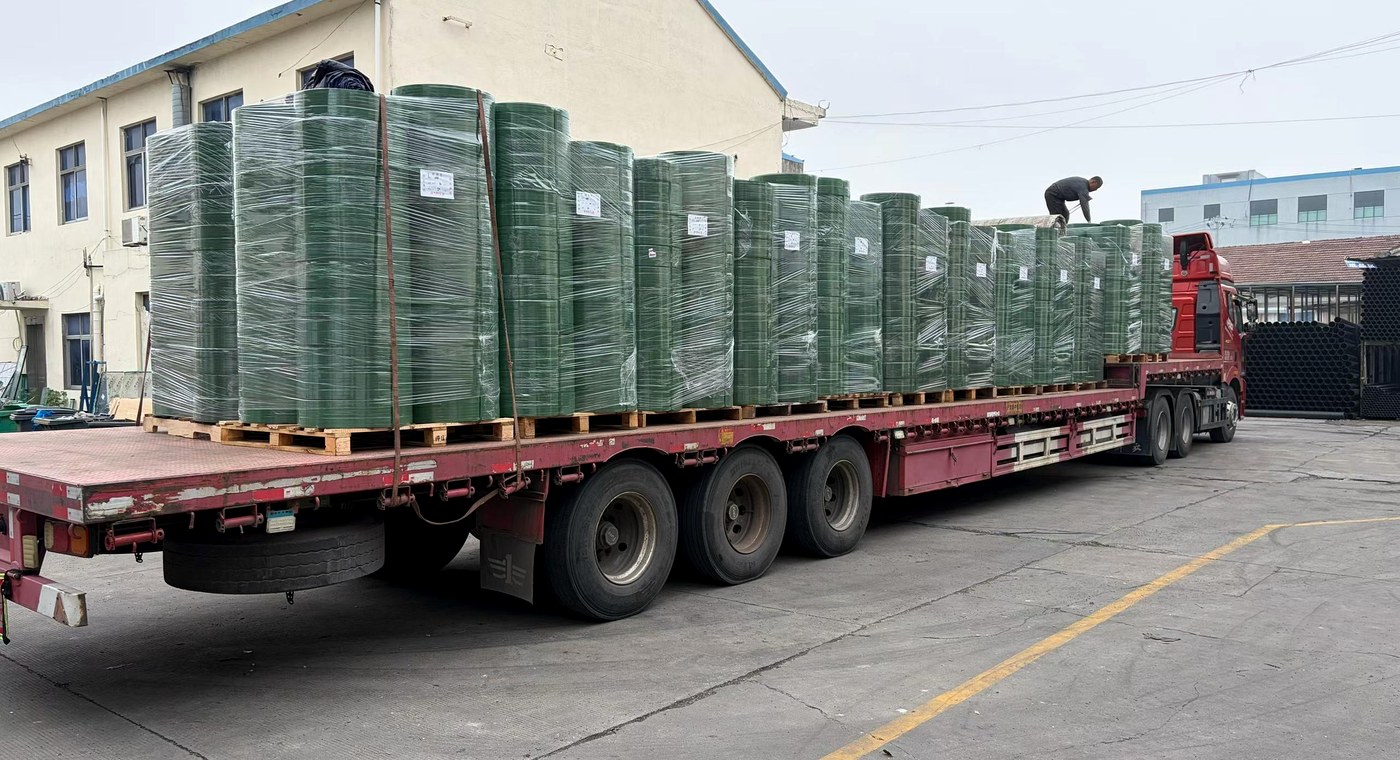
Wrapped coils prepared in a truck for shipment.
03
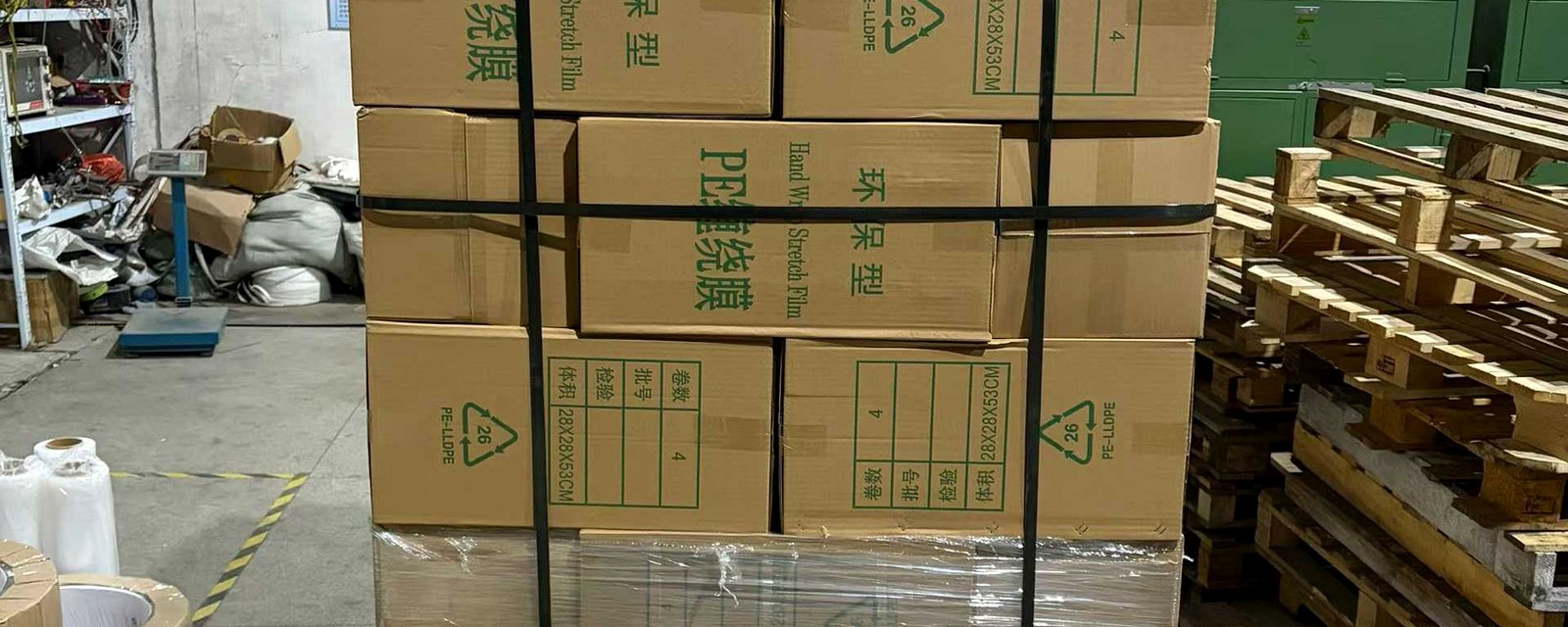
Building-material pallet secured with PET strapping.
Load Signature
Logistics and warehousing
Best for mixed cased and palletised loads that see repeated forklift handling. Signature: settlement after packing, fork contact at the strap line, and a strap path that must not run with the deck boards.
Explore Logistics Solutions
Load Signature
Construction and building materials
Best for brick, block, paver and panel packs off the kiln or press line. Signature: abrasive hard corners, gaps in the stack, and outdoor staging before despatch.
Explore Construction SolutionsSpecialized Sector Signatures

01
New energy & solar photovoltaics
Load Signature
Best for cartoned module stacks on pallets moving through multi-leg export routes. Signature: fragile glass faces, top-load pressure in stacking, and a buyer who will often ask for a substance declaration with the goods. Solar panel packaging is a stack of decisions — pallet, corner protection, carton, film and strap — and the strap is only the last of them.

02
Timber and wood products
Load Signature
Best for dimensional timber, plywood, particleboard and MDF panel stacks. Signature: moisture movement that changes bundle dimension in storage, so retained tension after conditioning matters more than the first tension reading. Lumber strapping and plywood strapping questions are best answered from a bundle measured after conditioning, not before.
03
Papermaking
Load Signature
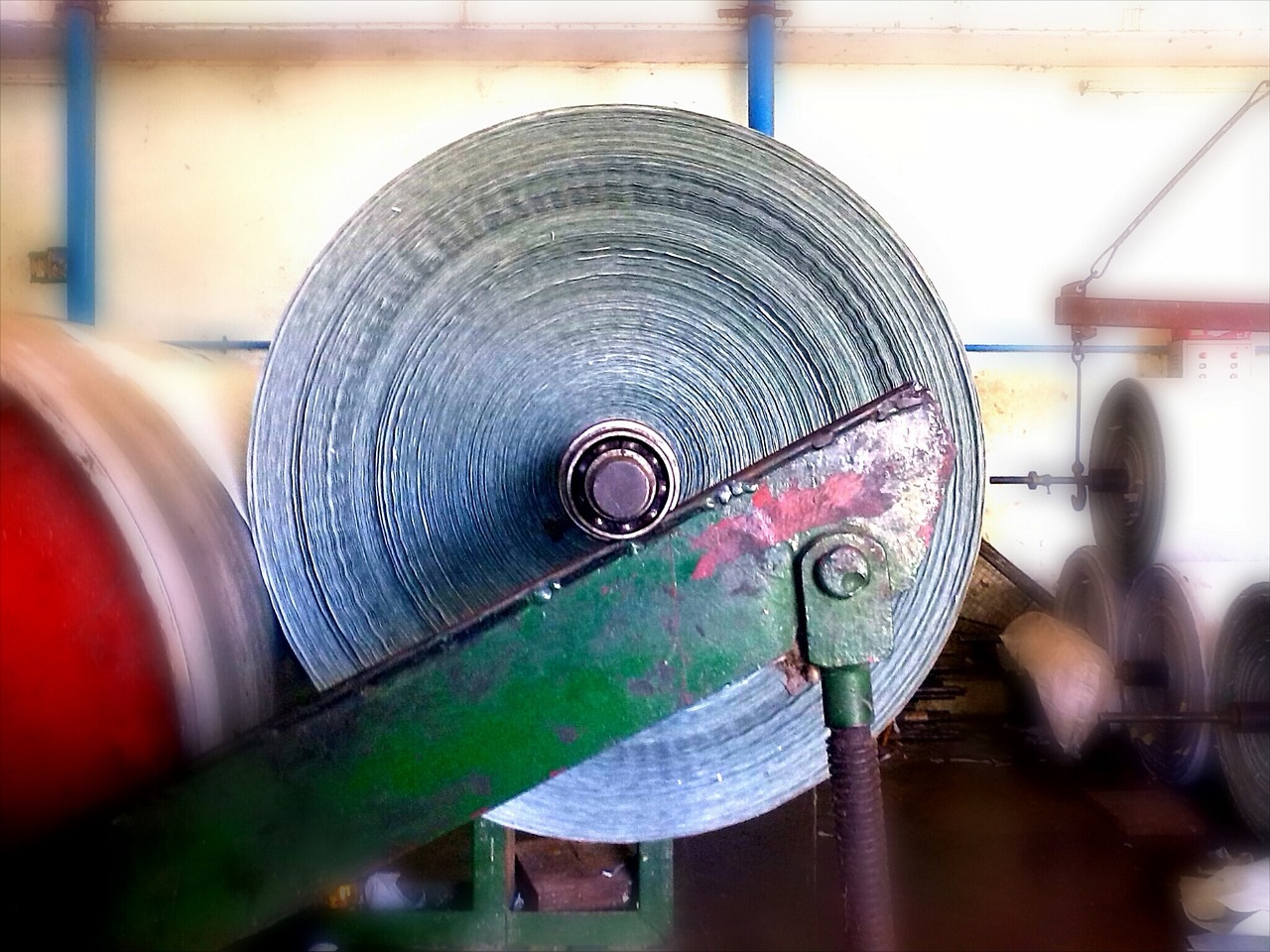
Best for reels, board bundles and baled recovered fibre. Signature: compressible surfaces that mark easily, and a strap face wide enough to spread contact pressure.

04
Chemical fibres & cotton textiles
Load Signature
Best for pressed fibre and cotton bales leaving a baling press. Signature: stored elastic energy in the bale, continuous creep against the strap, and a joint that has to hold while the bale pushes back.

05
Food
Load Signature
Best for cased and trayed food loads consolidated onto pallets. Signature: cold-chain temperature swings, hygiene rules on what may touch the pack, and buyers who ask for documentation with the delivery.

06
Electronics
Load Signature
Best for cartoned electronics palletised for export. Signature: low tolerance for pack deformation, and a supply chain that routinely pushes a substance declaration down to packaging materials. This is the industry where The Substance-Declaration Ask tends to arrive inside the purchase order rather than in the technical enquiry.

07
Tobacco
Load Signature
Best for cased and baled tobacco moving under close documentary control. Signature: consistent pack geometry, tight traceability expectations, and long storage before shipment.
Your industry is not listed
The register routes on load signature rather than on sector name, so an unlisted industry is not a gap. Send the load data and we will place it against the published rows.
Two of the eleven industries above already have a dedicated page with its own worksheets. The nine remaining industries are handled through the register and a specification review, which is the same route the two dedicated pages started from.
Request a Specification Review
Industry Load-Signature Selector
Pick your industry to see its load signature, the questions we will ask, and which of the six published rows sit inside the envelope for that load family. Nothing is submitted anywhere.
Engineering & Specification Tools
Leverage our precision calculators and selectors to streamline your packaging requirements and ensure load security.
01
Envelope Fit Check
Enter the nominal width and thickness your line needs. This screens the requirement against UD Packaging’s six published PET strap rows and tells you whether it sits inside the published envelope or has to go to specification review.
Access Tool02
Joint Efficiency Calculator
Published tensile force describes the strap. What reaches your load is set by the joint. Enter a published force and pick one of the four measured joints below to see what survives at that joint.
Access Tool03
Industry Load-Signature Selector
Pick your industry to see its load signature, the questions we will ask, and which of the six published PET strap rows clear a minimum force you set. The signature, not the sector name, is what changes the specification.
Access Tool
01
FAQ: Strapping Specification, Testing and Supply
Find comprehensive technical answers regarding industrial strapping families, specifications, load capabilities, and our engineering testing procedures.
Engineering Support
Load dimension changes or special environments? Our engineers can screen the specs against your exact parameters.
Four families cover most industrial work: polyester, polypropylene strapping, steel strapping and composite or corded strapping. Polyester and polypropylene are the two plastic strapping families, and they behave differently under sustained load. A steel strap holds high bare force but does not recover tension once a load settles.
Poly strapping is a loose trade term that can mean either polypropylene or polyester, which is why two quotes for the same word can arrive at very different prices. Polypropylene suits light to medium cased work with short transit. Polyester holds tension over longer periods and is the family we manufacture.
The same product appears as strapping band, strapping tape, banding, a pallet banding strap, a polyester strapping roll and plastic steel belt depending on the market. These are naming variants, not interchangeable specifications, and heavy duty plastic strapping is a use description rather than a grade. Order against a polymer, a nominal width, a nominal thickness and a joint route so the six published rows can be matched.
Across our published range, tensile force runs from 2600 N on the 12 × 0.6 mm row to 6800 N on the 19 × 1.0 mm row. Those are published material figures for the strap. The load your pack actually sees depends on the closure route, applied tension, edge condition and how far the pack settles.
Width is chosen for contact pressure and tool fit before it is chosen for force. A 19 mm face spreads pressure across a compressible pack, while a 12 or 16 mm face threads more easily through a tight guide path. For metal work the corner radius and edge protection usually decide the answer before width does.
Timber bundles are usually specified in the 16 to 19 mm part of the range because bundle dimension changes with moisture and the strap has to keep working after conditioning. Panel stacks of plywood, particleboard and MDF are flatter and more predictable, so a 16 mm row often clears them. Send the bundle geometry and the storage environment and we will screen the rows against both.
Strap count is an output of the trial, not an input to the quotation. It follows from pack length, where the load wants to move, the joint route and the handling the pack will see. We fix it in the trial build and record it with the approved specification, and our pallet strapping procedure covers how the count is applied on the floor.
Hand application depends on the operator holding a consistent tension and forming a repeatable closure, and both vary between people and across a shift. A powered tool applies tension under control and forms the joint under a fixed cycle. If a strap performs on one shift and fails on another, the closure is usually the first thing to check, not the coil.
A laboratory report covers the specimen described in it, tested under the conditions stated in it. SGS tensile testing of the submitted specimen measured a cut specimen of 16.022 × 1.058 mm and returned 4860 N with 21 % elongation at break. It is evidence about that specimen and is not a release value for the whole published range.
No, and The Substance-Declaration Ask is answered per specimen for exactly that reason. The 2026 SGS Shanghai result covers one submitted green PET strap specimen and returned non-detect for the ten substances restricted under EU Directive 2011/65/EU as amended by (EU) 2015/863, which makes it material-level evidence for a buyer’s file. ISO/IEC 17025 governs laboratory testing, while product certification sits under ISO/IEC 17065 and requires a certification scheme.
Four groups: product inputs such as nominal width, thickness and coil format; process inputs such as the tool or machine model and joint route; load inputs such as dimensions, gross weight, base and edge condition; and delivery inputs such as release quantity, destination, documents and the trade term you want quoted. Incoterms 2020 sets out eleven trade terms and each allocates cost and risk differently. Price, minimum order quantity, production timing and payment arrangement are confirmed in the quotation.
Dedicated pages with their own worksheets exist for logistics and warehousing and for construction and building materials. The other nine industries listed above are routed through The Industry Load-Signature Register and a specification review. The evidence base is the same in both cases: the six published rows, the applicable standards and a trial on your own pack.
Yes. We supply PET strapping, industrial stretch film, strapping seals and buckles, and manual, semi-automatic and fully automatic strapping machines. Quoting them together is what lets the strap row, the joint route and the tool be specified against one set of load data rather than three.