Get in touch with UD Packaging Company

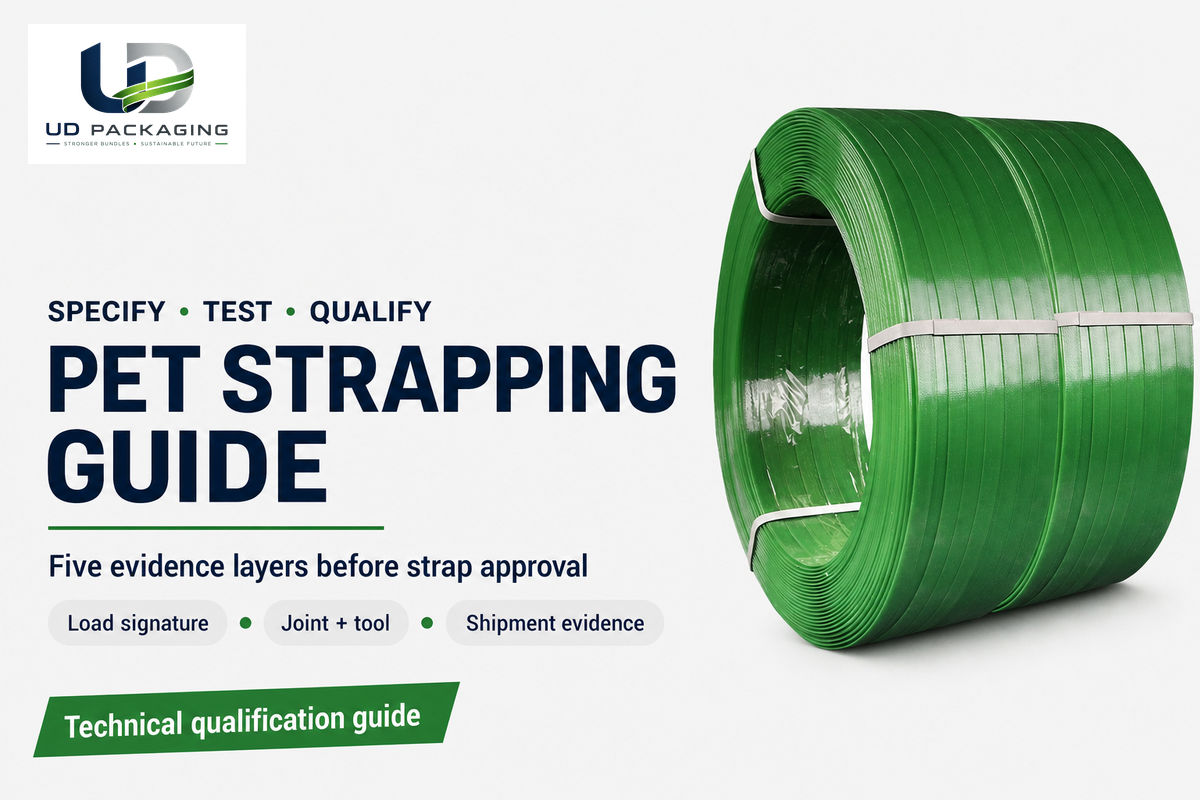
PET Strapping is often sold through a width, thickness, and break-strength figure. That’s enough to identify a roll, but it isn’t enough to approve a packaging system. Any joint, tool, load, edge, storage period, or distribution route can become the limiting part.
This guide gives plant, quality, logistics, and procurement teams a shared method for reviewing extruded polyester strap. It doesn’t replace a carrier rule, dangerous-goods packaging instruction, or a test plan prepared for the actual shipment.
Direct answer
Approve PET strapping through five evidence layers: product identity, material and batch data, joint and tool trials, package screening, and route-specific shipment testing. Results from one layer don’t automatically prove the next.
Key takeaways
- Extruded PET strap isn’t woven polyester cord, lifting gear, or automatically a vehicle cargo tiedown.
- Break force, joint performance, retained tension, and shipment stability are different measurements.
- Current standard numbers describe a method or specification scope; they aren’t supplier certificates.
- Recycled-content evidence and finished-system performance need separate approval records.
- Any material, tool, package, route, or supplier change needs a defined requalification decision.
PET Strapping: Define the Product Family First
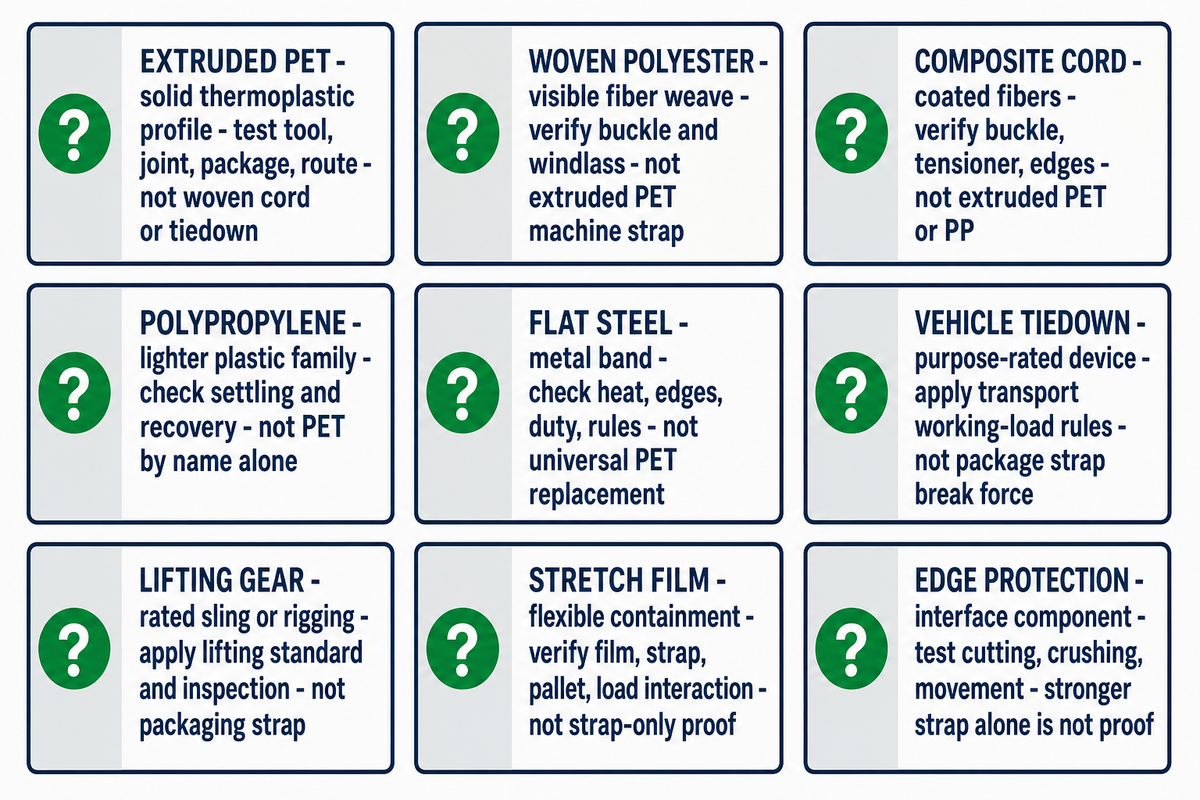
Extruded PET strapping is a thermoplastic polyester band used to close, bundle, palletize, or unitize goods. The ASTM D10.25 strapping standards list helps separate material specifications and selection guidance; woven polyester, composite cord, polypropylene strapping, flat steel strapping, lifting slings, and vehicle tiedowns still have different constructions, joining routes, and governing requirements.
Calling several products “polyester” causes avoidable specification errors. Extruded strap is made as a continuous plastic profile and is commonly joined by friction welding, heat sealing, or a compatible mechanical route. Woven strap is built from polyester fibers and usually works with a buckle and a different tensioning path. Machines or tensioners intended for one family may not accept the other.
Search behavior shows the same split. “PET strapping kit,” “where to buy PET strapping,” and “best PET strapping” signal commercial research, while “PP strapping” names another material route. This guide answers evidence and qualification questions, then sends product and quotation intent to the existing solution pages.
| Strapping type / product family | Construction clue | Approval question | Not interchangeable with |
|---|---|---|---|
| Extruded PET strap | Solid thermoplastic profile | Which tool, joint, package, and route were tested? | Woven cord or rated tiedown |
| Woven polyester | Visible fiber weave | Which buckle and windlass route apply? | Extruded PET machine strap |
| Composite cord | Fibers with polymer coating | Which buckle, tensioner, and edge rules apply? | Extruded PET or PP |
| Polypropylene strap | Lighter plastic strap family | How does the load settle and recover? | PET by name alone |
| Flat steel strap | Metal band and steel-specific joint | Do heat, edges, duty, or rules require steel? | Universal PET replacement |
| Vehicle tiedown | Purpose-rated securement device | Which transport rule and working-load system govern? | Package strap break force |
| Lifting gear | Rated sling or rigging assembly | Which lifting standard and inspection apply? | Any packaging strap |
| Stretch film | Flexible film containment | How do film, strap, pallet, and load interact? | Strap-only proof |
| Edge protection | Interface component | Will it resist cutting, crushing, and movement? | Stronger strap alone |
What is PET strapping used for?
PET strapping is used to close, reinforce, bundle, palletize, or unitize industrial goods when the approved package system benefits from a flexible plastic strap. Candidate loads include bundled lumber, paper products, building materials, metal products, and palletized goods. Suitability still depends on edges, heat, settling, handling, joint method, and the distribution route.
How is PET strapping made?
At category level, PET resin or qualified recyclate is dried and processed into an extruded profile, oriented to develop useful mechanical behavior, finished to the intended surface, and wound onto a specified core. Exact drying, filtration, draw, heat-setting, embossing, and winding conditions belong to the producer’s process window. They can’t be inferred from the material name.
What is the difference between strapping and banding?
Industrial packaging teams often use “strapping” and “banding” for the same restraint task. That terminology doesn’t prove a material, construction, strength, or approval route. Requests should still name PET, PP, woven polyester, composite cord, or steel; the dimensions; the joint; the tool; and the package conditions.
Start With the Load, Not a Catalog Number
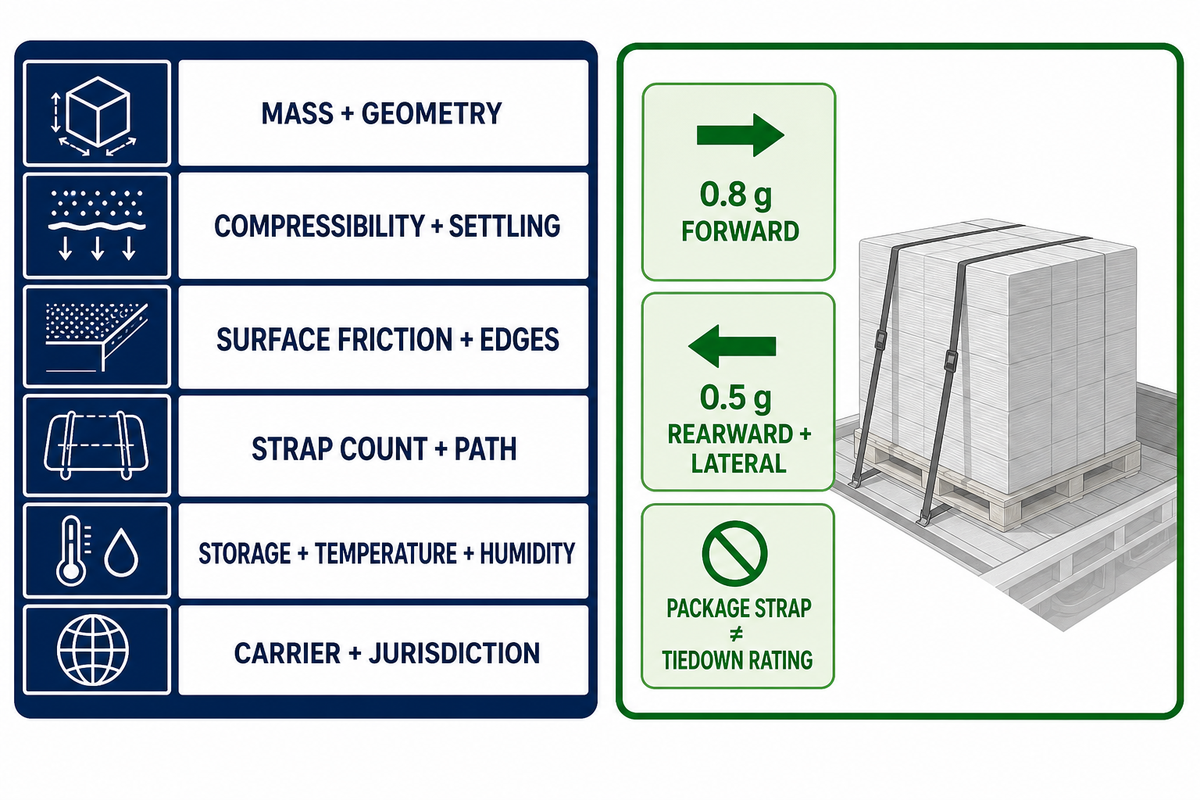
Load signatures describe what the strap must control: mass, geometry, compressibility, settling, center of gravity, surface friction, edges, strap path, handling, storage, and transport. One nominal PET strap can face very different demands on a rigid brick bundle and a settling paper load.
Begin with the package rather than a “strong enough” roll. Record load dimensions and mass, then show how the load can move. Add the strap count and path, edge-protection locations, pallet condition, forklift contacts, storage dwell, temperature and humidity, ultraviolet exposure duration, and the carrier or jurisdiction that will govern the shipment.
Illustrative input record: a buyer might document a 1,000 kg pallet measuring 1,200 × 1,000 × 1,500 mm, four strap paths, a 24 h warehouse dwell at 23 °C and 50% RH, followed by a 48 h route with an expected 0–35 °C range. These are sample fields, not PET strap limits; replace every value with the actual shipment data.
For applicable U.S. interstate commercial motor vehicles, the Federal Motor Carrier Safety Administration describes a cargo-securement system that must resist 0.8 g forward deceleration and 0.5 g rearward and lateral acceleration, considered separately. Those figures define vehicle securement duties; they don’t convert a PET package-strap break value into a tiedown rating.
UD Packaging’s application library can help teams describe their industrial strapping applications. Buyers still own the final route, carrier, and regulatory assessment.
Decision point
If the team can’t describe the load movement and route, it’s too early to choose a break-force value.
Read a PET Strap Specification as a System
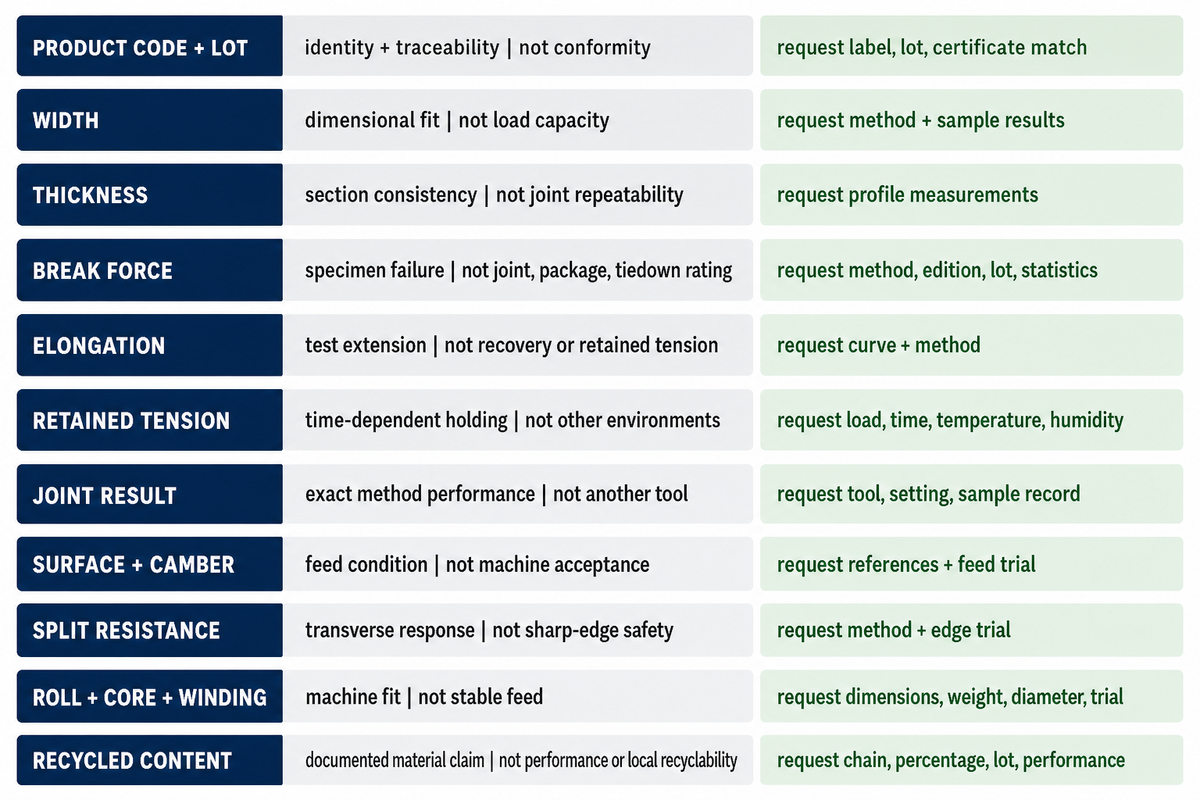
Useful PET strap specifications link each property to a method, tolerance, sample identity, and application decision. Width and thickness identify geometry; break force and elongation describe specimen behavior; joint data belongs to the exact joining route; retained-tension evidence needs a stated dwell and environment.
| Specification field | What it can establish | What it cannot establish alone | Buyer evidence | Limitations / not suitable for |
|---|---|---|---|---|
| Product code and lot | Identity and traceability | Conformity | Label, lot, certificate match | Unidentified samples |
| Width and tolerance | Dimensional fit | Load capacity | Method and sample results | Wrong guides or head |
| Thickness and tolerance | Section consistency | Joint repeatability | Profile measurements | Unverified setting range |
| Break force | Specimen failure result | Joint, package, or tiedown rating | Method, edition, lot, statistics | Single-value approval |
| Elongation | Extension under test conditions | Recovery or retained tension | Curve and method | Unstated temperature/dwell |
| Retained tension | Time-dependent holding behavior | Other environments or loads | Load, time, temperature, humidity | Point-in-time data |
| Joint result | Exact method performance | Another tool or setting | Tool/head, setting, sample record | Generic efficiency percentage |
| Surface and camber | Feed/interface condition | Machine acceptance | Reference samples and feed trial | Visual-only release |
| Split resistance | Transverse damage response | Sharp-edge safety | Method and edge trial | No edge protection |
| Roll, core, winding | Dispenser/machine fit | Stable feed | Dimensions, weight, outside diameter, trial | Unmatched dispenser |
| Recycled content | Material claim when documented | Finished performance or local recyclability | Chain, percentage, lot, performance | Universal circularity claim |
Illustrative test record: identify ten samples; record width in mm, thickness in mm, specimen break force in kN, elongation in %, joint force in kN, applied tension in N, and retained tension in N after 1 h and 24 h at 23 °C and 50% RH. Each purchase contract must set its own acceptance values and method editions.
One 2024 peer-reviewed paper demonstrates primary and secondary creep and stress-relaxation mechanisms in polyester strap reinforcement, with load, product, temperature, and humidity dependencies. Its application is geotechnical, not packaging. Use it only as a warning that an initial result isn’t long-duration evidence; don’t transfer its values into a pallet specification.
The 5-Layer PET Strap Proof Stack
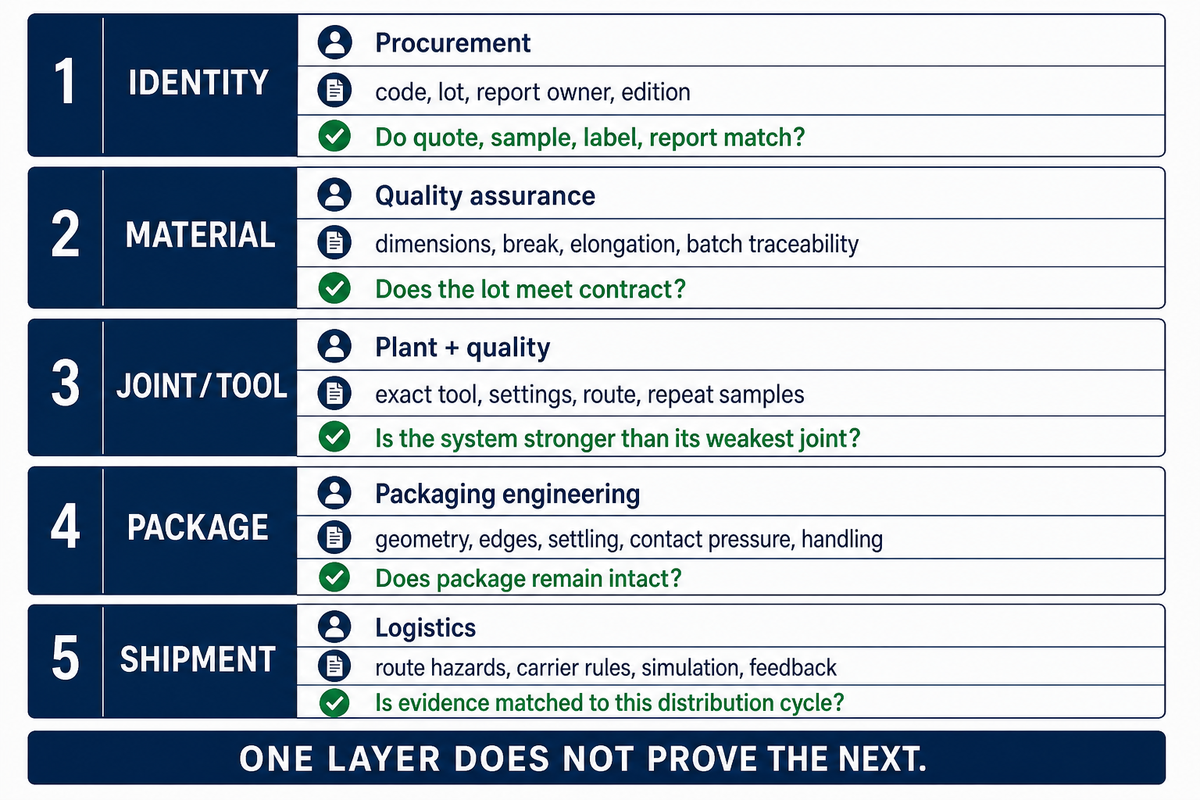
This 5-Layer PET Strap Proof Stack moves an exact product from document identity to shipment evidence. Procurement can’t skip straight from a data sheet to approval; quality, plant, and logistics each own a different failure boundary.
| Layer | Owner | Evidence | Release question |
|---|---|---|---|
| 1 — Identity | Procurement | Product code, lot, report owner, current edition | Do the quote, sample, label, and report describe the same item? |
| 2 — Material | Quality assurance | Dimensions, break, elongation, batch traceability | Does the lot meet the written material contract? |
| 3 — Joint/tool | Plant and quality | Exact tool/head, settings, joint route, repeat samples | Is the usable system stronger than its weakest joint? |
| 4 — Package | Packaging engineering | Geometry, edges, settling, contact pressure, handling | Does the strapped package remain intact during screening? |
| 5 — Shipment | Logistics | Route hazards, carrier rules, simulation, field feedback | Is the evidence matched to this distribution cycle? |
A flat-strapping guide is a starting point for evaluation, while a shipment test must be selected for the outcome and route being studied. Neither one turns a material value into complete system approval.
ISTA describes 1-Series tests as screening tools rather than simulations of environmental occurrences. Its 3-Series procedures are general simulations of transport motions, forces, conditions, and sequences. Procedure choice belongs to the shipment profile and the decision the test must support.
Joint, Tool, and Machine Compatibility Is a Separate Approval
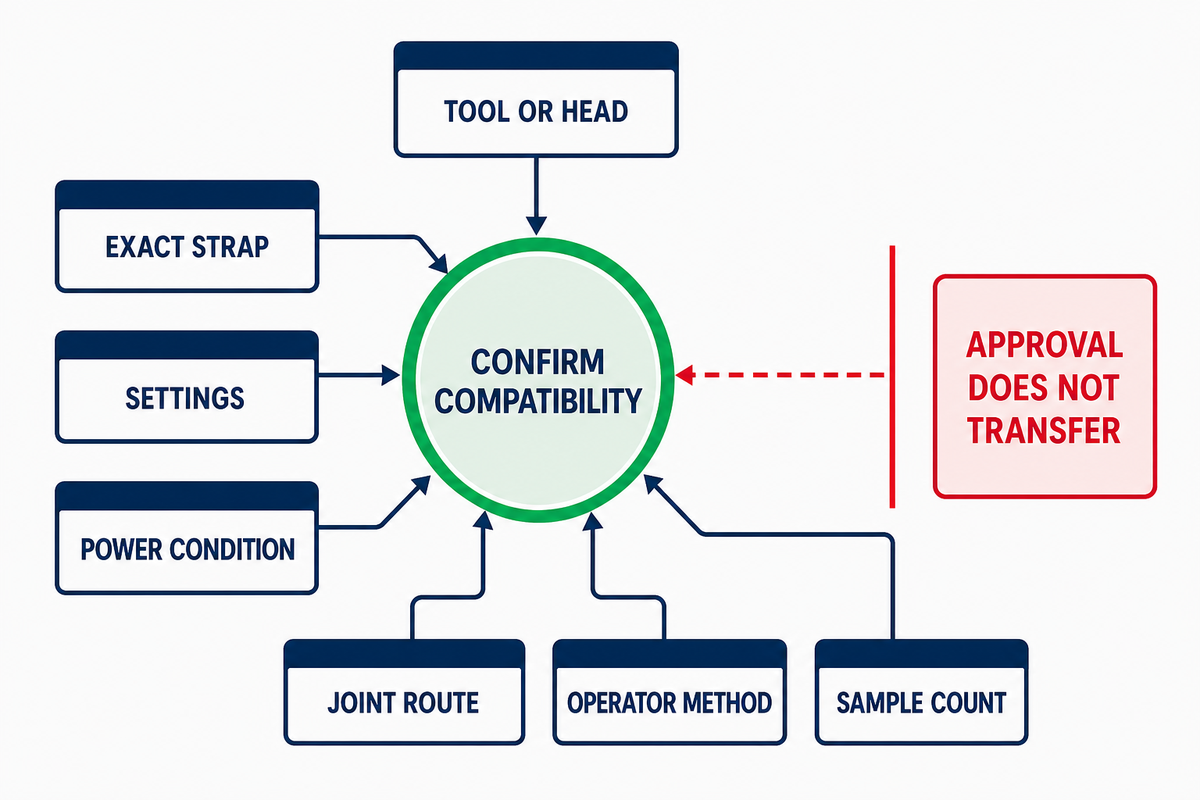
Joint approval belongs to the exact strap, tool or head, settings, consumables, power condition, and operator route. Tensile reports from unjoined specimens can’t establish friction-weld quality, seal performance, feed stability, or repeatability on another machine.
Freeze the test inputs before comparing samples. Record the tool or head model, software or firmware where relevant, battery or air condition, tension setting, weld and cooling time, strap surface, width and thickness, core and winding, operator method, and sample count. Results without those inputs are difficult to reproduce.
Machine fit also has a commercial consequence: the cheapest roll can become the expensive choice if it drives feed stops, joint variation, coil changes, or rework. Buyers can review candidate strapping tools and strapping accessories, then confirm compatibility for the exact strap and joint route.
Plant rule
Treat a new strap, tool setting, head, seal, buckle, surface, or winding as a controlled combination. Approval doesn’t travel automatically to the next combination.
The Spec-to-Shipment Failure Map
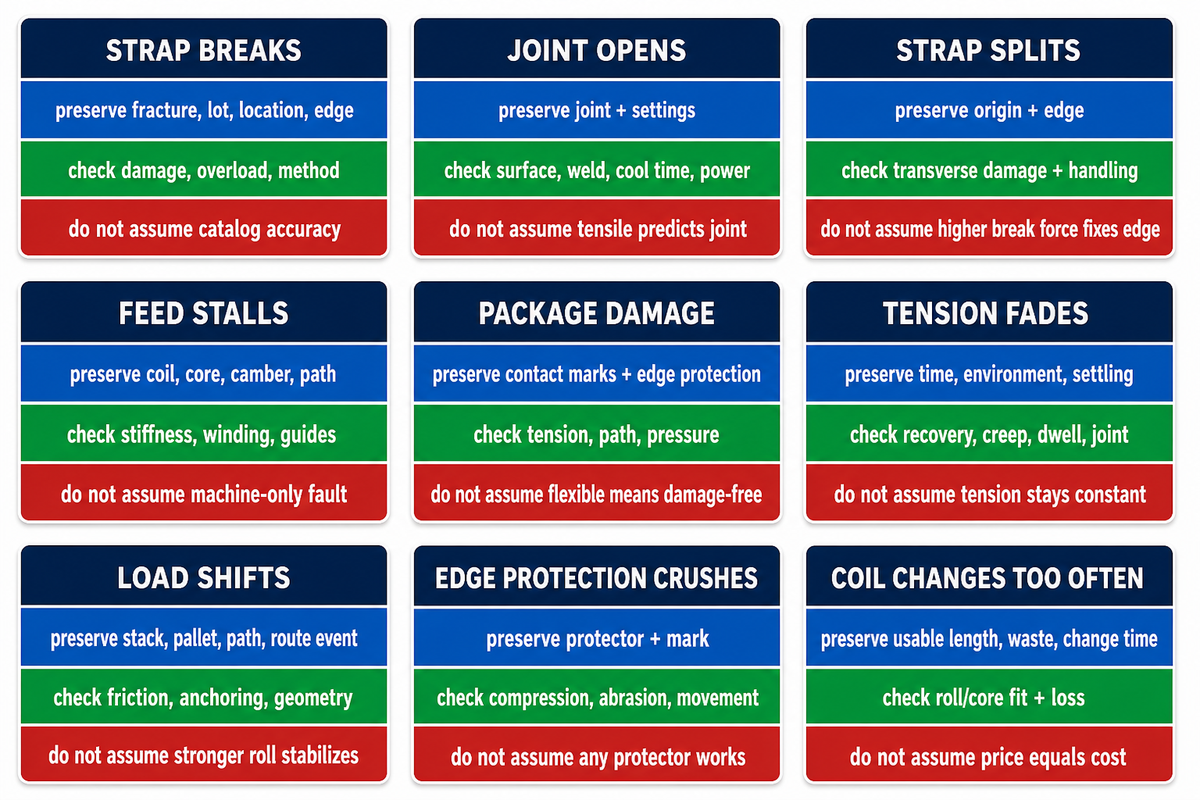
This Spec-to-Shipment Failure Map prevents a common reaction: buying a stronger strap whenever a load fails. Symptoms may originate in the material, joint, machine path, package interface, pallet, or distribution cycle, so the first action is to preserve evidence and locate the limiting layer.
| Observed symptom | First evidence to preserve | Check next | Do not assume |
|---|---|---|---|
| Strap breaks | Fracture, lot, location, edge contact | Damage, overload, method, interface | Catalog number was accurate |
| Joint opens | Joint sample and tool settings | Surface, weld/cool time, power | Strap tensile result predicts joint |
| Strap splits | Split origin and edge condition | Transverse damage and handling | Higher break force fixes the edge |
| Feed stalls | Coil, core, camber, feed path | Stiffness, winding, guides | Machine fault is the only cause |
| Package damage | Contact marks and edge protection | Tension, path, contact pressure | Flexible means damage-free |
| Tension fades | Time, environment, settling | Recovery, creep, dwell, joint | Initial tension remains constant |
| Load shifts | Stack, pallet, strap path, route event | Friction, anchoring, geometry | Stronger roll alone stabilizes design |
| Edge protection crushes | Protector type and load mark | Compression, abrasion, movement | Any protector works |
| Coil changes too often | Usable length, waste, change time | Roll/core fit and process loss | Purchase price equals system cost |
Pallets that look stable while stationary may expose combined weaknesses under braking, turning, vibration, or impact. That principle is consistent with package and distribution testing: stability is created by the load design, pallet, interfaces, restraint, and route, not by one material property.
ASTM, GB/T, ISO, ISTA, and SGS Do Not Mean the Same Thing
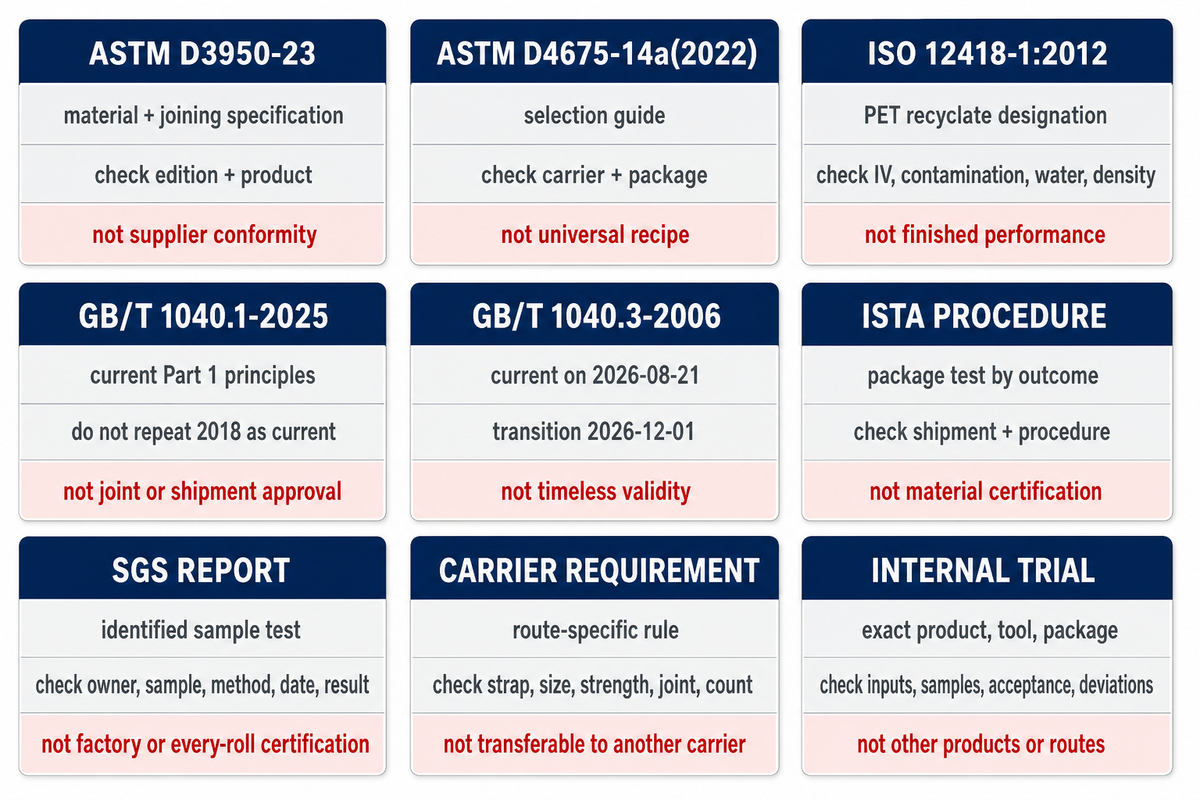
Standards and third-party reports must be read by issuer, edition, object, method, and result. Material specifications, selection guides, test methods, shipment procedures, feedstock designations, and laboratory reports answer different questions. Calling all of them “certification” erases the evidence boundary.
| Evidence item | Current role | Buyer check | Does not prove |
|---|---|---|---|
| ASTM D3950-23 | Nonmetallic strapping and joining-method specification | Report uses correct edition and product | Supplier conformity by citation alone |
| ASTM D4675-14a(2022) | Selection/use guide and evaluation starting point | Carrier and actual package requirements | Universal design recipe |
| ISO 12418-1:2012 | PET bottle recyclate designation | IV, contamination, water, bulk density, intended use | Finished strap engineering performance |
| GB/T 1040.1-2025 | Current Part 1 general principles | Do not repeat withdrawn 2018 edition as current | Joint or shipment approval |
| GB/T 1040.3-2006 | Current on 2026-08-21 | Transition to 2026 edition on 2026-12-01 | Timeless validity |
| ISTA procedure | Package/shipment test selected by outcome | Shipment type and procedure choice | Material certification |
| SGS report | Test/inspection report for an identified sample | Owner, sample, method, date, result | Factory certification or every-roll approval |
| Carrier requirement | Route/contract-specific packaging rule | Strap, size, strength, joint, count | Automatic transfer to another carrier |
| Internal trial report | Exact product/tool/package evidence | Inputs, samples, acceptance, deviations | Other products or routes |
Official Chinese records matter here. GB/T 1040.1-2018 is withdrawn and replaced by GB/T 1040.1-2025, effective 2025-10-01. GB/T 1040.3-2006 remains current on 2026-08-21, while GB/T 1040.3-2026 takes effect and fully replaces it on 2026-12-01. Purchase orders should name the required edition and laboratory reports should show which edition was used.
UD Packaging’s public product page mentions SGS product quality testing, but this research run didn’t receive a batch-matched report or certificate identifier. Safe purchasing practice is to request the document and match its sample identity, test items, method, date, and results to the quoted product. Testing a sample isn’t the same statement as certifying a factory.
Handling procedures also belong in the evidence file. Tensioning stores energy, and cutting or releasing a strap can create an uncontrolled movement path. Write the operation-specific tool, exclusion zone, personal protective equipment, release sequence, damaged-load response, and training requirement; don’t assume that a flexible edge removes the hazard.
Recycled PET Requires Feedstock and Finished-System Evidence
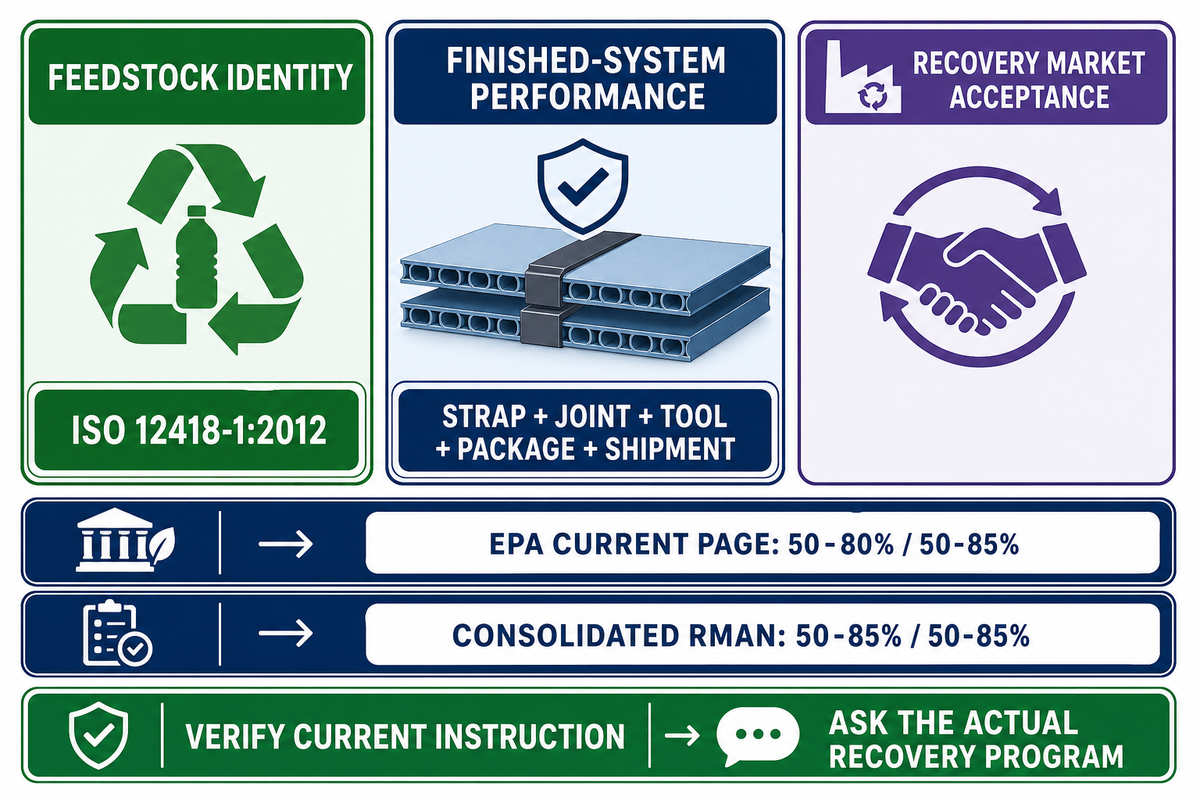
Recycled-content approval has two separate layers. Feedstock records describe where the material came from and how it was classified; finished-system records show whether the strap, joint, tool, package, and shipment perform as required. One layer can’t be used as a substitute for the other.
ISO 12418-1:2012 establishes a designation basis for post-consumer PET bottle recyclate using intrinsic viscosity, contamination, water content, and bulk density. Its abstract also says that equal designations do not imply equal performance and that the standard does not supply engineering data for a specific application.
EPA’s current procurement page lists 50–80% postconsumer and 50–85% total recovered material for manual-grade PET polyester strapping, while EPA’s consolidated RMAN text lists 50–85% in both columns. Because the agency sources conflict, don’t copy one range into an RFQ as a settled threshold. Confirm the current instruction for the covered procurement, then qualify finished performance separately.
Recyclability is also market-specific. PET strap can still fall outside a local collection or sorting route because of form, contamination, mixed components, or facility capability. Ask the actual waste contractor or recovery program whether clean industrial PET strapping is accepted. Sustainable Packaging Coalition’s 2026 report notes that definitions are increasingly regional and tied to producer-responsibility systems, making shared evidence more important.
Buyers that need a commercial follow-up can review recycled PET strapping after writing the required percentage, chain-of-custody evidence, lot identity, finished-strap tests, joint route, and recovery-market evidence.
A Role-Owned Sample Approval and Requalification Plan
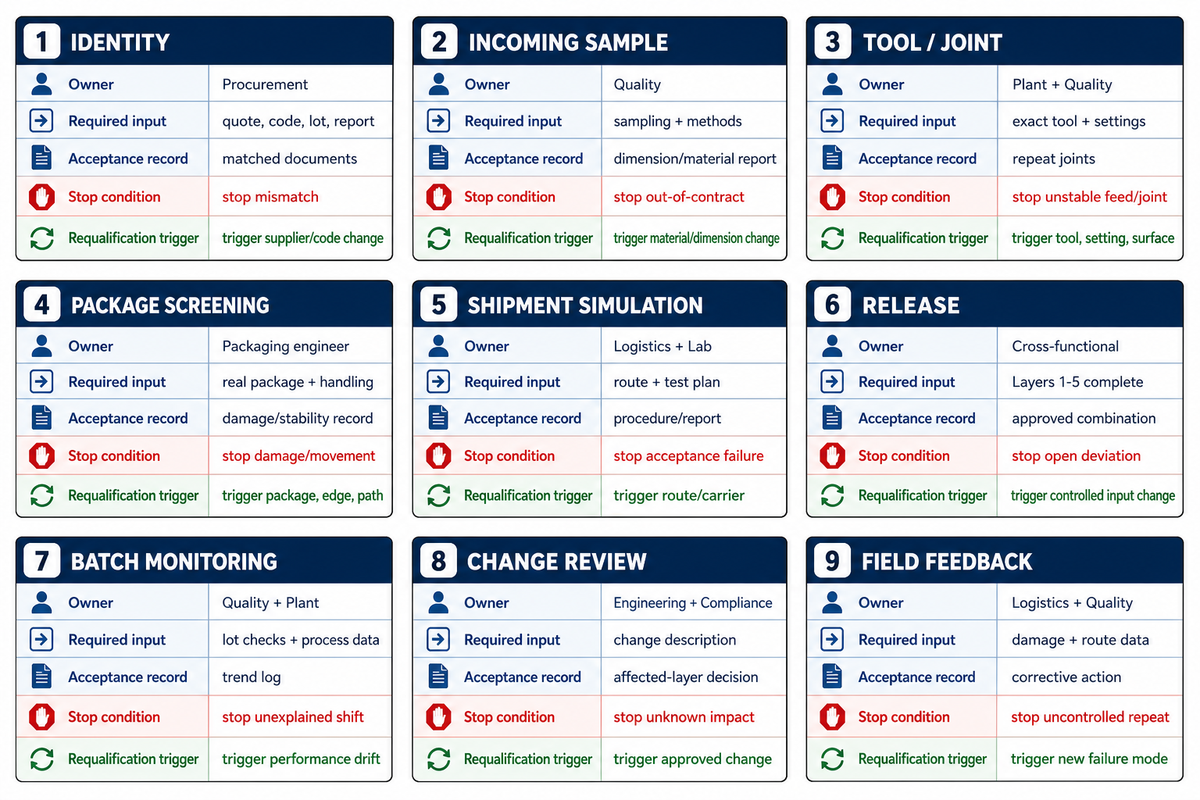
Sample approval works only when every stage has an owner, input, method, record, and stop condition. Procurement controls identity, quality controls acceptance evidence, the plant controls tool/package trials, and logistics controls route evidence. Signed samples without those roles are weak approval records.
| Stage | Owner | Required input | Acceptance record | Stop condition | Requalification trigger |
|---|---|---|---|---|---|
| 1. Identity | Procurement | Quote, code, lot, report | Matched document set | Any mismatch | Supplier or code change |
| 2. Incoming sample | Quality | Sampling and methods | Dimension/material report | Out-of-contract result | Material or dimension change |
| 3. Tool/joint trial | Plant + Quality | Exact tool and settings | Repeat joint samples | Unstable joint/feed | Tool, setting, surface change |
| 4. Package screening | Packaging engineer | Real package and handling | Damage/stability record | Damage or movement | Package, edge, path change |
| 5. Shipment simulation | Logistics + Lab | Route and test plan | Procedure/report | Acceptance failure | Route/carrier change |
| 6. Release | Cross-functional | Layers 1–5 complete | Approved combination | Open deviation | Any controlled input change |
| 7. Batch monitoring | Quality + Plant | Lot checks and process data | Trend/deviation log | Unexplained shift | Performance drift |
| 8. Change review | Engineering + Compliance | Change description | Affected-layer decision | Unknown impact | Approved change |
| 9. Field feedback | Logistics + Quality | Damage and route data | Corrective-action record | Uncontrolled repeat | New failure mode |
This guide doesn’t cover dangerous-goods specification packaging. Shippers in that scope must follow the approved package and closure instructions, keep any required design-qualification records, and obtain a hazardous-materials compliance review before changing a closure or restraint method. An ordinary commercial sample approval isn’t a substitute for that regulated route.
Once the load signature and evidence gaps are documented, UD Packaging’s PET strapping solutions page is the appropriate commercial next step. This link directs quote and product intent to the existing page rather than forcing this guide to compete for the same role.
What Changes in 2026: Evidence Versioning Beats Marketing Claims
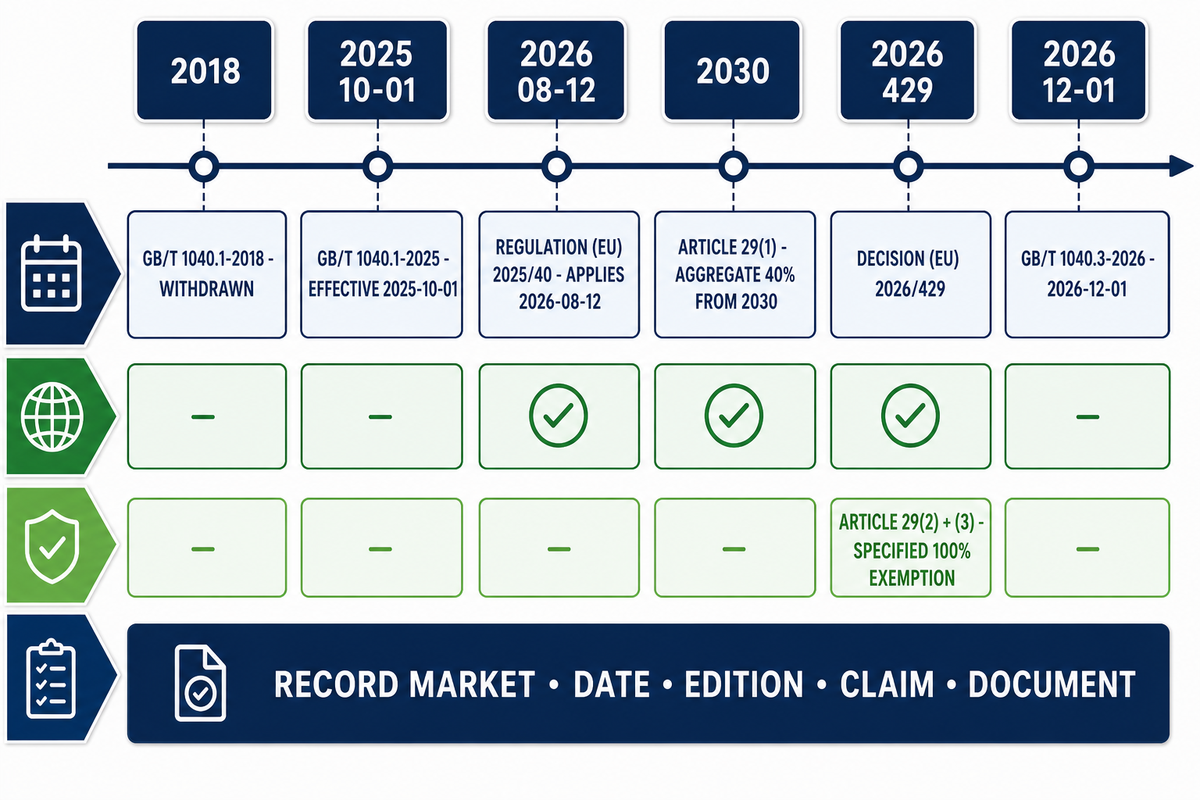
In 2026, the practical change for PET strap buyers isn’t a market forecast. It’s the need to version-control evidence across standards and markets. Chinese tensile-test editions are changing, and the European packaging framework now treats pallet straps through paragraph-specific reuse duties.
Regulation (EU) 2025/40 applies from 2026-08-12. From 2030, Article 29(1) sets an aggregate 40% reuse target for covered transport packaging formats, including pallet wrappings and straps. Commission Delegated Decision (EU) 2026/429 exempts specified operators using pallet straps for stabilisation and protection during transport from the 100% requirements in Article 29(2) and (3); it doesn’t erase the Article 29(1) aggregate target or every other duty.
Buyer response is simple: record the destination market, operator relationship, shipment date, standard edition, recycled-content claim, recovery claim, and supporting document. Labels such as “tested,” “certified,” “weatherproof,” or “recyclable” are incomplete until their owner, object, method, scope, and date are clear.
Frequently Asked Questions
Can PET strapping replace steel strapping?
PET can be evaluated as a steel alternative for a defined package and route, but it is not a universal substitute for every steel grade, joint, temperature, edge, handling method, transport rule, lifting duty, or lashing application.
Load behavior, edges, heat, joint method, handling, carrier rules, and jurisdiction all matter. Treat replacement as a controlled system change using the actual strap, tool, package, and route. Keep steel or another purpose-rated method where high temperature, sharp edges, extreme duty, lifting, lashing, or an applicable rule requires it. Use the PET vs PP vs steel selector for material-selection intent; this guide remains focused on qualification. Record the prior system, trial result, owner, deviations, and requalification trigger so the change remains auditable after production starts.
What test data should a PET strapping supplier provide?
Useful evidence packs identify the exact product and lot, test methods and editions, measured results, sample count, equipment, settings, intended joint route, and responsible reviewer.
Request dimensions and tolerances, break and elongation results, joint data for the intended tool, roll/core information, and the actual third-party report where one is claimed. Match every document to the quoted item, then perform an exact-tool package trial. Clean certificate packets cannot replace package and distribution validation. Records should also name the lot, sample count, equipment, settings, date, reviewer, and any failed or conditional result.
Is PET strapping a legal cargo tiedown?
Package strapping is not automatically a compliant vehicle tiedown or lifting device because those uses require their own purpose-rated design, working-load framework, attachment system, condition checks, edge protection, operating rules, and responsible approval.
For applicable U.S. interstate commercial motor vehicles, FMCSA rules govern the securement system, device condition, attachment, working-load framework, and edge protection. Other jurisdictions and carriers have their own requirements. Do not convert a PET package-strap break value into a tiedown working-load limit without a purpose-rated, rule-compliant design. Separate the inner package-unitizing record from the vehicle securement plan, then have the responsible transport specialist confirm both before dispatch.
Does recycled PET guarantee the same strap performance?
No. Feedstock identity and recycled-content records do not guarantee finished-system performance; the strap, joint, tool, package, batch, and distribution route still require their own evidence.
Recyclate designation and recycled-content documents describe material identity or chain. Finished performance also depends on processing, dimensions, batch variation, joint conditions, tool compatibility, package design, and route. Review the finished-strap evidence and repeat the intended tool, package, and shipment validation.
Can one PET strap run on any strapping machine?
No. The exact strap, winding and core, feed path, joint method, tool condition, and machine settings must be approved as one reproducible combination in production.
Width, thickness, stiffness, surface, camber, winding, core, joint method, tool condition, and settings can change feed and joint behavior. Approve the exact product/tool combination and document its acceptance window.
When should PET strapping be requalified?
Requalify when a controlled product, tool, package, supplier, route, carrier, method edition, or operating input changes, or when field performance shifts without an explained cause.
Triggers include product code, material declaration, dimensions, surface, winding, core, tool/head, setting, joint consumable, package, carrier, route, supplier, standard edition, or a new failure mode. Recheck only the affected layers when the impact is known; reopen the full plan when it is not.
About This Analysis
This guide uses public UD Packaging pages, current search-demand evidence, official standards and government sources, an additional research-agent check, and a separate adversarial review. No private plant dataset, customer result, universal temperature limit, certificate number, or supplier performance rate was supplied or invented.
Turn Your Load Signature Into a Testable Strap Request
Send the package, route, tool, joint, edge, environment, evidence, and change-control inputs, not just a requested break-strength number.
References & Sources
- ASTM Subcommittee D10.25 active standards
- ISO 12418-1:2012, PET bottle recyclates
- ISTA test procedure selection
- FMCSA cargo securement rules
- EPA recovered-content procurement guidance for manual-grade strapping
- SAMR record for GB/T 1040.1-2018
- SAMR record for the GB/T 1040.3 transition
- Regulation (EU) 2025/40
- Commission Delegated Decision (EU) 2026/429
- EPA consolidated Recovered Materials Advisory Notice
- 2024 polyester strap reinforcement creep study
- Sustainable Packaging Coalition 2026 trends report