Get in touch with UD Packaging Company

Anti Static Stretch Film: Choose the Right Protection Layer

PACKAGING MATERIALS · BUYER GUIDE
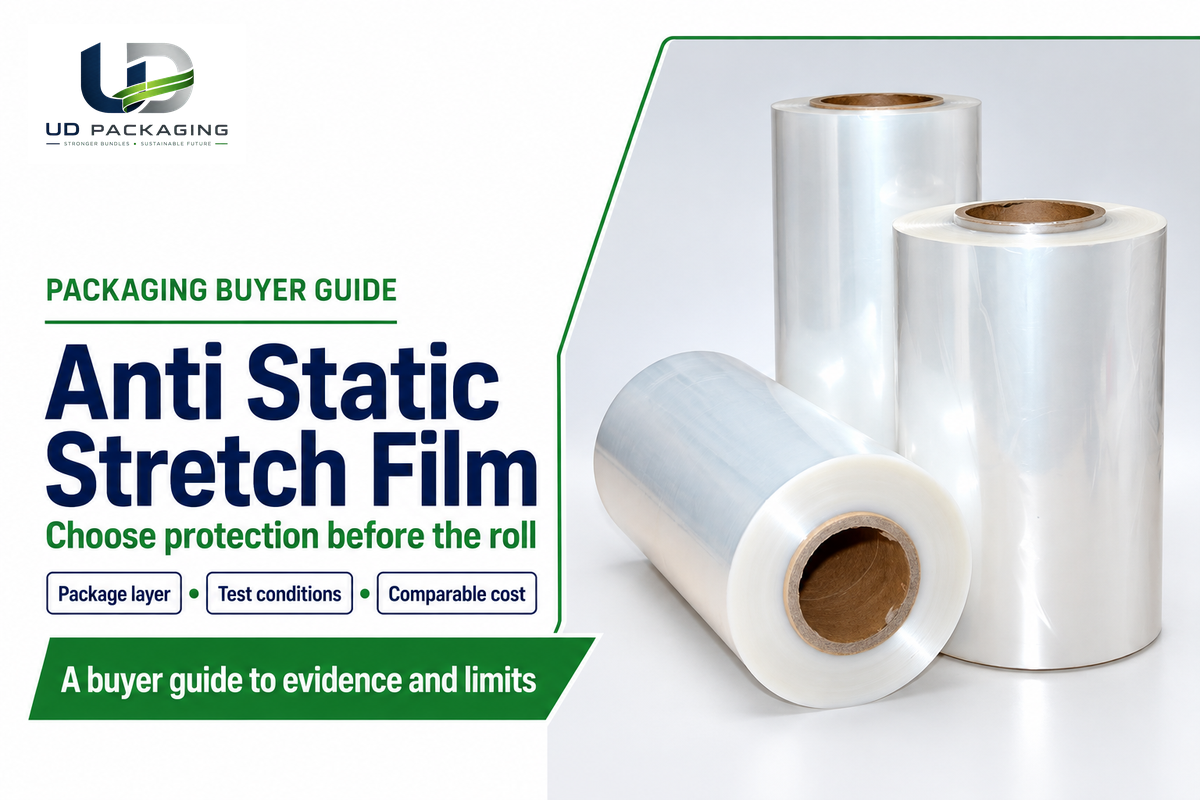
Anti static stretch film is anti-static stretch wrap formulated to reduce electrostatic charging during packaging and handling. It helps contain pallet loads while controlling a source of static electricity. For static-sensitive electronics leaving an electrostatic protected area, choose the required shielding package first, then select the outer film for its electrical properties and load containment.
A pink roll can look reassuring even when the purchasing specification is incomplete. This document separates the protection functions, compares roll and case pricing, and outlines the important details of a pertinent enquiry. The goal is a package that reaches the customer safely, with a film specification the warehouse can actually follow.
What anti-static stretch film does, and what it does not

Anti-static stretch film combines the physical job of holding goods together with a formulation intended to limit electrostatic charging. Contact and separation events occur in the process of unwinding and separating materials. Charging at those interfaces is addressed by an ESD control program, and puncture resistance, cling and retained tension address the problem of load containment.
Ordinary industrial stretch film is primarily selected for wrapping performance. An anti-static grade adds an electrical specification. Thus, a clear stretch film, an opaque film and a pink film can belong to different performance classes, even if their dimensions match. Colour aids in material identification; the required property belongs on the product specification and test report.
ESD (electrostatic discharge) is the transfer of charge between objects at different electrical potentials. Reducing charge buildup is an element of prevention, but transfer of charge also occurs during item handling. The complete selection of a packaging solution means also controlling the method by which an item is approached, moved and unpacked, along the shipping route.
The ESD Association’s packaging guidance separates low charging, conductive or dissipative behaviour, and discharge shielding. Assign each function to a physical layer in a package, with the outer wrap providing the specified static-control behavior and the closed inner layer providing the shielding.
When a buyer is comparing a specialty roll and standard clear wrap, the first thing asked about handling is what’s exposed. An inner qualified package in a closed carton requires a different review than an open circuit board on a tray. Dust protection and tight wrap matter, but neither establishes an electrical protection category.
Choose protection for the package layer
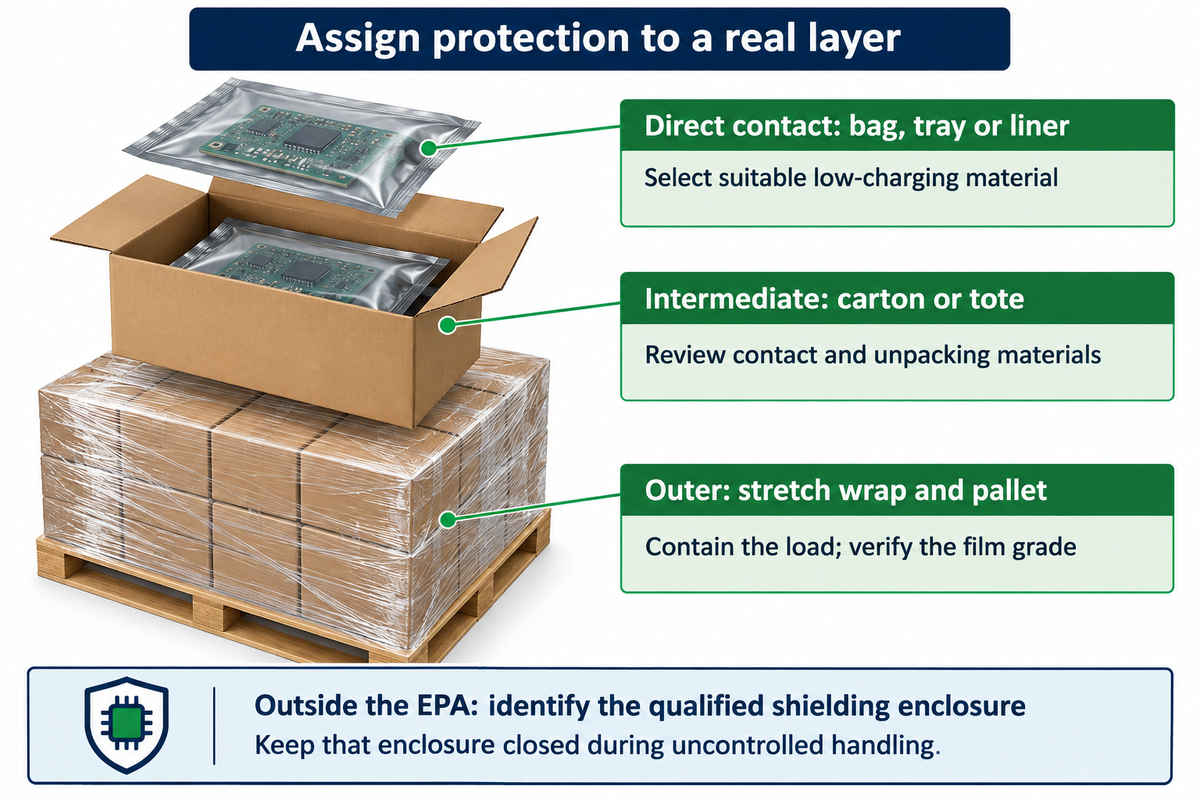
Choose the inner protective package around the component before choosing the pallet wrap. Inside an EPA, packaging must support the controlled environment; outside it, susceptible items also need discharge shielding. This allows procurement to buy the right outer containment and inner electrical protection, instead of requiring a spiral wrap to do all the work.
The 3-Function Package Overlay below turns that division into a packing review. Its rows are design questions, not approvals for an unnamed product. The electrical functions follow ESDA’s inside/outside-EPA guidance; the assignment of each function to a physical layer is a purchasing aid.
| Package layer | Function to resolve | Decision before release |
|---|---|---|
| Direct contact: bag, tray or liner | Low charging | Choose a contact material suitable for the item and handling route. |
| Direct contact: bag, tray or liner | Conductive or dissipative behaviour | Match the specified resistance class to the ESD control program. |
| Direct contact: bag, tray or liner | Discharge shielding | For outside-EPA movement, identify which complete structure provides shielding. |
| Intermediate: carton, divider or tote | Low charging | Review materials that approach or contact the exposed item during unpacking. |
| Intermediate: carton, divider or tote | Conductive or dissipative behaviour | Specify this function where the tote or divider is part of the control plan. |
| Intermediate: carton, divider or tote | Discharge shielding | Qualify the complete container if it supplies the shielding boundary. |
| Outer: stretch wrap and pallet | Low charging | Check the film grade and the unwinding/removal operation. |
| Outer: stretch wrap and pallet | Conductive or dissipative behaviour | Use the applicable film report, rather than infer behaviour from pink tint. |
| Outer: stretch wrap and pallet | Discharge shielding | Keep the qualified inner enclosure closed unless the outer system is itself qualified. |
Shipment scenario: An electronics distributor receives sealed shielding bags, places them in cartons and consolidates the cartons on a pallet. The warehouse needs wrap that will grip the cartons without tearing at their corners. At delivery, the receiving operator cuts away the outer film, usually in an uncontrolled dock area. Keeping the inner bags closed preserves the intended electrical boundary during that operation. Moving the same boards onto open trays to save packing time changes the package design, even if the operator adds more pink wrap around the pallet. The corrective action is to restore the specified enclosure and unpacking sequence, rather than increase the number of outer turns.
Customer requirements can also restrict the material itself. Clause QC69f of NASA/JPL excludes pink poly due to contamination reasons. That restriction is valid as long as the clause governs the order. It gives a good reason to check the buyer terms prior to offering a known film.
Anti-static, static dissipative and shielding: three separate functions
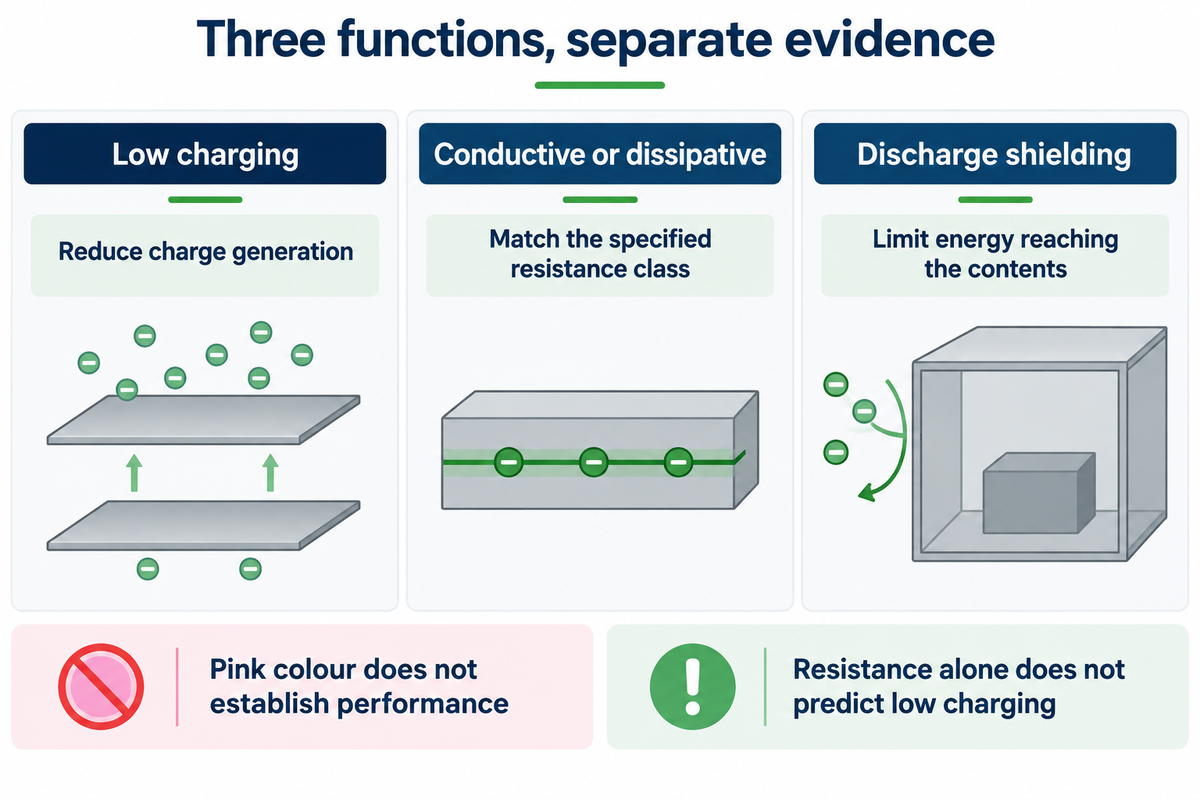
Low charging reduces charge generation, static dissipative behaviour concerns how charge can move through a material, and discharge shielding limits energy reaching the contents through a protective structure. Resistance measurement addresses only part of that concern. Keeping the terms separate helps a quality team decide which test result answers which purchasing question.
“A material’s low charging properties are not necessarily predicted by its resistance or resistivity.”
Does anti-static film provide static shielding?
No: use a qualified protective enclosure for required discharge shielding. Anti-static film primarily addresses charging, while a low-charging or static dissipative film can serve its specified role in the package. For an electronic component travelling outside the EPA, identify the shielding enclosure and its closure method in the packing instruction. Keep it closed during uncontrolled handling.
Does the pink color prove electrical performance?
No. Pink is an identification convention, and special additives supply the intended electrical behavior. The colour cannot tell a receiving inspector the resistance range, age limit or shielding result. A manufacturer can also formulate anti-static material without pink pigment. Purchase against the grade and its documented performance, then use color to help operators distinguish approved stock.
Reusing an unidentified pink bag presents a challenge. The recipient may be unable to determine the bag’s original grade and may be unaware of its history. Keep the item in the approved packaging system and follow the site’s reuse policy. An improvised multimeter check can’t tell if the bag is low charging and also determine its classification of resistance and shielding.
Electronics ESD packaging and explosion protection are different applications. The public scope of IEC 61340-5-3:2022 excludes protection of electrically initiated explosive materials or devices. Its label should not be used to approve packaging for flammable products or to promise general hazardous-area protection.
Match hand or machine film to the pallet load
Adjust the roll format and performance to the wrapping operation and then verify the electrical requirements of that grade. Hand stretch film must fit the dispenser and the operator’s handling method. Machine film must suit the wrapper’s roll capacity, stretch settings and load geometry. Changing either affects more than the amount of film on a core.
When considering manual wrapping and hand stretch film selection, record the roll width, the core’s diameter, gross weight and whether the dispenser is hand held or mounted. A stretch wrap film for hand application may be sold as pink cast hand film or blown film; these descriptions identify the construction and handling of the item, not an electrical acceptance test. Match cling to adjacent pallets as well as to the load itself.
On a machine, puncture at a sharp corner or loss of tension after wrapping can defeat containment even when the electrical report is acceptable. Film applied tightly at the wrapper can relax during storage and transportation. ASTM D5459-95(2025) addresses elastic recovery, permanent deformation and stress retention. These properties help explain why a high stretch percentage alone is a poor purchasing shortcut.
Wrapping-line scenario: A warehouse changes from uniform cartons to mixed-height equipment cartons with projecting corner protectors. The old film setting results in a thin band at one corner and loose film near the top. Procurement is offered a lower-cost roll with a higher advertised stretch rate. Start the comparison with the established wrapper recipe and the same load geometry, then examine corner damage, film breaks and retained containment. Record material consumption only for loads that pass the same checks. An older Cal Poly unit-load study found no pre-stretch/containment correlation in its own experiment; it supports testing the complete system rather than assuming a percentage predicts every load.
Use the machine stretch film specification to separate equipment fit from electrical-grade requirements. If a supplier suggests a different core or roll weight, check that fit prior to agreeing to a trial.
Compare roll sizes, gauge and delivered cost
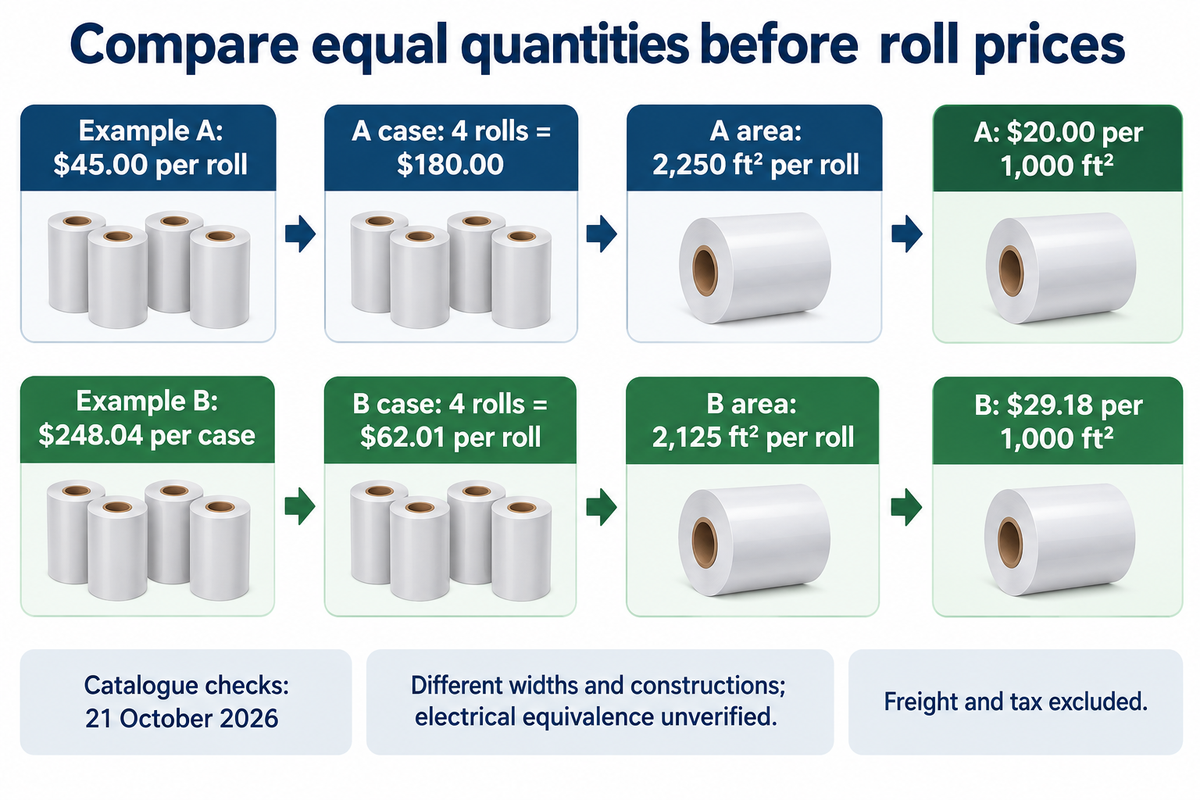
Width, length, thickness and rolls per case change the quantity purchased. Compare price per equal quantity of film before comparing price per roll, and compare qualified applications before declaring a saving. Freight, tax, and the least quantity purchased determine the invoiced amount. A cheaper area price can still lose if the film needs more material or causes rejected loads.
How much does stretch film cost?
Catalogue examples checked on 21 October 2026 show two hand film prices of $45.00 and $62.01 per roll, before freight and tax. They differ in width and construction, so this is a purchasing comparison rather than a ranking of equivalent grades. Example A quotes each roll within a four-roll order; Example B quotes the four-roll case.
| Comparison field | Example A | Example B |
|---|---|---|
| Film construction | Blown polyethylene | Cast polyethylene |
| Nominal width | 18 in / 457.2 mm | 17 in / 431.8 mm |
| Nominal roll length | 1,500 ft / 457.2 m | 1,500 ft / 457.2 m |
| Nominal thickness | 80 gauge / 0.8 mil / 20.32 µm | 80 gauge / 0.8 mil / 20.32 µm |
| Rolls per case | 4 rolls | 4 rolls |
| Nominal area per roll | 2,250 ft² | 2,125 ft² |
| Nominal area per case | 9,000 ft² | 8,500 ft² |
| Listed base price | $45.00 per roll, at 4 rolls | $248.04 per case, at 1 case |
| Comparable case amount | $180.00 | $248.04 |
| Calculated price per roll | $45.00 | $62.01 |
| Calculated price per 1,000 ft² | $20.00 | $29.18 |
Nominal area is determined by the width multiplied by the length. These calculations pertain to purchased area, and not coverage after stretching or cost per accepted pallet. The ASTM D4321 package-yield method distinguishes actual area per unit mass from nominal yield. For wholesale weight-based quotes, ask for net film mass separately from cores and packaging.
Purchasing scenario: Finance finds two cases containing the same roll count and asks why the second quote is more. The warehouse sees various widths and film constructions. Quality is awaiting an electrical report to accept the grade. The table resolves the first discrepancy by normalizing the billing unit and area. It doesn’t resolve performance acceptance. After both candidates meet the required package specification, compare film consumption, wrapping labor, breaks and rework on the same load. Divide relevant delivered and operating costs by accepted pallets. A small unit price difference is useful only if the denominator remains comparable.
Test electrical performance under the conditions of use
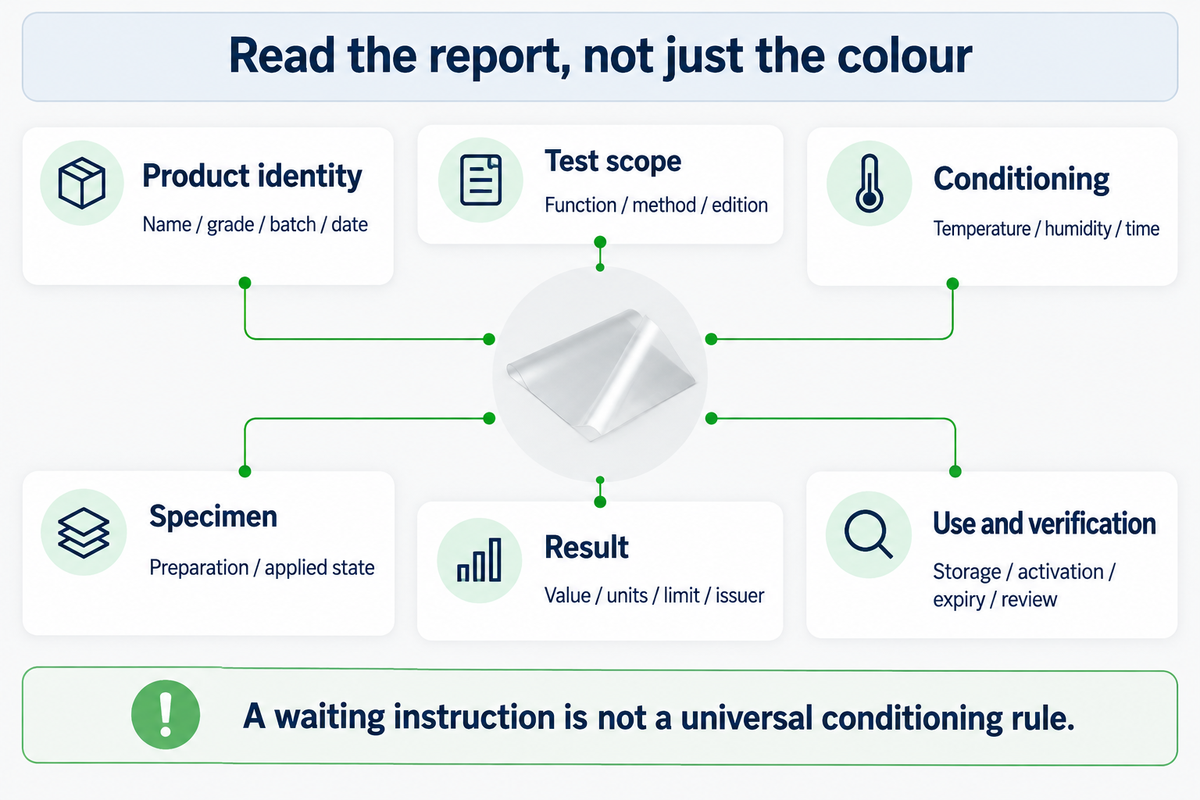
Use an electrical report specific to the grade that states the method, condition of the sample, and acceptance criteria. Temperature and relative humidity during storage and transportation, history of storage and stretch applied affect comparison. Product qualification establishes that the packaging is suitable to meet the customer’s specification; continued verification ensures that the packaging being used in production meets the control plan of the site.
Request a report with the following fields ideally attached to the quote rather than provided post delivery:
- Product name, formulation or grade identifier, batch and date.
- Test method and edition for each claimed function: low charging, resistance, charge decay or discharge shielding.
- Temperature, relative humidity and conditioning time.
- Specimen preparation, including whether it represents the applied film.
- Measured result, units, acceptance limit and report issuer.
- Storage limits, any activation period, expiry or reuse restrictions, and the verification plan.
A supplier’s waiting-time instruction is different from a laboratory’s conditioning requirement. One reviewed hand-film listing, for example, allows up to 48 hours before the film becomes fully static dissipative. That’s an instruction for that particular product and shouldn’t be viewed as a 48-hour general rule. Generally speaking, confirm when a newly wrapped shipment can be introduced to the intended handling route.
Additive systems can also vary in their dependence on humidity. Some systems are strongly dependent on humidity, while others use different mechanisms to achieve anti-static protection. Specify the lowest expected humidity in the actual warehouse or transport route, rather than accept a result obtained only in an easier environment. The interview on polymer additives in the Packaging Europe article illustrates why different additives and performance at low humidity vary.
Public changes for IEC 61340-5-1:2024 differentiate product qualification and packaging compliance verification. They do not establish a universal retest interval for the roll in this guide. State your requirements through the applicable program, including supplemental controls for unusually sensitive devices.
Suppliers and a useful request for quotation
Choose a supplier who can link the offered grade to a specification, appropriate roll form and proof. A manufacturer may offer custom dimensions or formulations; a distributor may offer smaller stock quantities and faster local delivery. Ensure each is given the same packaging task, quantity and destination to provide a usable comparison.
Send the item sensitivity or buyer packaging requirement, the inner package design, the point where the shipment leaves the EPA, pallet dimensions, load shape and wrapping equipment. Also include the current film width, length, gauge, net roll mass, core and consumption. Determine chemical compatibility or cleanliness limitations before finalizing the specialty formulation. If a customer clause excludes a material, a favourable resistance result will not remove that restriction.
UD Packaging supplies industrial packaging products from its Jiangyin manufacturing base, including stretch film and PET strapping. For a standard industrial film system, send the wrapping and electrical specs, so that our team can evaluate the option and supporting docs. General tensile tests of PET strapping address a different product and property from ESD packaging qualification. Obtain written supply and grade-specific document confirmation before requesting a specialty static-control film quotation.
Mixed shipments require the electrical requirement to be tied to the broader pallet packaging and transport plan. This helps the receiving site know which layer can be removed on the dock and which package should stay closed until controlled handling.
What is changing in ESD packaging requirements?
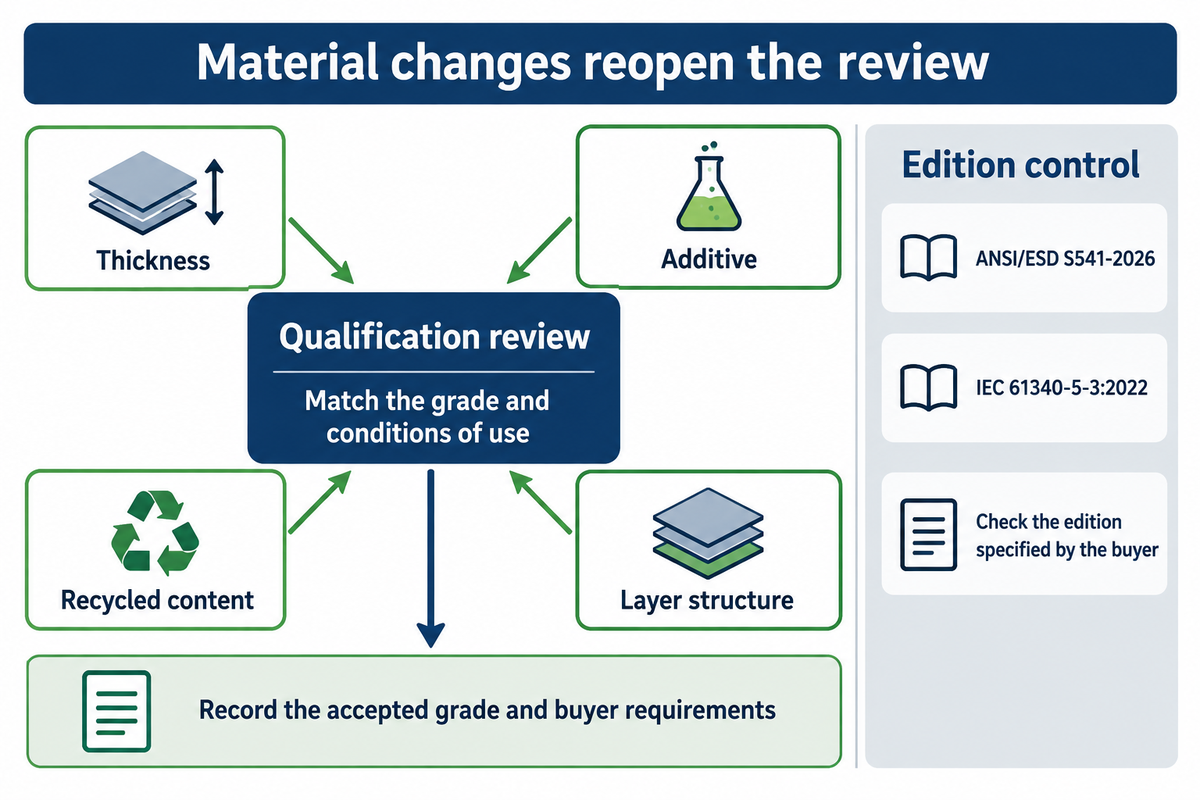
Consider edition control and material changes when renewing a packaging specification. The ESD Association now lists ANSI/ESD S541-2026, while IEC 61340-5-3:2022 remains the named international packaging edition reviewed here. Verify the edition specified by the buyer, and evaluate a changed film grade against the applicable tests, as opposed to automatically applying an old approval.
The official S541-2026 listing describes packaging requirements across production, transport and storage. The IEC’s 2022 change list includes a revision to the limit for the discharge-shielding energy from 50 nJ to 20 nJ. This concerns the shielding test. It is neither a resistance value nor a requirement for all outer pallet film.
Efficiency of materials is another pressure point during procurement. A stretch-film manufacturer’s June 2026 update reports demand for thinner films and recycled content alongside investment in performance testing. This is an industry observation and isn’t a measured or estimated market-wide growth rate. A 2025 antistatic stretch-film patent states a recycled-polyethylene intermediate layer, and names different assignees than UD Packaging. This isn’t a completed film approval.
During qualification review, changes in thickness, layer structure, additive or recycled content must be reviewed. Changes in requirements or conditions by buyers must be documented. The purchase specification must reflect the accepted grade, the conditions of use and the requirements of buyers.
Frequently asked questions
Is anti-static film the same as shrink film?
No. Stretch film holds a load through stretching and retained tension; shrink film contracts with heat. Either term describes a packaging format, while anti-static describes an intended electrical property. A heat-shrink product and a hand-wrap roll need different application equipment and operating instructions. Choose the format for the package, then specify the electrical function required for the item and handling route.
Can I replace a shielding bag with extra layers of pallet wrap?
Use the qualified shielding enclosure required by the packaging specification. Extra outer layers may change mechanical containment, but counting turns doesn’t establish discharge shielding around each component. A package design also includes closures, openings and the way it’s removed. Keep sensitive devices inside their approved enclosure outside the EPA unless the replacement complete structure has been qualified for that role.
Can the same anti-static film be used for hand and machine wrapping?
Use a grade and roll format intended for the chosen application. A hand roll and a machine roll can differ in width, core, weight and stretch behaviour, so a purchasing description should name the wrapper or dispenser. Start with equipment-compatible stock and the established packing recipe. Check containment in the applied state and confirm that the electrical evidence covers the proposed grade and use conditions.
Does stretch film replace a moisture-barrier package?
Use a separate qualified moisture barrier whenever the device or customer specification requires one. Stretch film primarily unitizes the load; the required moisture protection includes the enclosure, seals and any specified drying or humidity-control provisions. Keep those requirements separate from low charging and discharge shielding when writing the packing instruction.
What should I send UD Packaging for a standard film system review?
Send the product being packed, inner packaging, pallet dimensions, wrapping method and current roll specification. Include the required electrical tests, acceptance limits, lowest expected humidity, storage period and customer material restrictions. State the order quantity, delivery destination and price basis. Our team can then review the existing standard film system and documents alongside equipment fit and the wider packaging requirement.
Planning a film change? Share your load dimensions, current consumption and existing standard film specifications with UD Packaging. Start with our stretch film specifications or send a packaging enquiry for the appropriate roll format and grade review.
References & Sources
Technical guidance draws on the ESDA fundamentals and the public scope/change summaries for IEC 61340-5-3:2022 and IEC 61340-5-1:2024 linked in the relevant sections. Buyer restrictions are illustrated by NASA/JPL QC69f. Mechanical and yield methods are identified by ASTM D5459-95(2025) and D4321-24. The Cal Poly study is a 2012, non-antistatic unit-load experiment; the patent is a separately owned 2025 invention. Full paid standards were not reproduced. Catalogue prices are a dated comparison, and should be refreshed before ordering.