Get in touch with UD Packaging Company

Updated August 2026 · Written by XCX
Industrial strapping is the banding that holds a unitised load together in transit, and it comes in five materials: polypropylene, polyester, steel, composite cord and woven polyester. Material sets the break strength ceiling. The joint sets what you keep. A closure holding 45% of break strength halves your usable load, whichever type you bought.
Four things buyers get wrong about strapping types
- Two industry selection guides rate steel above polyester on retained tension, against the marketing consensus. Both readings are defensible, and the difference decides which one you order.
- A metal seal on polyester is held to a 45% minimum joint strength in ASTM D3950, while a friction weld on the same coil has been measured at 82–98%.
- Federal cargo securement rules still incorporate ASTM D3953-97, an edition from February 1998 and two revisions behind the active one.
- A thicker-measuring strap can be a weaker strap, because embossing depth inflates the gauge reading without adding material.
A buying guide published by Packaging Strategies puts the problem plainly: “as a general rule companies look for four attributes when purchasing strapping; elongation, break strength, corrosion resistance, and UV resistance.” Joint efficiency and retained tension appear nowhere on that page. Neither attribute appears on most vendor comparison charts either, and both decide whether a load arrives intact.
The Five Types of Strapping Materials at a Glance
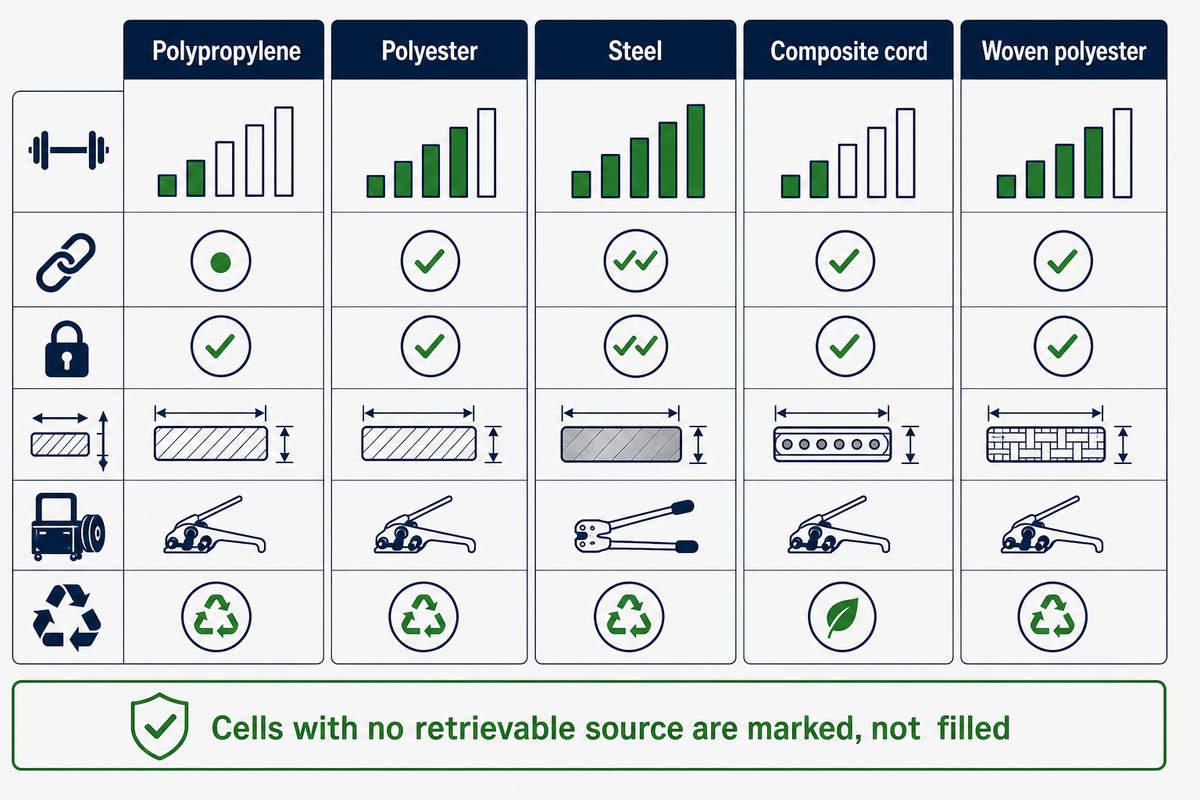
Five strapping materials carry almost all industrial unit loads: polypropylene, polyester, steel, composite cord and woven polyester. ASTM D3950 covers the nonmetallic families under five type designations, Types I, IA, II, III and IV, and ASTM D3953 covers flat steel separately. The material used fixes the number printed on the coil label; the closure fixes how much of that number survives to the load.
That split matters because the two specifications record joint strength the same way. D3950 method 12.6.3.1 states joint strength as a percentage of the parent material’s minimum breaking strength, and D3953 clause 13.5.3 uses an identical form, in the editions consulted for this article. One arithmetic covers steel and plastic, which is why a single ledger can hold both.
Those five cover the common types of strapping any supplier will quote, and the different types of strapping separate on behaviour rather than on chemistry. Polypropylene is the commonly used strapping material for light bundling; polyester carries most of what travels; steel, composite cord and woven webbing take the rest.
The Joint-Adjusted Load Board below pairs each material with the closure it’s normally sold with, then shows what the standard or the measurement leaves you. Cells without a retrievable primary source are marked rather than filled with a plausible figure. Full plastic strapping specifications should always be confirmed against the current edition of the standard you’re designing to.
| Material and closure | Width x thickness | Break strength | Joint efficiency | Usable load at the joint | Limitation / where it stops working |
|---|---|---|---|---|---|
| Polypropylene, friction weld | machine grade, 0.014–0.030 in | no published band retrieved | 45% floor, D3950 7.3.3 Type II | not computable without a band | Stretches 18–34% and returns 20–40% of it; slack within days on a settling load |
| Polypropylene, metal seal | machine grade, 0.014–0.030 in | no published band retrieved | 45% floor, D3950 7.3.3 | not computable without a band | Embrittles in freezing stores; degrades outdoors under ultraviolet exposure |
| Polyester, friction weld | 5/8 in x 0.035 in | 1,400 lb catalogue; 1,406–1,515 lb measured | 82–98% measured across two sealing heads | 1,148–1,372 lb | Weld quality collapses if the tool is set up wrong; no weld survives a hot load |
| Polyester, metal seal | 5/8 in x 0.035 in | 1,400 lb catalogue | 45% floor; one manufacturer says “usually less than half” | 630 lb | Discards more than half the coil you paid for |
| Polyester, buckle and manual tensioner | 1/2 in x 0.020 in | 600 lb catalogue | around 60% on a manual tool | around 360 lb | Result moves with the operator, not with the specification |
| Heavy polyester, friction weld | 1-1/4 in x 0.050 in | 4,000 lb catalogue | 82–98% measured | 3,280–3,920 lb | Needs a head that can apply the tension; one manufacturer’s automatic polyester heads top out at 7,000 N |
| Steel, single-notch seal | 3/4 in x 0.020 in | 2,000 lbf, D3953 Table 3 | 45% floor, D3953 8.9.2 | 900 lbf | Lowest-value closure in the standard; rarely worth the steel |
| Steel, double-notch seal | 3/4 in x 0.020 in | 2,000 lbf, D3953 Table 3 | 75% floor, D3953 8.9.2 | 1,500 lbf | On-vehicle tiedown only: strap 1 in or wider needs two crimp pairs per seal under 49 CFR 393.104 |
| Steel, crimp on USLM strapping | published pairing, D3953 Table 4 | 8,500 lbf | 90% floor, D3953 8.9.3 | 7,650 lbf | USLM coils must contain no production welds at all |
| Composite cord, wire buckle | replaced 13, 16, 19 and 32 mm steel | one supplier’s systems rated 480–2,600 kg | no published percentage retrieved | rated at system level, not at coil level | One supplier’s published range: service from minus 30 °C to 140 °C, with softening from 125 °C |
| Woven polyester, buckle | 4 in webbing | 20,000 lb minimum breaking strength | no published percentage retrieved | buckle-dependent | Rated figure is a straight-pull number; a sharp corner derates it |
Polyester break strengths are read from a published 46-row supplier catalogue; steel figures come from ASTM D3953 Tables 3 and 4; measured polyester joint efficiencies come from patent EP 2 768 889 B1, filed by a strapping manufacturer. Polypropylene bands were not retrievable from any primary source in this research, so they are left open.
Polypropylene Strapping: Where the Cheapest Type Actually Fails
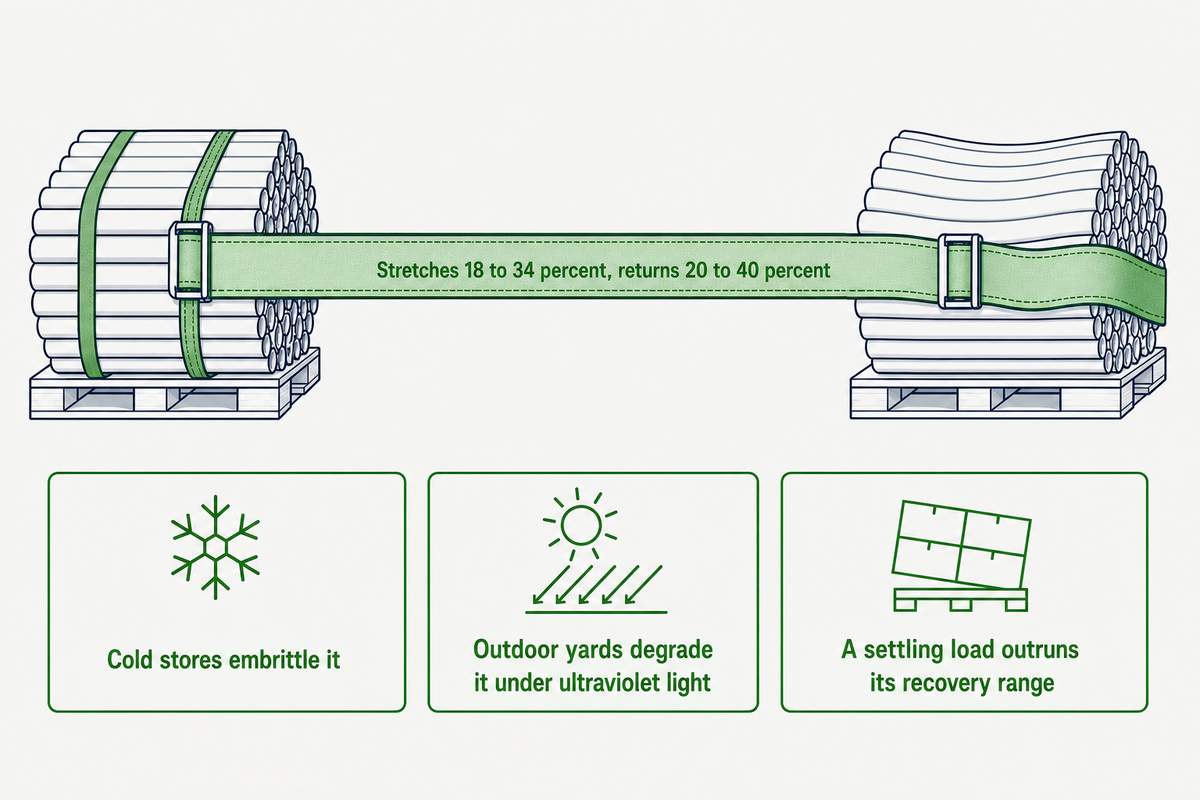
Polypropylene strapping stretches 18 to 34 percent under tension and gives back only 20 to 40 percent of that stretch, which is why a bundle tight on Monday can be loose by Thursday. Light to medium corrugated bundles, in-plant transfer between departments and manual strapping of lighter loads are the jobs it does well. Hand strapping with a tensioner and a metal seal is normal at this weight class, because the consequence of a slipped joint is a re-wrap rather than a dropped load.
Three conditions disqualify it before you compare price. Cold stores embrittle it. Outdoor yards degrade it under ultraviolet light. Any load that settles more than a couple of percent will outrun its recovery range, and the strap simply stops carrying force. Manufacturer selection guides rate its recovery range highly while rating its retained tension poorly, which sounds contradictory until you separate the two quantities. Recovery range is how far a strap can follow a shrinking load; retained tension is how much force is still there tomorrow. Polypropylene wins the first and loses the second.
Buyers also confuse polyethylene strapping with polypropylene. It is a different polymer with different behaviour under load, though ASTM D3950 groups both as Type II polyolefin, so the type designation alone will not separate them for you. If a quotation lists polyethylene where you expected polypropylene, treat it as different strapping to qualify, not as a synonym to accept. Bundling light cases and securing items together in a single pass is the honest limit of pp strapping. Anything that travels, sits or settles belongs in the next section.
Polyester Strapping: The Steel Alternative That Holds Tension
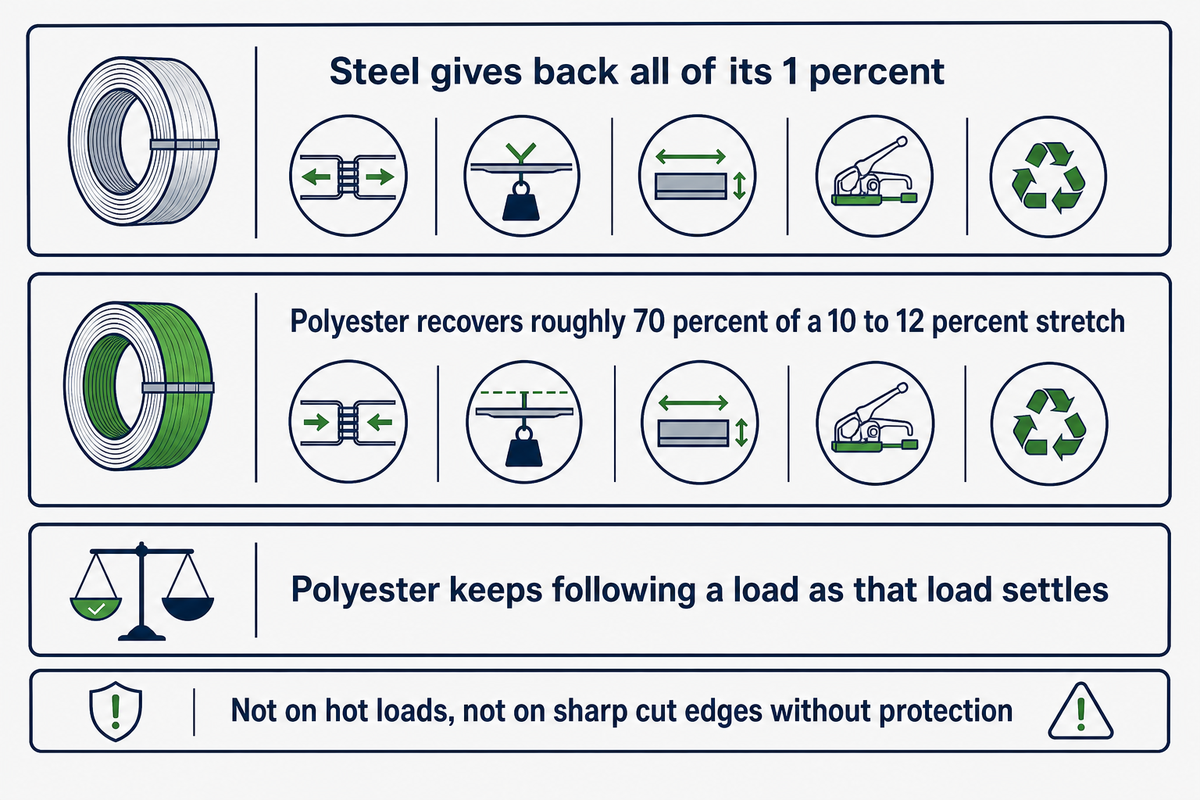
Polyester strapping replaces steel on most palletised and bundled loads because it recovers roughly 70 percent of a 10 to 12 percent stretch, so it keeps following a load as that load settles. Steel gives back all of its 1 percent stretch and then has nothing left to give.
Read those two sentences together and the substitution question answers itself. Steel doesn’t creep, so it holds a static tension better than any polymer. Polyester has a far larger recovery range, so it keeps force on a load that’s still moving. Choose on which of those two behaviours your load actually needs, not on which material sounds stronger. Our industrial strapping selection work with packers and shippers starts from exactly that question.
The boundary is real and it should be stated by anyone selling PET. Polyester does not replace steel on hot loads, and it does not replace steel on sharp cut edges without protection. The level of elongation quoted on a datasheet also carries more noise than buyers expect: the between-laboratory coefficient of variation in ASTM D3950‘s precision table, in the edition consulted for this article, is 2.4% for polyester break strength but 37.3% for polyester elongation, and the scatter runs high for both polypropylene and polyester on that property. The number vendors sell on is the noisier one.
UD Packaging states its own quality programme rather than implying a certificate you haven’t seen: its products pass SGS international product quality testing, tensile properties are tested to the GB/T 1040 series, and joint strength testing is declared as part of the same programme rather than as part of that series. Ask any supplier, ours included, for the report number, scope and date before you treat that as lot certification. Full PET strapping specifications and coil formats sit on the product page.
Steel Strapping: Where Polymer Substitution Stops Being Defensible
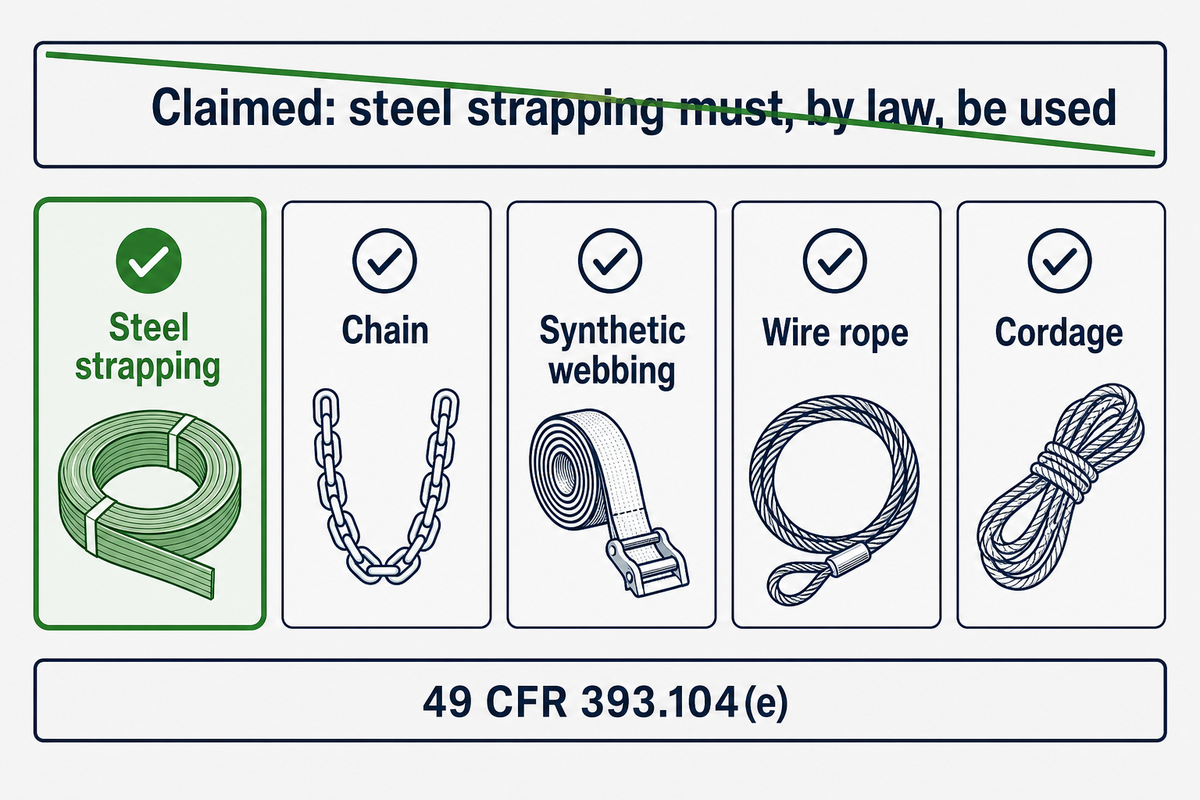
Steel strapping remains the sound engineering choice on hot loads, on unprotected cut edges, and wherever a load will not settle and a static tension must simply hold. Exclusivity claims about steel do not survive contact with the regulation, so treat the choice as engineering judgement rather than as a legal requirement.
One ranked comparison page states that when shipping any load not held in a container, “steel strapping must, by law, be used.” The table in 49 CFR 393.104(e) lists steel strapping, chain, synthetic webbing, wire rope and cordage side by side as conforming tiedown assemblies. The same page attributes the rule to “the government (specifically the Association of American Railroads),” and the AAR is a private trade association. One industry rule written for a single mode has been reported as cross-modal law, and it circulates.
Steel carries costs that rarely reach the quotation. Corrosion on stored goods. Operator laceration when cut ends spring back, which is common enough that one shipper on a trade forum reports a standing order at his base forbidding staff from trimming the leftover coil. Disposal weight. And a heavy dependence on crimp quality, since a single-notch seal is held to only 45% of the parent break strength while a crimp on USLM strapping reaches 90%. A steel buckle or seal is worth only as much as the crimp behind it, and the road-freight rule points the same way: under 49 CFR 393.104, steel strapping 1 inch or wider must carry at least two pairs of crimps in each seal. That is vehicle tiedown law rather than warehouse unitising law, but it is where the regulator chose to look. Heavier construction and building material loads are where this trade-off gets decided most often.
Composite and Woven Strapping: Where Cord Beats Both Plastic and Steel
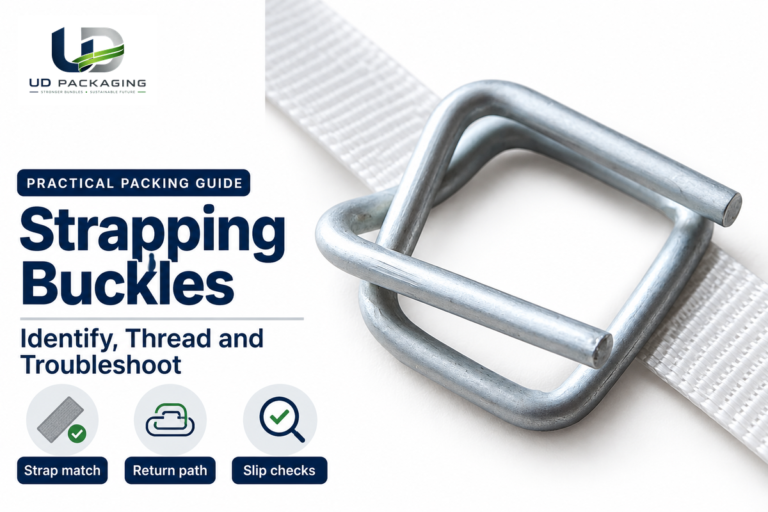
Composite strapping is high-tenacity polyester yarn encased in a polymer coating; woven strapping is polyester yarn woven into a flat webbing without that coating. Both close with a wire buckle rather than a weld, both absorb impact better than steel, and both correspond to Type IA in ASTM D3950 rather than to any separate material family.
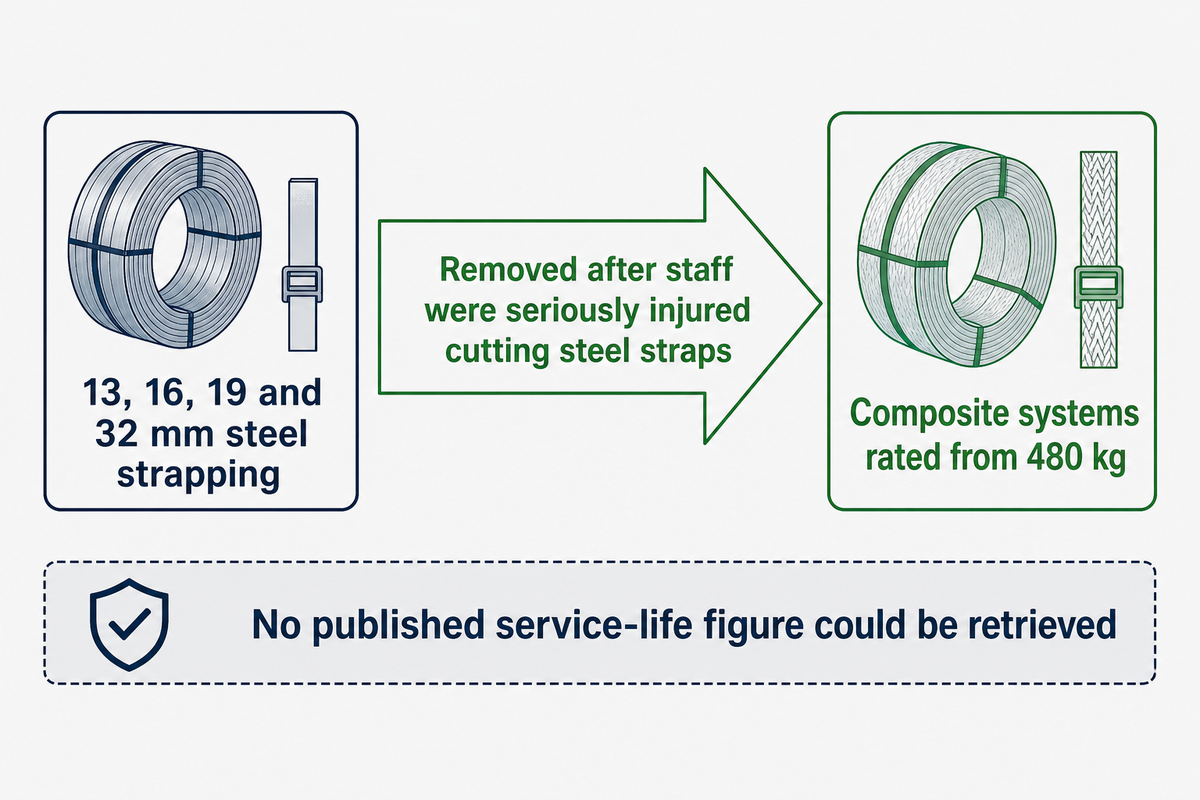
An Australian home and hardware retail chain removed steel strapping across its supply chain after staff were seriously injured cutting steel straps, replacing 13, 16, 19 and 32 mm steel with composite systems rated from 480 kg to 2,600 kg. That vendor’s own comparison table rates the wire buckle High for system-strength consistency against steel’s Low, marked operator and tool dependent. Two superlatives on the same page are not adopted here: the claim that composite is the only strapping stronger than steel size for size carries no test behind it, and a “five times lighter” bullet is contradicted by the page’s own table.
Service life is where honest reporting stops. No published service-life figure for composite or woven strapping could be retrieved in this research, and the AAR Open Top Loading Rules that govern rail acceptance sit behind a paywall. What can be said is that rail acceptance is marked on the strap itself: a 2017 AAR circular, as summarised in a railcar builder’s published digest of those circulars, revised General Rule 19.5.1 to require the grade and the minimum breaking strength in pounds alongside the AAR identification mark, with the literal example “AAR 123 Grade 7 MBS 11,000 lbs.” Read the mark, not the brochure. Cord is also easier to apply and remove by hand than steel, which is part of why the retail switch above happened at all, though the range of strapping available in composite grades stays narrow beside polyester. Vertical strapping and horizontal strapping passes on the same unit load may need different grades for that reason.
One market signal is worth naming. Across this article’s full keyword matrix, composite strapping carries the highest cost per click of any term at $49.45 while returning only nine keyword suggestions in total. Commercially valuable, editorially almost undocumented.
Joint Efficiency Ceiling: Why Your Seal Method Caps the Strap You Bought
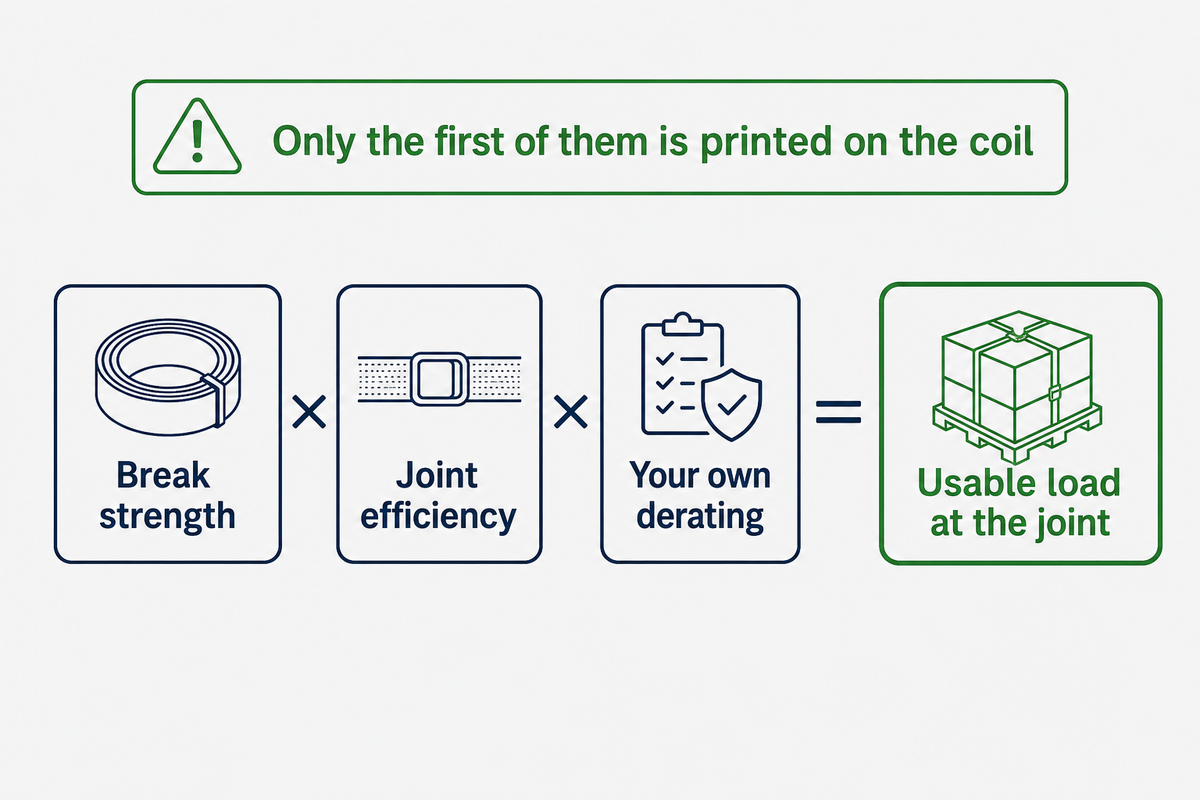
The Joint Efficiency Ceiling is the share of a strap’s break strength that its closure actually transmits, and it caps every load calculation you make. Every break strength quoted above is a coil-level figure, and this is the number that decides how much of it ever reaches your load. Two standards set minimums as low as 45%, manufacturers publish measured efficiencies that reach into the nineties, and the two kinds of number aren’t interchangeable, but neither of them moves because you changed material. The seal sets the figure.
“Without proper set up of the tool, no matter the technology used, strong welds will not be achieved.”
Read as specified minimums (the least a compliant joint may deliver, not what yours will), the standards give: the general nonmetallic floor and the single-notch steel seal at 45%; a coil splice at 50%, with a maximum of one per coil; Type IA Grades 3 to 5 at 55%; process welds, double-notch seals and heavy-duty crimps at 75%; and a crimp on USLM steel at 90%.
Read as measured efficiencies (what manufacturers report from their own test benches, which is a different kind of evidence and carries their interest), a manual tool with a buckle or seal sits around 60% and a friction weld on a battery tool around 85%. Don’t average the two lists together, and don’t read a 75% minimum as a promise of 75%. Percentages quoted here come from the editions and datasheets consulted for this article; current editions should be bought and checked before any of them is designed to.
We size to what we call the 3-Factor Usable Load Rule: usable load = break strength × joint efficiency × your own derating. Three numbers, one line, and only the first of them is printed on the coil. Work it once and the material argument reorders itself, because the weight a strap can hold on your line turns out to be a closure number rather than a coil number. Strapping is one of the few packaging inputs where the accessory decides the specification.
Worked example: same coil, two closures, one pallet
Strap: 5/8 in x 0.035 in polyester, 1,400 lb nominal break strength from a published catalogue.
Metal seal at the D3950 floor: 1,400 × 0.45 = 630 lb (2,802 N) per strap at the joint.
Friction weld at 85%, inside the 82–98% band measured on two sealing heads: 1,400 × 0.85 = 1,190 lb (5,293 N) per strap.
Now size the pallet. One manufacturer’s published rule for palletised cases is pallet weight × 1.5, divided by the number of straps. A 1,600 lb pallet on four straps needs 1,600 × 1.5 ÷ 4 = 600 lb (2,669 N) per strap.
The sealed joint clears that by 5 percent. The welded joint clears it by 98 percent. Same coil, same pallet, same weight of the load, and a 560 lb difference that came entirely from the closure.
Three variables move joint efficiency and none of them is the material: tool setup, embossing pattern, and heat-plate condition. Heat plates distribute heat less evenly at their outer edges over time and react to ambient temperature swings; friction welding has no such exposure, and every battery-powered strapping tool friction welds. Closure hardware is therefore a specification decision, not an afterthought, which is why strapping seals and strapping buckles belong on the same request for quotation as the coil.
ASTM D3953 adds a warning that no vendor chart carries: “Achieving the specified minimum joint strength is, by itself, not sufficient to ensure a safe lifting method.” Clearing the floor is the beginning of the calculation.
Key takeaway
Ask any supplier for the joint efficiency their closure achieves on your line, in writing. Any coil quoted without a closure figure is half a specification.
Tension Retention Window: What Your Load Looks Like After the First Day
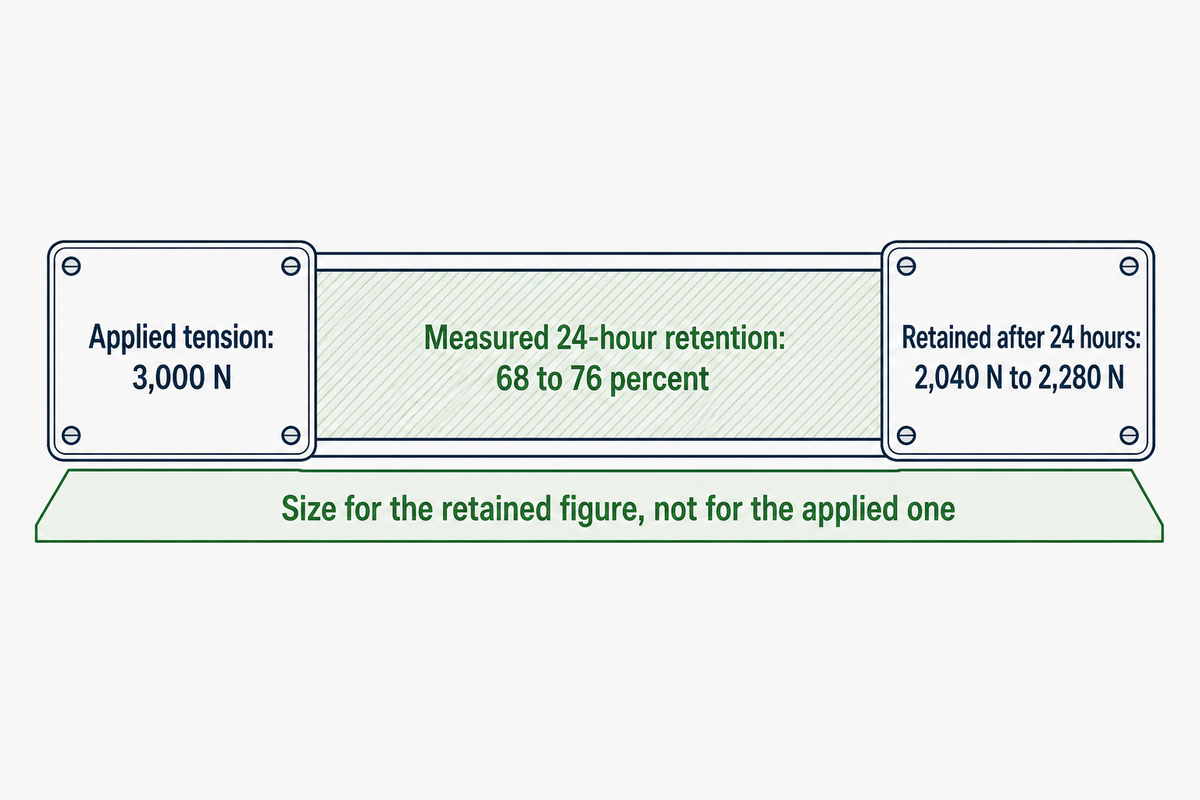
The Tension Retention Window is the gap between the tension a machine applies and the tension still present when the load arrives. Joint efficiency fixes what the closure transmits at the moment of sealing; this is what happens to that force over the day that follows. Applied tension is not retained tension. Load settling, thermal cycling and polymer relaxation each draw force out of a strap that was correctly tensioned at the dock.
Instrument-measured numbers for this are rare in public. The clearest set sits inside a granted European patent on polyester strapping, EP2768889B1, which reports 24-hour tension retention of 68 to 76 percent on 15 mm x 0.9 mm polyester across twelve compositions. That patent is assigned to a strapping manufacturer, which also publishes one of the two selection guides cited earlier, so treat it as industry measurement rather than independent validation, but it is measurement, made on named sealing heads, which is more than any comparison chart offers.
Worked example: what survives the first 24 hours
Applied tension: 3,000 N, comfortably inside the 3,500 N ceiling of one automatic polyester head.
Measured 24-hour retention band: 68–76%, from the patent’s tests on 15 mm × 0.9 mm polyester. Your geometry and your head are not that test, so treat this as the shape of the loss, not a prediction of your number.
3,000 × 0.68 = 2,040 N (459 lb). 3,000 × 0.76 = 2,280 N (513 lb).
So between 720 N and 960 N has left the strap by the time the truck is unloaded, before anything unusual has happened to the shipment. Size for the retained figure, not for the applied one.
Beyond 24 hours only the direction is defensible, and no figure will be invented for it here. Creep continues under constant force, and four amplifiers make it worse: long shipment times, heavy pallet loads, high temperatures during transport and storage, and compressible products. Polypropylene loses most of its applied tension, polyester keeps most of it, and steel keeps nearly all, while having almost no reserve when the load itself shrinks.
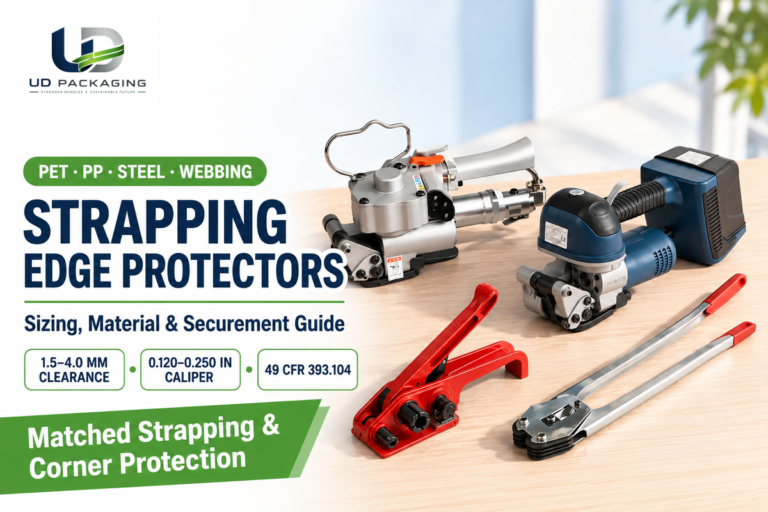
Applied tension has a second ceiling nobody mentions. One manufacturer’s automatic steel heads are rated to 9,000 N and 18,000 N, while every automatic polyester head in the same catalogue tops out at 3,500 N or 7,000 N. A 2.6-times gap in what the machine can put into the strap makes catalogue break strength irrelevant the moment the head cannot reach the tension you need. Whether you tension by machine or by hand, the strapping tensioner sets the starting number that everything else erodes.
Choosing Strapping by Load Signature, Not by Material Name
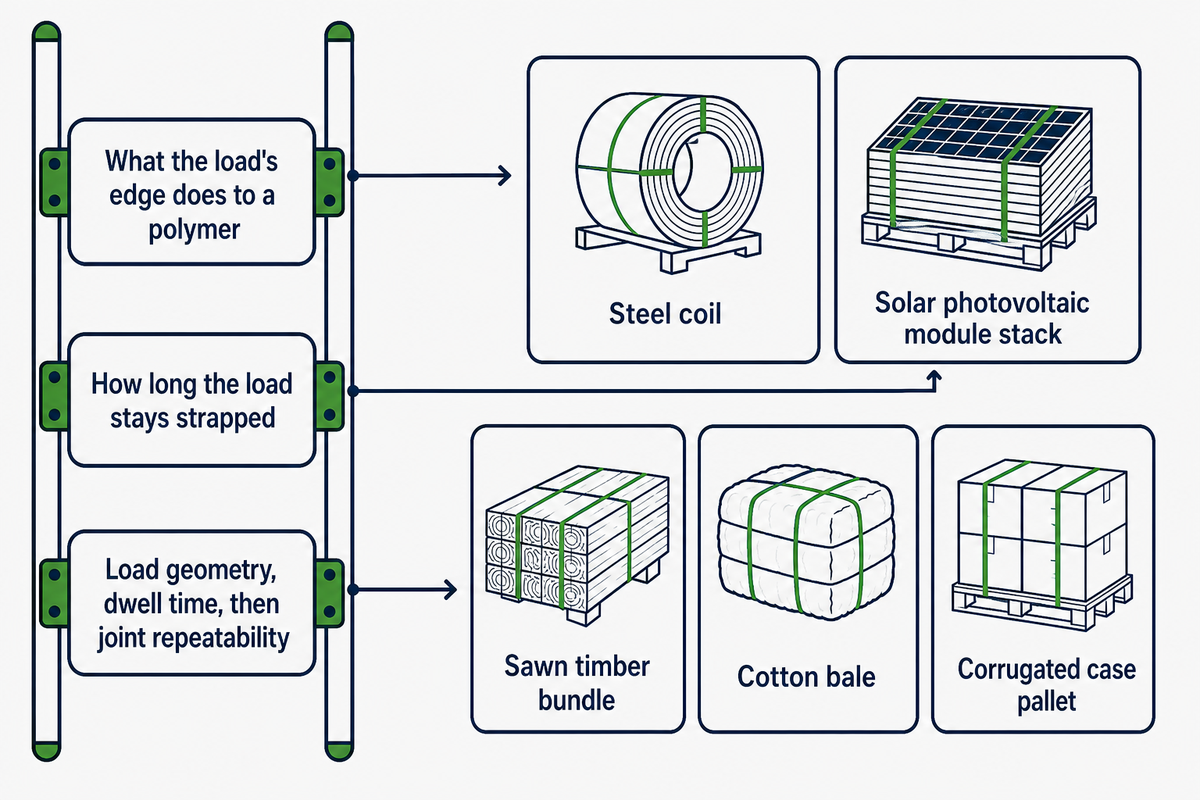
To choose the right strapping, start from what the load does rather than from what the material is called. Three questions settle almost every case: what the load’s edge does to a polymer, how long the load stays strapped and whether it settles, and what joint your line can make repeatably. The Load Signature Index below maps eleven common industrial loads onto those answers.
No single best strapping material exists, and the factors to consider when selecting one run in this order: load geometry, dwell time, then joint repeatability. Buyers who set out to find the best strapping in the abstract re-specify twice. Where strapping is used to unitise a load rather than to reinforce a package, the sizing ratio changes as well, from three to one up to five to one on total break strength.
| Load class | Edge character | Dwell and settling | Material | Joint method | Width x thickness | Failure mode watched |
|---|---|---|---|---|---|---|
| Steel coil | Sharp, heavy, unyielding | Long, no settling | Steel | Double-notch or crimp | 3/4–1-1/4 in x 0.020–0.044 in | Seal slip at the corner |
| Aluminium ingot stack | Blunt but abrasive | Long, minimal settling | Steel or heavy polyester | Crimp or friction weld | 1–1-1/4 in x 0.040–0.050 in | Edge abrasion through the strap |
| Solar photovoltaic module stack | Fragile frame, needs protection | Long transit, some settling | Polyester | Friction weld | 1/2–5/8 in x 0.020–0.030 in | Over-tension crushing the frame |
| Brick and block pack | Hard, chipping corners | Medium, settles in transit | Polyester or composite | Friction weld or wire buckle | 5/8–3/4 in x 0.035–0.050 in | Slack after the pack shifts |
| Sawn timber bundle | Splintering, irregular | Long, dries and shrinks | Polyester or composite | Wire buckle | 5/8–3/4 in x 0.035–0.040 in | Moisture loss outrunning recovery range |
| Paper reel | Soft, marks easily | Medium, compresses | Polyester | Friction weld | 1/2–5/8 in x 0.020–0.030 in | Strap cutting into the reel edge |
| Chemical fibre bale | Compressible, no edges | Long, expands after pressing | Polyester | Friction weld | 1/2–5/8 in x 0.025–0.035 in | Bale expansion snapping a rigid strap |
| Cotton bale | Highly compressible | Long, high stored energy | Steel or heavy polyester | Crimp or friction weld | 3/4–1-1/4 in x 0.035–0.050 in | Joint release under stored energy |
| Corrugated case pallet | Soft, crushable | Short to medium | Polypropylene or polyester | Friction weld | 1/2 in x 0.020–0.026 in | Corner crush before strap failure |
| Fibre drum stack | Rolled rim, no sharp edge | Medium, little settling | Polyester | Friction weld | 1/2–5/8 in x 0.025–0.035 in | Drums walking out of the strap line |
| Tobacco bale | Soft, compressible | Long storage, humidity cycling | Polyester | Friction weld or buckle | 1/2–5/8 in x 0.025–0.035 in | Tension loss over months in store |
This index is our own reading of the evidence in this article applied to the load classes we supply, covering industrial equipment, construction materials, forest products and soft bales; it is not a published specification. ASTM D4675 lists a wider variable set (load and package type, strapping properties and performance, weight, shear planes, component friction and geometry), and any row here should be confirmed by a trial on your own line.
When not to buy on the catalogue number
Sizing by dividing bundle weight by catalogue break strength fails in the field. On an engineering forum, three practising engineers worked the strap force on the same four-bundle stack and produced 38, 64.95 and 29.26 times the unit weight, a 2.2 times spread among professionals solving one problem. The thread starter had sized his bands by weight divided by catalogue strength, with no joint efficiency, no geometry and no derating, and his bundles were already failing in service.
Don’t buy on a break strength alone when the load has corners, when it will settle, or when your line can’t make the same joint twice. Don’t treat a minimum breaking strength as a working figure either: the AAR defines it, in the circular digest cited above, as the load at which an assembly fails in a straight pull, and no pallet is a straight pull. Road regulators frame the same problem in fractions rather than in a single number: the UK Driver and Vehicle Standards Agency expects a load securing system to withstand the entire weight of the load forward, half its weight to the sides and half to the rear, with a friction coefficient of 0.2 assumed unless you can show better. That is vehicle tiedown law rather than unitising law, but it is the clearest published answer to the question buyers actually ask, which is how a load becomes a number. Working out how many straps a strapping for pallets application needs, and where they sit, is covered step by step in our guide on how to strap a pallet.
Width, Thickness and Machine Compatibility: The Specs That Get Orders Rejected
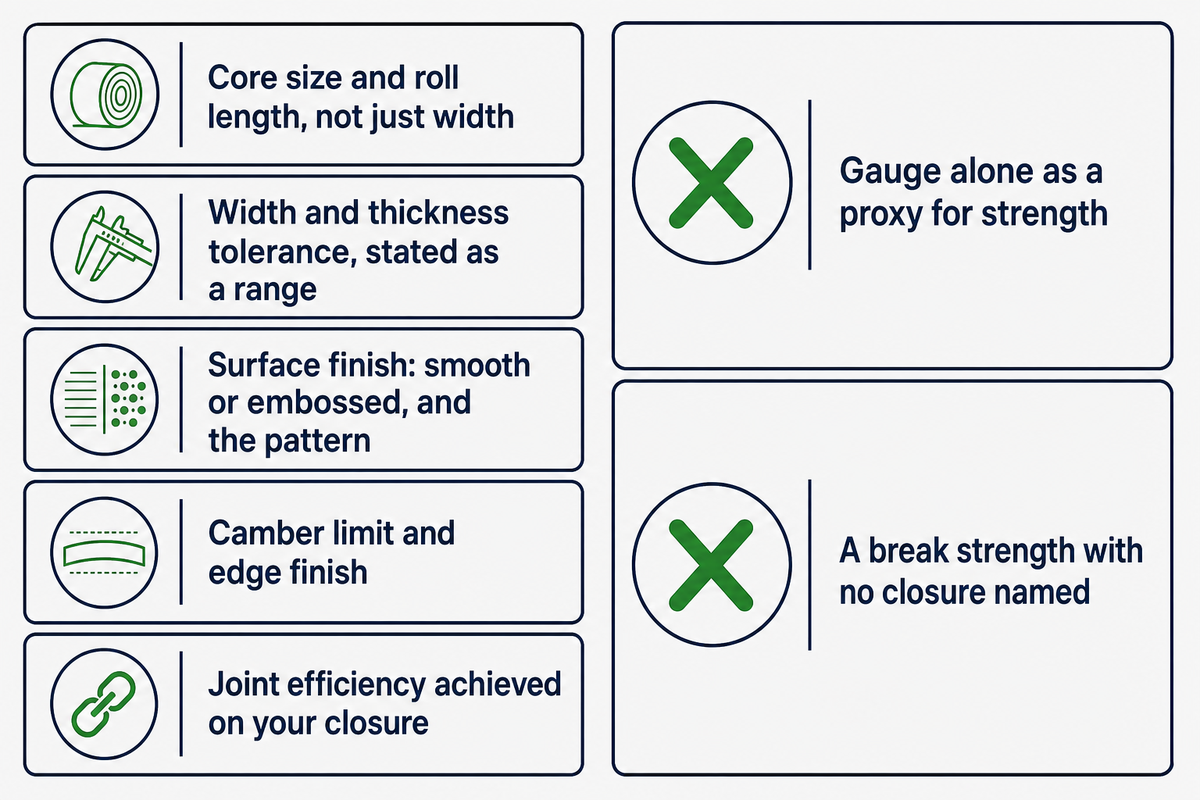
Four dimensions decide whether a substituted coil runs on your line: core size, roll length, width and thickness tolerance, and camber. Get one wrong and a machine tuned to a previous supplier will reject a strap that matches the nominal specification on paper.
Thickness deserves particular suspicion. One manufacturer calls strap thickness “a relatively nebulous measurement”, because a standard 1/2 inch machine grade strap can measure anywhere between 0.014 and 0.030 inch purely on embossing pattern depth, and in an over-embossed strap the thickness reading goes up while the break strength goes down. A second, unrelated supplier puts it directly: smooth-finish strapping has higher tensile strength than the same gauge with an embossed finish. A thicker-measuring strap can be the weaker strap.
The same coil of strapping can be used on more than one machine only when core size, camber and finish all match. Camber, an unwanted twist or curve along the coil’s length, is the second of the silent dealbreakers. Machine grade has to be largely camber free, enabling it to travel along the arch of an automatic strapping machine; recycled content that carries camber will damage the equipment before it damages the load.
Qualify any substitution against your own packaging process before it reaches production. Run a trial coil through the full strapping process, inspect the joint, then inspect it again after 24 hours. A strapping option that matches on paper and fails on the arch costs more than the saving it promised. Where one strapping solution has to cover several packaging needs across a site, specify the tightest case and let the easier ones run inside it.
Put on the request for quotation
- Core size and roll length, not just width
- Width and thickness tolerance, stated as a range
- Surface finish: smooth or embossed, and the pattern
- Camber limit and edge finish
- Joint efficiency achieved on your closure
Leave off it
- Gauge alone as a proxy for strength
- “Equivalent to” a competitor’s part number
- A break strength with no closure named
- A recyclability claim with no standard cited
- A working load limit with no test behind it
Recycled and Recyclable: What a Strapping Claim Actually Certifies
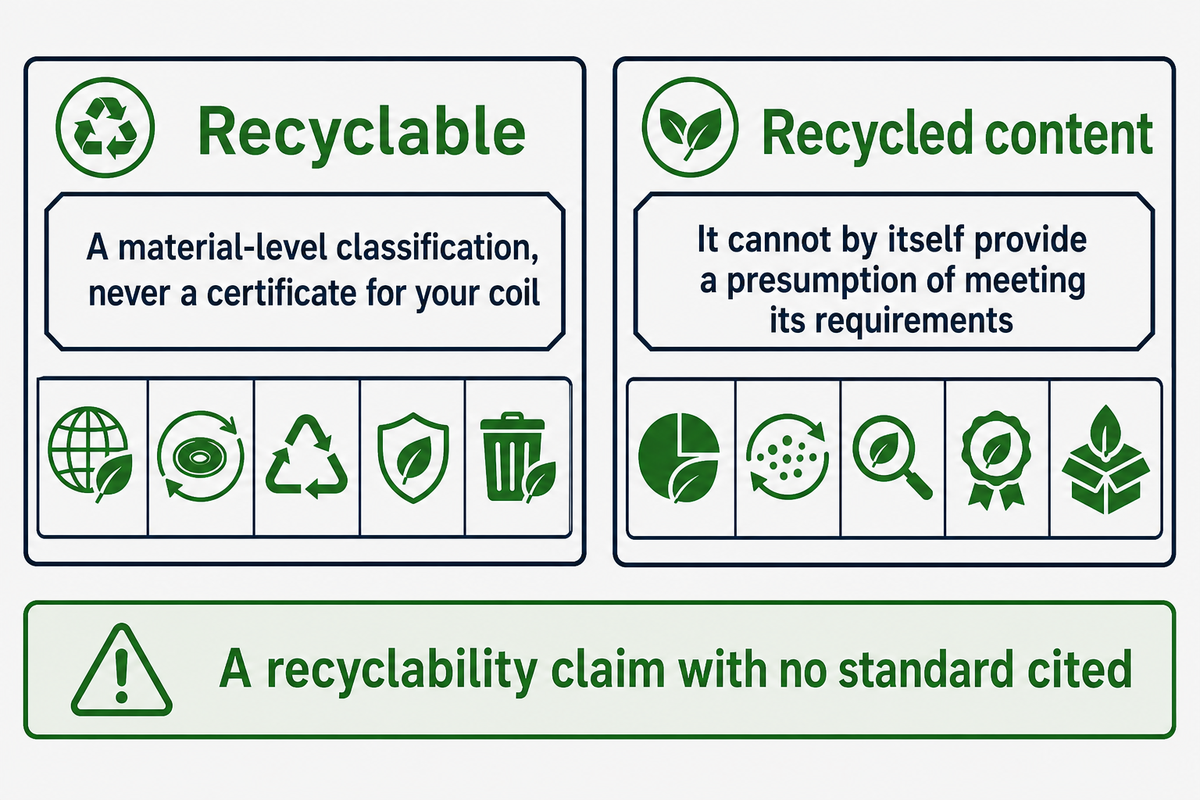
Recyclability and recycled content are two different assertions, governed by two different standards, and neither is a guarantee about the coil in front of you. ISO 18604 specifies the requirements for packaging to be classified as recoverable through material recycling; the public claim printed on a label falls under the ISO 14021 family instead.
ISO 18604 also states, in its own scope, that it cannot by itself provide a presumption of meeting its requirements; the application procedure sits in a companion standard. Treat it as a material-level classification, never as a batch-level certificate. Worth noting on the labelling side: ISO 14021:2016 was withdrawn on 24 June 2026 and revised by ISO 14021:2026, so any datasheet still citing the 2016 edition is quoting a withdrawn document.
“PET recyclate has a lower footprint than new virgin PET. Manufacturers making product from recycled PET — such as straps, films and fibers — should be able to claim that they are lower-carbon than alternatives made from new PET.”
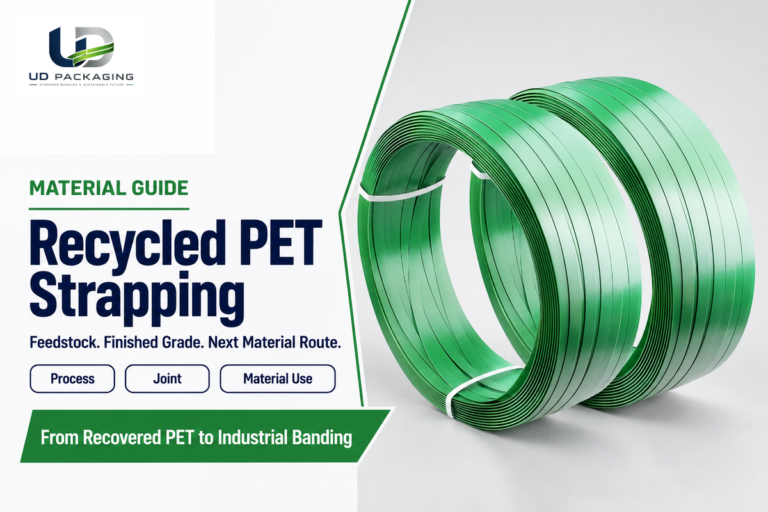
That reporting is twelve years old and is cited here as the origin of the argument rather than as a current figure. UD Packaging runs a chain from polyester granulation through to finished goods in support of renewable resource use, which is a supply position, not a certificate. Anyone quoting recycled PET strapping into their own customer’s sustainability report should ask for the standard, the edition and the scope in the same breath.
What Is Changing in Strapping Selection, and What It Means for Your Next Order
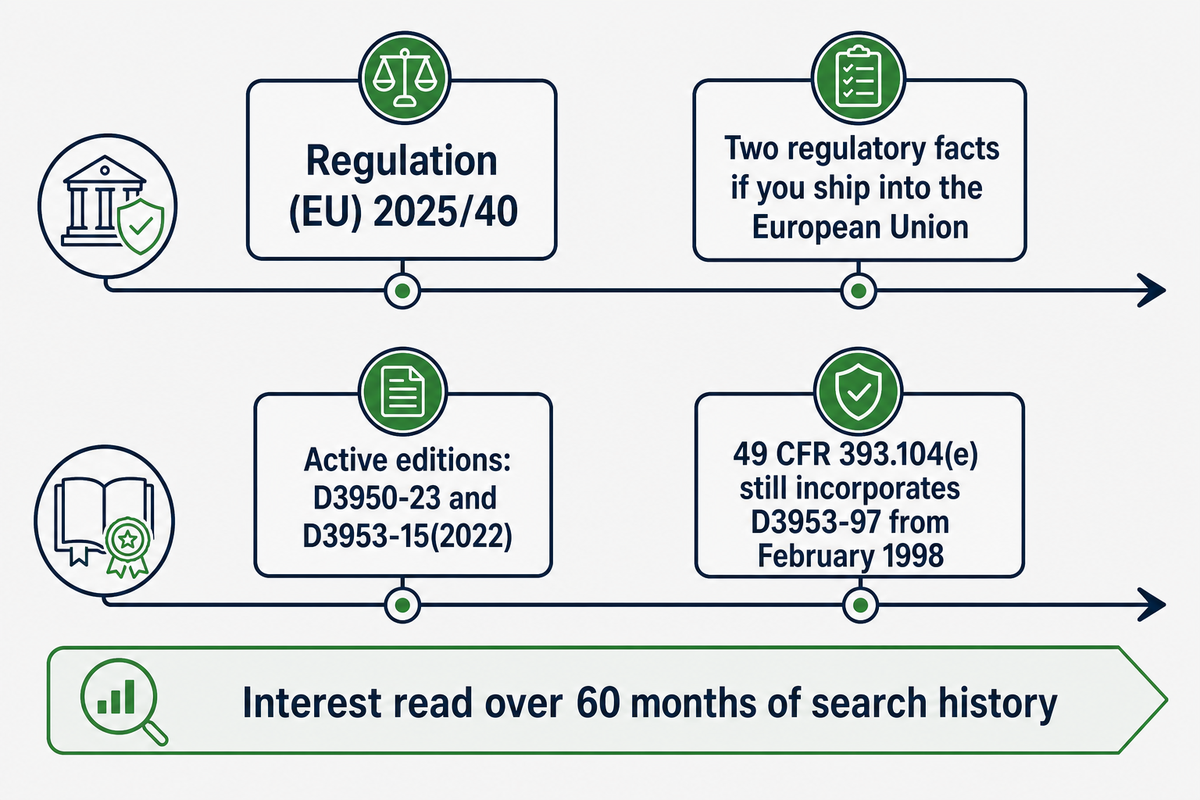
Buyers are re-opening a decision they had already settled, and the evidence for that is behavioural rather than promotional. In our own keyword matrix, over 60 months of search history, the interest baseline for strapping taxonomy questions rose 85.8 percent, with a recent 12-month average of 283.3 against 152.5 in the 24-to-36-month window, while the steel-family terms in the same matrix stayed flat with shallow, ordinary seasonality.
A rising taxonomy query beside flat material queries is the signature of buyers re-running a selection they thought was closed. If you ship into the European Union, two regulatory facts explain part of that. Regulation (EU) 2025/40 on packaging and packaging waste entered into force on 11 February 2025 and applies from 12 August 2026, when the previous directive is repealed for most purposes; some of its provisions continue to apply past that date. Inside that regime, a Commission Delegated Decision dated 25 February 2026 exempts certain economic operators that use pallet wrappings and straps from the 100% reuse requirement for those formats. Read the direction carefully: this is relief from a reuse obligation for a defined group, not a new rule aimed at strapping buyers. What it does prove is that pallet straps are now named individually in binding European packaging law, which no comparison page in this category mentions. Figures circulating in secondary summaries for 2030 targets aren’t repeated here, because they weren’t verified at source.
On the standards side the picture is the opposite of settled. ASTM’s active editions are D3950-23 and D3953-15(2022), while 49 CFR 393.104(e) still incorporates D3953-97 from February 1998. If you are writing a specification in the next quarter, name the edition you mean and check it, because the legal reference and the current standard are not the same document.
What no number here will do is size the market. Seven independent research publishers describe the same substitution of polyester for steel, and their figures span roughly threefold, partly because their scopes differ and partly because nobody can reconcile them. Direction is worth acting on; magnitude, in this category, isn’t evidence.
Frequently Asked Questions
What is the difference between polyester and polypropylene strapping?
Read the answer
Polyester stretches 10 to 12 percent and recovers around 70 percent of that stretch; polypropylene stretches 18 to 34 percent and recovers only 20 to 40 percent. Polyester therefore keeps following a load that settles, while polypropylene goes slack. Polyester also survives outdoor storage and low temperatures far better, which is why it carries palletised freight and polypropylene carries light bundles.
What is the alternative to steel strapping?
Read the answer
Polyester and composite cord are the two working alternatives to steel. Both avoid rust, cut edges and laceration injuries, and both hold force on a settling load better than steel does. Neither replaces steel on hot loads or on unprotected sharp edges. Federal cargo securement rules list steel strapping alongside chain, synthetic webbing, wire rope and cordage, so no general rule of law forces steel on road freight.
How long does composite strapping last?
Read the answer
No published service-life figure for composite strapping could be retrieved from a primary source for this article, and any supplier quoting one should be asked for the test behind it. What one supplier publishes for its own system is a service temperature window from minus 30 °C to 140 °C, with softening from 125 °C. Storage conditions, ultraviolet exposure and buckle quality move real service life more than the coating does.
Is polypropylene strapping recyclable?
Read the answer
Polypropylene strapping can be classified as recoverable through material recycling under ISO 18604, but that classification describes the material, not the batch. Ask which standard the claim is made under, which edition, and whether it covers recycled content or recyclability, because those are separate assertions.
What is the difference between woven and composite strapping?
Read the answer
Composite strapping is high-tenacity polyester yarn encased in a polymer coating. Woven strapping is polyester yarn woven into a webbing without that coating. Both close with a wire buckle and both fall under Type IA in ASTM D3950 rather than forming separate material families. The coating on composite gives a smoother, more consistent surface for the buckle to grip and better resistance to handling damage, while woven webbing spreads load over a wider face and suits soft or irregular bundles. Choose between them on dwell time, on how the buckle is threaded, and on whether the destination accepts the grade marked on the strap. A widely used trade buying guide recognises only three strapping materials and omits both of these, so vendor comparisons in this corner of the market are thin.
What is the plastic strap called?
Read the answer
Plastic strapping is the general trade name, and it is also known as banding. Underneath that label sit four distinct products: polypropylene strapping, sometimes written pp strapping; polyester strapping, usually sold as PET strap; composite cord strapping; and woven polyester strapping. ASTM D3950 sets formal type designations across the nonmetallic family: polyolefin is Type II, nylon Type III, polyester Type IV, and bonded or woven polyester cord Type IA. When a quotation says only “plastic strapping”, ask which of those four it means, because their break strength, elongation and joint behaviour are not interchangeable.
References and Sources
- 49 CFR 393.104, Standards for cargo securement devices and systems — United States Government, Electronic Code of Federal Regulations.
- ASTM D3950-23, Standard Specification for Strapping, Nonmetallic (and Joining Methods) — ASTM International.
- ASTM D3953-15(2022), Standard Specification for Strapping, Flat Steel and Seals — ASTM International.
- ASTM D4675-14a(2022), Standard Guide for Selection and Use of Flat Strapping Materials — ASTM International.
- EP 2 768 889 B1, Strapping and methods of making the same — European Patent Office grant, assignee Samuel Son and Co (USA) Inc.
- Securing loads on HGVs and goods vehicles, section 2 — UK Driver and Vehicle Standards Agency.
- ISO 18604, Packaging and the environment: material recycling — International Organization for Standardization.
- ISO 14021, Environmental labels and declarations: self-declared environmental claims — International Organization for Standardization.
- Packaging waste, Regulation (EU) 2025/40 — European Commission, Directorate-General for Environment.
- Commission Delegated Decision on economic operators using pallet wrappings and straps — European Commission, Directorate-General for Environment, 25 February 2026.
- A complete guide to strapping and strapping equipment — Packaging Strategies, BNP Media, 17 March 2016.
- Recycling not always lowest-carbon option for PET bottles, says new report — Packaging Digest, 29 January 2014.
How this article was researched, and what it doesn’t claim. Joint efficiency percentages, clause numbers, the precision table figures and the quoted D3953 caveat are all taken from the standard editions consulted for this article, not from the current editions, which should be purchased and checked before any of them is designed to. The 24-hour retention band comes from a patent assigned to a strapping manufacturer, so it’s industry measurement rather than independent validation. No polypropylene break strength band, no composite service-life figure and no market size appears here, because none could be retrieved from a source we were willing to stand behind. UD Packaging’s SGS testing and GB/T 1040 series references are the company’s declared quality programme, not per-batch certification.
Specifying strapping for a load that has to arrive tight?
UD Packaging manufactures PET strapping and industrial stretch film, and supplies strapping seals, buckles and manual to fully automatic strapping machines, from a production base in Jiangyin, Wuxi, supplying metal, new energy, building materials, timber, paper, chemical fibre, cotton textile, agriculture, food, electronics and tobacco loads.
Send us the load class, the dwell time and the closure your line can make, and we’ll quote against those three rather than against a width. Start with the closure and accessory range.