Get in touch with UD Packaging Company

Updated September 2026 · By XCX
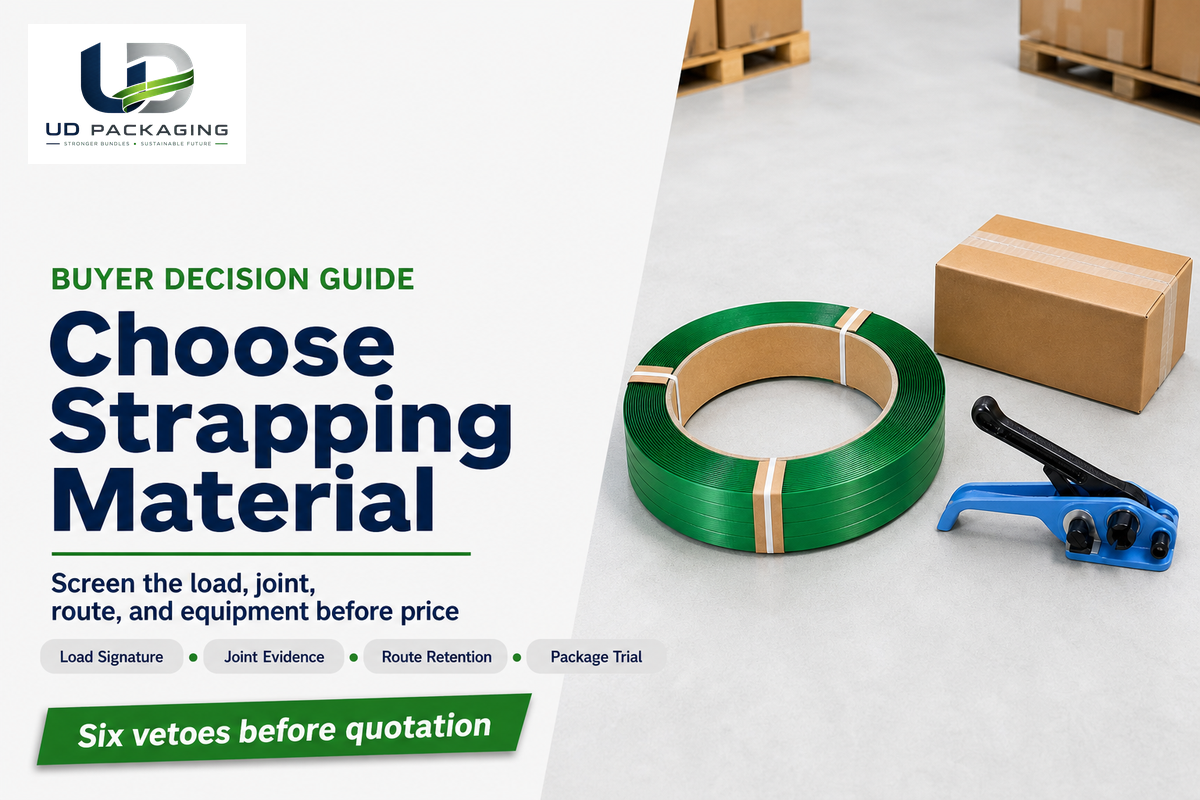
How to choose strapping material is a system decision: match the packaged load to an exact strap, completed joint, tool, route, and representative trial. Record settling and contact, then eliminate any candidate with an unresolved load, joint, edge, route, equipment, or trial condition.
Catalog break strength isn’t a package rating. Each material family contains different grades, dimensions, joints, and application conditions.
Intent boundary: this article owns the pre-quotation elimination sequence and evidence handoff. For family properties, performance comparisons, and load examples, use the existing industrial strapping material guide; this page does not re-rank those families.
Scope boundary: This guide covers package unitization. It does not select commercial vehicle tiedown assemblies or authorize strapping for hoisting. Those uses require their applicable rated systems and governing requirements.
Start With the Load, Not a Material Name
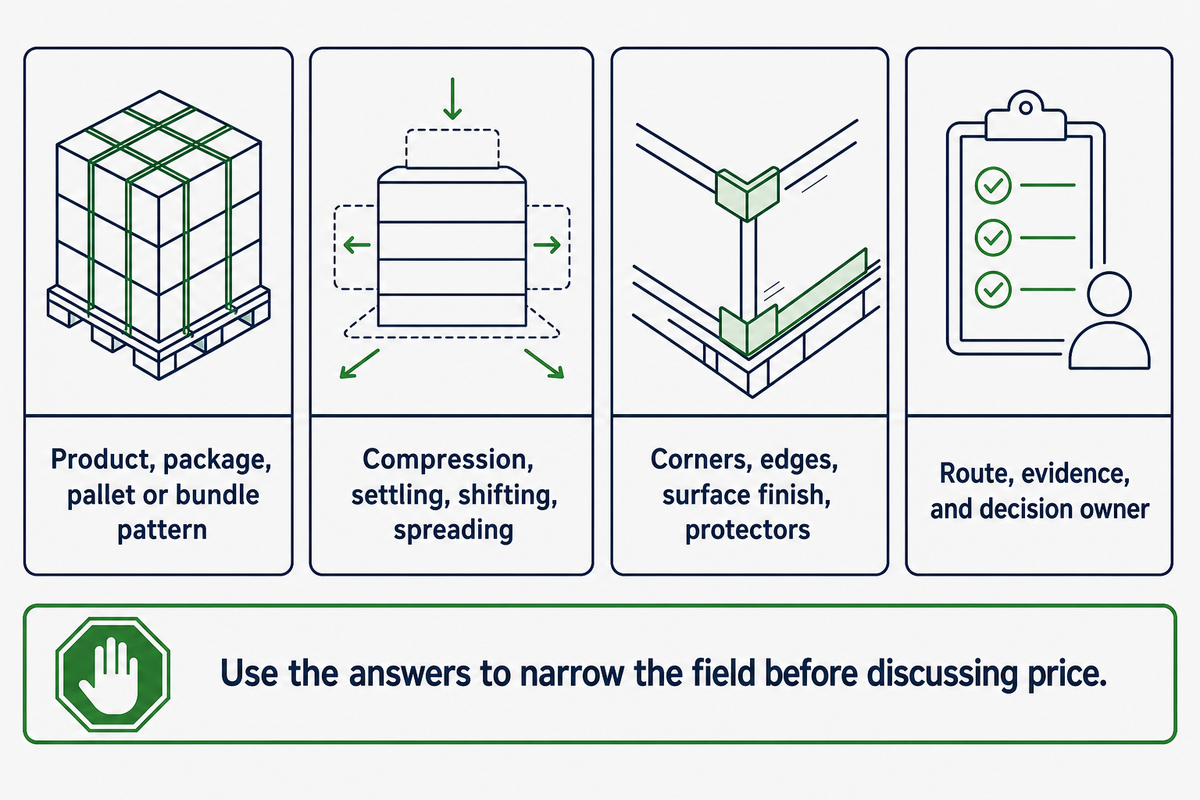
The first task is to create a load signature: mass, geometry, rigidity, settling, surface, edge condition, handling points, storage, route, and consequence of failure. Weight matters, but it can’t show whether a corner will cut the strap, a carton will crush, a bundle will spread, or a joint will release.
| Question | What to record | Unknown blocks |
|---|---|---|
| 1. What is being unitized? | Product, package, pallet or bundle pattern | A material comparison with no package identity |
| 2. How heavy and large is it? | Packaged mass and external dimensions | Any claim based on an assumed load |
| 3. Is the load rigid? | Compression, settling, shifting, spreading | A fixed-tension assumption |
| 4. Where does strap contact it? | Corners, edges, surface finish, protectors | A strap path with unreviewed damage points |
| 5. How is it handled? | Forklift, conveyor, crane-adjacent handling, manual moves | Unidentified shocks or snag points |
| 6. Where is it stored? | Indoor or outdoor, dwell time, stacking | Unbounded exposure |
| 7. What does the route add? | Vibration, impacts, transfers, temperature, moisture | A trial unrelated to the shipment |
| 8. What has failed before? | Break, slip, loosen, cut, crush, mark, shift | A replacement that repeats the same failure path |
| 9. Who accepts the result? | Decision owner, evidence, release and reopen rule | A trial with no decision basis |
Use the answers to narrow the field before discussing price. Material-family performance remains with the guide identified in the intent boundary above.
Evidence capsule: ASTM D4675-14a(2022) describes flat-strapping selection as a starting point and states, “Thorough user testing is essential.” The public page does not approve a material for a particular package. It supports recording the application first and testing the selected system under relevant conditions.
Turn a Material Shortlist Into Comparable Supplier Evidence
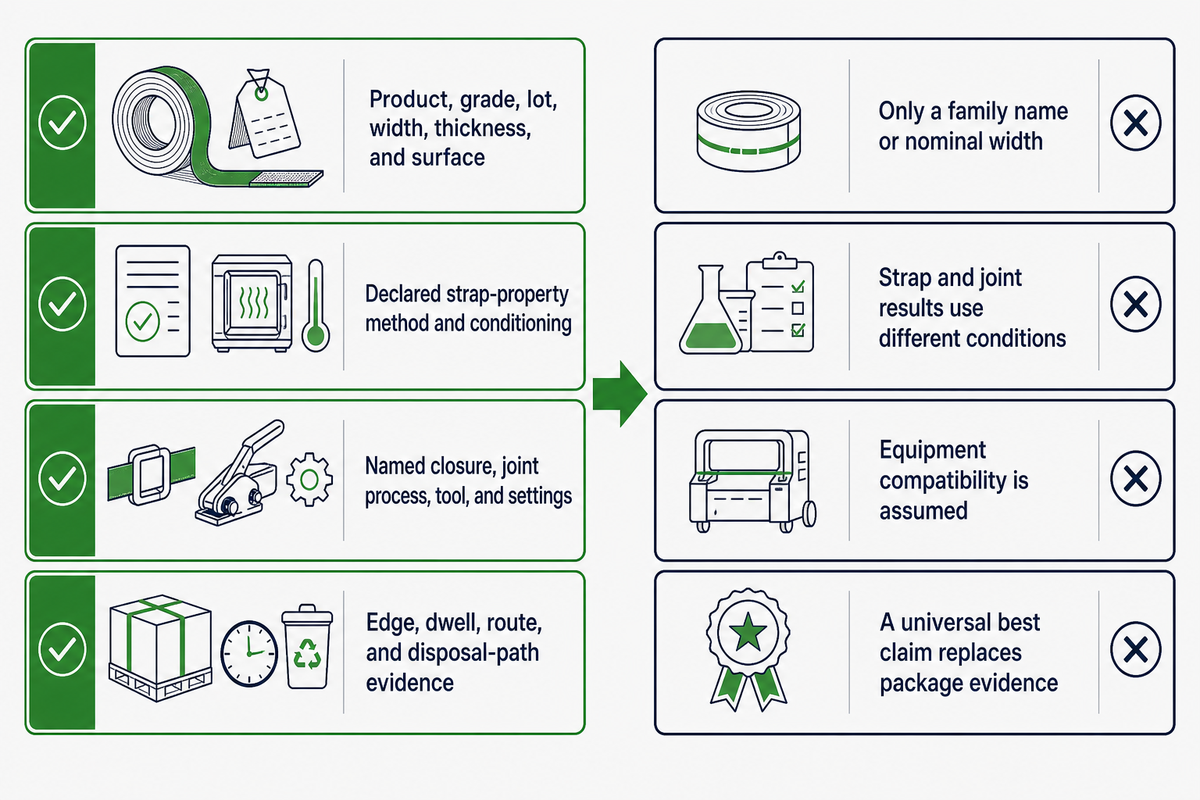
Questions such as how to choose strapping material for metal or packing still need system evidence, but this step does not repeat the site’s PP, PET, steel, woven, or composite cord rankings. Take a shortlist from the material-family guide above, then require the same evidence fields for every exact candidate before one reaches quotation.
Keep in the candidate packet
- Product, grade, lot, width, thickness, and surface
- Declared strap-property method and conditioning
- Named closure, joint process, tool, and settings
- Edge, dwell, route, and disposal-path evidence
Return the quotation when
- Only a family name or nominal width is supplied
- Strap and joint results use different conditions
- Equipment compatibility is assumed
- A universal “best” claim replaces package evidence
The output is a rejection-ready packet, not a second material recommendation. One shortlisted grade may advance while another stops because its joint, edge, route, or equipment evidence is missing; record that disposition before supplier price becomes the deciding signal.
Labels such as best strapping, heavy-duty strapping, polypropylene strap, polyester strap, fully automatic strapping, or hand strapping describe a category or application route; they do not approve a configuration. Use plastic strapping types and grade labels for taxonomy and the PET-versus-steel engineering comparison for that substitution question.
Normalize RFQ Language Without Re-ranking Materials
| Buyer wording | Pre-quotation interpretation |
|---|---|
| choose the right strapping; right strap; type of strapping; type of strapping material | Start with the load signature, then document why a candidate advances. |
| right strapping material; choose the right strapping material; appropriate strapping | Require all six vetoes to pass before commercial handoff. |
| polypropylene strap; polyester strap; polypropylene or polyester strapping; polypropylene and polyester | Use the existing family guide, then compare exact grades and joints here. |
| woven strapping; composite strapping; different types of strapping; different strapping | Name construction, coating, grade, and closure in the packet. |
| strapping solution; strapping option; strapping for your needs; packaging needs; strapping needs | Define the package, route, evidence owner, and unresolved vetoes. |
| strapping products; strapping available; variety of strapping; types of strapping available; strapping options available | Treat availability as a shortlist, not proof of suitability. |
| best strapping; best strapping material; find the right strapping; choose the best; selecting the right strapping; select the right; make the right choice | Reject the universal-best premise and record the selection basis. |
| fully automatic strapping; hand strapping; manual strapping; strapping machine; strapping equipment; fully automatic | Bind the candidate to the actual application route and settings. |
| heavy-duty; heavy loads; lighter loads; light to medium; strength and durability; durability; level of elongation | Replace broad labels with source, method, condition, and acceptance fields. |
| strapping applications; strapping for your packaging; pallet strapping; strapping seals; items together; products you are packaging; metal or plastic | Record the material used, strapping method, package, and closure. |
| types of plastic strapping; many types of strapping; types of strapping materials available; different kinds of strapping materials | Send taxonomy questions to the family guide before this evidence screen. |
| know which material; type of material; strapping is one; strapping is made; strapping material is best; material is right | Ask what comparable evidence makes the option cost-effective for this package. |
Evidence capsule: The public abstract for ASTM D3950-23 says the specification covers five material-based types of nonmetallic strapping. It also separates breaking strength and elongation, transverse strength, and joint strength. The abstract does not name universal values or make this pre-quotation vocabulary table an ASTM classification.
Calculate Usable Restraint Through the Completed Joint
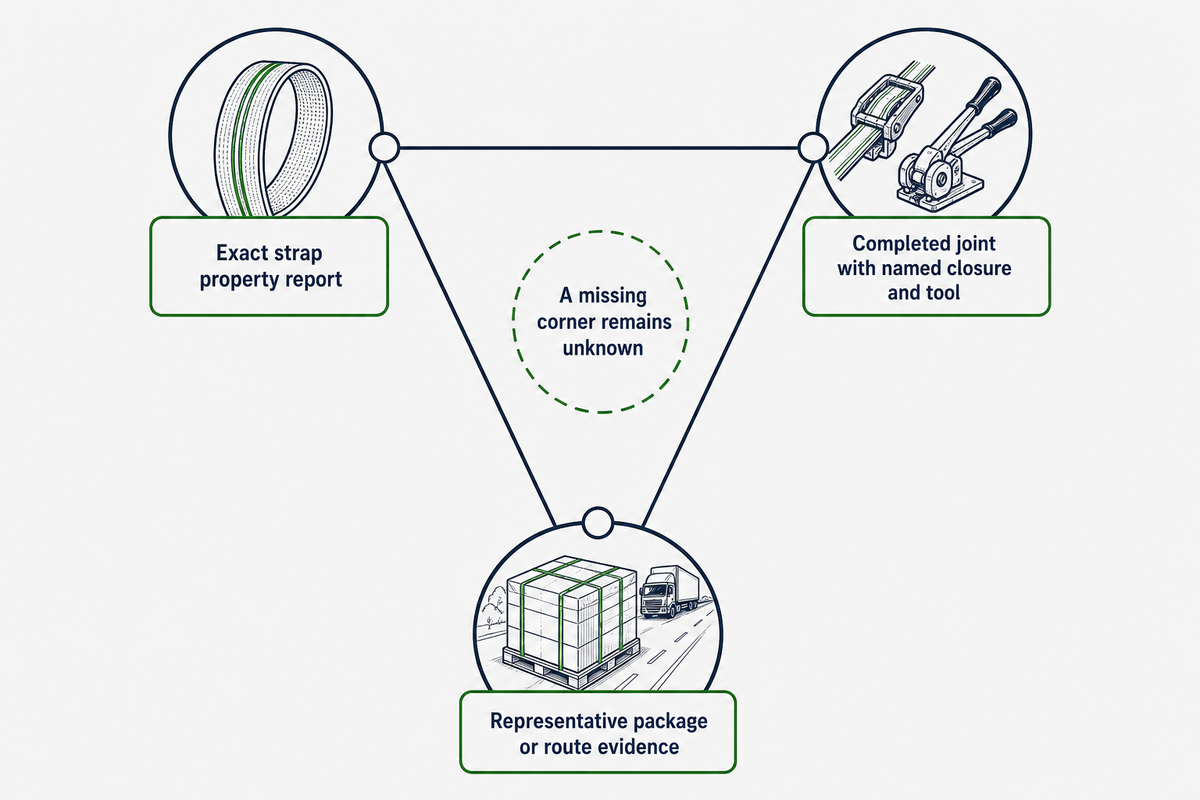
A strap-body result and a completed-joint result are different evidence layers. The weaker relevant link can limit the applied system, but multiplying either value by the number of straps doesn’t create a package rating. Geometry, load sharing, applied tension, route demand, and the responsible design basis still matter.
Material–Joint–Route Triangle
Ask for three records: the exact strap’s property report, the completed joint formed with the named closure and tool, and the representative package or route evidence. A missing corner remains unknown; evidence from one corner can’t stand in for another.
Compare strap and joint results only when identity, units, specimens, conditioning, and methods align. The comparison still applies only to the recorded configuration.
| Evidence | What it can support | What remains open |
|---|---|---|
| Strap-only test | Property of the identified specimen | Closure, applied process and package |
| Completed-joint test | Named strap, closure, tool and method | Load path, sharing and route |
| Representative package trial | The recorded package and challenge | Changed products, processes and routes |
The completed joint strength test method keeps raw forces, conditions, and failures together. Never replace missing data with a generic percentage.
Hypothetical teaching records only, not UD data: 16.0 mm × 1.0 mm strap, 23 °C, 50% relative humidity, 24 h conditioning, 200 mm/min pull rate, 100 mm overlap, 60 s hold, 3,250 N joint force, 5,000 N strap force, and a 65% ratio. A record at 40 °C, 80% relative humidity, 48 h, 300 mm/min, 120 mm overlap, or 500 mm free length is different. A contrasting hypothetical record might specify 12.0 mm × 0.8 mm, 18 °C, 36 h, 250 mm/min, 90 mm overlap, 45 s hold, 2,600 N joint force, 4,000 N strap force, 600 mm free length, 700 mm fixture span, and 30 s dwell.
Evidence capsule: ASTM D3950-23 treats joint strength as a separate property within nonmetallic strapping. The DLA ASSIST record lists ASTM D3953 as active for flat steel strapping and seals, with a next review date in 2029. Neither public record supplies a universal finished-package load formula.
Eliminate Candidates That Cannot Survive Edges and Surfaces
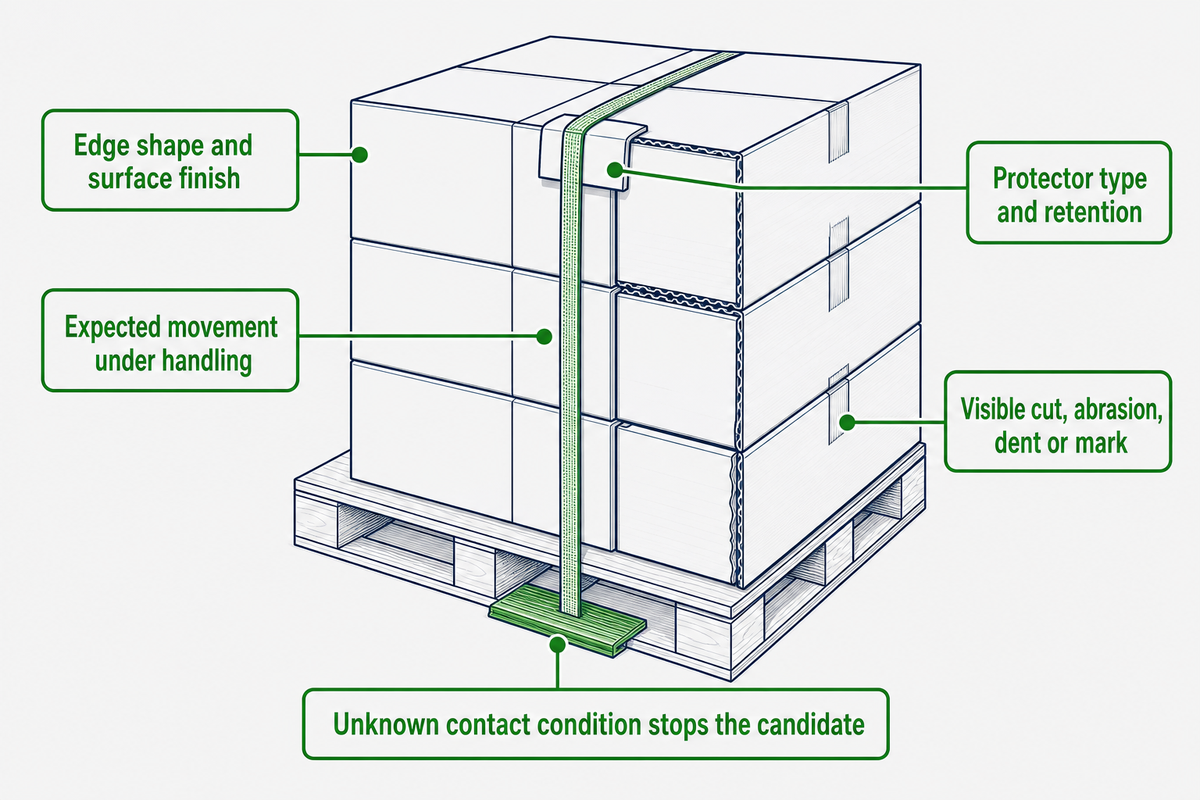
Tensile strength can’t answer cutting, abrasion, crushing, or marking risks at the package surface. Trace every strap path, note where the load can move, and inspect corners, gaps, protrusions, protectors, and sensitive finishes. If the contact condition is unknown, the candidate hasn’t passed the edge-and-surface veto.
Record at each contact
- Edge shape and surface finish
- Expected movement under handling
- Protector type and retention
- Visible cut, abrasion, dent or mark
Stop the candidate when
- The strap path crosses an unreviewed sharp feature
- A protector can migrate out of position
- The package crushes before the required tension is reached
- Surface damage has no acceptance owner
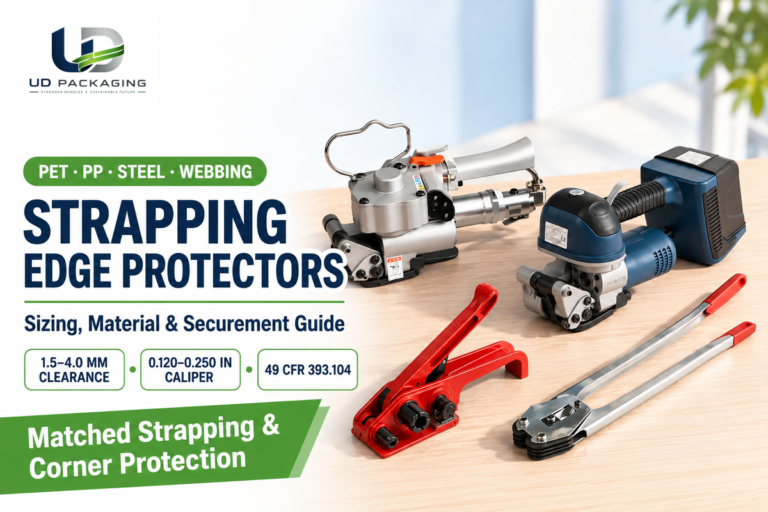
Trial corner protection with the actual package and handling method. Review edge-contact inputs for pallet loads after recording deck gaps and compression points.
Evidence capsule: ASTM D4675-14a(2022) includes package geometry, component frictional characteristics, handling, transit, and storage within its selection scope. That breadth supports an edge-and-surface veto, but the public guide does not publish one edge-radius limit or protector rule for all products and strap grades.
Match Tension Recovery to Settling, Shock, Storage, and Route
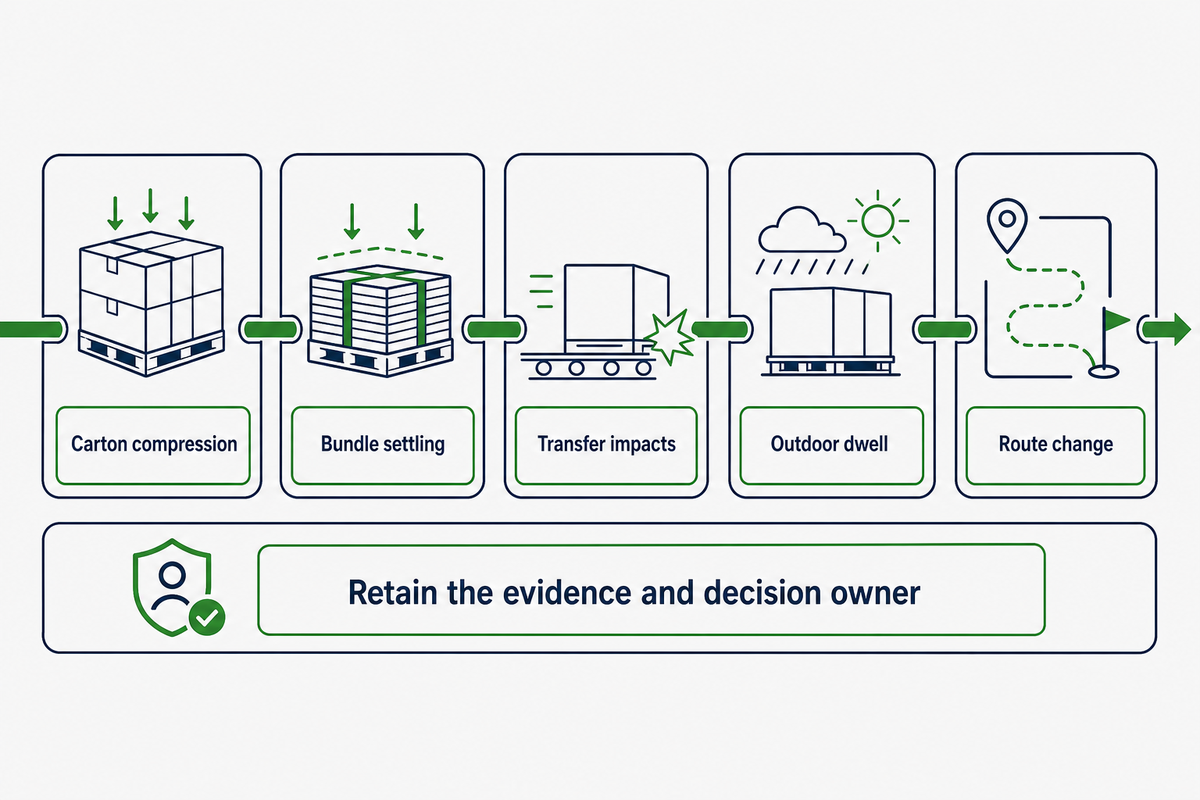
Initial tension is only the starting condition. The strap and load change together as cartons compress, bundles settle, temperature changes, moisture appears, and handling adds shock or vibration. Ask how the exact candidate behaves across the planned dwell and route, then compare that evidence with arrival observations and failure consequences.
| Route or load change | Question for the candidate | Evidence to retain |
|---|---|---|
| Carton compression | Can required restraint remain without crushing? | Dwell observations and package dimensions |
| Bundle settling | How does tension change as the bundle seats? | Applied and later tension method |
| Transfer impacts | Can strap, joint and protectors remain positioned? | Post-handling inspection |
| Outdoor dwell | What exposure limits apply to the exact grade? | Time and environmental record |
| Route change | Does the prior trial still represent the shipment? | Change decision and owner |
Request grade-specific data and an application trial. When supplier, speed, package, or route changes, record whether prior evidence still applies.
Evidence capsule: ISTA’s current retest guidance lists changes to the product, package, straps, closures, automation, equipment, speed, and distribution system among examples that may reopen testing when performance can be affected. It does not say every change needs the same test or acceptance threshold.
Confirm Seal, Buckle, Tool, and Machine Compatibility
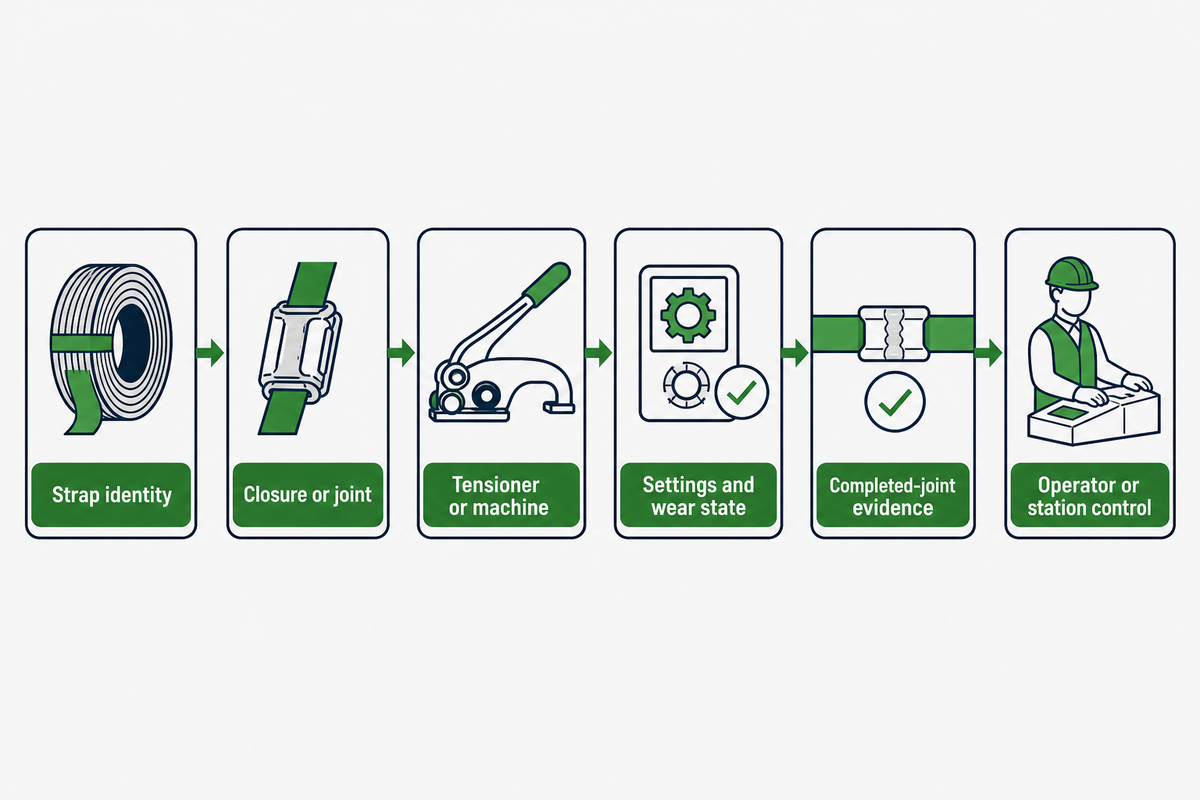
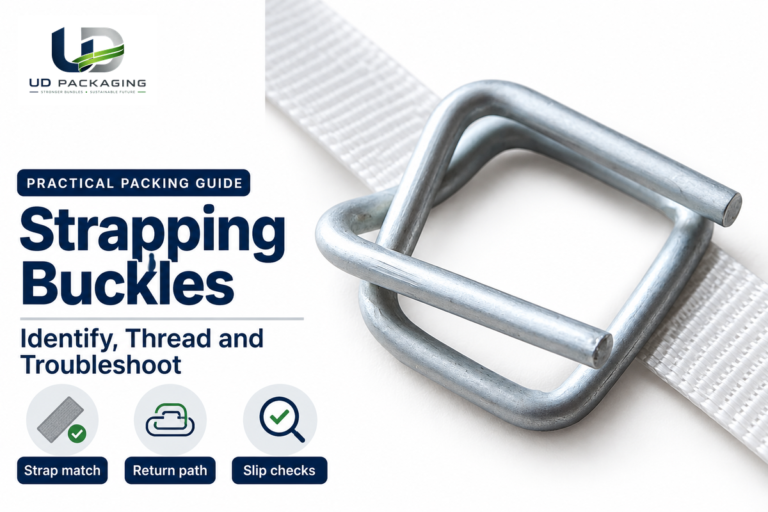
A candidate roll isn’t a working system until the specified seal, buckle, weld, tool, settings, and maintenance state can form a repeatable joint. Bind strap width, thickness, surface, and grade to the exact manual, semi-automatic, or fully automatic route rather than approving by nominal width alone.
Compatibility chain
Strap identity → closure or joint → tensioner or machine → settings and wear state → completed-joint evidence → operator or station control. A change anywhere in the chain needs a documented compatibility decision.
Record setting ownership, wear checks, alignment, and investigation triggers. Don’t transfer one tool’s result to another model or condition.
Use UD Packaging’s strapping tool and machine routes to discuss equipment fit, with every claim tied to the offered configuration and report.
Use the 6-Veto Strap Selection Framework
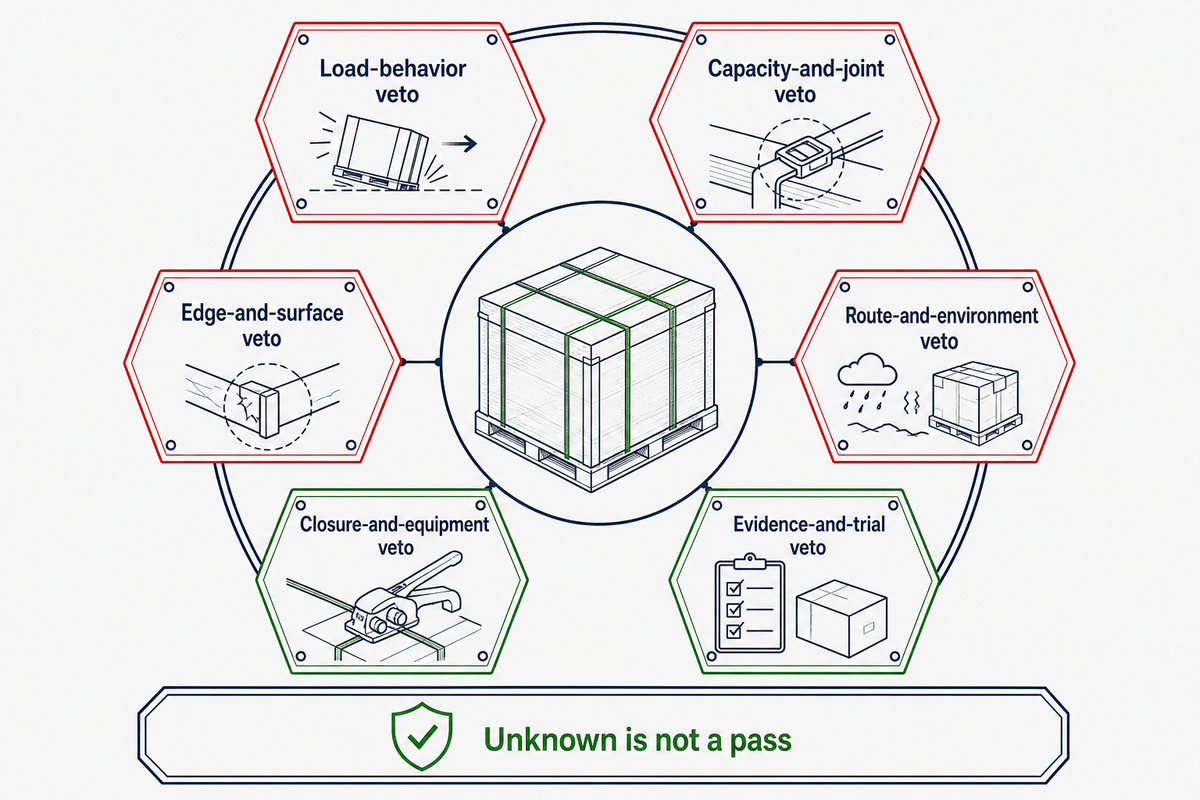
The Six-Veto Strap Selection Sequence is an elimination method: an unresolved load, joint, edge, route, equipment, or evidence condition stops a candidate before quotation or trial release. It is not a score, standard, safety factor, or package approval. A low price cannot offset a required condition that fails.
Use-class precondition: Confirm the strap is for package unitization. For a commercial vehicle tiedown or hoisting application, stop this sequence and use the relevant rated system and governing requirements.
- Apply the load-behavior veto to candidates screened against the wrong geometry, rigidity, settling pattern, or failure consequence.
- Use the capacity-and-joint veto when no comparable strap and completed-joint evidence exists for the proposed configuration.
- Edge-and-surface veto: reject candidates whose contact risks or protector stability remain unknown.
- Route-and-environment veto: reject candidates with no evidence for relevant dwell, temperature, moisture, handling, or route conditions.
- Closure-and-equipment veto: reject candidates that can’t be bound to the named joint, tool, settings, and process controls.
- Evidence-and-trial veto: reject release when the representative package, acceptance owner, observations, and change triggers are missing.
| Veto status | Meaning | Next action |
|---|---|---|
| Pass | Required evidence supports moving to the next gate | Keep the source and scope |
| Fail | A required condition is not met | Remove or redesign the candidate |
| Unknown | Evidence is missing or not comparable | Assign an owner; do not treat as a pass |
| Not applicable | The condition is outside this package | Record why it does not apply |
Once the six fields are visible, take the completed Six-Veto record into UD Packaging’s configuration review. That page is the commercial handoff; it doesn’t erase any unknown or turn this guide into a product claim.
Have a load, route, joint method, and current equipment record? Share the completed Six-Veto sheet with UD Packaging for a configuration discussion.
Trial the Candidate on a Representative Package
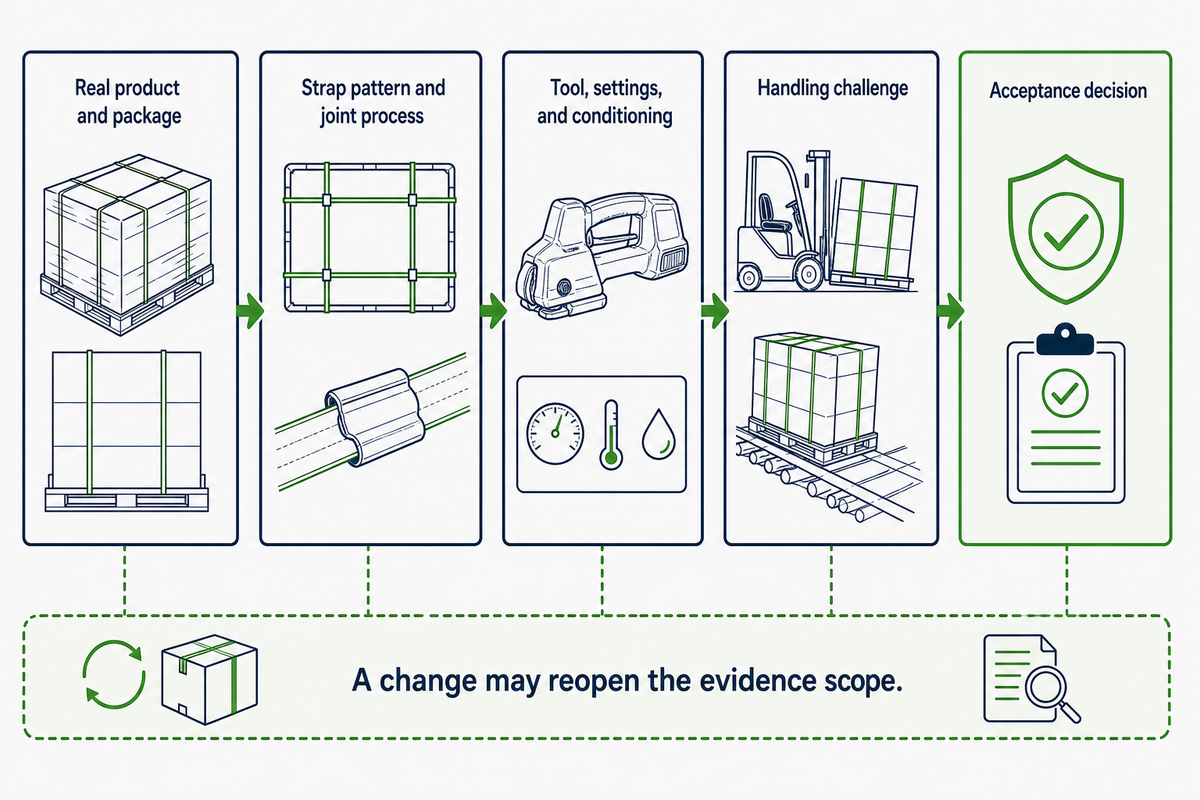
A representative trial binds the candidate to a real product, package, strap pattern, joint process, tool, settings, conditioning, handling challenge, and acceptance decision. It should also record worker exposure during tensioning, recoil, cutting, and removal. One good joint or undamaged sample doesn’t approve every route.
Do not create a second change-control worksheet here. When a product, package, strap, closure, supplier, tool, machine, automation step, line speed, or distribution system changes, use the existing 9-Delta retest workflow to choose and document the evidence scope. This guide ends at candidate elimination and the first configuration handoff.
Qualified process signal: Packaging Strategies reported that packaging-test-equipment provider Industrial Physics commissioned a 2024 survey of 380 food-and-beverage packaging professionals across five countries; 50% said their testing process had changed positively over five years. This supplier-backed research describes a cross-packaging testing signal; it does not show that one strapping material is replacing another.
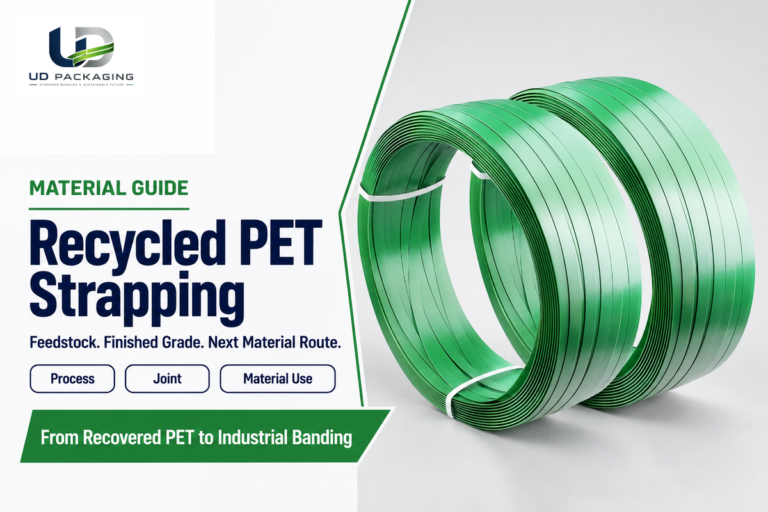
Review PET strapping options after completing the application record. Release still belongs to the tested configuration and named owner.
Evidence capsule: ISTA’s change guidance names straps, closures, equipment, automation, speed, and distribution among possible retest triggers. The 2024 survey adds qualified process context. Neither source supplies a universal specimen count, test sequence, or release threshold.
Frequently Asked Questions
How do you choose packaging strap, and what factors determine the right material?
Answer
Start with package geometry, mass, rigidity, settling, edges, surface sensitivity, handling, storage, route, and failure consequence. Then verify the exact grade, completed joint, tool and closure compatibility, and representative package evidence. Record who owns each decision, what proves it, and what change reopens it. An unresolved required field remains a veto; it isn’t a zero, a pass, or a reason to apply a generic safety factor.
Is PET or PP strapping better?
Answer
Neither is universally better. The material-family guide linked above owns that comparison and explains why family labels alone cannot decide the shipment. This page starts only after a buyer nominates an exact product. It then screens that product against the same load, joint, edge, route, equipment, and trial evidence vetoes before quotation, without creating another PET-versus-PP ranking.
Can PET strapping replace steel strapping?
Answer
Replacement is not a family-wide rule. The PET-versus-steel engineering comparison linked above owns the substitution analysis and helps form a shortlist for a defined use class. Bring one exact candidate from that work into this pre-quotation veto sequence. A candidate advances only when its supporting evidence is complete; this page does not issue a general approval to replace steel.
How strong is poly strapping?
Answer
There is no single value. Identify the grade and dimensions, then request comparable strap and joint results. Keep package validation separate.
When are edge protectors needed?
Answer
Consider protection when contact may cut or abrade the strap, crush packaging, or mark the product. Verify the protector’s position during tensioning and handling. It can’t correct a poor strap path, unstable load, unsuitable material, or unreviewed sharp feature.
What should be tested before changing strapping material?
Answer
This page does not define a second test or release checklist. Use the 9-Delta retest workflow linked above to decide which evidence a specific change reopens and who owns the release decision.
Related Strapping Guides
- How to strap a pallet for application sequence and pattern planning.
- Plastic strapping systems for the parent product and solution scope.
- Strapping accessories for seals, buckles, and supporting components.
Method and Evidence Note
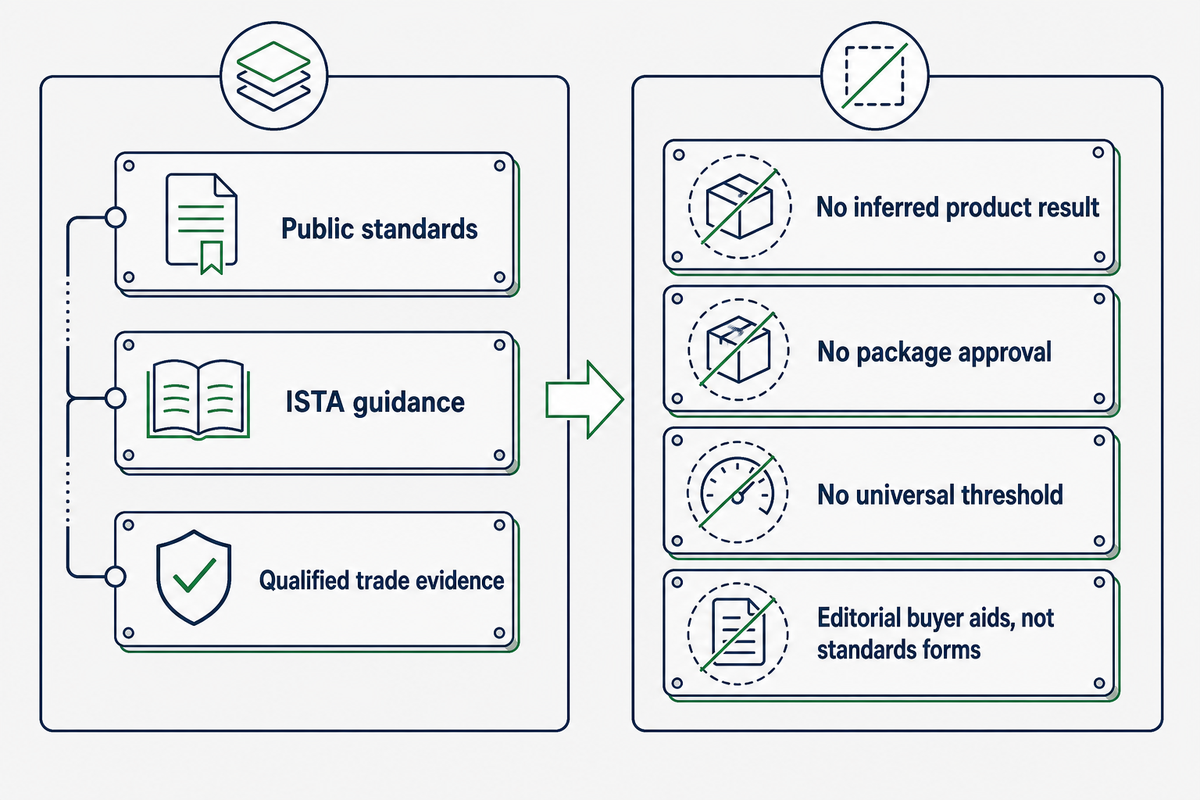
This guide uses public standards, ISTA guidance, and qualified trade evidence. No UD Packaging certificate scope, product result, package approval, price, minimum order, lead time, capacity, relationship, or universal threshold was inferred.
The Six-Veto Strap Selection Sequence and Material–Joint–Route Triangle are editorial buyer aids. They are not ASTM or ISTA forms, legal advice, rated cargo-securement methods, hoisting authorizations, or substitutes for the applicable package trial and workplace procedure.
References & Sources
- ASTM D4675-14a(2022), Standard Guide for Selection and Use of Flat Strapping Materials · ASTM International
- ASTM D3950-23, Standard Specification for Strapping, Nonmetallic (and Joining Methods) · ASTM International
- ASTM D3953 lifecycle record for flat steel strapping and seals · DLA ASSIST
- When should a packaged product be retested? · International Safe Transit Association
- Automatic process control seen as testing opportunity · Packaging Strategies report on an Industrial Physics-commissioned survey