Get in touch with UD Packaging Company

Strapping Edge Protectors: How to Match Strap Width, Contact Area, and Corner Protector Materials to Load Edges

Strapping edge protectors require 1.5–4.0 mm of channel clearance over 12–32 mm bands (or a 4.5 in slot for 2–4 in webbing) to spread clamping force across 90-degree load corners. Next, size leg length (1.5–4.0 in) and caliper (0.120–0.250 in) to your carton compression strength, and pick molded plastic, laminated kraft fiberboard, or galvanized steel by edge hazard.
You can see the impact corner protectors for shipping have on every shipment by walking any loading dock. A high-tension polyester band can crush a carton corner, or a sharp edge can slice through a strap during transportation unless guards prevent damage and safeguard valuable cargo. Both occur at the 90-degree corner interface.
At UD Packaging, we manufacture industrial polyester (PET) strapping systems and polypropylene (PP) bands in 9–25 mm widths. We test how these bands interact with different corner guards every week. This guide covers corner friction physics, channel sizing, bearing pressure math, material selection, and federal securement rules.
Key Engineering Takeaways:
- Corner Friction Loss: Across an unguarded 90-degree carton or wood corner (
μ = 0.20–0.40), belt friction drops single-corner strap tension by27%–47%. Smooth plastic corner protectors (μ = 0.10–0.15) cut that loss to15%–21%. - Channel Clearance Rule: Keep guide channel width
1.5–4.0 mmwider than nominal PET, PP, or steel banding width. Oversized slots let narrow poly strapping twist sideways under tension. - Contact Area Multiplier: A bare
16 mmstrap contacts only160 mm²at the corner. Adding a40 × 40 mmribbed plastic clip expands contact to1,600 mm²per leg and lowers bearing pressure by90%. - Compliance Boundary: Federal rule
49 CFR 393.104(f)(4)legally requires edge protection on highway vehicle tie-downs exposed to cutting or abrasion. Voluntary standardsASTM D3950-23andASTM D3953-15(2022)govern nonmetallic and flat steel strapping materials.
How Strapping Edge Protectors Distribute Strap Tension and Prevent Corner Damage
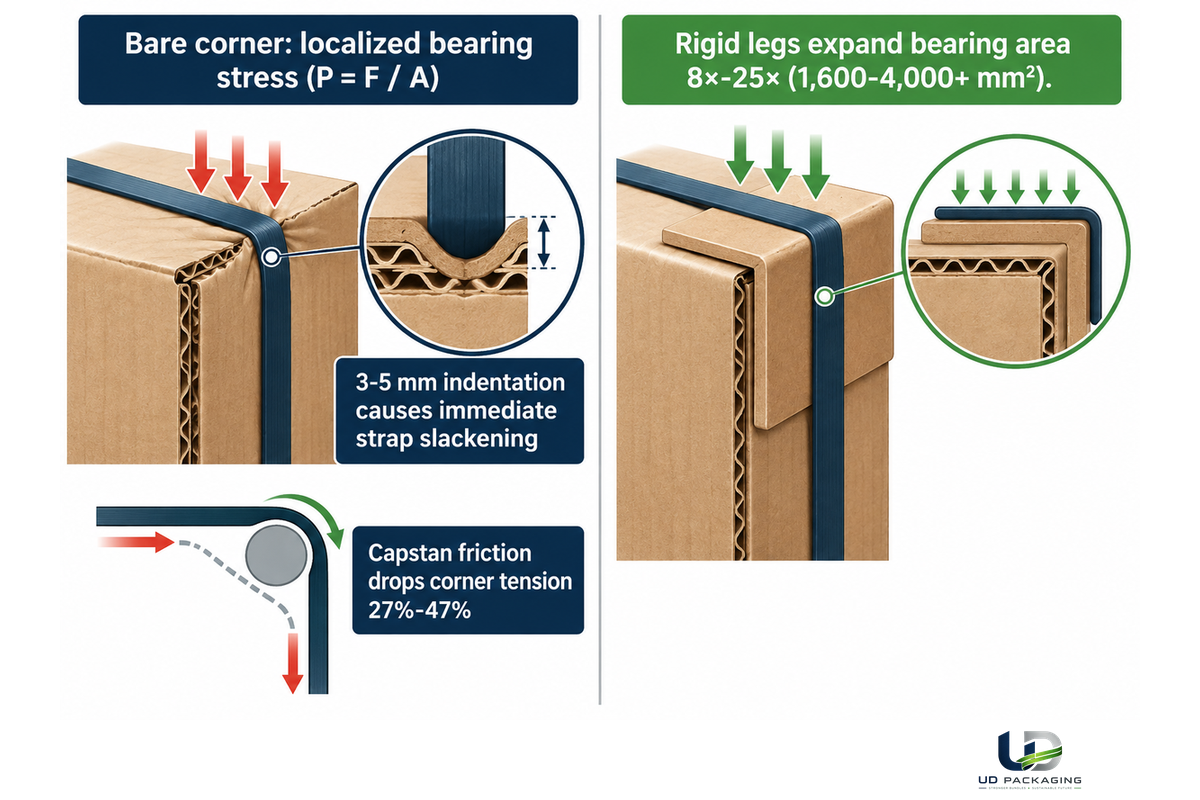
Pulling a tensioner around a palletized load can cause zero inward pressure on flat strapping carton walls. The major part of the inward compressive force is concentrated on the four 90-degree corners where strapping changes direction. If there is no rigid corner protector, two mechanical failure modes occur simultaneously.
First, the narrow band creates high localized bearing stress (P = F / A). If that local stress exceeds the corrugated carton’s edge crush resistance, the corner flutes collapse inward. Even 3–5 mm of corner indentation shortens the perimeter path and causes immediate strap slackening during warehouse handling or transport.
Second, sliding friction at each corner blocks tension from equalizing around the load. The Penn State Engineering Mechanics belt friction model defines this drop with the Euler-Eytelwein formula (Tfar = Tnear · e-μθ). At the point of impending slip across a 90-degree bend (θ = π/2 radians), an assumed friction coefficient of μ = 0.20–0.40 yields a calculated 27%–47% single-corner tension drop. Smooth molded plastic edge protectors (μ = 0.10–0.15) let the band glide and cut single-corner loss to 15%–21%.
The USDA Forest Service unitized pallet study conditioned corrugated boxes at 23°C and 50% relative humidity for 72 hours on 1016 × 1016 mm birch plywood pallet decks to measure how containment force and pallet stiffness govern load deflection. Rigid corner guards bridge across individual box flaps and help keep containment force stable throughout shipping.
| Failure Mechanism | Physical Cause at 90-Degree Corner | What Happens Without a Protector | How an Edge Protector Solves It |
|---|---|---|---|
| Inward Carton Crushing | High clamping force over a tiny contact area (120–250 mm²) |
Corrugated flutes buckle; perimeter shrinks; strap goes loose in transit | Expands bearing area 8×–25× across stiff legs (1,600–4,000+ mm²) |
| Corner Friction Tension Drop | Capstan friction (T2 = T1eμθ) as band bites into cardboard |
Far side of pallet receives 27%–47% less tension per corner than tool side |
Hard, low-friction bridge prevents band embedment and equalizes loop tension |
| Abrasive Strap Shearing | Vibration rubbing tensioned band against burrs, brick, or slit steel edges | Webbing fibers fray or PET/steel band snaps below rated break strength | Sacrificial steel, HDPE, or nylon barrier isolates the strap from sharp corners |
How Do Strapping Edge Protectors Work on Pallet Corners?
Strapping edge protectors work by placing a rigid L-shaped structural bridge between the tensioned strap and the 90-degree package edge. The outer channel guides the band and lowers corner friction during tensioning. Meanwhile, the two inner legs spread clamping force across a 10× to 25× wider area.
A strap corner protector shields a polyester band from slipping over the edge of the corner. Ribs with outer projections prevent the steel band from sliding off when a forklift tilts. From small warehouse clips to vee-shaped protectors for flatbeds, the 90-degree legs stabilize load securement without indenting carton walls.
Matching Strap Protectors to Strap Width: 12–19 mm PET/PP vs 32 mm Steel and 2–4 Inch Webbing
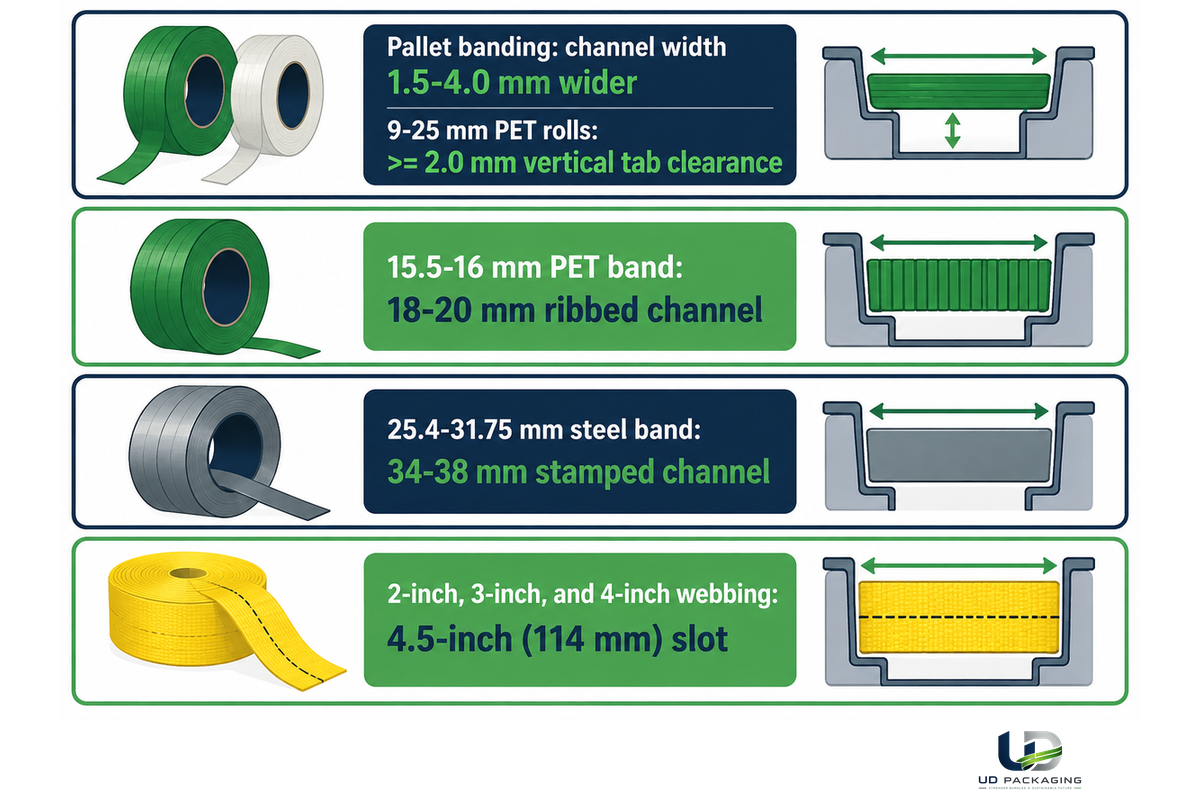
Ordering one “universal” corner guard for every department is a common procurement mistake. A ribbed clip built for 19 mm band width allows a narrow 12 mm polypropylene strap to twist on its edge. Conversely, forcing a 19 mm embossed polyester strap into a tight 16 mm guide slot causes the band edges to fray as you tighten the joint.
The ASTM D4675-14a(2022) flat strapping selection guide requires checking band width, thickness, shear faces, and load geometry together. For warehouse pallet banding, pick a channel width 1.5–4.0 mm wider than your nominal strap width. When using 9–25 mm embossed and smooth PET strapping rolls, confirm that retaining tabs leave at least 2.0 mm of vertical clearance. That space lets 0.8–1.27 mm thick bands slide freely.
Molded strapping guards use a raised rib design to center a narrow polyester band over the corner apex. A channel design to center a band over the corner apex can be seen in the WIPO patent WO2008087370A2 for ribbed strapping edge protectors. Use the Strap-to-Corner Bearing Area Matrix below to find the right protector for your strap family.
| Strap Family & Nominal Width | Typical Thickness & Break Strength | Required Protector Channel / Slot Width | Recommended Leg Length & Wall Thickness | Primary Protector Type & Load Application |
|---|---|---|---|---|
Light Arch PP Strapping9–12 mm (3/8–1/2 in) |
0.50–0.65 mm1,100–2,200 N |
14–16 mm ribbed channel (+2–4 mm clearance) |
25–38 mm (1.0–1.5 in) leg;2.0 mm PP clip or 0.100 in board |
Molded PP strap protectors or light paperboard guards for parcel and mail trays |
Medium Hand / Machine PP Band12–15 mm (1/2–5/8 in) |
0.65–0.85 mm2,200–3,400 N |
16–18 mm ribbed slot |
38–50 mm (1.5–2.0 in) leg;2.5 mm PP clip or 0.120 in board |
Self-retaining plastic clips or light kraft corner boards for single-wall corrugated boxes |
Standard Embossed PET Band15.5–16 mm (5/8 in) |
0.80–1.00 mm4,200–5,500 N |
18–20 mm ribbed channel or flat angle board |
40–60 mm (1.5–2.5 in) leg;3.5 mm HDPE or 0.160–0.200 in board |
Ribbed HDPE/PP corner clips or full-height laminated kraft angle boards for warehouse pallets |
Heavy-Duty Smooth PET Band19–25 mm (3/4–1 in) |
1.00–1.27 mm6,800–11,500 N |
22–28 mm deep-ribbed channel |
50–75 mm (2.0–3.0 in) leg;4.5–6.0 mm HDPE or 0.225–0.250 in board |
Heavy-duty ribbed plastic corner guards or 0.250 in kraft corner boards for timber and brick |
Corded Polyester Strapping16–32 mm (5/8–1.25 in) |
0.85–1.50 mm woven/composite5,000–18,000 N |
20–36 mm smooth rounded channel |
50–75 mm (2.0–3.0 in) leg;4.0 mm virgin HDPE or Cordura sleeve |
Low-friction virgin HDPE guards or flexible tubular wear sleeves for irregular machinery |
Regular-Duty Flat Steel Band12.7–19 mm (1/2–3/4 in) |
0.50–0.79 mm6,500–11,000 N |
22–25 mm stamped metal channel |
40–50 mm (1.5–2.0 in) leg;1.2–1.5 mm galvanized steel |
Stamped galvanized steel corner protectors or 0.250 in board on wood crates |
High-Tensile Steel Strapping25.4–31.75 mm (1–1.25 in) |
0.79–1.12 mm15,000–24,000+ N |
34–38 mm stamped channel with retention ears |
60–100 mm (2.5–4.0 in) leg;1.5–2.0 mm galvanized steel |
Heavy galvanized steel coil guards used with steel banding on slit coils and sheet metal skids |
Ratchet Tie-Down Webbing25–50 mm (1–2 in) |
2.0–3.0 mm polyester web1,100–3,333 lb WLL |
2.25–4.5 in (57–114 mm) slotted guard |
3.5–4.875 in (89–124 mm) leg;4.0–6.0 mm molded HDPE |
Compact slotted HDPE corner protectors for LTL pallets, hot-shot trailers, and box trucks |
Flatbed Trailer Winch Webbing75–100 mm (3–4 in) |
3.0–4.0 mm polyester web4,000–5,400 lb WLL |
4.5 in (114 mm) triple-slot opening |
4.0–8.0 in (100–200 mm) leg;10–48 in length (VeeBoards) |
Slotted HDPE flatbed corner protectors and VeeBoards for flatbed trailer cargo securement |
What Sizes of Straps Fit Plastic Corner Protectors and Strap Guards?
Small warehouse plastic strap guards fit 9 mm to 25 mm (3/8 in to 1 in) polypropylene, polyester, and cord strapping bands. Molded clips with 19 mm or 25 mm ribbed channels center pallet bands over the corner apex while preventing sideways twist during tensioning.
What Sizes of Tie Down Straps fit Corner Protectors?
Heavy-duty flatbed plastic corner protectors and VeeBoards feature wide 4.5-inch (114 mm) slots. Those wide guide openings easily fit standard 2-inch, 3-inch, and 4-inch synthetic polyester ratchet tie-down straps and heavy flatbed trailer winch straps during highway cargo securement.
Catalog specs from US Cargo Control flatbed corner protectors list standard blue HDPE guards at 4-7/8 × 4-7/8 in or 8 × 8 × 10 in. Both sizes include a 4.5-inch strap slot. Never run narrow 16 mm pallet strapping through unguided 4.5-inch flatbed slots if the load can shift sideways.
Sizing Leg Length, Wall Thickness, and Contact Area: Short Corner Clips vs Full-Length V-Boards
Once channel width matches the strap, leg length and caliper (wall thickness) govern whether the protector itself will bend or embed into the package. Never pair a thin 0.120-inch board or a 25 mm clip with high-tension 19 mm PET strapping on soft boxes. The thin guard will buckle along its apex and crush the carton anyway.
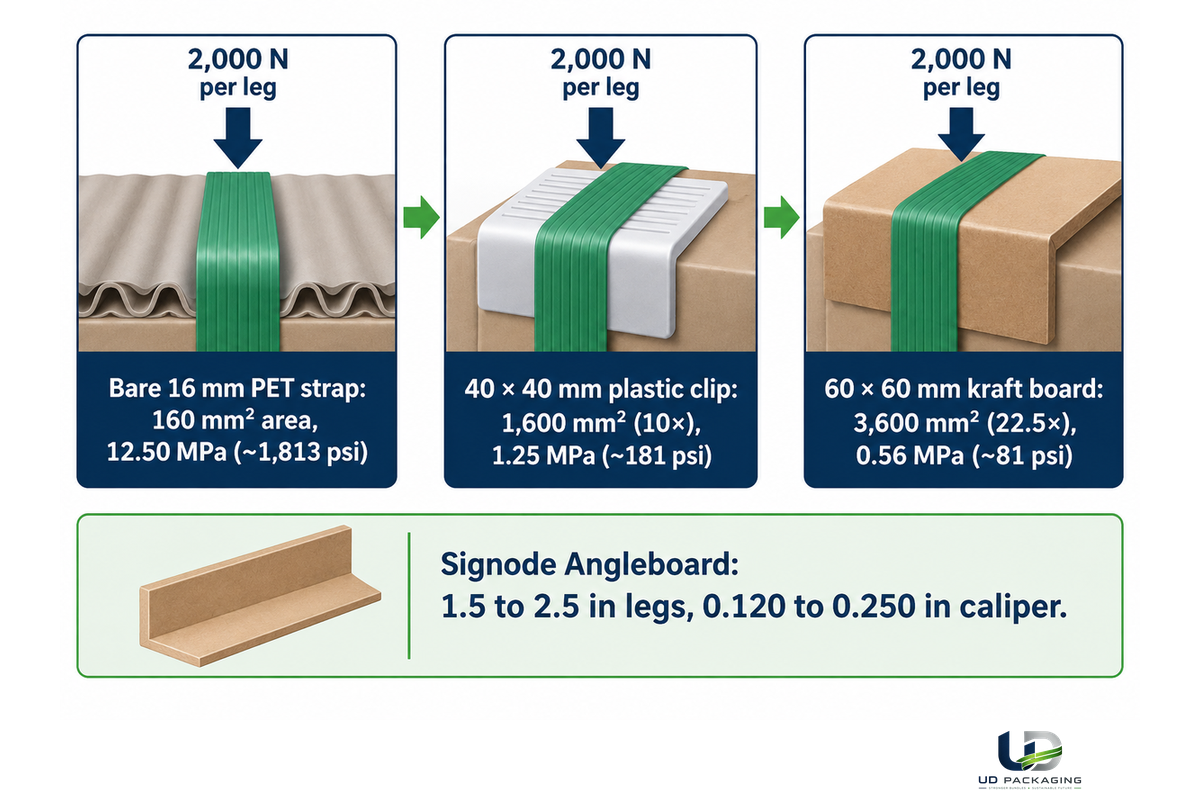
Published Signode Angleboard laminated paperboard specifications list standard leg lengths from 1.5 to 2.5 in and calipers from 0.120 to 0.250 in (3.05–6.4 mm). Similarly, Signode Cornerboard technical dimensions cover 1.5 to 3.0 in legs and 0.100 to 0.250 in calipers, while heavy Anglewrap reaches 4.0 in legs and 0.500 in caliper. Note one manufacturing geometry cap: combined leg lengths cannot exceed 8 inches on Angleboard or 6 inches on Cornerboard.
| Duty Tier | Laminated Board Caliper | Molded Plastic Wall Thickness | Recommended Leg Length | Typical Strap Tension & Load Type |
|---|---|---|---|---|
| Light Duty | 0.100–0.125 in (2.5–3.2 mm) |
1.8–2.5 mm PP clip |
1.5 × 1.5 in (38 × 38 mm) |
Hand-tensioned 9–12 mm PP strapping (<1,000 N); light single-wall cartons |
| Medium Duty | 0.160–0.180 in (4.1–4.6 mm) |
2.8–3.5 mm ribbed PP/HDPE |
2.0 × 2.0 in (50 × 50 mm) |
Battery-tensioned 12–16 mm PET strapping (1,200–2,500 N); standard C-flute pallet loads |
| Heavy Duty | 0.225–0.250 in (5.7–6.4 mm) |
4.0–5.5 mm virgin HDPE |
2.5 × 2.5 in to 3.0 × 3.0 in |
High-tension 16–19 mm PET strapping (2,500–4,500 N); double-stacked pallets and appliances |
| Extra-Heavy / Flatbed | 0.300–0.500 in (7.6–12.7 mm) |
6.0–8.0 mm HDPE VeeBoard (12–48 in long) |
3.5 × 3.5 in to 8.0 × 8.0 in |
Heavy PET/steel strapping or 2–4 in flatbed winch straps across drywall, brick, and lumber |
Worked Example: Corner Contact Area and Bearing Pressure Reduction
Assumed inputs: Consider a 16 mm wide PET strap tensioned to F = 2,000 N across a 90-degree corrugated carton corner. Across a 90-degree bend, resultant inward diagonal force is Fcorner = 2,000 N × √2 ≈ 2,828 N. Each leg face carries roughly 2,000 N of normal clamping load. Let’s compare the contact area and average face pressure across three setups:
| Corner Setup | Effective Contact Footprint (Per Leg) | Bearing Area Per Leg (mm²) |
Estimated Normal Force Per Leg (N) |
Average Face Pressure (MPa / psi) |
Field Outcome on Corrugated Carton |
|---|---|---|---|---|---|
| 1. Bare 16 mm PET Strap (No Guard) | 16 mm width × 10 mm corner crush zone |
160 mm² |
2,000 N |
12.50 MPa (~1,813 psi) |
Immediate flute crushing and linerboard tearing; strap loses tension |
| 2. Ribbed Plastic Corner Clip | 40 mm leg width × 40 mm clip length |
1,600 mm² (10× bare strap) |
2,000 N |
1.25 MPa (~181 psi) |
Prevents localized cut-through on firm double-wall boxes and rigid bundles |
| 3. Heavy-Duty Kraft Angle Board Segment | 60 mm leg width × 60 mm effective load spread length |
3,600 mm² (22.5× bare strap) |
2,000 N |
0.56 MPa (~81 psi) |
Eliminates corner indentation and adds vertical stacking stiffness |
Material Comparison: Molded Plastic Corner Protectors vs Laminated Kraft Angle Boards vs Galvanized Steel Guards
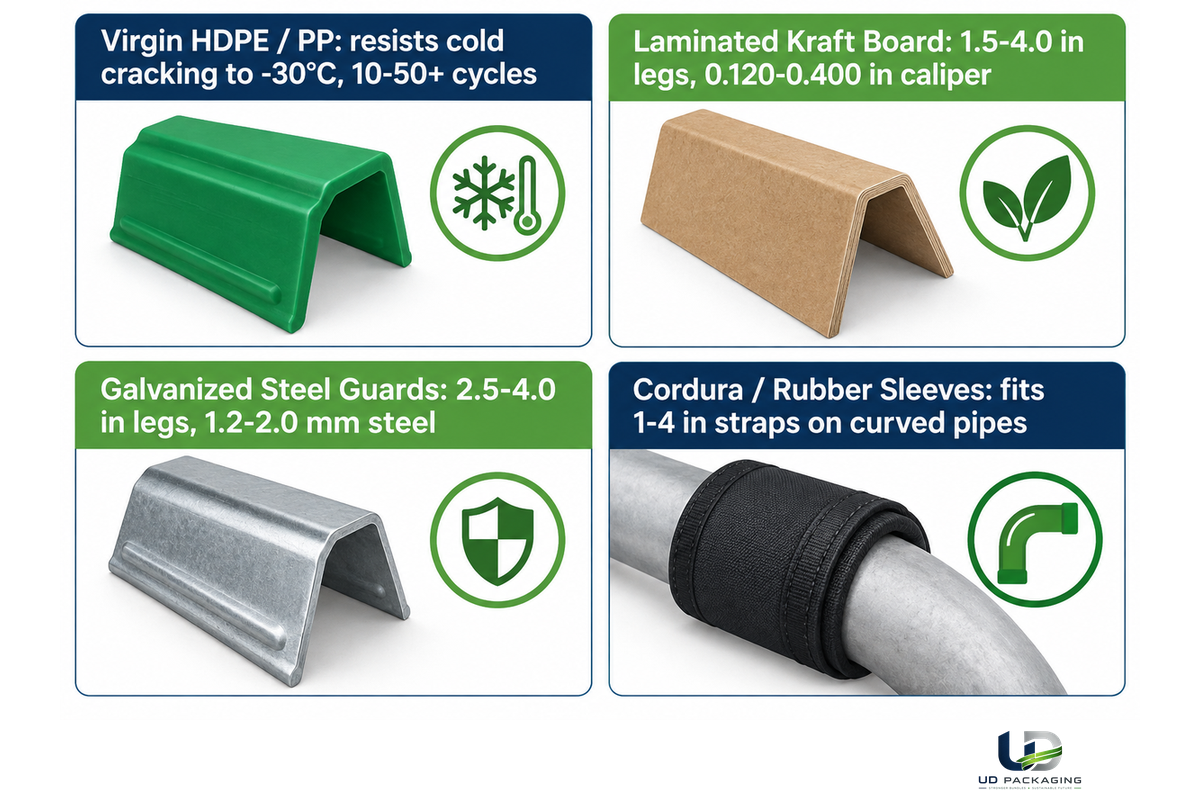
Laminated kraft angle boards (0.160–0.250 in caliper) provide full-column vertical stacking strength for dry palletized cartons inside the warehouse. By contrast, molded HDPE corner protectors and stamped galvanized steel guards prevent localized strap cutting on wet outdoor skids, reusable fleet totes, or sharp-edged metal loads.
The Racklify pallet strapping edge-crush guide states that compressed fiberboard boards lose their stiffness when crushed. The OEM Materials industrial edge protector guide also mentions that thin boards can buckle when subjected to high band tension. In the freezing winter, recycled polypropylene clips can break. However, virgin HDPE can remain impact-resistant at freezing temperatures.
When comparing polypropylene and polyester plastic strapping grades, pair outdoor bands with durable plastic or weather-resistant protectors. Use the six-dimension comparison matrix below to decide on the right material.
| Material Family | Typical Dimensions & Thickness | Moisture & Cold Resistance | Reusability & Recycling Stream | Best-Fit Strapping & Load Type | When NOT to Use (Hard Limitation) |
|---|---|---|---|---|---|
| Molded Plastic (Virgin HDPE / PP) | Clips: 1.5–2.5 in legs;Flatbed VeeBoards: 4–48 in long |
Waterproof; virgin HDPE resists cold cracking down to -30°C (recycled PP gets brittle) |
Reusable 10–50+ cycles in closed-loop fleets; recyclable resin (#2 HDPE / #5 PP) |
9–25 mm PET/PP pallet strapping and 2–4 in flatbed winch straps on brick, lumber, and totes |
Do not use short clips alone to add vertical column stacking strength on weak cartons; never use on razor-sharp slit steel coils |
| Laminated Kraft Fiberboard (Angle Board) | Legs: 1.5–4.0 in;Caliper: 0.120–0.400 in;Length: 2–240 in |
Standard kraft absorbs humidity; specify poly-coated or wax-treated board for sea freight | 1–2 trips max (discard once compressed); 100% curbside recyclable paperboard | Full-height vertical pallet corners under 12–19 mm PET/PP bands and stretch wrap |
Do not reuse crushed boards; do not use untreated kraft in open rain or wet flatbed transit |
| Galvanized Steel Corner Guards | Legs: 2.5–4.0 in;Thickness: 1.2–2.0 mm stamped steel |
Rust-resistant zinc coating; unaffected by extreme heat or sub-zero cold | Highly durable for multi-year heavy industrial reuse; recyclable scrap steel | 19–32 mm flat steel strapping, chains, or heavy webbing on steel coils and rough castings |
Never place unlined steel guards directly against painted machinery, glass, or anodized aluminum without a natural rubber cushion pad |
| Cordura Nylon / Natural Rubber Wear Sleeves | Tubular sleeve or molded pad fitting 1–4 in straps; 12–36 in length |
Excellent abrasion and UV resistance; flexible in cold weather | Reusable across dozens of hauls until abrasion wears through outer ply | Odd-shaped machinery, curved pipes, and tarpaulin contact points where rigid 90° angles cannot sit flat | Does not spread compressive crushing force across soft corrugated cartons; protects the strap only, not the box corner |
When Should You Use Cordura Wear Sleeves Instead of Rigid Corner Protectors?
Cordura nylon or natural rubber wear sleeves can be used on odd-shaped pipes, frames or assemblies. On unusual shapes, a rigid 90-degree corner protector cannot lie flat on the surface of the cargo. Sliding a tubular sleeve over the strap protects the webbing or band from surface abrasion without the need for a square corner.
Using a strap protector sleeve over sharp edges can prevent the strap from being cut, but the sleeve has no beam stiffness. Using a fabric wear sleeve in place of a rigid plastic or fiberboard corner protector can crush cartons, drywall, or foam insulation bundles.
Pairing Edge Guards with PET and PP Plastic Strapping Systems for Warehouse Pallet Unitization
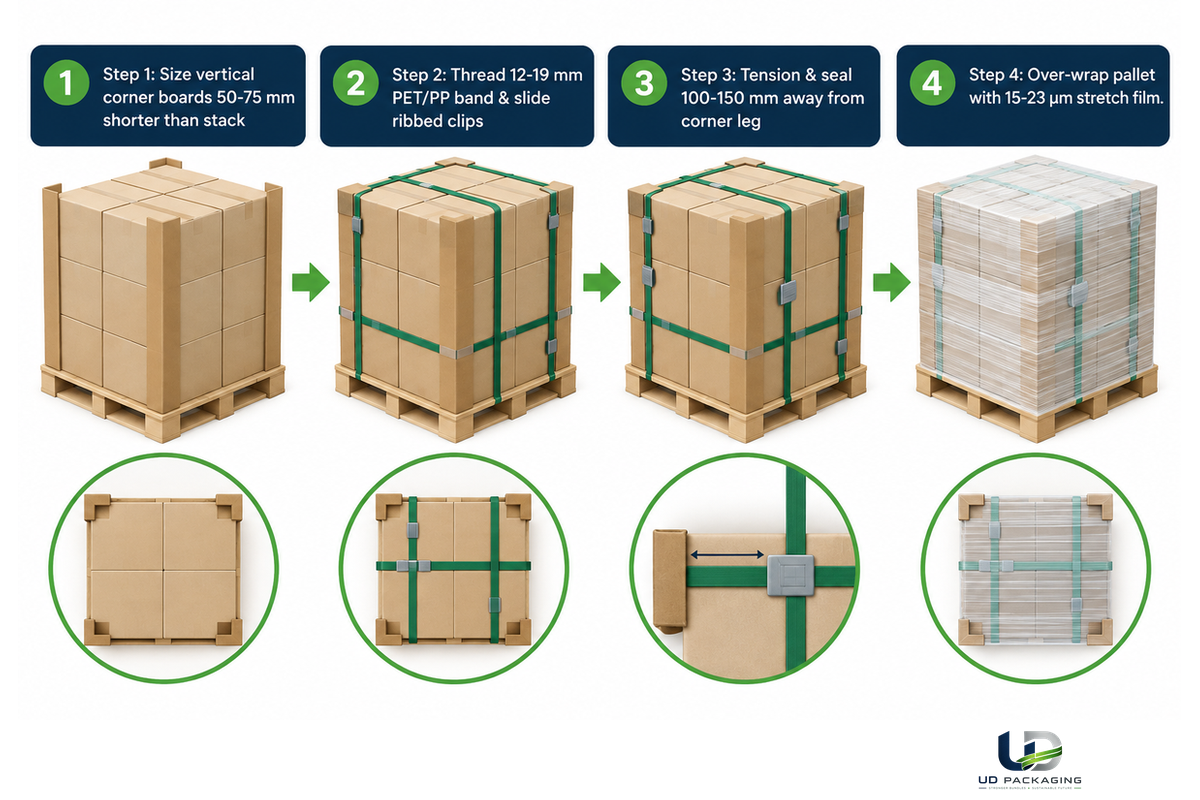
One issue with manual packing lines is that individual plastic corner clips can fall to the ground when the operator walks around the pallet with the strap. In a Packaging World article on automatic corner board applicators used by automated pallet strapping systems on high-speed lines, four vertical boards are positioned simultaneously before tensioning.
High-tension PET strapping operators can stop clip drop-off in a couple of ways. Operators can snap on self-retaining guards with internal grip tabs, as shown in European patent EP0229392A2 for pallet corner protectors. Or they can pre-snug the band in the tensioner and then slide the four corner clips into place.
Equally important is tool clearance. When sizing manual and battery strapping tensioner baseplate clearance, never place the friction weld or metal seal directly on top of a corner protector. A battery tool baseplate needs 100–150 mm (4–6 in) of flat load face away from the corner guard leg. That setback keeps the feed wheel and welding shoe level.
Step-by-Step Warehouse Pallet Unitization Sequence:
- Step 1: Position Full-Height Vertical Corner Boards: Place four kraft angle boards flush against the vertical carton columns. Size each board
50–75 mmshorter than stack height, and tack them with stretch film or adhesive tabs. - Step 2: Thread and Pre-Snug the PET or PP Strap: Feed your
12–19 mmPET or PP band around the load and load the tensioner. Pull slack out by hand, then slide ribbed plastic strap protectors onto exposed horizontal edges. - Step 3: Tension and Seal 100–150 mm Away from the Corner: Position the tensioner at least
100–150 mmaway from the corner protector leg. Apply target tension, complete the friction weld or serrated seal crimp, and inspect all four corners to confirm the band sits centered inside each guide channel. - Step 4: Apply Final Stretch Film Over-Wrap: Wrap the pallet with
15–23 μmstretch film over the vertical corner boards. This locks film containment force and strap tension into one shell.
The 4-Point Corner-to-Strap Compatibility Check
Prior to launching a new Pallet strapping Standard Operating Procedure (SOP) for the warehouse, have a 4-Point Corner-to-Strap Compatibility Check performed on a test skid:
- 1. Slot-to-Band Clearance (
+1.5 to 4.0 mm): Confirm the strap slides through the channel without edge curling or twisting under tension. - 2. Rib & Tab Retention Under Vibration: Tap the tensioned strap face with a rubber mallet. Guide ribs must stand at least
2.5×the strap thickness so the band stays seated. - 3. Tensioner Baseplate Setback (
≥100 mm): Keep the corner guard leg away from the tool nose so the baseplate sits flat during sealing. - 4. Zero Corner Indentation After 24 Hours: Check the carton edge 24 hours after tensioning. If the board buckles by more than
1.5 mm, move up one caliper tier (such as0.160 into0.225 in).
Heavy-Duty Edge Protection for Sharp Steel Coils, Sheet Metal, Lumber, and Flatbed Securement
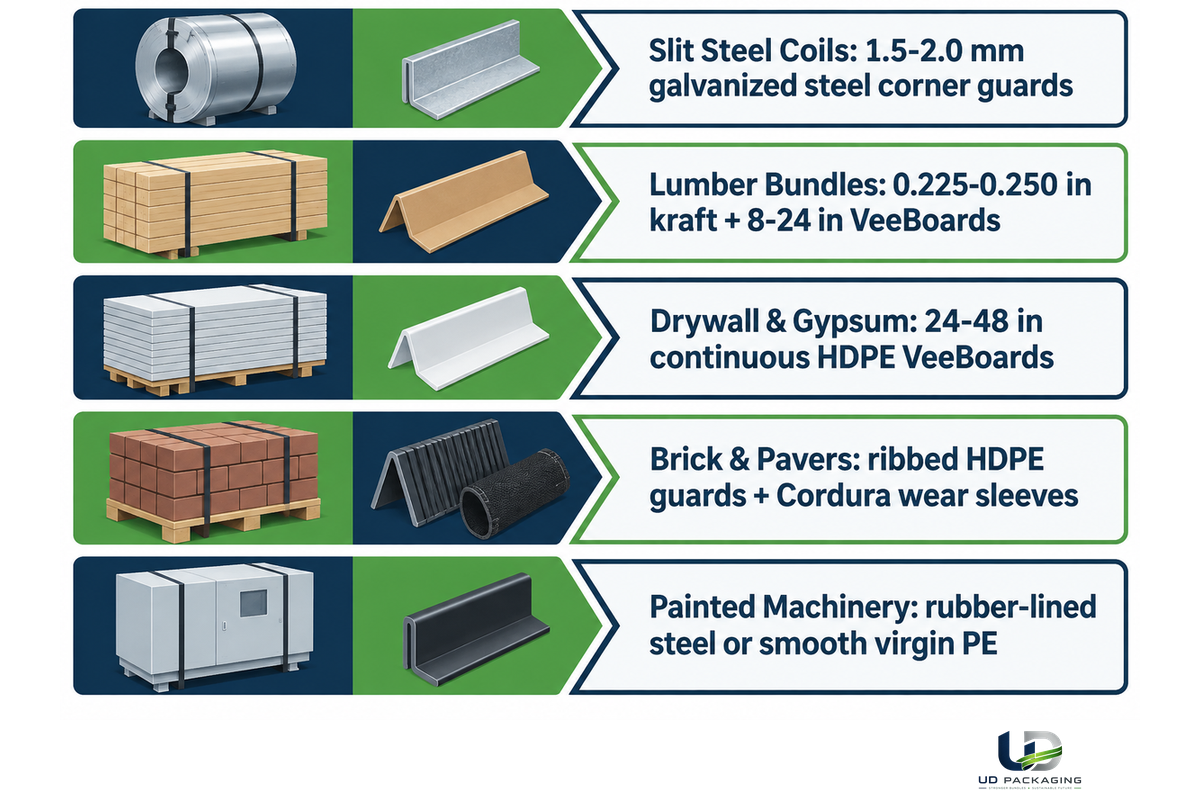
Securing heavy cargo on a flatbed trailer or unitizing slit metal skids places extreme shear stress on straps and guards. When a truck driver tightens a 31.75 mm steel band or 4-inch flatbed winch strap over bare metal, sharp burrs can slice the band below 50% break strength.
Catalog specs from Mytee Products flatbed corner and edge protectors group heavy-duty guards into two classes. Stamped galvanized steel corner protectors shield steel banding or transport chain on metal coils. High-density polyethylene VeeBoards (12 to 48 inches long) spread webbing pressure across brick, drywall, and lumber.
Mills and yards often review PET strapping options for brick, lumber, and building-material bundles. Pairing 16–19 mm embossed PET strapping with ribbed HDPE edge guards or 0.250-inch angle boards prevents corner crumbling and rust stains. Rounding sharp cargo corners with smooth plastic guards protects waterproof canvas or vinyl tarps from tearing in high winds.
| Cargo / Commodity Type | Primary Edge Hazard | Recommended Securement Band / Tie-Down | Required Edge Protector Specification |
|---|---|---|---|
| Slit Steel Coils & Sheet Metal Skids | Razor-sharp sheared metal burrs cut synthetic bands and plastic clips | 19–32 mm flat steel strapping or Grade 70 transport chain |
Stamped galvanized steel corner protectors (1.5–2.0 mm wall) with retention ears |
| Dressed Lumber & Timber Bundles | High strap tension crushes outer board edges and leaves pressure marks | 16–19 mm high-tensile PET strapping + 4 in flatbed winch straps |
0.225–0.250 in wax-coated kraft corner boards for bundle banding; 8–24 in HDPE VeeBoards under trailer winches |
| Drywall, Gypsum & Foam Insulation | Fragile core crumbles under point loading from ratchet straps | 2–4 in flatbed ratchet or winch straps tensioned by hand |
24–48 in continuous HDPE VeeBoards to spread clamping force across multiple panels |
| Brick, Concrete Pavers & Stone | Abrasive masonry surfaces fray polyester fibers during transit vibration | 16–19 mm embossed PET strapping or synthetic flatbed webbing |
Abrasion-resistant ribbed HDPE corner guards + heavy-duty Cordura wear sleeves |
| Painted Machinery & Coated Extrusions | Metal guards or bare straps scratch powder coat and anodized finishes | 2–4 in synthetic tie-down straps or poly strapping |
Rubber-lined steel guards or smooth virgin polyethylene corner protectors; add felt/foam padding under tarpaulin contact points |
FMCSA 49 CFR 393.104 Tie-Down Rules vs ASTM Pallet Strapping Standards: When Edge Protectors Are Mandatory
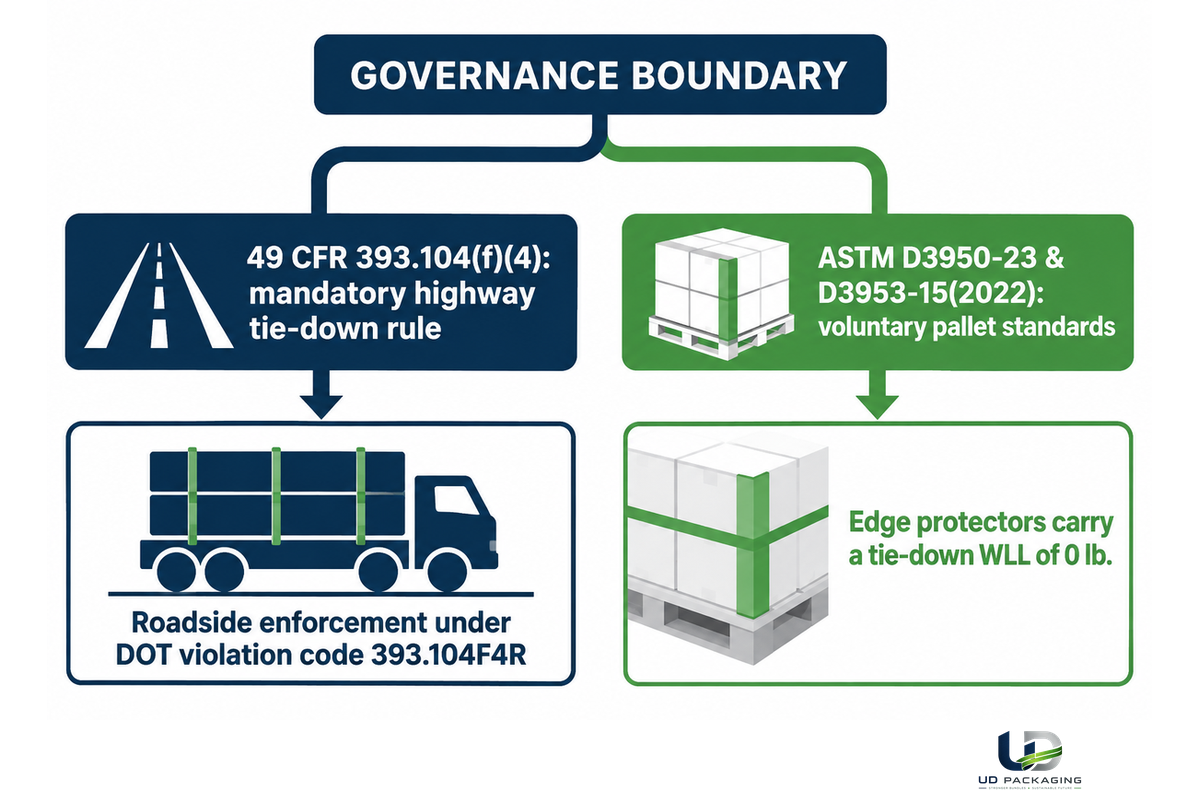
Under 49 CFR 393.104(f)(4), the Federal Motor Carrier Safety Administration legally requires edge protectors whenever a vehicle tie-down faces abrasion or cutting at a cargo edge. By contrast, corner boards under warehouse pallet strapping follow voluntary ASTM D3950 and ASTM D3953 unitization standards.
Shipping managers and fleet operators often mix up federal highway enforcement with voluntary packaging standards. On public highways, eCFR Title 49 CFR 393.104(f)(4) mandates edge protection whenever a tiedown touches cargo that could cut or abrade it. The rule also states that the protector must resist abrasion, cutting, and crushing. As outlined in the FMCSA Cargo Securement Rules, roadside inspectors enforce this rule under violation code 393.104F4R.
Meanwhile, ASTM D3950-23 for non-metallic strapping and ASTM D3953-15 (2022) for flat steel strapping are voluntary consensus standards for palletizing, unitizing and railcar/truck load bracing. Freight carriers also reference ASTM D4675-14a (2022) and reject damage claims when unguarded bands crush cartons.
| Regulation or Standard | Governing Body | Legal & Operational Scope | When Edge Protection Is Required | Consequence of Non-Compliance |
|---|---|---|---|---|
| 49 CFR § 393.104(f)(4) | Federal Motor Carrier Safety Administration (FMCSA) | Mandatory US federal law for commercial highway vehicle tie-downs | Whenever a vehicle tie-down strap, chain, or wire rope contacts a cargo edge that could cut or abrade it | DOT roadside citation (393.104F4R), CSA points, and out-of-service delay until corrected |
| 49 CFR §§ 393.110–393.136 | FMCSA Commodity-Specific Securement Rules | Mandatory highway rules for metal coils, lumber, dressed timber, concrete pipe, and heavy equipment | Mandatory on sharp coil eyes, metal edges, and abrasive concrete/masonry corners | Immediate roadside out-of-service order and carrier safety rating penalty |
| ASTM D3950-23 & D3953-15(2022) | ASTM International Subcommittee D10.25 | Voluntary consensus specifications for nonmetallic (PET/PP) and flat steel strapping materials | Applied alongside ASTM D4675-14a(2022) when unitizing pallets or bracing railcar and truck loads | Rejected LTL/rail damage claims or customer receiving dock refusal due to crushed cartons |
Do Strap Protectors Change the Working Load Limit of a Tie-Down or Pallet Band?
No, strapping edge protectors and tie-down corner guards carry a tie-down Working Load Limit (WLL) of 0 lb. They never increase the rated WLL or break strength of a strap or chain. Under FMCSA 49 CFR 393.104, aggregate working load limit is calculated strictly from the rated tie-down assemblies, winches, and anchor points.
However, distinguish tie-down WLL from two real mechanical effects. First, an unguarded 90-degree burr can shear a strap below 50% of its break strength, so the guard preserves usable strength. Second, full-height laminated kraft corner boards (0.160–0.250 in caliper) add measurable vertical column stacking strength to palletized cartons.
Bulk Case and Pallet Quantity Pricing: Cost Per Protector vs Freight Damage Prevention
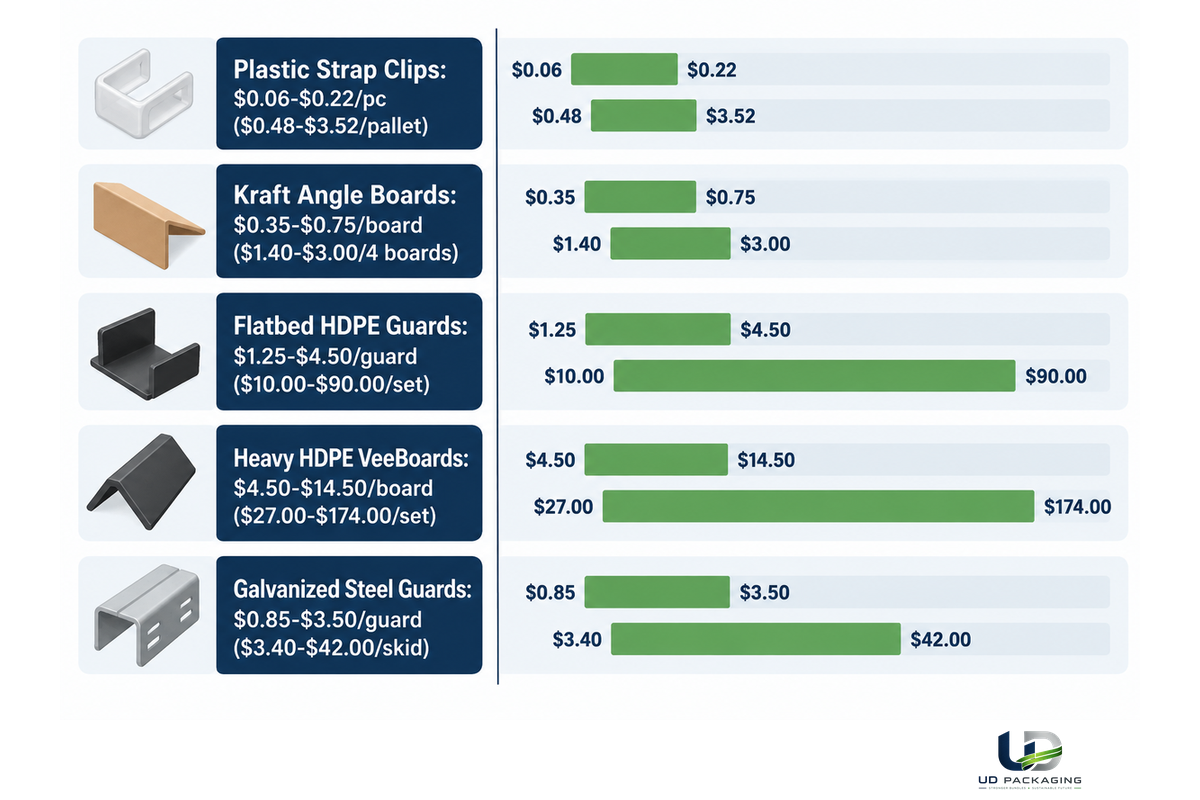
Buyers often compare a $0.08 plastic strap clip against a $0.55 48-inch kraft corner board and assume individual clips cost far less per skid. In practice, total unitization hardware runs $0.48 to $6.00 per pallet across piece count, dock installation labor, and horizontal versus vertical strap paths.
Consider how the two geometries are installed on a standard 48 × 40 in pallet. Four horizontal belly straps around the vertical columns need just 4 full-height 48-inch corner boards ($1.40–$3.00 per pallet total). Those four boards protect every horizontal band and boost stacking strength. By contrast, four vertical over-the-top straps cross eight to sixteen horizontal edges. Protecting those corners takes 8 to 16 plastic clips ($0.48–$3.52 per pallet) or four horizontal edge boards. Aligning protector geometry with ASTM Subcommittee D10.25 palletizing and unitizing standards prevents freight damage claims that far exceed hardware cost.
| Protector Type & Standard Size | Typical Bulk Pack Quantity | Published Bulk Unit Price Range (USD) | Pieces Needed Per 4-Strap Pallet | Total Hardware Cost Per Pallet / Load | Primary Cost & Labor Trade-Off |
|---|---|---|---|---|---|
| Molded Plastic Strap Clips ( 1.5–2.0 in leg, for 12–19 mm band) |
1,000–2,000 pcs per carton |
$0.06–$0.22 / pc( $60–$220 / case) |
8–16 clips (top/bottom or side corners) |
$0.48–$3.52 per pallet |
Lowest piece price and compact carton storage, but slower manual placement per strap |
| Laminated Kraft Angle Boards ( 2 × 2 × 48 in, 0.160–0.225 in caliper) |
1,800–5,000 boards per pallet skid |
$0.35–$0.75 / board |
4 vertical boards (+ optional 4 top edge boards) |
$1.40–$3.00 (4 vertical)$2.80–$6.00 (8 boards) |
One board spans multiple horizontal straps and boosts warehouse stacking strength |
| Flatbed HDPE Corner Protectors ( 4-7/8 in to 8 × 8 × 10 in, 4.5 in slot) |
20-pack bundle or 108-pc pallet case |
$1.25–$4.50 / guard |
8–20 guards per flatbed trailer (2 per strap) |
$10.00–$90.00 per trailer set (reusable) |
Reusable across dozens of flatbed hauls; prevents $80–$200 replacement cost on cut 4-inch winch straps |
| Heavy-Duty HDPE VeeBoards ( 8 × 8 × 24 in to 48 in) |
Sold individually or in pallet skids | $4.50–$14.50 / board |
6–12 boards per flatbed load |
$27.00–$174.00 per trailer set (reusable) |
Replaces multiple small guards on drywall, brick, and shingle loads |
| Stamped Galvanized Steel Guards ( 2.5–4.0 in leg) |
50–200 pcs per heavy carton |
$0.85–$3.50 / guard |
4–12 guards per coil or metal skid |
$3.40–$42.00 per skid/load |
Essential on slit steel coils where plastic or kraft guards shear through instantly |
Sourcing Edge Protectors with PET/PP Strapping Systems and 2026 Packaging Outlook
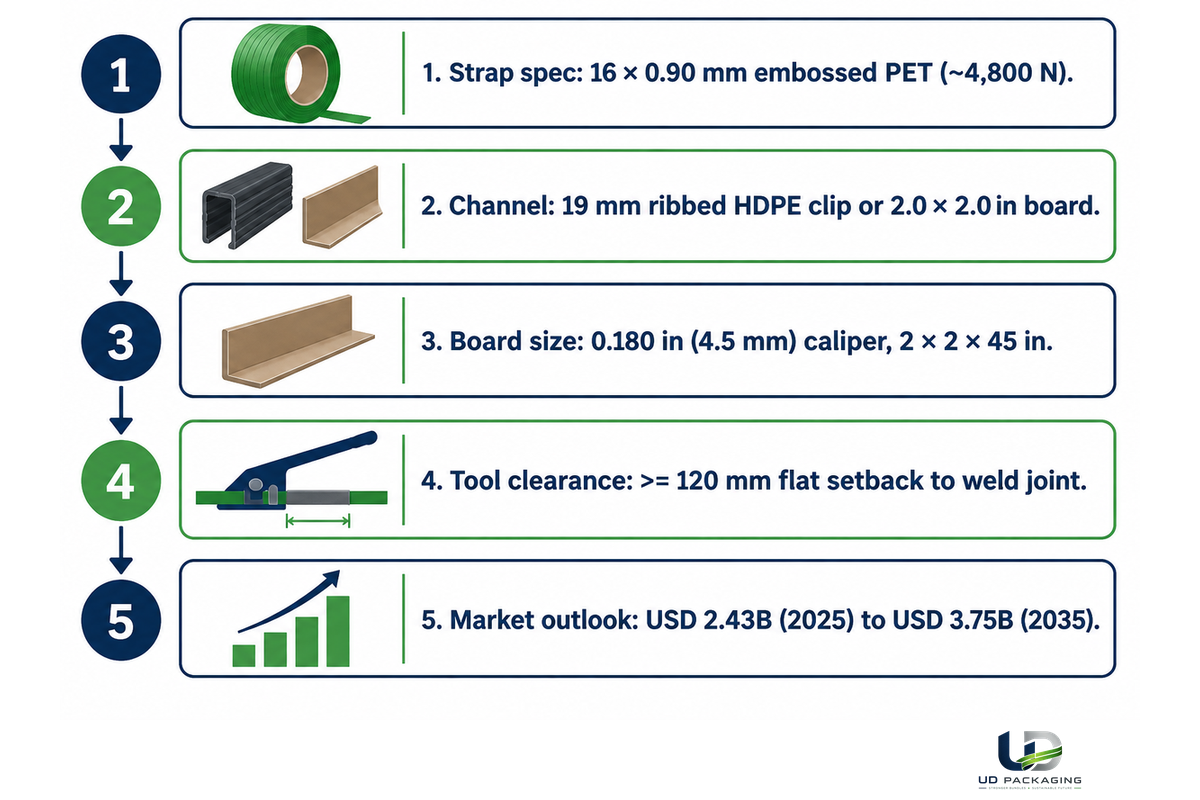
Two structural shifts are reshaping industrial edge protection procurement through 2026 and 2035. The Spherical Insights 2026–2035 cardboard edge protectors market report projects global revenue to grow from USD 2.43 billion in 2025 to USD 3.75 billion by 2035 (4.43% CAGR). First, warehouses are pairing uncoated kraft corner boards with recyclable PET strapping to simplify dockside material sorting. Second, high-throughput plants are installing robotic corner-board applicators (Innova Maquinaria automatic edge protector applicator) right ahead of automatic strapping arches.
Sourcing strapping rolls from one vendor, tensioners from a second, and corner guards from a third often creates dimensional mismatches on the packing floor. At UD Packaging, we manufacture 9–25 mm width and 0.5–1.27 mm thickness PET strapping rolls, PP strapping, seals, and tensioners. We also support co-sourcing hand and machine pallet stretch film so your entire pallet unitization package ships in one container.
Integrated Strapping & Edge Protection RFQ Specification Checklist:
| RFQ Parameter | What to Measure on Your Load | Target Specification Example |
|---|---|---|
| 1. Strap Material, Width & Thickness | Nominal band width (mm), thickness (mm), and surface texture (embossed vs smooth) |
16 × 0.90 mm embossed green PET strapping (~4,800 N break strength) |
| 2. Protector Channel & Rib Geometry | Guide slot width (+1.5 to 4.0 mm over strap width) and retention tab height |
19 mm ribbed HDPE channel clip or flat 2.0 × 2.0 in angle board |
| 3. Leg Length, Caliper & Board Length | Carton flute grade, stacking weight, and horizontal vs vertical strap path | 0.180 in (4.5 mm) caliper kraft corner board, 2 × 2 × 45 in length |
| 4. Tool Baseplate & Seal Clearance | Flat pallet face distance required for battery friction-weld tool or manual sealer | ≥120 mm flat setback from corner guard leg to weld joint |
| 5. Environmental & Stretch Film Pairing | Cold storage temperature, ocean container humidity, and stretch wrap gauge | Moisture-resistant corner guard paired with 20 μm machine LLDPE stretch film |
Frequently Asked Questions
Does every pallet strap or flatbed tie-down need an edge protector?
Not every load requires one, but two rules dictate when you cannot skip them. On commercial highway vehicles, federal regulation 49 CFR 393.104(f)(4) mandates edge protection whenever a tie-down contacts a cargo corner that could cut or abrade the strap. Inside the warehouse, install corner guards whenever strap tension exceeds carton edge crush strength. You also need them whenever bands leave pressure marks on finished goods.
Are laminated fiberboard corner boards and plastic strap guards recyclable?
Yes, 100% of uncoated laminated kraft paperboard corner boards can be baled with standard corrugated cardboard scrap. Avoid heavy poly-film laminations or metal staples when curbside paper recycling is required. Molded plastic corner protectors made from virgin HDPE (#2) or polypropylene (#5) can be reused across 10–50+ load cycles. Once worn out, they feed into standard industrial plastic regrind streams alongside PET and PP strapping.
Can laminated cardboard edge protectors be cut to custom lengths on the warehouse floor?
Yes, operators can trim light 0.100–0.120 inch paperboard corner boards on the floor with a heavy-duty anvil shear. However, hand-cutting thick 0.180–0.250 inch laminated boards with utility knives is slow, ragged, and risks hand injuries. Instead, order factory-cut boards sized 50–75 mm shorter than your pallet stack height. Pre-cut boards eliminate dock cutting labor and keep every vertical column corner square.
How do you keep plastic corner protectors from slipping off while tensioning a strap?
Snap self-retaining clips with 2.0–4.0 mm internal grip tabs directly onto the strap before tensioning, or tack vertical boards with stretch wrap. For manual pallet banding, ribbed plastic clips grip the 12–19 mm PET or PP band while you pull slack out. For full-height vertical corner boards, wrap one pass of hand stretch film around the pallet waist or use adhesive strips to hold all four boards flush. On flatbed trailers, start the winch strap in the trailer winch drum with slight slack, slide the slotted HDPE VeeBoard under the webbing, and ratchet tight.
Why do plastic strapping corner protectors crack in cold storage or winter flatbed transit?
Low-cost corner clips molded from brittle recycled polypropylene homopolymer lose impact strength below 0°C (32°F) and shatter under strap tension. Specify virgin high-density polyethylene (HDPE) or copolymer PP guards for freezer warehouses and winter flatbed hauls.
Are fiberboard corner protectors strong enough for steel strapping on heavy skids?
Heavy 0.250–0.400 inch laminated kraft angle boards can cushion wood crates under flat steel strapping, but they shear through on sharp metal edges. Never place paperboard guards against slit steel coils, sheet metal skids, or rough castings. For sharp metal edges secured with 19–32 mm steel banding, always install stamped galvanized steel corner guards with retaining ears.
Where should the strap seal or friction weld sit relative to a corner protector?
Place the metal seal or battery friction weld at least 100–150 mm (4–6 inches) away from the corner protector on a flat load face. Sealing directly over a rigid protector leg tilts the tool baseplate and weakens joint weld efficiency.
References & Sources
- U.S. National Archives and Records Administration – eCFR Title 49 CFR §393.104: Standards for Cargo Securement Devices and Systems
- Federal Motor Carrier Safety Administration (FMCSA) – Driver’s Handbook on Cargo Securement and Roadside Enforcement Rules
- Pennsylvania State University Engineering Mechanics – Mechanics Map Section 7.7: Belt Friction Across Curved and Angled Surfaces
- USDA Forest Products Laboratory – Evaluation of Corrugated Fiberboard Unitized Loads and Containment Force
- ASTM International— ASTM D3950-23: Standard Specification for Strapping, Nonmetallic (and Joining Methods)
- ASTM International — ASTM D3953-15(2022): Standard Specification for Strapping, Flat Steel and Seals (2026 Book of Standards Vol. 15)
- ASTM International — ASTM D4675-14a (2022): Standard Guide for the Selection and Use of Flat Strapping Materials
- Signode Industrial Group – Angleboard® Laminated Paperboard Corner Protection Technical Specifications
- Signode Industrial Group – Cornerboard® Edge Protection Leg Length and Caliper Specifications
- World Intellectual Property Organization (WIPO) – Patent WO2008087370A2: Co-Extruded Ribbed Edge Protector for Strapping Bands
- European Patent Office — Patent EP0229392A2: Pallet Load Corner Protector with Strap Retaining Features
- Packaging World — PAC Strapping Products Pallet Strapping Machine with Automatic Corner Board Applicator
- US Cargo Control — Flatbed Corner Protectors and HDPE VeeBoard Technical Specifications
- Mytee Products — Flatbed Corner and Edge Protectors Product Specifications
- Spherical Insights — Global Cardboard Edge Protectors Market Strategic Overview (2026-2035)