Get in touch with UD Packaging Company

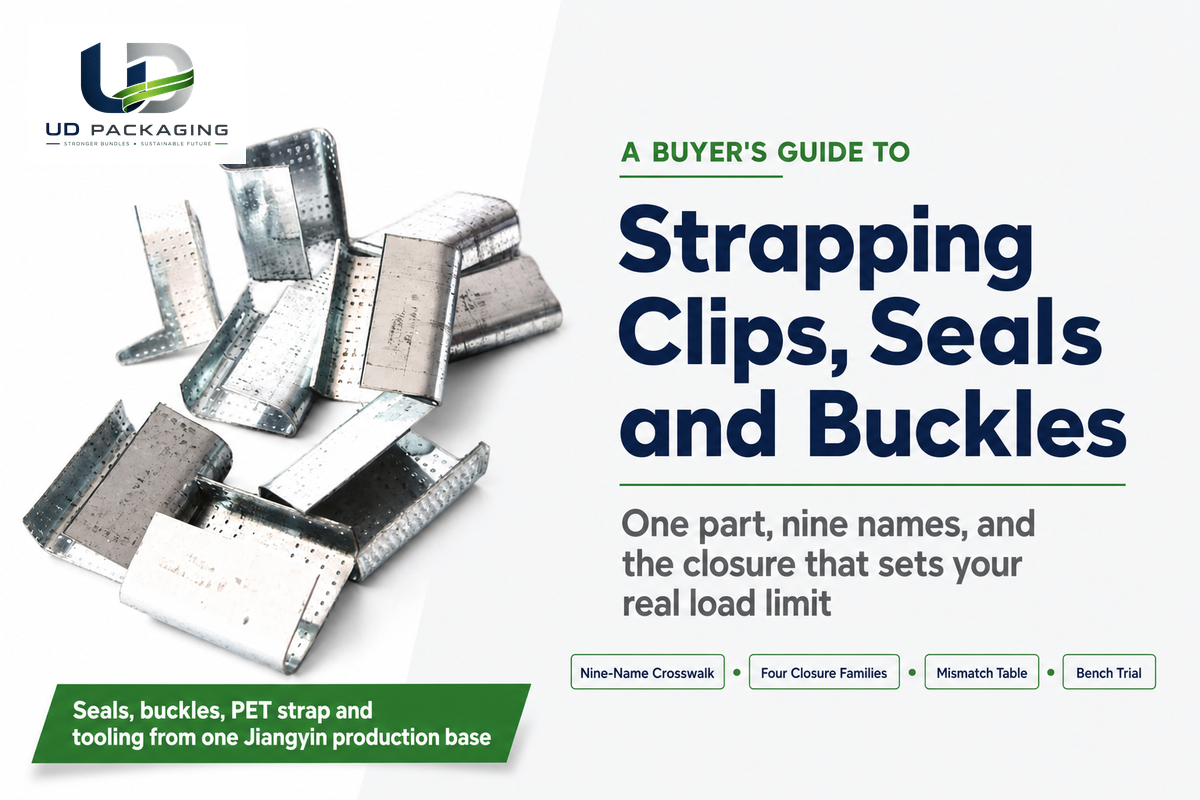
Buyers search for strapping clips, but almost no catalogue sells anything under that name. Strapping clips are the small metal or plastic fasteners that hold a tensioned strap closed around a load. The same part is listed as a seal, a buckle, a banding clip, a strap clip or a clamp, and which word a supplier chose tells you something useful about which strap material that supplier serves. The part turns up under all of those names across metal manufacturing, construction, lumber yards, shipping and logistics operations. This guide translates the nine names into one part, then walks the decision that follows: which closure your strap already rules out, how to size it, how to close it, and how to read it when a joint fails.
📐 What this article assumes: your strap material is already chosen. If it isn’t, start with choosing the strap material first and come back. Everything below is about the closure that holds it.
What Is a Strapping Clip? (And Why It Has Eight Other Names)
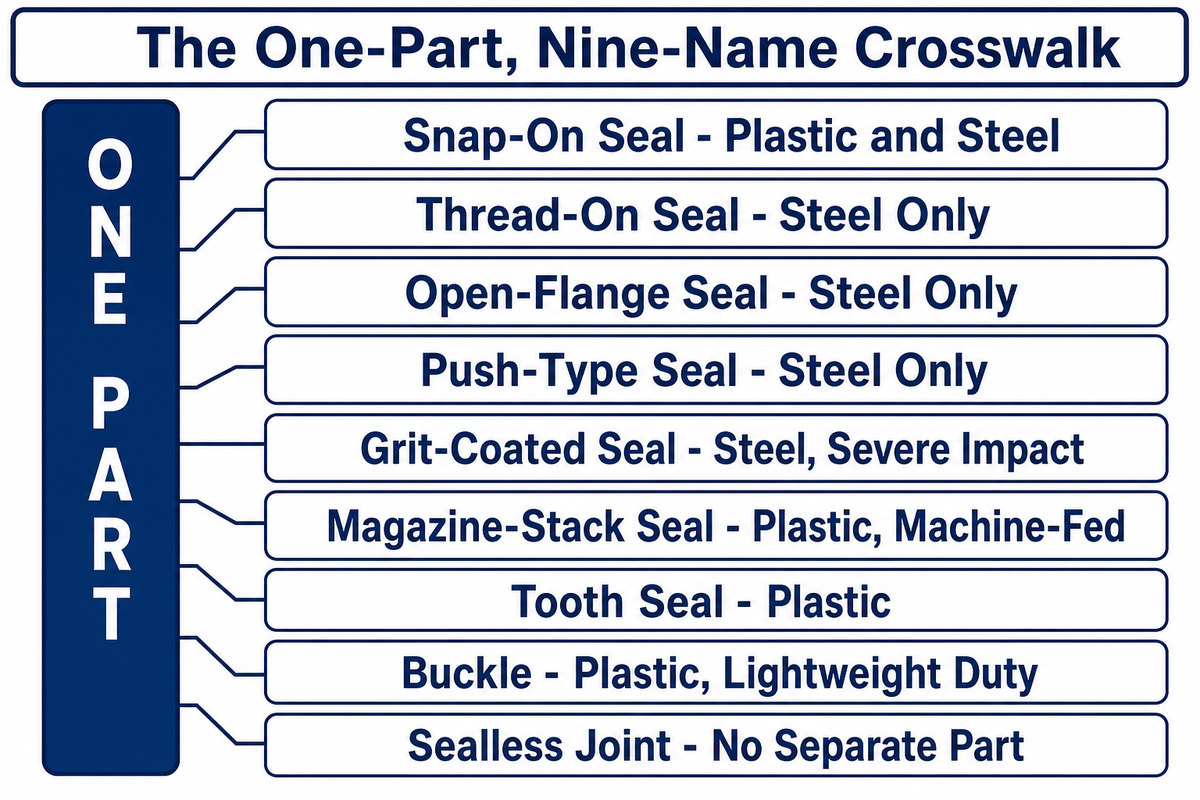
A strapping clip is a metal or plastic closure that holds a tensioned strap in an overlapped joint. One product class carries eight trade names across supplier catalogues, and a ninth entry that is not a name at all but the option of using no separate part, with no single published document reconciling them. ASTM D3953 sends terminology for this family to ASTM D996, and ASTM D4675 is a selection guide rather than a terminology standard.
That gap is why the crosswalk below exists. It’s compiled from supplier catalogue naming across the sources listed at the end of this article, each of which assigns a joint type and a strap material to the types it sells, so the name isn’t arbitrary decoration; it tracks what the part was designed to close. Read it as a translation table: find the word your supplier uses, then read across to what you’re actually holding.
The One-Part, Nine-Name Crosswalk
| Name you will see | What it physically denotes | Strap material it implies | Joint it makes |
|---|---|---|---|
| Snap-on seal | Open-flange sleeve snapped over both strap courses after tensioning | Plastic and steel — the one genuine crossover | Primarily notch |
| Thread-on seal | Closed sleeve threaded on before tensioning; catalogued markedly longer than a snap-on at the same strap width | Steel only | Crimp and notch |
| Open-flange seal | Heavier-gauge snap-on variant for heavy-duty work | Steel only | Crimp and notch |
| Push-type seal | Fully overlapping crowned flanges, pre-threaded onto the strap | Steel only | Reverse notch |
| Grit-coated seal | Abrasive-coated sleeve that bites through surface wax | Steel, severe-impact duty | Severe impact |
| Magazine-stack seal | Interlocking nibs so seals stack in a machine magazine | Plastic, machine-fed | Machine |
| Tooth seal | Internal teeth dig into lubricated strap; nibs bite poly beading | Plastic | Tooth bite |
| Buckle | Wrap-and-lock frame needing no sealing tool at all | Plastic, lightweight duty | Wrap |
| Sealless joint (no part) | Interlocking keys cut or punched through both strap courses | Steel, high-volume lines | Punched interlock |
Scope note: this crosswalk is our own compilation of supplier catalogue naming rather than a published taxonomy, and the material and joint columns describe how suppliers assign the types they sell. Another maker may sell a differently named part with a different material pairing, and joining methods for nonmetallic strap are covered by ASTM D3950 rather than by D3953. Read the table as a translation aid for the naming problem, not as an industry taxonomy.
The ninth entry is the one buyers miss: sometimes the correct closure is no separate part. Signode’s granted patent EP3319877B1 defines the boundary precisely for its own purposes, and a patent definition binds that patent rather than the trade at large: “the term sealless refers to the configuration or type of seal or joint that’s made in the overlapping portions of the strap … as compared to a joint that’s made using a separate element such as a crimp seal.” If your line runs a battery combination tool, you may be buying a consumable you no longer need.
One more disambiguation, because the collision is exact. The word seal carries a second standardised meaning that has nothing to do with joining a strap: ISO 17712:2013 Freight containers, Mechanical seals governs mechanical freight-container security seals for tamper evidence and access control. ISO 17712 marks its high-security seals H. ASTM D3953 calls one of its flat steel strapping seal classes Class H. Same letter, same word, unrelated parts, and a buyer searching “class H seal” lands in the wrong catalogue.
What is the difference between strapping and banding?
Nothing physical. Strapping and banding describe the same operation, putting a tensioned band around a load and closing it, and the same hardware. The difference is regional and sectoral vocabulary. In current United States search data, banding clips draws about 480 searches a month while strapping clips draws about 720, and the two vocabularies are moving in opposite directions, which the closing section quantifies.
For procurement the practical consequence is narrow but real: search both words before you conclude a part is unavailable, because a distributor that files it under packaging banding won’t surface on a strapping query.
The naming problem isn’t only supplier-side. These phrasings appear verbatim in the titles of currently ranking listings for this part: sturdy metal clips, pcs packaging strapping open serrated, packaging strapping open serrated seals, poly strapping metal, heavy duty reusable buckles, duty reusable buckles with anti-slip, reusable buckles with anti-slip coating, strap width woven cord strapping and strap width polyester. None of them is a standard term. All of them are what a search engine is currently being asked to match.
For the wider picture of where this part sits, see the industrial strapping overview.
The Closure Family: Open Seals, Closed Seals, Wire Buckles and Push-Type Clips
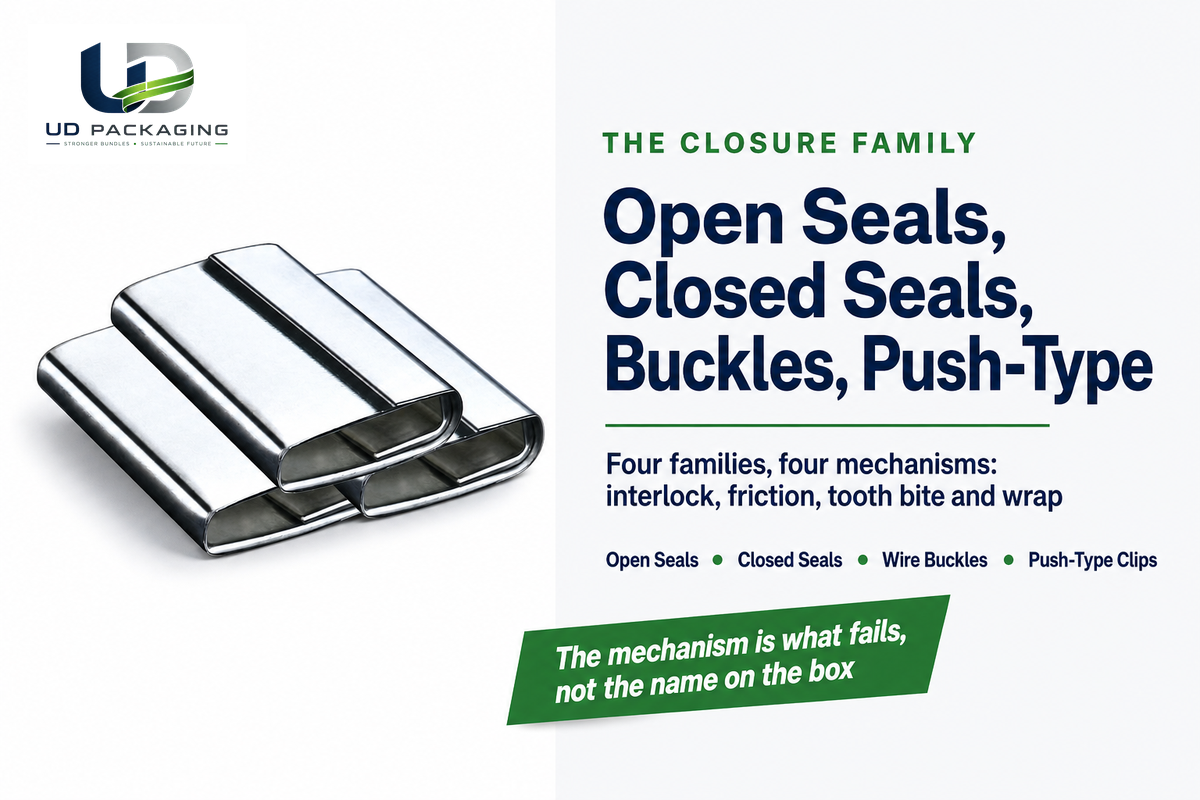
Four families cover almost everything sold. They differ in how the part is fitted, before or after tensioning, and in what physically resists the load: a mechanical interlock, friction, a tooth bite, or a wrap. Getting the mechanism right matters more than getting the name right, because the mechanism is what fails.
1. Open seals. The sleeve is open along one side and snapped over both strap courses after the strap is tensioned. This is the fastest family to apply and the most forgiving of an operator who has already pulled tension. Open-flange and snap-on types sit here, and these are the most versatile seals for steel strapping in manual use. An open seal is the default on manual steel and heavier poly work.
2. Closed seals. The sleeve is a full tube and must be threaded onto the strap before tensioning. Thread-on seals are catalogued long: 55 mm at 3/4 in (19 mm) strap, against 32 mm for a snap-on at the same width. The trade is sequence discipline for holding power: a closed seal wraps the strap on all four sides, so nothing can peel out sideways. Get the order wrong and you’ve tensioned a strap you can’t close.
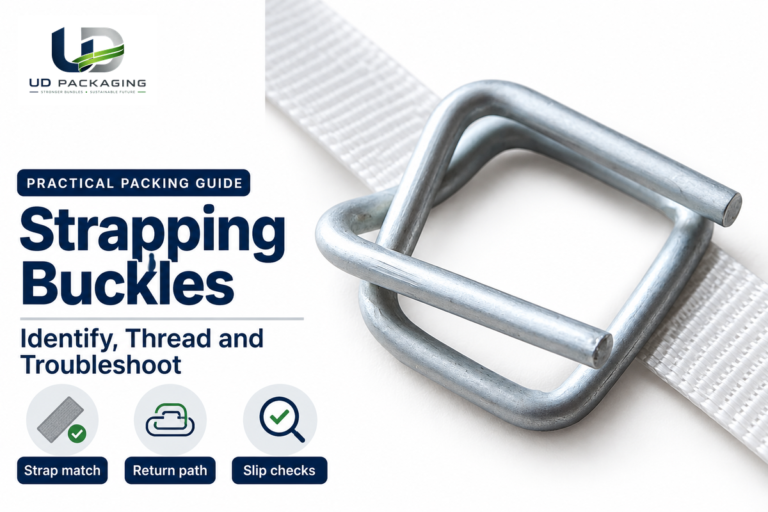
3. Wire buckles and metal buckles. A buckle is a frame, not a sleeve. The strap wraps back through it and locks against itself. The defining property is that no sealing tool is required: a buckle can be closed by hand, which is why buckles dominate lightweight and field applications where carrying a sealer is impractical. Supplier catalogues list buckles as plastic-strap, lightweight-duty hardware, and buckles for poly strapping are reusable in a way a crimped seal isn’t, which makes them the durable choice on returnable loads.
4. Push-type and tooth clips. Push-type seals have fully overlapping crowned flanges and are pre-threaded, making a reverse notch joint on steel. Tooth seals work the opposite way, with internal teeth that dig into a lubricated strap surface or bite into the beading on poly strap. Both are fitted before tension.
Product-level dimensions for the first two families are on the open and closed strapping seals page, and the frame types are on the wire and metal strapping buckles page.
💡 Mechanism note, and it isn’t a matter of degree. A notch joint takes its strength from mechanical interlock: the sealer cuts into the seal and the strap edges and turns tabs down or up. A crimp joint takes its strength from friction, the sealer presses wavy crimps and doesn’t cut, and the strength of a crimp joint comes from the deformed seal generating high frictional force against both strap courses. These are two mechanisms, not two grades of one. Catalogues assign the crimp joint to severe-impact duty such as carloading, and the notch joint to waxed strapping in packaging and unitizing.
Which Closure Your Steel, Poly, PET or Cord Strap Already Rules Out
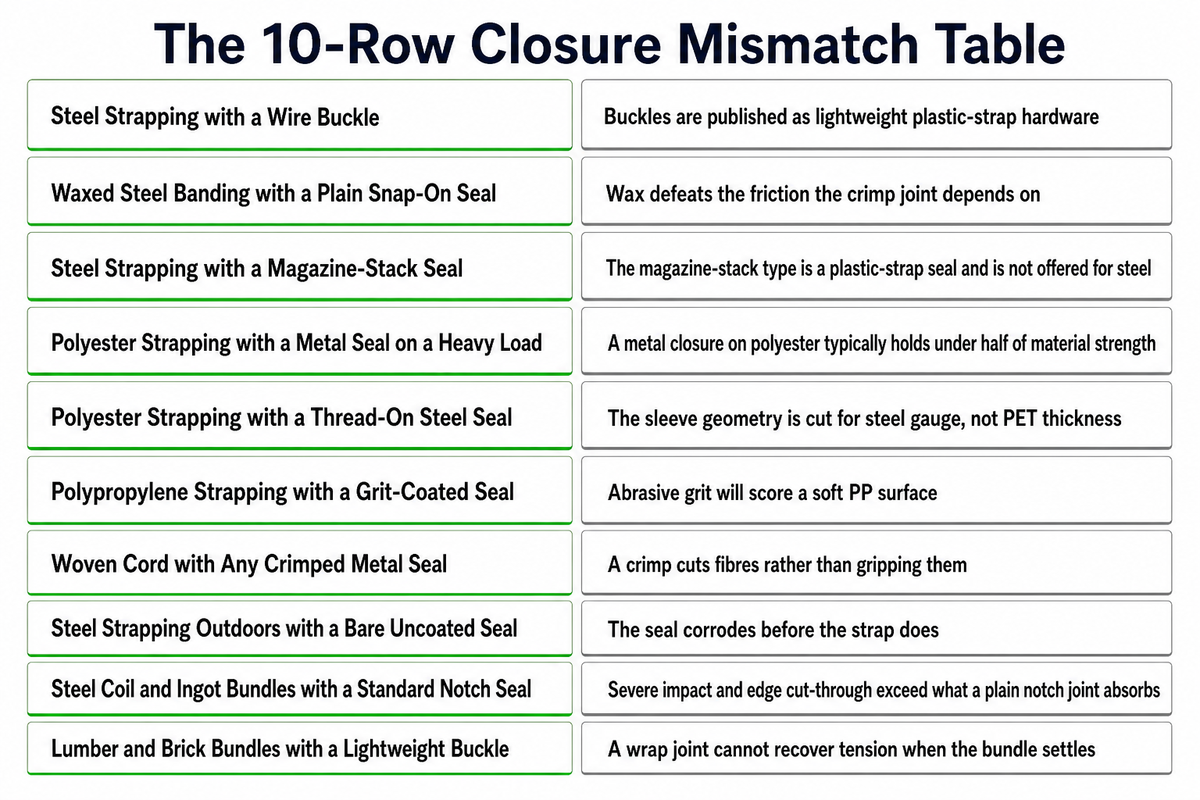
Your strap material has already eliminated most of the catalogue. Steel takes seals or a sealless punched joint. Polyester takes seals, a friction weld or a heat weld. Polypropylene takes buckles, seals or welds. Cord strapping takes buckles only. The table below is an elimination table: each row says what disqualifies a pairing, not what fits it.
The 10-Row Closure Mismatch Table
| Strap material | Closure family | Coating / condition | Disqualified because | Use instead |
|---|---|---|---|---|
| Steel strapping | Wire buckle | Any | Buckles are published as lightweight plastic-strap hardware; steel will not lock against a frame at rated tension | Open-flange or thread-on seal |
| Waxed steel banding | Plain snap-on seal | Surface wax | Wax defeats the friction the crimp joint depends on | Grit-coated seal, whose abrasive bites through the wax |
| Steel strapping | Magazine-stack seal | Any | The magazine-stack type is a plastic-strap seal and is not offered for steel | Push-type seal on machine lines |
| Polyester (PET) strapping | Metal seal on a heavy load | Manual tooling | A metal closure on polyester typically holds under half of material strength | Friction weld, which clears the 75% efficiency mark |
| Polyester (PET) strapping | Thread-on steel seal | Any | Steel-only type; the sleeve geometry is cut for steel gauge, not PET thickness | Snap-on seal or a weld |
| Polypropylene (PP) strapping | Grit-coated seal | Any | Abrasive grit is designed to cut wax on steel and will score a soft PP surface | Tooth seal or buckle |
| Woven cord strapping | Any crimped metal seal | Any | A crimp cuts fibres rather than gripping them; cord is closed by wrapping | Wire buckle sized to strap width |
| Steel strapping, outdoor storage | Bare uncoated seal | Weather exposure | The seal corrodes before the strap does, because it is thinner at the crimp | Galvanized or phosphate-coated seal matched to the strap finish |
| Steel coil and ingot bundles | Standard notch seal | Sharp edges, hot product | Severe impact and edge cut-through exceed what a plain notch joint absorbs | Grit-coated or heavy open-flange seal, with edge protectors |
| Lumber and brick bundles | Lightweight buckle | Settling, non-compressible | A wrap joint cannot recover tension when the bundle settles in transit | PET with a friction weld, which recovers tension elastically |
The mechanism behind row four and row ten is the same property: polyester strapping elongates under load and recovers, and steel doesn’t. That’s why the two materials carry different closure sets rather than different grades of one closure set. Published supplier figures put a manual mechanical closure near 60% of strap break strength and a friction weld near 85%, and a metal seal on polyester below half of material strength against a 75% efficiency threshold. Both figures come from suppliers who sell the welding equipment, so treat them as directional rather than as independent test results, but note that two firms with opposing commercial interests report the same direction.
For the material taxonomy behind this table, see polypropylene and polyester strap types; for the material itself, polyester (PET) strapping; and for the ordering step, strapping seals and buckles.
Sizing the Clip to the Strap: Width, Thickness and Overlap
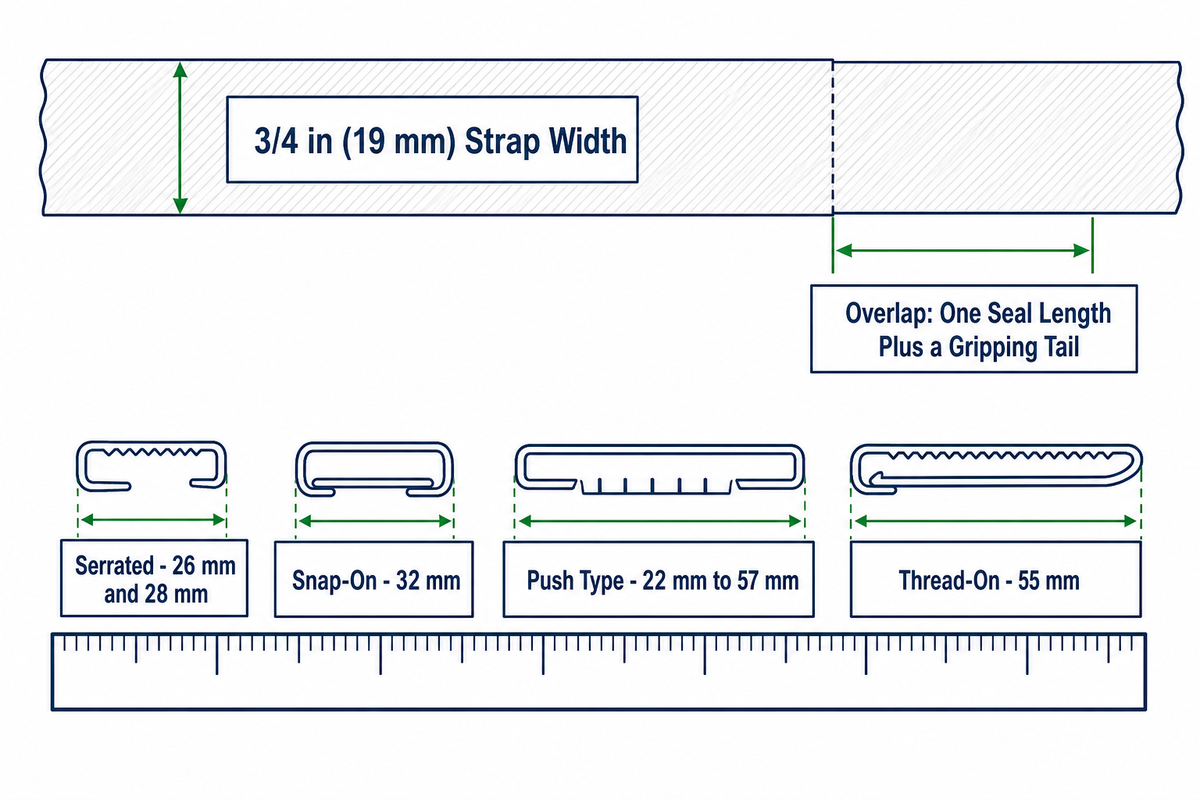
Seal size is named for the strap it fits, not for any dimension of the seal itself. A carton marked 3/4 in holds seals for 3/4 in (19 mm) strap, and at that one strap width, published seal lengths in a single supplier’s catalogue run from 22 mm to 57 mm depending on type. The inch figure narrows your choice; it doesn’t make it.
| Seal type at 3/4 in (19 mm) strap width | Published seal length | What the length is buying you |
|---|---|---|
| Serrated | 26 mm and 28 mm | Short bite zone; fastest to apply |
| Snap-on | 32 mm | Two crimp pairs fit within the sleeve |
| Push type | 22, 25, 32, 40, 45, 48, 50, 55 and 57 mm | Length is the tuning variable for load severity |
| Thread-on | 55 mm | Full four-sided wrap of both strap courses |
Manual grade and machine grade are published as separate dimension sets.
Worked example, end to end. Say you run 19 mm (3/4 in) polyester strap at 1.0 mm thickness on a manual sealer, closing palletised brick. Step one: strap width fixes the seal call-out, you’re ordering a 3/4 in seal, so every 1/2 in and 5/8 in part number is out. Step two: material rules out steel-only types, so thread-on, open-flange, push-type and grit-coated are out, which leaves snap-on and tooth. Step three: load severity sets length, brick settles and is non-compressible, so take the longer of the two available snap-on lengths rather than the 26 mm serrated. Step four: overlap. Lay the strap so the free end runs at least one full seal length past the seal, 32 mm here, plus a 10 to 15 mm tail you can grip; that gives you a nominal 45 mm overlap to work with and enough material for a second crimp pair if the first inspects badly. Step five: confirm the sealer jaw is rated for 19 mm before you order the case.
⚠️ Tool-to-strap incompatibility, the trap hiding inside the sizing step: some seal part numbers are catalogued as fitting two adjacent strap widths, and the sealing tools for those two widths are not interchangeable. A seal that spans two strap widths doesn’t mean a tool that spans two strap widths. Confirm the sealer’s rated strap width against the strap you actually run, in writing, before the case ships.
What the Closure Contributes to Joint Strength
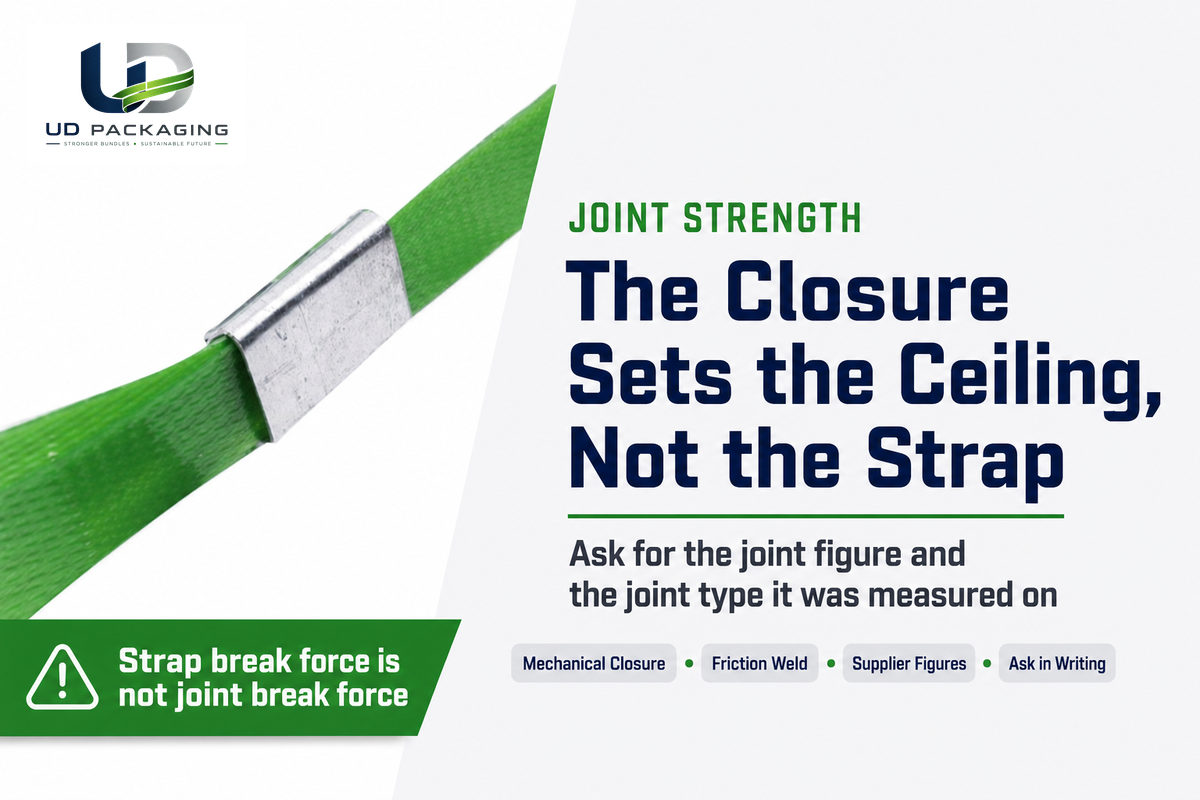
The strap’s published break force isn’t the joint’s break force. The closure sets the usable ceiling, and everything above it in the specification sheet is a number the assembled joint won’t reach. Ask a supplier for the joint figure, not only the strap figure, and ask which joint type it was measured on.
A worked reference point from a real report: in SGS tensile report SUZIN2605001676PL07_CN, issued 2026-06-02 by SGS-CSTC Standards Technical Services in Suzhou, a cut polyester specimen measuring 16.022 by 1.058 mm returned 4,860 N tensile force at 21% elongation at break. For context on the range that figure sits in, UD Packaging publishes six polyester models spanning 12 mm to 19 mm in width, rated from 2,600 N to 6,800 N, and quotes from an initial order quantity of 1,000 kg. That’s the strap. Put a manual mechanical closure on it and published supplier figures suggest roughly 60% of it survives the joint; put a friction weld on it and roughly 85% does. The gap between those two numbers is larger than the gap between most competing strap grades, which is the whole argument for treating the closure as a specification decision rather than a consumable.
One caution on which document to wave at a supplier. ASTM D3953 clause 8.9.4 requires periodic joint-efficiency testing on notched, crimped, sealless and crimp-type joints but publishes no pass threshold, so the number you are given is a supplier’s number and not a standard’s number. That clause sits in a flat steel strapping specification, so it is the one to cite for steel; for polyester, polypropylene and cord the governing specification is ASTM D3950 instead, and quoting the steel clause at a plastics supplier invites a well-earned correction. For the measurement itself, specimen preparation, test method and how to read a supplier’s figure, see how joint strength is measured.
How to Use a Strapping Clip: Tool, Sequence, and the Three Mistakes That Cost the Joint
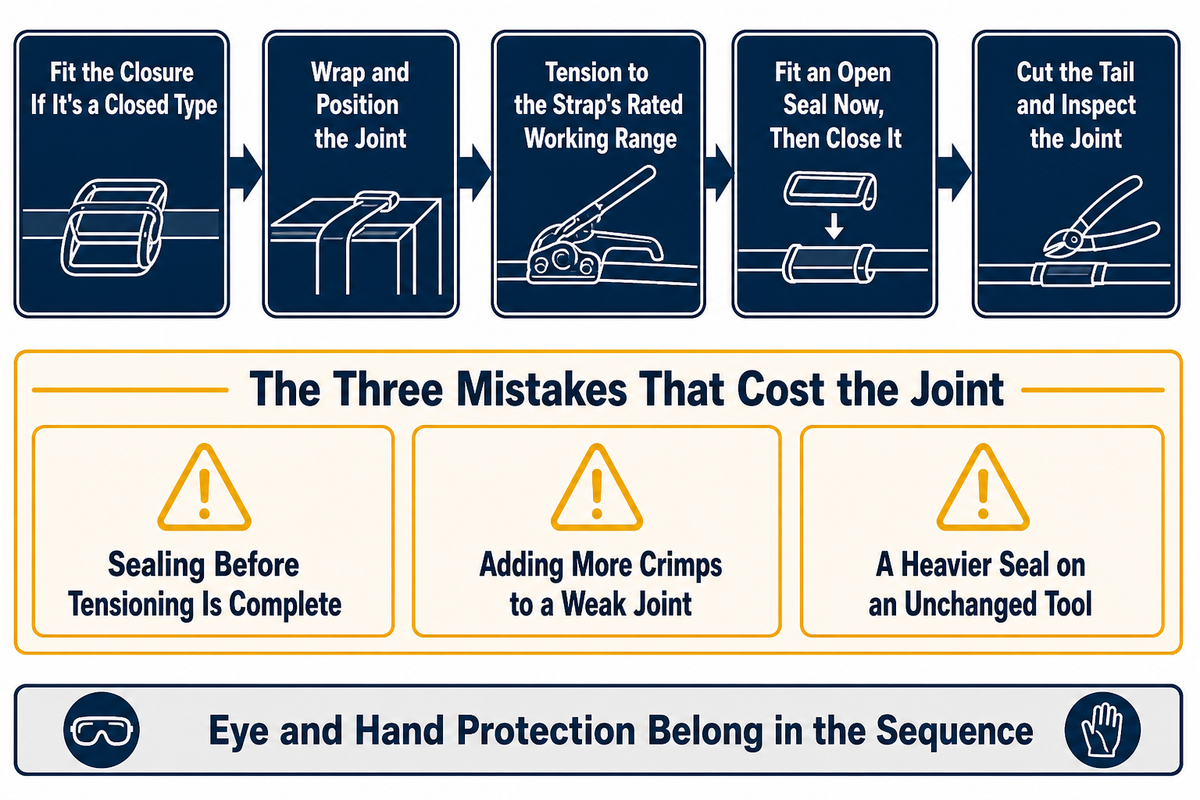
The sequence is tension, then seal, then cut, and the closure family decides whether the part goes on before or after the tension step. Closed seals thread on first. Open seals snap on last. Buckles need no sealing tool. Getting this order wrong is the single most common way to waste a strap.
How to use strapping clips
- Fit the closure if it’s a closed type. Thread-on and push-type seals go onto the strap before you pull tension. If you skipped this and the strap is already tight, you can’t recover: cut and restart.
- Wrap and position the joint. Put the joint on a flat face of the load, never over an edge or a corner. Overlap the free end by at least one seal length plus a gripping tail.
- Now tension to the strap’s rated working range, not to the operator’s limit. Details of this step are in the tensioning before you seal guide.
- Fit an open seal now, if that’s your family, then close it with a sealer rated for the strap width and the seal type. Manual, pneumatic and battery classes are compared under manual and pneumatic strapping tools.
- Cut the tail and inspect the joint before moving the load: crimps fully formed, no strap edge peeling out of the sleeve, seal centred on the overlap.
⚠️ This is a worker-exposure step, not only a mechanical one. A tensioned strap stores energy and releases it when the joint is cut or fails. OSHA accident record 201056140: “Employee #1 had just finished cutting three bands on a package when the final band, which was under tension, broke and whipped Employee #1’s face and eye.” Eye and hand protection belong in the sequence above, and the operator stands out of the strap’s release path; to the side of the joint, never in line with it.
The three mistakes that cost the joint.
One, sealing before tensioning is complete. Crimping a seal at partial tension locks in slack. The load looks strapped and isn’t, and the failure shows up in transit rather than on the line.
Two, adding more crimps to a weak joint. More crimping doesn’t convert a friction joint into an interlock joint. If the joint is weak because the mechanism is wrong for the strap, extra crimps deform the seal further without adding holding force, and can score the strap.
Three, a heavier seal on an unchanged tool. Selecting up in seal weight isn’t automatically a safety improvement. A trade glossary states the relationship plainly: a heavier seal can reduce joint efficiency, leading to a lower break and less secure holding, if the bander isn’t rated to handle it. The binding constraint is the tool, not the part. For how the closure fits the rest of the line, see where the closure sits in the system.
Why Joints Fail: Slip, Cut-Through and Seal Fracture
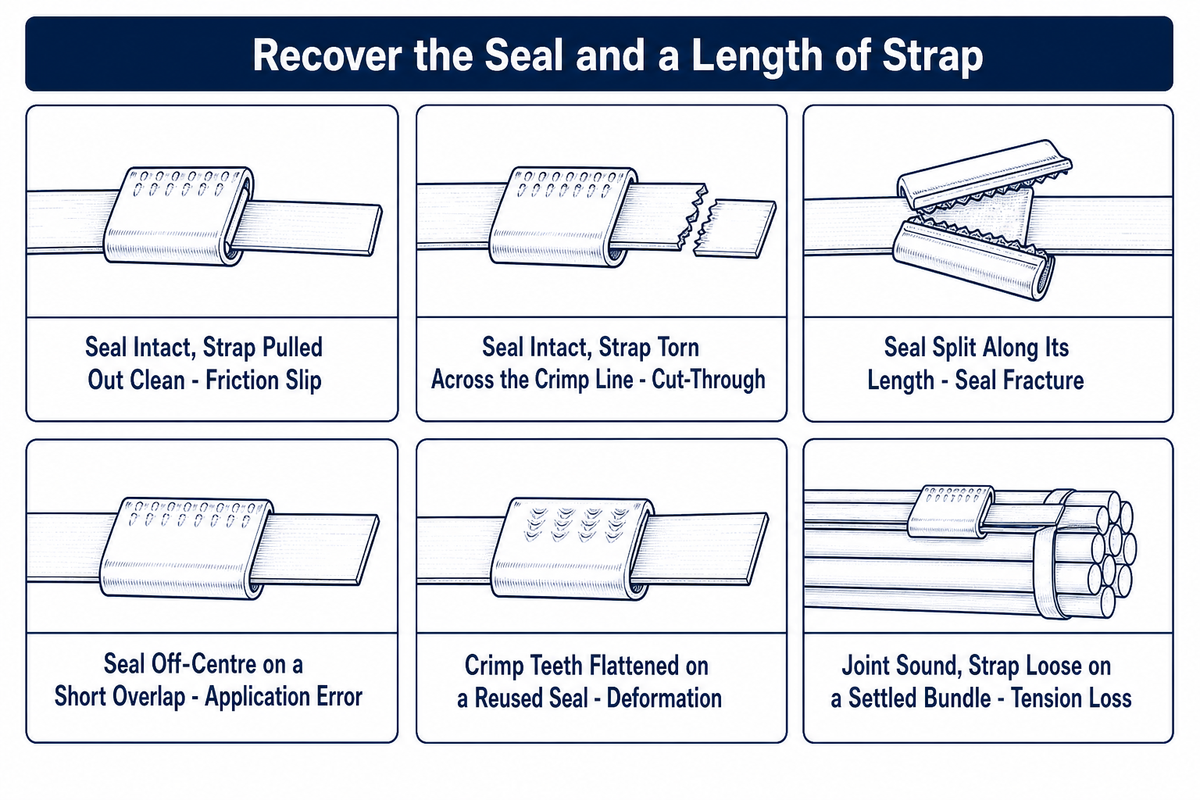
A joint that held on the line and let go in transit failed in one of a small number of readable ways. The failed part tells you which. Recover the seal and a length of strap from the failure, then match what you see against the signatures below before you change anything about the specification.
| What you find | What it means | Corrective action |
|---|---|---|
| Seal intact, strap pulled out clean | Friction slip — the crimp never developed enough grip | Check for wax or oil on the strap; move to a grit-coated seal or a notch joint |
| Seal intact, strap torn across the crimp line | Cut-through — the sealer bit too deep into the strap edge | Service or replace the sealer jaws; verify jaw rating against strap gauge |
| Seal split along its length | Seal fracture — seal gauge under-matched to load severity | Step up to a heavier family, and re-rate the tool at the same time |
| Seal off-centre on a short overlap | Application error — insufficient tail beyond the seal | Retrain on overlap length; it is the cheapest fix on this list |
| Crimp teeth visibly flattened on a reused seal | Deformation — the crimp geometry has already been consumed once | Treat crimped seals as single-use; the deformed seal is what generated the original holding force |
| Joint sound, strap loose around a settled bundle | Tension loss, not joint failure — the load compacted | Change strap material to one that recovers elastically, not the closure |
Row five is worth a sentence of its own, because it’s the most frequently asked question about this part. Can strapping seals be reused? A crimped seal takes its holding force from its own deformation, so once crimped, the geometry that produced the grip no longer exists in its original form. No supplier or standard located in this research endorses reuse. In the narrow context of cargo-carrying commercial motor vehicles operated in interstate commerce, 49 CFR 393.104(b) also prohibits securement components that are damaged or weakened in a way that affects performance; a condition-based rule rather than a blanket ban on reuse, and one that applies to that transport context, not to industrial packaging generally.
Cutting a failed or intact strap carries the same stored-energy exposure described in the previous section. Recover failed parts with the load still supported, and with eye protection on.
Which Published Document Actually Governs the Clip?
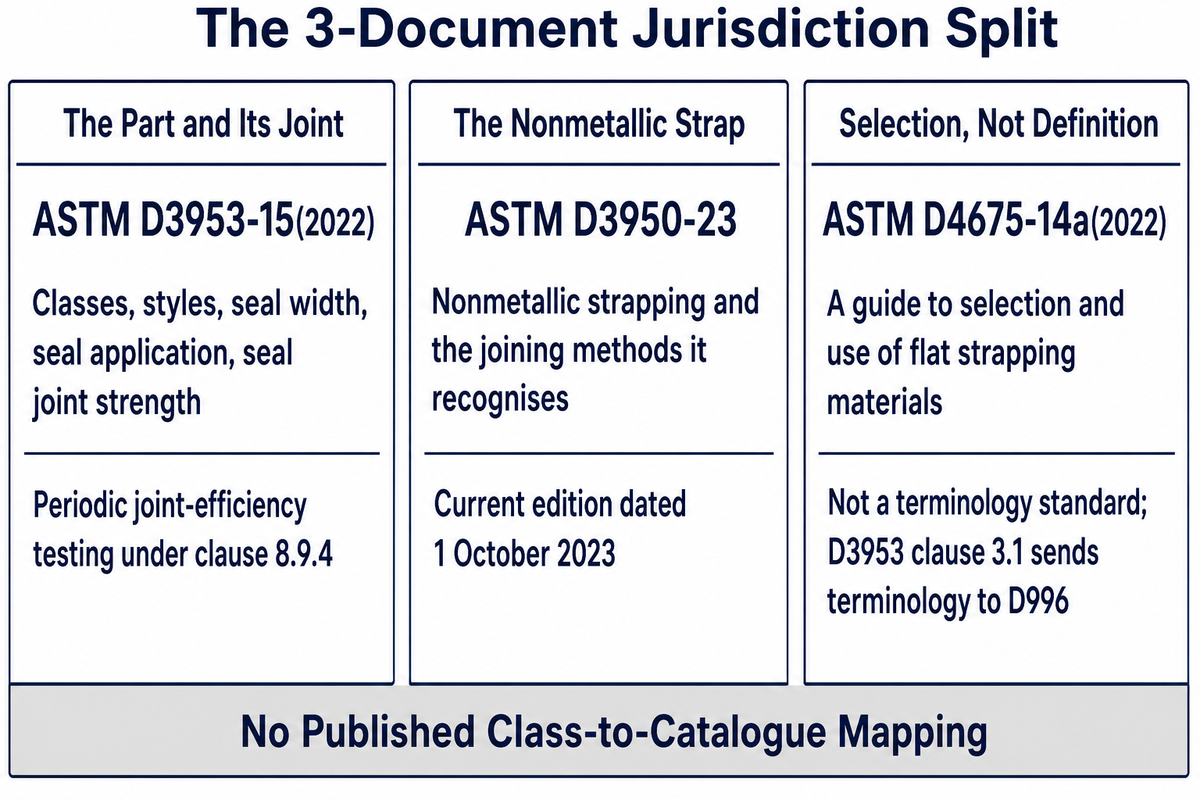
ASTM D3953 does govern the seal. Its published abstract states that seals “shall be of the following classes: Class R and Class H … and styles: Style I, Style II, Style III, Style IV, and Style V” and that strapping and seal “shall conform to the physical and mechanical property requirements prescribed for … seal joint strength … seal width, seal application, notch, crimp, and sealless joints.” The standard classifies the part, dimensions it, and sets a joint-strength requirement.
The 3-Document Jurisdiction Split
| Layer | Document | What it actually covers |
|---|---|---|
| The part and its joint | ASTM D3953-15(2022) | Flat steel strapping and seals: classes, styles, seal width, seal application, seal joint strength, and periodic joint-efficiency testing under clause 8.9.4 |
| The nonmetallic strap | ASTM D3950-23 | Nonmetallic strapping and the joining methods it recognises; current edition dated 1 October 2023 |
| Selection, not definition | ASTM D4675-14a(2022) | A guide to selection and use of flat strapping materials — not a terminology standard; D3953 clause 3.1 sends terminology to D996 |
So where is the gap the buyer actually falls into? The standard’s vocabulary and the catalogue’s vocabulary are not published against each other. D3953 sorts seals on three published axes, two classes (R and H), four finishes (A, B with Grades 1 to 3, C and D) and five styles (I through V), and it governs flat steel strapping and its seals. Hold the comparison inside that scope and the gap is still there: of the supplier range in the crosswalk above, five types are steel work D3953 does cover (snap-on, thread-on, open-flange, push-type and grit-coated), and not one of them is published as a Class, a Finish or a Style. The remaining names (magazine-stack, tooth, buckle) are plastic-strap parts that fall outside D3953 altogether, under ASTM D3950, so for those the standard does not even offer a vocabulary to map onto. And clause 1.2 limits the specification to the types and sizes as cataloged by strapping suppliers. The standard defers the catalogue to the supplier, and none of the supplier seal pages read for this article states which class or style a given trade name corresponds to. A mapping may exist inside a manufacturer’s own engineering documentation; what is missing is a published one a buyer can consult.
That’s a translation problem, not a jurisdiction problem, and it has a practical consequence you can act on today: you can’t write “Class H, Style III” on a purchase order and expect a distributor to match it, and you can’t audit a delivered seal against D3953 without asking the manufacturer which class and style the part is. Ask that question in writing. It’s the one procurement question in this article that no catalogue page answers for you.
That claim is measurable, so it was measured rather than asserted. Three buyer questions about this part were put to two answer engines for this article, and the replies cited 73 sources across 55 unique domains. Where those citations landed is the finding. Both engines cited freely on best strapping clips manufacturers and on strapping clips price, 20 and 20 sources from one engine and 7 and 7 from the other, while one of the two returned no citations at all for how to choose strapping clips. Purchase-intent questions have plenty of pages to point at. Nothing canonical exists for the selection question to cite, which is the gap this section describes arriving from a different direction.
💡 A reference gap worth knowing. 49 CFR 393.104 still incorporates ASTM D3953-97, dated February 1998, while the standard itself has moved to the 2015 edition reapproved in 2022. Under that regulation, steel strapping 25.4 mm (1 in) or wider must have at least two pairs of crimps in each seal, and an end-over-end lap joint must be closed with at least two seals; unmarked steel strapping is assigned a working load limit of one quarter of the D3953-97 breaking strength. The regulation does not require the device to be marked with its working load limit at all, which is why the default exists. All of this applies to cargo-carrying commercial motor vehicles in interstate commerce, and not to industrial packaging in general.
One disclosure, since this article is published by a manufacturer. UD Packaging cites ASTM D3950-23 and ASTM D3953-15(2022) as published specifications it works to; it does not run ASTM’s test programmes, and says so on its own standards page. Where this article quotes a figure from a supplier, including from competitors of UD Packaging, it is labelled as a supplier figure.
Proving a Closure on Your Own Package Before You Buy a Case
Run one joint before you commit to a case. A single-joint bench trial takes under an hour, uses material you already have in stock, and settles the question a specification sheet can’t: whether this closure holds your load, at your tension, on your tooling.
The trial. Close one joint on a representative package at your normal working tension. Inspect the crimps. Then apply load in the direction the load will actually move, for palletised goods that’s lateral shift, not vertical compression. If the joint slips at rated tension, you’ve a friction problem: step down a seal size or move to a different closure family rather than adding crimps. If the strap breaks away from the joint, the joint isn’t your limiting factor and the strap grade is. If the seal itself splits, step up a family and re-rate the sealer at the same time. Repeat once. One result is an anecdote; two consistent results are a decision.
This is a joint-level trial only. Package-level performance, drop, vibration, stacking, and whether a strapping change invalidates your existing qualification, belongs to a different protocol; see package-level retest after a strapping change. ASTM D4169 and ISO 4180 sit at that layer, above the joint.
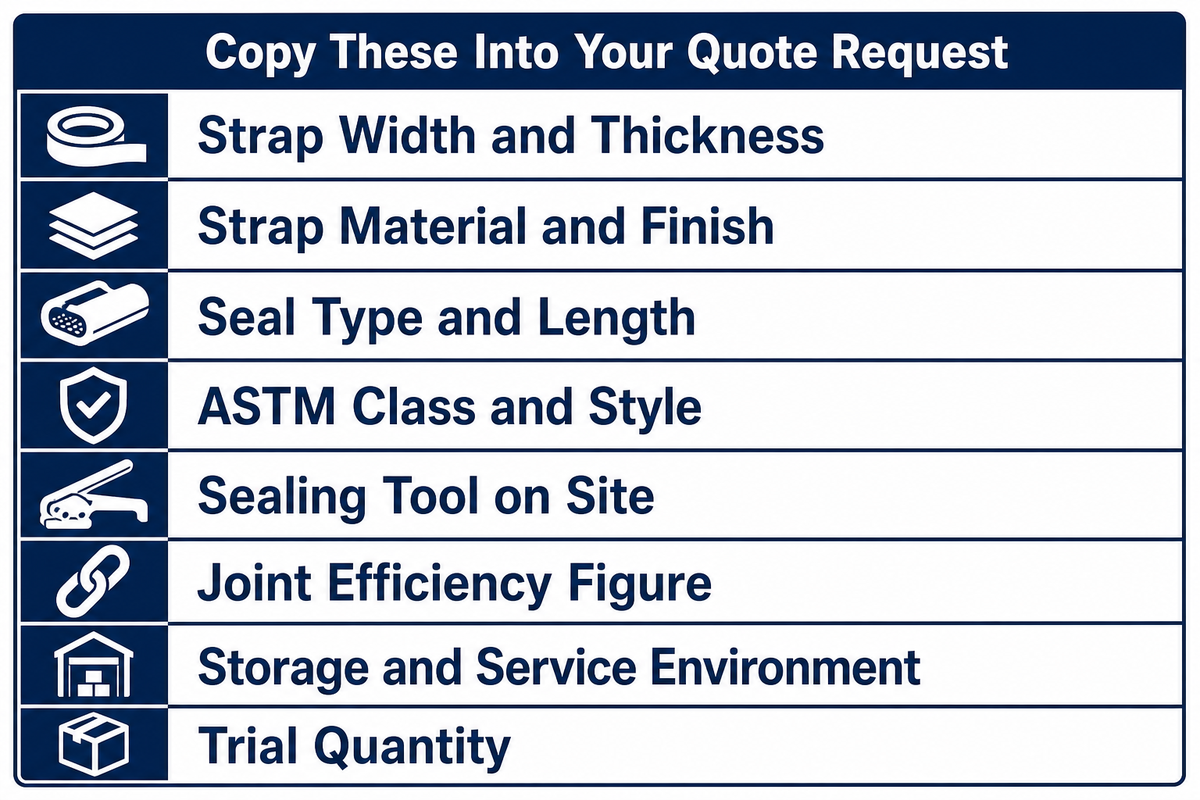
Once the trial passes, the enquiry writes itself. Copy the table below into your request for quotation, these are the inputs a supplier needs to quote a closure without a round of clarification emails.
RFQ checklist. Copy these into your quote request:
| Parameter | What to state | Why it matters | How to verify on delivery |
|---|---|---|---|
| Strap width and thickness | e.g. 19 mm (3/4 in) by 1.0 mm | Fixes the seal call-out and eliminates every other size | Caliper one seal against one strap course |
| Strap material and finish | Steel, PET, PP or cord; waxed, galvanized or phosphate | Rules out entire closure families before pricing | Mill certificate or coil label |
| Seal type and length | Family plus a length in mm, not just an inch size | One strap width spans 22 to 57 mm of seal length | Measure ten seals from the case, not one |
| ASTM class and style | Ask the manufacturer to state Class R or H and Style I to V | The only way to bridge the catalogue-to-standard gap | Written confirmation on the quotation |
| Sealing tool on site | Make, model and rated strap width | A seal spanning two widths does not mean a tool does | Tool nameplate against the seal carton |
| Joint efficiency figure | Ask for a percentage and the joint type it was measured on | Strap break force is not joint break force | Test report reference, not a brochure claim |
| Storage and service environment | Indoor, outdoor, marine, or hot product | The seal corrodes before the strap does | Coating stated on the packing list |
| Trial quantity | A sample case before a pallet | One bench trial is cheaper than one rejected shipment | Run the single-joint trial above |
What Is Changing: A Vocabulary Drift and a Standard Revision Clock
Two things are moving on a part that looks settled. The test-method edition behind a supplier’s published tensile figure changed on 1 October 2025, which turns the edition printed on a mill certificate into a checkable procurement item. And the vocabulary buyers search with is splitting, which changes how you find the part at all.
The revision clock. The national standards register carries GB/T 1040.1-2018, the tensile-properties method named in a good deal of Chinese supplier quality documentation, with the status withdrawn. It was issued 2018-12-28 and took effect 2019-11-01; GB/T 1040.1-2025 replaced it, issued 2025-03-28 and in force from 2025-10-01. The films-and-sheets part has moved too, and here the register gives a date worth putting in a calendar. A successor to GB/T 1040.3-2006 was issued 2026-05-25 as GB/T 1040.3-2026, is listed as pending implementation, and takes effect 2026-12-01. Its companion GB/T 1040.4-2026, covering fibre-reinforced composites, carries the same two dates. The action for a buyer is narrow and worth doing: read which edition your own certificate names. If it names the 2018 Part 1 edition, that document is withdrawn and the certificate is citing a retired method; if it names the 2006 Part 3 edition, ask the supplier when their own testing moves to the 2026 edition, because the register won’t answer that for you. Note also that the films-and-sheets part is scoped by its clause 1.1 to plastic films and sheets under 1 mm thick, it’s a material test method, not a strap joint-strength method.
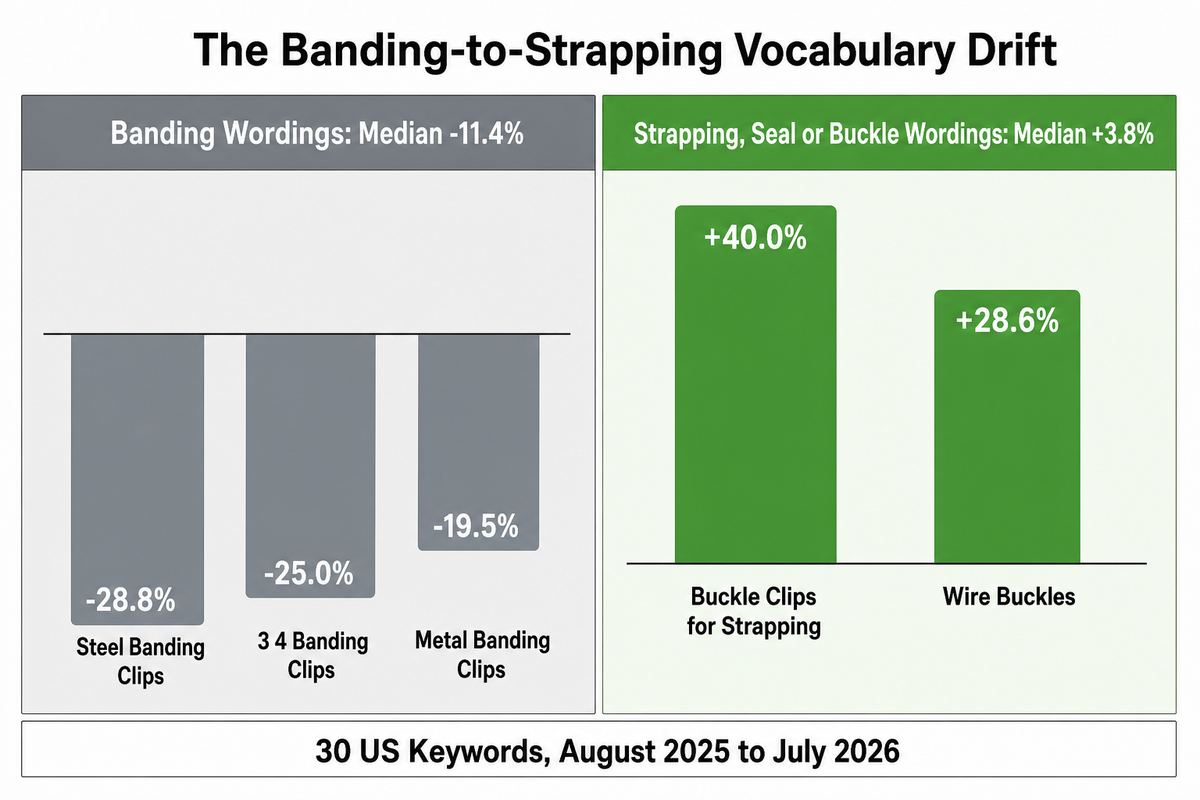
The Banding-to-Strapping Vocabulary Drift. Across 30 United States keywords measured over the twelve months from August 2025 to July 2026, queries worded with banding ran a median half-over-half change of −11.4%, with 7 of 12 declining. Queries worded with strapping, seal or buckle ran a median of +3.8%, with 6 of 18 rising. The steepest declines cluster in the banding family: steel banding clips at −28.8%, 3 4 banding clips at −25.0%, 1 2 banding clips at −21.9%, metal banding clips at −19.5% — though the single largest fall in the set runs the other way, strapping metal clips at −50.0%. The steepest rises lean to the strapping and buckle family, led by buckle clips for strapping at +40.0% and wire buckles at +28.6%, with banding strap clips at +35.3% the one clear exception on that side.
📐 Method, stated so you can discount it properly. One keyword set of 30 terms, one twelve-month window, United States, half-over-half comparison of the mean of the last six months against the mean of the first six. This is a directional observation about search language, not a measurement of demand for the hardware. No market-size figure appears anywhere in this article: five published estimates for this sector disagree irreconcilably on both scope and base year, so none of them is load-bearing here.
There’s a third shift, and it cuts against the interests of anyone selling this part, including the publisher of this article. Battery-powered combination tools that form a sealless notched joint are now listed as a standard configuration alongside manual and pneumatic classes; Signode holds a separate filing, EP3172135A1, for an electrically powered combination hand-held tool that tensions and forms exactly that joint in steel strap. On high-volume steel lines, the closure is moving off the separate part entirely. If your volumes justify the tooling, the honest answer to “which clip should I buy” may be none, and that’s worth checking before you standardise on a consumable for the next five years.
Frequently Asked Questions
What are different types of strapping?
Four materials cover industrial use: steel strapping for rigid, heavy or hot loads with sharp edges; polyester (PET) for heavy palletising where elastic tension recovery matters; polypropylene (PP) for lighter bundling and carton reinforcement; and woven cord for agriculture, building trades and marine work. Each carries its own closure set, which is the subject of the mismatch table above.
What is a strapping tool?
A strapping tool is the device that tensions the strap, closes the joint, or does both. Manual tensioners and sealers are separate tools; combination tools do both in one action. Pneumatic and battery classes add consistent tension independent of operator strength. The tool must be rated for the strap width and the seal type you’ve chosen, not just the material.
What’s the difference between strapping buckles and seals?
A seal is a sleeve that goes around both overlapped strap courses and is deformed by a sealing tool to grip them. A buckle is a frame that the strap wraps back through and locks against itself, and it needs no sealing tool. Seals are the heavier-duty closure; buckles are the field-serviceable one. Both are sold under the name “strapping clips”.
Why is it called strapping?
The word describes the operation rather than the hardware: strapping a load means binding it with a tensioned band. Banding is the same operation under a different regional and sectoral vocabulary, and the two words are drifting apart in search behaviour rather than in meaning.
How do you secure metal strapping with strapping seals?
Position the joint on a flat face of the load, never over an edge. If you’re using a closed seal, thread it on before tensioning; if it’s an open seal, snap it on after. Tension the strap to its rated working range, then close the seal with a sealer rated for that strap width and seal type. For steel strapping 25.4 mm (1 in) or wider under United States interstate cargo-securement rules, the requirement is at least two pairs of crimps in each seal, and at least two seals for an end-over-end lap joint. Cut the tail, then inspect: crimps fully formed, no strap edge peeling out of the sleeve, seal centred on the overlap. Wear eye protection, a tensioned band releases stored energy when it’s cut.
What’s the purpose of steel strapping?
Steel strapping secures rigid, non-compressible and high-value loads that won’t settle: coil, ingot, brick and construction material, plus product that’s hot at the time of strapping or has edges that would cut a plastic strap. Steel is also the most straightforward of the four to recycle at end of life, since recycling routes for scrap steel are already in place at most sites, whereas PP strapping and polyethylene terephthalate strap need a plastics stream. Its low elongation is the point, it holds a fixed dimension rather than recovering tension, which is exactly why it’s the wrong choice for a bundle that compacts in transit.
Getting the Closure Decision Right
The part is small, the vocabulary is a mess, and the decision is genuinely consequential: the closure, not the strap, sets what the joint will hold. Translate the name, eliminate the families your material rules out, size to the strap rather than to the seal, run one joint on your own package, and ask the manufacturer in writing which ASTM class and style you are buying. That last question is the one this industry has left unanswered on its catalogue pages, and it is the one that makes a delivered part auditable.
Working through a closure specification for steel, polyester, polypropylene or cord strapping? UD Packaging supplies strapping seals and buckles alongside the strap and tooling that run with them, from a single production base in Jiangyin, Wuxi. Bring your strap width, material, finish, sealing tool and load type, and request a specification-matched quotation. Sample cases for the bench trial above can be quoted alongside it.
References & Sources
- ASTM International D3953-15 Standard Specification for Strapping, Flat Steel and Seals, published abstract (seal classes, styles, seal width, seal application, seal joint strength).
- ASTM International, catalogue record ASTM D3953-15(2022), clause 8.9.4 on periodic joint-efficiency testing.
- ASTM International, catalogue record ASTM D4675-14a(2022) Standard Guide for Selection and Use of Flat Strapping Materials.
- Cornell Legal Information Institute 49 CFR 393.104, What standards must securement devices and systems meet?
- Federal Motor Carrier Safety Administration Cargo Securement Rules (scope and the damaged-component provision).
- Federal Motor Carrier Safety Administration Does 393.104(b) require securement devices to be marked or labeled with their working load limit?
- Occupational Safety and Health Administration Accident report 201056140, band under tension striking an employee’s face and eye during cutting.
- International Organization for Standardization ISO 17712:2013 Freight containers, Mechanical seals.
- European Patent Office, via Google Patents EP3319877B1 (Signode, definition of a sealless joint) and EP3172135A1 (Signode, electrically powered combination hand-held strapping tool forming a sealless joint in steel strap).
- State Administration for Market Regulation, national standards register GB/T 1040 series record (status and issue dates for GB/T 1040.1-2018, 1040.1-2025 and 1040.3-2026, plus the implementation dates of the two Part 1 editions; the implemented-on field for GB/T 1040.3-2026 is blank in the register); scope of the 2006 films-and-sheets edition read from the GB/T 1040.3-2006 clause 1.1 record.
- Supplier-published joint-efficiency figures, disclosed as supplier data: PAC Strapping application guide and Fromm Packaging on polyester weld methods.
- Trade glossary on seal weight and bander rating: Definition of terms related to banding tools.
Search-trend figures in this article were measured from DataForSEO monthly search volumes for 30 United States keywords over August 2025 to July 2026. Tensile figures attributed to UD Packaging come from SGS report SUZIN2605001676PL07_CN.
Written by XCX. Every figure above was checked against the sources listed in this section; no independent laboratory testing was performed for this article.