Get in touch with UD Packaging Company

Is PET Recyclable? PET is a recyclable thermoplastic polyester wherever suitable collection and processing exist, but a specific item is recycled only when its design, collection route, sorting process, and end market all work. The #1 resin code identifies the plastic; it doesn’t guarantee that every local program accepts every PET bottle, tray, fiber product, or industrial strap.
Quick Answer
| PET resin | A thermoplastic polyester that can be reprocessed |
| Identification | PET or PETE, usually marked with resin identification code #1 |
| Most established route | Beverage bottles and jars in programs that explicitly accept them |
| Conditional formats | Thermoforms, textiles, film, and industrial PET strapping |
| Buyer rule | Identify the exact item, then verify design compatibility and a real receiving recycler |
Is PET Recyclable? The Short Answer
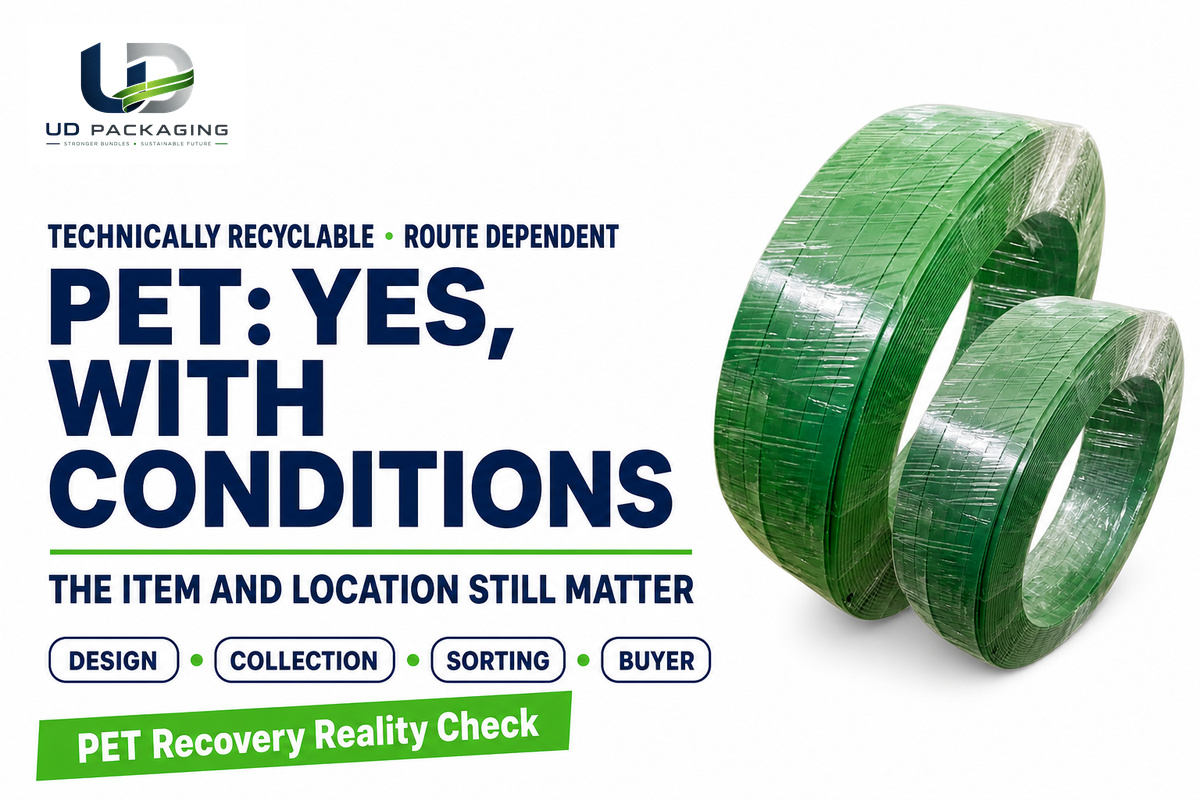
Polyethylene terephthalate, or PET for short, is technically recyclable. In a functioning plastic recycling system, a PET plastic bottle can be converted to flake, filtered, remelted, and reformed into a new product. Other processes involve the polymer being broken into smaller chemical building blocks prior to purification and repolymerization. For mechanical recovery projects, compare PET recycling equipment from Kitech against the incoming material and required flake quality, with food-contact suitability assessed separately for the intended end use.
That’s just a technical answer. The first of many hurdles is that the U.S. rule text for environmental marketing claims states that a product or package shouldn’t be marketed as recyclable unless it can be collected, separated, or otherwise recovered through an established program for reuse or manufacturing. The U.S. Environmental Protection Agency more practically states that a plastic resin code doesn’t guarantee that the item is recyclable in your area.
In a mature deposit or curbside system, the answer for a bottle may be yes. For a black tray, a multilayer package, polyester fabric, or a coil of PET strapping, the answer may be “only through a named commercial route.”
Key takeaway
This polymer is recyclable, but that isn’t a universal collection promise. Judge the exact PET item by its design, local or commercial collection route, reclaimer capability, and end market.
How to Identify PET and the #1 Resin Code
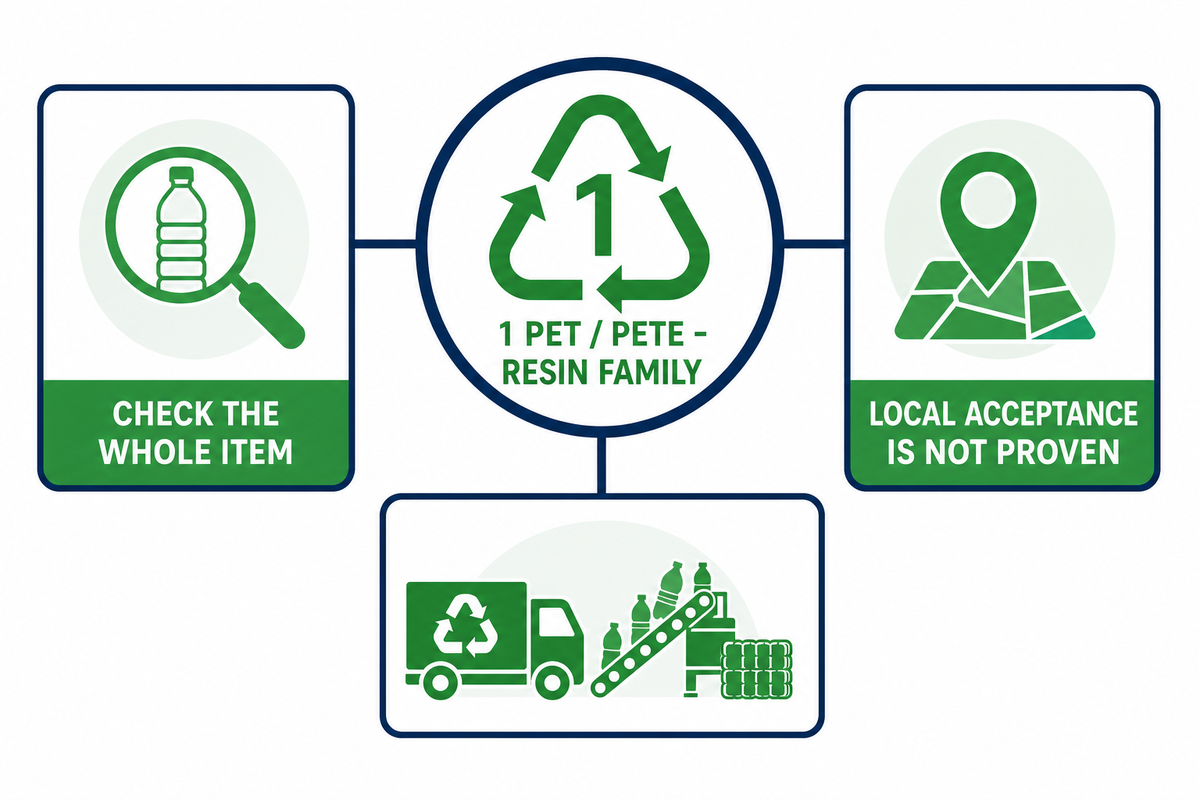
The names PET and PETE are interchangeable. Packaging usually has a 1 in its resin identification code that’s found on many bottles, jars, food trays, and clear clamshells. For polyester textile or industrial strapping products, some manufacturers may use the name “polyester” or provide a supplier declaration as an alternative to the usual package mark.
The code indicates the resin family. There’s no information on color, label system, adhesive, barrier layer, contamination, size or local acceptance. The EPA suggests that, for the exact item, you check with the recycling facility rather than just the resin number.
Do
- Read the PET or PETE material declaration
- Name the item format in your recycling check
- Confirm the current accepted-material list
- Keep business waste specifications in writing
Don’t
- Treat #1 as automatic curbside approval
- Mix bottles, trays, film, and strap into one claim
- Assume color and attachments do not matter
- Call an item recycled because it was collected
How PET Recycling Works
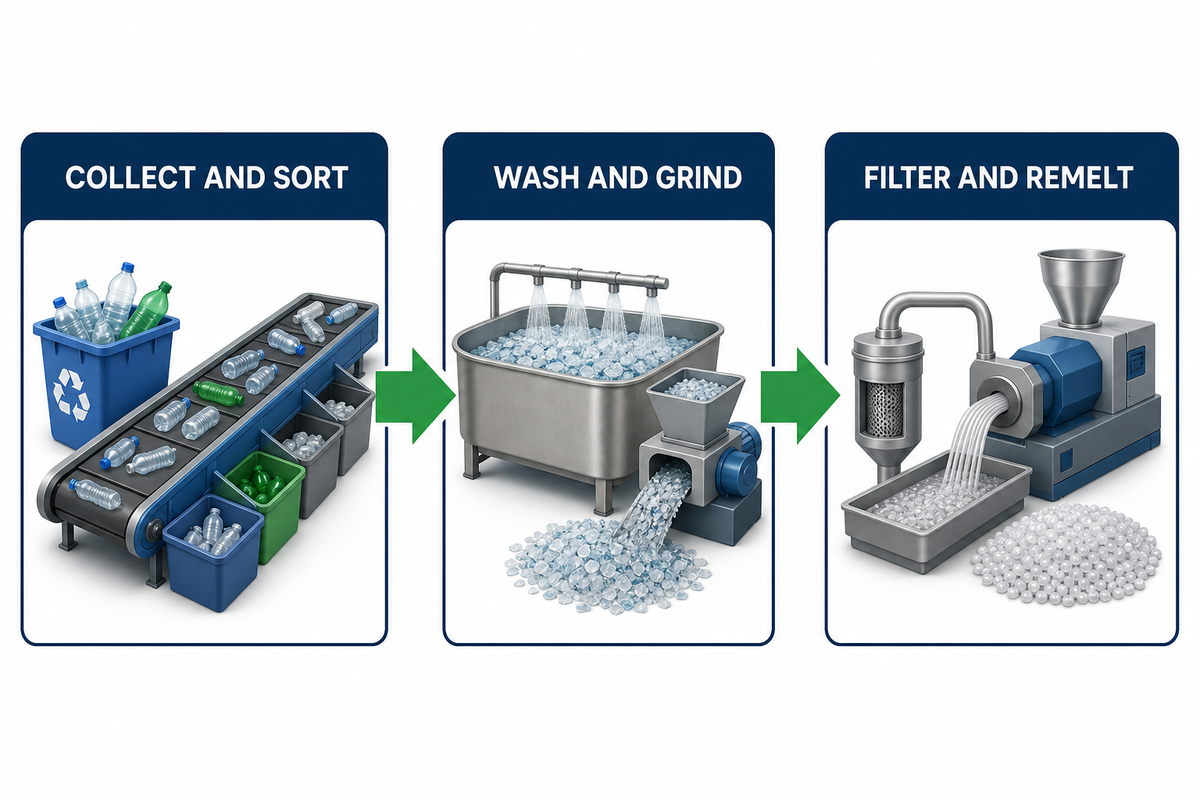
The established mechanical route isn’t a single-step process. The item collected must go through sorting, quality checks, washing, separation, and conversion. The peer-reviewed 2024 review of PET recycling methods discusses both conventional mechanical processing and depolymerization routes, together with the feed-quality and contamination constraints that shape their use.
- Collect and separate — keep the target PET format out of trash and incompatible material streams.
- Sort and bale — identify resin, format, color, and contaminants, then prepare a bale or business shipment that meets the receiver’s specification.
- Wash and grind — remove residue and reduce accepted PET to flake while separating caps, labels, metals, and other polymers where the process allows.
- Purify and convert — dry, filter, remelt, pelletize, or depolymerize the material; fines, residue, and rejected contaminants reduce yield.
- Qualify the next product — test the recovered material for its intended bottle, sheet, fiber, or strapping application.
The weight of the collection isn’t the same as the recycled output. During the recycling process, material can be rejected before being baled, lost as residue or fines, downgraded to a less demanding application, or left without a buyer and sent to landfill. Chemical recycling may remove or separate some impurities; however, it still requires suitable feedstock, operating capacity, energy, markets and an assessment of the energy and emissions. It doesn’t eliminate the need for design and collection.
At material recovery facilities, containers are collected for PET sorting. Empty PET bottles and other plastic bottles and containers are separated before PET is melted, filtered, and made into pellet feedstock or melted and formed into pellets for products made from PET.
In mechanical or physical recycling, recovered material can be used as raw material for new PET bottles and containers or spun into polyester, but every output has to fulfill the requisite specifications.
When PET waste from plastic containers is converted into rPET, virgin PET could still be blended in, with the product specification defining limitations for properties that recovered feedstock is unable to provide on its own.
Why Recyclable Does Not Mean Recycled Everywhere
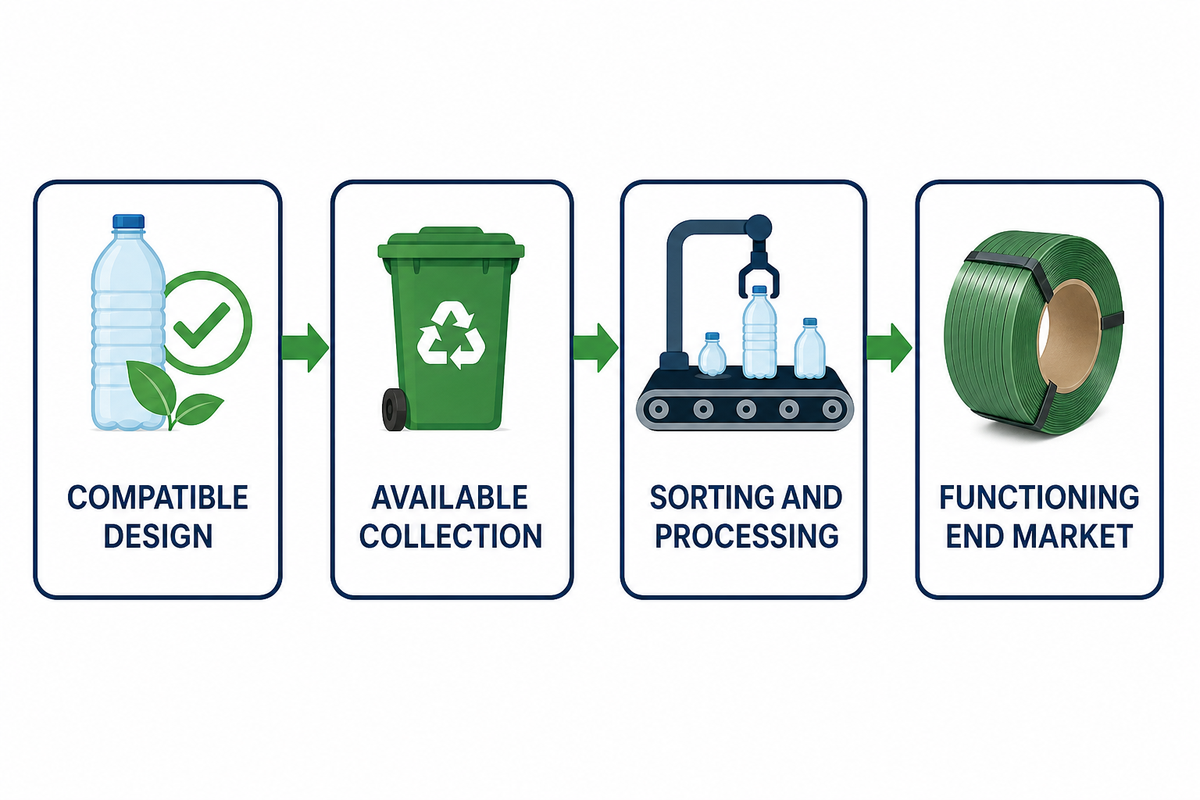
A response to “is PET recyclable?” needs to fulfill all of the following: a) compatible design, b) viable collection, c) effective sorting and processing, and d) accessible end markets. If any of these fail, the item may be technically recyclable, but not recycled in the region.
| Gate | Question | Evidence | Typical failure |
|---|---|---|---|
| 1. Material and design | Can the item enter the preferred PET stream? | Material declaration and design assessment | PVC, opaque color, barrier layer, or incompatible adhesive |
| 2. Collection | Is the exact format accepted where it becomes waste? | Current municipal list, deposit system, take-back contract, or waste-hauler confirmation | Bottle accepted, tray or strap excluded |
| 3. Sorting and processing | Can the facility detect, separate, clean, and convert it at useful yield? | Reclaimer specification, sortation test, bale quality, and yield data | Small item, tangler, dark color, contamination, or excessive residue |
| 4. End market | Will a buyer use the recovered output? | Purchase specification, offtake agreement, or qualified product route | No economical buyer for the grade or format |
For U.S. marketing, the Federal Trade Commission’s Green Guides summary supports the use of qualified recyclable claims where recycling facilities are available to at least 60% of the consumers or communities where the product is sold. The “substantial majority” benchmark refers to access to facilities. It’s guidance, not a legal safe harbor, and it doesn’t guarantee that collected units get converted to new products.
60%FTC substantial-majority access benchmark
30.2%2024 U.S. PET bottle measure reported by NAPCOR
54%TRP/GreenBlue program-acceptance data reported by Resource Recycling, September 2024: PET thermoforms
89%TRP/GreenBlue program-acceptance data reported by Resource Recycling, September 2024: PET bottles, jugs, and jars
A resin code identifies the material. The recovery route determines whether that item gets recycled.
Four-Gate PET Recyclability Reality Check
Is PET Recyclable in the United States?
In the United States, PET bottle recycling has the broadest collection route, while the recycling of PET in non-bottle formats is less consistent. Collection systems to process PET bottles and jars are much more consistent. Programs that recycle PET bottles may still reject trays, fiber, or strap. Used packaging and scrap businesses should rely on their contracted waste management providers and the receiving recycling companies as the operations decision makers.
What Makes PET Easier or Harder to Recycle
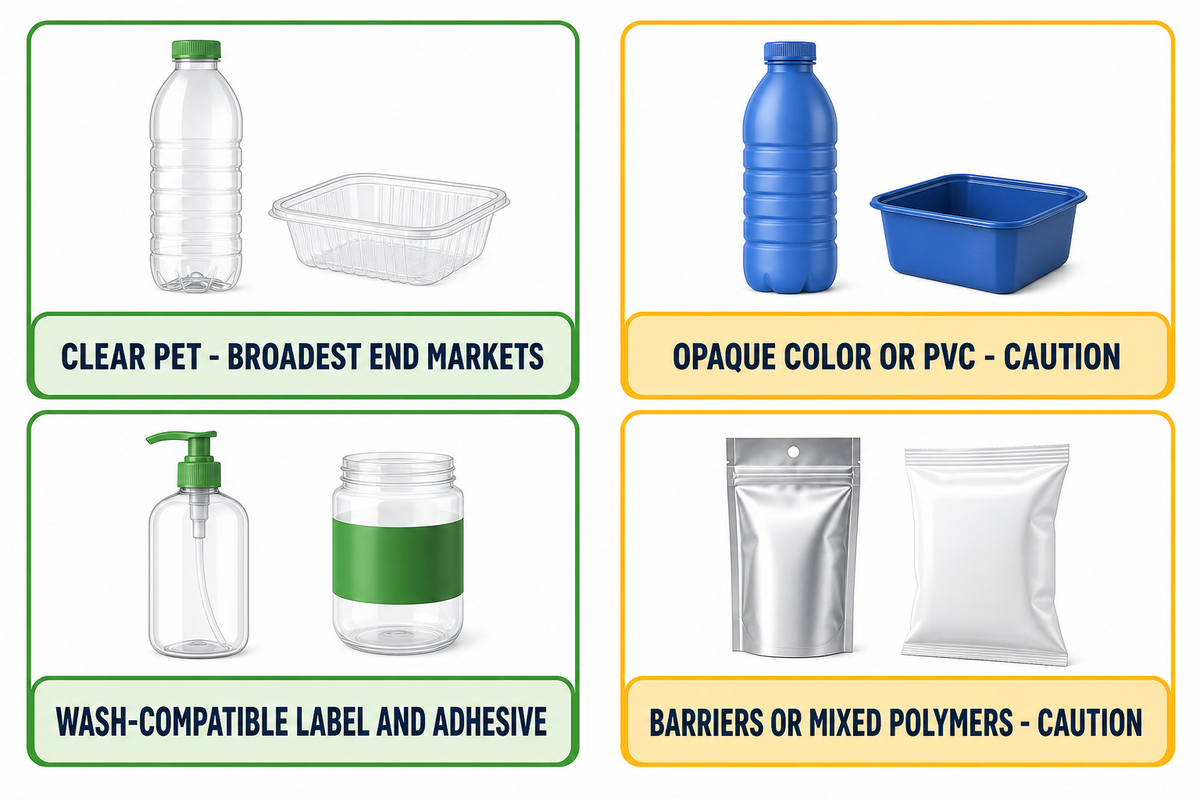
The Association of Plastic Recyclers’ PET design guidance illustrates that the polymer name is an incomplete answer. For clear PET, it’s likely that it will retain the broadest range of higher-value end markets. Color, admixture, decoration, and adhesives will all impact the sortability of the polymer and potentially contaminate the flake.
Identifying PET plastic is just the first design check. Some PET packaging may appear to be a recyclable plastic in one case, but not in another due to the type of plastic used. The effects of labels, barriers, color, and other components in different types of packaging require additional analysis.
| Feature | Why it matters | Buyer or designer check |
|---|---|---|
| Clear PET | Keeps the broadest range of high-value color options open | Prefer clear when the product and brand system allow it |
| Opaque or dark color | Color cannot simply be washed away and may reduce detection or end-market value | Ask for sortation and end-market compatibility |
| Labels and coverage | A large or incompatible label can block near-infrared detection or remain with PET flake | Check substrate, coverage, ink, and separation behavior |
| Adhesive | An adhesive that does not release in the wash can carry contamination forward | Use a tested wash-compatible label system |
| PVC or sinking attachments | Dense incompatible material can follow PET into the sink fraction | Avoid PVC and use compatible or separable components |
| Food, oil, metal, or mixed polymer | Raises cleaning cost, rejection risk, and residue | Define cleanliness and foreign-material limits with the receiver |
| Closures and liners | Components may float away cleanly or follow PET into the recovered fraction | Verify density, separation behavior, and the receiver’s instructions |
| Barrier layers and coatings | Some structures discolor or reduce the performance of recycled resin | Use a compatibility test for the complete package |
| Size and shape | Very small or flat items may be lost during sorting even when the resin is compatible | Confirm that the target facility can capture the finished format |
These points aren’t absolute blockers for the functioning of the designs. A cap or label that separates cleanly can be compatible, while another that looks the same may not be. Use the applicable design test and receiving specification.
Bottles, Trays, Fiber, and Strapping Are Not Collected the Same Way
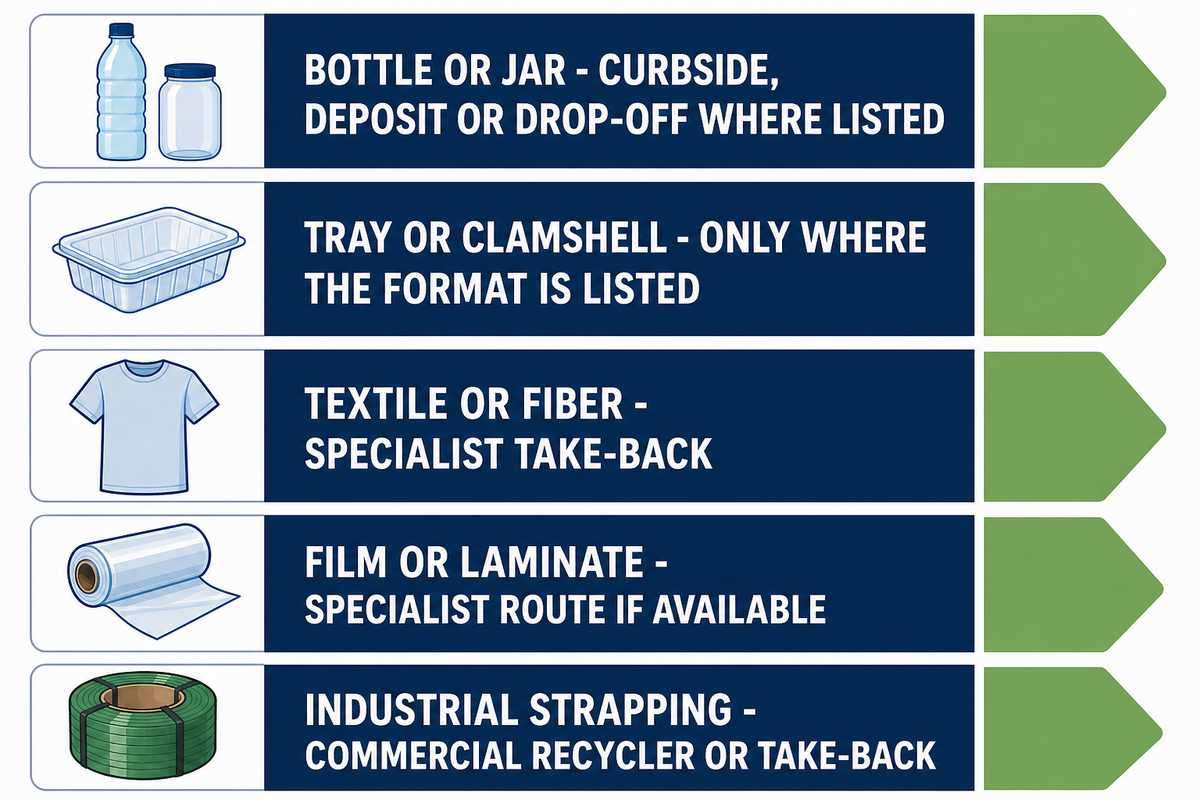
Format and handling affect collection and processing. In September 2024, national program data published by Resource Recycling reported 54% acceptance for PET thermoforms, compared to 89% for PET bottles, jugs, and jars. These are program acceptance numbers, not the actual rate of material that’s recycled. The PET Recycling Coalition has also indicated that only about 30% of North American PET reclaimers can process thermoforms.
| PET format type | Likely route | Preparation | Claim boundary |
|---|---|---|---|
| Beverage bottle or jar | Deposit, curbside, or drop-off where listed | Empty; follow local cap and label instructions | Do not generalize bottle access to all PET |
| Thermoform tray or clamshell | Only programs and reclaimers that list the format | Remove residue; verify that the item is PET | #1 does not override a program exclusion |
| Polyester textile or fiber | Textile take-back or specialized recycler | Sort by product and fiber composition | A polyester label does not prove bottle-stream compatibility |
| PET film or flexible laminate | Specialized route if one exists | Identify layers, coatings, and attachments | Do not call a multilayer structure mono-material without evidence |
| PET cup or tub | Only a program that names the format | Empty and check resin, label, and closure instructions | Shape can change sortation even when the resin is PET |
| Colored PET bottle | Bottle stream where the color is accepted | Follow the receiver’s color specification | Bottle collection does not guarantee a high-value clear-PET end market |
| Clean PET sheet offcut | Manufacturer return or commercial scrap recycler | Keep grades, colors, and coatings segregated | A production-scrap route does not prove consumer collection access |
| Mixed PET production scrap | Receiver-specific commercial route | Document composition and remove incompatible material | Mixed PET feed may still fail a recycler’s grade specification |
| Industrial PET strapping | Commercial recycler, scrap dealer, or contracted take-back | Segregate PET; meet the receiver’s cut, bale, color, clip, and cleanliness rules | Never assume household curbside acceptance |
Just because we assume a modified PET line can process thermoforms and bottles under certain constraints doesn’t imply that collection and yields for thermoforms and bottles would be the same. We need to find out which of the available systems is willing to accept the format, instead of just if the polymer is PET.
PET vs rPET vs Recycled Content
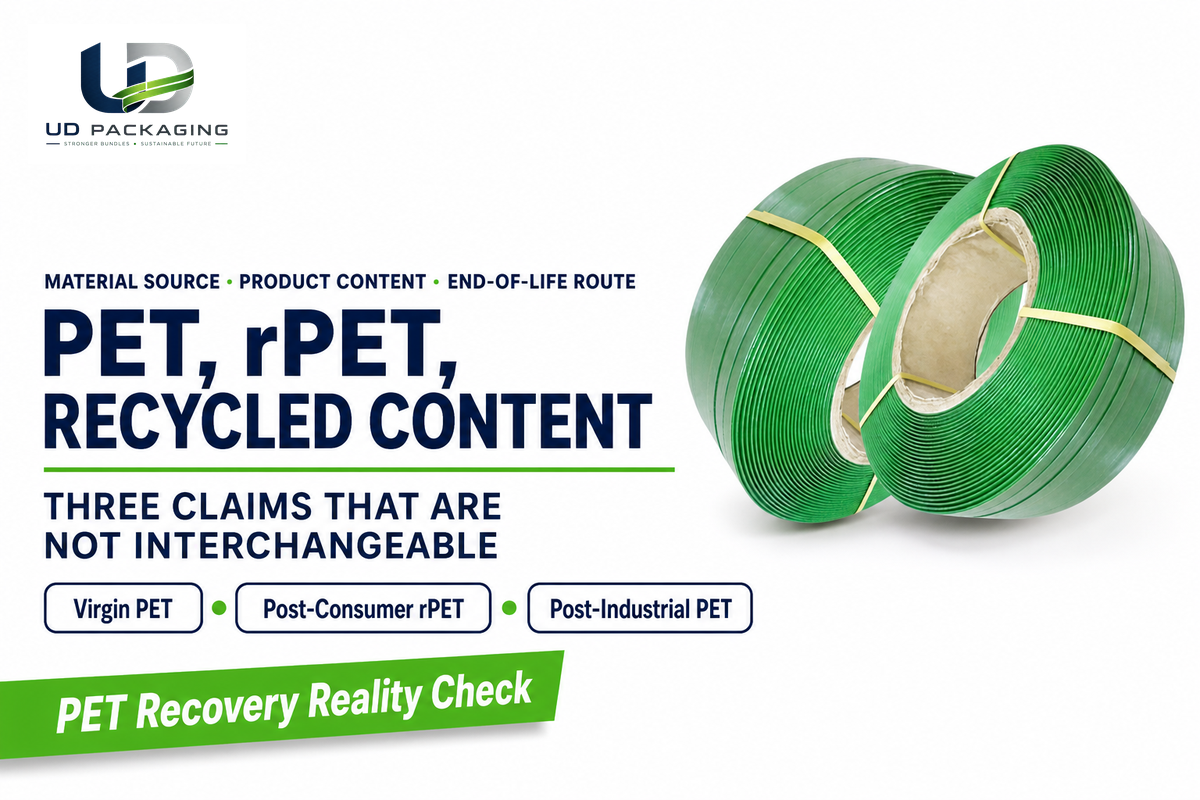
Virgin PET is produced from new petrochemicals. Recycled polyethylene terephthalate (rPET) is PET that’s recovered and reprocessed from a different stream of material. Post-consumer rPET is produced from used items and recycled PET is produced from post-industrial manufacturing. Any claim should provide which source is being referenced.
Post-consumer PET needs functioning recycling programs, access to recycling, collection and recycling infrastructure, consistent demand for recycled resin, and a PET recycling process that controls quality. A life cycle assessment can evaluate the impact across the whole system and the environmental impact of greenhouse gas emissions.
“recyclable” represents a potential end-of-life management solution. “Recycled content” refers to the material that’s presently incorporated into the product. Recycled PET doesn’t guarantee that there’s a pathway for its strap to be collected after being used. A clear bottle may still be collected for recycling, even if the bottle doesn’t contain recycled resin.
NAPCOR’s 2024 PET report release puts average rPET content in U.S. PET bottles at 15.9%. California’s minimum-content program requires 25% postconsumer recycled plastic from January 1, 2025 for covered plastic beverage containers subject to California Redemption Value. This is a product-content rule for a particular package category and is neither a recycling rate nor a requirement for industrial PET strapping.
Suitability of recycled PET for use in industrial strapping doesn’t imply suitability for use in food packaging. Food-contact materials would require additional decontamination steps. Separate feedstock must also be used and controlled, as must the process and intended use. The “it’s rPET, therefore it’s bottle-grade” mentality should also be avoided.
Can PET Strapping Be Recycled?
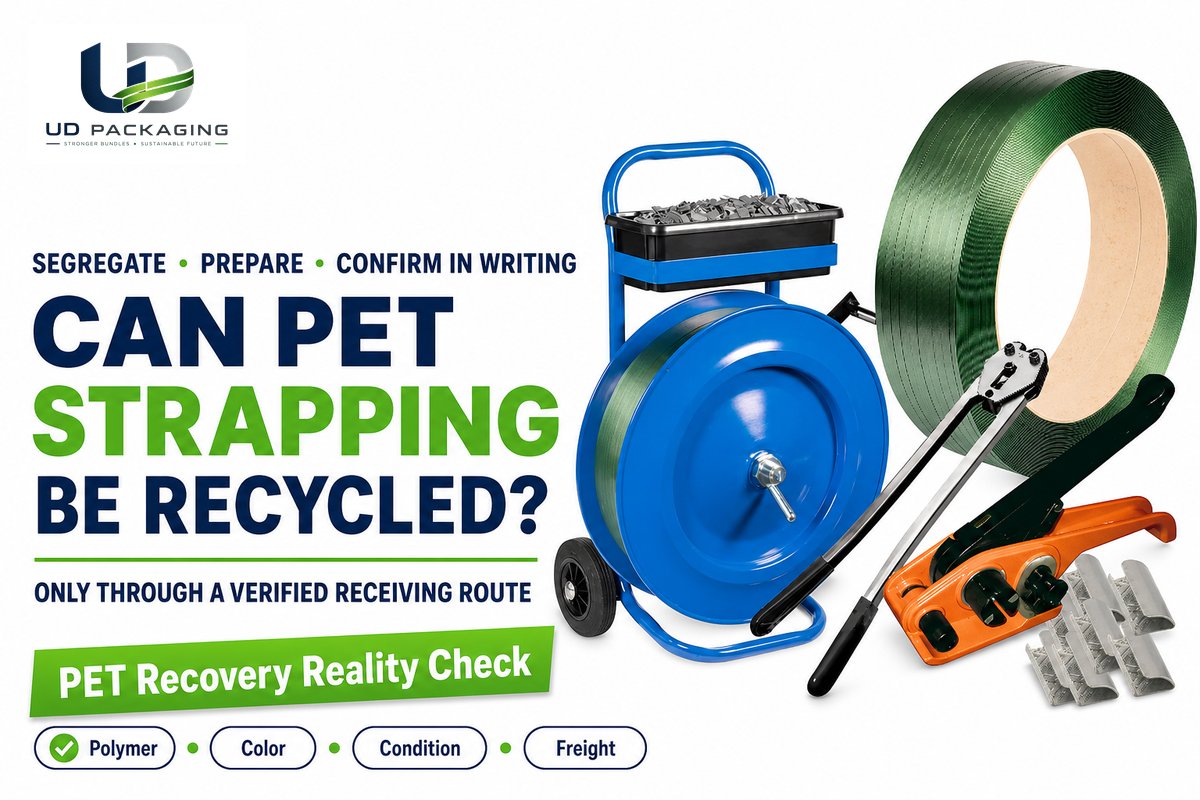
Clean PET strapping may have commercial recovery potential, but again, shouldn’t be assumed acceptable in the household curbside recycling stream. According to the recycling guidance provided by the City of Livonia, plastic and metal strapping, if added to curbside recycling, can get caught in the sorting equipment and break as a result. The City’s guidelines suggest that generators of these scrap materials separate the materials and confirm whether or not a local scrap recycler will accept the material.
The specification for each request can vary. For example, Signode states that its documented PET closed-loop program accepts only green PET strap, as a freight-on-carrier shipment of baled or chopped material with segregated, contaminant-free containers, and that these conditions apply to the program as described and aren’t general.
Prior to informing customers that used PET strapping is recyclable, obtain a written response from the intended recipient to the following questions:
- Polymer: Is the recipient accepting PET strapping, or are other welded materials also accepted?
- Color: Are green, black, or mixed colors accepted?
- Foreign Material: Are buckles/clips, labels, steel seals acceptable?
- Condition: What contamination and moisture limits apply?
- Form: What’s the preferred strap form- chopped, bagged, boxed, compacted, baled?
- Economics: What’s the minimum collection quantity, collection radius, freight, and service charge?
- Destination: What material grade is the strapping expected to become?
Purchasing teams should separate two questions: whether a new strap contains verified recycled material and whether a used strap has a verified recovery route at the destination site. If recycled content is the primary sourcing concern, review UD Packaging’s recycled PET strapping. This product route isn’t proof that every customer’s location can recycle used strap.
A Buyer Evidence Ladder for Recyclability Claims
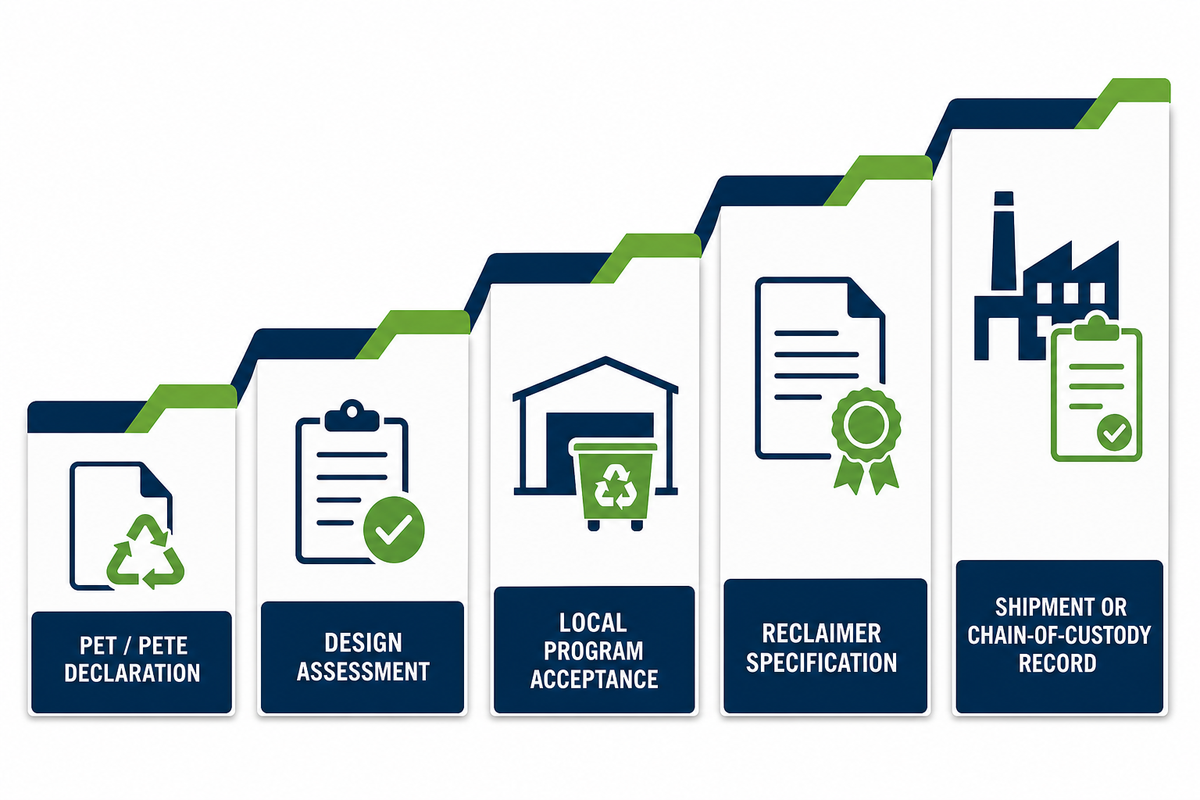
There’s more merit to a claim if the evidence shows a working recovery chain rather than just proving the identity of a material. The Summary of the FTC Green Guides places more importance on clear and conspicuous qualifications if access is limited. The following ladder applies this principle to procurement.
| Level | Evidence | What it proves | What it does not prove |
|---|---|---|---|
| 1 | PET/PETE declaration or #1 code | Resin identity | Local acceptance |
| 2 | Design-for-recycling assessment or test | Compatibility with a defined process | Collection access |
| 3 | Program or hauler acceptance by geography | A route into collection | Conversion yield or end market |
| 4 | Reclaimer specification and receiving confirmation | Processing route for the exact item | Every collected unit is converted |
| 5 | Shipment records, mass balance, chain-of-custody, or product content documents | A traceable claim within a named scope | Performance outside that scope |
The sustainability manager needs to understand the geographic scope of the claim. The warehouse operator needs to know how to safely collect and store the material. Quality teams need to know the receiver’s limits for contamination and preparation. Procurement requires documentation for content, as well as chain-of-custody. One recycling symbol can’t resolve all of these issues.
For bottles and containers, plastic packaging, water bottles, beverage packaging, and non-bottle PET, the recycling industry needs to verify the item specifically. Unlike other closed-loop recycled systems, it can’t assume that all PET containers follow the same closed-loop recycling process.
What Is Changing in PET Recycling in 2025–2026
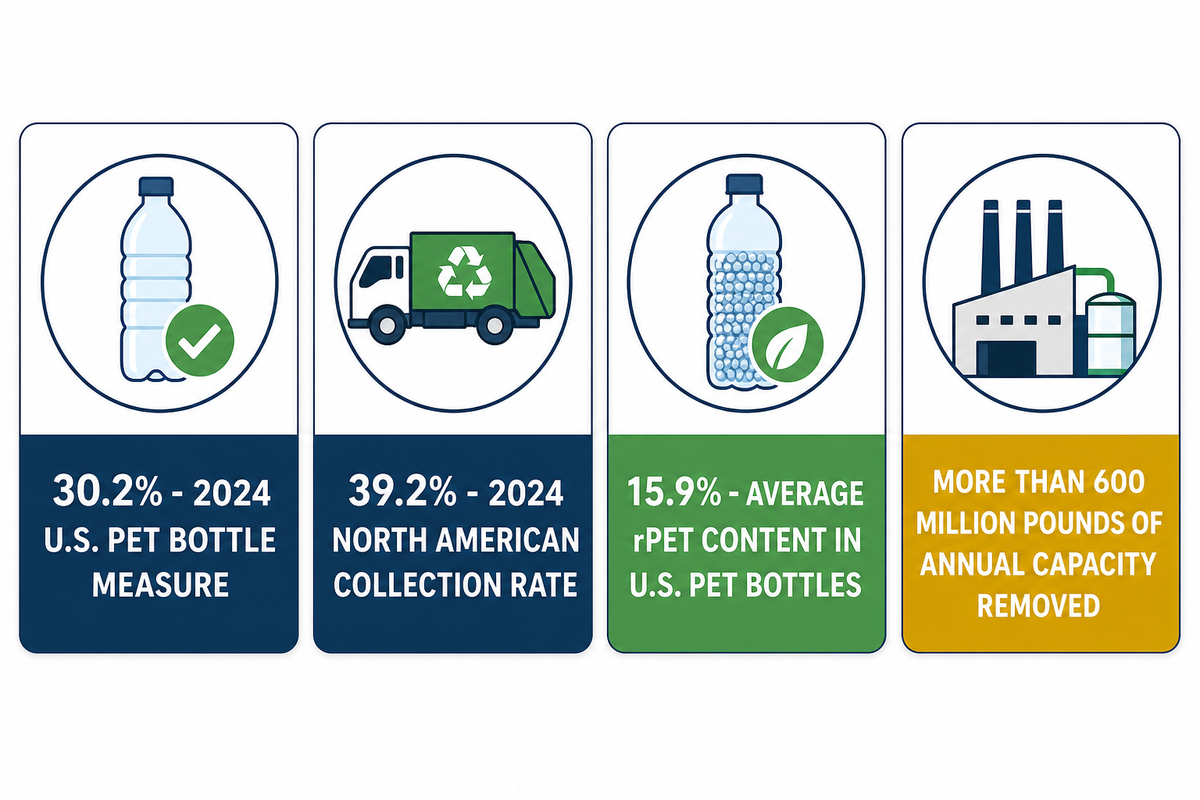
Recent data reflect positive indicators and market risk. NAPCOR reports a 30.2% U.S. PET bottle measure for 2024, down from 32.5% in 2023, and a 39.2% North American PET bottle collection rate. Its underlying framing uses bottles available versus bottles collected, so the 30.2% figure shouldn’t be read as finished recycled-product yield. NAPCOR also reports increased thermoform collection and 15.9% average recycled content in U.S. PET bottles.
At the processing end, the Association of Plastic Recyclers reported in April 2026 that seven U.S. PET recycling plants had closed in 15 months, removing more than 600 million pounds of annual processing capacity, nearly one quarter of the national total. APR attributes the pressure to demand, virgin-resin economics, and imports. Keep the date and attribution with the figure because it isn’t a permanent property of PET.
A broader slogan doesn’t define the practical buyer response. Stronger evidence is better. Design the product, create a sales outlet, capture the recycle’s specifications, and provide an appropriate date for each access or rate claim. A recyclable design without a collection capacity or market demand still misses the recovery route.
Frequently Asked Questions
Is PET plastic 100% recyclable?
The polymer can be reprocessed, but “100% recyclable” is too broad for a finished PET item because design, collection, sorting, processing yield, and end markets vary.
Color, labels, adhesives, layers, contamination, local collection, sorting capability, conversion yield, and end markets can all change the result. A technically compatible package may still have no accepted route where it becomes waste. Identify the exact item, location, and receiving program before making the claim, then date the evidence you rely on.
How many times can PET be recycled?
There is no single honest cycle count for every PET product; the practical limit depends on feed quality, process control, and the next product’s specification.
Repeated mechanical processing can change polymer properties and introduce contamination. Processors may purify, blend, rebuild viscosity, or redirect the resin to another application. Depolymerization is a different route with its own availability and economics. The practical limit depends on feed quality, process control, and the next product’s specification. Avoid “infinitely recyclable” unless a specific closed-loop process and evidence support the statement.
Is recycled PET the same as polyester?
Recycled PET belongs to the polyester family, but those terms alone do not prove the same product grade, recycled-content level, intended use, or recovery route.
Recycled PET can become bottle resin, sheet, fiber, or strap. Each output has its own purity, performance, and regulatory requirements. “Polyester” identifies a polymer family; it doesn’t establish recycled-content percentage, food-contact suitability, or local recyclability. The intended end use and the processor’s qualification data still control whether a particular rPET grade is suitable.
Can PET strapping be recycled?
Yes, when an industrial or commercial recycler accepts clean PET strapping under a documented written specification for color, contamination, preparation, shipment quantity, and freight terms.
Do not assume loose strap belongs in household curbside recycling. Separate PET from polypropylene and steel, follow the receiver’s rules for clips, contamination, chopping, bags, boxes, or bales, and confirm the minimum quantity and freight arrangement.
What does the #1 recycling symbol mean?
The #1 recycling symbol identifies PET or PETE resin; it does not guarantee that the finished item belongs in every local recycling bin or collection program.
Use the code as an identification step. Then check the item’s shape, attachments, color, contamination, and current local or commercial accepted-material list.
Specify recycled PET strapping without overstating the claim
If recycled content is part of your packaging specification, define the PET source, content evidence, dimensions, break strength, joining method, and used-strap recovery route as separate requirements.
References & Sources
- 16 CFR Part 260, including recyclable claims: Electronic Code of Federal Regulations
- Environmental Claims: Summary of the Green Guides: U.S. Federal Trade Commission
- Frequent Questions on Recycling: U.S. Environmental Protection Agency
- PET Rigid Design Guidance: Association of Plastic Recyclers
- Polyethylene terephthalate recycling: A review: Case Studies in Chemical and Environmental Engineering, 2024
- 2024 PET Recycling Report release: NAPCOR
- PET Recycling Coalition: The Recycling Partnership
- PET Recycling Coalition doubles down on thermoforms: Resource Recycling
- Recycling FAQ: plastic and metal strapping: City of Livonia
- Plastic Minimum Content Standards and Reporting: CalRecycle
- PET Closed Loop Recycling: Signode program requirements