Get in touch with UD Packaging Company

The plastic vs metal strapping clips comparison is a buying comparison between polymer buckles and metal closures used to join or tension strapping systems. These parts aren’t interchangeable merely because both fit a quoted strap width; the usable choice depends on the shipping route, exact strap, tool interface, application method, and evidence for the finished joint. For closure names and their differences, start with our guide to strapping clips, seals, and buckles.
Updated September 2026.
Bottom line: Do not base the selection on the material label alone. First, eliminate all route-incompatible parts. Compare complete closure systems on the same documented strap and load, then request evidence for the finished joint. Only then compare prices.
Quick Specs
| First comparison gate | Destination, carrier, and regulated route |
| Minimum object record | Polymer, width, thickness, surface, applying method |
| Useful strength evidence | Peak force in N plus failure mode on a named strap specimen |
| Cost basis | Cost per accepted joint, with buyer-supplied inputs |
| Decision boundary | The tested package and route, not every plastic or metal clip |
TL;DR
- A closure may be ruled inadmissible based on a route rule, even before considering strength or price.
- Nominal strap width alone doesn’t establish compatibility.
- Crimped seals, wire buckles, and plastic buckles have different geometry and application routes.
- Compare finished joint force and failure mode on a named strap specimen and not unrelated strap break-force data.
- For a plastic vs metal strapping clips cost comparison, unit price becomes useful only after tools, application time, and verified reuse share the same basis.
Plastic vs Metal Strapping Clips: Check the Route Before the 5-Field Object Lock
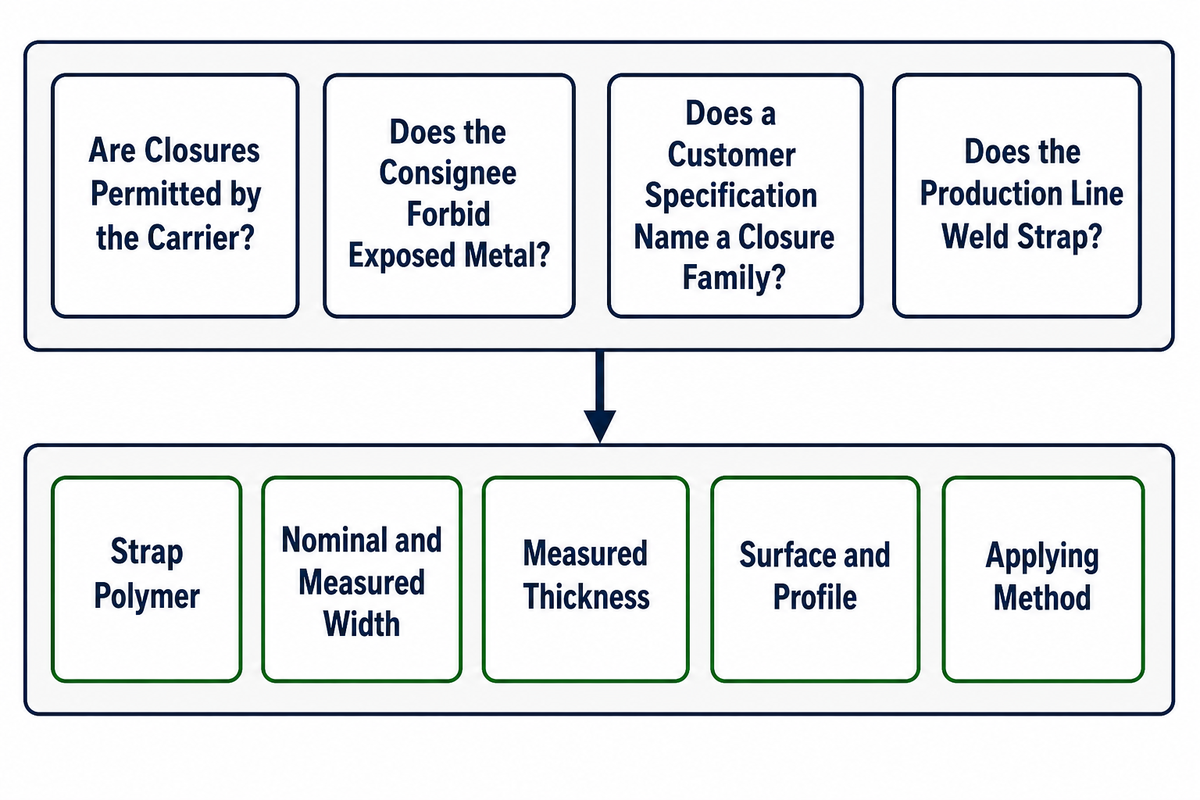
Route eligibility always comes before a material comparison, because a carrier, destination, or a regulated shipping program may exclude one closure type. When both are allowed, write down five details for the strap and the method of application. Without that, two parts of the same nominal width may be part of two different systems.
“Metal buckles or seals must not be used on strapping around letter and flat trays.”
Route Eligibility Gate: Ask four questions prior to comparing sections. Are closures permitted by the carrier? Does the consignee forbid exposed metal? Does a customer specification name a closure family? Does the production line weld strap and therefore use no loose clip? Any documented answer that disqualifies a candidate removes it without a strength debate.
The 5-Field Object Lock
- strap polymer: identify PET (polyethylene terephthalate), polypropylene, corded material, or other documented construction.
- Nominal and measured width: maintain catalog width and actual measurement.
- Measured thickness: don’t assume thickness from width or color.
- Surface and profile: describe a smooth, embossed, coated, or other noted surface.
- Applying method: name the tensioner, sealer, combination tool, threading route, or welding unit.
Scenario: the 16 mm quote that isn’t comparable. A buyer receives one quotation for a plastic buckle and another for a closed metal seal. Both say “16 mm,” so purchasing treats them as substitutes. Operations then reveals that the installed line uses a sealer jaw specified for one seal profile, while the plastic buckle route needs manual threading and a different tensioning sequence. The strap thickness and surface were never sent to either supplier. The quotations aren’t competing answers to one requirement. They’re two incomplete system proposals. The buyer should return both to the five-field record, ask each supplier to bind a part number and applying method to the same strap specimen, and only then compare trial evidence and cost.
Evidence capsule: The current-run object-confusion audit returned 18 organic results; among the top five, 3 were informational or blog pages and 2 were commercial or category pages, while several ranking pages compared straps or tools instead of like-for-like clips. Demand was fragmented at 170 US searches per month for “plastic strapping clips” and 140 for “metal strapping clips,” with no measurable volume for the exact comparison phrase. The answer-engine baseline produced 67 citations across 43 unique domains for six answers and none cited udpackaging.com; these figures describe the research set, not product performance.
Plastic Buckles: Five Questions That Establish Eligibility
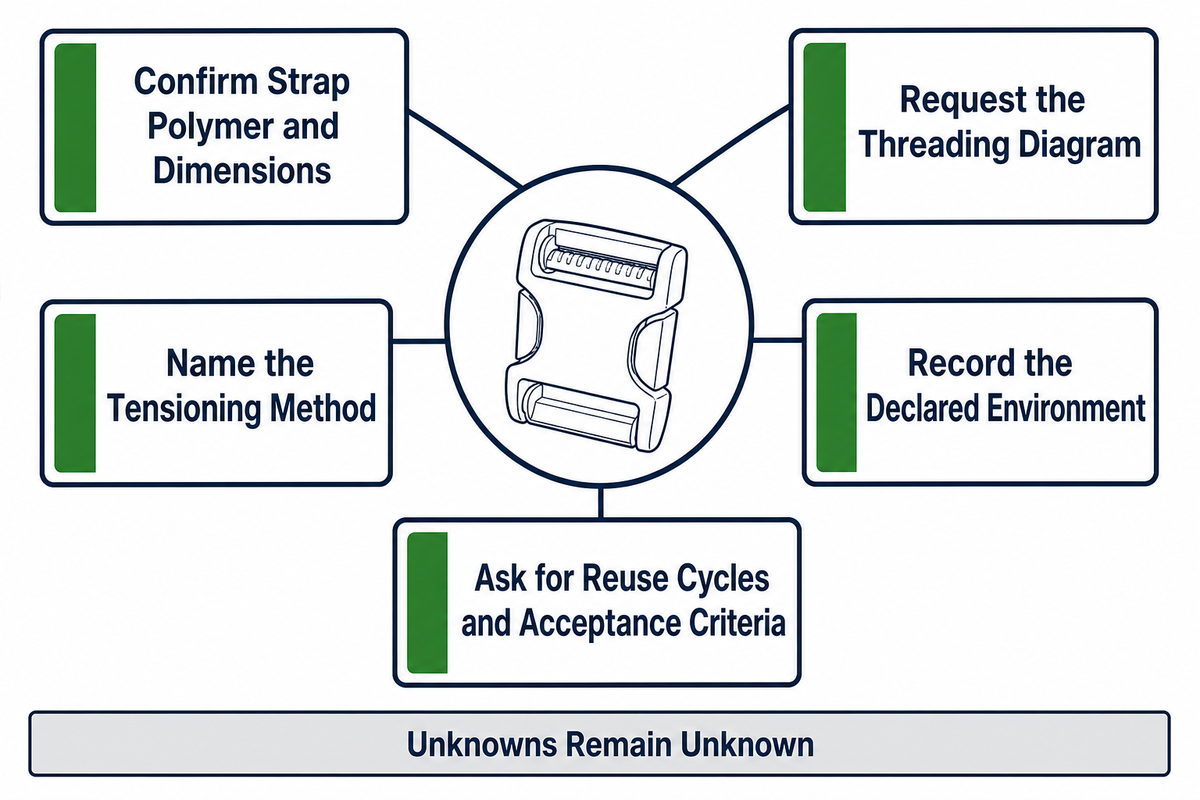
A plastic buckle joins the comparison when its product record includes the offered strap and application route. The material name doesn’t provide a loading class, threading path, environmental limit, or reuse allowance. Five specific questions transform a broad “plastic clip” into a candidate that can be assessed and priced.
One primary design record for a polyethylene buckle explains locking arms, a strap opening, and detent surfaces. The patent doesn’t rate existing products or indicate that each molded buckle incorporates the design. Request the drawing and threading information for the exact part.
Do
- Confirm strap polymer and dimensions
- Request the threading diagram
- Name the tensioning method
- Record the declared environment
- Ask for reuse cycles and acceptance criteria
Don’t
- Assume one colour identifies a grade
- Transfer a rating between strap polymers
- Call a visual check a holding test
- Price undocumented reuse as savings
- Treat a buckle trial as package certification
Five eligibility questions
Is the buckle approved for the exact polymer, width, thickness and surface; how both ends of the strap are routed; what type of tensioning is allowed; what range of temperature/moisture/exposure is provided; and is “reusable” supported by a cycle count, inspection criteria, and post-use holding? Unknowns remain unknown.
Scenario: a reusable claim without a duty history. An in-plant team releases a buckle after moving a tote 40 m across a warehouse and wants to use the same part on an outbound pallet. The catalogue calls the part reusable, but it gives no application count, deformation limit, strap dimensions, or retained holding result. The tote movement and the outbound journey are different duty histories. Weather exposure, higher tension, impact, and a changed threading path can alter the system. The safe procurement response isn’t to declare the buckle single-use or reusable by intuition. Record the intended cycle, inspect against the supplier’s stated criteria, and ask for evidence that covers the final application. Until then, the cost worksheet should count one use.
Joint evidence is not complete-load evidence
Buckles can pass a joint trial without proving that a filled pallet survives distribution. ASTM D4169 addresses shipping systems, while ISO 2234 addresses static-load stacking for complete filled packages or unit loads. Their scopes keep a clip result in its proper place.
Evidence capsule: ISO 2234 specifies three static-load methods at complete-package or unit-load level. A plastic buckle record may establish eligibility for one strap route, yet it cannot by itself establish deformation, creep, collapse, or failure performance for a loaded pallet.
Metal Seals and Wire Buckles Depend on Different Tool Interfaces
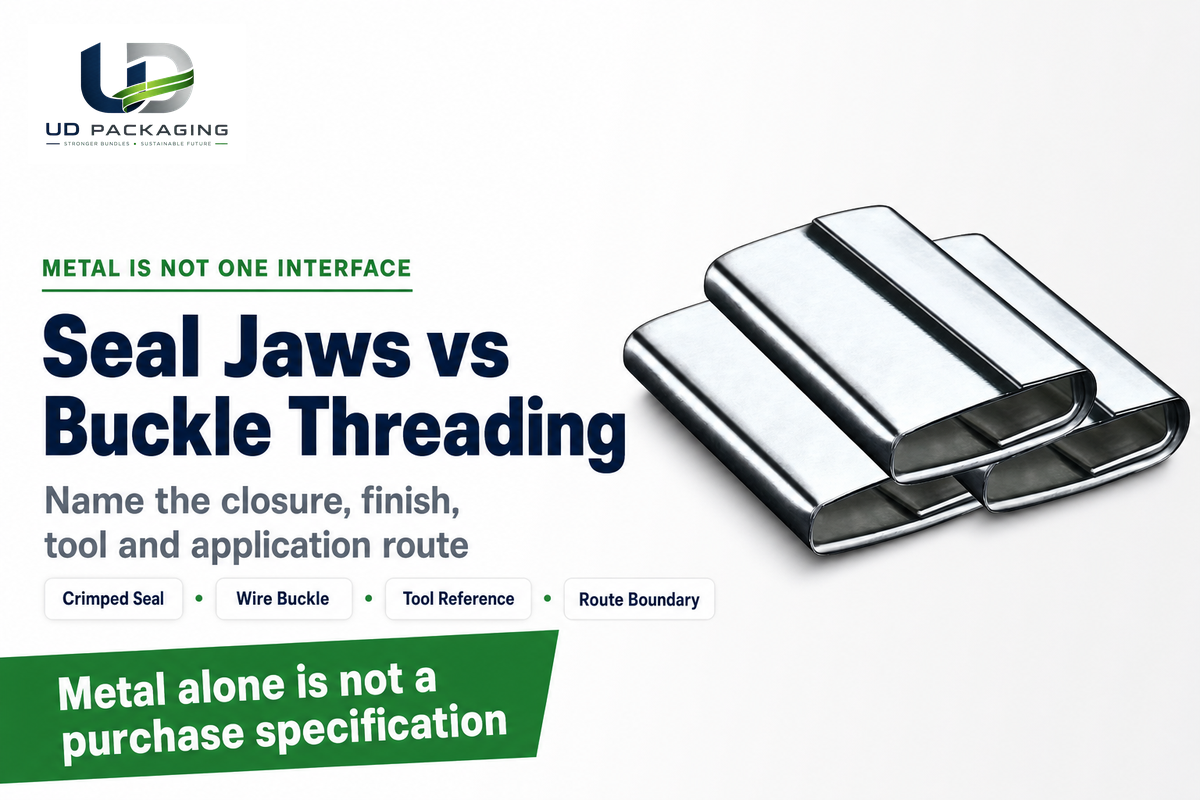
Crimped seals and wire buckles are both metal closures, but they aren’t the same closure. The preceding eligibility check identifies a candidate route; this section separates the metal interfaces. Purchase descriptions must state the actual finish or grade (“stainless steel” cannot be inferred from the word “metal”) and whether the supplier specifies a manual or pneumatic tool. The seal is defined by jaw geometry, overlap, and whether it uses a crimp or notch; the buckle is defined by its threading and tensioning route. The phrase “metal clip” names neither interface.
ASTM D3953-15(2022) is the sole public source for flat steel strapping and seals, with class and style information, as well as width, application, notch, crimp, and joint strength. A primary design record, EP1167200B1, provides a configured clip held in place by a tool that performs a crimp and forms an undulating joint in overlapped plastic strap. Neither reference provides a general permission to use.
Closure type and tool-interface matrix
| Quoted label | Interface to confirm | Evidence to request | Limitations / Not suitable for |
|---|---|---|---|
| Open seal | Sealer jaw and overlap | Part, tool, strap, crimp pattern | Not suitable when the specified jaw cannot form the declared profile |
| Closed seal | Pre-threading and sealer | Threading order and tool reference | Not suitable when a pre-threaded route conflicts with line access |
| Push-type seal | Tensioner nose and seal location | Application instruction | Not suitable for an unverified strap edge or tool nose |
| Serrated seal | Tooth profile and compression | Surface compatibility and joint result | Not suitable where tooth contact has no supplier approval |
| Wire buckle | Threading path and tensioner | Diagram, finish, strap range | Not suitable when route rules prohibit exposed metal |
| Stamped buckle | Bend geometry and threading | Drawing and system test | Not suitable when the offered geometry is undocumented |
| Plastic buckle | Locking geometry and threading | Polymer, dimensions, cycle claim | Not suitable beyond the declared strap and duty range |
| Heat-weld joint | Machine settings and weld head | Program, strap, weld result | Not a loose clip candidate |
| Sealless steel joint | Tool-made interlock | Tool and joint specification | Not a separate seal purchase |
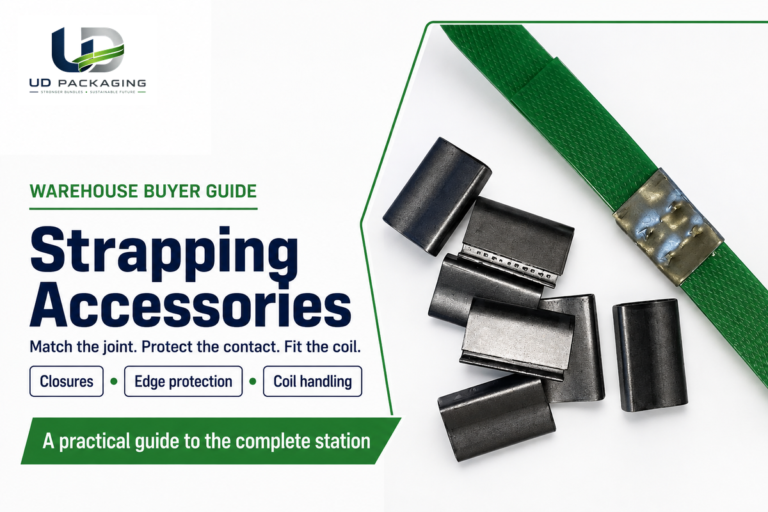
Name the object in the matrix and then search strapping accessories for documented closure routes. Buyers that want a more restrictive view may compare strapping seal options and strapping buckle options, preserving the strap and tool records.
Evidence capsule: ASTM D3953 specifies two classes and five styles for steel seals, identifying notch, crimp, application, and joint-strength properties. These characteristics explain why “metal” is too broad for a purchase order; they do not rank a seal against a plastic buckle.
The 7-Line Candidate Parity Screen Removes False Comparisons
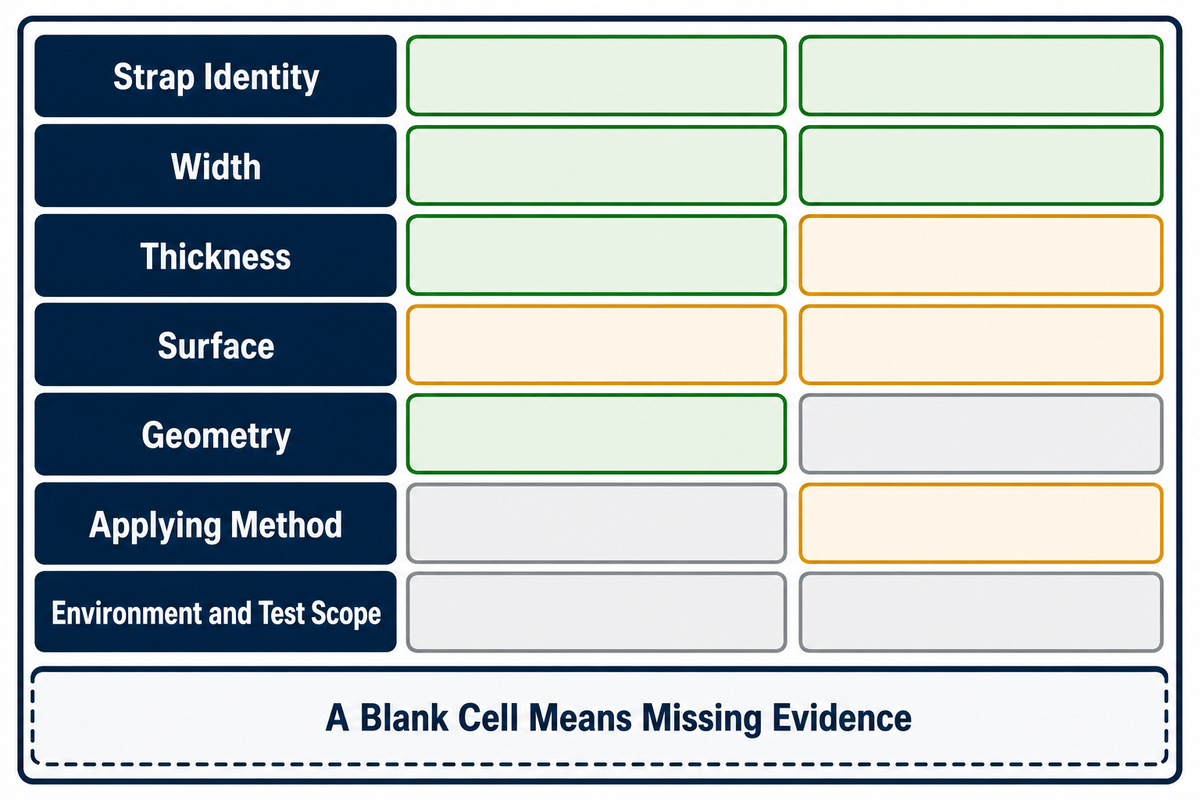
Two quotations become comparable only after seven fields describe the same requirement and each supplier fills its own route. This screen is an elimination tool, not a scoring model. The NIST/SEMATECH engineering handbook explains that one-factor-at-a-time experiments may miss interactions. A blank cell means missing evidence; it must never be repaired with a similar product photo, shared colour, or nominal width.
6 modelspublished PET rows
12–19 mmnominal width span
2,600–6,800 Nstrap tensile-force rows
UD Packaging publishes six PET strapping model rows spanning 12 to 19 mm and 2,600 to 6,800 N. This range shows variation of a specimen in a family of straps. It doesn’t show that any buckle or seal fits these rows, and it isn’t closure-joint evidence. The offered strap model must still be named.
Candidate parity screen
| Parity line | Buyer input | Plastic candidate | Metal candidate | Missing evidence |
|---|---|---|---|---|
| 1. Strap identity | Polymer and model | Declared fit | Declared fit | Unknown if model is absent |
| 2. Width | Nominal and measured mm | Approved range | Approved range | Tolerance missing |
| 3. Thickness | Measured mm | Approved range | Approved range | Range missing |
| 4. Surface | Finish and profile | Supplier statement | Supplier statement | Contact condition missing |
| 5. Geometry | Required route | Drawing or diagram | Drawing or diagram | Part profile missing |
| 6. Applying method | Tool and settings | Specified method | Specified method | Tool reference missing |
| 7. Environment and test scope | Storage, handling, route | Declared boundary | Declared boundary | Condition or evidence scope missing |
Evidence capsule: A 12 mm strap row and a 19 mm row aren’t one specimen, and 2,600 N and 6,800 N strap-force entries don’t predict a finished closure joint. Three recorded dimensions, polymer, width, and thickness, prevent width-only comparisons from entering the trial.
Closure Proof Dossier: Compare Finished-Joint Evidence
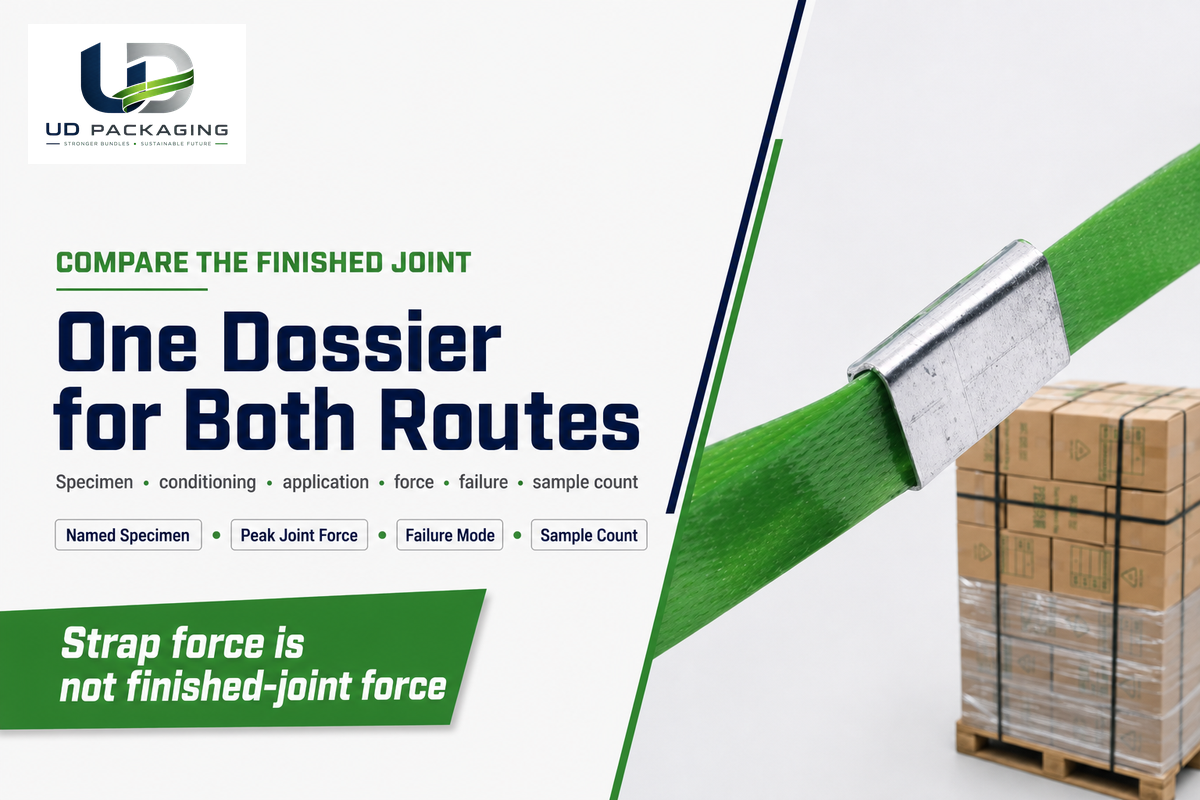
Finished-joint evidence is comparable only when both reports name the strap specimen, conditioning, application method, measured peak force, failure mode, and sample count. Strap breaking force and joint force answer different questions. Candidates can’t win by presenting a larger number measured on a different object or by a different method.
The six-field Closure Proof Dossier
| Field | Required record | Why it matters |
|---|---|---|
| Strap specimen | Polymer, model, width, thickness, lot | Binds the result to a real object |
| Conditioning | Time, temperature, humidity, exposure | Defines the state before testing |
| Application | Closure part, tool, settings, operator route | Captures system differences |
| Peak joint force | Measured value in N | Gives a common output unit |
| Failure mode | Slip, closure deformation, strap damage, or other observed mode | Explains what ended the test |
| Sample count | Number tested and rejected | Prevents one result from posing as a distribution |
Whether the report considers the documented representative family or the offered part is the primary consideration. If the equivalence rationale includes offered part geometry, material, strap range, the application method or route, and the offered conditions, it’s acceptable to consider family qualification. A report isn’t invalid due to a sample identifier, but the supplier should provide a rationale for the evidence.
Scenario: two impressive numbers that answer different questions. Supplier A submits the 6,800 N tensile-force row for a PET strap. Supplier B submits a lower peak value for a finished seal joint on another strap thickness. Purchasing puts the figures in one strength column and marks Supplier A stronger. The comparison is invalid. The first number describes a strap specimen, while the second describes a completed joint under a particular application route. Neither ranks the two offered closures on the buyer’s package. The correction is to request peak joint force in N, failure mode, conditioning, and sample count for both candidates on the same named strap lot. The buyer may use our strapping joint strength guide for measurement terminology, without importing an unrelated efficiency figure.
No independent public test in this research compares a plastic buckle and a metal closure, holding the relevant strap, load, and conditions constant. This is a useful negative finding because it prevents steel joining-mechanism percentages from being presented as a false cross-material comparison.
Engineering Note
Keep strap force and finished-joint force in separate fields. A published 2,600 N to 6,800 N strap range cannot fill the joint-force field required by the public scopes of ASTM D3950 and D3953.
Evidence capsule: UD’s six published PET models span 12–19 mm and 2,600–6,800 N, a 4,200 N range. Those figures describe straps, not clip joints. Valid dossiers add peak joint force in N, the observed failure mode, and the tested sample count for each route.
Research-data boundary: The search-demand percentages in the table below come from the current-run DataForSEO keyword records and result-page classification. They describe this research set only, not product performance or a market forecast.
| Metric type | Recorded values | Permitted use | Limitations / Not suitable for |
|---|---|---|---|
| Query change | 3.2%, 4.1%, a 0.9% gap | Demand language | Not for performance ranking |
| Wire-buckle change | 28.6%, 30% line, 1.4% gap | Trend disposition | Not a forecast |
| Top-five intent | 60% informational, 40% commercial | Search intent | Not for selection |
| Rising-keyword share | 13.3% | Scope disclosure | Not a market estimate |
| Citation share | 0% to UD | Visibility baseline | Not product evidence |
| PET width bounds | 12 mm to 19 mm, a 7 mm span | Specimen variation | Not fit proof |
| PET force bounds | 2,600 N to 6,800 N, a 4,200 N span | Strap rows | Not joint force |
| Steel seal route | About 70% to 75% | Disclosed supplier context | Not for plastic buckles or UD products |
| Punched and welded routes | 85% and 90% | Steel mechanism context | Not a material test |
| Variant-volume gaps | 21.4% and 17.6% | Derived search context | Not for technical decisions |
Unit Price Is Not Cost Per Accepted Joint
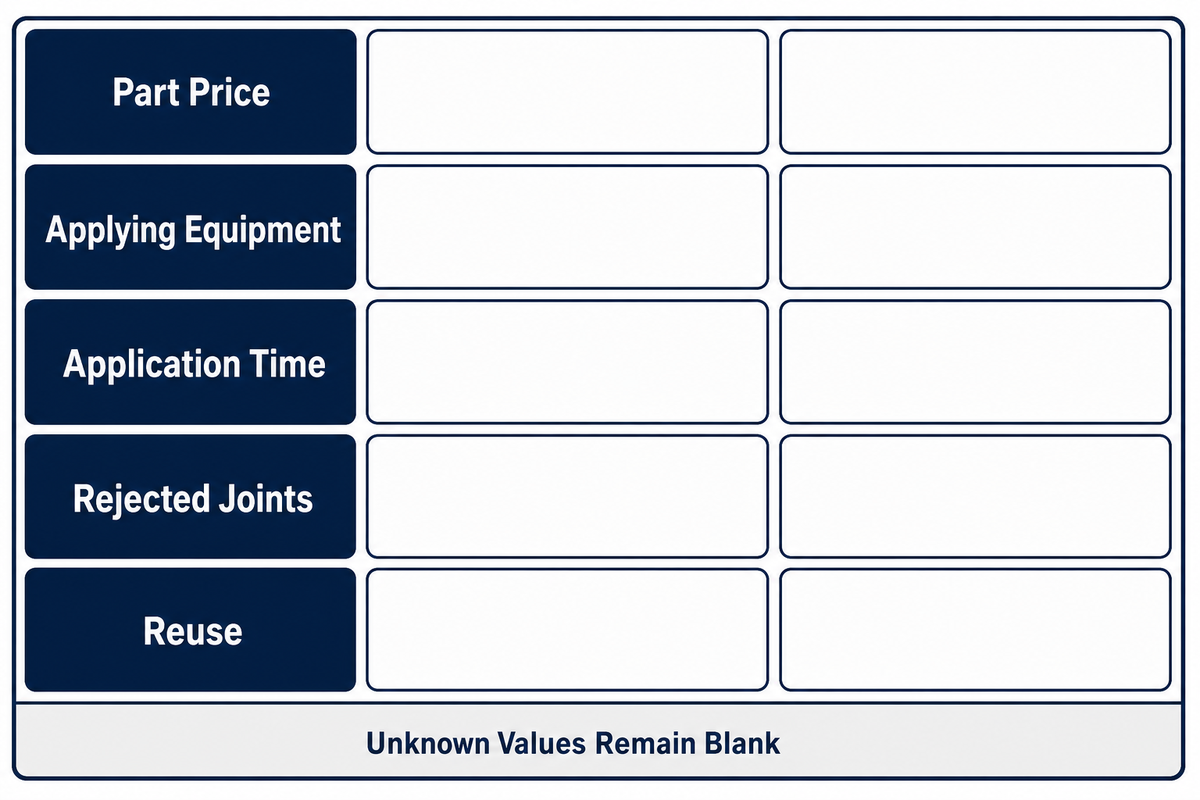
For unit price to have any value, both candidates should use the same basis for the quotation. The ASTM D3950-23 record covers nonmetallic strapping and joining methods; it does not provide a universal price comparison. Carry the finished-joint dossier fields established above into that shared quotation basis. The cost of an accepted joint can vary due to requirement specific tools, application time, the number of rejected joints, and documented reuse. For a complete evaluation, it’s best for the buyer to provide the information and leave the rest blank rather than using market provided estimates for the unknowns.
Are plastic strapping clips cheaper than metal clips?
Not always, but the material label can’t answer the question. Request the two prices for one order quantity and date and add the relevant tool basis, measured application time, observed reject rate and only the reuse cycles supported for that part and that duty. Keep freight and currency terms visible.
| Quote field | Plastic candidate | Metal candidate | Evidence rule |
|---|---|---|---|
| Part price | Buyer entry | Buyer entry | Same currency, quantity, date, and freight basis |
| Applying equipment | Buyer entry | Buyer entry | Exact tool and ownership basis |
| Application time | Measured seconds/joint | Measured seconds/joint | Same task start and stop points |
| Rejected joints | Observed count/batch | Observed count/batch | Same acceptance rule |
| Reuse | Qualified cycles | Qualified cycles | Zero savings without a duty-matched record |
Evidence capsule: Normalize five cost fields and measure application time in seconds per accepted joint and rejects per batch. No universal labor, reject, or reuse-cycle dataset was found for the two closure materials. Unknown values therefore remain blank rather than becoming zero-cost assumptions.
Closure-System Candidate Trial Sheet for the Same Strap and Load
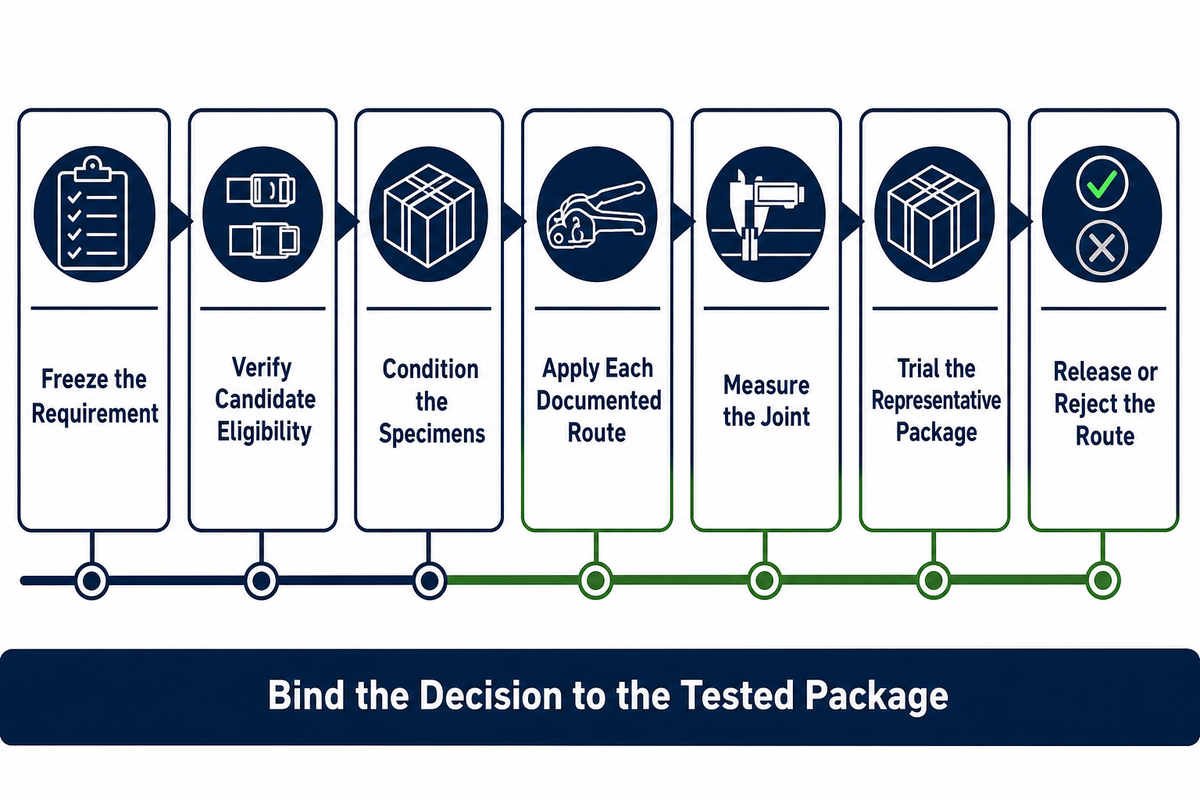
Useful trials hold the representative strap lot, conditioning, package, and load constant while each closure follows its documented tool and application method. The result ranks two complete candidate routes on that tested package. It doesn’t isolate a universal material effect because geometry, tool interface, and operator actions can change together.
The NIST/SEMATECH engineering handbook warns that one-factor-at-a-time experiments can miss interactions. That warning matters here: replacing a plastic buckle with a crimped metal seal usually changes more than material. Treat closure, tool, settings, and application sequence as one candidate-system record.
- Freeze the requirement — name the route, package, load, strap lot, and acceptance rule.
- Verify candidate eligibility — close every field in the parity screen before testing.
- Condition the specimens — record time, temperature, humidity, and any relevant exposure.
- Apply each documented route — use the specified closure, tool, settings, and trained operator method.
- Measure the joint — record peak force in N and the failure mode for every specimen.
- Trial the representative package — evaluate the complete load under the approved change-control plan.
- Release or reject the route — bind the decision to the tested package and retained evidence.
Keep a two-row result sheet with candidate closure, part closure geometry, tool, settings, operator, strap lot, conditioning, peak force, failure mode, and package observation. Don’t average away a recurring slip or deformation mode. Record each rejected specimen under the same acceptance rule used for both candidates.
Worker protection is still part of the case setup. OSHA 1910.133 requires the use of appropriate eye or face protection when hazards exist from flying particles or objects. This source supports the hazard control boundary only; it doesn’t establish that either of the clip materials is safer.
Evidence capsule: The seven-step sheet records conditioning time in hours, temperature in °C, application time in seconds, and peak joint force in N. The measured units enable two candidate systems to share one record while NIST maintains the caution that tool and closure adjustments, among other things, aren’t a study of the material only.
Evidence Gaps That Should Postpone the Switch
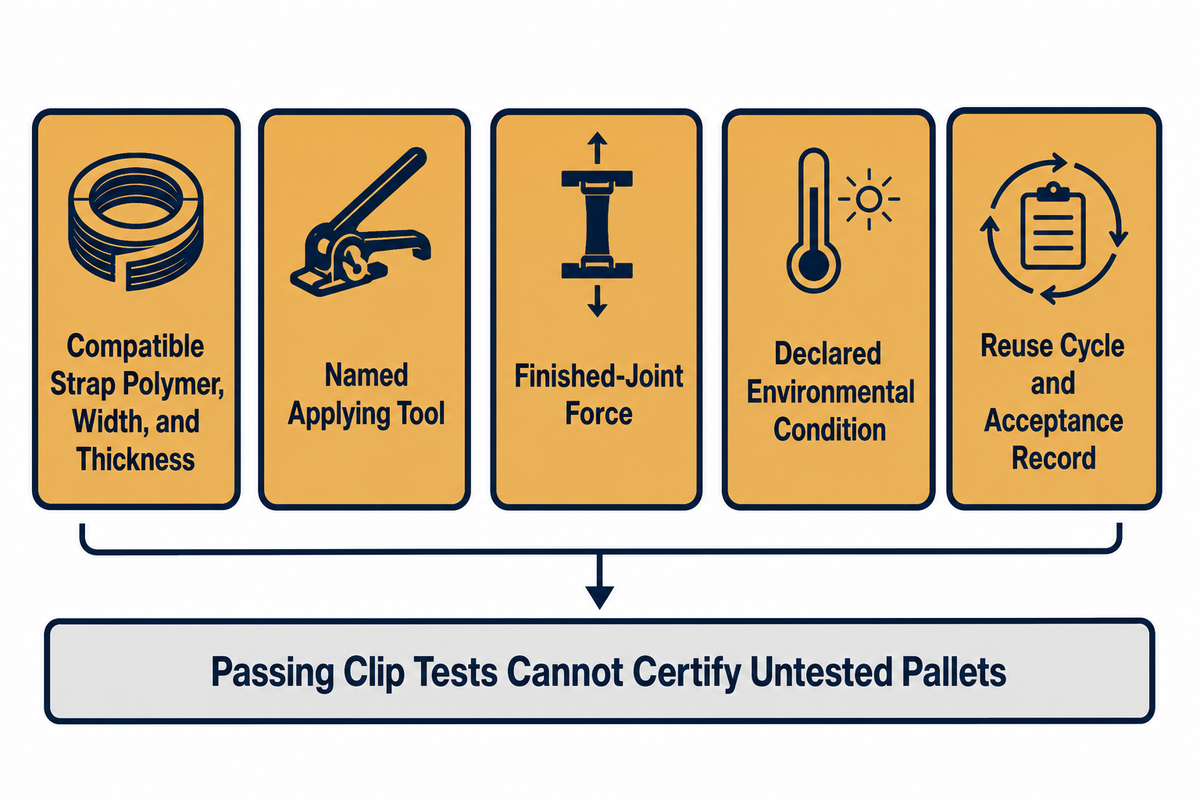
The closure should be bound to the strap range, tool interface, finished-joint evidence, environmental boundary, or package change control if offered. Search results often mix the type of strapping into the clip decision: polyester, polyester strapping, polypropylene strapping, poly strapping, woven strapping, cord strapping, strapping cord, metal strap, steel banding, and banding strapping. These are strap categories, not proof that a particular strap clip fits. A documented family qualification or equivalence rationale can close the gap of its scope if offered. Price doesn’t close technical evidence gaps.
When not to buy a replacement clip
Don’t purchase a production order if the supplier is unable to identify the compatible strap polymer, width, and thickness; if the applying tool is described as “standard”; if the result supplied is strap breaking force rather than finished-joint force; if the environmental claim has no declared condition, or if a reusable claim has no cycle count and a post-cycle acceptance record.
Missing exact-sample paperwork isn’t an automatic rejection. A stop should also be placed on the purchase if automatic lines weld strap since a loose clip is then the wrong procurement object. A strapping kit, ratchet, tensioner, or other strapping tools describes the application route; a flexible weave or elongation claim still doesn’t establish joint performance. Requests to use plastic strapping, recycle a closure, or compare plastic and steel strapping remain separate from this candidate trial. The right strapping choice may depend on a lumber bundle, fragile surfaces, heavy loads, extremely heavy loads, or the heaviest load class, but those package labels don’t replace measured joint evidence. If the supplier notes how the tested geometry, material, strap range, tool route and working conditions of the test correlate to the offered part in the report, then the supplier may use a representative family report. Request that equivalence rationale. If the boundaries don’t align, the gap remains open.
Complete-package performance needs its own release decision. For transportation and supply chain review, record whether the load is exposed to the elements, including UV, rust, and corrosion conditions, rather than calling one closure resistant, heavy duty, safe and secure, harder to work, likely to snap, or secure as possible. Terms such as securing heavy cargo, strength and durability, packing, packaging strapping banding, strapping solutions, industry, poly, and PP still require an operational definition. ASTM D4169, ISO 2234, ISO 2233, and ISO 10531 separate distribution, stacking, conditioning, and unit-load stability questions from a component joint measurement. See the ASTM D4169 record for the shipping-container performance-testing scope. Use the relevant package protocol after the closure-system candidate survives the joint screen. Passing clip tests cannot certify untested pallets.
Key takeaway
Lower-priced closures are not cheaper while any of five eligibility fields remain unsupported; close the gap with direct evidence or a documented family-equivalence record.
Evidence capsule: Three static-load methods in ISO 2234 operate at complete-package or unit-load level, while joint records use force in N on named specimens. Keeping those scopes separate prevents one component result from becoming an unsupported claim about stacked or transported cargo.
Send One RFQ Pack That Produces Comparable Samples
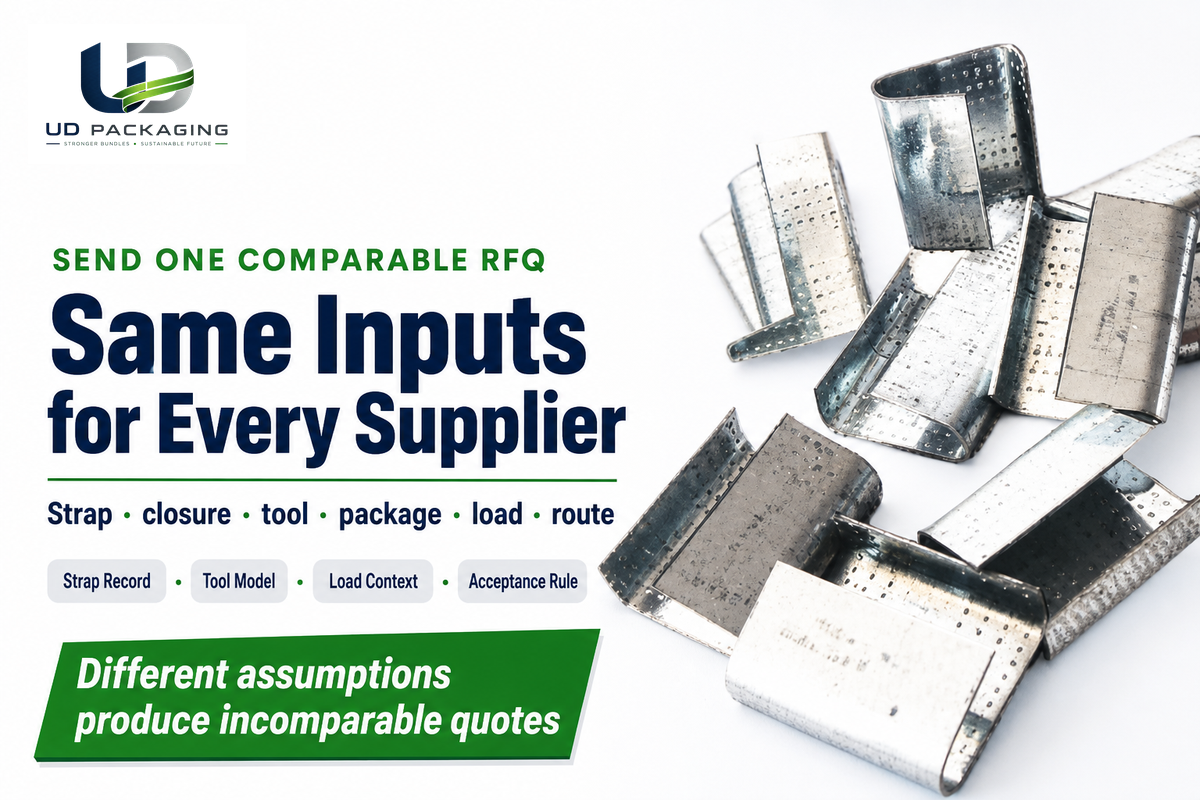
All suppliers receive the same ten-field evidence pack for the comparable request for quotation. Suppliers are asked to provide a bound part, tool route, and joint record along with the strap and package data. If these aren’t provided, then each supplier will likely address a different requirement, and the respective quotes won’t be comparable.
Ten fields to send
- Clear photo of the strap label and, where possible, physical sample.
- Strap polymer and exact product or model reference.
- Nominal width and measured width in mm.
- Measured thickness in mm and surface description.
- Type of package, mass of load, dimensions, and movement of load that causes concern.
- Storage and transport environment, including exposure to temperature and/or moisture.
- Current closure part, geometry, and application instructions.
- Current tensioner, sealer, combination tool, or machine model.
- The failure, cost, or workflow change being investigated.
- Required joint and package-level evidence, acceptance criteria, and sample size.
Have the supplier provide one proposed part number along with its corresponding tool or applying method, the declared strap range, and the evidence provided for the finished joint. Alternate routes should be entered in different rows. UD Packaging’s strapping team can use this pack to route a buckle, seal, tool or machine enquiry, all without a hint on the application.
Request a closure-system sample review
Evidence capsule: One ten-field pack should include width and thickness in mm, loading mass in kg, tool model, environment, and a named acceptance rule. If two suppliers give different strap assumptions or test scopes, correct the request before comparing unit prices or scheduling a trial.
Frequently Asked Questions
Most issues with closure material come from a missing compatibility, tool, or evidence field. The answers below maintain those boundaries. They also support a shortlist and sample request, but they don’t take the place of the supplier’s product record or a trial on the buyer’s rep package and route.
Are plastic and metal strapping clips interchangeable?
No.
No. A plastic buckle and a metal closure should be treated as interchangeable only after both are approved for the same strap polymer, width, thickness, surface, and applying method. “16 mm” on two catalogues isn’t enough because geometry and tool interfaces can differ. Compare each supplier’s compatibility record and finished-joint evidence before substituting either part.
Are plastic strapping clips weaker than metal clips?
Clip material alone doesn’t rank the strength of a finished strapping joint. Compare peak joint force and failure mode on the same named strap specimen.
Clip material alone doesn’t rank the strength of a finished strapping joint. The useful figure is measured on a named strap specimen with the closure applied by its specified method, followed by peak joint force in N and the recorded failure mode. Metal seals tested on steel strap and plastic buckles tested on polypropylene are two systems, not a controlled comparison.
Do metal strapping clips require a special tool?
Some do.
Some do. Crimped or notched metal seals are tied to a stated sealer geometry, while wire buckles follow a different threading and tensioning route. Ask for the exact closure style and applying-tool reference instead of ordering from the phrase “metal clip.” The supplier’s method must match the tool and access conditions on your line.
Can plastic strapping buckles be reused?
Treat reuse as a product-specific claim.
Treat reuse as a product-specific claim, not a property of every plastic buckle. Ask how many application and release cycles were tested, which strap polymer and dimensions were used, how the buckle was inspected for deformation, and what holding result remained after the final cycle. Separate reuse during temporary in-plant handling from reuse after transport, weather exposure, or a high-tension event because those are different duty histories.
Record who releases the tension and whether the same threading path can be reproduced without damage. A visual check alone doesn’t establish retained holding performance. If the supplier publishes a cycle boundary and test method, carry both into the cost comparison and trial record. If it provides only the word “reusable,” cost the buckle as a single-use part until the intended duty is verified on the same strap and tool route.
How should I compare the price of plastic and metal clips?
Use the same quote basis for both candidates.
Use the same quote basis: closure price, required tools, measured application time, rejected joints, and only documented reuse. Keep currency, order quantity, quotation date, and freight terms beside each input. A part-price difference without those fields doesn’t establish the cost of an accepted joint, and an unknown input shouldn’t be entered as zero.
What information should I send when requesting samples?
Send a clear strap label or sample plus the polymer, width, thickness, surface, tools, load, environment, current closure, and the problem being investigated for comparison.
Send a clear strap label or sample, polymer, nominal width, measured thickness, surface finish, current tensioner and sealer, load description, storage environment, present closure, and the failure or improvement being investigated. Ask the supplier to identify its proposed part, compatible tool, and available joint evidence. Keep both candidate sets tied to the same strap lot for the trial.
Related Articles
References & Sources
- ASTM D3950-23, Standard Specification for strapping, Non-metallic (and Joining Methods)
- ASTM D3953-15(2022), Standard Specification for strapping, Flat Steel and seals
- ASTM D4169-23e1, Performance Testing of Shipping Containers and Systems
- USPS PS-345, Letter and Flat Tray Strapping Specifications
- NIST/SEMATECH e-Handbook, One Factor at a Time
- OSHA 1910.133, Eye and Face Protection
- ISO 2234:2000, Packaging, Complete Filled Transport Packages and Unit Loads, Stacking Tests Using a Static Load
- ISO 2233:2000, Packaging, Complete Filled Transport Packages and Unit Loads, Conditioning for Testing
- ISO 10531:1992, Packaging, Complete Filled Transport Packages, Stability Testing of Unit Loads
- China National Public Service Platform for Standards Information, GB/T 1040.3-2006 record
- EP1167200B1, Manual Crimping Tool and Clip for sealing Ends of strapping
- US4400855A, Strapping Buckle Construction
Links to standards provide access to their public scope and edition records. No paid standards text is provided. Supplier and client evidence used in the article is identified in context and isn’t presented as independent proof of a universal material ranking.