Get in touch with UD Packaging Company

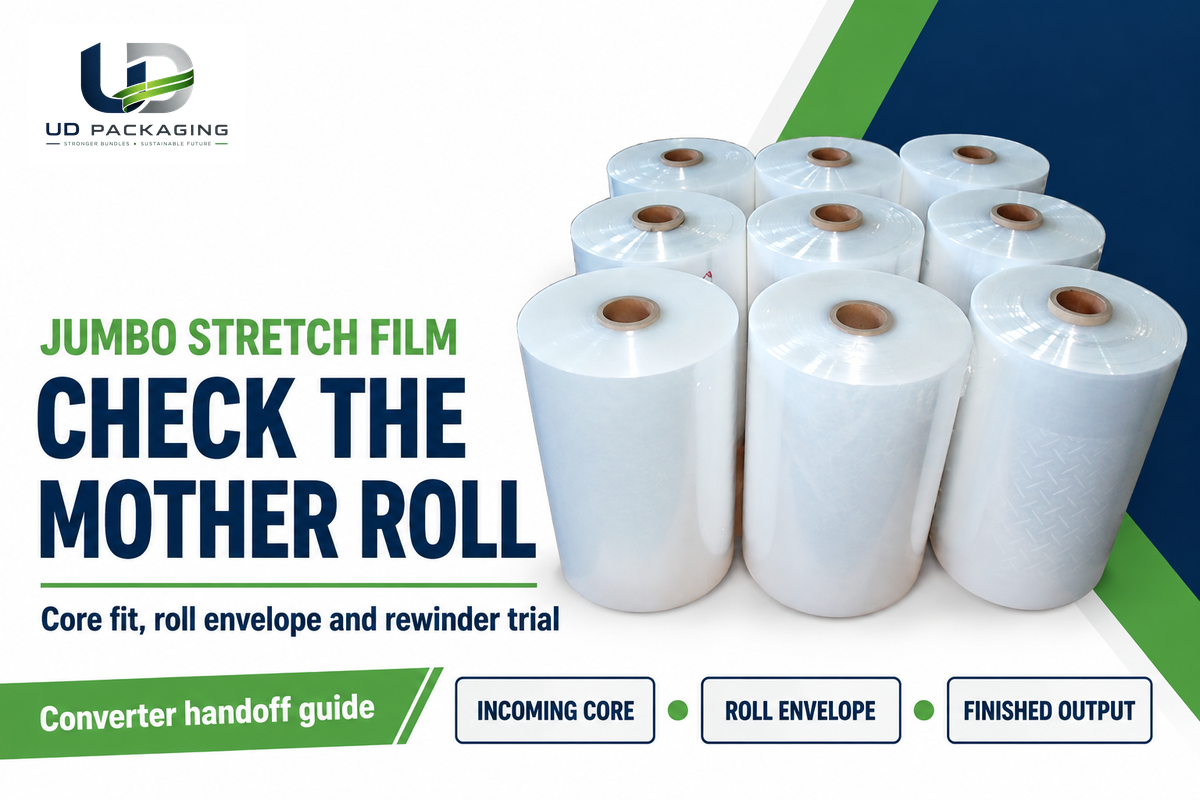
Jumbo stretch film is a mother-roll supply format for converters that slit or rewind film into smaller finished rolls. Buying it starts at the unwind station: the core must fit, the full roll must clear the machine, and the film must run into an agreed finished specification. A low price per roll settles none of those checks.
A roll can appear tidy on arrival and still shift during acceleration. Some can run cleanly and still generate finished rolls that don’t pass the buyer’s film requirements. The condition the rolls are received in, their fit in the machine, their behavior during trial runs and their finished output must all be documented to make informed decisions for converting.
Updated October 2026 · For industrial film converters and purchasing teams
Separate Mother Rolls from Finished Stretch Wrap
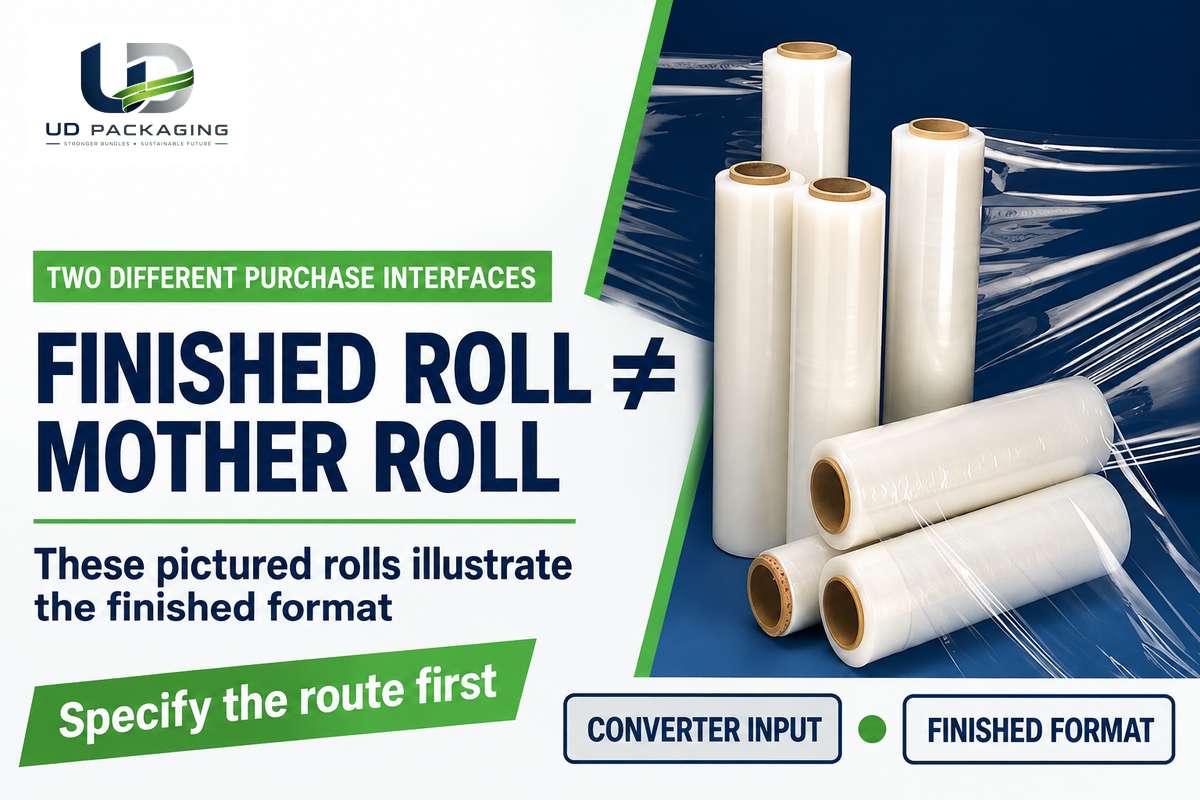
A stretch film jumbo roll ordered for conversion must be placed on an unwind station before it becomes a saleable hand or a machine roll. A finished stretch wrap roll is placed on a dispenser or wrapping machine. Distinguish this in the purchase order, as the word jumbo alone doesn’t describe the process in question.
Start the order with the material and route, for instance an LLDPE stretch wrapping film, to be slit and rewound to the specified finished format. Keep the mother-roll specification and finished-roll specification separate. Core dimensions, roll diameter and permitted weight can be different at the two ends of the same line.
How is jumbo stretch film made?
Jumbo stretch film is wound into a mother roll during film production and is converted into smaller rolls. The purchase handoff should identify the film construction and the conversion route, without treating ‘jumbo’ as a resin grade. Know which production specification the supplied film applies to, from the manufacturer.
For a converter already in use, the first consideration should be if the supplied construction and winding arrangement fit the line in use. Record any stretching during conversion as separate from simple rewinding. For pallet wrapping, consult the machine stretch film requirements for the carriage and the intended load.
Match the Paper Core to the Unwind Station
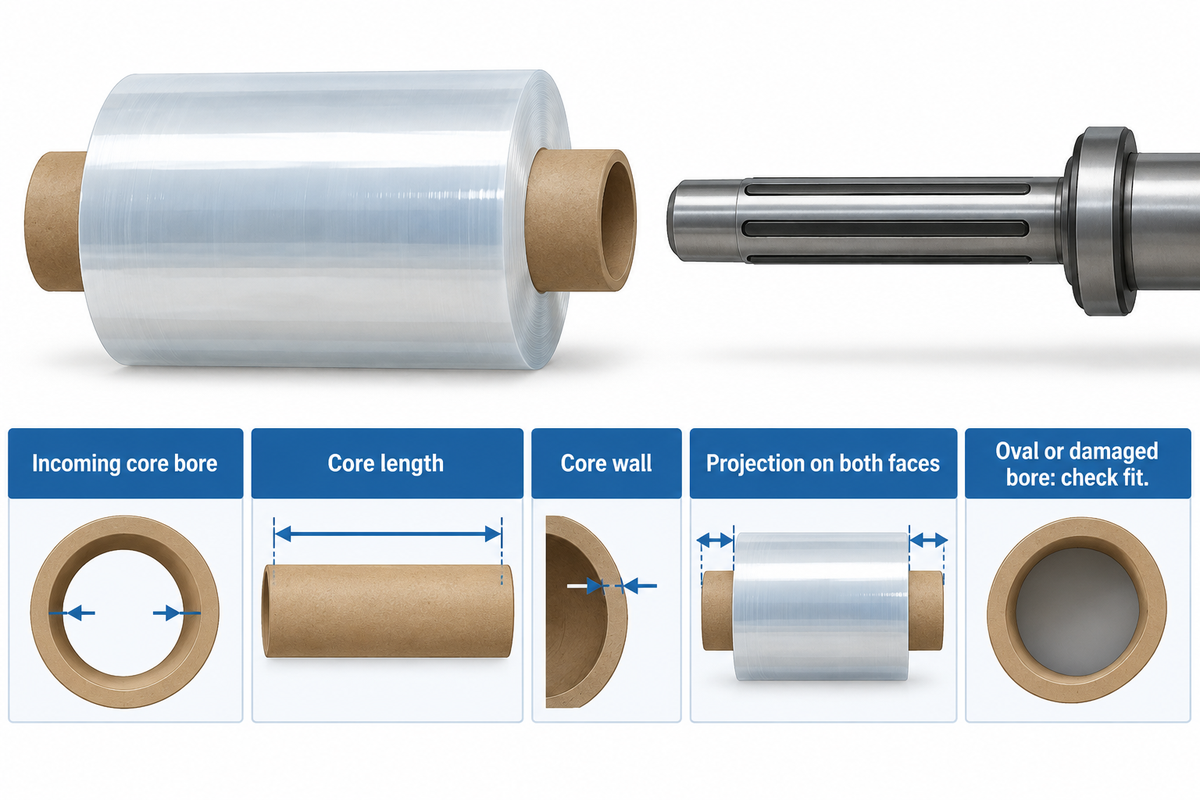
A rewinding machine requires the incoming core’s internal diameter, length, wall and condition to match the shaft or chuck arrangement. For a roll core, record the core projection on both roll faces. Nominal diameter matches are of little help if the core is oval or damaged. A nominal diameter match is only the starting point: an oval or damaged bore can obstruct mounting even when the purchase label is correct.
The DMS SRM-60F specification illustrates why incoming and outgoing values need separate boxes: its mother-roll core is listed as 76 mm, while finished-core hopper options include 38 mm and 50 mm. Those are interfaces on one named rewinder, not interchangeable choices or universal jumbo sizes. Core drawing and machine manual should be relied on for this order.
Core strength also merits a specific agreement. Sonoco’s film-core guidance describes radial pressure from wound film and crushing that may occur during storage. Wall thickness alone doesn’t address all aspects of that behavior. Replace a claim for superior strength with the core specification and an agreed strength-test method where required, then retain the core details provided by the supplier with the trial record.
| Interface category | Supplier entry | Line-side check | Owner and decision |
|---|---|---|---|
| Core bore | Internal diameter and tolerance, mm | Shaft or chuck drawing; mounting fit | Production confirms the exact incoming core |
| Core length and projection | Core length and projection at each face, mm | Chuck engagement and side clearance | Production resolves conflicting drawings |
| Core construction | Wall, grade and agreed strength method | Winding pressure and storage duty | Quality agrees the applicable core criterion |
| Film width | Supplied width and tolerance, mm | Web path and intended slit layout | Production approves usable width |
| Full-roll envelope | Outer diameter, mm; gross roll mass, kg | Unwind clearance and equipment rating | Production approves mounting capacity |
| Winding direction | Unwind direction and required cling side | Match the web route and finished-roll requirement | Production confirms orientation |
| Core condition | Bore shape and end condition at dispatch | Inspect before mounting | Quality holds damage for disposition |
| Measurement units | Consistent millimetre dimensions | Convert centimeter entries: 1 cm = 10 mm | Purchasing reconciles units before ordering |
| Packing and handling | Roll orientation, supports and restraint | Receiving equipment and storage position | Receiving confirms the handling route |
For example, a quote describing only the finished core leaves the first row open. Purchasing returns that drawing for correction prior to releasing the order. In the meantime, production doesn’t make a shaft-fit assumption. If the finished good is coreless, check finished rolls without a cardboard core separately from the mother roll’s incoming paper core.
Confirm the Roll Envelope Before Delivery
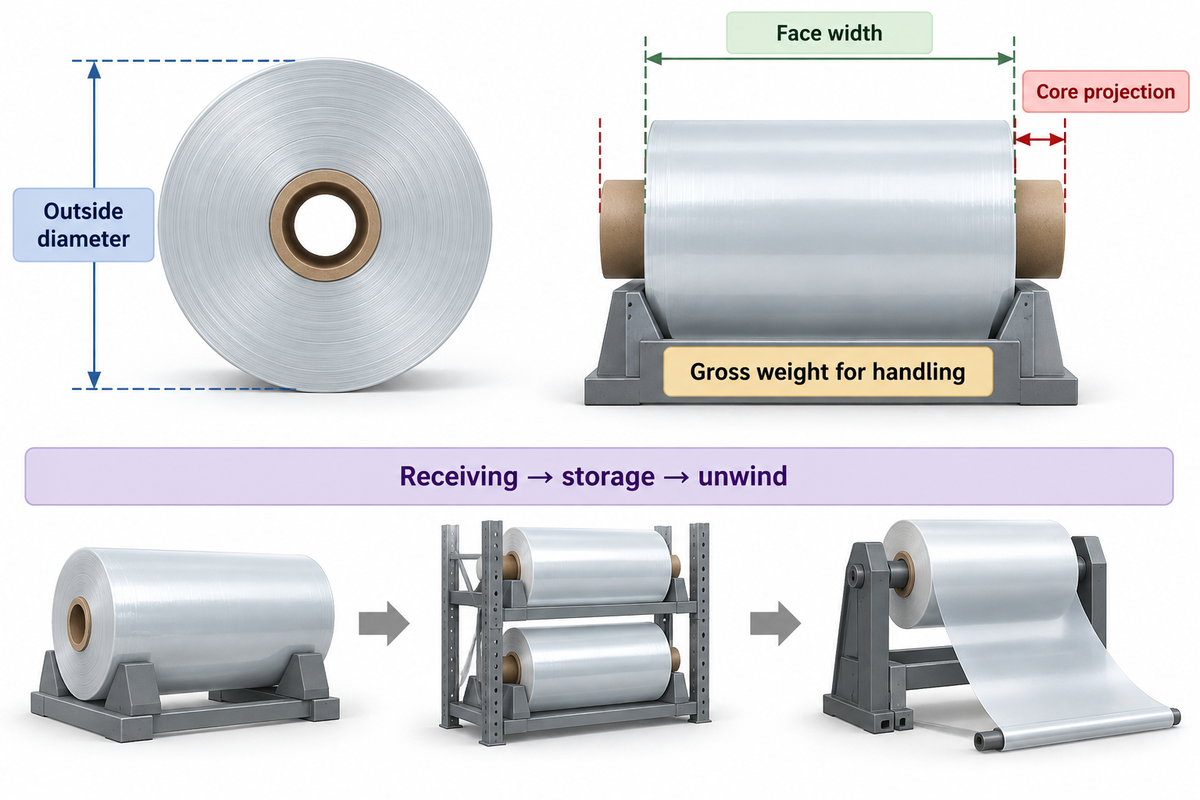
Roll envelope indicates the combined effect of outside diameter, face width, core projection and gross weight that the receiving and unwinding equipment must handle. Evaluate all these against approved limits for the line prior to shipment. A heavier roll may remain within diameter clearance and exceed a handling or unwinding rating.
Walk the physical route from the delivery vehicle to storage and to the unwinding station. Identify the lifting attachment, support points, roll orientation, and the clearance required for mounting. Record gross weight for handling; keep net film weight separate as a purchasing field. Packing material and core are to be included in gross weight.
The HSE guidance on handling paper reels is useful for its treatment of size and shape alongside weight. Its paper-industry examples aren’t film-roll limits. For powered industrial trucks, the relevant equipment rating and load arrangement matter; the US truck-loading provisions, 1910.178(o), address rated capacity and loads whose geometry affects that capacity.
For logistics planning, determine whether roll loading is manual or automatic, and give the approved lifting attachment. A high-speed line still requires a controlled procedure for mounting, before the speed of the line is of interest.
Prior to changing to a larger roll, production should sign the revised interface record, and receiving should confirm the new arrangement for handling. Fewer planned changeovers offer little advantage if a roll cannot reach the unwind station in the approved orientation.
Inspect Winding and Edges at Receipt
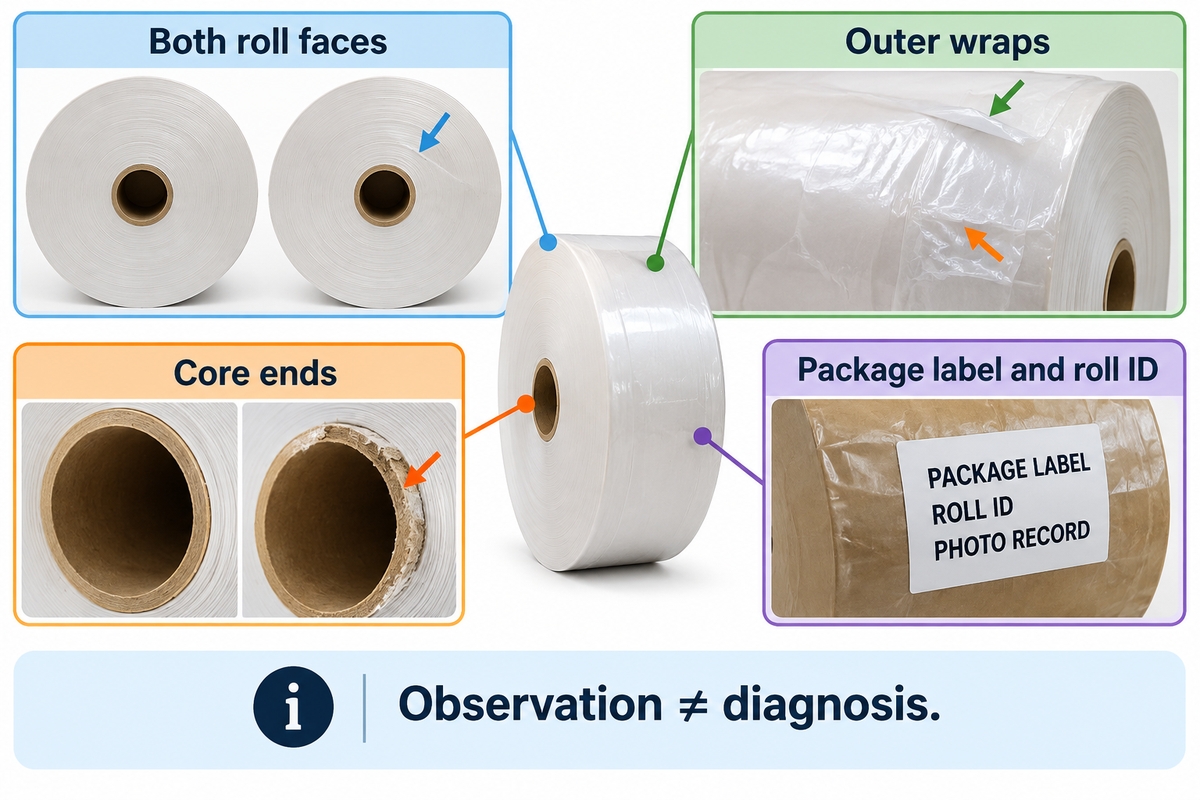
Receipt inspection should retain how the roll looked before mounting or adjusting the machine settings. Take photos of both faces, the outer wraps, the core ends and the package label. Note any layer shifts, crushed areas, edge damage, and/or loose wraps and record those against the roll identity. Then, route the affected material for a defined disposition.
Distinguish descriptions from causes. A shifted face is an observation; “incorrect winding tension” is a diagnosis that needs more evidence. In his 2023 PFFC article on wound-roll defects, Neal Michal distinguishes telescoping during unwinding from telescoping during winding. He advises noting the moment of slippage, as well as the roll diameter at the slip plane.
| Observation point | Record entry | Next check | Disposition owner |
|---|---|---|---|
| Before unpacking | Package restraint displaced; photograph label and support | Compare roll condition before mounting | Receiving and quality |
| At mounting | Core bore distorted; fit not accepted | Compare core condition with agreed drawing | Production and quality |
| At acceleration | Layers shift when speed rises | Save speed, tension setting and shift timing | Production investigates with supplier |
| During steady running | Edge break repeats at the same side | Retain film location and inspect the web path | Production separates line and material causes |
| Near the core | Change in unwind behaviour | Save remaining diameter and affected output | Quality holds the traced output for review |
| After storage | Outer wraps feel looser than at receipt | Compare photographs and elapsed storage time | Quality records the changed condition |
| At a splice | Marked joint reaches the web path | Trace the splice to the affected finished roll | Production follows the agreed splice rule |
| After shaft removal | Core shape changes after unloading | Preserve the core and prior mounting record | Quality requests a core investigation |
| At finished-output inspection | Rewound roll runs cleanly but misses an agreed property | Retain the test result and output identity | Quality separates conversion from release |
The above examples show how to write a record. Substitute these with the actual observation, roll identity, and agreed criterion; none establishes a universal threshold to reject a batch. Avoid adjusting the line or loosening a roll before preserving the original condition, because the later photo may not answer the receiving question.
A roll with a smooth outer surface may also not be sufficient. In Winding Better Rolls, Timothy J. Walker states that air can become entrained during winding, masking caliper variation, and subsequently escape, leaving a looser roll. Record the intervals between receipt, storage and the trial when a change in winding condition is being evaluated.
Agree Film Properties and Splice Conditions
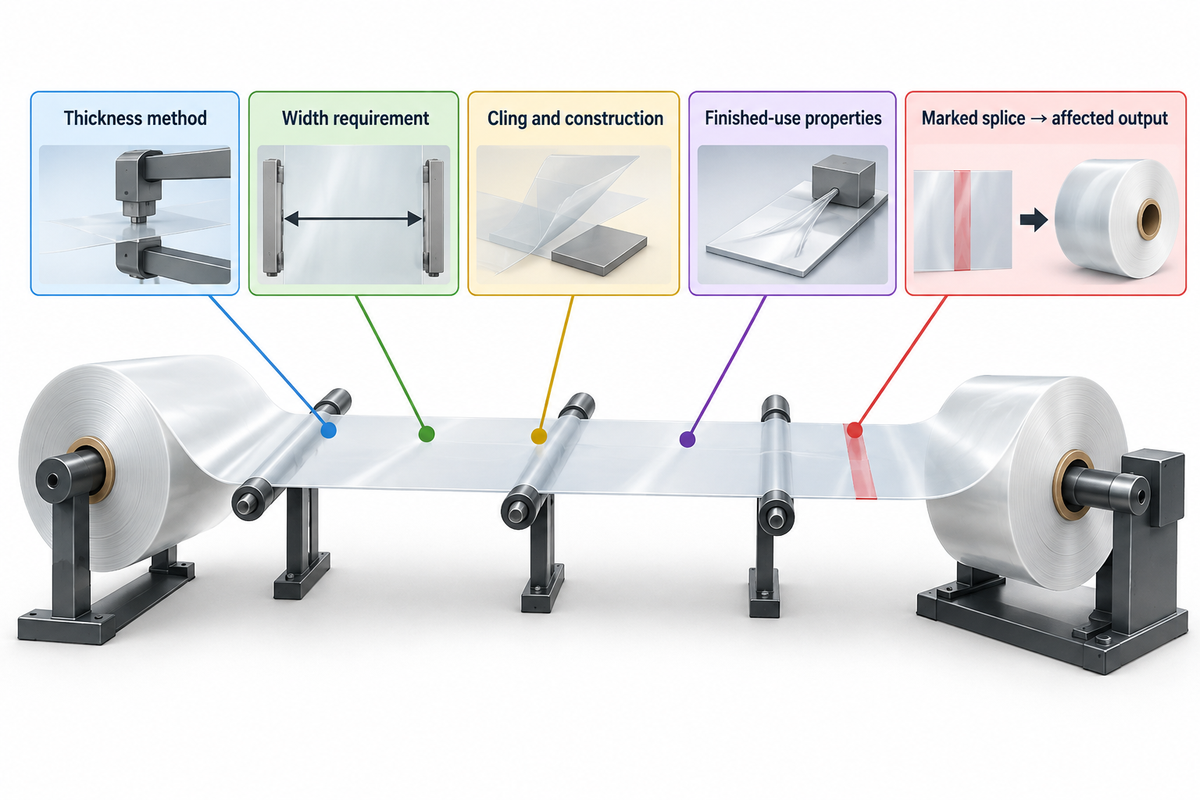
There must be consensus on the thickness method, width requirement, and the finished-use specification along with the winding checks. Average thickness, local thickness variation and stretching behaviour address various questions. State the test method and pertinent direction on the purchase specification to enable comparison of results obtained by the supplier and converter on the same basis.
“It may be used between the buyer and seller to arrive at purchase specifications.”
The guide provides information on stretch-film selection and use. For measurements of incoming films, ASTM D8136-24 describes non-contact capacitance measurement and thickness variability in the machine and transverse directions. The stated method range is 2.5 to 250 µm; this range represents a measurement scope, not a recommended jumbo-film thickness.
ISO 4593:1993 describes mechanical thickness measurement and remained current after confirmation in 2025. Discuss which method will be used and how the samples will be located. A mean reading can mask a cross-web thick band that builds up repeatedly at the same location in the wound roll.
Stipulate the film construction, cling, transparency or color, and converted film properties. ASTM D5459-95(2025) measures the recovery, permanent set and stress retention in the machine direction. These are distinct from testing whether the rewinder can run the material. A general statement such as “high-quality” or “strong and durable” gives little to no information to the quality staff on what test conditions to use or what acceptance criteria have to be met. Stretchability should be defined with agreed test and extension conditions, not with an unqualified percentage.
For black jumbo rolls, specify the requested color and appearance in the customer’s specifications. Different types of stretch films require their own approved properties. A change in color shouldn’t alter the underlying film specs. Certification requests, if applicable, belong to a named scheme and supplied product.
Put splice requirements in writing: permissible count, splice form, marking, location, record and treatment of affected finished rolls. Use the agreed specification when a splice occurs during a trial. For unit labels, compare gauge and micron labels; for declared footage, use the separate method for checking the stated roll length.
Run a Traceable Rewinder Trial
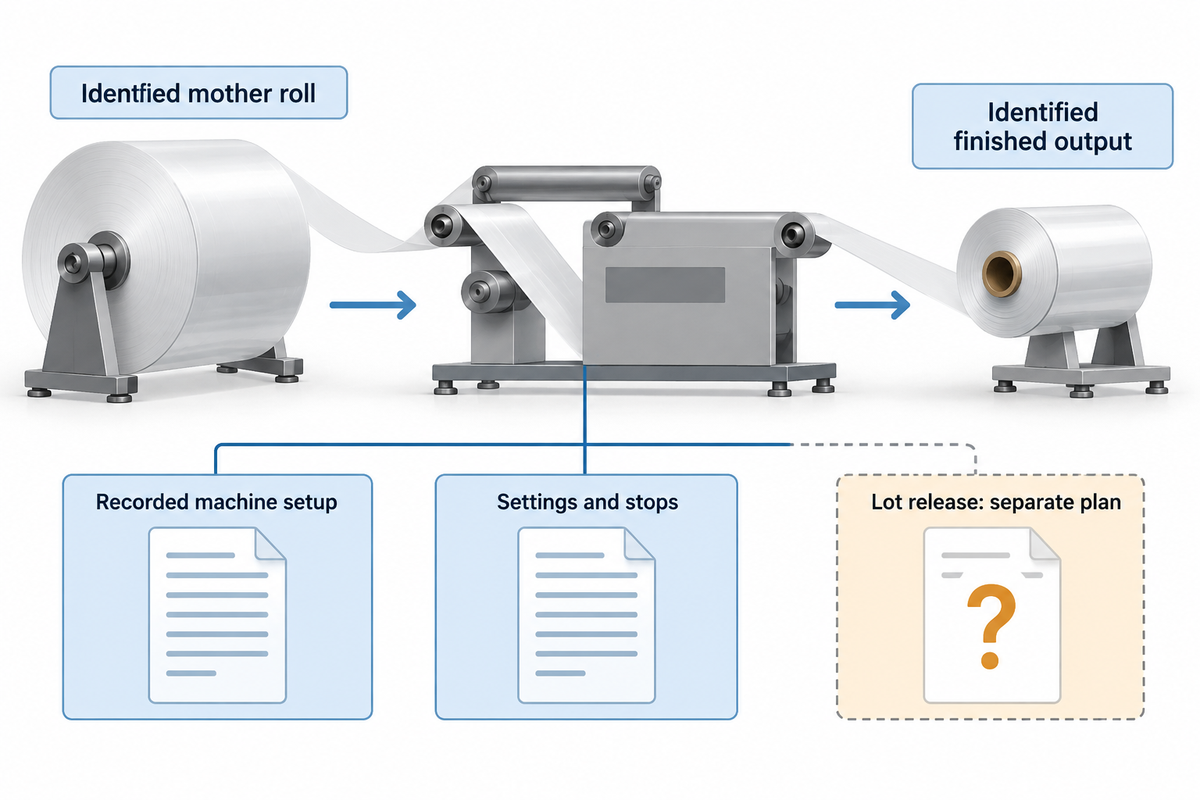
A traceable trial links one identified mother roll to a recorded machine setup and its finished rolls. Record the jumbo roll machine model and the incoming roll details. Save all settings, speed and tension adjustments and stops during the trial. Record, in detail, behavior during the startup and steady running of the machine as well as near the core of the unit. If different behavior is observed, record this in detail.
Production and quality should agree upon the trial conditions before a trial is run. Define what counts as acceptable finished output, including dimensions, winding condition and required film-property checks. Assign an output identifier that retains the link to the incoming roll. If changes to settings occur during the trial, retain records before and after the change, rather than combine all outputs.
Which jumbo stretch film is best for a converting line?
The best jumbo stretch film candidate for a converting line is the specified material that matches the incoming interface and meets finished-output requirements under the agreed trial conditions. Choose between candidates based on comparable roll construction, test methods, and output checks. A better first run doesn’t establish the better supply option.
Comparisons for production lines need comparable trial conditions. Film suitable for one setup shouldn’t inherit approval for another, without checking the changed interface and output requirements.
Compare stops by cause and location before attributing them to the film. A break at a damaged edge, a marked splice and a changed machine setting belong in different record fields. Keep the affected sample and machine record so the supplier can investigate the same event that production observed.
Release of lots is a separate decision. The NIST explanation of acceptance sampling discusses random sampling from a defined lot with a specific acceptance or rejection plan. Quality should agree with the lot definition, sampling method, sample size and decision rules with the supplier. One acceptable roll doesn’t indicate general acceptance of all rolls in that shipment.
Compare Usable Film and Conversion Losses
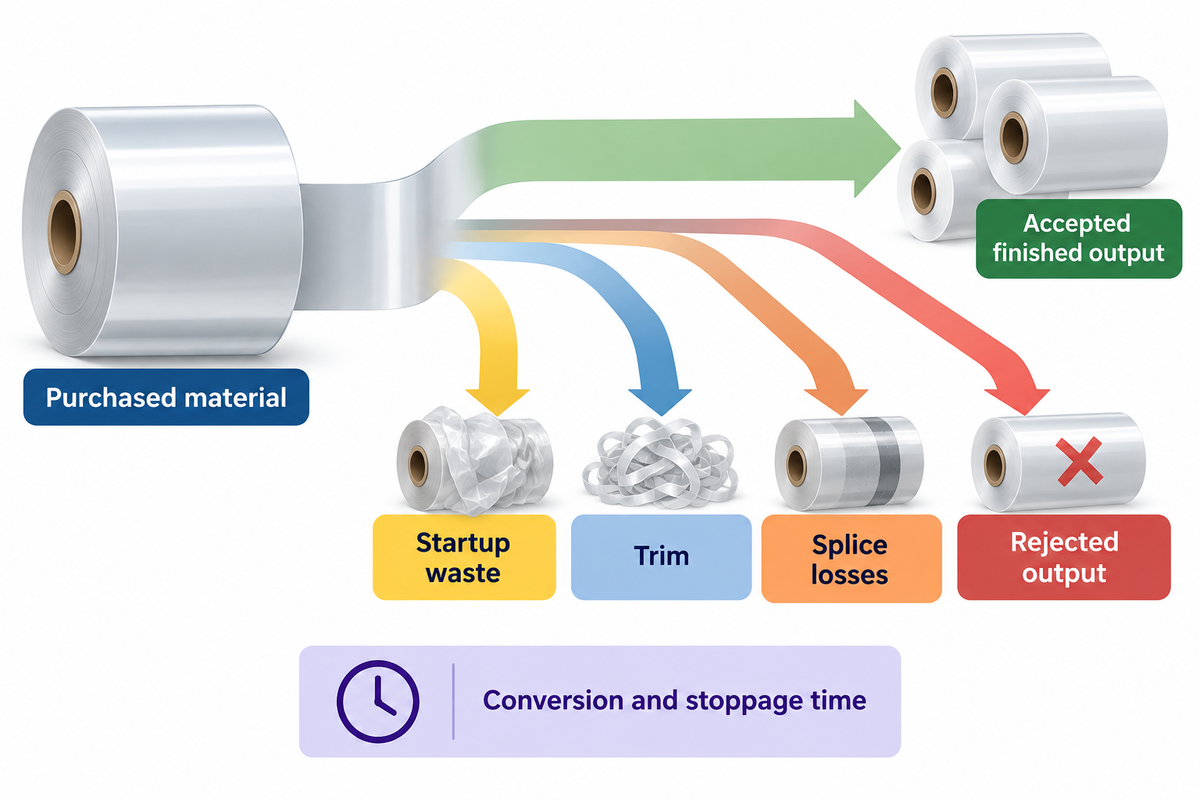
Comparisons of costs and evaluations of trials should use the same finished-film specification and state the output measurement unit (e.g., accepted net film mass). Keep purchased material, startup waste, trim, splice losses and rejected output separate. Roll counts alone may be misleading when comparing finished rolls that differ in length, width or thicknesses.
ISO 14051:2011 provides a framework for tracking physical material flows and associated costs. The EPA material-line method likewise separates input material from material incorporated in product. In the context of a trial, weigh the pertinent streams, using a consistent tare method, and relate each to the same production run.
Assess cost-effectiveness against accepted output. Keep conversion time, stoppage time and any extra handling charges beside the material record. Rejected output shouldn’t be hidden in the average cost of purchased kilograms. A buyer comparing quotations of “jumbo roll stretch film” must know which weight is net film and which is shipping weight, before evaluating prices.
For area-based comparisons, thickness and density also play a role. ISO 4591:1992 describes gravimetric thickness using mass, area and density. Use the same measurements for comparisons and leave the final specification unchanged. A thinner or shorter finished roll is a different offer, even if the price of the roll is less.
Send the Supplier a Complete Handoff
The approved incoming interface, film specification, labeled pictures, trial conditions and output disposition should be combined for the handoff to the supplier. Send the same revision to purchasing, production and quality. The document should explain what’s accepted, what needs correction and which of the changed inputs require a new review to determine acceptance before releasing a repeat order.
UD Packaging’s stretch film Supply Specification defines the scope for buyer-controlled conversion and asks for the converting line, roll dimensions and winding specification. Jumbo scope is quoted separately. Use those fields to start a conversation, then attach the interface and trial records rather than requesting an unspecified large roll.
Quote checklist — copy these requirements into the request:
| Parameter | Recommended range | Why it matters | How to verify |
|---|---|---|---|
| Incoming core | Line-approved bore and length, mm | Mounting and engagement | Match the incoming-core drawing |
| Roll envelope | Approved diameter and width, mm; gross mass, kg | Unwind and handling fit | Compare with equipment ratings |
| Film thickness | Buyer-agreed nominal and variation, µm | Consistent finished specification | Name the measurement method and sampling locations |
| Splices | Agreed count per roll and marked locations | Trace affected finished output | Retain the splice record during trial |
| Output and lot release | Agreed finished dimensions and property limits | Separate successful conversion from acceptance | Attach trial results and the lot sampling plan |
Ask the jumbo roll stretch film manufacturer to identify the specification used to manufacture the quoted material and to retain that version with the order. For jumbo roll stretch wrap used for packaging after conversion, connect the finished film tests to the customer’s actual packaging needs.
Enter the approved values before sending this checklist; the fields aren’t default engineering limits. For traceability, ask the supplier to identify the supplied film specification and the responsible manufacturer. Reach a similar agreement to ensure packing will secure the roll in the declared orientation during shipping.
Release the repeat order against the accepted revision. Changes in core, film construction, roll envelope or converting conditions should go back to the person responsible for that area. This closes the handoff with a named decision instead of a vague promise of durability or efficiency.
Frequently Asked Questions
What is jumbo stretch film used for?
Jumbo stretch film supplies converters with mother rolls for producing smaller finished rolls.
The purchasing description should specify the intended conversion route and the final format. Vendors can also use large roll wording to describe material fed directly to a wrapping machine, so examine the receiving interface as opposed to the label. A converter should have an approved incoming core, roll envelope and film specification, and then perform output checks under recorded trial conditions.
Is jumbo stretch film the same as cling wrap?
Jumbo stretch film and household cling wrap should be purchased against different application specifications.
A transparent look or a cling description doesn’t indicate resin construction, food contact suitability or rewinder fit. State the intended industrial use and request the corresponding film specification. If food contact is required for the application, address that need separately with the supplier. The mother-roll format describes how material is supplied and doesn’t prove a particular end use.
How much does jumbo stretch film cost?
A comparable jumbo-film quote needs the film specification, net mass, core, quantity, packing and destination.
Instruct all suppliers to submit quotes based on the same basis and to distinguish net film from gross roll weight. Then compare accepted finished outputs under the same conversion conditions and record scrap and extra handling separately. A price per roll cannot support a fair choice when roll contents or finished specifications differ. Use the trial record to explain the difference instead of assuming the lowest unit price is the best.
Does a larger roll always reduce conversion cost?
A larger roll reduces cost only when its usable output and handling requirements justify the change.
Fewer changeovers can’t make up for repeated stops and/or rejected finished rolls.
Can I approve a shipment after checking one sample roll?
One sample roll records a trial result; shipment release requires the agreed lot acceptance plan.
Define the lot, sample size, acceptance or rejection rules and the method used to select rolls before using samples to release shipments. Preserve the identity of incoming rolls and finished outputs during the trial. If any rolls show damage or different behavior, note their condition and route them for disposition, and don’t automatically apply the earlier sample result to the rest. Quality should also note whether there was a change in core, film or line settings which requires a new trial.
About this guide
This UD Packaging guide links public film-test scopes, winding help and the company’s published jumbo-roll quotation fields. The two record formats are editorial purchasing aids; sample observations show how to document a handoff. Machine limits and release criteria must be filled out from the buyer’s approved specifications. Standards were checked against their public catalogue pages in October 2026.
References & Sources
- ASTM D4649-20(2025), stretch-film selection and purchase specifications
- ASTM D8136-24, film thickness by non-contact capacitance
- ISO 4593:1993, mechanical film-thickness measurement
- ASTM D5459-95(2025), elastic recovery, deformation and stress retention
- Neal Michal, PFFC, 2023, solutions for common wound-roll defects
- Timothy J. Walker, PFFC, 2003, Winding Better Rolls
- NIST, lot acceptance sampling
- ISO 14051:2011, material-flow cost accounting
- EPA, Lean and Environment Toolkit, material flows
- ISO 4591:1992, gravimetric thickness and roll yield
- HSE, paper reel handling, size and shape
- eCFR, powered industrial truck loading, 1910.178(o)