Get in touch with UD Packaging Company

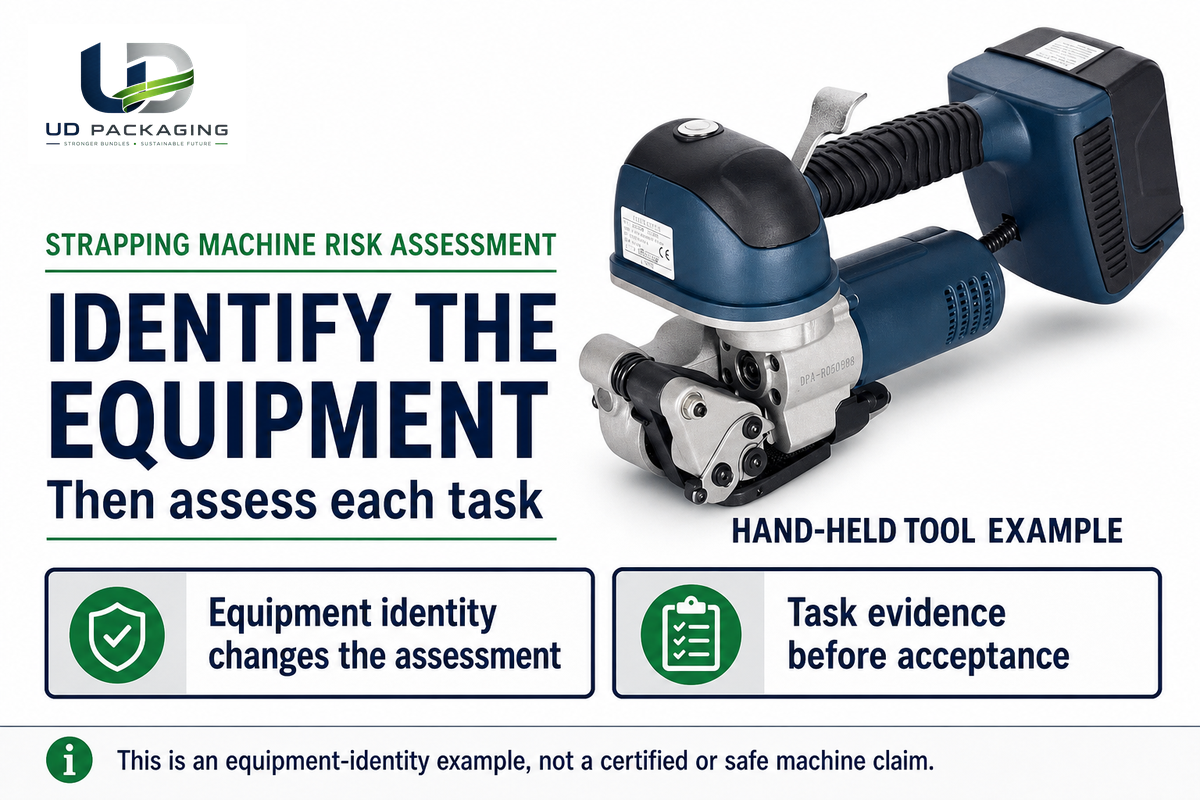
A strapping machine risk assessment considers who could be harmed by each task, how serious the injury could be, how likely exposure is, and whether the currently used safeguards are adequate. It starts with the machine and the surrounding work area. An adequate assessment needs competent site judgment; it can’t come from a supplier brochure or prefilled form.
Strapping machine risk assessment connects each task to hazards, exposed people, existing controls and evidence. Record unresolved risks and assign actions before accepting the task or equipment for use.
Assessment inputs at a glance
- Equipment: exact model, serial number, configuration and operating modes.
- Material: package dimensions, mass, strap specification and full reel mass.
- People: operators, maintenance personnel, cleaners and nearby workers.
- Decision: evaluate likelihood and severity, then document control adequacy and outstanding actions.
A useful purchasing question is whether a proposed item of equipment will enable a person to perform a task. A high-speed demonstration shows a production cycle. Reel replacement, cleaning and fault recovery expose different parts of the packaging process and merit separate entries. For high-volume work, include replacing inventory and interrupting work in progress in the assessment rather than evaluating only continuous work.
Key points
- A stop command doesn’t establish energy isolation.
- Automation can change exposure without removing loading or maintenance tasks.
- Reel dimensions don’t establish an acceptable manual lifting weight.
- Evidence must match the candidate model and the installed work area.
Define the Machine, People and Work Area
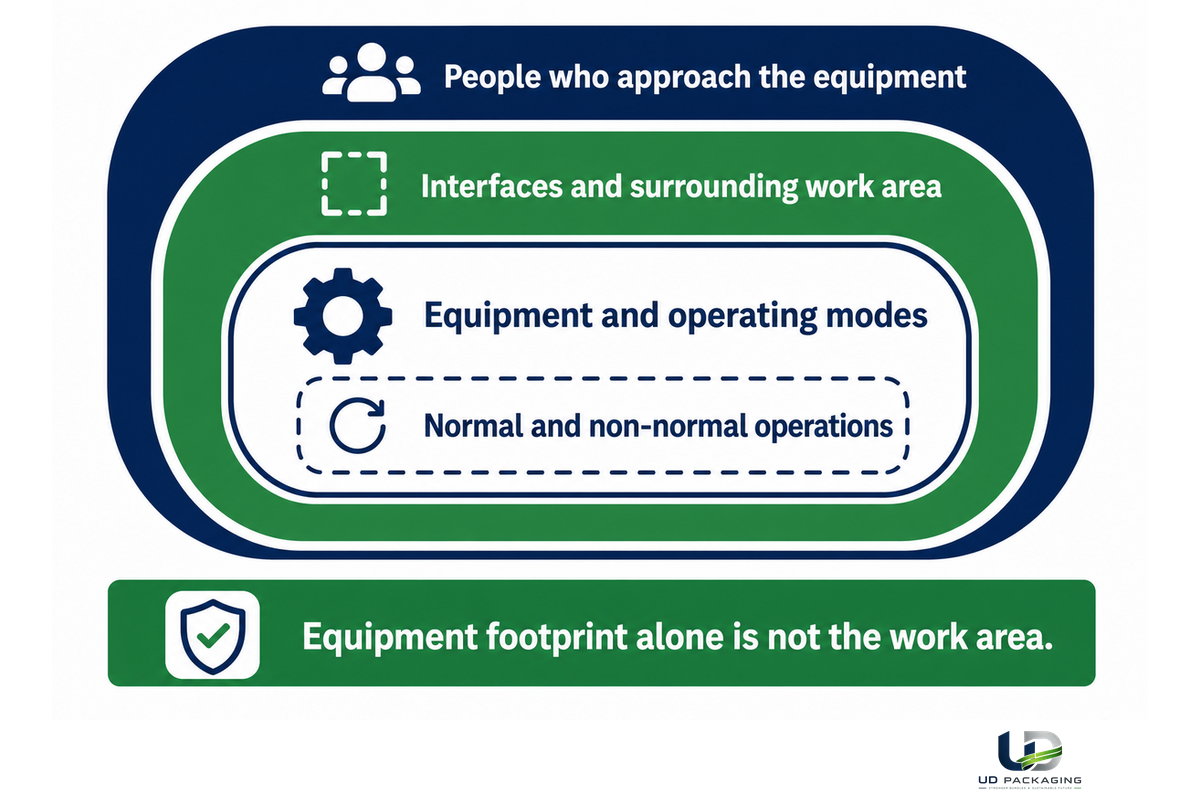
The scope of the assessment should include the installed strapping equipment, its interfaces, the surrounding work area, and people in the work area who approach the equipment for normal and non-normal operations. Identify the equipment and the different operating modes prior to discussing safeguards. Otherwise, assessing an automatic cycle of the equipment may omit the necessity of a manual intervention at the reel, conveyor or discharge point.
HSE’s risk assessment guidance emphasizes the importance of considering how people really work, non-routine operations and the type of people who could be hurt. All the above should be applied to the entire packaging line (including contractors), and the surrounding work area. The equipment footprint alone doesn’t describe the work area.
Using an Automatic Strapping Machine: Which Tasks Still Need Evidence?
Using an automatic strapping machine still needs evidence for presentation of packages, access during the cycle, replenishment and maintenance. Describe how tasks change as modes are altered. It’s possible that a fully automatic system can automatically move packages through the system without manual positioning, while still requiring manual service access and reel handling that need separate assessment.
Keep equipment categories as precise as possible. A hand-held strapping tool or combination tool isn’t the same as an arch machine, for example, for manual handling and access. If a quotation states, “manual strapping machine,” determine if it means manual tools or a powered machine with manual handling of packages. Semi-automatic strapping and automatic machines should also be assessed against the same task requirements. The existing types of strapping machines guide covers these aspects.
The components of an automatic strapping system should be listed according to the function proposed for it in the design: feeding, tensioning, joining, cutting and transport where fitted. Identify the energy associated with each function in the documents provided by the manufacturer. Not all banding machines have the same drive, joining method or stored-energy sources. Record who’s permitted to adjust settings and what training operating an automatic strapping machine requires on site.
Common mistake: accepting the statement, “automation enhances safety,” as proof. Which exposure does the design reduce, and which tasks remain? Productivity and product safety claims require their own acceptance evidence and don’t prove that personnel can enter a given area safely.
Loading Packages: Map Access Before the Cycle Starts
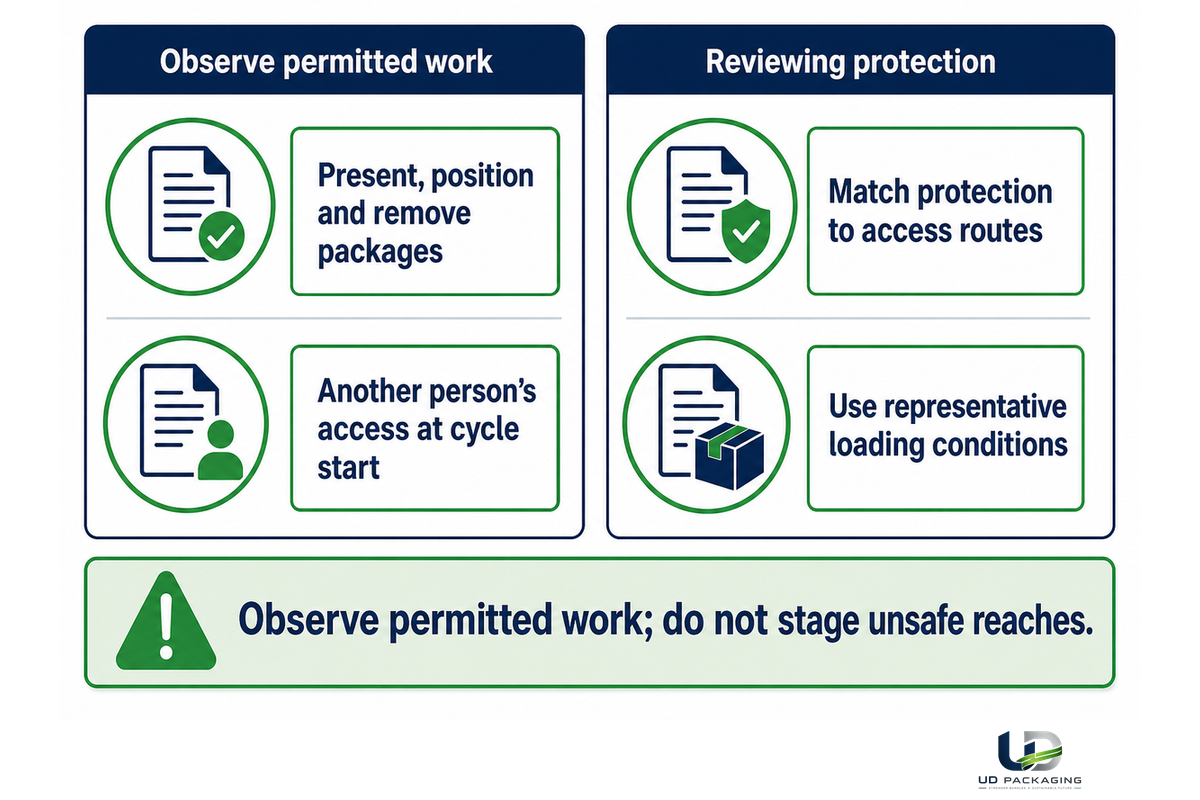
Loading assessment begins by observing the movements of people as they present, position and remove packages or pallets. Identify where people and hands can reach moving parts, the strap path, and the load. Compare the proposed protections with those access routes, including foreseeable access by another person while the operator starts a cycle.
With respect to the workplaces covered by it, OSHA 29 CFR 1910.212(a)(1) addresses guarding against hazards such as points of operation, ingoing nip points and rotating parts. Select controls against the specific hazard. A warning label doesn’t demonstrate that the required protection exists.
Who can reach the strap path?
Someone may approach the strap path when steadying, loading, or removing the package. From another angle, people may be bystanders, and they may enter a hazardous area. Observe permitted work from outside hazardous areas, and consult the operator. Record access routes and protective arrangements without staging an unsafe reach or defeating a guard to demonstrate a problem.
Illustrative loading scenario: the warehouse buyer watched the supplier strap a rigid carton on a clear demonstration table. At the intended station, an operator must turn an irregular package before feeding it forward, while a colleague collects completed packages at the opposite side. The demonstration has not answered whether either person can reach the tensioning unit or cutter blade during a strapping cycle. The plant manager took notes of both the positions and requested to review the proposed layout using representative packages. Procurement keeps that layout decision open in the quotation. No one is assuming a lower risk, based on how smooth the demonstration was. Evidence is required to support the risk for the installed configuration.
HSE’s machinery guidance further asks if guards are inconvenient to use or easily overridden. Talk to operators regarding awkward positioning and interruption. Document the concern for a design review; don’t eliminate the protection.
Boundary: The exposure to the risk varies based on the size and weight of the load, stability of the package, and the adjacent equipment. A successful cycle with a small carton can’t prove suitability for palletized loads. Representative loading conditions should be shown before comparison of automatic models.
Changing Reels: Record Handling and Stored Energy
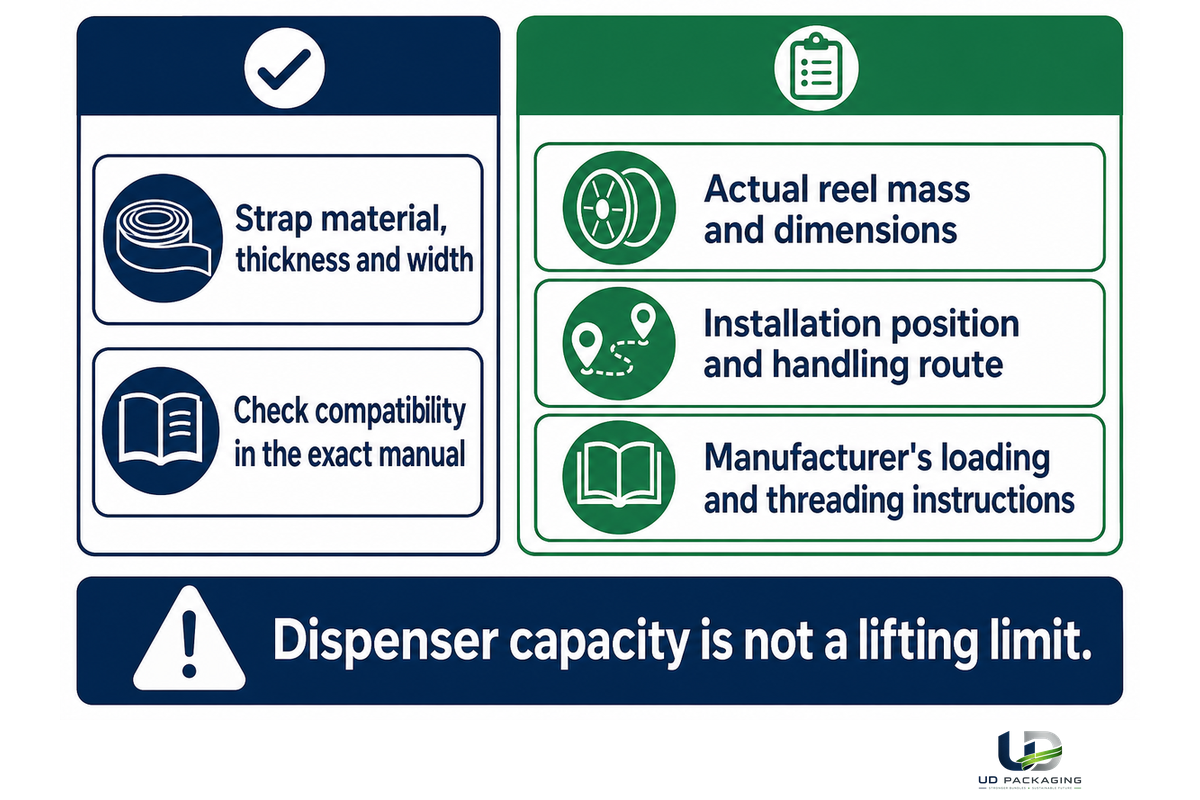
An assessment for reel change requires actual reel mass, dimensions and position of installation, as well as handling route. It requires the manufacturer’s loading and threading instructions. Separate feeding the strap from lifting. A reel that fits the dispenser may require a different handling arrangement or expose a person to moving parts during threading.
HSE’s manual-handling guidance states that the law doesn’t set specific weight limits. It calls for avoiding hazardous manual handling where reasonably practicable, assessing unavoidable tasks and reducing the risk of injury. Don’t accept a supplier’s maximum reel capacity as a lifting limit.
State polypropylene, polyester, or steel strapping, as applicable to the candidate equipment. Record thickness and width of strap and note core, outside and face dimensions of the reel. Check compatibility in the exact manual; a nominal material description doesn’t guarantee that the reel mounts securely, or that the feed system accepts it.
Illustrative replenishment scenario: two offers accept the buyer’s required strapping material. One proposal leaves the dispenser location unspecified, and neither gives the mass of a full supplied reel. Purchasing initially compares only consumable price. The maintenance lead asks for a drawing of the reel support and the approved loading method. The warehouse supervisor records the route from storage to the machine. A handling aid could change the space and cost requirements, but its suitability has not been determined. The buyer therefore separates consumable compatibility from replenishment access in the comparison. A missing reel weight remains an unresolved input, rather than a guessed value copied from a different machine.
Common mistake: treating a reel change as ordinary production in every situation. There may be a difference in the modes or access points for production or maintenance. For tasks like reeling or threading, there may be different provisions for the control of hazardous energy. Don’t assume that permission to remove a guard or work on an energized part of the mechanism is granted just because there’s a general procedure for reeling or threading.
Clearing Jams and Maintaining the Machine
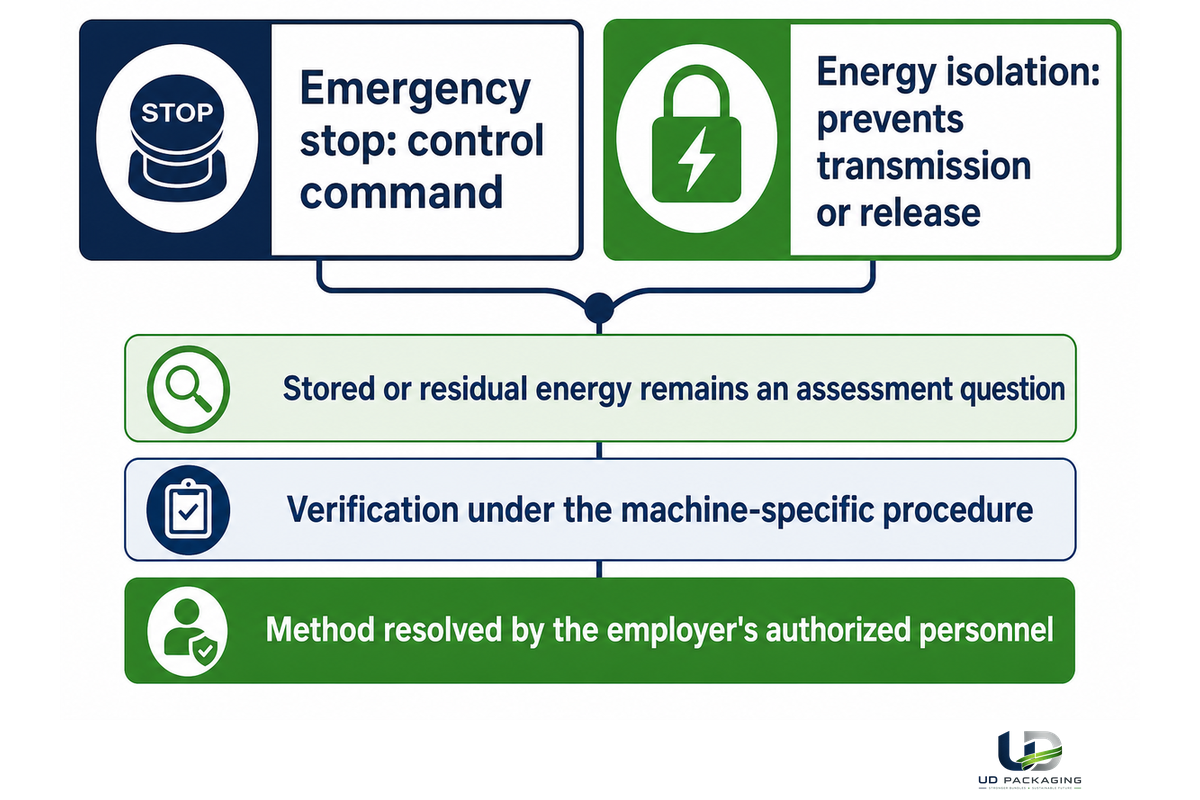
Considering jam clearing as an approach to a hazard that is inaccessible during normal production changes the assessment of hazardous energy control. The time required to remove a blockage doesn’t determine whether it’s necessary to control hazardous energy. A stopped machine may contain stored energy.
Why is an emergency stop different from energy isolation?
Emergency stops send a control command. Energy isolation physically prevents energy transmission or release through an appropriate isolating device. The distinction matters during servicing because restarting is only one possible hazard. The assessment must also address stored or residual energy and verification under the applicable machine-specific procedure, rather than treating a visible stop button as sufficient evidence.
“Push buttons, selector switches and other control circuit type devices are not energy isolating devices.”
The provisions of the US standard relating to servicing and maintenance addressing exposure to unexpected energization, startup or release of stored energy require control of the relevant energies. Section 1910.147(d)(5) addresses stored or residual energy; paragraph (d)(6) requires verification of isolation and deenergization before work starts. These are separate issues which must be addressed during a maintenance review.
There are limits to the normal-production exception. Servicing during the course of normal production could be covered by the standard if an employee must remove or bypass a guard and/or place a body part in a point of operation or a danger zone during a machine cycle. The minor-servicing exception applies only under its stated conditions: the activities must be routine, repetitive and integral to production, with alternative measures providing effective protection. Calling troubleshooting “quick” doesn’t establish any of the conditions for the exception.
The 2021 strapping-machine injury record of OSHA describes a machine head falling after a strap was cut to clear a jam. The record describes a falling component and doesn’t establish that correct isolation had already occurred. It isn’t an incident-rate record.
Record before intervention
- Task and exposed body position
- Applicable energy-control procedure
- Stored-energy and verification requirements
Reject unsupported assumptions
- A short task needs no assessment
- A stop button proves isolation
- No motor motion means no stored energy
The method for the installed equipment must be resolved by the authorized personnel of the employer. An assessment article won’t describe blocking points, or specify electrical tests or an isolation sequence for an unidentified machine. Make this responsibility clear when maintenance is performed by another party.
Turn Observations into a Task Exposure Register
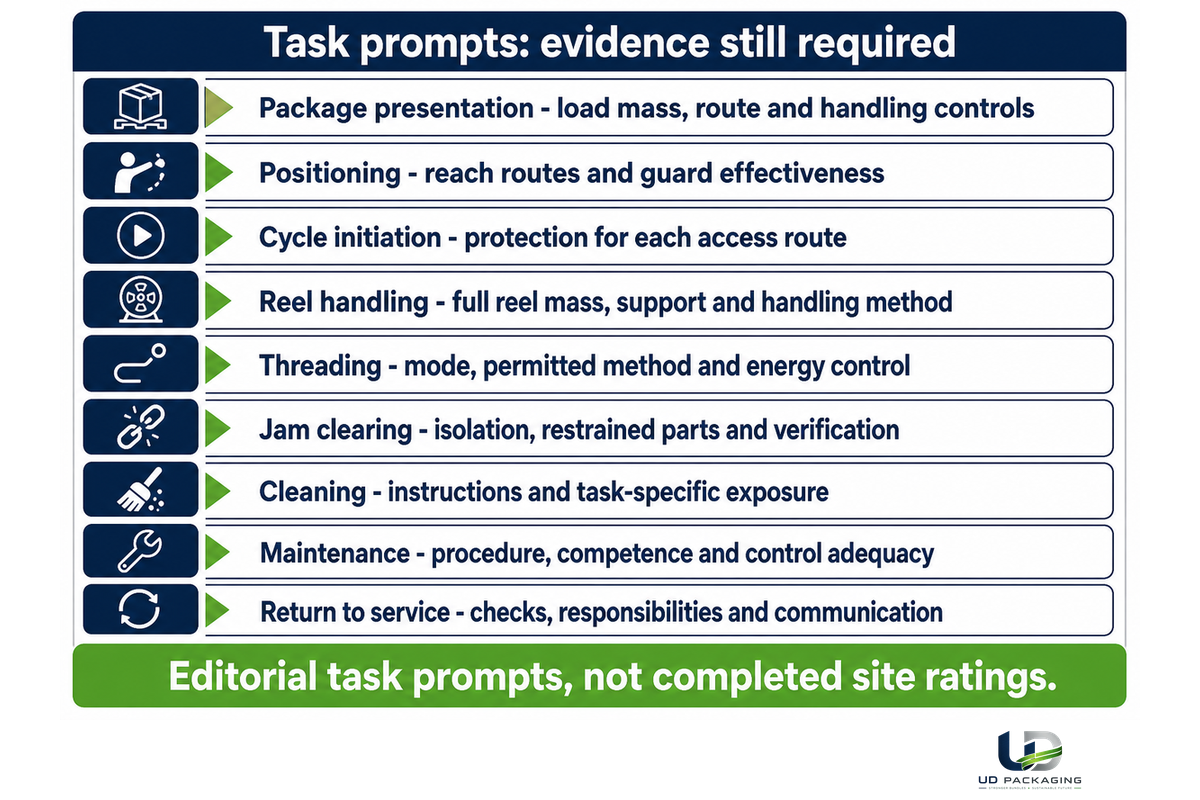
A Task Exposure Register links each observed task to possible harm, likelihood evidence and control adequacy. Use it to record judgments and actions, instead of treating a list of documents as a completed risk assessment. Each row must have a responsible person and a review decision that’s traceable to the installed equipment.
HSE asks assessors to consider how likely harm is and how serious it could be. A qualitative assessment can explain those judgments without an invented numeric score. Record the plausible injury, who’s exposed and when, then explain whether current controls adequately address the hazard. Unverified protection remains an open question.
| Task | Exposure to examine | Judgment and evidence needed | Suggested action owner | Limitations / Not suitable for |
|---|---|---|---|---|
| Package presentation | Lifting, unstable load, nearby traffic | Load mass, route, possible injury and handling controls | Warehouse supervisor | No assumed lifting limit |
| Positioning | Hands near moving or trapping points | Reach routes, exposure frequency and guard effectiveness | Site assessor | Demonstration layout alone is insufficient |
| Cycle initiation | Another person within the work area | Start conditions and protection for each access route | Controls specialist | Operator visibility alone is not proof |
| Reel handling | Lifting, rolling or trapping | Full reel mass, support and handling method | Warehouse supervisor | Dispenser capacity is not a lifting allowance |
| Threading | Access to feed mechanism | Mode, permitted method and applicable energy control | Maintenance lead | No generic energized-threading permission |
| Jam clearing | Unexpected motion or stored-energy release | Isolation, restrained parts and verification requirements | Authorized personnel | Stop command alone is insufficient |
| Cleaning | Access behind protection or near hot parts | Cleaning instructions and task-specific exposure | Cleaning supervisor | Normal cycle controls may not cover cleaning |
| Maintenance | Electrical, mechanical or other energy | Procedure scope, competence and control adequacy | Maintenance lead | Generic service instructions are insufficient |
| Return to service | People or tools left in the work area | Applicable checks, responsibilities and communication | Responsible supervisor | A completed repair alone is insufficient |
Source basis: The basis for the recommendations is the HSE risk assessment guidance and the OSHA standards 1910.147 and 1910.212. Task prompts and suggested owners are editorial synthesis, not prescribed staffing roles or completed site ratings.
Illustrative assessment entry: A maintenance lead sees that a stop button is accessible and the available manual doesn’t identify the isolation arrangement for the installed configuration. The jam-clearing row records a possible crushing injury and exposure during an intervention; the likelihood of this injury can’t yet be justified from the available evidence. The control-adequacy field is unresolved. The lead is taking the action to have the correct documentation and competent verification, under the site procedure, arranged with a due date set by the responsible manager. The row is reviewed after that work is complete. A jam-clearing row won’t become “low risk” just because a manual has been ordered and won’t allow the proposed intervention while the issue is still unresolved.
Use the record: With each task, document the assessor, assessment date, severity reasoning, likelihood basis, existing controls, further measures, owner, deadline and result of subsequent review. If the site has defined a scoring method, use that method and retain the reasoning. Don’t copy scores between machines with different access arrangements.
Request Model Documents Before Comparing Quotes
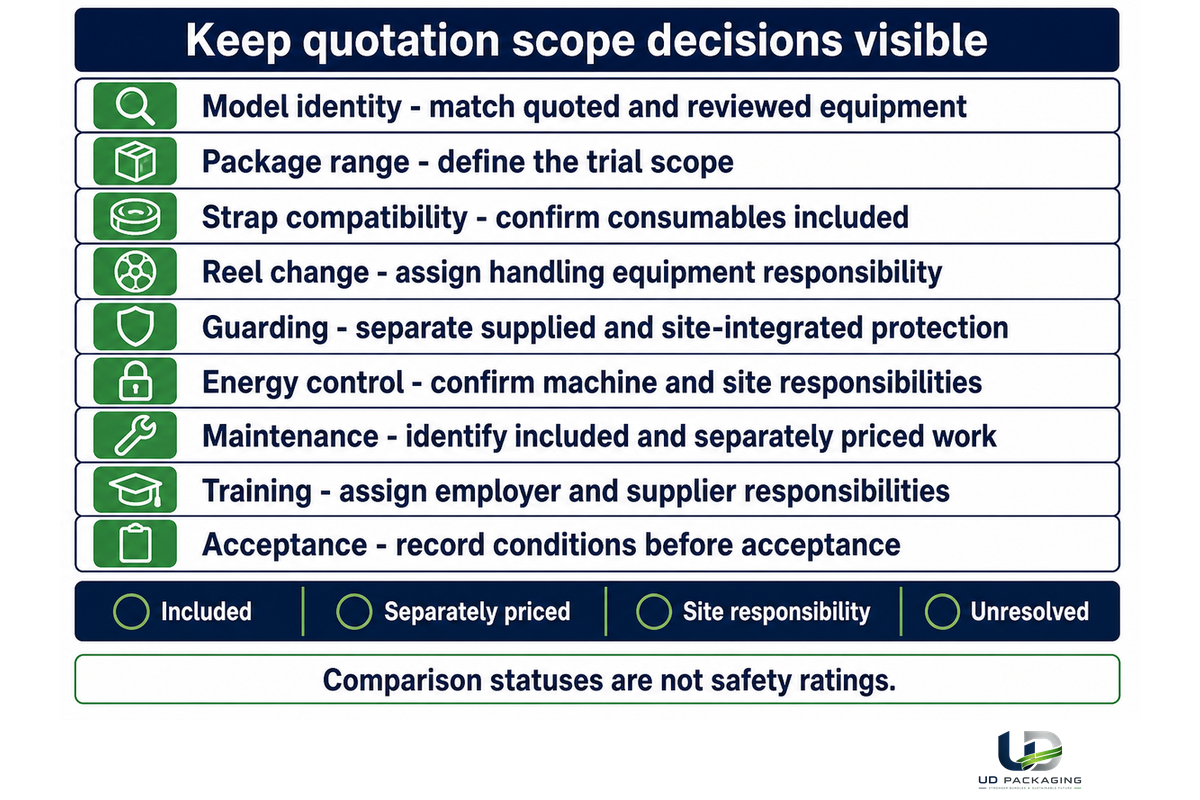
Compare equipment only after the supplier identifies the proposed model and operating envelope, as well as the documentation. Separate the price of the equipment from the site integration, as well as unresolved protection. Procurement needs to compare the equipment scope; the plant manager and maintenance team need to evaluate the proposed arrangement to validate if the equipment can support the desired tasks.
UD Packaging’s strapping tools and equipment enquiry route is the starting point for a candidate discussion. Its strapping machine application review requests model documents and written scope before model-specific commitments. That category-level information doesn’t certify a particular installation.
Control and Evidence Comparison
| Comparison item | Evidence to request | Commercial decision | Limitations / Not suitable for |
|---|---|---|---|
| Model identity | Model, configuration and document revision | Match the quoted and reviewed equipment | Family brochure alone |
| Package range | Dimensions, mass and representative loads | Define the trial scope | One demonstration carton |
| Strap compatibility | Material, dimensions and joining method | Confirm consumables included | Material name alone |
| Reel change | Mass, dimensions, support and loading instructions | Identify handling equipment responsibility | Assumed manual lifting capacity |
| Guarding | Arrangement matched to task and access | Separate supplied from site-integrated protection | Unexplained “safe design” claim |
| Energy control | Isolation and stored-energy information | Confirm machine and site responsibilities | Emergency stop description alone |
| Maintenance | Tasks, access, service and spare-parts scope | Identify included and separately priced work | Unqualified smooth-operation promise |
| Training | Audience, tasks and delivery scope | Assign employer and supplier responsibilities | Attendance equated with competence |
| Acceptance | Agreed tests, open items and review responsibilities | Record conditions before acceptance | Cycle speed as the only criterion |
Each offer should mark an item included, separately priced, site responsibility or unresolved; comparison statuses aren’t safety ratings.
Separate evidence of worker protection from packaging efficiency targets. Consistent tension, seal strength and a securely fastened load concern the result of the strapping process. If a supplier offers a friction weld or other joining method, check its compatibility and acceptance criteria. A satisfactory joint doesn’t validate access to the mechanism.
Record the required strapping tension and the means of verifying it in the product quality test. A proposal to improve packaging efficiency needs measurable acceptance conditions as well. If a reduction in the number of rejected packages is intended to reduce waste, then compare the rejected output under agreed trial conditions; don’t count an untested saving in the purchase decision.
When Not to Accept a Machine Proposal
A decision on equipment can’t be made based on a low price of a machine in question if responsibilities to provide site protection, handling equipment or commissioning remain unpriced. Hold the equipment decision when the proposed configuration cannot be matched to its instructions, or when important task exposures have no supported control arrangement. Record each omission and obtain a written scope.
Question a proposal that would reduce human errors without showing how the relevant task changes. Reducing manual labor in package positioning can leave replenishment and maintenance untouched. Claims about optimal performance or smooth operation should be translated into specific trial conditions, not accepted as evidence that protection is adequate.
Request the documents needed for purchase and use without presuming a right to every internal design record. HSENI’s technical-file guidance differentiates the purchaser’s position from the regulator’s access to the whole technical file. The purchaser’s position and the regulator’s access are different matters. Applicable instructions and other required supplied documents are a separate question. Have the supplier identify what accompanies the exact equipment for its destination market.
A missing full technical file isn’t, by itself, the same deficiency as missing user instructions. Define the missing evidence before accepting or rejecting an offer.
Industry Outlook: Review Controls After Changes and Faults
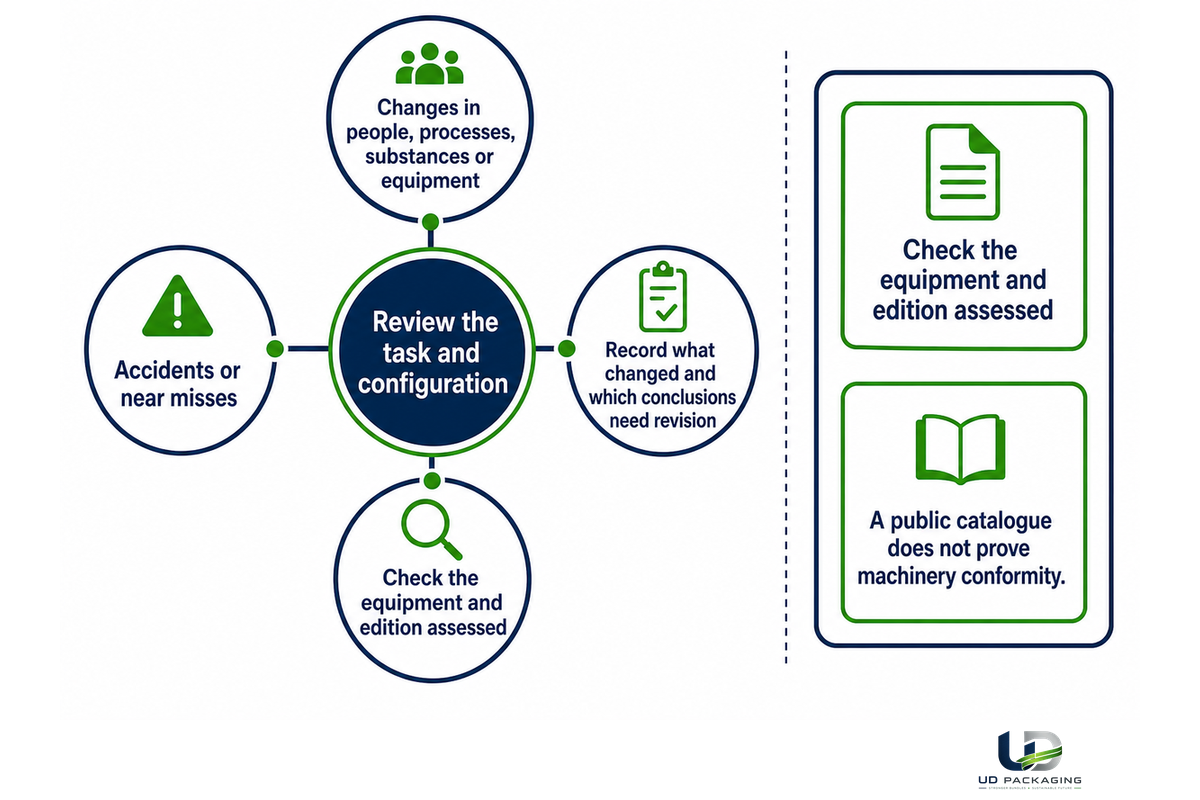
Changes to the standards and/or the installed tasks should entail a recheck of the assessment’s scope. DIN’s August 2025 edition of EN 415-8 provides a good case in point to illustrate why an older reference in a quotation should be examined. Ask which equipment and edition the supplier has assessed and examine whether the documents support the current configuration and intended use.
The public DIN EN 415-8:2025-08 catalogue identifies strapping machinery as its subject. Published changes include removing motor-driven hand-held electric tools and adding the needle-type strappers. Those distinctions matter when a purchasing list combines stationary packaging machines and portable tools. Don’t apply the same reference to every item of packaging machinery because each can fasten a strap.
The public catalogue shows edition and scope information. It doesn’t show the paid-for standard in its entirety. No inference can be drawn regarding a specific clause from the published catalogues, or the status of the Harmonised Standard or the Conformity of the Machinery. Procurement should require the supplier to state the applicable requirements and the basis of any declaration for the item of equipment in question.
Changes in the workplace, regardless of the date published, deserve attention. HSE recommends reviewing controls when changes in people, processes, substances or equipment may create new problems, and after accidents or near misses. What’s being assessed can be changed by alterations to the workplace, as well as different reels and packages. Record what changed and the earlier conclusions that may need revision.
Regarding the energy control procedures governed by US OSHA 1910.147, paragraph (c)(6) stipulates that these procedures must be inspected at least once a year. That’s a specific requirement for those procedures, not a universal annual timetable for every risk assessment. Paragraph (c)(7)(iii) addresses retraining in the event of changes to the employee’s assignment, machines, processes and/or procedures, as well as in the event that deficiencies are identified. For changes in machines, equipment or processes, the provision specifies those that present a new hazard. It also covers retraining when inspections reveal, or the employer has reason to believe there are, deviations from or inadequacies in employees’ knowledge or use of the energy-control procedures.
Common mistake: considering a document’s revision date as evidence that the assessment is current. Identify the task and configuration first. For 2026 purchasing projects, retain the document version referenced in the offer and assign responsibility for reviewing both the model documents and the site. It’s updating the citation without reviewing the work, which leaves the uncertainty in the original assessment unresolved.
Frequently Asked Questions
What should a strapping machine risk assessment include?
Include equipment scope, task exposure, severity, likelihood and evidence for controls.
Identify the actual machine, its operating modes and everyone exposed during production and nonroutine work. Record possible harm, the basis for likelihood judgments and whether existing safeguards are adequate. Add unresolved actions, owners and review dates. The task register provides a structure; competent people still need to complete the assessment using site observations, applicable requirements and the manufacturer’s instructions.
Is switching off enough before clearing a strap jam?
Switching off alone does not establish that hazardous energy is isolated and controlled.
The answer depends on the task and applicable energy-control requirements. A stop command is different from an isolating device, and stored energy or restrained components may remain hazardous. Authorized personnel must apply the appropriate machine-specific procedure and required verification. Don’t assume that an interruption lasting only a few seconds qualifies for an exception or that lack of visible motion proves the mechanism is safe.
Does an automatic strapping machine remove manual-handling risk?
Automatic strapping can change handling tasks while leaving replenishment and service work.
Assess loading, reel movement and access separately. Fully automated transport may reduce package positioning by hand, but that doesn’t establish acceptable reel handling or maintenance conditions. The actual package range, full reel mass and workplace layout still matter. Compare applications of automatic strapping machines using task evidence, rather than assuming that a machine category determines the remaining level of risk.
Can I reuse a generic assessment template?
A template is a starting structure, not a completed assessment for another installation.
Replace generic assumptions with the installed configuration, observed tasks and supported judgments. Retain unresolved items until the responsible person verifies the necessary evidence and records a decision.
What should happen when machine documents are missing?
Identify the precise document gap and assign an owner to obtain model-matched evidence.
Begin with the equipment identity and the task that can’t yet be evaluated. Missing operating instructions, an unclear isolation arrangement and an unspecified reel mass are different gaps; list them separately. Ask the supplier or responsible equipment owner for the relevant revision and check that it covers the installed options.
The site assessor should then decide which conclusions remain unsupported and what restrictions or further work are necessary. An enquiry acknowledgement isn’t evidence that a control is effective. Procurement should keep unresolved scope items visible before accepting a quotation, while maintenance and operations review the technical response. Don’t reconstruct an operating or energy-control procedure from a generic online template. Requirements differ by equipment and jurisdiction, so document the applicable basis and who verified it.
Key takeaway
A useful assessment explains each task’s risk judgment and its evidence. Keep unresolved controls, document gaps and quotation responsibilities visible until the responsible people have verified them.
Prepare a Model-Specific Equipment Enquiry
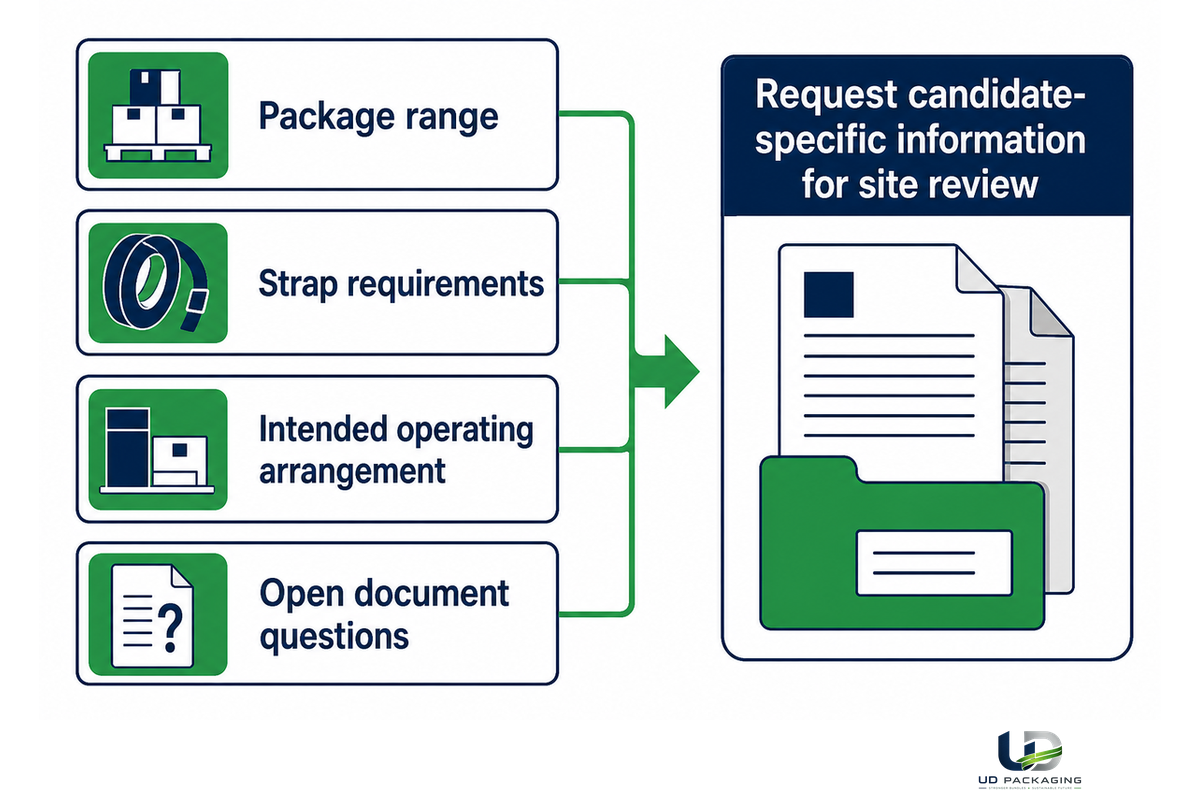
Send UD Packaging the package range, strap requirements, intended operating arrangement and open document questions. Start with the strapping equipment enquiry scope and request candidate-specific information for your site’s review.
Editorial basis: The basis for editorial judgment was public regulator guidance, a public standard catalog and UD Packaging’s application review page, which were reviewed in October 2026. The comparison tables and illustrative examples were not based on actual customer cases of UD Packaging. They are illustrative synthesis, not a site inspection or a declaration of conformity. US and UK references weren’t incorporated beyond their scope; assessment of local requirements and the equipped installation must be done separately.
References and Sources
- HSE: steps needed to manage risk
- HSE: manual handling at work
- HSE: machinery and work equipment
- OSHA: 29 CFR 1910.147, hazardous energy control
- OSHA: 29 CFR 1910.212, machine guarding
- OSHA: inspection 1530747.015 and linked injury narrative
- DIN Media: DIN EN 415-8:2025-08 public catalogue
- HSENI: technical files