Get in touch with UD Packaging Company

A strapping machine is an automated or semi-automated machine that tensions, seals, and cuts a plastic or steel strap around a pallet, carton, or bundle. Selecting the right one is less about finding the “best” machine and more about matching automation tier, strap material, and safety practice to your actual line — a decision the equipment-listing pages that dominate search results for this term rarely walk through in any depth. This guide covers machine types, material compatibility, real operating costs, installation requirements, and the operator-safety practices that none of the 26 commercial pages and listings we benchmarked for this topic make part of their buying guidance. Updated August 2026.
Quick Specs
| Manual tools | Hand tensioner + sealer, one strap at a time, no rated cycle speed |
| Semi-automatic | Roughly 50-200 bundles/hour; operator positions the load, machine tensions/seals |
| Automatic / arch | 30-65 straps/minute rated (vendor-published range); best above roughly 200 uniform bundles/hour |
| Strap materials | PET, PP, or steel — machine seal type (heat-seal vs. friction-weld) must match |
| Power | Electric machines: 110V/220V. Pneumatic tools: 0.5-0.7 MPa (72-100 psi) air supply |
What a Strapping Machine Actually Does (and What It Doesn’t Guarantee)
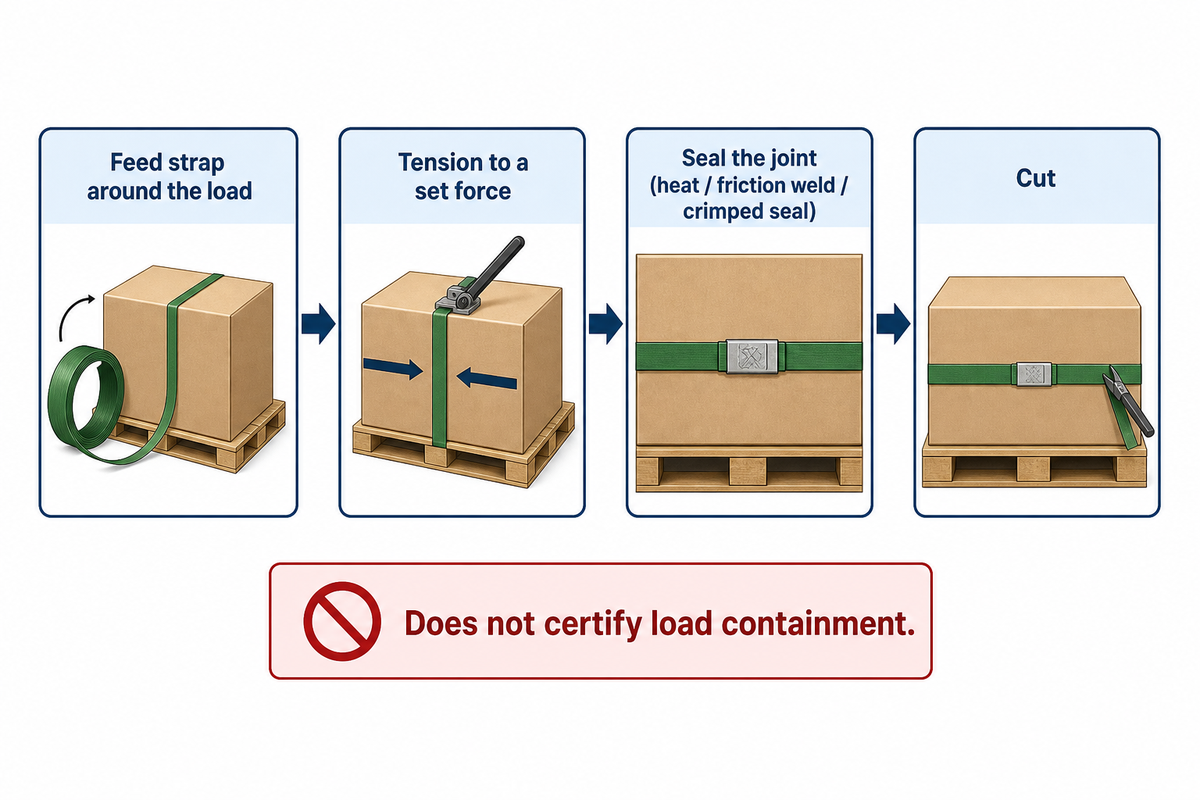
Four or five functions happen inside a single strapping-machine cycle: feeding strap around the load, retracting slack, tensioning to a set force, and sealing the joint by heat, friction weld, or crimped seal, with cutting built into the same motion on most models.
Completing that cycle doesn’t, by itself, validate that a pallet load is properly built, that the arrangement is supported correctly, or that it will hold together through the rest of the distribution chain — strapping contributes to load containment, it doesn’t certify it.
Strapping-machine patents filed over several decades describe this same four-function scope — see, for example, this feed-tension-seal mechanism patent — confirming it’s a stable definition of what the equipment class does, not a marketing simplification.
What Is the Difference Between Strapping and Banding?
In US industrial packaging, “strapping” and “banding” describe the same process — tensioning a plastic or steel strap around a load and sealing the joint — and the terms are used interchangeably by manufacturers, distributors, and buyers alike. There’s no formal technical distinction between the two: a “strapping machine” and a “banding machine” are the same category of equipment.
Some regions and industries lean toward “strapping” for pallet and carton applications and “banding” for steel-coil or lumber bundling. If a spec sheet or vendor uses one term exclusively, that’s a naming convention, not a different product category.
The Strapping Automation Ladder
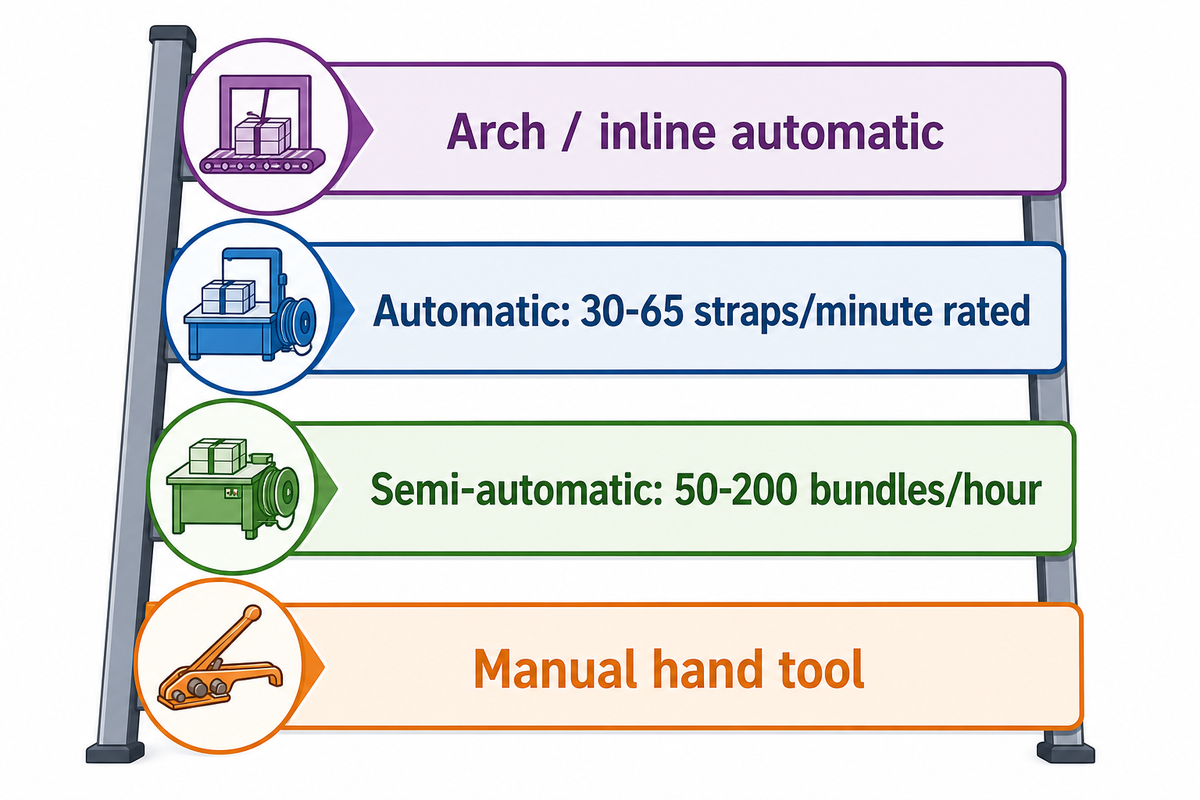
Automation tier is the single decision that determines cost, labor, and throughput more than any other spec. Four rungs cover almost every buying situation, and moving up a rung only pays off once volume and consistency justify it.
| Rung | Typical throughput | Where it fits | Not suitable for |
|---|---|---|---|
| Manual hand tool | Operator-paced, one strap at a time | Occasional strapping, mixed strap widths, low capital budget | Repetitive daily volume — labor cost overtakes machine cost fast |
| Semi-automatic | Roughly 50-200 bundles/hour | Variable box/pallet sizes, mixed production runs, no changeover time needed between sizes | Continuous single-SKU lines running near-constant load dimensions |
| Automatic (tabletop / walk-up) | 30-65 straps/minute rated; sustained real-world output commonly runs 70-80% of rated speed | Consistent load sizes above roughly 200 bundles/hour | Frequent size changeovers — setup time erodes the automation gain |
| Arch / inline automatic | Highest-volume tier; integrates with a conveyor line | Dedicated high-volume packaging lines, hands-free operation | Low or seasonal volume — integration cost is hard to justify below sustained high throughput |
The 50-200 versus 200-plus bundles/hour split above is commonly cited by equipment vendors as a rough dividing line, not a fixed engineering threshold — your realized throughput also depends on production-system factors the machine’s rated speed doesn’t capture: changeover time between product sizes, upstream and downstream bottlenecks, and how consistent your product mix actually is. A facility running highly variable order sizes can see a semi-automatic machine outperform a nominally faster automatic one once changeover time is counted, while a facility with flexible automation and a steady product mix can make automatic work well below the 200-bundle mark. Treat the ladder as a starting point for the conversation with a vendor, not a formula — once you know which rung fits, browse UD Packaging’s strapping machine range to see current models at that tier.
💡 Pro Tip
If your pallet or box sizes change from run to run, ask a vendor specifically how their machine handles a size changeover — some automatic and arch systems need physical adjustment or reprogramming that a semi-automatic machine skips entirely.
Formats and Brands You’ll Encounter While Shopping
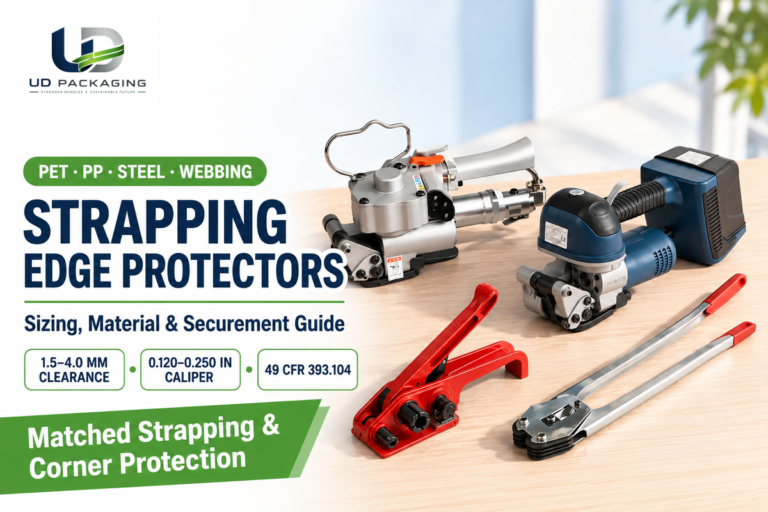
Search results for a strapping machine mix several distinct product categories, and knowing which one you’re looking at before comparing prices saves a lot of confusion. At the low end, portable, battery-powered handheld strapping tools — sometimes sold as an electric strapping machine, sometimes as a pedal-operated bander — turn up on budget e-commerce listings alongside catalogs from dedicated industrial machine builders offering automatic strapper and semi-automatic strapping machine lines built for continuous production. The full range of strapping machines runs from a lightweight, adjustable hand-held strapper you carry between pallets to a bulky, heavy-duty automatic and semi-automatic arch system bolted permanently to a conveyor — a manual belt packaging banding machine and an industrial arch unit are technically both “strappers,” but they solve very different volume problems. Stainless steel construction shows up on machines built for washdown or food-grade environments, where a painted-steel frame won’t hold up to the moisture and chemical exposure. Whichever tier you land on, powered strapping equipment also falls within the scope the packaging-machinery industry’s own consensus safety standard, ANSI/PMMI B155.1-2023 (ANSI explainer article), is written for — discussed further in the safety section below.
Manual strapping remains the standard choice for occasional or mixed-width jobs where volume never justifies a dedicated machine; portable electric units close the gap for operations that need more speed than a hand tool but not the cost of full automation.
| Format / type | Power source | Typical throughput | Best fit |
|---|---|---|---|
| Manual hand tool | Human-powered | Operator-paced, one strap at a time | Occasional or mixed-width jobs |
| Portable / handheld electric | Battery-powered | Faster than a hand tool, still one strap at a time | Mobile or multi-station use |
| Pedal-operated bander | Foot-pedal actuated | Hands-free trigger, operator still positions strap | Bench or fixed workstation setups |
| Sealless combination tool | Battery or manual | Tensions, seals, and cuts in one motion | Upgrade from a loose multi-tool kit |
| Semi-automatic tabletop | Electric | Roughly 50-200 bundles/hour | Variable box or pallet sizes |
| Automatic tabletop / walk-up | Electric | 30-65 straps/minute rated | Consistent load sizes above roughly 200/hour |
| Arch / inline automatic | Electric, integrated with a conveyor | Highest-volume tier | Dedicated high-volume packaging lines |
| Pneumatic (air-powered) | Compressed air, 0.5-0.7 MPa | Comparable to electric semi-automatic | Facilities with an existing compressed-air line |
| Stainless steel washdown-grade | Electric or pneumatic | Same as the painted-steel equivalent tier | Food-grade or washdown environments |
Matching the Machine to Your Strap Material (Steel, PP, PET)
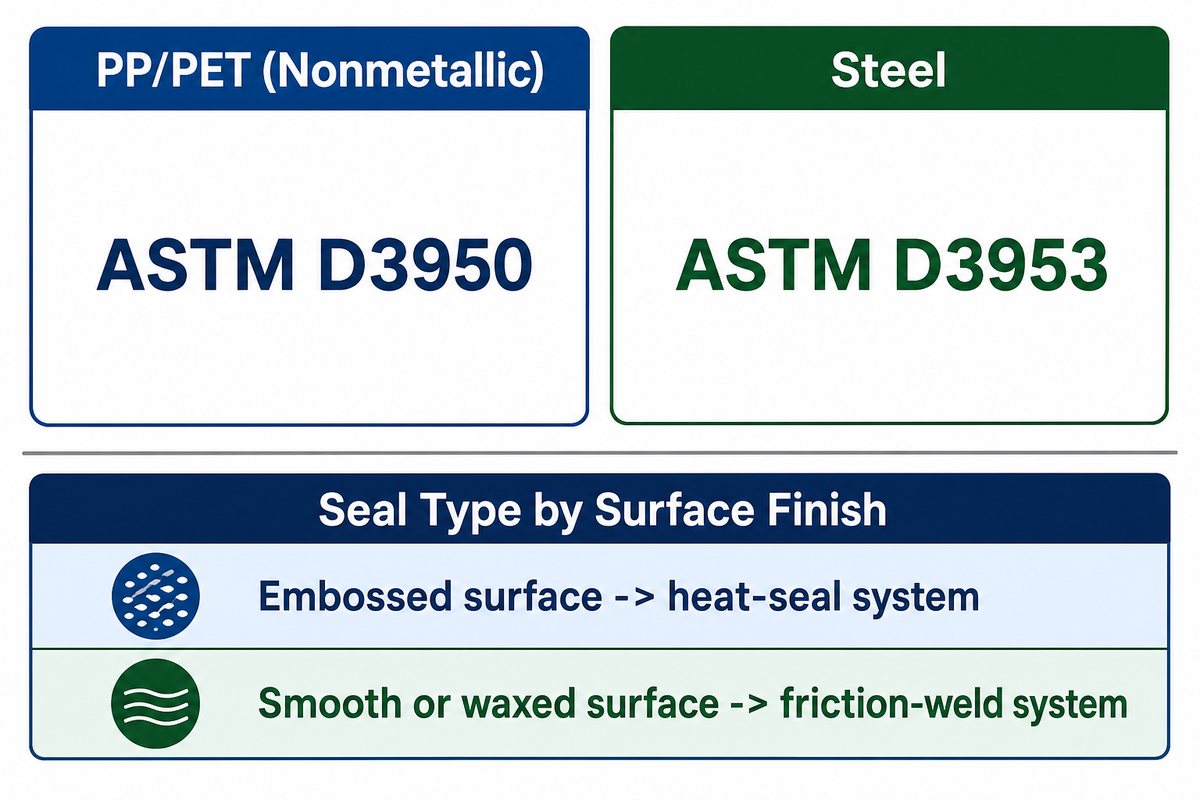
Machine-grade strapping runs, meaning without splices, through high-speed automatic equipment; hand-tool-grade strapping can have as many as one splice per coil, which is fine if you’re hand-tensioning the joint but can cause jams if the strap is fed into an automatic feed path. Surface finish is just as critical as grade: embossed surface strap goes into a heat-seal system, smooth or waxed surface goes into a friction-weld system, and putting the wrong surface into the wrong seal head is a common cause of weak or broken joints. Surface matching isn’t the only variable, either — seal temperature, dwell time, and pressure all affect joint strength too, so a machine running the right surface at the wrong seal settings can still turn out a weak joint.
ASTM D3950 is the nonmetallic (PP and PET) strapping specification for its material properties and joint performance, all in one document (see also ASTM D4675, the companion guide to selecting and using flat strapping materials); ASTM D3953 is the flat steel strapping and seal specification, all on its own. If a vendor test report mentions D3953, you are looking at steel-strapping performance, not a PET or PP strap, even if the numbers are similar. These standard numbers can be easy to misquote, so make sure that a machine or strap quote mentions the standard number you expect for the material you’re buying, and ask the vendor directly how their machine or their strap is tested.
While the tensile strength of a strap-and-seal combination should be straightforward, the joint strength and the tensile properties of the strap itself are tested and rated separately; a strap rated with very high break strength may be underwhelming if the seal method isn’t compatible with that strap’s surface. Make sure that when you compare straps and machines, you check seal-head compatibility, not just the strap’s headline strength number.
Material terminology varies by supplier, but the practical categories are consistent: poly strapping is the umbrella term covering both polypropylene (PP) and polyester (PET) strap, sold as pp pet straps or simply “poly” in most vendor catalogs, while steel banding is the metal alternative closed with a metal buckle rather than a heat or friction seal. Woven cord — a braided, high-tenacity strap format — is a niche option for irregular or sharp-edged loads that would cut into a flat strap. When you’re comparing strapping materials across vendors, three spec-sheet numbers matter more than the marketing copy: lbs break strength (the strap’s rated tensile capacity), core size (which has to match your dispenser or machine’s feed spindle), and the joint or seal strength discussed above. These distinctions matter most in pallet strapping and pallet packaging applications — and packaging strapping generally — where a mismatched material shows up as a failure in transit, not on the production floor.
What a Machine Automates vs. a Hand Tensioner and Sealer
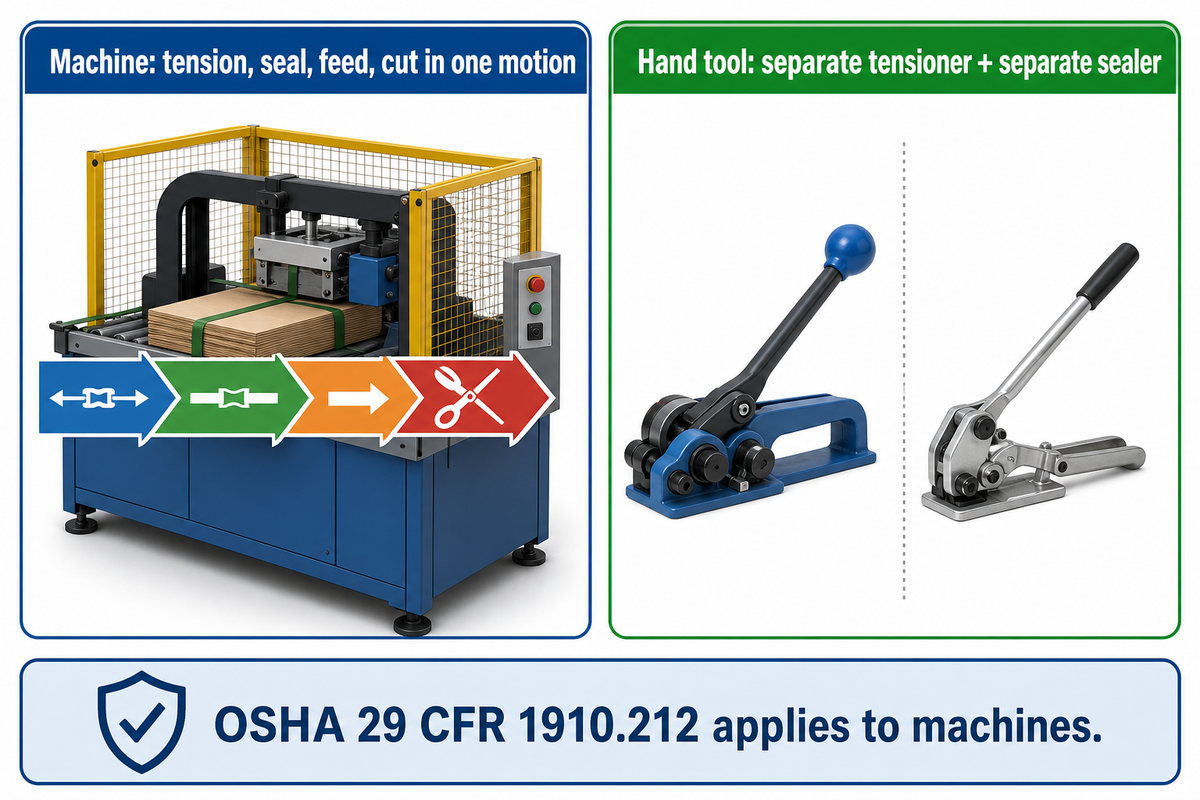
Broken down to the component level, a strapping machine’s real function is folding tensioning, sealing, and (on most models) feeding and cutting into one motion — and because it’s powered, it falls under OSHA 29 CFR 1910.212 machine-guarding rules in a way a hand tool doesn’t. The alternative is buying these as separate hand-tool components: a tensioner that pulls the strap tight and locks the tension, and a separate sealer that closes the joint.
For low or irregular volume, this two-tool route is often the more practical starting point — forum and vendor guidance on setting up a basic strapping system commonly points to the same starter kit: a coil of strap, clamps, a tensioner, and a crimper, with binder straps as a stopgap if a proper bander isn’t in the budget yet.
“Retained tension” is the industry term for the residual tensile force that remains in the strap after a tensioner sets and locks it, then unlatches itself. Buyers evaluating strap-and-tensioner combinations typically check four attributes together: elongation (how much the strap stretches under load), break strength, corrosion resistance, and UV resistance if the load will sit outdoors. None of these four is sufficient on its own to judge a strap-and-tool combination; a strap with high break strength but poor UV resistance will still fail outdoors well before it reaches its rated tensile limit.
Most buyers looking for a hand-tool starting point search for a strapping kit or banding kit — a bundled banding strapping kit or steel strapping kit tool set typically includes a coil of strap (sometimes a pet strapping roll for lighter jobs), a tensioner, a sealer or crimper, and a banding tool for cutting and finishing the joint. Sealless combination tools — which tension, seal, and cut in a single handheld unit without a separate crimped or heat-sealed buckle — are a common upgrade once the loose multi-tool kit becomes a bottleneck, and they’re the closest hand-tool equivalent to what a strapping tensioner tool does inside a full machine. Understanding this component breakdown makes the strapping process easier to evaluate, whether you end up buying a kit or a machine.
How Much Does a Strapping Machine Cost Compared to a Hand Tensioner and Sealer Kit?
Manual tensioner-and-sealer kits are the lower-cost entry point, typically priced well under $1,000 depending on strap width and tool grade, versus a strapping machine that can range from roughly $2,500 for a basic semi-automatic unit into five figures for a full automatic or arch system. The real tradeoff is labor time, not just equipment price.
A hand-tool route costs less upfront but scales with operator hours, while a machine’s higher upfront cost buys back labor time once volume is high enough to justify it (see the cost section below for the full breakdown).
Machine Choice by Application — Pallets vs. Cartons and Boxes
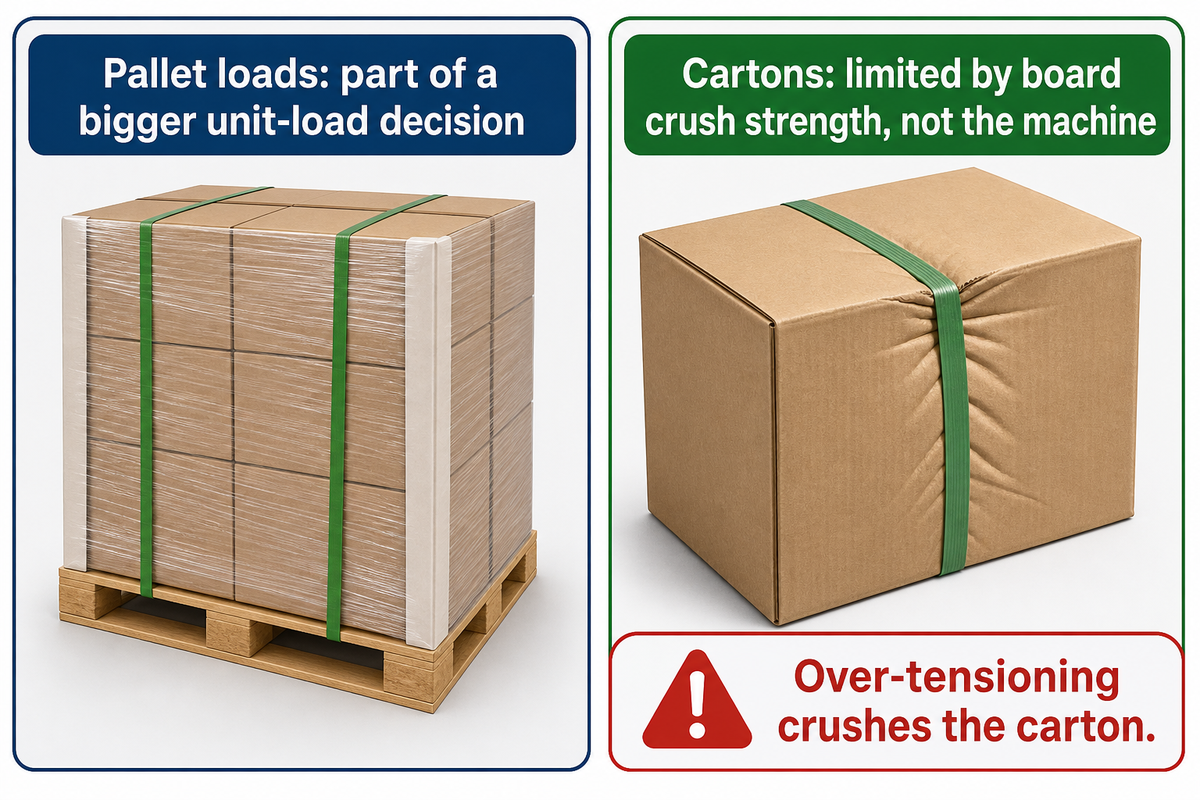
Pallet-load strapping and carton or box strapping put different demands on a machine, even though the mechanics are similar. For pallet loads, the strapping-machine question sits inside a bigger unit-load decision — how the load gets built, wrapped, and stabilized before it ever reaches the strapping step; our pallet unitization guide for logistics and warehousing covers that broader context in depth, and it’s worth understanding before you shop for a machine.
For carton and box lines, the limiting factor is usually the corrugated board itself, not the machine: over-tensioning a box strap can crush the carton well before the strap ever reaches its rated break strength, and that’s a tension-setting-versus-board-strength interaction, not a machine-selection question. Our box and carton strapping guide walks through that tension-versus-crush relationship in detail. For this guide’s purposes: box and carton lines generally do better with semi-automatic or compact automatic machines that offer fine tension control, since crush margin matters here more than raw speed — matching the strap material to the application is the material-selection half of that decision, which ASTM D4675 is written to help buyers work through.
Operating and Maintaining a Strapping Machine Safely
Every commercial strapping-machine page we reviewed for this guide — including the top-ranked result and another page in the top three for this exact search term — covers models, dimensions, and price. None of them covers how to run one safely. That gap is worth taking seriously: OSHA’s own incident records include real, documented strapping-machine injuries, not hypothetical risks.
In one case (OSHA Accident Summary Nr 125015.015), a worker at a box-manufacturing facility lost his left index finger to amputation in 2019 while clearing a strapping-machine jam without de-energizing the power source first. In a more severe case (OSHA Accident Summary Nr 200452050), a lumber-strapping operator was fatally crushed in 2006 when a relief operator activated a banding machine’s compressor head while the first operator was still underneath clearing strap — lockout procedure had been skipped in favor of simply turning a key at the control panel. Both incidents trace back to the same root cause: clearing a jam or fault while the machine could still move or cycle.
“Employee #1 was working at a box manufacturing facility to unjam a strapping machine. He did not de-energize or disengage the power source during servicing operations.”
— OSHA Accident Summary Nr 125015.015, U.S. Department of Labor
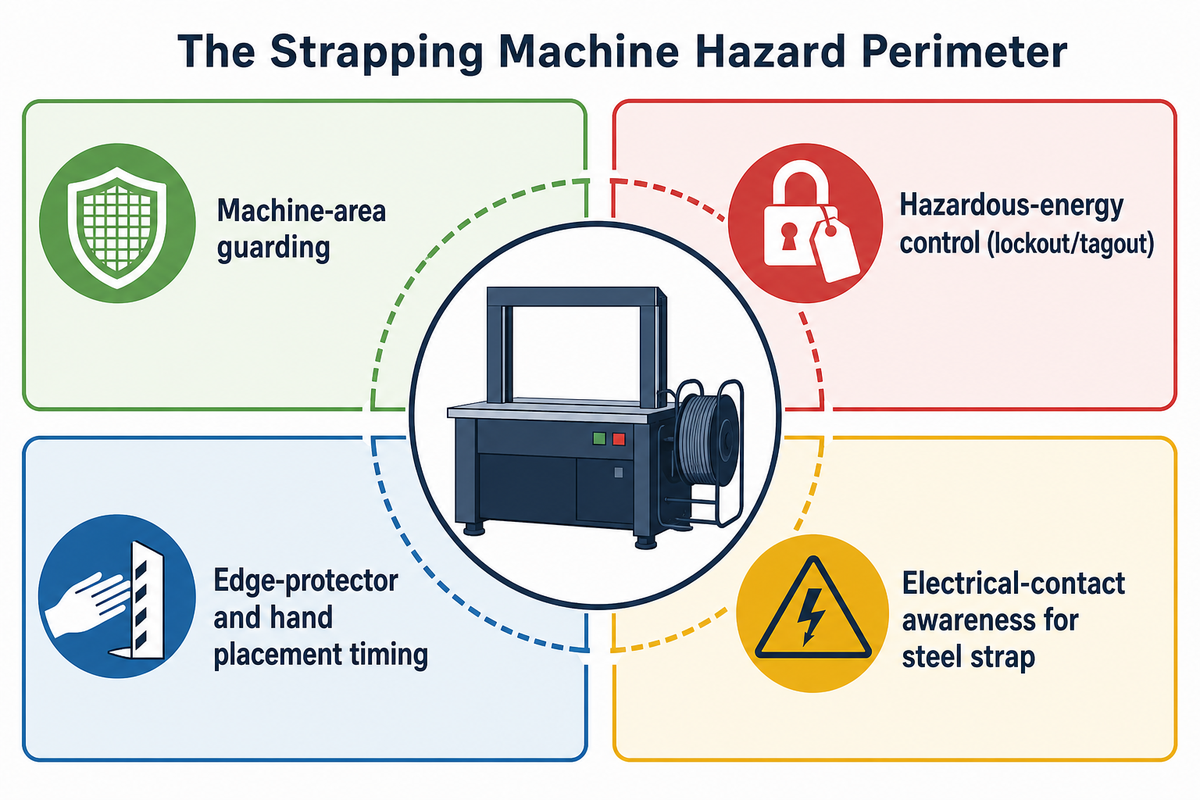
We call these four boundaries The Strapping Machine Hazard Perimeter — the specific points where an otherwise routine strapping-machine task turns into an OSHA-documented injury:
-
✔
Machine-area guarding. Powered or automated strapping equipment needs a model-specific guarding review under OSHA 29 CFR 1910.212 — referencing the regulation doesn’t certify a specific machine or kit; the review has to be done for the equipment you actually have. -
✔
Hazardous-energy control (lockout/tagout). OSHA 29 CFR 1910.147 governs setup, cleaning, and unjamming when those conditions apply — both documented incidents above involved skipping this step during jam clearing. -
✔
Edge-protector and hand placement timing. Don’t place or reposition an edge protector while a battery-powered strapping tool can still activate — isolate the trigger or energy state before hands enter the strap path. -
✔
Electrical-contact awareness for steel strap. Conductive steel strapping routed near exposed energized conductors needs the applicable site electrical-safety controls before handling proceeds.
Beyond OSHA’s general machine-guarding and energy-control rules, the packaging-machinery industry maintains its own consensus safety standard — ANSI/PMMI B155.1-2023, Safety Requirements for Packaging and Processing Machinery. It’s a useful reference point for buyers who want a structured way to evaluate a machine’s safety design before it’s on the floor, on top of (not instead of) the OSHA requirements already covered above in the Strapping Machine Hazard Perimeter.
⚠️ Important
Trapping points, cutters, unexpected movement, falling loads, released jams, stored energy, and the hand-under-strap nip point are the recurring hazard classes inside the Strapping Machine Hazard Perimeter. Both documented OSHA incidents above happened during jam clearing — treat any fault-clearing procedure as an energy-isolation event, not a quick fix.
What a Strapping Machine Costs — Budgeting Before You Request a Quote
Budgeting for a strapping machine means weighing more than the sticker price: automation tier, strap material compatibility, and installation requirements all shift the real cost of ownership up or down. The breakdown below covers published price bands by tier, what drives the total higher than a bare quote suggests, and why a dated online price list is only a starting point for the conversation with a vendor.
How Much Does a Strapping Machine Cost?
A strapping machine’s price depends heavily on automation tier and features, with published figures spanning from a few hundred dollars for a basic manual tool to tens of thousands for a full automatic system. The exact bands and what drives them are broken down below.
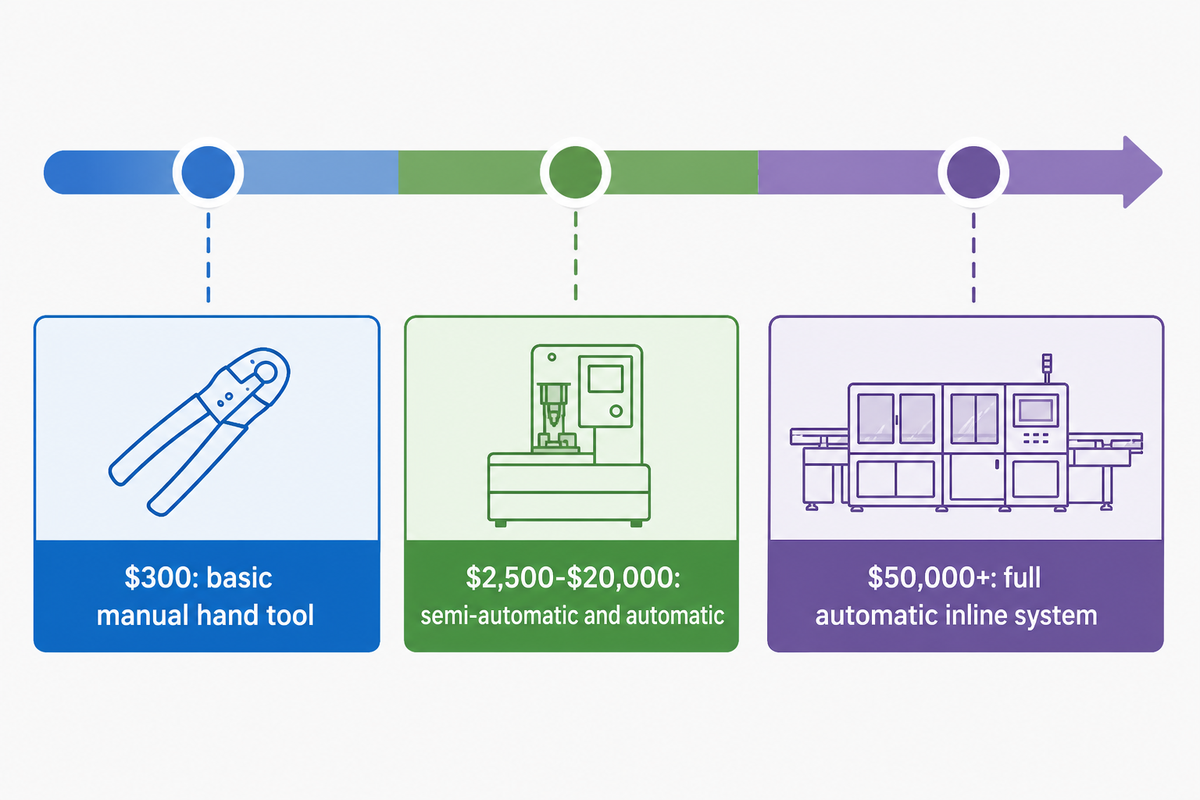
Published price bands vary widely by source and by how recently they were updated: figures we found ranged from around $300 for a basic manual hand tool up to $50,000-plus for a full automatic inline system, with most mid-tier semi-automatic and automatic equipment landing somewhere in the $2,500-$20,000 range depending on features like side-sealing or arch configuration. One detailed vendor breakdown we checked was published back in 2020, not 2026, and a second vendor’s more recent figures for automatic machines didn’t fully agree with it — which is really the point: published strapping-machine pricing ages quickly and varies by vendor, so treat any number you find online (including the ranges above) as a starting point for a conversation, not a quote. Request a current, dated quote from UD Packaging’s strapping machine lineup before budgeting a purchase.
One useful reframe when comparing steel strapping equipment to plastic strapping equipment on cost: a direct price-per-metre comparison between the two is unreliable, because steel and plastic systems typically need different configurations to secure the same load — more plastic straps of a different width can replace fewer steel straps, so comparing unit prices at equal dimensions isn’t really comparing equivalent packaging outcomes. Where the two are directly comparable is durability and handling: on a like-for-like joint-efficiency basis, PET strapping performance can be broadly comparable to regular-duty steel strapping, without the rust risk or the sharp-edge handling hazard steel strap carries — though joint-retention rates vary by surface treatment, so a bare-force comparison between the materials can be misleading.
✔ Advantages of Higher Automation
- Lower per-unit labor cost at sustained high volume
- Consistent, repeatable tension setting reduces operator-to-operator variation
- Frees up human workers for other production-related activities.
- Streamlines the line and improves operational efficiency once volume justifies the upfront cost.
- An easy-to-use semi-automatic unit is often the first productivity gain a growing facility makes, without the integration cost of full automation.
- Consistent tension also means more secure bundling with fewer in-transit failures — this is where higher automation most enhances efficiency across the whole shipping process, not just at the strapping station.
⚠ Limitations of Higher Automation
- Requires a higher upfront and integration cost, making the investment harder to justify unless you’re at high volume on an ongoing basis.
- Less flexible across frequent size or material changeovers
- Needs the guarding, energy isolation/LOTO discipline, and ongoing maintenance procedures outlined above — automation raises the safety stakes, it doesn’t remove them.
Integration and Utility Requirements Before You Install
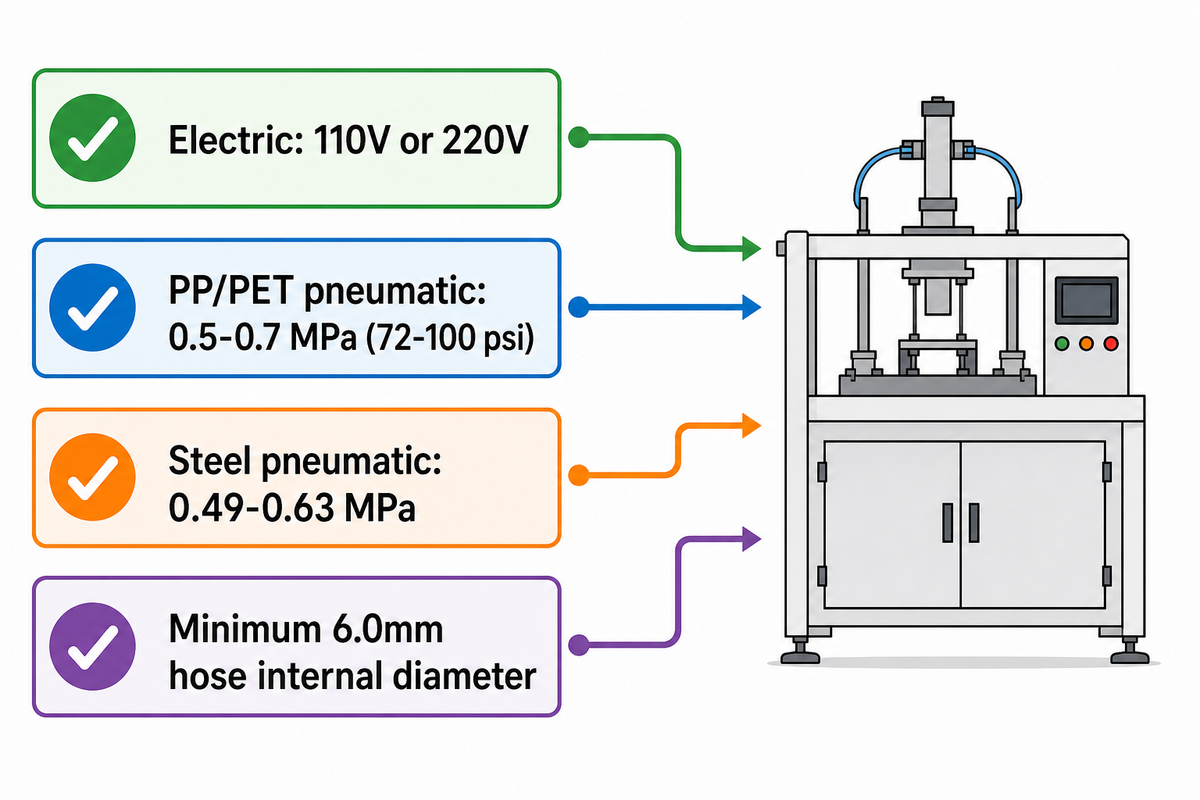
Before a strapping machine arrives, your facility needs the right utility connection ready: electric machines run on standard 110V or 220V power, while pneumatic tools and machines need a compressed-air line, typically at 0.5-0.7 MPa (72-100 psi) for PP/PET strapping equipment and a slightly lower 0.49-0.63 MPa for steel strapping tools, delivered through a hose with at least a 6.0mm internal diameter and ideally a filter/regulator/lubricator assembly ahead of the machine. Skipping the air-prep hardware is a common cause of inconsistent seal quality on pneumatic equipment, not a tension-setting problem.
For automatic and arch-type systems integrating into an existing conveyor line, confirm PLC and interlock compatibility with your line controller before ordering — retrofitting communication protocols after installation is a common source of unplanned downtime, and the interlocked guarding on the finished installation still has to meet OSHA 29 CFR 1910.212. Footprint and clearance also matter more than spec sheets usually convey: arch systems in particular need enough clearance for the load to pass through fully loaded, plus service access on at least one side for jam clearing and maintenance. The global strapping-machine market has been reported by industry analysts to be on a multi-billion-dollar growth trajectory into the mid-2030s, with automation adoption cited as one contributing driver — background context only, since the integration checklist above matters far more to your specific installation than the market’s overall growth rate.
Facilities that also compact scrap cardboard or plastic often install a baler near the strapping line, and it’s worth disambiguating the two: a baler compacts and bundles waste material for disposal or recycling, a fundamentally different function from a strapping machine’s tension-and-seal cycle on a finished, sellable load — the two are frequently confused by buyers researching general “bundling equipment.”
Common Buying Mistakes (When Not to Buy Full Automation)
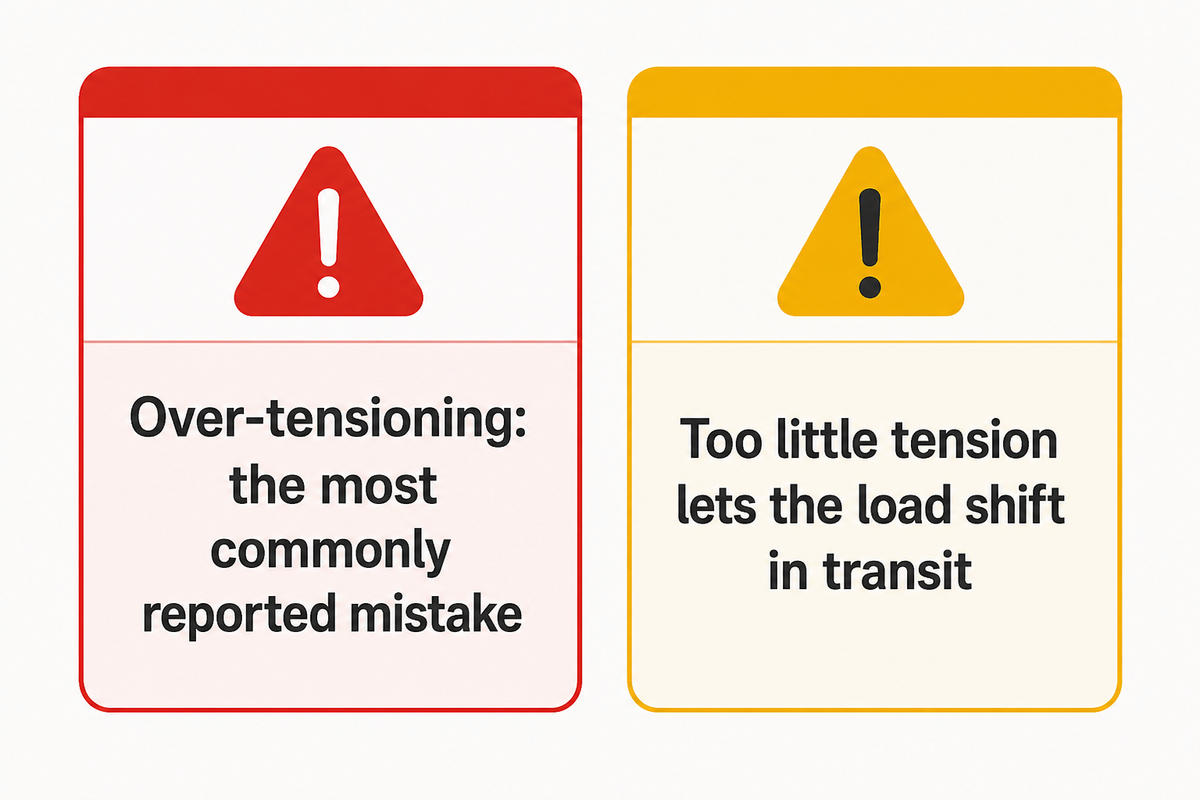
Over-tensioning is the most commonly reported operator mistake across the sources we checked, and it’s a mechanical problem, not a carelessness problem: too much tension crushes cartons, deforms product, or causes the strap or seal to fail outright, while too little tension lets the load shift in transit. The fix is a tension setting matched to the load and strap material, confirmed by watching the load’s edge condition after strapping — not simply maximizing tension on the assumption that tighter is always safer.
The second common mistake is buying more automation than the operation’s volume and product mix actually justify. Fully automatic or arch systems make sense once volume is high and product sizes are consistent; below that point, the setup time, integration cost, and reduced changeover flexibility can make a semi-automatic machine the better business decision even at similar rated speed. Revisit the automation ladder above with your actual order volume and size variability in mind, not just your growth projections.
Related Articles
- Plastic Strapping Guide — PET vs. PP material comparison and standards
- Strapping for Boxes Guide — tension-vs-crush margin for corrugated cartons
- Logistics and Warehousing Packaging — pallet unitization framework
Q: What is a strapping machine used for?
A strapping machine tensions, seals, and cuts plastic or steel strap around a pallet, carton, or bundle to hold the load together for handling and transport.
It automates the feed, tension, seal, and cut steps that a hand tensioner and sealer would otherwise perform manually. Common uses include palletizing for shipment, bundling cartons on a packing line, and securing coiled or lumber products for transport. It contributes to load containment — it doesn’t certify a load’s overall handling or transport safety, which depends on how the load itself is built.
Q: How much does a strapping machine cost?
Published prices range from roughly $300 for a basic manual tool to $50,000-plus for a full automatic inline system, with most semi-automatic and automatic machines in the $2,500-$20,000 range.
Published figures vary significantly by vendor and by how recently a price list was updated — some sources we checked while researching this guide were several years old, and two vendors’ current figures for the same automation tier didn’t fully agree. Treat any online price range as a starting point and request a current, dated quote before budgeting a purchase.
Q: What is the difference between strapping and banding?
Strapping and banding mean the same thing.
Some regions and industries favor “strapping” for pallet and carton applications and “banding” for steel-coil or lumber bundling, but there’s no formal technical distinction between the terms — a strapping machine and a banding machine are the same category of equipment, and the two words show up interchangeably on spec sheets, standards documents, and vendor catalogs across the industry.
Q: Why is it called strapping?
The term comes directly from the “strap” — a flat band of plastic or steel — that the machine or tool tensions and seals around a load.
“Strap” describes the physical material, and “strapping” describes the process and the industry built around applying it — much like “banding” derives from “band,” a near-synonym for the same flat material in this context.
Q: What’s the difference between a strapping machine and a hand strapping tool?
Automation is the core difference: a machine folds tensioning, sealing, and cutting into one motion, while a hand tool requires an operator to perform each step separately with its own tensioner and sealer.
Hand-tool routes tend to be less expensive at first and easier to adapt to occasional or low-volume usage, while a machine costs more upfront, including line integration, but then requires much less labor time on each bundle when volume climbs high enough. See the component breakdown above for a fuller comparison.
Q: Do I need a fully automatic strapping machine, or will semi-automatic work?
Semi-automatic is often the better fit below roughly 200 bundles/hour or when box and pallet sizes vary between runs; fully automatic pays off at higher, more consistent volume.
That threshold is a vendor-cited rule of thumb, not a fixed law — production mix and changeover frequency matter too. Walk through the Automation Ladder above with your real order pattern before deciding.
Why We Write This
We provide the PET strapping, stretch film, and strapping equipment side of this guide’s product line, so a useful buying guide has to be candid about tradeoffs — including where semi-automatic exceeds automatic, and where posted prices aren’t recent enough to present at face value. The Strapping Machine Hazard Perimeter above draws on real OSHA incident records because we’d rather a buyer learn from a documented jam-clearing injury before it happens on their floor.
Request a Strapping Machine Recommendation →
Ready to move from “which type” to “which model”? UD Packaging’s strapping machine lineup covers manual, semi-automatic, automatic, and arch systems matched to the tiers in this guide.
| Reference | Applies to | Key detail | Source |
|---|---|---|---|
| ASTM D3950 | Nonmetallic (PP/PET) strapping | Material properties and joint performance in one spec | ASTM International |
| ASTM D3953 | Flat steel strapping and seals | Separate specification, steel only | ASTM International |
| ANSI/PMMI B155.1-2023 | Packaging and processing machinery | Consensus safety-design standard for the industry | American National Standards Institute |
| OSHA 29 CFR 1910.212 | Powered/automated strapping equipment | Model-specific machine-guarding review required | OSHA |
| OSHA 29 CFR 1910.147 | Setup, cleaning, unjamming | Lockout/tagout hazardous-energy control | OSHA |
| Accident Summary Nr 125015.015 | Documented amputation incident, 2019 | Jam cleared without de-energizing the power source | OSHA |
| Accident Summary Nr 200452050 | Documented fatality incident, 2006 | Compressor head activated during jam clearing | OSHA |
| Manual hand-tool price band | Tensioner-and-sealer kits | Typically well under $1,000, by strap width and tool grade | Vendor price lists, multiple, dated 2020-2026 |
| Automatic / arch machine price band | Semi-automatic, automatic, and arch machines | Roughly $2,500 to $50,000-plus, by automation tier | Vendor price lists, multiple, dated 2020-2026 |
References & Sources
- OSHA 29 CFR 1910.147 — Control of Hazardous Energy (Lockout/Tagout) — U.S. Department of Labor
- OSHA 29 CFR 1910.212 — General Requirements for Machine Guarding — U.S. Department of Labor
- OSHA Accident Summary Nr 125015.015 — U.S. Department of Labor
- OSHA Accident Summary Nr 200452050 — U.S. Department of Labor
- ANSI/PMMI B155.1-2023 — Safety Requirements for Packaging and Processing Machinery — American National Standards Institute
- ASTM D3950-23 — Standard Specification for Strapping, Nonmetallic (and Joining Methods) — ASTM International
- ASTM D3953 — Standard Specification for Strapping, Flat Steel and Seals — ASTM International