Get in touch with UD Packaging Company

Hand Stretch Film Guide: Select, Apply, and Verify Manual Pallet Wrap

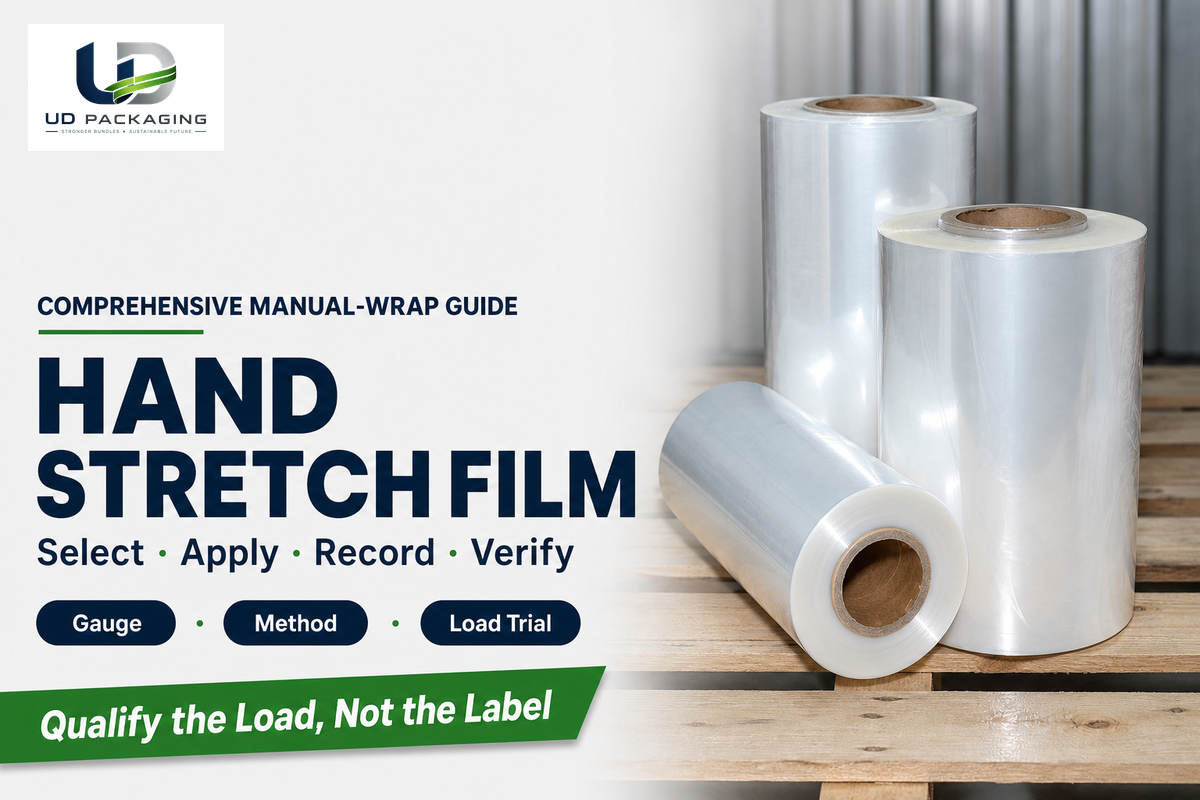
Manual pallet-wrapping guide · Updated October 2026
The roll label describes the film. It can’t prove that an operator, load, wrapping pattern, environment and route will create an acceptable unit load. This guide transforms those variables into a repeatable trial and review process.
TL;DRDescribe the load before selecting a roll. Record the operator method rather than relying on a fixed wrap count. Compare a baseline and candidate on repeated, like-for-like loads using site-defined acceptance criteria. Stop if the load, path, posture, environment, or evidence is outside the approved boundary. Product configurations, samples, price, MOQ, lead time, and quotations belong on UD Packaging’s existing solution page.
Hand stretch film is designed for manual application around cartons, bags, and other goods assembled into a unit load. It may provide a means of unitizing a load and protect load surfaces from dust and also help retain identity during warehouse handling. Its result is affected by a lot of factors including thickness. Load geometry, sharp edges, surface friction, film construction, unwind behavior and control, operator movement, applied tension, overlap, environmental exposure, and later handling all play a role.
The intention of this article is different from a product page. For available configurations, samples, quotations, MOQ, or lead-time discussion, go to UD Packaging’s hand stretch film solution page. The broader stretch film guide retains the cross-family survey. Here, the job is to make a manual wrapping process observable, testable and easier to troubleshoot, without inventing a universal setting.
The Load-to-Proof Sequence
Describe the load → interpret the roll → review the work method and higher-order controls → standardize observable steps → record repeated trials → review failures and environmental limits → accept, reject, or escalate.
What Is Hand Stretch Film, and What Can the Label Not Tell You?
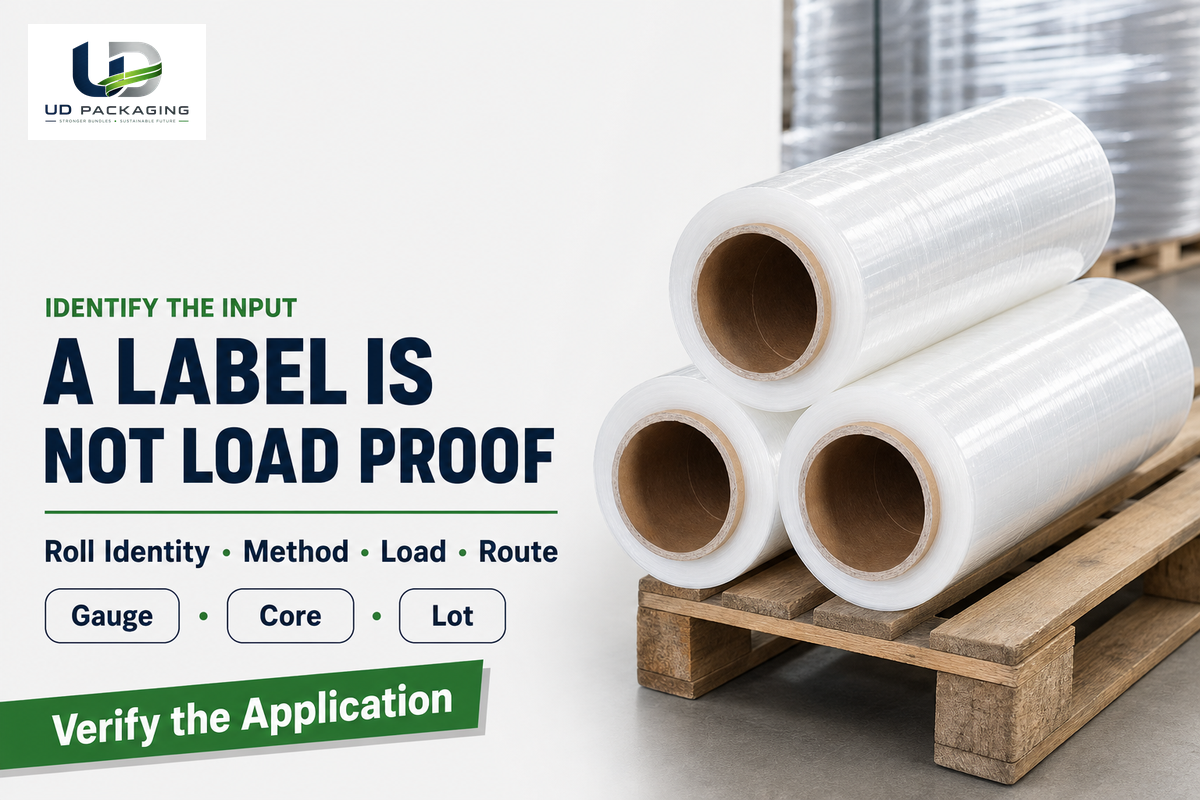
Direct answer: it is a stretchable thin film intended for manual application in industrial unitization or bundling operations. The category name, gauge, width, core, color, and roll length describe a product, but they will not identify a particular pallet load.
Stretch films aren’t shrink wrap. Stretch wrap relies on elongation, cling, and recovery around the load. The cling film that’s used in households is a different product class. Simply put, similar looks don’t mean those materials are interchangeable.
The word hand also makes a difference. Machine film is designed for a controlled wrapping system. Hand film is applied manually, and the operators become part of the system. This variation is outside the control of a high quality label. Two operators can yield different results from the same roll of film if they take a different path, apply different tension and angle, and varying overlap, base and top reinforcement, and finishing method. Even a high quality label can’t remove this variation.
ASTM D4649-20 (2025) covers stretch films selection and use for unitizing, reinforcing, and palletizing in indoor situations. It is a scope and use guide, not a load-capacity or load-containment certificate. The indoor limitation is important. Cold storage, high heat, sunlight, and outdoor staging can change the behavior of film, and require supplier and site validation. Do not extend the results of an indoor trial to different situations without looking at the differences.
| The label may tell you | The label cannot prove |
|---|---|
| Nominal gauge or micron | Puncture resistance or containment on your load |
| Width, length, core, or roll weight | Operator fit, material used per accepted load, or safe posture |
| Cling side, color, clarity, or barcode | Tail retention, visibility needs, or load stability through transit |
| Product family or marketing grade | Performance across operators, shifts, lots, environments, and routes |
Procurement language filter: Catalogs and packaging supplies listings may include phrases like wrap stretch film, shrinkwrap, high-performance, high-quality, heavy-duty, dependable, recyclable, superior cling, cost-efficiency, versatility, and an essential tool. A hand stretch film supplier may say it provides increased stretch, returns to its original length, improves pallet stability, or assists in stabilizing shipments securely. Each of these is to be treated as a claim to be defined and verified. Ask what test, load, environment, packaging operations, and acceptance limit supports it? The aim is to reduce unsubstantiated assumptions especially for freight and irregularly shaped loads and stabilization claims.
When Is Manual Wrapping the Right Process?
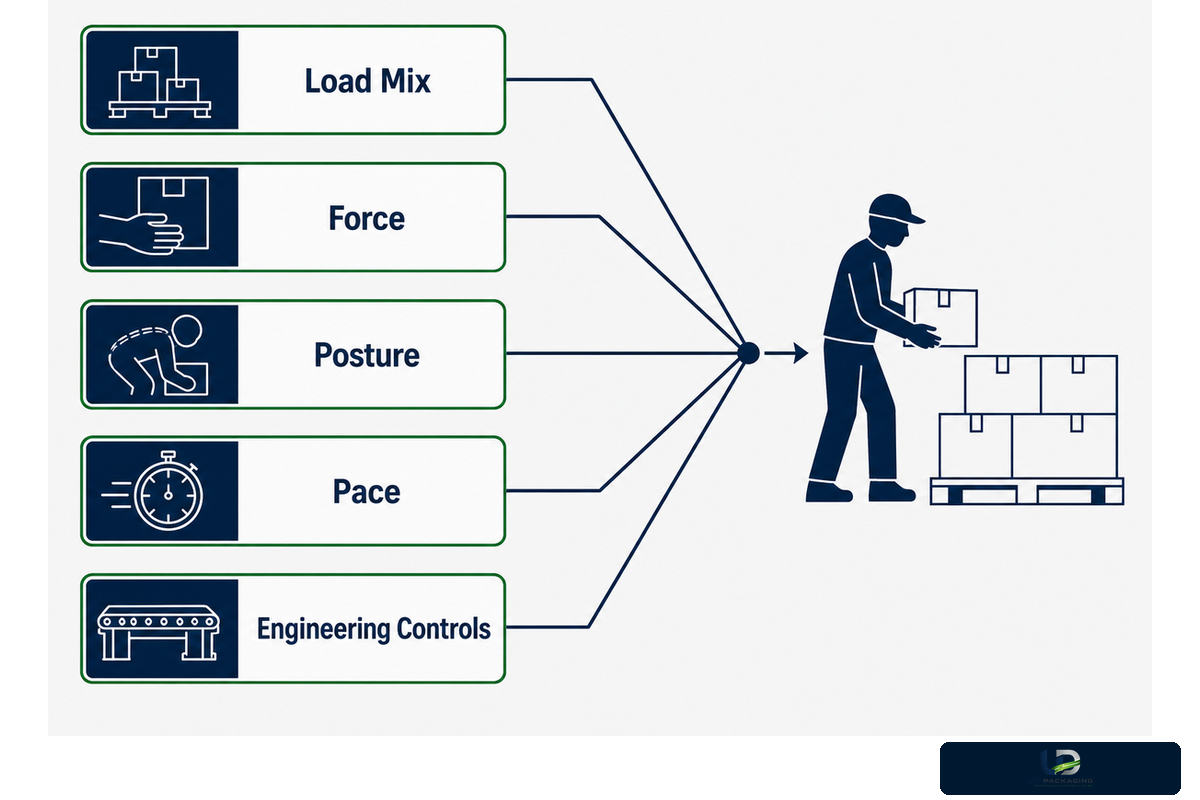
Direct answer: Manual wrapping may suit variable, intermittent, backup, or exception work when the site has reviewed feasible higher-order controls. It may also be appropriate for work where controls can be documented and an acceptable result maintained. An absolute universal pallets-per-day threshold can’t determine if manual wrapping is appropriate.
A larger operation may have a hand wrap station for miscellaneous work or recovery. Neither situation proves manual application is warranted. Load mix, repetition, force, posture, access, pallet height, roll weight, breaks, rewraps, pace, interruptions, exposure time, and the availability of engineering controls are all considerations.
The NIOSH hierarchy of controls places elimination, substitution, and engineering controls above administrative controls such as training and work practices. A better SOP is useful, but it isn’t automatically the best available risk control. OSHA’s manual wrapping guidance identifies bending and finger-in-core hazards and lists mechanical wrapping where feasible, as well as lighter rolls and handles when wrapping remains manual.
Use local data rather than a generic volume rule. Load or work-area redesign may be a better solution. This guide won’t choose that solution.
Conventional or Pre-Stretched Hand Film?
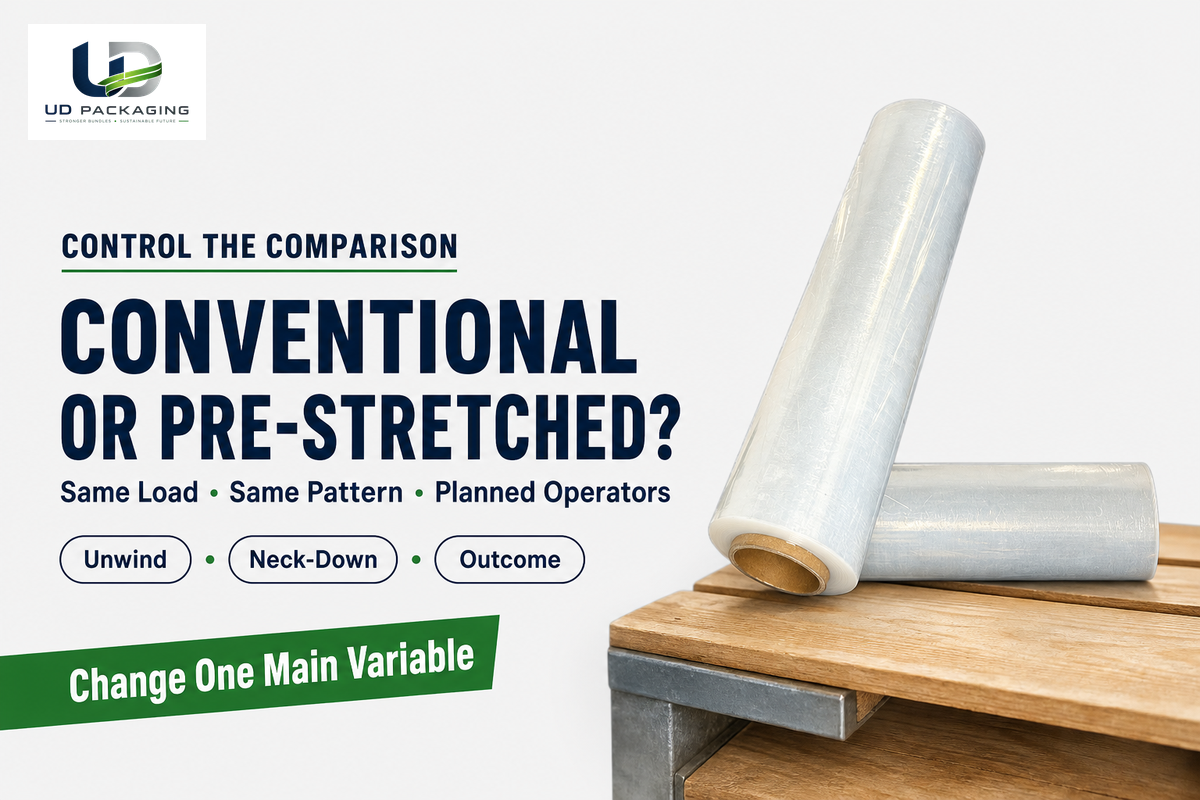
Compare the amount of stretch the operator must create, edge conditions, neck-down, puncture response, and unwind behavior on the actual load. Pre-stretched material isn’t always stronger, safer, or more cost effective; use this comparison only after the site has confirmed manual application remains appropriate, and treat the stretch film category as product-family navigation rather than proof that a roll fits the load.
Pre-stretched film has already been elongated during the manufacturing process and can therefore take less force to apply. Benefits to the end user still depend on the roll, load, method and measured outcomes.
When comparing rolls, don’t rely on hand feel. A thinner gauge may contain a different resin or be of a multilayer construction. Blown and cast films may exhibit differences in noise, clarity, cling, stretchability, and tear behavior. The family name doesn’t indicate a universal winner. The candidate film must meet the requirements of the application without damaging the product.
A fair comparison keeps four things steadyUse the same representative load, the same observable wrapping pattern, comparable operators or a planned operator sample, and the same acceptance criteria. Change one main variable at a time. If both film and method change, the result can’t show which change caused the outcome.
How Do You Read Gauge, Micron, Width, Core, Cling, and Clarity?
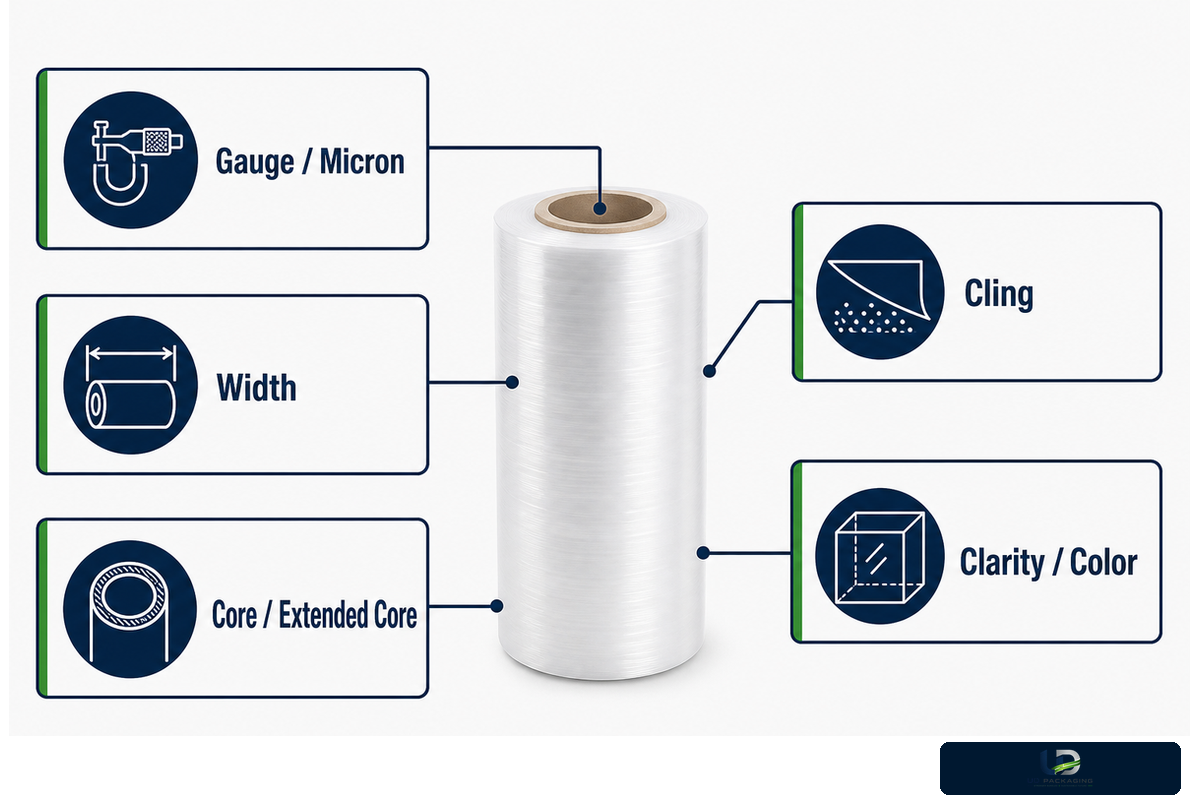
Direct answer: treat these as roll identification fields: gauge or micron expresses nominal thickness; width and core affect fit with the load and dispenser; cling and clarity describe handling or visibility characteristics; none of these fields alone establishes puncture resistance, tear resistance, load capacity, or suitability.
Gauge and microns are measures of thickness. In the common dimensional conversion, 100 gauge equals 1 mil, and 1 mil equals 25.4 microns. Therefore, 80 gauge is about 20.3 microns. This relationship is a unit conversion and does not reflect changes in thickness to resist puncture or tear, or change load capacity or durability. An engineered thin film may differ from a heavier construction, and nominal thickness still requires a tolerance to be useful.
Unit-reading examples, not film recommendationsFor dimensional comparison only, 60 gauge is about 0.60 mil or 15.2 microns; 70 gauge is about 0.70 mil or 17.8 microns; 80 gauge is about 0.80 mil or 20.3 microns; and 90 gauge is about 0.90 mil or 22.9 microns. Likewise, 400 mm is about 15.75 inches, 450 mm about 17.72 inches, and 500 mm about 19.69 inches. A converted number doesn’t establish suitability, tolerance, net roll length, or applied performance.
| Field | Useful question | Wrong shortcut |
|---|---|---|
| Gauge / micron | Is identity and dimensional conversion clear? | “Thicker always secures more.” |
| Width | Does it suit the load, overlap plan, and dispenser? | “Wider always means fewer problems.” |
| Core / extended core | How is the roll held, controlled, and changed? | “Any handle makes the task ergonomic.” |
| Cling | Which side clings, and does the tail remain controlled? | “More cling fixes an unstable build.” |
| Clarity / color | Must labels, counts, or tamper cues remain visible? | “Crystal-clear film proves high performance.” |
Record manufacturer/supplier, product code, lot, nominal gauge, width, roll identity, and date in every candidate trial. Breaks, loose tail, and accepted results can’t be traced to the same material without a roll identity.
Match the Film to the Load Before Adding Wraps
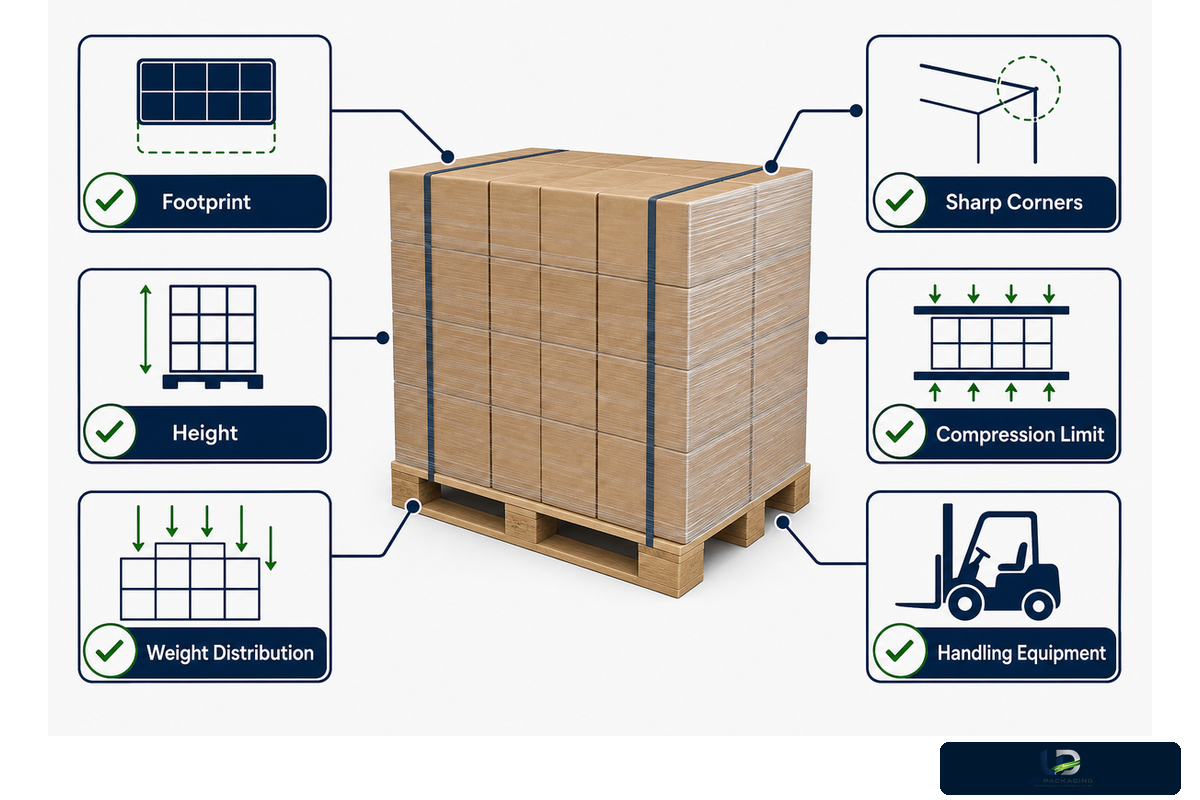
Direct answer: describe the load first. Added revolutions can’t repair a damaged pallet, unsupported overhang, unsafe stack, weak carton, leaking bag, or product that’s incompatible with the applied force.
Start with geometry. Inspect footprint, height, and weight distribution. Note column or interlocked stack. Start with geometry: Consider voids, protrusions and recessed layers. What’s the shape of the top surface? Contact risks include sharp corners, splinters and bands, as well as rough edges of pallets. Note if the product is breathable, compressible, or contains moisture. Product that settles, breathes, or transforms may require special consideration prior to wrap, as an irregular load may need a different preparation method.
Inspect surface characteristics. For example, cases and sacks can have a huge difference in friction. A bundle of smaller items may require an internal restraint instead of more external film. Pallet condition matters too: 29 CFR 1910.176 requires stable storage and aisles in the applicable U.S. workplaces, and film can’t replace a stable build.
Load ID, total mass, height, and footprint are needed. Concerns of center-of-gravity, edge failures, product compression limit, contact with the environment, and internal and external movements should be assessed. Note the handling equipment and the acceptance owner. If there is an unsafe condition, quarantine the load.
How Do You Wrap a Pallet by Hand Consistently?
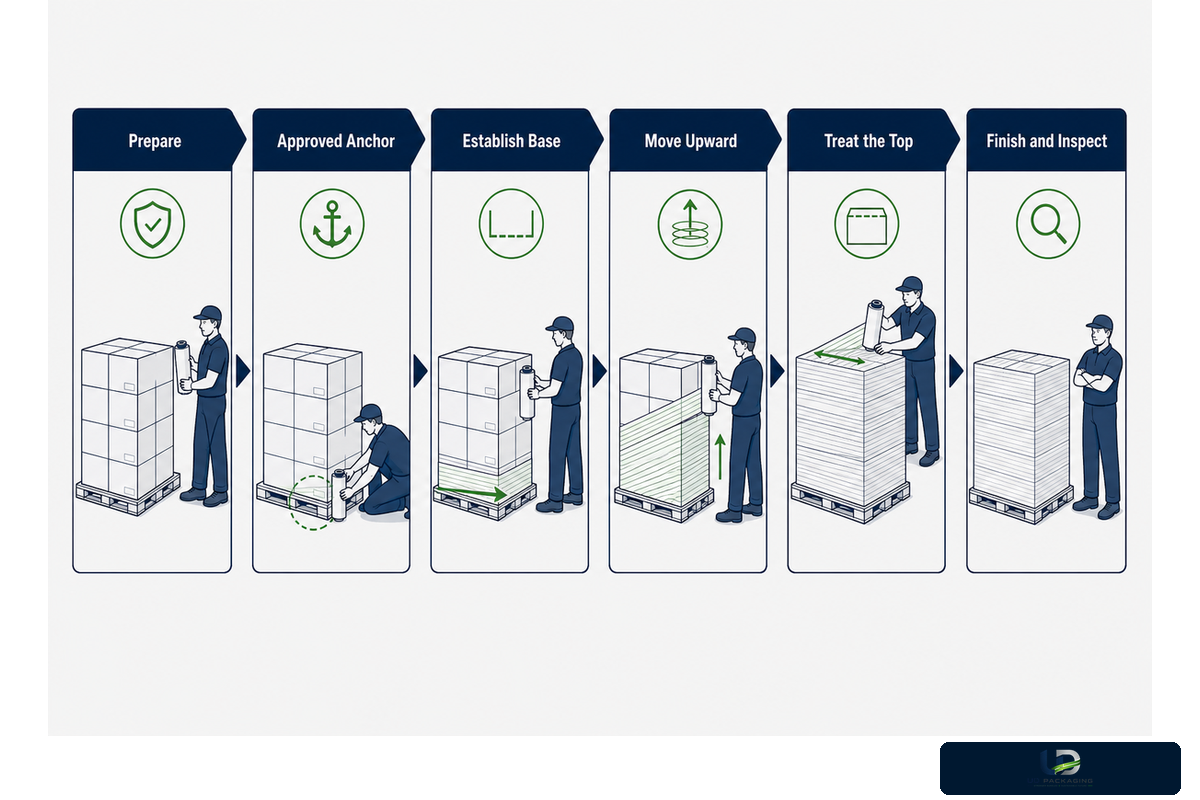
Direct answer: use the same preparation, approved anchor, base passes, upward movement, top treatment, finish, and inspection sequence. Define observable checkpoints instead of a universal wrap count, and qualify those checkpoints for the site’s load, film, dispenser, environment, route, and acceptance criteria.
- Prepare: Ensure load is stable and pallet is serviceable, clear the work area and ensure the roll matches an approved trial. Check the floor and travel path.
- Anchor by approved method: don’t place fingers in a moving core or create an anchor that causes a cut or trip hazard. SOP and risk assessment define allowed method.
- Establish base: make a connection around the lowest part of the load and pallet without dragging film across a damaged pallet. Note the position of the film relative to the load and pallet.
- Move upward and maintain tension: keep the walking path visible. Aim for the site’s target band only after a qualified trial.
- Treat the top deliberately. Reinforce or cover it only as the load and acceptance criteria require.
- Finish and inspect: secure the tail. Check base, middle and top of the load. Inspect all corners, labels, tail, pallet, and interface for signs of damage or movement.
The values in the 3M technical guide for measuring containment at the top, middle and bottom and illustrating a 40-60% overlap are context-specific to that document and aren’t a universal benchmark. Use the measurement locations as a reminder, then establish local limits for the selected film, load, equipment and route.
Stop conditionStop when the floor, path, load, posture, roll, dispenser, or environmental condition is outside the approved work method. A clean-looking wrap isn’t evidence that the exposure or the wrapped load is acceptable.
Use the 8-Field Hand-Wrap Consistency Card
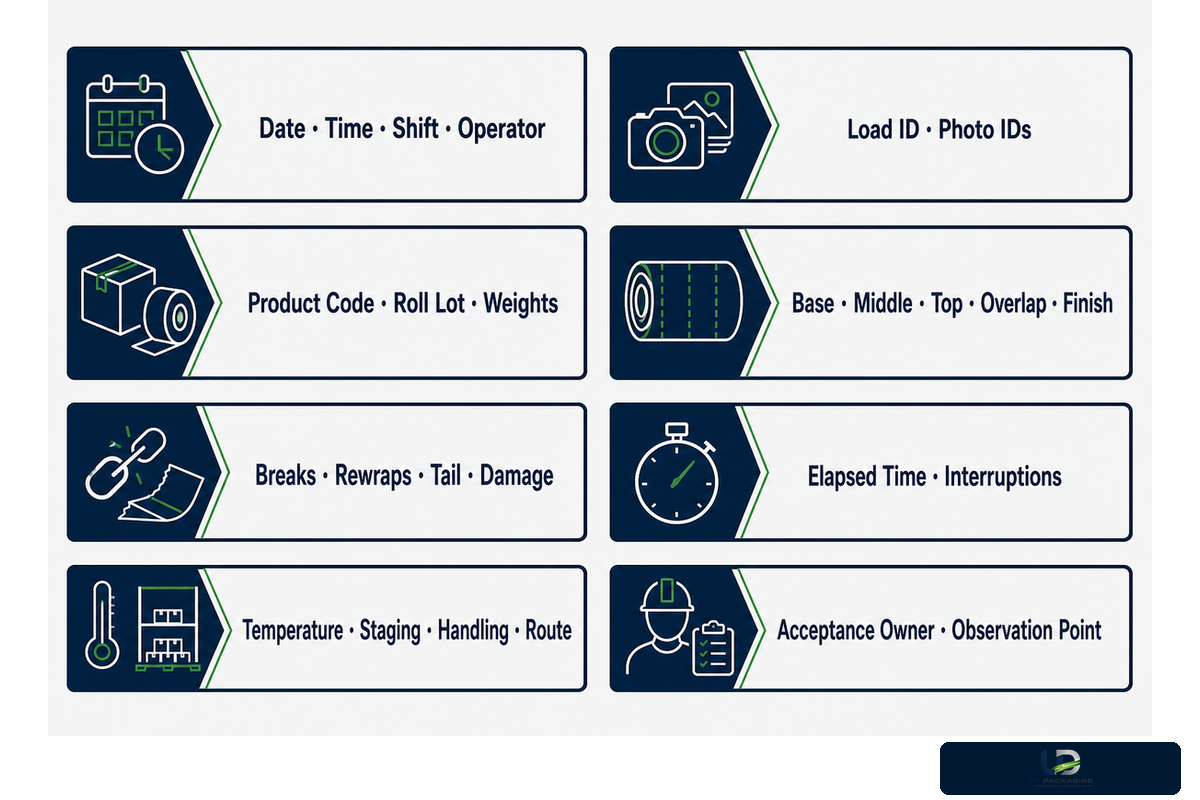
Direct answer: Record what actually happened so film behavior isn’t confused with operator technique, load variation or route exposure.
The consistency card is a data collection aid, not to say the process is repeatable. Each completed card is client data. For this purpose, a handy record connects roll identity, method and operator with load, the environment, the material used, any obvious failures, the elapsed time, and what was noted later.
| Record type | Why it matters | Record |
|---|---|---|
| Date, time, shift, operator | Separates method and exposure patterns | Complete on site |
| Load ID and photo IDs | Binds the result to one geometry and condition | Complete on site |
| Product code, roll lot, starting/ending weight | Identifies material and estimates use | Complete on site |
| Base, middle, top, overlap, finish | Shows the applied pattern without a generic wrap count | Complete on site |
| Breaks, rewraps, loose tail, damage | Captures failure cost and acceptance risk | Complete on site |
| Elapsed time and interruptions | Shows process burden and pace effects | Complete on site |
| Temperature, staging, handling, route | Preserves the environmental boundary | Complete on site |
| Acceptance owner and observation point | Names who decides and when | Complete on site |
One card is not a sample plan. ASTM D8314-20 (2025) describes performance testing after film is applied, states no universal precision or bias for its methods, and encourages users to establish these for their application. How many representative loads, operators, shifts, rolls and handling cycles are required to make the decision? The numbers should be in the client’s risk, variability and acceptance plan and not in this article.
Choose a Dispenser and Working Method Without Creating a New Risk
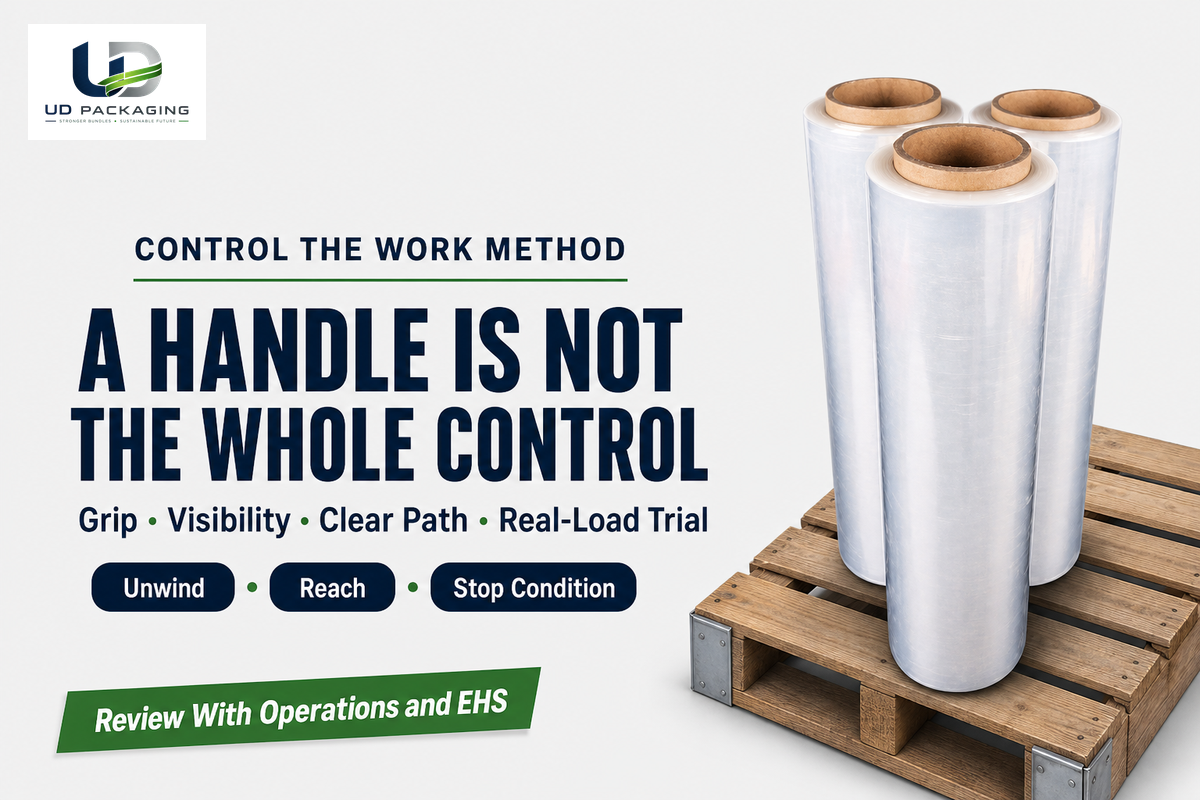
Direct answer: a dispenser should provide control of unwind and hand position while maintaining visibility and a clear path. Manual wrapping in itself is not automatically ergonomic because of the presence of a handle.
Consider grip and wrist position, braking method, roll change, roll weight, reach and pallet height. Evaluate floor condition and turning radius. Does the device promote back-walking? How does the film start and finish? A dispenser appropriate for one operator may not be appropriate for another. A tool that reduces finger contact may not address repeated bending and force.
Place the choice in the control hierarchy. Is the load reducible or hazard eliminable? Is an engineering control such as an appropriate turntable adequate? If manual work is unavoidable, then the tool, training, pace, rotation, and SOP form the administrative-control layer. While important, documenting this layer shouldn’t be confused with eliminating the hazard.
The decision should be made by operations and EHS. Test the dispenser under the real height, space, roll and load conditions. Stop if visibility is obstructed, balance is lost, or the walking path is unsafe.
Operator record: Manual pallet wrapping remains load- and site-specific. The hand stretch film dispenser can change grip and unwind control, but it does not replace a clear path, a defined work method, or a load-specific trial.
Run the Candidate Roll Proof Loop
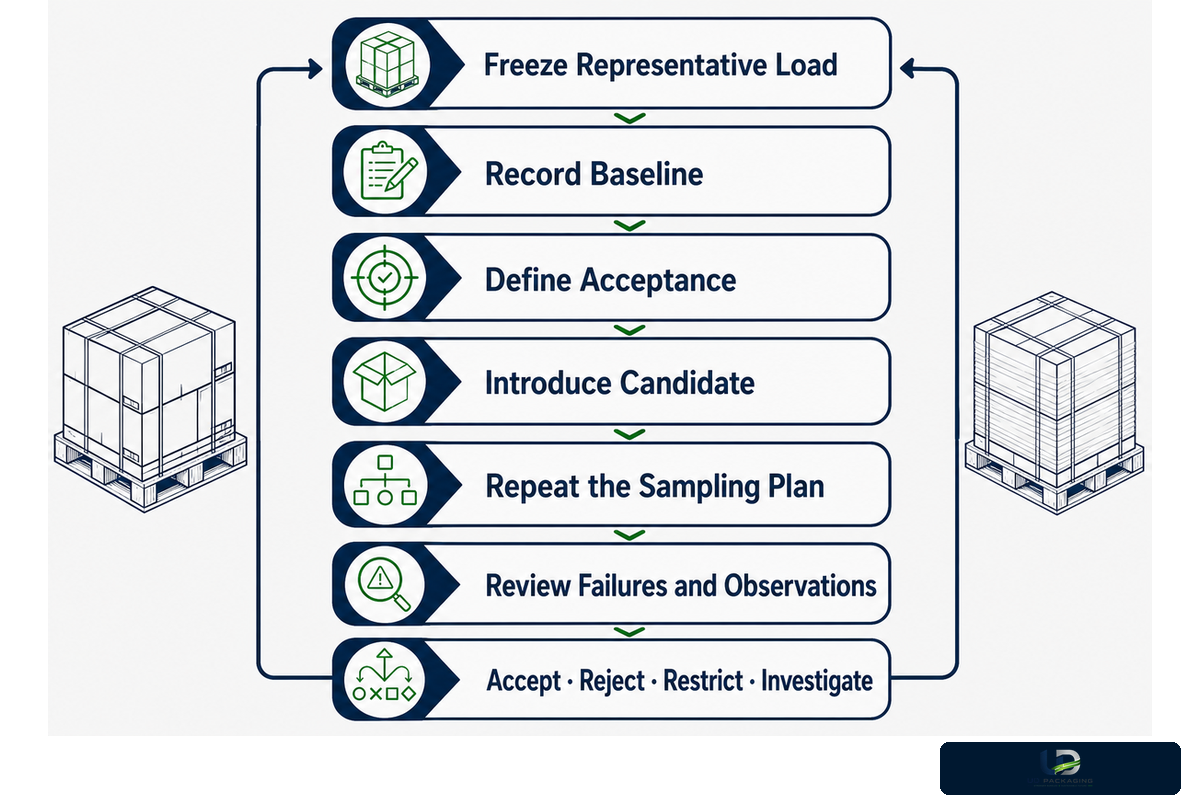
Direct answer: Compare current baseline and candidate on repeated like-for-like loads. Change one primary variable at a time, and define acceptance before trial. Retain failures as evidence.
Candidate Roll Proof Loop
- Freeze the representative load and environmental boundary.
- Record the baseline roll, method, operators, material use, failures, time, and outcome.
- Define containment, product-damage, handling, and documentation acceptance criteria.
- Introduce the candidate while holding the comparison conditions steady.
- Repeat across the sampling plan rather than relying on one successful pallet.
- Review breaks, rewraps, loose tails, movement, damage, and operator observations.
- Accept, reject, restrict, or investigate, with a named decision owner and deviation record.
The ledger should include description of the load, route/internal handling, environmental condition, roll identity, method, operator, shift, material, breaks, rewraps, elapsed time, post-handling observation, acceptance owner and deviations. If the candidate needs a different application pattern, record that as a second controlled change rather than hiding it inside the film comparison.
Keep environmental conditions in scope. An indoor ambient result would not be sufficient to demonstrate that freezer storage or hot staging are not required. Those conditions, direct sunlight, and outdoor exposure need to be tested with technical justification. Keep legal scope in mind: a wrapped pallet trial wouldn’t prove adherence to securement requirements of commercial vehicle cargo. FMCSA securement Rules govern preventing cargo from shifting or falling from commercial vehicles, which is different from qualifying pallet-packaging.
Troubleshoot Loose Loads, Breaks, Corner Tears, Neck-Down, and Loose Tails
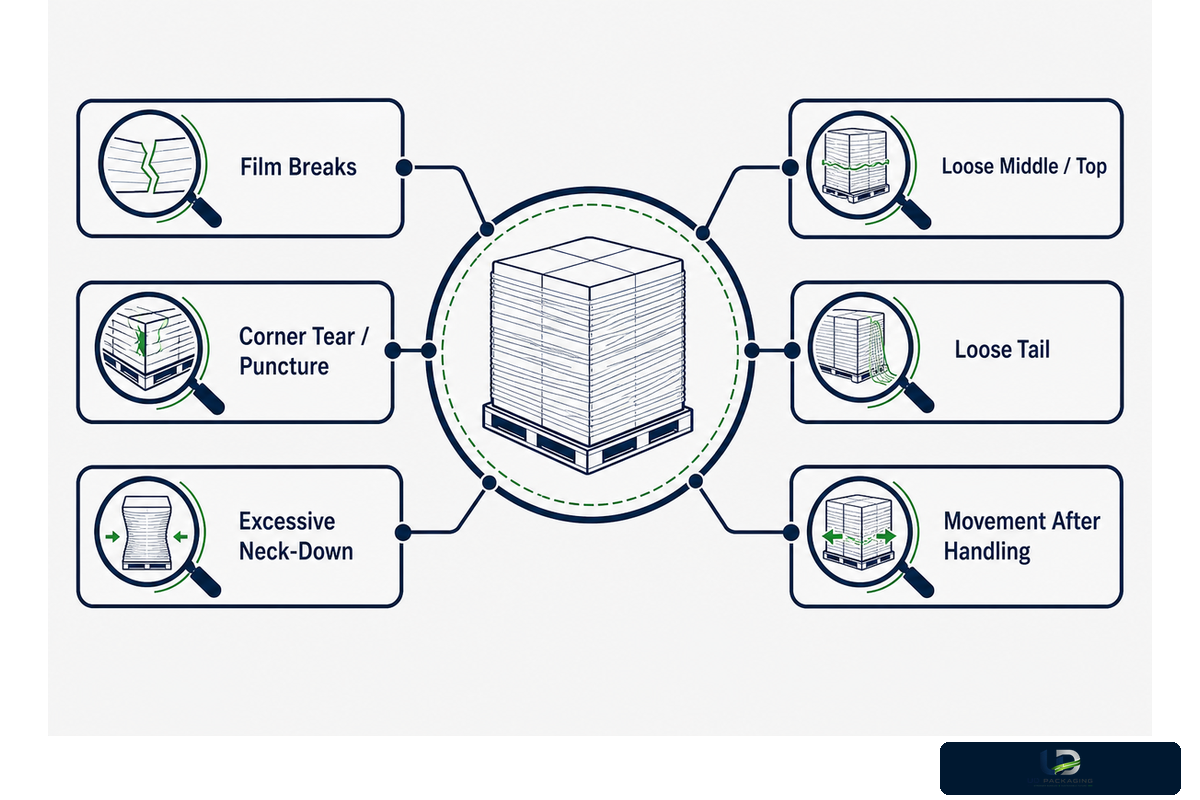
Direct Answer: Check symptoms across four lanes (film, process, load and handling) before changing gauge. A film break isn’t always a material defect, and a thicker roll isn’t always the correction.
| Symptom | Check first | Do not assume |
|---|---|---|
| Film breaks during application | Edge damage, roll storage, protrusions, tension spikes, dispenser condition | Every break is a defective roll |
| Corner tear or puncture | Sharp edge, load movement, contact angle, edge protection, film identity | More tension will solve it |
| Excessive neck-down | Applied force, roll orientation, width, overlap, film construction | Narrow coverage always means poor material |
| Loose middle or top | Pattern, load settlement, surface friction, observation timing | A higher wrap count is sufficient |
| Loose tail | Cling orientation, cut/tear method, finish position, dust, moisture, temperature | Cling alone proves load retention |
| Load movement after handling | Pallet build, internal voids, friction, applied pattern, retained containment, handling event | The roll label proves the process |
Quarantine unexplained failures. Retain roll and lot identity, photos, load and operator record and handling timeline. Then change one suspected cause at a time. Random adjustments can result in a strong load in one location and damaged product in another.
Use the 5-Trigger Manual Escalation Matrix
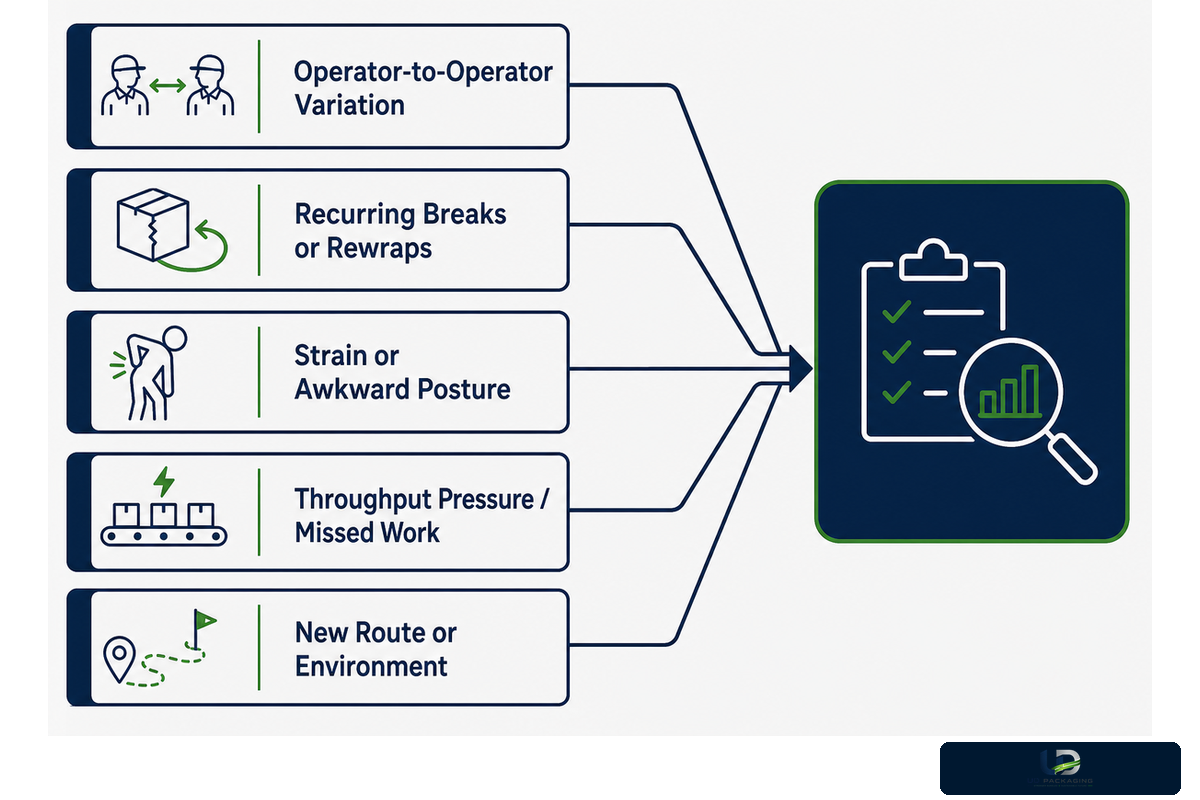
Escalate when local records show variation, rewraps, interruptions, strain signals, or throughput pressure that the documented manual process cannot govern adequately. Review higher order controls to establish feasibility instead of setting a uniform threshold for all equipment.
| Trigger | Evidence to bring | Next review |
|---|---|---|
| Operator-to-operator variation | Consistency cards across shifts and representative loads | Method, training, load design, and engineering-control review |
| Recurring breaks or rewraps | Failure type, roll lot, load, location, material used, time lost | Film, dispenser, load preparation, storage, and supplier review |
| Strain or awkward posture signals | Task observations, repetition, force, reach, pallet height, recovery time | EHS assessment and higher-order control study |
| Throughput pressure or missed work | Queue, cycle-time distribution, interruptions, load mix, staffing | Capacity study without presuming a machine answer |
| New route or environment | Temperature, sunlight, outdoor time, handling cycle, damage history | Separate film and package validation |
The matrix is to be utilized in support of a decision meeting and won’t calculate a payback or recommend equipment. EHS, QA, procurement, finance and operations should also review the same information. If the next step is a different product configuration or a documented sample discussion, use the commercial solution with the load profile and trial requirements prepared.
Frequently Asked Questions
What is hand stretch film used for?
It’s used to unitize cartons, bags, or other goods on a pallet and may help protect the load surface and identity during handling. Because it’s applied manually, the result depends on the roll, load, operator method, environment, and handling. It must not be treated as a repair for a damaged pallet, unsafe stack, or unstable load that needs separate review.
How do you use stretch wrap film by hand?
Begin with a stable load and clear path. Use the approved anchor, establish the base, move upward with controlled tension and locally validated overlap, treat the top as required, finish the tail, and inspect the result. Record the observable pattern rather than depending on a universal wrap count. Local risk assessment, training, and the hierarchy of controls govern the task.
What gauge hand stretch film should I use?
Gauge is a thickness description, not a universal strength or load rating. Review film construction, width, load geometry, edge condition, puncture risk, environment, route, and application method. Compare the candidate with the current baseline on repeated like-for-like loads, using the same acceptance criteria and a traceable roll identity. Record the nominal gauge as one trial field, not as the decision by itself.
Is hand stretch film the same as cling wrap?
No. Industrial hand stretch wrap is intended for manual load unitization and packaging. Household cling film is formulated for household or food-wrapping uses. They can both cling and appear clear, but appearance doesn’t make them interchangeable. Shrink film is another separate material that’s normally activated with heat.
Can hand stretch wrap be used in cold storage or outdoors?
Do not assume an indoor ambient trial applies. ASTM D4649 is indoor-scoped and notes that extreme temperatures may affect performance. Cold storage, heat, sunlight, moisture, and outdoor staging need a separate technical review and trial using the intended exposure, load, film, method, and acceptance criteria. Include storage before use, the wrapping temperature, dwell time, internal transfers, external transport, and the inspection point. If the exposure crosses the film supplier’s stated boundary, obtain application-specific technical evidence before treating a short trial as representative.
When should a warehouse move from manual to machine wrapping?
There’s no universal pallet-count answer. Review the process when records show uncontrolled variation, recurring rewraps, interruptions, strain concerns, unsafe movement, or throughput pressure that administrative controls can’t adequately govern. The equipment decision requires a separate capacity, safety, load, and financial study.
References & Sources
- ASTM D4649-20 (2025) Standard Guide for Use of stretch films and Wrapping Application
- ASTM D8314-20 (2025) Performance Testing of Applied stretch films and Wrapping
- NIOSH Hierarchy of Controls
- OSHA Grocery Warehousing eTool: Packaging
- OSHA 29 CFR 1910.176, Materials Handling and Storage
- FMCSA Cargo Securement Rules
- 3M RD-207 technical packaging guideline
- Instron Overview of ASTM D882 thin-film tensile testing
Additional context for UD packaging is located on the About Us page. Evidence pertaining to the company won’t take the place of product-specific, load-specific and site-specific evidence.
Bring a load profile, not just a gauge request
Document the load, environment, current method, failure history, route, and acceptance owner before discussing a candidate roll. That turns a sample into a controlled comparison.