Get in touch with UD Packaging Company

Updated October 2026
Quick specifications to request
Named paper grade and grammage in g/m²; roll width and core diameter in mm; supported wrapper model; closure method; conditioning temperature in °C and relative humidity in % RH. Match every value to the proposed load and route.
A paper-wrapped pallet can look ready for shipping while hiding a poor machine fit or a loose load. A brown surface, a durability claim and a recycling symbol aren’t enough to justify a purchase. Identify the exact material, then compare its behavior with the film system already running on your line.
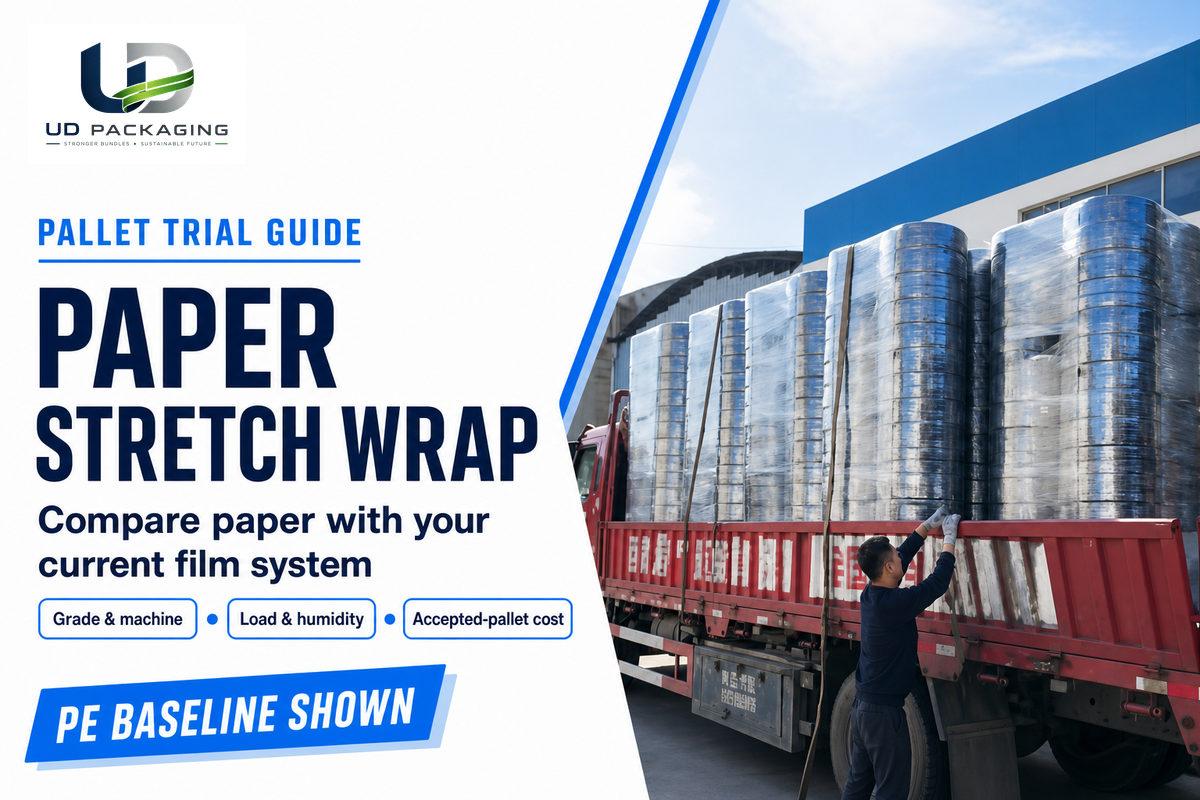
Extensible paper stretch wrap is paper used to hold palletized goods together. Commercially available grades of extensible paper stretch wrap vary in terms of stretch and machine requirements. Choose it through a defined load trial that assesses equipment, humidity, recovery and cost per accepted pallet.
- Paper grades can require different wrapping machinery.
- An intact paper envelope doesn’t prove that the load stayed stable.
- Recyclability testing and local collection answer different questions.
- Compare consumed material and operating time at the same acceptance checkpoint.
What paper stretch wrap does on a pallet
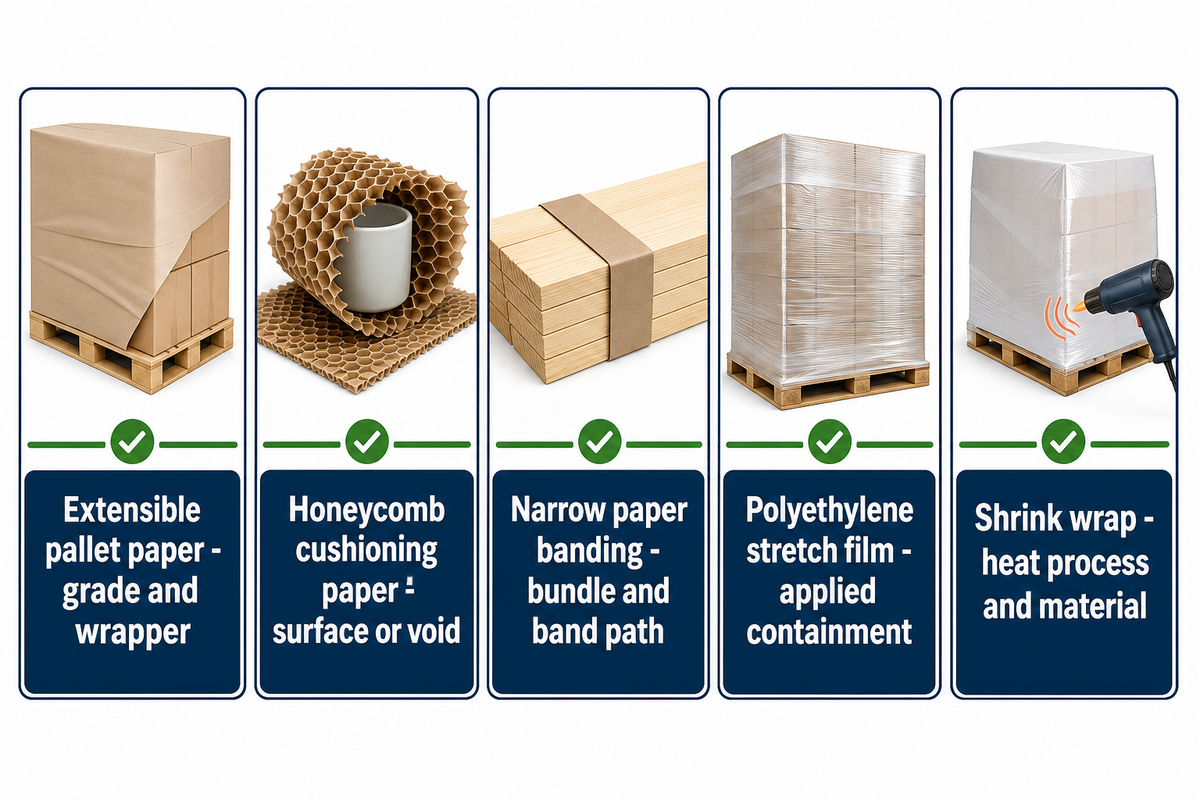
Paper stretch wrap holds a unit load within an extensible paper envelope. It covers numerous material designs. Thus, a customer specifies the grade name and application method before assessing specs. Cushioning paper, narrow banding and heat-applied shrink film play different roles in a package.
Polyethylene, often called poly film, extends around a load and develops containment through the applied wrapping system. A paper alternative may gain extension from its fibre structure, creping or another manufacturing treatment. Research by Zeng and colleagues in BioResources links fibre treatment and drying conditions to paper elongation. Those laboratory findings explain why structure matters; they don’t prescribe commercial wrapper settings.
Seaman Paper describes SeaStretch as a 42 g/m² creped paper capable of extending to nearly twice its original length. Mondi lists 70 g/m² and 11% stretch for Ad/Vantage StretchWrap. Each figure belongs to its named product. Without matched test methods, these values can’t rank strength or determine the machine’s pre-stretch ratio.
| Material format | Main purchasing question | Common mix-up |
|---|---|---|
| Extensible pallet paper | Which grade and wrapper hold this load? | Assuming any paper roll can replace film |
| Honeycomb cushioning paper | What surface or void needs protection? | Treating cushioning as pallet containment |
| Narrow paper banding | What bundle and band path are specified? | Assuming a band restrains the whole stack |
| Polyethylene stretch film | What applied containment survives the route? | Choosing solely by gauge |
| Shrink wrap | What heat process and material are required? | Applying a heat gun to extensible paper |
For a carton that requires surface cushioning, compare suitable cushioning materials, such as bubble wrap, separately from the pallet envelope. A stretchable sheet’s appearance says little about its ability to secure a stack. Before accepting a “heavy duty” rating, what’s the intended function? When selecting wrap for packing a pallet, distinguish its restraint role from the cushioning inside the corrugate case.
Keep the specifications with the grade. Both a 42 g/m² creped wrap and a 70 g/m² kraft wrap can be used for pallet applications. However, their extension figures describe different materials. Procurement should document the test basis and equipment route next to each figure before determining which roll fits the line.
Paper versus PE film: match the load and environment
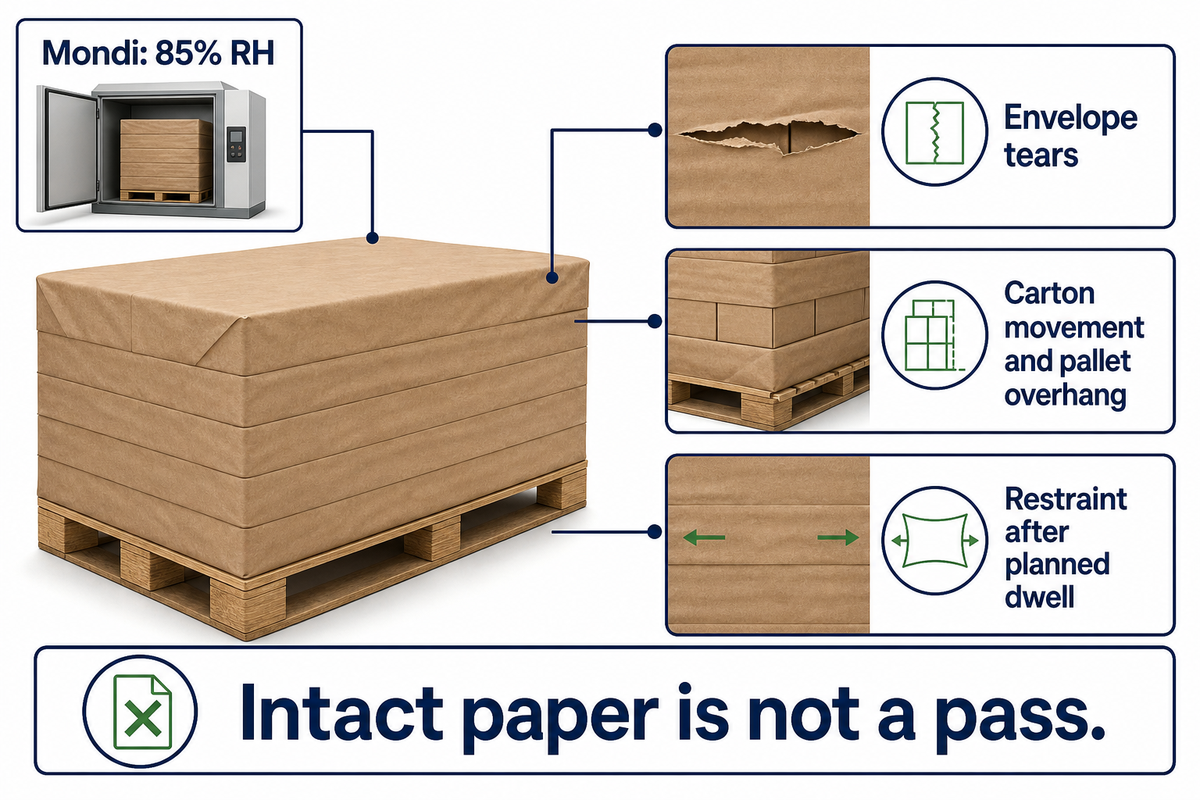
Paper and PE film should be evaluated based on the same load conditions and after the same set of environmental and handling tests. Humidity can cause the tension of the paper to change. A tear at a corner of a carton can also get bigger with movement. The neat envelope observed at the wrapping station is just an observation to get started.
Clear stretch wrap allows operators to see exposed carton surfaces through clear plastic. Paper obstructs that view, so the trial requires an inspection point prior to wrapping and another post removal. A heavy duty plastic film label provides no substitute for measured load performance.
Mondi states that Ad/Vantage StretchWrap remained intact in a chamber at 85% relative humidity, but states that the tension of the wrap was affected. Mondi states that the wrap is intended for indoor storage. This statement provides a useful trial condition for the discussion with the supplier. This statement doesn’t prove that the wrap is waterproof, or that the load is contained and secured with the wrap after every damp journey.
ASTM D4332-22 describes conditioning for packaging tests. Cellulosic materials used in packaging tests undergo physical changes as temperature and relative humidity vary. Hence, agree the exposure duration with the testing laboratory and record the retained restraint and load movement. Also record any visible damage.
“These special conditions do not necessarily duplicate actual field conditions”
A 2022 Virginia Tech project funded by Westrock shows the importance of testing. Recipes made with paper performed better in incline-impact and 22-degree tilt tests. Performance in rotational edge-drop tests was better with plastic film. Results show paper corner tears and slip. Materials used weren’t identified as commercial grades discussed in this paper, and 22 degrees isn’t an acceptance threshold.
Record separately
Envelope tears, carton movement, pallet overhang and restraint after the planned dwell.
Avoid this shortcut
Calling the trial a pass because the paper still covers the load.
An 85% RH result needs its original scope. Mondi reported intact wrapping alongside changed tension. A buyer with humid storage should ask how the grade would perform after the relevant dwell and handling sequence rather than consider a moisture-resistant description as proof and/or consider an intact outer surface as the only acceptance criterion.
Paper wrap machine compatibility depends on the grade
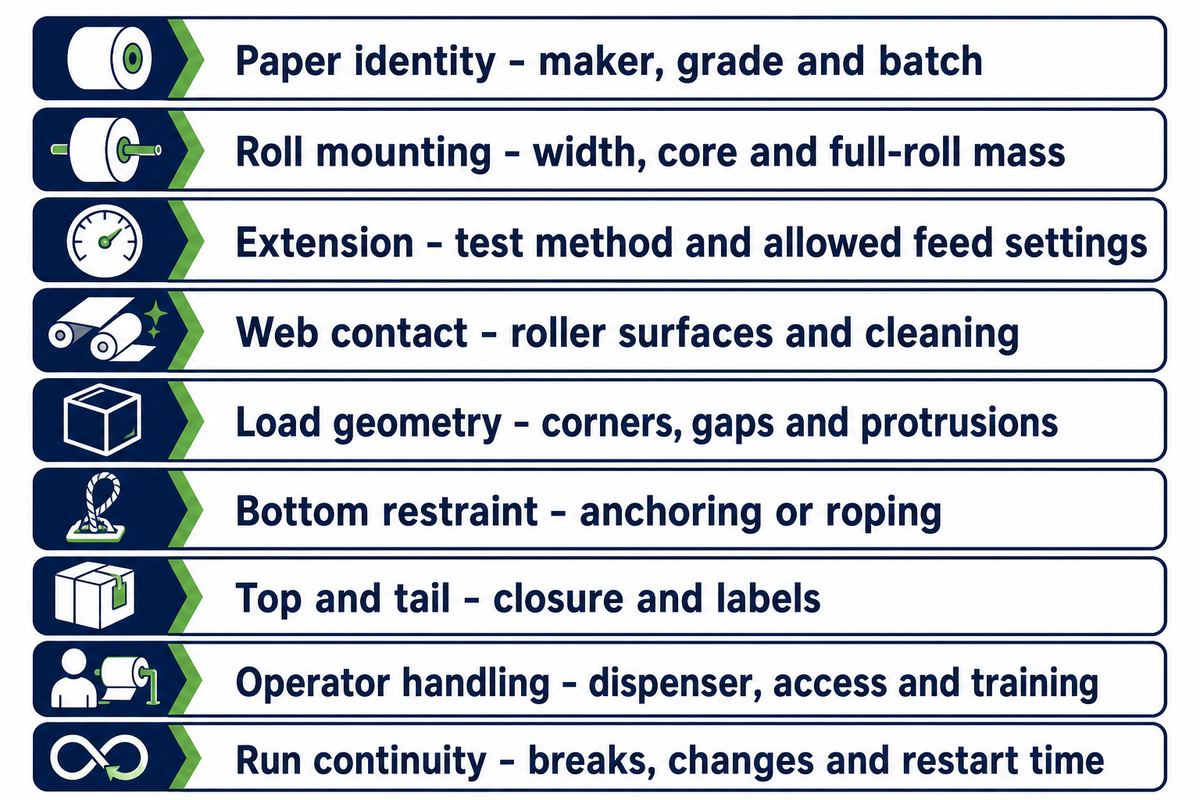
Paper wrap compatibility relies on the paper, feeding system and wrapping recipe. Seaman Paper sells SeaStretch for manual, semi-automatic and automatic application. Mondi advises a dedicated paper machine for Ad/Vantage StretchWrap. Both product statements are paper and application specific; they don’t prove compatibility with all plastic-film wrappers.
The University of Parma’s paper-wrapping research, supported by ACMI and public funding, combines real tests with fitted simulations and different wrapping configurations. It studies load deformation and paper damage under horizontal acceleration. Its preliminary research supports testing the configuration; it supplies no universal retrofit setting.
| Compatibility class | Evidence to request | Decision boundary |
|---|---|---|
| Paper identity | Maker, grade and batch | A different grade needs a separate approval basis |
| Roll mounting | Width, core and full-roll mass | Do not assume a film spindle fits |
| Extension | Paper test method and allowed feed settings | Paper elongation is not film pre-stretch |
| Web contact | Approved roller surfaces and cleaning method | Residue or slip requires equipment review |
| Load geometry | Corners, gaps and protruding boxes | A regular demo load does not cover irregular profiles |
| Bottom restraint | Approved anchoring or roping arrangement | Roping suitability varies by material |
| Top and tail closure | Specified closure and label system | Film cling cannot be assumed for paper |
| Operator handling | Dispenser, access and training requirements | Check reach and handle forces during the trial |
| Run continuity | Breaks, roll changes and restart time | Clock the full work cycle before capacity approval |
Phoenix’s undated supplier trial used one semi-automatic wrapper and two anonymous papers. Roping behavior and roller residue differed between those papers. Its machine modifications are study details, not instructions for modifying your equipment. Request an approved setup from the machine supplier before modifying a feed path or guard. Operators who wrap stretch film by hand should perform the trial with the paper in question; familiar handling habits may not be applicable to its feed and closure method.
Can I wrap loads quickly?
When determining speed, include time for loading and unloading, closure, and inspection and account for interruptions. Time a representative run with the proposed paper and operators and time a complete cycle. Moving heavy loads into position can take longer than the wrapper cycle. An easy first pallet may hide frequent roll changes, slower tail fastening, and/or extra walking if the work station is busy. Measure the accepted output for the full period under observation. For manual work, an extended core or separate dispenser must suit the selected roll. Confirm the arrangement during the operator trial.
Keep a documented manual film baseline for a hand-operated station. UD’s hand stretch wrap page lists enquiry options of 450 or 500 mm width, 12–25 µm thickness and 50 or 76 mm core diameter. These are PE-film candidates, not paper specifications. For powered lines, compare the machine film compatibility inputs with the machine supplier’s approved paper setup.
A 500 mm film roll provides no paper approval. Roll width and core diameter settle only part of the fit. Feed tension, paper contact surfaces and closure behavior still need their own trial evidence, especially when purchasing expects to keep an existing wrapper without a supplier-approved modification.
Compare paper stretch wrap cost per accepted pallet
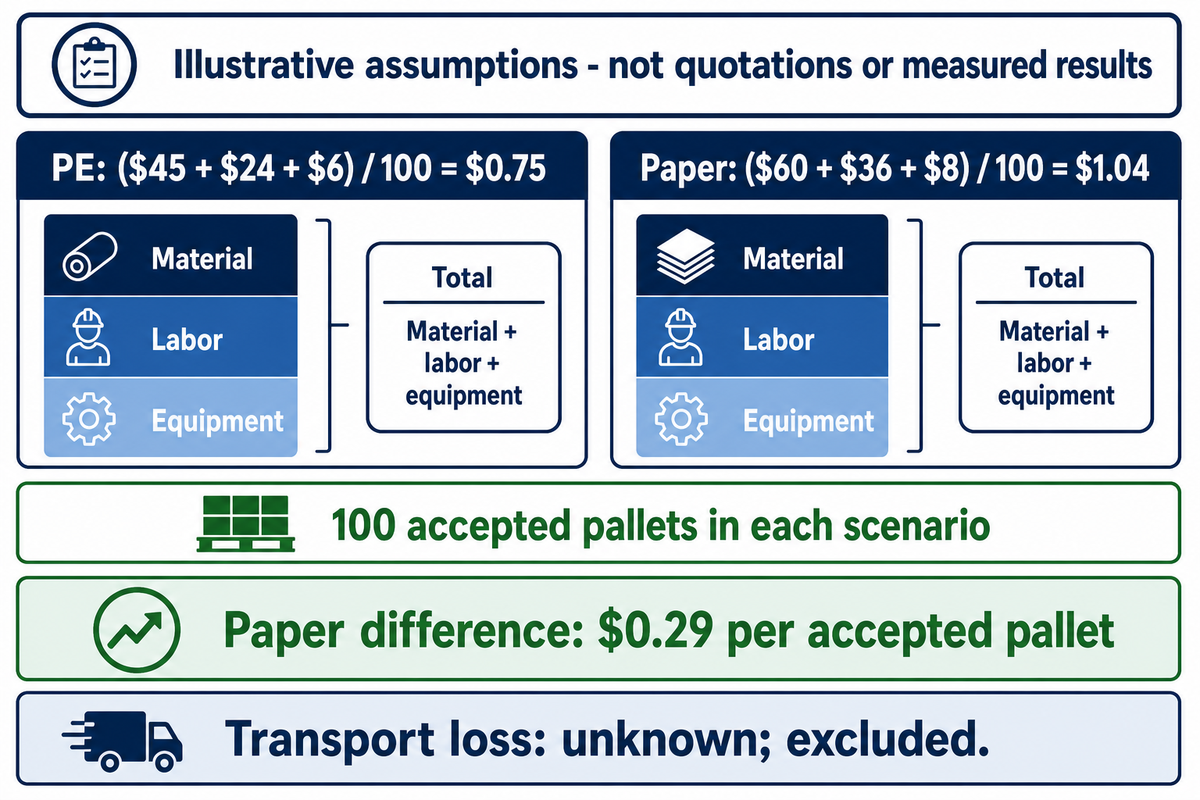
Compare the costs of wrapping stations by dividing the consumed material, labor, and equipment costs by the pallets accepted at a defined checkpoint. Include wasted wraps and rework in the numerator. Keep unmeasured transport losses outside that subtotal and label them “unknown”. A lower cost roll doesn’t mean a lower delivered cost.
Actual labor and overhead costs are needed for cost accounting. A case by the National Institute of Standards and Technology (NIST) describes the integration of these costs in job costs and the comparison of expectations and outcomes. It describes the situation of a truss business, and thus supports cost accounting and not paper-wrap savings.
Illustrative assumptions, not quotations or measured results: both runs produce 100 pallets accepted at the wrapping station. Labor costs $24 per hour. Material includes offcuts and failed wraps; labor includes the recorded interventions. Equipment allocation doesn’t include labor to prevent double counting. Transport damage hasn’t been measured.
| Input or result | PE baseline | Paper scenario |
|---|---|---|
| Accepted station output | 100 pallets | 100 pallets |
| Consumed material cost | $45 | $60 |
| Recorded labor time | 60 minutes | 90 minutes |
| Labor rate | $24/hour | $24/hour |
| Labor cost | $24 | $36 |
| Equipment allocation | $6 | $8 |
| Station subtotal | $75 | $104 |
| Cost per accepted pallet | $0.75 | $1.04 |
| Unmeasured transport loss | Unknown; excluded | Unknown; excluded |
The arithmetic is ($60 + 90/60 × $24 + $8)/100 = $1.04 per pallet for paper. PE is ($45 + 60/60 × $24 + $6)/100 = $0.75. In this case, paper costs an additional $0.29 per pallet; $0.12 comes from the added 30 minutes of labor. Other measured savings would need to cover the difference in order to claim a net benefit.
How do I calculate the amount of stretch wrap needed for my packaging needs?
Measure consumed mass or linear length over a defined run, and divide by the accepted output. Record attempted loads and rewraps alongside the result. Waste must be kept visible. Use the same unit of measurement, checkpoint, and accounting period for both alternatives. If no pallets meet the agreed station criteria, the comparison has no valid per-accepted-pallet result.
UD’s film-per-pallet measurement worksheet provides a measurement record. Log feed breaks, closures, and roll changes as non-overlapping events. Moving supplies closer may reduce walking, but stopwatch data must confirm the saving; don’t subtract an imagined improvement from the price of packing supplies.
At $24/hour, another 30 minutes costs $12. Spread over 100 accepted pallets, that adds $0.12 to each pallet before any material difference. A paper trial may appear visually successful; however, a potential buyer of a stretch wrap roll must request intervention time and accepted output along with price.
Recyclability depends on the complete wrapping system
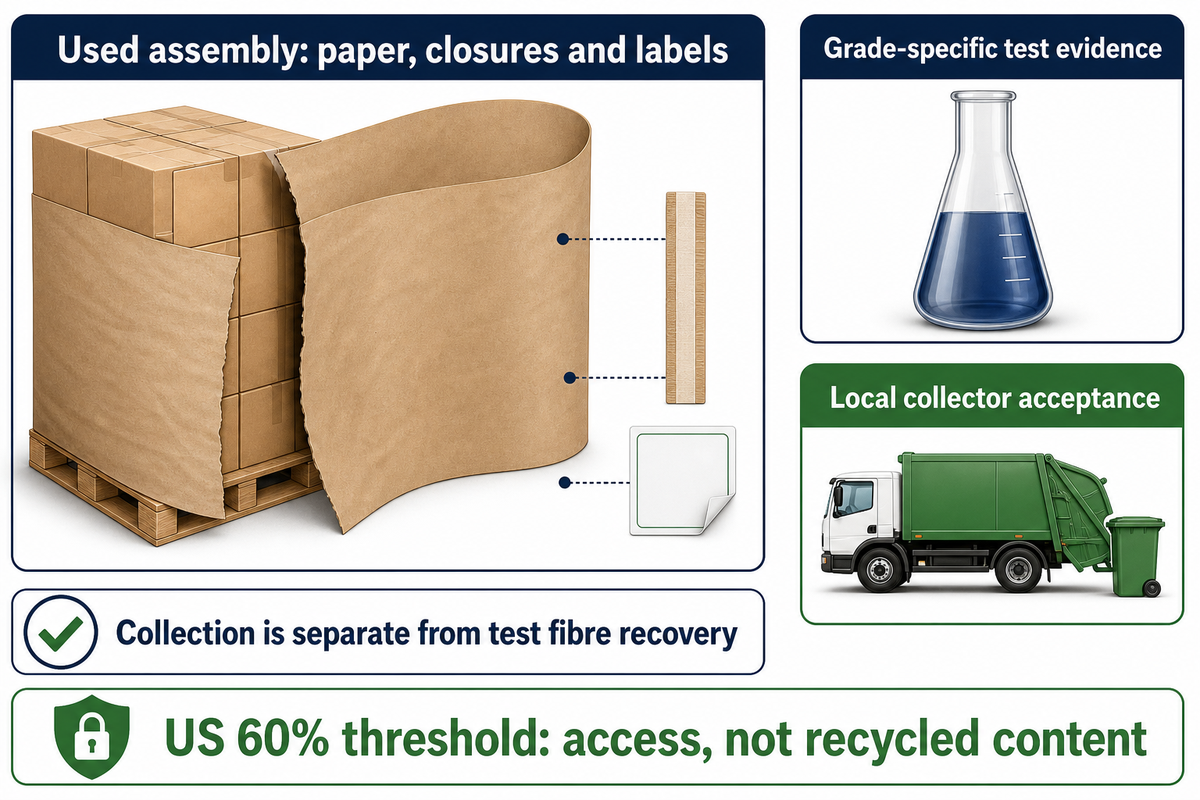
Paper-wrap recycling depends on a range of factors. These include the attached materials, the grade, the level of contamination, and the receiving collection route. A recyclability test addresses a defined sample and a defined process. Buyers also need confirmation that the receiver can separate and collect the actual assembly including closures and labels at the point where the waste occurs.
According to Seaman Paper, recycling testing for SeaStretch is covered by Aticelca 501 and UNI 11743:2019. This is a maker statement for the product in question. We need to understand what kind of adhesive and label configuration the evidence is covering. A paper base doesn’t make everything attached to it compostable, or suitable to be processed by the same mill.
The industry alliance 4evergreen distinguishes conventional, flotation-deinking and specialised recycling systems. Its packaging-value-chain membership also impacts claims evaluation. Collection and sorting remain separate from assessing fibre recovery in a test.
For US marketing, the Federal Trade Commission’s Green Guides summary says unqualified recyclable claims depend on suitable facilities being available to at least 60% of consumers or communities where a product is sold. That percentage measures access, not recycled content. Buyers checking a PE alternative’s recycled percentage can use UD’s guide to checking recycled film content claims.
Prior to changing plastic packaging, obtain a written collection route for used paper, closures and labels. Record food-contamination and odor restrictions, if any. A procurement objection due to disposal costs requires a receiver’s answer. Attractive recycling logos won’t solve this.
The 60% threshold is a US claim qualification. It doesn’t mean a roll contains 60% recycled fibre, nor does it guarantee that a particular warehouse can recycle the wrap. Evidence pertaining to collection and grade-specific testing should be captured in different fields on the approval record.
Run a bounded pallet trial before changing supply
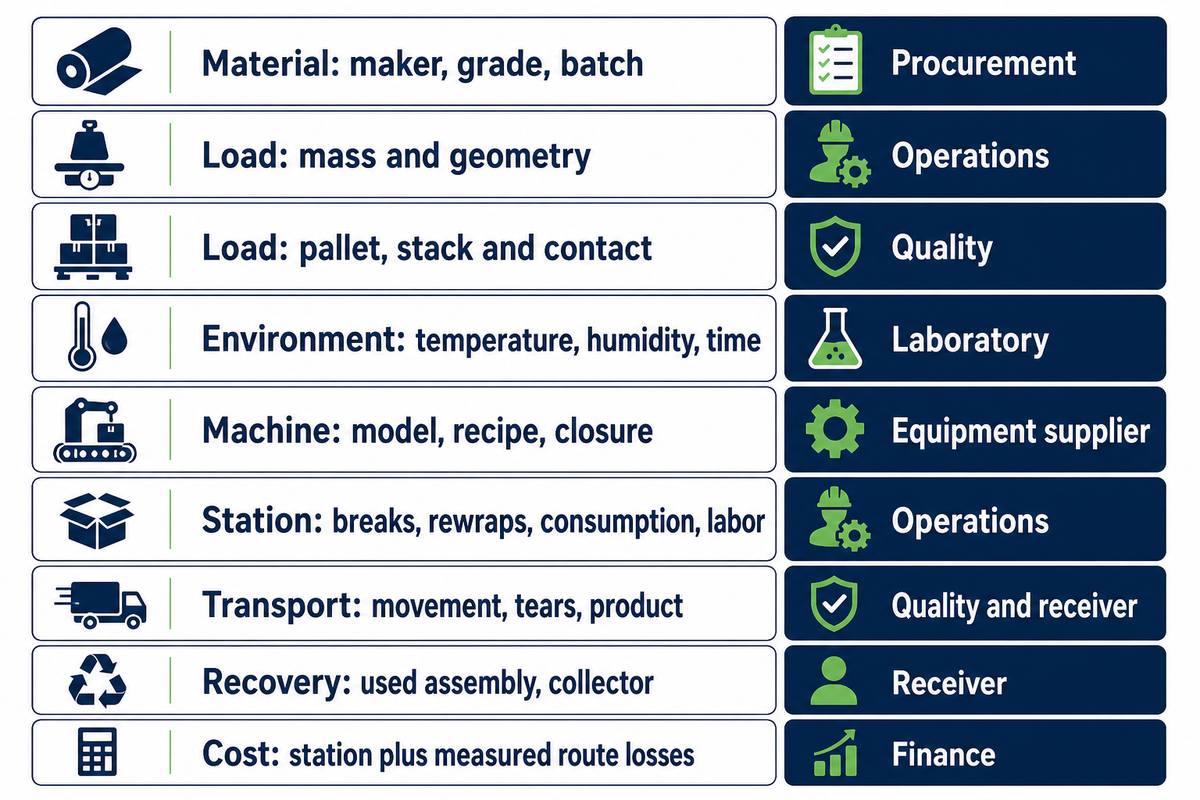
A paper-wrap trial fixes the load, grade, machine setup and exposure before comparison of results. Assign the wrapping-station acceptance checkpoint separately from transport validation. Quality and operations should agree what movement, tearing or product damage would reject the candidate, with a laboratory choosing the route-appropriate test sequence.
5-Check Paper Trial Boundary
Prior to approving a paper-wrap substitution, agree on the material identity, load and environment, machine setup, recovery route and measured cost.
Define
Freeze the candidate grade and load. Agree rejection criteria before wrapping.
Observe
Record station output, handling effects and receiving-site recovery separately.
Decide
Approve only the tested scope and document what requires a fresh trial.
| Boundary and record | Owner | Reason to withhold approval |
|---|---|---|
| Material: maker, grade, batch, g/m² | Procurement | Trial roll differs from quoted supply |
| Load: mass in kg or lbs, footprint and height in mm | Operations | Target load falls outside recorded geometry |
| Load: pallet construction, stack and contact surfaces | Quality | Changed support or slip behavior |
| Environment: °C, % RH and hours of exposure | Laboratory | Route exposure remains untested |
| Machine: model, recipe and closure method | Equipment supplier | Unsupported setting or modification |
| Station: breaks, rewraps, consumed kg and labor minutes | Operations | Agreed output or defect criterion missed |
| Transport: movement, corner tears and product condition | Quality and receiver | Agreed handling criterion missed |
| Recovery: used assembly and collector acceptance | Receiver | Claimed collection route unavailable |
| Cost: station subtotal and separately measured route losses | Finance | Required cost evidence is missing |
Park and colleagues’ 2018 pallet research links containment-force effects to package size and pallet stiffness. Maintain the inputs. Matching gross weight alone leaves a major difference if one trial uses a stiffer pallet or a different arrangement of cardboard shipping boxes.
Ask the laboratory which ISTA procedure is applicable to the actual distribution system. A package test doesn’t replace the planned loading and cargo securement of a commercial vehicle. For applicable commercial US vehicles, 49 CFR 393.106 describes securing cargo on or within the vehicle; it allows the use of appropriate structures, dunnage, tiedowns, or a combination thereof.
UD needs your current film dimensions, load photos, wrapper model and measured consumption for a stretch film supply assessment. Where a rigid load uses a separate strap system, assess PET strapping for that load as its own restraint design. These enquiries relate to UD’s published PE and PET offering. This guide doesn’t assess UD’s paper wrap supply capability.
Industry outlook: new paper systems and 2026 test updates
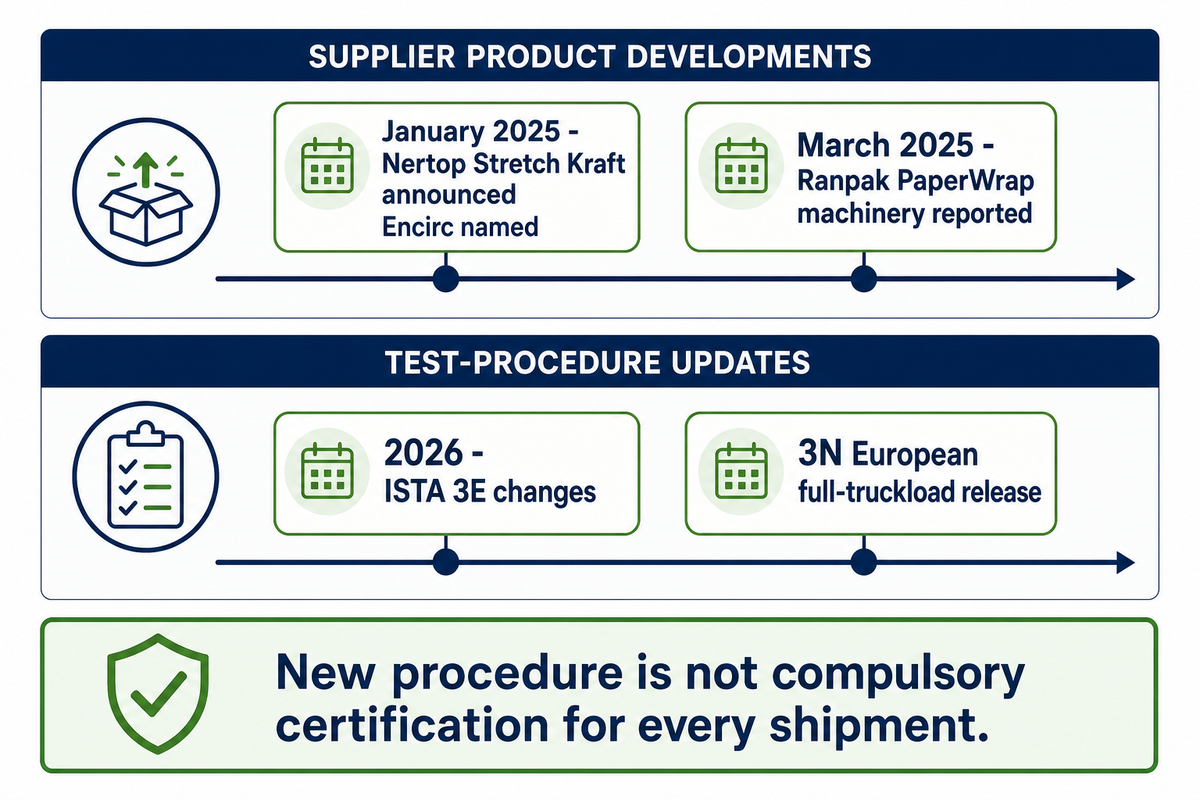
New paper systems broaden the trial candidates, and recent updates to transport-test procedures reinforce the need to check the applicable edition. Supplier launches show commercial activity, not universal fit or proven market-wide savings. Evaluate the paper maker and machine together, and request evidence for the load you wish to transport.
Smurfit Westrock announced its Nertop Stretch Kraft pallet wrap in January 2025, with Encirc named as a user. In March 2025, Packaging Europe reported Ranpak’s PaperWrap machinery. These are product developments with supplier interests behind them, not independent proof of lower total cost on another packing line.
ISTA’s published change table lists January and March 2026 changes to Procedure 3E and a March 2026 release of 3N for European full-truckload distribution. The laboratory will need to specify the applicable procedure and edition in their proposal. A new procedure isn’t a compulsory certification for every shipment.
For purchasing, the positive development is more options for paper and machine systems. Avoid a blanket “replace all plastic wrap” specification. Approve a documented application, then extend the scope only when additional loads and routes have supporting evidence.
Frequently asked questions
Is paper stretch wrap waterproof?
Water and humidity need separate checks
Paper stretch wrap shouldn’t be assumed waterproof. A supplier’s high-humidity result may show that wrapping remained intact while tension changed, which says little about direct rain, condensation or wet floors. Request the named grade’s storage limits and evaluate the actual route exposure. Indoor storage suitability doesn’t establish outdoor weather protection for the complete pallet.
Can paper stretch wrap be recycled?
Check the used assembly and collection route
Some named paper-wrap products carry supplier recyclability statements or test evidence. Confirm the exact grade, adhesive, closure and labels covered by that evidence. Then ask the receiving collector whether the used assembly is accepted, including any contamination. Technical recyclability doesn’t guarantee local collection, and a recyclable claim says nothing by itself about the percentage of recycled fibre.
Can paper stretch wrap be cut?
Follow the supplier’s cutting and closure method
Paper stretch wrap can be separated for application or removal using the supplier’s specified method. Check access to the load and keep cutting tools away from products and operators. A cut in a loaded envelope can release restraint, so unload according to the site’s handling procedure. Verify how the remaining tail closes securely before approving repeated use on a machine.
Is paper stretch wrap the same as shrink wrap?
The application processes differ
No. Extensible paper is applied through its specified wrapping process. Shrink wrap uses a suitable heat-shrink material and controlled heat application. A heat gun doesn’t turn pallet paper into shrink film. Choose the material and process together.
Is paper stretch wrap compostable?
Paper content alone is insufficient evidence
Paper content doesn’t establish compostability of the complete wrap system. Adhesives, coatings and labels need to be covered by relevant evidence, and industrial composting differs from home composting. The Federal Trade Commission’s guidance calls for substantiation and qualifications where appropriate. Ask which named product and disposal conditions the supplier’s evidence covers, then confirm access at the receiving site. Don’t substitute a recycling-test report for a compostability claim.
How is paper stretch wrap made?
Construction depends on the grade
Manufacturers use different fibre structures and conversion processes to produce extensible paper. Creped paper is one commercial route; other grades use a different kraft-paper structure. Request the named material’s technical data rather than transferring another manufacturer’s stretch figure.
Which paper stretch wrap is best for my pallet?
Choose within a tested application
The best candidate is the grade that meets agreed handling, recovery and cost requirements on your specific load and equipment. A lightweight carton stack, protruding industrial parts and dense rigid products present different contact surfaces and damage risks. Start with the current stretch wrap film system as a measured baseline. Include roll changes and rewraps in the comparison, and keep route performance separate from station output. A product description such as heavy-duty doesn’t supply that evidence. Ask the supplier to identify the tested paper batch and closure system in the quotation. A later change in adhesive, load geometry or machine recipe needs a documented review before the original approval can be extended.
Evidence and scope: This guide reviews public university research, standards summaries, regulatory guidance and attributed manufacturer statements checked in October 2026. Historical studies retain their dates and limitations. The dollar example is for illustrative purposes only. No UD paper trials, paper patents or paper production capability are claimed; proposed acceptance criteria must be agreed for the actual load and route.
References & Sources
- The elongation potential of paper Zeng et al., BioResources, 2013.
- D4332-22 public conditioning summary ASTM International.
- Undergraduate project testing paper stretch wrap Virginia Tech, Westrock-sponsored research, 2022.
- From plastic to paper University of Parma, publicly funded project supported by ACMI.
- Adjusting Price Model National Institute of Standards and Technology, Manufacturing Extension Partnership.
- Recyclability and collection resources 4evergreen industry alliance.
- Environmental Claims: Summary of the Green Guides Federal Trade Commission.
- Containment force, load bridging and pallet deflection Park et al., 2018; US Forest Service research record.
- Test procedure scopes International Safe Transit Association.
- 49 CFR 393.106 cargo securement Electronic Code of Federal Regulations.
- Ranpak PaperWrap machinery report Packaging Europe, March 2025.
- Procedure changes and development International Safe Transit Association, 2026 entries.