Get in touch with UD Packaging Company

Updated September 2026
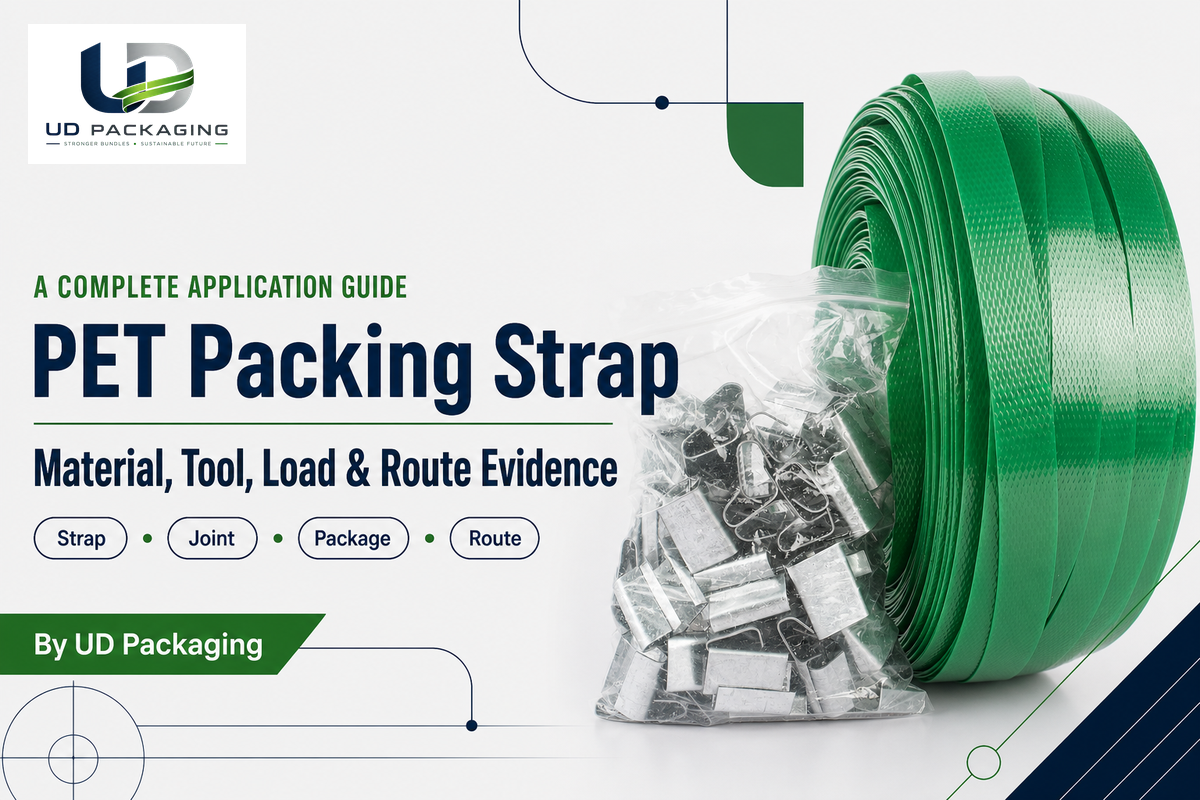
PET packing strap is just one element of a package-unitization system. A sound selection balances the material of the strap with the tool and joint, the load’s contact area, and the transport route, then validates the selection at multiple points in time.
Key takeaway
Do not buy a PET strap from a material name or break-strength line alone. Define the package, application equipment, joint, contact geometry, route exposure, measurement method, and acceptance evidence before choosing a commercial configuration.
That distinction is relevant because the components of the label on a coil describe the features of the material and the product. In contrast, the outcome of shipping is one element of a larger system. A strong polyester band, for example, can be combined with an incompatible feed path, a weak joint, a compressible carton stack, a sharp corner, or a route that was never incorporated in the test. Likewise, a field failure does not necessarily mean that the strap material is faulty.
This guide provides all stakeholders a common vernacular for making the decision. This guide does not publish a universal tension, weld time, temperature limit, load capacity, or replacement ratio. Those values depend on the documented strap, equipment, joint, load, environment, and test basis. The product dimensions and the details of the inquiry remain posted on the PET packing strap product page.
1. What PET Packing Strap Is, and What the Name Does Not Prove
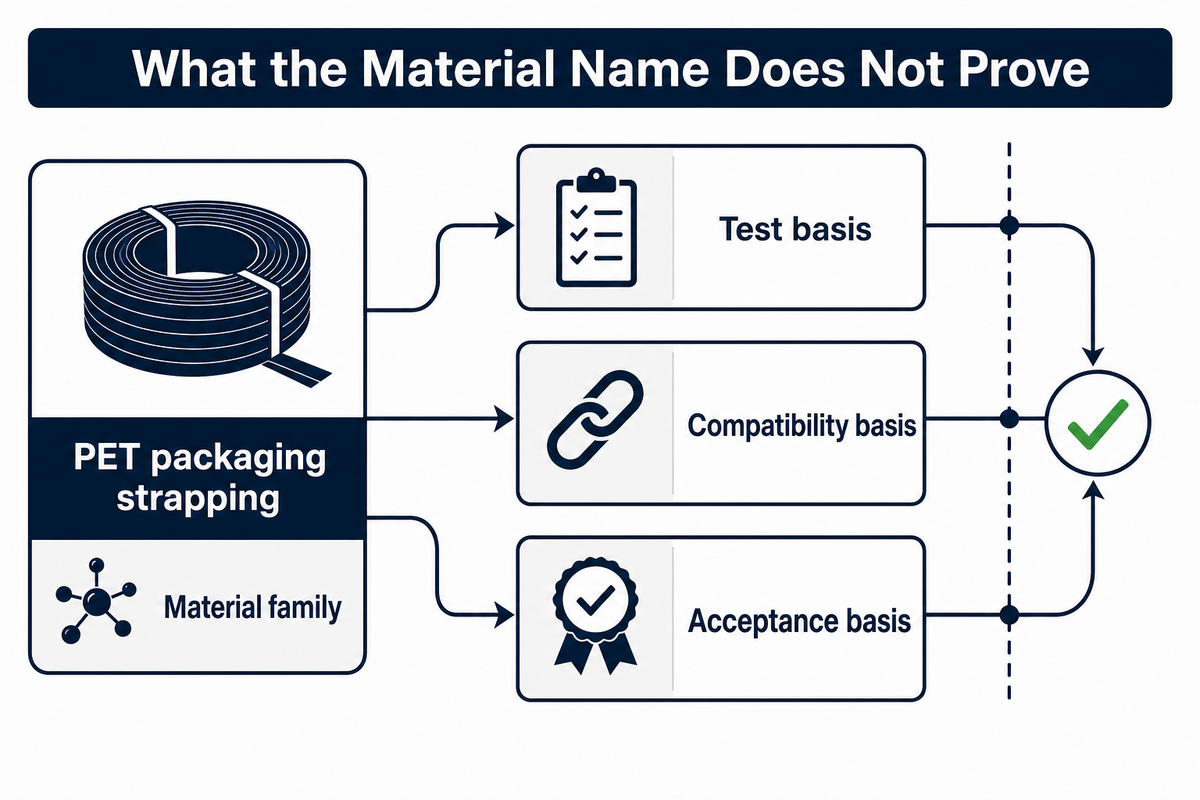
PET packaging strapping is a polyester banding material made from polyethylene terephthalate. It’s used for bundling articles or unitizing packages. The name describes a family of materials. Some buyers call it a PET packing belt, but that label still does not establish a specific product’s performance. It doesn’t provide a reference for the performance of a particular strapping coil, friction weld, metal seal tool cycle or pallet load or shipping unit.
Three factors make sure the name of the material isn’t an overclaim. First, there has to be a test basis for a supplier value. This basis includes specimen dimensions, conditioning, units, method, and whether the result describes raw strap or a completed joint. Second, the applied system needs a compatibility basis, which includes the tool or machine model, approved strap range, surface, feed behavior, and the joining method. Finally, the packed load needs an acceptance basis, which includes geometry, compressibility, edges, the direction of restraint, the staging time, and the manner in which the material is being handled.
ASTM D3950-23 covers nonmetallic strapping and joining methods and distinguishes properties such as breaking strength, elongation, transverse strength, and joint strength. That separation is useful for buyers because it blocks a common shortcut: treating one nominal number as proof of every other behavior. Citing the standard still does not prove that a supplier’s product conforms to it; matched reports or certificates must carry that burden.
Packaging unitization is also different from legal vehicle cargo securement. PET banding around cartons or a bundle isn’t automatically a rated tiedown. In the United States, the FMCSA cargo-securement rules and the governing federal cargo-securement regulations address the broader vehicle decision. Other jurisdictions and commodities can impose different requirements. When the question is whether freight is legally secured to a vehicle, leave the packaging decision and follow the applicable rules and qualified authority.
2. Use the Four-Layer PET Package-Unitization Model
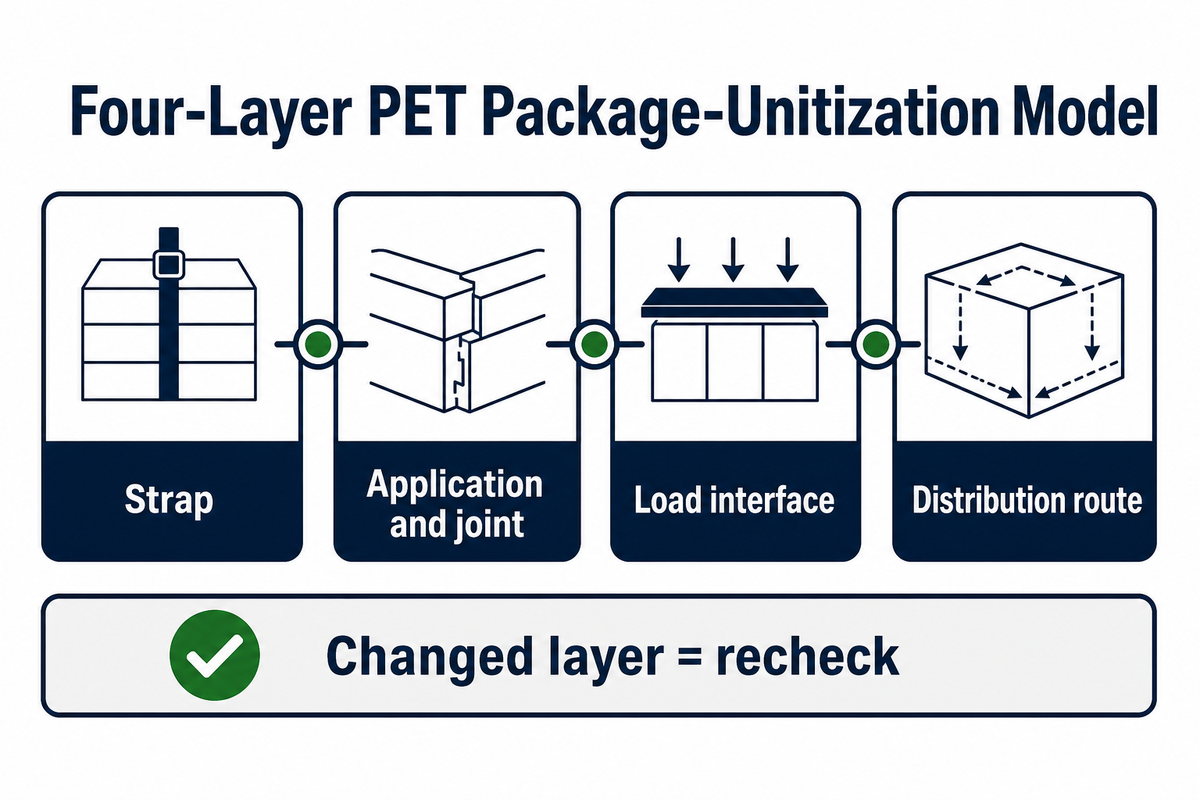
Packages depend on four connected layers for unitization. These layers are the strap, the application and joint, the load interface, and the distribution route, respectively. Nominal break strength belongs to the strap layer. The observation of tool condition, joint output, carton settlement, corner contact, forklifts, vibration, breaks, or how long the package waits before it’s released is beyond the description of break strength.
4-Layer PET Package-Unitization Framework
The Four-Layer PET Package-Unitization Model is an editorial decision framework, not a published standard. Its layers have owners, observable inputs, and evidence that can disprove first-order assumptions; a changed layer whose state has not been recorded leaves the trial open.
| Layer | Record | Evidence | Inference that fails | Owner |
|---|---|---|---|---|
| 1. Strap | Material, dimensions, finish, coil and lot | Label, certificate, measured dimensions, sample | PET means every coil performs alike | Supplier QA and procurement |
| 2. Application and joint | Tool, feed path, settings, overlap and joint method | Approved range, repeat cycles and joint samples | A machine display proves package force | Operations, maintenance and QA |
| 3. Load interface | Stack, pallet, edges, compression and strap path | Before and after geometry, contact marks and load condition | Weight alone defines restraint demand | Packaging engineering and operations |
| 4. Distribution route | Staging, handling, mode, climate and transfer points | Checkpoint observations and representative testing | A station-side pass proves every shipment | Logistics and release authority |
An RIT-hosted packaging study considers load build, pallet fit, restraint, and distribution movement in an interrelated way rather than in isolation. This approach helps to capture a system view without turning this four-level model into a universal law. If two levels change simultaneously, the impact doesn’t provide insight into which of the two levels caused the change.
Use a simple stop rule: don’t close application fit while an unrecorded layer differs between the approved trial and production. If the product, carton pattern, corner protection, tool, strap lot, storage interval, or route changes, identify what must be rechecked. A narrower conclusion is more useful than a confident statement with an invisible boundary.
3. Read Material Terms Without Treating Them as Interchangeable
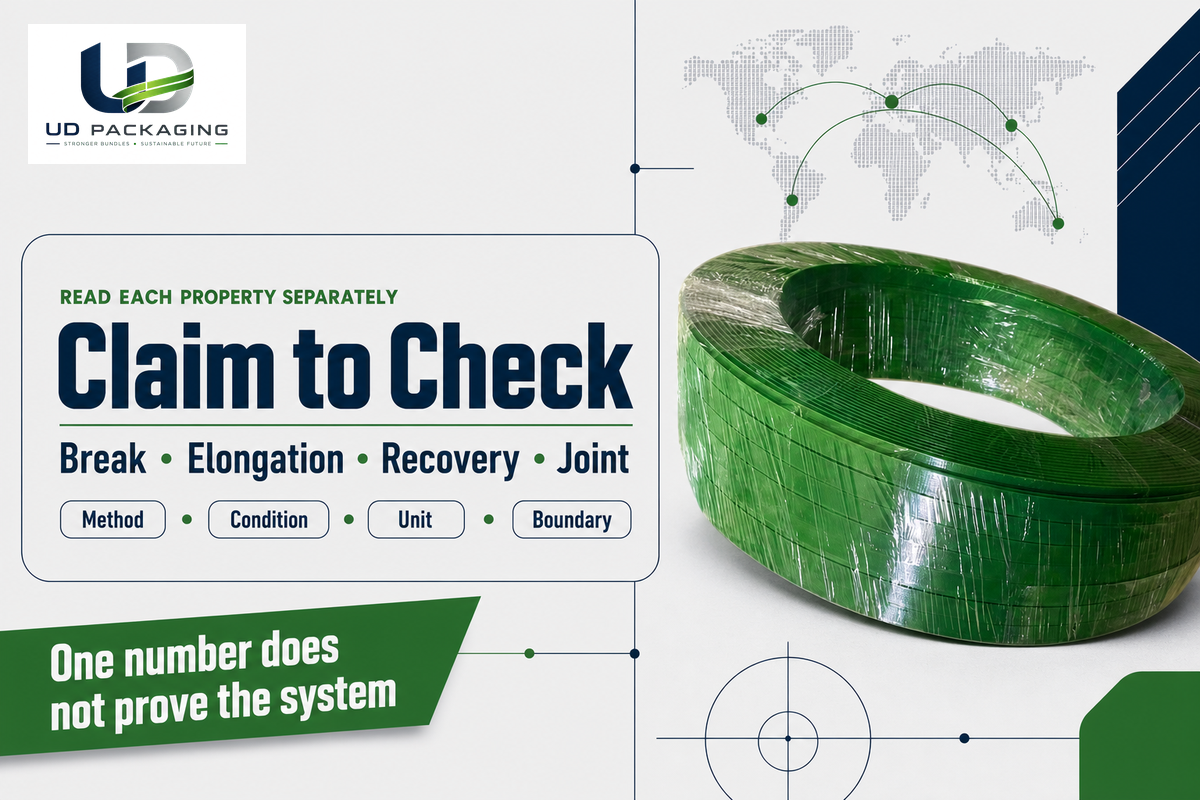
Break strength, tensile strength, elongation, elastic recovery, tension retention, and joint strength describe different properties or test outcomes. They’re related, but none is a universal substitute for another. A high break value can coexist with a weak joint, edge damage, poor retained restraint, or a tool that can’t process the chosen cross-section consistently.
Break strength describes the force at which a defined specimen breaks under a defined method. Tensile strength normally relates force to the specimen’s cross-sectional area, so width and thickness matter. Elongation describes extension under the stated test conditions. Elastic recovery concerns how much deformation is recovered after load changes, while tension retention asks what restraint remains over time and condition. Joint strength evaluates the joined system, not an unjoined strip.
The PET strapping patent literature provides circumstances where a method boundary is helpful by separating details concerning tension-retention, seal-efficiency, split-resistance, and simulated high-tension tests. That patent can’t speak to the achievements of UD Packaging products. It can, however, urge the proper reading discipline to understand that the tests have different objectives.
| Claim type | What to request | What it does not prove | Stop condition |
|---|---|---|---|
| High strength | Property, value, unit, dimensions and method | Joint output or route fit | Test basis missing |
| Good elongation | Conditioning, method and reported basis | Recovery or retained force | Compared values use different methods |
| Tension retention | Starting state, elapsed condition, method and result | Joint strength or route acceptance | Timing or condition is absent |
| Elastic recovery | Defined loading, unloading and measurement method | Package settlement response | Specimen basis is unclear |
| Strong joint | Joint method, tool, settings, samples and test | Raw strap performance | Tool or overlap is unspecified |
| Heavy-duty | Defined application and acceptance evidence | Universal load rating | No load or route boundary |
| UV resistance | Exposure method, duration, condition and acceptance result | Unlimited outdoor life | Route exposure exceeds the evidence |
| Moisture resistance | Condition, duration and package-system observation | Carton, label or joint performance | Complete package was not assessed |
| Steel alternative | Side-by-side application requirements and trial | One-for-one replacement | Temperature, edges or rules are unresolved |
When evaluating suppliers, keep the complete test basis beside each number. “Same break strength” isn’t a like-for-like comparison when a number of factors such as strap width, thickness, specimen conditioning, method, surface, and units may vary. A complete technical line may appear to the naked eye to be less presentable than a single marketing value, but it’s the only form procurement can audit.
For joint-method detail, consult the strapping joint strength guide. This article keeps the evidence boundary and avoids competing with the other page, which treats the topic in more detail.
4. Match PET Strap Behavior to the Load and Contact Geometry
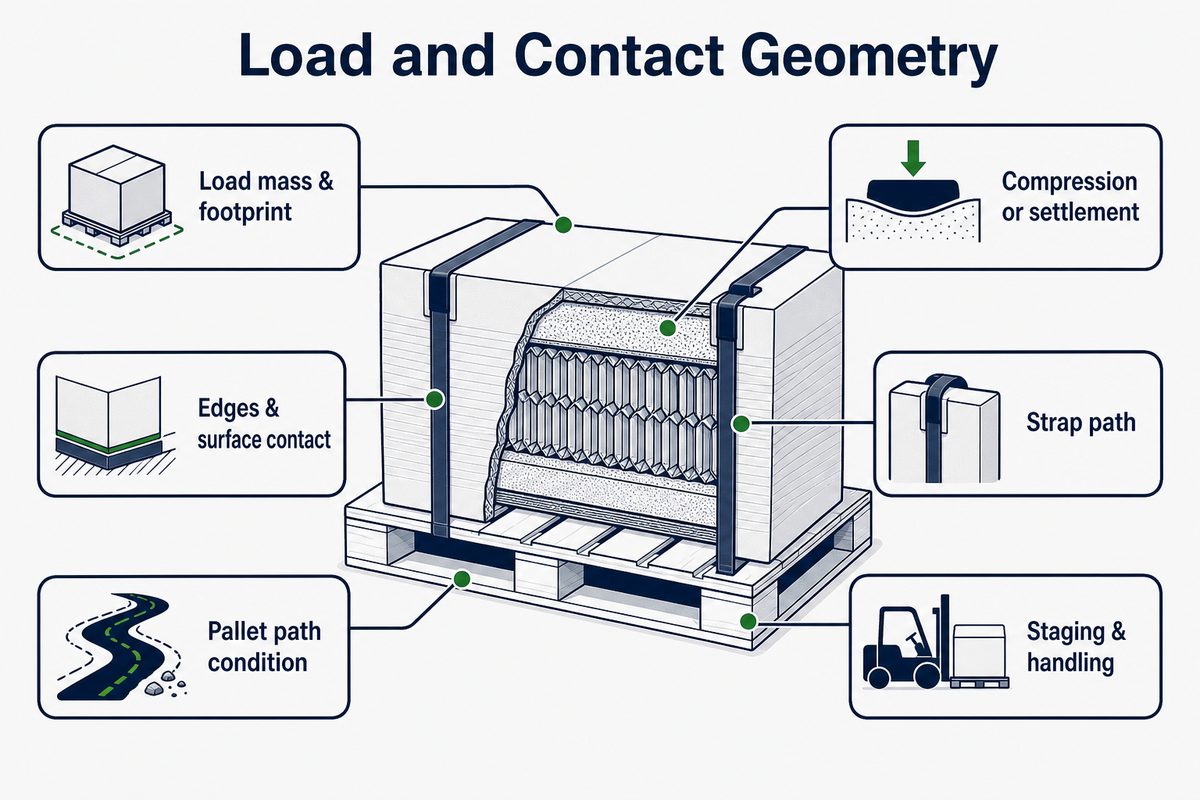
Different types of loads place varying demands on PET strapping. Load mass is only part of the story. It doesn’t articulate contact pressure, edge radius, loss in package height, migration of the strap, the direction in which a load is restrained, or behavior of the load during the handling process.
Let’s examine how packages change. Rigid bundles are capable of maintaining their perimeter, but can concentrate force at corners. Corrugated cartons are flexible and will compress, thus reduce the perimeter once the band is applied. Resilient packages, such as bales, will push back against a strap and settle. Packages with a long profile tend to twist or create contact points that are smaller than the profile. Drums and packages of irregular shape tend to move unless the package design is designed to control the movement. Products stored at elevated temperatures require documented temperature evidence. Use a documented temperature boundary rather than assuming that the material family supplies one.
Record for the application
- Load mass, footprint and stack pattern
- Compression or settlement over time
- Edges, corners and surface contact
- Strap path, count and restraint direction
- Pallet and under-pallet path condition
- Staging and handling checkpoints
Do not infer from
- Weight without geometry
- One immediate visual inspection
- A sharp edge without a protection decision
- A land trial for a marine route
- A different carton or pallet pattern
- A strap value without a joint basis
Inspect the strap path around the entire package for contact evidence. Check for localized flattening, abrasion, cutting, movement of the protection layer, a change in angle, or a path that moves toward a smaller perimeter. If the contact mark returns on one corner across multiple lots, geometry is a stronger lead than a general material complaint. If just one identified lot changes under a controlled load and path, both the suspect and control samples must be retained for the supplier.
Route scope must be explicit. ISO 10531 is a useful warning about external validity: a land-environment stability result should not be represented as proof for marine transport. Multimodal routes add transfers and hazard combinations. When sea exposure, unusual heat, severe edges, unstable geometry, or regulated restraint is outside the available evidence, route the application to packaging engineering and the appropriate authority.
5. Tool, Joint, and Strap Compatibility Form One Application System
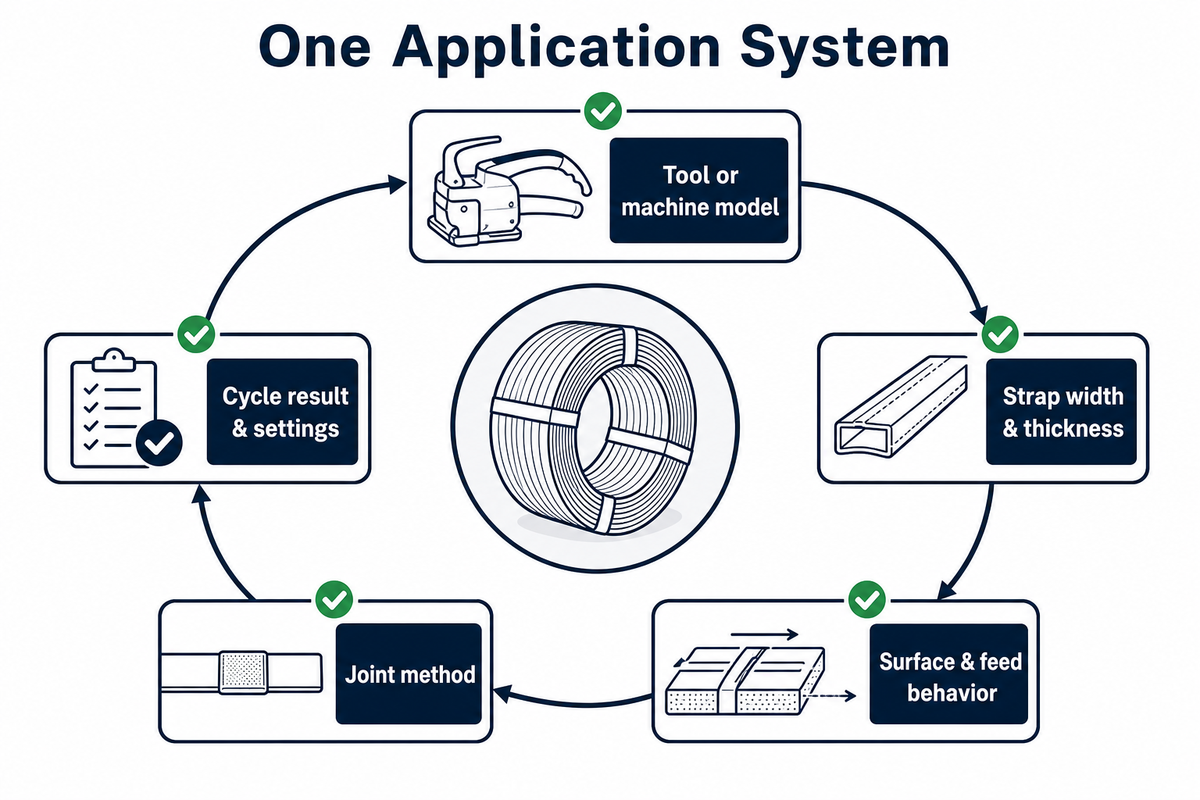
Connections, cuts, joins, feeds, and tensions of PET strap can be achieved with different tool varieties. Because the word “PET compatible” is simply a starting label, it doesn’t guarantee that the strap width, thickness, surface finish, core, winding, and cross-section would be able to run in a given piece of equipment.
The first step toward determining compatibility is the maker’s documented material and dimensional range. Then confirm the joint route: Verify the joint route is accomplished via friction weld, seal, buckle, or other approved method. Inspect the path of the strap, dispenser, guides, grippers, feed wheels, contact surfaces, cutter, and the relevant wear parts, as allowed by the approved maintenance program. Document the cycle result along with the settings. A photograph of the control panel might indicate the input is present but doesn’t demonstrate the force transferred to the package or retained after the package has been staged.
Measurement should have its own line. NIST measurement-process guidance separates repeatability, stability, calibration, and uncertainty; it is a measurement-method reference, not a PET strapping standard. If a change in gauge, fixture, operator method, or timing occurs, the difference may belong to the measurement process. Record the method and instrument state before using the result to change a strap specification.
Never take a weld time, tension setting, temperature, or service sequence from one model to another without factory authorization. Powered tools and machines can contain moving, heated, electrical, pneumatic, or stored-energy hazards. Follow the equipment supplier’s guarding instructions and directions to the operator. Services or entries into guarded zones must be performed by trained personnel under the site’s applicable energy-control procedure. OSHA’s hazardous-energy guidance explains why unexpected energization and release of stored energy requires control.
Operation detail belongs in the existing strapping machine guide and strapping tensioner guide. If the system already fails, use the PET packing strap troubleshooting guide before changing material.
6. Follow the Setting-to-Shipment Evidence Chain
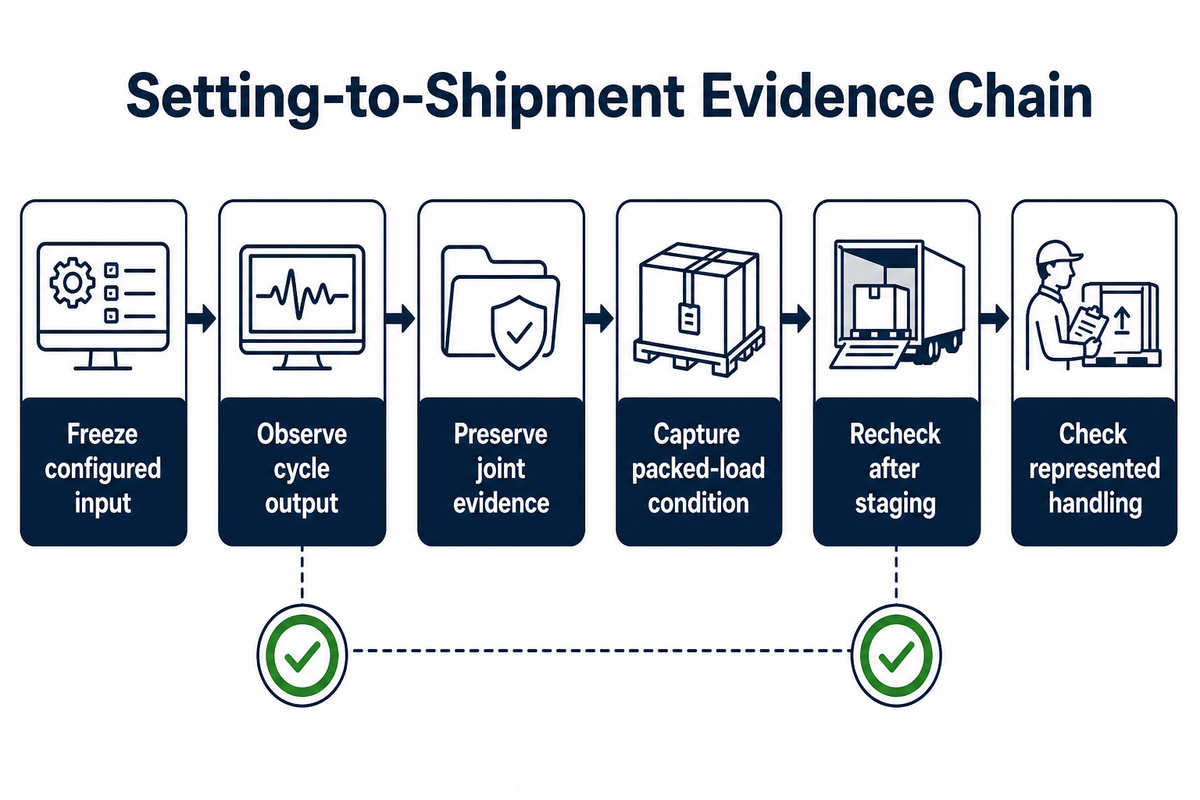
A displayed tool setting is an input. Evidence classes are applied tension, joint output, retained package condition, and post-handling restraint. The Setting-to-Shipment Evidence Chain links the input together without assuming that one station-side pass endorses each shipment.
This isn’t a universal legal requirement. This verification method is risk based. Other jurisdictions can make their own laws and determine different evidence and requirements for their side of the decision. Within packaging work, the chain helps teams see exactly where a conclusion stops.
- Freeze the configured input — record tool or machine identity, approved recipe or settings, strap identity, load family and operator method.
- Observe repeated cycle output — check feed, tensioning, overlap, joining and cutting across comparable cycles.
- Preserve joint and strap evidence — retain representative samples and record the applicable visual or test basis.
- Capture the packed-load condition — mark strap position, load height, contact points, pallet state and visible package deformation.
- Recheck after normal staging — use a defined interval and the same observation method to reveal settlement or movement.
- Check after represented handling — document the route or test scope, result, exceptions and acceptance owner.
ISTA test procedures distinguish screening, general simulation, and enhanced simulation according to purpose and represented distribution hazards. The label “passed vibration” is incomplete without the selected procedure, package configuration, conditioning, sequence, acceptance criteria, and intended route. ASTM D4332-22 likewise gives a formal boundary for conditioning packages or components before testing; it does not prescribe one plant-wide condition.
Timing is important when considering checkpoints. The joint may look entirely intact while the strap is shifting to a smaller perimeter. A tool may repeat its cycle, while the measurement process is beginning to drift. A pallet may be fine after passing through internal handling, but change due to the effect of a transfer point. Keep a record of the observation time and the current state.
If the extent of repeatability is unclear, the result should be called a screening observation rather than a validated cause. If multiple variables were changed, the comparison should be reset. NIST states that one-factor-at-a-time studies don’t elucidate interactions, and thus even a clean one-change trial has a limited answer when load compliance, joint formation, environment, and route can interact. For full validation of a proposed change, use the strapping changes in package testing guide.
7. PET, PP, or Steel: Keep the Comparison at the Decision Boundary
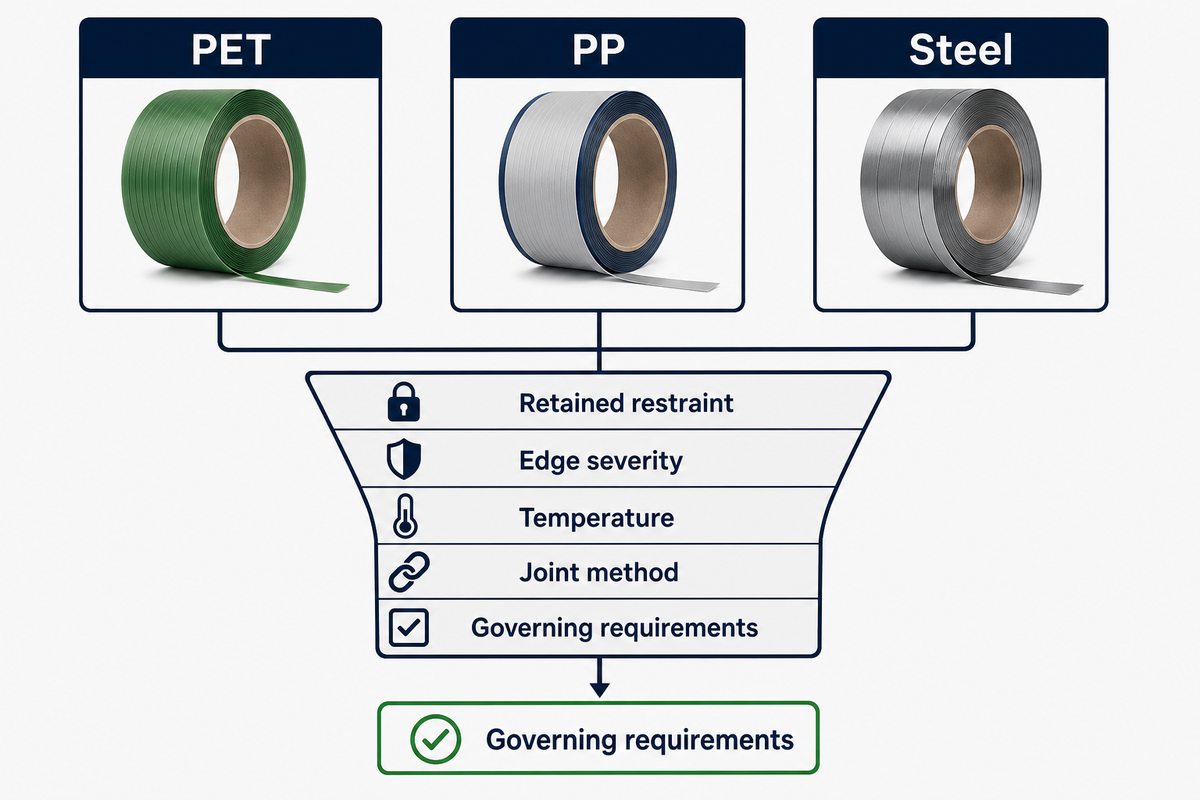
PET is usually assessed between PP strap that is employed on lighter packages, and steel strapping that is used when rigidity, sharp edges, high temperatures or special conditions overrule. This is a screening idea, not a general substitution rule.
Start the real comparison with the requirements of the application. These include retained restraint, loading rigidity and settlement, edge severity, handling mode, temperature, joint method, equipment, human exposure, and acceptance test. Headlines such as “alternative to steel” can’t satisfy these requirements. Further, equal nominal break strength doesn’t guarantee similar behavior at the joint or in a variable package.
If material substitution is the deciding factor, please refer to the dedicated PET vs PP strapping comparison or PET vs steel strapping comparison. We’ve purposely not repeated their comparison tables on this page. Engineering review remains appropriate when temperature, sharp edges, unusually rigid loads, route exposure, or governing requirements sit outside the documented application evidence.
8. Qualify Recycled Content and Recyclability Claims Separately
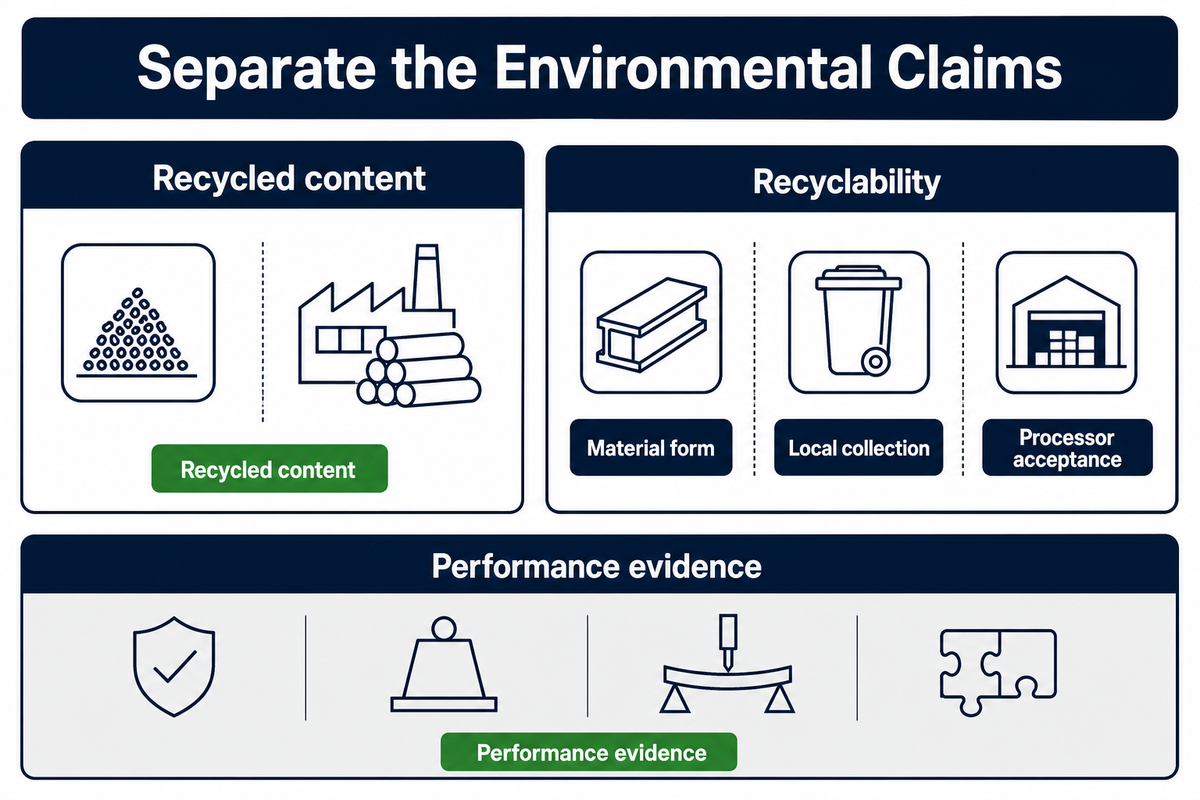
Recyclability is an end-of-use claim shaped by design, contamination, collection, sorting, markets, and local program acceptance. A green PET strapping coil with a recycling symbol or a statement of recycled content doesn’t ensure that the buyer has a viable recovery route.
According to the FTC’s environmental claims guidance, broad, unqualified environmental-benefit statements can be difficult to substantiate. For recycled content, request the percentage basis, material type, supplier declaration or certificate, lot or product scope, and verification. For recyclability, provide the exact material form, attachments or contaminants, jurisdiction, collection route, processor or program, and current acceptance criteria.
| Claim wording | Evidence to request | Disqualifier or boundary |
|---|---|---|
| Recycled content | Percentage basis, scope, declaration and covered product | No traceable basis or unclear mass boundary |
| Recyclable | Material form, local collection and current processor acceptance | Program absent, contamination or incompatible attachments |
| UV resistant | Test method, exposure, duration and acceptance result | No exposure basis or application exceeds it |
| Moisture resistant | Defined condition and package-system observation | Claim ignores labels, cartons, joints or route |
| Steel alternative | Matched load, tool, joint, temperature, edge and route evidence | Universal replacement wording |
| Heavy-duty | Defined application, method, result and acceptance owner | No measurable definition |
For design-for-recycling questions, the Association of Plastic Recyclers Design Guide is a good starting point, but one needs to confirm local collection and processor acceptance. The site offers a more detailed PET recyclability guide.
Keep performance evidence separate as well. Recycled PET materials can be used in polyester strapping, but a feedstock claim does not establish width control, break result, joint behavior, or package performance for a specific product. These require their own test and application data.
9. Turn the Evidence Into a Specification Handoff
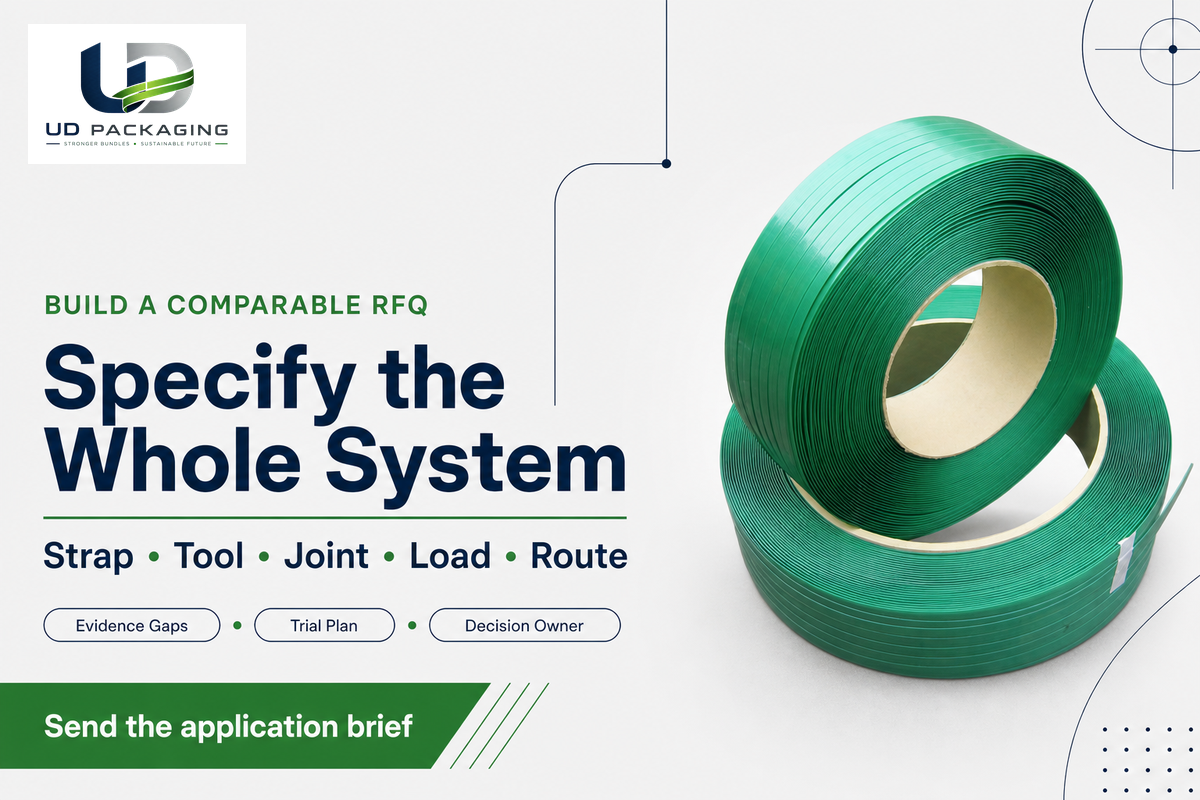
In evaluating potential PET strap supply offers, a documented application brief is more useful than a guessed stock keeping unit (SKU). Searching for “PET packing strap near me” can narrow a supplier list, but it does not replace that application brief. When every supplier receives the same load, equipment, joint, route, and acceptance criteria, procurement can evaluate offers without evaluating a different assumption as a better supply offer.
Describe the product and package by mass, geometry, dimensions, temperature, and settling time; identify existing equipment and joining routes by make, model, approved range, feed path, automation level, joint method, and relevant coil format; and state strap requirements by material, width, finish, thickness, core, winding, traceability, and intended test.
State the question concerning the distribution. List storage and staging requirements, steps in handling the loads, modes of transport, transfers, exposure of the loads to the environment, and any peculiar requirements of jurisdictional or commodity nature. State the trial boundary, measurement method, sample plan, checkpoints, acceptance criteria, exceptions, and decision owner. Mark every unknown as an evidence gap rather than filling it with a supplier’s promise.
Nine fields for a comparable supplier handoff
- Load and package geometry
- Compression, settlement and contact edges
- Current tool or machine
- Joint method and process boundary
- Strap dimensions, finish, coil and traceability
- Staging, handling and route profile
- Measurement and test methods
- Acceptance criteria and exceptions
- Evidence gaps, trial plan and decision owner
Don’t respond to unresolved field failures by purchasing stronger straps. Decide if the failure was due to material, equipment, joint, load, measurement, or routing. The troubleshooting workflow preserves failure-source isolation and makes supplier escalation cleaner.
Once the brief is done, check PET packing strap options for the application described. UD Packaging manufactures PET strapping from granulation to finished reels, and their public background is available on the About UD Packaging page. When selecting a product, evidence from the application is still more important than the company description.
Have a documented PET strapping application?
Share the load, equipment, joint, route, required evidence, and unresolved fields together. Include the tool or machine model, strap dimensions, joint method, staging time, and acceptance criteria. The UD Packaging team can review the material and configuration branch without guessing at your package system.
10. Frequently Asked Questions
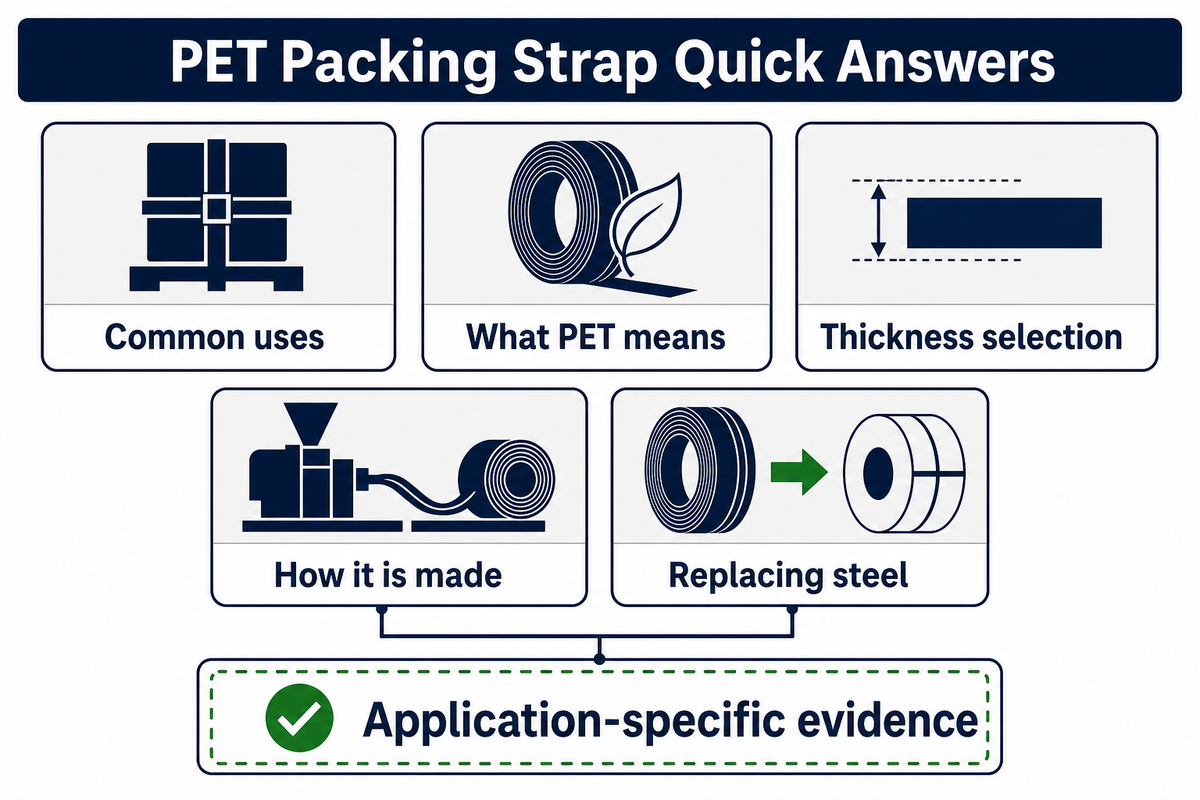
These answers address frequently asked questions while maintaining the same confines of evidence: the PET name doesn’t refer to a universal decision for application.
What is PET packing strap used for?
PET packing strap is commonly evaluated for medium- to heavy-duty bundles, cartons, and palletized loads when the complete package system suits polyester behavior under a documented application boundary.
PET packing strap is commonly evaluated for medium- to heavy-duty bundles, cartons, and palletized loads when the complete package system suits polyester behavior. “Used for” is not the same as “qualified for.” Confirm load geometry, edge condition, settlement, tool and joint compatibility, route exposure, and the acceptance method before selecting a commercial configuration.
What does PET mean in PET strapping?
PET means polyethylene terephthalate, the polyester material family used to make the strap; the material name alone does not provide a universal load or application rating.
PET means polyethylene terephthalate, the polyester material family used to make the strap. The name is not a load rating. Two PET straps can differ in dimensions, surface, grade, recycled content, process consistency, and test results. Compare like-for-like evidence and the intended tool and joint system rather than treating the PET label as a full specification.
What is the thickness of PET strap?
PET strap comes in multiple thicknesses, and thickness must be selected with width, surface, coil format, tool range, joint method, and load evidence for the actual package.
PET strap comes in multiple thicknesses, and thickness must be selected with width, surface, coil format, tool range, joint method, and load evidence. A thickness number without its tolerance and application context does not prove break strength or retained restraint. Use verified supplier dimensions and a documented trial for the exact system.
How is PET strap manufactured?
Manufacturing PET strap generally converts prepared PET feedstock into an extruded, oriented, finished, inspected, and wound band before it is qualified for a specified application.
Manufacturing PET strap generally converts prepared PET feedstock into an extruded, oriented, finished, inspected, and wound band. Feedstock preparation, drying, extrusion, orientation, cooling, surface finishing or embossing, heat setting where applicable, inspection, and winding controls vary by producer. Manufacturing claims should therefore be tied to traceability, process control, and matched test evidence.
Can PET strap replace steel strapping?
PET can replace steel in some documented applications, but there is no universal one-for-one replacement rule because load, joint, temperature, edge, route, and governing requirements still control the decision.
PET can replace steel in some documented applications, but there is no universal one-for-one replacement rule. Compare temperature, edge severity, load rigidity, required retained restraint, joint method, handling route, equipment, worker exposure, and governing requirements. Check whether the current steel system supplies package unitization, vehicle tiedown, or both, because those functions cannot be exchanged casually. Record the joint route and edge protection, then run the candidate through a representative package and handling trial with defined acceptance criteria. High heat, very sharp edges, unusually rigid loads, and special transport rules may keep steel or another engineered restraint in scope. Use the dedicated PET-versus-steel guide for the detailed decision.
Decision Scope and Evidence Boundary
UD Packaging manufactures PET strapping and related industrial packaging materials and equipment. This article deliberately separates material claims from joint, load, measurement, and route evidence, and it doesn’t substitute invented plant results for application testing.
References & Sources
- ASTM D3950-23, Standard Specification for Strapping, Nonmetallic, and Joining Methods ASTM International
- Load Securement and Packaging Methods Journal of Applied Packaging Research, Rochester Institute of Technology repository
- NIST/SEMATECH Engineering Statistics Handbook: Measurement Process National Institute of Standards and Technology
- One Factor at a Time and Interaction Limits NIST/SEMATECH Engineering Statistics Handbook
- ISTA Test Procedures International Safe Transit Association
- ASTM D4332-22, Conditioning Containers, Packages, or Packaging Components for Testing ASTM International
- Environmental Claims: Summary of the Green Guides U.S. Federal Trade Commission
- APR Design Guide Overview Association of Plastic Recyclers
- Cargo Securement Rules Federal Motor Carrier Safety Administration
- ISO 10531 Packaging: Complete, Filled Transport Packages, Stability Testing of Unit Loads International Organization for Standardization