Get in touch with UD Packaging Company

Updated August 2026
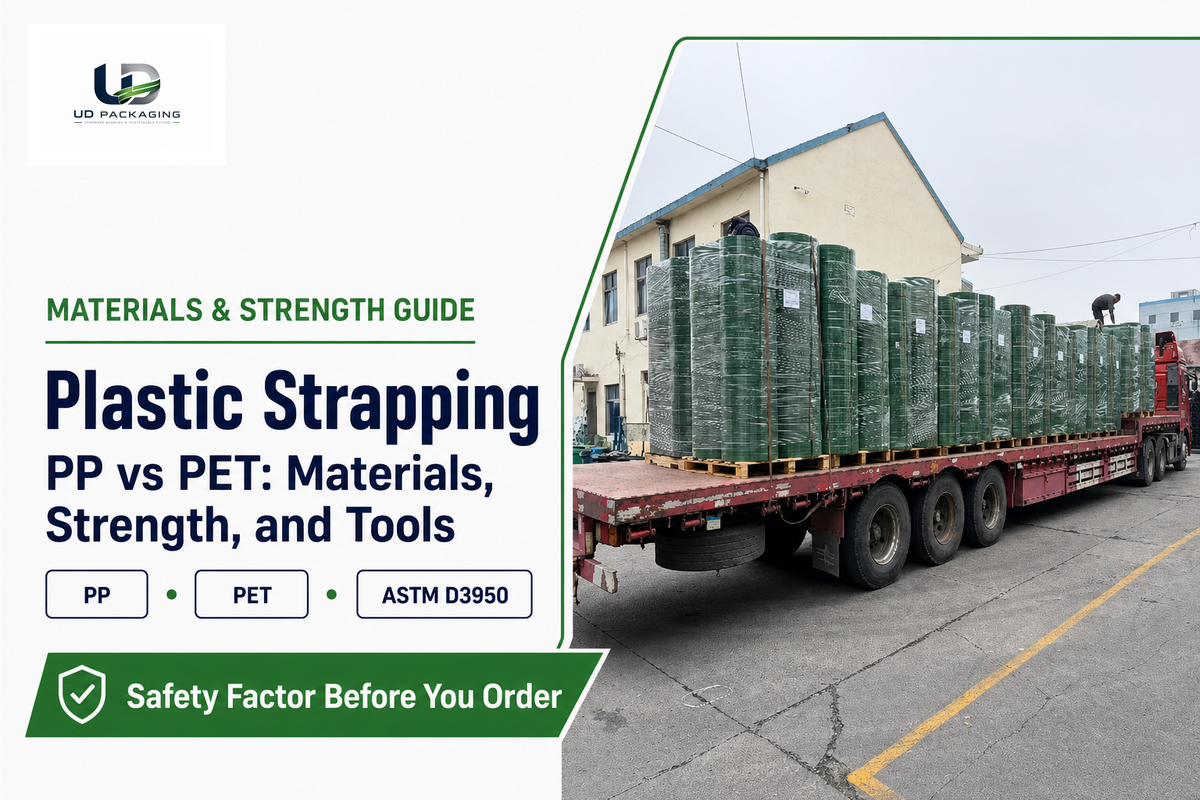
Plastic strapping is the flexible, non-metallic banding that holds pallets, cartons, and bundled goods together during shipping and storage — and choosing the wrong grade, material, or tool for a load is one of the more common ways a shipment arrives damaged. This guide works through what plastic strapping is made of, how to pick polypropylene versus polyester (PET), how much weight a given strap can realistically carry, which tool fits your volume, and the standard that actually governs the material so you can catch a mismatched test report before it costs you a claim.
Quick Specs
| Governing standard | ASTM D3950 (nonmetallic strapping) |
| Common materials | Polypropylene (PP), Polyester (PET) |
| Joint methods | Friction-weld, heat-seal (not a crimped metal buckle) |
| Typical elongation | PP ~18–34% · PET ~10–12% (illustrative, vendor-published) |
What Is Plastic Strapping?
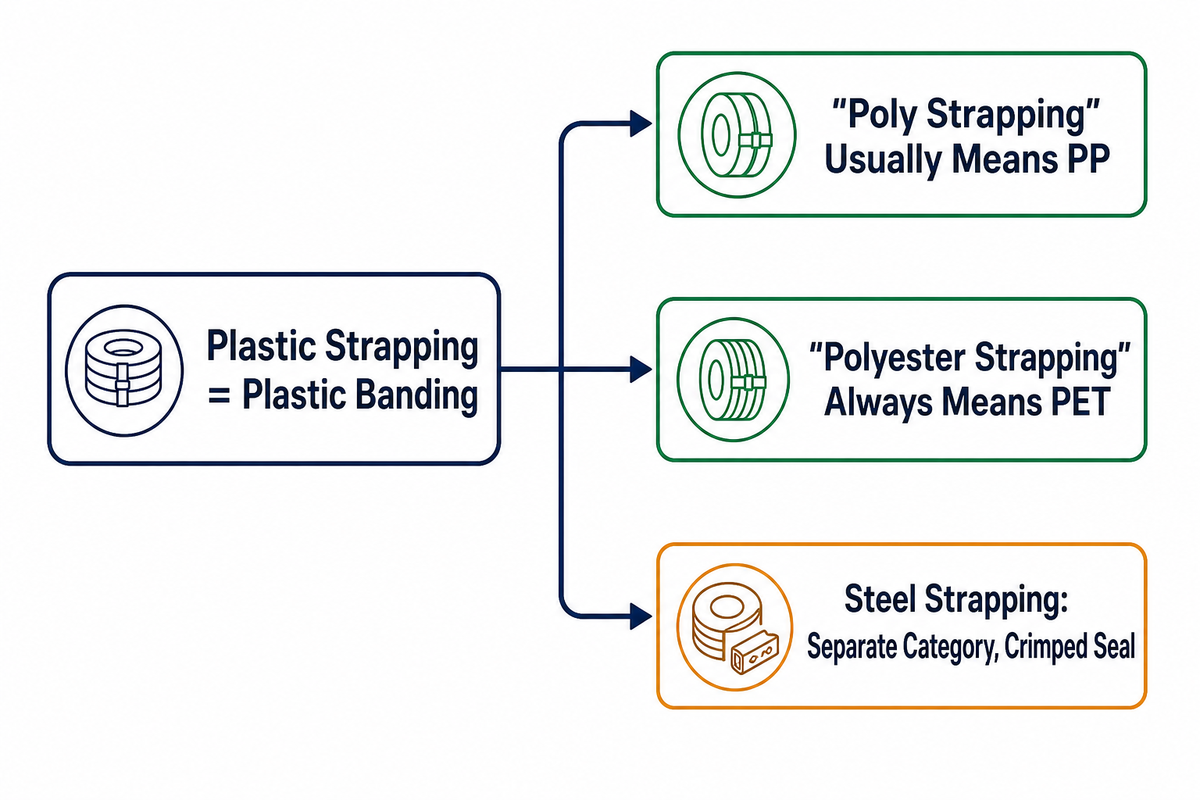
Plastic strapping is a coiled, non-metallic band — typically polypropylene or polyester resin — that gets tensioned around a load and joined at the ends to bundle, secure, or unitize goods for shipping and storage; it’s recognized as its own distinct product type in public procurement records such as the Florida Department of Transportation’s materials catalog.
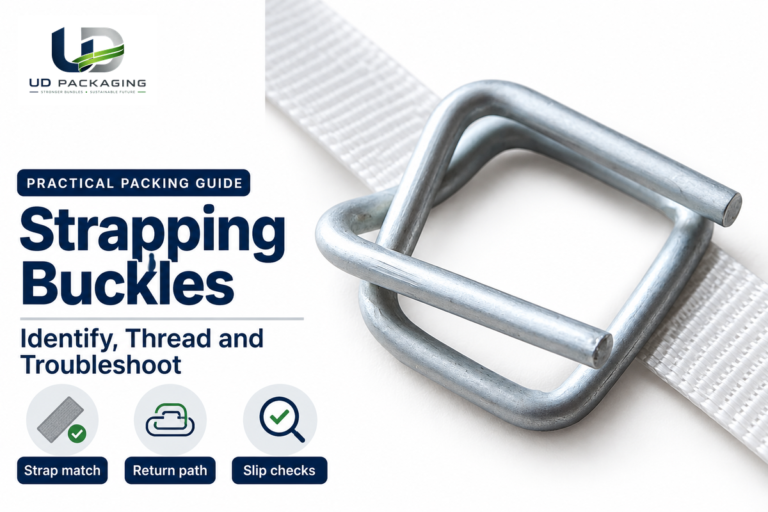
The material is also commonly sold as “plastic banding,” and most suppliers use the two terms interchangeably, so a search for one will usually turn up the other. What sets it apart structurally from steel strapping is the joint: plastic strap ends are friction-welded or heat-sealed together, melting the two layers into one bond, rather than crimped with a separate metal seal.
Buyers new to the category often assume “plastic strapping” is a single product. It isn’t — it’s a family that splits first by resin (polypropylene versus polyester), then by grade (hand versus machine), then by surface finish (smooth versus embossed), each of which changes which tool and joint method actually works. The rest of this guide walks through that decision tree in order: material, construction, strength, tools, application, standards, and the mistakes that show up most often when one of those variables gets skipped.
Naming gets loose at the retail end of the category, too. The same product turns up across supplier catalogs as plastic strapping, plastic banding, and — on a few less careful listings — the combined “strapping banding,” but all three describe the same product family. Buyers just getting started often reach for a plastic strapping kit — a tensioner, a sealer, and a roll bundled as one packing solution — before scaling up to a dedicated machine; there’s no direct steel equivalent to that starter bundle, since steel strapping needs a separate crimping tool entirely rather than a friction-weld or heat-seal head.
How Plastic Strapping Is Made
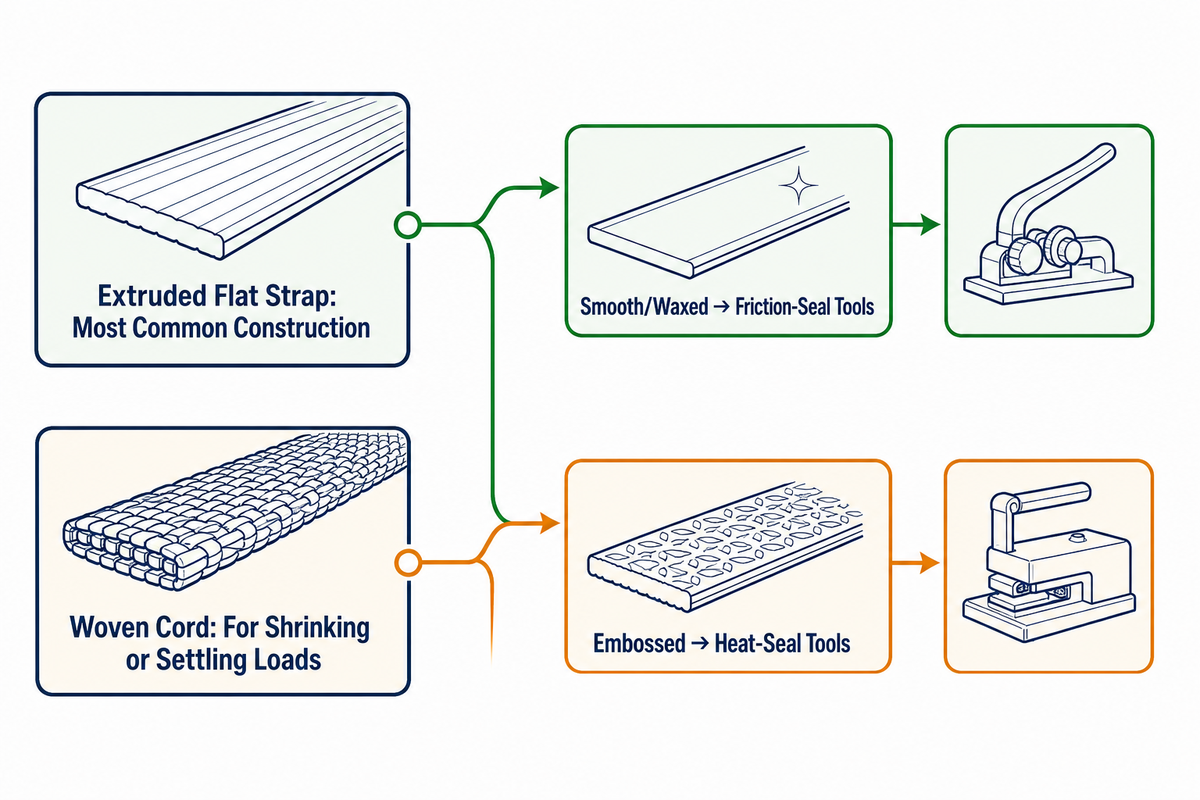
Plastic strapping reaches the market through one of two distinct manufacturing routes — extruded flat strap or woven cord — and the route changes how the strap behaves under load, a distinction that falls inside the “joining methods” scope of ASTM D3950. Extrusion produces the flat, ribbon-like strap most buyers picture; woven construction produces a rounder, rope-like cord used mainly where a shrinking or settling load needs sustained tension over time.
Knowing which construction you’re holding matters before you compare specs, because a woven cord and an extruded flat strap of the same nominal width aren’t interchangeable in the same tensioning tool. Woven construction also uses a noticeably tighter weave than flat extruded strap, which is part of why a cord holds up better under sustained settling load; a worn or nearly-exhausted cord roll can sometimes be spliced onto a fresh one in the field, a repair that isn’t really practical with flat strap.
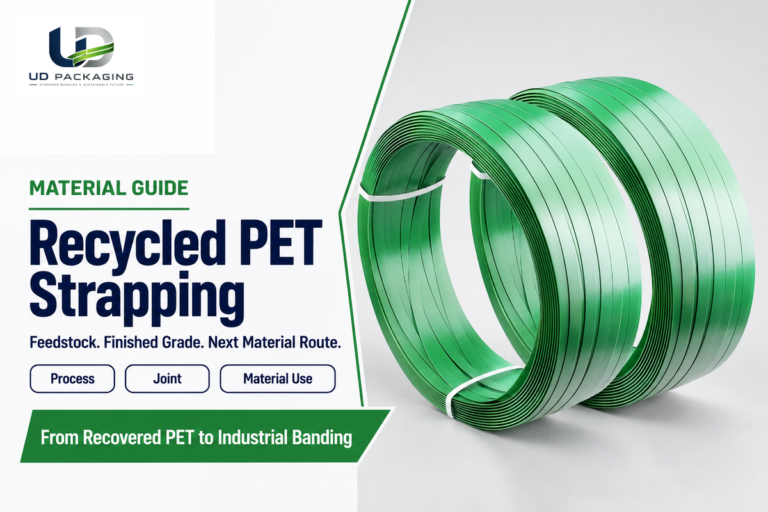
Strapping rolls — most buyers just call them coils, though “roll” shows up plenty in supplier listings too — are wound to a set length per roll, with width commonly running 3/8 inch to 3/4 inch and thickness typically in the 20 to 50 mil range for standard-duty straps. Always check the actual spec sheet for the exact linear footage on a given roll, since it varies by width, thickness, and core diameter — most rolls ship on an 8 inch or 16 inch core, and mismatching core size to your dispenser is its own avoidable headache alongside running out mid-pallet. Coils are also often color-coded by supplier — green, yellow, and black show up regularly on the shelf — but color is a vendor convention, not an ASTM-defined grade indicator; what actually matters for a shipment is a tough, corrosion-resistant material correctly matched to the load, not the color of the coil.
Surface finish is the second manufacturing variable, and it isn’t cosmetic — it’s a joining-equipment decision. Strap surfaces come smooth (often waxed) or embossed. Smooth, waxed strapping is built to run through friction-seal equipment, where the tool spins the overlapping ends against each other to generate melt-bond heat. Embossed strapping is built for heat-seal equipment, where the embossing pattern gives the strap more rigidity for feeding and a faster, more even weld. Ordering the wrong surface for the tool on your line is a common, avoidable mismatch.
Polypropylene vs. Polyester (PET) Strapping — Choosing the Right Material
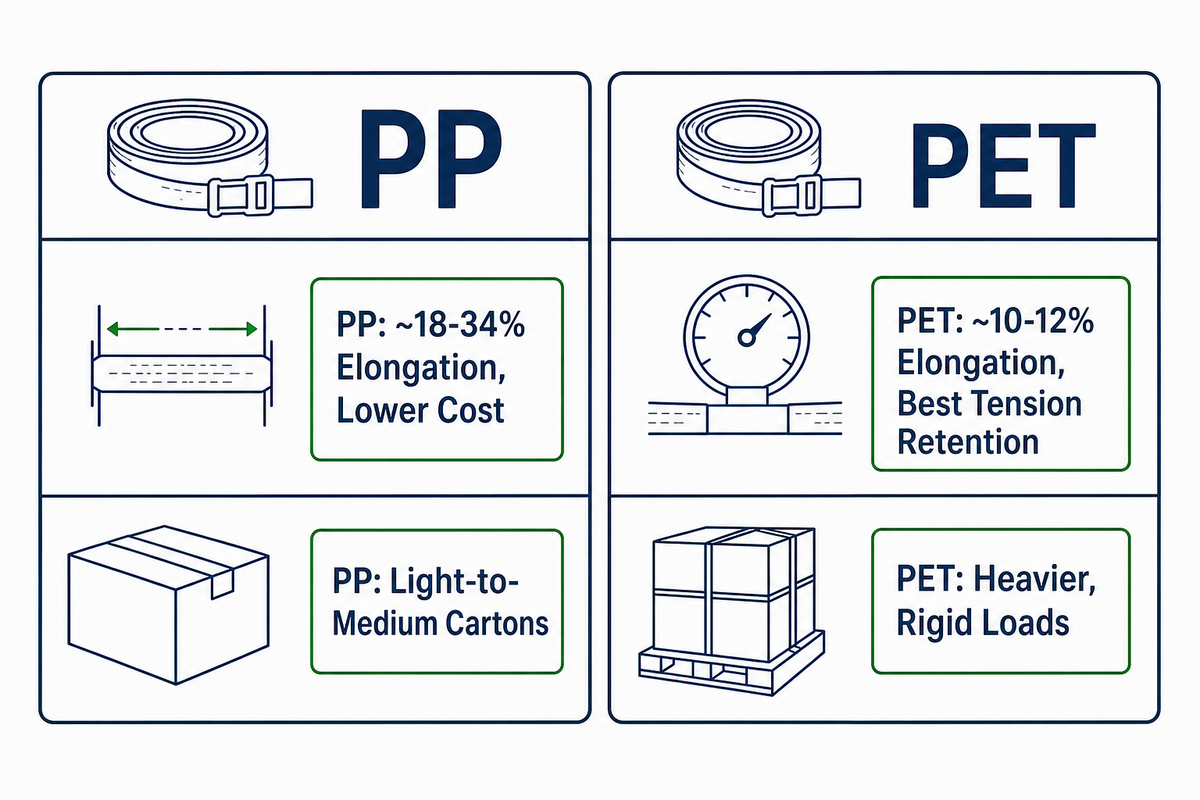
Polypropylene strapping (PP strapping) and polyester strapping are not interchangeable by name alone: PP costs less and stretches more under shock, while PET holds tension longer and handles heavier, more rigid loads — the right pick depends on load weight, storage duration, and budget, not on which one a supplier happens to stock. ASTM D3950 classifies these materials into five distinct types precisely because they are not interchangeable, each carrying its own required values for breaking strength, elongation, and joint strength. Except for steel, polyester has the highest retained tension of any strapping material, which is why it has been steadily displacing steel on medium-to-heavy unitizing jobs where corrosion resistance and worker safety also matter. Polypropylene, in contrast, is the more economical choice for light-to-medium bundling — it flexes more, so it absorbs shock better on lighter loads, but it loses initial tension faster than PET once applied. Part of that gap comes down to elastic recovery: PP’s higher elongation also means it recovers more of its stretch after the initial pull, which is exactly the mechanism behind its faster tension loss.
| Property | Polypropylene (PP) | Polyester (PET) |
|---|---|---|
| Elongation | ~18–34% (illustrative, vendor-published) | ~10–12% (illustrative, vendor-published) |
| Tension retention | Lower — loses tension faster after application | Highest among nonmetallic straps |
| Relative cost | Lowest | Higher |
| Best fit | Light-to-medium cartons, hand or arch machines | Heavier, rigid loads: brick, lumber, metal coils |
Figures are vendor-published and directional, not from a single cited ASTM test method — confirm exact numbers on your supplier’s own test report before treating them as a firm spec.
A widely searched question this comparison rarely answers directly: does anyone publish enough data to actually choose between them without guessing? None of the suppliers ranking for “how to choose plastic strapping” publish their own comparative specification data — the field is generic marketing copy, not a real material-decision table. That gap is exactly what the table above and the load matrix in the next section are built to close.
Break Strength, Width, and Thickness — How Much Weight Can It Hold?
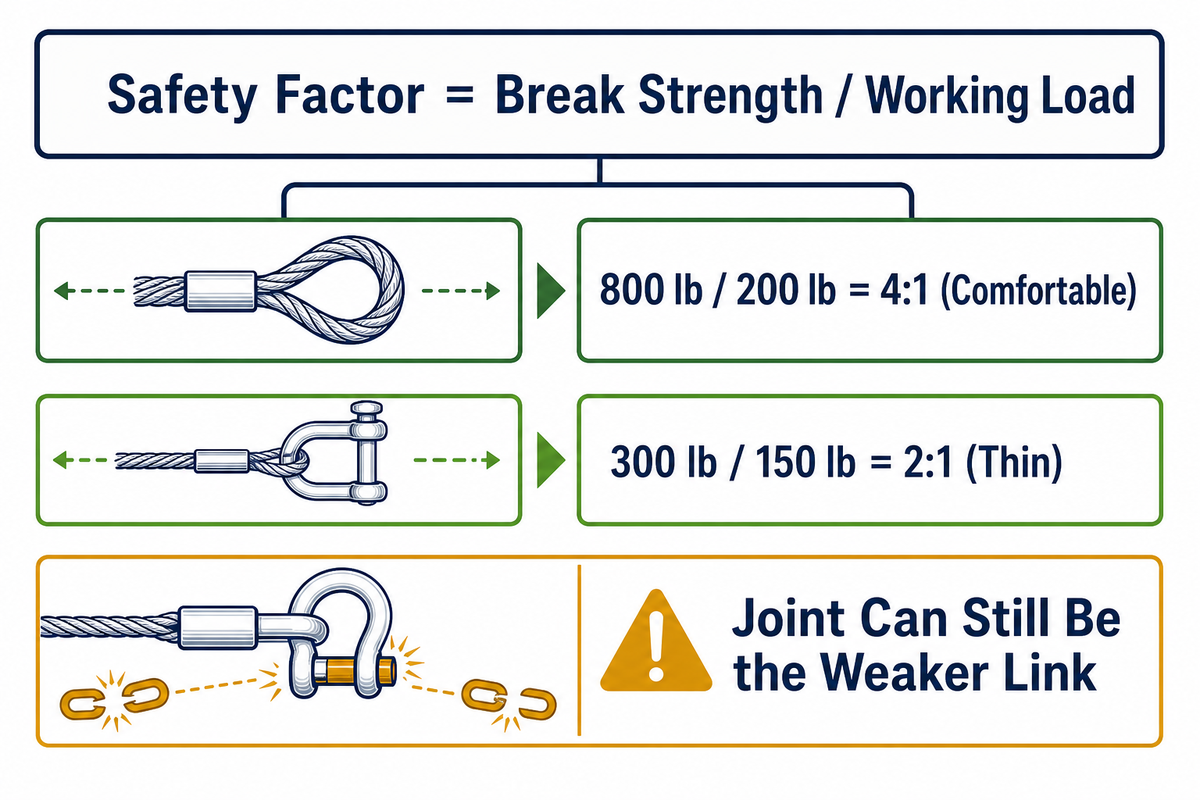
How much weight plastic strapping can hold depends on material, width, and thickness together — not on any one spec in isolation — and the number that actually protects a shipment is the working Safety Factor, not the strap’s raw break strength. ASTM D3950 sets minimum breaking-strength values by strapping type, but a published minimum is a floor for the material, not a system-level safety rating.
Safety Factor is calculated as Break Strength ÷ Working Load: a strap rated at 800 lb applying to a 200 lb working load gives a 4:1 safety factor, a comfortable margin for most general shipping. A strap rated well above the load weight can still be the wrong choice if the joint, not the strap body, turns out to be the weaker link — which is why break strength alone never fully answers the question.
The same arithmetic runs thinner in the other direction. Tension a 500 lb-rated strap around a 250 lb load and the ratio drops to just 2:1 — workable for a short, single-leg haul, but well under the 3:1 to 5:1 margin many shippers target once multi-stop transit and re-stacking risk enter the picture. Swap in a 1,200 lb-rated strap on that same 250 lb load, by contrast, and the margin opens up to roughly 4.8:1 with real room to spare if the load shifts slightly in transit — the illustration is purely arithmetic, not a claim about any specific product’s rating, but it shows why “rated well above the load” is the safer default whenever the extra cost is small relative to the shipment’s value. Three more reference points along that same curve: 300 lb over a 150 lb load is 2:1 (thin), 600 lb over a 150 lb load is 4:1 (comfortable), and 1,000 lb over a 200 lb load is 5:1 (generous headroom worth paying for on fragile or high-value freight).
Load-to-Material Matrix
Nominal strap break strength is not the same thing as your assembled package’s working capacity. Joint strength, applied and retained tension, load geometry, friction at contact points, and edge protection all affect what a strapped load can actually survive in transit — ASTM D4675 frames its guidance explicitly as a starting point for testing your specific configuration, not an application-specific answer. Use the table below to size a starting point for pallet strapping or any other bundled load, then confirm on a representative test load before committing to a production run.
| Working load range | Suggested material | Typical width | Grade | Limitations / not suitable for |
|---|---|---|---|---|
| Light cartons, <150 lb | PP | 3/8″ | Hand | Not for loads with sharp edges or long transit storage |
| Light-medium cartons, 150–250 lb | PP | 3/8″–1/2″ | Hand | Not for loads expected to settle or compress after strapping |
| Medium cartons/light pallets, 250–400 lb | PP | 1/2″ | Hand or semi-auto | Not for loads needing sustained tension over weeks of storage |
| Standard pallets, 400–600 lb | PET or heavy-duty PP | 1/2″–5/8″ | Machine or semi-auto | Not suitable without edge protection on unprotected corners |
| Standard-to-heavy pallets, 600–800 lb | PET | 1/2″–5/8″ | Machine | Re-check tension if the load shifts or settles mid-transit |
| Heavy pallets, 800–1,200 lb | PET | 5/8″–3/4″ | Machine | Not a substitute for metal strapping on sharp-edged loads |
| Heavy bundled goods, 1,200–1,600 lb | PET, heavier gauge | 3/4″ | Machine | Confirm on a representative test load before a production run |
| Shrinking or settling loads (lumber, textile bales), any weight tier above | PET woven cord | 1/2″–3/4″ | Machine | Not the flat-extruded default — needs a tool rated for cord, not flat strap |
| >1,600 lb or sharp/heavy metal loads | Consider steel | — | — | See note below — plastic strapping has real limits here |
Ranges are illustrative starting points assembled from vendor-published spec sheets (e.g. strapsolutions.com) and this guide’s Safety Factor framework, not a single cited ASTM test table — always confirm the exact break strength and elongation on your supplier’s test report before finalizing a spec, and test the assembled strap-joint-tool combination on a representative load, not just the strap in isolation.
When Plastic Strapping Isn’t Enough — A Brief Note on Metal Strapping
For very heavy, sharp-edged, or hot-cargo loads, steel strapping remains the highest-strength option — it holds the tightest initial tension and resists corner damage better than any nonmetallic material, though it lacks plastic strapping’s corrosion resistance, flexibility, and worker-safety profile. That trade-off is a topic on its own; this guide covers plastic strapping selection, not a full plastic-versus-steel comparison.
Tools and Application Methods — Tensioners, Sealers, and Joint Types
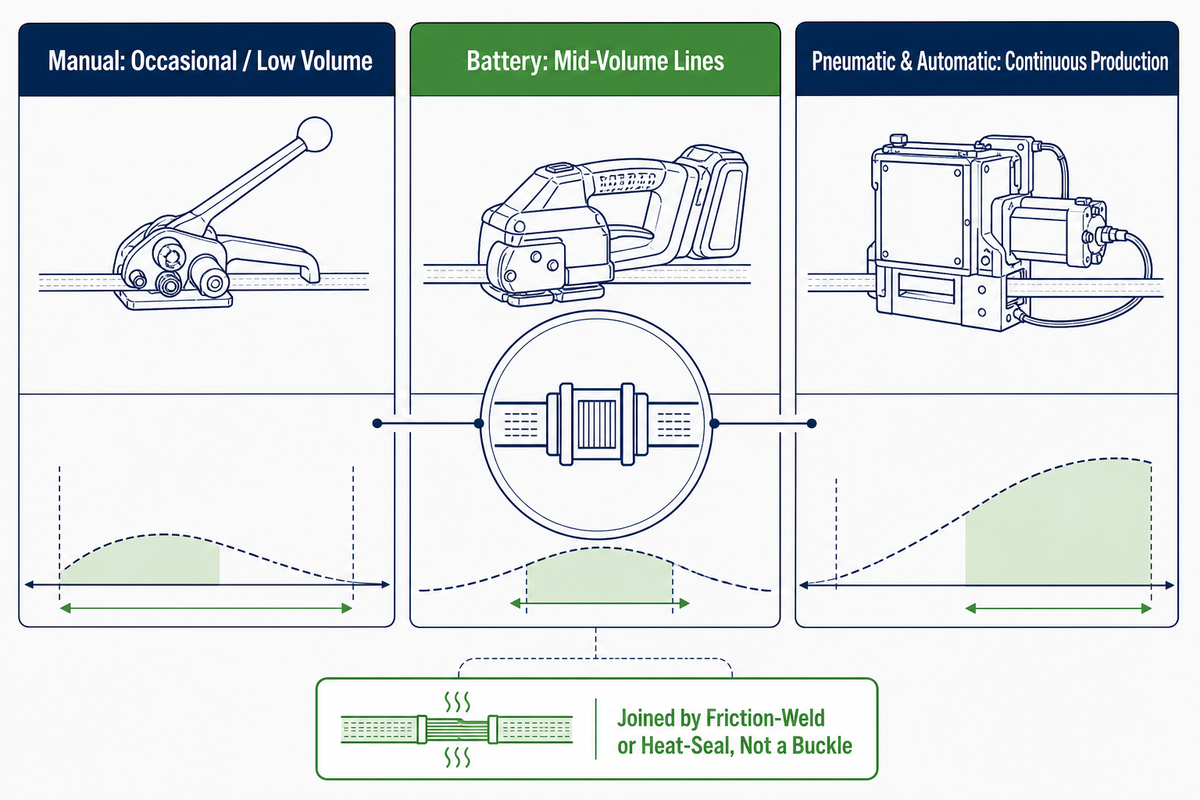
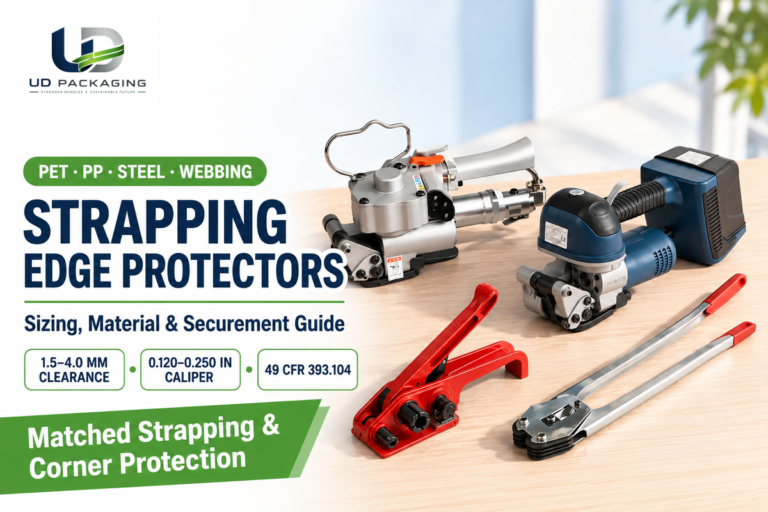
The right strapping tool depends on volume and power source, not just budget: manual tools suit occasional use, battery tools suit mid-volume packaging lines, and pneumatic or fully automatic systems suit continuous production. Every plastic strapping tool has to do two jobs — tension the strap and join the ends — and because plastic strapping is friction-welded or heat-sealed rather than crimped with a metal buckle, it needs a dedicated sealing head that steel-strapping tools don’t have. Tool selection also has an ergonomics side worth planning for: OSHA has documented back and knee strain from bending or squatting to change strap spools at floor level on strapping machines, and a simple waist-height spool stand or dispenser paired with the strapping tensioner removes most of that risk. On loads with exposed corners, budget for corner protectors (or an edge-board strip) alongside the strap itself — some operations also use a light spring clip for very light, temporary bundling where a full friction-weld or heat-seal joint would be overkill.
RFQ checklist — copy these into your quote request:
| Parameter | Recommended range | Why it matters | How to verify |
|---|---|---|---|
| Strap material & grade | PP or PET; hand or machine grade | Sets the joint method the tool must support | Match to current coil label / data sheet |
| Nominal width | 3/8″–3/4″ typical | Tool head must match strap width exactly | Measure current strap or check spec sheet |
| Surface finish | Smooth (waxed) or embossed | Determines friction-seal vs. heat-seal compatibility | Photo + product data sheet |
| Application volume | Straps per hour/shift | Decides manual vs. battery vs. pneumatic tier | Count current daily strap applications |
| Tension target | Material-specific (see Common Mistakes section below) | Over/under-tensioning both cause failures | Test on a representative load before production run |
Tensioner Power-Type Grid
Manual tensioner-sealer combination tools work fine for occasional or low-volume use and cost the least, but tension consistency depends entirely on the operator. Power tool grade battery combination tools hold tension more consistently and raise throughput for mid-volume lines without the infrastructure cost of compressed air, and they pair well with machine grade polyester strapping once volume moves past occasional use. Pneumatic and fully automatic arch machines deliver the most consistent tension and the highest throughput, but need compressed-air infrastructure and a larger upfront investment — the right tier is a volume and consistency decision, not a “biggest is best” one. The table below breaks that decision down by the eight tool categories buyers actually compare.
| Tool Type | Joint Method | Cost Tier | Tension Consistency | Best-Fit Volume | Compressed Air Needed |
|---|---|---|---|---|---|
| Manual tensioner-sealer, friction-weld | Friction-weld | Lowest | Operator-dependent | Occasional / low volume | No |
| Manual tensioner-sealer, heat-seal | Heat-seal | Lowest | Operator-dependent | Occasional / low volume | No |
| Battery-powered combination tool, friction-weld | Friction-weld | Medium | Consistent | Mid-volume | No |
| Battery-powered combination tool, heat-seal | Heat-seal | Medium | Consistent | Mid-volume | No |
| Pneumatic hand tool | Friction-weld or heat-seal (model-dependent) | Medium-high | High | Mid-to-high volume | Yes |
| Semi-automatic arch / table-top machine | Heat-seal (typical) | High | High | High volume | Usually — air or electric depending on model |
| Fully automatic in-line arch machine, side-seal | Heat-seal | Highest | Highest | Continuous production-line volume | Yes |
| Fully automatic in-line arch machine, top-seal (low-profile) | Heat-seal | Highest | Highest | Continuous production-line volume | Yes |
Cost tier, consistency, and volume fit are qualitative, cross-vendor generalizations about how these eight tool categories are commonly differentiated in strapping-equipment literature, not a single manufacturer’s spec sheet — illustrative and vendor-published, not ASTM-specified, same as the tension ranges covered later in this guide (Common Mistakes section). Confirm exact throughput and air-supply requirements, and the correct tension setting for your material, on the specific tool model’s own datasheet before purchase.
Friction-Weld and Heat-Seal Joints
The joint is where plastic strapping most often fails first, because it can be the weakest link in an otherwise correctly-specified system. This is a genuine plastic-vs-steel scope distinction covered by ASTM D3950’s joining-methods provisions: a friction-weld tool spins the two overlapped plastic strap ends against each other to generate melt-bond heat, while a heat-seal tool applies direct heat through a die — neither uses the crimped metal seal that closes steel strapping. Which specific surface pairs with which sealing equipment is a separate, vendor-published convention rather than an ASTM-defined rule: smooth, waxed strap is commonly run through friction-seal equipment, and embossed strap is commonly run through heat-seal equipment, though newer heat-seal machines increasingly handle both — confirm the pairing against your own tool’s manual rather than treating it as a fixed standard. A note on operator safety: cutting a tensioned strap can make the ends snap apart with force, so the same care that applies to strap removal on a loaded pallet (see our strapping for pallets guide) applies during tool servicing too.
Where Plastic Strapping Is Used Across Industries
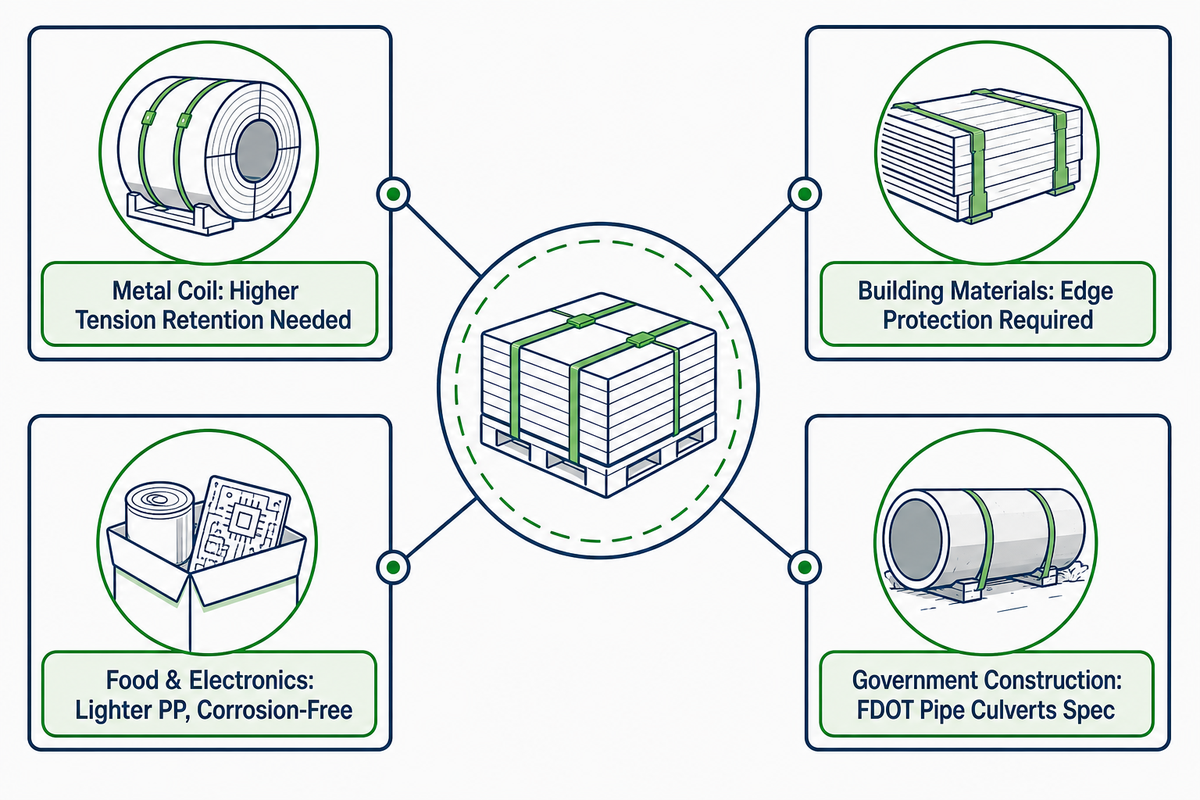
Plastic strapping shows up well beyond generic “boxes and pallets” — metal coil producers, building-materials suppliers, textile balers, food packagers, and electronics manufacturers each specify it differently based on load shape and handling risk, not just weight. Government procurement is one concrete example: the Florida Department of Transportation lists plastic strapping as an approved product type under its Pipe Culverts specification (Section 430), a construction use case with its own handling and weather-exposure demands.
Metal coil handlers typically need PET’s higher tension retention to keep a dense, unforgiving load from shifting; building-materials suppliers strapping lumber or brick bundles need edge protection alongside the strap to prevent cut-through on rough surfaces; food and electronics packagers more often use lighter PP grades on cartons where corrosion resistance and cleanliness matter more than raw strength.
For pallet-specific application detail, see our strapping for pallets guide; for box- and carton-level strapping detail, see our strapping for boxes guide — both go deeper into load-type-specific procedure than this material-selection overview does.
The Standard Behind the Strap — ASTM D3950 vs. D3953, and Why That Difference Matters
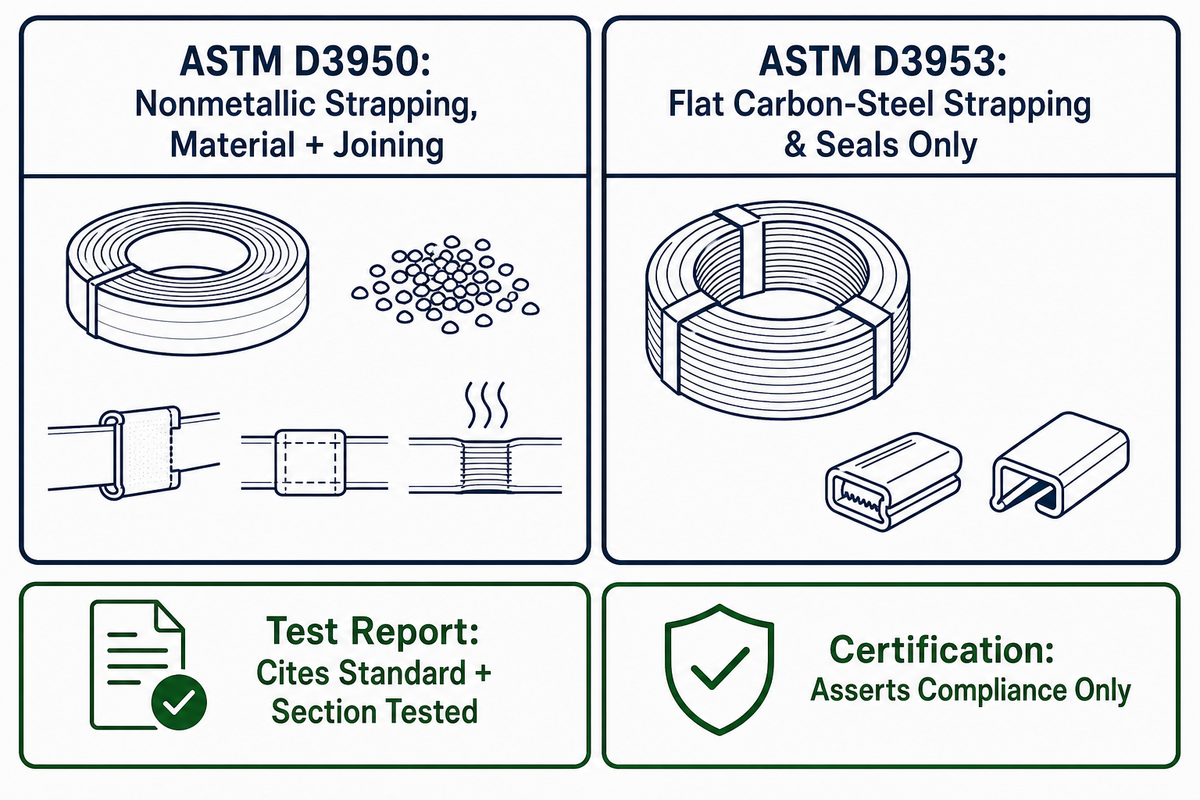
The standard that actually governs plastic strapping is ASTM D3950, not D3953 — a distinction that matters because D3953 covers flat carbon-steel strapping and seals, a completely different material, and a supplier citing it on a plastic strap’s paperwork is either citing the wrong standard or quietly selling you steel. ASTM D3950 (current edition D3950-23, active) is the Standard Specification for Strapping, Nonmetallic, and it classifies materials into five distinct types, each required to meet its own values for breaking strength, elongation, transverse strength, and joint strength. That last point matters on its own: a single tensile figure on a spec sheet is not a complete strapping specification, because the standard evaluates several properties together, and a published table usually shows only the first.
“This specification covers nonmetallic strapping and joining methods intended for use in closing, reinforcing, and bundling articles for shipment, unitizing, palletizing, and bracing for car loading and truck loading.”
— ASTM D3950-23, Section 1.1 (Scope)
| Standard | Governs | Applies to plastic strapping? |
|---|---|---|
| ASTM D3950 | Nonmetallic strapping and joining methods | Yes — this is your standard |
| ASTM D3953 | Flat carbon-steel strapping and seals | No — different material |
Reading a real test report versus a certification is a related, separate skill worth having before you order: a genuine test report cites the specific standard and the section actually tested — for example, a breaking-strength result run under D3950 Section 12 — while a general product certification often just asserts compliance without naming a test method. If a supplier’s paperwork cites D3953 for a plastic strap, or shows a break-strength number with no test method at all, that’s a fair reason to ask a follow-up question before you order.
Common Mistakes When Specifying Plastic Strapping
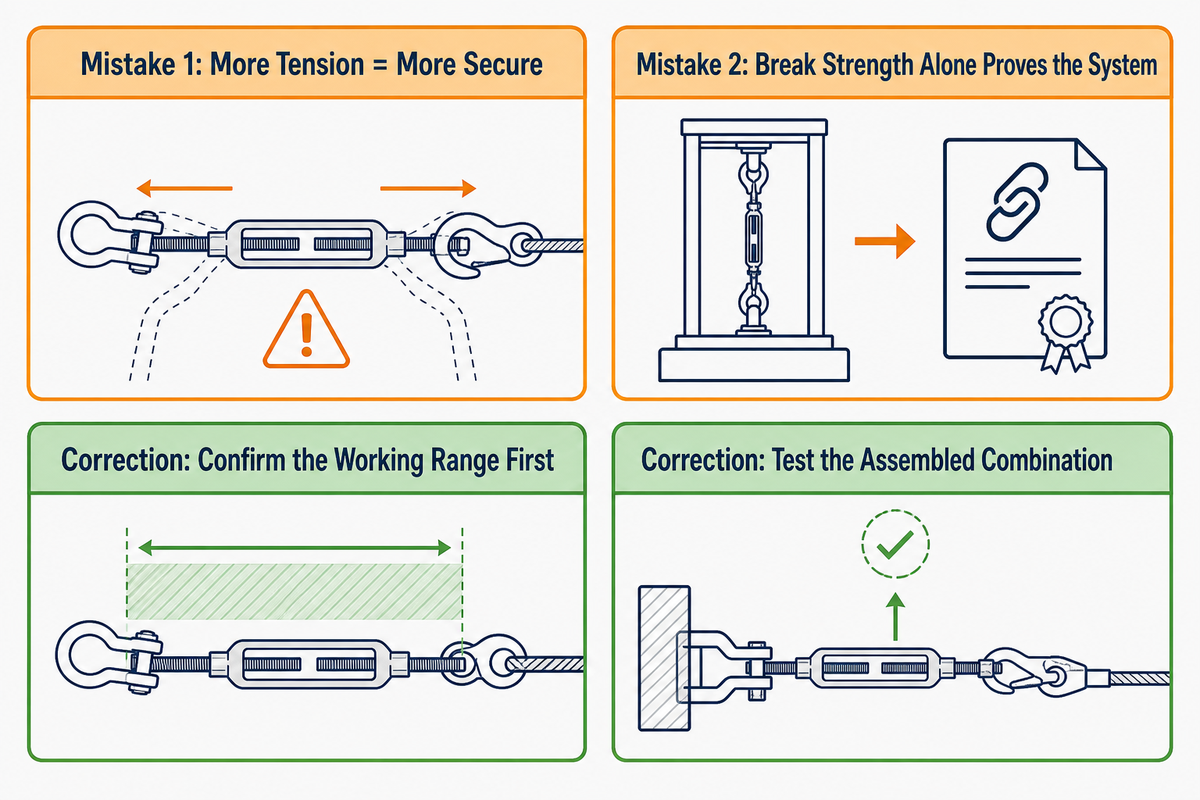
The most common plastic strapping mistake isn’t picking the wrong material — it’s assuming more tension always means a more secure load, when in practice over-tensioning crushes cartons, dents product, and can snap the strap or fail the joint before the load ever leaves the dock. One widely-cited industry source gives illustrative tension ranges as a rough starting point — roughly 15–30 kg (33–66 lb) for PP straps and 30–45 kg (66–99 lb) for PET straps — and other sources agree over-tensioning is a common, avoidable mistake even without publishing the same specific numbers; either way, these are vendor-published figures, not an ASTM-specified value, so treat them as a first setting to adjust from rather than a fixed target: confirm the working range against your tensioner’s manual and your specific strap’s data sheet, per ASTM D4675‘s own guidance that selection starts with testing the actual configuration. Under-tensioning has the opposite failure mode — it allows load shifting and gaps that lead to collapse in transit — so the goal is a calibrated middle, not either extreme.
The second recurring mistake is treating a strap’s bare break strength as proof the whole system is qualified. It isn’t. Joint efficiency, not bare tensile force, decides how much load a strap actually delivers. A strap that wins on bare force can still lose on usable load once the joint is factored in. A strap that tests strong on its own can still under-deliver in the field if the seal or weld is the weaker point — which is exactly why a representative test on the assembled strap-joint-tool combination matters more than any single spec-sheet number.
Industry Outlook — Regulation and Recyclability
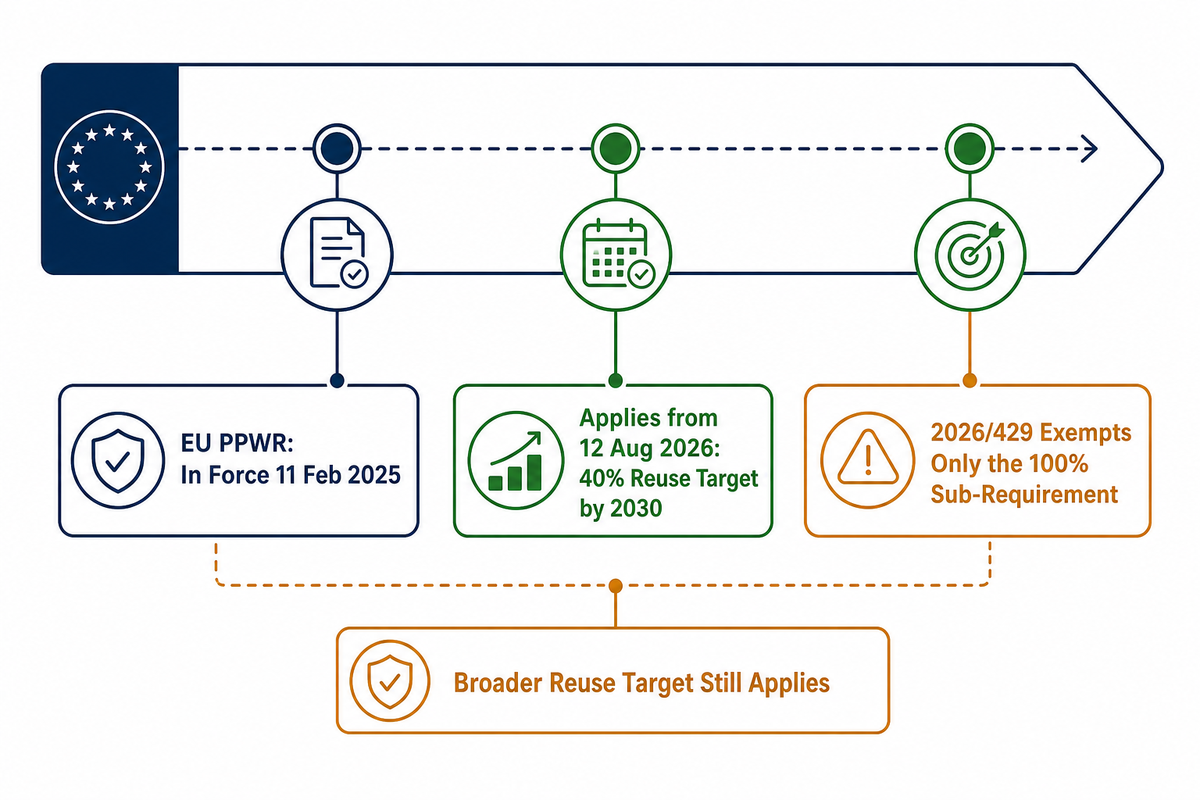
Buyers sourcing plastic strapping into the EU market have a real regulatory shift to watch: Regulation (EU) 2025/40 (PPWR) entered into force on 11 February 2025 and applies generally from 12 August 2026, setting a 40% reusable-packaging target for transport packaging — including pallet wrapping and strapping — by 2030. Commission Delegated Decision (EU) 2026/429 narrows that specific requirement: it exempts pallet wrapping and strapping only from the 100% reuse sub-requirement, while the regulation’s broader reusable-packaging target described above, along with its recyclability and recycled-content measures, still applies. For buyers, the practical takeaway isn’t “strapping is exempt” — it’s that the exemption is narrower than headline coverage suggests, so sourcing decisions ahead of the 2030 deadline should still account for the broader reuse and recyclability requirements, not just the pallet-wrapping carve-out.
On the demand side, search interest in recycled polypropylene showed a real bump in Q1 2026 before settling back — a plausible, though not confirmed, signal that buyers are already starting to plan around these requirements ahead of the 2030 deadline rather than waiting for it. Recycled-content plastic strapping is increasingly available from suppliers positioning ahead of the regulation — some market it specifically as “green PET strapping” — and confirming the actual recycled-content percentage, not just a “recyclable” claim, is a reasonable question to add to any RFQ placed against an EU-bound shipment from here forward. That sustainability advantage is worth weighing alongside cost and performance for buyers who already track the regulation’s broader reuse and recyclability requirements.
💡 Pro Tip
Ask any plastic strapping supplier for their material’s test report — not just a certification — and check that it cites ASTM D3950 (not D3953) with the specific section tested. That one question catches both a mismatched standard and an unsupported break-strength claim in a single ask.
Why We Write This
UD Packaging supplies PET strapping, stretch film, strapping seals and buckles, and manual through fully automatic strapping equipment from its Jiangyin, Jiangsu base — so material and joint-method distinctions like the ones in this guide come up directly in the RFQs we review. This guide reflects the standards and vendor-comparison research behind those conversations, not a generic industry summary.
Frequently Asked Questions
Q: What is plastic strapping?
Plastic strapping is a flexible, non-metallic band made from polypropylene (PP) or polyester (PET) resin, used to bundle, secure, and unitize loads for shipping and storage.
It comes in coils that are tensioned around a load and joined at the ends with a friction-weld or heat-seal, rather than the crimped metal buckle used on steel strapping. The material is also commonly called plastic banding, and buyers use the two terms interchangeably. Coils are sized by width, thickness, and grade — hand grade for occasional manual use, machine grade for automated lines — and the right combination depends on the load type, weight, and how the load will be handled, not on the material name alone. The material and break-strength sections above cover how to narrow that choice down.
Q: What are plastic straps called?
The most common alternate name is “plastic banding” — the two terms are used interchangeably by most suppliers and buyers, though resin type (polypropylene or polyester) further narrows which specific strap you actually need.
Within the category, the material itself is further named by resin type: polypropylene (PP) strapping, the lower-cost, higher-elongation option, and polyester (PET) strapping, sometimes called poly cord strapping, which holds tension longer over storage. Both are distinct from steel strapping and from nylon cord strapping, a less common third nonmetallic option.
Q: How much weight can plastic strapping hold?
There is no single answer — break strength depends on material, width, and thickness, and manufacturer test reports vary by supplier and product line, so always confirm on your supplier’s own test report rather than assuming a generic figure applies.
The number that actually matters for safety is the working Safety Factor: break strength divided by the real working load, not the break strength figure alone. A strap rated well above the load weight can still be the wrong choice if the joint or seal, not the strap body, turns out to be the weaker link — for example, a 1,000 lb-rated strap on a 500 lb load still nets only a 2:1 margin, thinner than it might sound at first.
Q: What is the difference between poly strapping and polyester strapping?
“Poly strapping” is shorthand often used loosely for polypropylene (PP) strapping, while “polyester strapping” specifically means PET, and the two materials differ meaningfully in cost, stretch, and how long they hold tension.
PET has higher tensile strength and better long-term tension retention; PP costs less and flexes more under shock.
Q: How do you apply plastic strapping by hand?
Feed the strap around the load, pull it tight with a hand or powered tensioner, then join the overlapping ends with a friction-weld or heat-seal tool.
The tool melts the two strap layers together at the joint rather than crimping a separate metal seal, which is how steel strapping is closed. Manual tensioner-sealer combination tools work for occasional use; battery or pneumatic tools suit higher-volume packaging lines.
Q: What are the different types of strapping materials?
Strapping materials fall into a few distinct families: polypropylene, polyester, nylon cord, and steel, each suited to a different load profile, so picking by name alone without checking that profile is a common sourcing mistake.
Polypropylene (PP) is the most widely used plastic strapping — lower cost, higher elongation, and enough strength for light-to-medium loads like cartons and light pallets. Polyester (PET) strapping costs more but holds tension longer over time and handles heavier, rigid loads such as brick, lumber, and metal coils, making it a common steel-strapping replacement. Nylon cord strapping is a less common woven option used mainly where shrinking loads need sustained tension. Steel strapping remains the highest-strength option for very heavy or sharp-edged loads but lacks the corrosion resistance, flexibility, and worker-safety profile of plastic alternatives, and cannot be joined with the same friction-weld tools.
References & Sources
- ASTM D3950 Standard Specification for Strapping, Nonmetallic (and Joining Methods) — ASTM International
- ASTM D4675 Standard Guide for Selection and Use of Flat Strapping Materials — ASTM International
- Plastic Strap Spool Ergonomics Success Story — U.S. Occupational Safety and Health Administration
- Packaging waste — Regulation (EU) 2025/40 (PPWR) — European Commission
- EU PPWR — Packaging and Packaging Waste Regulation — UK Government (business.gov.uk)
- Product Type — Plastic Strapping — Florida Department of Transportation
Related Articles
Have a specific strap, joint, or load in mind? Compare Materials on UD Packaging’s Plastic Strapping Page →