Get in touch with UD Packaging Company

Updated August 2026 · By XCX
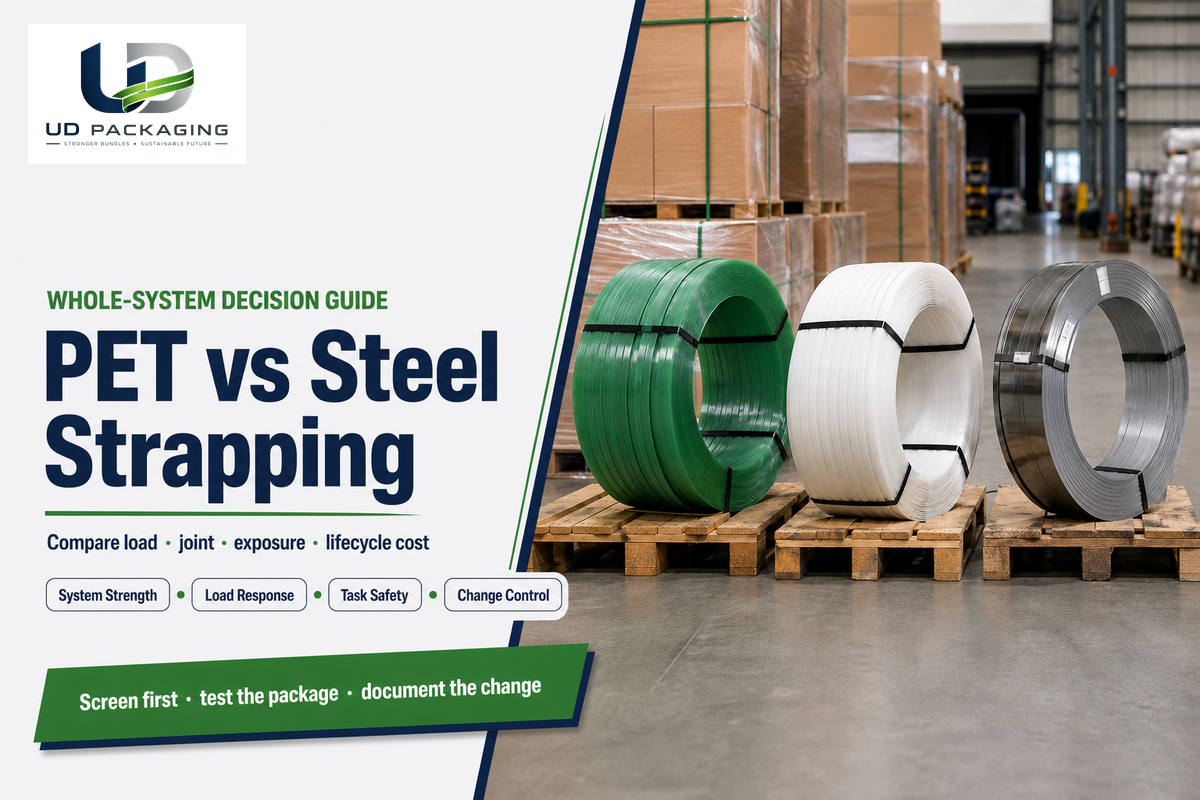
PET vs steel strapping is a whole-system comparison of two restraint options, not a material-name contest. There is no universal winner. PET can suit loads that settle or need elastic recovery, while steel remains a candidate for some rigid, sharp-edged, high-temperature, or unusually demanding systems. Approval should follow the load, joint, equipment, route, and representative-package evidence, not the material name alone.
That answer is less dramatic than “PET replaces steel,” but it’s much more useful on a loading dock. A strap doesn’t work in isolation. It’s tensioned by a tool, closed by a seal or weld, bent over edges, exposed to handling, and eventually cut by someone who may not have packed the load.
This guide focuses on how to compare those conditions and how to control a steel-to-PET change. It doesn’t provide an interactive material selector, a strap-count calculator, a product configuration table, or a universal safe working load. Those require application-specific inputs and testing.
It also doesn’t compare PP vs PET vs steel. Polypropylene strapping, often shortened to PP strapping, is a different type of strapping with its own grades and evidence requirements. Pulling PP and PET into this two-material guide would blur the decision and duplicate the existing selector intent.
After the comparison identifies PET as a candidate, use UD Packaging’s PET strapping product-family scope to prepare the next specification discussion. That commercial handoff does not replace the evidence and trial sequence in this guide.
The nine checks in this guide
- Define the load and the failure you must prevent.
- Compare strength at the strap-and-joint system level.
- Observe what happens after initial tension.
- Map hazards from application through unpacking.
- Set moisture, heat, chemical, ultraviolet, abrasion, and edge boundaries.
- Build a local lifecycle cost model.
- Use load traits instead of industry labels.
- Qualify any material change in controlled steps.
- Request traceable evidence before approval.
PET vs Steel Strapping at a Glance: No Universal Winner
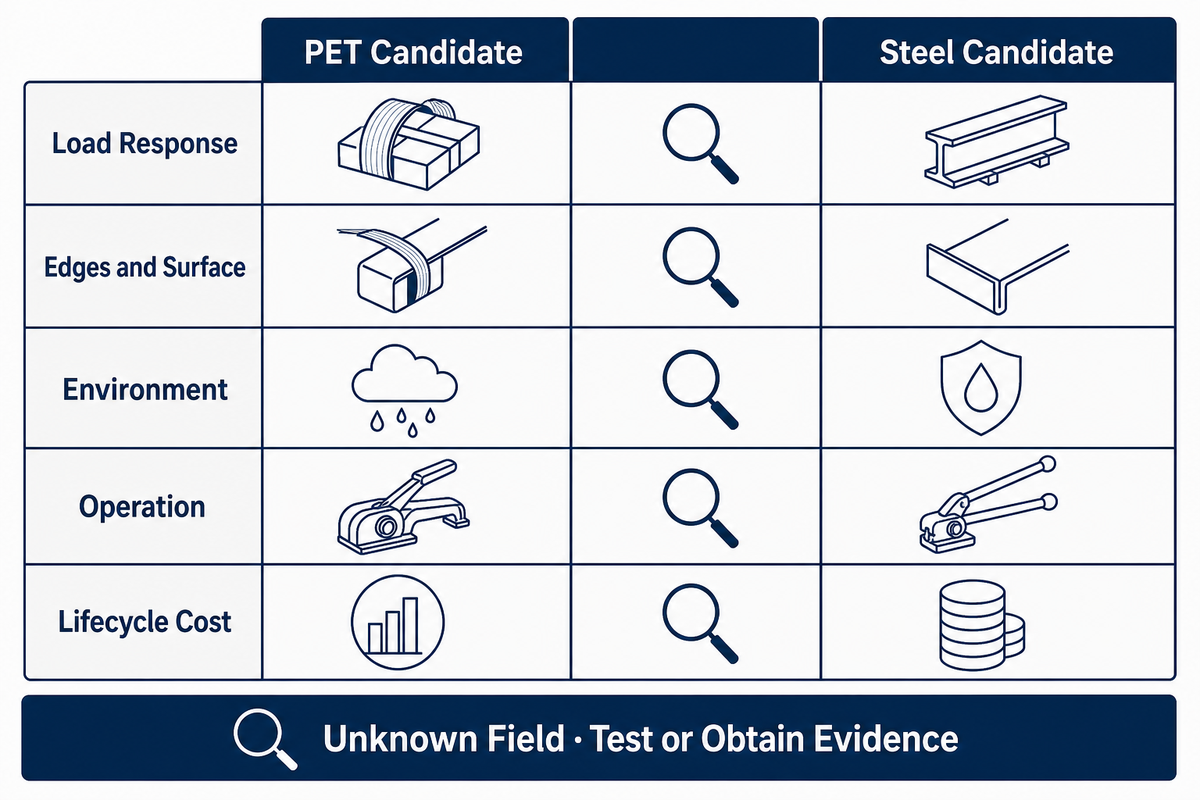
PET strapping isn’t automatically weaker, cheaper, safer, or more sustainable in every package, and steel strapping isn’t automatically the best choice for every heavy load. The defensible choice depends on the specified strap, joint, tool, load geometry, movement, edges, exposure, handling route, acceptance criteria, and applicable customer or carrier rules.
| Decision dimension | PET candidate | Steel candidate | Verify locally |
|---|---|---|---|
| Load response | May be useful where a product-specific PET grade can accommodate movement and recover tension. | May be useful where a rigid restraint and low elongation are required. | Initial and retained condition after dwell, handling, and transit. |
| Edges and surface | Screen for cutting, abrasion, splitting, and protector needs. | Screen for product marking, edge bite, coating damage, and protector needs. | Actual edge radius, contact points, movement, and protector design. |
| Environment | Request product limits for heat, ultraviolet exposure, chemicals, and time. | Request finish and corrosion data plus heat and storage limits. | Temperature profile, condensation, outdoor dwell, and chemical contact. |
| Operation | Requires a compatible PET tool, weld or seal, settings, and operator method. | Requires a compatible steel tensioner, sealer or sealless tool, and safe handling method. | Feed, tension, joint, cut, maintenance, guarding, and work instruction. |
| Cost | Material and handling may differ, but tooling, trials, and local recovery routes matter. | Material, seals, tools, maintenance, labor, and corrosion-related costs may matter. | A common time horizon and the buyer’s actual costs—not a vendor percentage. |
A shortlist should therefore begin with unknowns. Record whether the load is rigid or compressible, whether it settles, where the strap touches a sharp or vulnerable edge, the temperature and moisture envelope, the distribution route, the joint method, and the consequence of failure. If one of those fields is unknown, the comparison result is “test or obtain evidence,” not “assume PET” or “assume steel.”
Across a supply chain, choosing the right strapping material isn’t a contest for the most forceful label. A polyester strap may be the better choice in many applications, while a steel strap may remain in the candidate set for a heavy-duty route or the heaviest stable load. Corrugate packaging can fail at its corners before either strap body reaches its limit. Even “high elongation” is only a test description until the method and package response are known.
Contrarian check: ASTM D4675 treats flat-strapping selection as a starting point that still requires user testing and attention to applicable rules. That doesn’t make PET the automatic winner; it makes the complete application the unit of comparison.
Translate Search Shorthand into Evidence Requests
Search language compresses several engineering questions into a few words. The table preserves those phrases as buyer shorthand, then translates them into records that can support a decision.
| Source query language | Evidence question | Buyer record |
|---|---|---|
| “quick comparison” or “key differences” | Which load, joint, edge, route, and exposure differences can change the result? | Named candidates and a common comparison basis. |
| “right choice,” “right material,” or “best fit” | Right for which declared failure mode and acceptance criterion? | Failure-mode list and approval owner. |
| “choice for your packaging,” “choice for your packaging needs,” “packaging needs,” or “packaging requirements” | What must the complete package survive? | Package drawing, route, dwell, handling, and receiving method. |
| “choosing the right material,” “selecting the right,” or “matching the right” | Which product specification, joint, tool, and process window are being matched? | Supplier data and controlled setup record. |
| “steel and PET,” “differences between steel strapping,” or “strength steel” | Are body strength, joint result, elongation, and package behavior being kept separate? | Units, test basis, specimen, joint, and package result. |
| “high tensile strength,” “higher tensile strength,” “shock absorption,” or “resist” | Which named product shows the property, under what method and conditions? | Current technical sheet and test report. |
| “replacement for steel” or “switching to PET” | What baseline, trial, acceptance, monitoring, and rollback controls govern the change? | Approved change-control file. |
| “industrial packaging,” “heavy products,” or “heavier items” | What geometry, movement, edge, consequence, and distribution route define the actual load? | Representative load profile. |
| “medium loads,” “extremely heavy,” or “heaviest of loads” | Which measurable package conditions sit behind the weight label? | Mass, center of gravity, rigidity, edge map, and movement record. |
| “hand tools,” “steel strapping tools,” or “tools designed” | Is the exact tool compatible with the material, dimensions, joint, and required process? | Manufacturer compatibility statement and maintained-tool record. |
| “right width,” “designed to handle,” or “real-world conditions” | Was the candidate tested at its actual width, thickness, joint, setting, and route? | Candidate-specific trial plan and result. |
| “economical choice,” “material cost,” “easier and safer,” or “reducing the risk” | Do local cost and task-risk records support the wording? | Accepted-load cost model and task hazard review. |
| “polyester strapping material,” “manufactured from polyethylene terephthalate,” or “post-consumer recycled” | What resin, recycled-content, collection, and processor claims apply to the named product and destination? | Product declaration and local recovery evidence. |
| “PP or PET strap” or “manufactured from polypropylene” | Is this still a two-material PET-versus-steel decision? | If PP remains a candidate, start a separate three-material evidence plan. |
For the broader material taxonomy that this two-material guide intentionally excludes, use the site’s industrial strapping overview.
Compare Strength as a Strapping System, Not a Catalog Number
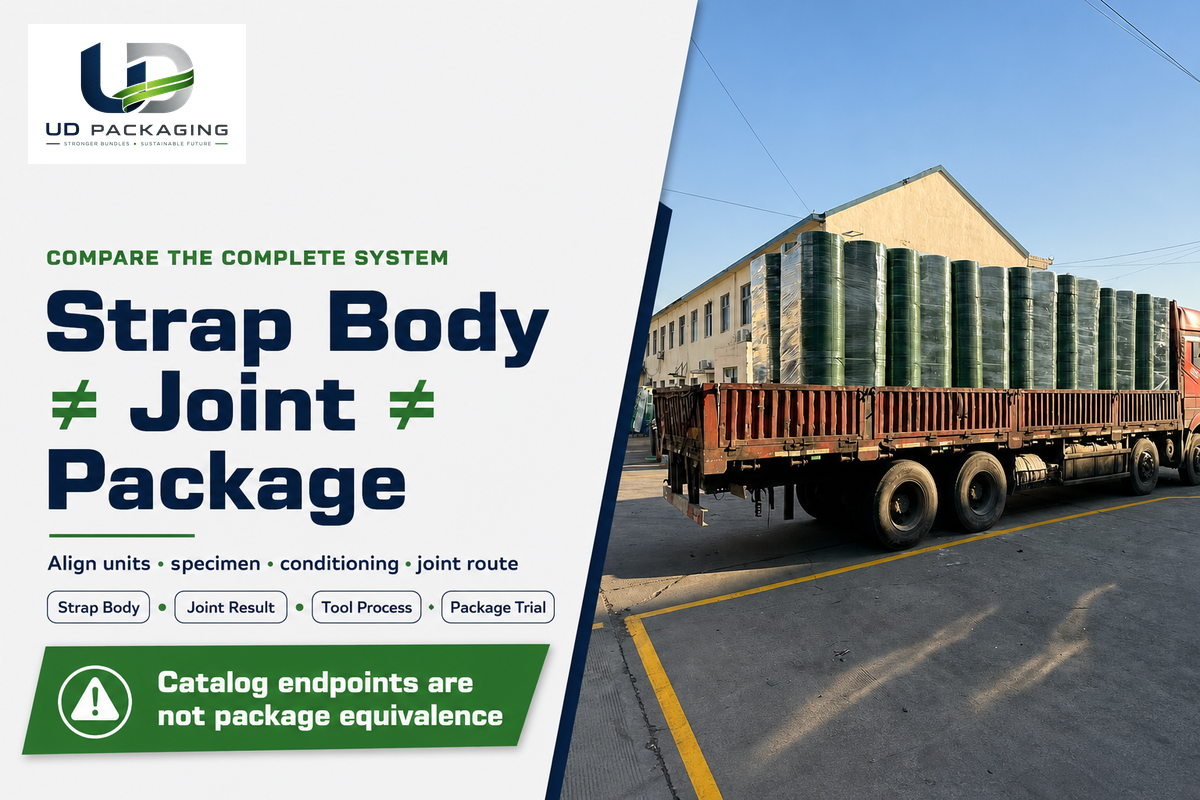
“Which strap is stronger?” sounds like a request for two numbers. In practice, it’s a request to define what’s being tested. A catalog may show strap-body break strength, tensile strength, width, thickness, or elongation. The package depends on the joint, the number and path of straps, the geometry, the edges, and what happens during distribution.
ASTM D3950 is useful here because its public scope treats breaking strength, elongation, transverse strength, and joint strength as separate conformance properties for nonmetallic strapping and joining methods. A strong strap body with a mismatched or poorly formed joint is not a strong strapping system.
How strong is steel strapping?
There is no single material-wide answer. As a source-specific example, Signode’s Magnus steel portfolio displays formats from 13 to 32 millimeters wide, with different thicknesses, tensile ranges, break strengths, elongation ranges, finishes, and application variants. Those values belong to the named products and their stated test basis; they aren’t a universal rating for every steel strap.
The same caution applies to PET. Signode’s Tenax embossed PET page displays formats from 9.3 to 18.7 millimeters, break strengths from 177 to 1050 daN, and elongation from 12 to 15 percent. This example shows why ranges can overlap and why the exact product format matters. It doesn’t establish that all PET equals a certain steel grade.
Worked range check, same manufacturer, not equivalence: the reviewed Tenax PET table includes displayed width endpoints of 9.3 mm and 18.7 mm, product break-strength endpoints of 177 daN and 1050 daN, and elongation from 12% to 15%. The reviewed Magnus steel page includes 13 mm and 32 mm widths, 0.5 mm and 1.0 mm thicknesses, displayed tensile endpoints of 850 MPa and 1390 MPa, break-strength endpoints of 6480 N and 36500 N, and multiple elongation ranges that include 3%, 12%, 10%, and 22%. Keep units, product names, and test bases attached; do not match candidates from these endpoints alone.
Source-Specific Specification Snapshot
The following rows transcribe the current public Tenax embossed PET and Magnus steel tables from the same manufacturer. They show why a material name cannot substitute for a format-level specification; they are not UD Packaging specifications and do not establish package equivalence.
| Source-owned format | Width and thickness | Coil or length field | Displayed performance field |
|---|---|---|---|
| Tenax standard coil | 9.3–18.7 mm wide; 0.53–1.27 mm thick | 500–4,500 m; approximately 22 kg per coil | 177–1,050 daN break strength; 12–15% elongation |
| Tenax jumbo coil | 9.3–18.7 mm wide; 0.53–1.27 mm thick | 2,100–13,000 m; approximately 65 kg per coil | 177–1,050 daN break strength; 12–15% elongation |
| Tenax super jumbo coil | 15.5–18.7 mm wide; 0.72–1.27 mm thick | 2,100–6,500 m; approximately 115 kg per coil | 470–1,050 daN break strength; 12–15% elongation |
| Tenax mega jumbo coil | 18.5 mm wide; 1.00 mm thick | 14,000 m; approximately 300 kg per coil | 850 daN break strength; 12–15% elongation |
| Magnus ribbon wound | 13–32 mm wide; 0.5–1.0 mm thick | 20–50 kg per coil; 13–21 coils per pallet | 950–1,050 MPa tensile; 6,480–36,500 N break; 3–12% A100 and 10–22% A5 elongation |
| Magnus oscillated wound | 13–19 mm wide; 0.5–1.0 mm thick | 50 kg per coil; 12 coils per pallet | 850–1,390 MPa tensile; 6,480–36,500 N break; 3–12% A100 and 10–22% A5 elongation |
| Magnus jumbo coil | 13–32 mm wide; 0.5–1.0 mm thick | 350–1,000 kg per coil; 1–2 coils per pallet | 850–1,390 MPa tensile; 6,480–36,500 N break; 3–12% A100 and 10–22% A5 elongation |
| Evidence field | Question it answers | Why it cannot stand alone |
|---|---|---|
| Strap-body break strength | Under the stated test, when did this specimen break? | The applied system also contains a joint and package interfaces. |
| Tensile strength | What stress was reported under the named method? | It does not define joint quality, strap count, or package acceptance. |
| Joint result | How did the seal, weld, or sealless joint behave? | Tool condition, settings, overlap, specimen conditioning, and production variation matter. |
| Strap count and pattern | How is restraint distributed around the load? | More straps do not correct an unstable pallet, weak edge, or wrong load path. |
| Representative package trial | Did the complete package meet declared criteria? | It applies only to the recorded configuration and conditions. |
ASTM D4675 describes flat-strapping selection and the applied configuration, and its public information presents the guide as a starting point that still requires user testing and attention to applicable rules. Use that boundary to stop a common procurement error: treating the steel seal, PET weld, strap count, and package trial as accessories to a single catalog number.
A steel strap value and a PET strap value become comparable only after the team aligns units, specimen basis, conditioning, joint route, and intended package configuration.
Tool selection is a separate handoff. Use UD Packaging’s strapping tools scope only after the material, dimensions, joint method, and process requirements are defined.
Do not calculate a safe package load from this article. The tables organize evidence fields; they do not supply a design factor, strap-count formula, or safe working load. Those decisions belong to the responsible packaging or load-securing engineer using the applicable rules and validated system data.
What Happens After Tension: Elongation, Recovery, and Load Settling
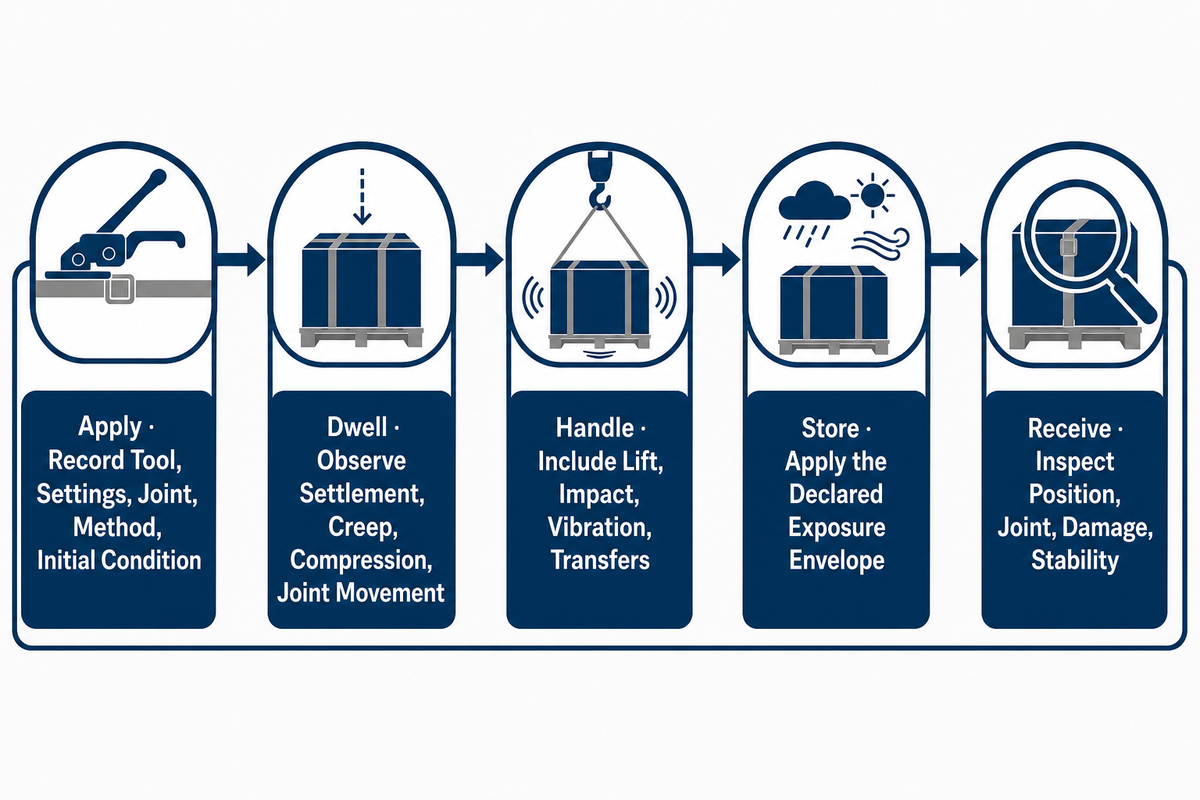
Initial tension is one frame in a longer event. A pallet may compress during dwell, a carton stack may settle, a bundle may expand or contract with moisture, and handling shock may briefly change the load path. The relevant question isn’t simply which material stretches more. It is whether the chosen system keeps the package within its acceptance limits over the declared cycle.
From application to receiving
- Apply: record the tool, settings, joint, operator method, and initial package condition.
- Dwell: observe settlement, creep, corner compression, joint movement, and visible loss of containment.
- Handle: include lift, acceleration, braking, impact, vibration, and transfers that represent the route.
- Store: apply the defined temperature, humidity, ultraviolet, chemical, and duration envelope.
- Receive: inspect strap position, joint, package damage, stability, and the condition before and after cutting.
PET is often described as having elastic recovery and an ability to respond to settling loads. Steel is often described as rigid and low-elongation. Those broad tendencies can help form a hypothesis, but a buyer still needs product-specific data and a package trial. “Elongation at break,” “elastic recovery,” “creep,” and “retained tension” aren’t interchangeable labels.
ASTM D3950’s public scope treats elongation and joint strength as separate conformance properties; it doesn’t establish retained tension over time. The reviewed sources don’t establish a universal long-duration retained-tension result for shipping-grade PET under combined time, temperature, and humidity. Request data for the named product, conditioning method, exposure range, duration, measurement intervals, joint, and units, then test the complete package under representative conditions. A short tensile result or a material-wide recovery statement can’t fill that evidence gap.
A useful thought experiment is to imagine that the load height decreases slightly after the first hour. Ask what measurement would show whether the strap remained effective, where the joint moved, whether an edge protector rotated, and whether the pallet stayed stable. Then design the dwell and handling observations around that failure mode. The thought experiment is a test-design aid, not a prediction of a real shipment.
Safety and Product-Damage Risks from Tensioning to Unpacking
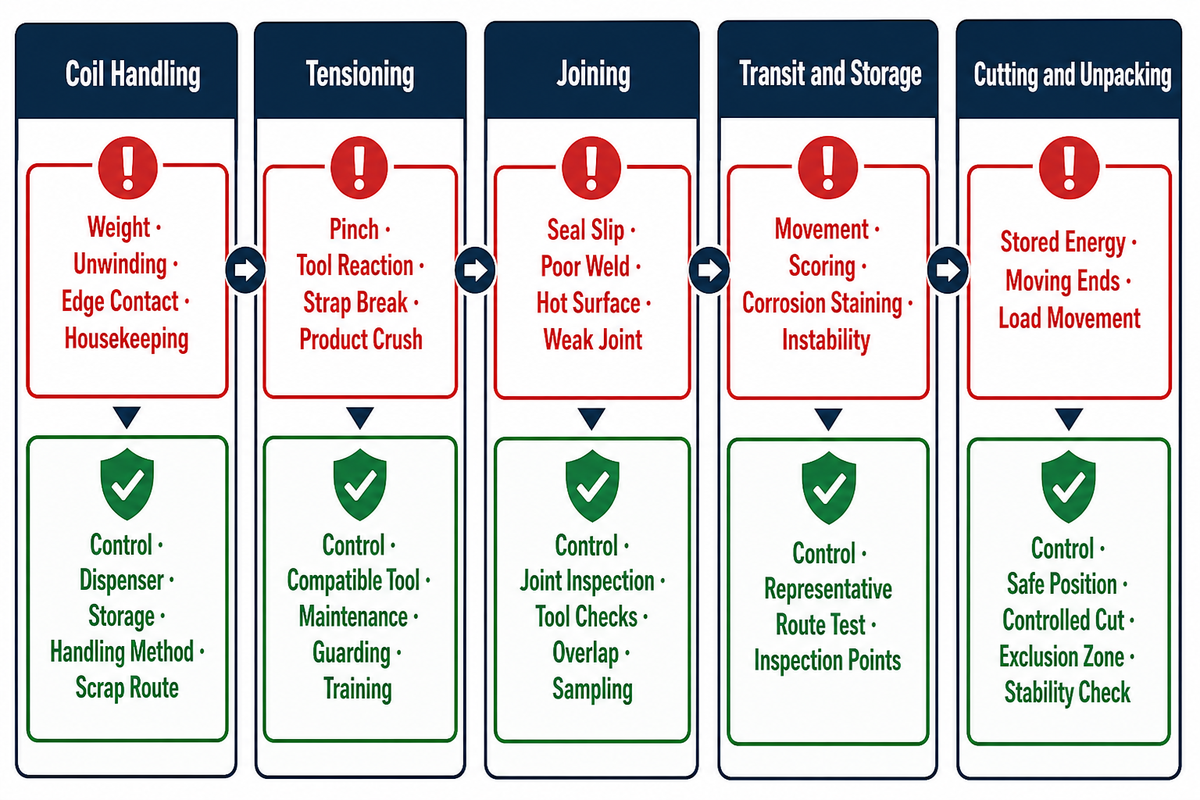
“PET is safer” is too broad to serve as a work instruction. PET can remove some sharp-metal handling concerns, but tensioned plastic strap still stores energy, tools still create pinch and cut hazards, and a weak or unstable load can move when any strap is removed. Steel introduces its own sharp edges, spring-back behavior, weight, and handling concerns. The risk review must follow the task.
OSHA shipyard guidance on banding warns that cutting can release tension and that moving band ends can injure the worker or others nearby. It calls for evaluating the risk, warning nearby workers, and using appropriate eye and hand protection. That official task guidance supports a hazard-control boundary; it doesn’t provide an unconditional material ranking.
| Task stage | Hazard or damage path | Control to define | Evidence owner |
|---|---|---|---|
| Coil handling | Weight, unwinding, edge contact, trip or housekeeping problems. | Dispenser, storage, manual-handling method, gloves where required, and scrap route. | Operations and safety. |
| Tensioning | Pinch points, tool reaction, strap break, product crush, or edge damage. | Compatible tool, maintenance, setting limits, guarding, training, and stop conditions. | Engineering, maintenance, and safety. |
| Joining | Seal slip, incomplete crimp, poor weld, hot surface, sharp offcut, or weak joint. | Joint inspection, tool checks, overlap, cooling time where relevant, and sampling plan. | Quality and operations. |
| Transit and storage | Strap movement, package scoring, corrosion staining, protector loss, or unstable load. | Representative route test and defined inspection points. | Packaging engineering and logistics. |
| Cutting and unpacking | Stored-energy release, moving band ends, sharp cut ends, or load movement after restraint is removed. | Safe position, controlled cutting method, exclusion zone, warning, personal protective equipment, and load-stability check. | Receiver, safety, and supplier of the work instruction. |
Product damage belongs in the same map. Steel may mark or cut a sensitive surface if the load path and protection are wrong. PET can abrade, split, or be cut at an edge, and excessive tension can crush cartons. Corner protectors are system components: specify their material, leg length, retention, contact area, and behavior after vibration instead of listing “use edge protection” as a generic cure.
Moisture, Heat, Sharp Edges, and Storage Boundaries
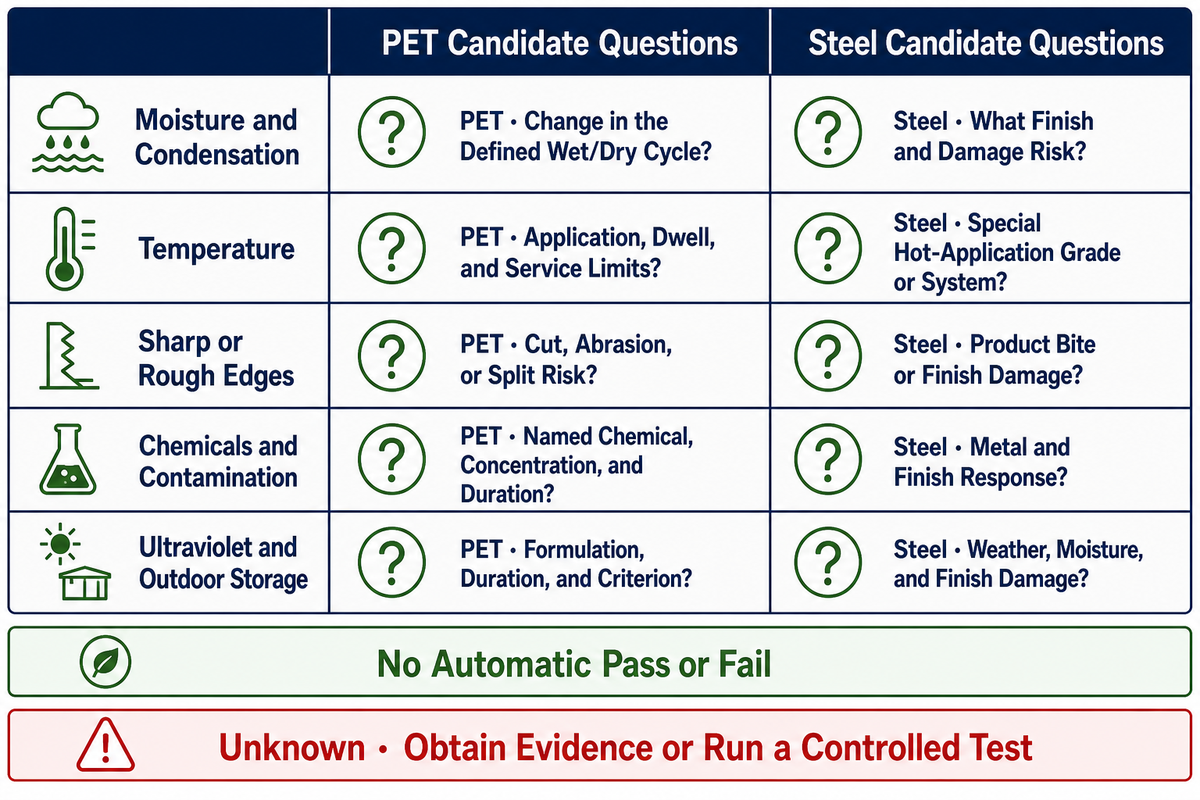
Environmental resistance is not one score. Moisture may create corrosion concerns for an unprotected or damaged steel system, but the finish, exposure time, condensation, salt, and contact surface matter. PET avoids steel rust, yet a PET supplier still needs to state relevant temperature, ultraviolet, chemical, abrasion, and storage boundaries for the candidate grade.
Will steel strapping rust?
Steel can corrode when its finish and the exposure conditions allow it. Don’t turn that general mechanism into a prediction for every coil. Request the steel type and finish, inspect coating damage at tool and edge contact points, define moisture and chemical exposure, and evaluate whether corrosion could weaken the system or stain the product.
| Boundary | PET candidate question | Steel candidate question | Unknown means |
|---|---|---|---|
| Moisture and condensation | Does the grade or joint change under the defined wet/dry cycle? | What finish applies, and can handling or edges damage it? | Run the exposure and inspect both strap and product contact points. |
| Temperature | What are the application, dwell, and service limits for this grade and joint? | Does a special hot-application grade or different system apply? | Do not substitute at temperature without named product evidence. |
| Sharp or rough edges | Can the edge cut, abrade, or split the strap during movement? | Can the steel edge bite into the product or damage its own finish? | Record edge radius, motion, protector, and post-test condition. |
| Chemicals and contamination | Does the supplier support the named chemical, concentration, and duration? | How will the metal and finish respond to the same contact? | Obtain compatibility evidence or run a controlled test. |
| Ultraviolet and outdoor storage | What formulation, duration, and performance criterion are supported? | Will weathering, moisture, or finish damage change the system? | Define the maximum outdoor dwell and inspection interval. |
ASTM D4675’s public scope makes the applied configuration and user testing part of selection; it doesn’t supply one exposure limit for every grade. The Signode portfolio example illustrates the same danger of material-wide claims. Its Magnus steel range includes different finishes and special-use variants, while its Tenax PET range contains multiple dimensions and performance ranges. A buyer should request the exact candidate, not a statement such as “steel is weather resistant” or “PET handles all export environments.”
Heat deserves a hard stop. If a product, process, or storage area can approach a plastic grade’s limit, a general PET-versus-steel article can’t authorize the substitution. Record the worst credible temperature, duration, contact mode, cooling period, and emergency condition, then obtain product-specific evidence and responsible engineering approval.
Build a Local Lifecycle Cost Model
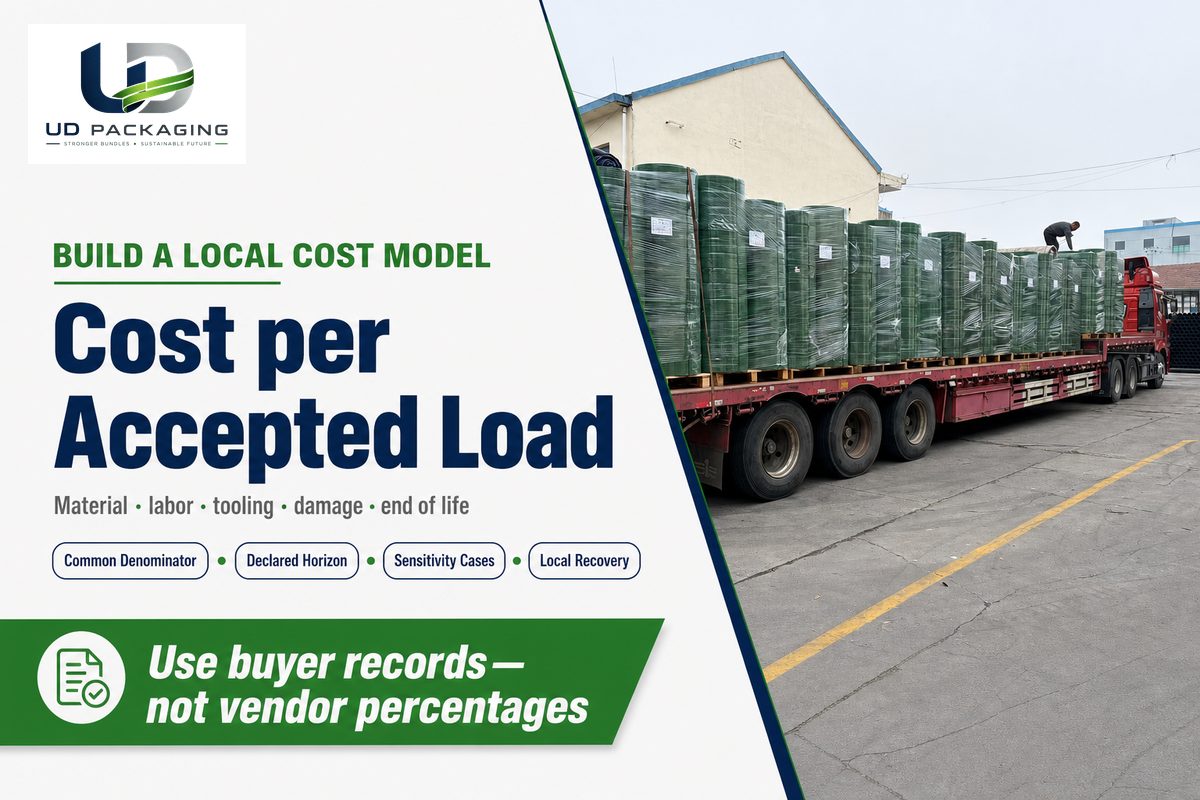
Price per coil is easy to obtain and easy to misuse. Coils can contain different lengths or masses, straps can use different patterns, and a material change can require tools, seals, training, maintenance, edge protection, trials, and new scrap handling. The model must compare a declared unit of output over a declared time, not two invoice lines.
Local lifecycle-cost worksheet
| Input category | Buyer-supplied field | Comparable unit | Sensitivity question |
|---|---|---|---|
| Strap material | Buyer input | Cost per accepted package or load | Does strap length, count, or scrap change? |
| Seals or joint consumables | Buyer input | Cost per accepted joint | Does the change eliminate, add, or alter consumables? |
| Labor | Buyer input | Minutes per accepted load × burdened rate | Include coil changes, rework, cleanup, and training. |
| Equipment and tooling | Buyer input | Ownership cost over the declared period | What is reused, replaced, financed, or kept as backup? |
| Maintenance and downtime | Buyer input | Parts, labor, and lost production per period | Use site records, not an assumed improvement. |
| Damage and nonconformance | Buyer input | Verified cost per incident × observed frequency | Separate product damage, load loss, claims, and rework. |
| Freight and storage | Buyer input | Declared coil and inventory basis | Does coil length, mass, space, or replenishment change? |
| Waste and end of life | Buyer input | Local handling, disposal, or recovery cost | Is a real collection and processor route available? |
Choose a time horizon before entering numbers, one production month, one year, or the expected tool-ownership period, and state what’s excluded. Then test at least three cases: base, adverse, and favorable. For example, a favorable labor assumption shouldn’t hide an adverse damage rate, and an assumed scrap credit shouldn’t count unless the local receiver or recycler accepts the material.
The total cost, sometimes called total cost of ownership, should use the same accepted-load denominator for PET strap and steel strap. Otherwise a longer PET coil or a heavier steel coil can make the invoice comparison look decisive while hiding strap count, joint consumables, rework, or freight costs.
This method deliberately provides blank cells. No article-specific UD Packaging customer dataset, line-speed study, damage history, material price, or payback period was supplied for this guide. Publishing a universal “20 to 40 percent savings” claim would therefore create false precision. The buyer’s records decide the outcome.
Keep sustainability boundaries separate
Recyclable, recycled content, reusable, lower-carbon, and locally recovered are different claims. PET resin identity doesn’t prove collection or processor acceptance at a destination, just as steel’s established scrap value doesn’t prove that every contaminated or attached strap is recovered. Record the jurisdiction, package boundary, collection route, and data source for each environmental field.
For a United States buyer shipping into European Union routes, add a separate destination-market check. The European Commission announced on 25 February 2026 that pallet wrapping and straps were exempted from the 100 percent reuse requirement described in its decision, while the page keeps them within the broader transport and sales packaging reuse framework. The Packaging and Packaging Waste Regulation entered into force on 11 February 2025. This dated export-route context affects evidence planning; it doesn’t make PET or steel the lifecycle winner.
Where PET Fits, and Where Steel Still Makes Sense
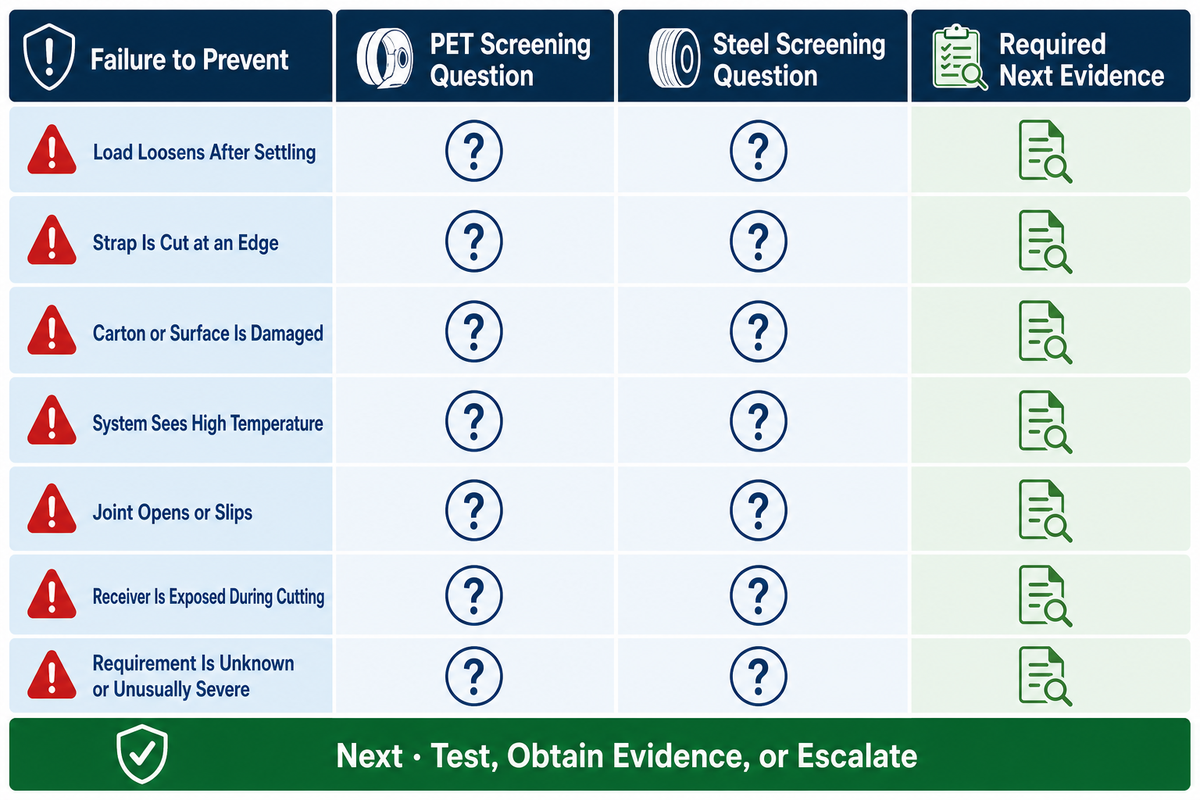
Application lists are useful only when they’re conditional. Two facilities in the same industry can have different edge geometry, heat, tool capability, load value, customer specifications, and routes. Start with the failure you must prevent, then keep both materials in or out of the candidate set based on evidence.
Failure-Mode-First Comparison Matrix
| Failure to prevent | PET screening question | Steel screening question | Required next evidence |
|---|---|---|---|
| Load loosens after settling | Can the named PET grade and joint retain acceptable containment after the defined dwell and movement? | Will a rigid steel system remain effective if the package height changes? | Dwell-and-handling trial with pre-agreed package criteria. |
| Strap is cut at an edge | Does the actual edge abrade, split, or sever the PET during movement? | Does steel tolerate the edge without damaging its finish or the product? | Edge-radius record, protector design, and dynamic inspection. |
| Carton or surface is damaged | Can tension, strap width, pattern, and protection avoid crush or abrasion? | Can edge bite, marking, or corrosion staining be controlled? | Representative product and visible-damage acceptance standard. |
| System sees high temperature | Is the candidate PET grade documented for the maximum temperature and duration? | Does a specified steel grade and joint suit the same process? | Product-specific limit plus responsible engineering approval. |
| Joint opens or slips | Are the tool, settings, overlap, weld or seal, cooling, and specimen conditioning controlled? | Are the seal, notch or sealless joint, tool wear, and application method controlled? | Joint test tied to the exact production process. |
| Receiver is exposed during cutting | What stored-energy and load-movement controls remain? | How are sharp ends and spring-back controlled? | Receiving work instruction and observed unpacking trial. |
| Requirement is unknown or unusually severe | Do not approve from a general PET claim. | Do not approve from a general steel claim. | Escalate to the responsible packaging/load-securing engineer. |
PET often deserves a trial where the package can settle, the product surface is vulnerable to metal marking, corrosion staining must be avoided, or handling weight and sharp metal edges are operational concerns. Steel can remain appropriate for some rigid, non-compressible, sharp-edged, very high-tension, or high-temperature systems. Every phrase in that sentence is conditional on the actual grade, joint, tool, and package evidence, consistent with ASTM D4675’s user-testing boundary.
For cartonized loads, use the dedicated page on strapping options for boxes and cartons to review the application route. This guide keeps the comparison and qualification intent; it doesn’t duplicate box-specific product selection or configuration.
If the task is an interactive PET, PP, and steel screen rather than a two-material engineering review, leave this guide and use the condition-based strapping selector. That Page owns product selection, trial routing, and quotation intent; this Blog owns comparison evidence, change control, and technical evidence-pack questions.
What are some alternatives to steel strapping?
Extruded PET is one widely considered alternative for selected flat-strapping applications. Woven or composite polyester and other containment systems may also appear in the market, but they use different constructions, joints, tools, and approval routes. Don’t treat every polyester product as equivalent to extruded PET, and don’t turn a PET-versus-steel trial into a three-material selector without a new evidence plan.
Qualify a Steel-to-PET Change in Six Controlled Steps
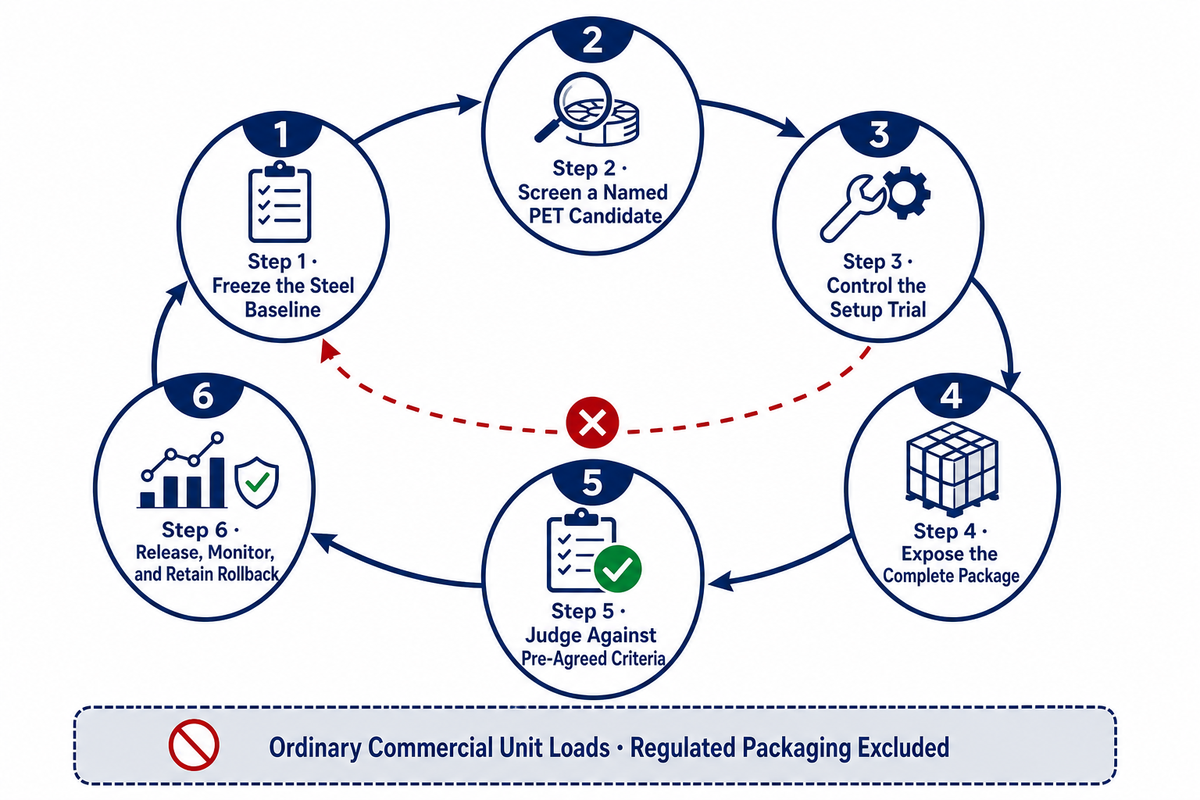
A conversion fails when screening is mistaken for approval. Finding a PET strap with a similar catalog break strength is only the start. A controlled process must preserve the steel baseline, define what changes, keep the trial representative, and establish who can accept or roll back the result.
Regulated-package scope exclusion: this six-step loop is for ordinary commercial unit loads. Do not use it to authorize a change to hazardous-material, UN specification, certified, or otherwise regulated packaging. Applicable regulation and design certification control. Current 49 CFR § 178.601 defines design-type and testing boundaries, while 49 CFR § 178.2 states the responsibilities tied to required closure information. The responsible regulated party must determine whether a proposed change remains authorized.
6-Step Steel-to-PET Change-Control Loop
- Freeze the steel baseline. Record the package drawing, product, pallet, strap grade and dimensions, strap count and path, joint, tool, settings, edge protection, route, damage history, receiving method, and applicable rules. Don’t use an undocumented “current practice” as the control.
- Screen a named PET candidate. Obtain dimensions, break and elongation data, joint method and result, temperature and exposure limits, core, surface, lot identity, tool compatibility, and change-notification process. List every unresolved field.
- Control the setup trial. Use maintained equipment, trained operators, recorded settings, the intended joint and edge protection, and representative products. Define how many samples and repetitions the responsible team requires.
- Expose the complete package. Apply the declared dwell, lifts, impacts, vibration, acceleration, braking, transfers, temperature, humidity, storage, and route conditions. Include the receiving and cutting task.
- Judge against pre-agreed criteria. Inspect joint integrity, strap position, retained containment, package movement, corner and surface damage, pallet condition, operator observations, and receiving safety. A trial can’t pass by changing the criterion after the result is seen.
- Release, monitor, and retain rollback. Tie approval to the candidate lot/specification and process window. Monitor early production and shipments, define escalation triggers, control supplier changes, and keep the validated steel baseline available until the owner closes the transition.
This loop is original planning guidance synthesized from the reviewed system-selection and task-control boundaries. It is not an ASTM procedure, a regulatory approval route, or a UD Packaging customer case study. It organizes change control but does not replace an applicable customer, carrier, regulatory, or recognized whole-package distribution protocol. The responsible team must select the applicable method: ASTM D4169 addresses performance testing of shipping containers and systems, ASTM D4728 addresses random vibration testing of shipping containers, and ASTM D4332 addresses conditioning packaging components for testing. ASTM D4169’s public scope also says its suitability for hazardous materials has not been determined.
The most important design decision occurs before the first PET roll reaches production: agree on the rollback conditions. Examples include unexplained joint separation, unacceptable package movement, edge damage, tool instability, receiving hazards, or a supplier change outside the approved specification. A rollback trigger isn’t proof that PET is unsuitable; it prevents uncontrolled learning on commercial shipments.
Evidence to Request Before Approval
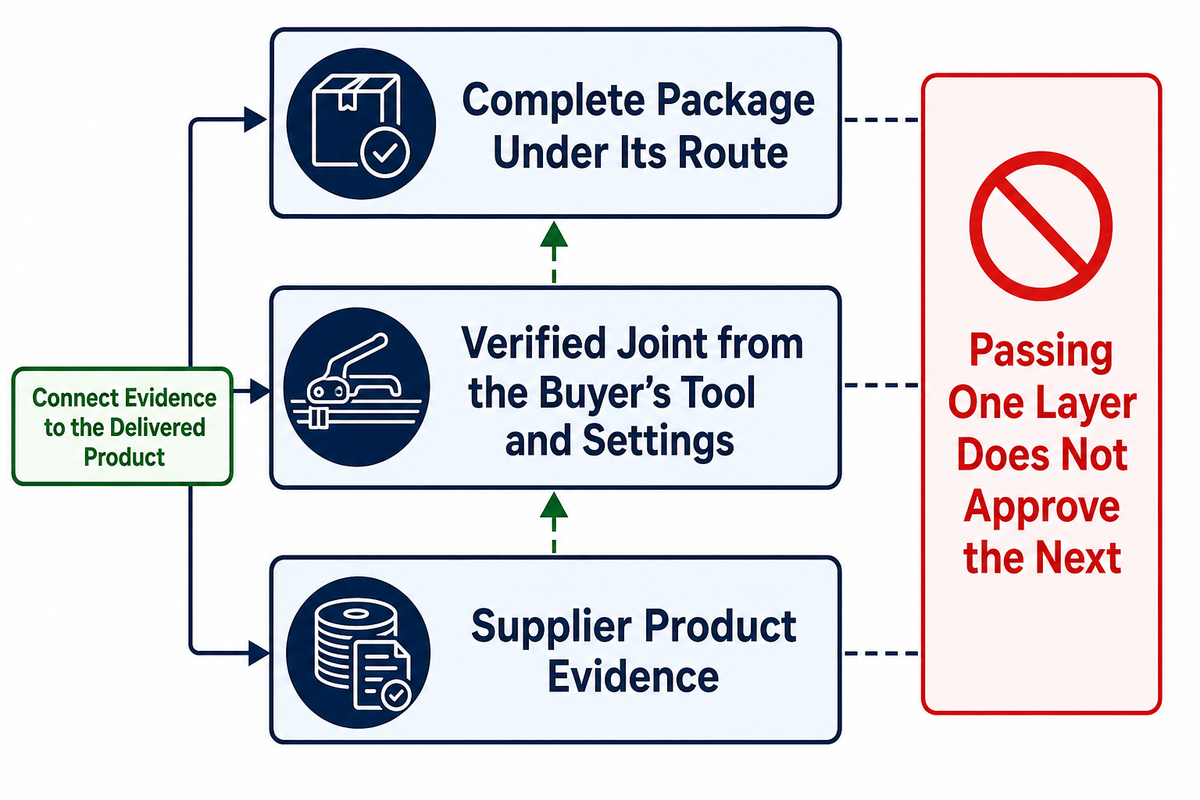
A supplier report is useful only when the buyer can connect it to the delivered product, the joint process, and the complete-package trial. ASTM D3950’s public scope separates material properties from joint strength, so “tested to a standard” is incomplete if the report doesn’t identify the specimen, method, conditions, units, result, date, and issuing party. A logo on a report also doesn’t prove that every product, lot, factory process, or performance claim falls within its scope.
Supplier and request-for-quotation evidence checklist
- Product name, material, grade, surface, and intended use.
- Nominal and tolerance values for width and thickness.
- Core, coil build, length or mass basis, and labeling.
- Lot or batch identity and traceability method.
- Break-strength and tensile method, specimen, conditioning, units, and result.
- Elongation, recovery, creep, or retained-tension method where claimed.
- Joint type, compatible tool, settings, overlap, and tested joint result.
- Temperature, moisture, chemical, ultraviolet, and storage limits relevant to the route.
- Edge-protection recommendation tied to actual geometry.
- Hazardous-material, UN specification, certification, or design-type status and the controlling approval route.
- Required closure components, closure instructions, and evidence that the proposed configuration remains authorized.
- Applicable customer, carrier, or jurisdictional requirement.
- Sample identity and plan for a representative-package trial.
- Change-notification rules for raw material, dimensions, process, site, or test method.
- Nonconformance, containment, corrective-action, and rollback contacts.
- Document revision, report owner, issue date, and validity boundary.
Separate three layers in the approval file. The first is the supplier’s product evidence. The second is the verified joint produced by the buyer’s tool and settings. The third is the complete package under its route. Passing one layer doesn’t silently approve the next.
UD Packaging describes itself as an integrated industry-and-trade enterprise with a manufacturing base in Jiangyin, Wuxi, and a PET scope from granulation to finished strapping. Its supplied portfolio also includes industrial stretch film, seals or buckles, and manual through fully automatic strapping equipment. Those are company-supplied scope statements, not independent proof for a particular roll or shipment.
The company also states that its products undergo SGS product quality testing and that it applies GB/T 1040.1-2018 and GB/T 1040.3-2006 for plastic tensile and joint-strength testing. No report file or article-specific result was supplied for this guide. A buyer should therefore request the actual report, specimen identity, scope, result, edition, and lot connection instead of turning the brand statement into a certification or performance guarantee.
Have a documented steel baseline and need a PET candidate evidence pack? Share the package, route, tool, joint, exposure, and acceptance fields so the discussion starts with a controlled comparison.
Frequently Asked Questions
Is PET strapping stronger than steel strapping?
Answer
Not as a universal material statement. PET and steel products span different widths, thicknesses, grades, finishes, test methods, and break-strength ranges. The usable package system also depends on the joint, strap pattern, edges, tool, and route. Compare named product data under a common basis, then validate the complete package. Don’t infer a safe working load from a catalog number or this guide.
Is PET strapping cheaper than steel?
Answer
It may be cheaper in a particular operation, but the result can’t be universalized. Compare material per accepted load, seals or weld consumables, labor, coil changes, tools, maintenance, downtime, product damage, freight, inventory, waste, and recovery over one declared period. Include transition trials and backup equipment. Use the same production volume, accepted-load denominator, and time horizon for both materials. Show tool purchase or depreciation, ramp-up scrap, training, planned maintenance, and any retained steel backup separately. Run base, adverse, and favorable cases so a low material price can’t hide an unverified downtime or damage assumption. A vendor savings percentage isn’t a substitute for the buyer’s local records and sensitivity cases.
Can PET always replace steel strapping?
Answer
No. PET can be a strong candidate for many industrial packages, especially where a validated grade and joint suit load settlement, handling, product-surface, and corrosion requirements. Steel can remain appropriate in some rigid, sharp-edged, high-temperature, or unusually demanding systems. Applicable customer or carrier rules may also control the choice. Use a documented baseline and representative-package trial before switching.
Will steel strapping rust?
Answer
Steel can corrode when the finish and exposure permit it. Verify the steel type, coating or finish, condensation, chemicals, outdoor dwell, and finish damage at tools and edges. Inspect whether corrosion could affect strength or stain the product.
Can PET and steel strapping use the same tools?
Answer
Generally, don’t assume they can. PET and steel use different tensioning, sealing, welding, cutting, and feed processes, even when a tool family or dispenser appears similar. Identify the strap material, width, thickness, surface, core, joint, and required tension, then obtain the equipment manufacturer’s compatibility statement for the exact model. For PET, record friction-weld or seal settings, overlap, cooling or hold time where applicable, and tool wear. For steel, record the seal, notch, sealless joint, cutter, and edge-handling controls. A dispenser may be reusable while the tensioner or sealer isn’t. Validate feed, applied tension, joint, cutting, ergonomics, maintenance, and package condition in a controlled trial; visual fit isn’t compatibility evidence.
What should a buyer test before switching from steel to PET?
Answer
Test the named PET grade and joint on the complete package using recorded tools and settings. Include dwell, handling or transit, edges, temperature and moisture, retained containment, package damage, joint condition, receiver cutting, acceptance criteria, supplier-lot traceability, monitoring, and rollback triggers.
About This Guide and Its Cannibalization Boundary
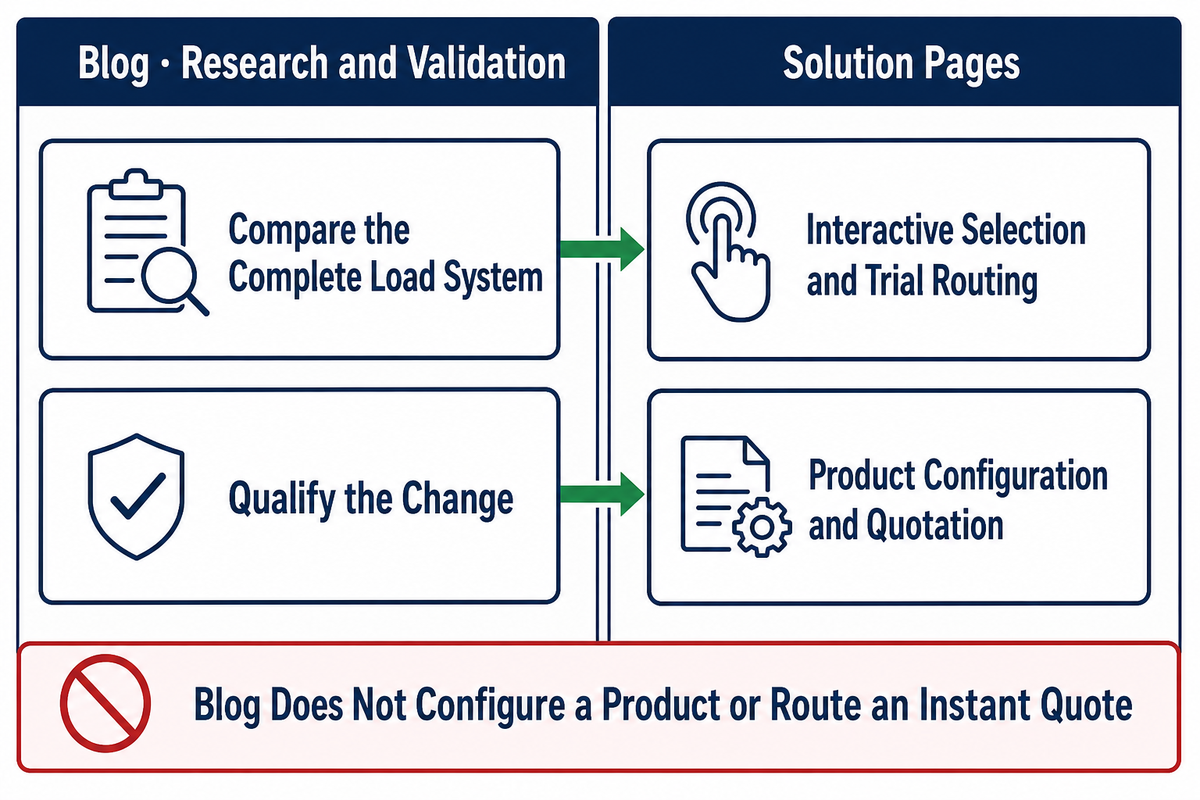
This article answers a research and validation question: how should a buyer compare PET and steel across the complete load system, and how should a change be qualified? It intentionally stays non-interactive. It doesn’t score PET, polypropylene, and steel; recommend a product size; configure a tool; calculate strap count; or route an instant quote.
That boundary separates this Blog from UD Packaging’s existing same-keyword solution Pages, which own interactive selection, trial routing, product configuration, and quotation intent. The Blog may receive technical questions about an evidence pack, but it doesn’t configure a product or route an instant quote. It also avoids repeating the site’s broader five-material Industrial Strapping overview. The Failure-Mode-First Comparison Matrix and 6-Step Steel-to-PET Change-Control Loop are unique to this guide.
Evidence note: the two named frameworks are author-created decision aids synthesized from the reviewed sources, including ASTM D4675’s public selection and user-testing boundary. They are not standards, validated formulas, regulatory approvals, or claimed UD Packaging customer results. The source set doesn’t establish a universal long-duration PET retained-tension result under coupled time, temperature, and humidity. No private customer trial, damage-rate dataset, price, minimum order, lead time, capacity, or universal savings result was supplied or invented.
References & Sources
- Rigging and banding safety guidance · United States Occupational Safety and Health Administration
- ASTM D4675, Standard Guide for Selection and Use of Flat Strapping Materials · ASTM International
- ASTM D3950, Standard Specification for Strapping, Nonmetallic (and Joining Methods) · ASTM International
- 49 CFR § 178.601, General requirements · Electronic Code of Federal Regulations
- 49 CFR § 178.2, Applicability and responsibility · Electronic Code of Federal Regulations
- ASTM D4169-23e1, Standard Practice for Performance Testing of Shipping Containers and Systems · ASTM International
- ASTM D4728-17(2022), Standard Test Method for Random Vibration Testing of Shipping Containers · ASTM International
- ASTM D4332-22, Standard Practice for Conditioning Containers, Packages, or Packaging Components for Testing · ASTM International
- Pallet wrapping and straps exempt from the 100% reuse requirement · European Commission, 25 February 2026
- Tenax polyester strapping technical specifications · Signode
- Magnus steel strapping technical specifications · Signode