Get in touch with UD Packaging Company

Updated August 2026
Strapping tools are the tensioners, sealers, cutters, and machines that apply and secure strap around a load, and picking the wrong one is a quieter, more expensive mistake than most buyers expect: the tool decides how consistently a load holds, how many operators an application need, and how many strap-related injuries a shift racks up. This guide works through the six core tool mechanisms, how to match a tool and joint method to your strap material, when manual still beats automation, what actually causes tool-related injuries, how to keep a tool running, and what a tool really cost once labor and downtime are counted in.
Quick Specs
| Manual tensioner/sealer | Low volume, mobile use, no compressor/battery required |
| Battery combination tool | Medium volume, cordless, tensions + seals + cuts in one motion |
| Pneumatic tool | High-volume, fixed-line stations, consistent tension output |
| Semi/full-automatic machine | Repetitive package profile, highest throughput per operator |
What Is a Strapping Tool, and How Does It Actually Work?
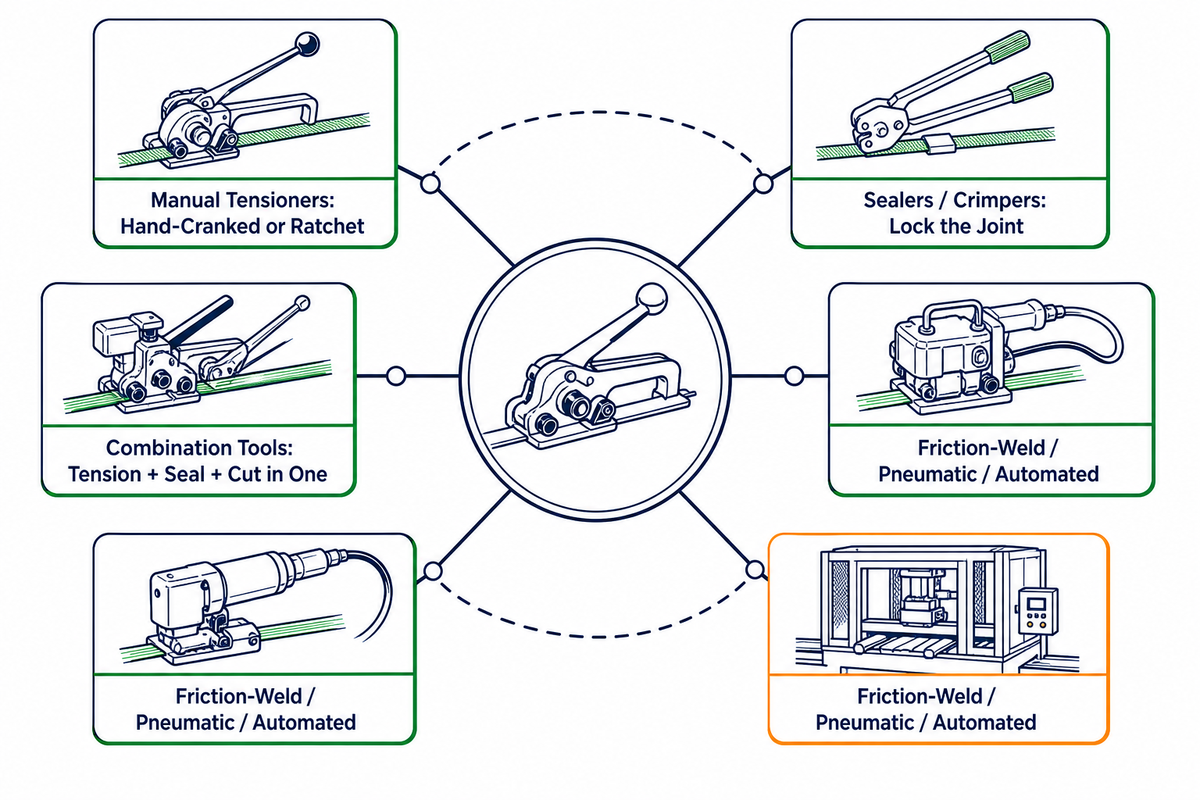
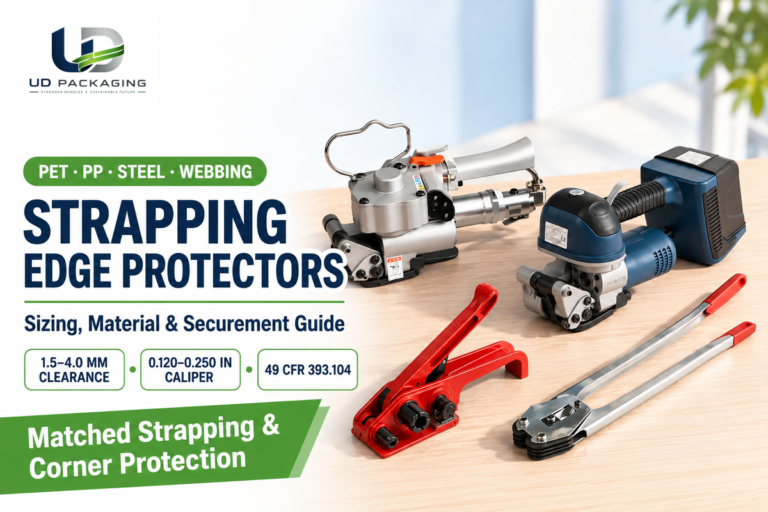
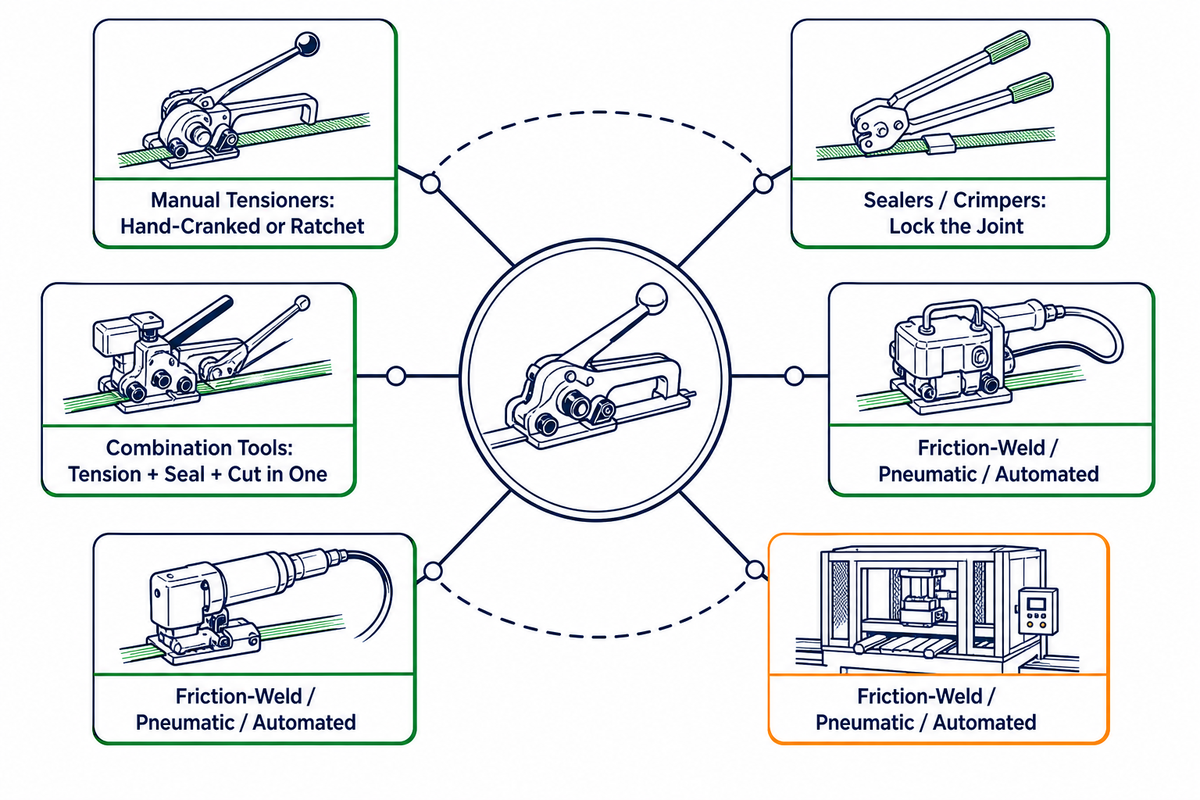
Strap tensioning, sealing, and cutting tools provide that mechanical function, in contrast with the strapping material itself, which primarily functions to maintain tension. These tools (including steel strapping or steel banding tools designed for carbon-steel strap, and poly strapping tools designed for polypropylene or polyester strap) include about six mechanisms that cover almost every job on a packaging line: manual tensioners, sealers or crimpers, combination tools, friction-weld (or heat-seal) tools, pneumatic strapping tools, and automated strapping machines.
The tool-to-material matching logic follows ASTM D4675, the standard guide for selection and use of flat strapping materials. General search results for this topic commonly name those same five or six categories, but rarely explain how each one is actually operated or implemented. Those are typically the areas where a purchase decision is ultimately based, and frankly, some basic mechanical explanations and comparison charts are really what most purchasers will be looking for.
Each mechanism involve a trade-off in terms of portability versus security and strap accommodation and each of the sections below go through that trade-off per mechanism and then go on to match mechanisms and materials with regards to safety and maintenance and cost.
The 6 Core Strapping Tool Types and How Each One Works
Each strapping tool does one or more of three functions: to tension (pull tight), seal, or cut. That builds directly on the six mechanisms named above — manual tensioners, sealers, combination tools, friction-weld tools, pneumatic tools, and automated machines. The half-dozen most popular varieties of tool are differentiated primarily by how many of the three it perform and in how much power (i.e., from what source of energy). A tensioner tugs the strap tight and a sealer or crimper locks the junction, or may crimp with a seal, sometimes called a clip or buckle.
A combination tool does all three actions in sequence but in one operation; an overall strapping machine is designed for maximum output per hour. Adjustable tension capability, provided on some tools, means the identical device will not become incapable when called upon for more or less demanding strapping jobs.
| Tool type / configuration | Mechanism | Typical strap compatibility | Not suitable for |
|---|---|---|---|
| Manual feed-wheel tensioner | Hand-cranked wheel grips and pulls strap through friction | PP, PET (hand/tool grade) | High-volume lines, steel strap over ~0.03 in (0.76 mm) thick |
| Manual ratchet tensioner | Ratchet handle winds strap onto a spindle | Steel, heavy PET | Fast-cycle repetitive lines |
| Notch/crimp sealer | Deforms a metal seal around overlapped strap to lock the joint | Steel, PET with metal seals | Sealless plastic strap systems |
| Friction-weld (heat-seal) tool | Vibrates or heats overlapped strap ends until the plastic fuses | PP, PET (embossed surface) | Steel strap, smooth/waxed-surface strap |
| Combination tool (manual) | Single body tensions, seals, and cuts in one clamped motion | PP, PET, light steel | Very heavy-gauge steel beyond hand-tool capacity |
| Battery combination tool | Motor-driven tension + weld/seal + cut, cordless | PP, PET | Continuous multi-shift use without spare batteries |
| Pneumatic tensioner/sealer | Compressed-air cylinder drives consistent tension + crimp | Steel, heavy PET | Sites without a compressed-air line |
| Cutter (dedicated) | Shear or guillotine blade severs strap | All materials, sized to strap width | Tensioning or sealing (cut-only) |
| Semi/full-automatic strapping machine | Motorized feed, retract, tension, seal, and cut on a fixed or portable frame | PP, PET (machine grade, no splices) | Irregular or one-off package shapes |
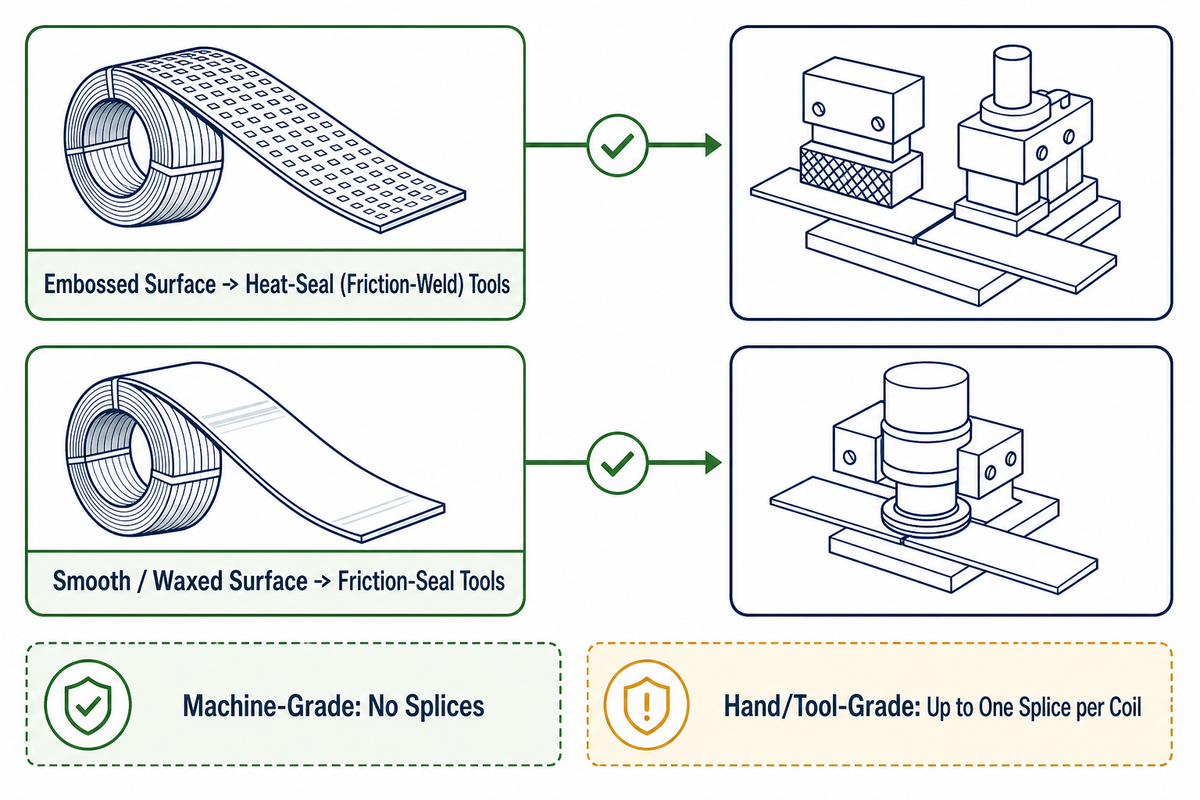
Strap grade is just as important as the tool itself, a distinction covered under ASTM D3953‘s strap and seal classifications for steel. Machine/systems-grade strapping is delivered without any splices so that it will run through a high-speed automatic tool without a break in the coil; hand/tool-grade strapping can have as much as one splice per coil, which an automatic feed mechanism will not tolerate, but a manual or battery tool will. Surface finish also has a corresponding joint mechanism: embossed-surface strap is designed for heat-seal (friction-weld) equipment; smooth, often waxed, surface strap is designed for friction-seal tools.
Using the wrong tool on the wrong surface finish is a common cause of weak or broken joints. Poly and steel strapping tensioners are quite similar but cannot be used interchangeably for packing a mixed-material load: a metal banding strap must be fed through a metal-rated wheel; a sealless combination unit built for one material will destroy a banding strap designed for another. Purchasing a poly strapping tensioner for a project that require a steel-rated piece of equipment is a common, but unnecessary and easily prevented, sourcing error.
Similarly, it is important to recognize exactly what proof the automation of a strapping machine give us. Strapping machines are capable of automating the feed, retract, tension, seal, and cut cycle – the full mechanical cycle – but a completed cycle does not by itself establish downstream load release or load distribution performance once away from the machine.
In other words, completing a cycle confirm to you that a strap has been dispensed to the strap ends – it does not confirm that the load it is securing will be able to withstand a ride in the back of a truck or the impact of a forklift. The safety and maintenance issues that follow are a large part of that why.
To give you some perspective on the span of specifications in use, one commercial battery-powered plastic strapping tool line reports the following range – maximum tensioning speed up to 290 mm/s, 9 mm to 32 mm range on strap width. Typical manufacturers’ lists or brochures for manual and combination strapping steel strapping tool catalog pages offer sizes in and around what approximates 9.5 mm (3/8 inch) to 31.75 mm (1-1/4 inch) strap width — these are catalog-observed, manufacturer-published ranges, not figures drawn from ASTM D3953 itself; but if you are about to order a tool of a certain catalog listing be sure to check its specific data sheet to be sure, because the available strap ranges are dependent on which specific manufacturers’ and their particular models of tools you select.
Looking for a head-to-head criterion-by-criterion comparison of manual-vs-pneumatic-vs-battery power-types?
Take a look at our Plastic Strapping Guide’s tensioner power-type breakdown in that reference. In this guide we compare them all to your task at hand.
Manual, Semi-Automatic, or Fully Automatic? Matching Tools to Your Throughput
Which of those six tool types makes sense for a given line often comes down to volume as much as mechanism. Automation is typically paid for most quickly in those high daily-volume/frequent-use scenarios, as evidenced by the demand for related searches: “automatic banding” and “auto banding” are each searched about 2,900 times per month with low advertiser competition – far more search volume than many individual manual-tool phrases see. However, pure volume is only part of the puzzle. Below we present approximate figures from various equipment dealers (these are vendor-provided figures, and are not audited, so should be treated as approximate; they reflect a likely product mix)
5-year total cost of ownership — illustrative, vendor-reported ranges:
| Cost item | Manual/battery tool | Semi/full-automatic machine |
|---|---|---|
| Purchase price | $150–$1,200 per tool | ~$3,499 and up for entry-level automatic units (vendor-reported) |
| Installation & commissioning | Minimal — plug-and-use or no power needed | Floor space, power/air drop, integration with conveyor line |
| Labor (5-yr) | Scales directly with headcount — one vendor reports ~8 people for a fully manual line vs. ~2 with a mobile machine | Near-zero incremental labor after setup, per vendor-reported case data |
| Maintenance & spares (5-yr) | Low — seals, tensioner wheels, batteries | Higher — motors, sensors, feed mechanisms; see maintenance section below |
| Downtime risk (5-yr) | Low — a spare hand tool covers most failures | Higher — a single machine failure can stop the whole line without a backup |
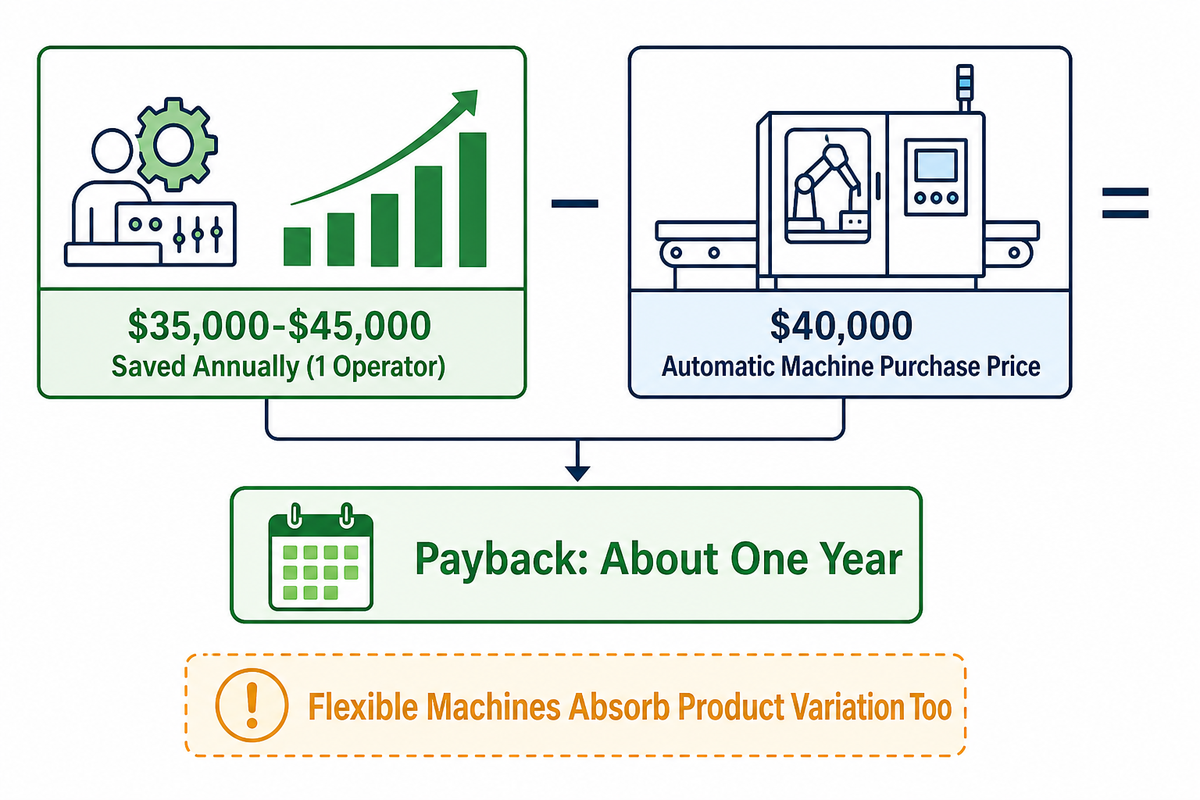
Payback example (illustrative only, a smaller single-line scenario than the ~8-to-~2 vendor case above — the labor rate, staffing change, and days-per-year below are round, assumed inputs for demonstrating the calculation method, not figures drawn from any government wage survey or a specific vendor’s audited case): a line running 40 straps per minute at an assumed fully loaded labor cost of $18/hour needs roughly 2–3 fewer operators once automated. At 250 production days a year, even a conservative one-operator reduction saves on the order of $35,000–$45,000 annually in labor alone — enough to clear a $40,000 automatic machine’s purchase price in about a year before maintenance and uptime factors are counted. Below that throughput, the same math simply does not clear in a comparable timeframe, which is the volume threshold the next paragraph qualifies.
However, that cutoff is not solely based on daily volume, either; NIST’s own manufacturing-oriented research recognizes collaborative robots as a good fit for high-mix, low-volume work precisely because they adapt to part variation with relatively few programmed changes and reduced need for custom fixturing – which complicates a simple volume-only view of strapping automation, too. A facility that switches out product size, straps, or joint type on one part out of many throughout the day does not automatically rule out a good automation payback; the more relevant question is whether the specific machine on the table is flexible enough to absorb those changeovers cheaply, the way a collaborative robot absorbs part variation in NIST’s example. Volume comes into play immediately but does not automatically make it the make-or-break factor.
Manual Hand Tools: When the Simplest Option Is Still Right
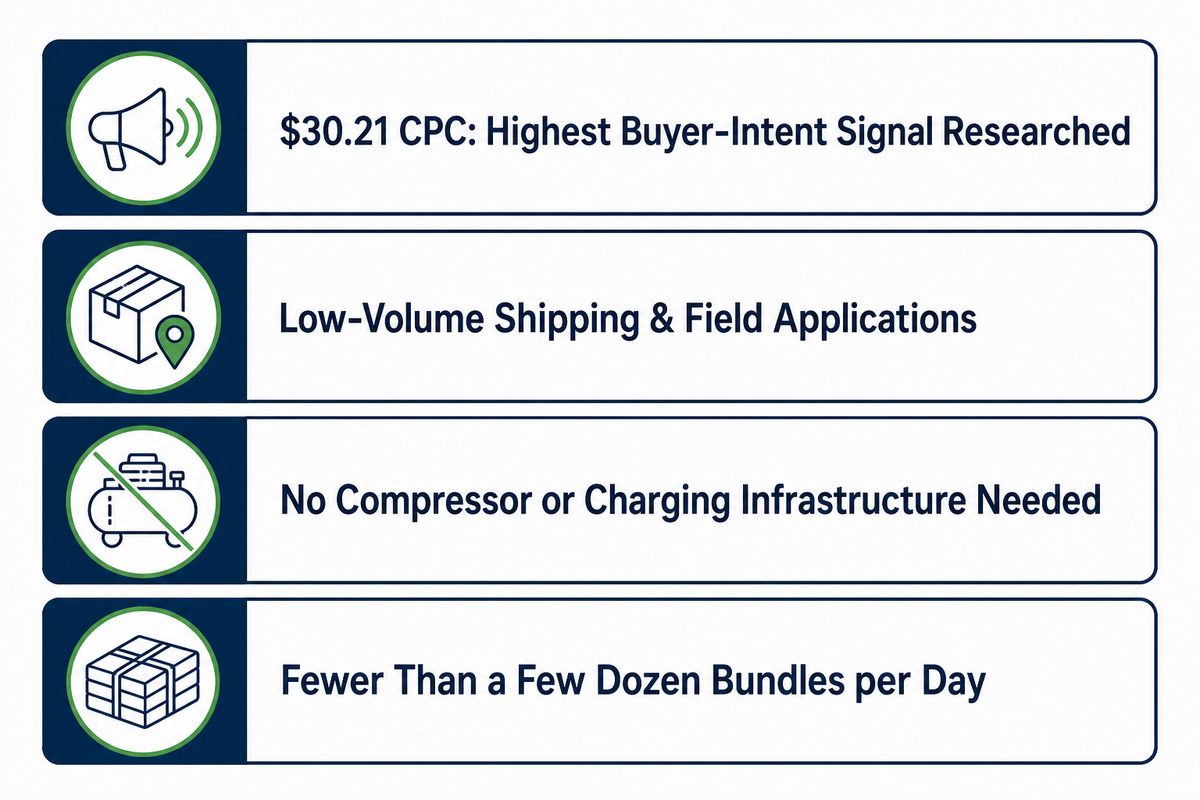
The keyword “manual strapping tool” carries the highest cost-per-click of any term in this research — $30.21, roughly 22% above the next-closest researched keyword ($24.82) — a high CPC signals intense advertiser competition for that search, which is consistent with (though it does not by itself prove) a genuine buyer closing in on a purchase; that fits with manual tools being the proper choice for low-volume shipping, field applications and operations that have the resources for straps and seals, but not for a compressed-air line or battery chargers.
You also find chatter among machinists and fabricators for plastic strapping tools in a shipping application, with real-time user discussions about various manual PP (polypropylene) hand strapping tensioners/sealers, indicating the prospect’s doubt in hand-tool selection for low-volume/occasional shipping operations in any shop. One person discussed obtaining secondhand tools as the cost effective method of picking them up:
One practitioner reported sourcing a complete used cart-and-tool setup, including a strap coil, seals, and a tensioner/sealer, for around $140 through a local classifieds channel, a fraction of new-tool cost for a shop that straps infrequently.
— paraphrased from a practicalmachinist.com forum thread on sourcing strapping equipment
At fewer than a few dozen shipping bundles per day the choice is simpler, nearly all shops would find that at this lowest-expense level, a durable, rugged manual combination tool — the kind of selection ASTM D4675 frames as a materials-and-use decision, not just a price comparison — outperforms the capex, workspace, and upkeep cost of automation most hours of the day, regardless of the job-cost approximations noted in the automation section above. Stepping up to a handheld pneumatic steel bander (most run on a standard 90 PSI shop-air supply) simply requires higher volume to justify having an air line; light-to-medium palletized loads are generally within what a well-maintained hand tool can secure reliably, but always match tension and joint method to the actual load weight rather than a generic rule of thumb.
Matching Tool and Joint Method to Your Strap Material and Grade
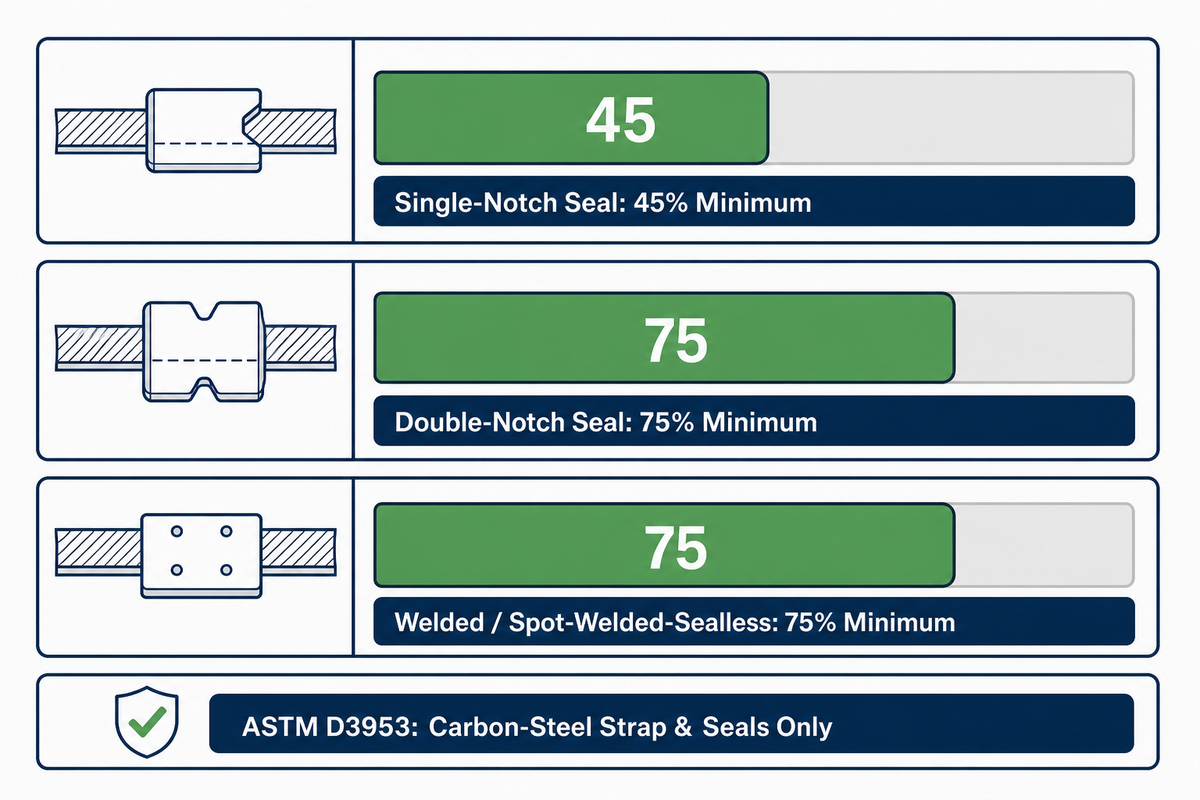
Joint efficiency, not bare tensile strength, decides how much load a strap actually delivers – and the ranking by bare force can invert against the ranking by usable load once the joint is factored in. A strap rated higher on paper can still fail first at the seal if the joint method is mismatched to the tool or the strap grade.
Scope note: The break and tensile data described above under “Joint efficiency” pertains to the requirements for carbon-steel strap and seals as outlined in the standard specification found by document designation ASTM D3953, which explicitly excludes specialty strapping and alloy-metal products. It does not cover nonmetallic PP or PET strapping either, which have separate evaluating as per the relevant document designation ASTM D3950, an altogether different evaluating process which is NOT equivalent for compare functions on a typical scale.
| Joint method | Tool that produces it | Minimum joint efficiency (D3953) |
|---|---|---|
| Single-notch seal | Notch/crimp sealer, general-use grade | 45% |
| Double-notch seal | Notch/crimp sealer, heavy-duty grade | 75% |
| Welded / spot-welded-sealless | Spot-welding tool (steel-rated, sealless) | 75% (separate provision — notch-seal terminology does not apply to weld-based joints) |
For nonmetallic polypropylene strapping (PP) and polyester strapping (PET), the equivalent decision is grade and surface finish, not a joint-efficiency percentage: machine/system-grade strap has no splices and matches automated feed tools, hand/tool-grade strap, sometimes sold as manual banding tools plus strap, may have one splice per coil and is compatible with a manual or battery tool. Nylon cord strapping, a less common fourth material, follows a similar tool logic to PET. Embossed surface matches heat-seal equipment; smooth, waxed surface matches friction-seal equipment, pairing the wrong combination is the most common cause of a seemingly good joint that prematurely open under load.
Strapping Tool Safety: What Actually Causes Injuries
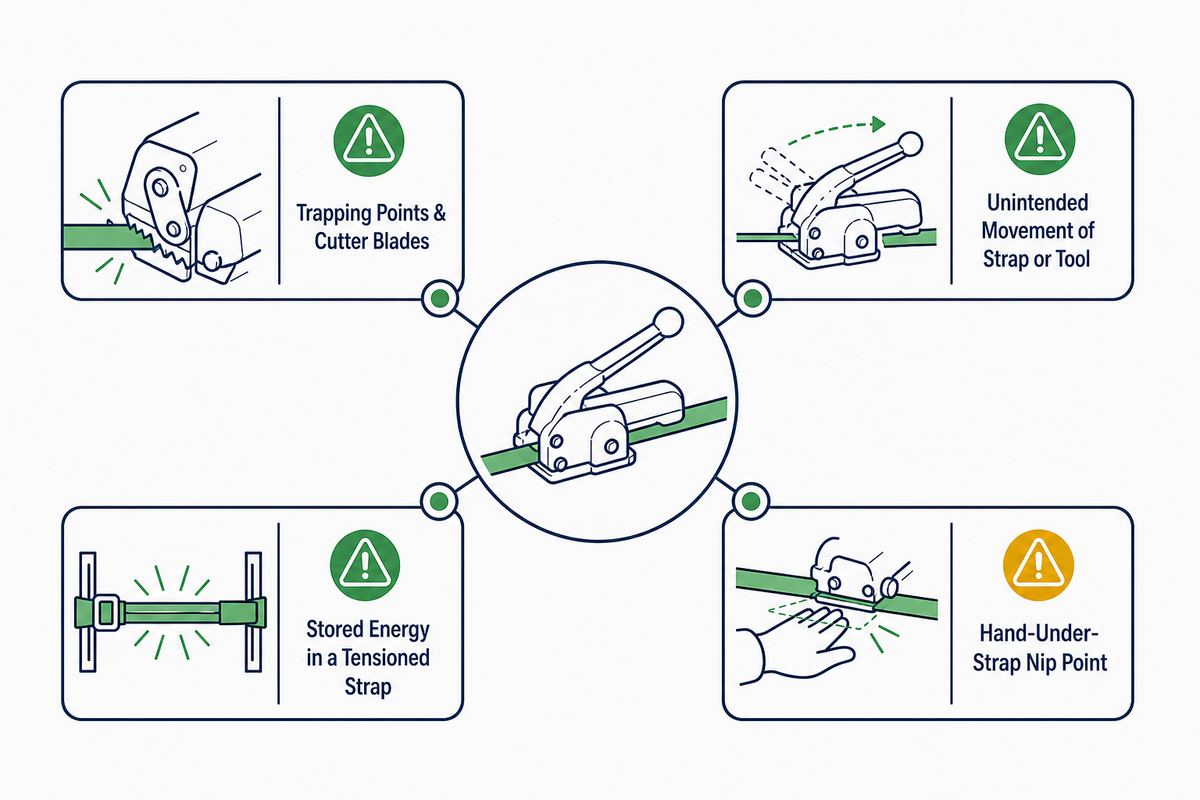
Strapping-tool related injuries tend to cluster around a handful of mechanisms: trapping points, cutter blades, unintended movement of strap or tool, stored energy in a tensioned strap, and a hand-under-strap nip point during tensioning. These are specific hazards, not a general “be cautious” poster-child, published, accessible engineering breakdown of accidents is nonexistent, so the following specifics synthesize OSHA’s own tool-safety regulations and published guidance rather than a larger literature.
A general powered-tool safety principle applies directly here: an energized or trigger-armed tool can release unexpectedly while a hand is in the strap path, so the message is to disable the tool’s trigger or energy state before anyone puts a hand in that path, not merely before cutting. Separately, OSHA’s Marine Terminals cargo-handling regulation, 29 CFR 1917.51(c), states that only cutting tools may be used to cut the metal strap or banding used to secure cargo, its legal jurisdiction is around maritime cargo handling specifically, but the underlying principle (never improvise a makeshift cutting tool on tensioned steel strap) bears following anywhere steel strap is used, not merely in the marine terminal context. Conductive steel strap near exposed energized conductors is a different hazard again, requiring appropriate site electrical-safety controls in advance of handling or routing.
Beyond acute incidents, manual strapping tool use has an ongoing ergonomic dimension that is easy to overlook if safety planning looks only at acute injuries. General CDC and NIOSH ergonomics guidance points to force, repetition, awkward postures, and vibrating hand tools as known risk factors for musculoskeletal disorders, factors which directly apply to an operator running a manual ratchet tensioner or combination tool through dozens of cycles a shift. None of the three competitor pages examined for this guide mention ergonomic risk at all; rotating tool assignments and selecting a battery or pneumatic tool for high-repetition stations are tangible controls.
Over-tensioning links to this same hazard mechanism: a strap that snaps while tensioned can whip back with significant force, hitting the operator or a nearby worker, another reason to have the correct tensioner setting in place (discussed in the mistakes section below) is a safety concern, not merely a quality concern.
Tool Maintenance and Common Failures
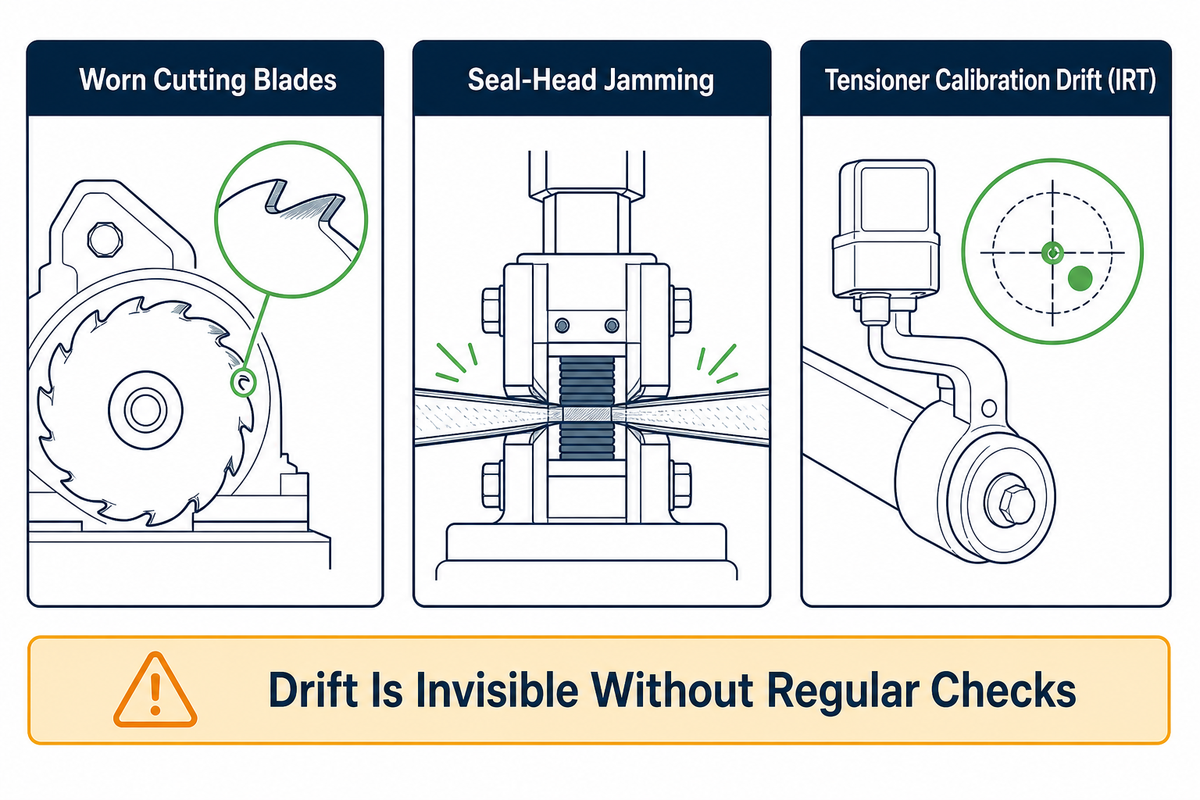
Most strapping tool malfunctions come down to one of three factors: cutting blades are worn out, seal head jamming and tool tensioner losing calibration – and all three are largely preventable with routine attention, and most cases can be resolved without shipping the tool out for service.
A dull or chipped cutting blade can be quite the slowdown, not to mention it makes the operator use excessive force to complete the cut – which is another ergonomic and pinch-point hazard in itself! Typically the leading cause of jams in the strap head have more to do with loose straps that are not tight enough, feed parts that are worn out, or low-quality or damaged strap material, but can usually be fixed by a more extensive clean and re-lubricate, tightening the strap head up instead of replacing any parts.
Last on this non-chronological list – not due to importance, but invisibility to the operator – is tensioner calibration drift. The operation appears perfect; it just quietly UNDER or OVER-tensions. And that is where another standards term comes in, Initial Retained Tension (IRT), a concept also discussed in ASTM D4675. This is the stress that remain in the strap once we have finished and taken tension off the tool.
If your tensioner has drifted out of calibration, you get over/under-IRT without any visible sign the tool is ‘broken.’ It is another argument for regular tensioning testing (using a known load), not repair on failure and ‘oh it still makes the noise’. Battery-driven hand tools add one further step to your regular maintenance list: battery maintenance. A partially discharged and older battery will produce fluctuating (under/over) IRT long before it runs out of sufficient oomph to start.
Buy vs. Rent, and What Tools Actually Cost Over Time
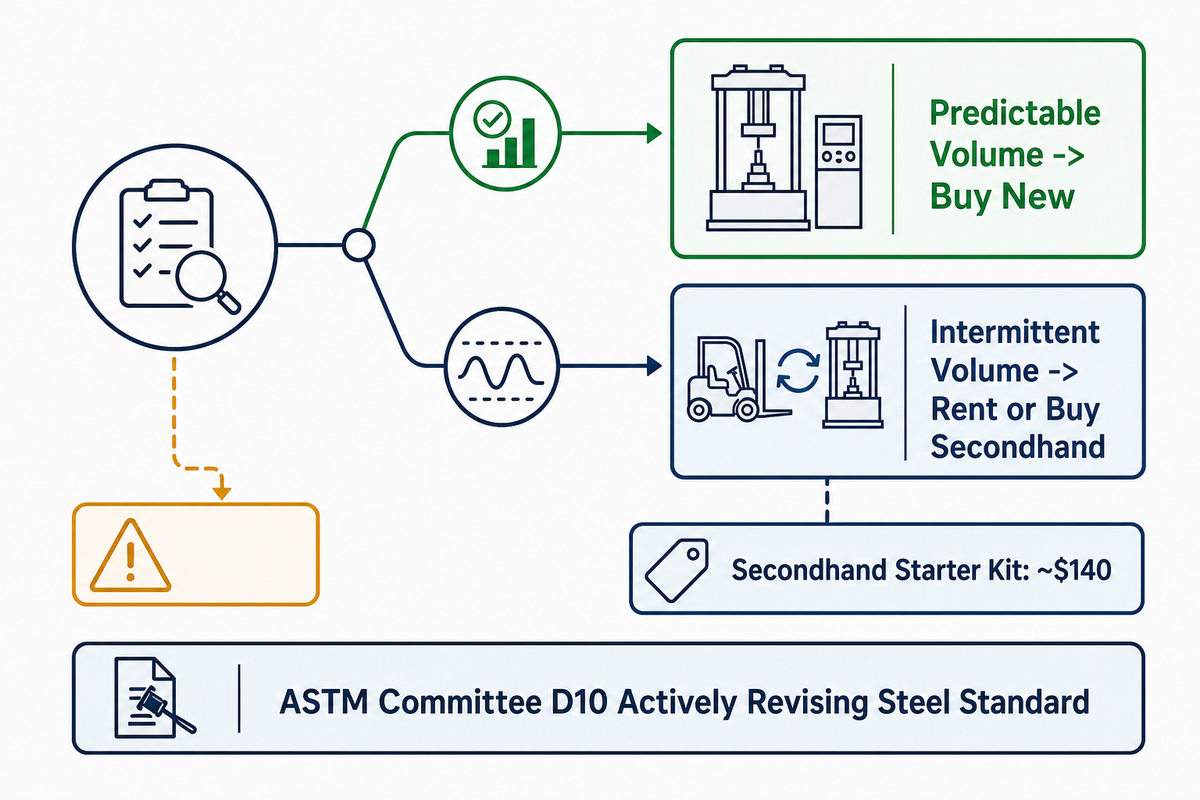
However there is also an active, open solicitation at ASTM’s Committee D10, Subcommittee D10.25 to update the steel strapping standard. Just why is there one?
Well, just one of the bullet points driving the effort are the “many changes in technology, especially in closure methods” from the time of the standard’s last complete review. This is the real action-point, not just whatever percentage one market-research estimate assigns to this segment’s growth.
Market-size numbers are for orientation purposes only: one set of market-research projections places the global strapping devices market around $5.6 billion in 2026, rising toward $8.1 billion in 2033 and the battery-powered tools sector as it can specifically seen going from an estimated $1.40 billion in 2024 to $2.98 billion by 2035, reportedly at a CAGR around 7.11 percent. The latter numbers from one firm in the first group and each of the estimates from the former should not be treated as audited, end-user, or buyer-specific market sizes but are considered for purposes of context and understanding.
In the packaging industry, heavy-duty applications that use stretch wrap also in conjunction with strapping tend to come to automation payback at the earliest in the shop – because both scale by the same rate of packaging. To rent or to buy in the first place come down to frequency and predictability, with the best path forward with new purchasing once volumes are forecast reliably and the automation section above’s payback numbers shake out to your satisfaction. Rental or purchasing used machines is an option for any infrequent or inconsistent volume in packaging operations, the used machine example from the Manual Hand Tools section above (a total kit to perform occasional strapping can now be purchased, often with no warranty, of around $140) to give you an idea just how far this alternative can extend a tightly budgeted venture.
| Metric | Value / range | Source type |
|---|---|---|
| Manual/battery tool purchase price | $150–$1,200 per tool | Vendor-reported |
| Entry-level automatic machine price | ~$3,499 and up | Vendor-reported |
| Battery-powered tool tensioning speed (one commercial model) | up to 290 mm/s | Trade press |
| Poly strapping tool width range (same model) | 9 mm – 32 mm | Trade press |
| Steel strapping tool catalog width range | 9.5 mm (3/8″) – 31.75 mm (1-1/4″) | Manufacturer catalogs |
| Standard shop-air supply for pneumatic tools | 90 PSI | Industry convention |
| Typical light-to-medium pallet load | 200 kg – 900 kg | Industry convention |
| ASTM D3953 single-notch joint efficiency floor | 45% | Standard (secondary source) |
| ASTM D3953 double-notch / welded joint efficiency floor | 75% | Standard (secondary source) |
| Secondhand starter tool kit cost | ~$140 | Practitioner forum |
| “Manual strapping tool” keyword CPC | $30.21 | Keyword research |
| Global strapping devices market size (2026 est.) | ~$5.6 billion, rising toward ~$8.1 billion by 2033 | Market research |
| Battery-powered tools market CAGR (2024–2035 est.) | ~7.11% | Market research |
| Illustrative payback example inputs (labor rate / days per year) | $18 hourly rate, 250 days per year | Illustrative example |
Common Mistakes That Damage Tools or Waste Money
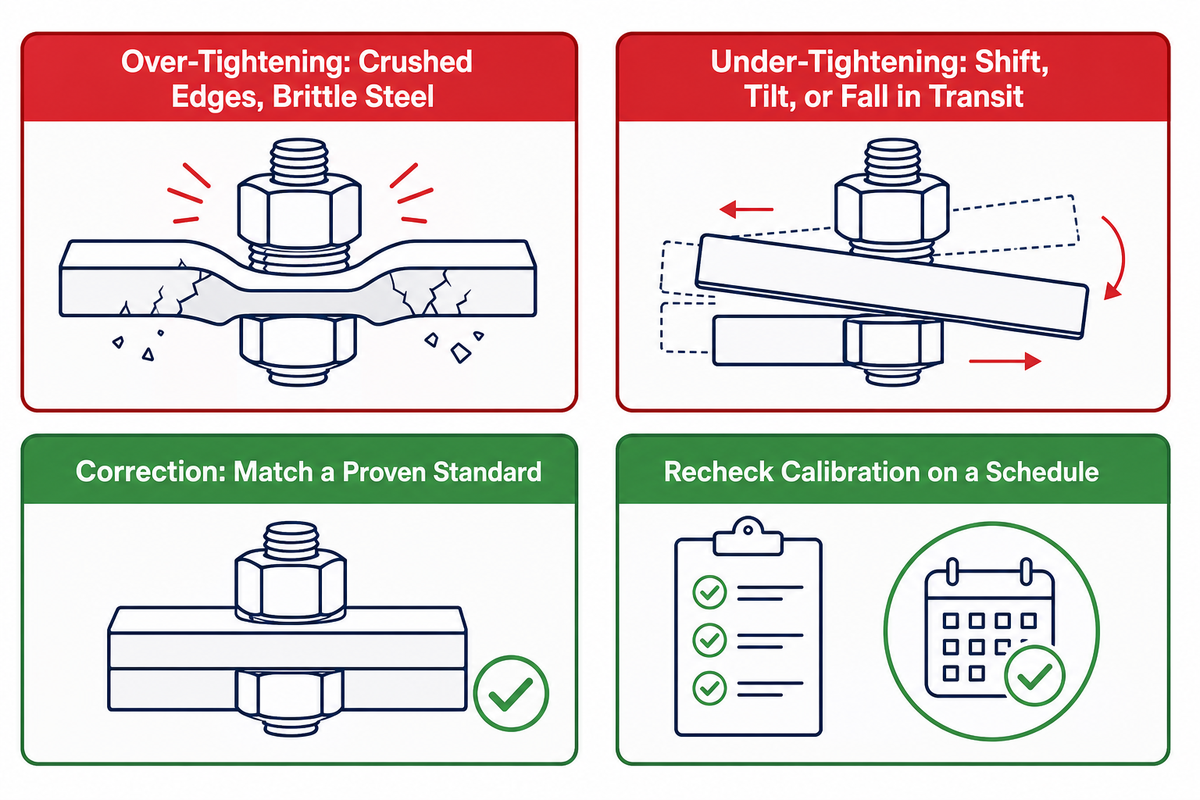
over-tightening or under-tightening your strapping are, based on all resources consulted in the preparation of this report on strapping equipment, two opposing problems which equally devastate and disappoint in their failure.
Do
- Set tension to the strap and load manufacturer’s guidance, not “as tight as the tool will go”
- Recheck tensioner calibration on a schedule, not only after a visible failure
- Match tool grade (hand vs. machine) to strap splice tolerance
Don’t
- Over-tighten to “be safe” — steel can fail prematurely once stressed past its yield point, and PET can stretch and weaken under excess tension
- Leave strap under-tensioned to save a cycle — the load can shift, tilt, or fall during handling
- Assume a tool that “still clicks” is still correctly calibrated
You crush edges; bend; dent; or simply break and shear away the strap; all due to over-tightening. Steel strap stressed past its yield point under excess tension becomes prone to premature failure, and PET stretched under that same excessive force loses overall strength over time. Under-tightening the package often appears later in the product life – it will tilt, shift, then topple or simply lose cohesiveness during transportation or after handling is completed; it all goes to say we may not actually find this problem until your products reach their destination. As you may conclude, both scenarios stem from the same remedial solution to prevent such problems: adjust tension consistently to match a known reference, following the tensioner-calibration guidance in ASTM D4675 and the maintenance section above, and do so rigorously and frequently. Do not estimate!
When You’re Ready to Spec a Tool
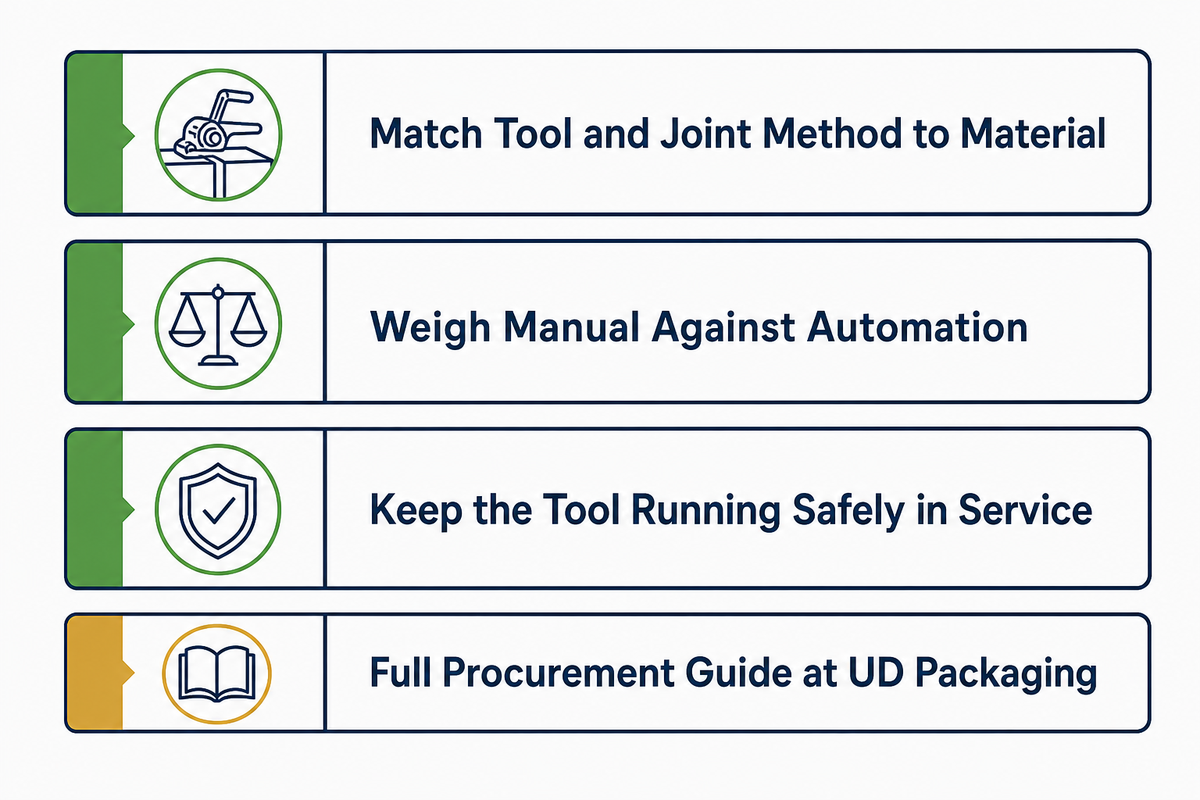
What this document outlines is how to assemble, choose, and ensure adequate functioning and safety for strapping — matching a tool and joint method to your material, weighing manual against automation, and keeping a tool running safely once it is in service.
At such time when your team is ready to advance beyond your preliminary research into concrete purchases, and to be comparing various tool equipment designs against your packaging work cell’s needs and projected volume, see UD Packaging’s full strapping tool selection and procurement guide for the detailed listing and purchasing guide on equipment selection guidelines, the standards guide regarding OSHA and other safety regulatory and code requirements not touched on within this article, as well as to review the full purchasing quotation procedures.
Frequently Asked Questions
Q: What is a strapping tool?
Strapping tools are the equipment, tensioners, sealers, combination tools, or powered machines, that tension, seal, and cut strap material around a load to secure it for shipping or storage.
Strength actually comes from within the strap as tensile force and only the tool can effectively secure that force across your pack – be it the use of hand tools such as portable strapping devices, some with hand crank application, or, finally, in fully automated machinery. Which one is right for your operation depends on strap material, volume, and how the load will be handled — the sections above walk through that decision in detail.
Q: What tools are used for strapping?
Six tool types cover most strapping work: manual tensioners, notch/crimp sealers, combination tools, friction-weld (heat-seal) tools, pneumatic tools, and semi/full-automatic strapping machines, each combining the tension, seal, and cut functions differently.
Each tool type is powered by hand, a battery operated motor, compressed air, or a full motorized system, and each is matched to a specific strap material — steels or synthetics that differ widely in strength and tensile properties. See the Tool Function Breakdown table above for the full mechanism-by-mechanism comparison; catalog strap-width ranges (roughly 3/8 inch / 9.5mm up to 1.25 inches / 31.75mm for steel-rated tools) are covered in the numbers-at-a-glance table above. Choosing the wrong power source or joint mechanism for a strap’s tensile requirements is one of the most common causes of a weak or failed joint on a packing line — know the differences before you order.
Q: Where can I buy a banding tool?
Banding tools are sold through industrial packaging suppliers, strapping-equipment distributors, and general industrial-supply retailers, the right source depends on whether you need a one-off manual tool or an ongoing supply relationship for a production line.
For sporadic use or for small volume applications buying used can make good fiscal sense on classifieds sites and used equipment vendors, as outlined in the section about manual tools. As volume becomes higher (production line level), a dedicated provider who can also support seals, replacement parts and repairs is almost always superior to an initial retail purchase.
Q: What are different types of strapping?
Strapping materials fall into steel, polypropylene (PP), polyester (PET), and nylon cord, each pairs with different tools and joint methods, which this guide covers from the tool side.
For a full breakdown of cost, elongation and strengths trade-offs by material, see our Types of Strapping guide.
This article addresses only the tools and joint methods needed for each type, rather than their strength properties.
Q: How do you maintain a strapping tool?
Regular cleaning, checking the cutter blade for wear, keeping the feed path free of debris, and periodically verifying tensioner calibration against a known reference are the core maintenance tasks.
The three factors covered in the maintenance section above (worn blades, seal-head jams, and tensioner calibration drift) cover most day-to-day failures. Jams specifically trace back to improper initial strap tension, worn feed parts, or damaged strap stock; calibration drift is the harder one to catch, because it reduces Initial Retained Tension without any visible sign of tool fault.
Why We Write This
UD Packaging works across PET strapping, industrial stretch film, and manual-to-automatic strapping equipment for medium- and heavy-duty goods, so tool selection questions come up constantly alongside material questions. This guide focuses specifically on the mechanism, safety, and economics side of strapping tools, the questions we see buyers get wrong most often, rather than repeating the material-comparison content already covered in our other guides.
References & Sources
- ASTM D3953 Standard Specification for Strapping, Flat Steel and Seals ASTM International
- ASTM D4675 Standard Guide for Selection and Use of Flat Strapping Materials ASTM International
- Interested Parties Invited to Join in Revision of ASTM Steel Strapping Standard ASTM International
- Plastic Strap Spool Assembly Ergonomics Success Story U.S. Occupational Safety and Health Administration
- 29 CFR 1917.51, Hand Tools (Marine Terminals) U.S. Occupational Safety and Health Administration
- High-Mix, Low-Volume Manufacturers Are the Sweet Spot for Collaborative Robots National Institute of Standards and Technology
- Ergonomics, Identify Risk Factors U.S. CDC / NIOSH
Related Articles
Ready to spec a tool for your exact load and volume? See UD Packaging’s Strapping Tool Selection Guide →