Get in touch with UD Packaging Company

How to Specify and Qualify Machine Stretch Film

Machine stretch film is not qualified by its label, gauge, or theoretical yield. It is qualified by the wrapper in which it is used, and a documented process that repeatedly produces a load of film that passes the site’s handling and route criteria. The evidence to qualify the wrapper is constructed through experience and repeated trials for wrapped products processed on turntable wrappers and in other wrapping operations, supporting operational efficiency in packaging operations. This guide focuses on constructing that evidence rather than turning the article into a quotation for a wrapper.
Quick decision: describe the load and route first, record the wrapper and current recipe second, then compare one controlled change at a time. Price, MOQ, lead time, samples, and product configurations belong on the machine stretch film options page after the technical brief is ready.
What Machine Stretch Film Is—and What the Label Cannot Prove
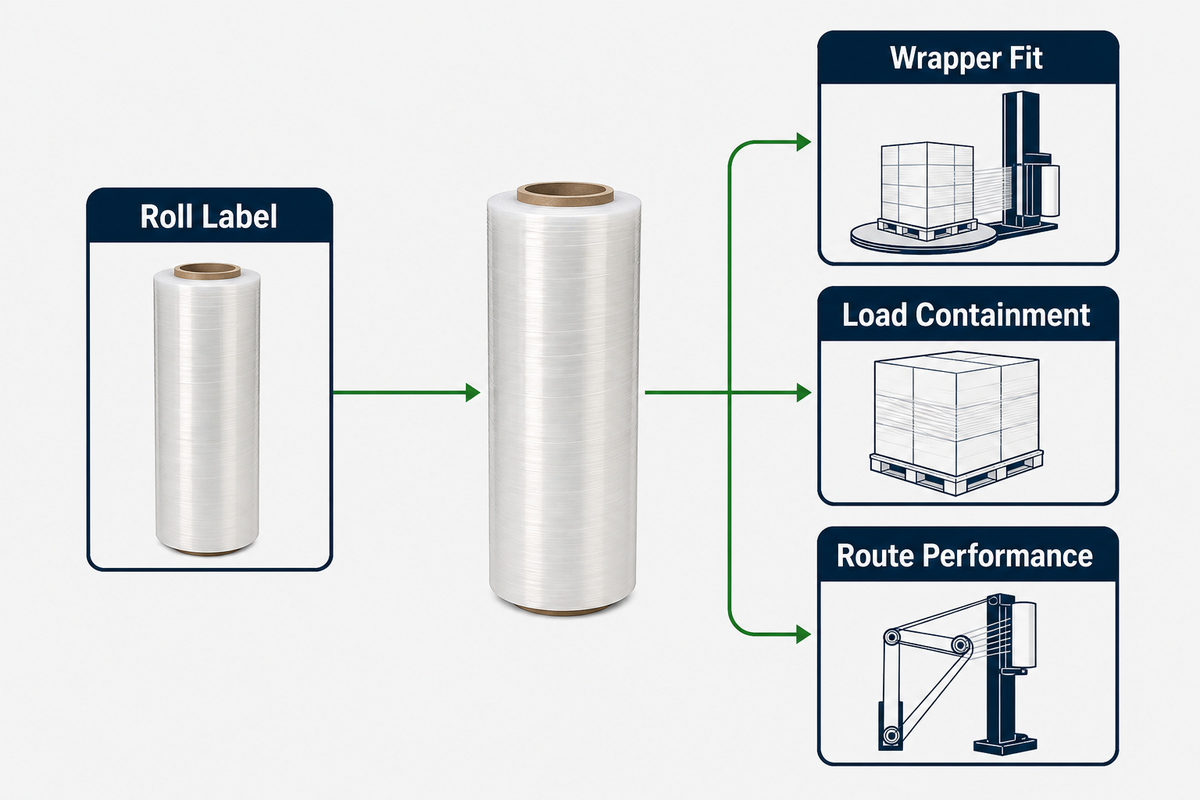
Machine stretch film is a type of polyethylene stretch wrap used in powered or semi-powered pallet wrappers. The roll is transported by a film carriage, while a turntable, rotary arm or a rotating ring moves the film around the load before storage and transportation, handling and transportation, or other storage and transport stages.
The machine may help make the application more repeatable than a manual process, but the term ‘machine’ does not prove that a roll fits a particular carriage, protects a particular pallet, or forms a protective barrier for every load.
A label normally identifies nominal thickness, width, roll length or weight, core size, and sometimes the film construction. Those fields can screen candidates, but they do not prove sustainable pre-stretch, puncture behavior at a sharp corner, retained force after relaxation, load behavior during forklift transfers and transport, or whether a pre-stretched grade fits the wrapper’s pre-stretch capabilities.
ASTM D4649 is useful as a selection-and-use boundary; it is not a certificate that a specific roll fits a specific wrapper and load.
| The label may tell you | The label cannot prove | Evidence to collect |
|---|---|---|
| Nominal gauge or micron | Load stability or puncture survival | Comparable wrapped-load trial |
| Width, core, diameter, roll weight | Carriage fit and clean film tracking | Wrapper limits plus a supervised setup check |
| Cast, blown, or multilayer description | A universal performance winner | Grade-specific data and same-line observations |
| Suggested stretch range | A safe recipe for every load | Machine capability, break behavior, and acceptance results |
What is the difference between stretch film and shrink film?
Stretch film uses elastic recovery to hold a load, while shrink film is heated and contracted to hold the load. The materials, machinery, process, material usage, and acceptance controls are different. Equating the two can result in the use of inappropriate and/or unqualified equipment.
Define the Load and Route Before You Change Film
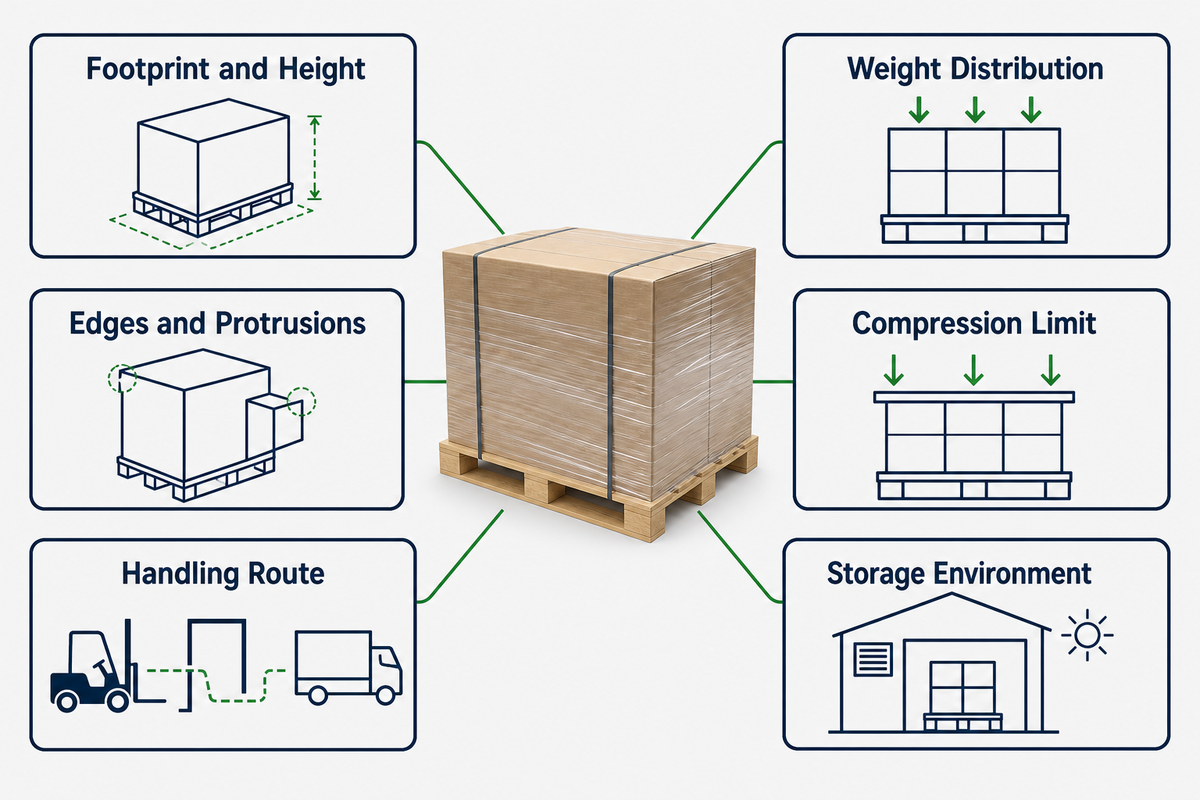
Document load, pallet, handling, environment, and route before altering film or machine settings. A stable case load presents a different problem from soft bags, tall columns, offset cartons, sharp metal edges, heavy loads, or loads with gaps that may settle, and appearance alone does not prove a secure and stable load. Film cannot repair a broken pallet, restore weak packaging, or make an unsafe stack acceptable.
Create a load card for each major load family. Document condition of pallet, dimensions, mass and distribution, product pattern, sensitivity to compression, edge exposure, surface friction, conditions and characteristics of the load, warehouse transfers, transport mode, and failures affecting palletized goods in warehouses and distribution centers or reducing productivity. Photographs of the load from four viewpoints are useful. Comparing loads during a trial assumes like is being compared to like.
The indoor selection scope described by ASTM D4649 is another reason to record temperature, exposure, and handling instead of treating the film label as route evidence.
Stop condition: quarantine a visibly damaged pallet or unsafe stack. Adding revolutions can mask the symptom while leaving the underlying load defect in place.
The 9-Check Wrapper–Film–Load Framework
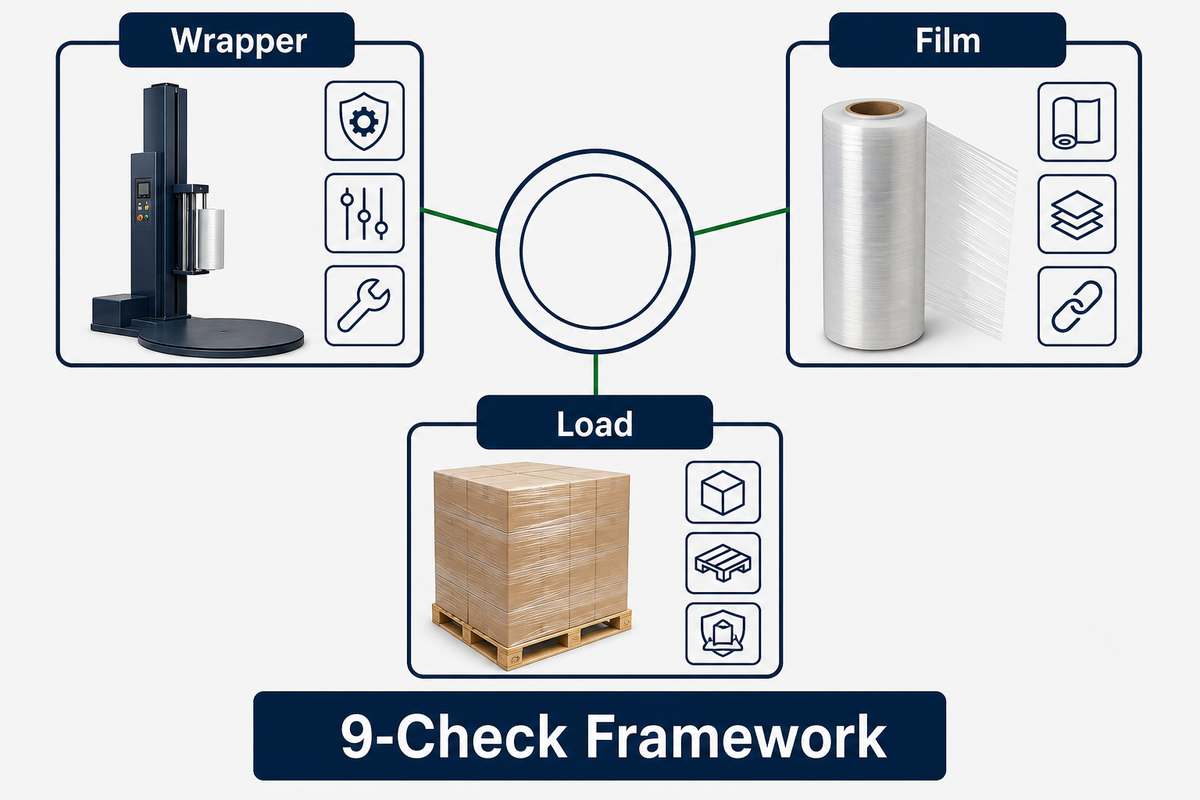
For this guide’s evaluation workflow, the behavior of film, wrapper, and load is treated as mutually constraining. Treat a roll as qualified only for like situations within the documented trial scope. Within this guide’s evaluation workflow, treat assumptions about the wrapper, film, and load as unverified until the same load sizes and weights are tested; record any breakage or loss of roll control as trial observations rather than universal outcomes.
Use the variables in ASTM D4649 to structure a selection review, then qualify the integrated wrapper–film–load system under the conditions that matter to the site.
| Wrapper | Film | Load and route |
|---|---|---|
| Machine type, carriage, film path, pre-stretch mechanism, speed, clamp/cut/wipe system | Width, core, diameter, roll weight, thickness, construction, unwind and cling behavior | Geometry, mass distribution, edges, compression, friction, handling, temperature and route |
| Current recipe, alarms, maintenance condition, OEM limits | Lot identity, data sheet, storage condition, observed breaks and tracking | Acceptance method, sampling, photos, damage and rewrap history |
Start with the stretch wrap machine manual and the current approved roll. Document the film path and condition of the carriages before changing material. Confirm that the core, width, OD, and weight of the roll are within the limits of the equipment. Across different wrapping machines, a roll that fits the mandrel may still track poorly, overload the carriage, or behave unexpectedly through the pre-stretch rollers. Treat machine wrap as a controlled process used to secure a shipment, not as a roll-only purchase.
Cast or Blown? Compare Process Behavior, Not Labels
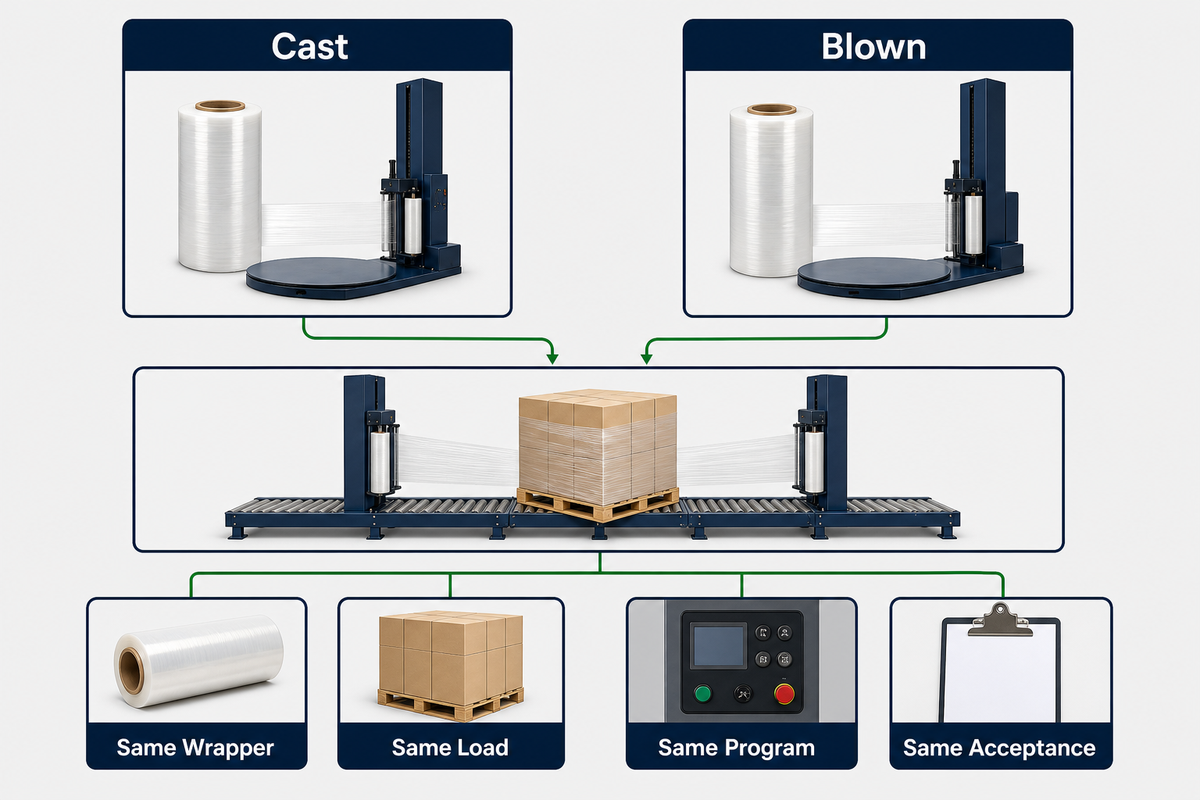
Cast and blown describe manufacturing processes, not guaranteed outcomes on your line. Often, Buyers associate cast film with quiet unwind and clarity and blown film with toughness or puncture response. While these trends may create an idea for a working hypothesis, several other factors such as resin system, layer design, gauge control, and formulation may ultimately determine the outcome.
ASTM D5459 is one example of measuring recovery and retained-stress behavior instead of inferring performance from a process label.
Express the hypothesis in a form that can be observed: does the film track centrally? Does the film unwind quietly at line speed in a high-speed application? Where do punctures initiate? Do tears propagate? Does cling hold the tail at the actual finish? Are there irregularities in the load? Do operator variability, control of the load, wrap, and measurement method used impact the outcome?
Decision boundary: process family narrows the trial. It does not qualify the load. Require grade-specific documentation and a same-line trial before declaring either construction better.
Gauge, Pre-Stretch, and Retained Containment Are Different Variables
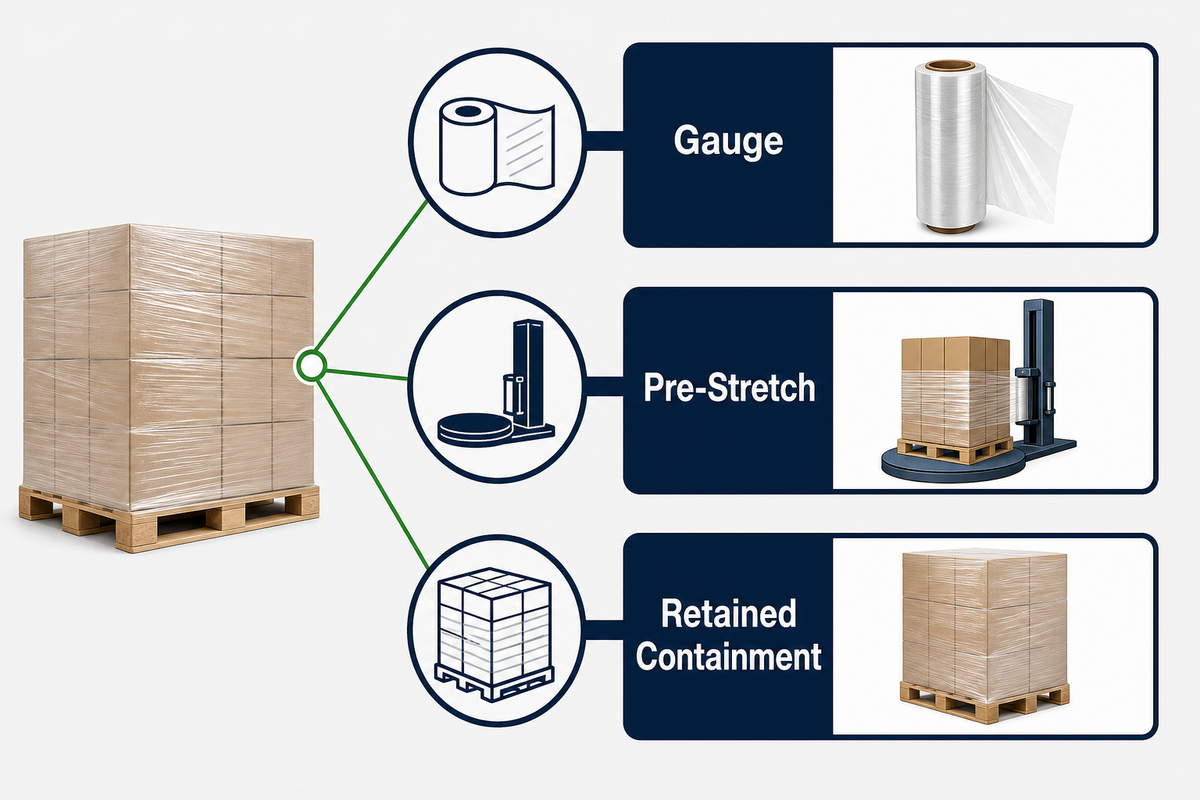
Thickness, Applied stretch, and the wrapped Load’s Retained Containment address different questions. Nominal film thickness may be described as Gauge or microns. Pre-stretch is elongation created by the carriage during application. Retained containment is what the wrapped Load experiences after elongation and relaxation. A higher number in one column does not mean improvement in the other two for a high-volume operation, regardless of high-performance or high-quality labels.
The official scope of ASTM D5459-95 (2025) addresses elastic recovery, permanent deformation and stress retention of stretch wrap film at multiple extensions. This differentiates recovery and retained stress from thickness. It is, however, a film test method and not a proof that a pallet will travel the site route.
This section applies containment to the combined effect of wrap force and film layers. The Lantech quick guide suggests checking multiple points on the load, defining the goal using actual shipping data, and using one instrument and one measurement system and comparing values; often, results from different methods or instruments are not comparable.
Does machine stretch film stretch?
Yes, but “stretch” is not a single, unambiguous performance level. The degree of extension attainable and how long it is sustainable is dependent on the type and condition of the film, carriage and rollers, speed, temperature, wrap force and load. If a new roll reaches a higher theoretical pre-stretch but breaks more often and/or delivers less contained load, the yield calculus has not achieved a better result.
How Do You Qualify a Replacement or Down-Gauged Film?
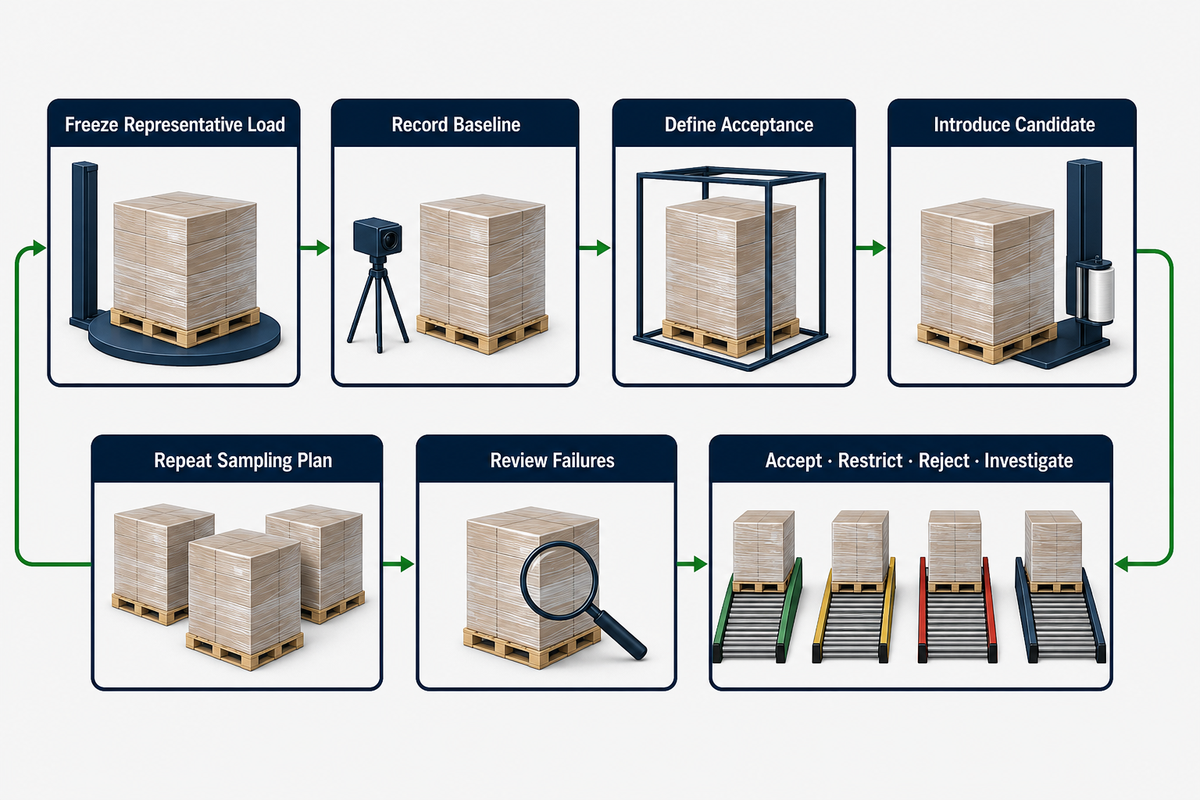
Freeze a baseline, define acceptance, change one variable, repeat comparable loads, observe actual handling, document deviations, and obtain approval or rejection by a named owner. This is the Candidate-to-Accepted-Loads Protocol, applied across representative shifts, loads, and route conditions before release.
Changing one variable is a troubleshooting control, not proof that interactions are absent. If film, recipe, load geometry, or temperature may interact, compare the relevant combinations in a designed trial and keep the conclusion inside the tested conditions. A laboratory or wrapper-station pass also does not establish route acceptance by itself; outdoor exposure, extreme temperature, mechanical handling, and other untested hazards require their own evidence.
The distinction matters because ASTM D5459 measures film properties, while the accepted-load decision belongs to the complete trial scope.
- Freeze the Baseline. Identify the film and lot, wrapper, recipe, instrument, load family, route, and observation window.
- Define acceptance before testing. State what will be measured, by whom, where, when, and under what conditions a unit will be rejected or quarantined.
- Check physical compatibility. Review roll geometry, tracking, OEM limits, clamp/cut/wipe/shake, safe loading procedures, and path of carriage.
- Change one variable. Do not change film, recipe, or load family simultaneously.
- Repeat loads of comparable type and condition. One successful pallet shows the potential for repeatability, but not for demonstrated repeatability. Sample across the loads, rolls, shifts, and conditions that represent the scope of the project.
- Observe actual handling and route. Record transfers by forklift, staging, trailer and container condition, state on arrival, and rework. A wrapping-station pass is not a route pass.
- Approve, reject, or extend. A named technical owner signs the document to state limitations and conditions for a roll-back.
ISTA test-procedure guidance treats the package and product as one unit, and suggests that unique distribution conditions such as moisture or pressure may not be handled by the test procedures. Therefore, field evidence, when warranted, should be included.
The Lantech Film Alternatives Project also refers to checking the performance of materials and forewarns of the limitations of a single test sample. The supplier context restricts how broadly the result can be generalized, but the replication boundary is sound.
Trial form fields; enter site values rather than assuming settings: record roll width and core, load height and mass, turntable or arm speed, indicated pre-stretch, applied film mass, observation times, staging temperatures, dwell, and shift. Use the actual machine, load, route, and measurement method.
| Trial data type | Baseline | Candidate | Decision use |
|---|---|---|---|
| Film and lot identity | Enter site record | Enter site record | Traceability |
| Wrapper and recipe | Enter site record | Enter site record | Confounding control |
| Comparable load count | Enter site record | Enter site record | Sampling scope |
| Film used; breaks; rewraps | Enter site record | Enter site record | Material and process outcome |
| Top/middle/bottom checks | Enter site record | Enter site record | Application consistency |
| Handling/arrival observations | Enter site record | Enter site record | Route acceptance |
| Storage and environment | Enter site record | Enter site record | Exposure boundary |
| Deviation and rollback trigger | Enter site record | Enter site record | Change control |
| Owner and decision | Enter site record | Enter site record | Approval or rollback |
Why Film Breaks, Tails Loosen, and Loads Shift
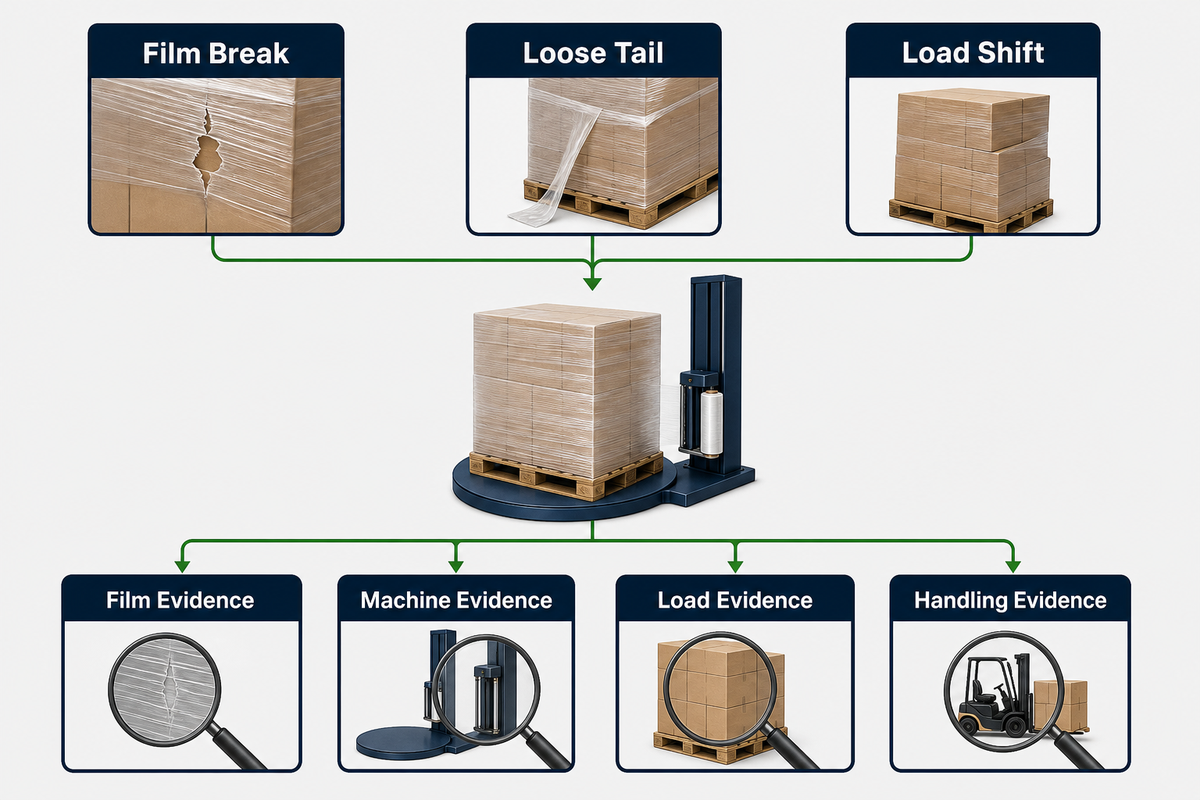
Document the symptom and then trace the path of the film and inspect the hardware if necessary. Inspect the roll, film, and recipe. Inspect the load and the how, when, and why of handling. If symptom persists, change one input and remeasure. This One-Change Diagnostic Sequence is faster than guessing the first five minutes and loses fewer loads than random adjustments during the shift.
ASTM D4649 provides selection and wrapping guidance, but the wrapper manual and observed break point still control equipment-side diagnosis.
| Symptom | First checks | Do not assume |
|---|---|---|
| Break at one recurring machine location | Film path, rollers, nicks, alignment, contact points, carriage condition | The roll is defective |
| Break at one load edge | Edge geometry, protrusions, load movement, wrap force at that location | Higher gauge alone will solve it |
| Loose or dragging tail | Cling side, tail length, cut/wipe/clamp action, dust or moisture, finish sequence | More top wraps address the tail mechanism |
| Low or uneven containment | Recipe, film delivery, load profile, measurement point, film relaxation, maintenance | One center reading represents the load |
| Load shifts in transit | Load-to-pallet relationship, route event, base/top control, pallet/stack condition | The wrapping station is the only cause |
Keep the record of the failed sample: the time, load ID, roll and lot, wrapper, alarms, settings, failure point, photo, and what changed. Repeating unexplained failures of equipment, missing traceability, or an obviously dangerous load are triggers for a quarantine, not an excuse to ramp up the process.
Compare Cost Only After the Load Passes
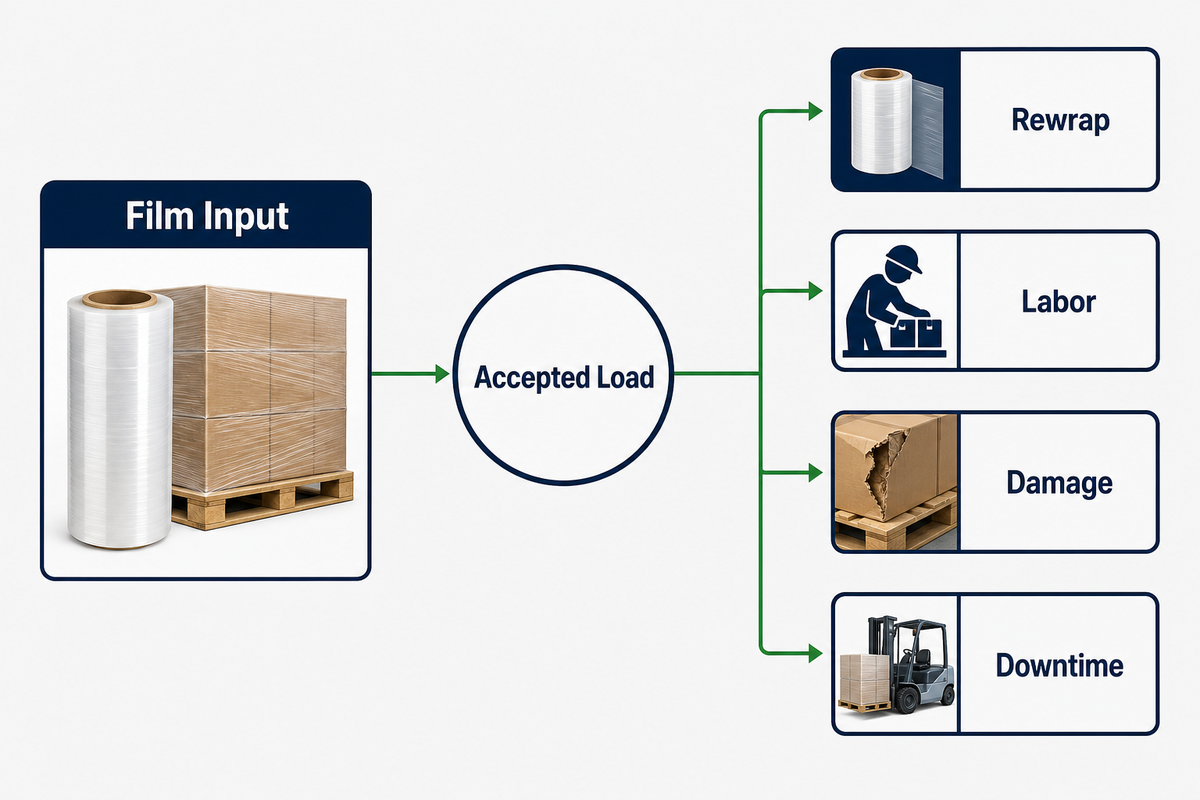
Divide the justified total trial cost by the number of accepted loads, and include only process losses that are actually tracked. Theoretical roll yield and cost are screening inputs, not the final denominator.
A Virginia Tech unit-load study reports film consumption in grams per pallet, illustrating why applied material belongs in a comparable-load cost record.
The Accepted-Load Cost Ledger starts with the cost of the film, and verifies the consumption of the film. It includes tracked breaks, rewraps, and downtime. It also includes rejected loads and other losses that are agreed upon by both the baseline and candidate processes. Use the same rules for baseline and candidate. If the site is unable to justify a loss, leave it out, and state the justification.
Minimum defensible comparison: same load family, same route scope, documented wrapper/recipe, verified film used, accepted-load count, and a consistent rule for breaks and rewraps. A lower cost per attempted pallet can still produce a higher cost per accepted load.
What Evidence Should You Hand to a Supplier?
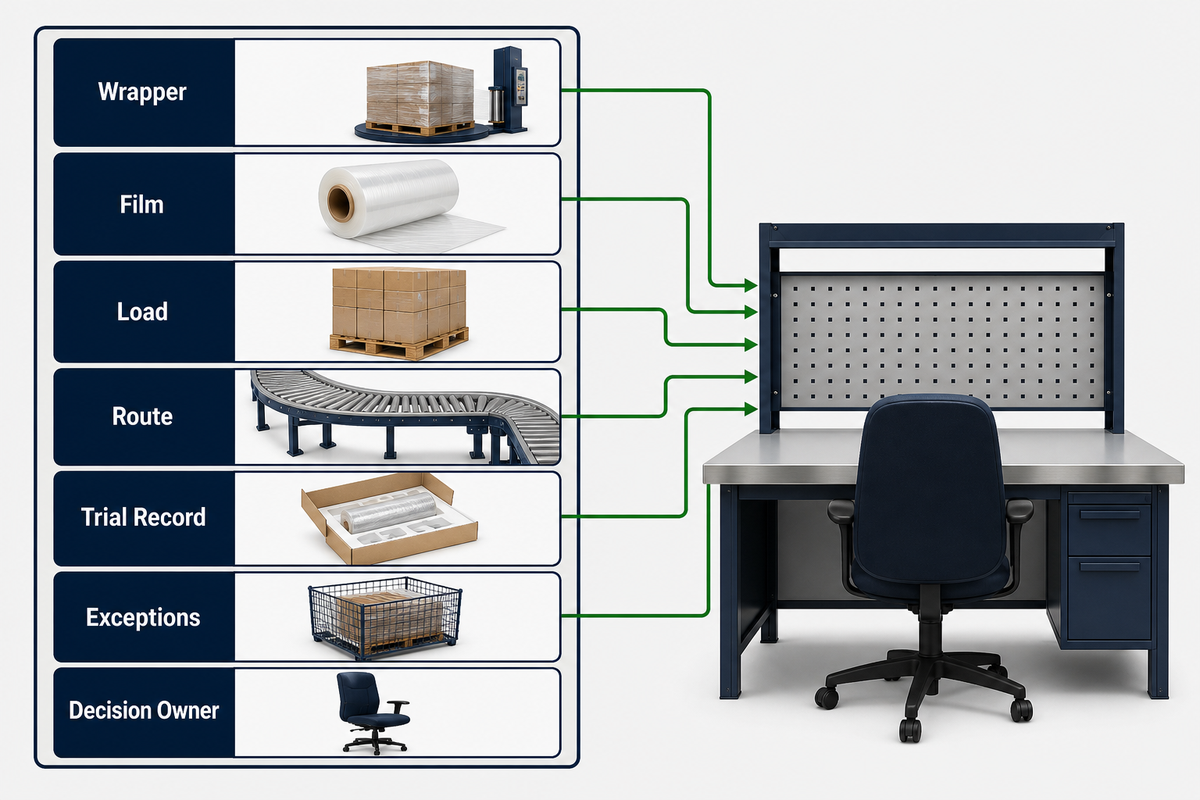
Send load and route cards, details of wrapper, current film and recipe, failure history, photos, necessary documents, and acceptance criteria for the trial. An adequate evidence packet provides the supplier the opportunity to submit the most relevant sample and clarifies to both parties what is required to be proven.
Identify the method and edition in the handoff—for example, the official ASTM D5459 record—so a test name is not mistaken for evidence from the wrong procedure or revision.
- Load families, dimensions, mass distributions, sharp and soft areas, pallet and stacking condition
- Wrapper and carriage, Pre-stretch system, film path, roll limits, speed and recipe
- Identity, dimensions, and lot of film and known failures in application
- Route conditions, staging, exposures, and observations
- Required data sheets, declarations, test reports, sample labeling and notifying of change
- Trial, method, scope, measurements, owner and rollback and rejection criteria
- Use the following handoff matrix to keep a machine stretch wrap enquiry tied to evidence. A type of stretch film, a plastic film label, or a claim of a high level of elasticity cannot identify the right stretch film on its own. The wrapping process, proper stretch range, durability, and ability to remain stable must be checked on the relevant wrapper so products remain stable through the supply chain, and a different load family must be treated as a new scope.
Once the brief is compiled, review product-specific options of UD Packaging’s machine stretch film for discussion on the product. The UD Packaging Company Profile is provided for first-party background and is not used here for technical performance.
| Evidence checkpoint | Record to provide | Decision it supports |
|---|---|---|
| Wrapper format | Turntable, rotary arm, ring, semi-automatic, or fully automatic stretch wrapper | Defines the equipment boundary |
| Film family | Current machine stretch wrap label, construction, and lot | Creates a traceable baseline |
| Roll interface | Core, width, outside diameter, weight, and loading method | Checks carriage compatibility |
| Application recipe | Film path, pre-stretch mechanism, wrap force, overlap, speed, and revolutions | Defines the controlled wrapping process |
| Load family | Geometry, mass distribution, surfaces, edges, pallet, and photographs | Prevents results from being transferred to a different load |
| Route exposure | Handling, staging, transport, temperature, moisture, and dwell | Sets the intended-use boundary |
| Observed performance | Break point, tracking, tail, containment, stability, and damage record | Tests whether accepted loads remain stable |
| Acceptance plan | Method, sample scope, measurement points, owner, and rollback rule | Separates a trial from a product claim |
| Supplier response | Candidate identity, evidence, limits, change notice, and trial support | Supports a secure and stable release decision |
Frequently Asked Questions
What is machine stretch film used for?
Machine stretch film is used by stretch wrappers to unitize pallet loads for distribution and handling. Successful unitization is dependent on various wrapper factors, film type and compatibility, geometry of the load, exposure during the route, and validated settings of the machine. It should not be used for repair of an unstable load or for an unsafe stack of pallets.
What is the difference between machine and hand stretch film?
Machine film is to be fitted to wrapping equipment and must conform to the carriage, roll dimensions, pre-stretch system, film path and program. Hand film is applied manually and follows a different procedure. They may be in the same polymer family or look the same but that does not mean they are interchangeable. Obtain wrapper limits, supplier data, and application-specific trial data before considering substitution.
What gauge machine stretch film should I use?
No single gauge is applicable to all wrappers, loads or routes. Gauge describes thickness; it does not prove puncture resistance, stretch behavior, retained containment or load acceptance. Starting from the verified baseline, describe wrapper and load, and trial a candidate on repeated comparable loads. Change one variable at a time and approve it only against local acceptance criteria.
Can I down-gauge without changing wrapper settings?
Don’t jump to conclusions. A thinner candidate may behave differently in transit and on the load. Establish a baseline, check compatibility, set one variable, and repeat tests in comparable conditions before deciding if the settings or the material need to be changed.
How do I calculate the cost per wrapped pallet?
Divide the justified total cost of the test by the accepted loads, not the loads attempted, for the trial. Capture verified film used and, where reliably monitored, breaks, rewraps, downtime and rejects. Maintain the baseline and candidate scope comparable. Theoretical roll yield may help trim options, but it can’t validate cost savings until the load passes the acceptance plan.
References & Sources
The method boundaries in this guide come from the linked ASTM, ISTA, equipment-side, and unit-load sources. For site navigation, see the industrial stretch film category and the separate hand stretch film solution; neither page replaces wrapper-specific qualification.
Turn the guide into a testable film brief
Bring your load profile, wrapper details, current film, recurring failure, and acceptance plan. UD Packaging can use that evidence to discuss a product-specific next step without replacing your plant’s qualification decision.
Reviewed against the cited ASTM, ISTA, and equipment-side sources by the UD Packaging technical-content workflow. Actual film approval is case-to-case.