Get in touch with UD Packaging Company

Updated September 2026
Reusable pallet wrap is a recoverable restraint or cover that can reduce repeated film use on a viable return route, but it remains only one part of the operating system. Buyers also need a return path, inspection protocol, an active asset pool, secure pallet management, cleaning ownership, and artefacts documenting completed reuse cycles. Without these controls, a durable wrap can be permanently lost or returned too late to support the subsequent shipping cycle.
This guide separates fitted mesh or fabric restraint wraps from plastic stretch film, pallet bands, straps, netting, and weather covers. It explains where reuse can fail on cost or operational grounds. The three named frameworks below are original, non-exhaustive procurement screens. They aren’t test standards, certified methods, or confirmation that all pathway variables have been considered.
Direct answer
Reusable pallet wrap is a recoverable pallet-restraint or cover system that must be removed, returned, inspected, and put back into service. Its value depends on achieved cycles and load performance, not advertised life alone.
Key points before you request a quote
- A reusable product isn’t automatically the lower-cost or lower-impact choice.
- Closed-loop control matters as much as physical durability.
- Load movement, damage, rework, and worker exposure belong in the comparison.
- A pilot qualifies one documented configuration, not every pallet in the network.
What Is Reusable Pallet Wrap?
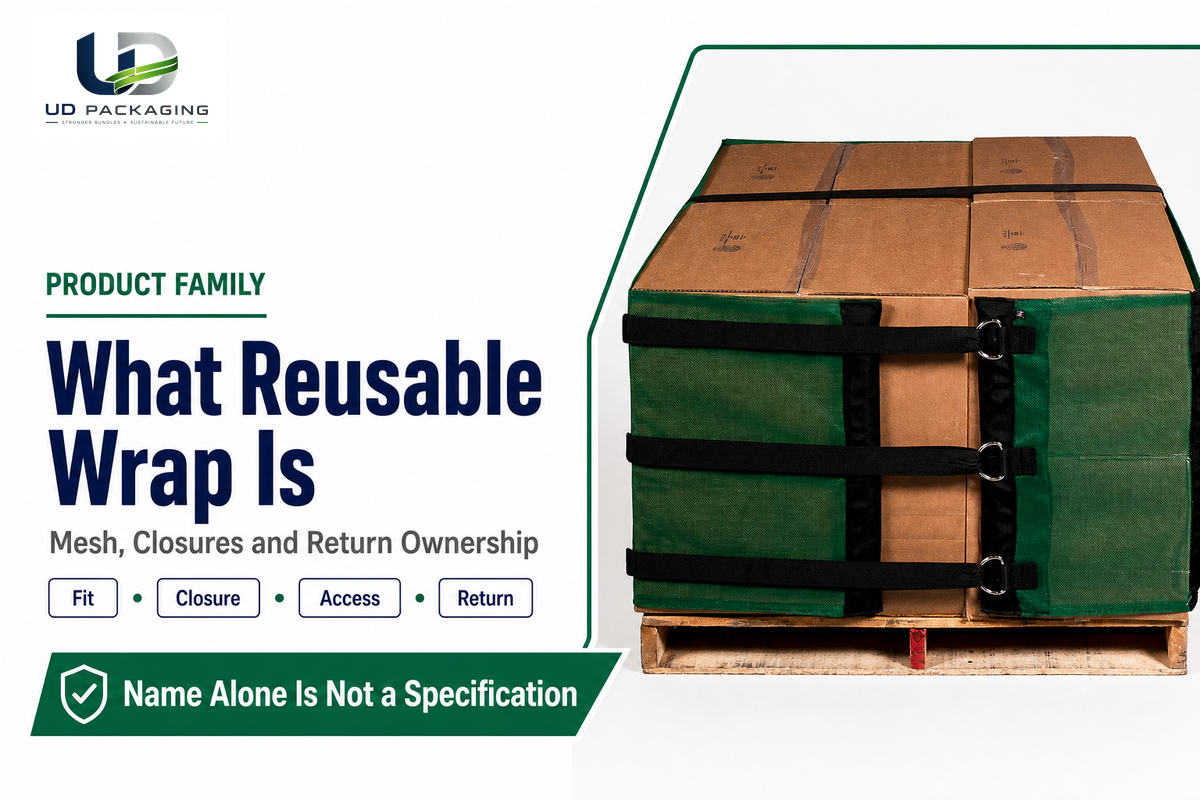
Reusable pallet wrap is a fitted mesh, fabric, or reinforced plastic system designed to go around a unit load, close with straps or hook-and-loop fasteners, and return for another use. The name describes a reusable operating loop; it doesn’t specify waterproofing, load rating, tamper evidence, or compatibility with all pallet configurations.
The majority of products in this category are sized by pallet footprint and load height. Some use corner straps, some use a full mesh body, and others act more like a cover than a restraint. Describing the item only as a “48 × 40 pallet wrap” leaves the closure, height, ventilation, access, and restraint duty unresolved.
| Format type | Primary job | Return needed? | Main limitation |
|---|---|---|---|
| Reusable mesh restraint wrap | Contain stable cartons while allowing airflow | Yes | Does not create a weather barrier |
| Reusable pallet covers | Protect from dust or weather exposure | Yes | Covering is not proof of containment |
| Reusable pallet band | Apply local horizontal pressure | Yes | Leaves most load faces open |
| Pallet strap | Apply line restraint across a load | No or route-specific | Can concentrate force on cartons |
| Pallet netting | Ventilated containment | Product-specific | Open structure gives little weather protection |
| Stretch wrap | Conforming load containment | No | Creates a recurring plastic waste stream |
Buying by name alone can leave a warehouse with the wrong format. Define whether the need is containment, weather protection, access, ventilation, or a combination, then require a drawing and closure description. Calling it “heavy-duty” can’t replace that scope. Dated supplier listings reviewed for this guide included 2 ft, 4 ft, and 6 ft heights; one set paired 80 cm, 120 cm, and 180 cm options with listed prices of €129 to €169; and another specified a 1,200 mm × 1,000 mm × 1,500 mm configuration. These are vendor examples, not recommended sizes or performance limits.
Is Reusable Pallet Wrap a Real Alternative to Stretch Film?
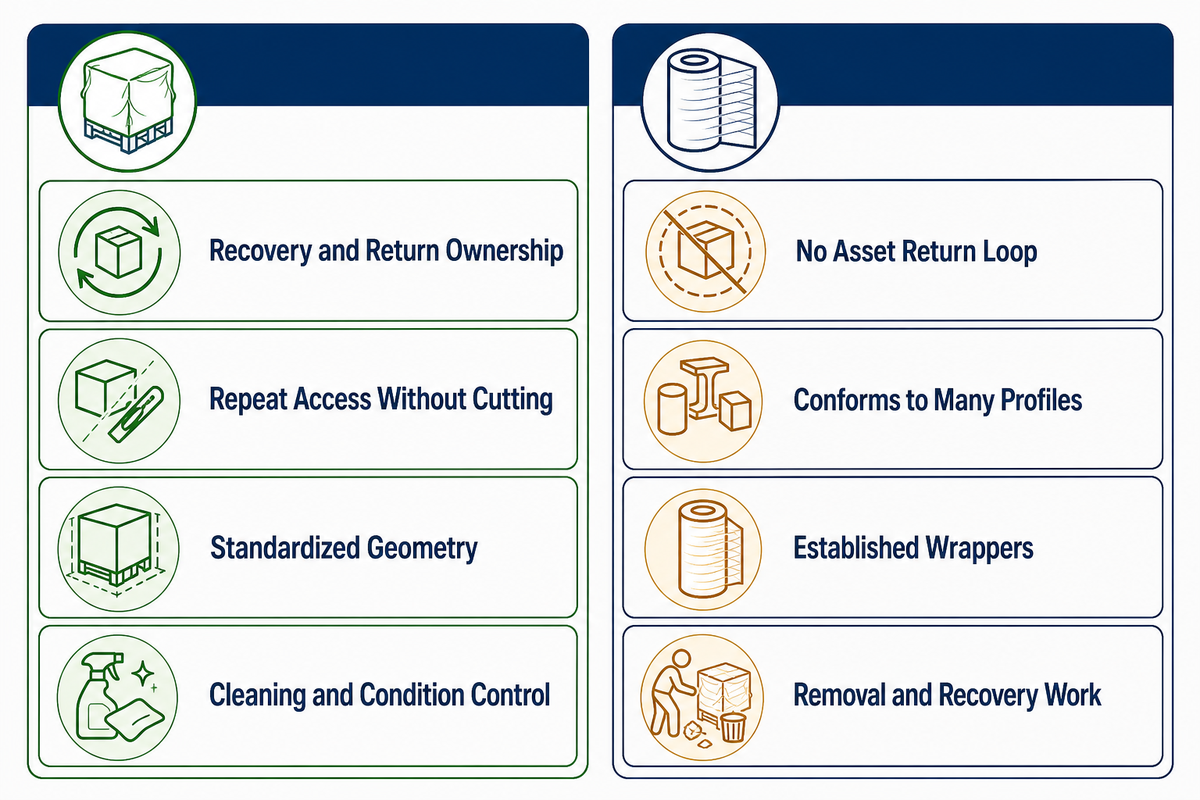
Reusable wrap can substitute for stretch film on certain loads and routes, but it isn’t a universal one-for-one replacement. Official load-security guidance treats wrapping, banding, strapping, sheets, nets, and rigid covers as distinct methods. The right comparison starts with the restraint job and the tested load, not a general environmental label.
Reusable mesh wraps suit routes where receiving staff can remove the asset and return it to the reuse loop. Conventional machine stretch film works for irregular profiles and automated wrapping programs. Straps concentrate force over narrower pathways. Solid covers may block rain or dust but do not automatically hold loose cartons together.
Reusable fitted wrap
- Needs recovery and return ownership
- Offers repeat access without cutting film
- Fits standardized geometry best
- Requires cleaning and condition control
Single-use stretch film
- Needs no asset return loop
- Conforms to many load profiles
- Works with established wrappers
- Creates film removal and recovery work
The study done by Cal Poly found no statistically significant correlation between tested pre-stretch percentage and load containment. That result does not evaluate textile wraps, but it does show why one material setting cannot predict whole-load performance. The claim that “a reusable product must be a direct replacement” is not supported unless the same load, handling, and acceptance conditions are evaluated.
Published pallet testing gives a useful scale for that caution. One setup used 17 wraps and 0.448 kg of film per pallet; a second used 24 wraps and 0.225 kg. At the 0.5 g test, the first produced 31.4 cm deflection against a 17.0 cm limit and failed. The second measured 14.3 cm and passed. The stated displacement ceiling was 8.5 cm, or 5% of load height, and the deflection ceiling was 10%. The result proves that material and application pattern changed this test outcome, not that the second configuration fits another load.
Where Reusable Wrap Works, and Where It Does Not
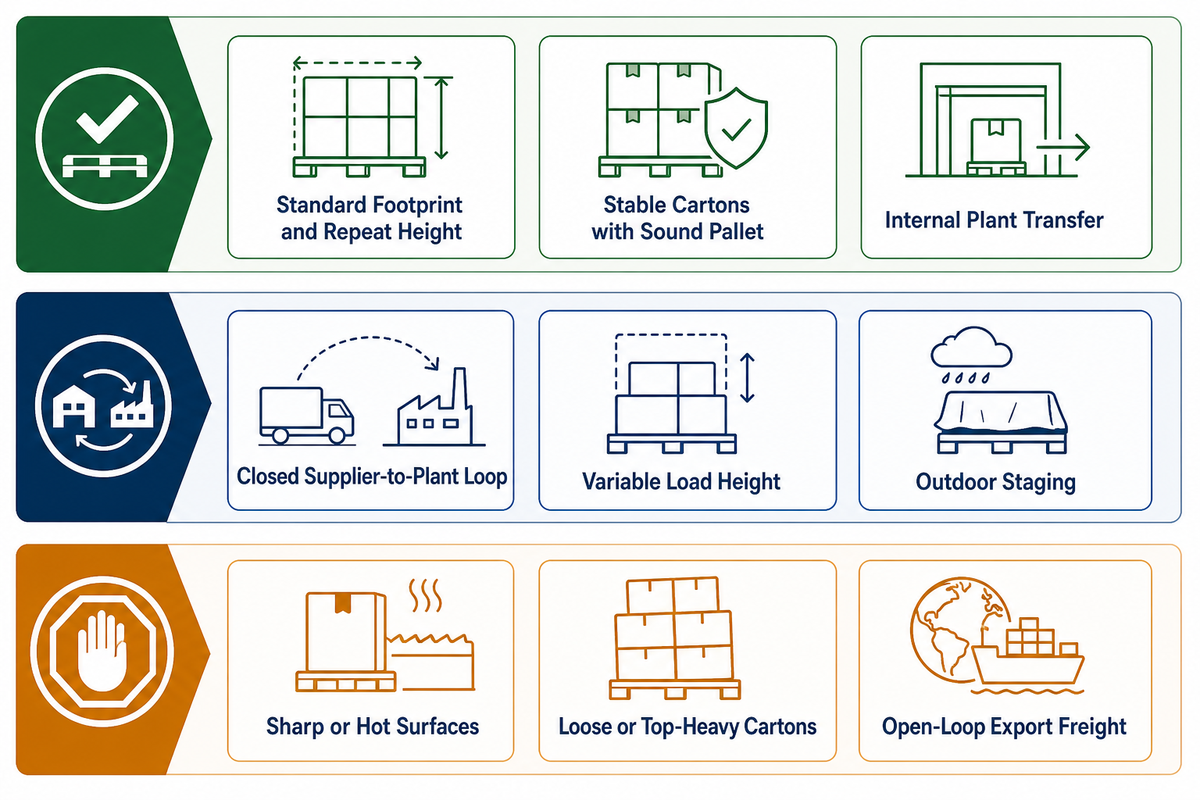
Reusable wrap is feasible for standardized pallet loads moving on a controlled, repeat route with known handlers and a practical backhaul. It becomes less advisable when loads or exposure change, or when the asset crosses into another organization. Unstable pallets, damaged pallets, sharp profiles, and open-loop export freight require a separate restraint review.
| Condition category | Typical evidence | Starting decision | Limitation / not suitable for |
|---|---|---|---|
| Standard footprint and repeat height | Measured pallet and load envelope | GO to pilot | Does not cover mixed overhang |
| Stable cartons with sound pallet | Load map and damage history | GO to pilot | Does not repair poor stacking |
| Internal plant transfer | Named return owner | GO to pilot | Check access and traffic exposure |
| Closed supplier-to-plant loop | Backhaul schedule and receiving point | PILOT | Late assets increase pool size |
| Variable load height | Height distribution in inches | PILOT by load family | One size may leave gaps |
| Outdoor staging | Rain, dust, UV, and dwell record | Separate cover review | Mesh is not waterproof |
| Sharp or hot surfaces | Edge and temperature review | STOP pending material check | Puncture or heat damage |
| Loose or top-heavy cartons | Observed movement and restraint test | Separate engineering review | Closure tension cannot stabilize the stack |
| Open-loop export freight | Recovery contract and landed return cost | Usually STOP | Asset recovery may be uneconomic |
Closing the buckle proves only that the closure engaged. It does not validate pallet capacity, carton compression, rack condition, fork entry, conveyor transfer, or transport vibration. Where line restraint is needed, evaluate pallet strapping as a separate restraint function instead of asking a fitted wrap to do every job.
The 4-Leak Return Loop for Closed-Loop Control
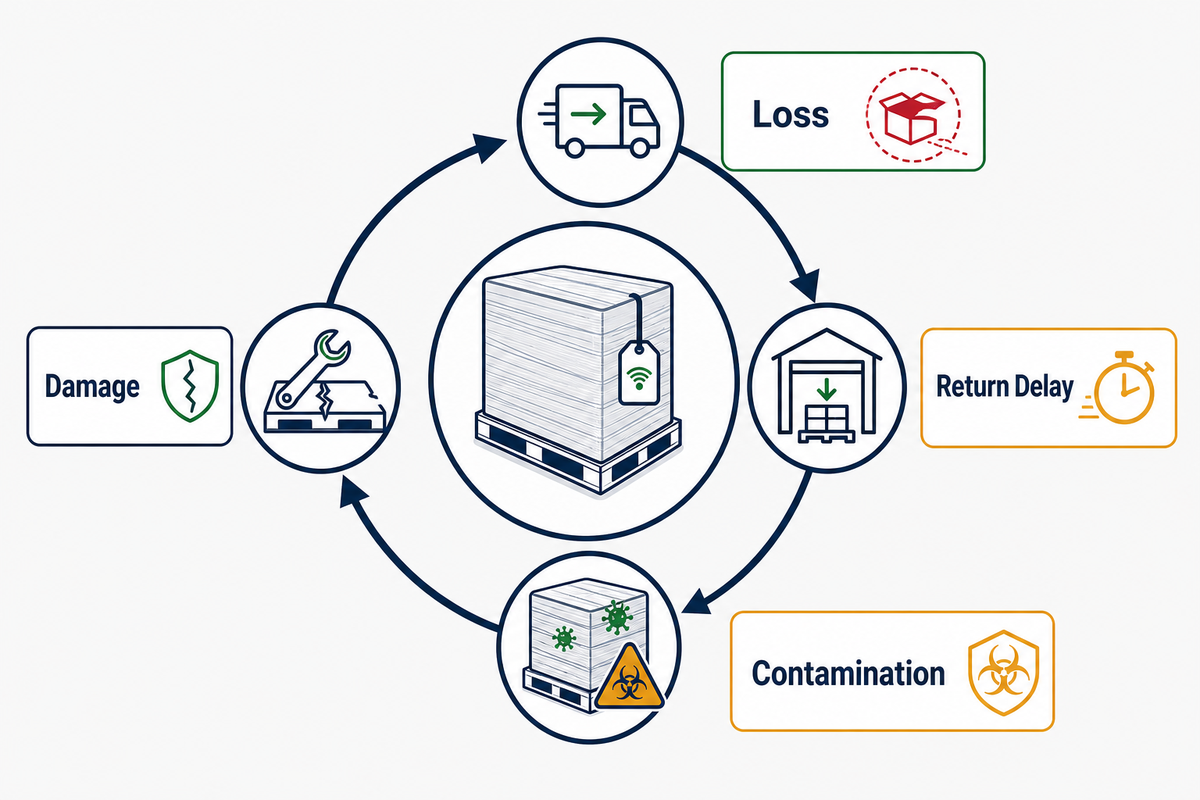
The 4-Leak Return Loop is a non-exhaustive procurement screen for asset loss, return delay, contamination, and damage. A wrap may continue to be usable but may fail the program if any leak forces it out of service. Pool size, spare inventory, vehicle utilization, and auxiliary packaging surround this screen as separate system inputs.
Public program examples demonstrate that a controlled loop can reduce some types of waste. StopWaste notes that the Elder Care Alliance used 40 reusable pallet wraps and avoided more than 27,000 lb of single-use plastic wrap each year. The same source reports that Drakes Brewing avoided the use of 290,000 sq ft of wrap in its first year. These are real program results, and aren’t meant to be substitution factors for a warehouse.
| Leak type | Warning signals | Control owner | Decision |
|---|---|---|---|
| Loss | Unscanned dispatch; no receiving count; asset leaves the contracted lane | Logistics coordinator | STOP if ownership cannot be assigned |
| Return delay | Dwell exceeds the route cycle; wraps queue at consignee; backhaul misses pickup | Transport planner | Add pool capacity or shorten the loop |
| Contamination | Unknown residue; wet storage; cleaning status absent | Quality or sanitation owner | Quarantine until disposition |
| Damage | Torn mesh; failed closure; stretched edge; unreadable asset ID | Warehouse supervisor | Repair, retire, or reject before loading |
Clearly, barcodes or RFID tags provide visibility into where an asset has been scanned, but they can neither clean, inspect, nor return an asset. The program requires named handoffs at dispatch, receiving, empty-asset storage, and backhaul. UD Packaging’s warehouse operations and logistics load-handling context can frame the operating environment; the route owner still has to document the actual loop.
Supplier maximum-use claims don’t resolve these issues. A lost wrap provides no additional cycles even if the material has many years of useful service life. The practical objection “the product lasts, so the program will pay back” is addressed solely by asset-level completed-cycle and downtime data.
The 11-Input Reuse Cost Stack
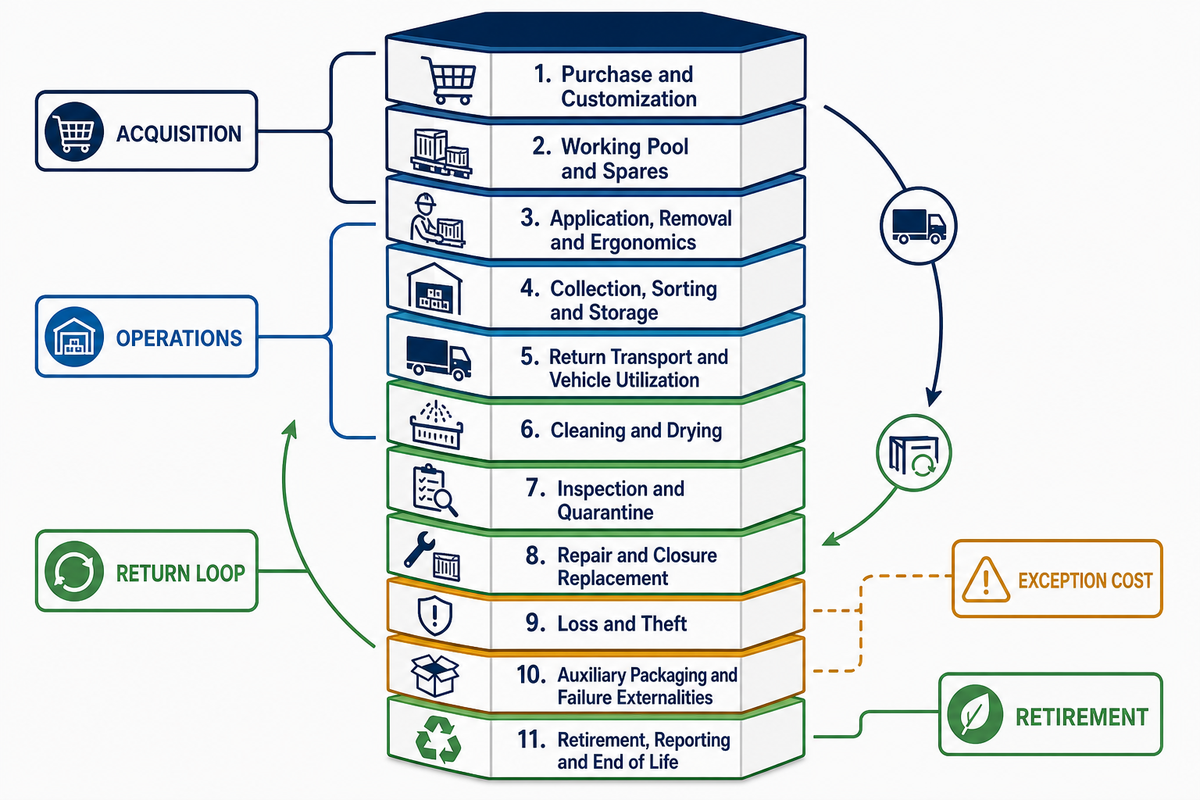
The 11-Input Reuse Cost Stack is a base accounting screen for route-specific comparison and isn’t a validated cost model. It generates a more complete assessment of purchase costs by considering working inventory, labor exposure, return logistics, unavailable assets, auxiliary materials, load stability failures, and retirement. Compare the result to a separately stated single-use-film baseline.
Van den Berg and ten Klooster examined 18 single-use/reuse comparisons and found only one study that addressed vehicle load. Their method identifies pool size, loss, breakage, auxiliary single-use components, transport, washing, repair, and end of life as important inputs. Evidence has shown that the purchase price divided by the claimed maximum cycle count is incomplete.
| Cost input | Value or rate to collect | Source record | Boundary / not suitable for |
|---|---|---|---|
| 1. Purchase and customization | USD per wrap plus marking | Supplier quote | Do not divide by advertised life |
| 2. Working pool and spares | Units in service, in transit, and unavailable | Asset register | Return rate alone misses downtime |
| 3. Application, removal, and ergonomics | Minutes per pallet and observed handling exposure | Timed work study | Minutes do not capture awkward posture |
| 4. Collection, sorting, and storage | Labor hours and floor space | Warehouse record | Include empty-asset staging |
| 5. Return transport and vehicle utilization | Miles, trips, cube, and incremental freight | Transport record | Do not assume an empty backhaul is free |
| 6. Cleaning and drying | Events, labor, water, energy, and downtime | Sanitation log | Material compatibility remains product-specific |
| 7. Inspection and quarantine | Minutes and held units | Condition record | A visual check is not a load test |
| 8. Repair and closure replacement | Parts, labor, and out-of-service days | Repair ticket | Repeated repair may trigger retirement |
| 9. Loss and theft | Units missing per completed rotation | Asset reconciliation | Lost assets have zero future use |
| 10. Auxiliary packaging and failure externalities | Film, straps, damage, rework, rejected loads, incidents | Shipment exception file | Do not hide single-use additions |
| 11. Retirement, reporting, and end of life | Disposal or recovery cost per retired unit | Retirement record | Recyclable does not mean locally recovered |
Hypothetical Route A: a buyer needs 100 wraps in service and 20 spare units for a 5-day loop. At an illustrative $220 per wrap, starting asset cost is $26,400. If the route completes 50,000 pallet trips before retirement, purchase cost alone equals $0.53 per trip. Add 2.0 minutes of handling at $30 per labor hour ($1.00), $0.35 return allocation, $0.20 inspection and cleaning, and $0.12 expected loss/repair. The subtotal becomes $2.20 per trip before damage, auxiliary packaging, storage, or end-of-life cost.
The example shows the method and not the market performance. Current Cary listings viewed on September 21, 2026 ranged from $197.15 for a 2 ft product to $285.85 for a 6 ft configuration, but size and closure differ. Use a dated quote for the exact configuration and replace every Route A figure with measured values.
Cleaning, Inspection, Repair, and Retirement
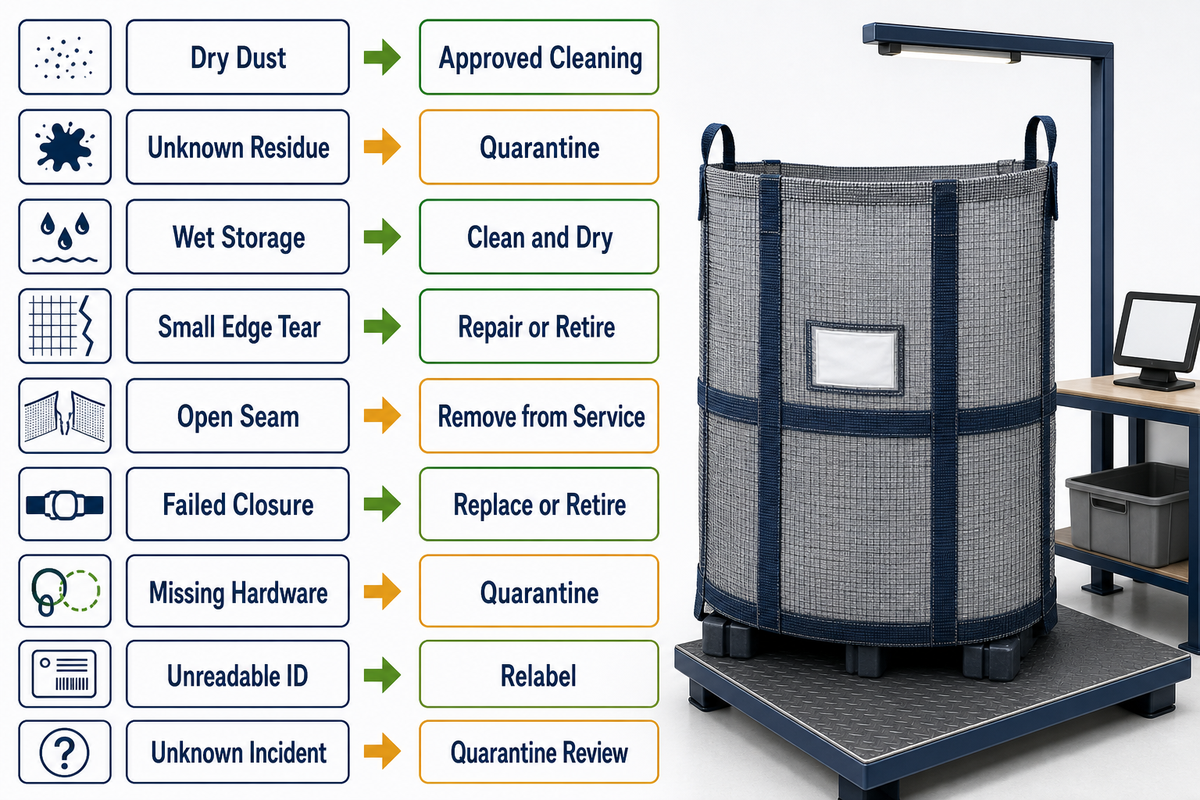
Before reuse, each wrap should pass a defined condition decision. This decision must determine ownership of cleaning, inspection, repair, quarantine, and retirement. A wrap that appears intact may have a damaged closure, embedded contamination, an unreadable tracking mark, or an unknown exposure that makes it unsuitable for direct reuse.
| Condition type | Immediate action | Release evidence | Limitation / not suitable for |
|---|---|---|---|
| Dry surface dust | Clean by approved method | Clean status and inspector | Method must suit the material |
| Unknown liquid residue | Quarantine | Residue and compatibility review | Do not guess chemical exposure |
| Wet wrap in closed storage | Clean and dry | Dry-status check | Avoid trapping moisture |
| Small edge tear | Repair or retire per supplier rule | Repair ticket and reinspection | No universal tear allowance |
| Open seam or split mesh | Remove from service | Qualified repair or retirement | Do not load-test by shipment |
| Failed hook-and-loop closure | Replace closure or retire | Functional closure check | Closing once is not durability proof |
| Missing buckle or strap | Quarantine | Correct part and attachment check | Do not improvise hardware |
| Unreadable asset ID | Relabel before release | ID linked to condition history | Anonymous assets break cycle records |
| Unknown incident or overload | Quarantine for review | Incident disposition | Visual appearance may miss damage |
Instructions for cleaning should come with the purchase of the specific construction. Do not invent a chemical concentration, wash temperature, or drying limit. The buyer’s objection “no tear is visible, so it’s ready” doesn’t consider the closure function, the history of contamination, or the exposure of the load.
Run a Route-Specific Pilot Before Rollout
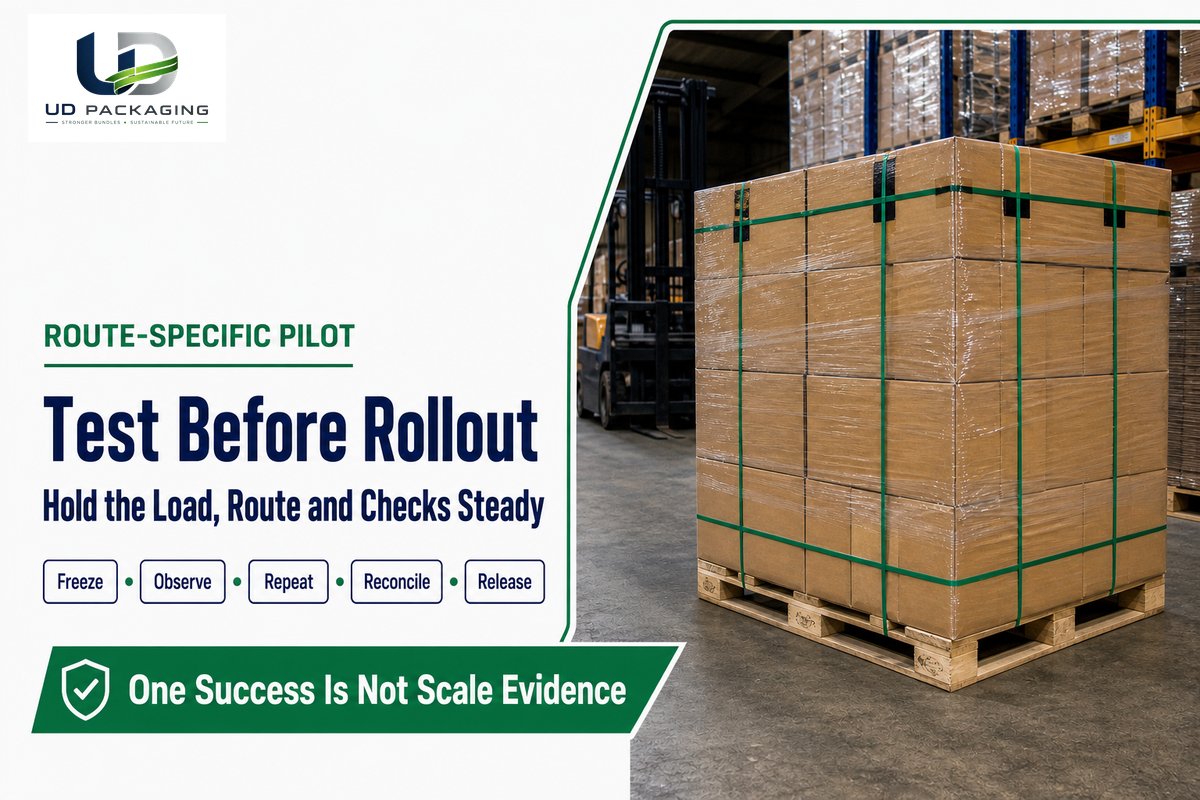
To keep results interpretable, hold the load family, route, wrap configuration, handlers, and acceptance checks steady during the pilot. One successful case does not justify expanding the pilot scope. Expand the program after repeat results show acceptable containment, asset return, condition, labor exposure, and product-damage outcomes.
“Manually wrapping a pallet can require torso bending.”
OSHA also reports a case where workers circled a pallet 8 to 10 times with a 30 to 35 lb manual dispenser before a semi-automatic wrapper reduced ergonomic exposure. This case isn’t a reusable-wrap comparison, but it shows why labor time alone is too narrow. Record bending, reaching, pulling, lifting, trip hazards, and access around the load.
- Freeze the test case — identify pallet, load, route, wrap, closure, handler group, and weather boundary.
- Set acceptance checks — define movement, damage, rework, safety, return, condition, and loss outcomes before dispatch.
- Run repeat shipments — retain timestamps, asset IDs, application and removal minutes, and exception photos where permitted.
- Reconcile the pool — count assets in service, in transit, quarantined, under repair, spare, and missing.
- Release a bounded scope — approve only the tested load family and route, with a change trigger.
Pilot records should also contain information pertaining to the use of auxiliary film or straps, the use of vehicles, cleaning, damaged goods, rejected loads, rework and safety incidents. If the route changes from 20 to 400 miles, the load changes from 800 lb to 1,200 lb, or the height changes by 12 in, this should be considered a new scenario rather than extending an old scenario by habit.
What to Put in a Reusable Pallet Wrap RFQ
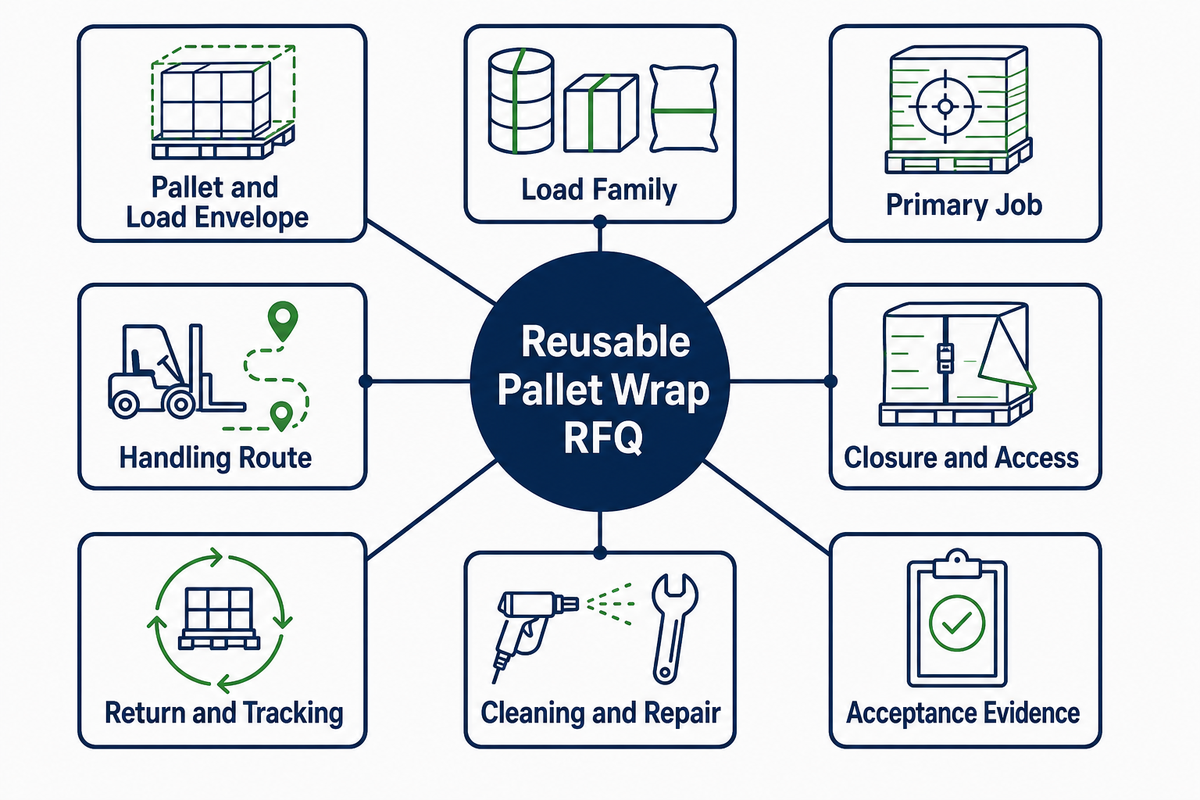
A reusable pallet wrap RFQ (request for quote) should inform the supplier about what the wrap has to fit, what function it has to perform, how it will be used, and how the buyer will accept it. It should also force a clean distinction between dimensions and construction facts, vendor lifespan claims, route assumptions, and independently testable outcomes.
Copy the checklist into the inquiry and replace every open field with route data. Once the supplier receives this information, they can respond to the same boundaries instead of comparing a 2 ft corner-strap wrap to a 6 ft full-height mesh product.
RFQ checklist: copy these into your quote request
| Parameter | Recommended range | Why it matters | How to verify |
|---|---|---|---|
| Pallet and load envelope | Length × width × minimum/maximum height in inches | Controls fit and closure reach | Dimensioned drawing and sample fit |
| Load family | Weight in lb, carton pattern, overhang, edges | Defines restraint challenge | Photos, load map, and pilot |
| Primary job | Containment, cover, ventilation, access, or combined | Prevents format mismatch | Written capability scope |
| Handling route | Miles, transfers, storage days, rack/conveyor use | Sets exposure boundary | Route map and acceptance record |
| Closure and access | Opening frequency and authorized operators | Affects wear and tamper control | Closure drawing and sample trial |
| Return and tracking | Owner, scan points, backhaul interval, missing-asset rule | Controls achieved cycles | Asset-register pilot |
| Cleaning and repair | Soil types, approved method, parts, turnaround days | Controls downtime and condition | Supplier instructions and repair terms |
| Acceptance evidence | Load result, ergonomic observation, return, condition, damage | Separates claims from outcomes | Signed pilot protocol |
Ask suppliers to label any “150 uses,” “500 cycles,” or “2,500+ uses” statement as design intent, test result, warranty limit, or observed fleet outcome. These statements aren’t equivalent. To send the completed boundary, use a route-specific packaging inquiry instead of a size only request.
The 2026 Shift: Reuse Evidence Matters Even When Demand Is Stable
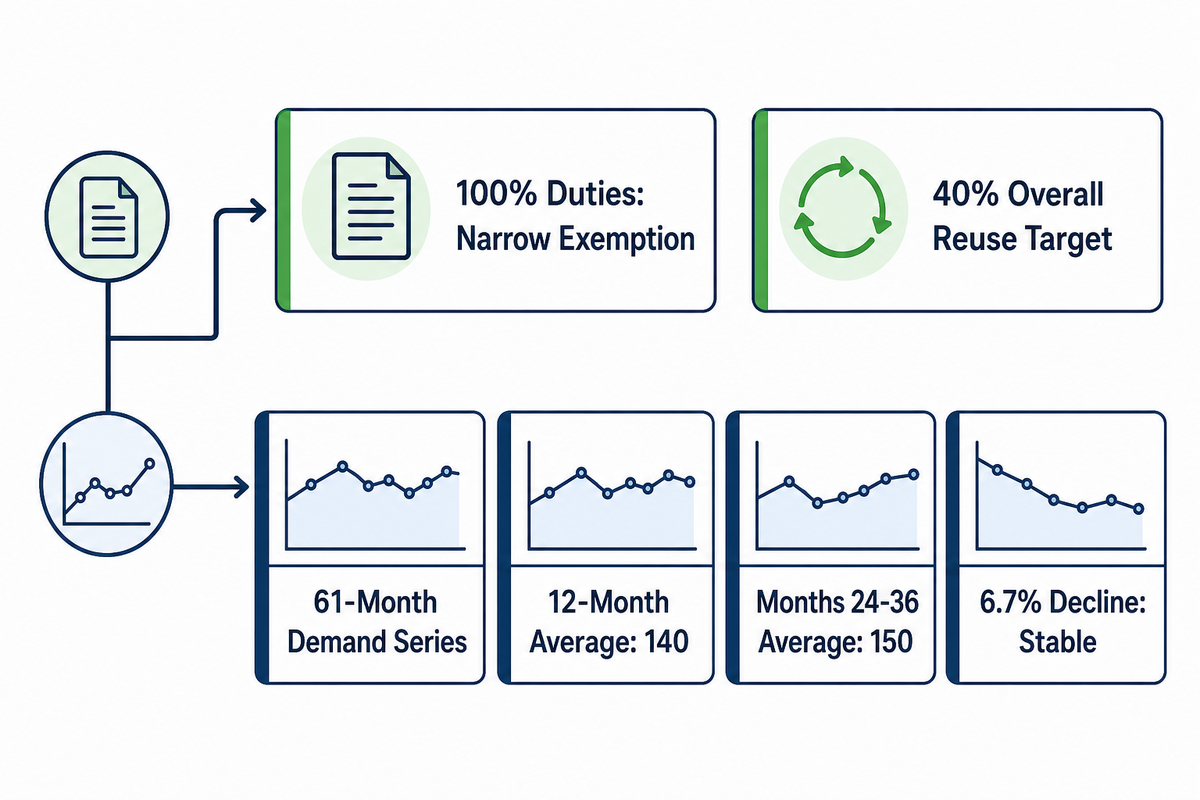
The 2026 European change narrows specific reuse duties for pallet wrapping and straps; it does not prove that reusable wrap fits every route or remove the wider packaging regulation. For buyers, the durable lesson is evidence discipline: distinguish a complete rotation, advertised life, return percentage, recycled content, recyclability, and measured waste reduction.
On February 25, 2026, the European Commission said pallet wrapping and straps were exempted from specific 100% reuse duties because exclusive reuse on covered routes could create disproportionate adaptation costs. The same Commission communication retains an overall 40% reuse target for transport packaging. This is a narrow scope decision, not a blanket exemption or a product endorsement.
Regulation (EU) 2025/40 defines a rotation as the cycle from placing reusable packaging on the market with a product until it is ready to be used again inside a reuse system. It also connects reusable status with reconditioning, safety, and technical information. Later acts are intended to set minimum rotations for frequently used formats. Rather than interpreting this article as a compliance provision, it’s advisable to seek recent legal advice for your specific market.
United States exact-query demand was stable in the captured 61-month series: the latest 12-month average was 140 searches per month versus 150 in months 24 through 36, a 6.7% decline classified as stable. The regulation changed faster than search demand. That makes achieved-cycle records more useful than market-growth claims.
The 9-Scenario Restraint Selector
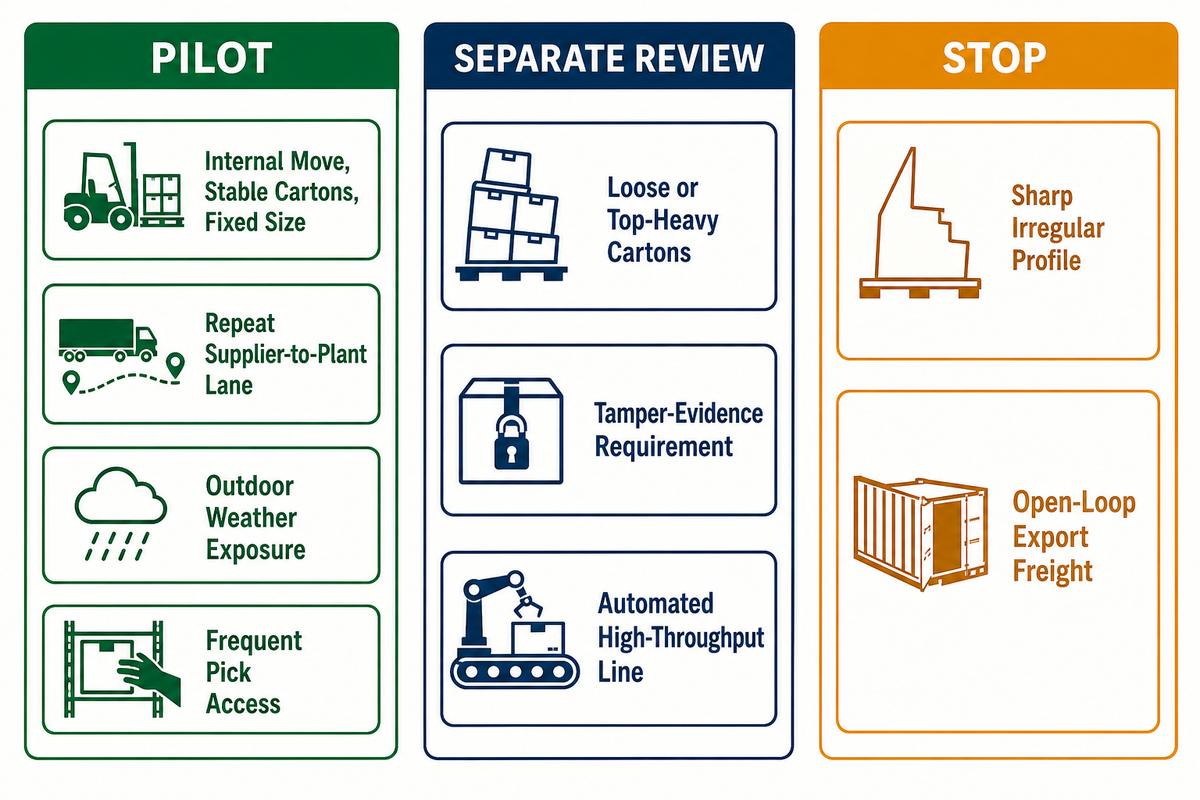
The 9-Scenario Restraint Selector is a non-exhaustive triage aid that routes common pallet cases to a starting format and a next action. This tool isn’t an engineering standard. Loads outside these nine categories, or any case with uncertain stability, damage history, or regulatory duties, need a separate review.
| Scenario type | Starting format | Disposition | Reason | Limitation / not suitable for |
|---|---|---|---|---|
| Internal move, stable cartons, fixed size | Reusable mesh wrap | GO to pilot | Short controlled recovery loop | Still validate handling |
| Repeat supplier-to-plant lane | Reusable fitted wrap | PILOT | Backhaul may return assets | Pool delay can erase savings |
| Loose or top-heavy cartons | Engineered stretch-film program | Separate review | Needs conforming containment | No material label proves stability |
| Sharp irregular profile | Edge protection plus route-specific restraint | STOP before trial | Puncture and snag risk | Fitted wrap may be damaged |
| Outdoor weather exposure | Solid cover plus required restraint | PILOT | Weather and containment are separate jobs | Mesh is not waterproof |
| Frequent pick access | Reusable wrap with designed opening | PILOT | Access avoids repeated film cutting | Closure wear must be tracked |
| Tamper-evidence requirement | Film, seal, or documented security layer | Separate review | Reusable closure may reopen | Do not infer tamper evidence |
| Automated high-throughput line | Machine stretch film or engineered automation | Separate review | Cycle integration drives choice | Manual fitted wrap may bottleneck output |
| Open-loop export freight | Single-use or locally recoverable restraint | Usually STOP for reusable asset | Recovery ownership is weak | Return freight may dominate |
The selector doesn’t indicate a “most sustainable” format. Published reuse comparisons show that pool size, losses, transport, washing, vehicle use, and auxiliary packaging can change the result. A single-use option can be lower impact under some boundaries. Assess the fit of the format and then evaluate the operational system.
Frequently Asked Questions
What is reusable pallet wrap?
Reusable pallet wrap is a recoverable mesh, fabric, or reinforced-plastic restraint or cover that, unlike other types of reusable transport packaging, fits a defined unit load, returns for inspection, and goes back into service on a controlled route.
Reusable pallet wrap usually uses mesh, fabric, reinforced plastic, straps, buckles, or hook-and-loop closures instead of disposable stretch film. It works as a system only when the asset returns, passes a condition check, and fits the same load duty again. The term does not guarantee waterproofing, load containment, a minimum number of cycles, or a lower lifecycle impact.
How do you choose reusable pallet wrap?
Choose reusable pallet wrap by matching the restraint job, pallet geometry, route, recovery plan, condition rules, and pilot evidence to the actual load, handlers, and exposure, then apply best practices and confirm that the asset can return reliably.
Start with the pallet footprint, minimum and maximum load height, weight, carton pattern, edges, access frequency, weather exposure, and handling route. Then define who returns, cleans, inspects, repairs, and retires the wrap. Compare a dimensioned supplier sample on the actual route. A suitable pilot result should include load movement, damage, labor exposure, return time, condition, and missing-asset records.
How much does pallet wrap cost when reusable systems are compared with stretch film?
Reusable systems have no universal cost per pallet; compare the asset pool, spares, labor, return transport, cleaning, repair, losses, auxiliary packaging materials, disposal costs, and achieved completed rotations for the actual route.
A dated supplier snapshot showed roughly $197.15 to $285.85 for selected 2 ft to 6 ft configurations, but product design and size differed. The useful comparison adds working pool, spares, labor, return transport, cleaning, inspection, repair, loss, auxiliary packaging, load damage, retirement, and the single-use baseline. Divide by achieved completed rotations only after those costs and outcomes are recorded.
What is an eco-friendly pallet wrap?
No format qualifies as an eco-friendly alternative to stretch film from reusability alone; sustainability depends on the whole operating system, so sustainable pallet wrap is not automatically environmentally friendly and does not by itself prove that a route will reduce waste or lower the total amount of plastic.
A defensible claim identifies the product, route, completed cycles, losses, transport, cleaning, damage, auxiliary materials, and end-of-life boundary. “Reusable,” “recyclable,” and “recycled content” describe different evidence.
Is reusable pallet wrap waterproof?
Reusable mesh pallet wrap is generally not waterproof; compare solid covers, shrink wrap, and other wrap alternatives separately, then test the barrier and restraint functions together on the intended load and route.
Ask whether the product is open mesh, coated fabric, or a solid cover, and request the supplier’s weather and seam limitations. A cover may block rain or dust without supplying the containment force needed for transport. If both jobs matter, specify the barrier and restraint functions separately and test the combined configuration.
Can reusable pallet wraps work in open-loop freight?
Open-loop freight is usually a weak fit unless contracts assign ownership, recovery, tracking, return timing, and landed cost; solid waste rules and extended producer responsibility (EPR) do not replace a missing return owner, prove that reusable assets can replace single-use restraint, or make a switch from single-use work reliably.
A wrap sent to an unknown receiver or distant export destination may never return, even if the material remains serviceable. Before piloting, identify the consignee handoff, empty-asset storage, scan points, backhaul provider, return interval, customs or cross-border burden, and missing-asset charge. Set a maximum dwell time, a named escalation owner, and a rule for assets that reach the wrong site. Price return shipping costs at actual vehicle utilization rather than assuming an empty backhaul is free. Compare that landed return system with a locally recoverable single-use restraint and include any auxiliary packaging needed for the trip. If no party owns the return, no receiving site accepts the asset, or tracking stops at delivery, stop the reusable-asset proposal.
Conclusion: Buy the Loop, Not Just the Wrap
A reusable pallet wrap decision has a prescribed order. Screen the restraint job, load fit, and route fit in that order. The four return-loop leaks are tested. The eleven base inputs are priced and the ownership of the conditions is assigned. A configuration is piloted and a bounded request for quote is issued. Separate supplier lifespan claims from achieved rotations, and separate load safety from sustainability claims.
Because UD Packaging hasn’t shared private reusable-wrap field data for this article, this guide makes no assertion that UD Packaging manufactures or verifies a reusable wrap. For adjacent restraint and packaging alternatives, check the industrial packaging supply portfolio and send the documented route boundary for a fit-first discussion.
References & Sources
- Securing loads on goods vehicles UK Government.
- Distribution test research on stretch-film settings and load containment California Polytechnic State University.
- Study of the Stability of Palletized Cargo by Dynamic Test Method Sensors.
- Reusable transport packaging success stories StopWaste.
- Use Reusables: Fundamentals of Reusable Transport Packaging U.S. Environmental Protection Agency hosted material.
- Steps Towards a Template for Fair Comparisons Between Single-Use and Reusable Items Packaging Technology and Science.
- Printing Industry eTool: manual pallet wrapping U.S. Occupational Safety and Health Administration.
- Advanced Filtration Systems ergonomics success story U.S. Occupational Safety and Health Administration.
- Pallet wrapping and straps exempt from 100% reuse requirement European Commission.
- Regulation (EU) 2025/40 on packaging and packaging waste EUR-Lex.
Our Perspective on This Buyer’s Guide
UD Packaging supplies industrial packaging products. This article is an evidence-bounded decision guide, not a reusable-wrap performance claim, legal opinion, or certification. Route data, supplier instructions, load validation, and applicable rules should govern the supply chain decision.