Get in touch with UD Packaging Company

Updated September 2026
Logistics and warehousing systems work best when goods, information and responsibility flow together. Logistics & Warehousing refers to the coordinated flow of goods and information through transport networks and each logistics warehouse. This connected view ties warehouse management to supply chain management, giving the logistics strategy a practical control point. Use it to define warehouse logistics, identify warehouse logistics challenges and improve warehouse logistics without turning this guide into a list of logistics solutions. The UD Packaging company profile provides the manufacturing context for the first-party handoff card used later in this guide. This guide uses handoffs as its diagnostic starting point. A pallet may arrive without a usable identity, stock may move without a completed transaction, a pick location may be empty, or a staged load may reach the dock with no designated exception owner. This guide therefore treats the warehouse as one integrated system from receiving through dispatch and returns, helping teams find weak handoffs before they add equipment or push for more speed.
The Warehouse Flow Chain
Receive → inspect → ID → putaway → store → replenish → pick → pack → stage → dispatch → return. At each of the arrows, confirm the three things: the physical state, the system state, and the next owner.
What Logistics and Warehousing Mean, and Where the Boundary Sits
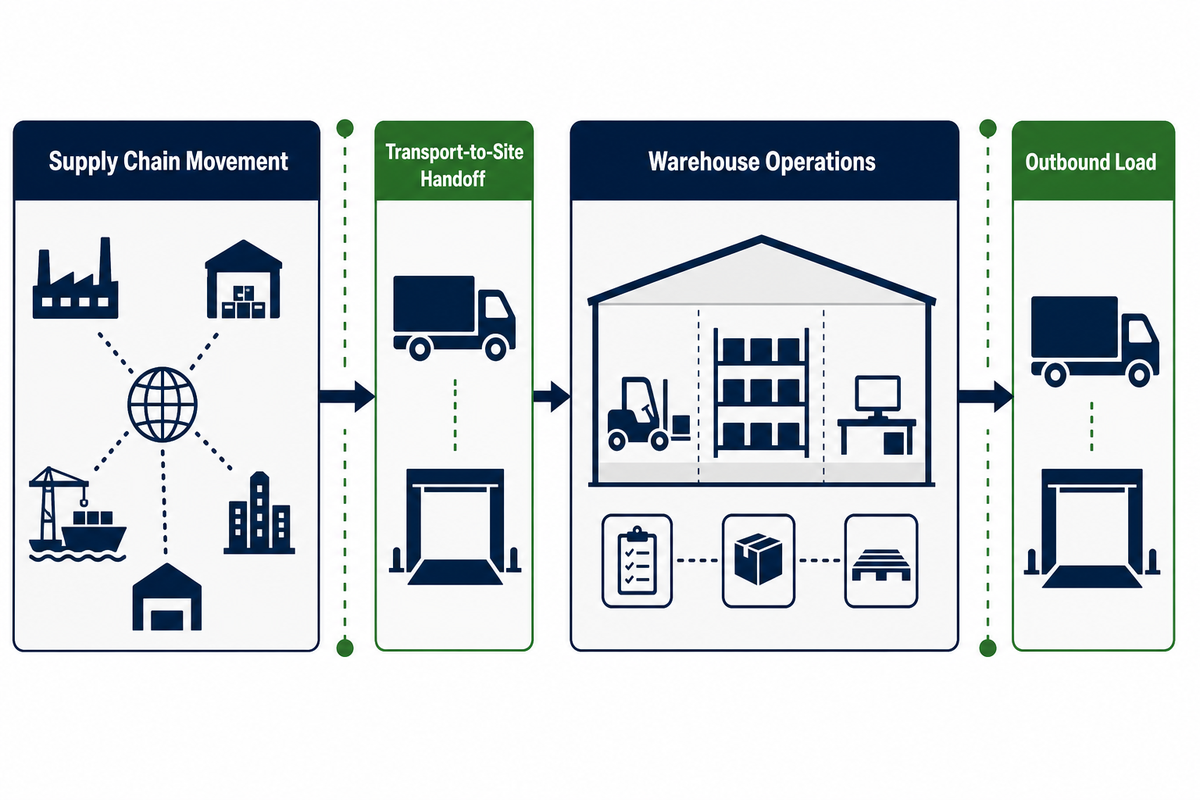
Logistics and warehousing connect the controls for moving, receiving, identifying, storing, picking, staging and releasing goods: logistics coordinates movement across the supply chain, while warehousing controls the goods, transactions and ownership inside the facility, with the practical boundary at the transport-to-site handoff.
A logistics warehouse offers controlled storage and distribution of products, but results depend on how the warehouse operates, not on floor space alone. Strong warehouse operations coordinate each supplier, shipment priority and delivery times so products reach the next node as planned. In-house teams and any service provider should share one operating rule set. That is how logistics can improve an efficient supply chain, efficiency and customer satisfaction, and ultimately improve customer delivery performance. Warehousing manages everything that happens to the goods when they enter, are stored, are under control, are prepared and are released from the facility. Consequently, a warehouse is one component of a logistics chain and cannot be optimized on its own.
The practical boundary can be mapped as an ownership boundary. One useful operating model assigns inbound arrival planning to transport, appointment and paperwork checks to receiving, order release to customer service, and replenishment, picking, packing and staging to warehouse operations. At the outbound handoff, the warehouse verifies the goods, records and load condition before the carrier accepts the load. Actual responsibility and custody still depend on the organization’s procedures, contracts, trade terms and applicable rules.
This distinction is helpful because it shows that an improvement that benefits one department can cause a failure for another. The unloading team can post a fast dock time and leave unidentified freight for inventory control. Pick teams can post a high line rate while packing absorbs the errors. The risk and control overview for warehousing from OSHA also presents receiving, storage, picking and powered equipment as interconnected work functions with different hazards and controls.
Map the End-to-End Warehouse Flow, and Its Internal Controls
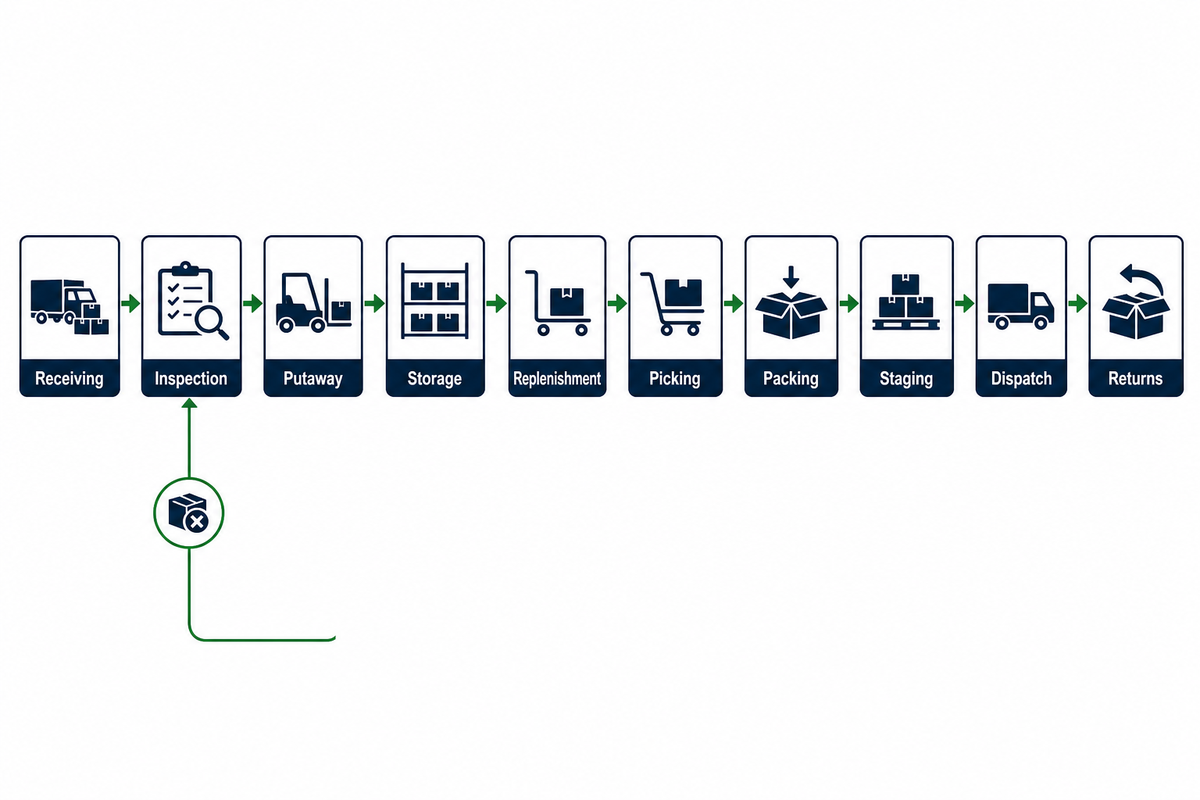
Start with the real path a unit takes, queues and exception paths. In practice, a warehouse management system can streamline complex operations only after the management system reflects the real process. That sequence can improve warehouse operations through better labor allocation and lower operating costs, but software alone cannot automate warehouse routines safely. Happy-path-only process maps aren’t control documents. Walk one normal order and one problem order from door to door, then record who owns each decision and which signal shows that the step is complete.
| Process category | Required input | Proof of completion | Failure signal |
|---|---|---|---|
| Receiving | Appointment, documents, physical unit | Quantity, identity and condition recorded | Unknown, short, over or damaged stock |
| Inspection | Received unit and acceptance rule | Released or quarantined status | Unowned discrepancy |
| Putaway | Released inventory and valid destination | Unit and location transaction agree | Floor stock or wrong-location scan |
| Storage | Stable unit and compatible location | Accessible, secure inventory | Blocked aisle, damage or lost status |
| Replenishment | Demand trigger and reserve stock | Pick face restored before shortage | Emergency move or aisle conflict |
| Picking | Released work and available stock | Correct item and quantity confirmed | Short, substitution or wrong item |
| Packing | Confirmed lines and packing rule | Order identity and condition protected | Rework, mismatch or loose contents |
| Staging | Completed order and route assignment | Correct cutoff, door and sequence | Aged queue or wrong door |
| Dispatch | Verified load and carrier | Load scan and carrier handoff | Missed cutoff or unstable unit |
| Returns | Returned unit and disposition rule | Restock, repair, hold or scrap decision | Unidentified stock re-enters inventory |
In this guide, use a warehouse Flow-and-Control Audit at five handoffs: receiving, storage, pick/pack, staging and dispatch. This is a practical diagnostic framework, not an industry standard. At each handoff, also examine four controls within the work, not only between departments: ergonomics, storage condition, transaction integrity, and pace or exception pressure. This is important because the changing nature of monitoring technology can change the nature of how work is paced and ultimately performed. The U.S. Government Accountability Office states that, in certain circumstances, technology can improve safety and reduce risk while performance monitoring and a faster pace can increase the risk of ergonomic injuries.
Receiving and Putaway: Stop Errors at the Door
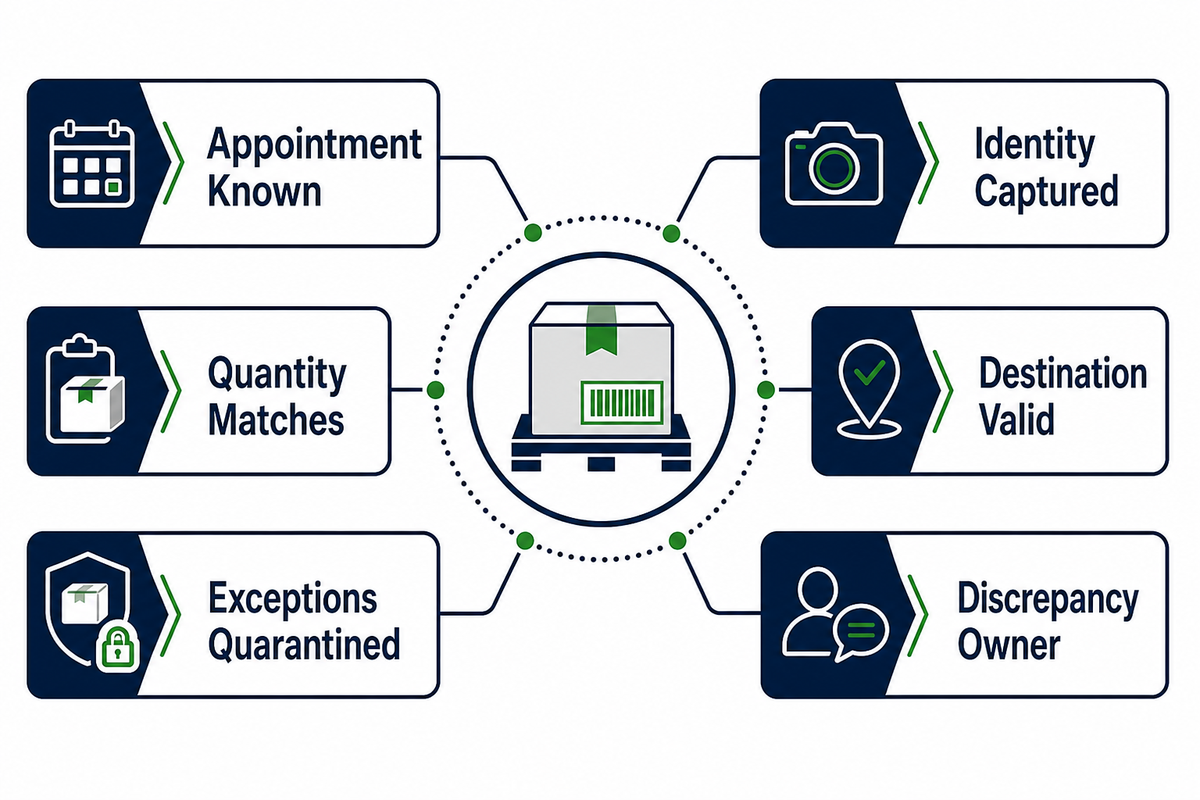
Finding a discrepancy in receiving can prevent avoidable downstream searches, counts and picks. The receipt of goods should establish identity, quantity, condition, ownership and the exception path before putaway. Contractors and suppliers should use the same acceptance language. Stock that enters reserve storage as unidentified or damaged creates extra work later. Prepare the receiving door and destination. Verify documentation, quantity and visible condition. Quarantine exceptions. Capture the unit identity, then release only confirmed inventory to directed putaway.
Receiving control checklist
- Is the appointment, purchase order or transfer known prior to unloading?
- Does the physical quantity match the expected handling-unit count?
- Are damage, contamination or instability separated from usable stock?
- Can the unit identity be read and linked to the correct transaction?
- Is the putaway destination valid for size, weight, compatibility and status?
- Who’s responsible for the discrepancy, and where does the unit wait without disappearing?
Each logistics unit, such as a pallet, can be identified by a Serial Shipping Container Code. The GS1 Logistic Label Guideline outlines how this identifier is used throughout the transport and warehouse processes. However, a scanned SSCC can’t confirm that the inventory record is correct. The associated receipt, item, quantity, and location are all needed to confirm the transaction. Identity, capture, and transaction posting are three separate controls.
Storage and Slotting: Design for Travel, Access and Stability
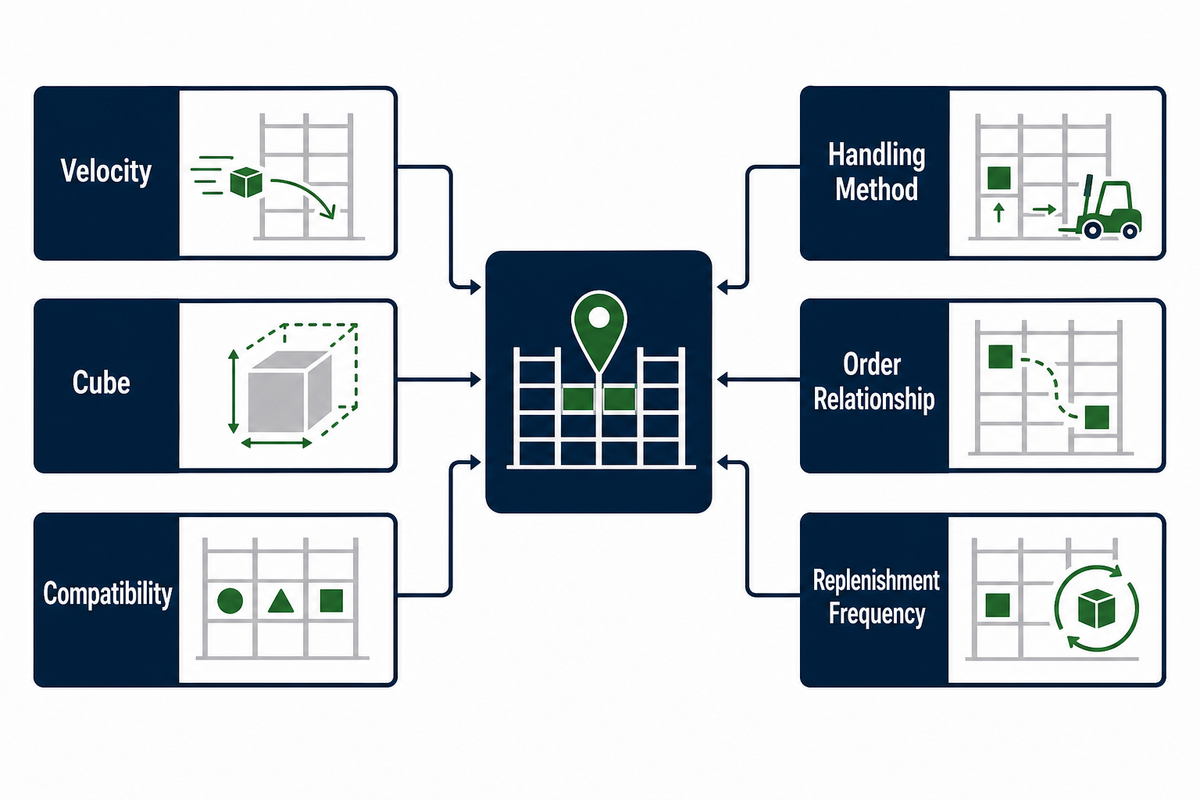
Slotting determines where each item should reside. A good slotting determination considers velocity, cube, compatibility, handling method, order relationship, and replenishment frequency. There are other factors that determine the primary slotting location. For example, even though a location may have a high velocity, that doesn’t make it the most stable or safe location.
Keep reserve and forward-pick logic separate. The forward location should have stock to cover the replenishment cycle without creating a stock jam. Reserve rack positions should make replenishment more predictable as opposed to filling every cube. Review family groupings carefully: items that are often ordered together might reduce travel if positioned close to each other, while look-alike products may require a deliberate separation to prevent a mis-pick.
Storage rules must fit the actual facility and equipment. Storage space and warehouse space are not the same as usable capacity; product storage rules, storage systems and access controls determine how much floor space can be used. Dry storage space, refrigeration and food grade zones need different storage solutions and compatibility rules. A facility should maximize space only after it proves products are stored safely and products are available for release. For U.S. workplaces covered by OSHA, 29 CFR 1910.176 requires safe clearance for aisles and passageways used by mechanical handling equipment, clear and well-maintained passageways, and stable storage secured against sliding or collapse. Other locations should apply their current local requirements. This supports a risk-based site rule, not a universal aisle-width number copied from another building.
Inventory Accuracy: Control Transactions, Not Just Counts
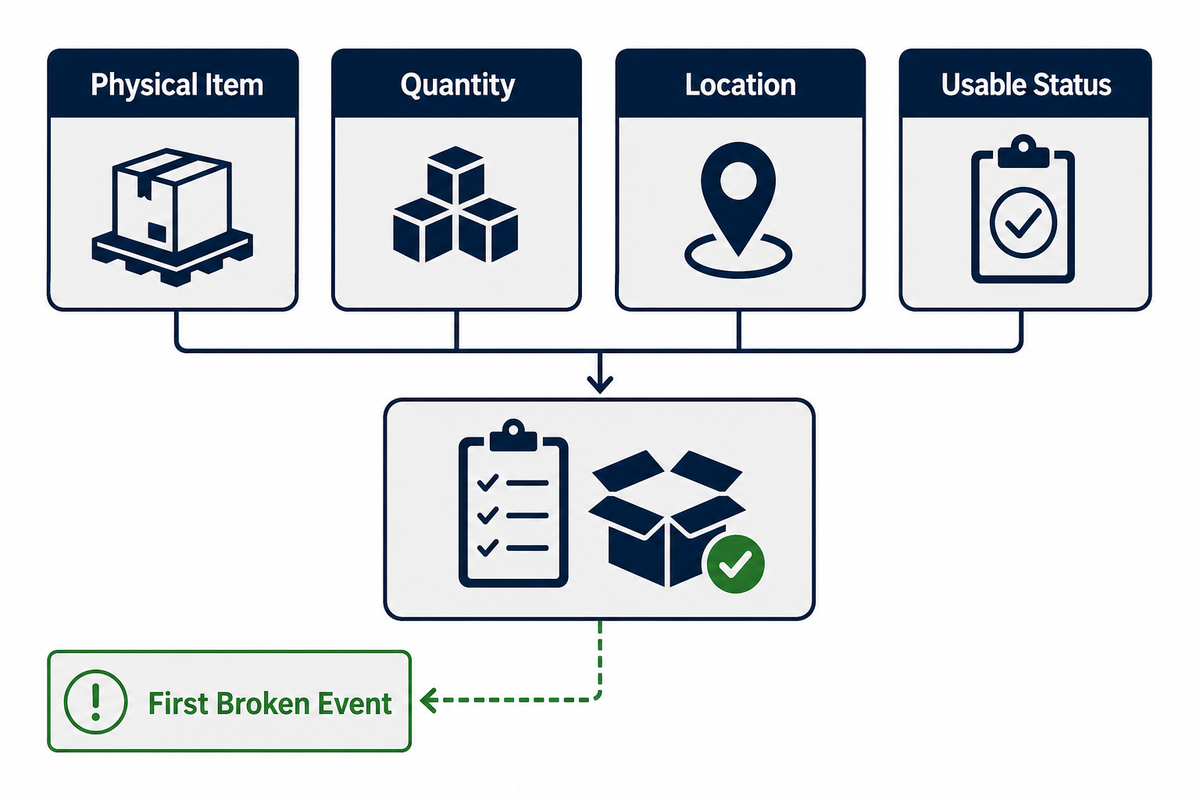
Inventory accuracy is the agreement between the physical item, its quantity, its location and its usable status. The storage and slotting rules above create the location baseline; accuracy shows whether the system and physical stock still agree with it. A stock count may appear accurate while the stock is in the wrong location or has a blocked status. Each and every physical movement should be treated as a transaction: receive, put away, pick, adjust, return, scrap, and replenish.
For inventory management, cycle counting works best as a feedback loop. Efficient inventory management connects physical inventory, inventory control and system status. Teams manage inventories by recording every receipt, move, adjustment and release at the point of work. Rather than giving every item a count with a fixed frequency, set counts by level of risk: high velocity, high value, variance or a new process, or even short pick cycles. Once variance occurs, hold the evidence long enough to identify the first broken event. Correcting the balance without correcting the process failure only resets the clock.
Count resultPhysical quantity compared with recorded quantity at a defined location and time.
Process resultThe transaction or handoff that created the difference, and the control changed to prevent recurrence.
Before teams compare performance metrics, the definitions need to be consistent. A good starting point for these definitions is ASCM’s warehouse KPI overview, but any percentages provided should be taken as context, not as targets. Product mix, order profile, and counting method dictate what an acceptable performance looks like.
Picking, Packing and Replenishment as One System
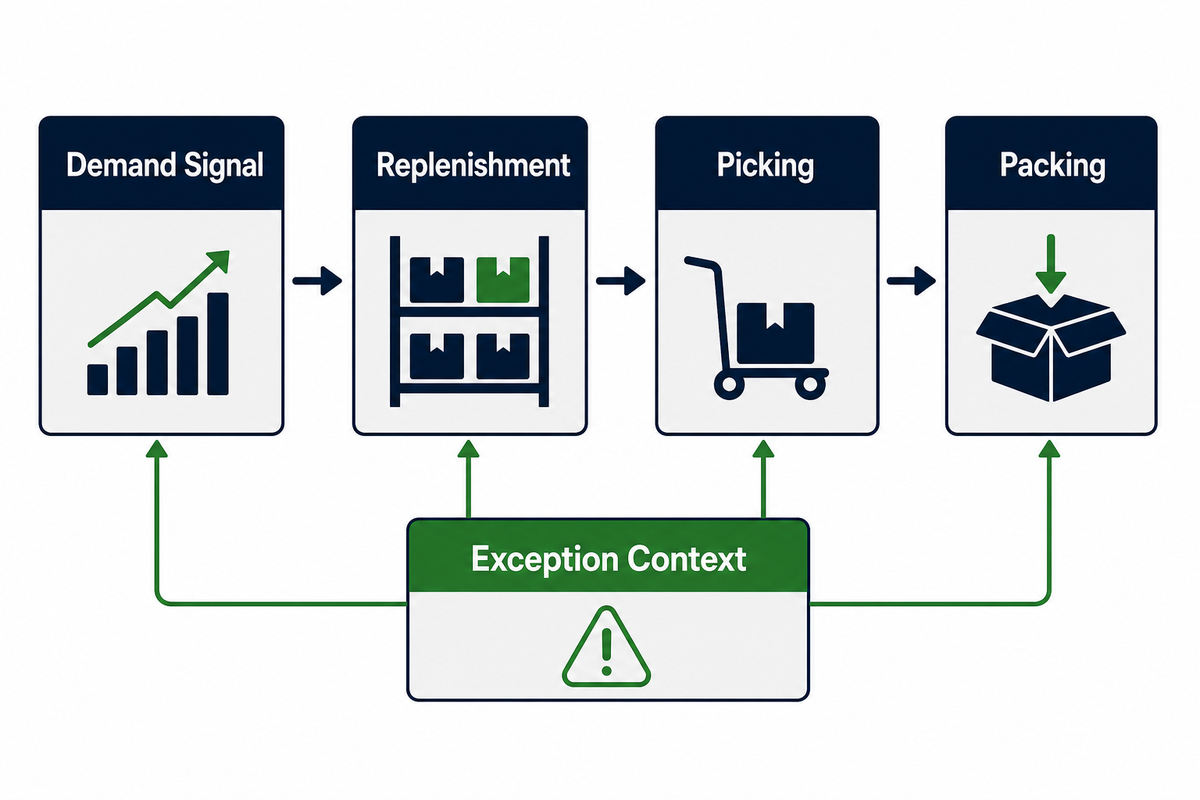
If picking is to remain productive, then replenishment must be predictable. Order preparation connects picking and replenishment to order fulfillment; reliable fulfillment depends on exception context reaching packing. To improve warehouse performance, track the full path rather than one isolated labor rate. Packing cannot stay accurate if pick exceptions arrive without context. Choose a method around order structure: discrete picking suits low-volume or complex orders; batch picking reduces repeated travel for similar small orders; zone picking keeps operators in defined areas; wave picking coordinates work with carrier cutoffs or packing capacity.
Replenishment should aim to protect the pick face, but shouldn’t create demand for replenishment vehicles to share aisles with pickers. Use the demand, case quantity, lead time, and stock level to set the trigger for replenishment. Record emergency replenishments separately; they are a diagnostic of slot capacity or planning quality, not normal work to hide inside the average.
Hybrid picking methods are common, and ergonomics belongs in method selection. For qualifying two-handed lifts, the NIOSH Revised Lifting Equation covers lift load, position of hands, travel distance, asymmetry, frequency, duration and coupling. Tasks outside the equation’s stated scope need a separate ergonomic assessment rather than an assumed RNLE result.
Staging, Unit-Load Integrity and Dispatch Handoffs
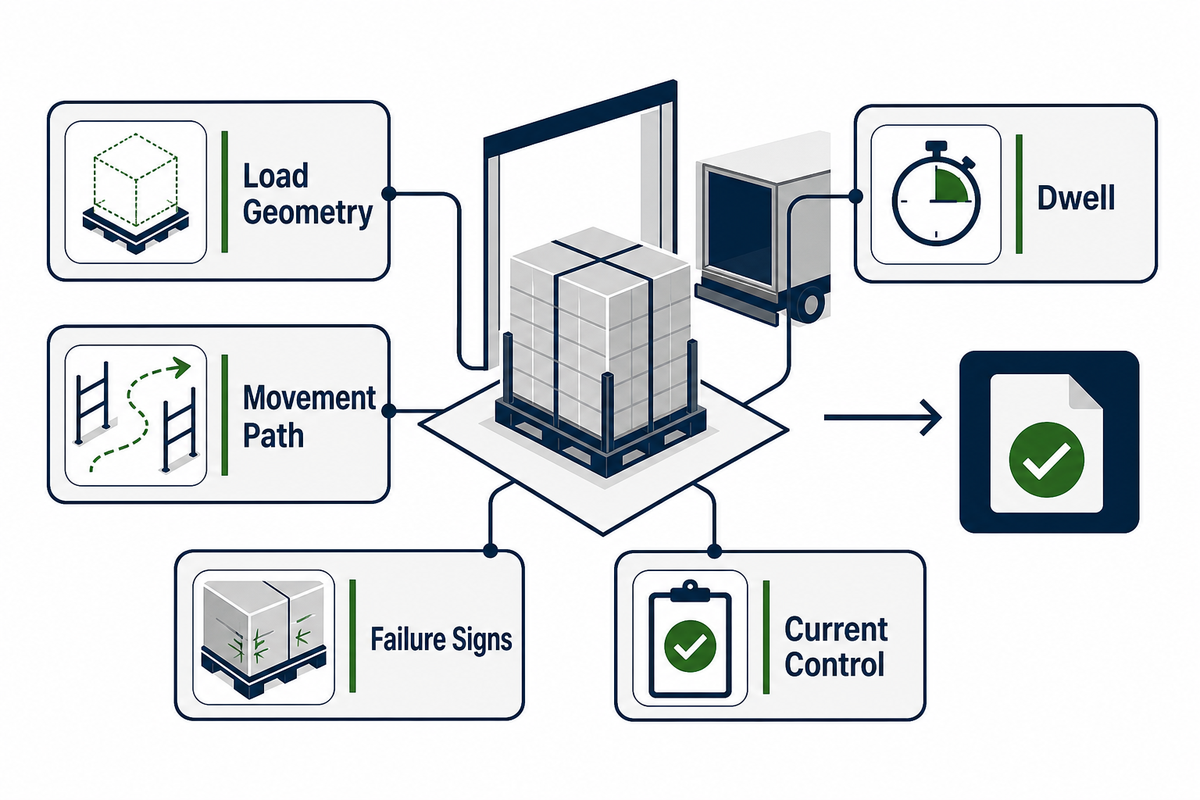
Staging is a controlled queue, not spare floor space. At dispatch, load integrity and routing can also change transportation costs before the shipment leaves the warehouse. Position units based on route, cutoff, door, or loading sequence. Make the identity legible from the travel aisle. Exceptions should be given a marked lane. Before loading, be sure to verify the order, carrier, route, and physical unit. A scan-before-load helps only if the scanned identity is tied to the correct dispatch record.
UD Warehouse Handoff Card
Prior to changing a containment method, record the actual facts that the load experiences: For a repeatable intake, the industry load signature selector helps capture application conditions before a packaging route is chosen.
- Load geometry: footprint, height, weight distribution and edge exposure.
- Movement path: conveyor, forklift, hand truck, transfer points and vehicle type.
- Dwell: time in storage, staging, transit and outdoor or variable conditions.
- Failure signs include shifting, crushing and abrasion. Also check for loosened containment or damaged corners.
- Current control: material, application method, inspection point and exception rule.
The card distinguishes a load-control problem from a scheduling, handling or transaction problem. For a structured follow-up, use the unit-load review to organize observations without turning this guide into an RFQ. If the diagnosis indicates containment at the warehouse-to-transport handoff, go to the commercial application path of UD Packaging’s logistics and warehousing packaging solution on their website. Keeping the discussion about that solution out of this operational guide helps clarify the distinction between process diagnosis and product selection.
GS1’s SSCC support guidance supports the same point. GS1’s SSCC support guidance reinforces the same distinction: the code uniquely identifies a logistics unit, while business systems and scan events carry the associated information. Business systems and scan events contain the rest of the data. Check the physical load and its digital handoff prior to release.
Warehouse KPIs That Diagnose Flow Instead of Hiding It
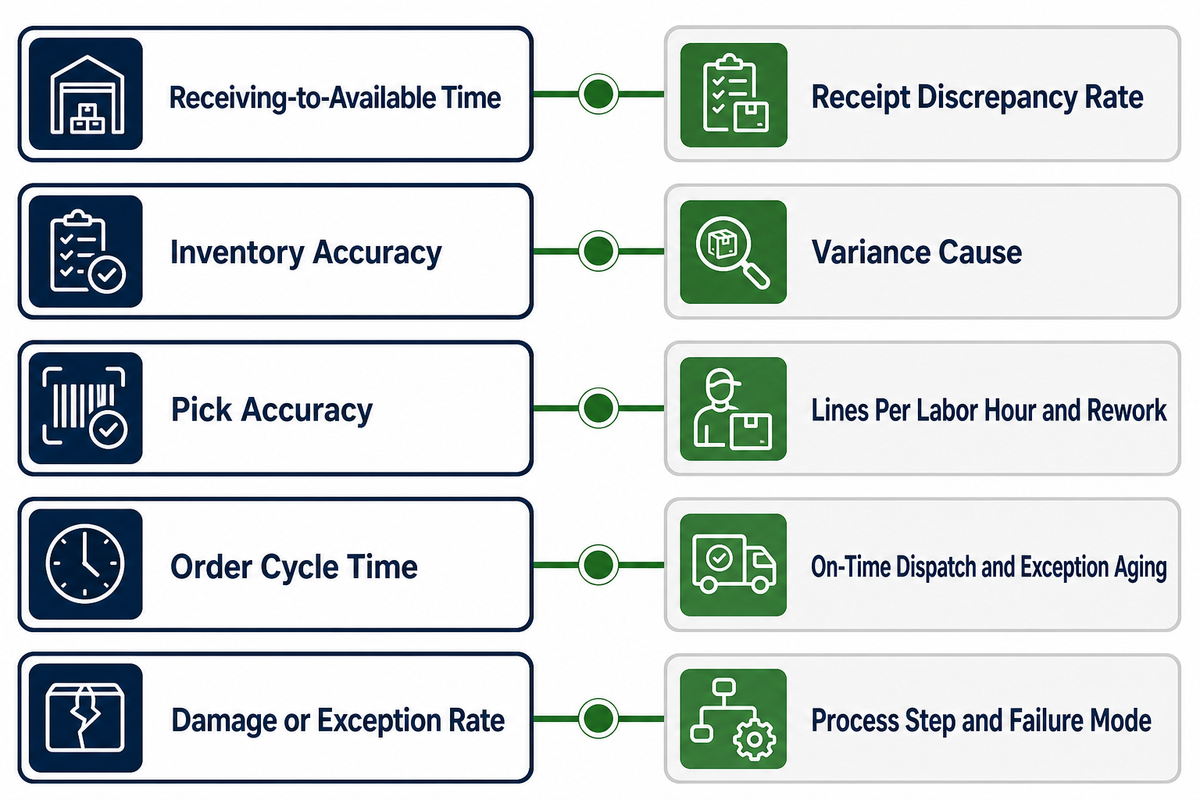
A metric or measurement must influence a decision. The staging handoff above supplies the first diagnostic boundary: identity, load condition, route and release status. Start with a small set spanning speed, accuracy and exceptions, then segment it by process, shift, order type or SKU family. The average of a single facility can mask a failing path within a large volume of routine work. Operational measures should connect to service level targets such as customer satisfaction and on time dispatch, but keep the process signal narrow enough for a warehouse owner to act.
| KPI | What it diagnoses | Pair it with |
|---|---|---|
| Receiving-to-available time | Inbound flow and release delay | Receipt discrepancy rate |
| Inventory accuracy | Physical-to-system agreement | Variance cause and location accuracy |
| Pick accuracy | Correct item and quantity | Lines per labor hour and rework |
| Order cycle time | End-to-end response | On-time dispatch and exception aging |
| Damage or exception rate | Handling and containment failures | Process step and failure mode |
As a practical diagnostic rule in this guide, pair speed measures with quality measures. Increased speed with an increase in mistakes isn’t an improvement, and shorter receiving time with a growing examination queue isn’t an improvement in dock productivity. The U.S. Bureau of Labor Statistics productivity program illustrates why output and labor inputs need precise definitions at a broad economy level. In a warehouse, use your own established definitions and baseline instead of importing a target from a different operating profile.
WMS, Scanning and Automation: Sequence the Investment
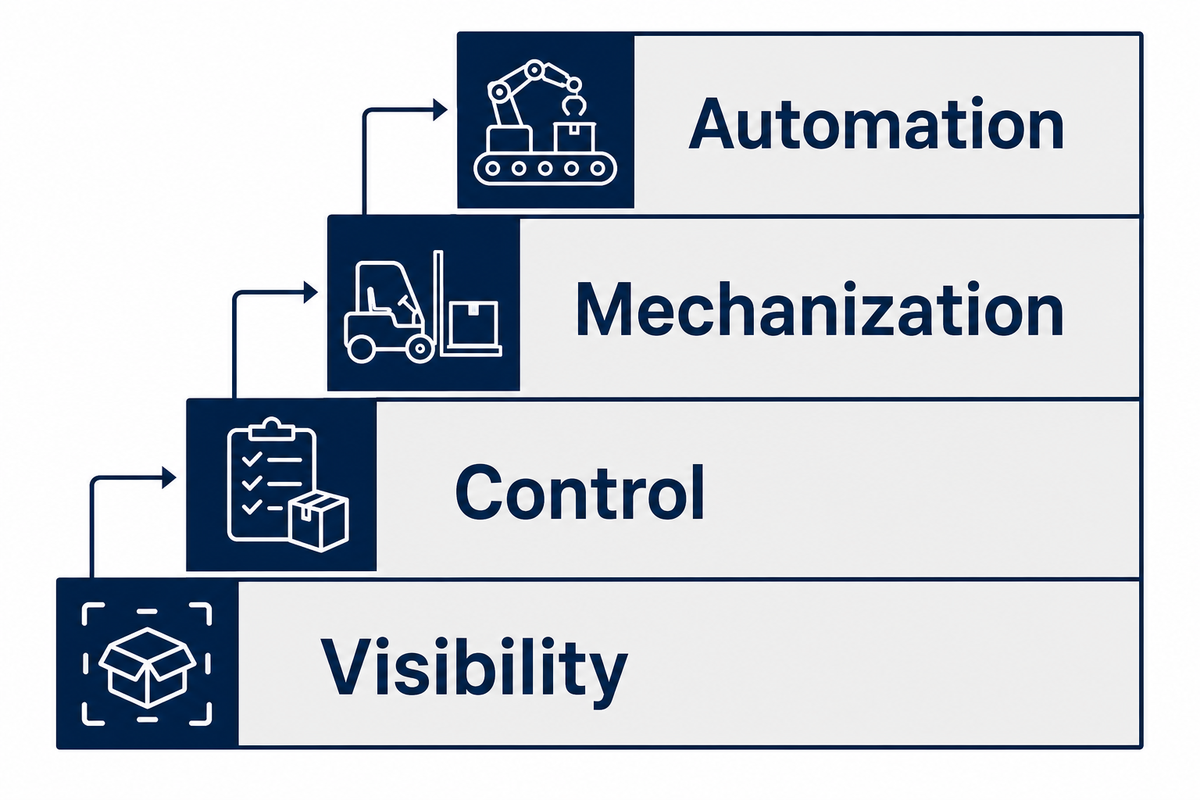
Technology compounds the effects of the process it receives. If item masters, locations, units of measure or exception ownership aren’t defined, faster execution can spread the same process error before a team notices it. This guide uses a practical Visibility-to-Automation Decision Ladder to sequence the discussion:
- Visibility: make units, locations, status and queues observable.
- Control: define valid transactions, confirmation points and exception owners.
- Mechanization: reduce a specific physical burden with appropriate equipment.
- Automation: automate a defined, measurable process with exception cases.
Your WMS must support the agreed flow and not replace the work of agreeing on it. Scanning must confirm a meaningful occurrence and shouldn’t add a beep that will only lead operators to learn how to ignore it. Safety, maintenance, recovery mode and changes in work pace must also be considered when evaluating automation. The GAO warehouse worker safety review is a good example to counterbalance automatic ROI assumptions: technology may reduce some exposures, but performance management and changed work pace may introduce some new exposures.
For energy and facility projects, create a baseline before selecting the intervention and then monitor the result. The U.S. Department of Energy Better Buildings examples apply this measure-before-and-after logic to warehouses and distribution centers. The same discipline should apply to an automation business case.
A 30-Day Warehouse Improvement Plan
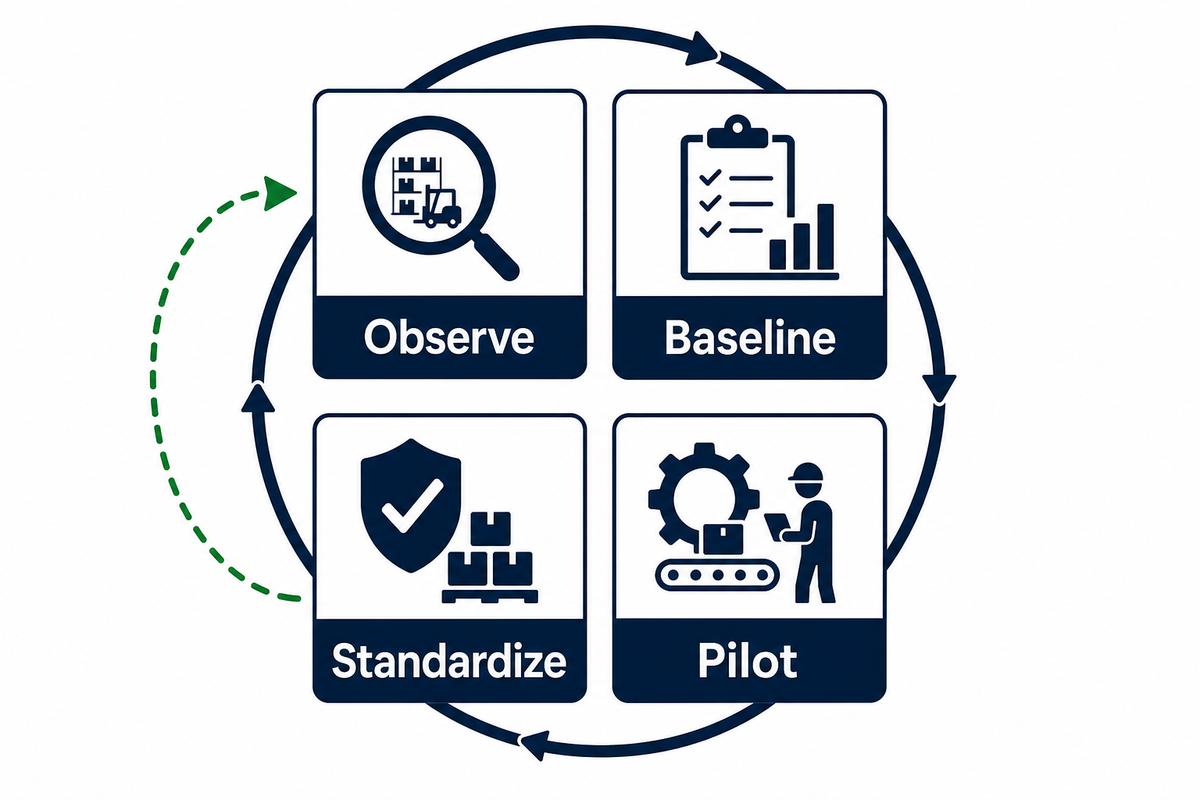
Don’t plan on a full redesign. The following 30-day starter plan uses one month to make the flow visible, establish a trustworthy baseline, test one constraint and decide whether the result should become a standard. It is a bounded improvement cadence, not a promised performance timeline.
Week 1: Observe
Walk normal and exception orders. Map queues, handoffs, workarounds and missing owners.
Walk normal and exception orders. Map queues, handoffs, workarounds and missing owners.
Week 2: Baseline
As a manageable starting set, define three to five measures. Validate how each number is captured before judging performance.
As a manageable starting set, define three to five measures. Validate how each number is captured before judging performance.
Week 3: Pilot
Choose one constraint. Change one control in one bounded area, shift or product family.
Choose one constraint. Change one control in one bounded area, shift or product family.
Week 4: Standardize
Compare the paired speed and quality measures. Keep, revise or stop the change; assign an audit owner.
Compare the paired speed and quality measures. Keep, revise or stop the change; assign an audit owner.
Printable warehouse flow audit
- Each handling unit has a readable identity and valid system status.
- Normal and exception routes are physically visible.
- Every handoff names the next owner and completion signal.
- Physical moves and system transactions close together.
- storage locations match the item’s cube, stability, compatibility and access needs.
- Replenishment protects the pick face without creating aisle conflict.
- Speed KPIs are paired with accuracy, damage or exception measures.
- Staged units are assigned to route, cutoff and door before loading.
- Load condition and digital identity are both confirmed at dispatch.
- Every pilot has a baseline, owner, review date and rollback rule.
The legal and physical baseline still applies while you pilot changes. For U.S. workplaces covered by OSHA, the OSHA material-handling standard requires safe clearance and clear, well-maintained passageways for mechanical handling, along with stable storage. Other locations should apply their current local requirements. Process changes shouldn’t impair controls that protect storage stability and aisle safety.
Does the audit point to a load-containment failure?
When you bring the load geometry, movement path, dwell time and the observed failure to a packaging review, it keeps the discussion focused on an operating problem rather than on a product request. Include the route, handling method and observed damage so the review can test a specific failure hypothesis against the actual handoff.
Frequently Asked Questions
What is logistics and warehousing?
View answer
Logistics plans and controls how goods and related information move through a wider supply network. Warehousing is the facility-level work of receiving, identifying, storing, replenishing, picking, packing, staging and releasing those goods. The two overlap at handoffs such as inbound appointments and outbound dispatch. A warehouse supports logistics when its physical movements, system transactions and ownership rules stay synchronized.
What does warehouse logistics do?
View answer
Warehouse logistics turns inbound goods into available inventory and customer orders into verified outbound loads. It coordinates dock activity, putaway, storage, inventory control, replenishment, picking, packing, staging, dispatch and returns. Its job is not only to move products quickly. It must also preserve identity, condition, transaction accuracy and responsibility at every handoff so downstream teams receive usable goods and reliable information.
What is the difference between warehousing and logistics?
View answer
Warehousing focuses on controlling goods inside a storage and fulfillment facility. Logistics covers the broader network, including transportation, inventory positioning, information flow and coordination between facilities, suppliers and customers. Warehousing is therefore a part of logistics. The distinction helps assign ownership: transport may own arrival planning, while the warehouse owns the receipt, condition check, identity capture and putaway transaction. The boundary becomes especially useful during an exception. A late trailer is a network event; an unloaded pallet that never receives a valid location is a warehouse-control event. Naming the boundary prevents one team from improving its own clock by passing unfinished work to another.
What are the main warehouse processes?
View answer
The main flow is receiving, inspection, identification, putaway, storage, replenishment, picking, packing, staging, dispatch and returns. Inventory control, exception handling, safety and maintenance run across all of them. A process is complete only when the physical unit, the system record and the next owner agree, not merely when the unit has moved to another area.
Which warehouse KPIs should a team track first?
View answer
Begin with receiving-to-available time, inventory accuracy, pick accuracy, order cycle time and damage or exception rate. Use stable local definitions and segment results by the process or product family that can act on them. Pair each speed measure with a quality measure, for example, lines picked per hour with pick accuracy, so a faster department cannot hide rework passed to the next step.
When should a warehouse review its packaging and load-containment method?
View answer
Review it when staged or transported units show shifting, loosened containment, crushed corners, abrasion, repeated rework or instability after a specific handling step. First record load geometry, movement path, dwell conditions and the exact failure point. That evidence helps separate a containment issue from poor stacking, equipment contact, staging delay or an uncontrolled handoff and makes any later solution review far more specific.
References & Sources
- Warehousing: Hazards and Solutions U.S. Occupational Safety and Health Administration.
- 29 CFR 1910.176, Handling Materials, General OSHA.
- GS1 Logistic Label Guideline GS1.
- Revised NIOSH Lifting Equation CDC/NIOSH.
- warehouse Worker Safety: Technology, Injury Risks, and Protections U.S. Government Accountability Office.
- Optimizing warehouses and Distribution Centers for Energy Efficiency U.S. Department of Energy Better Buildings.
- warehouse KPI Overview Association for supply chain Management.
About UD Packaging
UD Packaging collaborates with the operations teams on transport-packaging and load-containment applications. Learn more about the company’s background on the About UD Packaging page. This guide is educational. Due to the nature of the guide, we’ve intentionally left the path of product selection as a separate and distinct solution path.