Get in touch with UD Packaging Company

Recycled Stretch Film: How to Verify Content Claims and Trial a New Roll

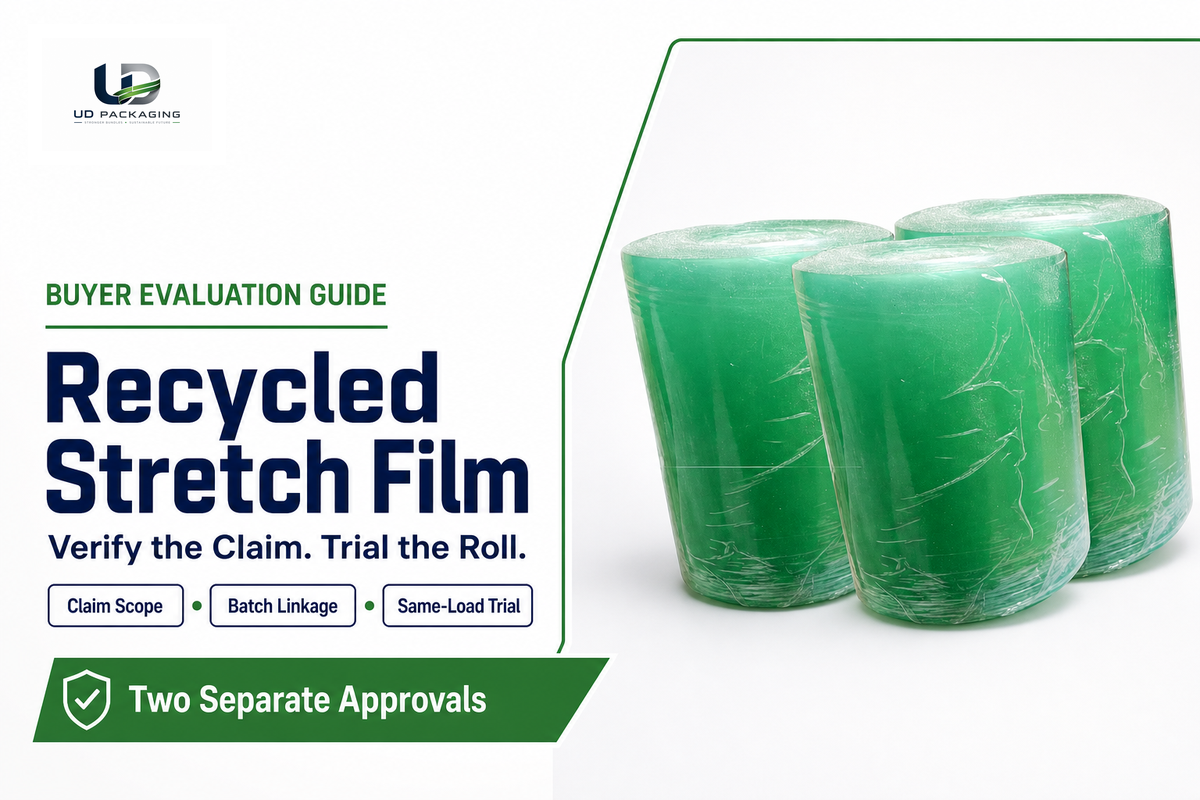
Recycled stretch film refers to pallet-wrapping film sold with a stated recycled-content claim; buying it isn’t a decision between sustainability language and pallet protection. It’s two different approvals which require different evidence. The procurement and the sustainability team must know what the recycled content statement means. Operations and quality teams must confirm whether a given roll performs on the defined load, wrapper, and route.
Start with the evidence chain, not a headline percentage. Suppliers can make a product-level statement while the receiving team still lacks documentation that connects it to the delivered batch and roll.
Decision rule: approve the claim only when its scope is documented, and approve the roll only when it passes a controlled same-load trial. Neither approval substitutes for the other.
What a Recycled Stretch Film Claim Must Identify
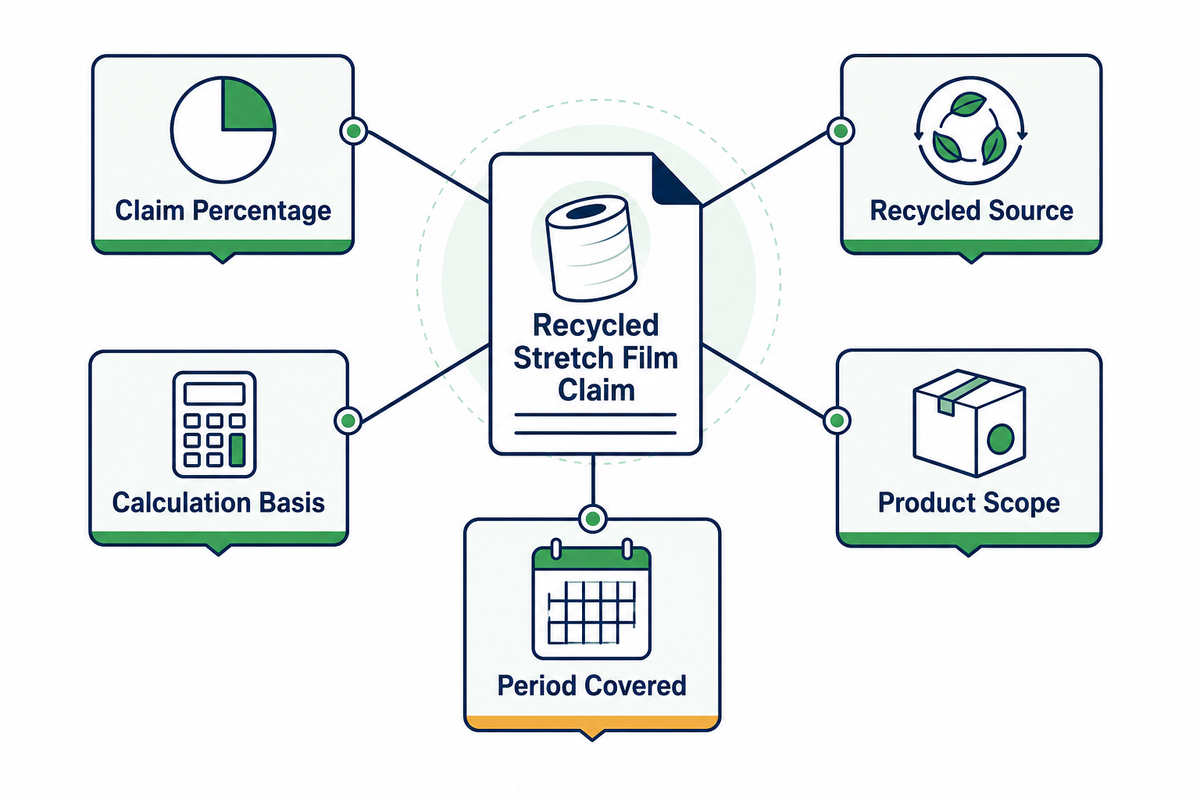
The risk is a mismatch between a broad claim and a traceable roll; a usable recycled-content statement therefore names the percentage, recycled source, calculation basis, product scope, and period covered. Under 16 CFR 260.13(c), a less-than-wholly recycled product needs a weight-based qualification. Section 260.13(b) separately distinguishes qualifying recovered inputs from normal in-process scraps reused in the same process.
ISO 14021:2026 is the current public ISO page for self-declared environmental claims and related assessment and verification methodology. It helps define terminology, but it is not a certificate for a particular film roll.
Procurement searches may call the material “recycled stretch wrap,” “recycled pallet wrap,” or “environmentally friendly pallet wrap,” but the supplier still needs to place the percentage and source category beside the product code. When buyers compare “recycled stretch film suppliers,” “recycled stretch film wholesale” offers, or “recycled stretch film for packaging,” they should still ask whether the percentage is based on direct physical segregation, a controlled blend, or an accounting approach. An annual weighted average can be a valid claim basis. This, however, isn’t a physical assurance of recycled material in every individual roll.
Under 16 CFR 260.13(b), recycled content must come from materials recovered or otherwise diverted from the waste stream.
The Claim-to-Roll Evidence Ledger
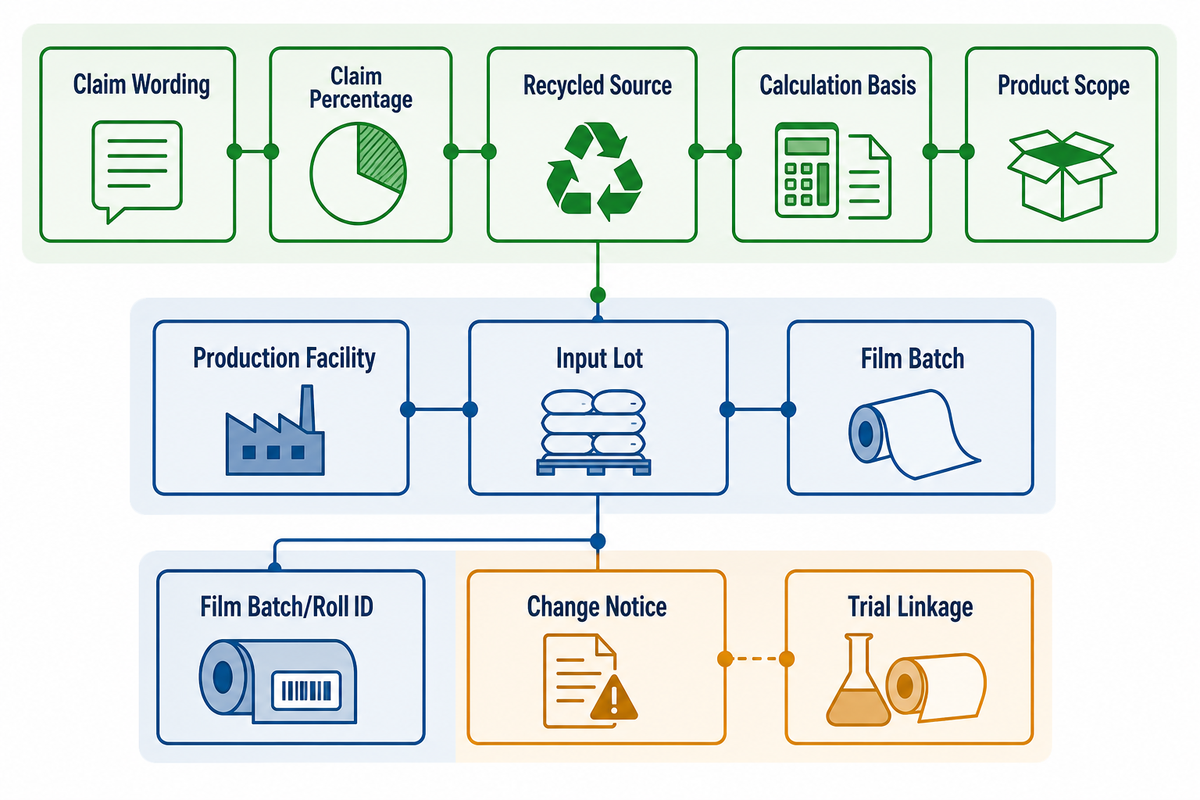
With the claim fields defined, the ledger below gives procurement, quality, and receiving teams one consistent record. It doesn’t require a standardized certification format; ISO 14021 remains the terminology reference. It makes each handoff visible, so a claim can be accepted, qualified, or held until evidence is provided. Certification scopes vary, so the buyer must verify the named product, the facility, the accounting period, and the shipping connection on the evidence provided.
| Evidence point | Record to request | Owner | Scope or limitation |
|---|---|---|---|
| Claim wording | Exact sales or specification statement | Procurement | Do not infer a percentage from a logo. |
| Claim percentage | Percentage by stated basis | Sustainability | A percentage needs its denominator. |
| Recycled source | Post-consumer, qualifying pre-consumer, or named source | Sustainability | PCR is one sub-question, not the whole claim. |
| Calculation basis | Blend, allocation, or weighted-average explanation | Quality | Accounting is not per-roll physical measurement. |
| Product scope | Product code, gauge, width, and roll format | Procurement | One listed SKU does not cover a portfolio. |
| Production facility | Named manufacturing location | Quality | Check certificate facility scope. |
| Input lot | Resin or input-lot reference | Supplier quality | May be confidential; request a traceable attestation. |
| Film batch | Production batch or lot record | Receiving | Batch must match the shipment. |
| Film batch/roll ID | Roll label, batch code, and delivery record | Warehouse | Record the actual roll tested. |
| Change notice | Notice for source, formulation, facility, or construction changes | Supplier quality | Prior approval does not automatically carry forward. |
| Trial linkage | Same-load record and acceptance decision | Operations | Performance approval remains separate from claim approval. |
The purpose of the 11-row ledger is an evidence map, not a scorecard. A complete claim file may also require a receiving check, and a complete receiving record doesn’t establish recycled content without the supplier’s stated source and calculation basis.
PCR, Pre-Consumer Material, and Rework Need Different Questions
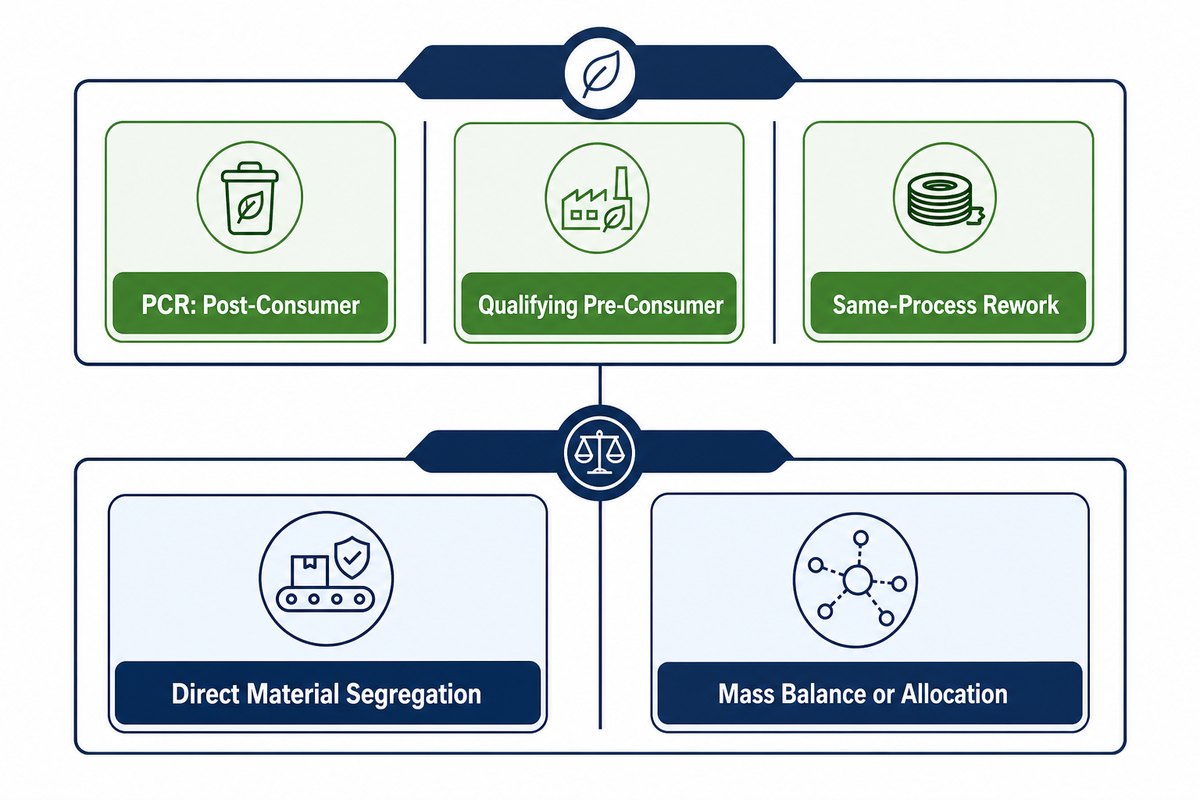
PCR is post-consumer recycled material. It’s a reasonable material to request, although it isn’t a synonym for all recycled content. The current U.S. guidance can also recognize qualifying pre-consumer material, while normal in-process scraps returned to the same process are a different case.
Don’t accept a bare term such as “PIR” without the supplier’s definition, the percentage basis, and the relevant product scope. Keep mass balance or allocation techniques separate from direct material segregation. The correct answer can be a qualified claim; however, the qualification needs to state what it does and what it doesn’t establish.
The Same-Load Roll Trial Protocol: 5 Controlled Steps
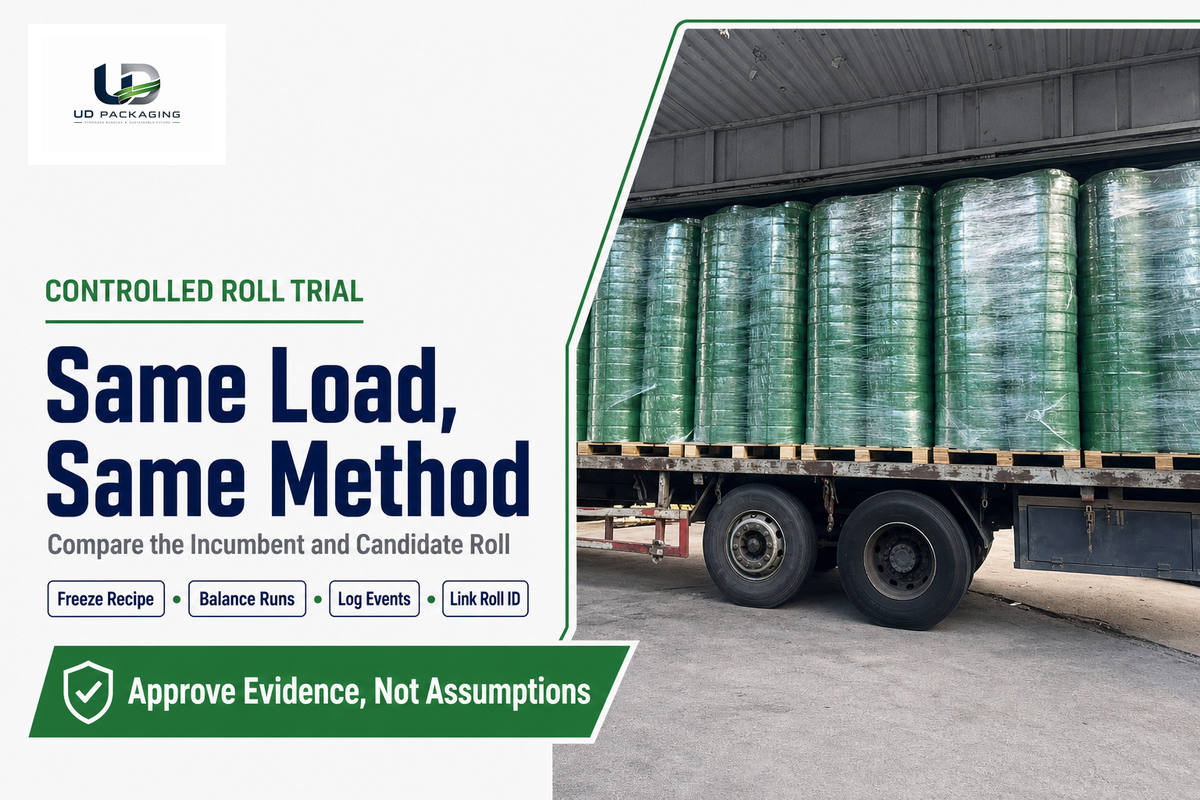
Once the source and percentage questions are separated, new films can be tested without selecting a universal sample size or wrapper specification. Use the same documented load family, application method, wrapper recipe, and acceptance criteria for the incumbent and candidate films. Film and load outcomes are impacted by more than a single specification. This includes application condition, environmental factors and the load itself.
Protocol: freeze the incumbent recipe, define accepted-pallet criteria, alternate or randomly balance baseline and candidate runs, log every event, and review only matched observations. Repeated balanced runs are more informative than one candidate pallet.
- Before commencing, define the load family, pallet dimensions, corner protection, destination route, wrapper or hand-wrap method, and acceptance criteria.
- Record baseline film use, roll mass (if available), break record, recipe, operator or shift, and accepted pallets for the incumbent.
- Run the candidate film in alternate or randomized sequence with the same load and documented settings. Don’t change load geometry to rescue a result.
- Separate wrapping-station acceptance from distribution validation. A stable wrap at the station isn’t proof of performance through handling, vibration, storage, or a particular transport route.
- Link every record to the film batch/roll ID, then decide whether the result supports approval, conditional approval, or rejection.
For machine applications, start from the existing machine-film compatibility intake and use the film-per-pallet comparison worksheet to keep baseline and candidate calculations consistent. Hand-application trials should retain the same load and operator-method record rather than borrowing machine settings.
Treat a matched run as an evidence unit, not an automatic release. Record load, recipe, and roll ID prior to analysis; a repeatable station result can aid the next decision, but by itself can’t demonstrate transport performance along a previously untested route.
Compare Film per Accepted Pallet, Not Roll Price Alone
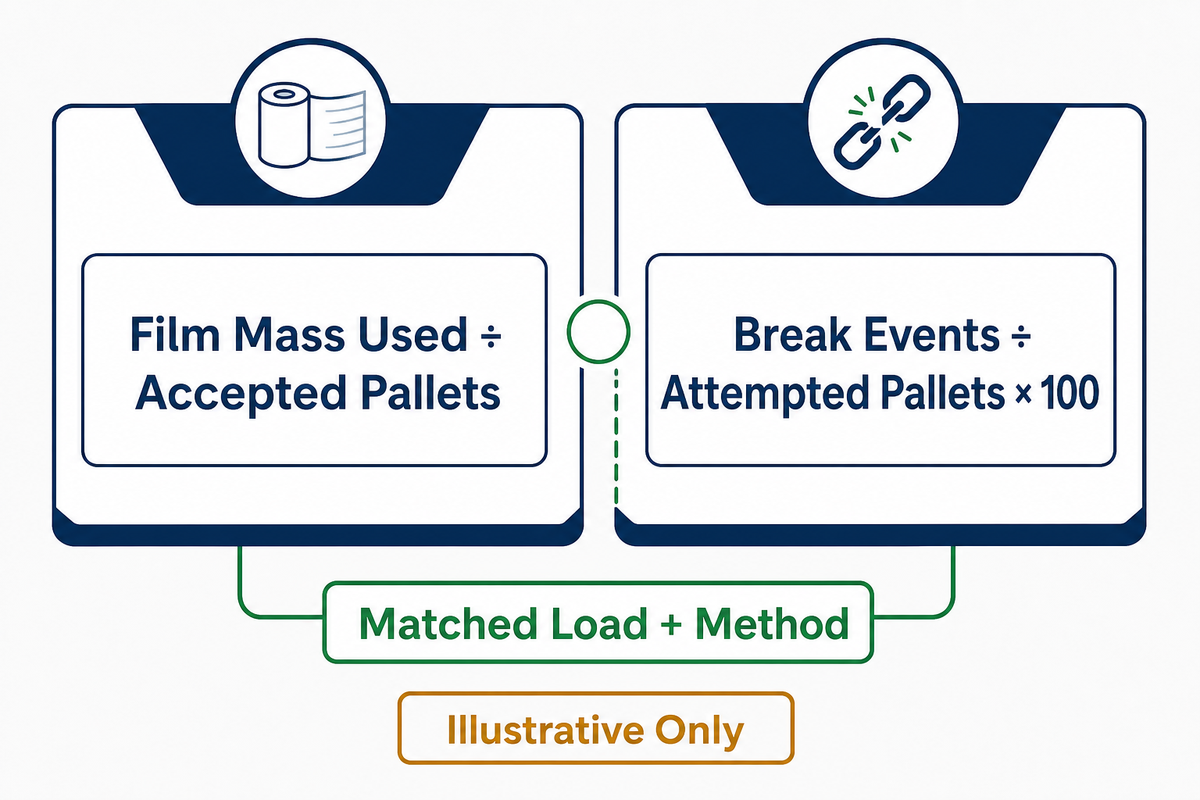
The better comparison is film used per accepted pallet together with break and rejection records. Price per roll can be deceptive if the candidate uses more film, more wraps, or produces more rejected pallets.
Illustrative, not UD Packaging data: suppose the baseline record lists 500 mm width, 20 μm thickness, 16.0 kg starting roll mass, 8.0 kg ending roll mass, 200% pre-stretch, and 30 pallets/hour. The hypothetical log also notes 50 mm overlap, a 15 rpm carriage reading, a 5 min observation pause, a 60 sec check, and a 10 kg calibration check. The candidate is also logged at 500 mm, 20 μm, and 200%, while the observed area stays at 20–22 °C for a 2 hour window. A baseline uses 48 kg across 120 accepted pallets from 124 attempts, with 4 recorded break events. Its result is 0.40 kg per accepted pallet and 3.23 breaks per 100 attempts. A candidate uses 45 kg across 125 accepted pallets from 128 attempts, with 3 breaks. Its result is 0.36 kg per accepted pallet and 2.34 breaks per 100 attempts. Calculation: film mass used ÷ accepted pallets; break events ÷ attempted pallets × 100. These values are only a worked example. They support no savings or performance claim, and the comparison is interpretable only if the load, method, and acceptance basis match.
State the calculation basis along with the result: total film mass or other agreed film consumption measurement, accepted-pallet denominator, excluded cases, and if any runs were repeated. Don’t transform an illustrative calculation into a supplier pledge, universal savings claim, or a carbon claim.
Trial Event Taxonomy
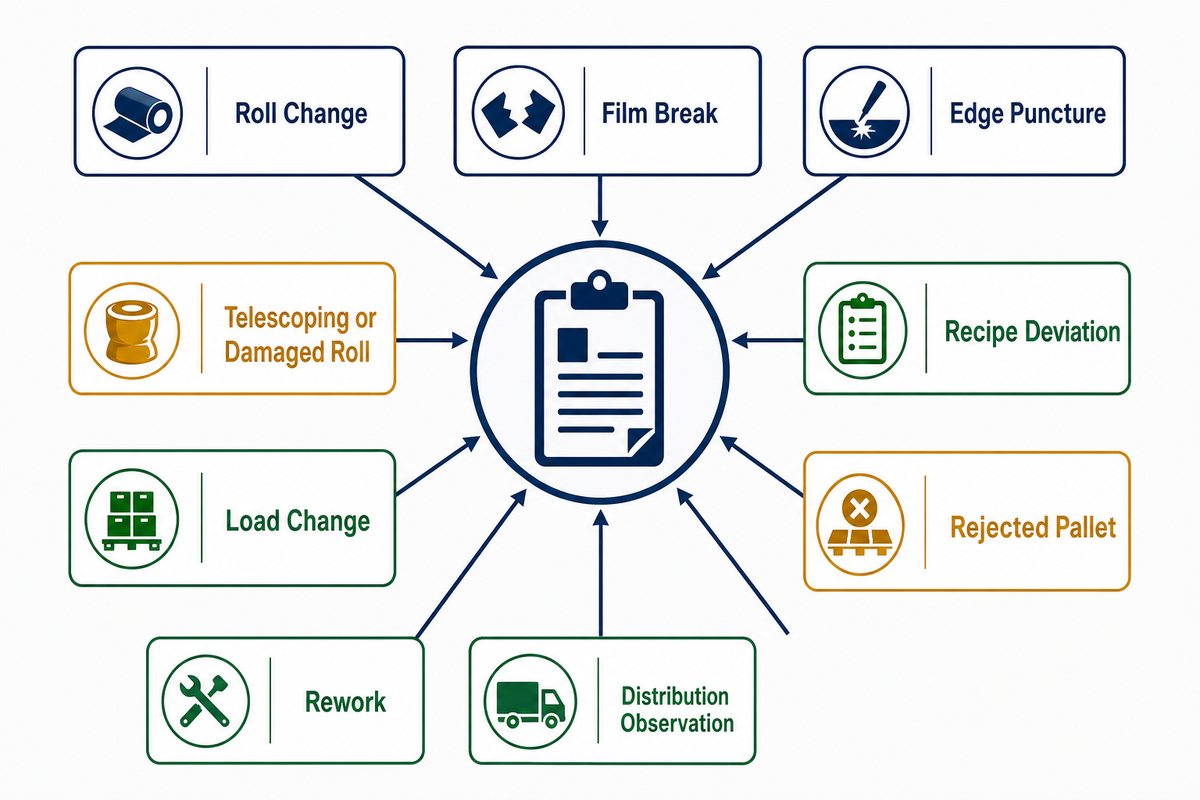
After comparing consumption, treat a break as an event to analyze, not a verdict on recycled resin. Film construction, load edges, handling damage, wrapper settings, temperature and test method information can all be potential causes. While a single cling, puncture, or tensile test may not fulfill the requirements for a pallet-acceptance test, each test answers a different property question.
| Event category | Capture | First review question | Scope or limitation |
|---|---|---|---|
| Roll change | Roll ID and time | Was sequence balanced? | Not a quality failure. |
| Film break | Location, load, recipe, photo if allowed | What competing cause exists? | One break is not causal proof. |
| Edge puncture | Load edge and protection state | Did geometry change? | May be load-specific. |
| Telescoping or damaged roll | Condition on receipt and setup | Was handling a factor? | Do not label resin cause without evidence. |
| Recipe deviation | Actual versus frozen setting | Is comparison still matched? | May make run inconclusive. |
| Load change | Weight, geometry, corners | Was it pre-approved? | Do not pool unmatched loads. |
| Rejected pallet | Reason and disposition | Which criterion failed? | Use agreed criteria. |
| Rework | Extra wraps or labor | Was the pallet accepted? | Include labor boundary if compared. |
| Distribution observation | Route and condition record | Was route validation planned? | Separate from station acceptance. |
The nine-event record captures useful information after an exception and carries it into the next decision. The goal isn’t to blame the wrapper; it’s to record enough detail to decide whether a repeat, adjustment, containment action or an independent investigation is warranted.
Use a Three-Outcome Decision Matrix
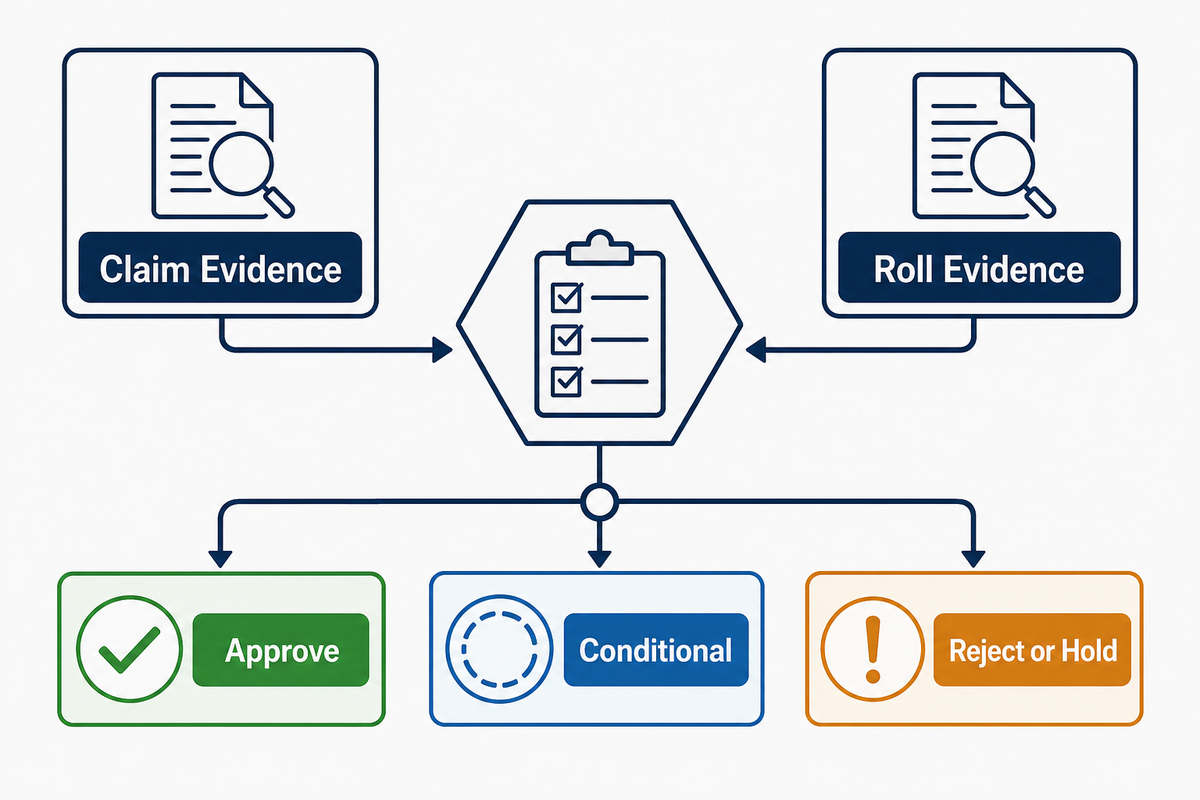
| Outcome | Claim evidence | Roll evidence | Next action and limitation |
|---|---|---|---|
| Approve | Scope, source, basis, and batch linkage are documented. | Matched trial meets agreed criteria. | Release only for defined product and change-control conditions. |
| Conditional | Claim is qualified or one traceability item is pending. | Result is promising but a matched condition is incomplete. | Set the missing document or rerun condition before broader use. |
| Reject or hold | Percentage, source, basis, or scope cannot be substantiated. | Failure cannot be resolved within the agreed protocol. | Do not convert the result into a broad material conclusion. |
Using the event record, conditional acceptance can be a sound decision when evidence is incomplete but the risk can be bounded, while the FTC recycled-content guidance remains the claim-qualification reference. Define the missing record, allowed load range, and recheck criterion to keep a temporary decision from becoming a permanent material approval.
Keep Approval Valid with Change Control and Receiving Checks
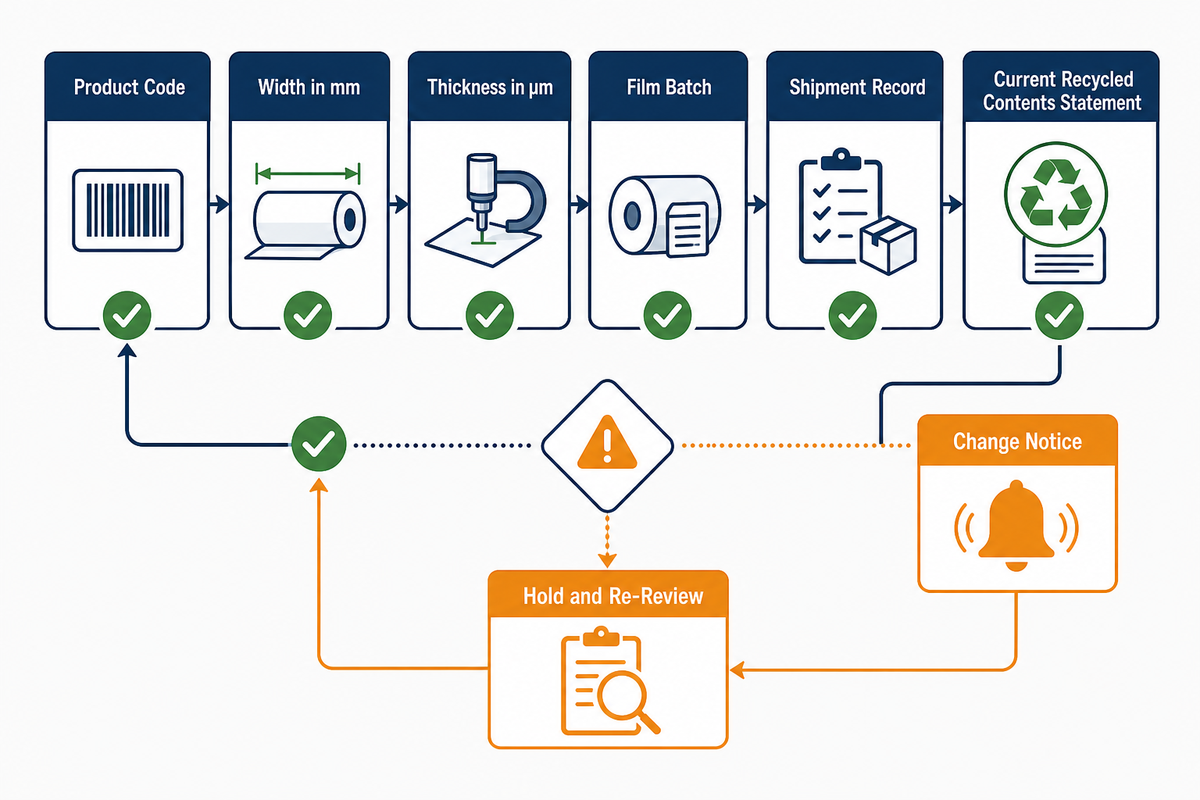
A passed test is applicable to the documented film construction, production source, load family, wrapper method and observed testing time. It doesn’t automatically approve subsequent lots. The purchase record should require roll or batch identification, notice of relevant source or formulation changes, and a defined receiving response when evidence no longer matches the record.
Receiving can check the label against the approved product code, stated width in mm, declared film thickness in µm, film batch, shipment record, and the current recycled contents statement. An incongruity doesn’t automatically mean the material is defective. The lot will be held until the supplier provides an explanation or the buyer repeats the affected review.
Write conditional approval so it cannot spread by habit: name the permitted line and load, the evidence still due, its owner, and the date or event that triggers re-review. ISO 14021 covers assessment and verification methodology for self-declared environmental claims, but the buyer still has to connect current documentation to the goods received.
Buyer Terminology: Useful Search Terms, Separate Evidence
While procurement language can help construct a question, it cannot generate an answer. Use the following vocabulary to ask for the correct record. Separate the claim, film application, and end-of-use evidence.
| Topic | Terms a buyer may encounter | Question to keep evidence-bound |
|---|---|---|
| Claim source | PCR film, PCR resin, PCW, post-consumer recycled content, certified recycled | Which percentage, source definition, calculation basis, and product scope apply to this roll? |
| Material language | recycled plastic, recycled film, plastic material, polymer, polyethylene, LLDPE, mechanical properties, elasticity | Which finished-film property and load condition was actually reviewed? |
| Application language | performance stretch film, film application, film usage, wrapping machine, hand film, benchmark | Was the candidate compared with the incumbent on the same documented load and method? |
| Sustainability language | sustainable, sustainable packaging, sustainable packaging solutions, sustainable stretch, eco friendly stretch, eco-friendly, eco-conscious | Does the wording identify a specific recycled-content, recyclability, or carbon boundary? |
| Recovery language | stretch film recycling, recycling of stretch film, recycling process, recycling program, recycling efforts, plastic waste, landfill, recapture, repurposed, recyclable | Can the end user collect clean film and does a local route accept it? |
| System language | industrial packaging, plastic packaging, supply chain, circularity, circular economy, reducing waste, minimise, utilise | Which operational record supports the stated outcome rather than a general ambition? |
| Policy and impact language | EPR, extended producer responsibility, APR, environmental impact, lowering the environmental impact, carbon emissions, cost savings | Which market rule, calculation method, and evidence file support the specific claim? |
| Future-facing language | R&D, research and development, sustainability goals, promoting sustainability, sustainable future, contaminant | Is there a controlled material or contamination record, rather than a future-facing statement? |
Application Boundaries That Need Separate Review
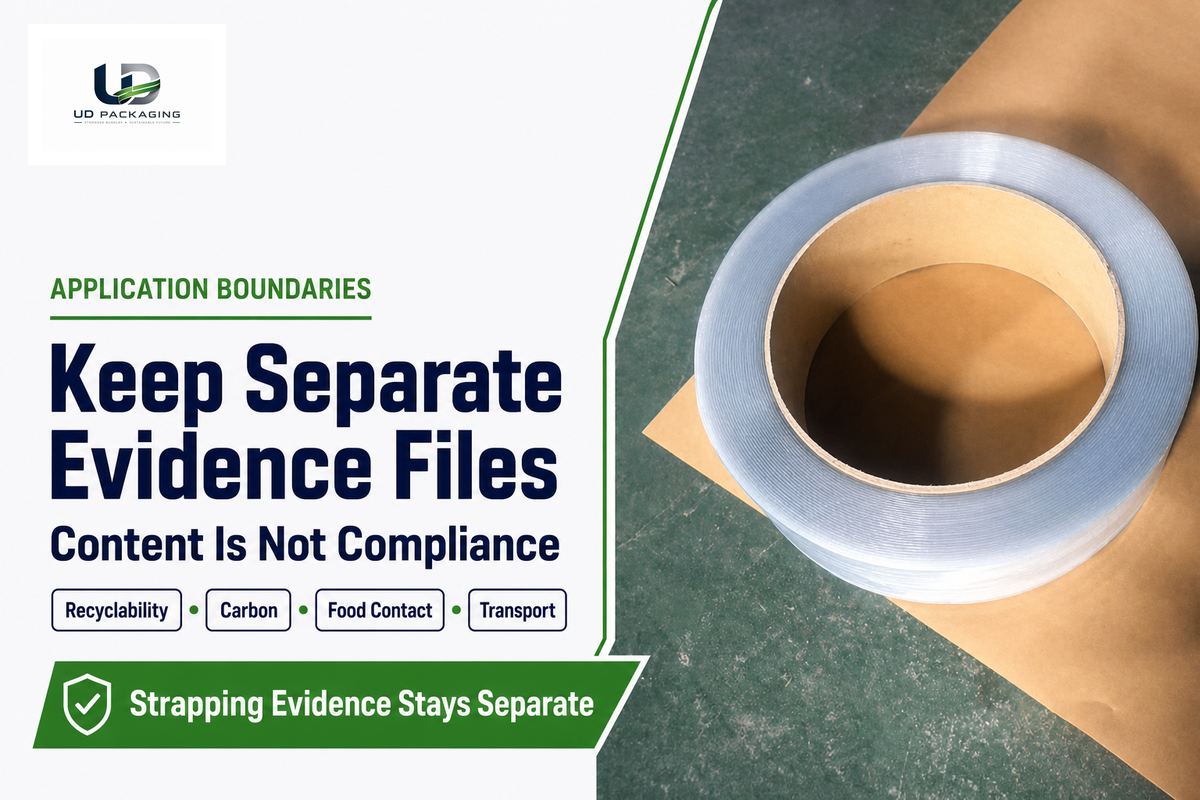
Even after receiving controls are set, recycled content, recyclability, carbon footprint, food-contact status, transport validation, and market-specific compliance remain separate issues. Having a recycling route doesn’t prove a recycled-content percentage. A carbon comparison also requires its own methodology and scope. Food-contact controls and a migration review require a review of applicable material and jurisdiction.
PET strapping certifications or strapping tensile tests aren’t capable of substantiating a stretch film recycled content claim. They’re for a different product family, construction, and the scope of the claim. The same is valid for a single laboratory property test used as a pallet-transport conclusion.
Regarding legal requirements in the EU, Regulation (EU) 2025/40 entered into force on 11 February 2025 and generally applies from 12 August 2026, but the exact packaging category and requirement must be checked for the relevant product and market. A general EU date shouldn’t be used as a stretch film compliance approval.
For the broader product choice, review UD Packaging stretch film options, including machine stretch film and hand stretch film. For post-use collection and handling, use the separate stretch wrap recycling guide.
The 12 August 2026 general application date is a regulatory reference date and not a film specification date. Keep market compliance, food-contact migration review, collection feasibility, carbon accounting, and pallet-route validation in separate evidence files.
Frequently Asked Questions
What is PCR stretch film?
PCR stretch film contains a stated share of post-consumer recycled input. That description identifies one material source; it doesn’t establish the complete recycled-content accounting method, the performance of a delivered roll, recyclability after use, or suitability for a specific application. Ask for the percentage by weight, product scope, calculation basis, and batch linkage alongside the PCR statement.
Does recycled stretch film perform as well as virgin stretch film?
No universal yes or no is defensible. Performance depends on the finished film construction, manufacturing control, load geometry, application method, wrapper settings, handling, and acceptance criteria. Compare the candidate and incumbent through repeated matched observations. Report film used per accepted pallet, breaks, rejections, and the tested scope instead of treating the recycled source alone as the outcome.
Can stretch film be recycled?
Some stretch film can enter suitable film-recycling streams when it’s clean, collected separately, and accepted by the local recycler, but a recycled-content claim doesn’t prove that a particular warehouse has a viable collection route. Check contamination, labels, collection volume, local acceptance, and market rules separately. The stretch wrap recycling guide covers that post-use workflow.
What documents should support a recycled-content percentage?
Request the exact claim wording, percentage and denominator, recycled source definition, calculation or allocation method, product code, production facility and accounting period, input or chain-of-custody record, production batch, roll or shipment link, and change-notice terms. Add the scheme name, validation date, and any exclusions stated on the certificate or declaration. Quality should be able to trace the offered product through the batch and shipment without assuming that a facility-level statement covers every roll. A certificate can be part of the file, but its scope must match the film received.
How many pallets should be included in a new-roll trial?
No universal count applies. Use repeated, balanced observations that represent the defined load, then pre-agree acceptance and stopping rules. A higher-risk route may also need separate distribution validation.
References & Sources
- eCFR, 16 CFR 260.13: Recycled Content Claims U.S. Government Publishing Office
- ISO 14021:2026, Self-declared environmental information and claims International Organization for Standardization
- Green Guides topic page U.S. Federal Trade Commission
- Peer-reviewed pallet-stability and stretch-film study PubMed Central
- Wrap cling-film testing application note AMETEK Test & Calibration Instruments
- Packaging waste overview European Commission
- Managing PCR risk through test and measurement Packaging Europe
Need a roll comparison plan? Bring the claim wording, source category, film batch or roll ID, baseline film use, break record, and same-load acceptance criteria to the discussion. Request a stretch-film trial conversation.