Get in touch with UD Packaging Company

Vented Stretch Film: Balancing Airflow, Condensation and Pallet Restraint

Vented stretch film is a stretch wrap product with a die-cut or micro-perforated hole pattern added to the same polyethylene film used for solid stretch wrap. The pattern enables the escape of heat, moisture and off-gas from a wrapped pallet, whereas in standard product constructions these would accumulate against the load. The trade-off is straightforward to articulate, yet often misunderstood. Holes sacrifice some containment force to gain airflow, and the degree of this trade-off depends on the pattern and the open-area ratio. This guide does not treat “vented” as a yes or no product choice. This guide comes from UD Packaging’s logistics and warehousing packaging work, and the right solution for a given load depends on which of the drivers below is actually present.
Decision rule: pick vented film only when a real airflow driver is present (hot-fill cooling, cold-chain condensation, off-gassing produce, outdoor temperature swings), then specify hole pattern and open-area range rather than accepting a generic “vented” line item.
What “Vented” Actually Means in Stretch Film
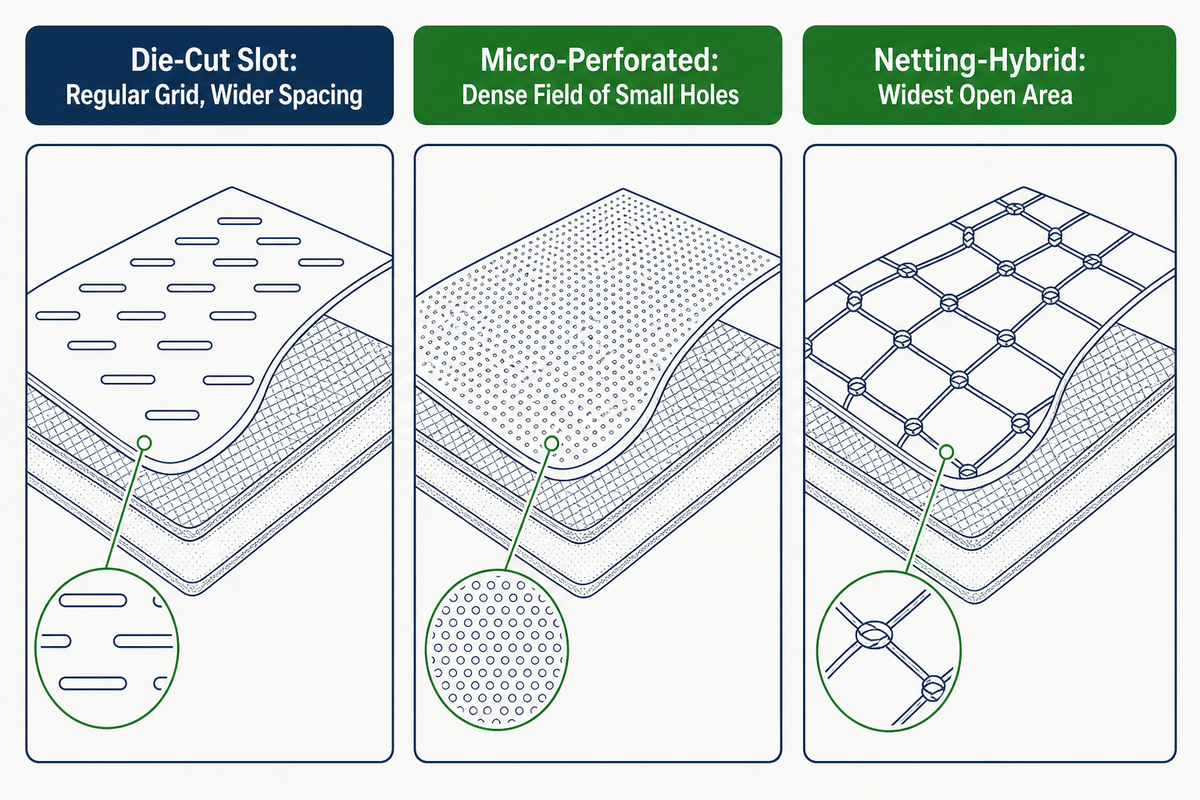
Vented stretch film uses the same LDPE or LLDPE base resin as machine or hand stretch wrap, with a hole pattern added during or after extrusion. It builds on standard stretch-film manufacturing. It is an industrial packaging solution for airflow around palletized loads, not a different polymer family. Changing from solid to vented film changes the construction, not the underlying material system.
Two major manufacturing techniques are used in the market: die-cut slot patterns and micro-perforation. Die-cut slot patterns punch a regular grid of slots into the film after extrusion, while micro-perforation uses finer needle rollers to create a field of smaller holes. A third manufacturing technique combines vented film with a netting-based airflow system. Each technique results in a different open area ratio and a different roll feel, so “vented stretch film” by itself doesn’t protect the buyer from receiving a different construction.
Vented film is more than a marketing label: a published European patent filing describes a perforated extensible palletizing film with ventilation holes as a distinct engineering approach, documenting the hole-pattern construction rather than a single company’s proprietary claim; the filing documents one construction, not a universal performance threshold or performance on a buyer’s specific load, and this article does not associate that patent with UD Packaging or any specific current supplier.
| Construction | Hole pattern | Typical use |
|---|---|---|
| Die-cut slot | Regular grid of slots, wider spacing | Produce, agricultural loads needing visible airflow |
| Micro-perforated | Dense field of small holes | Hot-fill and cold-chain loads needing steadier moisture release |
| Netting-hybrid | Widest open area, mesh-like structure | Maximum-airflow cases where containment is a secondary requirement |
Buyers looking into this manufacturing technique will see the technology referred to under many different names like vented film, vented pallet wrap, ventilated stretch wrap, breathable stretch film, or perforated pallet wrap, but all refer to similar technologies within the product family. When a construction is requested, the manufacturer should specify the design rather than rely on any given term. If a supplier calls it perforated film, vented stretch wrap, or a die-cut hole pattern, ask for the open-area ratio regardless of what’s written on the quotation.
Beyond the base construction, some rolls have additional options. Additives that protect film from UV degradation, printed film for pallet identification, longer cores for high capacity machine dispensers, and cling or adhesive additives to help secure the tail end are some add-ons suppliers market as “premium” or “high-performance.” However, a buyer should verify the manufacturing specifications and the open area ratio on each of these add-ons rather than relying on “premium,” “high-performance,” or “superior strength” market terminology.
When Airflow Matters More Than Containment Force
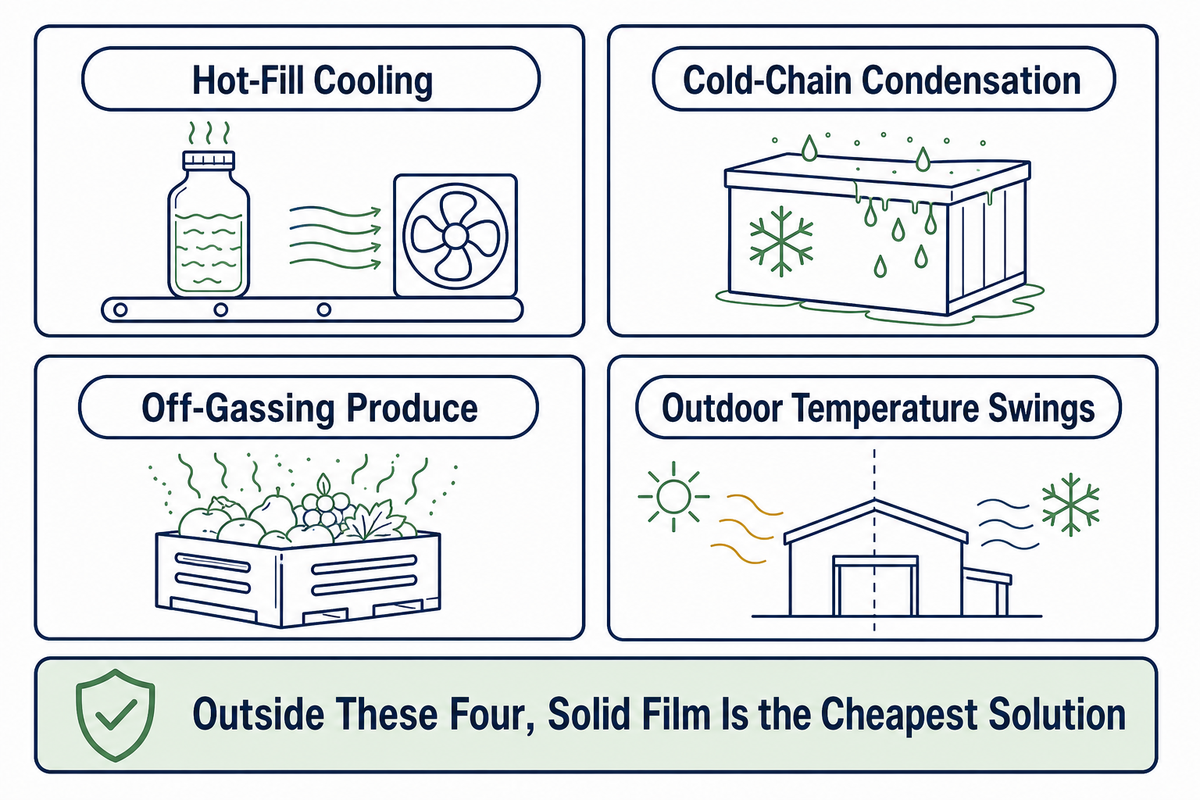
Four conditions create a pallet-level airflow driver: cooling hot-filled containers, condensation on boxed or bottled cold-chain goods, off-gassing from packaged produce or flowers, and outdoor transport with temperature swings. The vent path can allow packaged products to breathe during cooling or controlled off-gassing, but only when the cartons or containers are already designed for that airflow. Outside those conditions, solid stretch film is usually the simpler starting point; holes reduce containment force without solving a defined airflow problem.
Ventilated pallet film addresses airflow around an already-packaged unit load — boxes, cartons or bottles stacked and wrapped together — not airflow around loose, unpackaged fresh produce. University extension guidance on fresh-produce transport advises against wrapping loose fruit and vegetables in plastic film because doing so restricts airflow; effective ventilation depends on carton vent placement, pallet patterns, air-return channels, refrigeration, and routing as one system, not on a film’s open-area ratio. If produce is already boxed with designed ventilation, vented pallet wrap can allow airflow around the boxes; it is not a substitute for correct carton ventilation and is the wrong tool for wrapping unpackaged produce.
Hot-filled containers cool down after packaging and that cooling can pull moisture out of the air inside a solid wrap and deposit it on the product or the packaging. Cold-chain goods have the same issue, but on the other end of the spectrum: outside air that’s warmer than the cold load condenses on contact with the film. As an example, a vented-film distributor published a case account of a beverage bottler whose warm-filled, pasteurized bottles were arriving with damaged labels and standing water under solid stretch wrap; switching to a vented construction let trapped air escape instead of condensing against the bottles. The account was published by the vendor rather than independently verified; however, the mechanism of action described matches what was discussed earlier.
An independent trade publication corroborates this example. In 2025, the Dole Food Company’s Latin American banana and pineapple divisions began rolling out a macro-perforated, fully recyclable stretch film to replace corner boards, straps, and metal clasps on export pallets. Packaging Digest reports the film maintains ventilation performance comparable to Dole’s prior system, per the company’s own internal data; Dole’s packaging director, Chi Yuen Chan, is quoted on the record crediting the switch with “a significant benefit in load stability and delivery consistency,” and the company’s VP of Logistics, Ana Cristina Obregon, separately called the rollout “a win for both the environment and our business.” Unlike the beverage industry account above, this is independent journalism citing the company, executive, and technology, and corroborates the same mechanism from a different industry: a hole pattern added to stretch film can perform ventilation without adversely impacting the stability of loads, if matched to the correct load.
Driver-to-symptom check: condensation beading on the inside of the wrap, a musty or off-gas smell trapped against the load, visible fogging that blocks a receiving inspector’s view of the product, or mold starting at pallet corners are the four signals that point to an airflow problem rather than a containment problem.
These drivers appear across pharmaceutical cold-chain shipments, boxed produce moving through storage and transit, and any load where a packaging engineer needs visibility for inspection without unwrapping it. A vented pattern is designed to allow air to flow out steadily, which helps dissipate condensation that would otherwise cause spoilage, instead of attempting to prevent moisture with a traditional stretch film barrier. None of these drivers, by themselves, can communicate the amount of open area required for a buyer. This open area specification is discussed in the next section. There’s no airflow driver on a load that doesn’t have hot-fill, cold-chain, off-gassing, or outdoor transport exposure, and vented film is an added cost with no benefit.
Hole Pattern and Open-Area Ratio: What to Specify
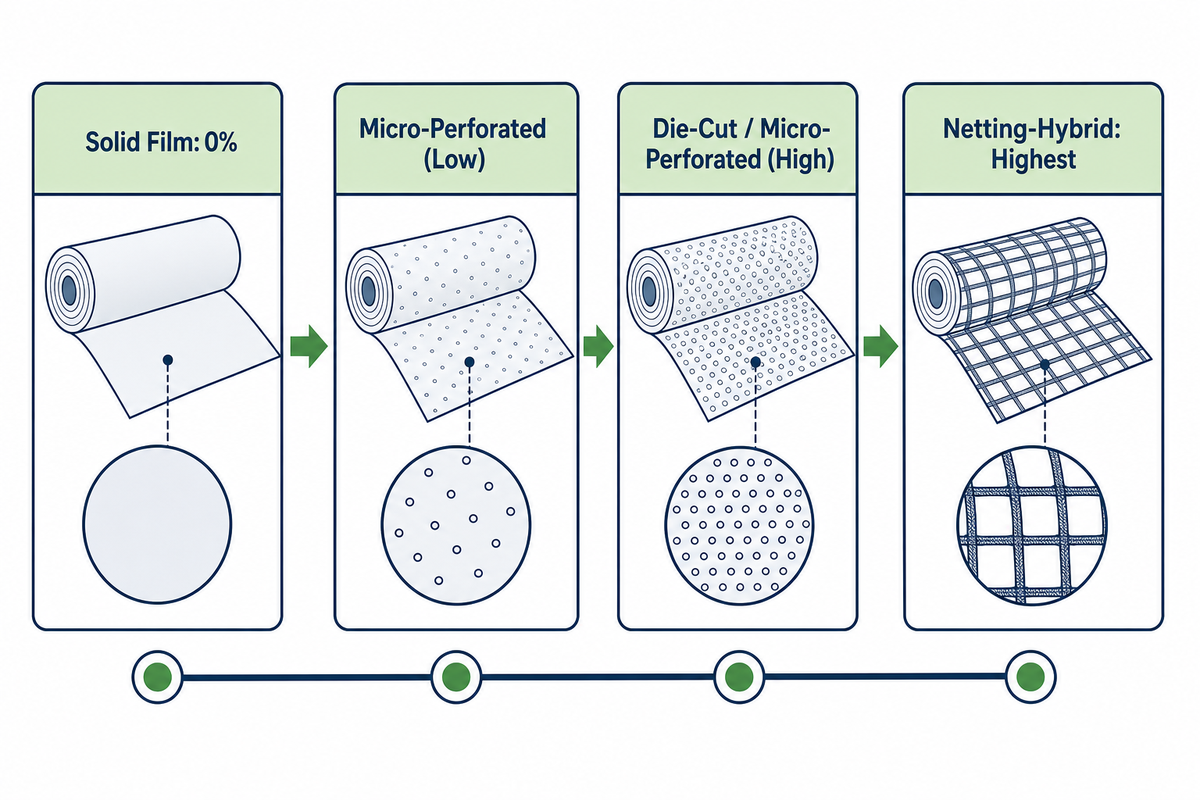
Open-area ratio is the share of film surface removed by the hole pattern, and it is a key specification for comparing the nominal venting of different film constructions. A quote labeled “vented” without a stated open-area ratio cannot be compared cleanly with another quote, just as a strapping quote without a stated gauge cannot be compared cleanly.
| Construction | Relative open-area ratio | What to ask the supplier |
|---|---|---|
| Solid film | 0% | Baseline containment force at the current gauge |
| Micro-perforated (low) | Lower than die-cut, per supplier spec | Stated open-area percentage and tested tensile retention |
| Die-cut / micro-perforated (high) | Higher, per supplier spec | Same-load trial result, not just the nominal percentage |
| Netting-hybrid | Highest | Whether containment force is adequate for the specific load shape |
The buyer request for quote should include the construction (die-cut, micro-perforated or netting-hybrid) and the approximate range of the open area, in addition to the film width, gauge and roll length that the existing machine stretch film intake already asks for; open area and construction are the two additional fields a vented request needs on top of that baseline.
The Open-Area Ceiling: The Trade-off Most Buyers Get Backwards
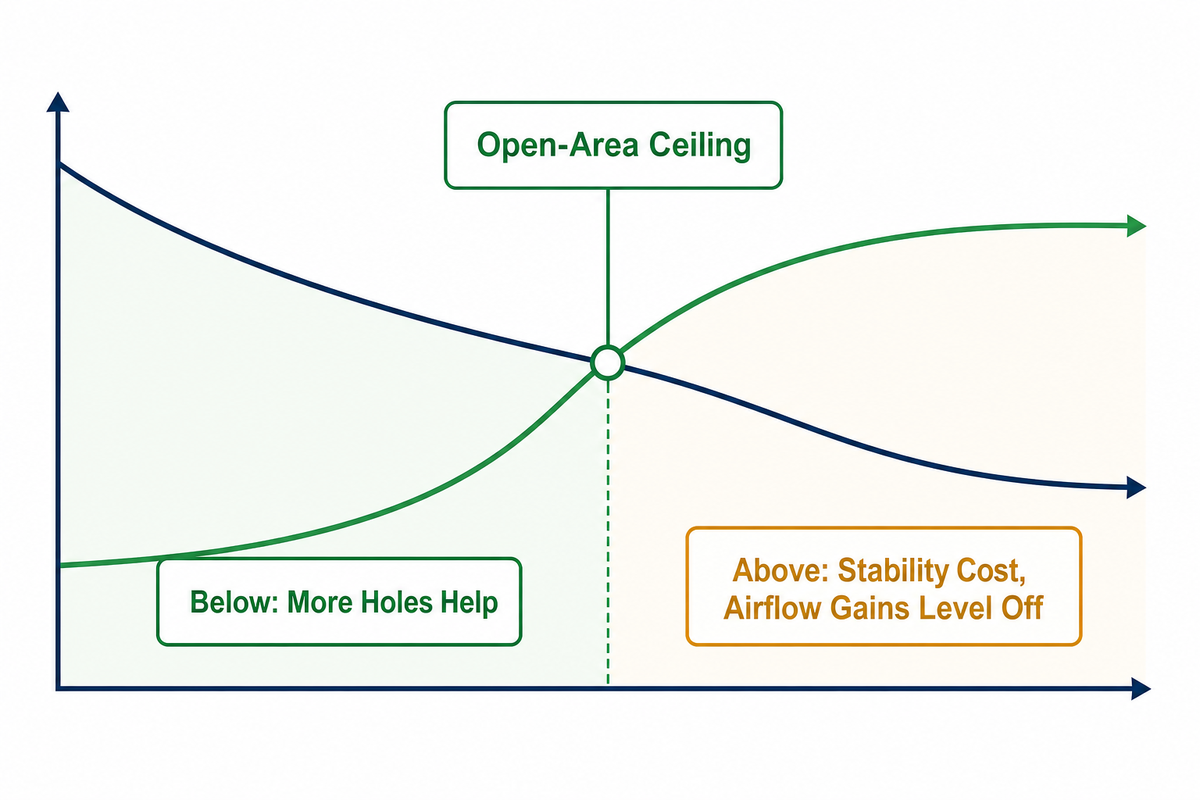
Open-area ratio has an implied limit: if a structure becomes too open, then successive increments of area covered by holes diminish the tensile strength and the containment force more rapidly than they add ventilation benefit. We can call this the open-area ceiling. Below the limit, successive holes add more airflow at a small stability cost; above the limit, the buyer is paying in load stability for airflow gains that level off. Higher open area can reduce puncture resistance, the property that ASTM D5748 compares between film samples; the standard sets no open-area threshold of its own.
| Film type | Relative airflow | Relative containment force | Typical failure mode if misapplied |
|---|---|---|---|
| Solid film | None | Highest at a given gauge | Condensation trapped against the load |
| Low-vent (below ceiling) | Moderate | Close to solid film at the same gauge | Rare when matched to a real airflow driver |
| High-vent (above ceiling) | Highest | Reduced tensile strength and puncture resistance | Load shift or film tear on an unstable or heavy load |
Similar stretchiness in a sample roll doesn’t indicate that a sample roll holds a load in the same way once the wrap program, load weight and corner geometry are taken into account. It would only be relevant to make that comparison within a controlled trial (described in the testing section that follows).
The Open-Area Ceiling: A 10-Row Vented Film Application Matrix
| Load type | Airflow driver | Recommended construction | Open-area range to request | Wrap grade |
|---|---|---|---|---|
| Hot-filled canned or bottled goods | Condensation from post-fill cooling | Micro-perforated | Confirm supplier’s tested % before ordering | Machine |
| Cold-chain goods, already boxed or bottled | Condensation from outside-in temperature change | Die-cut slot | Confirm supplier’s tested % before ordering | Machine or hand |
| Off-gassing cut flowers, already packaged | Ethylene and off-gas buildup | Micro-perforated | Confirm supplier’s tested % before ordering | Hand |
| Loose, unpackaged fresh produce | None — excluded; use correct carton ventilation instead | Solid or vented film, neither is the fix | 0% (not applicable) | N/A |
| Outdoor temperature-swing transport | Day-night condensation cycling | Die-cut slot | Confirm supplier’s tested % before ordering | Machine |
| Unstable or crush-sensitive load | None — excluded per boundary review | Solid film only | 0% (not applicable) | N/A |
| Sharp or irregular profile load | None — excluded per boundary review | Solid film only | 0% (not applicable) | N/A |
| Moisture-barrier requirement | None — vent works against the goal | Solid film only | 0% (not applicable) | N/A |
| Dangerous or regulated goods | Resolve compliance separately | Solid film plus separate compliance review | 0% (not applicable) | N/A |
| No airflow driver present | None | Solid film (default) | 0% (not applicable) | Machine or hand |
Construction and wrap grade are starting points for comparing the trade-offs in this matrix; no row publishes a percent open area. This review did not identify a reliable category-level source for open-area figures, so request the supplier’s value for the specific roll instead of assuming a number found online.
Where Vented Film Is the Wrong Answer
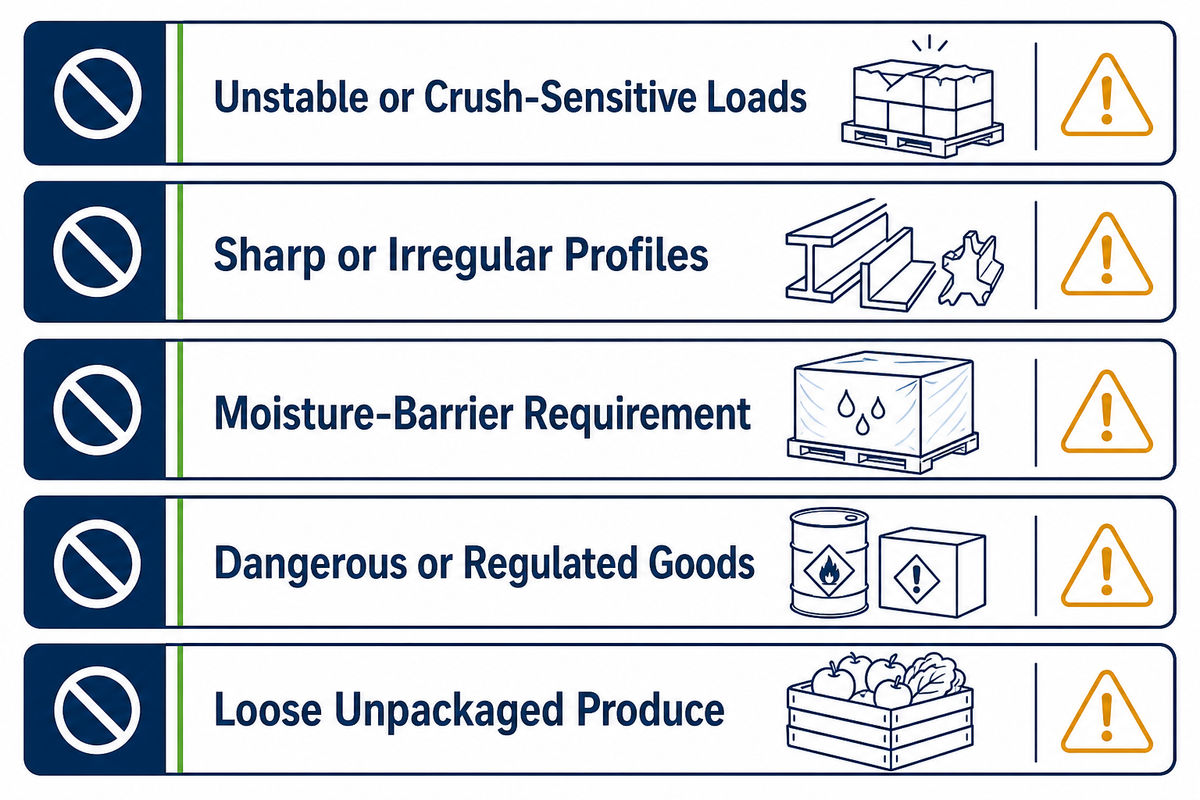
Five cases rule out vented film: unstable or crush-sensitive loads, sharp product profiles, moisture-barrier applications, dangerous or regulated goods, and unpackaged fresh produce. UD Packaging’s machine stretch film application-boundary review already places unstable loads, sharp profiles, and regulated goods in separate review categories. This article adds the vented-specific moisture-barrier boundary.
- Unstable or crush-sensitive loads: In such cases, every available point of containment force from the film is essential. Trading tensile strength for airflow compounds an existing stability risk and doesn’t solve it.
- Sharp or irregular profiles: A hole weakens the film locally, and a corner or protrusion at the same location will increase the likelihood of a tear initiating there.
- Moisture-barrier cases: when the goal is to block outside moisture, dust, or other contamination rather than release internal moisture, a vent works against the requirement. Solid film is the more appropriate starting point for load protection.
- Dangerous or regulated goods: packaging and transport compliance for these goods should be resolved on its own evidence and kept separate from the film decision.
- Loose unpackaged fresh produce: neither solid nor vented pallet film is the fix; extension guidance instead points to carton ventilation and cold-chain airflow design, not direct plastic-film wrapping of produce.
Some loads use stretch film with steel or PET banding for additional restraint at the base or top of the pallet; vented film does not change that need, and a load that needs banding for stability still needs it with vented film. Checking the boundary list before specifying the construction helps prevent a buyer from ordering a roll that solves an airflow problem but creates a stability problem.
Machine vs Hand-Applied Vented Film
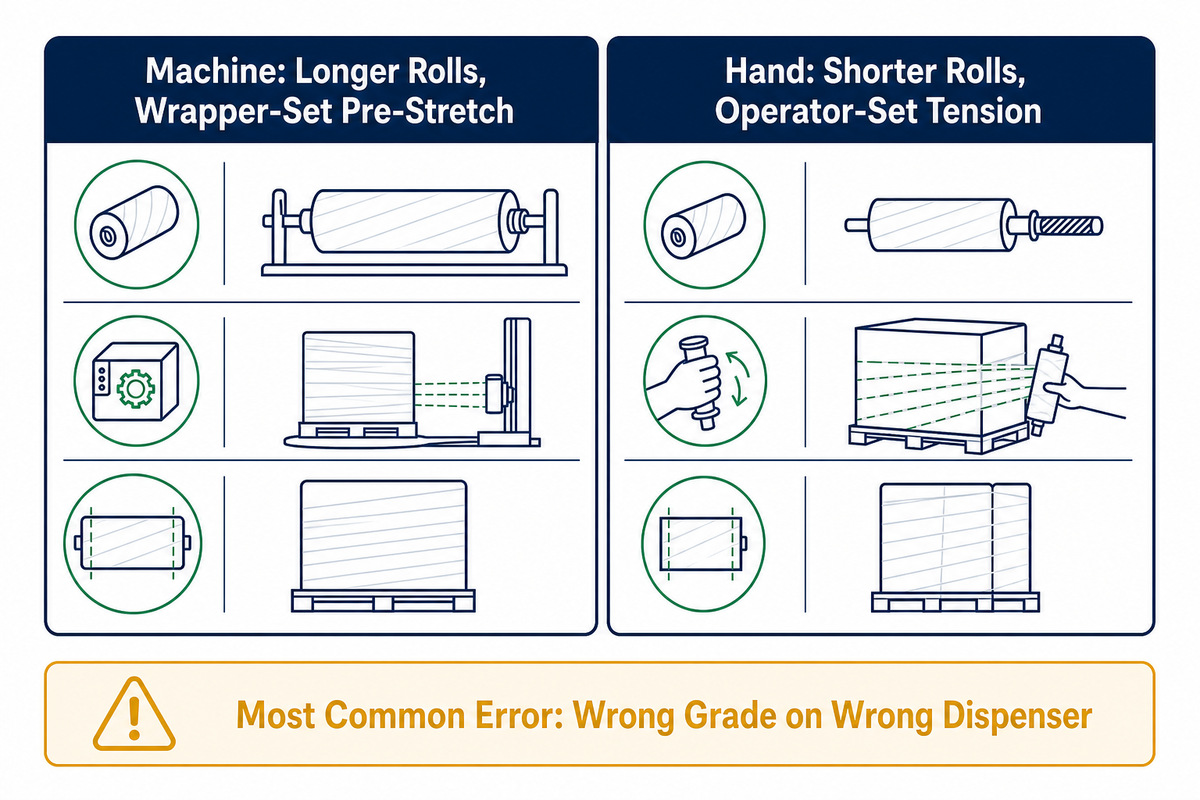
Vented film is available in both machine and hand-wrap grades, and the grade impacts the roll specification more than it changes the hole pattern. The machine grade is built for a wrapper’s pre-stretch carriage and runs on longer rolls at a gauge tuned to the equipment’s tension settings, while the hand grade is built for a manual dispenser and typically runs shorter, narrower rolls at a gauge a person can tension consistently by hand.
| Attribute | Machine grade | Hand grade |
|---|---|---|
| Roll length | Longer, matched to wrapper carriage capacity | Shorter, sized for manual handling |
| Pre-stretch | Set by the wrapper’s program | Set by the operator’s technique, less repeatable |
| Typical width | Wider, standardized to carriage size | Narrower, sized to hand-wrap width |
Asking a hand-wrap crew to switch construction is a smaller operational adjustment than replacing wrapping machines entirely: the main adjustment concerns film tension and handling, not replacement of the dispenser or wrapping equipment. The most common mismatch is a machine-grade roll dispatched through a hand-dispensing system, or a hand-grade roll dispatched through a machine wrapper. A trial kit should include a short roll and the compatibility-intake fields listed above, giving the buyer a way to confirm dispenser fit, film tracking, and thickness before purchasing a full pallet load. That step helps ensure the selected film and dispenser remain compatible with the load-containment method and the pallet’s other packaging systems. One US distributor lists a hand-grade vented roll (17 inches by 1,500 feet) and a machine-grade roll (19 inches by 3,000 feet) in the same product line — a useful reference pair when comparing quotes against what a wrapper or dispenser would need, though roll dimensions may vary from supplier to supplier.
Testing a Vented Film Candidate Before You Commit
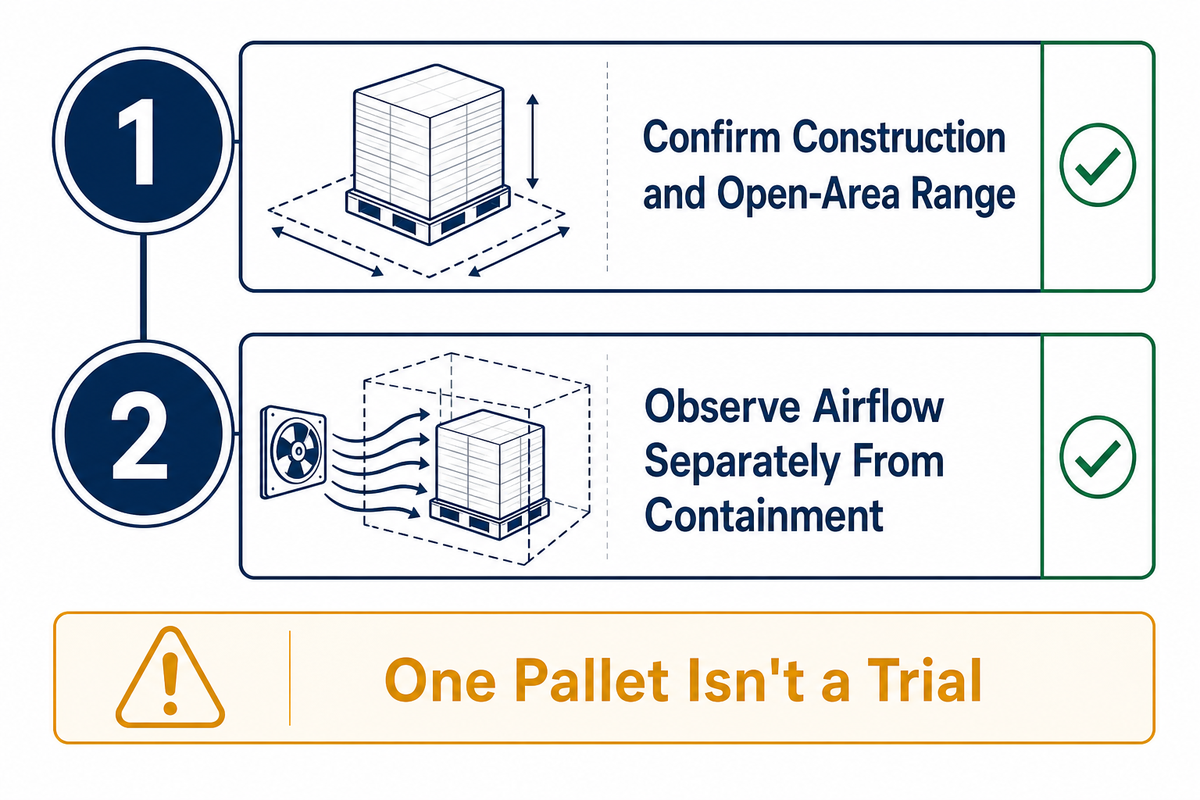
The same-load trial confirms whether the candidate construction and open-area ratio work on the buyer’s pallet; a sample roll is not an approved product. Use UD Packaging’s unit-load review to record geometry, handling, shipping exposure, and the containment system before committing to volume, helping eliminate guesswork. The logic follows ASTM D8314, which tests film on an applied unit load rather than in isolation.
Trial checklist: freeze the current wrap program and load, run the candidate on the same load and route, observe both airflow effect and containment at the same checkpoints already used for solid film, and record any break, tear or rejected pallet before scaling up.
- Keep a record of the existing film construction, gauge, wrap program and any existing condensation or airflow complaint before making any changes.
- Ask the supplier for the candidate’s construction type and open-area range instead of accepting “vented” alone.
- Run the candidate on the same load, using the same pallet pattern and route as the current film.
- Check containment at the same points as you would for the acceptance test: corners, top layer, and any known weak points on this load.
- Observe the airflow result separately: less condensation, no fogging, and no off-gas smell trapped at the corners.
- Any breaks, tears, or rejected pallets should be logged and evaluated against the baseline.
- Confirm that crews can handle, stack, and store the new roll as safely and consistently as the existing film before increasing the order quantity.
One pallet isn’t a trial. To start, order a few dozen pallets for a trial lasting several weeks. Adjust the quantity upward if the results remain inconsistent.
Evaluating only whether the roll feels the same on the dispenser skips the actual question. Airflow and containment are separate outcomes, and both need to be evaluated for the same trial.
Standards, Supply Confirmation and What to Ask a Supplier
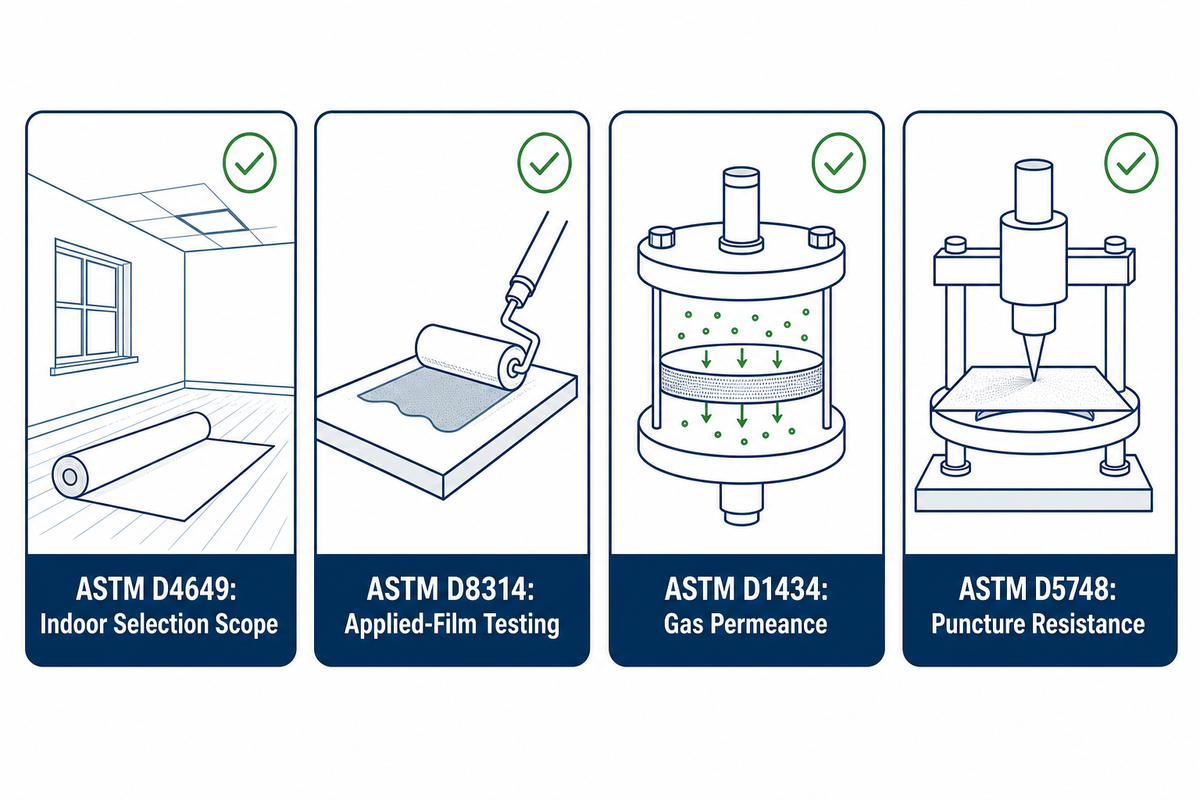
Two ASTM guides frame a vented-film purchase without addressing venting specifically: D4649 mentions stretch film when used for unitizing, reinforcing, and palletizing and when used for indoor applications such as warehouses, closed truck trailers, rail boxcars, and transfer terminals and does not refer to outdoor exposure. D8314 covers testing the mechanical characteristics of stretch film after a wrapper has applied it to a unit load, for either hand- or machine-wrapping applications, and explicitly excludes agricultural stretch-wrap applications.
A third standard is closer to the actual property a hole pattern changes: ASTM D1434 measures the gas-transmission rate and permeance of plastic film and sheeting. ASTM itself states the results as semiquantitative, indicates that correlation to real packaged-product protection must be established by experience, and is careful to stress that the test should not be used as a referee method unless buyer and seller agree on quantity and precision terms prior to the test; the method measures a film property, not a pass/fail ventilation criterion. A fourth standard addresses the tear risk that was discussed earlier in this article: ASTM D5748-26 (the active edition; the older reapproval D5748-95R19 of 1995 is now historical) measures the puncture resistance of a stretch wrap film when subjected to biaxial deformation stress. ASTM considers puncture resistance important to the end-use performance of the material, but states that the method “cannot be expected to duplicate all field experiences” — it is intended to support comparison of samples, and not to evaluate against a universal pass/fail criterion. No ASTM, ISO or government standard identified in this review imposes a percent open area limit for vented stretch film; the best reference found in this article is the University of Florida IFAS produce-packaging guidance, which suggests 5% of the total surface area of the carton as a vent size for produce cartons — this is at best a useful first order estimate, but a carton-vent figure and not a stretch-film open area limit and not a substitute for the supplier’s own tested value.
This guide covers testing of mechanical properties of stretch wrapping films as they have been applied by a stretch wrapper to a unit load or test structure… This guide may be applied to hand-wrapping or to machine-wrapping applications.
Neither standard certifies a vented-film performance claim or specifies an open-area ratio — they frame the general selection (D4649) and testing (D8314) process that a vented-film decision sits inside. That limitation makes the buyer’s pre-agreed success criteria part of the test plan. D8314 itself states that it makes no claim about the precision or bias of its test methods; conformity is judged only against success criteria the buyer sets, so passing a D8314-style test doesn’t by itself prove a film will perform on a different load or route. That leaves an apparent scope gap. D4649 doesn’t address outdoor environmental exposure, and D8314 doesn’t cover agricultural stretch-wrap applications, so the outdoor-transport and agricultural-load examples used earlier in this article fall beyond the scope of both standards; they need their own evidence instead of relying on either standard. Tying a specific roll to a specific claim takes a supply confirmation, not a standard citation alone.
| Field | What to request |
|---|---|
| Construction and open-area range | Die-cut, micro-perforated or netting-hybrid, with an approximate percentage |
| Gauge, width and roll length | Matched to the wrapper or hand-dispenser in use |
| Food-contact status, if applicable | Written confirmation naming the specific regulation, notification or letter of guaranty for the resin and use case, not a general company statement — FDA guidance is explicit that status depends on every constituent substance and its specific conditions of use |
| Trial record reference | Link the quoted product to the same-load trial result before bulk ordering |
Buyers who focus solely on price when comparing vented stretch film suppliers often make avoidable mistakes. A listing for vented stretch film wholesale that appears to be the best deal per roll can end up costing buyers more, per pallet, if the supplier’s construction doesn’t correspond with the airflow driver. The right suppliers answer the specification questions listed above before providing a price, rather than pointing only to the “vented” label on a product page. A search for vented stretch film for sale mainly pulls the same catalog listings that are featured throughout this article. None of them replace a clear pallet-strapping procedure or the same-load vented-film trial on the first shipment. For a given pallet, the right vented stretch film remains the one matched to its corresponding airflow driver, not the one with the best offer.
Why Demand for Vented Film Keeps Growing
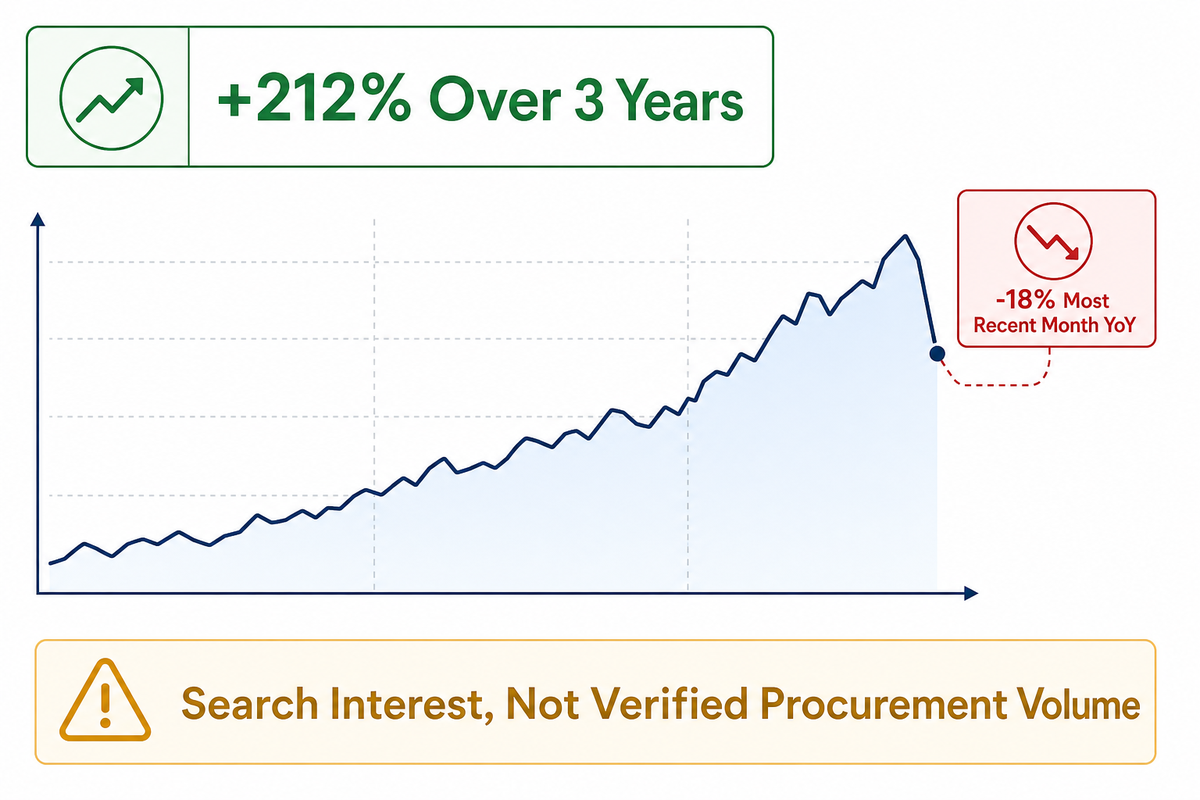
Search interest in vented stretch film has risen roughly 212% over three years, peaking each September and October alongside “cold chain packaging” — the same cold-chain season University of Florida IFAS extension guidance on fresh-produce transport addresses (its advice concerns carton design, not film open area). That said, the most recent monthly reading is down 18% against the same month a year earlier, off an elevated 2025 base, so treat the category as established and seasonal, not one still accelerating.
All of the figures above measure search interest, not verified procurement, production or shipment volume for vented film specifically. No independent procurement, production or shipment series was found for this category; therefore, an increase in search interest shouldn’t be interpreted as an increase in purchase volume. The useful takeaway is a specification burden, not a volume forecast. Broader supplier participation can put several construction and open-area systems under the same “vented” label. The practical risk shifts from “can I find a supplier” to “do I know exactly which construction I’m ordering.” Independent market-research firms separately report roughly 6-7% annual category growth, though their absolute market-size figures and forecast windows disagree substantially depending on scope and methodology — that range is background context only, not a claim this article relies on.
Frequently Asked Questions
Is vented stretch film the same as perforated pallet wrap?
Not exactly the same term, though the products overlap. “Perforated pallet wrap” usually describes the general category of stretch film with holes cut through it, while “vented stretch film” is the more common commercial name for that category in the US market. Both refer to the same underlying product: a polyethylene stretch film with a die-cut or micro-perforated hole pattern designed to let air, moisture and heat pass through the wrap instead of trapping them against the load.
Does vented stretch film cost more than solid stretch film?
Usually yes, per pound and often per roll, because adding a controlled hole pattern is an extra manufacturing step beyond standard extrusion. The more useful comparison isn’t price per roll but applied cost per accepted pallet, since a vented film that needs a different wrap program or lower pre-stretch setting can change how much film a load actually consumes — ask for both the roll price and the wrap program before comparing two quotes.
Will vented stretch film hold a pallet as securely as solid film?
At the same gauge and wrap program, a vented film with a lower open-area ratio can perform close to solid film, but very high open-area patterns trade away tensile strength and containment force for airflow — that trade-off is the reason this article treats open-area ratio as a real specification, not a marketing label. The safe approach is to request the supplier’s stated open-area range, run a same-load trial against your current film, and check containment at the same checkpoints you already use, rather than assuming any vented roll performs identically to what you’re replacing.
Can vented stretch film be used with an automatic wrapping machine?
Yes, vented film is available in both hand-wrap and machine grades; ask for the roll length, gauge and pre-stretch rating matched to your wrapper rather than assuming a hand-wrap roll works on machine equipment.
Is vented stretch film recyclable?
Like most stretch film, it’s typically LDPE or LLDPE polyethylene, which many film-recycling streams accept — confirm with your local or contracted recycler, since acceptance depends on the collection stream, not the material itself.
Is choosing vented stretch film the same decision as switching to a ventilated cardboard box?
No — they solve different problems. Vented film changes airflow around an already-packed pallet; a ventilated box changes airflow inside each unit before palletizing. Cold-chain and produce shippers may use both together rather than choosing one, depending on the product and route; neither solution substitutes for the other’s ventilation role.
References & Sources
- ASTM D4649-20(2025), Standard Guide for Selection and Use of Stretch Wrap Films ASTM International
- ASTM D8314-20R25, Standard Guide for Performance Testing of Applied Stretch Films and Stretch Wrapping ASTM International
- Fresh produce transport and handling guidance University of Florida IFAS Extension
- ASTM D1434, Standard Test Method for Determining Gas Permeability Characteristics of Plastic Film and Sheeting ASTM International
- Determining the Regulatory Status of a Food Contact Substance U.S. Food and Drug Administration
- Stretch film for the beverage industry (Case Study) IPS Packaging & Automation — a vented-film distributor and competitor source, cited for its published account, not as a neutral third party
- ASTM D5748-26, Standard Test Method for Protrusion Puncture Resistance of Stretch Wrap Film ASTM International
- Dole Peels Away 85% of its Conventional Palletizing Materials with New Recycled Wrap Packaging Digest, April 2025
Specifying a vented film candidate? Bring the airflow driver, construction preference, gauge and roll size, and same-load trial criteria to the discussion. Request a stretch-film application review.