Get in touch with UD Packaging Company

Mils to Microns Converter: Film Thickness Chart and Formula


To convert mils to microns, multiply by 25.4. Mils to microns is the conversion from thousandths of an inch to micrometres. One mil is equal to 25.4 microns (µm), and one micron is approximately 0.03937 mil. A mil is equivalent to 0.001 inch. The International inch is defined by NIST as 25.4 millimeters, and hence the conversion factor is exact. Enter a thickness in the box, or swap the units to convert microns to mils.
Thou / mil to micrometre converter
Instant
Result
µm
1 mil = 25.4 µm
The converter normally displays up to four decimal places, with additional significant digits for very small results. Each of these decimal places reflects a calculation, not necessarily the precision of the actual measured value of the film. When dealing with a measurement tolerance, retain the unit as stated by the vendor and include it with the value stated by the vendor.
Mils to Microns Chart
The values stated in this document represent the exact relationship microns = mils x 25.4. Treating 1 mil as 25 µm introduces errors in the specified limit. This is particularly true when a vendor labels a nominal film thickness and the limit is to be determined by a measurement.
| Mils (thou) | Microns (µm) |
|---|---|
| 0.25 | 6.35 |
| 0.5 | 12.7 |
| 0.6 | 15.24 |
| 0.75 | 19.05 |
| 0.8 | 20.32 |
| 1 | 25.4 |
| 1.2 | 30.48 |
| 1.5 | 38.1 |
| 2 | 50.8 |
| 3 | 76.2 |
| 4 | 101.6 |
| 5 | 127 |
| 6 | 152.4 |
| 10 | 254 |
For example, a supplier’s 2 mil specification converts to 50.8 µm. Writing 51 µm is a rounded description; it doesn’t change the underlying requirement unless both parties agree. The Michigan State University machine-shop reference confirms multiplication by 25.4. Its short worked examples use rounded results; this table keeps the full decimal result for each listed input.
Microns to Mils
To convert microns to mils, divide by 25.4. For example, 20 µm ÷ 25.4 is approximately 0.7874 mil, while 25.4 µm is exactly 1 mil. Use the calculator’s swap control for the reverse direction.
| Microns (µm) | Mils (thou) |
|---|---|
| 12 | 0.4724 |
| 15 | 0.5906 |
| 17 | 0.6693 |
| 20 | 0.7874 |
| 23 | 0.9055 |
| 25 | 0.9843 |
| 30 | 1.1811 |
| 50 | 1.9685 |
Rounding twice causes a common purchasing mistake: 20 µm becomes 0.8 mil, then someone converts that rounded number back to 20.32 µm. The extra 0.32 µm came from rounding, not a change in the film. Keep the original 20 µm value in your specification worksheet because the converted display can’t recover precision that was discarded. NIST’s conversion guidance distinguishes the numerical conversion from rounding the result.
Use the Conversion for Stretch Film Quotes
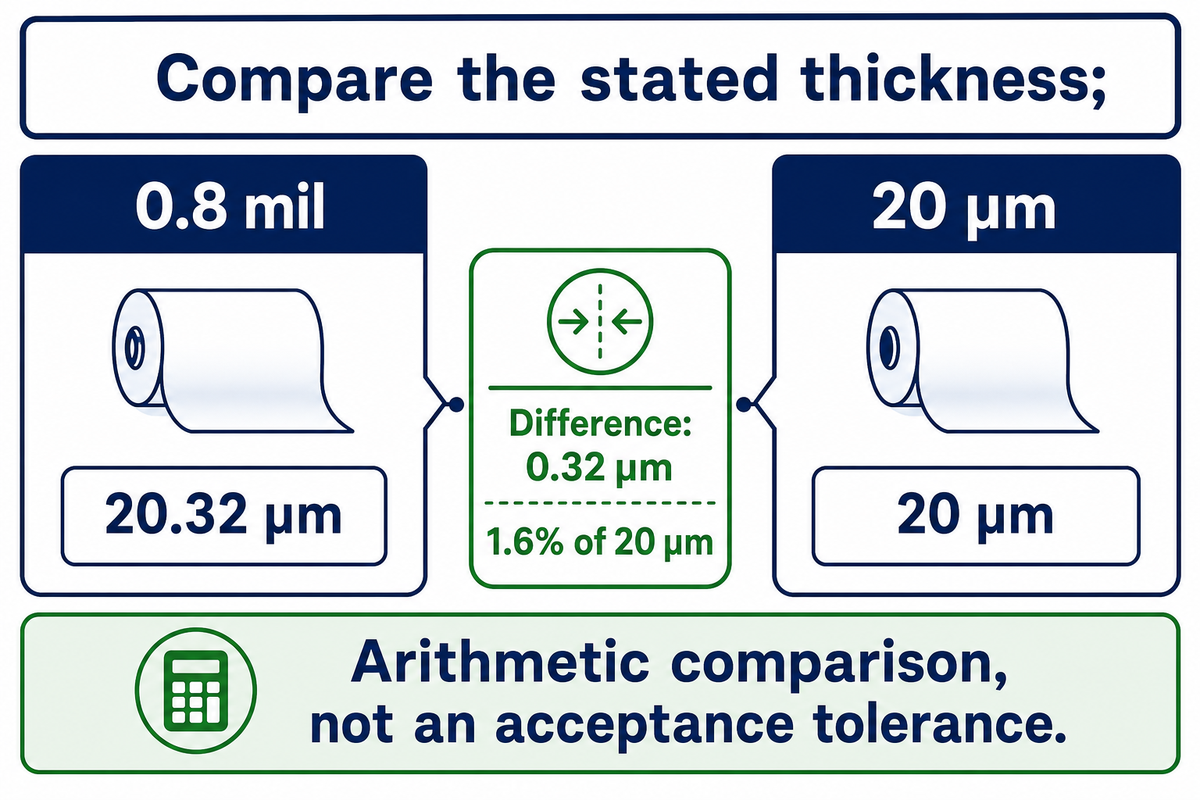
Convert thickness into one unit before comparing rolls, then check what each supplier actually measured. A 0.8 mil offer and a 20 µm offer are close, but they aren’t identical numerical specifications. Their stated values differ by 0.32 µm, or 1.6% of 20 µm. This is an arithmetic comparison, not a measured variation or an acceptance tolerance.
The stretch film supply page of UD Packaging mentions a hand film range of 12-25 µm. Converted with the same factor, its endpoints are approximately 0.4724–0.9843 mil. This range is provided to assist a customer request, and doesn’t mean that all thicknesses in the range will be acceptable for a given load, dispenser or wrapping style. Check the hand stretch film roll options when matching the roll to manual wrapping.
Record these fields on the quote before comparing rolls:
- Nominal thickness and unit: When looking at stated thicknesses and unit, keep the stated thickness as is and add the converted value.
- When looking at stated tolerances, ask if the stated value is nominal or minimum and what measurement basis will be used to evaluate the film.
- When comparing prices of rolls, account for the difference of the core from the film.
- Application conditions: record hand or machine wrapping, pre-stretch settings, load shape and the agreed sample-trial result.
Thickness conversion can’t predict load containment. Lantech’s containment-force guidance explains why wrap force and the number of wraps must be established on the load. For practical roll comparisons, use UD Packaging’s stretch film specification worksheet to add width, length and a stated density assumption. That worksheet estimates film mass; this page converts thickness units.
Send the original roll label, required thickness and tolerance, wrapping method and pallet details when you request a written film quotation. For the wider selection and trial process, see the stretch film selection guide.
What Does a Mil Mean?
A mil is one thousandth of an inch: 0.001 inch, or 25.4 µm. A mil is not a millimeter. “Thou” and mil name the same length unit. The micron is a micrometre, also spelled micrometer in American English, equal to 0.001 millimeter. The µ in µm is the Greek symbol used for the micro prefix.
It’s recommended that on Engineering Prints and Purchase Orders the first use of unit and/or micron be spelled out in full.
For a more formal definition of inch, see the publication of the National Institute of Standards and Technology.
“exactly equivalent to 25.4 mm”
NIST, SI Units, Length, definition of the standard inch.
This converter implements the length definition of inch. An angular mil is a different quantity; mL denotes milliliters, a unit of volume. Both are out of place in a film-thickness conversion. A gauge number given by a supplier also requires a stated definition; before a gauge number is entered as a mil, verify what it represents.
Exact Factors and Rounded Measurements
The factor 25.4 is exact; a physical thickness measurement has limited precision. Micrometer readings and manufacturer’s specification reports give only a limited number of significant digits. Beyond that, a limited number of significant digits don’t rule out measurement uncertainty. The precision of a roll thickness measurement is limited by the instrument measuring it.
Consider an illustrative specification of 0.8 ± 0.05 mil. Converting the nominal value and tolerance gives 20.32 ± 1.27 µm. The limits are 19.05 and 21.59 µm. Keep the agreed limits visible during inspection because rounding the nominal value alone can hide a pass/fail difference. These numbers are a worked example, not UD Packaging’s standard tolerance.
ASTM D6988-26 covers film-specimen thickness used in calculating material properties. Its scope excludes commercial classification and quality-control sampling, so it does not provide a complete incoming-inspection plan for a roll. Agree the measurement method and acceptance criteria with the supplier. A unit converter does not set acceptance criteria.
Keep the measured value. The actual value is not established by the calculated value or the number of decimal places. Adjust the calculated value to the appropriate number of decimal places only after determining what the value represents and the intent of the inspection. Be confident the measurement value and the inspection limit are assessed using the agreed measurement method and rounding rule, rather than assuming the same degree of precision.
Frequently Asked Questions
How many microns are in 1 mil?
Multiply any mil value by 25.4 to obtain micrometres; for example, 1.5 mil is 38.1 µm. Therefore 1.5 mils is 38.1 µm. One mil is exactly 25.4 microns. This fixed relationship applies to the length units; it does not establish the precision of a physical film measurement.
Is 2 mil the same as 50 microns?
No. Two mils equal 50.8 µm. A 50 micron description is nearby, but the difference matters when a purchasing specification has a minimum thickness or an agreed tolerance. Confirm the supplier’s original unit and acceptance limits before treating these nominal descriptions as interchangeable.
How do I convert thou to microns?
Use the same formula as mils: thou × 25.4. A thou is one thousandth of an inch, so 5 thou is 127 µm. Enter the thou value in the mil field because both names refer to the same unit of length; do not substitute a millimeter value.
Is a micron the same as a micrometer?
Yes, when micrometer names the length unit. Micron and micrometer are names for the same unit, written µm. Remember that micrometer can also be used to name the measuring instrument, and consider the context of the sentence under consideration. In a thickness specification, a number followed by µm names the unit.
Does a higher micron value mean stronger stretch film?
A higher micron value indicates a greater thickness. Thickness alone does not establish puncture resistance, stretch behaviour or load containment. Study the film construction and test the proposed roll on the actual load and wrapping equipment. Keep the application conditions consistent when comparing sample results from different rolls.
References & Sources
- The definition of inch is provided by NIST and published in the section of unit definitions.
- NIST, Guide to the SI, Appendix B: Conversion Factors; linked in the reverse-conversion section.
- Michigan State University, Mils vs. Microns; linked below the forward-conversion table.
- ASTM International, D6988-26 : public scope for plastic-film specimen thickness; linked in the precision section.
- Lantech gives guidelines on film containment and load assessment; see the film-quote section.