Get in touch with UD Packaging Company

Updated October 2026
Construction & Building packaging is a coordinated system that protects materials and forms stable unit loads. This system preserves the unit load through storage and hands it over to the carrier under a separate securement plan. It defines what the receiving personnel must inspect. Construction packaging may include pallets, skids, dunnage, edge protection, straps, film, covers, and identification. The right system begins with how the load behaves, rather than a preferred packaging material.
This guide follows the package from plant release to jobsite receipt. It’s deliberately different from UD Packaging’s commercial construction and building packaging solutions page, which owns product options, tooling compatibility, trial inputs and quotation decisions. Here, the focus is the diagnostic work that should happen before a product is specified.
The Plant-to-Site 5-Control Chain
- Classify the load: record geometry, edges, settlement, surface sensitivity and base support.
- Assign packaging functions: give every layer one primary job and one check.
- Model the route: include storage, weather, handling, transport and partial unloading.
- Validate the applied system: test the real load, joint, edge system and distribution hazards.
- Release with evidence: name acceptance criteria, receiving checks and the owner of every exception.
Define the Package System Before Choosing a Strap
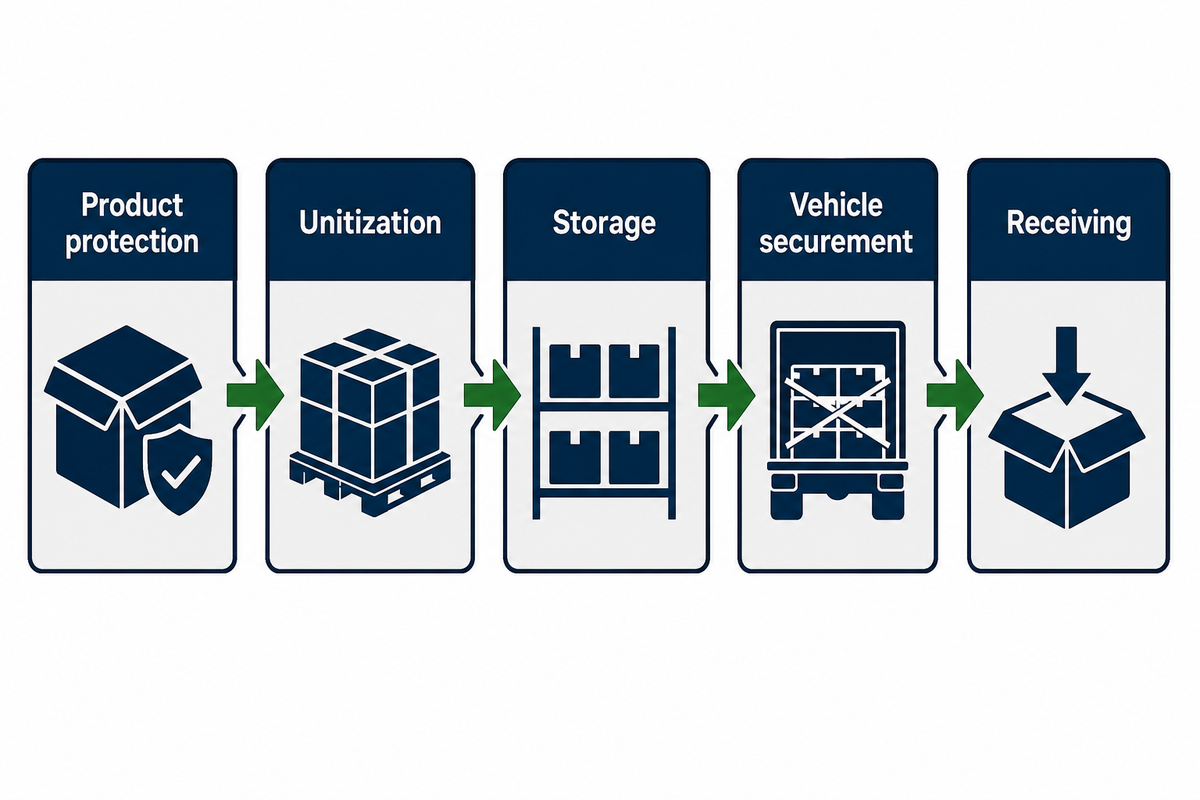
A practical package boundary begins before the first band is applied and ends after the receiving inspection. Product protection prevents abrasion, contamination, moisture damage or cosmetic marking. Unitization integrates individual pieces of a load to be transported. Storage control is for orderliness and stability of the load while awaiting transport. Carrier securement is for restraining the load to the vehicle. Receiving personnel inspection is to confirm identity and condition of the load.
There’s some physical overlap of these functions, but they aren’t interchangeable. A strap may help bundle a shipment, but that doesn’t prove the trailer’s tiedown plan is adequate. A weather cover may keep rain off the bundle and product, but it may also trap moisture that can ruin a moisture-sensitive product. A strong pallet may support the static load but still leave unsupported edges during forklift entry. The right question to ask is “Which hazard is each packaging layer controlling, and what proof do we have that it controls that hazard?”
| Control | Primary question | Completion evidence |
|---|---|---|
| Product protection | What surface or condition must be preserved? | Inspection rule and accepted condition |
| Unitization | Will the pieces remain one handled load? | Stable geometry after defined handling |
| Storage | Can the unit wait safely in the planned environment? | Site, stack, cover and reinspection record |
| Vehicle securement | How is the cargo restrained to or within the vehicle? | Carrier-compliant securement plan |
| Receiving | What makes the load acceptable or quarantined? | Condition, identity and exception disposition |
The portion of the rule dealing with storage isn’t optional housekeeping. OSHA 1910.176 states that bags, containers, and bundles must be stable to prevent collapse or sliding. The carrier’s boundary also has specific rules. FMCSA’s Cargo Securement Overview describes general requirements as well as requirements for specific commodities. These rules specify requirements, and don’t provide a ‘one size fits all’ package recipe.
Classify the Load Signature, Not Just Its Weight
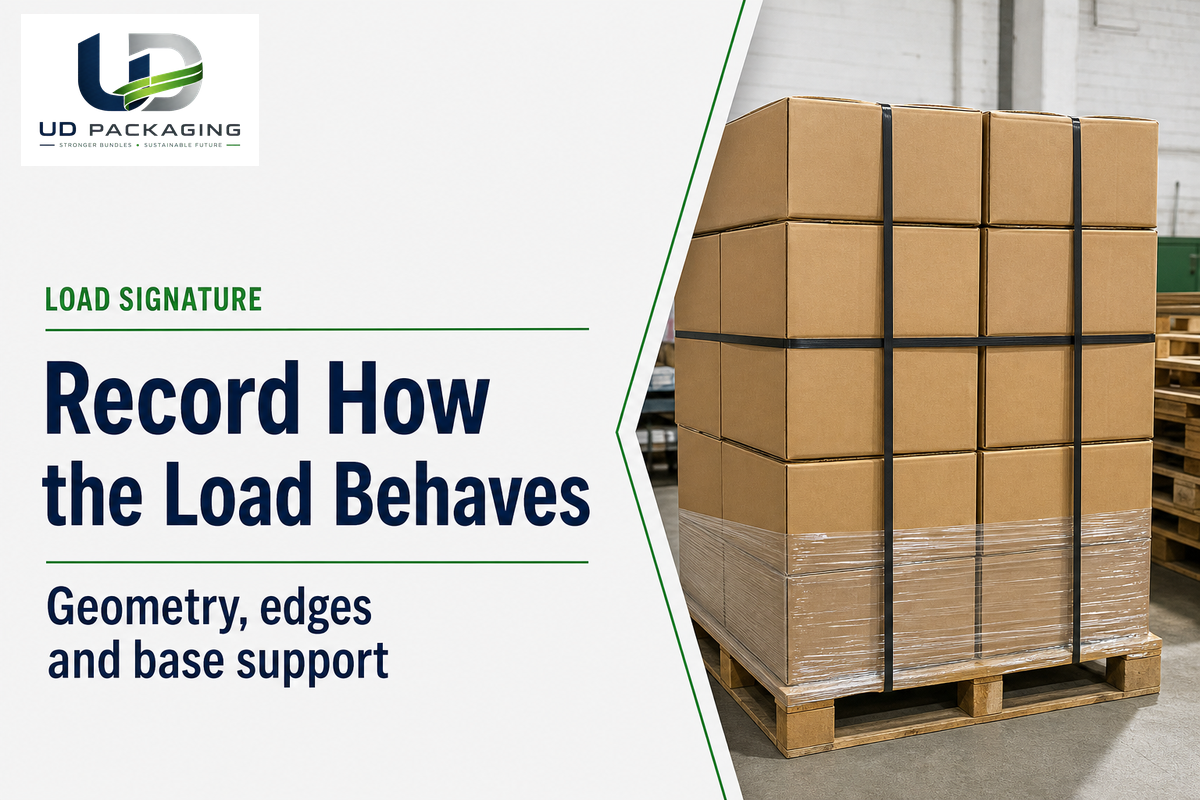
Different loads may have the same total weight, but still demand different controls. Bricks, for example, may create hard and abrasive contact surfaces. Bagged product may settle and change geometry of the layer. Long products may concentrate the risks of bending and handling. Panels may be surface-sensitive and need broad support. Pipe may roll or spread, and geometry may need to be controlled to prevent that. A ‘load signature’ may be used to define these behaviors.
| Load type | Signature to record | Likely failure signal | Do not assume |
|---|---|---|---|
| Brick, block, paver | Abrasive edges, layer friction, chips, voids | Edge cutting, layer walk, corner damage | Higher tension fixes poor contact geometry |
| Panels and boards | Span, surface sensitivity, edge support | Bow, crushed edge, rub mark | A flat face means a rigid load |
| Timber and profiles | Length, moisture state, bundle shape, support points | Settlement, twist, end movement | The release geometry will not change |
| Pipe and cylindrical stock | Diameter, nesting, rolling tendency, blocking | Spread, roll or local strap loading | Banding replaces chocks or blocking |
| Bags and sacks | Compression, settlement, surface friction, moisture sensitivity | Layer movement, leaning, loose containment | Release height remains stable |
| Steel and rebar bundles | Sharp edges, rigidity, length, contact points | Band damage, end movement, concentrated loading | High strength removes edge risk |
| Stone, tile and glass | Brittleness, face protection, orientation, impact sensitivity | Crack, chip, rub mark or local crush | A stable bundle protects every surface |
| Prefabricated components | Lift points, projections, support, sequence, identity | Distortion, missing part, handling damage | Transport packaging defines the lift plan |
| Mixed project kits | Height variation, voids, incompatible surfaces, item identity | Lean, migration, hidden damage or receiving error | One gross-weight class describes the unit |
These distinctions aren’t merely editorial. OSHA 1926.250 states that bagged materials, bricks, lumber, pipe, and other cylindrical material must be stored differently. Evidence shows that ‘building material’ is too broad to be used as input for packaging.
Build the signature from the heaviest and most difficult planned configurations, not just the average shipment. Record the length, width, height of the package. Know the location of the center of gravity. Be aware of unsupported spans and edge conditions. Understand the layer or pattern of the package, as well as the design of the base, contact surfaces, expected settlement, weather exposure, and what handling equipment will be used, as well as the number of package transfers. If one of these isn’t known, indicate it’s unknown rather than making an assumption about it.
Build a Packaging Stack by Function
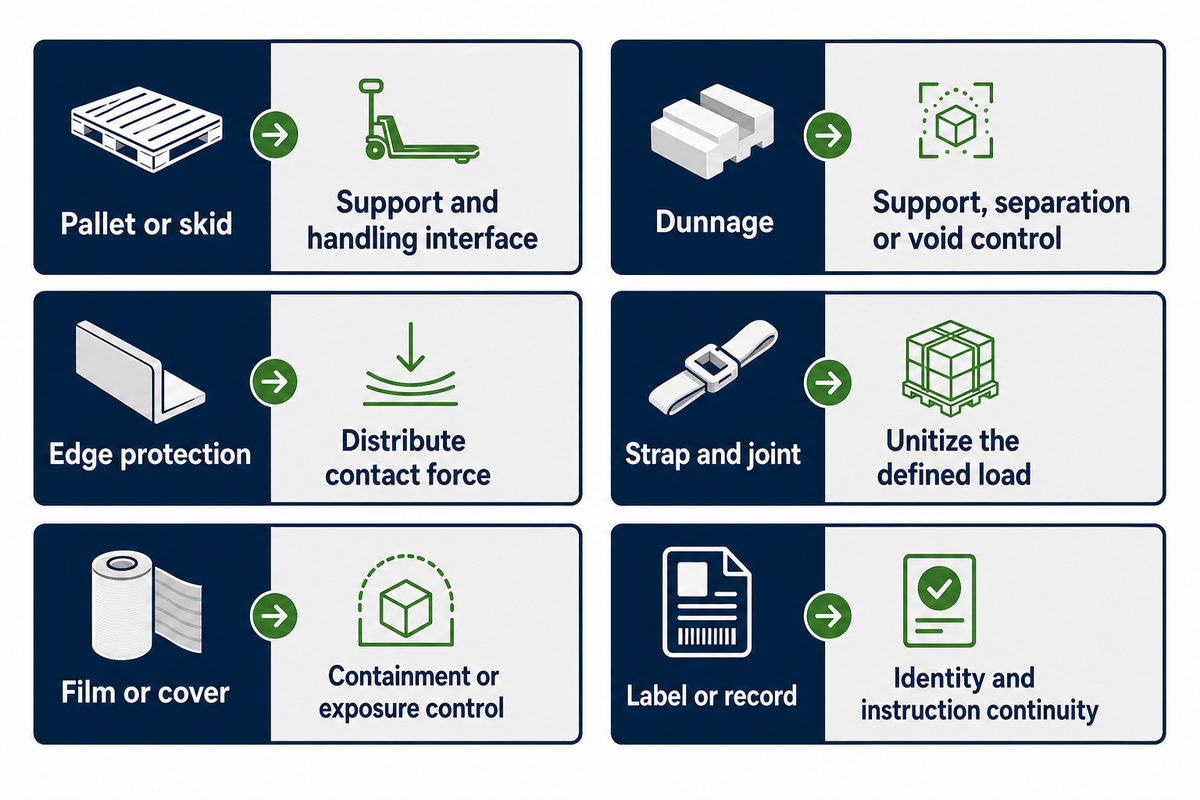
Packages are easier to diagnose when each layer has a primary job. The base provides contact with the handling equipment, presents the package to the equipment, and may also support or protect the contained items. Spacers and cushioning materials may separate items or fill space; edge protection distributes contact pressure. Straps and bindings may be used to unitize or compress a package. Film may be used to contain a loose face. Covers may protect the package from the elements. Labels preserve identity and handling instructions. One layer may serve multiple purposes, but that doesn’t eliminate the need to name its primary function.
| Layer | Primary function | Limit to expose | Useful check |
|---|---|---|---|
| Pallet or skid | Support and handling interface | Footprint, stiffness, entry and condition | Deflection and handling trial |
| Dunnage | Support, separation or void control | Movement, crush and moisture response | Position after representative handling |
| Edge protection | Distribute contact force | Crushing, migration and coverage | Contact marks and retained position |
| Strap and joint | Unitize the defined load | Applied tension, joint, edges and recovery | Applied-system inspection and test |
| Film or cover | Containment or exposure control | Tears, trapped moisture and openings | Condition after dwell and handling |
| Label or record | Identity and instruction continuity | Readability, attachment and data ownership | Receiving readback |
This matrix addresses the “add more” response. Cover, supports, and containment measures may all be needed, but that doesn’t eliminate the need to state each layer’s primary function. Evidence of missing functions may be assessed by observing how the package was transported and handled, by assessing the route the package traveled, the equipment used to transport it, and by inspecting it for damage. When judgement is in doubt, return to the evidence and state the primary function that’s missing.
ISTA’s procedure directory distinguishes integrity screening from distribution simulation; select the scope that represents the package’s planned handling environment.
Why Bundles Change After They Leave the Line
A release photo only shows that the load looked acceptable at a certain moment. Later, layers can settle. Edges can work against the band. Joints can experience repeated loading. Film can creep. Covers can move. Bases can flex. For example, local impacts can occur with forklifts. Transport can add vibration and braking. These can add cycles that can’t be reproduced with a static check. Because of this, the system should be considered changing.
Failure-chain diagnostic
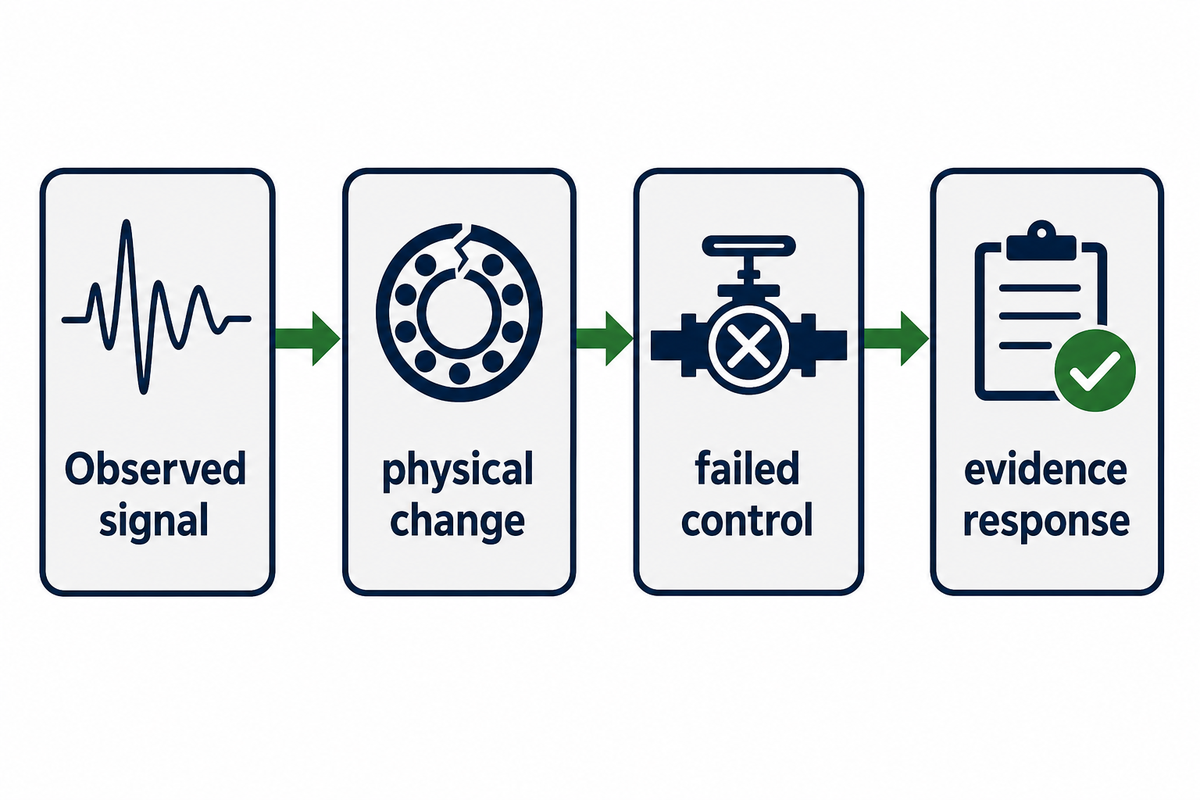
Observed signal → physical change → failed control → evidence response. A loose band may follow layer settlement, loss at a joint, edge-protector movement, base deformation or an application inconsistency. “Use a stronger strap” isn’t a diagnosis until the chain identifies which mechanism actually occurred.
The 2017 RIT study Evaluation of Stability of Unit Loads for Tilt and Shock Events During Distribution describes methods to analyze unit load behavior with respect to tilt and impact during short duration shock events. The study conducted experiments using a unit load of bottled water. It, therefore, doesn’t set construction material limits. However, it provides a lesson in an industry setting: stability should be evaluated under identified events and the material and conditions should be considered.
Why does pallet strapping become loose during transport?
Several mechanisms can cause pallet strapping to come loose including changes to the load, base, edge system, or the joint and band. Compressible materials may settle; long materials may come into contact with each other; a corner board may crush or migrate; the pallet may deflect; the joint may slip; or the strap may lose tension. Start by preserving the received condition, comparing it with release records, and locating the first visible change. Then, the complete system of pallet strapping should be tested to see how it will perform under typical service conditions and use. Increasing initial tension without identifying the mechanism can damage edges, distort the product or increase worker exposure.
For basic information on applying pallet straps, see the separate pallet strapping guide. This article won’t cover basic product information on pallet strapping; it will focus on analysis of packaging-system failures, while dimensions, tooling and trial inputs stay on the commercial solution page.
Read Strapping as an Applied System, Not a Catalog Number
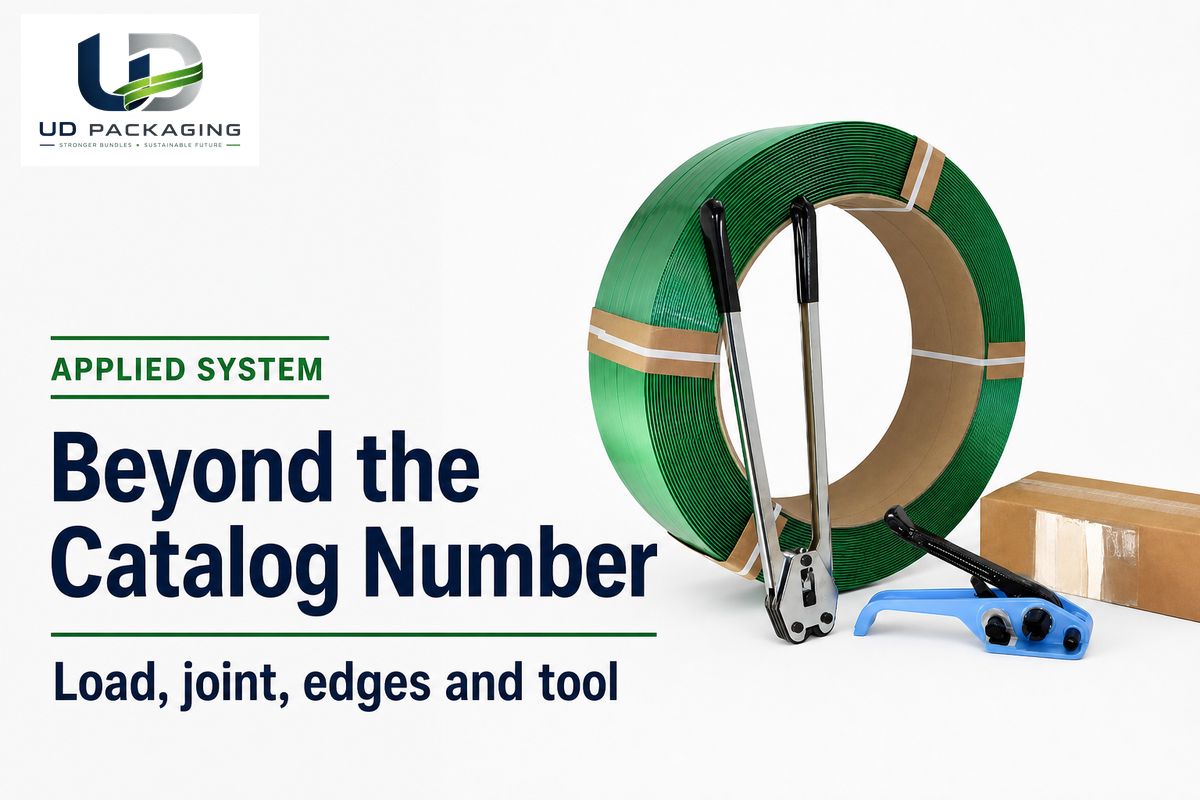
A data sheet can provide information on the strap material, dimensions and test values. It cannot, by itself, prove the result after that strap passes around the actual load, over its edge protection, through a particular joint, with a particular tool and setting, under a particular route. The weakest link may be in the joining tool and method, an unsupported contact area, a lack of compatibility between the tool and the material or the load that has the potential to change shape.
| Evidence source | What it can answer | What remains unproven |
|---|---|---|
| Material datasheet | Declared material and specimen properties | Applied joint, retained tension and load survival |
| Tool manual or compatibility record | Compatible width, thickness, joint and settings | Performance on the production load |
| Applied-joint check | Joint consistency under defined conditions | Complete distribution-cycle performance |
| Representative load trial | Observed response of the complete package and route model | Unrepresented hazards or uncontrolled future changes |
ASTM’s Packaging Standards Listing lists D3950-23 for nonmetallic strapping and joining methods and D4169-23e1 for performance testing of shipping containers and systems. A standard title defines a route to evidence; it is not evidence that an untested package complies.
How do I choose between plastic and steel strapping materials?
Consider load signature and route rather than material before selecting a system. Factor in edge severity, rigidity, settlement, recovery, corrosion and/or weather exposure, temperature, joint method, tool capability, and worker handling. Then review candidate systems and compare their joints and edge protection with those representative loads. Break strength of a material doesn’t always indicate actual system performance. For a comparative analysis of the behavior of PET, PP and steel, see the strapping-material selection guide. Product-specific dimensions, tooling and trial inputs remain on the commercial solution page.
Plan Storage and Weather Exposure Before Dispatch
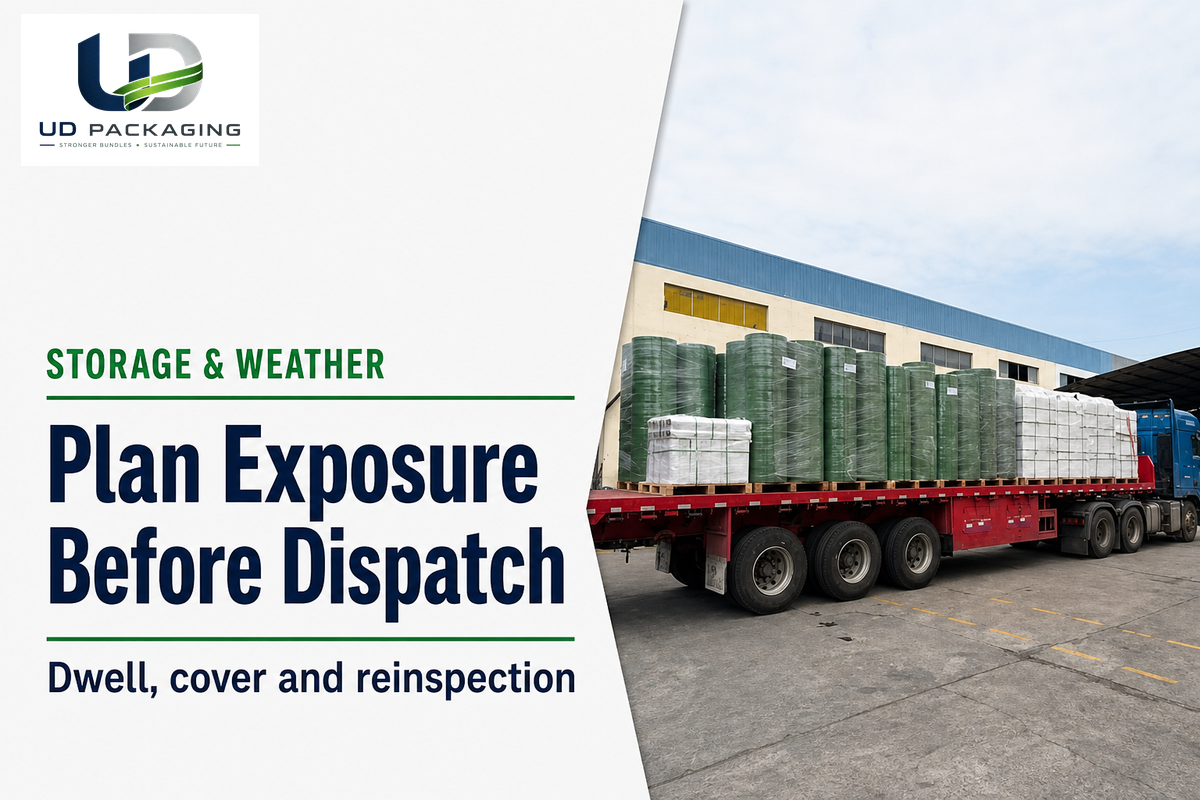
“Outdoor storage” is incomplete routing information. Define siting, expected dwell, what, if anything, supports the load, how drainage is designed, if a cover is used, what, if anything, shields the load from the elements and how the load is protected from wind. Product instructions control moisture, UV, temperature and contamination exposure limits.
- Confirm a level, load-appropriate base and drainage path.
- Keep the stack stable for the material family and handling method.
- Define cover, ventilation and fastening without assuming “wrapped” means dry.
- Separate exposure duration from transport duration.
- Set reinspection triggers after rain, high wind, relocation, impact or extended dwell.
- Record who may release, rework or quarantine the load.
Regulatory interpretation is important. U.S. OSHA 1926.250 addresses tiered materials, stepped and cross-keyed bag stacks, brick-stack geometry, supported lumber and blocking for pipe or other cylindrical stock. Under that construction rule, bag layers are cross-keyed at least every 10 bags; loose brick stacks are limited to 7 ft and taper after 4 ft; lumber piles are limited to 20 ft, or 16 ft when handled manually. These rules are scoped safety limits and don’t replace exposure instructions or a site-specific engineering review.
International transport introduces additional conditions. The USDA APHIS wood-packaging guidance states that regulated solid wood packaging that supports, protects or carries cargo to the US must be treated and certified to ISPM 15. The guidance also mentions exporting to meet importing-country requirements. This is a route and material question, not a claim that every pallet or domestic shipment is regulated.
Keep Unitization, Vehicle Restraint and Lifting Distinct
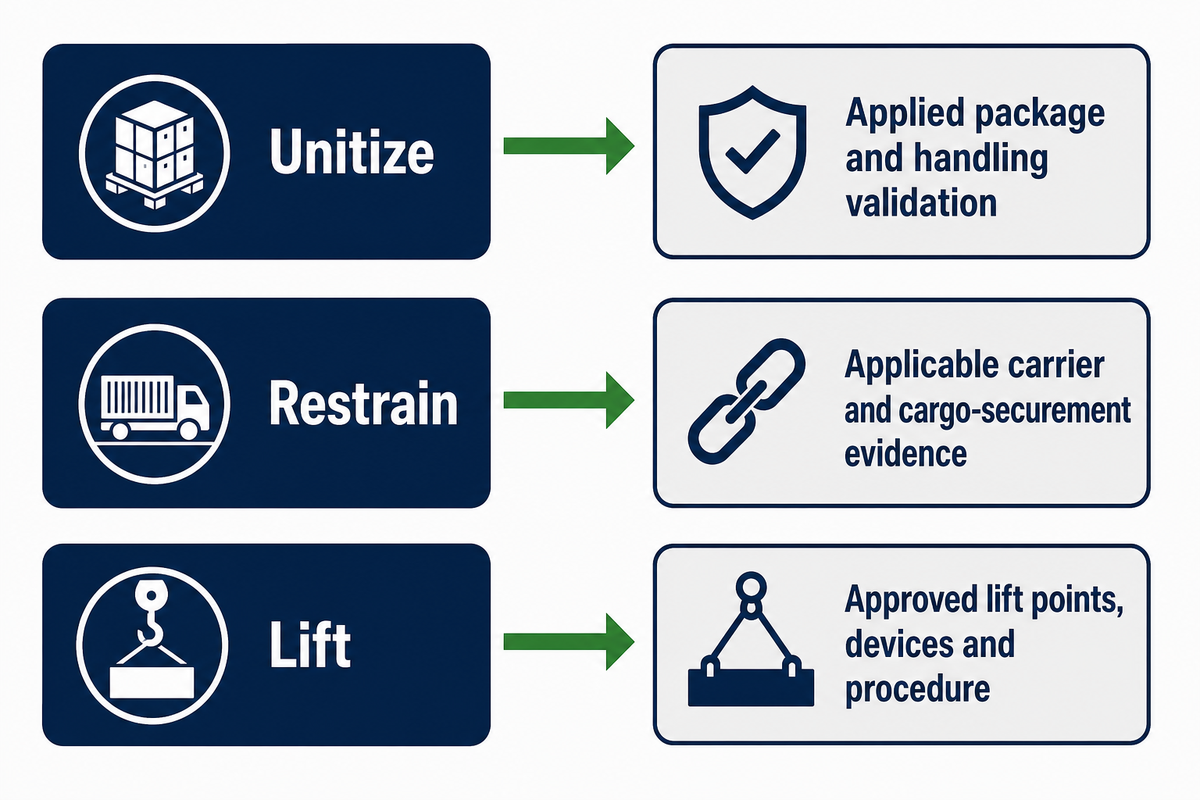
Some of the terms may be unfamiliar. “Unitization” refers to preventing separate pieces from moving with respect to each other; “vehicle restraint” prevents cargo from moving on or within the vehicle. “Lifting” refers to suspending or raising the load. Evidence for lifting is also required. For package bands to be treated as lifting slings, a separate engineered and approved lifting system would be required.
The distinction is clear, but not absolute. According to FMCSA, bundles of dressed lumber and similar packaged building products, when unitized for securement, are to be considered a single article of cargo. FMCSA rules also incorporate standards for tiedowns, including steel strapping, and require edge protection where a tiedown is subject to cutting or abrasion. Therefore, the geometry of the package affects the securement plan of the carrier. Banding doesn’t mean, for certain, that the vehicle restraint system is compliant.
“Cargo must be firmly immobilized or secured on or within a vehicle”
Federal Motor Carrier Safety Administration, Cargo Securement Rules
Some performance criteria stated by FMCSA include 0.8 g forward deceleration and 0.5 g acceleration in the rearward and lateral directions, applied separately. The page also states that the aggregate working-load limit of a securement system must be at least one-half the weight of the article or group of articles. These performance criteria belong to the U.S. motor-carrier rule and must not be interpreted as strap count or package test instructions for factory packaging.
| Function | Owner question | Required evidence | Unsafe shortcut |
|---|---|---|---|
| Unitize | Will pieces stay one manageable load? | Applied package and handling validation | Treat catalog strength as load approval |
| Restrain | Will cargo remain secured to or within the vehicle? | Applicable carrier and cargo-securement evidence | Assume package bands are the tiedown plan |
| Lift | How may this load be raised safely? | Approved lift points, devices and procedure | Hook or sling ordinary packaging bands |
Receiving and unpacking also require an owner. OSHA’s manufacturing hazard identification training indicates that overtensioning of packaging bands can cause failure and bands striking individuals. Treat bands as stored energy. The work instructions should be written by the safety team responsible for the actual band, load, and workstation. This guide won’t specify a universal method of cutting.
Validate the Actual Load, Joint and Route
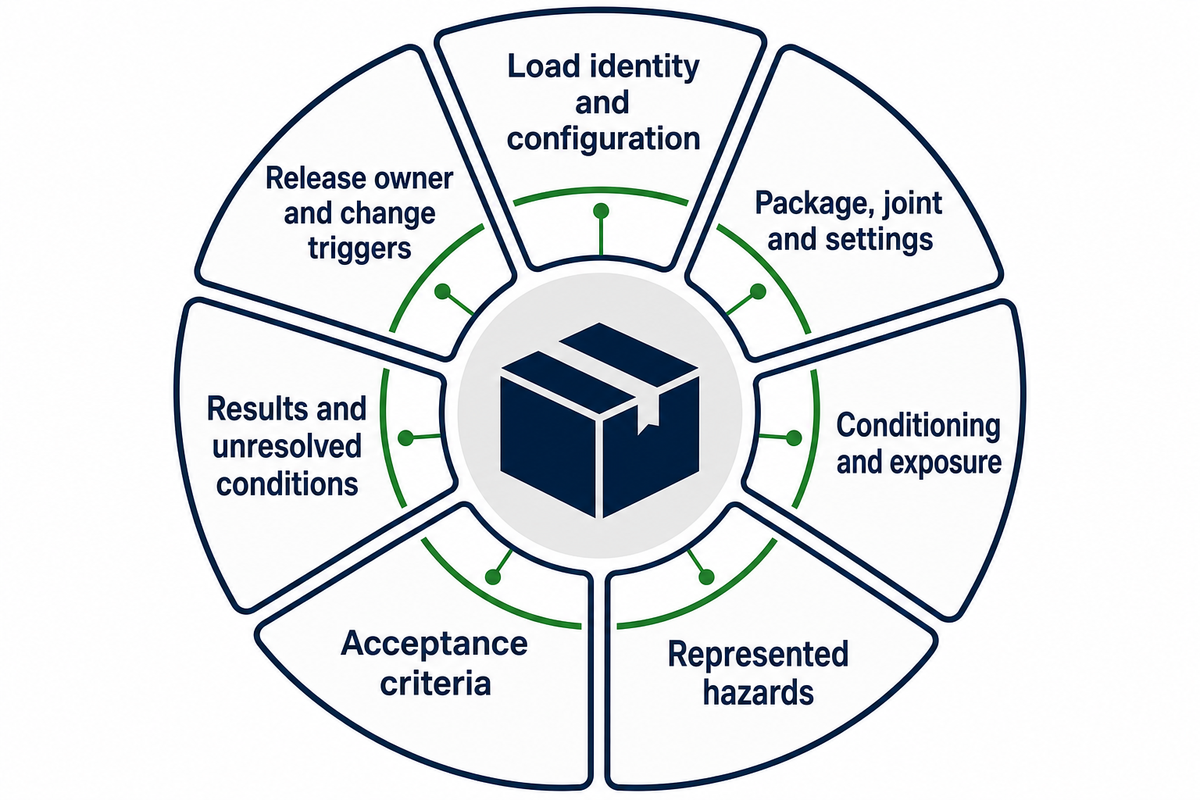
A good validation plan begins with the decision it supports. Define the worst planned condition. Condition the load for the applicable environment. Assemble it with the production tool and joint and retain the real edge system and base. Expose it to events along the route and judge it against the acceptance criteria. Label unresolved hazards rather than hiding them under a ‘tested’ label.
The Seven-Record Release File
- Load identity, geometry, mass range and configuration.
- Base, dunnage, edge protection, strap, joint, tool and settings.
- Conditioning and planned storage or weather exposure.
- Handling and distribution hazards represented by the test.
- Measured or observable acceptance criteria.
- Results, deviations and unresolved conditions.
- Release owner, receiving inspection and change triggers.
ISTA’s procedure directory describes 1E as an integrity test for unit loads and 3E for similar packaged products within a unitized truckload shipment. The limited scope of the procedure is useful for deciding which material and impact hazards the test represents. The correct question isn’t “Did we run a standard?” The correct question is “What hazards did the selected procedure represent? What hazards did the selected procedure not represent?”
Use evidence-status labels during review:
- Verified: the defined specimen and condition met the written criterion.
- Conditional: the result applies only within a stated load, tool, route or environment.
- Unresolved: a required input or hazard wasn’t represented and still needs a decision.
The guide on package testing for strap changes describes the process for planning tests in more detail and the guide on strapping joint strength explains the rationale for a separate test of the joint. Addressing these topics in detail elsewhere prevents this overview from being too broad.
Use the Plant-to-Site Decision Framework for Every Change
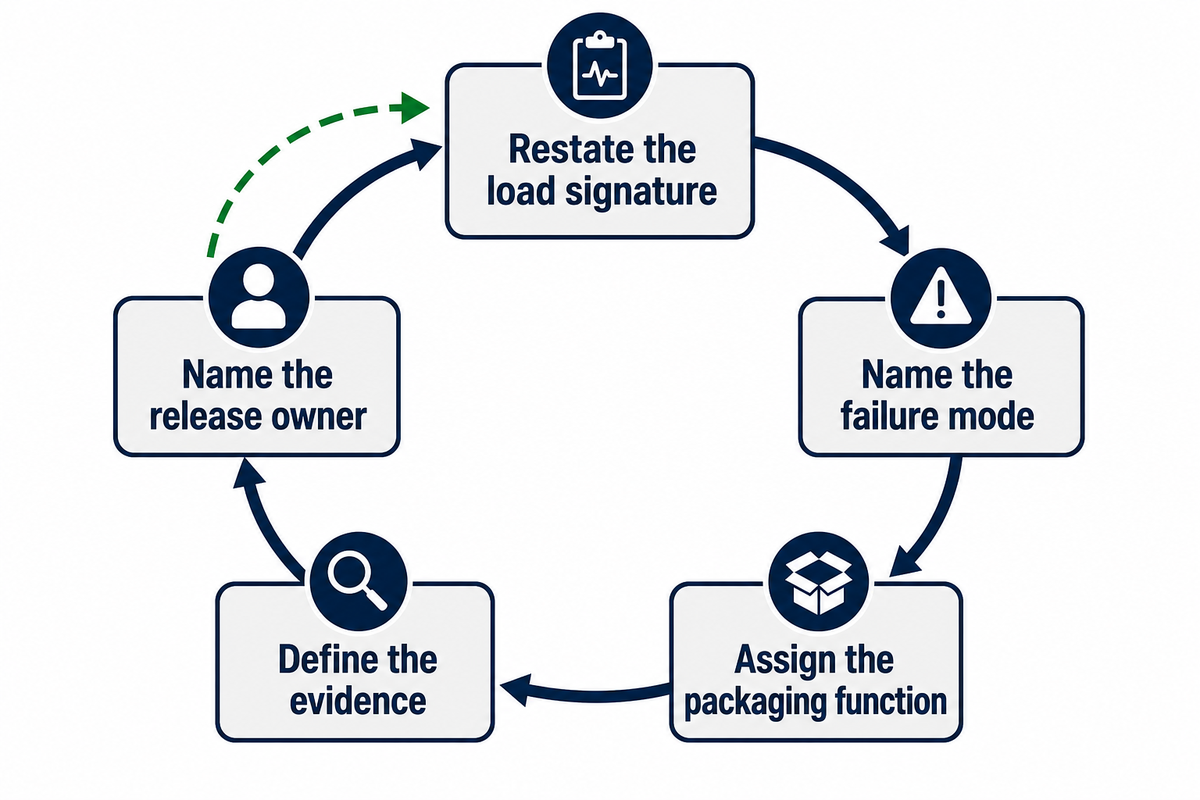
Packaging change control should reopen the evidence chain when any of the following change: material, supplier, load pattern, base, joint, tool, route, weather window, handling equipment, or complaint pattern. A lower material mass or purchase price may be advantageous, but it isn’t a complete sustainability or cost result if damage, rework, additional layers or evidence is lost.
For construction management teams, packaging technology is part of the project handoff. An innovation only counts when building construction crews receive identifiable, stable materials in the expected condition. AI or analytics may help organize records, but neither replaces physical validation, competent engineering judgment or a named release owner.
- Restate the load signature. Identify what changed and whether the worst planned case moved.
- Name the failure mode. Describe the observable event the change is meant to prevent or improve.
- Assign the packaging function. Change the layer that actually owns that function.
- Define the evidence. Select conditioning, handling, test and acceptance criteria that answer the decision.
- Name the release owner. Record who approves, monitors and reopens the decision.
Digital identifiers may help bridge that gap, but the evidence is nascent. A 2025 Purdue-hosted residential-construction case study outlines the use of digital labels and traceability to verify delivery, and provide information about how the item was handled and change communications. It involved seven participants, so it may be read as a bounded case.
The decision framework remains vendor-neutral. If the evidence identifies a PET-strapping application, use the commercial solution page to compare published formats and prepare a controlled trial. If the evidence indicates an edge, base, storage, carrier or lifting gap, solve that gap with the responsible specialist rather than a strap purchase.
Ready to review a real construction-material load
Bring the load geometry, current package, joint and tool, route conditions, failure history and acceptance criteria. That creates a useful application review without turning a sector name into a product guess.
Frequently Asked Questions
What is construction and building packaging?
View answer
Construction and building packaging is the coordinated system that protects a material, forms it into a stable unit load, preserves it during storage, hands it to the carrier under a defined securement plan, and tells receiving staff what to inspect. It may include a base, dunnage, edge protection, straps, film, covers and identification. The correct system depends on load behavior and route conditions rather than one universal packaging recipe.
What information is needed before specifying packaging for building materials?
View answer
Record the load’s dimensions, mass range, stacking pattern, edge condition, surface sensitivity, expected settlement, base and support points. Add the current strap, joint, tool and settings; storage and weather exposure; handling equipment and transfer count; transport mode; failure history; and the condition that receiving will accept. These inputs reveal whether the real gap is unitization, support, edge protection, exposure control, cargo securement, lifting or evidence, not simply strap strength.
Can packaging straps be used as vehicle tiedowns?
View answer
Do not assume so. Package bands are normally selected to keep pieces unitized, while the carrier’s tiedowns must satisfy the applicable cargo-securement requirements. FMCSA does recognize steel strapping among tiedown types and treats some unitized building-product bundles as one cargo article, so the two systems can interact. The carrier or qualified securement owner must still verify the vehicle restraint, attachment, working-load limits, edge protection and commodity-specific rules for the actual shipment.
Can packaging bands be used to lift a bundle?
View answer
No. Ordinary packaging bands are not lifting slings. Use only approved lift points, rigging and procedures selected by the responsible competent person for the actual load.
How should building materials be stored outdoors?
View answer
Follow the product manufacturer’s exposure instructions and the applicable site-safety rules. Define a level, supported base; drainage; stack stability; cover and ventilation; access; planned dwell; and reinspection triggers after weather, impact or relocation. Bricks, bagged products, lumber, panels and pipe do not share one storage rule. For international routes, also check whether regulated solid-wood pallets, crates, skids or dunnage bring ISPM 15 requirements.
What should be in a construction-package validation record?
View answer
Keep the load identity, dimensions, mass range and configuration; the base, dunnage, edge protection, strap, joint, tool and settings; conditioning; represented handling and distribution hazards; acceptance criteria; results and deviations; unresolved conditions; receiving checks; release owner; and change triggers. Name the exact standard or procedure used and state what it did not cover. Attach photographs or measurements that let another reviewer identify the tested specimen. A report that says only “passed testing” cannot show whether the production load, actual edge system, storage environment, worker interface or route was represented, and it cannot reveal which later change should reopen the approval.
References & Sources
- 29 CFR 1910.176, Handling Materials, General U.S. Occupational Safety and Health Administration.
- 29 CFR 1926.250, General Requirements for Storage OSHA.
- Cargo Securement Rules Federal Motor Carrier Safety Administration.
- Paper Standards and Packaging Standards ASTM International.
- ISTA Test Procedures International Safe Transit Association.
- Evaluation of Stability of Unit Loads for Tilt and Shock Events During Distribution Rochester Institute of Technology repository, 2017.
- Wood Packaging Material USDA Animal and Plant Health Inspection Service.
- Hazard Identification Training Tool: Manufacturing Scenario OSHA.
- Improving Supply Chain Efficiency through Traceability Technology Adoption in Residential Construction CIB World Building Congress proceedings, Purdue University repository, 2025.
About UD Packaging
UD Packaging is based in Jiangyin, Wuxi, Jiangsu, manufactures PET strapping, and supplies packaging materials, seals and machines. Read the company introduction for its manufacturing background. This guide is educational; project-specific product configuration and commercial decisions remain in the separate solution path.