Get in touch with UD Packaging Company

Top 20 PP Strapping Manufacturers: Who Is Best for Which Application?

Last updated: September 2026
The best polypropylene strapping manufacturers include Mosca for automatic carton lines, Samuel Packaging for digitally printed PP, Greenbridge for splice-free machine coils, and Teufelberger for documented recycled-content PP. Your shortlist should follow the package, machine, joint and order size: none of these application matches establishes a single winner for every plant.
Disclosure: This guide is published by UD Packaging. UD Packaging manufactures PET strapping and supports PP-versus-PET application reviews, but its current public information does not establish in-house polypropylene strapping production. For that reason, UD Packaging is not included in the 20-manufacturer ranking below.
Quick Picks
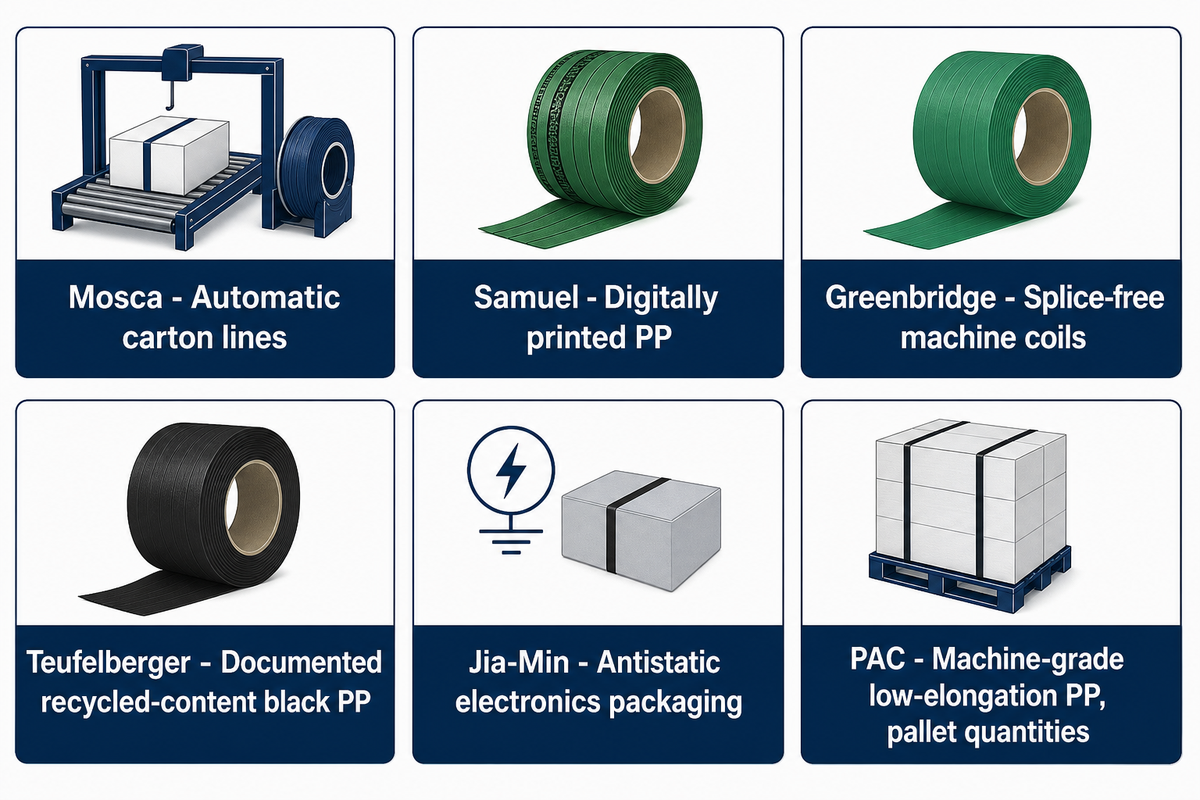
- Best for automatic carton lines: Mosca, with its own PP production and matched strapping equipment.
- Best for digitally printed PP: Samuel Packaging, which combines PP manufacturing with digital printing.
- Best for splice-free machine coils: Greenbridge, whose machine-grade specification excludes splices.
- Best for documented recycled-content black PP: Teufelberger, with a product-specific 2026 certification update.
- Best for antistatic electronics packaging: Jia-Min, which offers a dedicated antistatic PP line.
- Best for machine-grade low-elongation PP in pallet quantities: PAC Strapping, with a distinct low-elongation offer and published order constraint.
How We Selected These Polypropylene Strapping Manufacturers
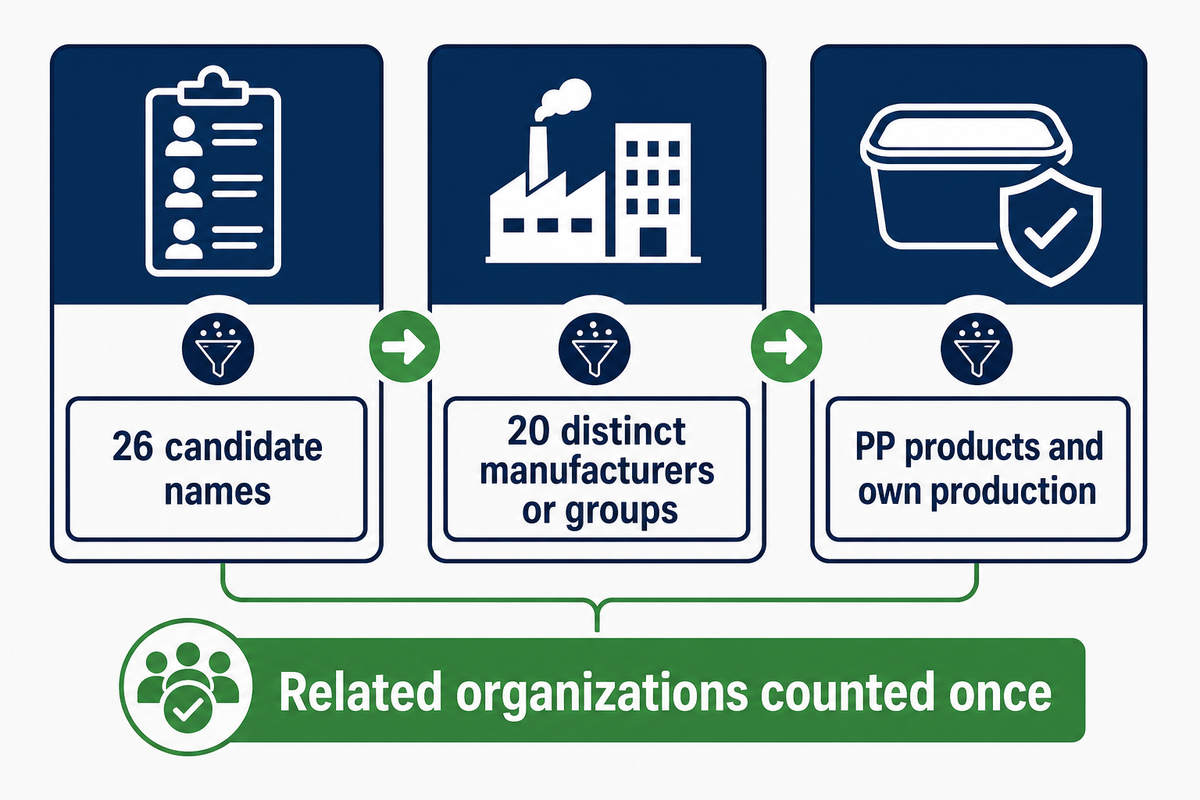
We reviewed Google results and current official company, product and manufacturing information through September 27, 2026, starting with 26 candidate names and selecting 20 distinct manufacturers or manufacturing groups. The definition of a qualifying manufacturer was an organization that has issued a public statement of polypropylene products and its own production.
Selling unspecified plastic strap or PET strapping, or strapping machinery, wasn’t sufficient. Among the organizations considered, we excluded distributors and organizations that don’t produce polypropylene strapping. We counted related organizations only once. The order of the organizations doesn’t reflect their relative market size. The term “best for” represents our interpretation of a published capability in relation to a specific application and job requirement. Each organization is described by its founding history, separately from its history of producing polypropylene.
20 Polypropylene Strapping Manufacturers at a Glance
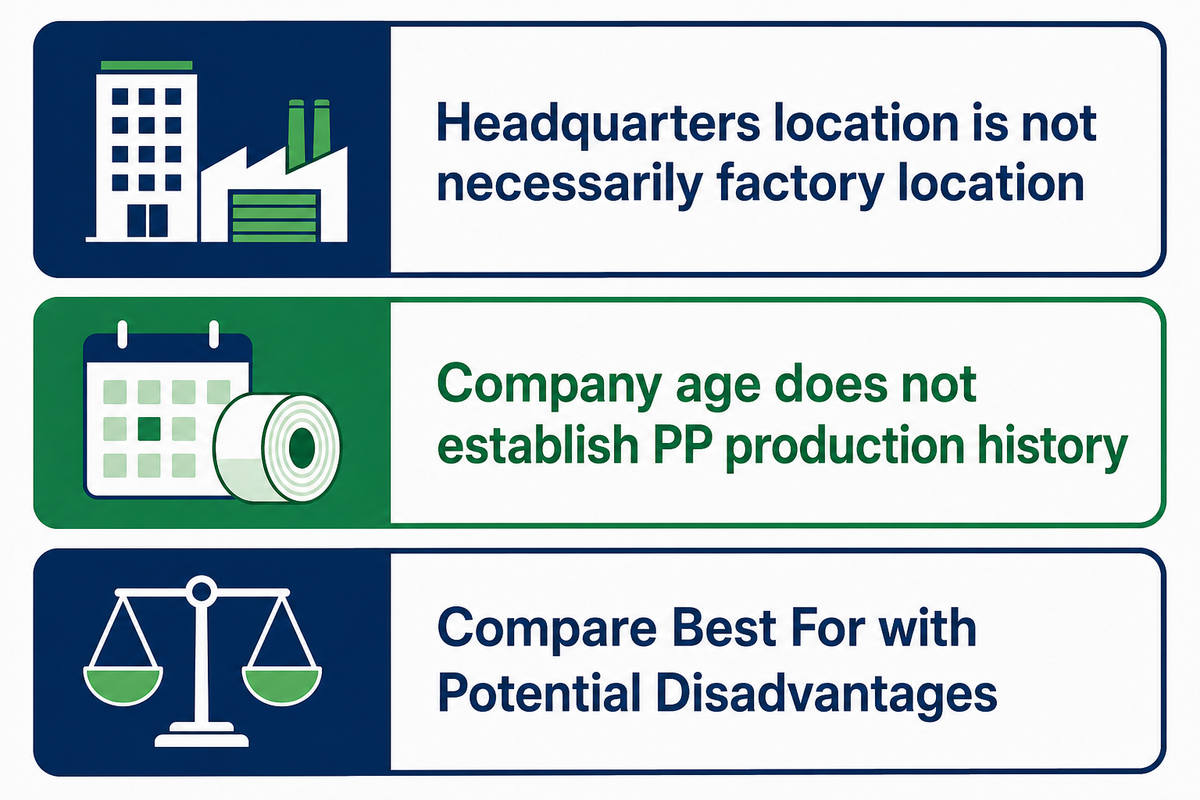
Products and company information in the profiles are to be compared and contrasted. The location of a company’s headquarters isn’t necessarily where the company manufactures the product. Age of the company doesn’t mean that company has manufactured a certain product for a long time.
| No. | Company Name | Headquarters | Founded Year | Best For | Brief Introduction | Main Products | Key Advantages | Potential Disadvantages | Official Website |
|---|---|---|---|---|---|---|---|---|---|
| 1 | Signode | Tampa, Florida, USA | 1913 | Mixed hand and automated carton closure | Industrial packaging group producing Empax PP for hand and automated carton work. | Empax PP hand and automatic-machine strap | Empax controls camber and curl for machine feeding | Empax PP targets light-to-medium packages. | www.signode.com |
| 2 | Mosca | Waldbrunn, Germany | 1966 | Automatic carton and corrugated-board lines | German strap and equipment manufacturer with integrated PP production. | PP strap for cartons, corrugated products and printed materials | Printed PP strap and matched strapping equipment | Published standard PP widths run from 5 to 15 mm. | www.mosca.com |
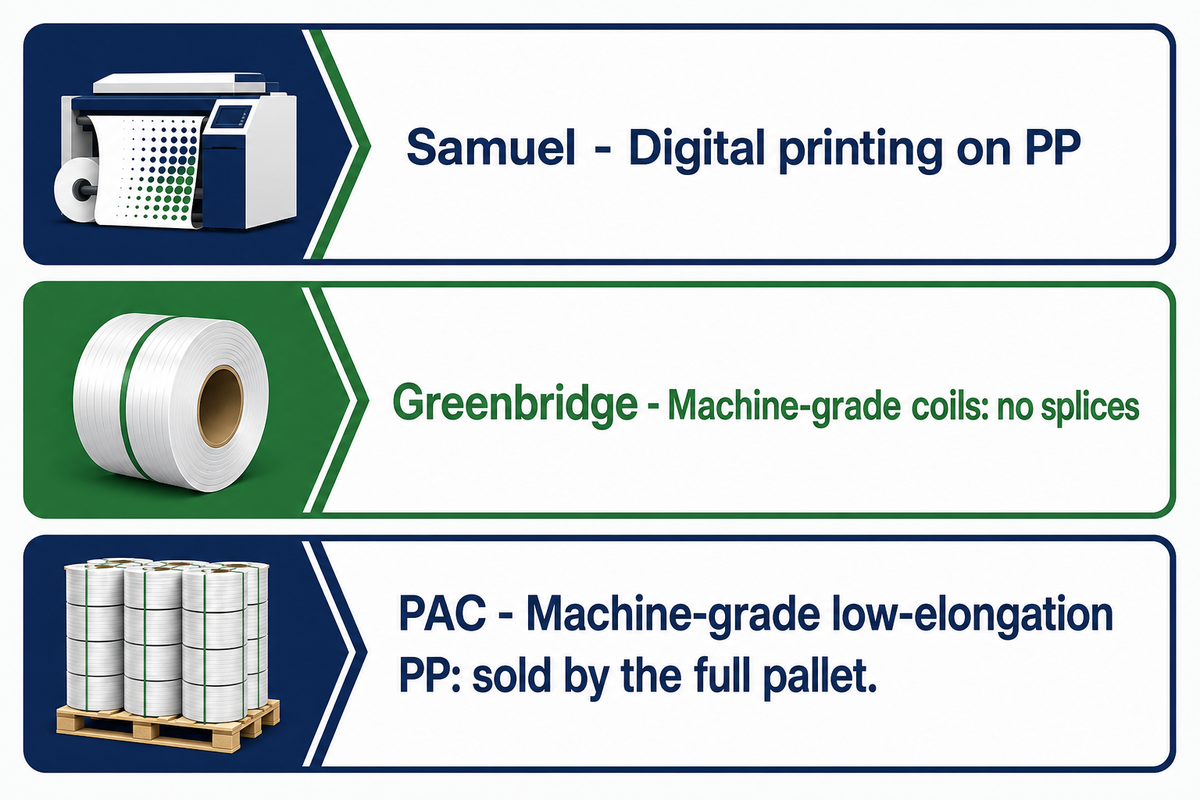
| 3 | Samuel Packaging | Oakville, Ontario, Canada | 1963 | Digitally printed PP for North American packaging lines | North American packaging division offering PP extrusion and digital printing. | Hand-grade, machine-grade and digitally printed PP strap | Digital printing on PP strapping | North American production affects overseas freight planning. | www.samuelpackaging.com |
| 4 | Greenbridge | Cleveland, Ohio, USA | 1974 | Splice-free coils for continuous automatic feeding | Manufacturer combining Polychem and Dynaric PP product lines. | Machine-grade and hand-grade PP strap | Machine-grade coils have no splices | Hand-grade coils may contain one splice. | www.greenbridge.com |
| 5 | PAC Strapping | Exton, Pennsylvania, USA | 1982 | Machine-grade low-elongation PP in pallet quantities | U.S. plastic-strapping producer within the FROMM group. | Hand-grade, machine-grade and low-elongation PP strap | Low-elongation PP and published coil-order options | Machine-grade low-elongation PP is sold by the full pallet. | strapsolutions.com |
| 6 | StraPack | Tokyo, Japan | 1933 | POLYPROSTRAP matched to StraPack equipment | Japanese machine group with PP production in Illinois. | POLYPROSTRAP machine-grade polypropylene strap | Danville, Illinois PP manufacturing | U.S. supply operates through a distributor network. | strapack.com |
| 7 | Quality Strapping | Brooklyn, New York, USA | 1995 | Hand-strapping kits for flexible packing stations | Brooklyn manufacturer supplying machine strap and portable hand kits. | Machine-grade PP, hand-grade PP and portable strapping kits | Portable kits alongside machine-grade PP | Hand-strapping kits do not replace machine-grade coils. | www.qualitystrapping.com |
| 8 | Teufelberger | Wels, Austria | 1790 | Black PP with documented recycled-content certification | Austrian manufacturer offering TEWE PP and certified recycled-content articles. | TEWE polypropylene machine strapping | Certified pre-consumer content: listed white/colored PP 30%; listed black PP 60% | Certified recycled content depends on the listed article and color. | www.teufelberger.com |
| 9 | baumhueter extrusion | Rheda-Wiedenbrück, Germany | 1863 | Metric coil and core options for packing equipment | German extrusion specialist publishing detailed metric reel options. | PB STRAPPING polypropylene packing strap | Core diameters include 62, 200, 280 and 407 mm | Published PP width range is 5–16 mm. | www.baumhueter-extrusion.com |
| 10 | Messersì | Barbara, Ancona, Italy | 1980 | Three-color printed PP for production lines | Italian producer of PP strap, printed band and packaging machinery. | Narrow PP, automatic-machine PP and printed PP strap | PP printing in up to three colors | Publishing and industrial PP ranges use different widths. | messersi.com |
| 11 | Cyklop / Campanini | Helmond, Netherlands | 1912 | Printed PP for corrugated packaging through Cyklop | Cyklop group represented by its Italian PP producer Campanini. | Campanini polypropylene and printed PP strapping | Campanini manufactures PP within the Cyklop group | Campanini’s published PP range starts at 9 mm. | www.cyklop.com |
| 12 | Plastex | Wickford, Essex, UK | 1963 | UK trade-channel PP and custom orders | UK producer supplying PP through packaging trade channels. | Hand-grade, machine-grade and custom PP strap | Single-color printing and testing of a five-metre customer strap sample | Sales are through the trade channel. | www.plastexstrapping.co.uk |
| 13 | Plasticband | Granollers, Barcelona, Spain | 1978 | Recycled-content PP selected by application grade | Spanish producer with application-specific recycled-content PP grades. | ECO, ECÖBAND, nature and iPremium PP strap | ECO manual strap lists 100% recycled content | Recycled percentage and application differ between PP grades. | www.plasticband.com |
| 14 | Comosa Strapp | Ripollet, Barcelona, Spain | Not publicly disclosed | Spanish PP procurement with integrated packaging support | Spanish manufacturer producing PP since 1988. | Manual, semiautomatic and automatic PP strap | PP production began in 1988 | Published PP widths run from 5 to 19 mm. | comosastrapp.es |
| 15 | Scientex | Shah Alam, Malaysia | 1968 | Volume export orders including narrow automatic PP | Malaysian group producing PP through Scientex Tsukasa. | Machine, hand and heavy-duty PP strapping | 5 mm PP for printed-material bundling | Hand-grade widths start at 12 mm, unlike narrow machine grades. | scientex.com.my |
| 16 | Jia-Min | Taichung, Taiwan | 1987 | Antistatic PP for electronics packaging | Taiwanese PP producer offering antistatic and printed products. | Machine-grade, printed and antistatic PP strapping | Antistatic PP developed for electronics applications | Antistatic performance is grade-specific. | www.jm-pack.com.tw |
| 17 | BETEC | Walnut, California, USA | 2019 | Vietnam-based PP sourcing through an international group | International packaging manufacturer with Vietnam PP operations. | Manual, semiautomatic and automatic PP strapping | Vietnam PP operations alongside a U.S. group established in 2019 | Manufacturing origin and commercial location differ, affecting dispatch and the landed-cost quote. | betecgroup.com |
| 18 | STRAPERT | Xinxiang, Henan, China | 2001 | Pallet-quantity custom PP export orders | Chinese PP manufacturing brand owned by Xinxiang Yongsheng. | Machine-grade and custom polypropylene strap | PP manufacturing under the STRAPERT brand | Published minimum order is 99 rolls. | www.ysstrapping.com |
| 19 | Changcheng | Foshan, Guangdong, China | Not publicly disclosed | Specification-led PP quotes using dimensions and linear weight | Foshan producer publishing detailed PP dimensional and reel specifications. | Manual and machine-grade polypropylene strap | Detailed PP specification tables with weight per meter | Published standard PP widths stop at 16 mm. | packaging-strapping.com |
| 20 | Arrigo | Klang, Selangor, Malaysia | 2004 | Regional Malaysian PP supply and custom printing | Malaysian PP manufacturer with Klang and Kapar factories. | Embossed, printed, manual and machine-grade PP strap | PP production at Klang and Kapar factories | Listed PP widths start at 9 mm. | www.arrigotrading.com |
Global and North American PP Strapping Producers
1. Signode: Best for mixed hand and automated carton closure
Headquarters: Tampa, Florida, USA · Founded: 1913 · Type: Integrated strapping manufacturer
Official website: www.signode.com
Main products: Empax PP hand and automatic-machine strap
Signode’s Empax range brings polypropylene consumables into a wider packaging operation that also uses tools and automated equipment, making it a practical starting point for facilities with several carton-closing methods under one roof. According to its product page, Empax is manufactured with controlled camber and curl, so the relevant advantage is how the strap travels through the feed path rather than a broad claim about being stronger than every competing product. The published range includes 5 mm and 12 mm grades, with different thicknesses, giving the packaging engineer specific sizes to match against an existing machine specification. Empax is positioned for light-to-medium applications; a purchasing team handling substantially heavier loads would need to evaluate a different material or product family rather than extend that positioning to every pallet.
2. Mosca: Best for automatic carton and corrugated-board lines
Headquarters: Waldbrunn, Germany · Founded: 1966 · Type: Strapping machine and strap manufacturer
Official website: www.mosca.com
Main products: PP strap for cartons, corrugated products and printed materials
Certifications / history: Company history records ISO 9001 certification from 1995; historical management-system milestone (according to the company).
Mosca has made PP strapping since 1989 and combines that consumable production with its own strapping equipment, including the North American EAM-Mosca business within the same group. Its standard PP offer covers 5–15 mm widths, with cartons, corrugated-board products and printed materials among the named applications, which makes the company relevant to lines where repeatable feeding matters as much as nominal break strength. Buyers can discuss printed strap and equipment settings with the same group, reducing the number of separate product specifications that the packing department must coordinate. The published standard width range remains a useful boundary: a requirement outside it belongs in a specific product enquiry, while Mosca’s recycled-PET statements shouldn’t be read as recycled-PP percentages.
3. Samuel Packaging: Best for digitally printed PP for North American packaging lines
Headquarters: Oakville, Ontario, Canada · Founded: 1963 · Type: Packaging manufacturing division of Samuel
Official website: www.samuelpackaging.com
Main products: Hand-grade, machine-grade and digitally printed PP strap
Samuel Packaging dates its packaging division to 1963, within the Samuel group founded in 1855, and identifies North American PP production using both strand and large-sheet lines. Its product information describes PP sizes from 5 mm to 5/8 inch alongside digital printing, a combination that suits customers using the strap itself for product identification, branding or distribution codes. A corrugated plant can therefore discuss the print and the machine grade together instead of choosing artwork first and discovering later that the selected coil format doesn’t suit its equipment. The practical tradeoff for buyers outside North America is freight and replenishment planning around that production footprint; the suitability of the printed grade still follows the packing line’s dimensions and sealing method.
4. Greenbridge: Best for splice-free coils for continuous automatic feeding
Headquarters: Cleveland, Ohio, USA · Founded: 1974 · Type: Plastic-strapping manufacturer incorporating Polychem and Dynaric
Official website: www.greenbridge.com
Main products: Machine-grade and hand-grade PP strap
Greenbridge combines the former Polychem and Dynaric businesses, so those names represent one manufacturing group in this comparison. Its machine-grade strapping is specified without splices, a concrete feature for automatic feeding where an interruption can stop the line even when the strap’s nominal breaking force is adequate. The company separates PP for light-to-medium bundling from polyester for more demanding unitizing duties, giving buyers a way to discuss both the current carton application and any heavier work elsewhere in the plant. Hand-grade coils may contain one splice, so a warehouse buying both hand and machine stock needs separate item codes; Greenbridge’s statement about 100% recycled polyester is a PET claim and doesn’t describe its PP offer.
5. PAC Strapping: Best for machine-grade low-elongation PP in pallet quantities
Headquarters: Exton, Pennsylvania, USA · Founded: 1982 · Type: Plastic-strapping manufacturer within FROMM
Official website: strapsolutions.com
Main products: Hand-grade, machine-grade and low-elongation PP strap
PAC manufactures plastic strapping in the United States and identifies itself as a FROMM company in its 2025 catalogue, which is why FROMM doesn’t receive a second row here. Its PP portfolio separates hand grade, machine grade and low-elongation material, giving buyers a more specific choice than simply ordering polypropylene by width. Low-elongation PP is particularly useful to investigate when a current PP application loses too much tension but the plant wants to assess a different PP grade before changing its tooling or material route. PAC sells its machine-grade low-elongation PP by the full pallet, so its application fit must be considered alongside storage space, consumption rate and working capital rather than treated as a small trial-coil purchase.
6. StraPack: Best for POLYPROSTRAP matched to StraPack equipment
Headquarters: Tokyo, Japan · Founded: 1933 · Type: Strapping equipment and PP strap manufacturer
Official website: strapack.com
Main products: POLYPROSTRAP machine-grade polypropylene strap
Certifications / history: Japan manufacturing division lists ISO 9001 and ISO 14001; not a PP product certification (according to the company).
StraPack manufactures POLYPROSTRAP polypropylene in Danville, Illinois, in addition to supplying the strapping machines for which many buyers know the brand. That combination is relevant when the maintenance team wants a consumable discussion tied closely to the feed, tension and sealing behavior of its existing StraPack equipment. The company traces its origins to 1933 in Japan, while the Illinois operation provides a separate North American PP production base rather than relying on the age of the group as proof of local manufacturing. U.S. supply runs through a distributor network, so buyers should build the local stockholding and service route into procurement; the Japanese manufacturing division’s management-system credentials aren’t a product certificate for every PP reel.
7. Quality Strapping: Best for hand-strapping kits for flexible packing stations
Headquarters: Brooklyn, New York, USA · Founded: 1995 · Type: PP strapping manufacturer and distributor
Official website: www.qualitystrapping.com
Main products: Machine-grade PP, hand-grade PP and portable strapping kits
Quality Strapping identifies both its corporate office and manufacturing plant in Brooklyn, New York, and has operated since 1995. Its offer spans PP machine grades, hand grades and portable kits, which gives a packing department a way to equip intermittent manual work without confusing that requirement with its high-speed machine consumables. The portable format suits stations that move between small production runs, repairs or dispatch tasks, where keeping the dispenser, closures and correct strap together can be more useful than committing to a fixed automatic line. Machine-grade polypropylene remains a separate purchase: a convenient hand-strapping kit isn’t evidence that its reel will feed, tension or seal correctly in an automatic arch machine.
European Machine-Grade and Custom PP Specialists
8. Teufelberger: Best for black PP with documented recycled-content certification
Headquarters: Wels, Austria · Founded: 1790 · Type: Polymer strapping and rope manufacturing group
Official website: www.teufelberger.com
Main products: TEWE polypropylene machine strapping
Certifications / history: May 2026 OK recycled certificate covers listed PP articles with EN 15343 traceability (according to the company).
Teufelberger’s PP offer is especially relevant when a buyer needs a recycled-content claim tied to identified products rather than a general environmental description. The May 2026 edition of its OK recycled certificate lists 30% pre-consumer recycled plastic for specified white and colored PP articles and 60% for specified black PP articles, with traceability assessed under EN 15343. That provides a clearer starting point for a purchasing specification than assuming all dark-colored strap contains the same amount of recycled resin, while its TEWE machine-strapping portfolio keeps the application discussion connected to an actual PP product line. The limitation is equally specific: the stated percentages belong to the named article clusters and must not be extended to every color, dimension or PP item sold by the group.
9. baumhueter extrusion: Best for metric coil and core options for packing equipment
Headquarters: Rheda-Wiedenbrück, Germany · Founded: 1863 · Type: Polymer extrusion specialist
Official website: www.baumhueter-extrusion.com
Main products: PB STRAPPING polypropylene packing strap
Certifications / history: Company publishes ISO 9001:2015, ISO 14001:2015 and ISO 50001 certification (according to the company).
baumhueter extrusion manufactures PB STRAPPING in Rheda-Wiedenbrück and publishes dimensions that help a buyer prepare an equipment-specific enquiry. Its PP offer spans 5–16 mm widths and 0.4–1.2 mm thicknesses, with listed core diameters of 62, 200, 280 and 407 mm, making coil configuration a visible part of the product discussion. Those details matter when the dispenser or machine accepts only a particular core and outer-coil format, because matching the material alone won’t make an incompatible reel usable on the shop floor. The family business traces its origins to 1863, but the useful procurement boundary is the current PP range: a width beyond 16 mm shouldn’t be assumed to be part of its published standard offer.
10. Messersì: Best for three-color printed PP for production lines
Headquarters: Barbara, Ancona, Italy · Founded: 1980 · Type: Packaging machinery and strapping manufacturer
Official website: messersi.com
Main products: Narrow PP, automatic-machine PP and printed PP strap
Messersì manufactures PP strapping as well as packaging machinery in Barbara, Italy, and describes separate dimensions for publishing and broader industrial applications. Its 5–6 mm PP grades address printed-material bundling, while the 8–15 mm range covers work including corrugated packaging, wood products and logistics, giving a buyer a more precise starting point than one universal machine-grade description. Printing in up to three colors makes the manufacturer worth considering where a strap carries branding, handling information or a distribution identifier as part of the production process. The narrower publishing grades and wider industrial grades serve different equipment and package needs, so their availability shouldn’t be mistaken for interchangeability within the same machine setup.
11. Cyklop / Campanini: Best for printed PP for corrugated packaging through Cyklop
Headquarters: Helmond, Netherlands · Founded: 1912 · Type: Packaging group with Italian Campanini PP manufacturing
Official website: www.cyklop.com
Main products: Campanini polypropylene and printed PP strapping
Cyklop’s PP manufacturing entry here’s its Italian Campanini business, rather than the packaging group’s machinery portfolio alone. Campanini describes production of polypropylene strapping, a 9–15 mm PP range and printing in up to three colors, which supports an application fit for corrugated products and other repeatable industrial packing work. The wider group was established in Cologne in 1912 and now identifies Helmond in the Netherlands as its headquarters, so the headquarters shown in the table is distinct from the Italian manufacturing location. A buyer needing narrow 5 mm newspaper strap would be outside this published Campanini range; the relevant strength of the offer is printed industrial PP within the Cyklop network, not coverage of every possible strap width.
12. Plastex: Best for UK trade-channel PP and custom orders
Headquarters: Wickford, Essex, UK · Founded: 1963 · Type: UK plastic-strapping manufacturer
Official website: www.plastexstrapping.co.uk
Main products: Hand-grade, machine-grade and custom PP strap
Certifications / history: ISO 9001:2015 management system according to the company website (according to the company).
Plastex makes PP strapping in the UK and sells through the trade, making it a useful candidate for packaging distributors developing an own-range or customer-specific supply programme. Its product page offers single-color printing in black, red, blue or green ink and says the company can test a five-metre sample of an existing strap to help specify the replacement grade. The company’s history dates the start of operations to January 1963, following legal incorporation in December 1962, and describes the later development of its own extrusion machinery. Trade-only supply is the main purchasing constraint for an end user seeking a direct factory account, while a distributor can use the sample-testing and custom-printing offer to define a more exact replacement product.
13. Plasticband: Best for recycled-content PP selected by application grade
Headquarters: Granollers, Barcelona, Spain · Founded: 1978 · Type: Packaging consumables and machinery manufacturer
Official website: www.plasticband.com
Main products: ECO, ECÖBAND, nature and iPremium PP strap
Certifications / history: Company reported RecyClass recognition in 2024; product scope should follow the certificate (according to the company).
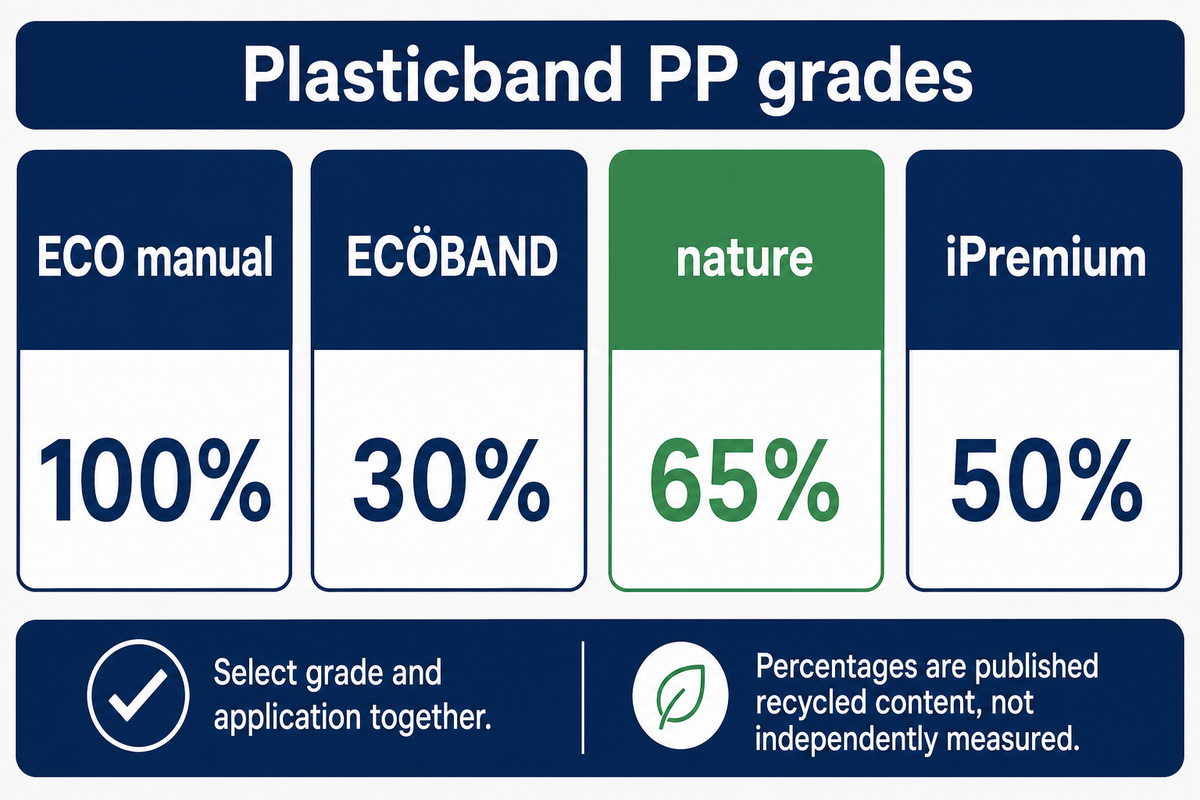
Plasticband’s published PP portfolio distinguishes recycled-content grades by their intended work: ECO manual strap lists 100% recycled content, ECÖBAND lists 30%, nature lists 65% and iPremium lists 50%. For a procurement team working to a recycled-material requirement, these named grades provide a more useful basis for selection than treating the entire company’s PP output as one environmental specification. The Granollers manufacturer also offers customized strap and reports RecyClass recognition, while its current history traces the business to 1978. The tradeoff is that recycled percentage and application must be selected together: the manual ECO grade doesn’t become the right automatic-machine consumable simply because it carries the highest published recycled-content figure.
14. Comosa Strapp: Best for spanish PP procurement with integrated packaging support
Headquarters: Ripollet, Barcelona, Spain · Founded: Not publicly disclosed · Type: Spanish strapping manufacturer
Official website: comosastrapp.es
Main products: Manual, semiautomatic and automatic PP strap
Certifications / history: Company reports AENOR recycled-plastic certifications for PP, PET and black manual PP (according to the company).
Comosa Strapp reports PP production from 1988 and supplies manual, semiautomatic and automatic strapping within a published 5–19 mm range. Its Ripollet base and wider packaging offer make it relevant to Spanish buyers who want to discuss the consumable together with machinery, service and the way the packing station operates. The company also reports AENOR recycled-plastic certifications that distinguish PP, PET and black manual PP, so the named material category matters more than a general claim that everything it makes is certified in the same way. A requirement outside the published PP width range calls for a different specification discussion, and the 1988 production milestone shouldn’t be confused with an exact legal founding date for the company.
Asian and Export-Focused PP Strap Manufacturers
15. Scientex: Best for volume export orders including narrow automatic PP
Headquarters: Shah Alam, Malaysia · Founded: 1968 · Type: Packaging group manufacturing PP through Scientex Tsukasa
Official website: scientex.com.my
Main products: Machine, hand and heavy-duty PP strapping
Certifications / history: Scientex Tsukasa Strapping lists ISO 9001:2015 management-system certification (according to the company).
Scientex began PP strapping production through its Tsukasa partnership in 1997, within a Malaysian group established in 1968, and identifies production in Melaka. Its product range separates machine, hand and heavy-duty PP grades, including 5–19 mm machine strap and narrow 5 mm material for printed-product bundling, which supports a fit for volume export procurement serving different packing stations. Published manufacturing descriptions include processing steps such as embossing and annealing, while the group’s certification page identifies the Scientex Tsukasa Strapping management system. Hand-grade widths begin at 12 mm, so the purchasing specification needs to name the grade as well as the width; a 5 mm machine product isn’t interchangeable with the hand-grade range simply because both are PP.
16. Jia-Min: Best for antistatic PP for electronics packaging
Headquarters: Taichung, Taiwan · Founded: 1987 · Type: Taiwanese PP strapping manufacturer
Official website: www.jm-pack.com.tw
Main products: Machine-grade, printed and antistatic PP strapping
Certifications / history: Company history lists ISO 9001:2008 as a historical credential (according to the company).
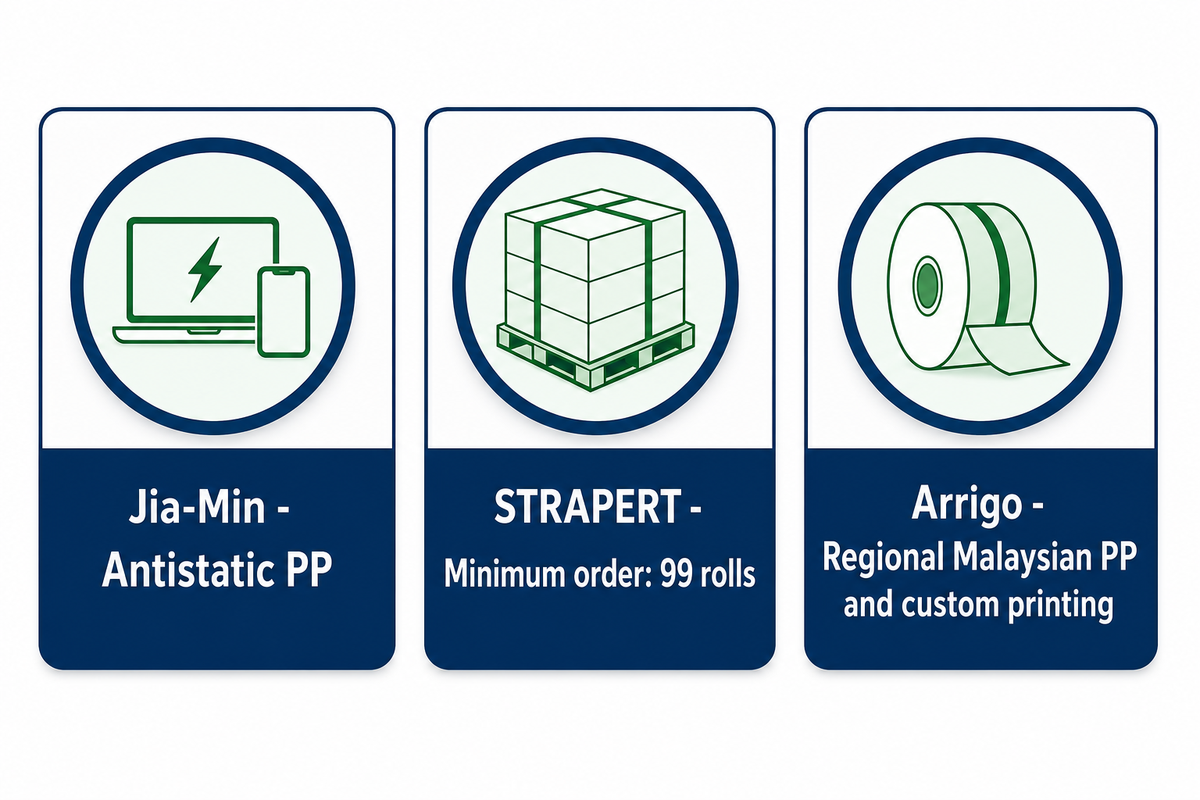
Jia-Min manufactures polypropylene strap in Taiwan and has developed machine-grade, printed and antistatic products rather than limiting its offer to undifferentiated packing band. The antistatic line makes it a relevant candidate for electronics packaging where the strap’s electrical behavior becomes part of the packaging specification alongside dimensions, joint performance and feeding. Its history distinguishes a 1986 predecessor from the current company’s 1987 establishment and later extrusion-factory development, while printing in up to three colors adds identification options for controlled production flows. Antistatic behavior belongs to the selected grade, not to every PP reel from the factory; the historical ISO 9001:2008 reference describes a past management-system credential, separate from the selected application’s performance.
17. BETEC: Best for vietnam-based PP sourcing through an international group
Headquarters: Walnut, California, USA · Founded: 2019 · Type: Packaging manufacturer with Vietnam operations
Official website: betecgroup.com
Main products: Manual, semiautomatic and automatic PP strapping
BETEC describes itself as a packaging manufacturer and publishes a distinct polypropylene-strapping range, with Vietnam operations beginning in 2023 after the U.S. group was established in 2019. That structure is relevant to buyers looking for PP production in Vietnam with an international commercial contact rather than assuming that the headquarters address is also the shipping origin. The product range covers manual, semiautomatic and automatic applications, allowing an enquiry to identify the packing method before discussing a nominal strap size or order volume. Because manufacturing and commercial locations differ, the quotation needs to specify the producing operation and dispatch point; this is a practical freight and replenishment consideration for the buyer, not a reason to treat all group locations as interchangeable factories.
18. STRAPERT: Best for pallet-quantity custom PP export orders
Headquarters: Xinxiang, Henan, China · Founded: 2001 · Type: Brand of Xinxiang Yongsheng Packaging Material Technology Co., Ltd.
Official website: www.ysstrapping.com
Main products: Machine-grade and custom polypropylene strap
STRAPERT is the PP strapping brand of Xinxiang Yongsheng Packaging Material Technology Co., Ltd., which dates its business to 2001 and explicitly describes its own polypropylene production. Its published 5–16 mm offer and custom-order route make it relevant to buyers sourcing pallet quantities of machine-grade PP from China, especially when width, color and reel format must be specified together. A published minimum order of 99 rolls is the main procurement constraint: a small packing station testing a few coils may find that quantity more important than the availability of additional customization options.
19. Changcheng: Best for specification-led PP quotes using dimensions and linear weight
Headquarters: Foshan, Guangdong, China · Founded: Not publicly disclosed · Type: Plastic-strapping manufacturer
Official website: packaging-strapping.com
Main products: Manual and machine-grade polypropylene strap
Changcheng publishes detailed PP specifications covering dimensions, weight per metre and coil information, and states that it has produced polypropylene strapping since 1993. That makes the Foshan manufacturer useful to a buyer trying to compare quotations on a common material basis, because a nominal width alone can hide differences in thickness, footage and resin consumed per package. Its range includes manual and machine applications with listed widths from 5 to 16 mm, giving the enquiry a concrete set of product parameters instead of relying on a generic export description. The published standard range stops at 16 mm, and the 1993 PP-production milestone should be kept separate from an exact company-incorporation year.
20. Arrigo: Best for regional Malaysian PP supply and custom printing
Headquarters: Klang, Selangor, Malaysia · Founded: 2004 · Type: PP strapping manufacturer with Klang and Kapar factories
Official website: www.arrigotrading.com
Main products: Embossed, printed, manual and machine-grade PP strap
Arrigo’s company name includes Trading, but its own website describes PP manufacturing at factories in Klang and Kapar. The Malaysian business dates to 2004 and lists embossed PP in 9, 12, 15 and 19 mm widths for manual, semiautomatic and fully automatic packing, together with printing options. Those facts support a fit for regional Malaysian buyers who want to discuss a standard machine grade and branded strap with the same local manufacturing operation. Its published width list starts at 9 mm, so a narrow 5 mm automatic-bundling requirement belongs with another product range; the presence of 19 mm PP also doesn’t by itself make that grade a substitute for PET on every heavy load.
How to Choose a Polypropylene Strapping Manufacturer
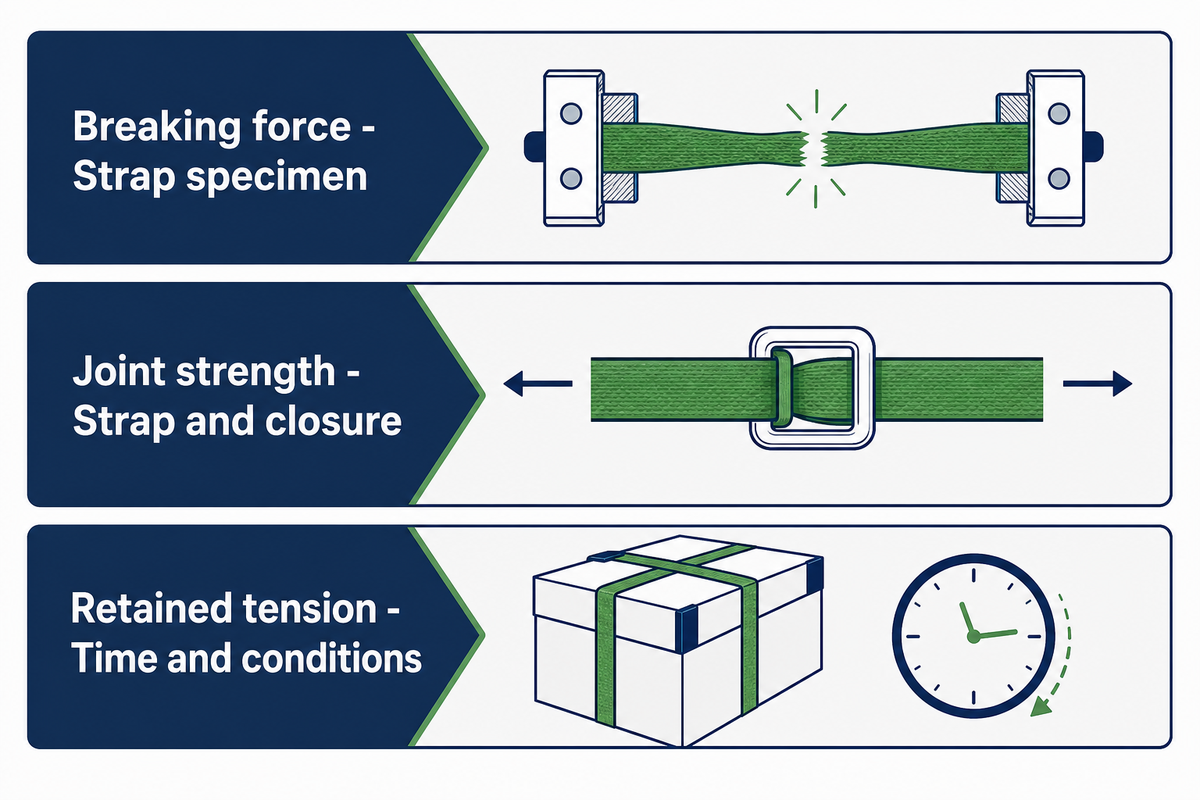
This enquiry determines the criteria against which the performance of the packaging system will be assessed prior to evaluating strapping products or requesting quotations. For the packaging engineer, a specification is of no use if it can’t be implemented. Warehouse operations require packaging coils, which operate continuously through a full shift. Intervention during a shift reduces its usefulness. These requirements, coupled with procurement requirements of equivalent offers, help refine the manufacturer’s shortlist for sample testing.
1. Describe the load and distribution cycle
To begin, specify the type of product, its dimensions and weight, the number of cartons in a pallet, the number of straps in a package, the mode of transport and its duration, as well as whether it will be stored for a long period and if it will be handled outdoors. Also provide the label of a strap in its current form as well as photographs of the packaged load showing edges and corners as well as folds and joints. A compact carton designed for local travel presents different requirements from a pallet which settles while being transported over a long distance.
Within the packaging industry, PP strapping is suitable for lightweight packs, while polyester strapping is used for heavier and bulkier loads. Other demands and the nature of handling applications also determine the type of strapping to be used. For heavier duty applications, compare PP with PET and steel strapping; securing light cartons presents a different material-selection problem. For packaged loads, the outcome can be altered by the type of equipment and the method used for corner protection and joining. This site’s guide can assist in selecting the appropriate material. To determine the appropriate strap count, one should consider the nature of the equipment as well as the purpose for which the package will be used. Don’t make the mistake of dividing a package weight by a catalog break to obtain a strap count.
2. Specify width, thickness and the complete coil
“12 mm PP strap” is an incomplete purchase description. Add thickness, dimensional tolerances, linear weight where relevant, coil length, core dimensions, outer diameter and permitted coil weight. The same width can cover different cross-sections, stiffness and break strengths, while an otherwise suitable reel may not fit the dispenser or feed consistently from it.
Ask potential suppliers to provide quotes in the same measurement base. A cheaper price per roll may represent a smaller amount of total footage. A lighter coil may represent thinner material, rather than more efficient packaging. After removing the core and other packaging, report the net weight of the strap and compare prices on a per kg basis. Be aware of the ranges published by manufacturers; an upper width limit for a strap specification may not always be paired with the upper thickness limit. The code, drawing or specification identifying the item to be purchased should be attached to the purchase order and maintained for all subsequent purchases.
3. Separate breaking force, elongation, recovery and retained tension
Breaking force is the force required to break a strap specimen and is expressed in newtons or kilogram force. Tensile strength is the maximum tensile stress, calculated as force divided by cross-sectional area and expressed in megapascals. When ordering, specify the minimum breaking force for the required thickness and width of the specimen under a stated test method. Comparing tensile strength of different size strap specimens won’t determine which will support a greater load. A “high tensile strength” claim still needs the minimum breaking force for the purchased dimensions.
Elongation is the extent of extension under a given load. Recovery is the extent to which extension is recovered when a load is partially or wholly removed. Retained tension is the tension remaining in a strap after a specified time under stated conditions. A strap may lose tension through creep under a prolonged load or as the package settles under compression. The extent of elongation of PP varies among different grades of PP and is generally greater than PET, so no single percentage applies to every PP grade. It’s recommended that in all cases the strap be assessed for tension after the completion of the transportation and/or storage test to which it would be subjected.
4. Trial the machine, the strap and the joint together
For semi-automatic machines, automatic strapping machines with an arch, and high-speed production lines, test for width, thickness, straightness, stiffness, camber, surface finish, and consistency of winding and feed. Evaluate the consistency of tension and feed at the intended running speed of the machine using production coils. Watch the first and last portions of reels and note ordinary running conditions and anomalies such as coil changes and misfeeds. Also note any adjustments made to the machine to restore normal operation. The dependability of the strap to transport through the desired path is influenced by many factors and may not be determined by a tensile test. The ease of operation of the machine in threading and coil changing should also be considered. Compare machine-grade polypropylene strapping offers on smooth feeding and ease of use during the trial, rather than on a supplier’s “high-quality” label.
Each joint should be analyzed independently. Heat sealing, friction welding, metal seals, and buckles are different. Raw strap may fit the tool, but that doesn’t mean the joining methods are interchangeable. Weld settings, dwell time, cool down and the type of closure should also be documented, in addition to overlap and joint efficiency. The weakest part of the strap-joint system limits the performance potential of the system. Catalogue strap breaking strength shouldn’t be treated as the strength of a secured package. Joint strength testing is also needed. The use of strap should be reviewed against the options of strapping tool for the selected material. A package trial should be conducted for any change in the use of strap.
5. Treat printing and color as separate specifications
Polypropylene strap can be printed with text, but the lead time and minimum order quantity should be determined prior to requesting the shipment. The text should be evaluated for legibility, rub off and registration. Confirm the print color count, ink colors, artwork, repeat length and ink durability as well. A packaging department should evaluate the impact of a printed-reel change on the machine by checking the base grade and coil format.
Approve a print sample against actual application and provide any contact and abrasion exposure that the package may experience during shipping. A one-color distributor program and a three-color factory run may have different commercial constraints, even if their straps have the same width. Color alone doesn’t establish breaking strength, resin quality, ultraviolet stability, or whether a resin is of recycled content. Black PP doesn’t mean the resin is of an outdoor grade. If color is used to identify production runs or customers, it shouldn’t be confused with a technical grade code.
6. Include temperature, sunlight and time in the trial
Temperature and UV exposure may cause changes in the strap, so test the strap and the package under intended exposure conditions. The effects of exposure may vary, based on the UV stabilizers and other additives in the resin. The presence of a dark colorant may not ensure adequate UV stability. For outdoor storage, specify UV stabilization, exposure duration, temperature range and test conditions; a short indoor trial cannot establish long-term outdoor suitability. A statement about the potential for the strap to be recycled doesn’t mean that the strap is of sufficient strength to withstand exposure to the conditions it may experience during extended storage.
The strap of a package should be evaluated at the various temperatures (e.g., at the temperatures of a refrigerated or cold warehouse) which may be encountered during transport. Also the brittleness and flexibility of the strap, and the performance of the joint, may vary with temperature and need a conditioned package trial. Reach an understanding on sample conditioning and requirements for a shipment lot before purchasing. Evaluate the complete package as it will be shipped, including the package material: an intact strap may cut into a carton edge or lose tension as the package compresses.
7. Keep recycled content, testing and certification distinct
For PP with a claimed “sustainability feature,” determine if the recycled material is post-consumer or post-industrial, its percentage, and if the claim covers physical recycled content or a mass-balance approach. Identify the grade, color, factory and batch and ensure the recycled-content claim is controlled. Recycled content and recyclability are different, and an “eco” name doesn’t provide recycled content level.
Request the certificate and its scope where certification is claimed, alongside current dimensional, breaking-force, elongation and joint-test documentation. An ISO management-system certificate concerns how an organization operates, while a recycled-content certificate addresses a different claim. The ASTM D3950 specification for nonmetallic strapping and joining methods defines a specification framework; the official catalogue identifies D3950-23 as its active edition. Use wording such as “tested against specified ASTM D3950 requirements” only when the test evidence supports it, rather than calling an ordinary test report “ASTM certification.”
8. Compare cost per successfully secured package
Compare quotations against the same approved specification, and study the performance of the material during trial processing and handling before awarding production contracts. Document the behavior of the material during usage, and measure lost time, idling time, downtime, and “loss in the system.” Rework time and jams should also be documented. Meters used and straps per package should also be recorded, as well as the number of failed joints and any re-strapping. Record jams and maintenance done on the machine. Also record the behavior of the material during transit, and any material or package damage. The behavior of the material during processing should also be recorded. Freight and delivery costs, coil changes, minimum-order inventory, and printing setup costs should also be considered. A low price per meter should be balanced against additional time lost, and the amount of material used.
The costs associated with strapping, closure, labor, rework and interruption should be divided by the number of packages successfully secured under the acceptance criteria to determine the average cost for the trial. If major damages occur, they shouldn’t be averaged and hidden amongst other packages. There’s no universal price for PP strap that replaces this package-level cost comparison. The objective of the trial should be to identify an economical strapping solution for the packaging operation to transport the package in a cost-effective manner and in a manner that the warehouse can replenish.
Frequently Asked Questions
Which is the best polypropylene strapping manufacturer?
The best polypropylene strapping manufacturer depends on package weight, required break load, machine type, joint method, storage conditions and purchasing volume. Mosca is worth considering for automatic carton lines, Samuel Packaging for digitally printed PP, and Teufelberger for documented recycled-content black PP. These are application matches based on published capabilities, so the final selection should follow a trial using your package and equipment. Compare delivery terms and minimum quantities as well, because an unsuitable order size can outweigh a feature.
Which PP strapping manufacturer is best for automatic machines?
The best fit for automatic machines is a producer whose machine-grade PP matches your feed path, sealing system and coil format. Mosca, Greenbridge, StraPack and Scientex publish relevant PP products or production capabilities. Compare dimensional consistency, camber, winding and heat-seal behavior, then run production coils at the intended operating speed rather than accepting nominal breaking force as the only criterion. Include normal operators and representative package variation in the trial so the result reflects everyday production conditions.
Is polypropylene strapping stronger than PET strapping?
PP strapping is generally selected for lighter applications, while PET strapping typically provides higher strength and better retained tension for heavier industrial loads. The comparison still depends on the actual dimensions and product grade. A wider or thicker PP strap can have a different breaking force from a smaller PET strap, so compare complete specifications and joint performance rather than material names alone. Elongation recovery and long-term tension loss should also be assessed under the expected storage and transport conditions.
What is polypropylene strapping used for?
Polypropylene strapping is commonly used to unitize cartons, parcels, printed materials and light-to-medium bundles for handling, storage and transport. Match the grade to breaking force, distribution conditions, joint and equipment; hand-grade and machine-grade products suit different application methods and coils.
Are Chinese polypropylene strapping manufacturers reliable?
Some are, but country of origin alone isn’t a sufficient supplier qualification criterion. Check actual PP extrusion, dimensions, breaking force, elongation, coil quality and test documentation. STRAPERT and Changcheng publish useful manufacturing information; a production machine trial remains essential.
How much does polypropylene strapping cost?
PP strapping prices vary with resin cost, recycled content, width, thickness, color, printing, coil format, order quantity and destination. Compare equivalent specifications and delivery terms, including failures and downtime. Cost per successfully secured package is more useful than price alone.
Request a PP-versus-PET Application Review
Job requirements shift the type of products needed to create a shortlist. Automatic bundling, hand strapping, printed identification, and recycled-content requirements call for different products to be considered. Let’s compare product strengths against the application requirements. Let’s look at the application specifics like strap dimensions, minimum breaking force, elongation, joint, and the equipment and distribution situation and compare manufacturers’ published PP ranges.
UD Packaging produces PET strapping and carries out PP-versus-PET material reviews for the packaging industry. For more information, send the details of your current PP strap label, width and thickness, weight and dimensions of the pack, joint and machine model to request an application review or quotation. This will assist in assessing the end use requirements.
Related Articles
- Compare the main types of plastic strapping
- Choose strapping for boxes and cartons
- Match strapping to the machine and packing process
- Understand the components of an industrial strapping system
- Choose a strapping material for the load
Sources and Research Notes
References & Sources
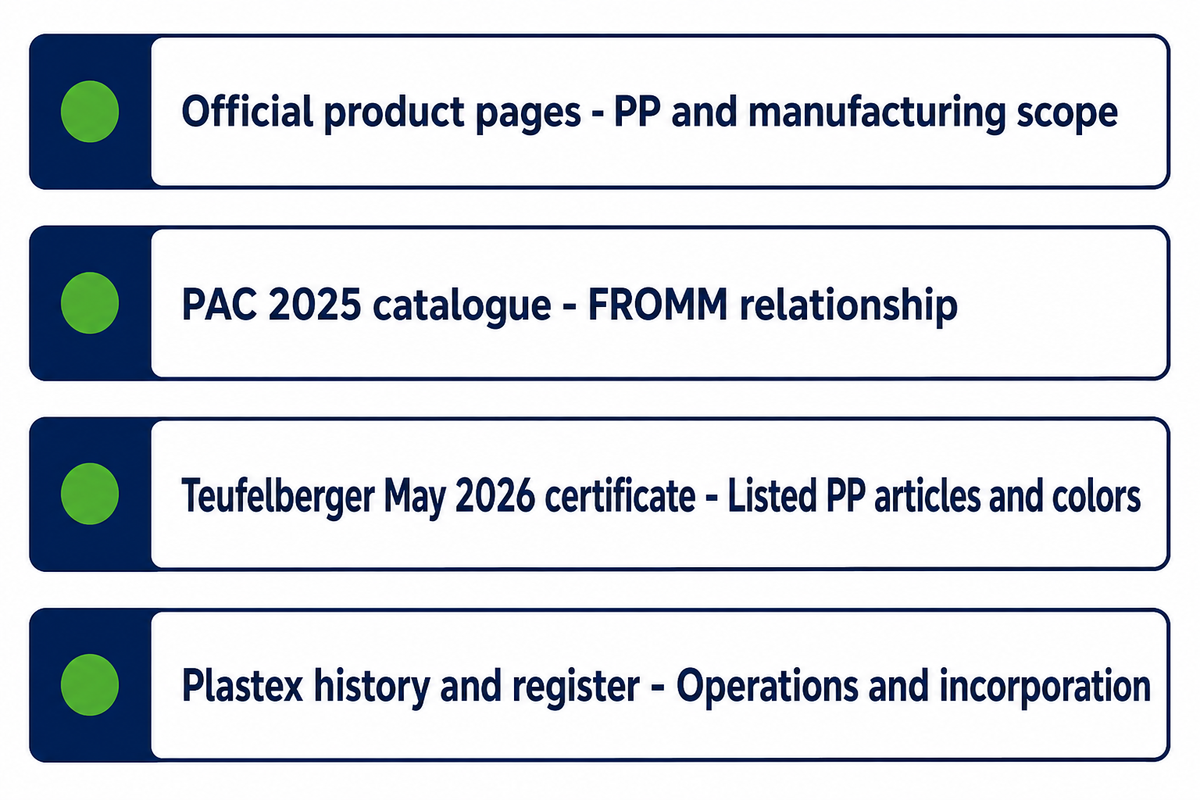
Company facts come from the manufacturers’ official history, product, manufacturing and certification pages reviewed in September 2026. Each profile and the comparison table identify the official website in plain text. Particularly useful documents include PAC’s 2025 product catalogue for its FROMM relationship, Teufelberger’s May 2026 OK recycled certificate, Plasticband’s grade-specific PP product page, and the Plastex business history alongside the Plastic Extruders Limited company register. Older milestones are identified as historical; a 2026 review date doesn’t mean every source was first published in 2026.

![Plastic Strapping Types: PP vs PET [Buyer Guide]](https://udpackaging.com/wp-content/uploads/2026/08/plastic-strapping-types-featured-150x150.png)