Get in touch with UD Packaging Company

Updated August 2026 · Written by Cherry
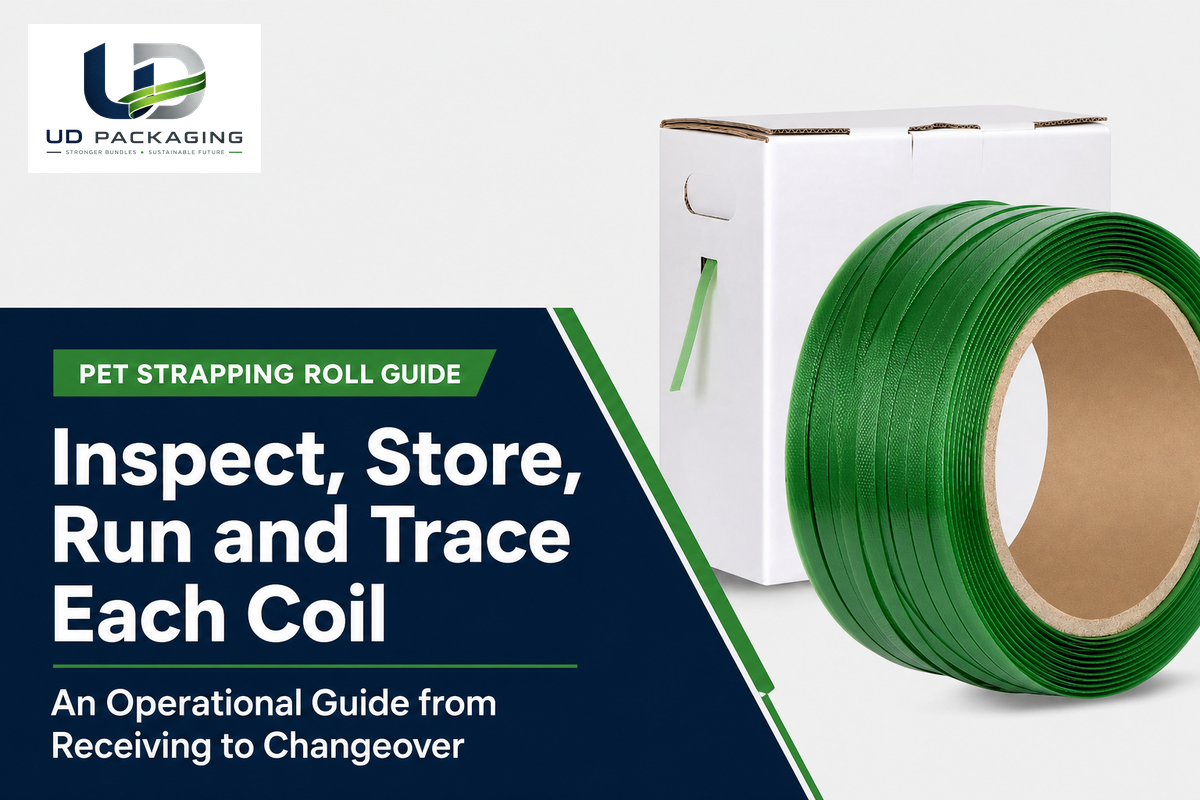
A PET Strapping Roll is a coil of polyester strap supplied on a core for controlled pay-off through a dispenser, tool or strapping machine. Manage each roll as a working input: identify it, inspect the winding, store it correctly, match it to the dispenser, load it by the equipment manual, verify the first completed joint, and keep the result tied to the roll ID.
Quick answer
PET strapping roll identity includes the strap profile, winding, core and coil format. Production release comes only when those interfaces fit the dispenser and the first completed package passes your local check.
Quick operating map
| Lifecycle | 7 controlled steps from receipt to traceable changeover |
|---|---|
| Compatibility | 5 interfaces: strap, winding, core, dispenser and application equipment |
| Release decision | Inspect the completed package, not the roll label alone |
| Commercial next step | Use the PET strapping roll sizes and supply page for grades, dimensions, documents and quotation |
Key points before you start
- Matching strap width does not prove that the core, coil, dispenser and feed system are compatible.
- Each new roll needs its own release result; verify the first completed package after every change.
- Feed faults may start at the roll, dispenser, guide path, tool, joint or load.
- Use plant records and supplier instructions for tolerances; this guide intentionally avoids made-up universal limits.
1. Treat a PET Strapping Roll as Five Linked Interfaces
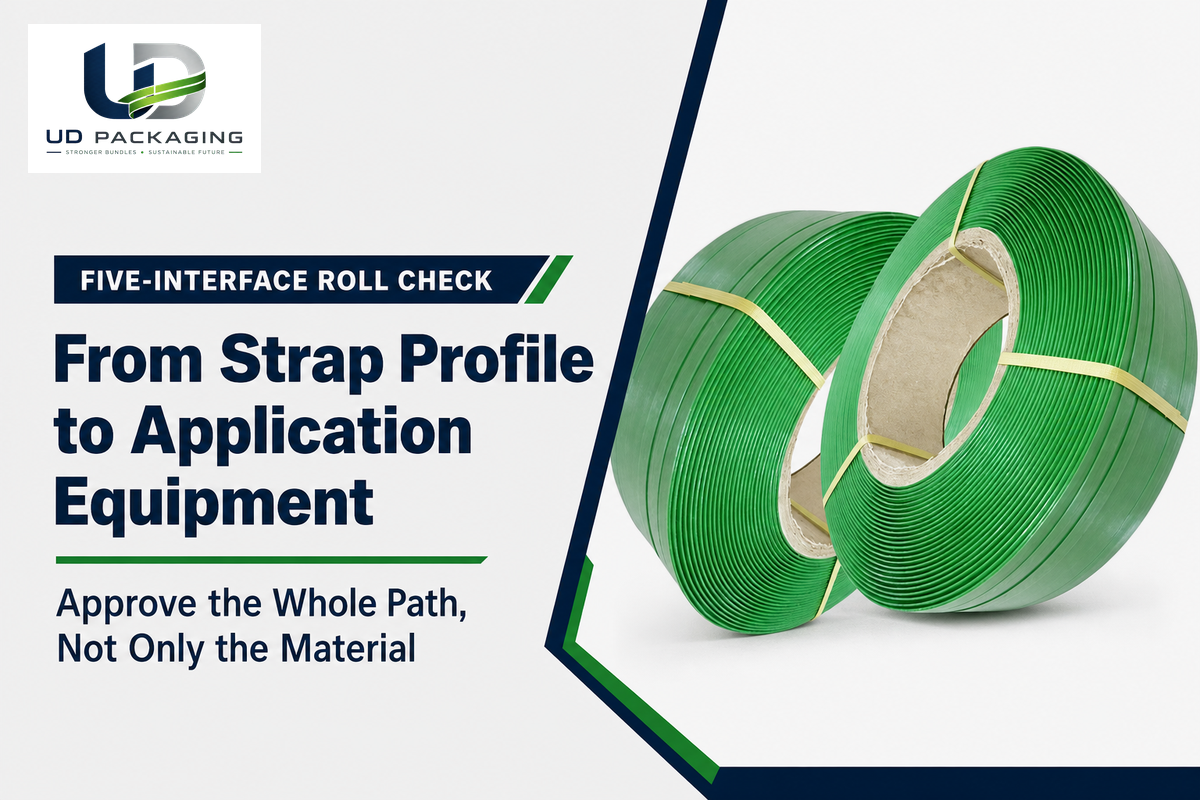
Every usable strap roll has five linked interfaces: the strap profile, the winding, the core, the dispenser and the application equipment. Width and thickness describe the strap, but stable pay-off also depends on coil geometry, core fit, restraint and the path into a manual tool or strapping machine.
Some teams call the material polyester banding, but the operating question stays the same: does this specific coil fit the full application path? Even a strapping kit that bundles a tensioner, sealer and accessories cannot prove that its roll matches a separate machine or dispenser.
This is the Five-Interface Roll Check. It prevents a common troubleshooting error: approving the material certificate and then assuming every feed problem must be a machine fault. Blaming a new roll before checking the brake, dancer, guides or tool setup creates the opposite error.
| Interface | What to match | Failure signal | Boundary |
|---|---|---|---|
| Strap profile | Material, width, thickness, surface and grade | Poor tracking, feed or joint formation | Use the approved product specification |
| Winding | Edge condition, coil shape and layer stability | Spill, rub, telescope or intermittent feed | Hold visible transport damage for review |
| Core | Inside diameter, face width and structural condition | Poor capture, wobble or flange contact | Follow reel and supplier limits |
| Dispenser | Reel support, brake or dancer and pay-off direction | Overrun, excess drag or strap twist | Use the dispenser manual |
| Application equipment | Feed path, tensioning and joining method | Fraying, inconsistent tension or open joint | Validate the complete package |
ASTM D3950 for nonmetallic strapping separates applicable strap and joint properties for packaging and shipping work. That distinction matters on the line: an acceptable break-strength value does not, by itself, confirm the completed joint.
2. Inspect the Roll Before It Enters Stock
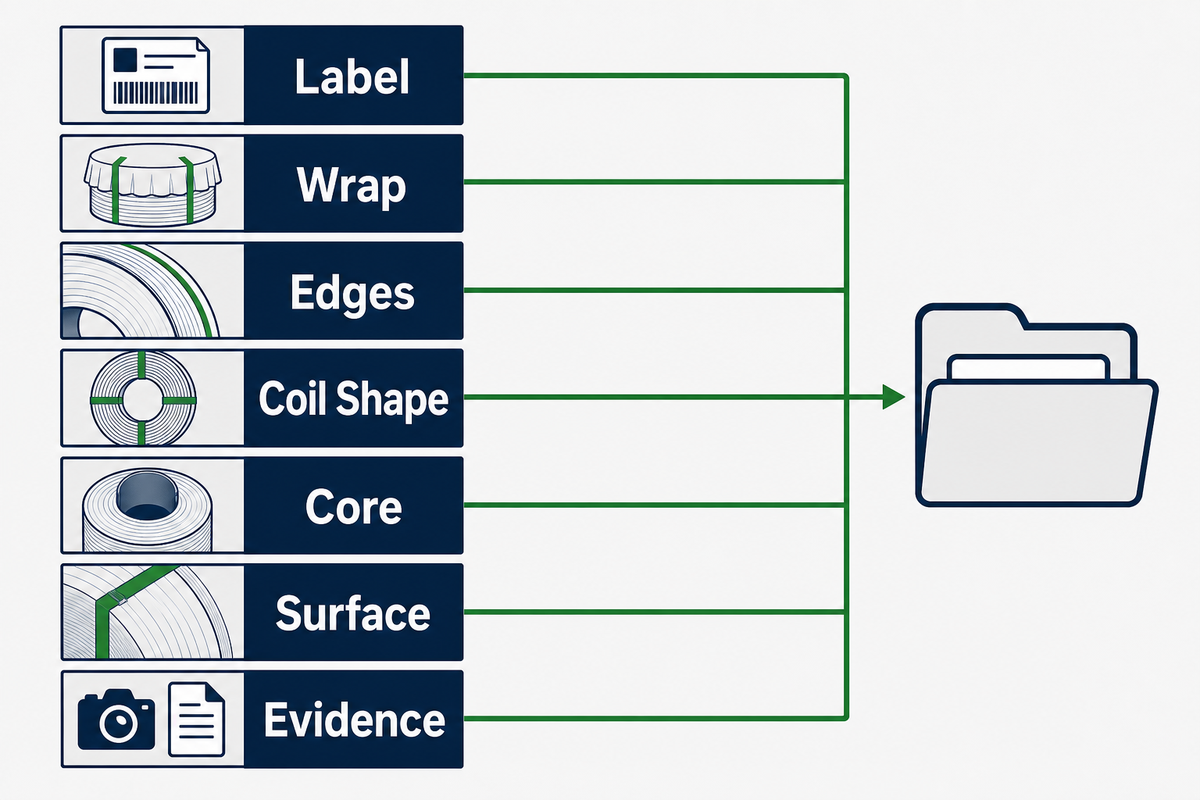
Receiving inspection should decide whether a roll is released, held for review or rejected before its identity is lost in warehouse stock. Check the supplier label against the purchase specification, then inspect the protective wrap, edges, coil shape, core and visible contamination without removing restraints prematurely.
Do this at the dock because later evidence becomes ambiguous. Once wrap is discarded and a coil has moved through several storage locations, the team may no longer know whether an edge defect came from transport, internal handling or the dispenser.
| Check | Record | Release | Hold for review |
|---|---|---|---|
| Label | Supplier, lot, roll ID and ordered profile | Matches the approved order | Missing or conflicting identity |
| Wrap | Tears, punctures and water marks | Protective barrier intact | Damage reaches the coil |
| Edges | Cuts, crushing, chips or loose layers | Even and protected | Visible deformation or exposed damage |
| Coil shape | Dishing, telescope or side shift | Layers remain aligned | Shape may affect capture or pay-off |
| Core | Cracks, crushing and out-of-round appearance | No visible structural damage | Damage may prevent stable mounting |
| Surface | Oil, dust, water or foreign material | Clean under approved packaging | Contamination could reach feed or joint surfaces |
| Evidence | Photos, delivery note and inspector | Record is complete | No traceable evidence for a disputed roll |
Do not invent acceptance tolerances at the dock. If a supplier drawing or internal specification defines allowed telescope, edge damage or core deformation, use those values. If it does not, quarantine visible damage and ask for a documented disposition.
3. Store, Condition and Rotate Polyester Strapping Rolls
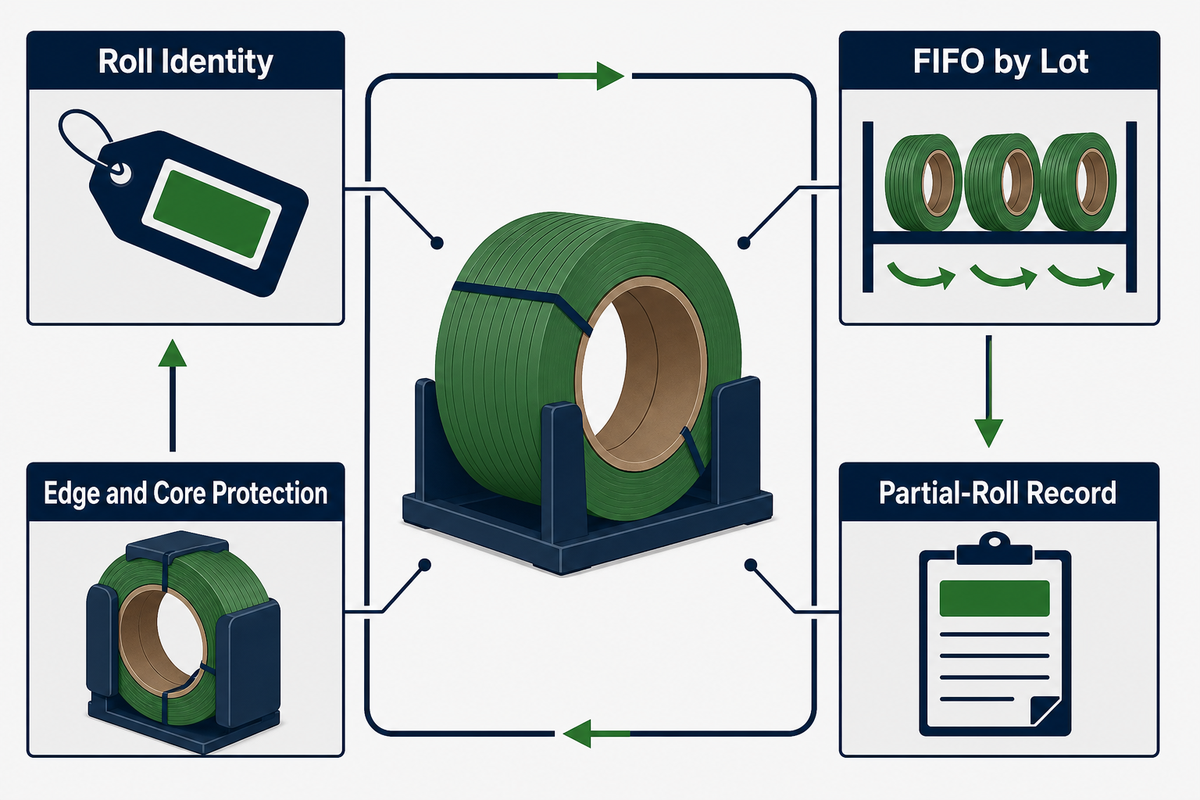
Polyester strapping rolls should remain identified, supported and protected from impact, contamination and uncontrolled exposure until the line needs them. Storage orientation and stacking must follow the supplier’s packaging instructions, while the warehouse record preserves lot order and prevents a partially used coil from becoming an unidentified leftover.
OSHA materials-handling guidance sets a useful general boundary: stored material shouldn’t create a workplace hazard, and storage areas should remain orderly. It doesn’t set PET coil temperatures or stacking patterns; those details belong to the roll supplier and your facility procedure.
Do
- Keep every roll label linked to the physical coil.
- Use first-in, first-out control by lot and receipt date.
- Protect edges and cores during internal movement.
- Record the identity of every returned partial roll.
Don’t
- Leave a loose strap end across a travel path.
- Stack rolls by convenience when packaging forbids it.
- Move a damaged coil into production without disposition.
- Mix unlabeled partial rolls at the machine.
When storage and production environments differ, let the roll reach the line condition specified by the supplier before release. Avoid universal conditioning times: coil mass, packaging, ambient difference and supplier instructions change the answer. Useful control comes from a recorded transfer time and a site-approved rule, not an unsupported number.
4. Match Core, Coil, Dispenser and Pay-Off Direction
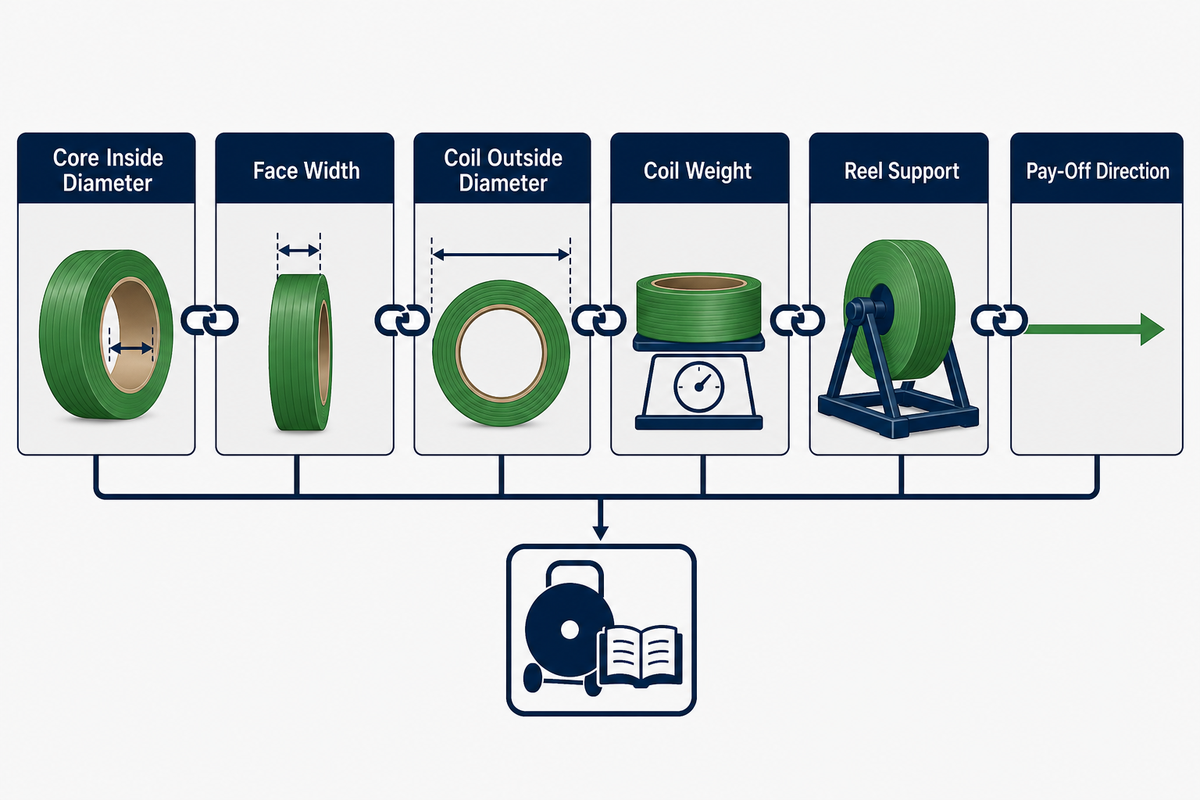
Core and coil compatibility requires more than checking strap width. Match the core inside diameter, face width, outside diameter, coil weight, reel support, flange capture and required pay-off direction to the dispenser manual. Any mismatch can change drag, alignment or overrun before the strap reaches the tensioner.
Commercial PET strap sheets commonly separate width, gauge, footage and coil fields because different equipment accepts different formats. UD Packaging’s PET strapping roll solution page is the correct place to confirm available dimensions and supply options; this article focuses on how to release the chosen roll at the line.
- Read the reel plate — capture the allowed core and coil format from the dispenser or machine manual.
- Read the roll label — match material, profile, core, lot and roll identity to the approved order.
- Inspect the capture — confirm the coil sits squarely and the retaining parts engage as designed.
- Confirm pay-off direction — route the leading end in the direction shown by the equipment maker.
- Check free movement — verify that the coil does not rub a flange or frame before production starts.
Dispenser faults and coil-format faults can look alike. Excess drag may come from coil rub, incorrect capture or an over-tight brake. Overrun may come from weak braking, incorrect restraint or damaged winding. Change one variable at a time and record the result.
Don’t carry over polypropylene reel settings to PET automatically. Both are plastic strapping materials, but the approved strap profile, coil format, feed behavior and joining setup must come from the equipment and material specifications used at your site.
5. Load and Thread the Roll Without Creating a New Fault
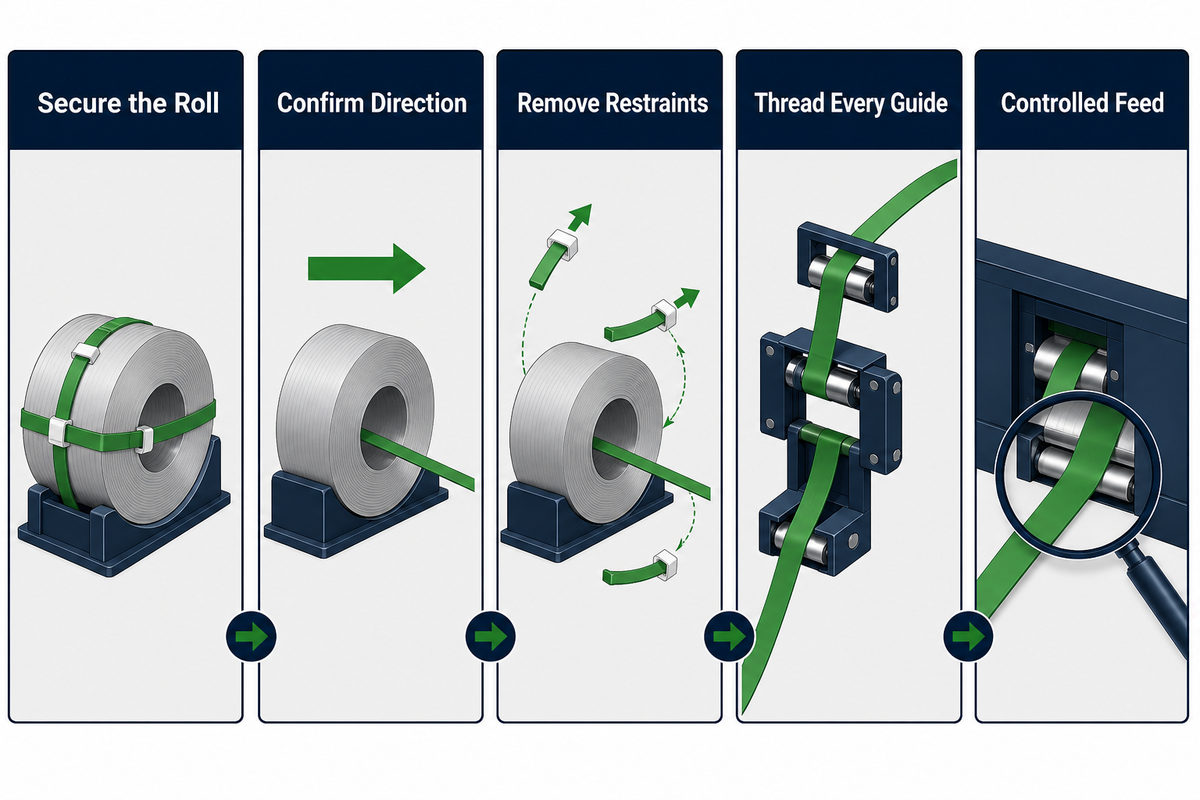
Loading should follow the exact machine or dispenser manual, with equipment isolated as required and the coil controlled before its retaining bands are removed. The reliable sequence is to secure the roll, confirm direction, remove restraints in the required order, thread every guide, and inspect the first meters during a controlled feed.
Equipment designs vary too much for a universal button-by-button procedure. Carts, stand-alone dispensers, semi-automatic table machines and automatic arch machines do not share the same brake, dancer, accumulator or auto-feed sequence. Your installed model manual therefore outranks any generic online checklist.
Operating boundary
Keep restraints on until the coil is captured when the equipment manual requires that order. Releasing a free coil first can allow layers to shift before the reel controls them.
During the first controlled feed, watch where the fault first appears. Visible twist before the first guide points back toward pay-off direction or the coil. Fraying that begins only after a guide points toward alignment, contamination or wear in the feed path. This location-based check is faster than replacing parts at random.
After threading, clean up the work area, secure the free end as the dispenser maker directs, and record the installed roll ID. That record now connects any later fault to a specific coil, machine, operator and time window.
6. Verify the First Completed Package After Every Change
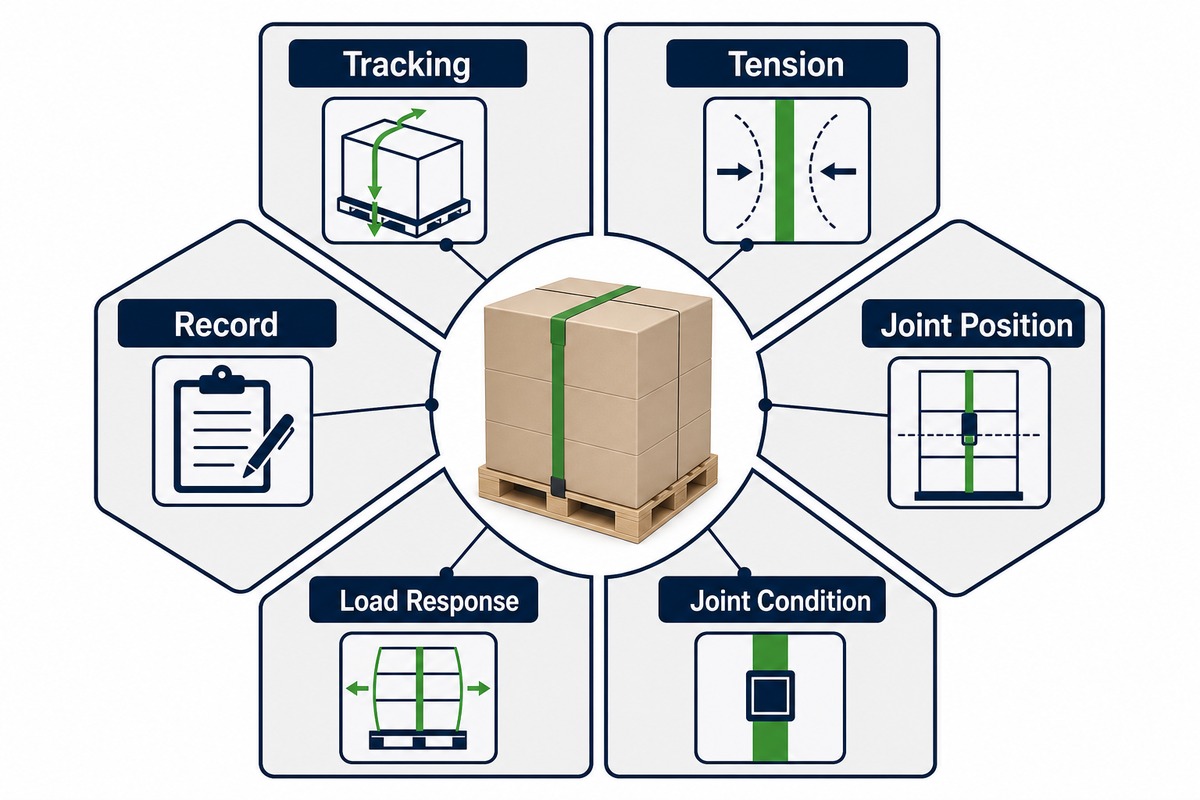
First-off verification should release the completed strapping system, not only the raw strap. Check tracking, tension response, joint position, joint formation, edge protection and load behavior against the approved package standard. If any result is unclear, stop and correct the cause before normal production resumes.
“The need for thorough user testing is to be emphasized.”
In practice, a catalog value can’t predict every combination of load geometry, edge condition, joint method, tension setting, handling event and distribution route. ISTA’s test-procedure framework also distinguishes screening work from general simulation and asks users to select a test that fits the intended outcome.
- Tracking: the strap enters, travels and exits without edge contact or twist.
- Tension: the approved setting produces the expected package response without damaging the product or edge protector.
- Joint position: the joint lands where the package design expects it.
- Joint condition: the seal, buckle or friction-weld area is complete and visually acceptable under the site rule.
- Load response: compression, corner contact and strap path match the released package.
- Record: the operator signs the roll ID, machine and result before the line returns to normal speed.
Break strength and joint strength are separate characteristics under ASTM D3950. A first-off check that looks only at the strap label misses the joining system, the part that actually closes the loop around the load.
7. Troubleshoot the Fault Signal Before Blaming the Roll
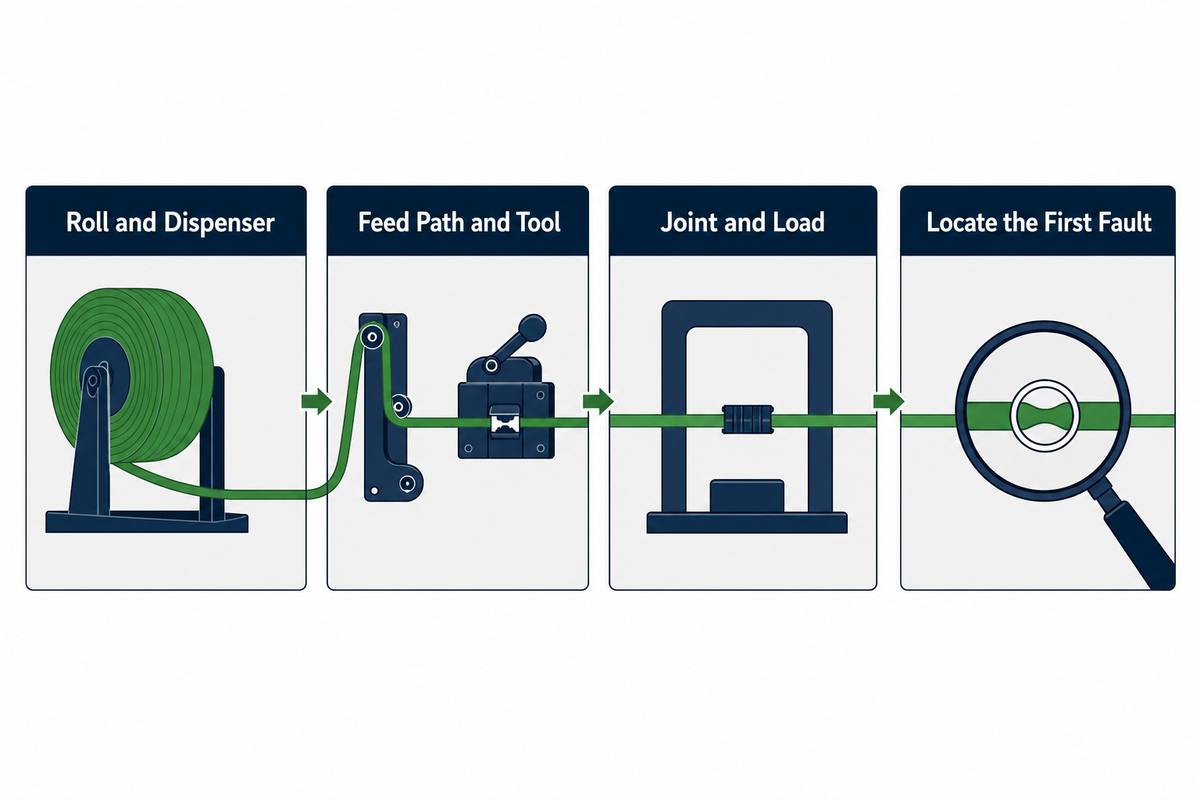
Troubleshooting works best when the team identifies where the fault first appears, then isolates one subsystem at a time. Start with the roll and dispenser, continue through the feed path and tool, and finish at the joint and load. Timing a fault to a new roll is evidence, not proof of cause.
| Fault signal | Check first | Then isolate | Hold the roll when |
|---|---|---|---|
| Coil spills or bird-nests | Restraint and brake | Pay-off direction and winding damage | Layers shifted before controlled mounting |
| Feed hesitates | Coil rub and edge condition | Guide contamination, accumulator or feeder | Damage is visible before the feed path |
| Strap frays | Where fibers first appear | Guide alignment and worn contact points | The unwound strap already has edge damage |
| Strap twists | Leading-end orientation | Guide routing and coil direction | The coil cannot pay off in the required direction |
| Tension varies | Brake or dancer movement | Tool calibration and load compression | Coil shape creates repeatable drag changes |
| Joint opens | Joint setup and overlap | Tool condition, surface and tension | Verified contamination or profile mismatch exists |
| Coil telescopes | Receiving photos | Storage, handling and winding condition | Shape prevents safe, stable capture |
| Fault follows one roll | Repeat on a controlled comparison roll | Lot, machine, operator and time records | The fault repeats with the roll and disappears with the control |
Controlled comparison is stronger than an impression. Keep the machine setting, tool, load and operator constant; change only the suspect roll when that can be done under the site procedure. If the fault remains, the roll was probably not the sole cause. If it moves with the roll, quarantine it and preserve photos, label data and a sample.
8. Estimate Roll Usage and Build a Traceable Changeover
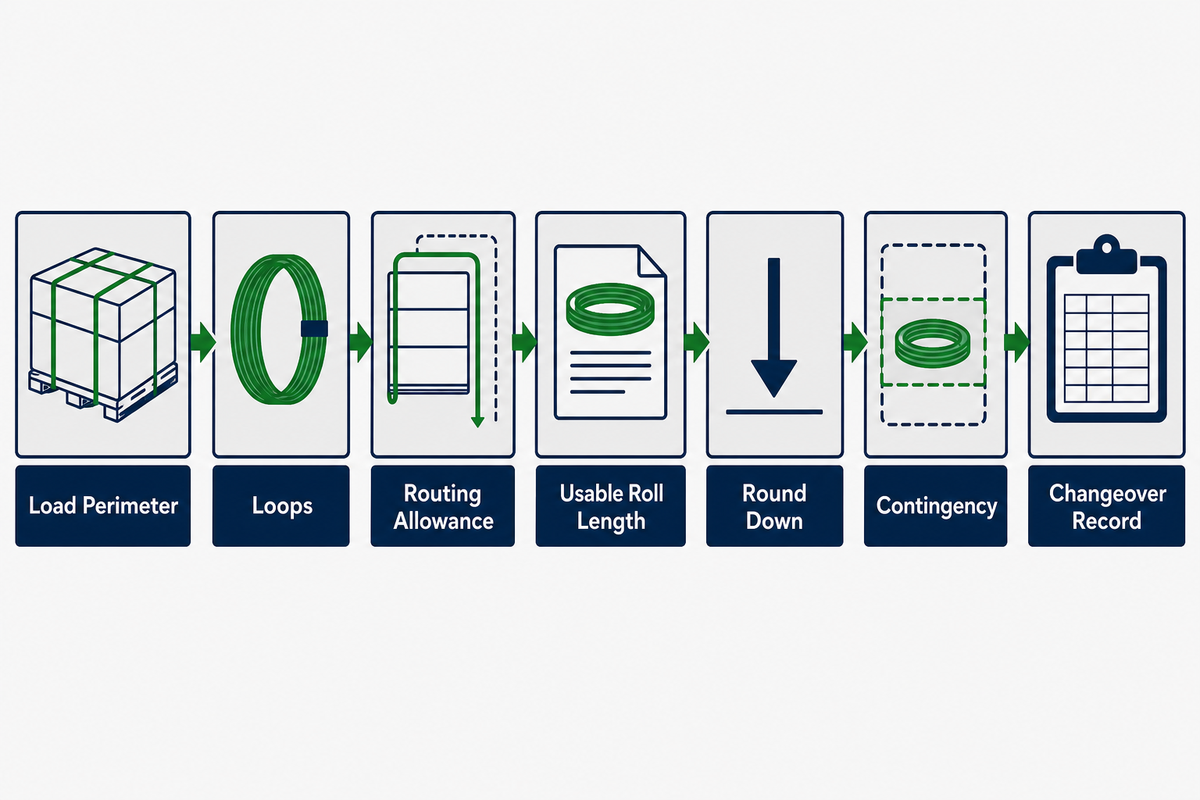
Roll planning starts with a transparent length calculation, then converts the estimate into a changeover trigger and a traceable record. Use actual load perimeter, loops, routing allowance and usable roll length from your released process. Round down to complete loads and keep a contingency for starts, samples and waste.
Usage formula
Strap per load = loops × (load perimeter + routing allowance)
Complete loads per roll = usable roll length ÷ strap per load, rounded down
Worked example: turn a roll length into a shift plan
Assume an illustrative load uses 2 loops, has a measured perimeter of 4.8 m, and needs 0.4 m of routing and joint allowance per loop. Strap per load is 2 × (4.8 + 0.4) = 10.4 m. If usable roll length is 1,200 m, then 1,200 ÷ 10.4 = 115.38, so plan no more than 115 complete loads before contingency. Replace every input with validated plant data; these numbers are an example, not a UD Packaging roll specification.
| Record field | Why it matters | Minimum entry |
|---|---|---|
| Supplier and lot | Groups related material | Label value |
| Roll ID | Separates one coil from the lot | Unique roll reference |
| Profile and core | Confirms installed format | Approved description |
| Machine or dispenser | Locates the equipment path | Asset ID |
| Install time | Defines the exposure window | Date and time |
| Operator | Supports follow-up | Name or ID |
| First-off result | Proves release status | Pass, hold or reject with reason |
| Usage | Improves future planning | Loads or measured length |
| Fault and sample | Preserves evidence | Fault, time and sample disposition |
Key takeaway
Roll-label identity starts traceability; the first-off result and changeover record make it useful when production later needs to separate material, equipment and load causes.
PET Strapping Roll FAQ
What is a PET strapping roll used for?
PET strapping rolls supply polyester strap for closing, reinforcing, bundling, unitizing and palletizing loads, but only through a released combination of roll, tool, joint and package design.
Correct application depends on the strap profile, joining method, equipment and complete package design. Use the roll only within the released combination of material, tool and load, then verify the first package. For a broader framework covering material specification, joint proof and supplier qualification, see the PET strapping specification and test guide.
Is PET strap roll size the same as core size?
No. Strap size describes the profile, while core and coil dimensions describe mounting and pay-off. Record both because matching width does not prove that the roll fits the dispenser.
Record both sets of values before release. Strap width and thickness describe the material passing through the tool, while core inside diameter, face width, coil outside diameter and weight describe how the roll sits on the reel. A matching width can still fail when the coil does not fit or pay off correctly.
How should a polyester strapping roll be stored?
Store each identified roll in clean, orderly conditions, protected from impact and contamination, using the supplier’s required orientation and stacking method. Keep the label attached and follow its conditioning instructions.
Keep lot and roll identity attached, apply first-in, first-out control, and give every partial roll a return-to-stock record. Protect edges and cores during internal movement. When the warehouse and line environments differ, follow a documented conditioning rule. Do not invent universal stacking, temperature or time limits when supplier instructions are the controlling source.
Why does a new roll feed differently?
A new roll can change coil geometry, edge condition or pay-off drag, but timing alone does not prove a material fault. Locate the first fault signal before assigning the cause.
Locate where the fault begins, then compare the roll, dispenser, guide path and tool.
How do I tell whether the roll or strapping tool caused a fault?
Locate the first visible fault, keep other variables constant, and compare one controlled roll change. A fault that follows the material is evidence; one that remains points elsewhere.
Damage visible before the first guide points toward the roll or pay-off. Damage that begins at a guide points toward alignment, contamination or wear. A joint-only fault needs a joining-method and tool check. When the procedure allows, compare a known control roll while holding the machine setting, load and operator constant, then document whether the fault moved with the material.
How many pallets can one roll strap?
Calculate strap per load from loops, measured perimeter and routing allowance, then divide usable roll length by that value and round down to complete loads.
Use measured perimeter, loops and routing allowance, with contingency for starts and waste.
When should a PET strap roll be quarantined?
Quarantine a roll when identity is uncertain, damage may affect mounting or pay-off, contamination is present, or the first-off release check fails. Preserve its label, photos and process record.
Preserve the label, delivery evidence, photos, machine and operator record, fault time and retained sample. Keep the roll in a controlled hold location so it cannot re-enter production unnoticed. Request a documented disposition against the purchase specification or supplier instruction instead of applying an unsupported tolerance after the event.
Product specifications and supply
Use the product solution page to confirm size, grade, coil format, documents and supply options, then bring the approved values into your receiving and changeover record.
Method and source boundary
This PET strapping roll guide separates warehouse and line-control decisions from the commercial specification already published on UD Packaging’s product page. It uses current ASTM and ISTA scope statements for evidence boundaries, avoids universal operating limits, and directs product or company questions to the approved UD Packaging company profile. Written by Cherry.
Related Articles
References & Sources
- ASTM D3950-23: Standard Specification for Strapping, Nonmetallic (and Joining Methods) ASTM International
- ASTM D4675-14a(2022): Standard Guide for Selection and Use of Flat Strapping Materials ASTM International
- ISTA Test Procedures International Safe Transit Association
- Getting Started with Design and Testing International Safe Transit Association
- Materials Handling and Storage Occupational Safety and Health Administration
- Paper and Packaging Standards overview ASTM International