Get in touch with UD Packaging Company

Don’t reuse plastic strapping cut from a shipment to secure another load. Use new, matched banding. Inspect recovered bands for safe handling and recycling; choose a purpose-made reusable system when repeated use is the goal.
Updated October 2026
A receiving team may find long, apparently clean bands beside a pallet. This makes buying another roll seem wasteful. However, the correct comparison is between new banding, a designed returnable strap, and an accepted recycling route. A neat piece of old plastic doesn’t come with a new strength rating.
This guidance assists warehouse managers in distinguishing scrap, engineers in specifying the replacement system and procurement teams in evaluating the full packing process. When considering new polyester options, begin with the PET strapping specifications from UD Packaging and keep the load, joint and machine requirements together.
Separate Reuse from Recycling
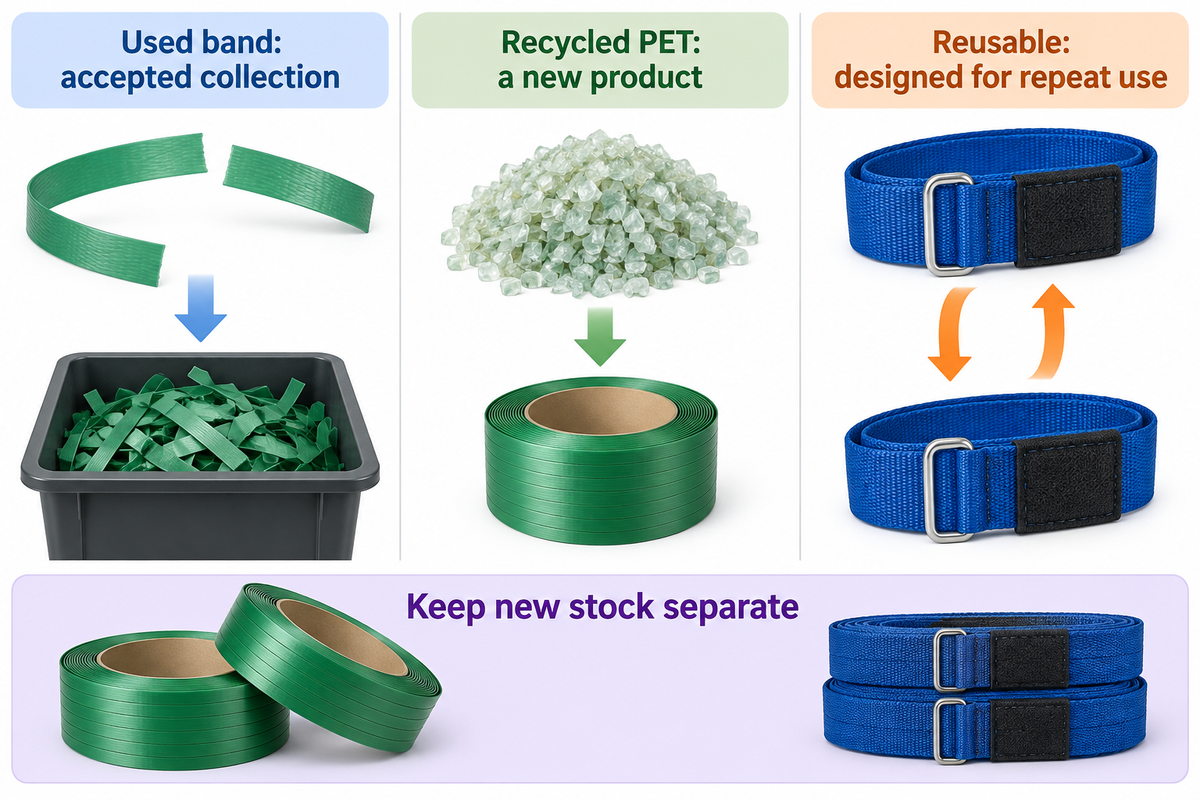
Recycling breaks down recovered material to feedstock for new products. Recycled content PET strap is a new product; it isn’t a used band that has been pulled tight again. Keeping these routes separate helps simplify a sustainability proposal.
Can polypropylene strapping be reused or recycled?
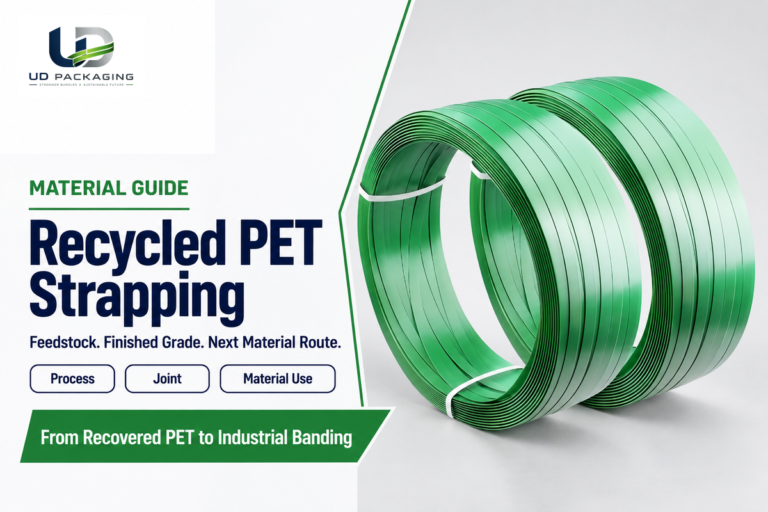
Ordinary polypropylene strapping removed from a shipment should be directed to an accepted collection route. Recycled material can enter new strap production after processing. A purpose-made reusable strap takes a different route: the entire product, along with its fasteners, is designed for repeated use.
The Federal Trade Commission’s Green Guides separate recycled content and recyclability as different environmental claims. Neither indicates a specific used length is ready for another packing job. The same holds true when buying plastic packaging made from recycled materials.
For a warehouse, the first step toward reducing waste is establishing a clear destination for each stream. New stock should be kept at the packing station, and recovered bands at the collection point. Reusable equipment should be kept in its return system. Mixing them in a single bin makes the next operator guess which material is usable.
Identify the Strap and Its Previous Job
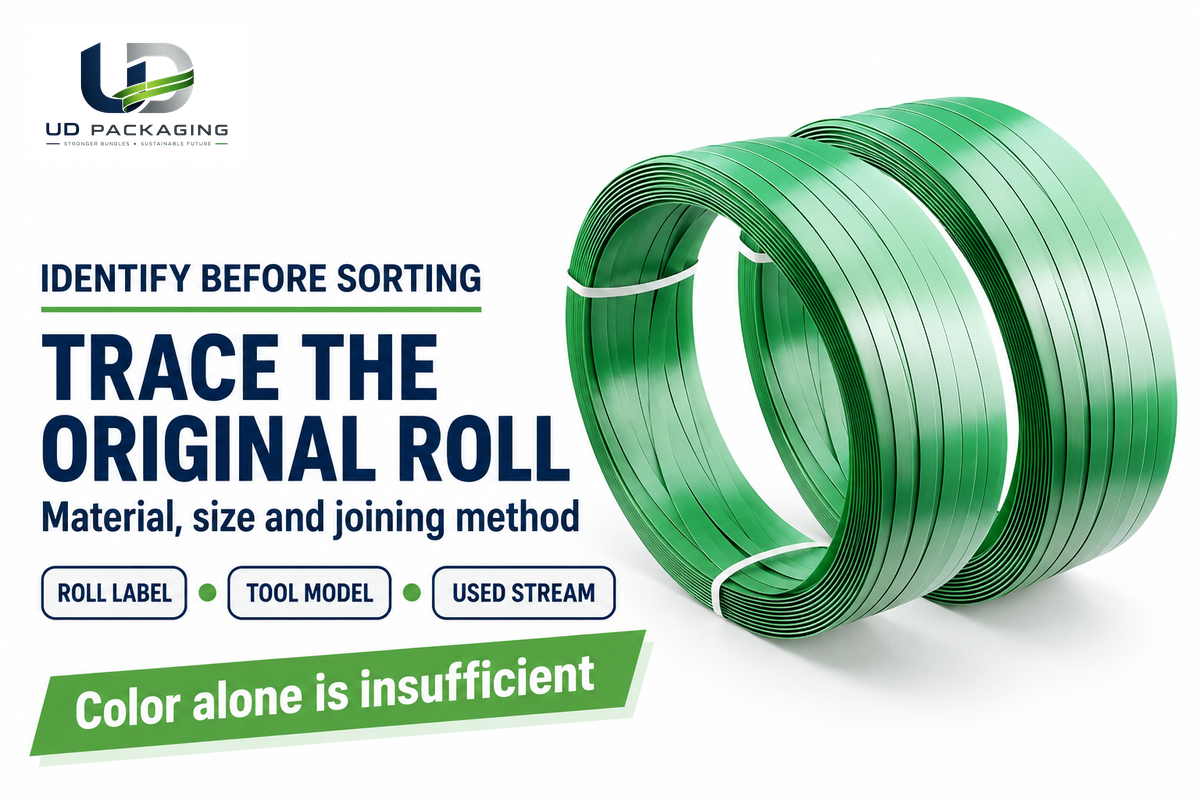
Color isn’t a reliable means for identification. It’s better to use a roll label or product code if available. Record whether the band is polypropylene, or PP, or polyethylene terephthalate, or PET, or polyester. Also record the original width, thickness and method of joining, if any. Once a band is loose, its appearance doesn’t recover a missing service history.
Identification still helps after a decision to replace it. Concentrated cuts in the same area of a package point the packing team toward edge protection. A distorted welded area points the investigation toward the process used to join the band. These help investigate the original job; they don’t help recover the band’s capability.
Let’s say there’s a receiving dock where there are multiple suppliers delivering green bands. If you sort all green lengths together, that could combine different grades and widths. The warehouse manager should retain the labels for each shipment and separate known PET strapping bands from the unknown plastic. This would allow procurement to discuss a defined recovery stream, instead of offering the recycler an unknown mixture.
In regard to material selection, the public scope of ASTM D4675 ties the choice to the application and calls for users to assess their conditions of handling, transit and storage. The material name alone is only the beginning of that choice.
Inspect Damage Before Any Further Handling
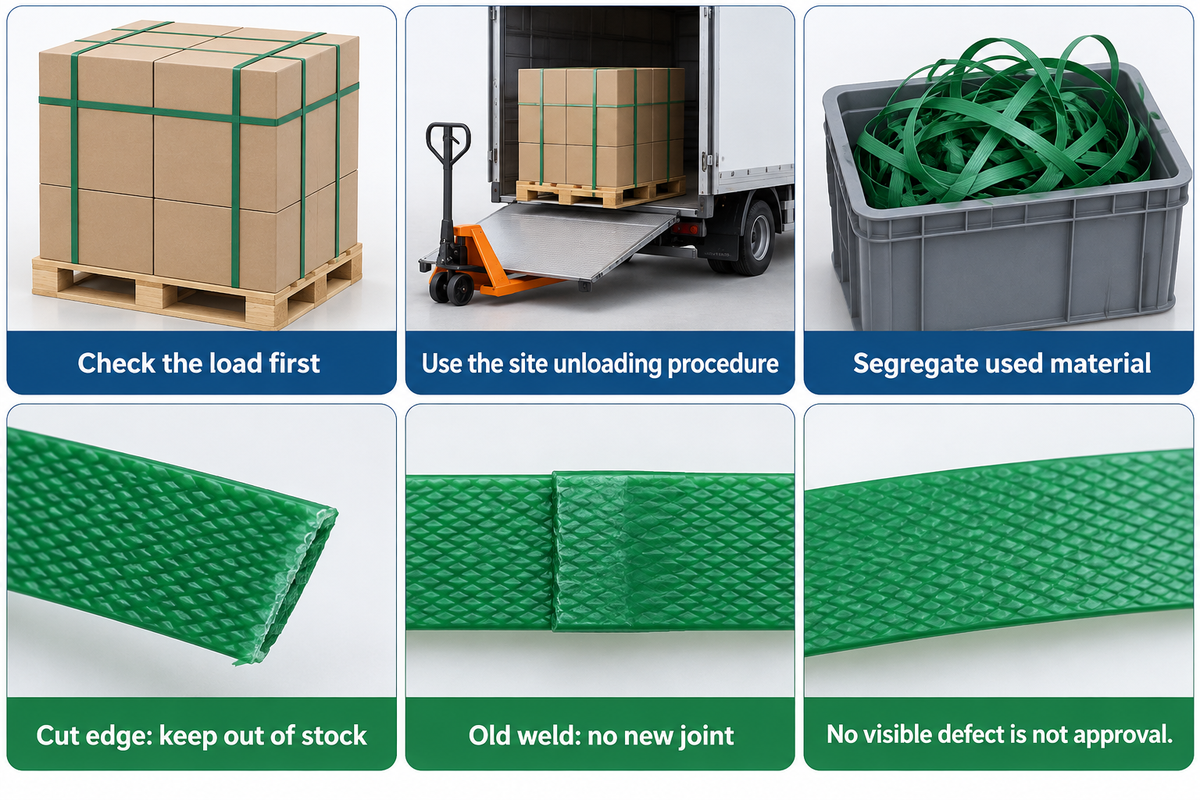
Inspect the load prior to checking the loose band. If strapping is still under tension, removal should be specified in the site’s unloading procedure. Once safely removed, inspect and segregate the material for collection. Visible damage is a reason to isolate a band; an undamaged-looking surface is not a reason to repack with it.
The Health and Safety Executive’s loading guidance says to check for any movement during transportation and for goods that might move or fall when the restraints are removed. This is to be done prior to any cutting. Keep uninvolved people away from the unloading area and carry out the agreed procedure for the actual goods.
| Observation | Warehouse action | Useful follow-up |
|---|---|---|
| Band still tensioned around goods | Use the agreed unloading procedure before removal | Check load movement and who controls unloading |
| Cut or nick across an edge | Keep the removed band out of packing stock | Photograph the package contact point |
| Longitudinal split | Isolate the recovered length | Retain the roll identity for the packing review |
| Sharp permanent bend | Separate the band from new coils | Review corners and handling contact |
| Scuffed or abraded surface | Collect it as used material | Check the route and protective arrangement |
| Heat-distorted area | Segregate it from the normal recovery stream | Identify the exposure and receiver requirements |
| Old welded overlap | Keep it out of another joint-making operation | Review the original tool and weld appearance |
| Attached seal or buckle | Follow the collector’s metal-separation instructions | Identify the fastener before handling it |
| Oil, adhesive or other contamination | Hold it separately from clean scrap | Confirm whether the receiver accepts it |
| No visible defect, unknown history | Keep it in the used-material stream | Recover identification for sorting, not reuse approval |
Tension release and sharp edges require special mention. Protective equipment and the cutting tool belong to the site’s handling procedure. Pulling on a band to see whether it breaks isn’t a suitable means of examination, and a packaging band must not be used to lift the load.
Treat Old Joints as a Separate Limitation
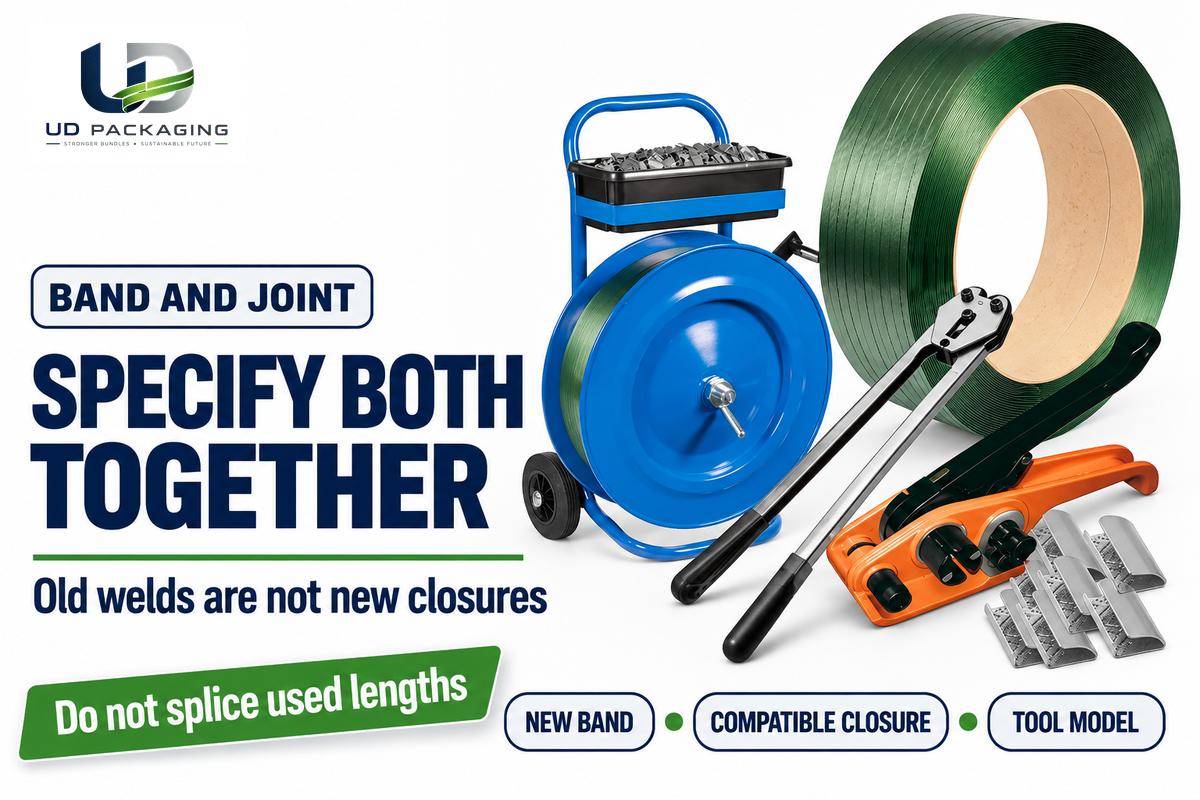
An old weld, a compressed seal and a reusable buckle are examples of different closures. Re-opening a buckle doesn’t mean the band passing through it is approved for another service. For ordinary, disposable banding, replace the used length and use the closure and settings as required for the new material. Don’t splice the previously used banding together.
A specification from the cotton industry’s bale-tie spec offers a good example. Its approved PET systems combine certain strapping materials with tested machinery. The specification separates band strength from joint strength instead of considering a good looking connection as the whole answer.
The average break strength is at least 2,400 pounds-force, and average joint strength is at least 2,200 pounds-force, for the cotton-bale application. The minimum break and joint strengths are 2,250 and 1,950 pounds-force, respectively. These are specified properties for the approved bale system, and not ratings for a secondhand band or a different pallet.
Imagine a workshop that has saved metal buckles and cut PET lengths. Buying new PET strap while keeping the wrong buckle would still not meet the closure specification. The engineer requires the closure specification, along with the dimensions of the new band, and the type of strapping tool model. A PET strapping kit enquiry should reveal what’s supplied, optional and owned.
Keep Break Strength Separate from Package Performance
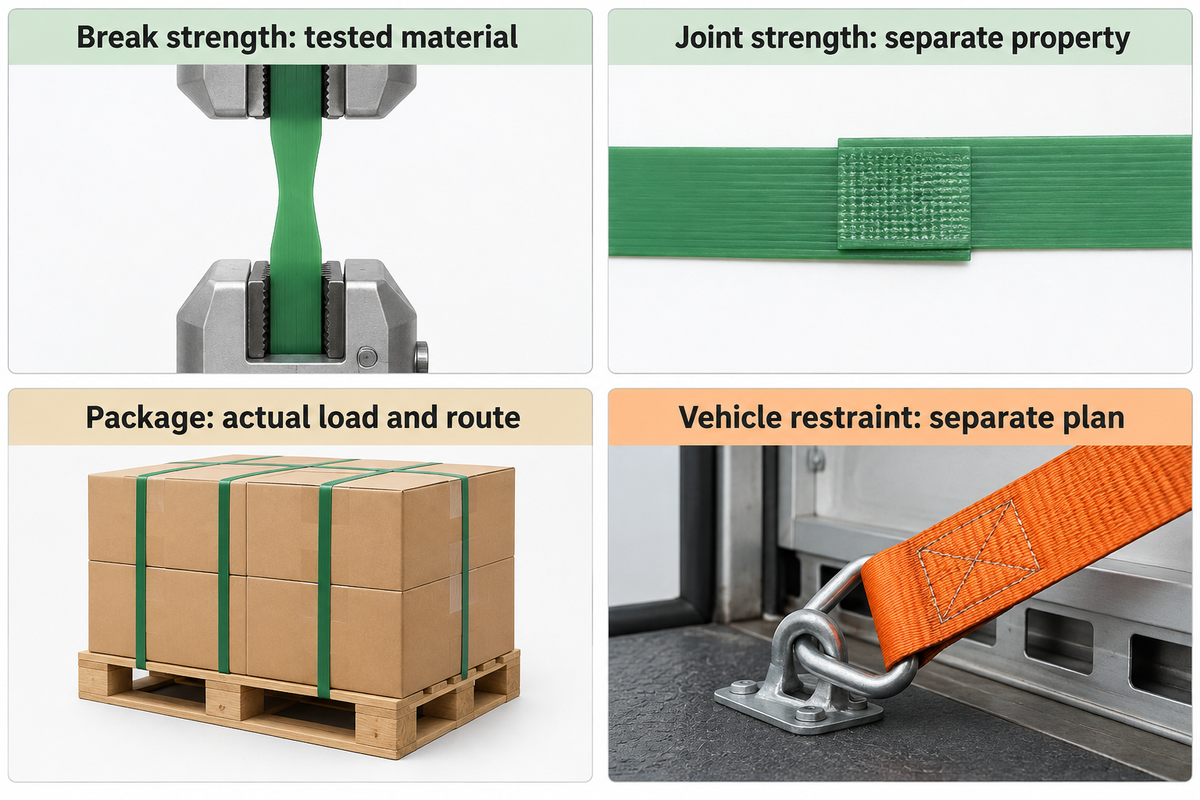
Breaking strength is a property of a tested material. Package performance is concerned with the total package, including its shape, contact surfaces, banding and joints. A new-roll datasheet can’t provide the remaining capacity of used banding. Likewise, a banding rating can’t replace the cargo-securement plan of a vehicle.
How much weight can plastic strapping hold?
Plastic strapping, in itself, has no universal load-weight rating. Select the new grade and joining system for the package, instead of converting breaking strength of the band into a pallet mass. The public ASTM D3950 specification distinguishes breaking strength, elongation, transverse strength and joint strength.
“This guide is not intended to give specific information as to how strapping must be used in any particular packaging or loading situation.”
ASTM D4675 public scope, section 1.3
The difference is important for heavy-duty bundles. A wider strap, tighter application or an extra band does not by itself establish a reliable package. The Federal Motor Carrier Safety Administration’s cargo-securement overview addresses the vehicle system. Separate that transport requirement from the choice of packaging consumable.
| Decision | Evidence to obtain | Responsible role |
|---|---|---|
| Replace a cut disposable band | New roll identity and agreed grade | Procurement |
| Match the packing machine | Band width, thickness, surface and tool model | Engineering |
| Make a new joint | Compatible closure and joining instructions | Engineering |
| Approve the package | Results for the actual load and handling route | Quality team |
| Release goods at receiving | Agreed unloading method and load-stability checks | Warehouse |
| Choose a reusable system | Declared use, closure, inspection and retirement instructions | Engineering |
| Keep reusable assets circulating | Return responsibility and loss records | Operations |
| Send recovered material for recycling | Receiver acceptance and preparation requirements | Warehouse |
| Approve the commercial proposal | Material, labor, return, rejection and disposal costs | Finance |
Use this map during the purchasing handoff. An unknown machine specification goes to engineering; an unconfirmed collection destination goes to the waste contractor. The cost of the roll doesn’t resolve either of these gaps.
Compare Purpose-Made Reusable Pallet Straps
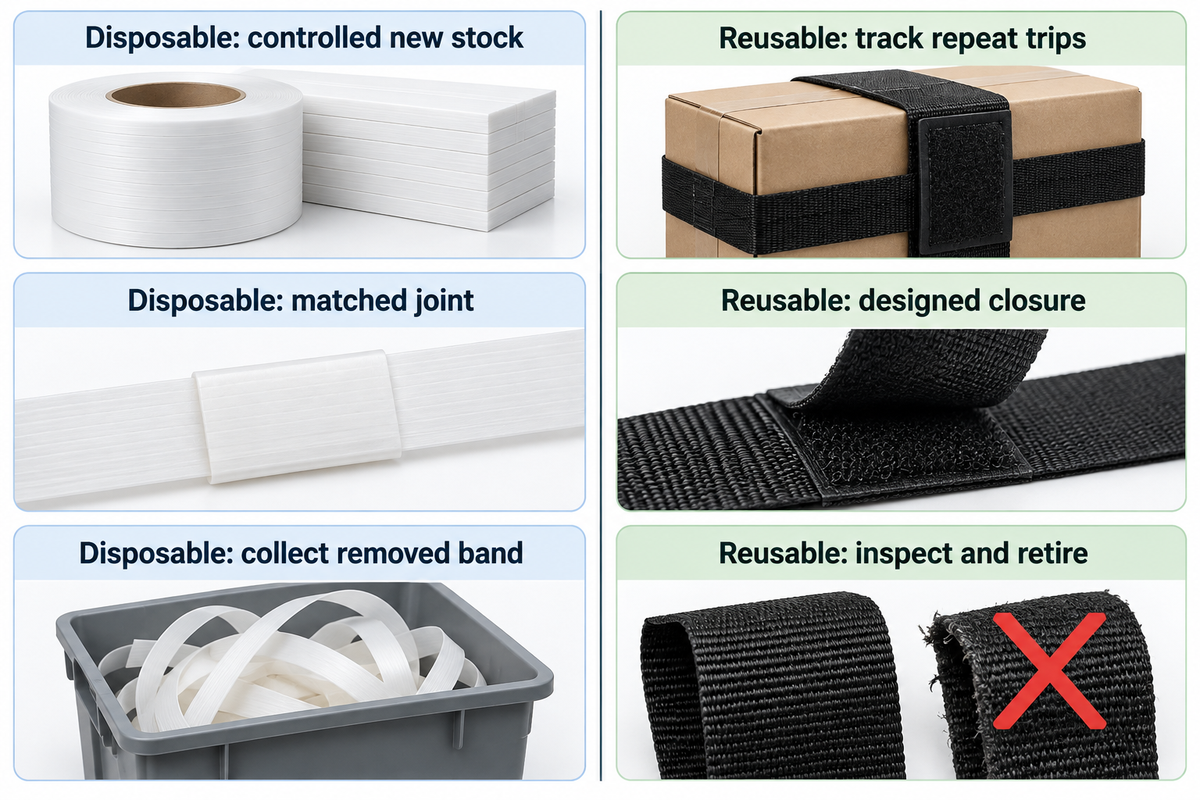
Reusable hook-and-loop closures allow for the repeated fastening of pallet straps. However, cut extruded PP or PET bands are a different product category from purpose-made reusable pallet straps. The planned application, cleaning and inspection of reusable straps, and how they’re returned, must be considered to choose the correct straps for transporting goods.
Maxpack’s PalletPAL nylon hook-and-loop pallet straps demonstrate the difference. The flexible textile body opens and closes without cutting a welded overlap. Justifying the use of that format for its stated job is left to the user. It does not turn ordinary polyester strapping into reusable equipment, and a textile product is not automatically suitable for road transport or lifting.
Used band or reusable system: new disposable banding
- Replenish controlled new stock
- Match the joint to the band
- Collect removed material separately
Purpose-made reusable system
- Track assets through repeat trips
- Follow the designed closure instructions
- Inspect, clean and retire as specified
A hypothetical plant shifting covered totes between its own departments has a clearer return loop than an exporter shipping to various receivers. The first can assign collection responsibility at both ends. The second must answer who sends the straps back, and what happens to them when they disappear. That practical difference often decides which strapping solutions deserve a trial.
Collect Plastic Strapping for an Accepted Recycling Route
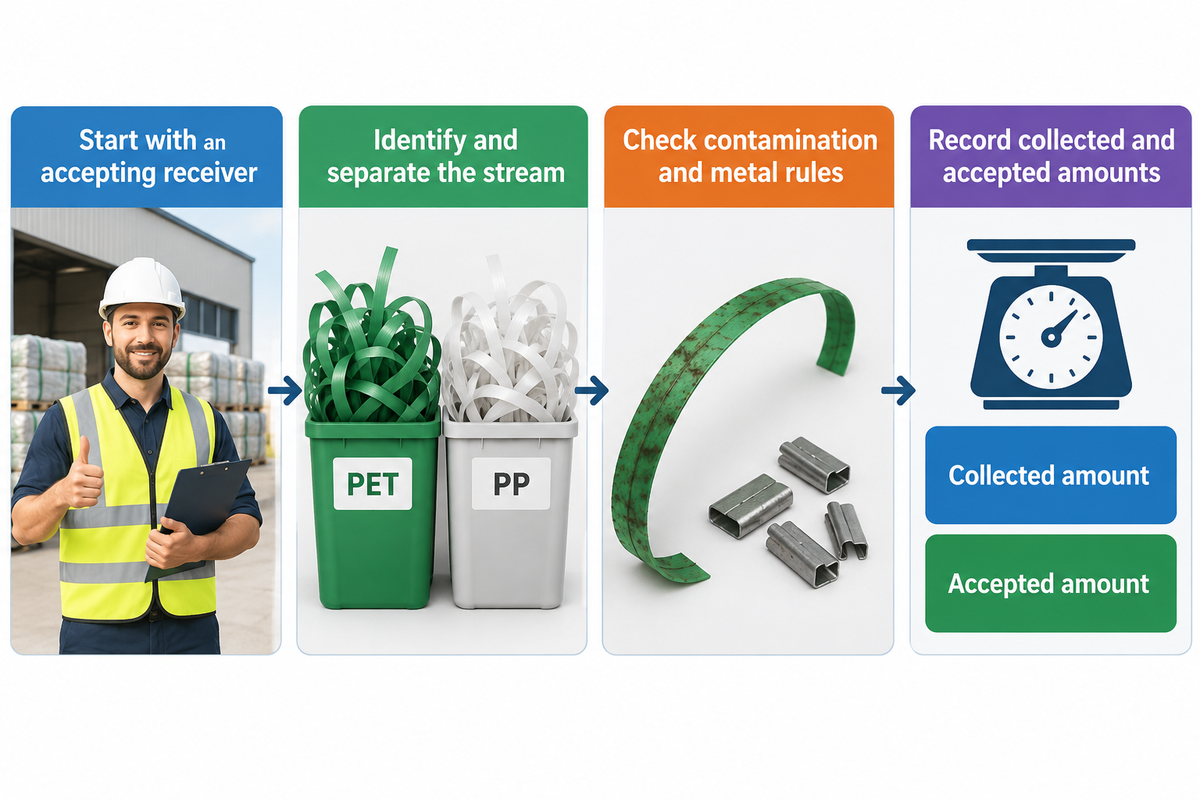
Recycling PET or PP strapping starts with an accepting receiver and a defined collection stream. Determine the acceptance standard for materials, contamination level, removal of metal and delivery form of the service. Then align your collection to those standards. A recyclable resin doesn’t mean a local curbside or commercial service accepts loose bands.
Can I recycle plastic strapping?
Yes, loose PP and PET bands can access a legitimate commercial recycling route. Check acceptance before gathering bulk for shipping. Keep your stream identified and separated from unrelated waste. Recyclability describes a material route. The infrastructure of the collection determines if your batch can use it.
Some commercial programs use bags or bales and agree logistics by location and quantity. Their terms may differentiate clean, sorted material from mixed material. Don’t assume a collector’s price, minimum collection size, or service area applies to you. Get the receiving specification before investing in storage or compaction.
Separating recovered strap can help divert accepted waste from landfills. Be prepared to show how much was collected and accepted. Those records help justify environmental claims. Calling strap recovery eco-friendly doesn’t replace those records. New recycled PET strapping is another option; request the material declaration for the supplied grade.
Compare the Cost of the Proposed Packing Process
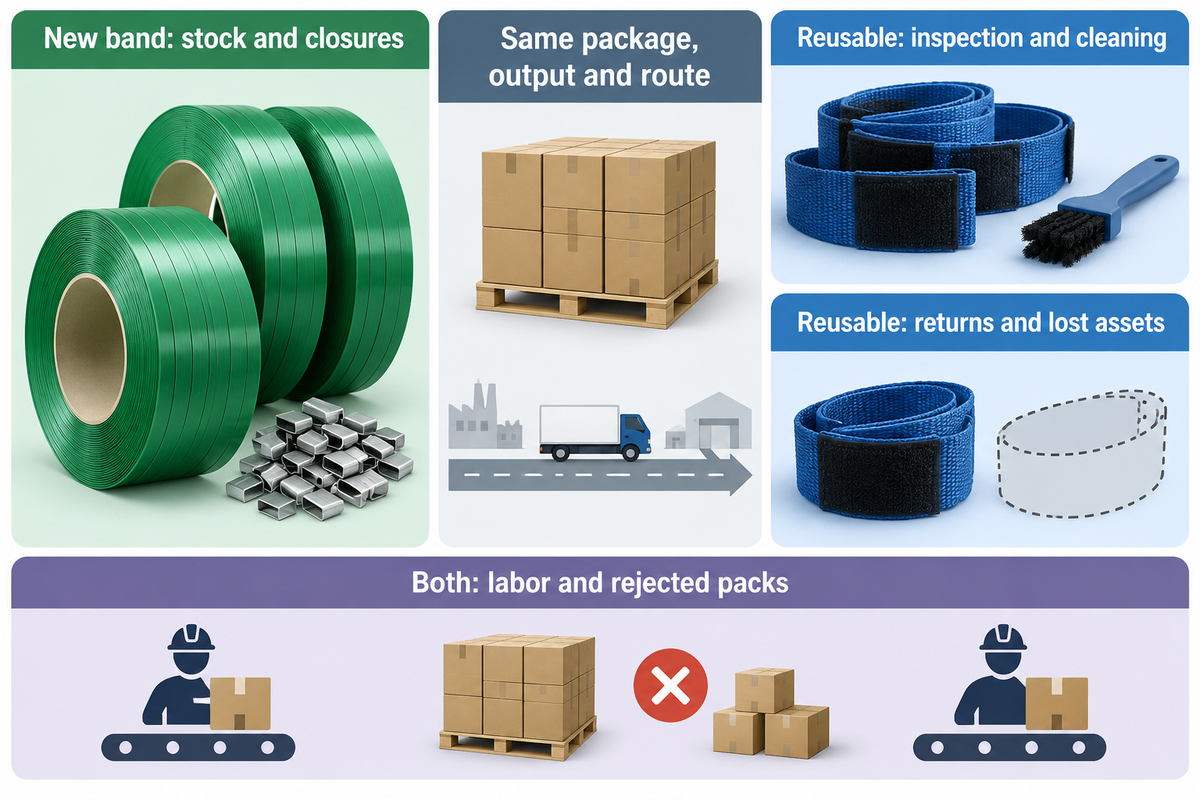
Consider costs only after selecting an appropriate packing system. Free recovered banding isn’t a cost-effective replacement for specified new material. For new disposable banding and a designed reusable option, use the same package, output and route so the business can compare labor and losses with purchase price.
Finance must count new stock, closures, application time, rejected packs and disposal costs. For a reusable option, include inspection, cleaning, return transport and lost assets. During a trial, warehouse staff can record actual handling time, while procurement can confirm replacement prices and collection terms. A low unit price can disappear into extra touches.
Automatic and semi-automatic strapping machines create another constraint. The consumable must feed and join correctly in that machine. Manual hand tools or a pneumatic tool also need the specified band dimensions. A versatile-looking strap isn’t an ideal choice if the line must stop repeatedly to handle it.
Keep carbon and emission claims separate from cost sheets. Lower costs don’t show a lower environmental footprint. A sustainable proposal must include measured consumption and recovery data for the process being compared, and include returns. Start with a limited, defined trial; good packs produced, and labor used, should be documented prior to projecting savings.
Check What Current Reuse Claims Actually Cover
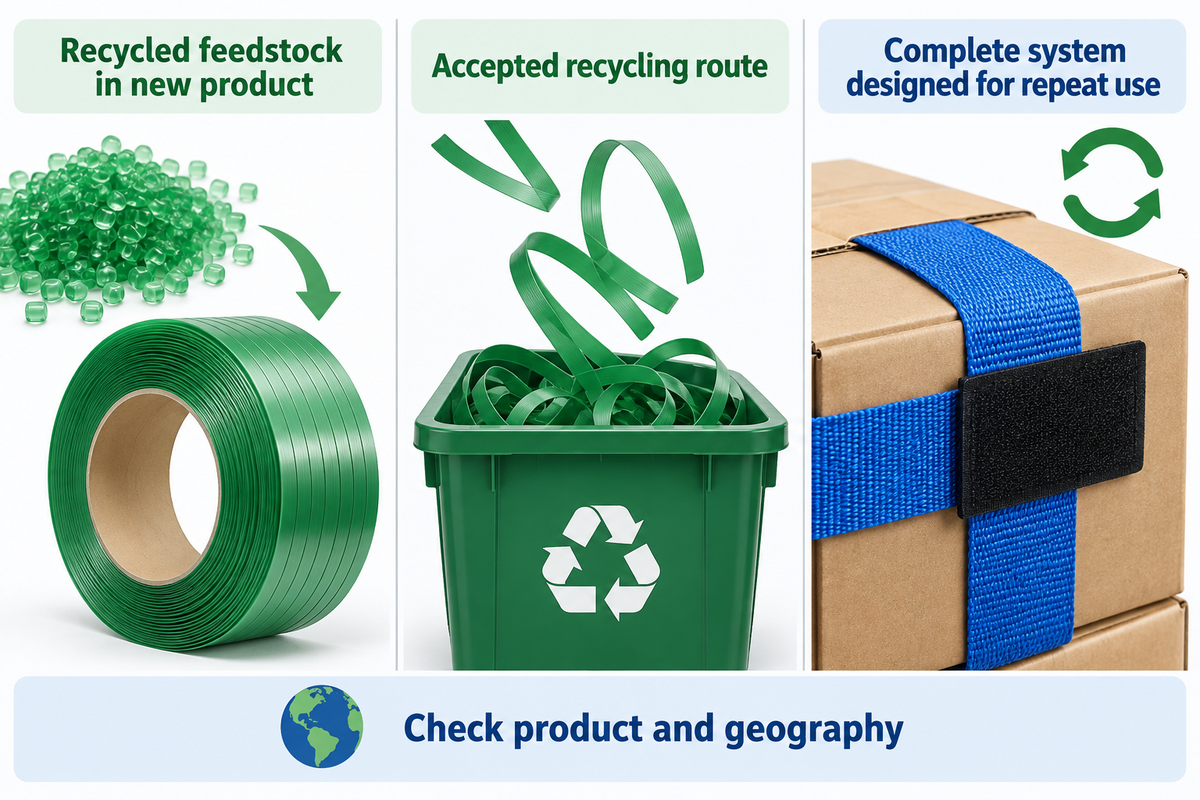
Recycled content, recyclability and reuse targets address different aspects. An announcement of a policy can’t inform an operator if a recovered plastic strap can secure the next load. Review product claims and their geographic limitations prior to using them to set purchase requirements or warehouse directives.
On 25 February 2026, the European Commission announced an exemption for pallet wrapping and straps from certain 100% reuse requirements for specified internal and same member state transports. That older European announcement neither mandates reuse in the US nor serves as an engineering approval for old bands.
For purchasing, replace broad claims such as environmentally friendly with the specific attributes offered. Is the new product made with recycled feedstock? Is there an accepted recycling route? Is the complete fastening system designed for repeat use? A circular economy claim becomes actionable when it defines the specific product and process.
Send the Supplier a Traceable Sample Request
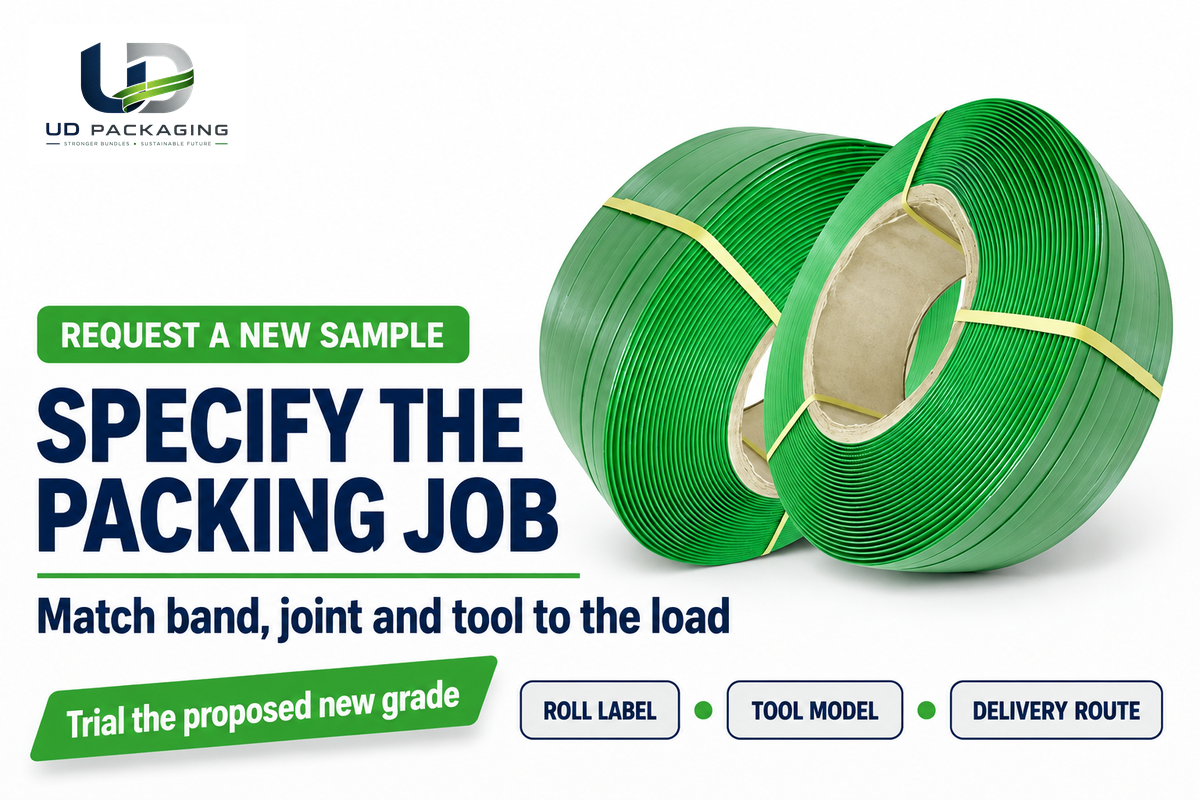
Ask for samples of the new replacement strapping against a written specification. Provide the roll label, tool or machine model, photos of the package and delivery route. State the method of joining and geometry of the load. Old bands can be used to describe the existing system, but the new product being evaluated must be identified.
UD Packaging’s PET strapping roll page lists a supply range of 9–25 mm width and 0.50–1.27 mm thickness, with smooth or embossed options and different application grades. Generally, the candidate dimensions will be determined based on the tool and load requirements. Those new-roll choices don’t assign strength to a used length.
For a steel replacement project, be sure to include in the brief the reason the current system uses materials like steel (package, joining arrangement and method of handling). Select plastic banding, like steel strapping, as part of the packaging system. Avoid ordering a lighter material solely because it’s described as a safer or lightweight alternative.
Key takeaway
Use new matched banding for the next packing job. Choose a designed reusable system for repeated service, and give recovered PET or PP a confirmed collection destination.
Purchasing can now request a defined solution: new band and closure for the current packing line or a separate reusable system with a controlled return loop. Provide expected output, available labor, recorded pack rejects and the product family to enable the supplier to understand the real situation.
Frequently Asked Questions
Can polypropylene strapping be reused or recycled?
Used polypropylene banding belongs in an accepted recycling stream, not back around another load.
Recycling processes the polymer into feedstock, while direct reuse puts the same band back under tension. Keep new packing stock separate from removed lengths, even when the recovered material appears clean. Confirm that the collector accepts the identified grade and preparation. A reusable fastening system is a separate purchase with its own instructions for repeated service.
Is it safe to reuse plastic strapping?
Ordinary cut plastic banding should be replaced with new matched strapping for load restraint.
A visual inspection helps identify cuts, sharp bends, damaged joints and contamination for handling or segregation. It does not establish a remaining strength value. First check that the goods will stay stable when the existing restraints are removed. For repeated fastening, choose a product designed for that purpose and follow its inspection, use and retirement instructions.
How much weight can plastic strapping hold?
Plastic strapping has no single load-weight rating; the band, joint and complete package must work together.
Breaking force on a new-roll datasheet describes a tested property of that material. It does not rate an unidentified used band, a suspended load or every arrangement of goods on a pallet. Select the specified new grade and closure, then evaluate the package for its handling and transit conditions. Packaging bands are not lifting slings.
Can I recycle plastic strapping?
PET and PP strapping can be recycled through a service that accepts the particular material stream.
Confirm sorting, metal removal and delivery requirements with the receiver. Keep contaminated or unidentified bands separate until their acceptance is settled. Do not put commercial strapping in a household collection bin without checking the local service.
Can you reuse strapping clips?
Clip reuse is product-specific, and a reusable closure does not make a disposable strap reusable.
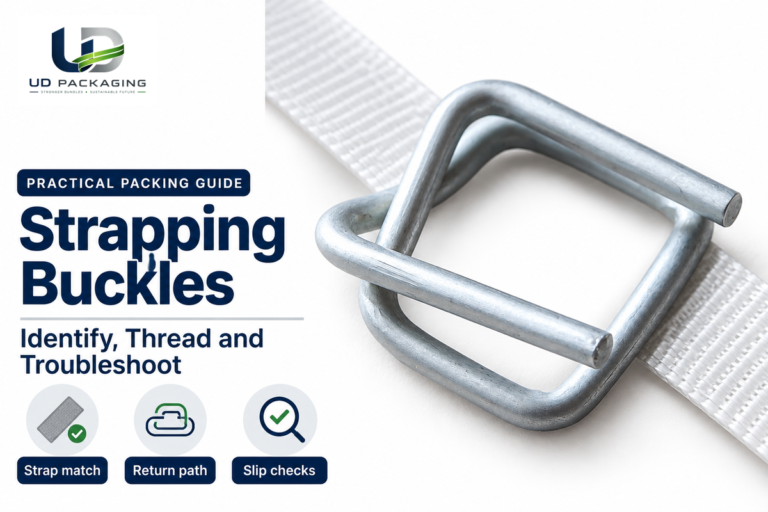
A compressed seal, friction weld and releasable buckle perform different jobs. Do not treat them as interchangeable because they all join a band. Identify the exact fastener and follow its instructions; for the replacement packing job, specify the new strap and compatible closure together. Keep old welded or previously compressed sections out of the new joining operation. If a kit is proposed, have the quote distinguish included components from optional tools and items already owned.
How to use a plastic strapping tool?
Use the exact tool instructions with the specified new band and compatible joint.
Match the material, width and thickness before setting tension or weld controls. Trained operators should follow the site’s guarding, unloading and recoil procedures. Do not copy settings from a different tool.
What should I send a supplier before replacing used bands?
Send a traceable description of the existing package and request a specified new replacement grade.
Include the original roll label, dimensions, joining method, tool model and photographs of the goods and contact points. Describe storage, handling and the delivery route. State the number of good packs needed and the labor available for application. For a reusable option, describe how equipment returns from the receiver. Keep sample approval tied to the proposed new material and package; a convenient old length is not a representative acceptance sample for a pile of recovered bands.
Related Articles
References & Sources
- ASTM D4675: public selection-guide scope and application-testing guidance.
- ASTM D3950: public nonmetallic-strapping specification abstract.
- Joint Cotton Industry Bale Packaging Committee: PET bale-tie system and joint requirements.
- HSE: loading and unloading guidance.
- FTC: environmental-claims summary.
- European Commission: 25 February 2026 pallet-wrapping and strap announcement.
Why We Separate Scrap from New Packing Stock
UD Packaging supplies industrial packaging materials, including PET strapping. This article brings together public material specifications, handling guidance and purchasing considerations for used bands and replacement rolls. The warehouse examples are hypothetical, and the cotton-bale figures describe that industry’s specified system. Our purpose is to help buyers send a clearer new-material enquiry while arranging an appropriate destination for recovered plastic.