Get in touch with UD Packaging Company

Package Testing for Strapping Changes: A Packaging Retest Guide

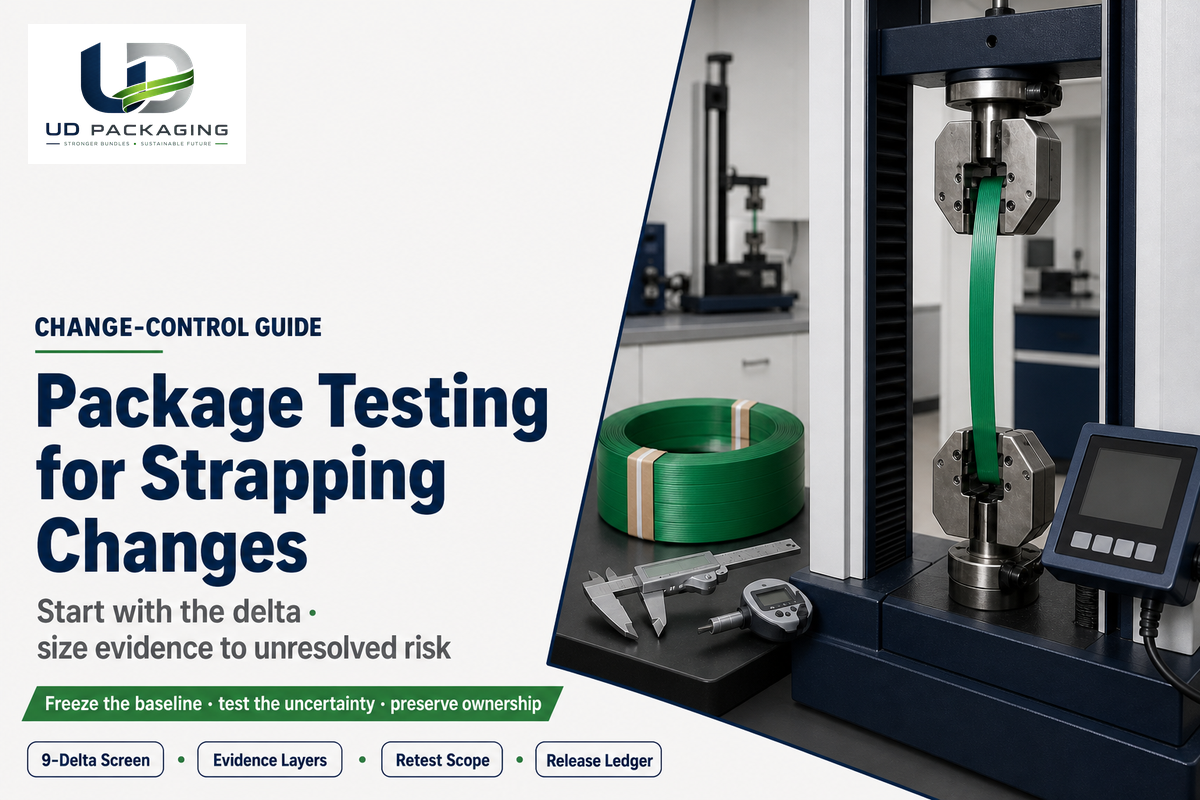
Package testing for strapping changes is a change-control process that starts with the delta, not with a standard list of drop, vibration, or compression tests. A new strap, supplier, joint, tool setting, load, or distribution route can change a different failure path, so the evidence plan should show what changed, what could fail, and who is authorized to accept the result. This article assumes an approved packaging baseline; for initial PET specifications, joint and tool qualification, and sample approval, use the PET strapping specification and qualification guide.
The short answer
Do not order a full distribution test automatically, and do not approve the change from a supplier certificate alone. Screen the change for a potential performance effect, trace that effect to the uncertainty it opens, choose the least broad evidence that resolves the uncertainty, and preserve the rationale, acceptance owner, and monitoring trigger.
The International Safe Transit Association says packaged-product tests should be repeated when the product, package, or process changes unless the change has no potential performance effect. That exception is important: a controlled review may justify no physical retest, but the reason should be recorded before the changed configuration ships.
Package Testing Starts With the Change, Not a Test List
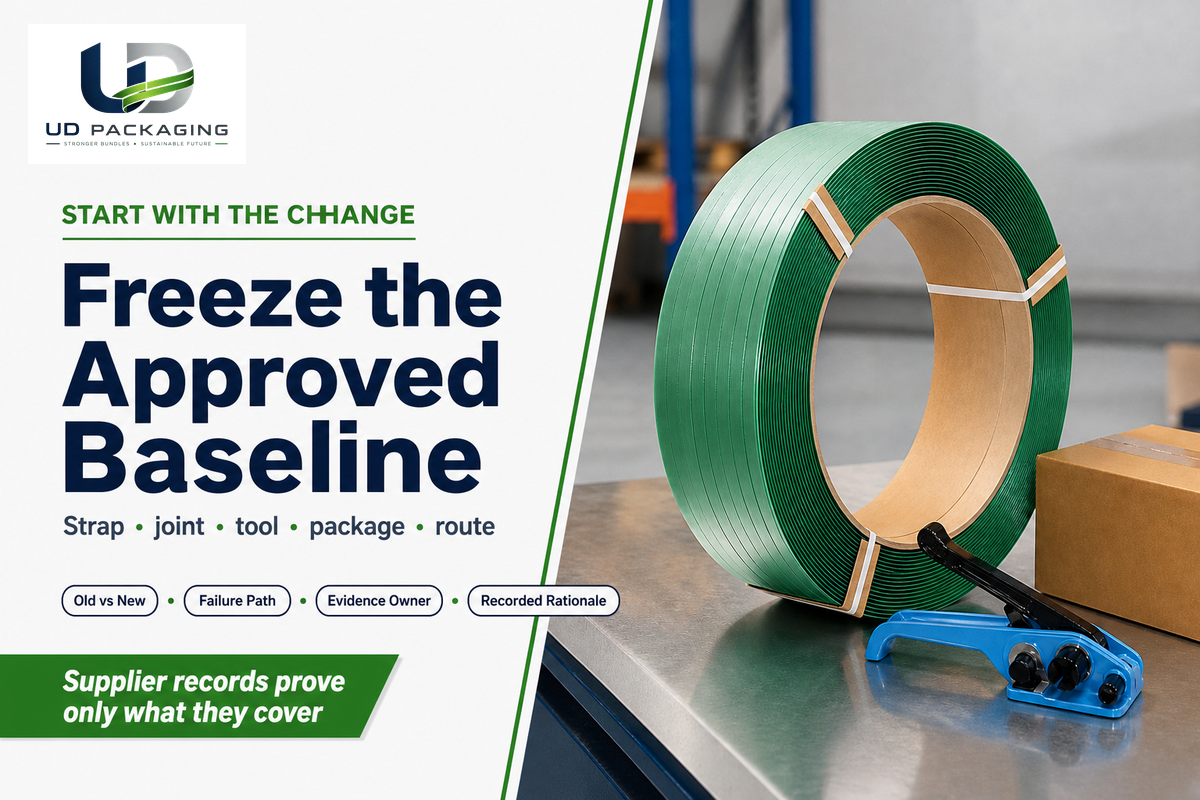
The request “test the new PET strap” is incomplete because the test object is not just the strap. The relevant system may include the strap, joint, tool, edge protection, box or pallet, product, load pattern, handling equipment, storage environment, and transport route.
Change
Write the old and proposed state in measurable or traceable terms.
Write the old and proposed state in measurable or traceable terms.
Potential effect
Name the package behavior that could change, even if the answer is uncertain.
Name the package behavior that could change, even if the answer is uncertain.
Evidence decision
State what will resolve the uncertainty and who owns acceptance.
State what will resolve the uncertainty and who owns acceptance.
Supplier records can establish the properties and lot identity they actually cover. They cannot, by themselves, show that your finished shipping unit will retain geometry, preserve the relevant protective properties at edges, contain the load, or survive the intended distribution hazards.
Open a change review whenever the proposed delta could affect performance. If the team decides that it cannot, record the technical basis, affected configurations, approver, and conditions that would reopen the decision.
Use the 9-Delta Retest Screen for a Strapping System
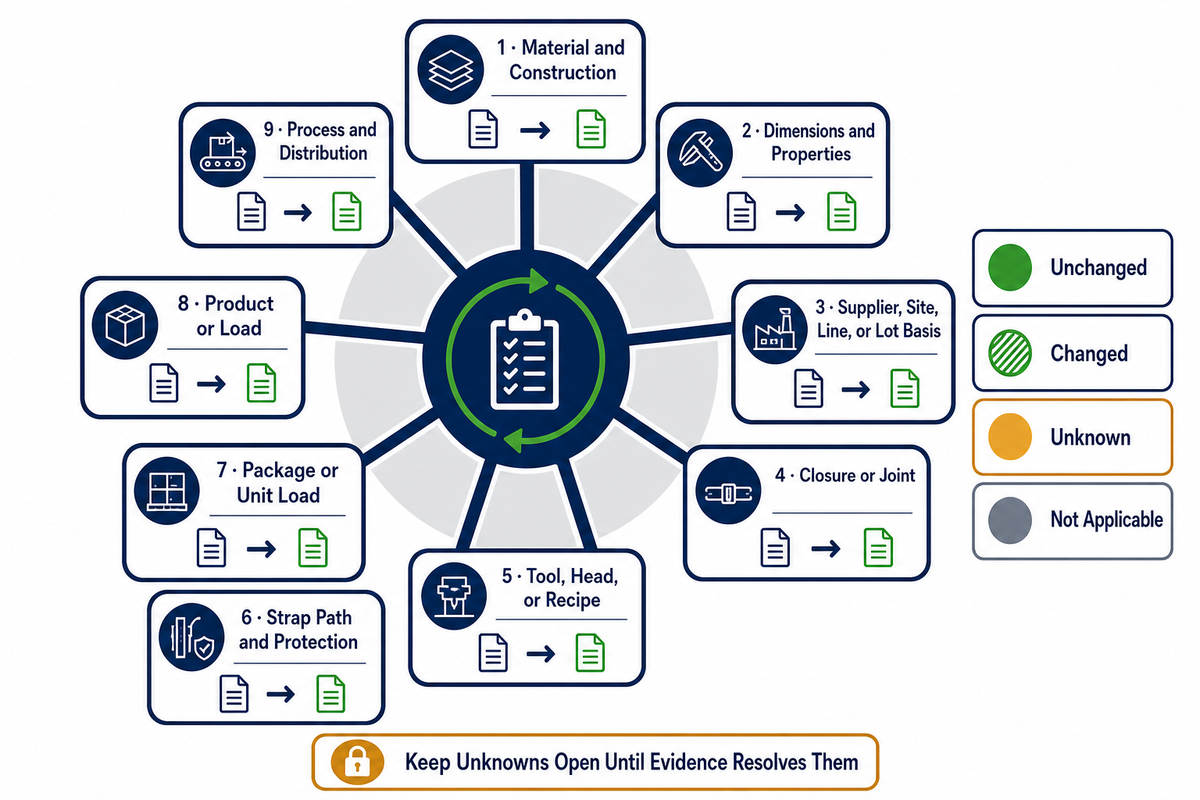
The 9-Delta Retest Screen is an editorial decision aid, not an ASTM or International Safe Transit Association standard. Mark each row unchanged, changed, unknown, or not applicable, then assign the first evidence owner. Keep unknowns open until relevant evidence resolves them.
| Delta | Record old versus new | Why it can matter | First evidence | Owner |
|---|---|---|---|---|
| 1. Material and construction | Polymer route, grade, recycled-content route, construction | Strength, elongation, recovery, friction, or environmental response may differ | Specification and controlled comparison | Packaging engineering |
| 2. Dimensions and properties | Width, thickness, surface, elongation, controlled property limits | Tool feed, contact stress, joint formation, and retained load may change | Component and joint data | Supplier quality / packaging |
| 3. Supplier, site, line, or lot basis | Legal manufacturer, location, production line, approved lot rule | The same purchase description may hide a different process window | Change notice, samples, incoming comparison | Procurement / supplier quality |
| 4. Closure or joint | Seal, buckle, weld, overlap, joint geometry | Usable system strength can be controlled by the joint rather than the strap | Joint formation and joint test | Packaging / operations |
| 5. Tool, head, or recipe | Tool model, tension, weld time, cooling, software recipe, maintenance state | A valid material can produce a poor joint or excessive package stress | Line trial and setting window | Operations / maintenance |
| 6. Strap path and protection | Count, direction, spacing, contact points, edge protection | Load restraint and local box or product pressure can shift | Visual setup review and line sample | Packaging engineering |
| 7. Package or unit load | Box, interior, pallet, skid, wrap, stack pattern | Compression paths, edges, restraint, and resonance can change | Representative shipping-unit review | Packaging / logistics |
| 8. Product or load | Mass, dimensions, center of gravity, sensitivity, pack pattern | The same strap can interact differently with a heavier or unstable load | Worst-case rationale and representative sample | Product / packaging |
| 9. Process and distribution | Manufacturing, storage, handling, carrier, route, climate, duration | A new hazard or exposure can make old evidence unrepresentative | Route brief and monitoring data | Logistics / quality |
ASTM D4675’s public scope treats strapping selection as a use decision involving handling, transit, storage, carrier requirements, and user testing. ASTM also lists D4675 under its Subcommittee D10.25 on Palletizing and Unitizing of Loads. That supports a system review, but the paid standard text was not used to create this nine-row screen.
Separate Material Testing and Joint Data From Finished-Package Proof
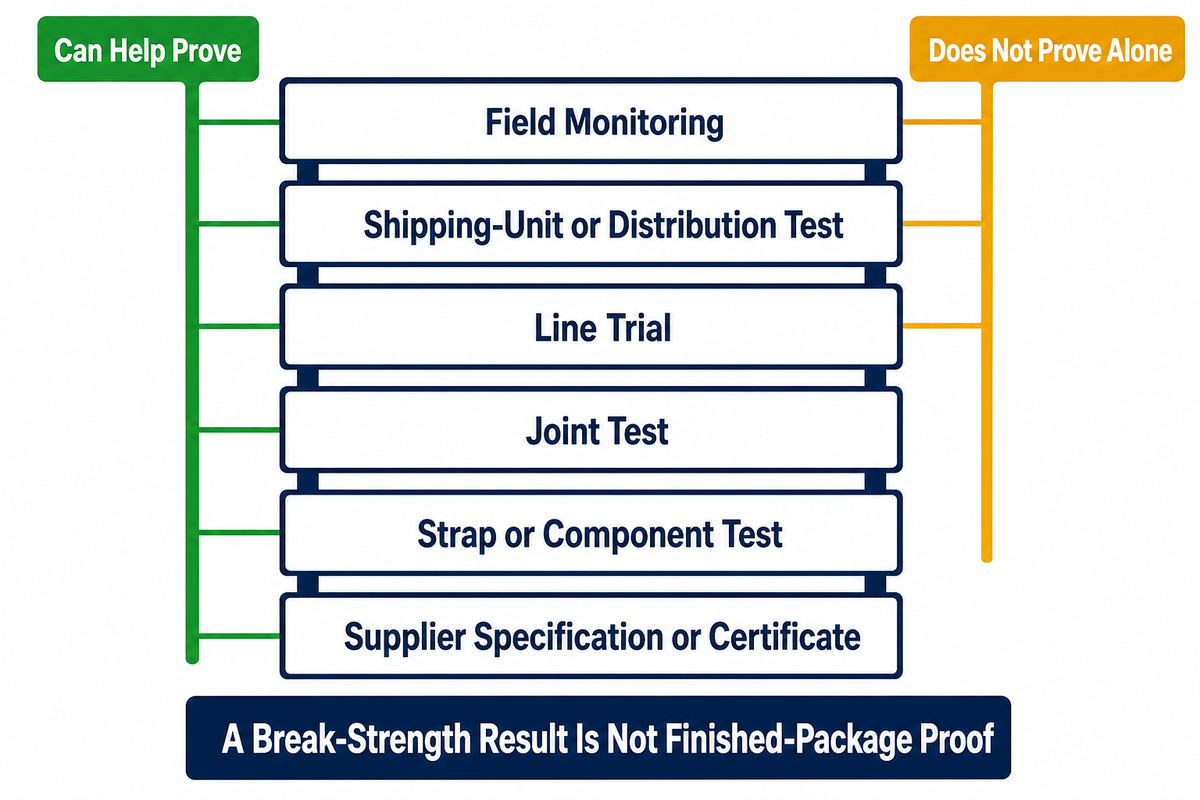
With those system deltas defined, the next task is to separate each test result by what it actually proves. Tensile results are valuable when the specimen, conditioning, speed, calculation, and acceptance rule are defined. They still answer a different question from a joint result, a line trial, a tested shipping unit, or field monitoring.
| Evidence layer | Can help prove | Does not prove alone | Typical reopen signal |
|---|---|---|---|
| Supplier specification or certificate | Identity and listed properties for the stated product or lot | Your joint, line, package, route, or acceptance result | Supplier, site, formulation, method, or limit changes |
| Strap/component test | A measured property under a named method | Joint formation or load interaction | Material, dimensions, conditioning, or method changes |
| Joint test | Performance of the tested strap-joint-tool combination | Package deformation, edge damage, or route survival | Closure, tool, settings, operator, or maintenance changes |
| Line trial | Feed, tension, joint consistency, and package interaction on the line | Defined distribution-hazard performance | Machine, recipe, maintenance, speed, or package changes |
| Shipping-unit or distribution test | Performance of represented units through a defined sequence | Every untested product, package, route, or production variation | Family boundary or route changes |
| Field monitoring | Observed performance for shipped configurations and lanes | Causation without controlled investigation | Trend shift, damage mode, complaint, or deviation |
ASTM D4169’s public scope addresses performance testing of shipping units through a sequence of distribution hazards. Its scope is therefore different from a flat-strapping selection guide, and neither public page supports copying a distribution cycle, assurance level, or pass criterion into every change request. For method-level context, see how a completed strapping joint is tested.
Decide the Retest Scope and Test Method From the Changed Baseline
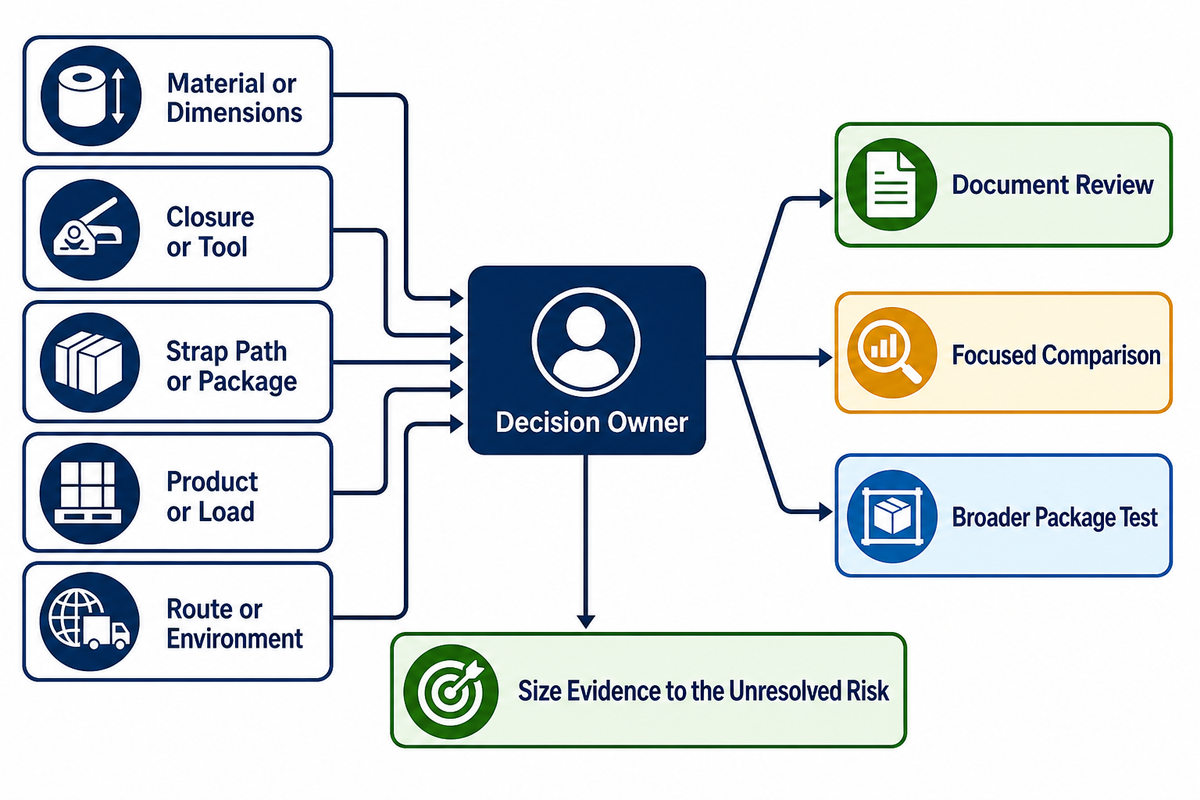
Starting from the approved baseline, identify which uncertainty the change reopens. Choose a document review, focused comparison, or broader package test according to unresolved risk, not organizational habit. The task here is to size a retest, not to repeat initial PET specification and qualification.
| Change against approved baseline | Uncertainty opened by the change | Narrowest evidence that can resolve it | When broader package evidence is necessary | Decision owner |
|---|---|---|---|---|
| Material or dimensions | Joint window, retained tension, edge pressure, recovery | Specification, component, joint, and line comparison | Package interaction is uncertain or outside prior evidence | Packaging / quality |
| Closure or tool | Incomplete joint, excessive heat, variable tension | Joint samples across a justified setting window | Line variation or package response remains unresolved | Operations / quality |
| Strap path or package | Corner crush, strap migration, stack instability | Representative pack build and handling trial | Distribution hazards or product damage are plausible | Packaging engineering |
| Product or load | Shift, concentrated load, changed resonance, restraint loss | Worst-case rationale and representative-unit evidence | The old test family does not represent mass or geometry | Product / packaging / quality |
| Route or environment | New shock, vibration, stacking, moisture, temperature, or handling exposure | Route profile, carrier/customer requirements, targeted simulation | The hazard sequence differs from the accepted evidence | Logistics / quality |
The Retest Scope Router is a post-change briefing tool. It does not say that one row is sufficient, and it does not replace the laboratory, carrier, customer, regulatory, or internal procedure that actually governs the shipment.
Keep Packaging Quality Control Inside the Retest Scope
For this strapping-change review, treat it as a packaging quality control decision; the broad label “packaging industry” does not mean one packaging solution can ensure the quality and safety of all types of packaging. Packaging standards, testing requirements, and packaging requirements change with the product, route, customer, and regulated status. The labels “international standards” or “ISTA standards” do not identify the right sequence by themselves.
Do not substitute seal testing, seal integrity, test pressure, or compatibility testing when those questions are outside the changed failure path. Compression testing machines or various testing methods may be relevant only when they represent the unresolved hazard, including tests to simulate a defined distribution exposure. The purpose is product protection and product safety, not an unsupported overall quality claim for new materials.
Specify the Test Method, Testing Equipment, and Packaging Line Brief
Testing objectives should describe the decision, not merely name testing equipment. Give the laboratory or packaging line enough information to identify the represented plastic packaging material, product package, outer packaging, strap and joint, route, controls, and unresolved failure cause.
| Brief field | Define before work starts | Reject as incomplete |
|---|---|---|
| Decision and scope | Change, affected configurations, testing objectives, release decision | “Test the new strap” |
| Samples | Product, packaging design, lot, build, strap path, tool settings, controls | “Use typical boxes” without a family rationale |
| Conditioning and environment | Applicable storage, temperature and humidity, route assumptions, sequence | A copied condition with no connection to the shipment |
| Test method | Governing procedure, deviations, instrumentation, measurement uncertainty | “Use standard testing” without an owner or edition |
| Acceptance | Preapproved criteria, observation method, seal or joint decision, deviation route | “Looks acceptable” after results are known |
| Report and release | Test report owner, limitations, configuration scope, monitoring handoff | A pass label with no represented configuration |
Drop testing, vibration testing, compression, static load testing, seal strength work, and material testing are specific tests that can answer different questions. Do not combine them to create the appearance of completeness; evaluate each method against the failure path, the supply chain, and the evidence already available.
Competitor pages may mention ISO, the Code of Federal Regulations, medical device packaging, flexible packaging, leak testing, primary packaging, or hazardous materials. Those regulations and standards apply only when the product and shipment are actually inside their scope, so an ordinary industrial strapping change should not be told to comply with an unrelated testing standard.
Independent testing can strengthen a release record when the laboratory is qualified for the chosen method and receives accurate samples and instructions. It cannot protect the product from a weak brief, an unrepresented configuration, or acceptance criteria written after product damage appears.
Which Packaging Testing Standards and Procedures Apply?
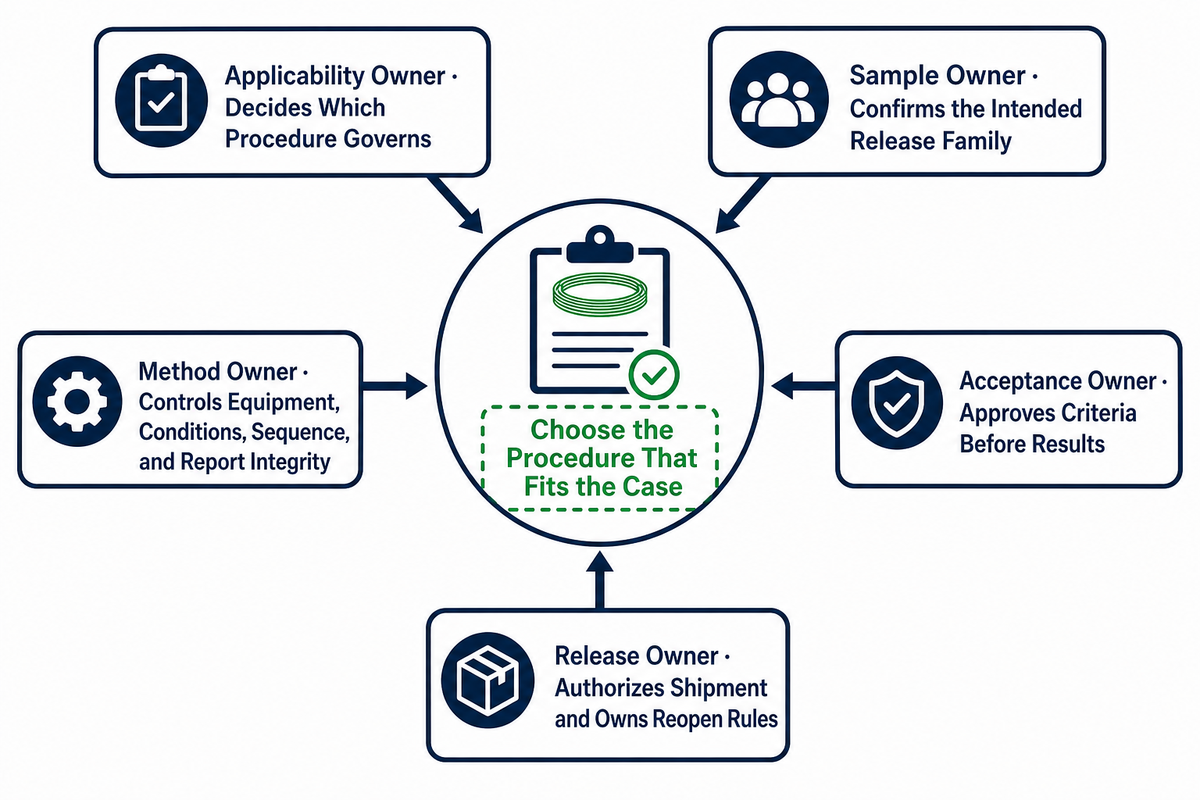
Once the failure path identifies a candidate test method, ownership still matters. The right procedure cannot be selected from the words “PET strapping change” alone. Product sensitivity, package format, transport mode, carrier, customer contract, regulated status, geography, and decision objective can all change the applicable path.
Five owners to name in the test brief
- The applicability owner decides which external or internal procedure governs.
- The sample owner confirms that tested units represent the intended release family.
- Method owner: controls equipment, conditioning, sequence, deviations, and report integrity.
- Acceptance owner: approves criteria before results are known and disposes deviations.
- Release owner: authorizes production or shipment and owns monitoring or reopen rules.
International Safe Transit Association guidance expressly directs users to choose a procedure or project that fits the case. Carrier programs such as FedEx package testing can also have their own application inputs and service boundaries; they are not universal UD Packaging capabilities or approvals.
Build a Representative Test Family Without Blanket Approval
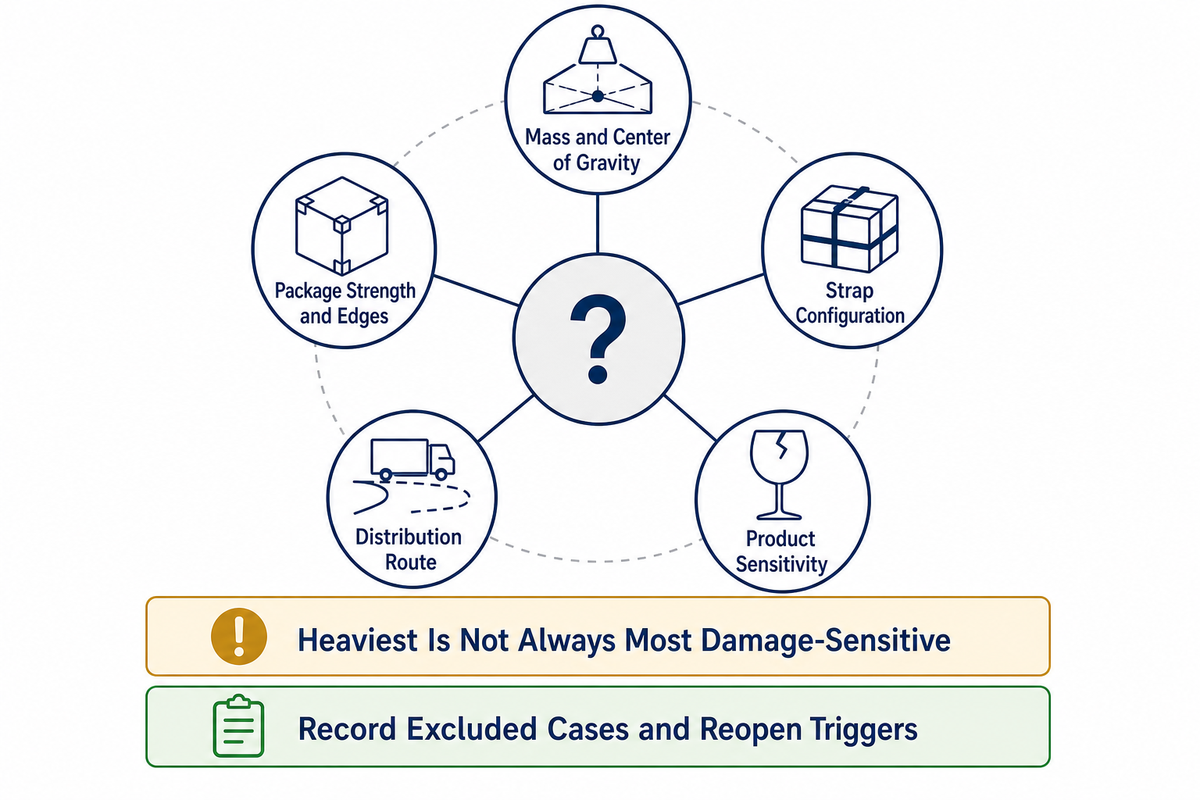
Testing every combination may be impractical, but choosing one “worst case” by weight alone is also weak. The representative family should explain why the selected units challenge the failure paths affected by the change. Record excluded cases and reopen triggers separately.
| Family dimension | Compare | Candidate boundary case | Reason it may not transfer |
|---|---|---|---|
| Mass and center of gravity | Light, typical, heavy, offset | Highest restraint demand or most unstable geometry | Heaviest is not always most damage-sensitive |
| Package strength and edges | Rigid, flexible, weak corner, protected edge | Most strap-sensitive contact condition | Different compression paths can control |
| Strap configuration | Count, direction, spacing, closure, settings | Narrowest operating margin | A different path may create another failure mode |
| Distribution route | Parcel, pallet freight, export, storage duration | Route with the relevant severe hazard | Severity in one hazard does not cover every sequence |
| Product sensitivity | Cosmetic, dimensional, functional, fragile | Lowest acceptable damage tolerance | Acceptance criteria can differ by product |
For every untested family member, record the reason for extrapolation, the evidence that makes it credible, the person accepting the risk, and the field signal that would reopen the decision. International Safe Transit Association guidance treats family matrices and monitoring as risk decisions, not automatic approval for configurations that were never represented.
Work Three Strapping-Change Examples Without Inventing a Universal Result
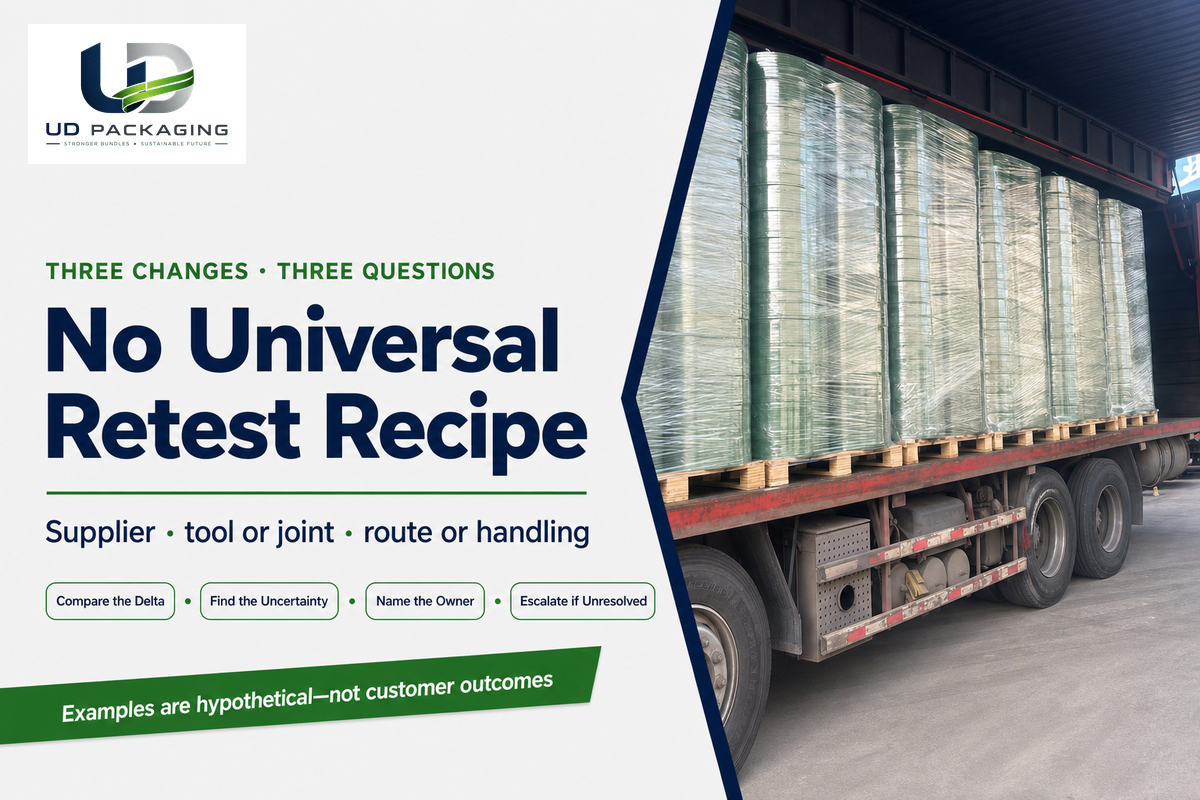
The test-family boundary provides the starting point for the examples below because each scenario changes what prior evidence still represents. The following are hypothetical decision examples, not UD Packaging customer cases or promised outcomes. Their purpose is to show why different deltas need different evidence questions.
Example 1: new strap supplier
Nominal material, width, and break strength appear unchanged. Procurement first confirms manufacturer, site, lot basis, methods, tolerances, and change notice, while packaging compares joint formation and line behavior. For a polyester candidate, the published PET strapping range provides product context, not release approval.
Escalate to represented-package evidence if retained tension, friction, joint window, package contact, or prior family coverage remains uncertain.
Example 2: new tool or closure
The strap itself is unchanged, but the joint and applied tension may not be. Operations freezes the current tool or machine route, maintenance state, joint route, settings, line speed, and package sample before comparing the operating window.
Escalate if the line trial cannot resolve joint consistency, package deformation, or interaction with production variation.
Example 3: new route or handling mode
The strap and package are unchanged, but the hazard sequence is not. Logistics documents the old and new carrier, mode, transfer points, stacking, storage, climate, and handling assumptions.
Escalate when accepted evidence did not represent the new hazards, or when monitoring cannot bound the exposure.
These examples also explain why “same break strength” is not a complete equivalence statement. A single property can be relevant without describing the joint, process window, retained load, package contact, or distribution sequence. A separate steel-to-PET change control comparison applies the same principle to a material-class substitution.
Close the Change With a Change-to-Release Evidence Ledger
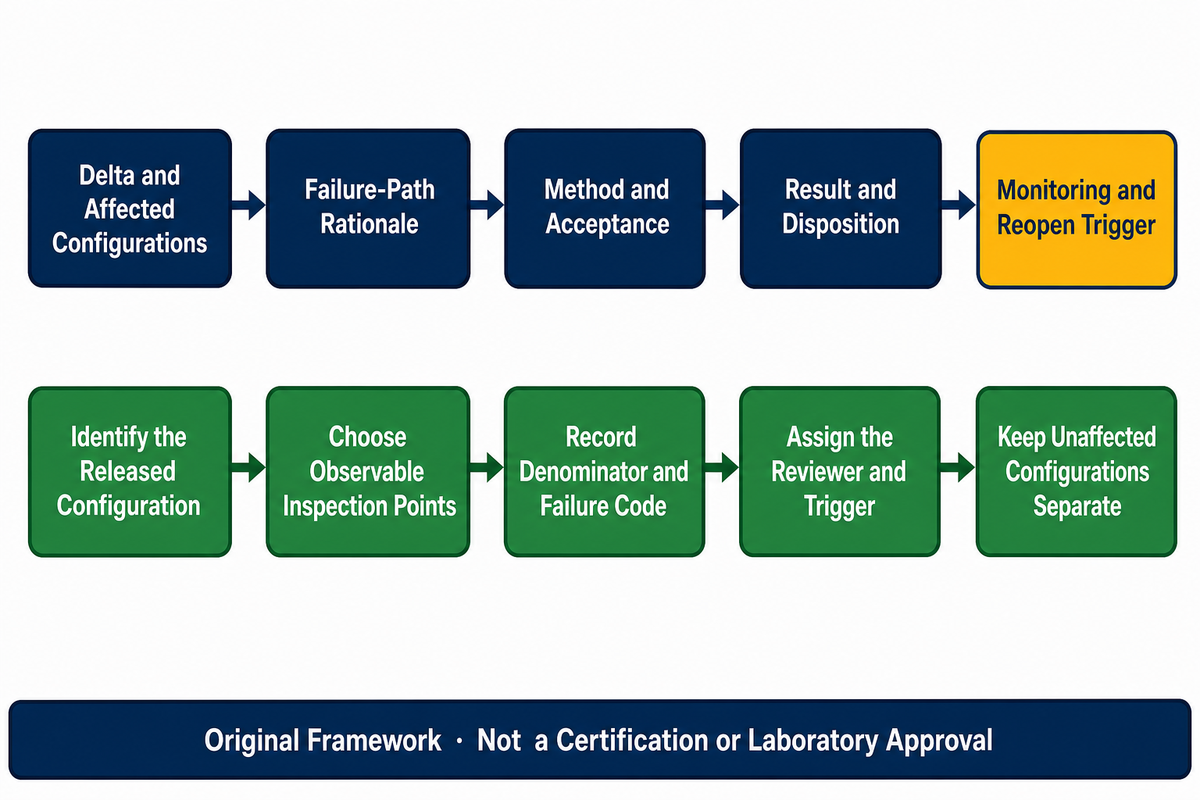
The worked comparisons show why the release record must preserve configuration, not just a pass statement. A pass statement without configuration and ownership is difficult to reuse. The Change-to-Release Evidence Ledger keeps the decision auditable and tells the next reviewer when old evidence stops representing the shipment.
| Ledger field | Minimum record | Why it matters |
|---|---|---|
| Delta and affected configurations | Old/new state, part and revision, package/load/route families | Prevents evidence from drifting to an unrepresented system |
| Failure-path rationale | Potential effect, unknowns, why the evidence is proportionate | Explains both testing and no-test decisions |
| Method and acceptance | Procedure owner, samples, conditions, criteria, deviations | Stops criteria from being invented after results appear |
| Result and disposition | Report, limitations, approver, released configurations | Keeps the conclusion inside its evidence boundary |
| Monitoring and reopen trigger | Field signal, review interval, owner, next-change trigger | Connects a controlled release to real shipment feedback |
This ledger is an original documentation framework, not a certification form or laboratory approval. Keep the underlying reports, supplier records, deviations, and decision signatures in the organization’s controlled system.
Plan a monitored release before the first changed shipment
Laboratory evidence and a packaging-line trial can reduce uncertainty, but they do not make field conditions disappear. Define the monitoring window before release so the first shipments test the decision rather than silently expanding its scope.
Monitored-release record
- Identify the released strap, joint, tool recipe, package, product, load, and route revisions.
- Choose inspection points that can observe joint condition, strap movement, edge or box damage, damaged products, load shift, and handling deviations.
- Record the shipment denominator and each defined failure code; do not report a percentage without both.
- Assign the person who reviews the data and the preapproved trigger for containment, investigation, or retesting.
- Keep unaffected configurations separate so a stable product family cannot hide a weak changed family.
No universal shipment count or review period is claimed here. The owner should justify the monitoring duration using shipment frequency, route variability, consequence of failure, detectability, prior evidence, and the uncertainty left after focused or independent testing.
Brief the Strapping Supplier Without Transferring the Release Decision
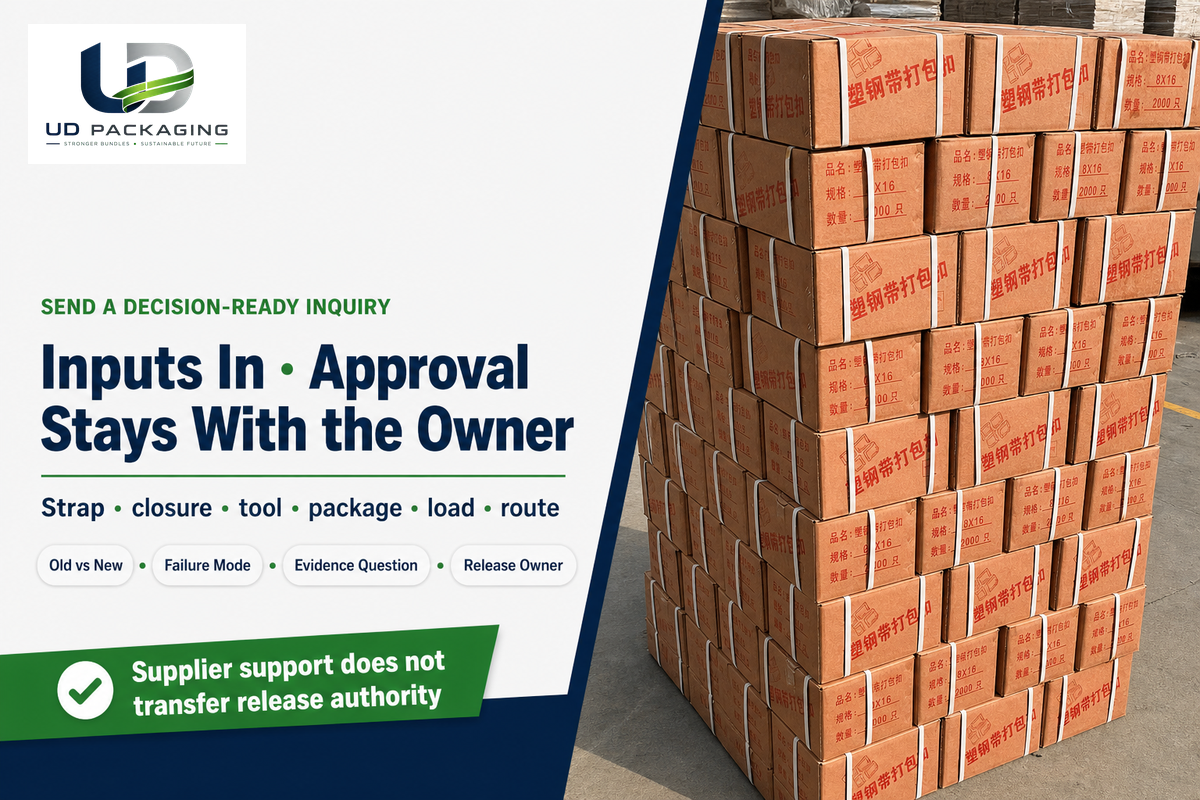
A strapping supplier can help define material, dimensions, joint route, tools, consumables, and application inputs. The shipper, package owner, qualified laboratory, carrier, customer, or regulated approval owner still decides which evidence is applicable and whether the changed package may be released.
Send a decision-ready inquiry
Provide the current and proposed strap specification, closure and tool, box or pallet configuration, product mass and dimensions, strap path, line conditions, route, observed failure mode, and the evidence question you need to resolve.
Provide the current and proposed strap specification, closure and tool, box or pallet configuration, product mass and dimensions, strap path, line conditions, route, observed failure mode, and the evidence question you need to resolve.
If the changed application uses cartons, use UD Packaging’s box-strapping page to record carton configuration inputs for a change review. Use that page to prepare the commercial and application brief, not as a substitute for package approval.
UD Packaging can review the strapping, closure, and equipment inputs within its supply scope. It should not be described as the owner of an ASTM or International Safe Transit Association procedure, a third-party laboratory result, or your organization’s release decision.
Discuss Your Strapping Change Inputs
Frequently Asked Questions
Does every new strap supplier require a full package retest?
No. A supplier change requires a documented review, but the evidence scope depends on what can affect performance and what prior evidence still represents. Before choosing focused or broader testing, compare manufacturer, manufacturing site, qualified lot basis, specifications, methods, tolerances, joint formation, line behavior, package interaction, and distribution coverage. If those comparisons stay inside an approved operating and family boundary, a controlled supplier qualification and monitored release may resolve the change; otherwise escalate to evidence for the unresolved failure path.
Is matching break strength enough to approve a replacement strap?
No. Break strength describes one tested property and may not establish elongation, recovery, friction, joint behavior, retained tension, tool compatibility, package contact, or shipping-unit performance. Record the properties and failure paths relevant to the actual package. Equivalence therefore has to be judged at the system level.
Should a change in strapping-tool settings trigger retesting?
A strapping-tool setting change should trigger a review because settings can change applied tension and joint formation. A controlled line and joint comparison may be sufficient when the package and route remain represented, but package-level evidence may be needed if deformation, damage, restraint, or process variation is unresolved.
Can one package test cover a family of box sizes or loads?
Sometimes, through a documented risk-based family rationale. Define the dimensions that affect the failure path, explain why selected samples represent the untested members, limit the approval boundary, and monitor released configurations; one heavy sample does not automatically cover every geometry or damage sensitivity.
Which standard should be used after a strapping change?
There is no universal answer. The applicable path depends on the product, package, route, carrier, customer, regulated status, market, and decision objective, so the procedure owner should document applicability before selecting test details or acceptance criteria. Record why the chosen procedure applies.
What should be saved after the change is released?
Save the old and new configuration, change rationale, affected family, sources, samples, procedure, criteria, results, deviations, approvers, released scope, monitoring plan, and reopen triggers. This makes later supplier, tool, package, load, or route changes easier to screen without overstating old evidence.
References and Sources
- International Safe Transit Association — When should a packaged-product be retested?
- International Safe Transit Association — product-family matrix and monitoring guidance
- International Safe Transit Association — procedure or project selection
- ASTM International — D4675-14a(2022) public scope
- ASTM International — Subcommittee D10.25 jurisdiction
- ASTM International — D4169-23e1 public scope
- FedEx — Packaging Lab testing program
Scope note: Public ASTM pages were used only for visible scope, edition, and limitations. No paid standard text, universal test level, sample count, assurance level, distribution cycle, or acceptance threshold is reproduced here.