Get in touch with UD Packaging Company

Last updated: September 2026
The best strapping machine manufacturers include Transpak for narrow-strap cartons, Mosca for connected ultrasonic systems, FROMM for configurable industrial automation, and TITAN for metal coils. The right shortlist depends on your package and production line. This comparison separates carton workstations, pallet machines and engineered heavy-load systems so buyers can approach relevant manufacturers.
Disclosure: This guide is published by UD Packaging, a supplier of industrial strapping materials and strapping equipment. UD Packaging is not included in the manufacturer ranking because its current public information does not establish that it manufactures the machines itself. The 20 companies below were selected based on publicly verifiable strapping-machine manufacturing capability.
Different strapping machine types, including carton strappers, horizontal pallet machines, and steel-coil strapping lines, solve different packaging problems. Users who purchase these machines against the same speed figure can find that they’ve purchased unsuitable equipment. For industrial use cases, first determine your load, and then consider the manufacturer’s family of machines, supported strapping materials, the sequence of operations, and the service arrangement.
Quick Picks
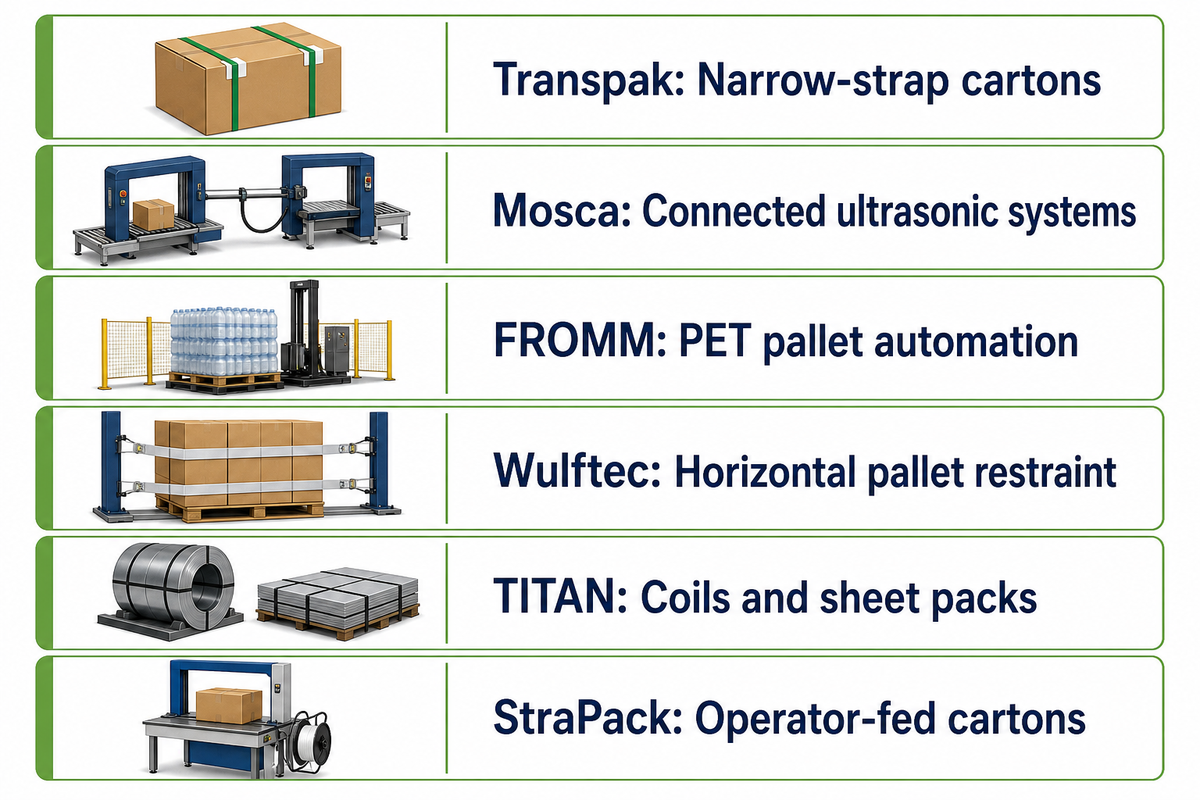
- Best for high-speed narrow-strap cartons: Transpak, particularly the TP-702 Mercury family.
- Best for connected ultrasonic carton strapping: Mosca, including the 2026 SoniXs P7-Connect B.
- Best for configurable PET pallet automation: FROMM, with its FPA PM systems.
- Best for horizontal pallet restraint and wrapping integration: Wulftec, including VarioMaster 9490.
- Best for automated coil and sheet-pack strapping: TITAN, with application-engineered metal-industry systems.
- Best for operator-fed cartons needing selectable tension modes: StraPack, particularly the iQ-400.
These recommendations focus on application fit rather than a universal quality ranking. A smaller machine manufacturer, for example, might be the better choice if its equipment has an appropriate package envelope and is supported locally, even if a more internationally oriented competitor offers a larger product range.
How We Selected These Strapping Machine Manufacturers
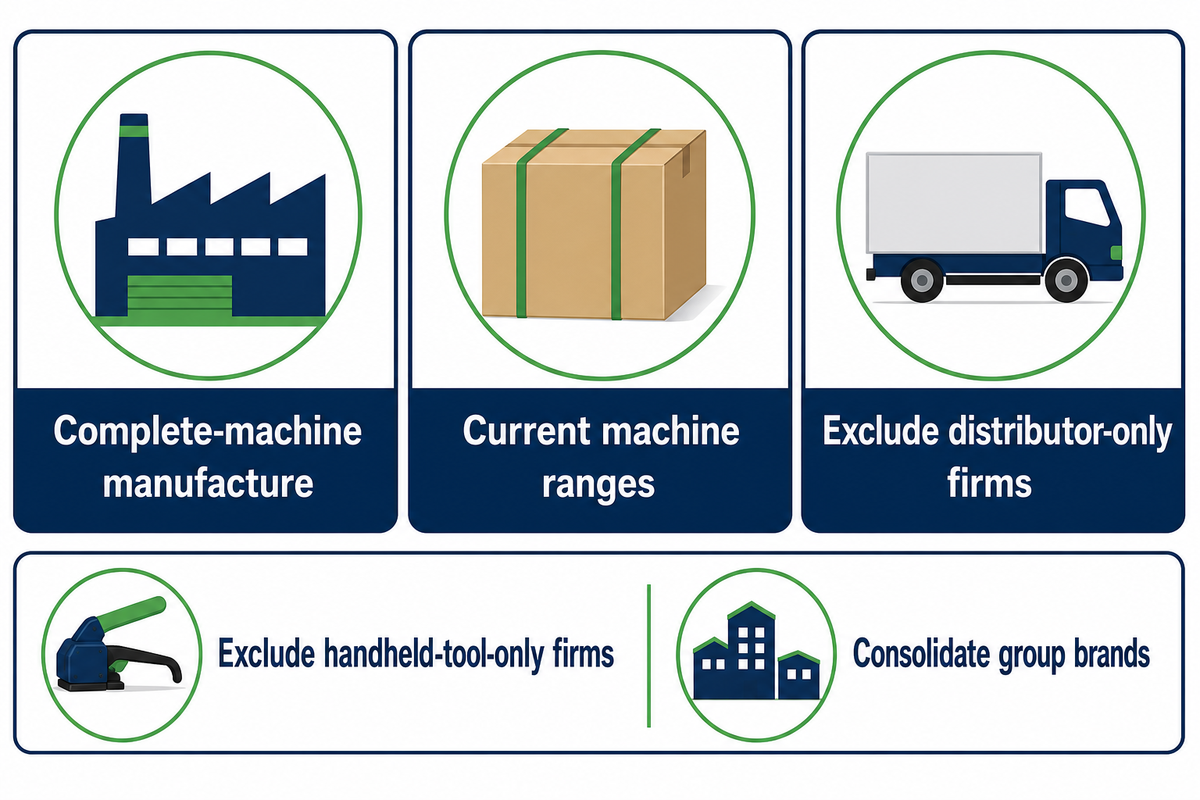
Information was checked against manufacturer websites and reliable public sources in September 2026. We screened 33 candidates and selected 20 businesses with public evidence of complete strapping-machine manufacture and current machine ranges. Selection considered documented applications, automation, technical information, service and spare-parts routes.
Distributors without established machine production, handheld-tool-only businesses and strap producers without machine manufacture were excluded. Brands within the same identified group were consolidated: Reisopack appears within Mosca’s coverage, while SMB and Strapex don’t receive separate places from Signode. Numbering helps readers locate each company; it isn’t a market-share ranking. Company facts and specifications below are drawn from the manufacturers’ published material.
Strapping Machine Manufacturer Comparison
Use this table to build an initial quotation list based on application requirements.
The machines named in this column don’t represent the companies’ entire product lines.
Years indicated reflect the founding years of the companies or their stated predecessors; differences between the company histories and the history of the machinery operation are explained in the profiles.
| No. | Company Name | Headquarters | Founded Year | Best For | Brief Introduction | Main Machines | Key Advantages | Potential Disadvantages | Official Website |
|---|---|---|---|---|---|---|---|---|---|
| 1 | Signode | Tampa, Florida, USA | 1913 | Steel, lumber and demanding industrial lines | Industrial packaging group manufacturing application-specific strapping equipment, consumables and associated line systems. | BRP, BPX, HSM, GCU-3 | Distinct machinery for metals, lumber and corrugated compression | Industrial project layouts can exceed simple carton-workstation needs | https://www.signode.com/ |
| 2 | Mosca | Waldbrunn, Germany | 1966 | Connected ultrasonic carton strapping | German machine manufacturer with carton, corrugated and pallet systems, including Reisopack within its group. | SoniXs P7-Connect B, KZV-111, Reisopack 2905 | Ultrasonic sealing and connected controls on designated models | P7-Connect B’s PP/paper route is not a PET pallet specification | https://www.mosca.com/ |
| 3 | FROMM | Steinhausen, Switzerland | 1947 | Configurable PET and steel automation | Swiss packaging group with dedicated production of automated strapping systems and strapping heads. | FPA PM, FPA AM | Material-specific platforms and several closure-position arrangements | PET and steel routes require different systems and heads | https://www.fromm-pack.com/ |
| 4 | Cyklop | Helmond, Netherlands | 1912 | PP/PET compression strapping for paper products | Packaging machinery group offering complete strapping systems alongside consumables and other end-of-line equipment. | SPE compression press, Smart line | Compression and vertical strapping combined for paper-product loads | Compression-press layouts are unnecessary for many individual cartons | https://www.cyklop.com/ |
| 5 | OMS Group | Paruzzaro, Italy | 1949 | Coordinated horizontal and vertical pallet lines | Italian manufacturer of strapping, wrapping and integrated industrial packaging equipment. | 08ACTIVE, 06ACTIVE, 08COMBO | Several orientations and combined packaging-machine routes | Standard package envelopes differ between configurations | https://oms-group.com/ |
| 6 | StraPack | Tokyo, Japan | 1933 | Carton stations needing gentle or stronger tension | Japanese strapping machinery business with semi-automatic machines, automatic arches and integrated systems. | iQ-400, automatic arch and inline systems | Selectable torque and stroke tension modes on iQ-400 | The iQ-400 still requires operator-fed strap | https://strapack.com/ |
| 7 | Transpak | Taipei, Taiwan | 1983 | High-speed narrow-strap carton stations | Taiwanese manufacturer covering carton strapping, pallet machines and integrated packaging systems. | TP-702 Mercury, pallet and inline systems | Published model-specific cycle rates and narrow PP strap choices | Cycle ratings cannot be applied directly to package output | https://www.transpakcorp.com/ |
| 8 | Schneider & Ozga | Bindlach, Germany | 1965 | Cross-strapping newspaper and magazine bundles | German strapping-machine maker with machinery for printed bundles and conveyor-based packaging operations. | SO 2004.1Q, TM 01 | Dedicated cross-strapping and belt or roller arrangements | Narrow strap ranges and bundle envelopes limit larger packs | https://www.schneider-ozga.de/ |
| 9 | Wulftec | Ayer’s Cliff, Quebec, Canada | 1990 | Horizontal pallet restraint with wrapping integration | Canadian Duravant company manufacturing strapping, stretch wrapping and pallet-handling equipment. | VarioMaster 9490, VarioMaster 9440, PowerMaster | Horizontal, side-seal and compression systems with combined-line options | Horizontal straps do not provide through-pallet vertical restraint | https://www.wulftec.com/ |
| 10 | TITAN | Schwelm, Germany | 1928 | Automated coil and sheet-pack strapping | German manufacturer of application-engineered industrial strapping machines and robotic packaging lines. | Robotic slit-coil, coil and sheet-pack systems | Laser-guided coil positioning and application-specific steel or plastic routes | Performance depends on the surrounding coil-handling layout | https://www.titan-schwelm.de/ |
| 11 | Messersi Packaging | Barbara, Italy | 1980 | Compression strapping for corrugated loads | Italian producer of vertical, horizontal and compression strapping machines for industrial packaging. | VR80, PR99, OR60 | Dedicated cardboard compression and PP/PET vertical machine options | Compression is unsuitable where the load must retain its original shape | https://messersi.com/ |
| 12 | Itipack | Villaverla, Italy | 1970 | Custom coil and heavy-load strapping systems | Italian machine manufacturer with integrated engineering and production for industrial load applications. | SKC/SKD, SKE/SKB, engineered industrial lines | Application-specific layouts supported by in-house engineering and manufacture | Load geometry and handling interfaces must be specified early | https://www.itipack.com/ |
| 13 | Pamminger | Linz, Austria | 1996 | Pallet strapping with constrained lance space | Austrian packaging machinery operation manufacturing vertical and horizontal strapping systems in Linz. | Vertical/horizontal systems, T-Aggregat configurations | Sequential lance layouts and model-scoped PP/PET vibration welding | Cited T-Aggregat specification covers 9–16 mm strap width | https://www.pamminger.at/ |
| 14 | Superworker | Shenzhen, China | 2011 | Strapping projects in metals production | Chinese manufacturer of automatic steel and PET strapping machinery and industrial packing lines. | Coil, pipe and plate strapping systems | Engineering spans machinery, installation and industrial packing-line integration | Documented focus is metal loads rather than parcel workstations | https://chinasuperworker.com/ |
| 15 | Joinpack | Taichung, Taiwan | 1973 | Carton stations requiring several machine variants | Taiwanese strapping-machine manufacturer offering related carton models for different working layouts. | A-98, A-98M, A-93 | Low-table, side-seal, stainless and conveyor variants | Table and conveyor versions require different operating arrangements | https://www.joinpack.com/ |
| 16 | Packway | Taichung, Taiwan | 1979 | Low-table stations for bulky packages | Taiwanese packaging equipment manufacturer with semi-automatic, automatic and integrated strapping machinery. | PW-311L, PW-311H, PW-0860A | Low working-height and conventional arch-machine choices | Low-table semi-automatic models retain manual handling | https://www.packway.com/ |
| 17 | CHALI / Jangzin Industrial | Taichung, Taiwan | 1979 | Mobile-guide pallet strapping with carton equipment | Jangzin manufactures strapping and carton-sealing machines under the CHALI identity. | JN-85E, JN-85PS, JN-85PSA | Mobile pallet guides and optional PET configuration | PET capability is configuration-specific within the JN-85 range | https://www.chali.com.tw/ |
| 18 | Extend Great International | Taichung, Taiwan | 1986 | Combined carton-sealing and strapping procurement | Taiwanese end-of-line machinery maker producing EXS strappers alongside sealers and wrappers. | EXS semi-automatic, automatic and fully automatic series | Several packaging-machine categories from the same manufacturing organisation | Series names alone do not define unattended operation | https://www.extendgroup.com.tw/ |
| 19 | Youngsun | Hangzhou, China | 1983 | Narrow-strap PP carton automation | Chinese packaging machinery manufacturer with strappers, conveyors, case equipment and customised packing lines. | YS-505B, YS-305B, YS-305P | Published narrow PP strap specifications and broader line equipment | Cited YS-505B specification does not establish PET compatibility | https://www.youngsunpack.com/ |
| 20 | Hualian Machinery | Wenzhou, China | 1989 | Semi-automatic PP carton stations | Packaging machine manufacturer with PP strapping models within a broader equipment portfolio. | KZB-II, KZB-I, SK-1 | Several operator-fed carton-strapping configurations | Operator handling remains part of the machine cycle | https://www.hualianmachinery.com/ |
Global Industrial Strapping System Manufacturers
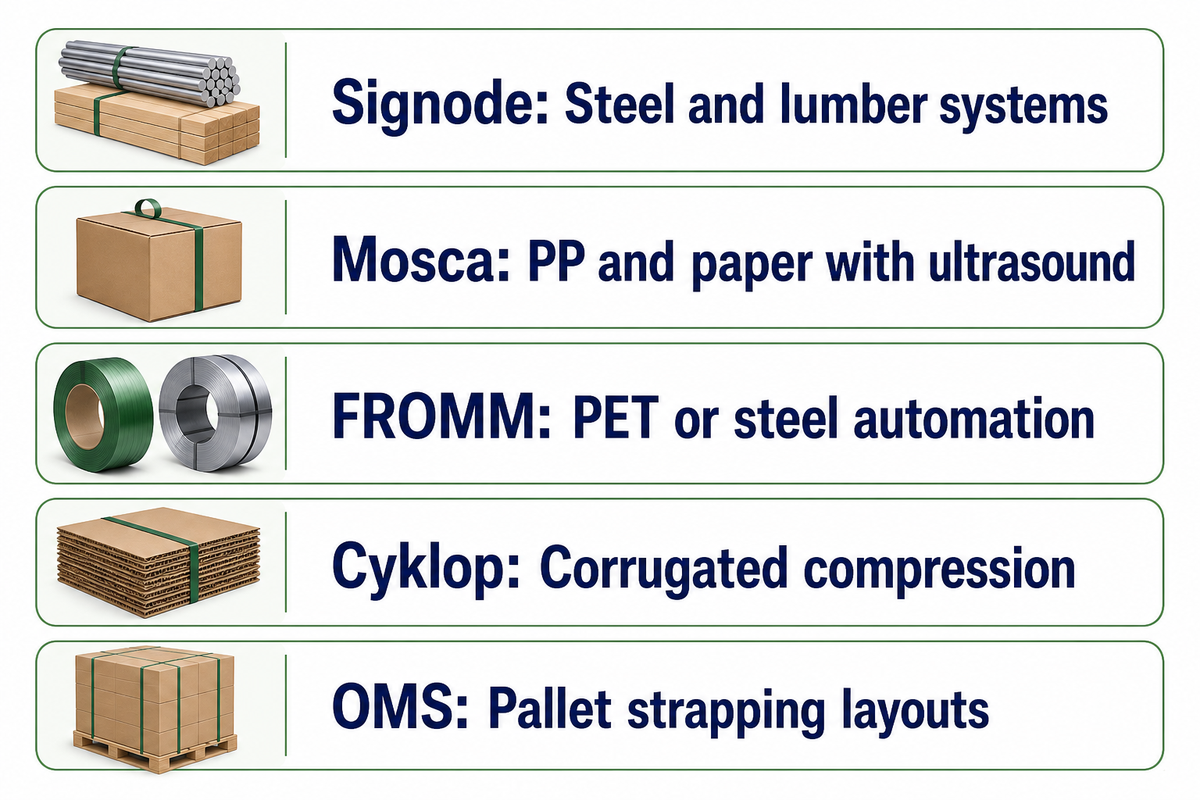
These strapping equipment manufacturers cover several industrial applications or packaging technologies, including automatic strapping systems. Their breadth is useful when one organisation needs carton, pallet and heavy-load equipment, but the relevant product family still determines suitability. The group name on a quotation should identify a specific machine, manufacturing entity and service scope.
1. Signode: Best for steel, lumber and demanding industrial lines
Headquarters: Tampa, Florida, USA · Founded: 1913, predecessor history · Type: industrial strapping machine manufacturer
Official website: https://www.signode.com/
Main machines: BRP, BPX, HSM and GCU-3 · Documented routes: steel bar/rod/pipe strapping, lumber compression, horizontal strapping and corrugated compression
Signode’s application-specific catalogue makes it a useful starting point for plants whose loads differ substantially from ordinary shipping cartons. The BRP applies steel strapping to bar, rod and pipe, while the BPX addresses lumber packages with compression; those are different machine assignments within the same group. Purchasing teams responsible for several industrial sites can discuss the package-handling sequence and consumable route with one group, while keeping each plant’s specification separate. This strength has a practical limit: an engineered metals or lumber system brings layout and integration work that a straightforward carton workstation may not need.
2. Mosca: Best for connected ultrasonic carton strapping
Headquarters: Waldbrunn, Germany · Founded: 1966 · Type: strapping machine manufacturer
Official website: https://www.mosca.com/
Main machines: SoniXs P7-Connect B, KZV-111 and Reisopack 2905 · Featured route: P7-Connect B for PP and paper strap, with ultrasonic sealing and WebHMI
Mosca’s April 2026 Interpack announcement introduces the SoniXs P7-Connect B as a successor to the MP-6, giving this shortlist a current product update rather than only a company history. Connected controls and ultrasonic sealing make that machine relevant to carton operations that want to manage strapping alongside other end-of-line equipment. Mosca also covers pallet applications, and its group now includes Reisopack following the 2025 transaction, so the latter isn’t counted as another independent selection here. The P7-Connect B’s documented PP and paper route should remain separate from PET pallet requirements, which belong with a different model and strapping specification.
3. FROMM: Best for configurable PET and steel automation
Headquarters: Steinhausen, Switzerland · Founded: 1947 · Type: strapping systems and machinery manufacturer
Official website: https://www.fromm-pack.com/
Main machines: FPA PM and FPA AM · Materials: PET for FPA PM; steel for FPA AM · Production: automated systems through FROMM Packaging Automation in Italy
FROMM separates its plastic and steel automation routes clearly enough to support a technical discussion before individual components are selected. FPA PM systems address PET strapping, while FPA AM systems use steel, and the published range offers different closure positions for the surrounding load-handling layout. That combination suits pallet and industrial projects in which the strap path, head location and access for maintenance must fit an existing process. The buyer still has to choose the correct platform: a broad FROMM catalogue doesn’t make one machine interchangeable between steel and PET, or between every strap width listed across the family.
4. Cyklop: Best for PP and PET compression strapping of paper products
Headquarters: Helmond, Netherlands · Founded: 1912, in Cologne · Type: packaging machinery and strapping systems manufacturer
Official website: https://www.cyklop.com/
Main machines: SPE compression strapping press and Smart line · Featured specification: SPE vertical strapping with a CFH-1 head for PP and PET
Cyklop’s SPE combines a press with fully automatic vertical strapping for corrugated cardboard, printing, paper and paper-bag loads. Its published design includes adjustable compression and conveyor integration, making the compression stage part of the packaging process rather than a separate manual operation. The company’s history also identifies its Italian-made Smart line and acquisition of strapping-machine manufacturer Ligotech, supporting its role beyond the sale of consumables or handheld tools. An SPE-type press is a focused choice for loads that benefit from controlled compression; an individual carton that simply needs a closing strap calls for a different machine arrangement.
5. OMS Group: Best for coordinated vertical and horizontal pallet lines
Headquarters: Paruzzaro, Italy · Founded: 1949 · Type: industrial packaging machine manufacturer
Official website: https://oms-group.com/
Main machines: 08ACTIVE vertical, 06ACTIVE horizontal and 08COMBO · Featured specification: 08ACTIVE TR1400 head for PP or PET, 9–16 mm wide and 0.6–1.0 mm thick
OMS Group is relevant when a pallet line needs several packaging operations coordinated around the same load. Its 08ACTIVE uses a top-mounted strapping head for vertical applications, while the 06ACTIVE and combined-machine routes address different layouts. On the published 08ACTIVE configuration, the TR1400 head’s stated PP/PET dimensions give engineers a concrete starting point for the strap specification, instead of a general plastic-strapping compatibility claim. The standard machine’s package envelope still limits the selection; larger loads, another orientation or a combined wrapping operation require the appropriate OMS configuration rather than an assumption that one ACTIVE model covers them all.
Automatic Strapping Specialists for Cartons and Pallets
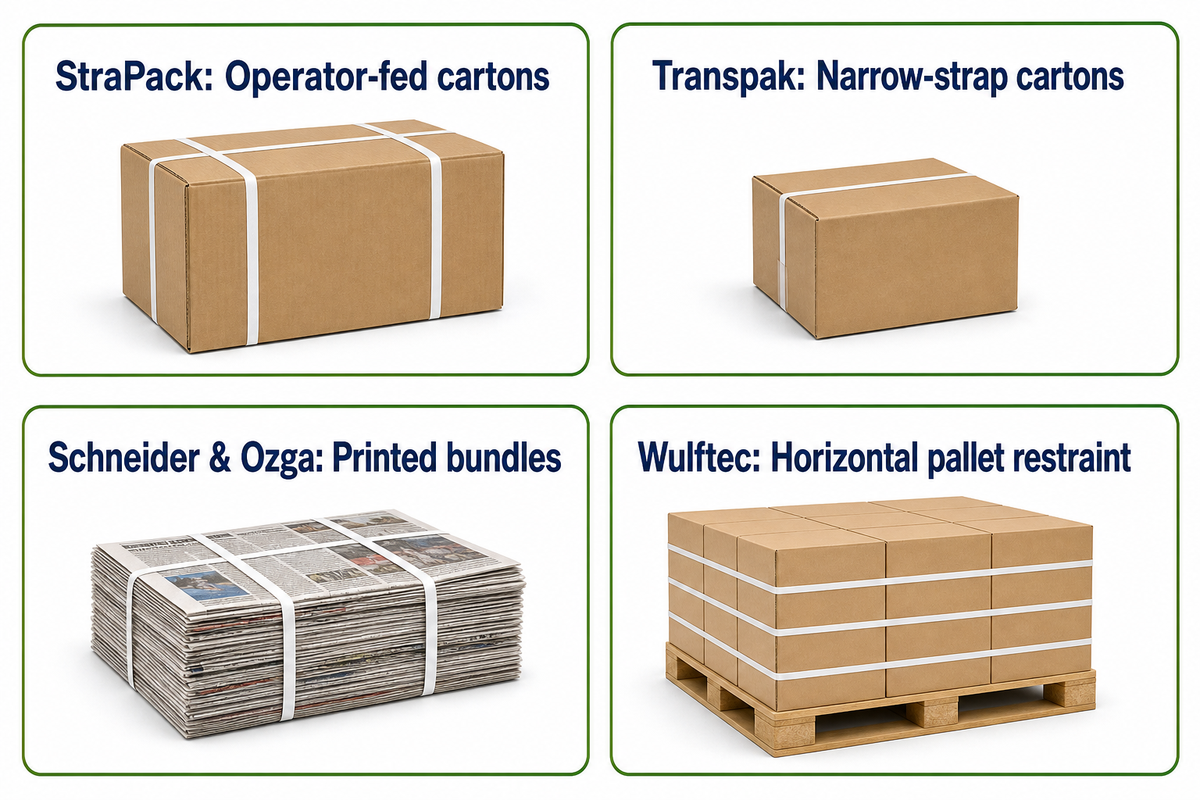
Automatic strapping machine manufacturers differ in what they automate. Some machines close a strap around a box presented by an operator; others position bundles, cross-strap them or surround a pallet at selected heights. The following choices illustrate those differences without treating every automatic machine as an unattended production line.
6. StraPack: Best for carton stations needing selectable tension modes
Headquarters: Tokyo, Japan · Founded: 1933, predecessor history; machinery company formed in 1969 · Type: strapping machinery manufacturer
Official website: https://strapack.com/
Main machines: iQ-400, automatic arch machines and integrated systems · Featured route: operator-fed PP strapping with torque or stroke tension mode
StraPack offers automatic and semi-automatic strapping machines, but the iQ-400 provides a particularly clear reason to shortlist the company for a manual packing station. According to its product description, torque mode suits stronger tension and compressible packages, while stroke mode suits soft tension or quick operation. That choice is useful where one operator handles boxes with different sensitivity to pressure, because the machine’s tension behaviour matters as much as its nominal cycle time. The iQ-400 remains semi-automatic: the operator wraps and inserts the strap, so a plant seeking automatic package transfer must move to another StraPack system rather than expecting this table machine to run a conveyor line.
7. Transpak: Best for high-speed narrow-strap carton stations
Headquarters: Taipei, Taiwan · Founded: 1983 · Type: strapping equipment manufacturer
Official website: https://www.transpakcorp.com/
Main machines: TP-702 Mercury, pallet machines and inline systems · Featured specification: TP-702-59 rated at 65 cycles/min with 5, 6 or 9 mm PP strap configurations
Transpak’s TP-702 range gives carton buyers a model family with published distinctions between strap widths and cycle ratings. The manufacturer’s table lists 65 cycles per minute for the narrow-strap TP-702-59 configurations, while wider versions have different ratings. This makes the family useful for a packing operation that can define its actual PP strap and carton format before comparing production speed, and Transpak’s broader range provides a separate route toward pallet or inline equipment. The rating is still a strapping-cycle figure: package presentation, multiple straps on one carton and downstream release determine whether the workstation can meet the plant’s required output.
8. Schneider & Ozga: Best for cross-strapping printed bundles
Headquarters: Bindlach, Germany · Founded: 1965 · Type: strapping machine manufacturer
Official website: https://www.schneider-ozga.de/
Main machines: SO 2004.1Q and TM 01 · Applications: newspaper and magazine bundles, cross-strapping and conveyor handling · TM 01 layouts: belt or roller arrangements
Schneider & Ozga is a focused option for printing and distribution operations whose product is a bundle rather than a closed shipping box. The SO 2004.1Q is a cross-strapping machine, while TM 01 layouts include different belt or roller arrangements and an off-centre seal option. Those details matter where a bundle must remain supported as it moves through the strapping station, especially when upstream equipment determines its orientation and spacing. Its specialised bundle envelope and narrow strap selections are the purchasing constraint: a plant handling large industrial packs should evaluate another machine family instead of stretching a print-bundle specification beyond its purpose.
9. Wulftec: Best for horizontal pallet restraint with wrapping integration
Headquarters: Ayer’s Cliff, Quebec, Canada · Founded: 1990 · Type: strapping and packaging machinery manufacturer; a Duravant company
Official website: https://www.wulftec.com/
Main machines: VarioMaster 9490, VarioMaster 9440 and PowerMaster · Featured route: automatic horizontal strapping; the VarioMaster 9490 page specifies PET coils with a 16-inch core
Wulftec combines strapping, stretch wrapping and pallet-handling equipment, making it relevant when those operations must work as one line. VarioMaster 9490 surrounds pallets or individual layers horizontally, while other Wulftec machines provide side-seal or compression arrangements. The manufacturer’s description of a height-adjustable horizontal arch gives a clear application: placing straps around load layers or holding corner protection in position before subsequent handling. Horizontal restraint has a different geometry from vertical strapping through or beneath a pallet, so a buyer who needs that second function must specify the additional route rather than treating the 9490 as interchangeable with a vertical machine.
Pallet and Heavy-Load Strapping Manufacturers
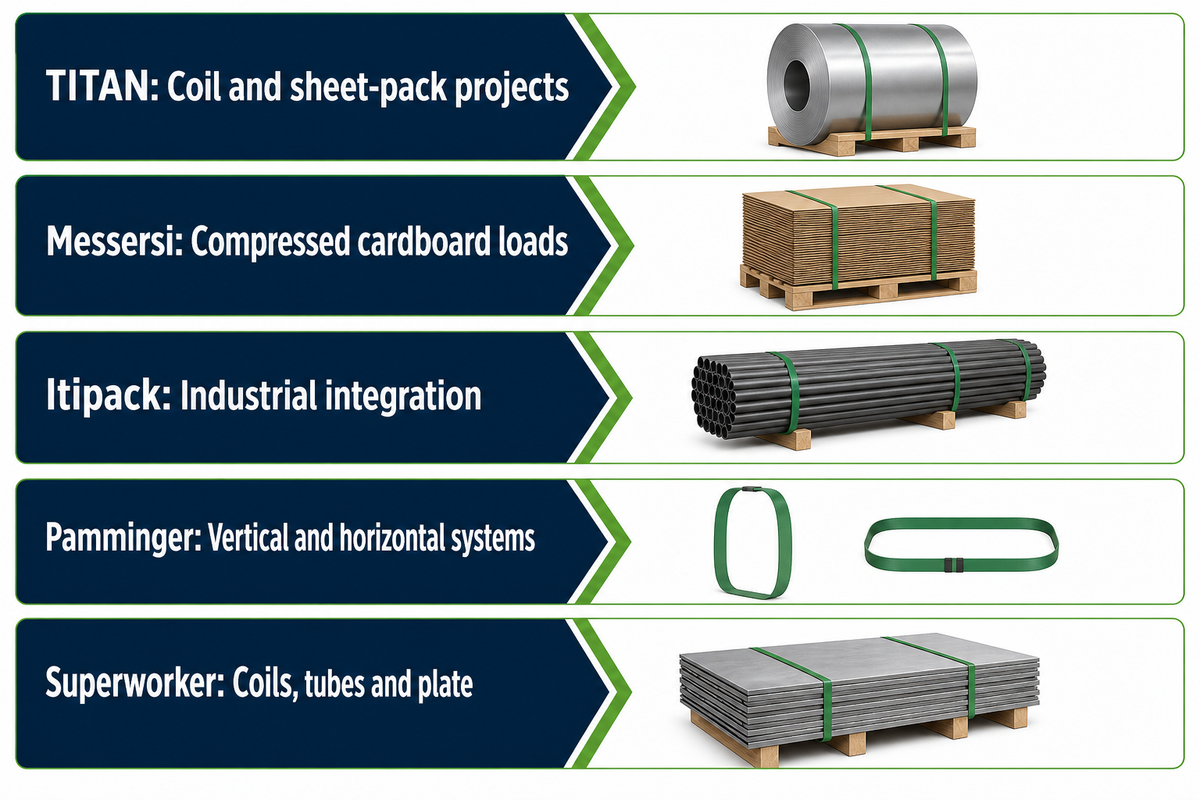
Purchasing equipment to handle coils, sheet packs, timber and compressed paper loads involves more than the design and manufacture of a sealing head. By itself, this design and manufacture capability does not establish complete-system capability. These machine builders have designs, technology and solutions for different pallet strapping applications, including heavier loads and material handling systems. For these applications, the machine builder provides engineered systems for strap path and load movement.
10. TITAN: Best for automated coil and sheet-pack strapping
Headquarters: Schwelm, Germany · Founded: 1928 (predecessor history) · Type: industrial strapping machine manufacturer
Official website: https://www.titan-schwelm.de/
Main machines: robotic slit-coil lines, coil strapping and sheet-pack systems · Materials: application-specific steel and plastic systems, including PET for wood-panel loads
TITAN’s current machine examples describe the load-handling problem in detail, which helps engineers distinguish a complete industrial system from a portable strapping tool. In its robotic slit-coil example, a laser measures coil widths and positions, the control calculates the strapping pattern, and two robot arms place the strap before tensioning and sealing. Other examples cover through-eye or circumferential coil paths, sheet packs and PET-strapped wood panels, giving the company a strong fit for metal-industry automation and related heavy-load projects. The surrounding handling layout is inseparable from the purchase: coil supports, positioning and movement must be coordinated with the strapping station for the specified process to work.
11. Messersi Packaging: Best for compression strapping of corrugated loads
Headquarters: Barbara, Italy · Founded: 1980 · Type: strapping and packaging machine manufacturer
Official website: https://messersi.com/
Main machines: VR80 vertical, PR99 compression and OR60 horizontal · Materials: VR80 is documented for PP and PET · Production: machines manufactured in Italy
Messersi’s PR99 brings vertical compression and strapping together for cardboard applications, while its broader range includes standard vertical and horizontal machines. That distinction is useful to corrugated plants: keeping a stack under controlled pressure during strapping is a different assignment from passing an already stable pallet through a conventional arch. The VR80’s published PP/PET route also gives buyers an alternative when the load requires vertical strapping without the same compression-machine arrangement. Compression should be selected because the product benefits from it; loads that must retain their original shape or can’t tolerate the press action need another configuration within the range.
12. Itipack: Best for custom coil and heavy-load strapping systems
Headquarters: Villaverla, Italy · Founded: 1970 · Type: industrial strapping machine manufacturer
Official website: https://www.itipack.com/
Main machines: SKC/SKD, SKE/SKB and application-specific industrial lines · Scope: steel and plastic strapping systems for metals, wood, paper and other industrial loads
Itipack describes an integrated design and manufacturing operation, with machinery assembled and tested at its Villaverla headquarters. Its catalogue is organised around industrial applications and machine families such as SKC/SKD and SKE/SKB, making the company relevant where package geometry drives the equipment design. For a procurement team, the useful capability is the ability to discuss how a complete strapping station fits the load and surrounding equipment, rather than buying a head and leaving all machine engineering to another party. This project-oriented route needs defined load dimensions, strap orientation and handling interfaces early; an incomplete description of the product leaves too much of the final configuration unresolved.
13. Pamminger: Best for pallet strapping where lance space matters
Headquarters: Linz, Austria · Founded: 1996, packaging subsidiary; parent business dates to 1932 · Type: packaging machine manufacturer
Official website: https://www.pamminger.at/
Main machines: vertical and horizontal pallet systems with application-specific strapping units · Featured specification: T-Aggregat for 9–16 mm PP/PET strap, using vibration welding
Pamminger manufactures its vertical and horizontal strapping machines in Linz and describes a sequential lance arrangement for installations with limited space. That’s a concrete reason to involve the company when pallet openings and available travel space shape the machine layout. Its T-Aggregat specification identifies PET and PP, with published width and thickness limits, while the company’s broader machinery offering connects strapping with conveying and packaging operations. The cited unit covers 9–16 mm strap width, so a wider strap requirement must lead to another documented solution rather than an assumption that an equivalent unit will accept it after a routine adjustment.
14. Superworker: Best for strapping projects in metals production
Headquarters: Shenzhen, China · Founded: 2011 · Type: automatic industrial strapping machine manufacturer
Official website: https://chinasuperworker.com/
Main machines: steel or PET systems for coils, pipes and plates · Project scope: machine manufacture, integrated packing-line design, installation and maintenance
Superworker’s published offering centres on automatic steel and PET strapping for industrial loads, with application examples in coils, tube bundles and plate handling. The company describes responsibility from packing-line design through machinery manufacture and installation, which suits projects where the strapping station must fit a metallurgical process. According to its website, its customer references include Shougang. This is a metals-oriented shortlist entry, so a small-parcel operation seeking a compact standard carton strapper should focus on the workstation manufacturers elsewhere in the comparison.
Asian Strapping Machine Manufacturers
Asian manufacturers offer standalone carton equipment as well as packaging systems. The geographical location of a manufacturer alone does little to determine whether a piece of equipment suits a particular application. The following examples show actual product differences: table height, package transfer systems, pallet guides, strap specifications, and the provision of related packaging systems.
15. Joinpack: Best for carton stations requiring several machine variants
Headquarters: Taichung, Taiwan · Founded: 1973 · Type: strapping machine manufacturer, also known as Jia-In
Official website: https://www.joinpack.com/
Main machines: A-98, A-98M and A-93 · Layout choices: low-table, side-seal, stainless steel and belt or roller conveyor variants
Joinpack’s A-98 family is useful when a business needs related carton machines for several workstation layouts. Its published update describes servo drive and variants that change table height, sealing position, housing or package transfer, rather than presenting automation as one fixed arrangement. A packaging engineer can therefore compare the same family’s options against the available operator space, carton movement and working environment, including applications where a stainless housing is relevant. The distinction between table and conveyor variants remains important: a familiar model family doesn’t make their package-positioning duties or line-control requirements identical.
16. Packway: Best for low-table strapping of bulky packages
Headquarters: Taichung, Taiwan · Founded: 1979 · Type: packaging machinery manufacturer
Official website: https://www.packway.com/
Main machines: PW-311L, PW-311H and PW-0860A · Published working heights: PW-311L, 450 mm; PW-311H, 750 mm · Automation: semi-automatic through integrated systems
Packway’s low-table PW-311L gives buyers a specific alternative to a conventional-height semi-automatic station. The company publishes a 450 mm working height for that model and 750 mm for the PW-311H, a difference that affects how a bulky package reaches the strapping position. Its automatic arch and integrated-machine range provides a separate path when packaging operations move beyond an operator-fed workstation. Lowering the table doesn’t itself automate handling: the semi-automatic route still includes manual package movement and strap placement, so the ergonomic benefit and the required production rate need to be assessed together.
17. CHALI / Jangzin Industrial: Best for mobile-guide pallet strapping
Headquarters: Taichung, Taiwan · Founded: 1979 · Type: strapping and carton-sealing machine manufacturer
Official website: https://www.chali.com.tw/
Main machines: JN-85E, JN-85PS and JN-85PSA · Featured route: semi-automatic pallet strapping with a mobile guide; PET available as an option on JN-85PSA
CHALI is the commercial identity associated with Jangzin Industrial, so the two names belong in one manufacturer entry. The JN-85 range includes carton machines and mobile-guide pallet equipment, giving a warehouse a route beyond handheld strapping without immediately moving to a complete conveyor installation. In the manufacturer’s brochure, the JN-85PSA’s mobile guide and optional PET configuration describe a specific pallet-handling solution rather than an undifferentiated automatic machine. The optional material route is the purchasing limit: PET capability on that configuration shouldn’t be extended to every JN-85 model or to every coil dimension used elsewhere in the plant.
18. Extend Great International: Best for combined carton-sealing and strapping procurement
Headquarters: Taichung, Taiwan · Founded: 1986 · Type: end-of-line machinery manufacturer
Official website: https://www.extendgroup.com.tw/
Main machines: EXS semi-automatic, automatic and fully automatic series · Related equipment: EXC carton sealers and EXP pallet wrappers · Production: Taiwan plant
Extend’s own plant produces EXS strapping equipment alongside carton sealers and pallet wrappers, which makes the company relevant to a distributor or factory sourcing several end-of-line categories. The practical advantage is a common manufacturing organisation for related machinery, particularly when carton closure and strapping must be specified together. Its published EXS range separates semi-automatic, automatic and fully automatic series, giving the buyer a starting structure for discussing operator involvement and package transfer. Those series labels still cover different workflows: purchasing an EXS machine doesn’t by itself establish automatic package positioning, unattended operation or the interfaces needed to connect a case sealer.
19. Youngsun: Best for narrow-strap PP carton automation
Headquarters: Hangzhou, China · Founded: 1983 (mould-business predecessor); machinery company established in 2002 · Type: packaging machinery manufacturer
Official website: https://www.youngsunpack.com/
Main machines: YS-505B, YS-305B and YS-305P · Featured specification: YS-505B for 5 or 6 mm PP strap, 0.5–0.8 mm thick, with a published 65-cycle/min rating
Youngsun manufactures strapping machines alongside case equipment, palletizers and conveyors, making it relevant to buyers assembling a broader packaging line. The YS-505B specification is unusually useful for initial screening because it identifies both PP strap dimensions and the stated cycle rate. An engineering team can compare that narrow-strap route with its carton format before discussing how the machine connects to upstream case handling or downstream material handling equipment. The published specification is for PP, so the presence of PET consumables or other machinery in Youngsun’s wider catalog doesn’t establish that the YS-505B can process PET strap.
20. Hualian Machinery: Best for semi-automatic PP carton stations
Headquarters: Wenzhou, China · Founded: 1989 · Type: packaging machine manufacturer
Official website: https://www.hualianmachinery.com/
Main machines: KZB-II, KZB-I and SK-1 · Featured route: KZB-II semi-automatic PP strapping · Applications: operator-fed cartons and general packing stations
Hualian’s KZB-II places the company on the shortlist for businesses that need a defined semi-automatic PP carton-strapping route. Its broader packaging-machine range can be relevant where a workshop or warehouse purchases several small packing operations together, but the strapper should still be selected on its own operating requirements. The useful distinction is the role of the operator: a semi-auto machine carries out the strapping functions after the required package and strap presentation. Manual handling remains between cycles, so this route fits an operator-led station more naturally than a line whose acceptance requirement is continuous, unattended package transfer.
How to Choose a Strapping Machine Manufacturer
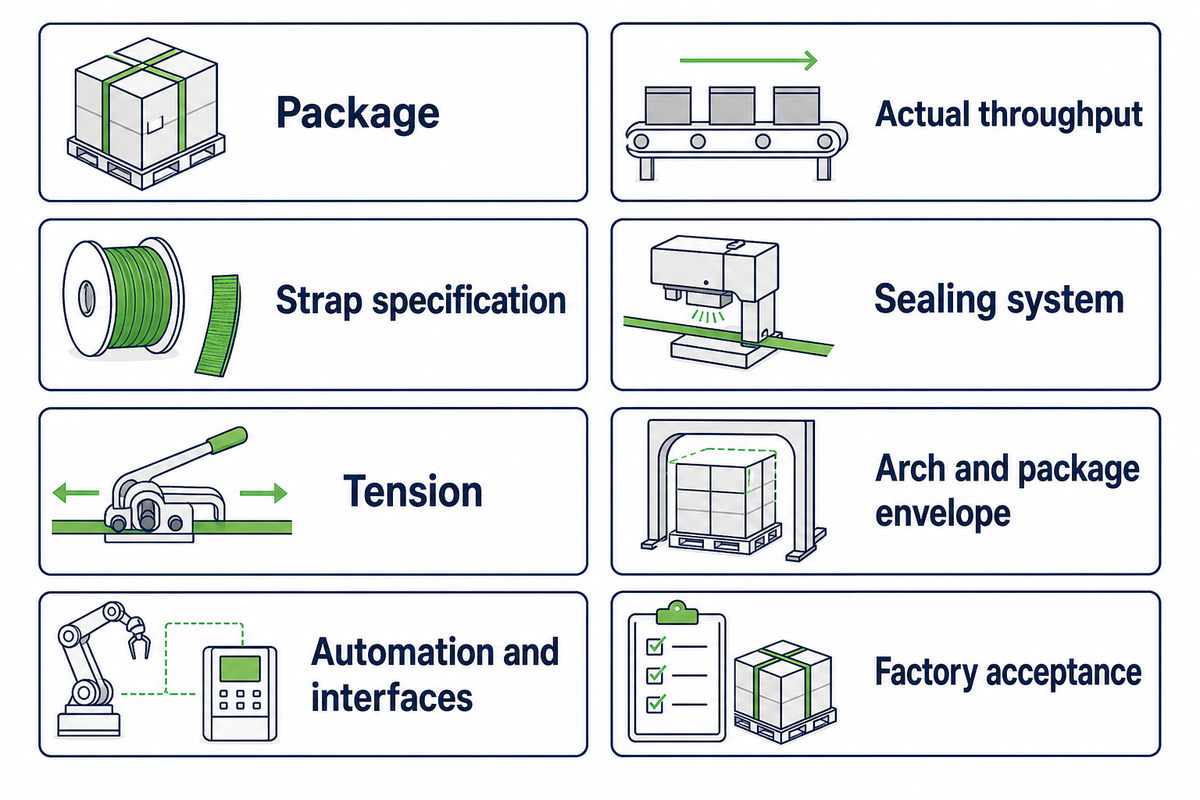
Choose an appropriate manufacturer based on your package, strap and production sequence, and then assess support and commercial trade-offs. A short-list of vendors should only be developed after these steps. In logistics, the term banding can also describe strapping operations. Specify the functions of the straps and the machines instead of using the label. Give the same case description to potential vendors so that the proposals address the case in the same way. This reduces the risk that the case is misinterpreted or its various elements are addressed inconsistently.
1. Start with the package
Enter minimum and maximum values for length, width, height and mass for each load. Also include characteristics such as the load’s surface, stability, compression sensitivity, pallet openings, overhang, sharp edges and strap positions. Steel coils, bundles and cartons of similar mass can require different methods of material handling and strapping.
Describe the working environment as well. Some types of seafood, poultry and other food processing, for example, may require machinery designed for washdown. A stainless steel cover doesn’t define a washdown machine. For lumber or dusty corrugated paper processing, the nature of the contaminants and the accessibility of the part of the machine to be cleaned should be described in the request.
2. Define actual production throughput
State the required accepted packages per hour and strap pattern, and include your predictions for peak periods and product changes. The number of packages and the number of straps handled per minute are two different quantities. For this example, assume 60 straps per minute, with two straps on each package: the ideal limit is 30 packages per minute before handling losses, and this is an arithmetic example, not a production guarantee.
Establish the quoted configuration prior to comparing rates for customizable machines. Find out what the manufacturer rating covers (i.e. package sensing, conveying, tensioning, sealing, etc.). Machines can become a constraint in a system during coil changes or fault recovery, even if they seem to be working fast enough during a short demo. Evaluate the overall system, including the length of time it takes to perform the complete process, including any coil changes and recovery actions from process faults.
3. Match the machine to the strap
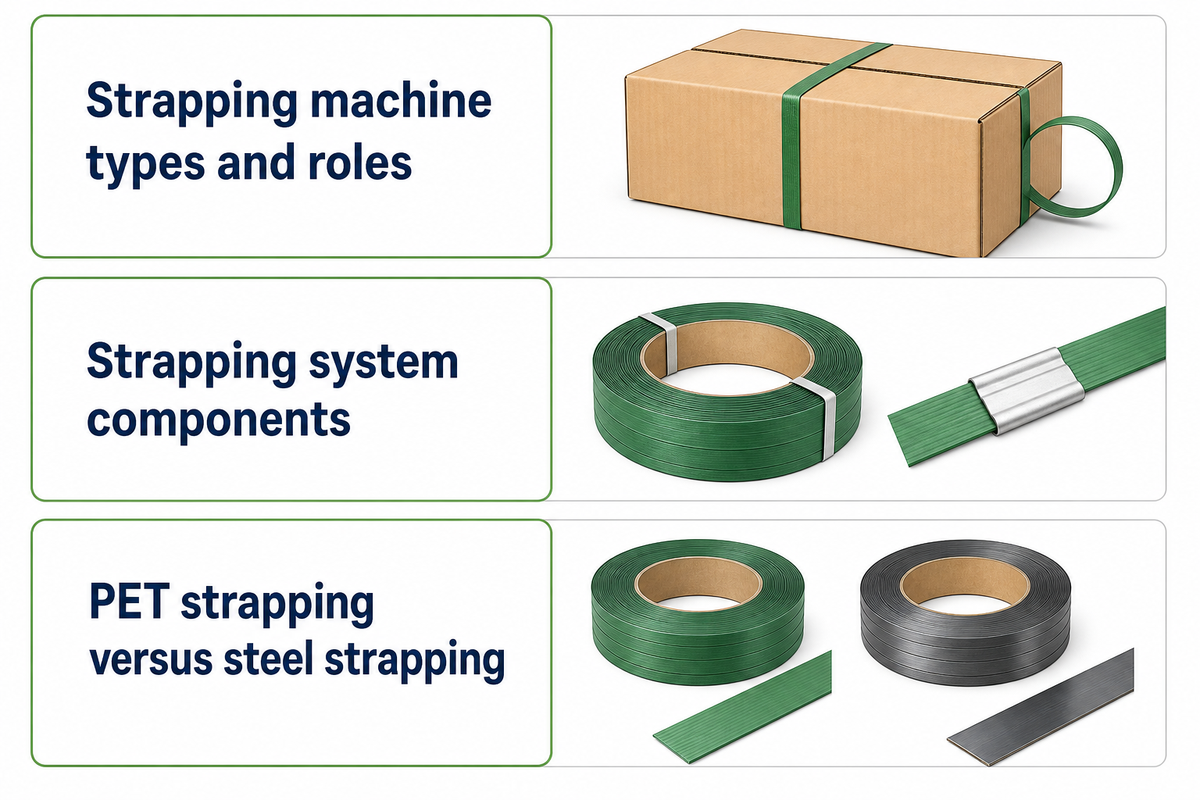
Polypropylene (PP) is more common for cartons and lighter packaging applications. Polyester (PET) is normally considered for pallet loads and other heavier industrial bundles. Steel strapping is applicable to certain metal and heavy loads. None of the above material descriptions specifies a complete load-restraint system.
For plastic strapping machines, include width, thickness, surface finish, coil core and size, and the joint method to be used. The strength of a finished joint is influenced by many factors besides the tensile strength of the plastic straps. Therefore, a standard plastic strap description will not be sufficient for comparing plastic strapping machinery or selecting a consumable item for a machine.
4. Check the sealing system
Heat sealing, friction or vibration welding, ultrasonic sealing, and steel joint systems all have different machines and preventive maintenance procedures. Identify the sealing heads and strap specification. Obtain samples of the joints from the actual material, agree on a test procedure, and set the acceptance requirements for the test.
Note the access required for heater, knife, feed wheels and tension wheels, if applicable. A machine designated as ‘easy to use’ may still require lengthy access procedures for removal of a wear part. The maintenance staff needs information on joint consistency and accessibility for cleaning and replacement, rather than a general reliability claim.
5. Define tension requirements
State how the product responds to tension and compression, including fragile corners, soft or malleable contents, and settling. Excessive tension can cause damage to the product, and an improper setting may result in the contents not being restrained.
Compare the usable adjustment range, repeatability and method of changing settings between products. StraPack’s selectable tension modes illustrate why control behaviour can matter at a mixed carton station. The machine and strap suppliers should agree how the proposed setting will be established and checked during the representative package trial.
6. Define the arch and package envelope
Determine the height of the conveyor and the clearances between the conveyor and the packages. The largest and the smallest packages that the machine can handle must be considered. The machine must be able to handle the packages with sufficient clearance for the complete strap path; maximum arch dimensions do not automatically describe the usable package envelope. A package must also be in the right position and sufficiently supported during the strap process.
Vertical strapping
- Surrounds a vertical section of the load.
- Can use an undertrack or pallet-lance route where designed.
- Requires clearance and support for the complete strap path.
Horizontal strapping
- Surrounds the load at selected heights.
- Can restrain layers and hold corner protection in position.
- Requires suitable access around the sides of the load.
Side-seal describes the position of the sealing head or joint. It does not by itself describe horizontal strapping. The two must be specified separately.
7. Check automation and line interfaces
Manual or handheld equipment leaves positioning and application largely with the operator. Semi-automatic machines usually still require the operator to present the package or strap. An automatic arch machine performs more of the strap-feed cycle, while a fully automatic inline system may also control package arrival, positioning and discharge. Confirm the actual sequence rather than relying on a marketing label.
How adjustable is the machine between different products? What’s the extent of user participation in the strap process? How much of the strap process is performed automatically? How is the package positioned on the machine? How is the package removed from the machine? What’s the process for positioning and discharging packages?
For complete integration of strapping equipment with a production line, how are the packages positioned on the line? Define conveyor direction and height, programmable controller signals, input/output connections, package sensors, upstream and downstream interlocks, recipe management and fault recovery. What controls the package position? Is the strapping equipment integrated with the production control system? Does the strapping equipment provide recipe management? Does the strapping equipment generate alarms? Can the strapping equipment automatically recover from process faults? What safety and emergency-stop controls are integrated with the strapping equipment?
8. Define factory acceptance criteria before ordering
Define representative products, strap specification, output requirements and duration of the factory acceptance test. Verify feeding, tension, joint quality, sensor operation and alarms, and demonstrate recovery from representative faults. Powering on the machine to demonstrate one strap cycle does not establish sustained performance for the buyer’s production mix.
For safety and conformity, identify the exact model, destination market, declaration of conformity, applicable electrical requirements, guarding and emergency stops. An ISO 12100 risk-assessment process concerns hazards across the machine’s use; a company logo or a broad certification claim does not replace the machine documents. Where United States workplace rules apply, address the relevant machine guarding and hazardous-energy controls with the site’s responsible personnel.
The European Commission’s machinery guidance states that machines placed on the European Union market before 20 January 2027 must comply with Machinery Directive 2006/42/EC; Machinery Regulation (EU) 2023/1230 applies on a mandatory basis from that date. CE marking concerns conformity of the product within the applicable scope. It isn’t a whole-company certification, and any claimed third-party certificate should identify its model and assessment scope.
Machinery Regulation (EU) 2023/1230 “applies on a mandatory basis as of 20 January 2027.”
European Commission, machinery guidance
Quote the scope of after-sales services and support, including commissioning responsibility, locally stocked parts and chargeable travel or labour. Who answers a call for support, and where that support is provided from, are considerations to include in the quote. Other design aspects, such as durable construction and reliability, should be assessed separately from a dependable service response. The quote should specify the scope of after-sales support to be provided after the acceptance test.
Compare Total Cost of Ownership
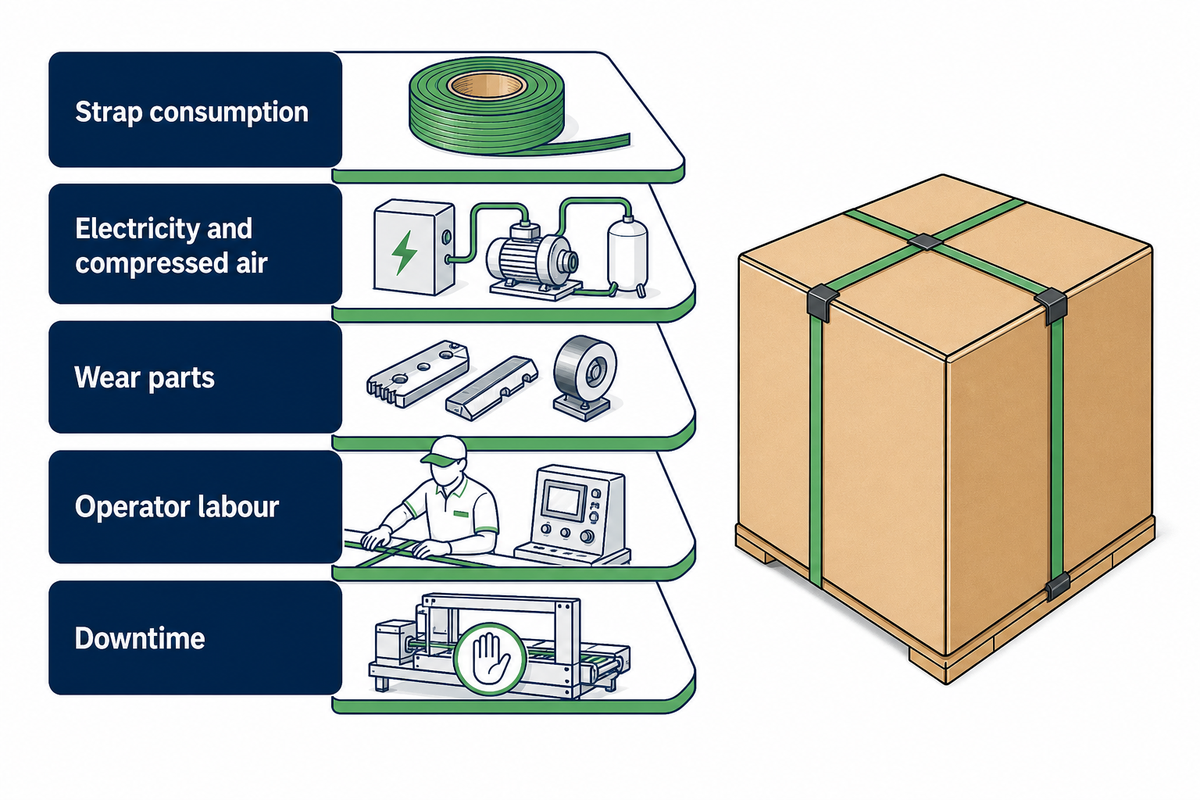
Compare the cost of producing a successfully processed strapped package over the same time period and level of production variation. Consider other costs like the consumption of strap and the time required for processing and packing. Waiting for wear parts to be available can also impact the cost.
There are many costs associated with a strapping system that need to be evaluated when comparing systems, including installation, line integration, commissioning and operation. These costs include strap, electricity and compressed air where required, as well as the maintenance and replacement of sealing components, wheels, knives and sensors. Add spare-parts stock, technician visits, operator labour and the consequences of downtime. When evaluating strapping systems, count successfully accepted packages rather than the total number of system cycles.
When assessing costs, assumptions must be expressed and understood by the various business functions. For example, a maintenance employee must understand the scope of work required to replace components of a strapping machine. A business accepting a package must use the same acceptance definition for each machine being compared. When considering a capital item, the costs of related resources, like an integrated conveyor, must also be considered.
Samples can be evaluated for strap consumption and reject rate, and the efficiency of the strapping machine can be analyzed with respect to material use per accepted package. Sustainability claims about recyclable strap do not quantify the efficiency of the machine or system. A controlled packaging trial can provide better evidence of reliable packaging performance than a universal market price or an unsupported savings claim.
Frequently Asked Questions
Which is the best strapping machine manufacturer?
Choose by application and operating requirements
The best strapping machine manufacturer depends on package size, strap material, required throughput, automation level, line integration and local service needs. Transpak and StraPack are useful carton-machine candidates; FROMM and OMS offer industrial automation routes; TITAN addresses coils and heavy loads. Compare the relevant model from each company against identical package samples and acceptance requirements. No single manufacturer is the best choice for every production line. The quotation should identify who commissions the machine and supports it locally.
Which manufacturer is best for automatic strapping machines?
Match the automation sequence to the line
Mosca, Transpak and StraPack are useful candidates for automatic carton strapping, while OMS, FROMM and Wulftec offer pallet and integrated-system routes. Selection depends on the actual machine range, arch size, sealing technology and package-transfer sequence. Compare the published cycle conditions with your required accepted-package output, then confirm line interfaces, spare parts and service. An automatic strap cycle doesn’t necessarily include automatic package positioning or unattended fault recovery. Include product changes and routine maintenance access in the comparison.
Which strapping machine is best for PET strap?
Compare the complete PET specification
The correct machine depends on PET strap dimensions, required tension, joint method and package format. FROMM FPA PM, OMS 08ACTIVE and suitable Cyklop or Pamminger configurations provide documented PET routes. Match the proposed width, thickness, surface, coil core and dispenser arrangement to the exact machine specification. A PET-compatible label doesn’t mean every PET coil will feed or form an acceptable joint, so include the intended material in the package trial. Agree joint acceptance during that trial.
How much does a strapping machine cost?
Compare quotations with the same scope
Strapping machine cost depends on automation, arch size, strap type, tension, conveyors, controls, protective equipment, installation and service. Request configuration-specific quotations and compare the same delivery scope. Include operating and downtime costs; a bare-machine price and an installed production-line price are different purchases.
What is the difference between semi-automatic and automatic strapping machines?
Look at operator involvement and strap feeding
Semi-automatic machines generally require operator presentation of the package or strap, while automatic arch machines perform more of the strap-feeding sequence. Fully automatic systems may add conveyors and package positioning. Compare the actual operating steps, since manufacturers use automation labels differently across their ranges.
What is the difference between a strapping machine manufacturer and a supplier?
Identify who builds and supports the equipment
A manufacturer designs and builds the machine, while a supplier may distribute, integrate or source equipment produced by another company. Confirm the actual manufacturer, model, production location, warranty provider, spare-parts source and service responsibility. A supplier can provide useful application support without manufacturing the equipment.
Choose Around Your Package and Production Line
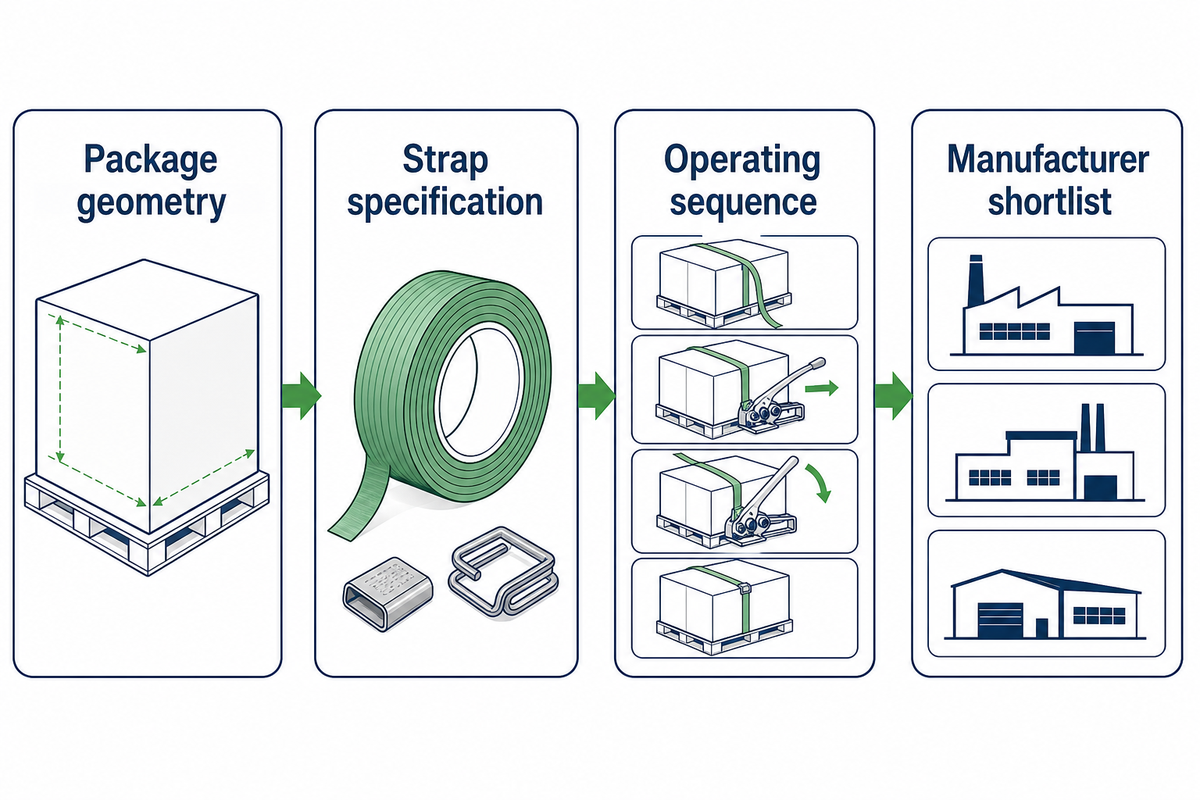
The top strapping machine choice for a carton station may not work for pallets, steel coils or compressed corrugated stacks. Narrow the field using the manufacturer comparison. Then, send the same package and strap specification, along with throughput, automation, interface and service requirements, to two or three potential suppliers. The next relevant step is to describe and explain your requirements to potential suppliers, and evaluate your applications through a comparable review and trial plan.
Key takeaway
Choose the machine route before choosing the brand: package geometry, strap specification and the complete operating sequence determine which manufacturers belong on your shortlist.
Request an Application-Fit Review from UD Packaging
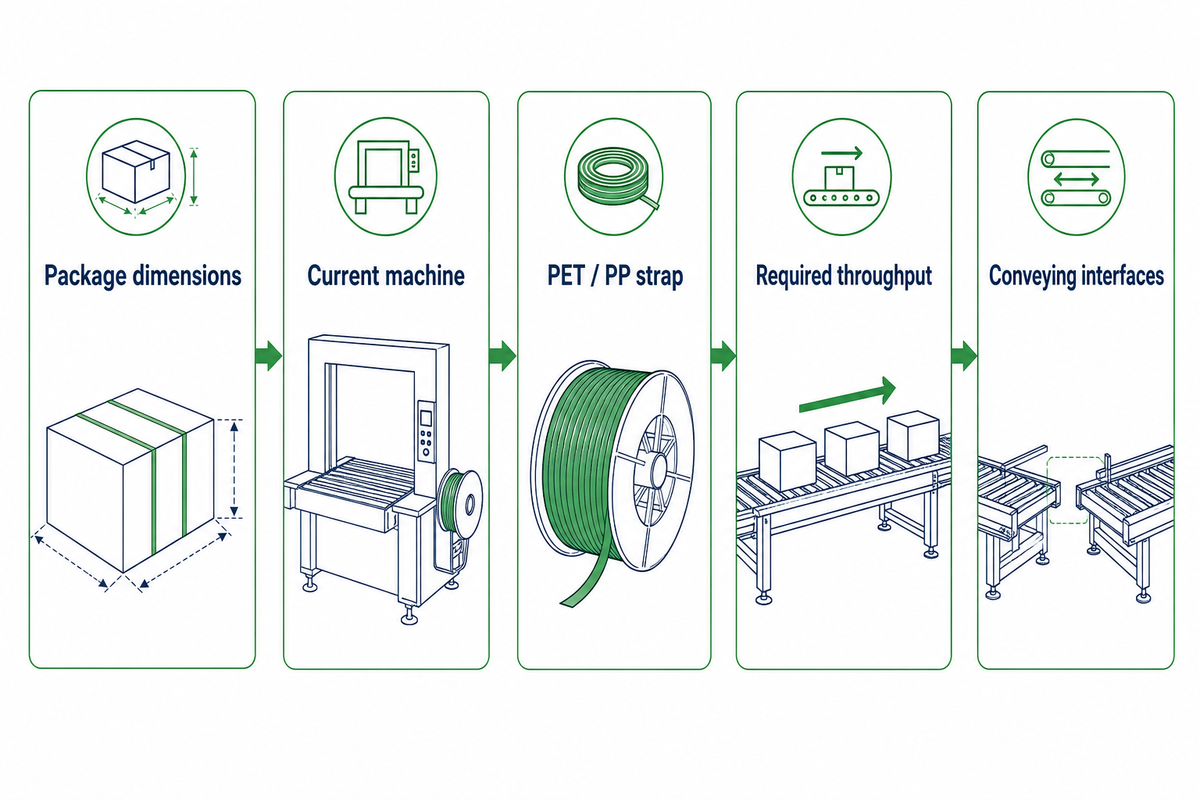
UD Packaging supplies industrial strapping materials and equipment, including handheld tools and machine routes. Its strapping machine selection service covers manual equipment, semi-automatic machines and fully automatic categories. The company also supplies PET strapping, seals and buckles; its role here is a strapping machine supplier and application-review partner.
What are your package dimensions? Which machine model are you currently using? What type and volume of PET/PP strap do you want to use, and what throughput do you want to achieve? Also, explain the task of the operator, as well as any interfaces with conveying equipment. Please fill out the information as completely as possible. Ask us for a Review and Quotation.
References & Sources
Company profiles use the manufacturers’ published histories, product pages and technical material, with their official websites shown as plain text in the comparison and profiles.
- International Organization for Standardization: ISO 12100:2010, risk assessment and risk reduction
- Occupational Safety and Health Administration: 29 CFR 1910.212, machine guarding
- Occupational Safety and Health Administration: 29 CFR 1910.147, hazardous-energy control
- European Commission: machinery legislation, transition dates and conformity guidance
Related Articles