Get in touch with UD Packaging Company

Updated September 2026
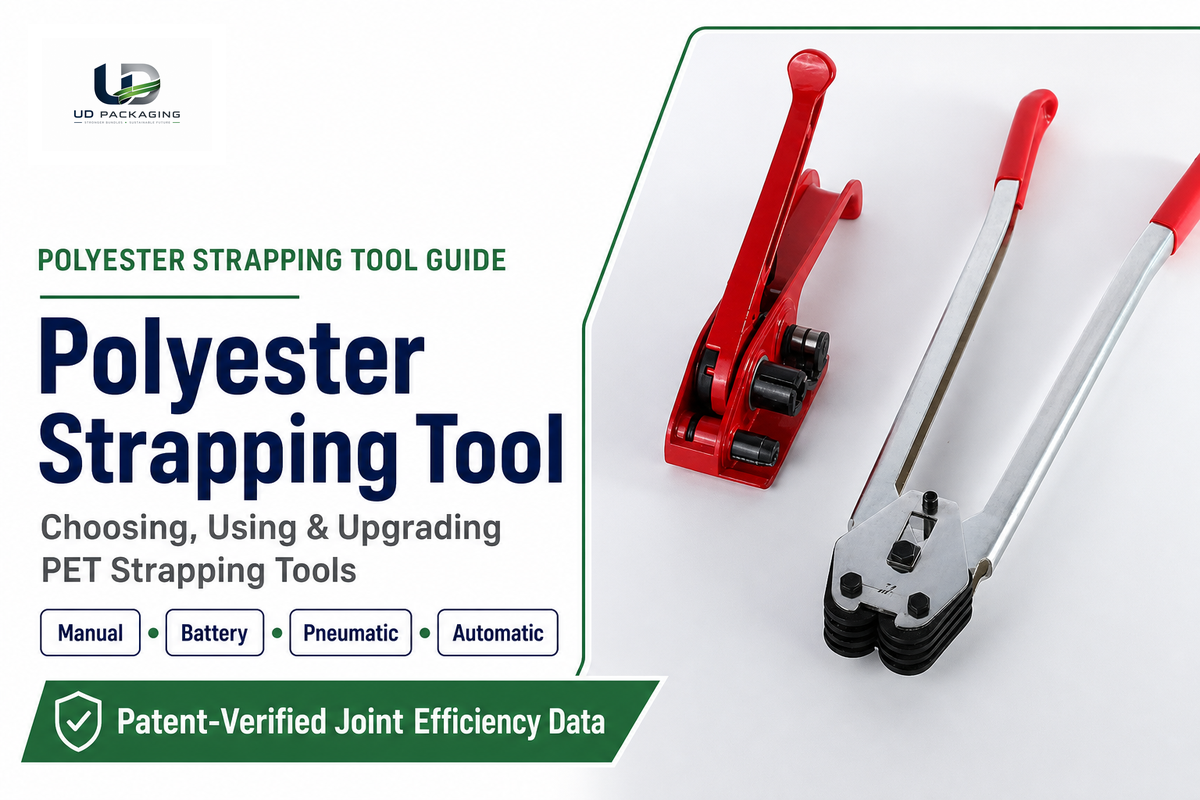
A polyester strapping tool is the tensioner, sealer, or combination unit used to apply PET strap around a pallet or bundle. The tool must match the strap material, width, joining method, load, and work rate. This article explains what the tool does, why a steel-strapping tool is not an automatic substitute, the operating sequence and safety checkpoints, and how nine tool types fit different production settings.
Quick Specs
| Applicable standard | ASTM D3950-23 (nonmetallic strapping and joining methods) |
| Common mechanisms | Manual tensioner-sealer, battery friction-weld, pneumatic |
| Joint method | Model-specific weld, seal, or buckle qualified for the selected strap |
| Cost scope | Tool, battery or air supply, charger, consumables, spares, training, and service |
What Is a Polyester Strapping Tool?
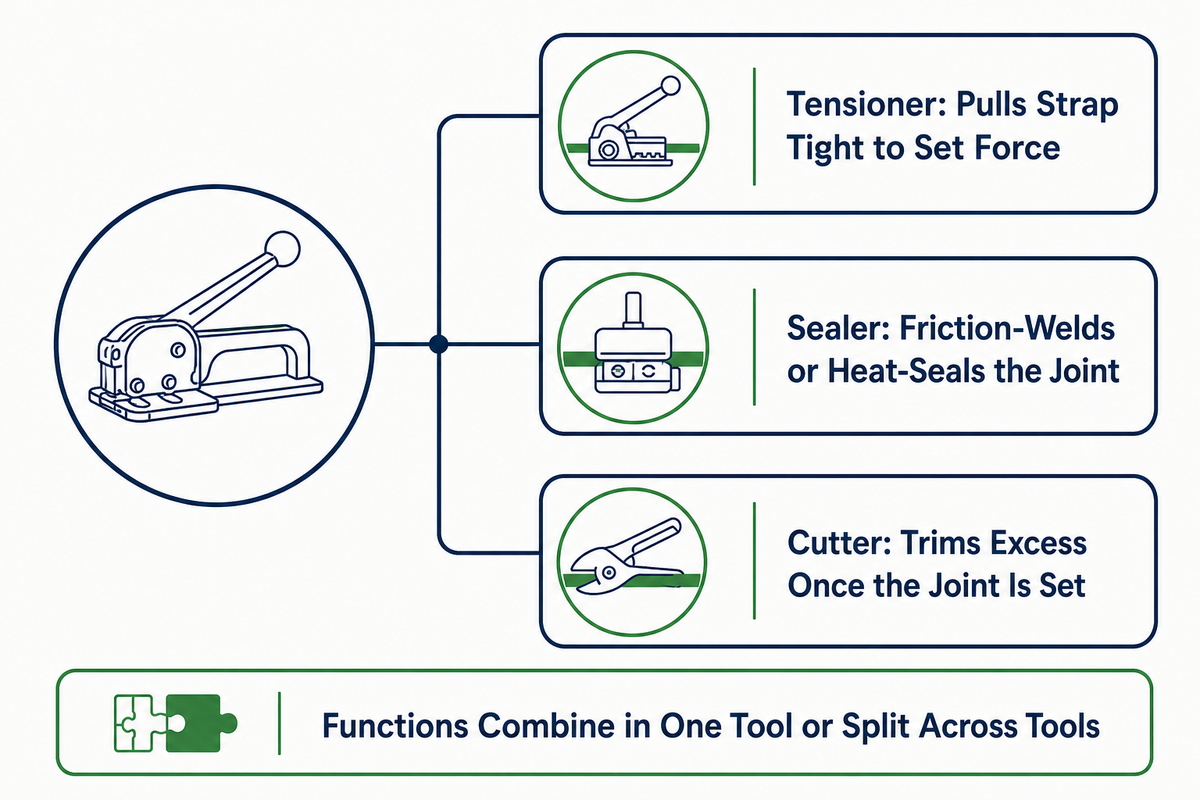
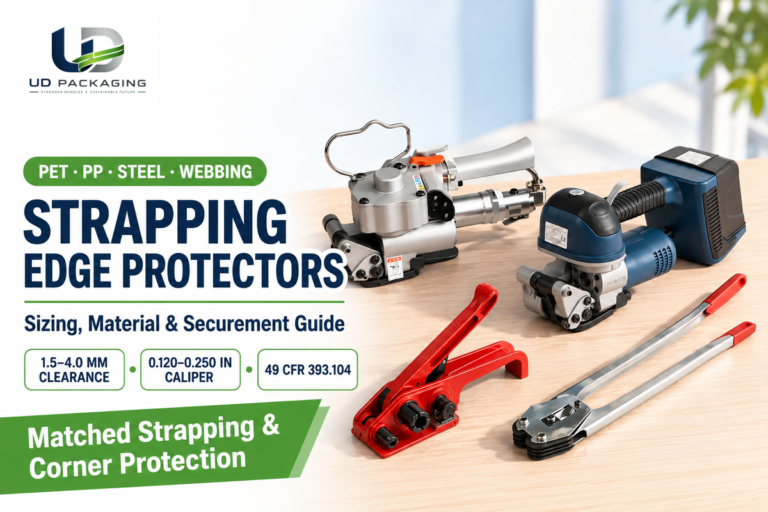
Polyester strapping tools are handheld or powered devices used to tension PET strap, join its overlapping ends, and, on tools equipped for the task, cut the excess. Those three functions can live in one combination unit or be split across separate tools. The specified strap-and-joint system carries the load; the tool applies that system repeatably when it is set up and operated according to its model instructions.
| Function | What it does |
|---|---|
| Tensioner | Pulls the strap tight around the load to the operator’s or machine’s set force |
| Sealer | Friction-welds or heat-seals the overlapping strap ends into one joint |
| Cutter | Trims the excess strap once the joint is set |
The active system standard is ASTM D3950-23, which covers nonmetallic strapping and its joining methods; it does not certify a tool in isolation.
Catalog terminology is inconsistent. Polyester banding, PET strapping, woven strapping, composite strapping, and polypropylene strapping can describe different constructions even when all appear under “plastic strapping tools.” A sealless combination tool is also different from a separate tensioner and sealer. Treat the product name as a search aid, then verify the exact strap material, width, thickness, joint method, and tool model on the specification sheet.
For repetitive work, record the actual cycle count, strap specification, joint result, load geometry, operator reach, and service conditions before comparing a manual, battery-operated, or pneumatic tool. Ergonomics, tool weight, battery or air availability, replacement parts, and the manufacturer’s rated operating window matter more than a generic “heavy duty” label.
Distributor catalogs are less precise. Banding tools may appear under labels such as cutter manual banding tools, heavy duty strapping, strapping banding, tool strapping, sealless strapping, strapping tensioner and cutter, or sealer tool. Filters for strapping widths may use awkward strings such as width polyester, polyester and polypropylene, polypropylene straps, battery operated strapping, and battery operated plastic strapping. A warehouse buyer should translate each label into a normalized material, size, joint, tool model, and shipping requirement before comparing quotes.
For pallet packaging, a durable or rugged housing does not by itself establish reliability, durability, productivity, or a dependable fit. Compare ergonomic design, an adjustable grip, lightweight or light-weight handling, service access, and performance on irregular packages. A pneumatic sealer, pneumatic plastic combination tool, or pusher-equipped station also needs a verified air supply and guarded blade or cutter path. The goal is not simply to tighten faster; it is to produce an accepted joint within the facility’s logistics and safety controls.
Types of Polyester Strapping Tools
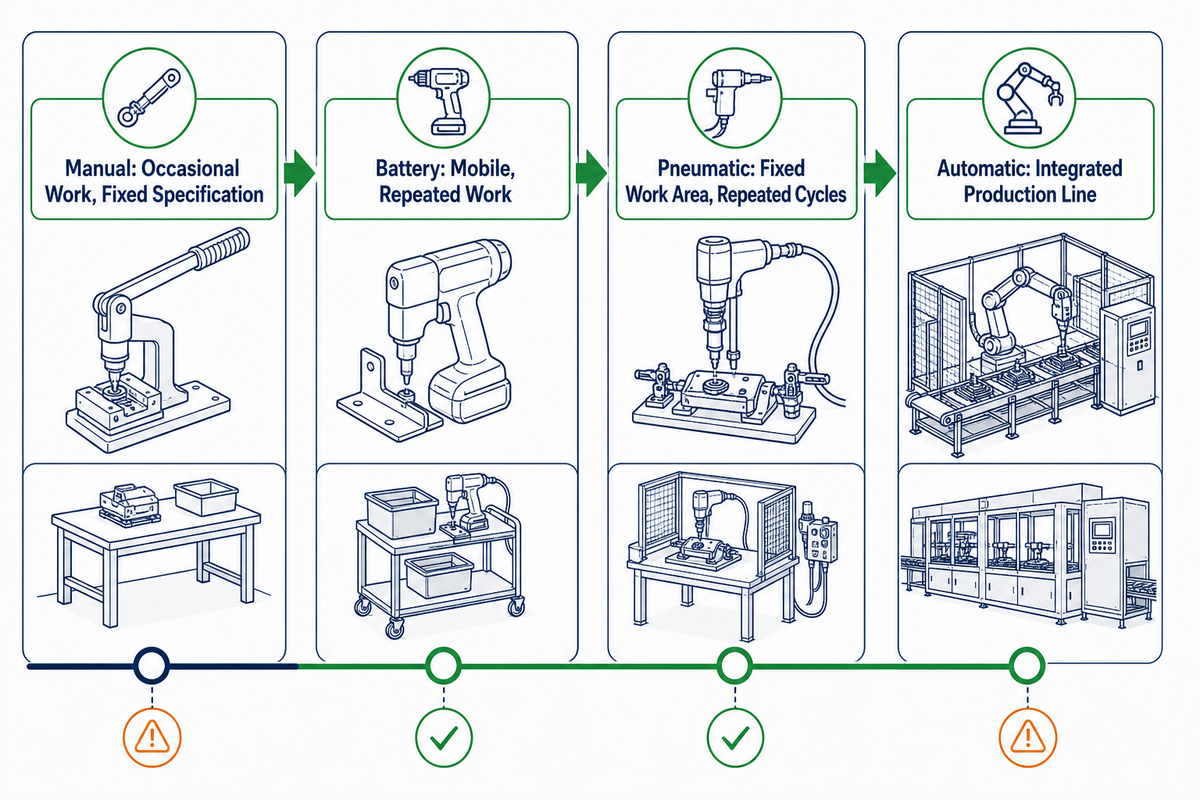
Nine practical categories cover the spectrum from separate hand tools to an integrated automated line. Call this the 9-Type Strap-Tool Tier Map: use it to shortlist a mechanism, then confirm every numeric limit against the exact tool and strap data sheets. The published values below are identified only where the cited model coverage supports them.
| Tool Type / Tier | Typical daily volume / operating fit | Power source / published example | Strap width / compatibility checkpoint | Not suitable for / main limitation |
|---|---|---|---|---|
| Separate manual tensioner and sealer | Occasional work and a fixed strap specification | Hand-powered | Confirm both tools list the same PET width and seal | More handling steps and greater operator effort |
| Manual sealless combination tool | Portable, low-cycle work | Hand-powered; no separate seal on compatible systems | Verify PET grade, width, thickness, and joint rating | Compatibility is model-specific |
| Compact battery friction-weld tool | Mobile repeated work | Rechargeable battery; weight and charge time are model-specific | Use the model’s published PET range | Battery capacity and charge planning |
| Higher-duty battery friction-weld tool | Mobile work needing a wider qualified strap range | Battery; tension speed and size range are model-specific | Confirm the selected PET width, thickness, and grade | The exact configuration still governs |
| High-cycle battery friction-weld tool (BXT4 example) | Repeated mobile work | Published at up to 800 cycles per battery charge | Confirm the selected model and strap combination | Published cycle count is not a throughput guarantee |
| Pneumatic tensioner plus separate sealer | Fixed work area with repeated cycles | Compressed air; pressure is model-specific | Match air supply, tensioner, sealer, and PET strap | Air hose and two-tool handling |
| Pneumatic combination tool | Fixed high-cycle work | Compressed air | Check rated air pressure and PET joint specification | Not portable away from the air supply |
| Semi-automatic strapping station | Repeatable work at one station | Configuration varies by machine | Validate strap, arch/table layout, controls, and joint | Requires a defined workstation and integration |
| Fully automatic strapping machine | Integrated production line | Line controls and power are system-specific | Validate line speed, package geometry, strap feed, and joint | Highest integration and service burden |
What is the difference between a manual and pneumatic strapping tool?
Manual tools use hand force and may divide tensioning, sealing, and cutting among separate devices. Pneumatic tools use a compressed-air supply and can also be separate or combined. Compare the complete work sequence, compatible strap-and-joint specification, air availability, ergonomics, and measured cycle demand rather than assuming every tool performs all three functions.
Current model coverage shows how battery tools are evolving. Packaging Insights reports that the Signode BXT4 uses single-finger strap handling, a touch display for tension and welding control, and an AMPShare battery rated for up to 800 cycles per charge. Packaging World’s supplier-submitted BXT4 overview provides additional model context but is not independent verification. Treat the cycle figure as a published model rating, not a package-throughput promise. That same 2025–2026 Packaging World trade coverage puts other models in the line at a similar spread: a compact model is reported at about 8.05 lbs with its battery and roughly 80% charge in about 24 minutes, while a heavier-duty model in the same cordless family is reported tensioning PET or PP strap from about 9mm to 32mm wide at speeds up to 290mm/s — published trade-coverage figures, not independent lab verification.
For polyester specifically, use the poly strapping tool range as a commercial shortlist only after the strap-and-joint requirements are fixed. Readers working with steel or another material should use the wider cross-material mechanism guide instead.
Why Polyester Needs a Different Tool Than Steel or PP Strapping
Both applicable standards describe a strap-and-joining system, not a tool in isolation. ASTM D3950-23 covers nonmetallic strapping with joining methods; ASTM D3953 covers flat carbon-steel strapping with seals and joint forms. The polyester tool must match its specified system even when nominal strap widths overlap.
When a specification cites D3953, it identifies a steel-strapping context but does not demonstrate PET compatibility. Call this the Overlapping-Width Fallacy: require the tool specification to state the strap material, size range, and joining method instead of assuming that two tools are interchangeable because their nominal strap widths overlap.
ASTM’s revision notice cites technology changes in closure methods as a reason to update D3953. That notice concerns the steel-strapping standard; it does not announce a revision to D3950-23 or establish PET tool compatibility.
The mechanisms often differ as well. Many steel-strapping systems crimp a metal seal or form a sealless steel joint, while PET combination tools commonly use a friction-weld or another joint expressly qualified for the plastic strap. The exact model sheet, not the material label alone, determines which joint the tool makes.
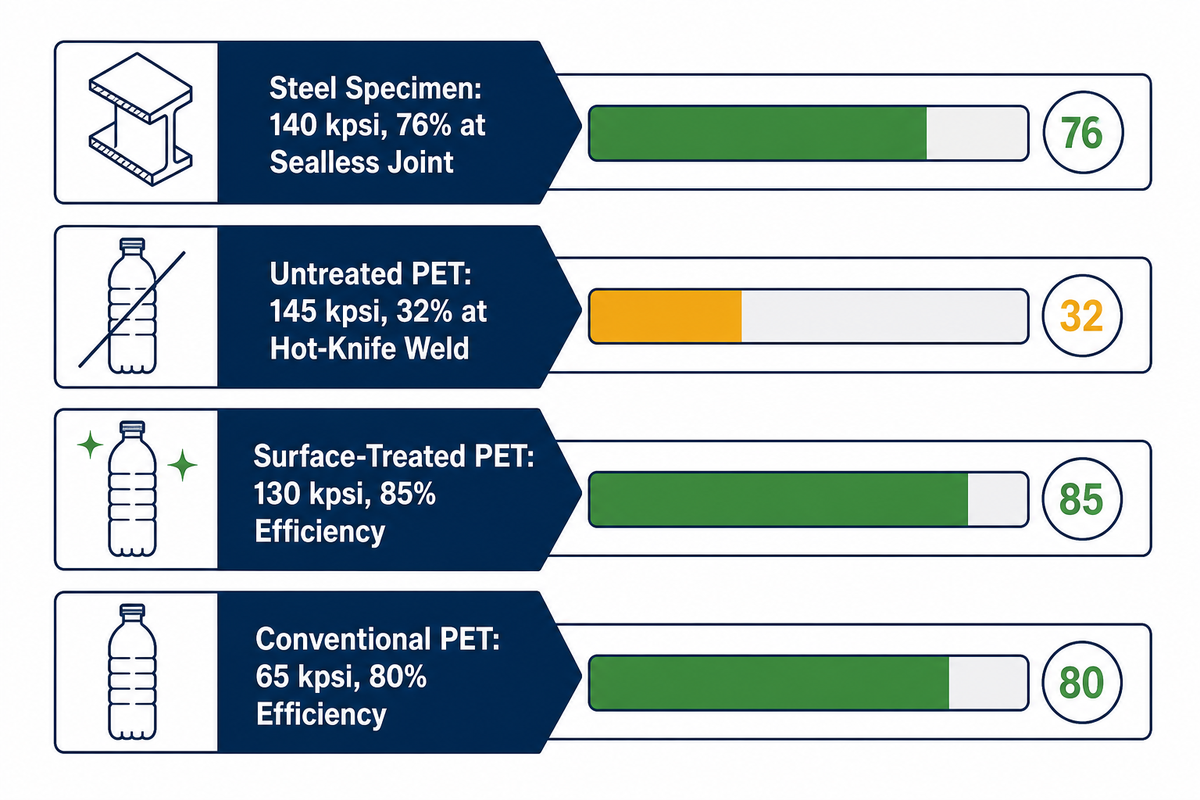
Joint efficiency is the other piece buyers tend to miss: the U.S. Patent 5,772,944 specimen table lists a 140 kpsi high-tensile steel specimen at a 2,100 lb break load and 76% at a sealless joint, while an untreated high-strength PET specimen is listed at 145 kpsi, 2,175 lb, and 32% at a hot-knife weld. Those are patent-test specimens, not universal commercial grades. They demonstrate that bare strap strength cannot substitute for the rated performance of the finished joint.
Published Evidence Checkpoint Table separates model data, specimen data, and scope limits so that a buyer does not mix unlike numbers:
| Evidence item | Published value | Decision use | Limitation |
|---|---|---|---|
| ASTM D3950-23 | Active nonmetallic-strapping specification | Identify the PET/PP strap-and-joint context | Does not certify a tool by itself |
| ASTM D4675-14a(2022) | System selection and user testing | Frame the qualification plan | Not a model-specific setting sheet |
| ASTM D3950-23 joining hardware | The published scope allows qualified seals or buckles when needed | Avoid excluding a joint by label alone | The selected strap-and-joint combination still requires qualification |
| BXT4 operating modes | Manual, semi-automatic, and automatic modes | Compare control options during a trial | One published model example |
| BXT4 example | Up to 800 cycles per charge | Plan battery coverage | Published rating, not an ROI threshold |
| Patent steel specimen | 140 kpsi; 2,100 lb break; 1,600 lb joint; 76% efficiency | Keep strap and joint values separate | Patent specimen, not a universal grade |
| Patent untreated PET specimen | 145 kpsi; 2,175 lb break; 700 lb joint; 32% efficiency | Show why finished-joint data matters | Historic hot-knife-weld specimen, not a universal grade |
| Patent surface-treated PET specimen | 130 kpsi; 1,950 lb break; 1,660 lb joint; 85% efficiency | Compare strap strength with joint performance | Historic specimen with a specific surface treatment |
| Patent conventional PET specimen | 65 kpsi; 1,300 lb break; 1,040 lb joint; 80% efficiency | Compare a second PET specimen | Historic specimen, not a current product specification |
| OSHA 29 CFR 1917.51(c) | Metal banding; marine-terminal cargo | Check rule scope before applying it | Not a PET warehouse-tool rule |
How to Use a Polyester Strapping Tool (Step by Step)
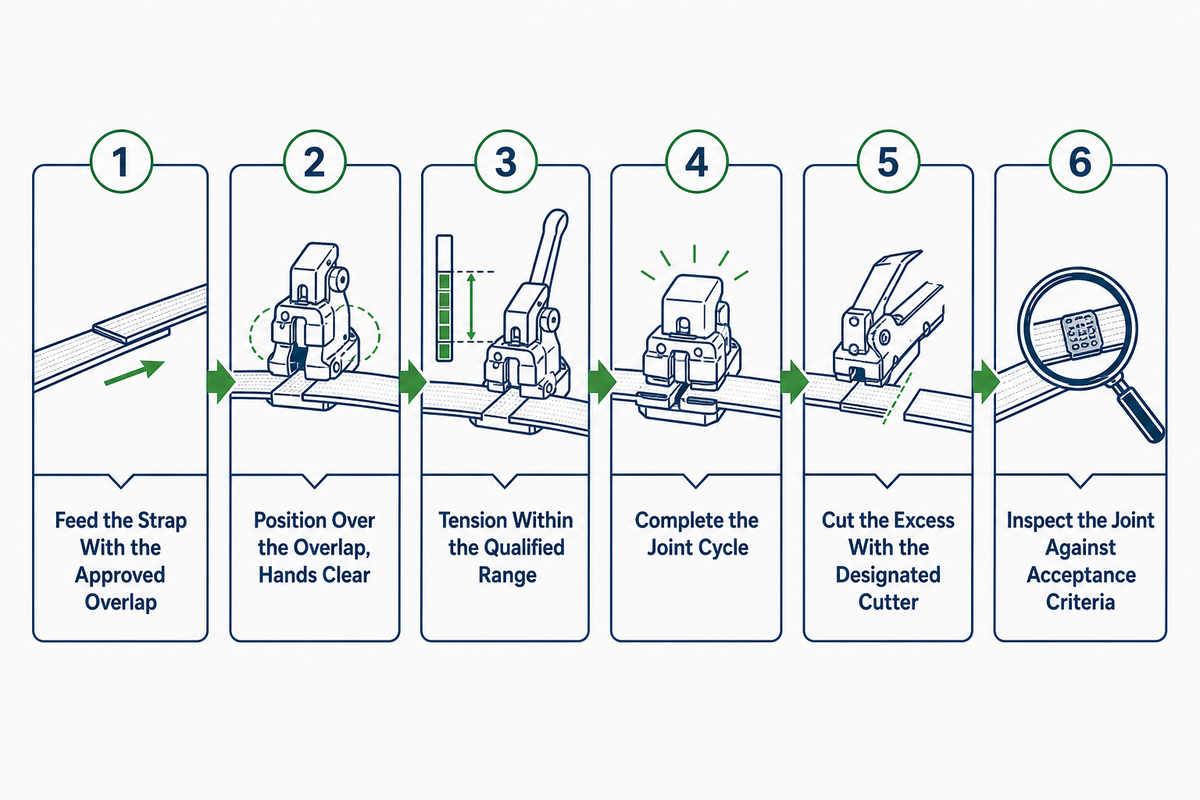
Combination tools commonly follow six stages: feed the strap, position the tool over the overlap, tension, complete the specified joint cycle, cut with the designated cutter, and inspect the result before moving the load. Separate tensioners and sealers add tool-change steps. This sequence is an orientation, not a substitute for the selected tool’s operating manual or the load’s approved packaging procedure.
- Feed the strap using the approved routing for the package, leaving the overlap specified by the tool maker.
- Position the tool over the overlapping strap ends as shown in the model instructions, with hands outside the strap and jaw path.
- Set and apply tension within the qualified range for the strap, joint, and package trial; do not use maximum tension as a default.
- Complete the joint cycle and wait for the model’s completion indication or specified cooling time.
- Cut the excess only with the cutter designated for that strap and tension state, following the model instructions.
- Inspect the joint against the manufacturer’s acceptance criteria before releasing the tool or moving the load.
ASTM D3950-23 provides the relevant strap-and-joining reference; use the tool maker’s instructions for the exact tension, seal dwell, and cutter sequence.
📐 Engineering Note
There is no universal “hand pull” test or one tension value for every pallet. Qualify the setting with the strap maker’s data, the tool’s rated range, the joint result, package geometry, and a representative load test. Soft or crushable packages may be damaged before a high tension setting improves restraint.
How to use a pallet strapping tool?
For a pallet, use the strap routing, edge protection, number of straps, and anchoring pattern approved for that package and transport mode. A deck-board gap is not a universal routing rule. Place and support the tool exactly as its manual requires, and confirm that the chosen position keeps hands clear and allows the joint to form without interference.
Whether the equipment is sold as a poly strapping kit, a separate tensioner and sealer, or a battery combination tool, the operating record should identify the tool model, PET strap specification, setting, joint inspection result, and package tested.
Matching Tensioner and Sealer Settings to Your Strap Grade
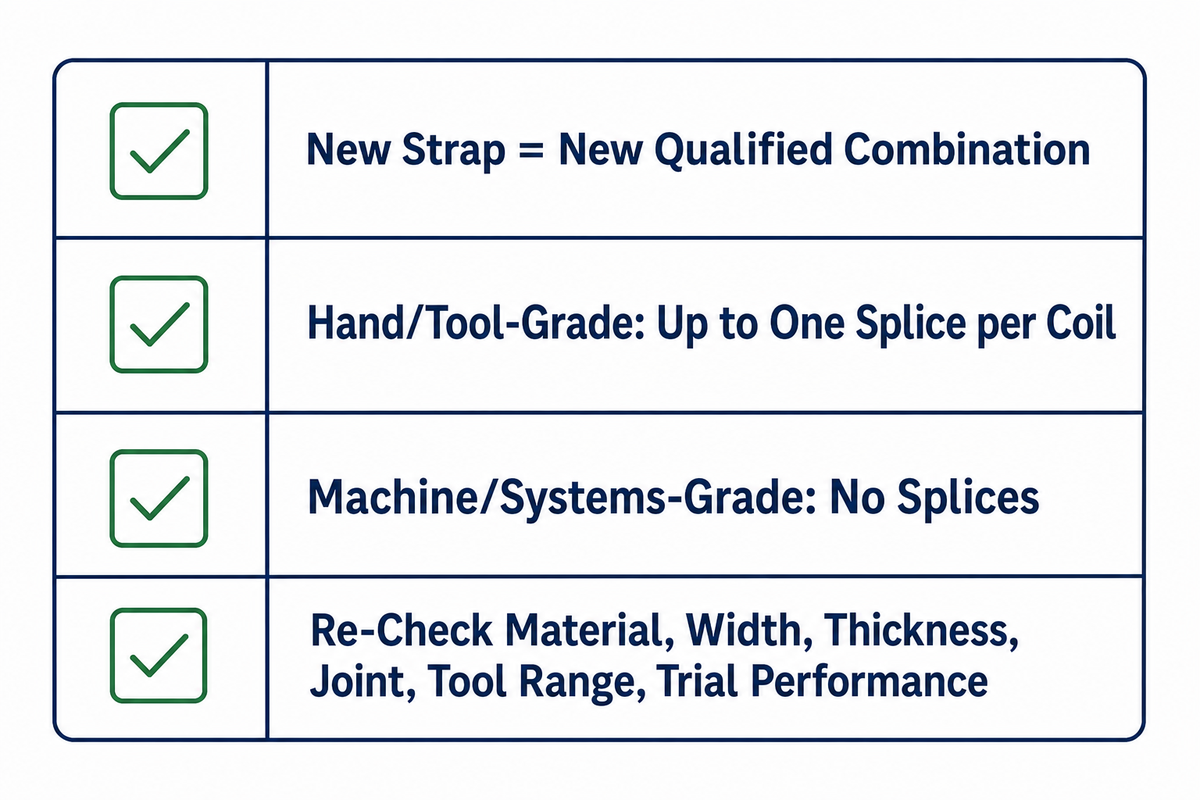
One supplier’s product grading illustrates why coil details matter: its hand/tool-grade polyester strap may contain up to one splice per coil, while its machine/systems-grade line is listed without splices for high-speed equipment. Treat that as a supplier-specific classification, not an industry-wide allowance. Check the selected coil’s data sheet and the machine’s splice policy.
Do not select a joining method from surface appearance alone. Embossing, coatings, dimensions, resin grade, and tool design can all affect compatibility, so require an explicit strap-and-tool qualification from the manufacturer. A trial joint should then be inspected and tested using the maker’s criteria before production release.
When switching between PET and PP, treat the new strap as a new qualified combination rather than copying the old tension or seal setting. Re-check material, width, thickness, joint method, rated tool range, and trial-joint performance. The strapping tensioner and strapping seal pages can be used to request a matched configuration, but the final approval should remain model- and strap-specific.
How to Choose the Right Polyester Strapping Tool
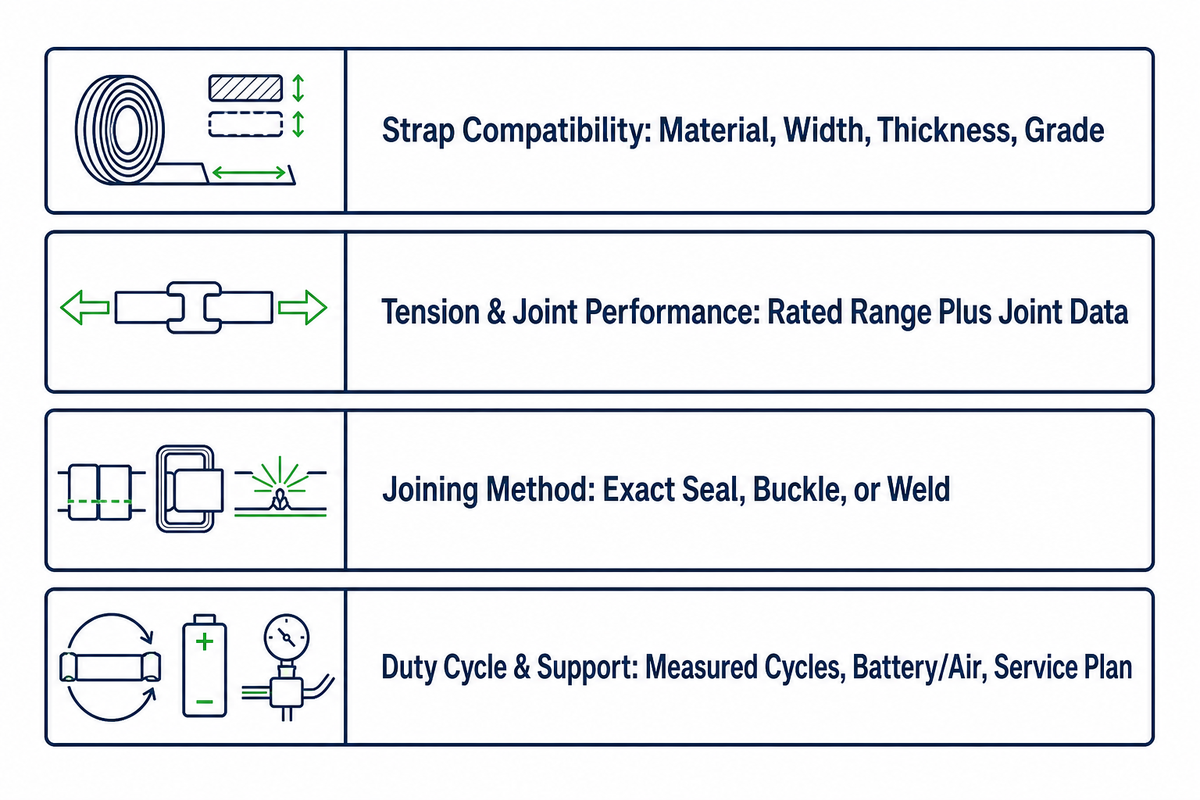
Choosing a polyester strapping tool starts with the package, strap-and-joint system, and measured work rate, not a single tension number. Collect the strap maker’s break-strength and elongation data, the proposed joint-performance data, package geometry, storage exposure, cycle demand, and the tool’s rated limits; then qualify the combination with representative testing.
Corrosion and UV exposure matter for outdoor storage, but they do not by themselves select a sealer. ASTM D4675-14a(2022) treats strap properties, load, package geometry, friction, joining method, and application equipment as one selection problem and calls for user testing before adoption.
Once the strap width and joint method are fixed, compare the matching polyester strapping tool line against your load and daily volume.
RFQ checklist — copy these into your quote request:
| Parameter | What to specify | Why it matters | How to verify |
|---|---|---|---|
| Strap compatibility | Material, width, thickness, grade, and surface treatment | The tool must expressly list the proposed strap | Compare the tool specification with the coil label and data sheet |
| Tension and joint performance | Rated tool range plus joint data for the chosen strap | Tool force, strap break strength, and finished-joint performance are different values | Request manufacturer data and test a representative package |
| Joining method | Exact seal, buckle, weld, or other qualified joint | Surface appearance alone does not establish compatibility | Require written strap-and-tool compatibility and acceptance criteria |
| Duty cycle and support | Measured cycles per shift, peak period, battery/air access, and service plan | The operating pattern determines labor, charging, and maintenance needs | Time the current process and compare it with the quoted model’s rated duty |
Buyer-Tier Tool Recommendation Table is a straightforward way to translate the checklist above into a purchase decision by operation size:
| Buyer profile | Recommended tier | Why |
|---|---|---|
| Occasional, stable specification | Evaluate manual separate or combination tools | Low capital cost can suit a measured low-cycle process |
| Repeated mobile work | Evaluate a battery friction-weld model | Portable power may reduce manual handling; verify charge and service needs |
| Fixed, sustained or integrated work | Compare pneumatic, semi-automatic, and automatic systems | Use a timed trial and total-cost model to decide among the tiers |
Once the RFQ checklist and tier table point to a mechanism, request a matched PET tool configuration rather than ordering from a generic listing.
Polyester Strapping Tool Safety
⚠️ Important
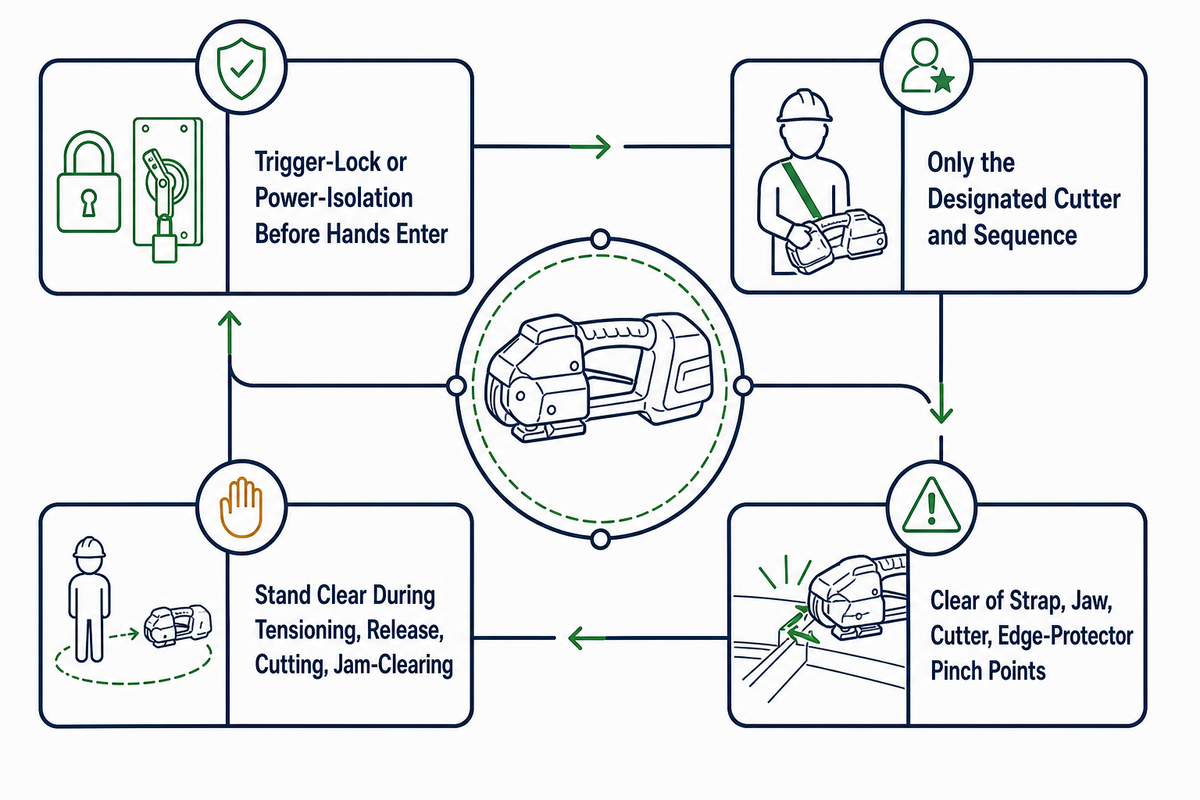
A tensioner can activate if its trigger is not isolated before hands enter the strap path; the single OSHA edge-protector incident described below documents the resulting injury.
Polyester strapping tool safety begins with following the selected model’s power-isolation, pinch-point, cutting, personal protective equipment, and jam-clearing instructions. Keep hands and the body outside the strap and jaw path, and use only a cutter that the tool or strap manufacturer designates for the task. The OSHA rule below is scoped to metal banding in marine-terminal cargo handling; it is included to show that regulatory scope matters, not to create a PET-specific rule.
OSHA 29 CFR 1917.51(c) states that only cutting tools may be used on metal strapping or banding used to secure cargo in the covered marine-terminal context. For PET work, follow the applicable workplace rules and the manufacturer’s designated cutting procedure.
“Only cutting tools shall be used to cut metal strapping or banding used to secure cargo.”
One OSHA accident record documents a laborer banding a pallet of doors who placed an edge protector beneath the strap when a battery-powered plastic strapping tool activated. His index finger was caught between the strap and edge protector and amputated at the tip. This is a single recorded incident, not a frequency estimate. For work that follows a comparable sequence, keep hands out of the strap path and use the model maker’s specified trigger-lock or power-isolation procedure before repositioning an edge protector or clearing a jam.
- ✔ Use the model-specific trigger-lock or power-isolation procedure before hands enter the strap path.
- ✔ Use only the cutter and cutting sequence designated for the strap and tool.
- ✔ Keep hands clear of the strap, jaw, cutter, and edge-protector pinch points.
- ✔ Stand clear of the strap path during tensioning, release, cutting, and jam clearing.
What Does a Polyester Strapping Tool Cost?
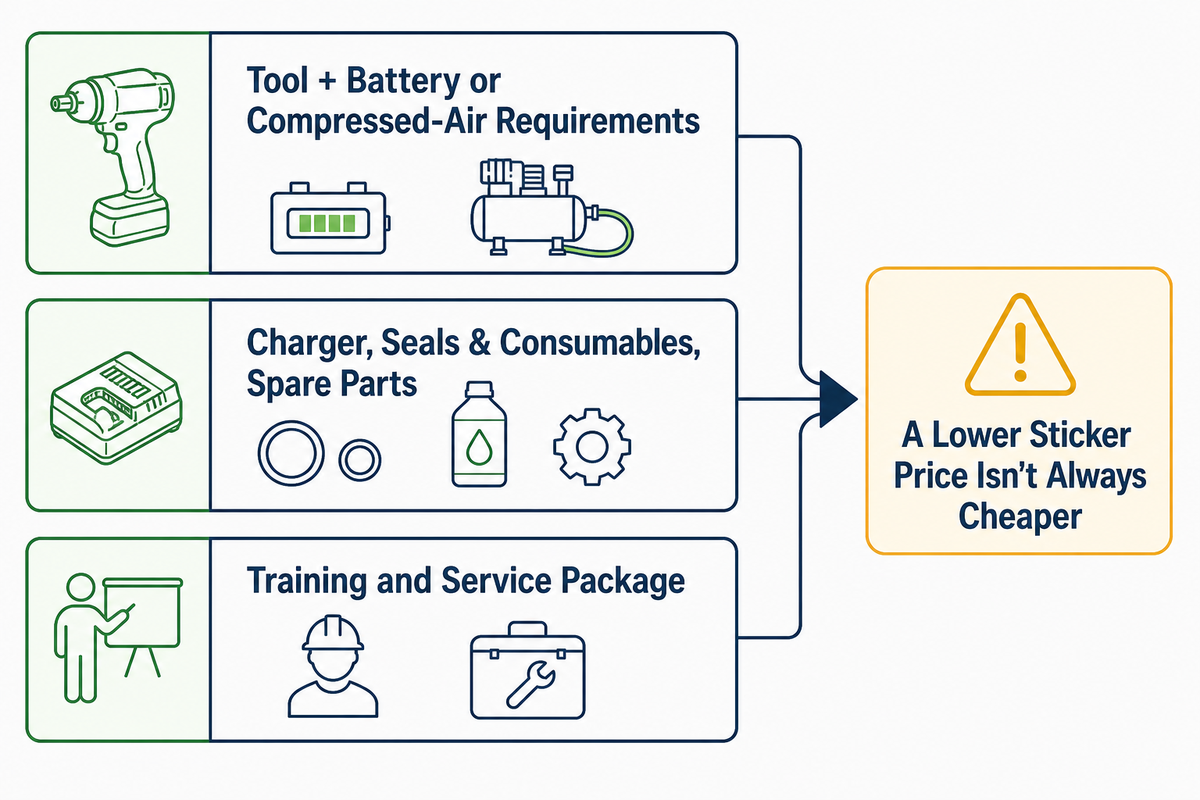
A meaningful quote must match the exact mechanism, strap specification, and work pattern. Ask suppliers to separate the tool, battery or compressed-air requirements, charger, seals or other consumables, spare parts, training, and service package instead of comparing bare tool prices.
ASTM D4675 is also a useful cost-screening reference: confirm the strap, load, joining method, and application equipment as one system before comparing quotes.
Read the quoted price alongside the safety and joint checks above: a lower-cost tool can still be unsuitable when its rated strap range, joint method, cutter, or duty cycle does not match the qualified package.
Comparing a polyester tool’s price against a steel-strapping tool’s price isn’t a reliable shortcut, either. The two tools serve different standards and joint methods (see the standards section above), so a lower sticker price on one doesn’t mean it’s the cheaper choice once duty cycle, strap consumable cost, and joint failure risk are counted together. Request quotes for the specific strap width and grade in use rather than comparing list prices across materials. Use the PET tool range to line up options against the checklist above before requesting quotes.
Common Polyester Strapping Tool Mistakes
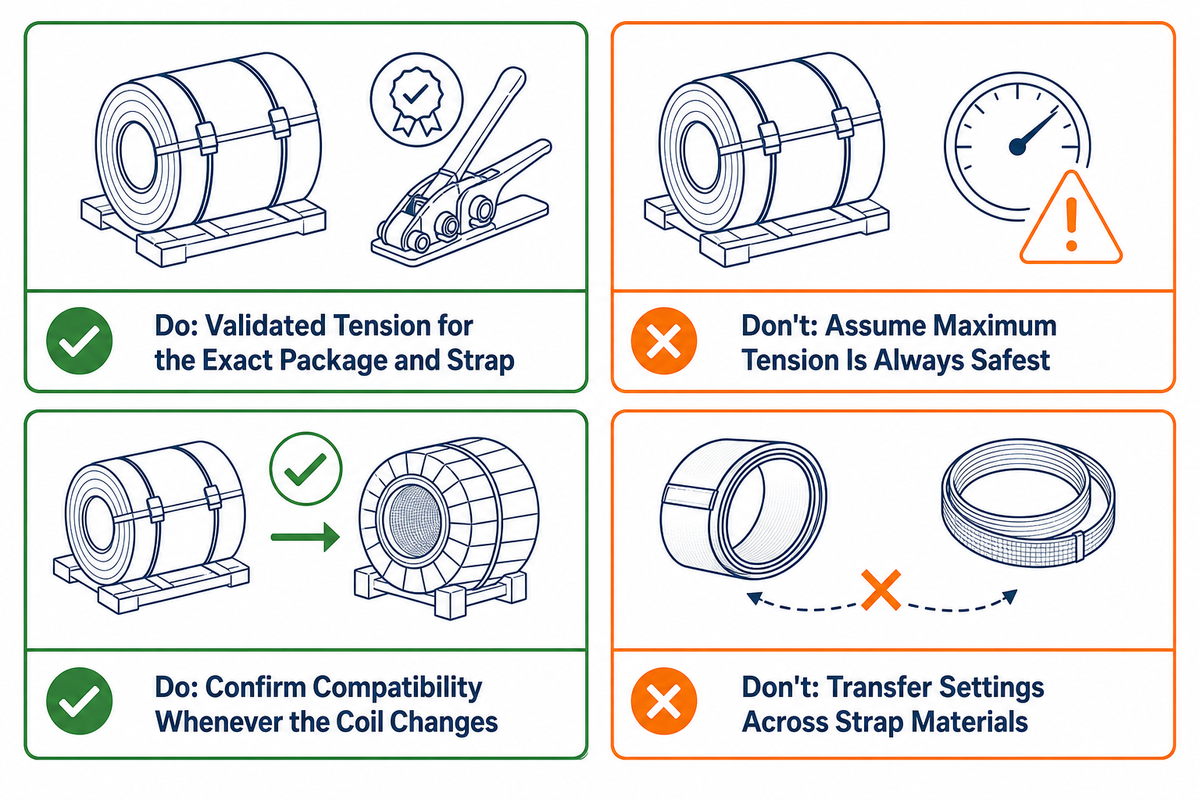
Maximum tension is not a universal safety setting. Supplier guidance used in this research warns that excessive tension can increase stress at the joint, while the package itself may be crushed or deformed before greater strap force improves restraint. The acceptable setting must come from the qualified strap-and-joint system and representative package testing.
✔ Do
- Use a validated tension setting for the exact package and strap
- Confirm written strap-and-tool compatibility whenever the coil changes
- Inspect the joint against the maker’s acceptance criteria
⚠ Don’t
- Assume maximum tension is always the safest setting
- Improvise a cutter or cutting sequence outside the manufacturer’s instructions
- Transfer settings from another strap material without requalification
Tool condition is another checkpoint. A strapping-tool patent describes a mechanism in which rough or toothed surfaces and excessive tension deform strap ends and contribute to premature fracture. That patent is evidence for a possible mechanism, not a failure rate for every modern tool. Use the selected model’s inspection and replacement limits for jaws, grippers, weld plates, and cutters.
When to Upgrade From a Hand Tool to a Strapping Machine
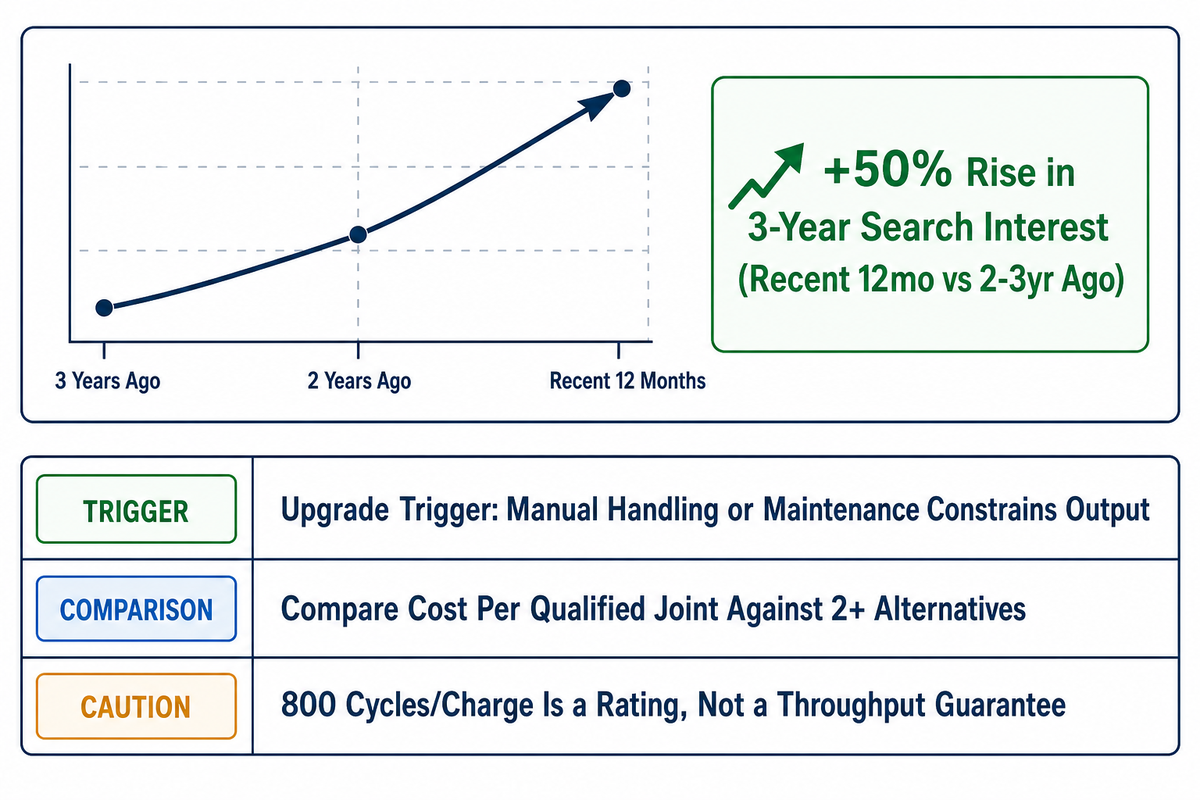
Upgrade when a timed process study shows that manual handling, charging, tool availability, maintenance, or operator exposure is constraining required output — not when a generic pallet-count threshold says so. Compare the current cost per qualified joint against at least two alternatives, including labor, consumables, batteries or compressed air, maintenance, downtime, training, rejected joints, and line-integration work.
Demand for this tool tier is a genuine multi-year trend rather than a seasonal blip: three-year keyword-search data for this article’s focus keyword shows search volume up roughly 50% in the most recent 12 months compared with the same period two to three years earlier. Published BXT4 coverage lists single-finger strap insertion and up to 800 cycles per battery charge. That number is useful for planning a trial, but it is not a throughput or return-on-investment guarantee. If a battery tool approaches its rated cycle capacity in the actual shift pattern, test a second-tool, pneumatic, semi-automatic, and automatic scenario before selecting the lowest total-cost option.
Frequently Asked Questions
Q: What is the difference between poly strapping and polyester strapping?
“Poly strapping” is often used as a broad label for plastic strap, while polyester strapping means PET specifically. Confirm the material before ordering a tool or joint.
Sellers may use “poly” for PET or polypropylene (PP), but those are different materials and should not share settings by assumption. Ask for the resin type, width, thickness, surface treatment, break-strength data, joint method, and explicit tool compatibility. Put those fields on the purchase order so a generic catalog label cannot silently change the approved combination. If the tool lists both PET and PP, obtain separate starting settings and acceptance criteria for each material.
What is poly strapping used for?
Plastic strapping is used to unitize or reinforce packages and palletized loads for handling, storage, or transport. The approved material and pattern depend on the package and distribution hazards.
Common examples include palletized goods, bundles, cartons, lumber, and pipe. Those examples do not define a safe design by themselves; the strap specification, number and position of straps, edge protection, joint, and application equipment should be qualified as one package system. Record how the package is lifted, stacked, stored, and transported, then test the proposed pattern under representative handling conditions before routine use.
How strong is poly strapping?
There is no single capacity for “poly strapping.” Use the rated strap break strength and the qualified performance of the finished joint for the exact material and dimensions.
The patent specimen in this guide shows why bare tensile strength and finished-joint efficiency must be kept separate. Request data for the selected PET strap, tool, and joint, then validate the complete package rather than assigning the strap’s laboratory break value directly to a pallet. The number of straps, their orientation, package friction, edge protection, handling shocks, and storage conditions all belong in that qualification.
How to tie poly strapping?
For a tool-applied PET system, use the manufacturer-specified joint rather than substituting a knot; the exact joint may be a weld, seal, or buckle approved for the strap.
The specified joint may be a friction weld, heat seal, buckle, seal, or another qualified method, depending on the strap and tool system. Follow the exact combination’s instructions and acceptance criteria.
How much weight can plastic strapping hold?
A strap’s break-strength number is not a pallet weight rating. Capacity depends on the complete package design, the qualified strap-and-joint system, and representative handling tests.
Ask for the selected strap’s material and dimensions, rated break strength, finished-joint data, tool compatibility, and test method. Package geometry, friction, edge protection, number and orientation of straps, handling, and distribution hazards also affect the design, so do not convert a single strap value directly into allowable load weight.
What is a pallet packing strapping tool?
A pallet-packing strapping tool is the same tensioner-sealer-cutter used to secure strap around a palletized load. Pallet packing describes the application, while the tool supplies the tension, joint, and cut.
“Pallet packing” describes the application, not a different mechanism.
References & Sources
- ASTM D3950-23, Standard Specification for Strapping, Nonmetallic (and Joining Methods). ASTM International.
- ASTM D3950-17, historical research version. Superseded by the active D3950-23 version cited above.
- Signode launches BXT4 battery hand tool. Packaging Insights.
- Signode BXT4 supplier-submitted product overview. Packaging World.
- Interested Parties Invited to Join in Revision of ASTM Steel Strapping Standard. ASTM International.
- U.S. Patent 5,772,944, Strapping Joint Efficiency Specimen Data. USPTO / Google Patents.
- ASTM D4675-14a(2022), Selection and Use of Flat Strapping. ASTM International.
- 29 CFR 1917.51, Marine Terminals, Cargo Handling Gear and Equipment. U.S. Occupational Safety and Health Administration.
- OSHA Accident Record #202439790, Battery Strapping Tool Injury. U.S. Occupational Safety and Health Administration.
- Canadian Patent CA2066818C, Strapping Tool. Google Patents.
The Team Behind This Report
This guide was prepared from the standards, government records, patent specimens, trade coverage, and supplier examples listed below. Model-specific figures remain labeled as published examples, and supplier thresholds are not presented as universal engineering limits. Final tool selection and operating instructions must be confirmed against the chosen strap, package test, and current manufacturer instructions.