Get in touch with UD Packaging Company

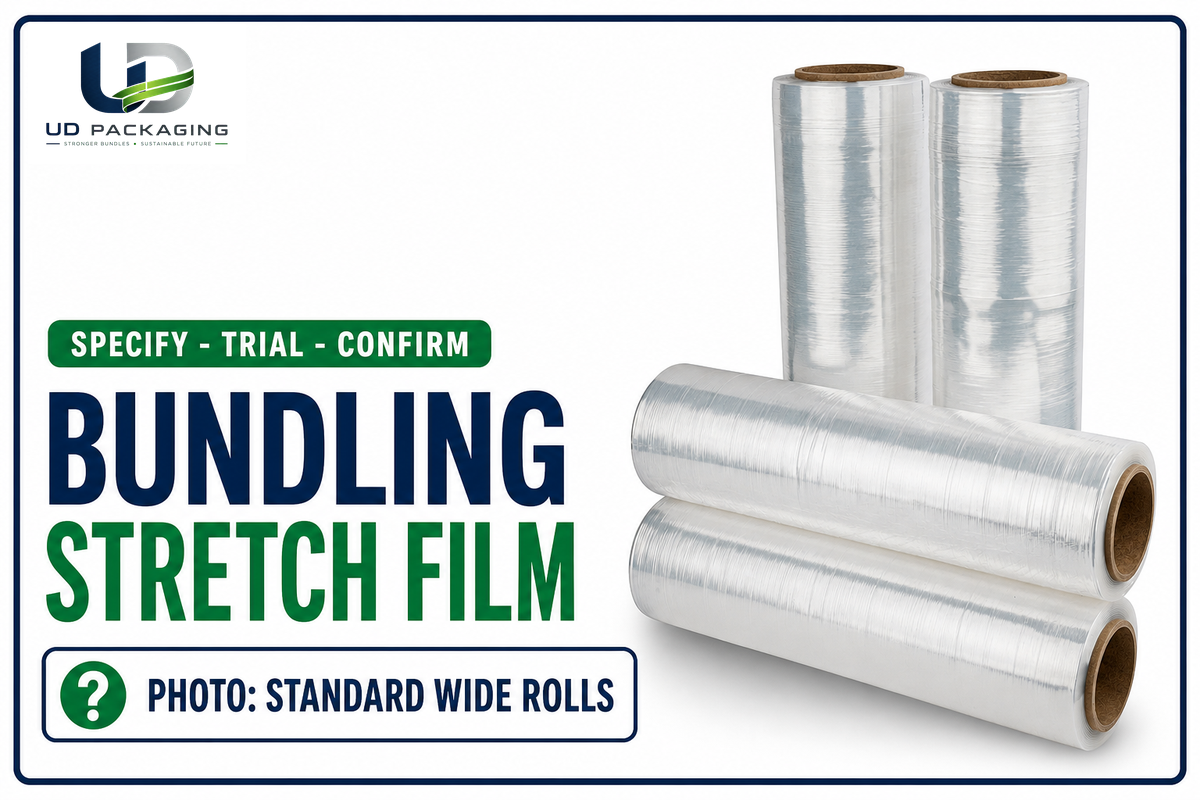
Bundling stretch film holds several small items together with a narrow band of tensioned film. Choosing a roll starts with the bundle geometry and handling task. A wider roll, a thicker gauge or a lower roll price can’t seal the deal on their own.
Keep three decisions separate for profiles, cartons and workshop kits. Keeping the items together is one of them. Protecting the surfaces of the package is the second and verifying the finished package for its handling route is the third. Bundling stretch wrap can help stabilize a group for a specific task but a tidy pack at the wrapping bench answers only part of that task.
Before ordering: keep film width separate from core diameter, compare candidate rolls on the same bundle, and agree when a wrapped bundle counts as accepted.
What bundling stretch film does for small bundles
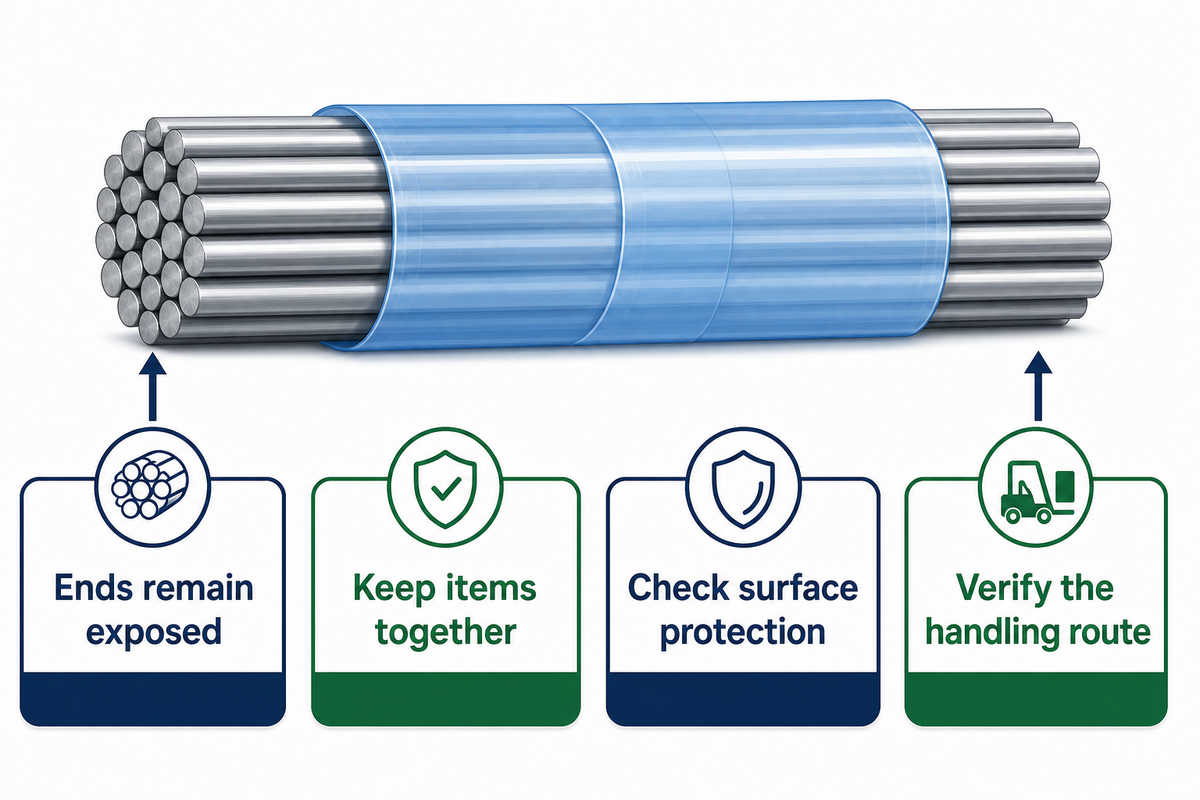
Narrow stretch banding groups multiple items by applying film under tension around part of a bundle. The film adheres to itself without a heat-shrink step. Local bands may leave ends and surfaces exposed; therefore the purchaser should specify if the job is workshop organization, surface coverage or preparation for a subsequent shipping package.
A clear bundling stretch film band can keep a label visible while a kit moves between workstations. Banding film leaves uncovered areas outside the applied band. The band doesn’t close an open carton, seal a package bag against water, or determine the lifting capacity. General stretch film materials provide useful context, but the local contact band remains the relevant geometry for a small bundle.
How is bundling film different from stretch film?
“Bundling film” refers to a task and can describe different kinds of packaging materials. Narrow stretch bundling uses cold tension. For shrink wrap, a matching heating process is required. Verify the material and application route on the quote rather than order by the word bundling. A shrink-film sleeve is not automatically a replacement for hand-applied stretch banding.
Public ASTM D4649-20(2025) guidance covers stretch-film selection and use for indoor environments. Its scope excludes outdoor exposure and flags extreme temperatures as a possible performance concern. A warehouse grouping method therefore needs separate evaluation before it becomes an outdoor-storage specification.
Common mistake: A band is thought to be complete protection. Inspect the areas that the band leaves uncovered. Choose any outer packaging, as well.
Choose a roll width around the bundle geometry
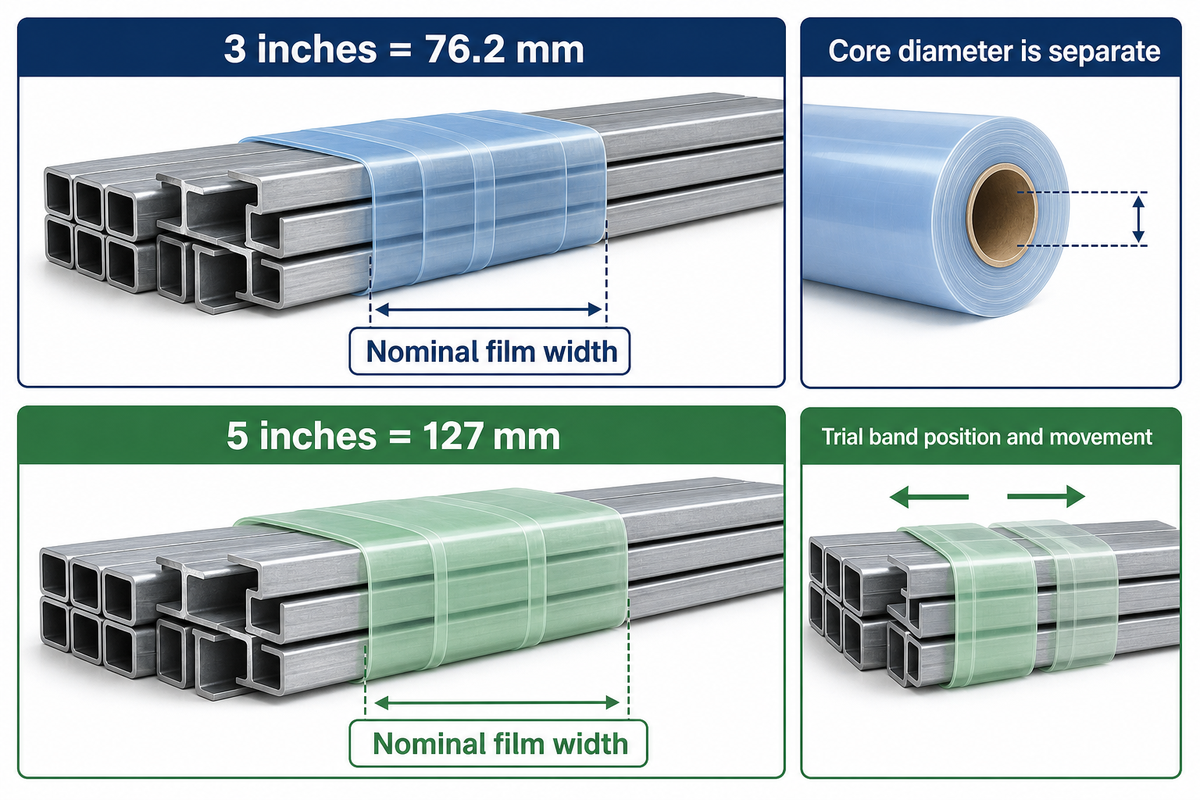
Three-inch and five-inch film widths describe different contact bands, not fixed strength classes. When comparing the film widths, determine if the band stays in place without crushing or marking the items. Core diameter, thickness and usable length belong in different specification fields.
The dimensional conversion is straightforward: Conversion to metric units is 3 inches = 76.2 mm, and 5 inches = 127 mm. Those measurements are nominal film width. A listing with a 3-inch core can contain 5-inch film; the function of the dispenser interface and band width are different.
| Bundle geometry | Width question to trial | Record | Limitations / Not suitable for |
|---|---|---|---|
| Long profiles | Does the band stay on the chosen contact zone? | Band position and movement after handling | Exposed ends still need a separate protection decision |
| Small carton pairs | Does the band keep the pair aligned? | Corner condition, seam access and slip | Grouping does not replace carton closure |
| Irregular workshop kits | Can the film contact a stable outer shape? | Protrusions, loose items and label visibility | Loose or sharp components may need an inner container |
Illustrative Profile Trial: A buyer has to keep four coated profiles together between cutting and final packing. The profiles are 1m long and the proposed bands sit clear of the ends. The buyer attempts 3” and 5” rolls on the same bundles, with the same separators and a recorded wrapping method. The operator marks the starting band positions and checks movement after the agreed workstation transfer and storage interval. Quality staff inspect the coating when the film is removed. If the wider band hides a receiving label or catches on a rack, that observation belongs in the result even if the bundle looks tidier. The agreed width of band is the one that meets the task; the trial doesn’t assign a transport rating.
The application should be identified in the purchase specification alongside dimensions, as in the selection-and-use scope in D4649. No clear winner was found in the public documents reviewed between 3-inch and 5-inch designs.
Protect finished surfaces without hiding sharp edges
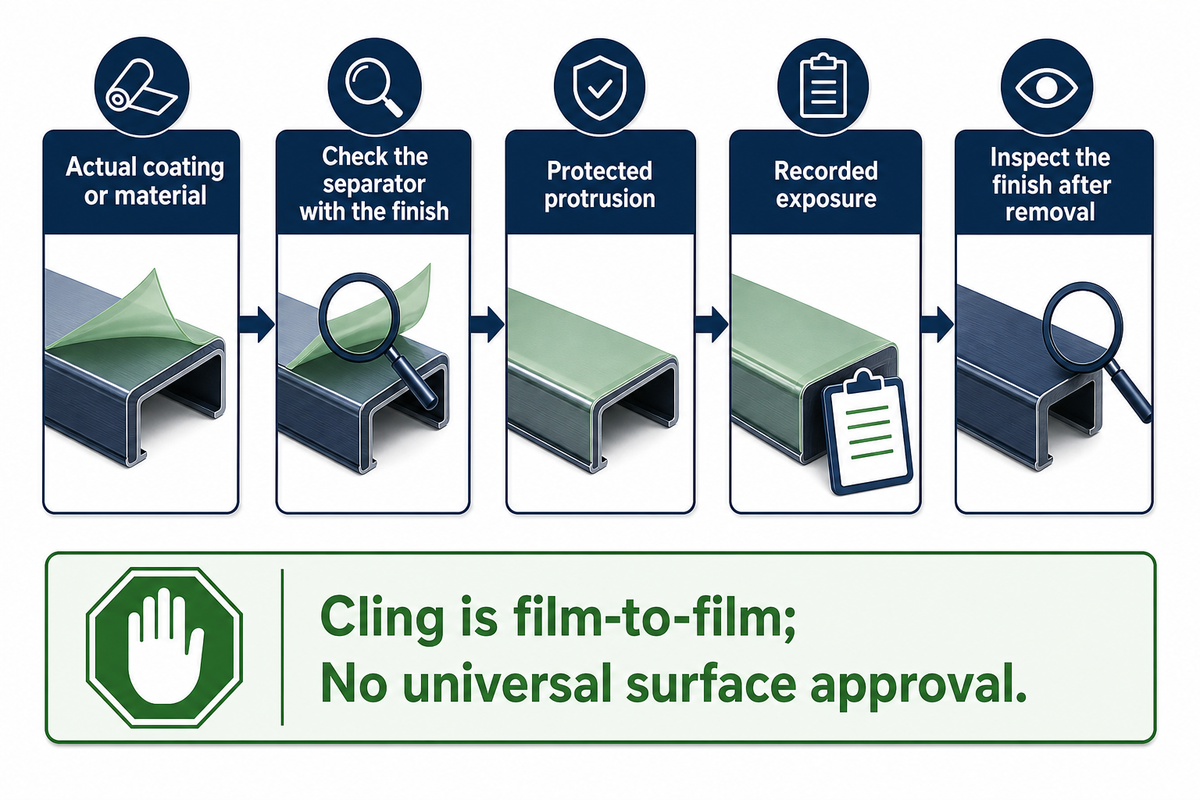
Finished-surface protection requires a contact trial with the supplied film and the actual coating or material. Cling of film-to-film and puncture resistance measure different properties. Neither establishes that a painted profile will remain unmarked after storage, pressure, and/or heat or removal. Therefore, surface acceptance must be documented separately.
ASTM D5458-95(2025) measures cling between layers of stretch wrap film. It does not test the film against a painted part. ASTM D5748-26 addresses protrusion puncture resistance under controlled conditions. Its public explanation says the method cannot duplicate all field experiences.
Cling helps maintain a band’s applied form, and a sharp protrusion creates a local failure point. Verify any protective separator with the finish prior to approval of contact. Adding film cannot remove that protrusion. Consider other separators, edge protectors or small inner boxes, and repeat the application test with such protection.
Is bundling stretch film safe?
Suitability depends on the task, product and wrapping method. A narrow band should not be used as a lifting handle. Protect exposed sharp ends and keep identifiers readable and assess the complete bundle under the intended handling conditions. A general product description doesn’t set a load limit.
When not to buy narrow film as the whole packaging solution
When there are any requirements for complete weather protection, protection for exposed finished ends, or a verified transport restraint system, a narrow band is considered an incomplete purchase. The D4649 indoor scope doesn’t support a promise of outdoor performance. D5748’s controlled puncture result doesn’t resolve all impact or abrasion risks on a shipment. Specify the missing protection before increasing the roll width or gauge.
Surface-protection proposals should be rejected if the supplied sample hasn’t been checked on the finish at the agreed storage temperature and time. Inspect the finish after removal as a tightly wrapped appearance can conceal contact marks. A trial on a bare metal surface doesn’t validate compatibility with a painted version of the same profile.
When dealing with loose components, an inner container or tray may provide the necessary stable shape prior to banding. For a heavy or unstable bundle, ask for a complete restraint design with documented limits. A roll of clear bundling film won’t address a lacking handling specification. These are application decisions and not evidence that every narrow roll will fail.
Stretch banding, tape, shrink film or strapping?
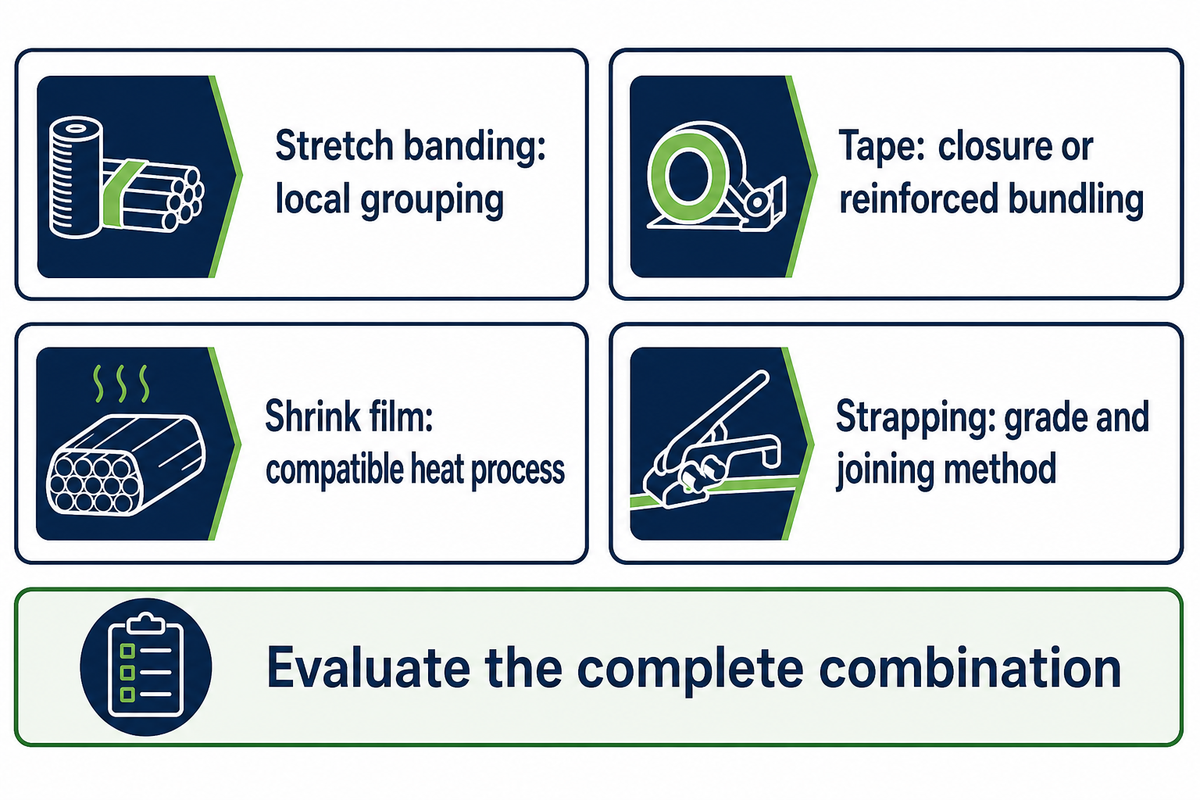
The four packaging methods should be compared based on the function they need to perform. Stretch banding groups items through applied film tension; adhesive tape can provide closure or reinforcement; shrink film requires heat; strapping combines a band with a joining method. Each of these combinations should be evaluated for compatibility and acceptance.
| Method | Useful function to evaluate | Check before purchase | Limitations / Not suitable for |
|---|---|---|---|
| Narrow stretch banding | Local grouping of a stable bundle | Band position, surface contact and retained grouping | Not a substitute for an unspecified transport-restraint design |
| Adhesive tape | Carton closure; appropriate reinforced grades can bundle | Adhesion, surface removal and tape grade | Plain carton tape does not represent every reinforced bundling tape |
| Heat-shrink film | A fitted sleeve or package with suitable equipment | Material, heating process and product heat tolerance | A cold hand dispenser cannot provide the required shrink process |
| Nonmetallic strapping | Bundling or restraint within a designed system | Strap grade, joint, tension and edge protection | A strap alone does not establish the complete package’s capacity |
ASTM D5330/D5330M-06(2020) uses filament-reinforced tape for bundling items for shipment. ASTM D3950-23 discusses nonmetallic strapping and joining methods. The specification for reinforced-tape covers combining items for shipment. These scopes eliminate a simple “film versus any tape” comparison; they do not rank the four methods by cost.
For a carton pair, confirm closure first and grouping second. If a strap route is appropriate, the strapping for boxes guide covers that separate decision. Don’t modify the restraint method solely because a film roll costs less.
Match the dispenser and wrapping method

A bundling dispenser must fit the supplied core and allow the operator to apply the agreed wrapping method consistently. Verify the core’s internal diameter, handle arrangement and roll format. Film width controls the contact band; core dimensions control the interface with the holder.
Extended core rolls and separate dispensers are different arrangements. Determine if a handle is included in a case, if it’s reusable, and if the replacement roll uses the same interface. The broader hand stretch film guide supplies context for application, while a narrow roll still needs a fit check.
Can bundling film be used with packaging equipment?
Only a film format approved for the equipment should be quoted for that route. Verify roll dimensions and application and mounting settings with the equipment supplier. A machine stretch film label alone doesn’t prove compatibility with an orbital wrapper and a mini-roll holder.
Record line speed and the film format for a high-speed equipment trial. Approval of a manual shop application doesn’t approve the same roll for that machine route.
Common mistake: changing the dispenser during a comparison without recording the change. A different application method can alter the observed result; keep it fixed or evaluate it as a separate trial condition.
Compare usable film and cost per accepted bundle
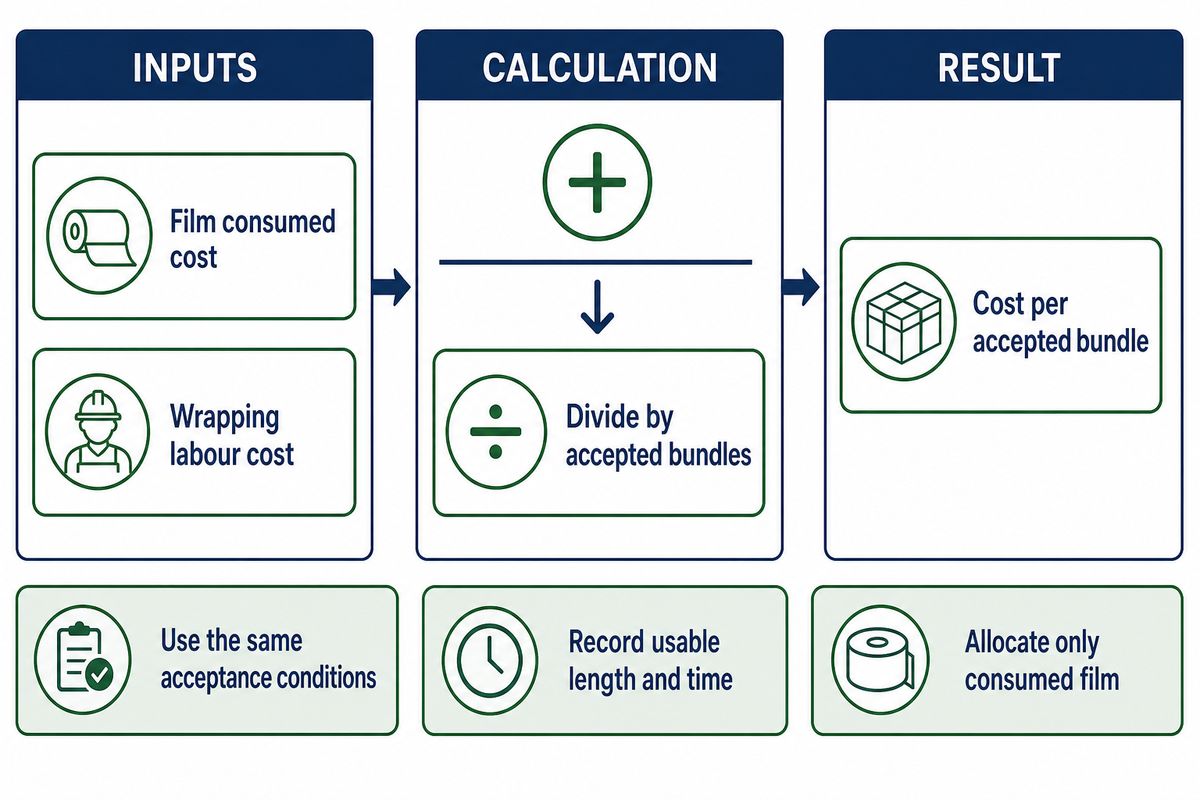
Cost per accepted bundle compares the film and wrapping labour consumed with the number of bundles meeting the same agreed acceptance conditions. Measure usable length, application time and rejects. Fix the inspection time, temperature and handling task before comparing rolls; otherwise the denominator can represent different levels of packaging performance.
The Bundle-to-Quote Conversion Sheet retains inputs. The numbers shown below are just illustrative examples, not quotes, or UD prices or test results by customers. Both illustrations use the same assumed acceptance endpoint. Width isn’t assigned to either illustration.
| Input or result | Assumed option A | Assumed option B | Limitations / Not suitable for |
|---|---|---|---|
| Roll price | $10 | $12 | Illustrative prices only |
| Usable film length | 900 ft | 1,000 ft | Replace with measured usable quantity |
| Film consumed per bundle made | 9 ft | 8 ft | Includes the assumed application consumption |
| Bundles made | 100 | 125 | 900 ÷ 9; 1,000 ÷ 8 |
| Accepted bundles | 95 | 125 | Assumed shared acceptance endpoint |
| Wrapping time per bundle made | 20 s | 15 s | Replace with observed operator time |
| Hourly labour rate | $30/h | $30/h | Assumed wrapping labour only |
| Wrapping labour cost | $16.67 | $15.63 | Unrounded values used in calculation |
| Film plus wrapping labour | $26.67 | $27.63 | Excludes freight, tax and product damage |
| Cost per accepted bundle | $0.281 | $0.221 | Illustration, not a performance forecast |
Calculation: The cost per accepted bundle is calculated as (film consumed cost + wrapping labor cost) divided by the number of accepted bundles. When the entire usable roll is consumed in the comparison, the cost of the roll is equal to the cost of the film. A partial-roll comparison must allocate only the film consumed, including trial waste.
Worked example: a packing team comparing the two assumed options first divides usable length by consumption per bundle. Option A makes 900 ÷ 9 = 100 bundles, of which 95 are accepted. Wrapping labour is 100 × 20 ÷ 3,600 × $30 = $16.6667, so ($10 + $16.6667) ÷ 95 = $0.2807 per accepted bundle. Option B makes 1,000 ÷ 8 = 125 bundles, all assumed accepted. Its labour is 125 × 15 ÷ 3,600 × $30 = $15.625, giving ($12 + $15.625) ÷ 125 = $0.221. The higher-priced roll has the lower result under these inputs. Change the measured acceptance or time and the conclusion can change.
Gross roll weight includes a core and may include other packaging. Net film mass and usable length address different questions; for coreless stretch film, a guide answers questions about the core. Comparison to minimum requirements becomes economical only after the required output has been satisfied, not when the least expensive alternative has been entered on the worksheet.
Run a trial with a written acceptance record
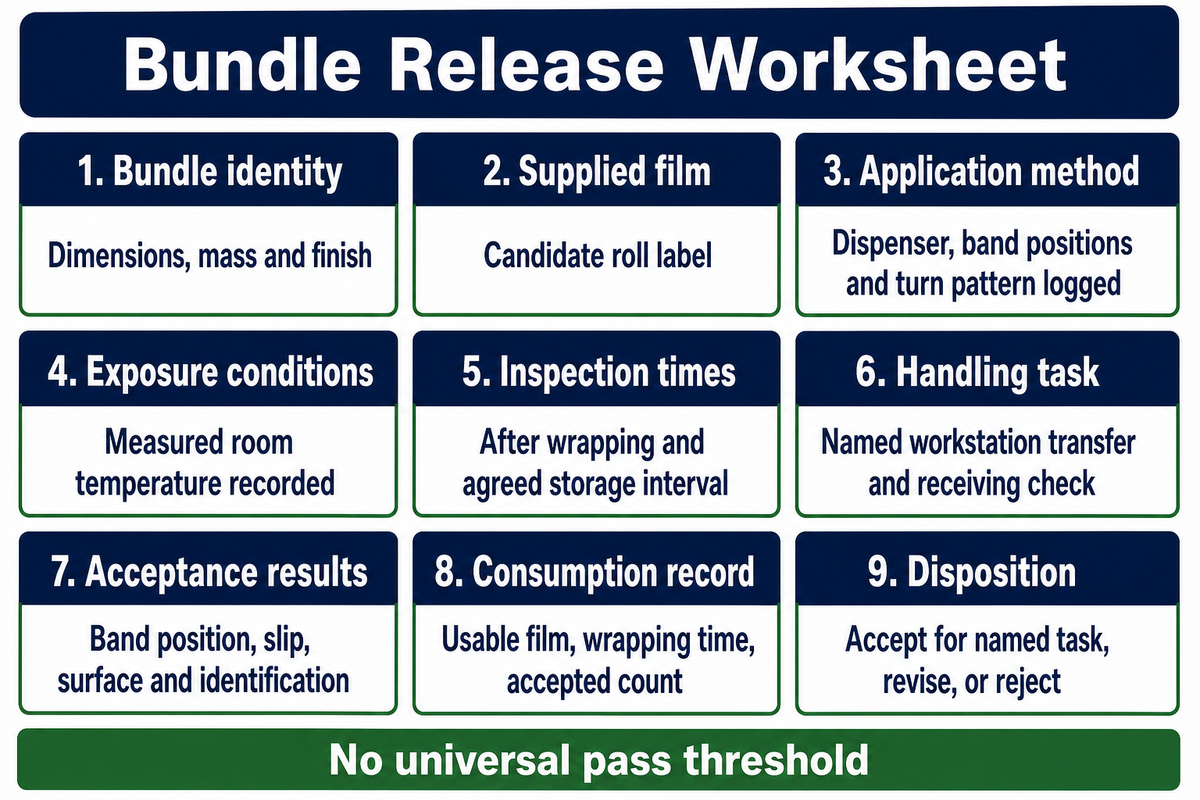
A bundle trial needs a defined product, wrapping method and inspection endpoint before the first sample is applied. Document the conditions with the observations and repeat the method on other bundles. The acceptance criteria belong to the intended application; a local grouping check does not certify an entire shipment.
ASTM D8314-20(2025) provides guidance for test procedures, including hand and machine wrapping, after stretch film has been applied to a unit load. Its public scope leaves success criteria to the user and encourages users to establish precision and bias for their application. The following editorial worksheet does not assert compliance with the recommendations in that guide.
“The user is encouraged to establish the precision and bias for their own application.”
The Bundle Release Worksheet provides a means for the operator, quality reviewer and buyer to concur on entry. Filled entries are examples to replace, not recommended thresholds.
| Field | Illustrative entry | Owner / observation | Limitations / Not suitable for |
|---|---|---|---|
| 1. Bundle identity | Four profiles, 1 m long; coating and batch noted | Quality: dimensions, mass and finish | Changing the finish creates a new condition |
| 2. Supplied film | Candidate roll label photographed | Buyer: width, thickness, core and batch | A trade name is not a complete specification |
| 3. Application method | Dispenser, band positions and turn pattern logged | Operator: applied condition and repeat count | Different methods need separate records |
| 4. Exposure conditions | Measured room temperature recorded in °C | Quality: humidity or other relevant exposure | No assumed outdoor performance |
| 5. Inspection times | Immediately after wrapping and at the agreed storage interval | Quality: elapsed time recorded in h | Immediate acceptance does not cover later storage |
| 6. Handling task | Named workstation transfer and receiving check | Operations: complete task and route | Not a substitute for shipment validation |
| 7. Acceptance results | Band position, slip, surface after removal and identification checked | Quality: agreed pass criteria plus observations | No universal pass threshold is supplied |
| 8. Consumption record | Usable film in m, wrapping time in s, accepted count | Operator and finance: comparable cost inputs | Use the same acceptance endpoint for both rolls |
| 9. Disposition | Accept for named task, revise, or reject; signer and date | Buyer and quality: scope released for purchase | No approval for untested tasks |
Timing matters because film tension can change after application. Dunno and Symanski’s 2021 storage study examined two 20.3 µm machine films on simulated unit loads over 30 days at 23°C and 38°C. Behavior observed in the study supports recording time and temperature; however, the numerical losses observed in the study should not be used to make predictions for bundles involving hand films.
What is bundling film used for in manufacturing?
Illustrative carton trial: a workshop groups two closed spare-parts cartons for transfer to a picking station. The trial captures carton dimensions, combined mass and film batch before an operator applies the selected band pattern. Operations name the transfer route; quality agrees how much movement is acceptable and whether corners, barcodes and carton closure must remain intact. The operator performs the method on different pairs and captures any variance, instead of providing a single ‘ideal’ example to the customer. Receiving staff inspect the pairs after the agreed wait and handling task. A pair that passes inspection can be released for the named internal use. Shipping of the same pair through a carrier requires a separate evaluation of the complete package and distribution conditions.
OSHA 1910.176(b) states that stored material must be stable and secure against sliding or collapse. It does not approve a film band or replace application-specific assessment. Keep the grouping result and the storage arrangement in the same review.
Freeze the roll specification and quotation

A narrow-roll quotation should specify film width, thickness, usable length, core interface and case quantity, as well as the bundle and trial particulars. Ask the selected supplier to confirm that exact format in writing. Published specifications for standard-hand pallet film don’t state availability of a narrow-bundling roll.
UD’s published industrial stretch film supply page gives a hand-film starting format of 450 or 500 mm width, 12-25 µm thickness and 50 or 76 mm core. Those are wider hand-film options. The public page doesn’t confirm 3-inch or 5-inch bundling-roll stock; a narrow requirement warranted explicit written availability and grade confirmation. For a poly film inquiry, confirm the resin and supplied grade instead of relying on the general material specification.
Complete the relevant fields in the inquiry and replace the examples with your chosen format. The information ranges below describe what to supply, not product recommendations.
RFQ checklist — copy these into your quote request:
| Parameter | Recommended range | Why it matters | How to verify |
|---|---|---|---|
| Film width | Chosen width in mm or inches | Defines the contact band | Written quote and sample measurement |
| Thickness | Quoted µm; clarify any gauge convention | Keeps the grade comparison explicit | Supplier data and agreed check |
| Usable quantity | Length in m or ft; net film mass in kg if quoted | Separates film from core and packing weight | Agreed quantity and tolerance method |
| Core and holder | Internal diameter in mm; handle arrangement | Controls dispenser compatibility | Fit the supplied sample |
| Case pack | Rolls per case and included handles | Exposes the purchase unit | Quote, packing list and receiving count |
| Application and acceptance | Named task, measured °C and inspection time in h | Preserves the shared performance endpoint | Completed trial record |
| Commercial scope | Quantity, destination, sample terms and required date | Allows a comparable written offer | Confirm price, freight and lead time |
For a procurement file prepared in October 2026, distinguish a current method reference from a product certificate. D5748-26 and D4649-20(2025) aren’t a test or certification of a supplier’s roll.
Environmental wording also needs a defined scope. EPA collection guidance distinguishes plastic bags and wraps from ordinary curbside recycling. Verify the commercial collection route and contamination rules; the stretch wrap recycling guide covers that hand off. Verify if the collection facility accepts clean film separately. A resin description alone isn’t a collection assurance.
Common mistake: accepting a general stretch-film offer as assurance for all special requirements. Release the purchase against the written roll specification and agreed sample result.
FAQ
Is bundling stretch film the same as shrink wrap?
Stretch bundling uses applied tension; shrink wrap needs a compatible heating process.
The word bundling can refer to either task, so identify the material on the order. A narrow stretch band is applied around the selected contact zone and can leave ends exposed. A shrink sleeve requires a film and heating route suited to the product. Compare the coverage and equipment requirements as well as the roll dimensions before substituting one process for the other.
Should I use 3-inch or 5-inch mini stretch wrap?
The width choice depends on the bundle’s contact zone and the agreed application result.
Keep film width separate from core diameter and compare the candidates on identical products. Record thickness, dispenser, band position and wrapping method before evaluating movement or surface condition. A 3-inch width is 76.2 mm and a 5-inch width is 127 mm; neither conversion assigns a strength rating. Use the same inspection time and temperature for both candidates. If one width obscures a barcode or catches on a rack, include that limitation in the purchase decision rather than judging only the pack’s appearance.
How many turns should I apply to a small bundle?
A small bundle has no universal turn count that establishes acceptance for every film and handling task.
Agree a starting method with the supplier and record the pattern used in the trial. Check band movement, item alignment and any surface changes after the named handling and storage conditions. Repeat the method on separate bundles and record variation. If the criteria are missed, change one condition at a time and assess the revised method. An attractive immediate result doesn’t establish later storage or shipping performance.
Can I compare rolls by gross weight?
Gross roll weight includes the core and may include packaging, so it is not net film quantity.
Request net film mass or usable length with the quantity tolerance. Use consumed film and accepted output for the application-cost comparison.
Can printed shrink film run on a hand stretch dispenser?
A hand stretch dispenser cannot replace the heating process required by shrink film.
Confirm material and equipment compatibility. Printing doesn’t make the two application routes interchangeable.
Does UD offer narrow bundling-roll sizes?
UD’s published wider hand-film formats do not confirm narrow bundling-roll availability.
The public stretch-film page gives 450 or 500 mm hand widths, 12–25 µm thickness and 50 or 76 mm cores. Those values belong to the published hand-film starting format; they shouldn’t be copied into a mini-roll specification. Send the bundle, selected width, dispenser interface and acceptance record when discussing an industrial packaging requirement. Ask for a written confirmation of the exact grade and format before treating a general film quotation as a narrow-roll offer. Availability, quantity, sample terms and delivery timing must be settled in that specific quotation.
Why UD separates the band from the shipping decision
UD publishes industrial hand and machine stretch-film supply information. This guide uses public method scopes and clearly labelled examples to help buyers prepare a usable enquiry. The two worksheets are editorial tools, not UD test results or standards certificates. A narrow format, surface requirement or transport task needs its own written specification and application evidence before purchase.
References & Sources
- ASTM D4649-20(2025): stretch-film selection and use
- ASTM D5458-95(2025): film-to-film cling
- ASTM D5748-26: protrusion puncture resistance
- ASTM D8314-20(2025): applied-film performance testing
- ASTM D3950-23: nonmetallic strapping and joining methods
- ASTM D5330/D5330M-06(2020): filament-reinforced tape
- Dunno and Symanski (2021): stretch-film behaviour during storage
- OSHA 1910.176: handling and storage
- EPA: recycling questions and collection guidance