Get in touch with UD Packaging Company

Updated September 2026
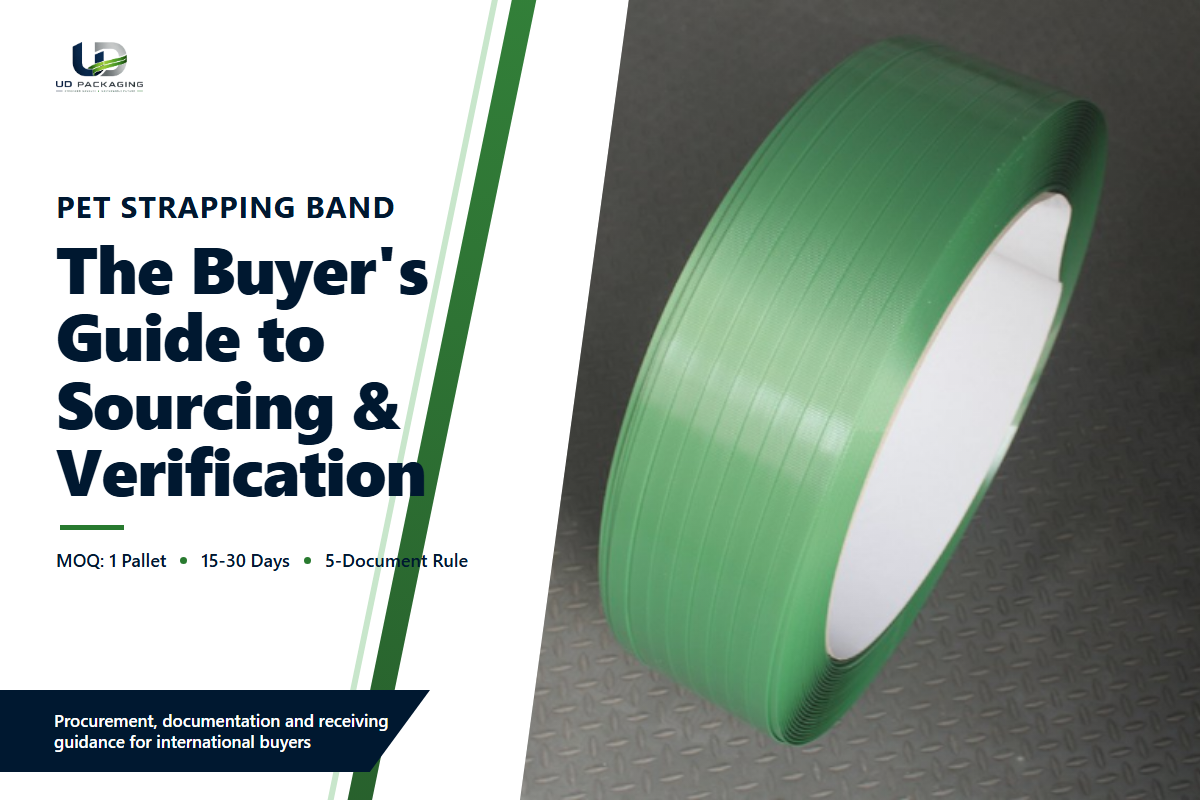
PET strapping band is the extruded polyester coil material buyers order to secure palletized loads, and sourcing one internationally involves more than picking a width. Minimum order quantity, production lead time, a paper trail, and a set of receiving checks are the parts most product pages skip entirely. This guide walks through ordering mechanics, required paperwork, container-load math, and receiving steps a procurement buyer actually needs, not the material comparison or joint-strength question, which UD Packaging’s PET Strapping Guide already covers in depth.
Quick Specs
| Width range | 9, 11, 12, 15, 16, 19, 25, 32 mm |
| Thickness | 0.5-1.5 mm |
| Core size | 200 mm or 406 mm |
| Coil mass | 500-700 kg per pallet |
| Minimum order | 1 pallet |
| Lead time | 15-30 working days after confirmation |
| Payment terms | 30% deposit, 70% before shipment (orders under $1,500 prepaid in full) |
What Buyers Mean by “PET Strapping Band” (Polyester Strapping Banding)
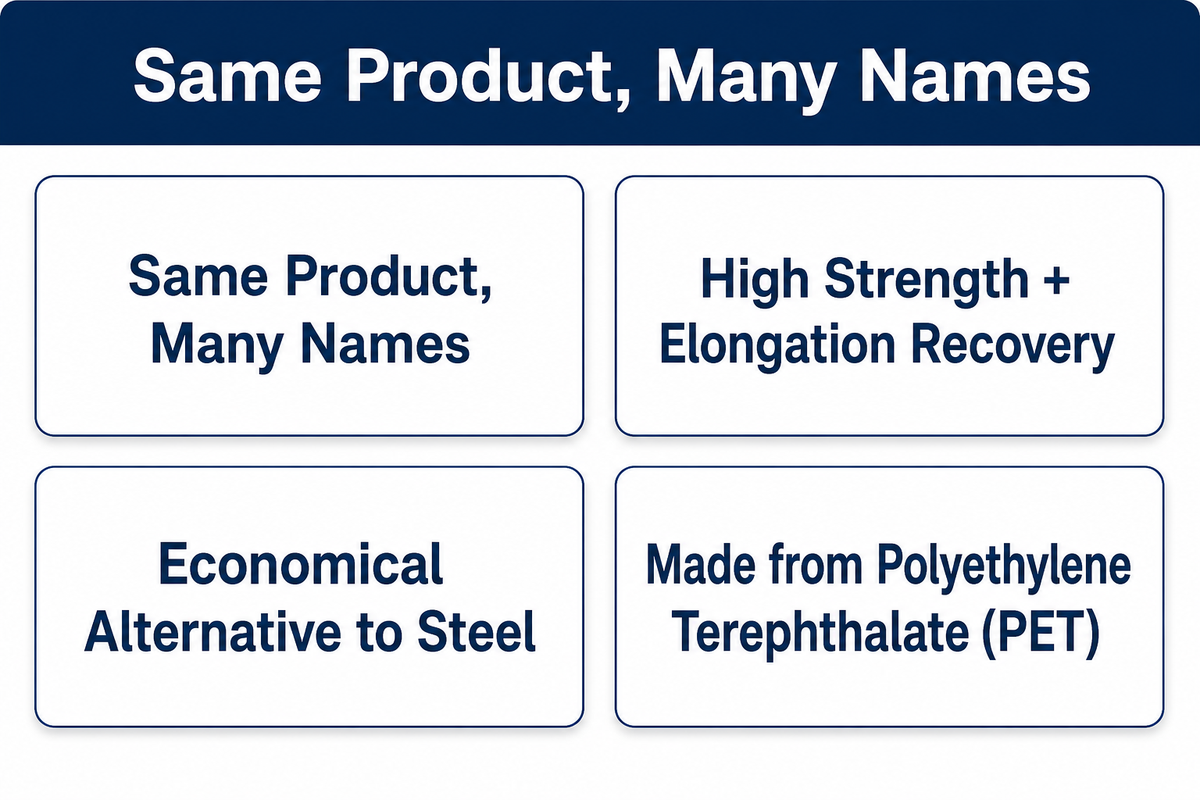
PET strapping band, strapping band, and strap all name the same plastic strap — a material made from polyethylene terephthalate (PET) resin, extruded, stretched, and heat-set onto a coil. Suppliers use different labels for the identical banding material depending on the market they sell into: strap, band, strapping, strapping banding, pet strapping roll, PET band, pet strap band, pet pallet strap, and coil all describe the same roll once a width and thickness are attached.
The terms can be treated as interchangeable unless a specific supplier’s documentation defines them differently. If one seller quotes “strapping band” and another quotes “strap,” and both are the same width and thickness, they are quoting the same product.
High strength and elongation recovery are the two properties that come up in nearly every quote conversation: pet strap flexes under a moving load instead of breaking, and weather resistance to UV and humidity makes polyester pet strapping an economical alternative to steel strapping wherever rust or durability is a concern, at a lighter, more budget-friendly weight for medium to heavy loads — the elasticity that gives it this reliability is the same property covered in the container-load math below. It ships smooth or embossed, suited to manual or automatic strapping-machine use, and buyers switching over from steel usually cite exactly those two advantages: comparable strength, with the flexibility and safety of a plastic band used for general plastic packaging. PP strap (polypropylene) costs less than a pet strap but gives up retained tension in exchange — that comparison, along with the full width and thickness range, belongs on the product page, not re-derived here.
An engineer replacing steel strapping with a plastic alternative is usually chasing the same two things: strength that combines the strength of steel with the elasticity of strength polyester, and load retention that does not fatigue at the seal the way some lower-grade plastic banding does under repeated shifting. Sold as an industrial-grade, split-resistant option for secure packaging, quality strapping like this fits equally well described as heavy-duty pallet strap for heavy goods and industrial bundling, packing strap for smaller cartons, or plastic strapping generally used across logistics operations — the underlying thermoplastic does not change — the characteristics of pet strapping stay the same regardless of the label on the invoice, whether sold as pet strapping banding roll or under a house brand.
The choice of material, the joined technique and the standards reference behind that coil are a different issue. The PET Strapping Guide by UD Packaging covers the ASTM D3950-23 and GB/T 1040 standards environment and the whole approval process; the PET Strapping Band product page displays the full specification table and the PET-vs-PP-vs-steel comparison. This guide picks up where these leave off – when a customer orders.
How PET Strapping Band Orders Are Actually Structured
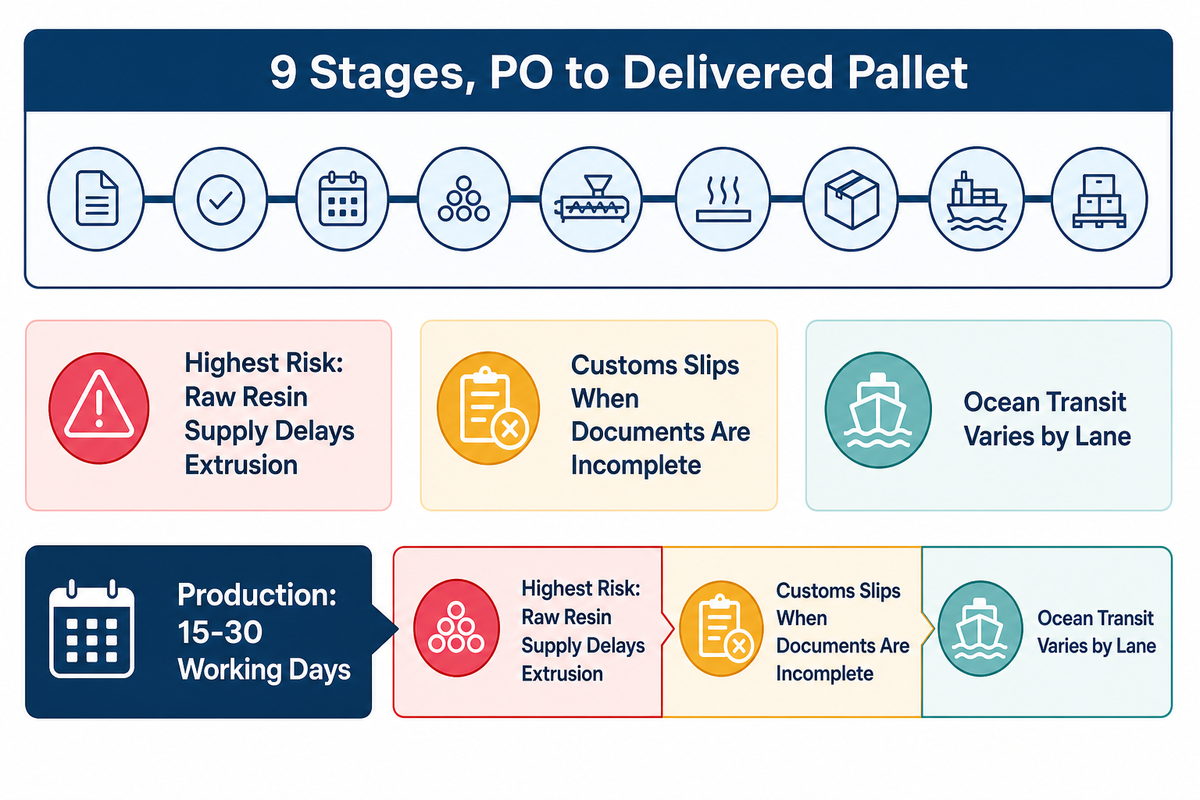
One full pallet per size is the minimum order; 15-30 working days from confirmation to completion is the production window; 30% deposit against 70% before shipment is the payment split, with orders under $1,500 prepaid in full instead. An approval cycle built around next-week delivery finds the production window alone eats most of a typical budget-cycle timeline, before ocean transit is even added.
Nine stages carry that timeline from purchase order to delivered pallet, each owned by a different party and each capable of slipping independently. This structure holds across the various widths in the catalog and across industries the strap ships into — buyers sourcing for steel-coil, brick, or paper-reel loads all work through the same nine stages, not a shortened version for smaller orders.
| Stage | Reference duration | Owner | Where it slips |
|---|---|---|---|
| PO confirmation and spec sign-off | 1-2 days | Buyer + supplier sales | Unresolved width, core, or grade questions |
| Deposit clearance (30% T/T) | 1-3 banking days | Buyer’s bank | International wire routing varies by bank pair |
| Production queue entry | 0-5 days | Supplier planning | Longer during peak seasonal demand |
| Extrusion, stretching, heat-setting, winding | 10-20 days | Supplier factory | Core of the 15-30 day window; slips if raw resin supply is tight |
| Lot test and QC report | 1-2 days | Supplier QC | Runs alongside final production, not always after it |
| Balance payment (70%) and booking | 1-3 days | Buyer + freight forwarder | Balance is due before shipment releases |
| Ocean freight transit | Route-dependent, weeks not days | Carrier | Varies by origin-destination lane; confirm with the forwarder, not a generic estimate |
| Customs clearance | 1-5 days | Buyer’s customs broker | Longer when the document package (see below) is incomplete |
| Inland delivery | 1-3 days | Local trucking | Distance from port to final warehouse |
The number one reason for an accelerated customs file is booking a shipment prior to QC clearing the lot test report – not after – the report is one of the key bits of evidence a broker checks against the shipment.
Before confirming an order size, it’s worth cross-checking the pallet count a supplier proposes against a container-fit reference rather than taking the number on faith — Freightos’ pallet-to-container calculator guide is one widely used tool for that check, and it flags the same load-planning variables (pallet footprint, stack height, weight distribution) that make the nine-stage timeline above slip when they’re settled late instead of at PO confirmation. The width, core, and grade questions that stall step one of that timeline are exactly the variables ASTM D3950 classifies strapping into five types by, which is why resolving them against that specification at spec sign-off (rather than after production starts) is what keeps the timeline from slipping.
The Document Package a Legitimate PET Strapping Band Order Should Include (REACH, RoHS and Recyclability)
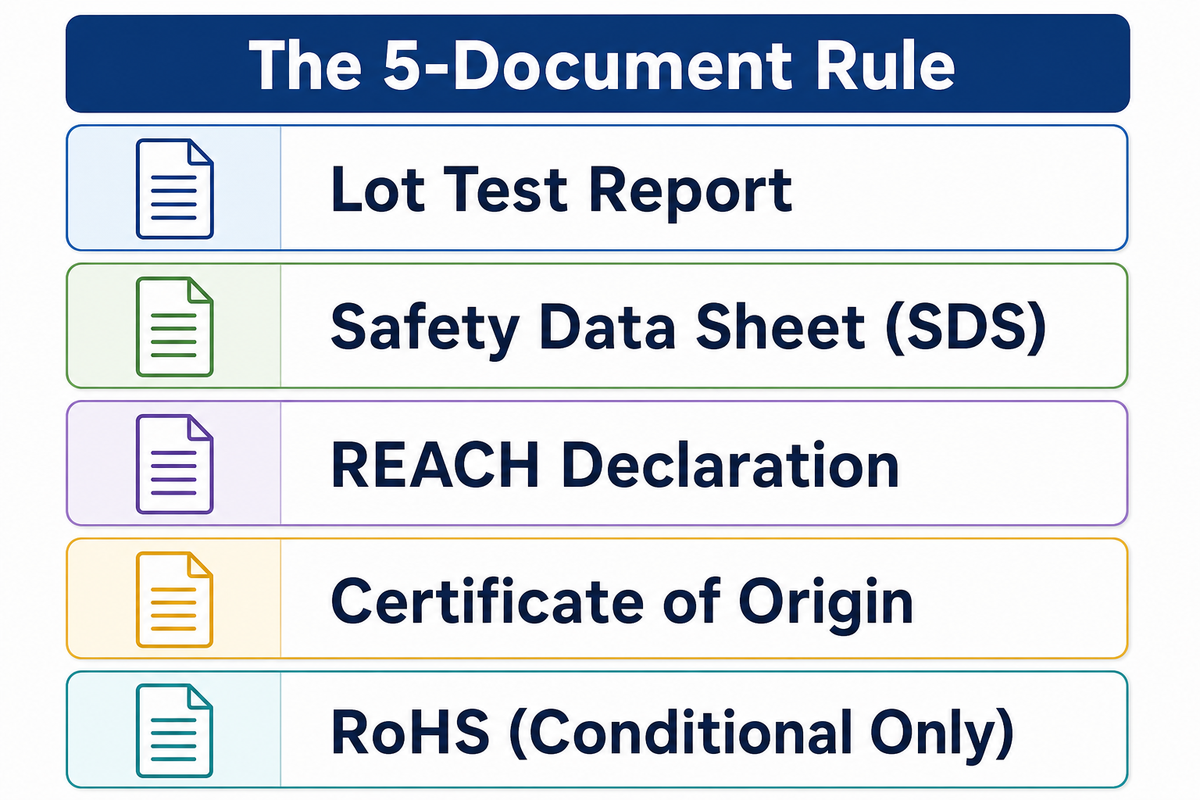
Without a lot test report, a Safety Data Sheet, and a Certificate of Origin, a buyer has no way to verify what was paid for actually matches what shipped. The 5-Document Rule covers what a complete package should include: lot test report, SDS, REACH declaration, Certificate of Origin, and, only where genuinely applicable, a RoHS declaration.
That last item is where buyers most often over-ask. RoHS restricts ten substances in electrical and electronic equipment specifically; a plain PET strapping coil is neither. Handing over a RoHS certificate for strapping that is not bundled with any electronic component is providing paperwork that does not actually apply to the product, useful only as a courtesy, not as a compliance requirement. REACH is the framework that does apply broadly to packaging materials: any Substance of Very High Concern present above 0.1% concentration must be disclosed, and under EU law suppliers of qualifying articles have had to report that information to the SCIP database maintained by the European Chemical Agency since January 2021.
ASTM’s specification for the product, cited on most PET strapping band spec sheets, covers strapping and joining methods “intended for use in closing, reinforcing, and bundling articles for shipment, unitizing, palletizing, and bracing for car loading and truck loading,” and classifies the material into five types.
Recycling and recycled-content claims deserve the same scrutiny as the RoHS question. A common assumption fails here: a signed supplier declaration alone does not verify a recycled-content percentage. What it should specify is the percentage, whether that percentage is post-consumer or pre-consumer, the test method behind it, and traceable production data — not just a stated number on a letterhead. As a benchmark for what a credible number looks like, the EPA’s Comprehensive Procurement Guidelines set a recommended recovered-content range of 50-80% postconsumer material (or 50-85% total recovered content) for manual-grade PET strapping — a claim far outside that band, in either direction, is worth asking the supplier to explain rather than accepting at face value. A “green pet strapping” or sustainability claim printed on packaging is marketing copy until that documentation exists. For buyers sourcing into the EU specifically, Regulation (EU) 2025/40 entered into force on 11 February 2025 and applies from 12 August 2026; a 2026 delegated act removed the requirement for pallet-wrap and strapping to hit a strict 100% reuse target, but strapping shipments into the EU still need to meet four heavy-metal limits and carry a recyclability self-declaration plus a technical file — a narrower, still-real compliance bar that a generic “recyclable” claim does not satisfy on its own.
RFQ checklist — copy these into your quote request:
| Parameter | Recommended range | Why it matters | How to verify |
|---|---|---|---|
| Width | 9-32 mm | Must match the jaw width of the tensioner or sealer already on hand | Check the tool’s own spec sheet before ordering |
| Thickness | 0.5-1.5 mm | Sets the break-strength tier | Cross-reference against the lot test report |
| Core size | 200 mm or 406 mm | Must fit the dispenser or tensioner spindle | Measure a sample core before confirming the full order |
| Coil mass | 500-700 kg per pallet | Drives the container-load math below | Spot-weigh one pallet on receipt |
| Documentation | SDS + REACH + Certificate of Origin + lot test report | Establishes traceability and compliance | Request before wiring the deposit; confirm the entity name matches the invoice |
| Standard cited | ASTM D3950-23 or GB/T 1040.1-2025 | Confirms which test method produced the break-strength number | Ask which specific standard and edition the lot test report cites |
| Payment terms | 30% deposit / 70% before shipment | Standard structure for this product; deviations are worth a question | Compare against the written quote line by line |
Requesting and Evaluating a Free Sample: Width, Thickness and Joint Checks Before a Pallet Order
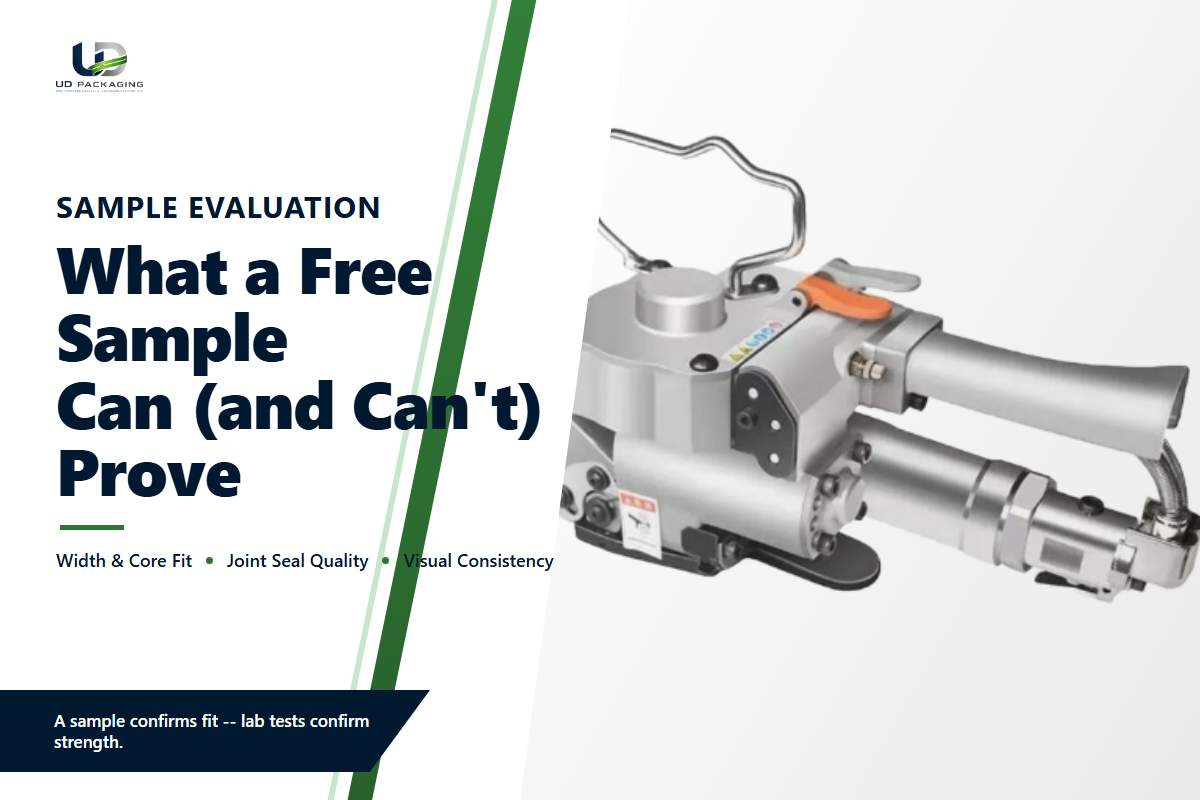
A free-sample check differs from a full lab test in what it can prove, not in whether it’s worth doing. Certified break-strength numbers stay out of reach without lab equipment and the specific test method ASTM D3950 calls for. What a sample can confirm, using tools most receiving docks already have, comes down to three questions: does the width and core match your existing tool, does the embossing grip hold consistent tension through a hand tensioner, and does the joint method the supplier recommends actually seal cleanly on that specific coil?
✔ What a Sample Check Can Confirm
- Width and core fit against your existing tool
- Embossing grip through a hand tensioner
- Joint seal quality with the recommended method
- Visual color and surface consistency
⚠ What It Cannot Confirm
- Certified break strength (needs lab test equipment)
- Elongation-recovery over repeated load cycles
- Recycled-content percentage or feedstock source
- Consistency across a full production lot, not just the sample coil
Let’s look more closely at the methods the manufacturer typically employs, and what a receiver might be able to emulate without an outside test house: production line testing routinely uses electronic vernier calipers to take occasional, fixed-schedule samples confirming width and thickness. Suppliers typically pull a final production coil before it ships for more thorough breaking-strength verification — but the caliper/visual check still delivers useful quality feedback, even without the lab testing that breaking-strength verification requires.
And the joining method warrants a closer inspection on a representative sample coil. What kind of joining material is employed, how are they bonded together? PET strapping band joins with a metal seal, a buckle, or a friction-weld, and each pulls on a different property of the strap’s weave and surface friction — a metal-seal joint depends on how the strap resists deformation under the metal clips, a buckle depends on grip against embossing, and a friction-weld depends on how cleanly the surface fuses under heat. Suppliers describing it as an excellent choice for high-strength packaging strapping usually mean specifically that, unlike steel, it won’t gall the seal tool over repeated cycles the way a work-hardened steel strap can. Verifying the recommended joining method on the purchased coil, rather than assuming it will work, is the whole point of this first sample inspection — the manufacturer’s technical sheet will typically specify which joining method to use, but how well it performs is unique to each coil.
Coil Mass, Pallet Counts and Container-Load Math for PET Strapping Band
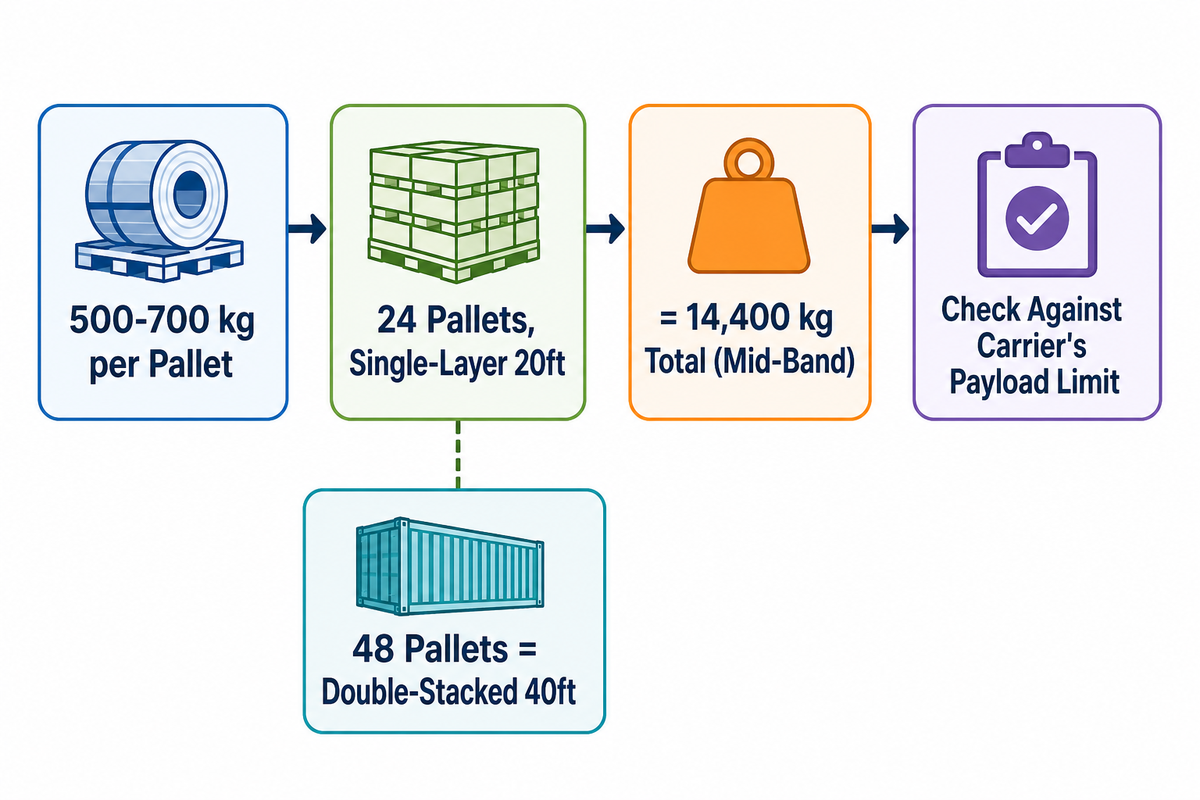
What goes into making the order: 500 to 700 kgs of coil mass per pallet – never strap’s sleekness – determines how many pallets fit a ship container. Typical fits: Twenty to 24 pallets in a single layer for a 20-ft; 48 pallets is more for a double-stacked 40-footer. Pallet-count X coil-mass range gives a workable preliminary estimate — a general-purpose ocean-freight load calculator can then confirm that estimate against the specific container type and weight limit a forwarder quotes. The 500-700 kg band itself follows from the coil dimensions and core size a supplier builds to under ASTM D3950, so a coil mass that falls well outside that band on a spec sheet is worth a second look before it’s used to plan container fit.
| Pallets | Total mass, low end | Total mass, high end | Container load class |
|---|---|---|---|
| 1 | 500 kg | 700 kg | LCL / partial load |
| 4 | 2,000 kg | 2,800 kg | LCL / partial load |
| 8 | 4,000 kg | 5,600 kg | Below single-layer 20ft minimum |
| 12 | 6,000 kg | 8,400 kg | Below single-layer 20ft minimum |
| 16 | 8,000 kg | 11,200 kg | Approaching single-layer 20-24 pallet band |
| 20 | 10,000 kg | 14,000 kg | Within single-layer 20-24 pallet band |
| 24 | 12,000 kg | 16,800 kg | Upper end of single-layer 20-24 pallet band |
| 36 | 18,000 kg | 25,200 kg | Requires double-stacking |
| 48 | 24,000 kg | 33,600 kg | Upper end of double-stacked 40ft reference |
Limits: This calculation excludes any of the tare weight of your pallet. Check actual container payload capacity with your freight forwarder.
Worked example: a buyer targeting a full single-layer 20ft container at 24 pallets, using the mid-point of the coil-mass band (600 kg/pallet), is loading roughly 14,400 kg of strapping alone — worth checking against the carrier’s stated payload limit for that route before committing to pallet count, since a 20ft container’s weight limit can bind before its floor space does.
This math holds across the full width range (9-32mm) and scales the same way whether the load is a single pallet destined for a domestic warehouse or a full container built for export — the coil-mass band drives the container math regardless of which width in that range is on the roll. Buyers running pallet packaging or bundling programs across multiple facilities apply the same arithmetic per site; a supplier quoting fast delivery on a heavy-duty order should be able to walk through this exact math on request, not just quote a lead time.
Verifying What Arrives: Lot Test Reports, SGS Testing and Short-Weight Checks
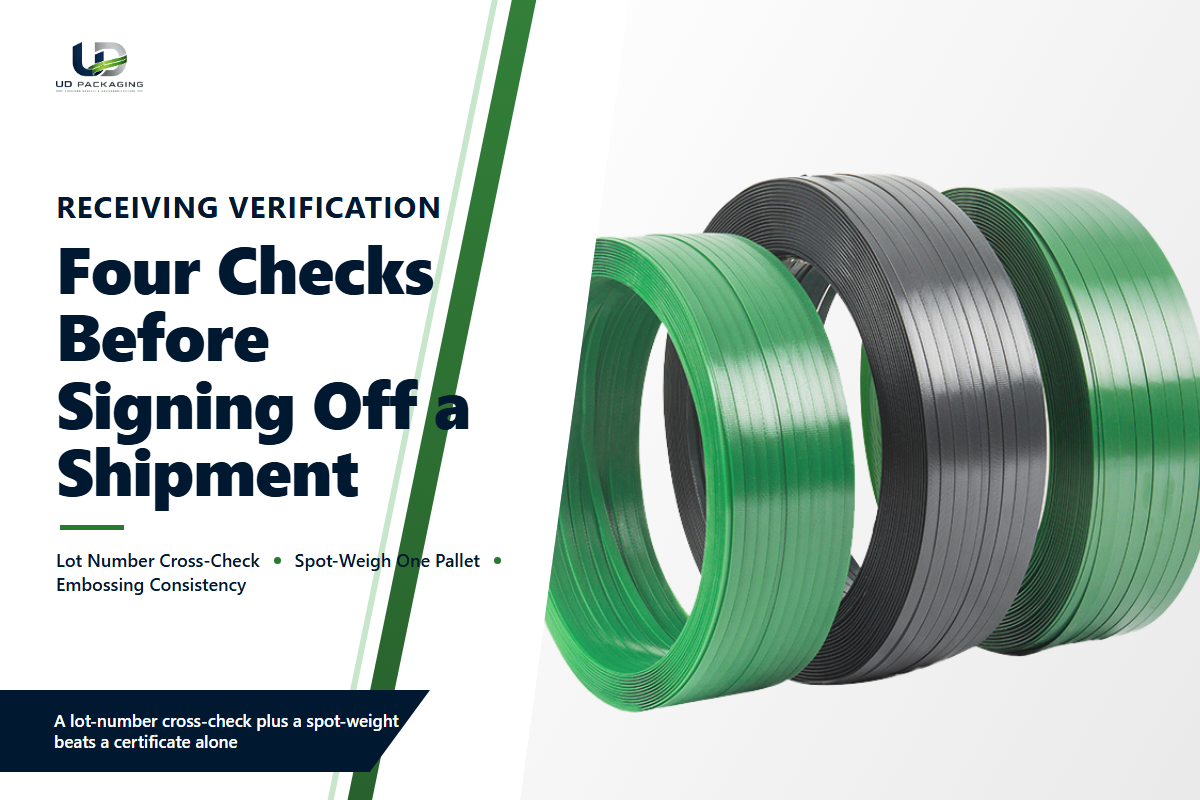
A signed certificate alone proves less than a lot-number cross-check paired with a spot-weight on arrival. One confirms a supplier tested something; the other confirms that something is what actually showed up on the truck. Four checks, each doable by a receiving clerk without special equipment, catch most of what goes wrong between a factory and a warehouse door.
✔ Do
- Cross-check the lot number on the coil label against the lot test report
- Spot-weigh at least one pallet against the quoted coil-mass figure
- Check width and embossing pattern consistency across coils in the same shipment
- File the SDS and Certificate of Origin with the shipment paperwork, not just the invoice
✗ Don’t
- Accept a lot test report with no lot number that ties back to the coils received
- Assume a matching supplier name on a certificate is enough without checking its date and scope
- Sign off on a multi-pallet shipment before a basic spot-weight check
- File documentation only in an inbox — keep a physical or shared copy with the receiving record
Signals That Warrant a Re-Weigh or Re-Test
Three signals are worth a second check before a shipment goes into inventory: coil mass that comes in under the quoted range by a wide margin, a lot number that does not appear anywhere on the accompanying test report, or embossing that shifts pattern mid-coil. None of these confirm a problem on their own — a small mass variance can fall within normal manufacturing tolerance — but together with a missing or altered-looking test report, they’re worth a phone call to the supplier before use. The same logic applies to any recycled-content or sustainability claim printed on the coil label: verifying a supplier’s recycled-material claim takes the same document-plus-physical-check approach, not a signature alone. A lot test report that cites ASTM D3950 without stating which of the specification’s five types the tested coil corresponds to is incomplete in the same way — the standard number alone is not the same as the test result.
Storing PET Strapping Band Coils in a Packaging Warehouse Without Losing Tension
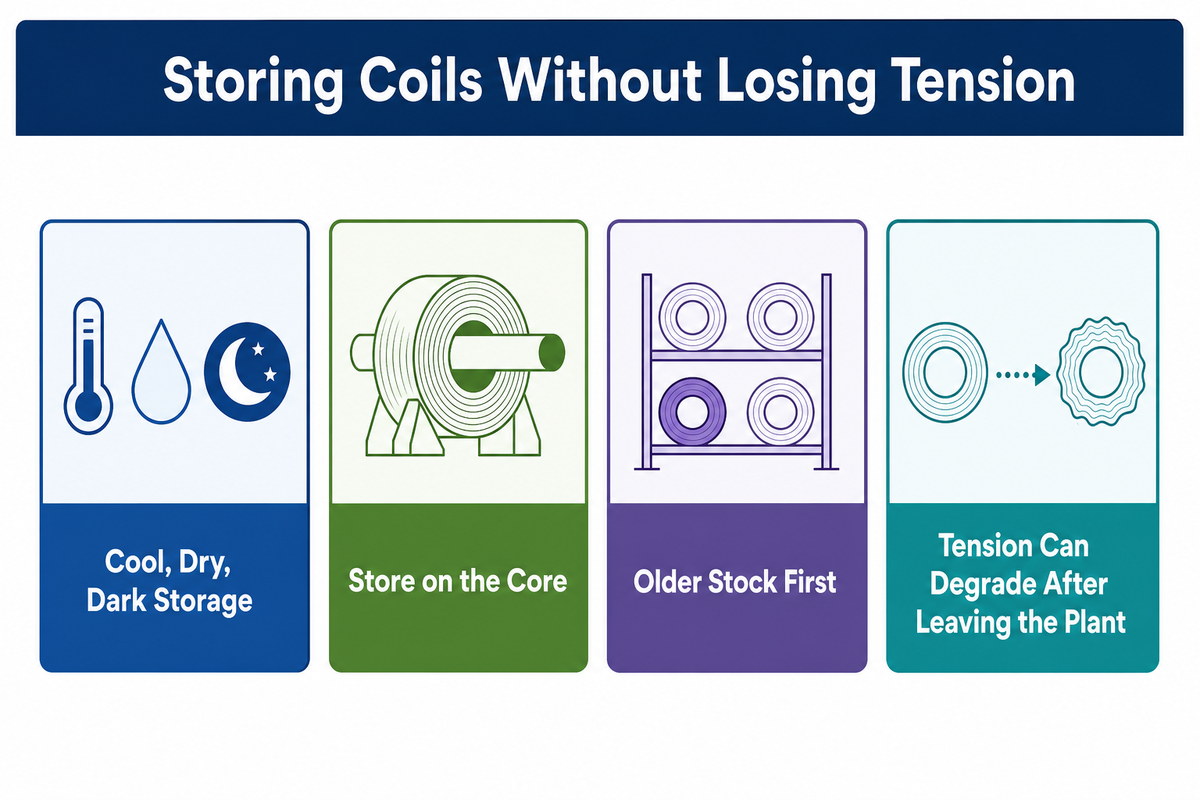
Tension retention: the tension in a loaded coil’s straps can degrade after it leaves the plant — a higher and stronger initial PET strap doesn’t guarantee prolonged tension, and a supplier’s tension-retention claim might be overstated depending on the storage environment.
Polyester, more generally, can show time-dependent creep and stress relaxation behavior, but the best quantified example of this behavior is geotechnical, not packaging-specific – it can’t provide an exact PET strap-strap retention value, only the broad direction that tension isn’t indefinitely stable. In practice, that means leaving coils in a cool, dry, dark place, away from UV or Ozone, storing on the core instead of loosely coiled, and ordering older stock (which has had time to vent) before newer stock.
Frequently Asked Questions
Q: What is a PET strapping band?
PET strapping band is polyester strap wound onto a coil, sold by width and thickness, and used for securing heavy loads, pallets, and bundles for transport and storage.
It combines high tensile strength with elongation recovery, meaning it stretches under tension and tightens back up if a load shifts, and it will not rust the way steel strapping can. Widths run 9-32mm and thickness 0.5-1.5mm across most catalogs, wound onto a 200mm or 406mm core so it fits standard hand tensioners and automatic strapping machines. Suppliers ship it smooth or embossed, and either surface works with metal-seal, buckle, or friction-weld joining, so the choice comes down to what tool and joint method your operation already runs.
Q: What does PET stand for in strapping?
PET stands for polyethylene terephthalate, the polyester resin used to extrude strapping-grade strap; the same resin family also appears in bottle-grade PET, though strapping-grade material is oriented and heat-set specifically for tensile strength and joint performance rather than for beverage packaging.
A bottle-grade PET certificate does not guarantee strapping-grade performance and vice versa — ask a supplier which grade a datasheet actually describes before assuming resin purity data transfers between the two. Strapping-grade PET is drawn and heat-set specifically to hold tension and survive a joint under load, properties a beverage-bottle resin specification never tests for. When a quote cites a PET quality certificate, confirm it was issued against strapping-grade material and the ASTM or GB/T method used, not a generic resin data sheet borrowed from a different product line.
Q: Is PET strapping the same as polyester strapping?
Yes, PET strapping and polyester strapping are the same material; PET names the specific resin, polyester the broader commercial family suppliers use in product listings and RFQs.
Suppliers use the two terms interchangeably in product names and quotes — neither term alone separates machine-grade from hand-grade strap; that is a separate specification question tied to width, thickness, and core size, not to whether the listing says “PET” or “polyester.” A quote that says “polyester strapping” and one that says “PET strapping” for the same width, thickness, and core should be treated as competing bids on the identical product. If the price or spec differs meaningfully between two such quotes, the gap is coming from grade, standard cited, or documentation, not from the resin name on the label.
Q: How long does a PET strapping band order take from deposit to delivery?
Production alone runs 15-30 working days after deposit clearance, and that comes before booking, ocean or air transit, and customs clearance at the destination are added on top, so treat the production window as only the first of several stages between purchase order and delivered pallet. Rushing this estimate is the single most common planning mistake first-time buyers make, since a budget cycle built around a 30-day total misses the transit and clearance stages entirely.
The nine stage timeline above breaks down where that window commonly slips, most often at raw resin availability during production, or at customs if the document package is incomplete. Confirm route specific transit time with your freight forwarder rather than assuming a fixed number, since it changes by lane and by season.
Q: What documents should come with a PET strapping band shipment?
A complete package includes a lot test report, a Safety Data Sheet, a REACH declaration, and a Certificate of Origin, with a RoHS declaration only where the product is actually bundled with electrical equipment.
Ask for the package prior to wiring a deposit, and confirm the legal entity listed on each document agrees with the entity on the commercial invoice.
Not ready to order a whole pallet? Send a quick question to the UD Packaging team before requesting a quote.
The Team Behind This Report
This guide draws on UD Packaging’s own published order terms and specifications for PET strapping band, cross-checked against live 2026 research into EPA procurement guidance, EU packaging regulation, and ASTM standards citations, the same source discipline our production team in Jiangyin, Wuxi applies to every lot test report we issue. Reviewed by the UD Packaging technical team.
Related Articles
- PET Strapping Guide: 5 Tests for Polyester Strap Approval: standards, specification reading, and the full approval workflow
- PET vs PP Strapping: A Buyer’s Comparison: material selection by duty class
- PET Strapping Band: full specification table and request-a-quote
References & Sources
- Comprehensive Procurement Guidelines for Miscellaneous Products: US Environmental Protection Agency
- Packaging and Packaging Waste (from 2026): EUR-Lex, Official Journal of the European Union
- Packaging Waste: European Commission, Environment Directorate
- ASTM D3950, Standard Specification for Strapping, Nonmetallic (and Joining Methods): ASTM International
- EU Drops Pallet Wrap Reuse Mandate in New Packaging Rules: Packaging Gateway
- RoHS vs REACH Compliance: Assent