Get in touch with UD Packaging Company

Metal ingot PET strapping secures ambient-cooled aluminum, zinc, lead, and tin ingot bundles using extruded polyethylene terephthalate (PET) bands under ASTM D3950-23 Type IV. It suits cold metal within the strap supplier’s temperature limit and requires cut-resistant edge protection over sharp burrs. Buyers must verify pull-tested joint capacity rather than sizing width from bundle weight alone. When ingot surfaces stay hot, sharp edges exceed PET guard limits, or contracts mandate metal bands, plants keep steel strapping with proper edge contact geometry.
Purchasing the wrong strapping material creates two failures on a foundry floor. Undersized plastic snaps during forklift braking or container transit, whereas unnecessary carbon steel adds recoil injury hazards, rust stains, and higher operational costs. This engineering guide outlines verified temperature thresholds for a thermoplastic band, edge guard rules, LME baseline specifications, and a procedure for bundle screening.
| Control Parameter | Verified Benchmark | Primary Source |
|---|---|---|
| Cold-metal contact ceiling | Up to approx. 60 °C (140 °F) for TYCOON PET | Teufelberger metal-industry guide |
| PET glass transition (Tg) | 70–85 °C (158–185 °F) | NETZSCH polymer thermal data |
| LME polyester ingot baseline | 15.6 × 0.9 mm, 6,000 N avg strength | LME Appendix D Table 2 |
| LME joint efficiency benchmark | 80% friction weld (2,500 N) vs. 60% metal seal (3,500 N) | LME Appendix D Tables 2 & 4 |
| Heavy metal PET gauges | 19 × 1.0–1.27 mm, 25mm × 1.27 mm, 32 × 1.00 mm | Teufelberger & Strapping4Less |
What Is Metal Ingot PET Strapping and Where Does Polyester Fit on Ingot Bundles?
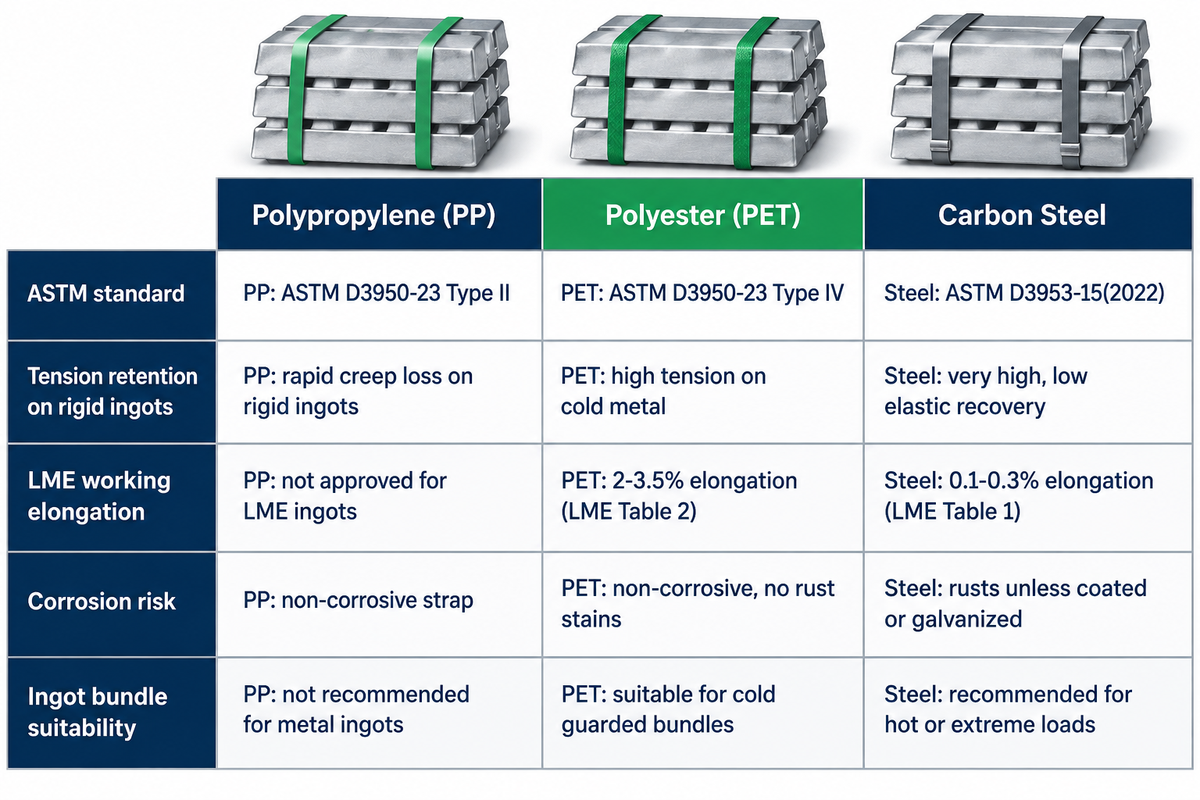
Polyester strapping (PET strap) is an oriented thermoplastic band under ASTM D3950-23 Type IV for unitizing heavy rigid loads. In non-ferrous casthouses, metal ingot pet strapping binds cooled stacks of primary aluminium ingot, aluminum alloy, zinc ingots, tin, and lead into forklift-ready units, without rust staining.
A key question for casthouse buyers is whether a plastic strap can hold a one-metric-ton metal bundle without stretching loose. LME Appendix D, Table 2, gives specs for 15.6 × 0.9 mm polyester strapping at 6,000 N average breaking strength. This rule covers primary aluminum, aluminum alloy, tin, lead and zinc ingots. Working elongation, under tension, is 2-3.5% compared to 0.1-0.3% for LME Table 1 Steel strap.
Elasticity acts as an industrial shock absorber. Rigid metal stacks shift slightly as timber dunnage compresses or stacked ingots seat together during ocean freight. For steel strapping operating at 0.1-0.3% working elongation, preload can fall as an ingot stack settles. However, polyester retains working tension elongation of 2-3.5%, which allows it to hold metal bundles together and maintain tension under multi-modal handling conditions.
What is the difference between PET and PP strapping?
ASTM D3950-23 classifies polyester (PET) as Type IV strapping and polypropylene (PP) as Type II strapping, reflecting a wide gap in sustained load retention. Tension retention shows a significant gap. Under sustained tension on dense cooled ingot bundles, PET generally retains tension better than PP. PP strap creeps under static stress. It is therefore common to see buyers of carton loads specify polypropylene and heavy metal loads be packed in PET.
Polypropylene polymers deform permanently when held under high tension over days of warehousing or export shipment. Even a wide PP band can lose clamping force. Molecular chains can slide past one another under load from the dense mass of cast ingots. In NETZSCH engineering thermoplastic reference data, general PET polymer lists a Young’s modulus of 2,100 to 3,100 MPa. Finished oriented polyester strapping PET grades build higher tensile stiffness than PP to withstand heavy rigid bundles. Review our detailed PET vs PP strapping load and joint comparison before selecting a packaging strapping grade for mixed warehouse lines.
| Property | Polypropylene (PP) | Polyester (PET) | Carbon Steel |
|---|---|---|---|
| Governing ASTM spec | ASTM D3950-23 Type II | ASTM D3950-23 Type IV | ASTM D3953-15(2022) |
| Tension retention on rigid ingots | Poor; rapid creep loss | High on cold metal within spec | Very high; low elastic recovery |
| Working elongation (LME baseline) | Not approved for LME ingots | 2–3.5% (LME Table 2) | 0.1–0.3% (LME Table 1) |
| Corrosion and stain risk | Non-corrosive strap | Non-corrosive strap | Rusts unless coated or galvanized |
| Metal ingot suitability | Not Recommended | Suitable (cold, guarded bundles) | Recommended (hot or extreme loads) |
At What Surface Temperature Does PET Strapping Soften or Lose Tension on Cast Ingots?
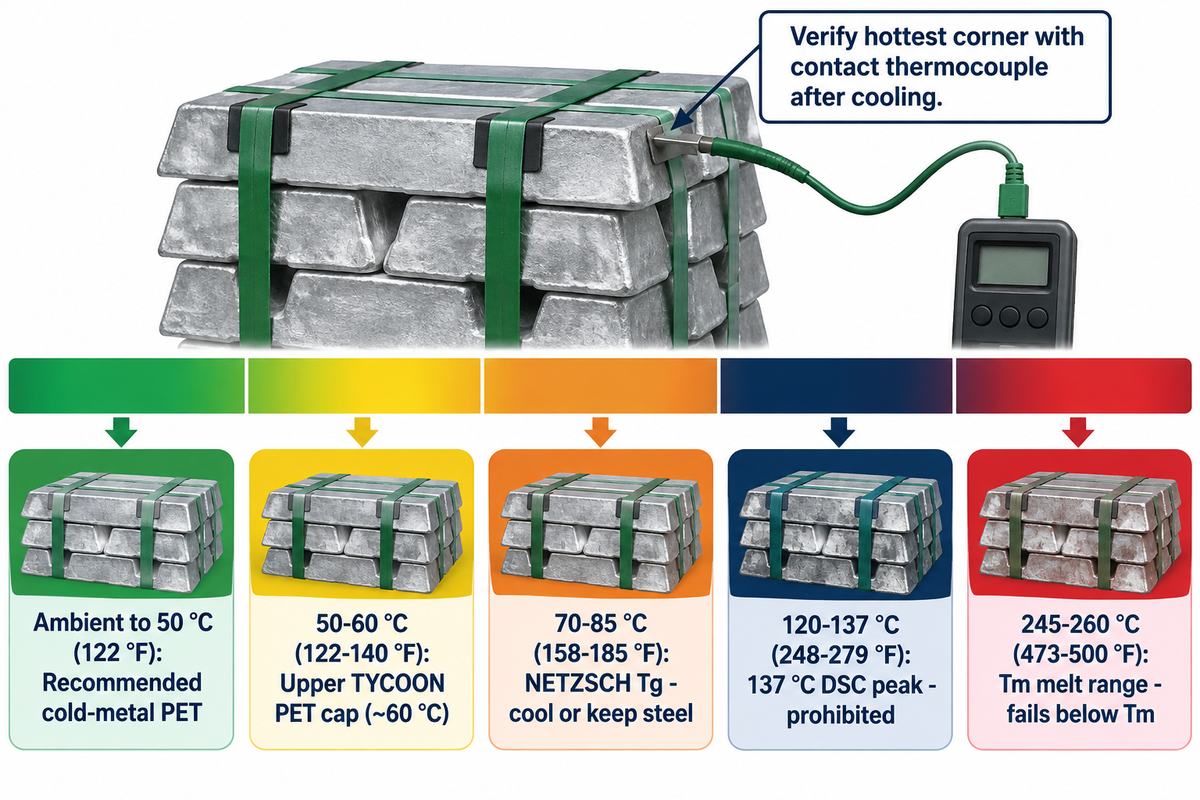
Teufelberger indicates its TYCOON PET strapping is restricted to cold metal applications up to approximately 60 °C (140 °F) and requires alternative materials for hot applications due to polymer relaxation. See Teufelberger metal-industry PET strapping guidance and NETZSCH PET thermal data for the primary thermal boundaries. NETZSCH Polymer Thermal data indicates the Tg of PET is in the range of 70-85 °C and PET melts at 245-260 °C. Treating PET’s melting point as its service-temperature limit leads to strap relaxation on warm ingots.
Think of a polyester strapping PET strap under 2,500 N of tension like a stretched nylon guitar string left inside a hot car trunk. The string doesn’t melt into liquid, yet heat lets internal chains relax and pitch drops rapidly. NETZSCH differential scanning calorimetry (DSC) data list PET’s glass transition at 70–85 °C and melting peaks at 249–251 °C. Those thermal scans also show a post-crystallization exothermic peak at 137 °C.
Packaging brochures occasionally state that polyester resists deformation up to 120 °C without specifying applied load or contact duration. However, they don’t state the load or contact time. Research on oriented PET fibers at the Oak Ridge National Laboratory, under constrained heating conditions, states that stress response is affected by factors such as molecular orientation, initial tension, and time. Because a brief unloaded test does not match sustained tension on a warm ingot stack, casthouses should cool the bundles below the strap supplier’s cold-metal limit or retain steel strapping.
| Ingot Surface Band | Polymer Physics & Source | Ingot Bundling Verdict |
|---|---|---|
| Ambient to 50 °C (122 °F) | Glassy semi-crystalline PET state (below NETZSCH Tg) | Recommended for cold-metal PET strapping |
| 50–60 °C (122–140 °F) | Upper cold-metal boundary (~60 °C cap for Teufelberger TYCOON PET) | Upper limit; verify stabilized contact temperature |
| 70–85 °C (158–185 °F) | PET glass transition range Tg (NETZSCH) | Outside cold-metal PET window; cool bundle or keep steel |
| 120–137 °C (248–279 °F) | Post-crystallization DSC peak at 137 °C (NETZSCH) | Prohibited for PET; keep steel strap |
| 245–260 °C (473–500 °F) | Crystalline melting range Tm; DSC peaks 249–251 °C (NETZSCH) | Prohibited; tensioned PET fails well below Tm |
Can PET strapping be used for aluminum ingots right after casting?
No, freshly cast aluminum ingots must cool before PET strapping contacts the bundle. Surface spray cooling can cool the outer skin while the dense core stays hot. As airflow through the stack slows, heat again rebounds to the surface, softening the polyester.
Operators can avoid rebounds by using a contact-thermocouple check. The hottest point in contact with the aluminum should be measured rather than taking a reading from an infrared gun. Allow the stack to thermally stabilize after cooling, and only cycle the strapping machine once contact readings are safely within the strap supplier’s cold-metal operating limit. Take into account the temperature increase in the hot, enclosed airspace of a fully loaded ocean container in the summer.
How Do Sharp Edges, Casting Flash, and Burrs Damage PET Strapping?
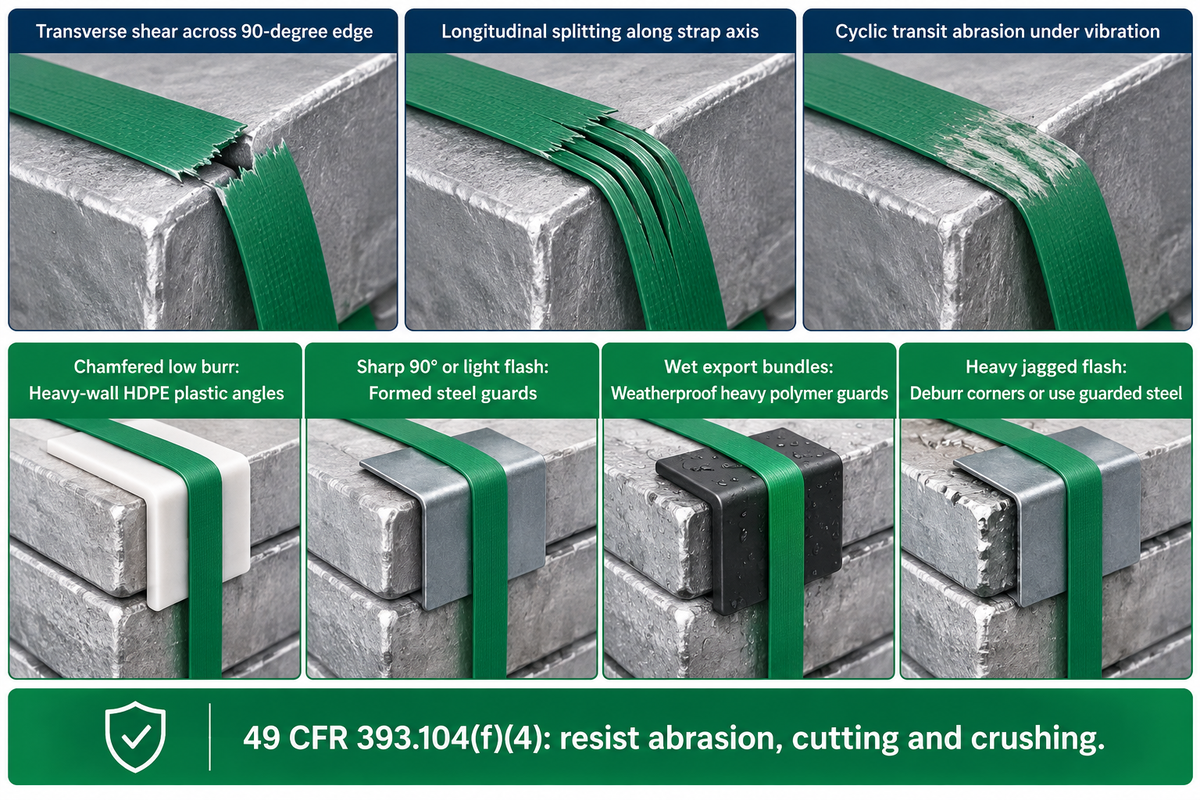
Raw cast ingot corners, parting-line flash, and saw burrs concentrate strap tension along a microscopic line and nick polyester fibers under load. Once nicked, strap tension along the edge allows road vibration to form a microscopic notch into a full break across the band width. No extruded PET thickness can replace proper corner protection on un-deburred metal edges.
Three distinct mechanical failure modes attack bare plastic on metal products such as ingots, steel plates, and metal sheets. The first is transverse shear, which cuts the band directly across a sharp 90-degree edge during initial tensioning. Second, longitudinal splitting unzips oriented polyester fibers along the strap axis; patent WO2013059555A1 blends polyolefin co-polymer additives specifically to improve split resistance. The third is cyclic transit abrasion, which wears through the strap edge. Note that un-deburred flash can score and weaken steel bands as well, so proper edge geometry or corner protection matters across both materials.
“Edge protection must be used whenever a tiedown would be subject to abrasion or cutting at the point where it touches an article of cargo. The edge protection must resist abrasion, cutting and crushing.”
Regulatory distinctions are important here. Under 49 CFR § 393.5, an “article of cargo” includes a unitized bundle bound by strapping, while a “tiedown” attaches cargo to a vehicle’s anchor points. So 49 CFR § 393.104(f)(4) legally governs vehicle tiedowns, not standalone unitizing bands. Packaging engineers still apply the same abrasion-, cut-, and crush-resistance rules when using PET strapping on sharp ingots. Unprotected sharp flash slices through a tensioned strapping band whether it’s anchored to a flatbed or unitizes a stack. Drivers of heavy flatbeds are used to reporting razor sharp metal coils slicing straight through thin plastic corner guards.
Resistance to corner guards is common among plant employees. Plant teams often resist corner guards because manual placement adds seconds to each bundle, while switching to a thicker strap gauge rarely helps prevent shearing. A thicker strap, or in general a thicker PET, still shears at the root, and increases costs. The goal is to protect the edge and make sure corner guards stay captured during automated tensioning. Our guide on matching strapping edge protectors to sharp load corners covers this topic in detail.
| Ingot Edge Condition | Recommended Guard Material | Retention Method | Operational Limit |
|---|---|---|---|
| Chamfered cast ingots, low burr | Heavy-wall HDPE plastic angles | Recessed strap channel | Deforms if exposed to warm metal |
| Sharp 90° edges or light flash | Formed steel or steel-backed guards | Friction seat plus strap groove | Higher unit cost; reusable closed-loop |
| Wet or outdoor export bundles | Weatherproof heavy polymer guards | Slotted corner clips | Avoid uncoated paperboard in rain |
| Heavy jagged flash, no deburring | Not suitable for thin packing materials | Not applicable | Deburr corners or use guarded steel |
Why Ingot Weight Alone Cannot Determine PET Strap Width and Thickness
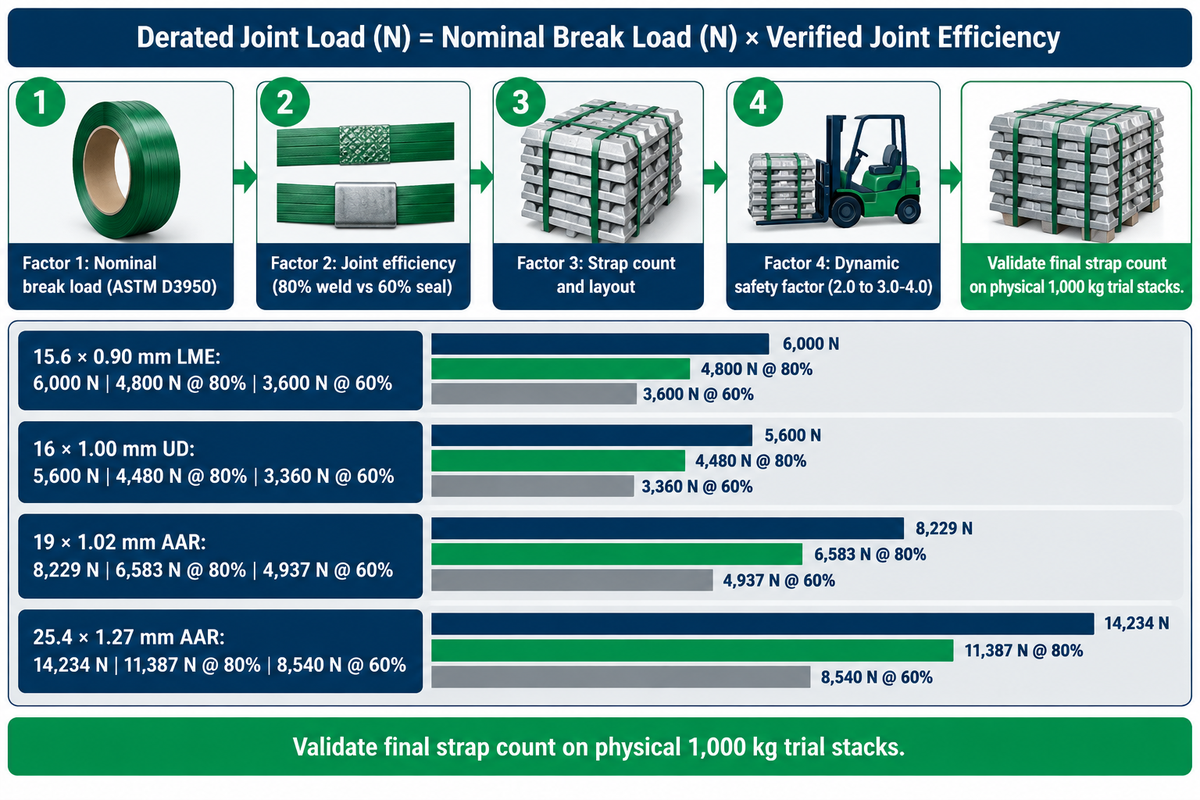
Selecting 19 mm or 25mm strap width from bundle weight alone ignores joint losses, strap count, edge friction, and transit shock. Our 4-Factor Ingot Strap Sizing Formula pre-screens strap gauges using four inputs: nominal breaking strength, joint efficiency, strap count, and a dynamic safety factor. For aluminum and zinc ingots, LME Appendix D Table 2 sets a 15.6 × 0.9 mm (6,000 N) polyester baseline. It specifies 2,500 N applied friction-weld tension (80% joint) or 3,500 N metal-seal tension (60% joint), and tools must match the strap thickness.
HB Sub Noor’s failure guide notes that matching strap breaking strength 1:1 against pallet weight leads to transit snaps. Sudden braking, cornering, and forklift jolts multiply static forces by three to four times, and a poor seal can cut effective band strength by 50% or more. Pefilmpack’s tooling guidance adds that a tool built for a thin strap cannot weld a thick-gauge PET strip reliably. Packaging engineers also separate four distinct force metrics: straight strap break load, derated joint strength, applied tool tension, and directional vehicle restraint under 49 CFR § 393.102. Under ASTM D3950 tensile test methodology, straight breaking strength is measured at 5 in./min (127 mm/min) crosshead speed with 150–250 mm grip spacing.
Pre-trial strap selection involves four coupled checks rather than summing straight strap loads to produce a misleading bundle rating:
Derated Joint Load (N) = Nominal Break Load (N) × Verified Joint Efficiency
Evaluate that single-loop derated joint load alongside three operational factors: strap count and cross/longitudinal layout, inter-ingot friction plus preload retention, and dynamic transit safety margin. For example, LME Appendix D Table 2 lists 80% joint efficiency for friction welds (2,500 N applied tension) and 60% for serrated metal seals (3,500 N applied tension) on 15.6 × 0.9 mm (6,000 N) polyester strap. Juwo Plastic applies a 2.0 safety factor to rigid heavy items such as bricks, steel pipes, and blocks, while HB Sub Noor uses 3.0–4.0 for truck, rail, or sea freight shocks. The table below compares nine published PET specifications across LME, UD Packaging, and Strapping4Less catalogs using 1 lbf = 4.448 N. Always validate final strap count on physical 1,000 kg trial stacks rather than adding straight loop loads to match bundle weight. By contrast, 49 CFR § 393.104(e) footnote 1’s 1/4 Working Load Limit (WLL) applies strictly to unmarked ASTM D3953-97 steel tiedowns.
| Width & Thickness | Nominal Break Load (Source) | Single Joint @ 80% Weld | Single Joint @ 60% Seal | Standard / Catalog Context |
|---|---|---|---|---|
| 15.6 × 0.90 mm | 6,000 N (LME Table 2) | 4,800 N | 3,600 N | LME Appendix D non-ferrous ingot spec |
| 16 × 0.60 mm | 3,900 N (UD Packaging) | 3,120 N | 2,340 N | UD Packaging published 16 mm light gauge |
| 16 × 0.80 mm | 4,600 N (UD Packaging) | 3,680 N | 2,760 N | UD Packaging published 16 mm mid gauge |
| 16 × 1.00 mm | 5,600 N (UD Packaging) | 4,480 N | 3,360 N | UD Packaging published 16 mm heavy gauge |
| 5/8-inch × 0.035-inch (15.9 × 0.89 mm) | 1,370 lbs / 6,094 N (Strapping4Less) | 4,875 N | 3,656 N | AAR-rated 5/8-inch commercial coil |
| 3/4-inch × 0.040-inch (19 × 1.02 mm) | 1,850 lbs / 8,229 N (Strapping4Less) | 6,583 N | 4,937 N | AAR embossed 19 mm catalog coil |
| 3/4-inch × 0.050-inch (19 × 1.27 mm) | 2,315–2,500 lbs / 10,297–11,120 N (Strapping4Less) | 8,238–8,896 N | 6,178–6,672 N | Heavy-duty applications (green / AAR black) |
| 1-inch × 0.050-inch (25.4 × 1.27 mm) | 3,200 lbs / 14,234 N (Strapping4Less) | 11,387 N | 8,540 N | AAR-rated 25mm heavy metal coil |
| 1-1/4-inch × 0.050-inch (32 × 1.27 mm) | 3,968 lbs / 17,650 N (Strapping4Less) | 14,120 N | 10,590 N | Widest commercial catalog PET coil |
Surface texture also alters micrometer readings without adding solid polymer cross-section. Per ASTM D3950-23 section 5.1.4, an emboss pattern can yield an overall nominal thickness of the embossed strap, up to twice that of a smooth strap of equal width and break strength. Refer to the ASTM D3950-23 nonmetallic strapping specification for official thickness and classification rules. In Strapping4Less listings at the same nominal 0.040-inch caliper, smooth 3/4″ AAR PET has a break strength of 1,900 lbs while the embossed 3/4″ AAR PET has a break strength of 1,850 lbs. Embossments displace solid resin at the outer caliper. Always specify width and thickness alongside minimum verified tensile break load in newtons or lbs, rather than assuming gauge equals strength.
PET vs. Steel Strapping for Metal Ingots: Strength, Standards, and Go/No-Go Limits
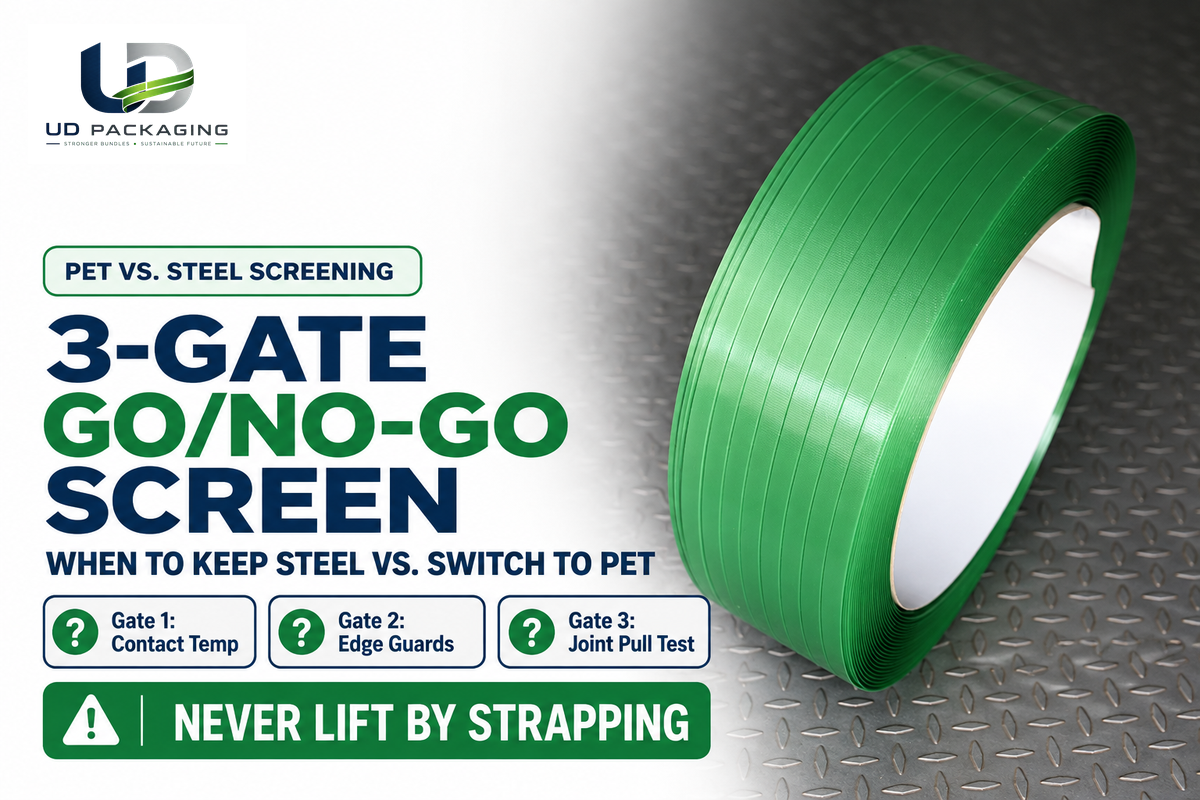
High-tensile carbon steel can withstand high static break loads and hot metal, while high-performance PET reduces cut-recoil risk, prevents strap rust, and retains tension as stacks settle. Run our 3-Gate Ingot PET Go/No-Go Screen to assess edge protection, contact temperature, and pull-tested joint capacity before converting any steel line.
How strong is metal strapping?
Under ASTM D3953-15(2022) and Signode catalog ranges, regular-duty cold-rolled steel strap spans 650 to 1,990 lbf (approximately 2,891 to 8,852 N) at 0.38–0.58 mm thickness. Heat-treated high-tensile steel spans 1,900 to 13,200 lbf (approximately 8,451 to 58,714 N) at 0.51–1.12 mm. Breaking strength is never a working load limit, and strapping is never rated for overhead lifting.
Commercial PET and regular-duty steel overlap substantially in mid-weight breaking strength. High-tensile steel reaches higher static ceilings (up to 58,714 N in Signode’s Magnus range) for extreme heavy loads. Settling bundles behave differently in transit. LME Appendix D Table 1 lists 19 × 0.63 mm steel strap at 12,000 N average strength with only 0.1–0.3% working elongation. When an ingot stack compacts under crane or truck vibration, steel can’t contract like polyester to keep preload. Unpacking steel also introduces recoil hazards documented by the National Safety Council.
Tensioned steel straps can become dangerous weapons that will lash out when the bands are cut.
Using a tool called duck-billed shears, operators can cut tensioned steel bands. However, operators must wear proper personal protective equipment and stand outside of the recoil zone. If cold non-ferrous loads pass all three gates and trial pull tests, high strength PET provides the necessary bundling strength and durability with lower whiplash risk. Additionally, it helps prevent rusting like steel in humid ports. Clean mono-material PET is fully recyclable, which allows for an eco-friendly alternative with sustainable packaging programs. For a detailed comparison of lifecycle costs, see our PET vs Steel strapping Performance Trade-offs guide.
When should a foundry keep steel strapping instead of switching to PET?
Foundries should retain steel strapping under the following conditions. Steel should be kept when ingot surfaces exceed the cold-metal cap of your PET grade (such as ~60 °C for Teufelberger TYCOON PET) or when there’s no documented load-bearing tension retention across contact time. Steel should also be kept when corner protection can’t be secured over burrs or when there’s no allowance for PET elongation of 2-3.5%. Steel should also be kept when the buyer or the rail dictates the use of metal bands, and when downstream remelt furnaces prohibit plastic in the scrap charge.
One operational boundary catches casthouses off guard during customer qualification. Some secondary aluminum remelters charge entire strapped bundles or inspect scrap returns strictly against polymer contamination. Buyer contracts or rail loading rules may still require ASTM D3953 steel even where LME Appendix D Table 2 allows polyester on LME-approved non-ferrous ingot grades. Separately, 49 CFR § 393.104(e) footnote 2 applies to steel strapping used as highway cargo tiedowns in the U.S. This rule requires a minimum of two pairs of crimps per seal and two seals on end-over-end lap joints for bands 25.4 mm or wider.
| Screening Dimension | PET Suitable Window (GO) | Keep-Steel Trigger / Trade-Off | Field Verification Check |
|---|---|---|---|
| Gate 1: Contact temperature | Cooled metal within supplier cold-metal cap (e.g., ≤ 60 °C TYCOON PET) verified for contact time and tension retention | Hot cast surfaces exceeding cold-metal cap or approaching 70–85 °C Tg | Contact thermocouple at hottest strap corner |
| Gate 2: Edge & burr profile | Deburred edges or captive corner protectors | Unshieldable casting flash or knife-sharp burrs | Physical edge walkaround & abrasion trial |
| Gate 3: Pull-tested joint load | Qualified PET joint capacity passes dynamic trial margin | Loads exceeding qualified PET pull-tested joint capacity | Sample weld pull test & overnight tension check |
| Standard / exchange rule | ASTM D3950 Type IV strap spec; LME Table 2 for LME-governed non-ferrous ingots; plus written buyer/carrier acceptance | Customer, exchange, or carrier clause mandating ASTM D3953 steel | Written off-take & freight tariff audit |
| Breaking strength span | 3,900–17,650 N across listed 16–32 mm commercial PET catalogs | High-tensile steel reaches 58,714 N (Signode Magnus) | Batch COA tensile curve verification |
| Working elongation | 2–3.5% shock recovery for settling stacks (LME Table 2) | Zero-stretch rigid geometry (0.1–0.3% steel, LME Table 1) | Stack height & forklift tilt test |
| Corrosion & moisture | Humid export & outdoor yards (PET strap does not rust) | Bare steel rusts; requires coated or galvanized bands in wet yards | Export humidity & condensation review |
| Operator safety at de-banding | Lower cut-recoil energy and lighter coil handling | Steel cutting requires full PPE & duck-billed shears (NSC/DWS) | Receiving dock EHS sign-off |
| Remelt furnace policy | Bands stripped cleanly prior to furnace charging | Direct bundle charging with strict zero-plastic rule | Confirm downstream smelter SOP |
| Overhead lifting | Strictly prohibited | Strictly prohibited (use certified slings/forks) | Crane rigging safety rule |
Joint Efficiency, Strapping Tools, and Automatic Ingot Line Compatibility
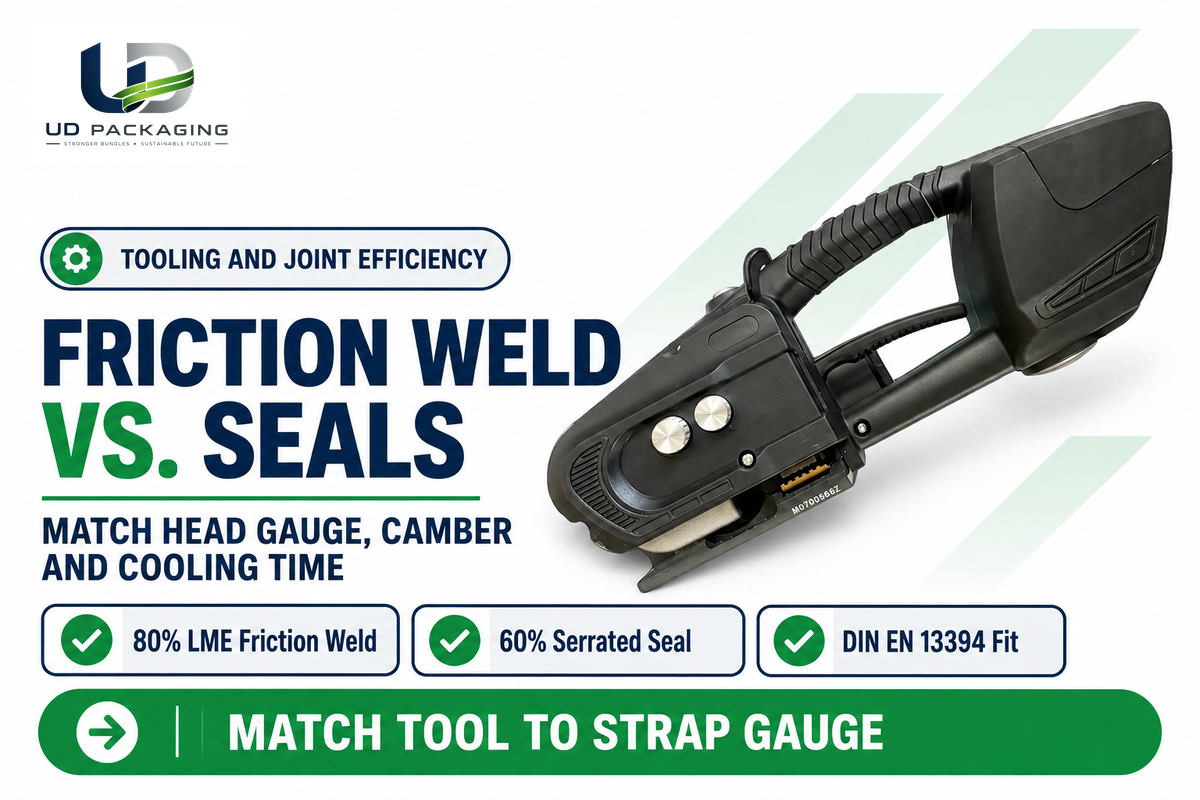
Friction-weld joints retain 75–90% of nominal PET breaking strength per Juwo Plastic. LME Appendix D Tables 2 and 4 list 80% for friction weld, and Itipack cites ~85% for sealless joints. Manual serrated metal seals drop to 60%, and wire buckles sit lower. Existing steel tensioners and smooth steel clips cannot seal polyester safely, as PET requires serrated grips or controlled thermal fusion.
On a cooled, edge-protected bundle, the joint usually sets the practical load ceiling before the strap body breaks. Unguarded burrs or thermal damage can still sever the band first. LME Appendix D Table 4 contrasts two PET tool classes on 15.6 × 0.9 mm (6,000 N) polyester strap. Pneumatic friction-weld tools apply 2,500 N tension and hold 80% joint strength (4,800 N). Manual metal-seal setups apply 3,500 N tension at 60% joint strength (3,600 N). High-speed automatic strapping lines also use ultrasonic weld heads to form consistent joints without metal clips. Granted USPTO patent US12397943B2 details how battery handheld strapping tools synchronize tension wheels with vibrating friction plates for repeatable weld timing.
Tool-to-strap compatibility makes the difference between a smoothly running packaging line and one that repeatedly jams. Pefilmpack reports a hand tool designed for thin 0.6 mm strap can’t weld thick 1.27 mm ingot-grade polyester reliably. For battery-powered hand tools, the FROMM P329S user manual mandates use of plastic strap in accordance with DIN EN 13394. Technopet also states that it manufactures strapping in accordance with ASTM D3950 and DIN EN 13394. Feeding jams along the chute on an automated strapping arch are caused by too much camber (sideways curvature). Before purchasing bulk coils, ensure that the core dimensions of the coil, weld-cooling time and seal-serration bite match your tool or head manual. Our guides on choosing a polyester strapping tool and strapping seal setup and joint fault diagnosis help match equipment to heavy-duty PET.
| Joining Method | Published Joint Efficiency | Equipment Type | Best Ingot Line Fit | Primary Failure Mode |
|---|---|---|---|---|
| Friction weld | 75–90% (Juwo); 80% (LME) | Battery or pneumatic tools | Mid-to-high output casthouses | Short cooling time pops warm weld |
| Ultrasonic / sealless weld | Approx. 85% (Itipack) | Automatic strapping machine | Continuous ingot casting conveyors | Camber drift or dirty feed wheels |
| Serrated metal seal | 60% (LME Tables 2 & 4) | Manual tools & heavy crimpers | Low-volume backup banding | Smooth seal slips off smooth PET |
| Phosphated wire buckle | Below 60% (field-variable) | Manual tensioner | Light non-ingot pallets only | Unseated buckle creeps under shock |
Aluminum, Zinc, and Non-Ferrous Ingot Bundle Layouts and Export Handling
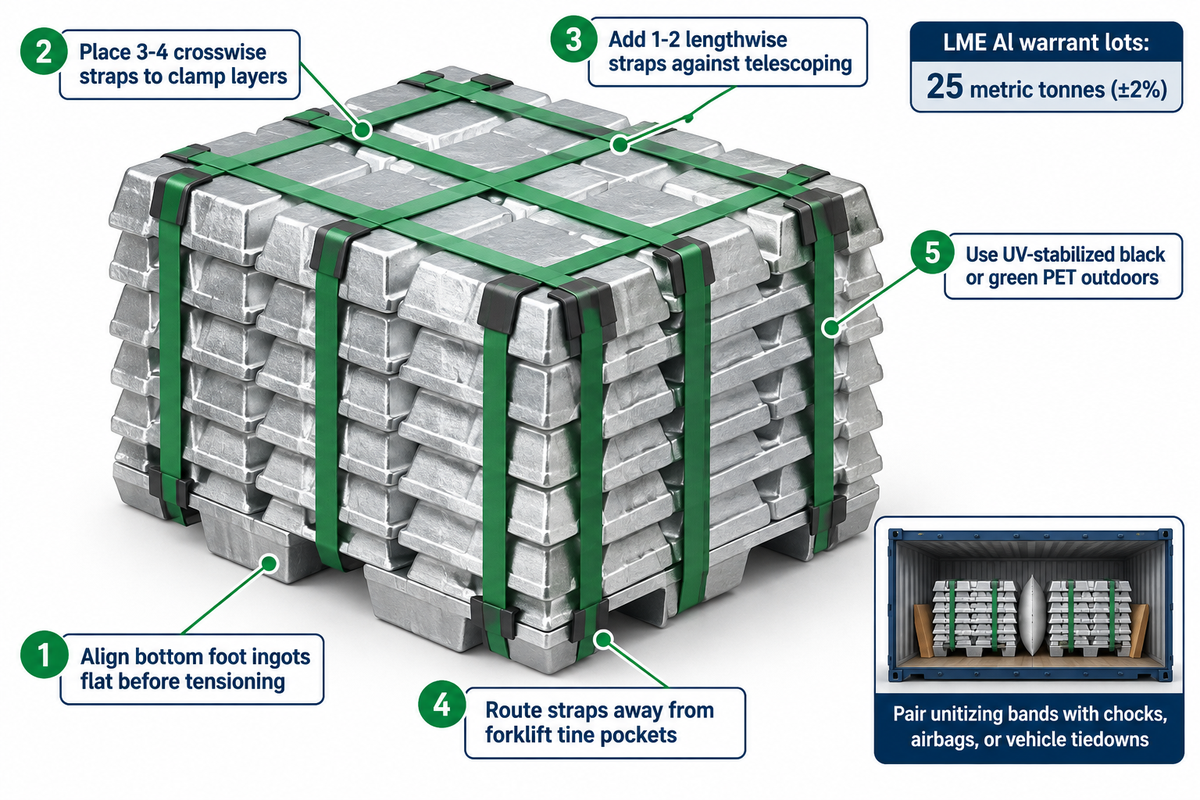
Export aluminum ingot packaging pairs three to four crosswise straps with one or two lengthwise straps across a self-palletized stack, keeping forklift pockets clear. Under LME Primary Aluminium contract specifications, physical warrants are shipped in 25-metric-tonne lots (±2%) of ingots, T-bars or sows, making uniform stack geometry key for container loading.
Domestic, indoor transfers don’t normally bring to light the hidden stresses that ocean freight imposes on ingot packaging. A bundle that has sat snug in a dry warehouse experiences the effects of salt-air humidity, repeated crane lifts and radiant heat in the container, during transportation. PET bands don’t rust or cause rust stains; however, metal corner guards can still corrode and stain the load.
Juhong’s Troubleshooting Guide identifies a counterintuitive aspect of strap tension. Simply tightening the strap harder isn’t always the best solution when bands arrive loose after export. Over-tensioning bands crushes soft wooden dunnage or squeezes misaligned bottom feet, which then settle during vessel rolling and create slack. Use the five layout controls given to build reliable bundling for export containers.
- Align bottom-layer self-palletized foot ingots evenly before cycling tension so cross straps compress a flat perimeter rather than bridging gaps.
- Place 3 to 4 evenly spaced cross-bands to clamp layers vertically, and add 1 or 2 longitudinal bands to prevent ingot telescoping during container braking.
- Route packing strapping inside recessed cast grooves or away from forklift tine entry zones so fork tips cannot nick the band during loading.
- Use UV-stabilized black or green PET packaging strapping, whenever bundles wait in port yards to be loaded into containers.
- Pair unitizing bands, and either chocks, airbags, or carrier tiedowns, because bundle straps hold the stack together as one pallet, rather than anchoring it to the container floor.
Facilities that handle a mix of bars, coils, and non-ferrous stacks, along with ingots, can standardize line layouts based on our playbook on metal distribution center strapping systems. It provides details on how to simultaneously align strapping solutions for various heavy metal formats.
19 mm Heavy-Duty PET Strapping Cost, MOQ, Lead Time, and Supplier Selection
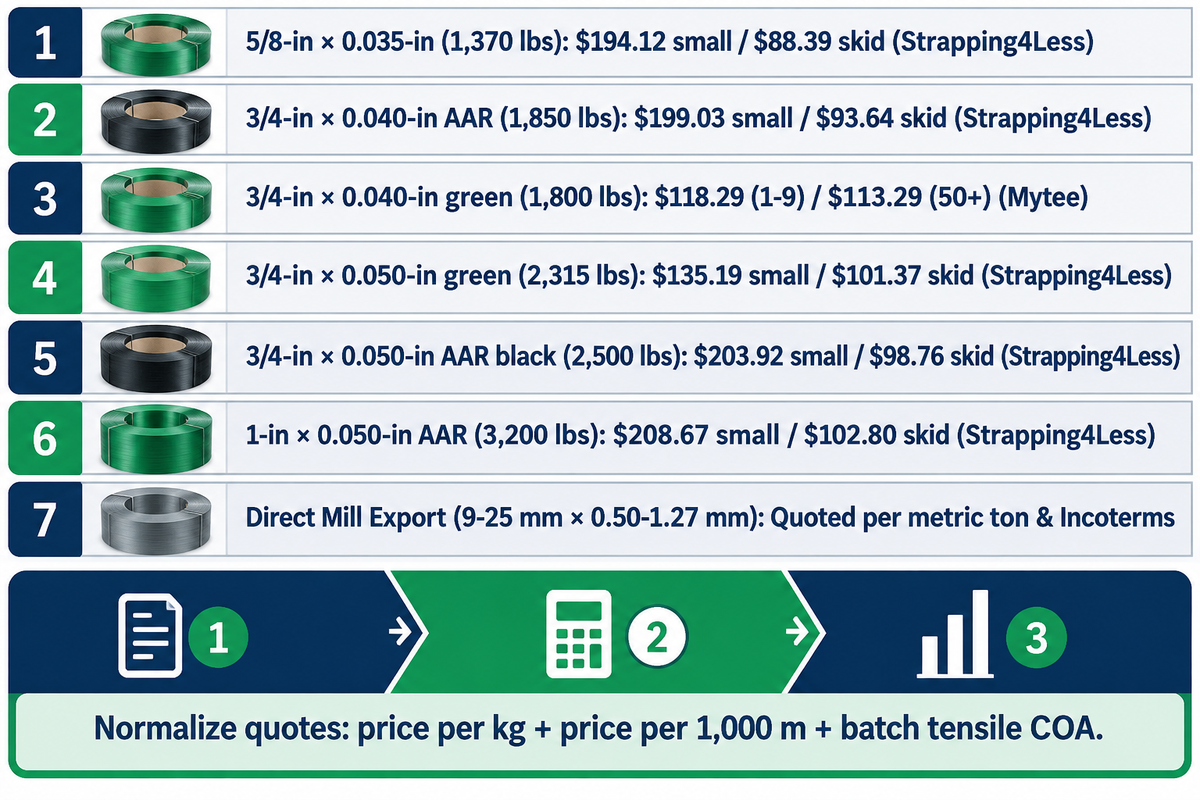
Verified November 2026 U.S. distributor prices for 3/4-inch (19 mm) heavy-duty PET strapping run $118.29 to $203.92 per single coil across listed offers. Full 24- to 28-coil skids drop to $93.64–$101.37 per coil. Factory export orders are quoted based on net strap weight, the grade of the resin, Incoterms, and minimum order quantity, all in metric tons.
Procurement teams see large price differentials in coil listings online, as the listings don’t disclose coil net weight or resin construction. The coil price of a 44.75 lb coil of 3/4″ × 0.050″ strap can’t be compared directly with that of a 50 lb coil of 3/4″ × 0.040″ strap. Buyers must convert every offer to price per kilogram and price per 1,000 meters at matched breaking strength. Lower-priced packing plastic rolls may use woven composite substitutes or thin regrind with inconsistent welds. Adjust all quotes by dividing delivered coil price by net polymer mass (no cardboard core), and examining batch tensile certificates.
| Channel & Verified Source | Strap Size & Break Load | Coil Spec | Small-Order Price | Full-Skid / Bulk Tier |
|---|---|---|---|---|
| U.S. Distributor (Strapping4Less, Nov 2026) | 5/8-inch × 0.035-inch AAR (1,370 lbs) | 3,800 ft coil | $194.12 (1–3 coils) | $88.39 (28-coil skid) |
| U.S. Distributor (Strapping4Less, Nov 2026) | 3/4-inch × 0.040-inch AAR embossed (1,850 lbs) | 3,000 ft, 50 lb coil | $199.03 (1–3 coils) | $93.64 (28-coil skid) |
| U.S. Distributor (Mytee Products, Nov 2026) | 3/4-inch × 0.040-inch green (1,800 lbs) | 3,000 ft, 16×6 in. core | $118.29 (1–9 rolls) | $113.29 (50+ rolls) |
| U.S. Distributor (Strapping4Less, Nov 2026) | 3/4-inch × 0.050-inch green embossed (2,315 lbs) | 2,300 ft, 44.75 lb coil | $135.19 (1–3 coils) | $101.37 (24-coil skid) |
| U.S. Distributor (Strapping4Less, Nov 2026) | 3/4-inch × 0.050-inch AAR black (2,500 lbs) | 2,300 ft coil | $203.92 (1–3 coils) | $98.76 (full skid) |
| U.S. Distributor (Strapping4Less, Nov 2026) | 1-inch × 0.050-inch AAR (3,200 lbs) | Heavy-duty coil | $208.67 (1–3 coils) | $102.80 (full skid) |
| Direct Mill / Export Extruder | 9–25 mm × 0.50–1.27 mm custom | Standard or jumbo coils | Request quote (MOQ varies by spec) | Quoted per metric ton & Incoterms |
Volume tiering cuts distributor unit cost by more than half from 1–3 trial coils ($199.03) to a 28-coil full skid ($93.64). Both U.S. distributors offer single rolls for trials. Quotes from the factory for a metric-ton MOQ depend on resin grade and shipping lane, while Greenbridge vendor comments note that recent U.S. trade policies and steel import tariffs may extend steel-strap supply chains and lead times, thereby requiring some plants to qualify polyester alternatives.
Which industrial suppliers make heavy-duty PET strapping and automatic systems for ingot lines?
Industrial buyers distinguish between equipment makers and consumable PET coil extruders. Verified equipment specialists include Packway Machines (metal ingot strapping machines), FROMM (battery strapping tools such as P329S), Signode (steel and strapping systems), and Itipack (sealless strapping equipment). Teufelberger is a metal industry PET strapping supplier and extruders like UD Packaging produce consumable PET coils. Buy consumable PET coils from a direct extruder, if you’re using a qualified tool, or engage equipment providers for strapping heads and automated conveyors, if you’re purchasing new equipment.
Casthouses running established automated heads or battery tools qualify direct extruders on four measurable checks. Audit ISO9001 quality management traceability and third-party SGS or mill tensile certificates of analysis (COA). Also test camber straightness on automated tracks and repeatable friction-weld pull strength on your exact head model. UD Packaging extrudes PET strapping in-house at its Jiangyin, China plant in 12, 16, and 19 mm standard widths and 9–25 mm × 0.50–1.27 mm made-to-order coils. Published 16 mm examples specify 3,900 N at 0.6 mm, 4,600 N at 0.8 mm, and 5,600 N at 1.0 mm. Use our PET strapping sourcing and quality verification checklist to audit batch certificates and sample runs before signing annual supply agreements.
Pre-Production Ingot Strapping Trial Checklist and RFQ Input Table
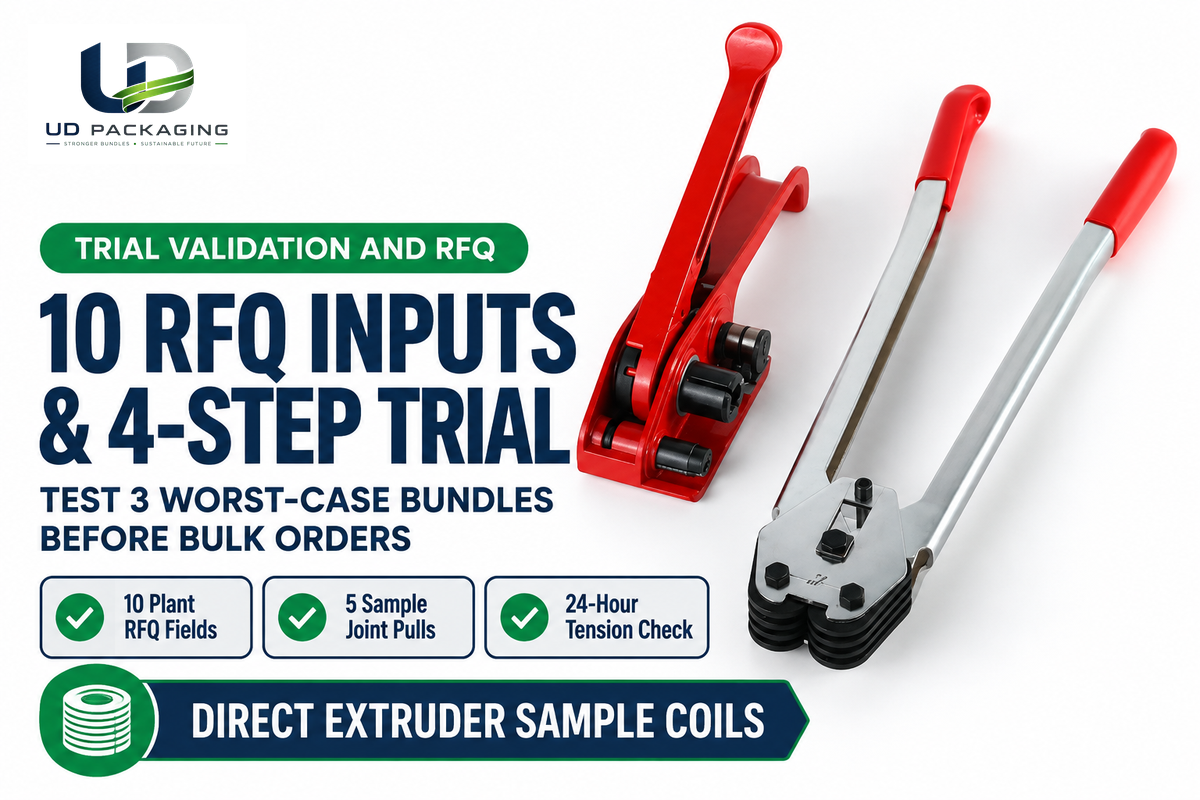
Obtain ten site-verified inputs and combine them into a single specification sheet before you consider a bulk order or convert an ingot line. Validate sample coils on at least three worst-case bundles and perform an overnight cooled tension recheck. Don’t assume required breaking strength from strap width alone, and confirm edge and thermal limits prior to placing a bulk order.
| # | RFQ Parameter | What Your Plant Must Measure | Why It Changes Strap Selection |
|---|---|---|---|
| 1 | Alloy & ingot form | Al, Zn, Pb, Sn ingots, T-bars, or sows | Sets exchange compliance & stack interlocking |
| 2 | Bundle mass & perimeter | Net kg per stack, L × W × H (mm) | Drives strap count and coil meter usage |
| 3 | Hottest contact temperature | Contact thermocouple reading after thermal stabilization (°C) | Gate 1 check against supplier cold-metal cap (e.g., ~60 °C TYCOON PET) |
| 4 | Edge condition & guards | Deburred vs. flash; HDPE or steel corner guards | Gate 2 check against shear and splitting |
| 5 | Target width & thickness | Metric mm (e.g., 16 × 1.0, 19 × 1.0, 19 × 1.27) | Must match strapping head track clearances |
| 6 | Minimum breaking strength | Required break load in N or lbf (not width alone) | Anchors 4-Factor screening & COA acceptance |
| 7 | Surface finish & color | Smooth vs. embossed; green or UV-black | Matches weld plate grip & outdoor UV needs |
| 8 | Tool or machine head model | Manual crimper, battery tool, or automatic arch | Sets joint method, gauge compatibility, and camber tolerance; verify via pull test |
| 9 | Coil core & weight limits | 406 × 152 mm (16×6 in.) or custom dispenser core | Prevents unwinding snags on existing stands |
| 10 | Transit mode & volume | Truck, rail, or sea container; monthly metric tons | Determines safety factor, skid vs. export MOQ |
- Log hottest strap-contact temperatures after thermal cooling and inspect every corner for sharp parting flash before threading sample coils.
- Achieve five consecutive sample joints on your production tool, check for smooth fusion with zero burnt curl, and perform pull-testing against joint efficiency.
- Band three full-weight worst-case stacks with edge guards installed, then execute normal forklift lifting, sudden braking, and double-stacking transfers.
- After 24 hours of ambient settling, check all joints, corner guards, and strap tightness before signing off bulk supply.
Have you finalized the coil dimensions and sample rolls for your cooled ingot bundles? Kindly submit your ten RFQ inputs, head model, and anticipated breaking strength on our Industrial PET strapping Specifications to request sample coils and a quotation from the factory. UD Packaging supplies extruded PET strapping coils directly and organizes sample tests; we don’t provide dedicated pull-test rigs, protective netting, or strapping-machine repair.
Frequently Asked Questions About Metal Ingot PET Strapping
What is PET strapping made of?
PET strapping is extruded from polyethylene terephthalate resin, often blending clean recycled bottle flakes with virgin resin and impact modifiers. Once extruded and cooled, manufacturers draw the solid PET longitudinally to align the polymer chains. The orientation improves tensile strength and elastic recovery for rigid heavy bundles under ASTM D3950-23 Type IV.
What does PET strapping mean in industrial metal packaging?
In industrial packaging, PET strapping refers to high tensile polyester banding that’s a non-corrosive bundling solution for cooled heavy ingots, like aluminum and zinc. Compared to light polypropylene bands, polyester can retain sustained clamping tension for long transit cycles, and compared to carbon steel, it prevents strap rust and can reduce cut-recoil risk.
Will metal ingot PET strapping rust or stain aluminum bundles during export?
No, polyester strapping is completely non-metallic and won’t rust or corrode, nor leave iron oxide marks on aluminum, zinc, or tin ingots during humid ocean transport. For wet export lanes, use PET in combination with non-metallic polymer corner guards, as damaged galvanized coatings can still corrode and transfer surface marks under sustained condensation.
Can you lift metal ingot bundles by PET strapping?
Don’t lift ingot bundles by PET or steel strapping. Packaging bands unitize stacks for handling and transport only. Always hoist using forklift tines through base pockets or certified crane slings.
How should an aluminum ingot strapping trial be validated before full conversion?
Start by confirming the hottest ingot contact corner stays within your PET supplier’s cold-metal limit after core heat stabilization. Use a contact thermocouple. Next, perform five friction welds on your actual battery or automated head and check for clean fusion as well as pull strength. Band three full-weight bundles with captive edge protectors, run normal forklift braking and stacking cycles, and recheck retained tension after overnight settling. Approve bulk conversion only when no strap nicks, weld slips, or loose loops are present.
Do smooth or embossed PET straps work better with serrated metal seals?
Embossed PET typically grips serrated metal seals better on manual crimpers because its surface texture helps the teeth bite cleanly. Smooth PET is better suited for friction-weld and ultrasonic heads, as it creates a better seal by fusing flat surfaces, with less air entrapment.
Why does PET strapping loosen on cast metal bundles after overnight cooling?
There are three main causes for overnight loosening. The first is that banding warm ingots allows core heat to rebound towards PET’s 70–85 °C glass-transition range, accelerating stress relaxation. The second cause is uneven base ingots and soft timber dunnage settlement with heavy stack weight. The third cause is that friction welds open when tools are released before cooling is finished. Measure stabilized contact temperature, square the bottom ingot layer first, and verify weld cooling time on your head.
What coil core size fits automated ingot strapping machines?
High-speed ingot lines use larger or machine-specific coils, matched to the dispenser mandrel bore and outer width, as specified by the head OEM. Standard 406 × 152 mm (16 × 6 in.) cores listed by Mytee Products and Strapping4Less serve hand-dispensed and semi-automatic units. For your specific mandrel dimensions, check your RFQ before ordering.
Reviewed by the UD Packaging technical team.
References & Sources
- London Metal Exchange (LME), Aluminium Alloy Guidance Notes (Appendix D: Strapping Specifications, Tables 1, 2 & 4) lme.com
- London Metal Exchange (LME), LME Aluminium Physical Contract Specifications lme.com
- 49 CFR § 393.104 (Standards for Securement Devices), § 393.102 & 393.5 – ecfr.gov.
- ASTM International/iTeh Standards ASTM D3950-23: Standard Specification for Strapping, Nonmetallic (and Joining Methods) standards.iteh.ai
- iTeh Standards Catalog, ASTM D3953-15(2022): Standard Specification for Strapping, Flat Steel and Seals – standards.iteh.ai
- Teufelberger Strapping, Metal Industry, High-Performance Strapping for Steel Products (TYCOON PET Operating Limits) teufelberger.com
- NETZSCH Analyzing & Testing, Polyethylene Terephthalate (PET) Thermal Properties & DSC Analysis analyzing-testing.netzsch.com
- Oak Ridge National Laboratory (ORNL), Orientation-Induced Crystallization of Polyethylene Terephthalate impact.ornl.gov
- Signode Industrial Group, Steel Strapping Specifications (Apex Regular-Duty & Magnus High-Tensile) signode.com
- National Safety Council Safety+Health Magazine, Steel Strapping Safety (Wyoming DWS Recoil & Cutting Guidance) safetyandhealthmagazine.com
- FROMM Packaging Australia, Model P329S Battery-Powered Plastic Strapping Tool User Manual (DIN EN 13394 Reference) fromm-pack.com.au
- Itipack Systems, The Safest Steel & Sealless Strapping Joint Efficiency Benchmarks itipack.com
- Packway Machines, Metal Ingot Strapping Machine Specifications packwaymachines.com
- Technopet, Quality Standards Conformance (ASTM D3950 & DIN EN 13394) technopet.com.pk
- Greenbridge, Avoid the Steel Tariff Price Hike: Switching to PET Strapping greenbridge.com
- Juwo Plastic (PETPackingStrap), PET Strapping Sizes and Breaking Strength Guide petpackingstrap.com
- USPTO / Google Patents, US12397943B2 (Handheld Strapping Device) & WO2013059555A1 (Anti-Splitting Polyester Strapping) patents.google.com
- Strapping4Less, PET Polyester Strapping Delivered Coil & Skid Price Catalog (Verified November 2026) strapping4less.com
- Mytee Products, 3/4″ × 0.040″ × 3,000′ Green Polyester PET Strapping Roll 16×6 Core (SKU POLYS-34040, Verified November 2026) myteeproducts.com
- HB Sub Noor, Common Strapping Mistakes and How to Avoid Them: A Practical Guide hbsubnoor.com
- Juhong Packaging, Why Does PET Strapping Become Loose After Shipping? – jsjhpackaging.com
- UD Packaging, PET Strapping Specifications & Manufacturing Scope udpackaging.com