Get in touch with UD Packaging Company
Stretch Film Cutters for Receiving Docks: Concealed-Blade Geometry, Safe Pallet Unwrapping, and Film-to-Strap Limits

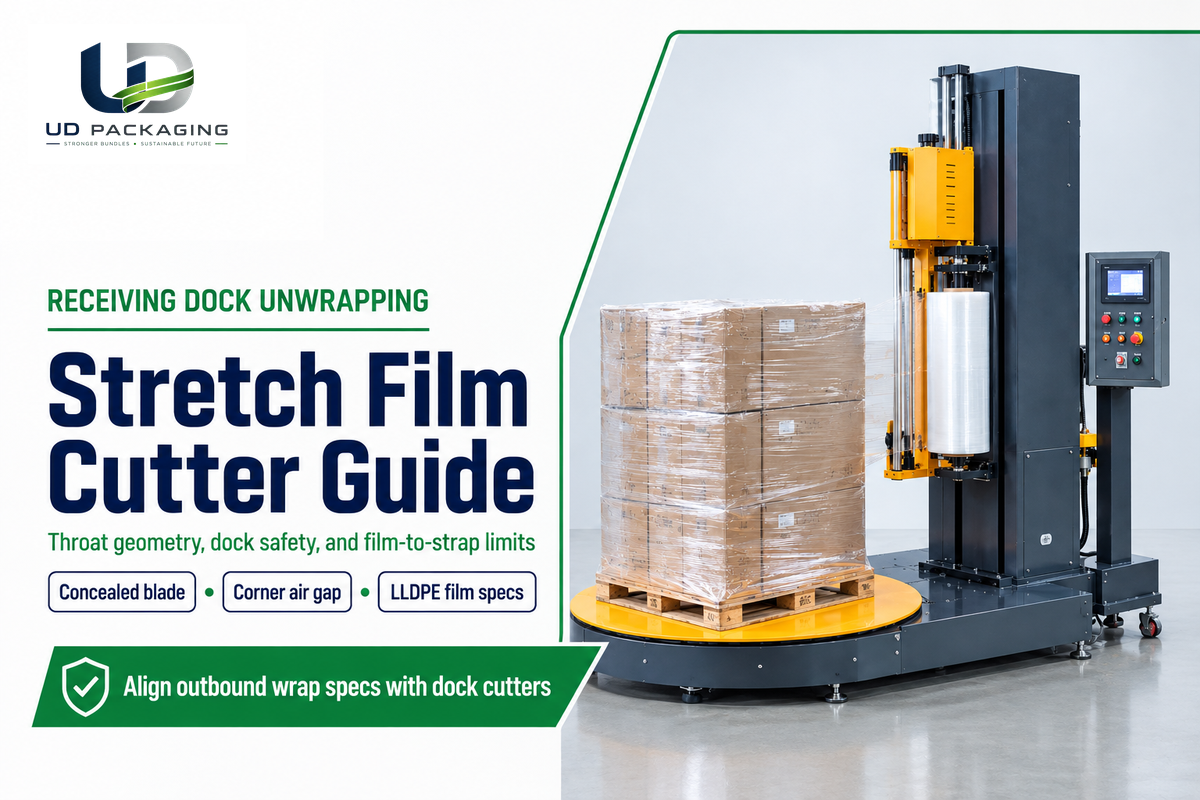
A stretch film cutter is an inbound receiving safety tool that recesses a steel or ceramic razor edge in a molded polymer channel behind a blunted splitter nose. It’s used to slice multi-layer Linear Low-Density Polyethylene (LLDPE) pallet wrap, shrink film, and carton sealing tape while minimizing bare-blade contact with hands or cargo. It’s designed to match the cutter’s verified clear throat gap and cutting depth to outbound film and strapping specifications to reduce carton-face slitting, roller scoring and hand lacerations.

What a Receiving-Dock Stretch Film Cutter Does, and What UD Packaging Actually Supplies
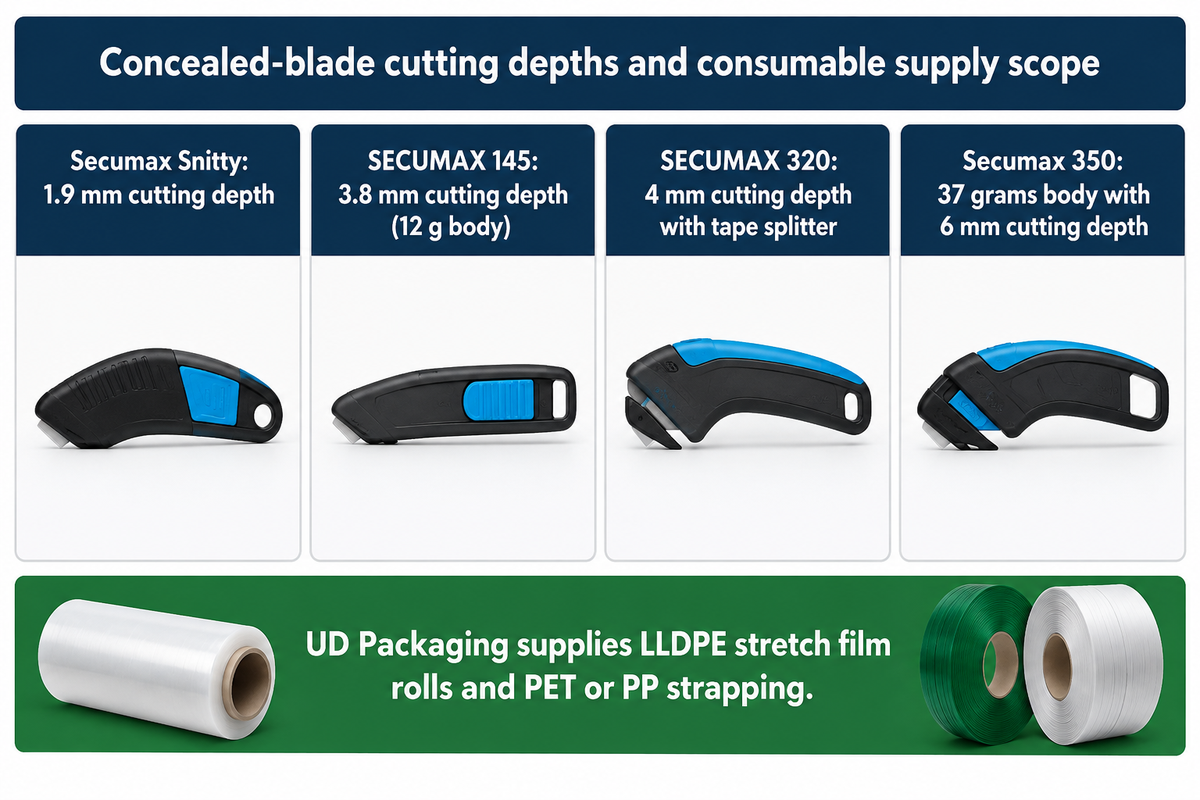
On an industrial receiving dock, a concealed-blade stretch wrap film cutter isolates the sharp cutting edge inside a guarded slot. This construction provides an easy, controlled method to strip containment wrap off unitized pallets in a downward corner draw while protecting inner retail trays or flexible pouches. Commercial models published on the Martor Secumax 350 technical specification page use a glass-fiber-reinforced plastic body weighing 37 grams with a 6 mm cutting depth and a replaceable 38.9 mm by 25.8 mm by 0.3 mm blade insert (part 3550.20). Compact disposable variants listed on the same specification page and in the Martor SECUMAX 145 and SECUMAX 320 datasheet offer a 1.9 mm cutting depth (Secumax Snitty), a 3.8 mm cutting depth (12 g body), or a 4 mm cutting depth with an integrated tape splitter.
For procurement clarity, UD Packaging manufactures and supplies industrial LLDPE stretch film rolls and polyethylene terephthalate (PET) or polypropylene (PP) pallet strapping consumables with batch Certificates of Analysis, and does not sell safety knives, dispensers, or wrapping machines. We provide this reference because wrap tearing behavior and roped-band tension affect how dock crews remove wrap. Meanwhile, ASTM D4649-20(2025) stretch film application guidelines guide stretch-film selection, specification, and indoor unitizing use between buyer and seller.
When outbound shipping lines use high-cling cast or blown LLDPE wrap without standardizing edge-rope density or strapping placement, receiving personnel often abandon guarded cutters and reach for open pocket blades. Aligning outbound consumable specifications with inbound unwrapping tools can reduce that mismatch across multi-site distribution networks.
Inbound Concealed-Blade Cutters vs. Handheld Roll Dispensers and Turntable Clamp-and-Cut Systems
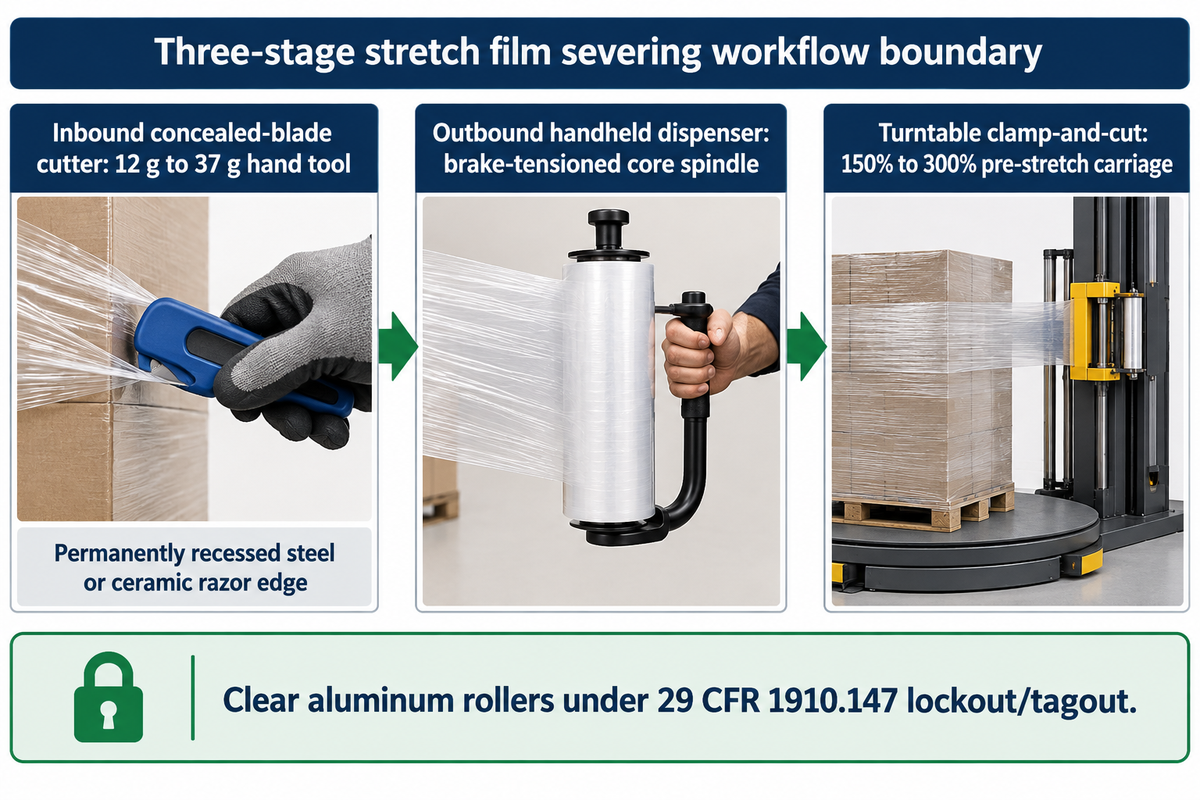
It’s common in procurement catalogs and online markets to combine three different devices under the same search heading: inbound concealed-blade unwrapping knives, outbound manual stretch film dispensers used for wrap rolls, and clamp-and-cut or hot-wire actuators on turntable pallet wrappers. Even general office products listings sometimes group handheld roll frames and pocket unwrapping knives together. Separating these three tool classes by workflow stage, roll-holding function, and blade exposure prevents ordering outbound roll frames when the receiving dock needs guarded unwrapping tools.
| Comparison Dimension | Inbound Concealed-Blade Stretch Film Cutter | Outbound Handheld Roll Dispenser with Slide Cutter | Turntable / Rotary Wrapper Clamp-and-Cut Assembly |
|---|---|---|---|
| Primary Warehouse Workflow Stage | Inbound receiving dock, cross-dock de-unitizing, and wrapper roller jam clearing | Outbound manual pallet wrapping, low-volume shipping bays, and staging lanes | Automated outbound high-throughput pallet unitizing lines |
| Roll-Holding & Tensioning Capability | None; standalone lightweight hand tool (such as 12 g to 37 g models) carried in a pocket or holster | Holds manual stretch wrap rolls on a brake-tensioned core spindle handle | Carries machine-grade film rolls on a powered 150% to 300% pre-stretch carriage |
| Blade Exposure State | Permanently recessed steel or ceramic razor edge behind a molded throat guard | Recessed slide cutter channel or serrated brake bar mounted on the dispenser frame | Pneumatic swing blade, serrated punch knife, or heated wire behind safety guarding |
| Film Severing Mechanism | Oblique shear draw guided by a blunted polymer nose shoe | Cross-web slide draw or tension snap after completing the final manual wrap turn | Automated mechanical clamp capture followed by hot-wire melt or blade stroke |
| Grip Ergonomics & Hand Load | Full-hand ergonomic handle or comfort grip designed to reduce pinch-grip tendon stress | Two-handed spindle handle with adjustable torsional palm or thumb brake | Zero manual grip during normal cycle; operator panel outside safety perimeter |
| Interaction with Corrugated Cartons | Nose shoe rides in the corner air gap between film web and box wall to reduce carton slitting | Does not contact carton walls during cut; severs the free film span between roll and load | Severs film tail at the base clamp away from upper carton faces |
| Compatibility with Roped Film Bands | Suitability for roped LLDPE bands depends on the verified clear throat gap and manufacturer material guidance | Can twist film into a manual rope during application, while slide cutter severs flat tails | Dedicated roping wheel forms base or top cables; clamp cutter severs final tail |
| Wrapper Pre-Stretch Roller Jam Clearing | Under LOTO (or 1910.147(a)(2)(ii) alternative protection), the facility’s maintenance supervisor and EHS team can approve using a polymer shoe to lift jammed film into a recessed blade, though trapped grit can scratch aluminum | Not applicable; dispenser frame cannot enter wrapper carriage rollers | Requires energy isolation under 29 CFR 1910.147 (unless minor servicing exception applies) before manual roller clearing |
| Primary Failure Mode | Throat clogging from adhesive tape residue or guard damage if forced onto rigid PET strapping | Core spindle drag, uneven manual pre-stretch, or operator wrist fatigue | Pneumatic clamp pressure loss, heater wire burnout, or tail wipe failure |
There are differences in handle ergonomics between industrial receiving knives and miniature box blades. According to OSHA grocery warehousing packaging ergonomic guidance (Figure 14 and Figure 15), if a razor knife is too small, employees may use a pinch grip that can stress the tendons of the hands. Selecting ergonomic razor knives with substantial handles requires less wrist bending and less finger force when pulling through heavy duty stretch wrap.
Can you clear jammed stretch wrap off anodized aluminum rollers without scoring the roller surface?
Yes, after isolating the wrapper with lockout/tagout (or verified alternative protection where the minor servicing exception applies), operators can clear stuck stretch wrap from anodized aluminum rollers by sliding a clean polymer cutter shoe parallel to the roller axis. This method keeps the recessed blade edge away from the aluminum surface, though trapped grit or lateral twisting can still scratch the roller.
When wrapping lines are running automatically with machine-grade stretch wrap, a film tail that breaks mid-cycle can wind tight layers around aluminum idle rollers or elastomer nip rollers. As stated by maintenance practitioners in industrial Manufacturing Maintenance Discussions, a jammed wrap is often cut open with a pocket knife. This scrapes the anodized aluminum shell and leaves burrs that catch subsequent film webs.
Under OSHA 29 CFR 1910.147 lockout/tagout rules, workplace unjamming of machines where an employee may be exposed to unexpected energization or startup is regulated as servicing and maintenance requiring energy isolation. The only exception is the minor servicing exception in 29 CFR 1910.147(a)(2)(ii) for routine, repetitive tasks integral to normal production when performed under verified alternative effective protection. Once the carriage is properly protected, guiding a clean polymer cutter shoe under the wound film sleeve lifts the LLDPE layers into the recessed blade while keeping the metal edge off the roller face.
Concealed Throat Width, Blunted Nose-Shoe Radius, and 45-Degree Shear Geometry
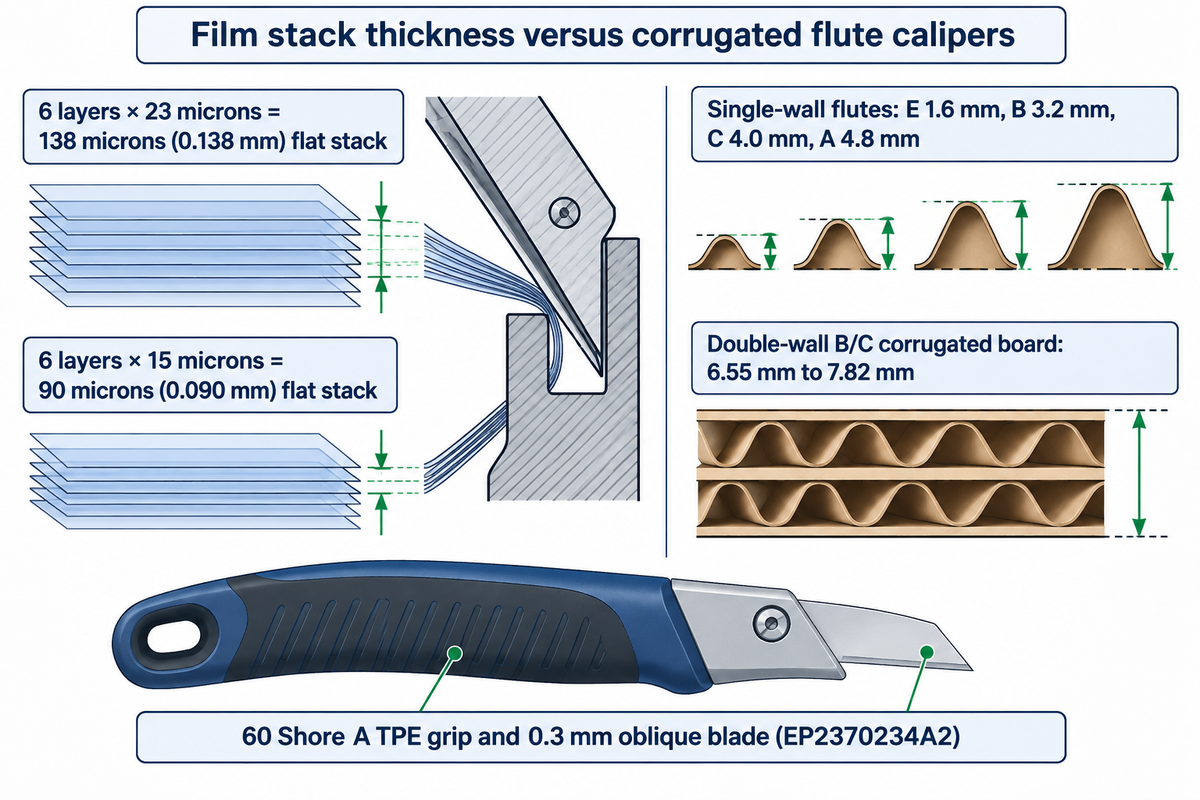
To strip pallet wrap while protecting corrugated cartons, retail display windows, and inner flexible pouches, a receiving team must evaluate both published cutting depth and actual clear throat gap width against multi-layer film thickness and corrugated flute calipers. As noted in Pallet wrapping Research in Polymers (PMC 12656129), high-quality LLDPE stretch film of 15 to 17 microns and standard film of 23 microns work within a 150% to 300% pre-stretch range.
We’ll calculate the flat unstretched film stack thickness with a direct multiplication method and analyze it against corrugated board:
Unstretched Stack Thickness (microns) = Number of Layers × Single-Layer Film Thickness (microns)
For a 6-layer wrap using 23-micron LLDPE film, multiplying 6 × 23 microns = 138 microns (0.138 mm) gives the flat unstretched stack thickness, while 6 layers of 15-micron film equal 6 × 15 microns = 90 microns (0.090 mm). However, the calculated flat-film stack is thinner than a bunched, folded, or roped web, so sizing a cutter opening from flat-layer thickness alone can lead to throat jams during pallet unwrapping. On the packaging substrate side, single-wall corrugated flute thickness benchmarks list E-flute at approximately 1.6 mm (1/16 inch), B-flute at approximately 3.2 mm (1/8 inch), C-flute at approximately 4.0 mm (about 5/32 inch; Arvco notes 3.2 mm to 11/64 inch), and A-flute at approximately 4.8 mm (3/16 inch). Meanwhile, Fibre Box Association double-wall B/C corrugated board specifications measure 6.55 mm to 7.82 mm (0.258 in. to 0.308 in.).
| Cutter Feature / Model Class | Published Specification | Target Material Accepted | Substrate Boundary & Verification Rule | Primary Dock Application |
|---|---|---|---|---|
| Ultra-Narrow Foil Slot (e.g., Secumax Snitty) | 1.9 mm cutting depth | Single-to-multi-layer flat plastic film and paper sheets (15 to 23 microns per layer) | Narrow slot restricts thick board entry; verify clear throat gap against 1.6 mm E-flute flaps | Retail display trays, thin film slitting, and cleanroom sheet cutting |
| Compact Concealed Cutter (e.g., Secumax 145) | 3.8 mm cutting depth, 12 g body | Multi-layer pallet stretch wrap, poly bags, and thin shrink film | Published 3.8 mm cutting depth measures blade reach, not clear throat width; angled 1.6 mm E-flute or 3.2 mm B-flute flaps can still enter if the cutter is tilted | General distribution receiving docks and fast-moving consumer goods unwrapping |
| Medium Concealed Cutter (e.g., Secumax 320 / 150 MDP) | 4 mm cutting depth (31 g on 150 MDP) | Multi-layer stretch wrap, light PP box straps, bubble wrap, and carton tape | Verify clear throat gap separately from 4 mm cutting depth; compressed 4.0 mm C-flute edges can enter if angled | Combined pallet unwrapping and carton tape slitting at receiving stations |
| Wide Replaceable-Head Cutter (e.g., Secumax 350) | 6 mm cutting depth, 37 grams body | 2-ply cardboard, stretch and shrink film, foil, tape, plastic strapping, and twine | Designed to cut up to 2-ply cardboard and roped film; keep nose shoe in corner air gap when unwrapping cartons | Heavy industrial receiving docks stripping gathered machine wrap and shrink hoods |
| Blunted Splitter Nose Shoe | Radiused glass-fiber-reinforced polymer tip | Glides inside vertical corner air gaps between taut wrap and carton walls | Helps guide film into the throat, though loose inner pouches can still enter the slot if cut across open tray faces | Vertical downward cuts along pallet corner channels and roller jam removal |
| Oblique Angled Blade Mount | 0.3 mm replacement blade (38.9 × 25.8 × 0.3 mm on Secumax 350) | Elastic low-density polyethylene webs that stretch under perpendicular contact | An angled cutter slices through stretch film smoothly instead of bunching the web against a flat edge | Reducing elastic LLDPE bunching and mid-stroke stalling on tacky wrap |
| Shielded Replaceable Head Latch | Elongated head section with side-notch latch (EP2370234A2) | Supports interchangeable shielded blade heads with task-specific throat sizes | Provides a stable head-to-handle interconnection during downward unwrapping draws | Multi-shift receiving operations using replaceable-head concealed knives |
| Integrated Tape-Splitter Tab | Dedicated tab on Secumax 320 (4 mm depth); Secumax 350 cuts tape via 6 mm head | Pressure-sensitive carton sealing tape and water-activated paper tape | Parts top center seam tape; operators must still verify clearance above tightly packed inner pouches | Two-in-one pallet wrap stripping and master carton opening without bare-blade exposure |
| Ergonomic TPE Overmold Handle | About 60 Shore A TPE durometer (EP2370234A2) | Provides frictional thumb and palm grip surface during repetitive shift pulls | Substantial handle geometry supports a full-hand grip rather than a small-knife pinch grip | High-volume receiving lanes and cold-storage docks where operators wear gloves |
Mechanical stability and cushioning comfort in replaceable-head cutters depend on how the head seats into the handle. As described in European Patent EP2370234A2 on replaceable-head concealed cutters, an elongated head section is fitted into the handle recess with a side-notch latch. The thermoplastic elastomer (TPE) grip has a durometer of about 60 Shore A and provides a frictional surface for the thumb and palm (42D and 43D). Because the blade is set at an oblique angle inside the channel, this durable, efficient design cuts through stretch wrap smoothly without stalling on heavy-duty stretch film.
What throat opening prevents a stretch film cutter from catching corrugated flaps or inner pouches?
No single throat dimension prevents carton contact by itself: published cutting depths (such as 1.9 mm, 3.8 mm, 4 mm, or 6 mm) measure blade reach rather than clear throat gap width. Receiving teams must verify the cutter’s actual clear throat opening before selection and guide the blunted nose shoe along vertical pallet corner channels.
Even when a narrow opening blocks 6.55 mm to 7.82 mm double-wall B/C board, thin 1.6 mm E-flute flaps, 3.2 mm B-flute flaps, or compressed 4.0 mm C-flute carton edges can still enter a 3.8 mm to 6 mm slot if the cutter is tilted into a loose box flap. To reduce inner pouch punctures on display-ready pallets, receiving standard operating procedures pair a narrow-gap concealed cutter with a strict vertical path. Operators insert the blunted nose shoe at the top corner board and draw straight down the vertical corner air gap rather than cutting across open display windows.
Zero-Carton-Damage Pallet Unwrapping Procedure: Vertical Corner Channels, Opaque Film Checks, and Scrap Handling
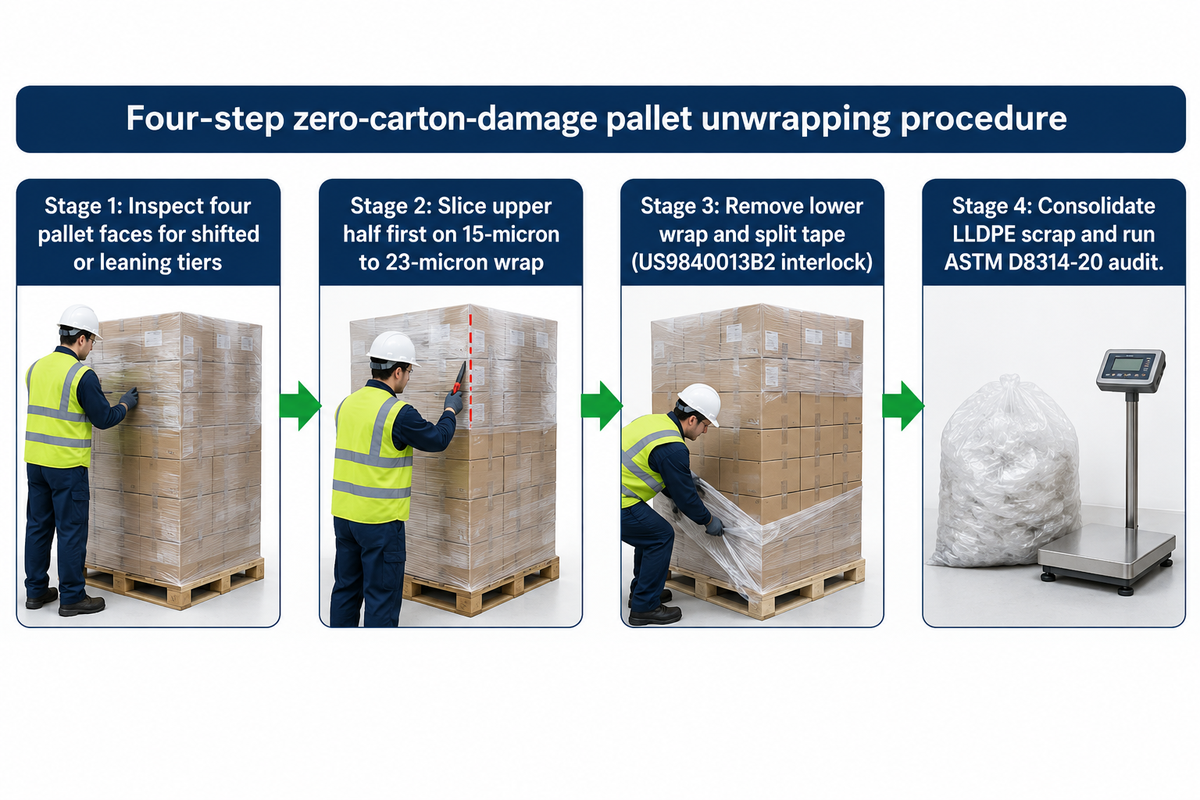
Even with a guarded stretch wrap cutter in hand, cutting a misaligned pallet in the wrong sequence can allow unstable upper cartons to fall or leave loose film tails around forklift wheels. Following a four-step receiving procedure protects the operator and the unitized load.

- Stage 1 (Pre-Cut Load-Shift Inspection and Quarantine Gate) requires inspecting all four pallet faces for crushed bottom cartons or leaning tiers before touching the film. As warned in OLFA pallet and bundle handling safety guidance , plastic strapping and wrap can stretch in transit, and cutting a shifted load without rearranging or stabilizing it first allows upper goods to fall. Cutting a shifted load can result in upper cartons falling. Extra care is needed with loads wrapped in black or tinted colored stretch wrap , where opaque film hides shifted cases or internal bands until the wrap is opened.
- Stage 2 (Upper-Half Vertical Corner Slitting) begins once load stability is confirmed: pierce the wrap at the upper corner and slice the upper half of the stretch film first using a concealed-blade knife such as an OLFA SK-10 or a Martor Secumax cutter. When unwrapping 15-micron to 23-micron (60 to 90+ gauge) LLDPE applied at 150% to 300% (typically 200% to 300%) pre-stretch, keeping the lower wrap intact holds base containment while drawing the nose shoe down a vertical corner channel controls elastic snapback so operators can unload top tiers first.
- Stage 3 (Lower-Half Wrap Removal and Interlocked Carton Tape Splitting) separates the remaining lower film wrap and roped base bands along the vertical corner channel after upper tiers are unloaded or stabilized, and opens master cartons using a dedicated tape splitter. Multi-function cutters described in US Patent US9840013B2 (cutter apparatus 100) use an interlock device (240) that prevents the slider (104) from extending the front blade (126) from the housing (102) while the rear auxiliary film cutter (220) is deployed.
- Stage 4 (Immediate LLDPE Scrap Consolidation and Cut-and-Weigh Verification) gathers the stripped polyethylene wrap immediately into a compact ball placed into a dock recycling bin so trailing tails never wind around forklift wheels. During incoming cut-and-weigh stretch film audits aligned with ASTM D8314-20 applied stretch film evaluation methods (Section 8.1.3.2 Observed Tear Test and Section 8.1.3.3 Cut and Weigh Test), operators weigh the intact stripped web from a single vertical slit to verify applied film mass per pallet.
Multi-Layer LLDPE Gauge, Cast vs. Blown Tear Propagation, Roped Bands, and Strapping Shear Limits
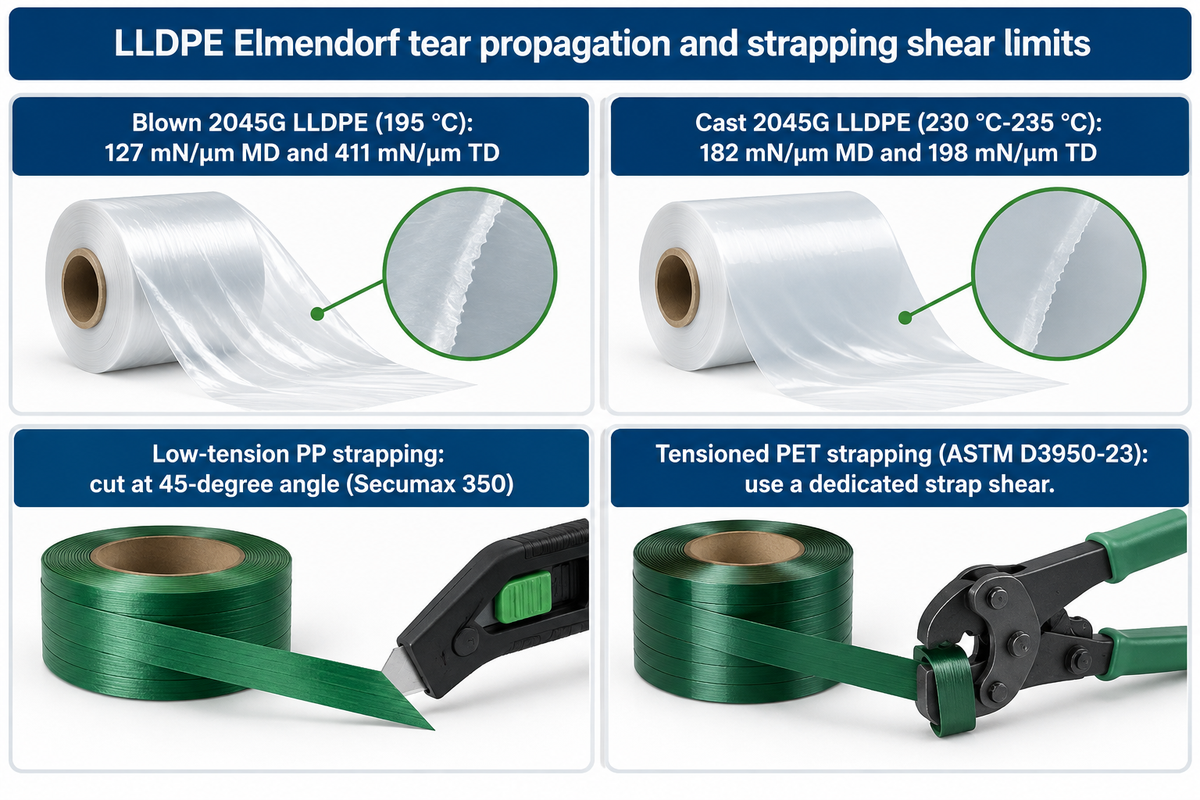
Resin comonomer and draw orientation affect machine-direction (MD) and transverse-direction (TD) tear propagation alongside the cast-versus-blown manufacturing process. Understanding how film orientation, 60-to-120 gauge roped base bands, and nonmetallic strapping behave under tension helps receiving managers assign the right cutting tool to each material.
Specifically, experimental LLDPE film tear research published in Polymers (Ren et al., 2019) studied blown films extruded at 195 °C (30 RPM screw speed, 80 mm die diameter, 1.27 blow-up ratio) and cast films extruded at 230 °C-235 °C across butene, hexene, and octene LLDPE resins. Regarding the octene-based 2045G resin (Table 3), blown films recorded an Elmendorf tear strength of 127 mN/µm in MD and 411 mN/µm in TD and cast films recorded 182 mN/µm in MD and 198 mN/µm in TD. Because high-TD-tear films resist horizontal unzipping during an ASTM D8314-20 Observed Tear evaluation, a receiving cutter needs a sharp, guarded edge that makes a clean vertical slit without relying on brute pull force to tear the web open.
| Receiving Consumable / Unjamming Task | Disposable Concealed Cutter (e.g., 3.8–4 mm Depth) | Replaceable-Head Concealed Cutter (e.g., 6 mm Depth) | Sintered ZrO2 Ceramic Concealed Cutter | Spring Self-Retracting Utility Knife | Dedicated Hold-Down Strap Shear |
|---|---|---|---|---|---|
| Standard Cast LLDPE Wrap (15–23 microns, 182/198 mN/µm MD/TD sample) | Recommended; clean single-draw vertical slit along corner channel | Recommended; rigid 37 g handle tracks smoothly through multi-layer corners | Recommended for clean ambient or washdown docks | Not recommended; exposed blade can slit carton walls | Unsuitable; heavy shear jaws snag thin film webs |
| High-TD-Tear Blown LLDPE Wrap (127/411 mN/µm MD/TD sample) | Recommended; oblique steel edge reduces adhesive drag | Recommended; 6 mm cutting depth handles heavy blown corner wraps | Acceptable on clean wrap; high surface tack increases draw drag | Not recommended; if slider is held, bare blade stays exposed | Unsuitable; cannot glide through continuous sheet |
| Roped Pallet-Base LLDPE Bands (60–120 Gauge Multi-Layer Twisted Cord) | Check gathered rope diameter against the tool’s verified clear throat gap | Recommended when verified throat opening fits the gathered roped band | Use with care; avoid twisting brittle ceramic against pallet wood | Hazardous; high pull force increases slip risk off round ropes | Acceptable if roped cable is tightly tensioned over wood deck |
| Shrink Wrap Hoods, Bubble Wrap & Foam Sheet | Suitable for thin shrink film, bubble wrap, and poly bags within throat gap | Recommended; Secumax 350 (6 mm depth) cuts stretch and shrink film, foil, and foam | Suitable for thin shrink film and poly mailers | Not recommended; exposed tip can puncture underlying goods | Unsuitable for sheet packaging materials |
| Anodized Aluminum Wrapper Roller Jam Clearing (Under LOTO) | Suitable after LOTO; clean polymer shoe keeps recessed blade off aluminum | Suitable after LOTO; glass-fiber-reinforced shoe lifts film off roller | Acceptable after LOTO if housing is non-marring polymer | Not recommended; bare steel tip scores anodized aluminum rollers | Not recommended; metal lower jaw gouges precision roller faces |
| Corrugated Carton Sealing Tape (Center Seam) | Select a model with an integrated tape splitter (such as Secumax 320 at 4 mm depth) | Secumax 350 is rated for tape and 2-ply cardboard via its 6 mm head; verify clearance | Micro-blade depth stop slices tape; verify clearance above inner pouches | High content-damage risk unless blade extension is depth-limited | Unsuitable for carton tape seams |
| Low-Tension Polypropylene (PP) Carton Strapping (ASTM D3950-23) | Slices lightweight, low-tension PP carton and bundle straps (e.g., OLFA SK-10) | Recommended; Secumax 350 cuts low-tension plastic strapping at a 45-degree angle | Verify manufacturer guidance for low-tension PP straps | OLFA SK-4 cuts lightweight low-tension PP straps, though concealed blades reduce exposure | Recommended; clean single-stroke shear |
| High-Tension Polyester (PET) Pallet Strapping (ASTM D3950-23) | Not suitable; tough polyester dulls light film blades quickly and snaps back | Not suitable for heavy tensioned PET; use a dedicated strap shear instead | Not suitable for heavy tensioned PET banding | Not suitable; exposed blade and strap recoil create a laceration risk | Recommended; hold-down foot restrains strap recoil during cut |
| High-Tensile Steel Pallet Strapping | Not suitable; immediate blade damage | Not suitable; polymer housing and 0.3 mm razor cannot shear steel | Not suitable for steel strapping | Not suitable; severe blade damage and recoil hazard | Recommended; two-hand safety steel strap shear with hold-down |
Why should operators avoid cutting tensioned PET pallet strapping with a plastic concealed-blade film cutter?
Operators should use a dedicated strap shear that controls recoil when cutting tensioned polyester (PET) pallet strapping covered by ASTM D3950-23 nonmetallic strapping specifications. Forcing a concealed-blade film cutter through rigid PET banding quickly dulls light film blades, can damage the plastic guard, and allows the tensioned strap to snap back.
As explained in the OLFA strapping safety guidance, lightweight low-tension polypropylene (PP) strapping on individual cartons and light bundles can be cut with an OLFA SK-10 concealed-blade knife or SK-4 knife. However, strong strapping materials (e.g. polyester, woven webbing or composite fiberglass strapping) are more difficult to cut and quickly dull a blade. When inbound pallets contain both light banding with stretch film and heavy PET banding, dock crews should use a concealed film cutter for the LLDPE wrap with a hold-down strap shear for the PET straps and consult our guide on industrial PET and PP strapping selection to adjust the break strength of outbound strapping.
Carbon Steel, Stainless Steel, Zirconium-Oxide Ceramic Blades, and Metal-Detectable Housings
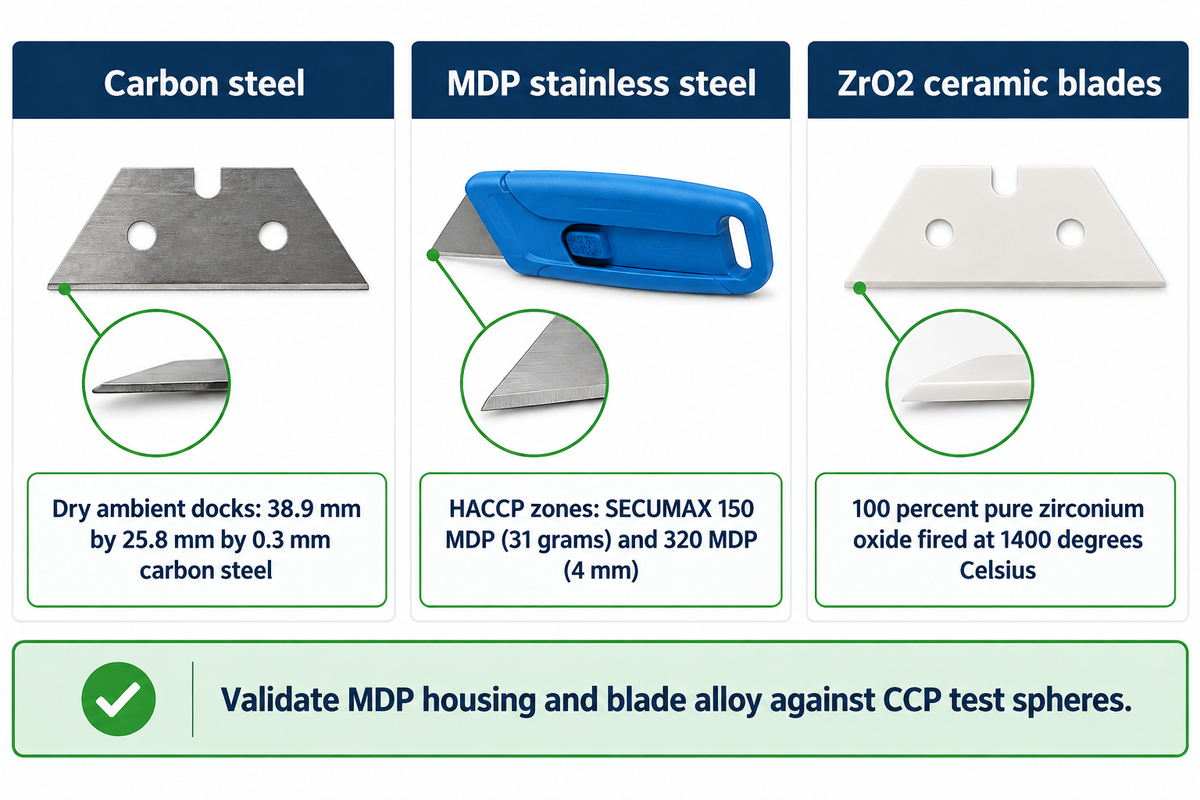
Warehouse humidity, cold-chain condensation, and foreign body inspection protocols drive the selection of carbon steel, stainless steel, or sintered zirconium-oxide (ZrO2) ceramic blades in standard or metal-detectable polymer (MDP) housings at a receiving dock.
- Dry ambient distribution centers typically specify 0.3 mm carbon steel replacement blades (such as the 38.9 mm by 25.8 mm by 0.3 mm extra replacement blade 3550.20 for the Martor Secumax 350) to slice stretch and shrink film, tape, and lightweight plastic strapping. Because carbon steel can oxidize in damp ocean containers or washdown bays, dry warehouses store spare blade packs in closed tool cribs.
- Food, pharmaceutical, and cosmetics receiving zones operating under Hazard Analysis Critical Control Point (HACCP) foreign-body programs specify metal-detectable safety knives like the Martor SECUMAX 150 MDP (weighing 31 grams) and SECUMAX 320 MDP (4 mm cutting depth). These knives combine metal- and X-ray-detectable blue plastic housings with permanently installed or replaceable stainless steel blades offering two cutting edges.
- Chemically wet or non-sparking tasks often use ceramic blades: Slice ceramic safety blade documentation notes that Slice blades are made from 100 percent pure zirconium oxide fired at 1400 degrees Celsius, making them non-metallic and not detectable by magnetic metal detectors. Separately, Oklahoma State University food-processing metal detector engineering guidance explains that coil sensitivity depends on metal magnetic permeability, electrical conductivity, and wet or salty food product effect. Because 100% zirconium-oxide ceramic blades are non-magnetic and stainless steel fragments vary in detectability with fragment size, orientation, and food product moisture or salt content, HACCP plants must validate any MDP cutter housing and metal blade alloy against their own line’s Critical Control Point test spheres.
OSHA 29 CFR 1910.138 Hand Protection, GS Safety Certification, and Concealed vs. Self-Retracting Knives
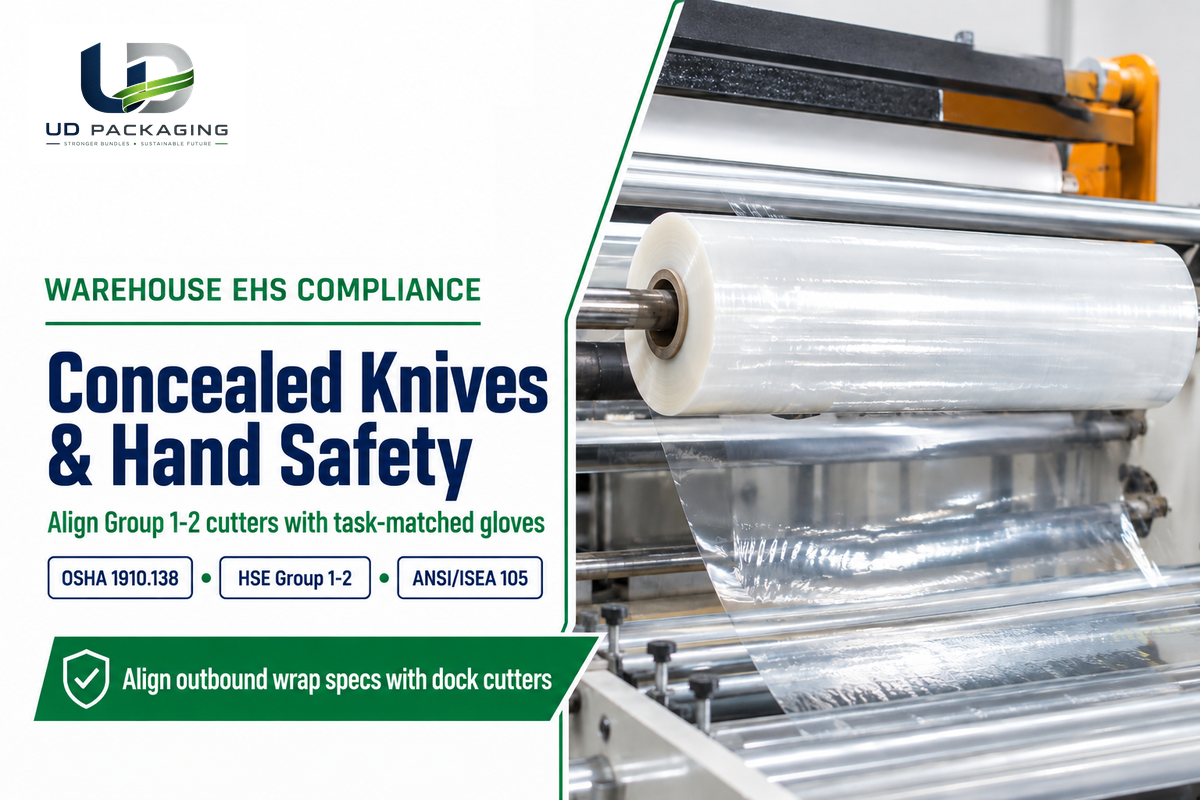
Environmental Health and Safety (EHS) managers auditing receiving-dock cutters often see supplier catalogs advertising tools as “OSHA-approved.” However, OSHA 29 CFR 1910.138 requires employers to evaluate task-specific hand hazards and select appropriate hand protection rather than issuing brand-level approvals for commercial safety knives. Under 29 CFR 1910.138(a) and 1910.138(b), employers are required to select hand protection based on an evaluation of performance characteristics relative to the tasks performed, conditions present, duration of use, and hazards identified.
Statistics on occupational injuries in warehouses demonstrate why warehouse safety programs focus on guarded cutting tools. According to U.S. Bureau of Labor Statistics (BLS) data for Warehousing and Storage (NAICS 4931), private-industry warehousing injury and illness rates per 100 full-time workers recorded 4.8 total recordable cases, 4.1 cases involving days away from work, job restriction, or transfer (DART), and 1.5 cases involving days away from work. Separately, a National Safety Council Safety+Health report on ergonomic safety knife programs notes that workplace hand lacerations average $46,000 in combined direct and indirect costs, driving substitution toward concealed-blade knives.
To reduce the risk of lacerations on the receiving dock, practical verification safety programs combine three steps:
- Following the UK Health and Safety Executive PPIS12 hand knife hierarchy, EHS teams rank hand knives across four engineering groups: Group 1 (disposable knives with permanently concealed blades), Group 2 (concealed-blade knives with replaceable heads or blades), Group 3 (fully automatic retracting blade knives), and Group 4 (spring self-retracting thumb-slider knives). As noted in box cutter safety comparison reviews, a Group 4 spring self-retracting knife retracts only when the slider is released and the mechanism clears the cut, so thumb pressure or binding during a pallet cut can leave the bare blade extended if the tool slips. Choosing a Group 1 or Group 2 concealed cutter provides a safer engineering solution for stripping pallet wrap.
- When validating mechanical guards, procurement teams look for independent third-party certification such as the German GS (Geprüfte Sicherheit) mark under Product Safety Act (ProdSG) Sections 20-24. The GS mark requires third-party testing, factory surveillance, and a maximum 5-year certificate validity (both the Martor Secumax 350 and Secumax 150 MDP have GS certification).
- When matched with gloves, the ANSI/ISEA 105-2024 Hand and Arm Protection Classification system uses a 9-level scale (A1 through A9) to classify blade cut resistance from A1 (200-499 g for light-duty cardboard handling and packaging) and A2 (500-999 g for general warehouse tasks) to A9 (6,000+ g). Group 1 or Group 2 concealed cutters reduce access to the cutting edge, while gloves with task-matched ANSI/ISEA 105-2024 cut ratings address assessed hand hazards under 29 CFR 1910.138; the pairing alone does not establish regulatory compliance without a documented workplace hazard evaluation.
Disposable Sealed Cutters vs. Replaceable-Head Handles: Shift Economics and Consumable Alignment Checklist
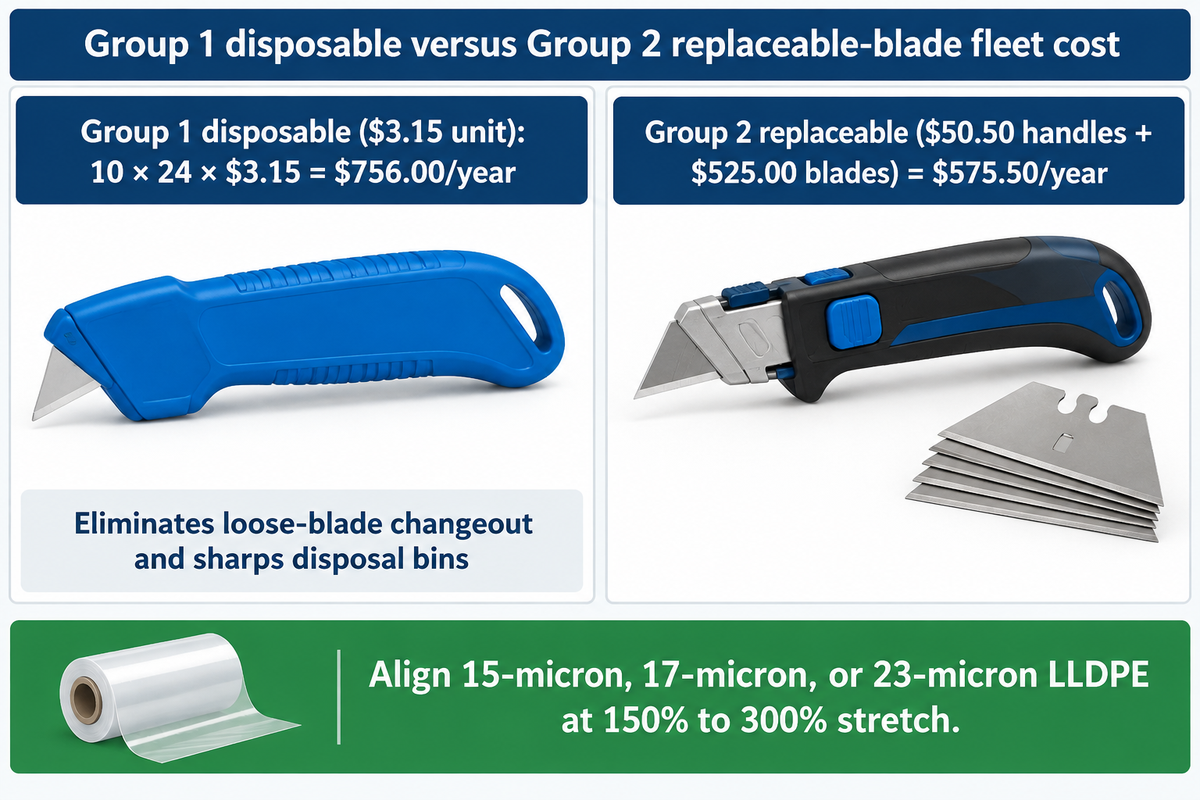
Selecting between Group 1 sealed disposable cutters (such as the 31 g Martor SECUMAX 150 MDP or 12 g Secumax 145 at 3.8 mm cutting depth) and Group 2 replaceable-head handles (such as the 37 g Martor Secumax 350 at 6 mm cutting depth using 10-piece replacement blade packs 3550.20) requires balancing blade changeout exposure, sharps disposal management, and pocket tool loss across shifts, key drivers highlighted in warehouse safety knives adoption studies.
Published commercial stretch film cutter distributor catalog prices list an economy single stretch film cutter (G5SFCT) at $3.15, a 2-pack of premium handles at $10.10 ($5.05 per handle), a 10-pack of replacement blade cartridges at $26.25 ($2.625 per cartridge), and a 25-pack of disposable film cutters (DFC-364) at $101.10 ($4.044 per cutter). Warehouse managers can compare Group 1 disposable fleets against Group 2 replaceable-blade fleets using an explicit annual shift-cost equation:
Annual Fleet Cost = Operators × [(Handles Replaced Per Operator × Handle Unit Price) + (Blade Cartridges Used Per Operator × Cartridge Unit Price)]
- High-turnover cross-dock operations using Group 1 sealed disposable cutters ($3.15 per G5SFCT unit): if 10 operators each consume or misplace 24 disposable cutters per year, multiplying 10 × 24 × $3.15 equals $756.00 per year. Group 1 cutters eliminate loose-blade changeout exposure and require no sharps disposal bins during shift changes.
- Tethered multi-shift receiving teams using Group 2 replaceable-blade handles ($10.10 per 2-pack handle plus $26.25 per 10-pack replacement blades): if 10 operators consume 5 handle two-packs ($50.50) and 20 replacement blade ten-packs (200 cartridges = $525.00), total hardware spend is $50.50 + $525.00 = $575.50 per year (saving $180.50 before counting sharps disposal containers and blade-change supervision).
Inbound-to-Outbound Stretch Film & Strapping Consumable Alignment Checklist
Six of the outbound packaging parameters aligned when sample rolls or batch Certificates of Analysis are requested, help reduce unwrapping drag, film roping jams, and tool mismatches:
- Specify whether the wrapping line runs 15-micron, 17-micron, or 23-micron (60 to 90+ gauge) LLDPE and a 150% to 300% pre-stretch window; cutters with published 3.8 mm to 4 mm cutting depths still need a verified clear throat opening that fits the gathered corner wrap and any 60 to 120 gauge roped base bands.
- Review machine-direction versus transverse-direction Elmendorf tear strength (such as the 127/411 mN/µm blown and 182/198 mN/µm cast 2045G resin benchmarks in Ren et al., 2019) alongside our stretch film datasheet parameters, and evaluate load containment on the actual pallet under ASTM D8314-20 Observed Tear procedures.
- One-sided differential-cling machine film (tacky inner face, low friction outer face) should be specified to reduce pallet-to-pallet sticking inside trailers, which allows nose shoes to slide down corner channels with less surface drag.
- Verify roll core inner diameter and wall stiffness using our guide to stretch wrap roll core specifications so cores fit powered pre-stretch spindles cleanly without crushing and triggering aluminum roller wrap-ups.
- Substitute clear or zone-printed custom printed stretch wrap in place of solid black wrap whenever receiving docks need visual pre-cut inspection of leaning tiers or internal strapping bands.
- Match lightweight, low-tension polypropylene (PP) strapping for carton bundling where concealed cutters are used, and color-code high-tension polyester (PET) pallet strapping under ASTM D3950-23 so dock crews use hold-down strap shears instead of plastic film knives.
Frequently Asked Questions
Can a concealed-blade stretch film cutter slice through shrink hoods, bubble wrap, and poly mailers as well as LLDPE pallet wrap?
Yes, a concealed-blade stretch film cutter with a 4 mm to 6 mm cutting depth (like the Martor Secumax 350, rated for stretch and shrink film, foil, tape, and 2-ply cardboard) cleanly slices polyethylene shrink hoods, bubble wrap, thin foam sheets, and poly mailers. Operators should keep steady forward pull tension so soft cellular materials feed smoothly without bunching in the throat.
How many pallets can a single disposable stretch film cutter unwrap before the recessed blade dulls?
There’s no standard published by all manufacturers on the number of pallets that can be moved with a disposable stretch film cutter, as edge life depends on thickness of the film, dust contaminations and if the head houses a single fixed edge or a double reversible 0.3 mm steel or ceramic edge. Clean 15- to 23-micron LLDPE wrap causes minimal edge wear, while gritty cardboard dust, wood staples, or polyester strapping quickly dulls the edge.
Should warehouse operators cut wrapped pallets from the top down or from the bottom up at the receiving dock?
After inspecting the pallet and quarantining or mechanically stabilizing loads with severely leaning tiers, operators remove the wrap at the upper corner and discard the upper half of the stretch film. Keeping the lower wrap intact holds base containment while top tiers are unloaded or verified stable before severing the lower wrap.
Do concealed-blade stretch film cutters work equally well for left-handed and gloved operators?
Yes. Symmetrical central-channel cutters like the 37-gram Martor Secumax 350 feature a ribbed soft grip for both right- and left-handed users and are compatible with ANSI/ISEA 105-2024 cut-resistant gloves.
How does an integrated tape splitter on a stretch film cutter open corrugated cartons without puncturing inner goods?
An integrated tape splitter on the cutter spine uses a blunted polymer or metal tab (for example, the 4 mm depth splitter on the Martor Secumax 320, or the tape-rated head on the Secumax 350) to split pressure-sensitive or paper carton sealing tape along the center flap seam without extending a bare utility blade. Operators need to ensure that the top seam gap isn’t in direct contact with tightly packed inner pouches.
Are metal-detectable blue stretch film cutters disposable or available with replaceable blade heads?
Both configurations are available for HACCP docks: sealed Group 1 disposable knives, such as the 31-gram Martor SECUMAX 150 MDP, and Group 2 replaceable-head cutters use metal-detectable blue plastic.
When should a shipping and receiving operation adjust its outbound stretch film specification instead of changing dock cutters?
When inbound receiving crews repeatedly experience outer-surface blade drag, pallet-to-pallet sticking in trailers, or excessive film breaks, adjusting outbound film selection under ASTM D4649-20(2025) is often more effective than changing dock knives. The use of one-sided differential-cling LLDPE may help reduce outer-face tack, while matching resin tear balance and a calibrated 150% to 300% pre-stretch window helps reduce roped bunching; validate the selected film against the cutter’s clear throat gap.
References & Sources
- U.S. Occupational Safety and Health Administration (OSHA) 29 CFR 1910.138 Hand Protection Standard (eCFR)
- U.S. Occupational Safety and Health Administration (OSHA) 29 CFR 1910.147 The Control of Hazardous Energy (Lockout/Tagout)
- U.S. Occupational Safety and Health Administration (OSHA) Grocery Warehousing eTool: Packaging & Cutting Ergonomics (Figures 12–15)
- U.S. Bureau of Labor Statistics (BLS) Industries at a Glance: Warehousing and Storage (NAICS 4931) Injury Incidence Rates
- ASTM International ASTM D4649-20(2025) Standard Guide for Use of Stretch Films and Wrapping Application
- ASTM International / iTeh Standards ASTM D8314-20 Standard Guide for Performance Testing of Applied Stretch Films and Stretch Wrapping
- ASTM International Annual Book of ASTM Standards Volume 15.10 Packaging (ASTM D3950-23 Nonmetallic Strapping)
- American National Standards Institute (ANSI) ANSI/ISEA 105-2024 American National Standard for Hand and Arm Protection Classification
- UK Health and Safety Executive (HSE) Safe Use of Hand Knives in the Paper and Board Industry (PPIS12 Group 1-4 Hierarchy)
- National Library of Medicine / PMC Optimization of LLDPE Stretch Film Thickness (15-23 Microns) and Pre-Stretch Containment (PMC12656129)
- MDPI Polymers (Ren et al., 2019) Different Dependence of Tear Strength on Film Orientation of LLDPE Made with Different Co-Monomer
- Fibre Box Association (FBA) Corrugated Board Caliper Specifications (Double-Wall B/C Flute Standards)
- Arvco Container Corp. Understanding the Different Types of Corrugated Flutes (A, B, C, E, and F Flutes)
- Oklahoma State University Extension Metal Detectors for Food Processing: Ferrous vs. Stainless Steel Sensitivity and Product Effect
- Sollex AB / Martor Technical Specifications Martor Secumax 350 Concealed-Blade Safety Knife (6 mm Depth, 37 g, 38.9 × 25.8 × 0.3 mm Blade)
- RS Components / Martor KG Martor SECUMAX 145 (3.8 mm) and SECUMAX 320 / 320 MDP (4 mm) Technical Datasheet
- OLFA Industrial Safety Eliminate Cardboard and Bundle Strapping Handling Hazards (OLFA SK-10 and SK-4 Guidance)
- Slice Inc. Are Slice 100% Zirconium-Oxide Ceramic Safety Blades (1400 °C) Metal Detectable?
- Food Safety Magazine
Product Name: SECUMAX 150 MDP (31 g) Metal-Detectable Concealed-Blade Safety Knives for Food and Pharma
- FCBA / German ProdSG — GS (Geprüfte Sicherheit) Mark Certification Under German Product Safety Act
- National Safety Council (NSC) Safety+Health
- OnePack Warehouse Safety
Box Cutter Safety Comparison: Permanently Concealed vs. Spring Self-Retracting Blades
- European Patent Office
EP2370234A2 Cutter with Replaceable Head and 60 Shore A TPE Ergonomic Grip
- United States Patent and Trademark Office
US9840013B2 Safety Cutter Apparatus 100 with Rear Film Cutter 220 and Interlock Device 240
- PackagingSupplies.com Commercial Stretch Film Cutters, Disposable Packs, and Replacement Blade Cartridges
- Market.us Global Safety Knives Market Adoption Forecast and Warehouse Segment Analysis
- reddit /r/manufacturing
Maintenance Field Discussion: Non-Marring Tools to Cut Stretch Wrap Off Anodized Aluminum Rollers