Get in touch with UD Packaging Company

PET Strap for Geogrid Packaging: Control Coil Shape, Strap Routing, and Edge Contact

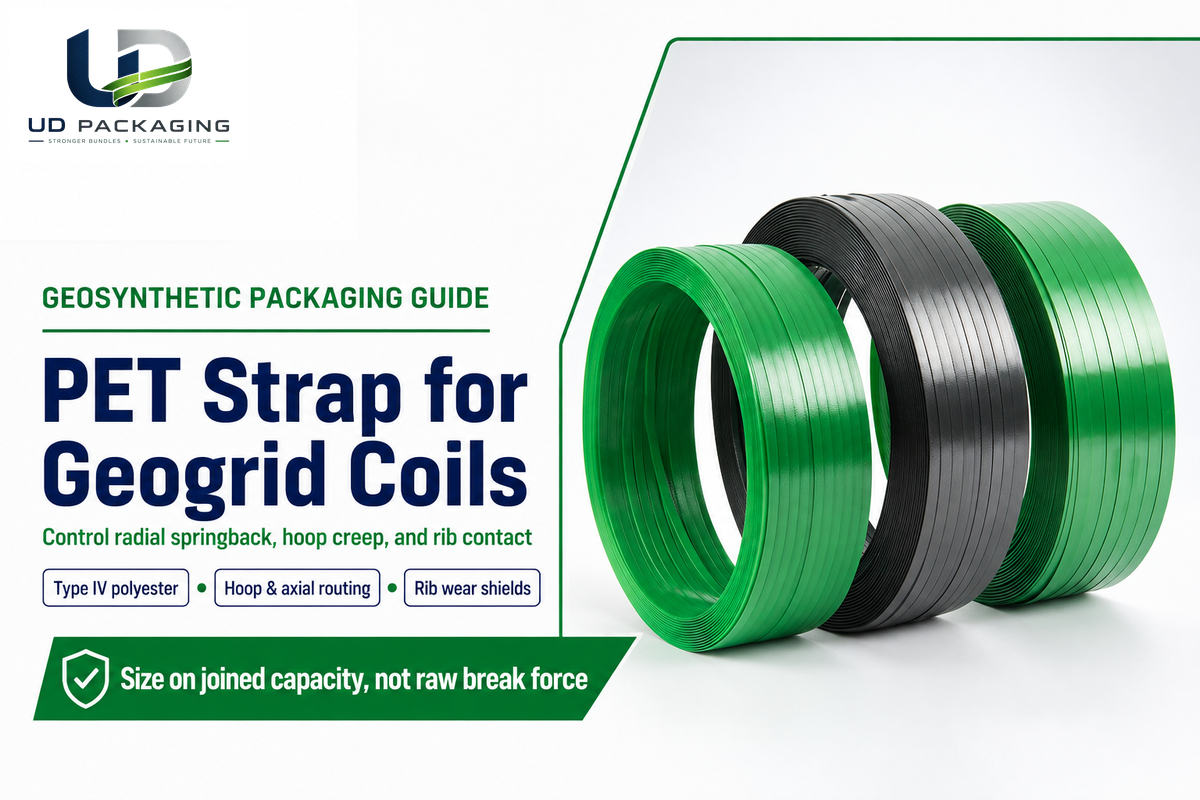
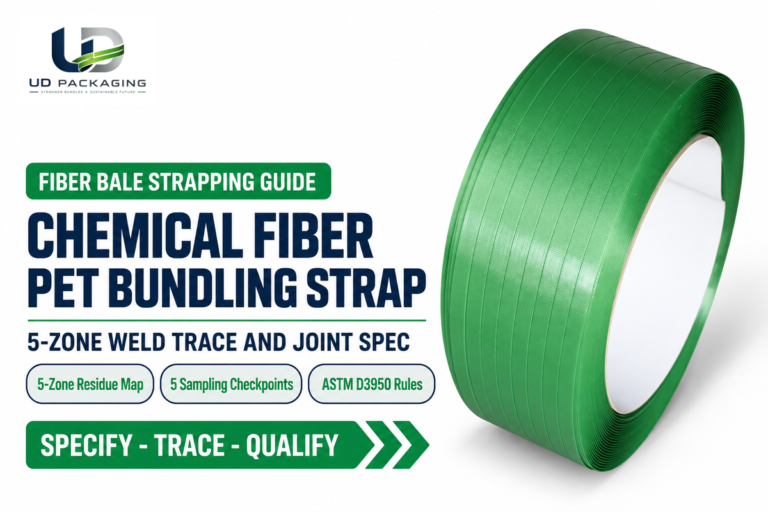
PET strap for geogrid packaging is ASTM D3950-23 Type IV polyester strapping engineered to restrain cylindrical polymer rolls using smooth or sleeved finishes, spaced hoop-and-axial routing, and cradle immobilization. Smooth 16 mm (5/8 in.) PET avoids rib notching from steel and prevents tension relaxation common on lower-spec PP/PET packing lines.
Rigid corrugated cartons can be held with light strapping tape or low-tension film because they stay dimensionally stable during logistics handling. Heavy wound geosynthetic rolls, by comparison, require specialized strapping equipment to satisfy heavy packaging requirements around hollow cores. Internal “roll memory” pushes outward against outer wraps in cargo transit, turning light settings into oval cores, telescoped layers, and sheared coatings.

Why Geogrid Coils Fail Under Generic Strapping: Stored Radial Springback, Hoop Creep, and Ovality
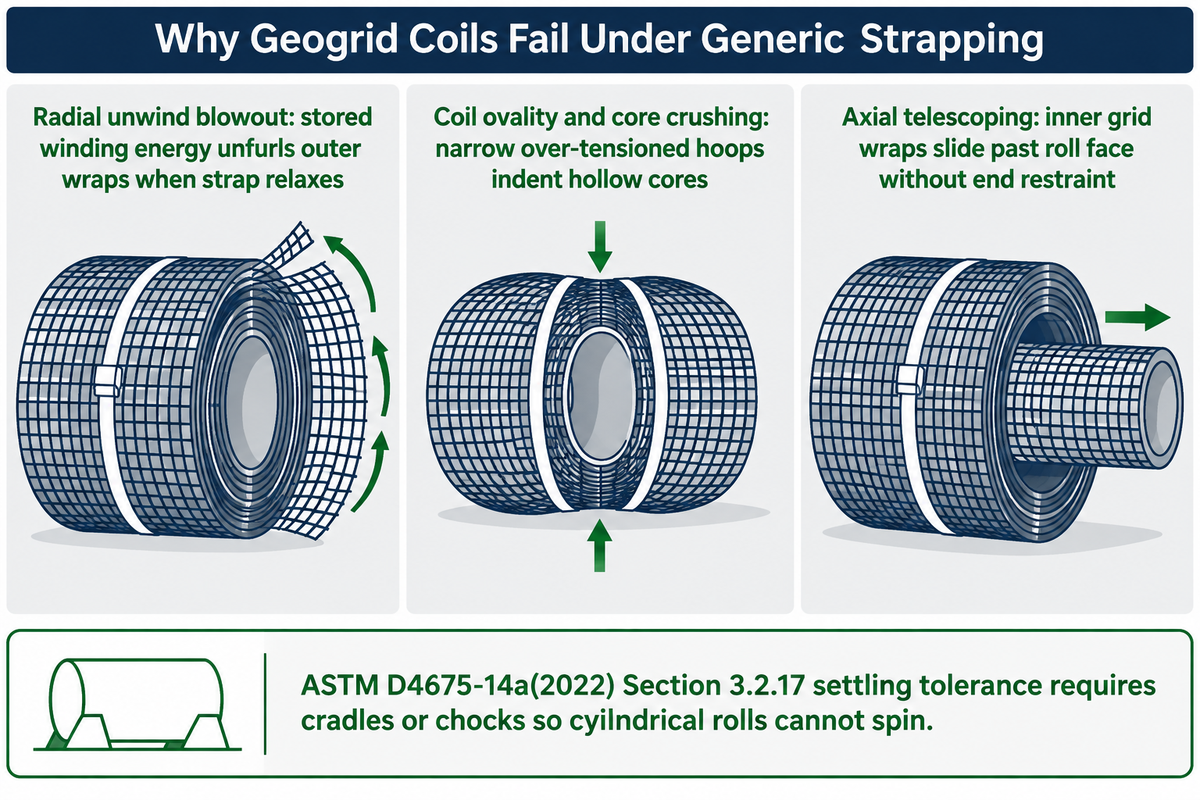
Generic pallet packaging rules fail on geogrid rolls because cylindrical polymer coils slightly change their diameter after winding. Unblocked rolls also rotate freely beneath perimeter bands unless restrained with cradles or chocks. Tensar’s TriAx Installation Guide notes that cool days trigger radial “roll memory” when bands are cut.
Consider a tightly wound coiled garden hose, tied by thin string. The outer loop tries to flatten out and shifts sideways with respect to the other layers when vibration reduces the inter layer friction. Extruded polypropylene (PP) biaxial grids and punched HDPE sheets react differently than flat 90-degree carton corners. Likewise, coated fiberglass meshes behave unlike rigid goods when subjected to hoop compression.
ASTM D4675-14a(2022) Section 3.2.17 defines settling tolerance as a strap’s ability to remain taut on a shrinking unit load. Roll securement field guides recognize three recurring coil failure modes, attributable to mismatched plastic strapping.
- Radial unwind blowout: If joint failure or strap relaxation allows stored winding energy to release, the outer grid wraps will unfurl suddenly across the staging yard.
- Coil ovality and core crushing: Excessive clamping tension over narrow hoop bands indents lightweight hollow cores or upper stacked tiers.
- Axial telescoping: Lateral braking acceleration slides inner geogrid wraps out past the roll face because circumferential hoop friction alone lacks axial end-face restraint.
Strap selection has to balance this outward clock-spring force against creep relaxation per unit roll mass. Strap from a pet strapping roll recovers elastic strain as layers settle inward, preventing field packaging problems such as unwind blowouts common with creeping pp band. Perimeter strapping alone lets a cylindrical roll spin unless blocked inside a cradle or wedged on both flanks.
PET vs. PP vs. Carbon Steel Strapping for Geogrid Rolls: ASTM D3950 Recovery vs. D3953 Rigid Cut Risk
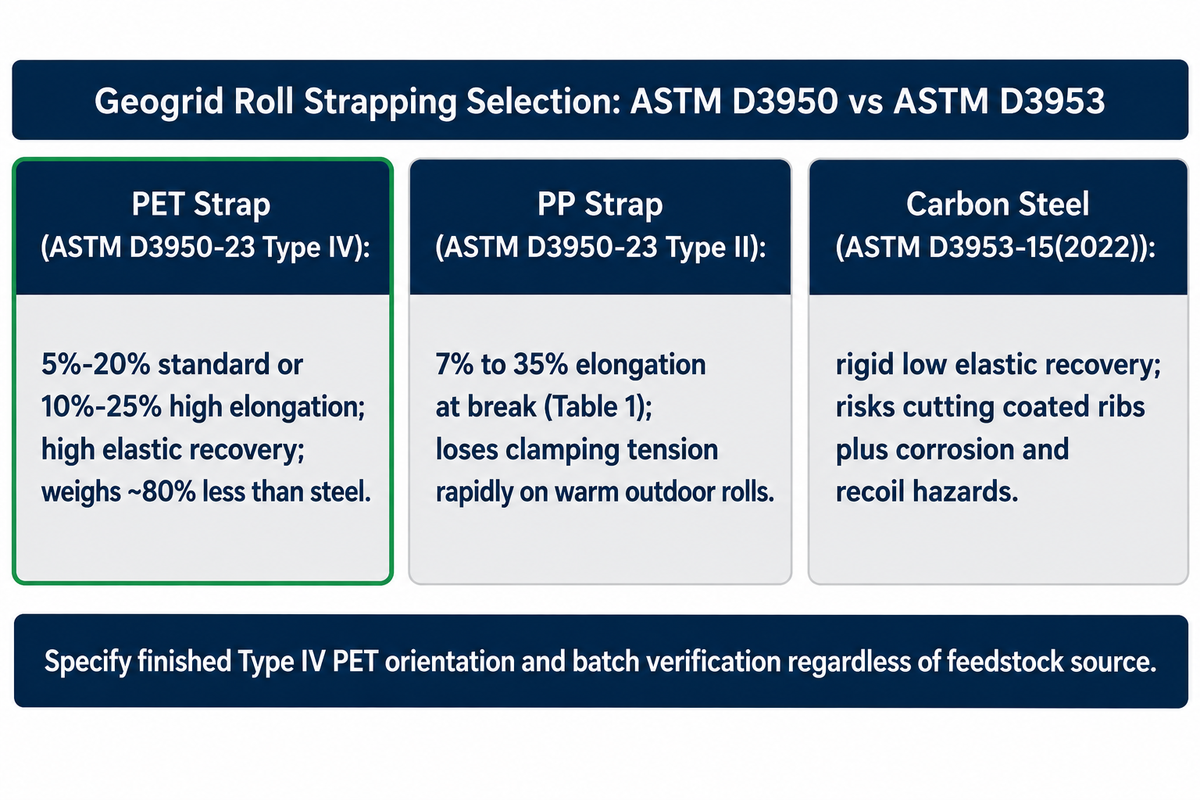
Type IV polyester strap (ASTM D3950-23 Table 3) holds coil tension better than Type II PP strapping without steel’s rib-cut risk. This heavy duty pet grade holds 5% to 20% standard or 10% to 25% high elongation. It weighs ~80% less than steel per Signode TENAX product data.
For manual pet strapping or machine lines, the PET versus PP and steel plastic strapping guide helps buyers write an accurate strap specification. Under ASTM D3950-23, extruded oriented polyester strap is classified as Type IV. Oriented polypropylene falls under Type II with 7% to 35% elongation at break (ASTM D3950-23 Table 1). Although PET bottle recycling yields strap feedstock, actual finished-strap performance depends on controlled orientation and batch verification. Finished Type IV PET must meet 5%–20% standard or 10%–25% high elongation alongside rated breaking strength and elongation limits across rigid and flexible packaging profiles.
That polymer difference governs coil stability across extended storage and transport cycles. Type II polypropylene strap loses initial clamping tension rapidly on shrinking or warm outdoor rolls. Meanwhile, ASTM D3953-15(2022) regular-duty carbon steel lacks elastic follow-up recovery and adds corrosion and recoil hazards. Industrial packaging FAQs confirm polyester strap provides steadier load retention to stay tighter than both pp strap and steel strapping on settling rolls.
| Performance Criterion | PET Strap (ASTM D3950-23 Type IV) | PP Strap (ASTM D3950-23 Type II) | Carbon Steel Strap (ASTM D3953-15(2022)) |
|---|---|---|---|
| Polymer / Metal Classification | Extruded, oriented polyethylene terephthalate (polyester strap) | Extruded, oriented polypropylene strapping (Type II) | Type 1 cold-rolled flat steel band (lubricated or zinc/painted) |
| Breaking Elongation Range | 5%–20% standard grade; 10%–25% high elongation (Table 3) | 7%–35% elongation at break (Table 1) | Low elastic elongation with permanent plastic yield past limit |
| Tension Retention on Settling Coils | High recovery keeps hoop tension active as layers bed down | Noticeable dead stretch and stress relaxation over warm days | Zero contraction capability once coil perimeter shrinks slightly |
| Rib Notching & Surface Damage | Smooth strap profile distributes load cleanly with shields | Soft edge spares ribs, yet insufficient hold for heavy rolls | Rigid knife-like steel edges notch extruded PP/HDPE ribs |
| Outdoor UV & Corrosion Resistance | UV-stabilized green/black PET does not rust on wet yards | UV resistance degrades outdoors unless heavily UV-compounded | Scratched finish rusts and stains woven polyester/fiberglass grids |
| Operator Mass & Recoil Risk | ~80% lighter than steel with controlled cut release per Signode TENAX brochure | Lightweight handling for manual packaging of small rolls | Heavy coils and sharp whipped ends increase operator injury hazard |
| Primary Fit for Geogrid Rolls | Preferred alternative to steel for 3–5 m biaxial, uniaxial, coated coils | Restricted to light indoor sample kits or soft protective wraps | Hot furnace coils or mandated AAR rail securement layouts |
Strap Routing Patterns for Geogrid Coils: Circumferential Hoop Bands vs. Axial Eye-to-Sky vs. Pallet Cross-Ties
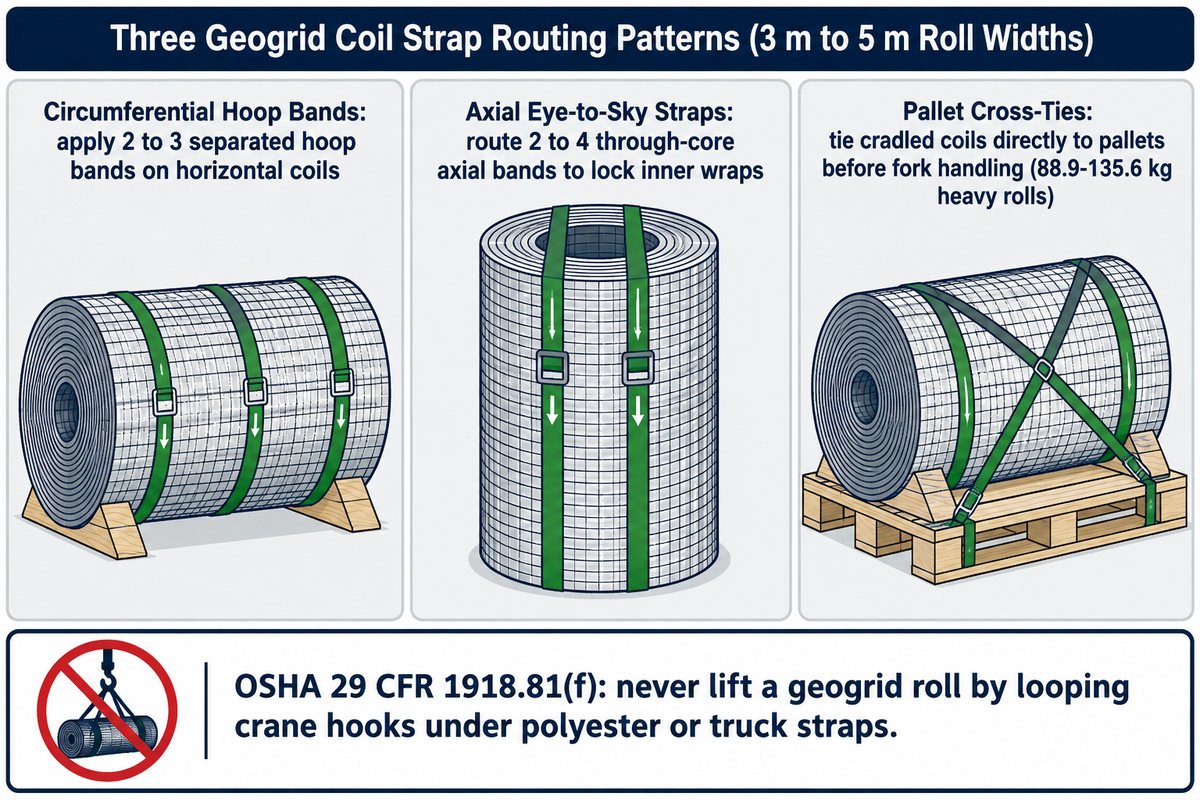
Packaging engineers combine three routing patterns based on roll weight, width, and stack height. Apply 2 to 3 separated circumferential hoop bands on horizontal coils and add 2 to 4 through-core axial bands for eye-to-sky rolls. Tie cradled coils to pallets before fork handling.
Roll geometry and unit load weight dictate base hardware before selecting manual tools or tension recipes. Commercial geosynthetic rolls in 3 m to 5 m (9.8 ft to 16.4 ft) widths commonly run 50 to 100 m (164 to 328 ft) long. Published roll weights span 39.0 kg (86 lb) on 3 m rolls up to 88.9–135.6 kg (196–299 lb) per roll on 5 m widths per Tensar’s TriAx Installation Guide. Light 3 m coils take 2 outer hoop bands, while heavier 4 m–5 m coils add a center hoop, cradle blocks, or eye-to-sky axial straps. Horizontal stacks stay capped at five rolls high unless flange cradles support each tier. As roll-securement guides warn, no plastic band holds an unblocked cylinder still by friction alone. A saddle cradle or opposing plastic wedges must anchor the roll base first using industrial shipment strapping mechanics.
Equally strict limits on handling apply to cranes, hooks, and forklifts. As cited in Geoworks installation guidance, flat forklift tines must never enter roll core holes. A smooth carpet pole or cradled tines underneath must be used instead. Likewise, standard packaging strapping never functions as crane lifting gear:
“Unitized loads bound by bands or straps may be hoisted by the banding or strapping only if the banding or strapping is suitable for hoisting and is strong enough to support the weight of the load.”
Never lift a geogrid roll by looping crane hooks under polyester or truck straps. Standard PET packaging straps aren’t appropriate for hoisting, and lifting a roll by its bands doesn’t meet the OSHA 29 CFR 1918.81(f) hoisting condition. Using unrated bands under vertical load can snap both the strap and core. To qualify lines for coil use, match each case against the nine-scenario matrix below.
| Geogrid Product Family | Roll Orientation & Mass Class | Primary Routing Pattern | Secondary Axial / Pallet Cross-Tie | Interface & Base Hardware | Primary Failure Mode Prevented |
|---|---|---|---|---|---|
| Biaxial Extruded PP Grid (3 m–4 m) | Horizontal individual roll (light–medium) | 2 separated circumferential hoop bands inboard of cut ends | Optional center hoop on 4 m coils | Overlapped outer wrap or kraft paper sleeve under bands | Radial unwind blowout on warehouse racks |
| Biaxial Extruded PP Grid (tiered stack) | Horizontal pyramidal stack (≤5 rolls high) | 2–3 hoop bands per individual roll | Chock outer base rolls; saddle cradles on palletized deck | Wood or molded plastic wheel wedges bracing lower flanks | Sideways roll-out and stack pyramid shift |
| Stiff Uniaxial HDPE Roll (heavy core) | Horizontal long roll (high stored memory) | 3 spaced circumferential hoop bands (never over raw selvedge burrs) | Cross-tie pairs over cradle timbers for truck transfer | Smooth PET strap + wide polymer edge protectors at weld zone | Clock-spring snapback in cold yards (<0 °C) |
| Rigid Aperture Roll on Short Flat Pallet | Eye-to-sky (vertical core axis) | 2–4 axial straps routed through center core to end face | 1 outer belly hoop band midway down roll height | ID core-rim plastic guards (Grip Strapping specs) | Core telescoping during highway braking |
| PVC-Coated Knitted PET Geogrid | Horizontal single or dual pallet bundle | 2–3 moderate-tension circumferential smooth PET bands | 2 pallet cross-ties anchored through deck runners | Corrugated wrap liner + broad wear pads under tool shoe | Surface coating scuffing and aperture skew |
| Bitumen-Coated Fiberglass Mesh Grid | Horizontal sensitive roll | 2–3 lightly tensioned circumferential smooth/waxed PET bands | Paired cradle compression straps over outer board wrapper | Full kraft paper sleeve blocking bitumen adhesion to band | Binder sticking, rib fracture, and fiber fray |
| Nonwoven Geocomposite (Grid + Fabric) | Horizontal bulky large-diameter roll | 3 circumferential hoop bands aligned over fabric overlap | Full poly shroud + 2 palletized perimeter ties | Wide-footprint plastic angle shields spanning outer ribs | Geotextile tearing and localized indent rings |
| Short-Cut Narrow Sample / Utility Rolls | Vertical clustered bundle on pallet | 1–2 light circumferential bands grouping cluster | 2 cross-strap loops over top corrugated cap sheet | Top/bottom cap board with corner protection angles | Bundle toppling during courier/LTL freight |
| Export Container Multi-Roll Pyramid | Horizontal intermodal container stowage | 3 hoop bands per heavy roll + interleaved cradle sleepers | Dunnage/chock framing; no reliance on PET bands for hoisting | Edge protectors on every pallet tie + barcode batch tracking | Oval core deformation over 4–6 week ocean transit |
Edge Contact Protection and Surface Selection: Smooth vs. Embossed PET, Wear Pads, and Polymer Shields
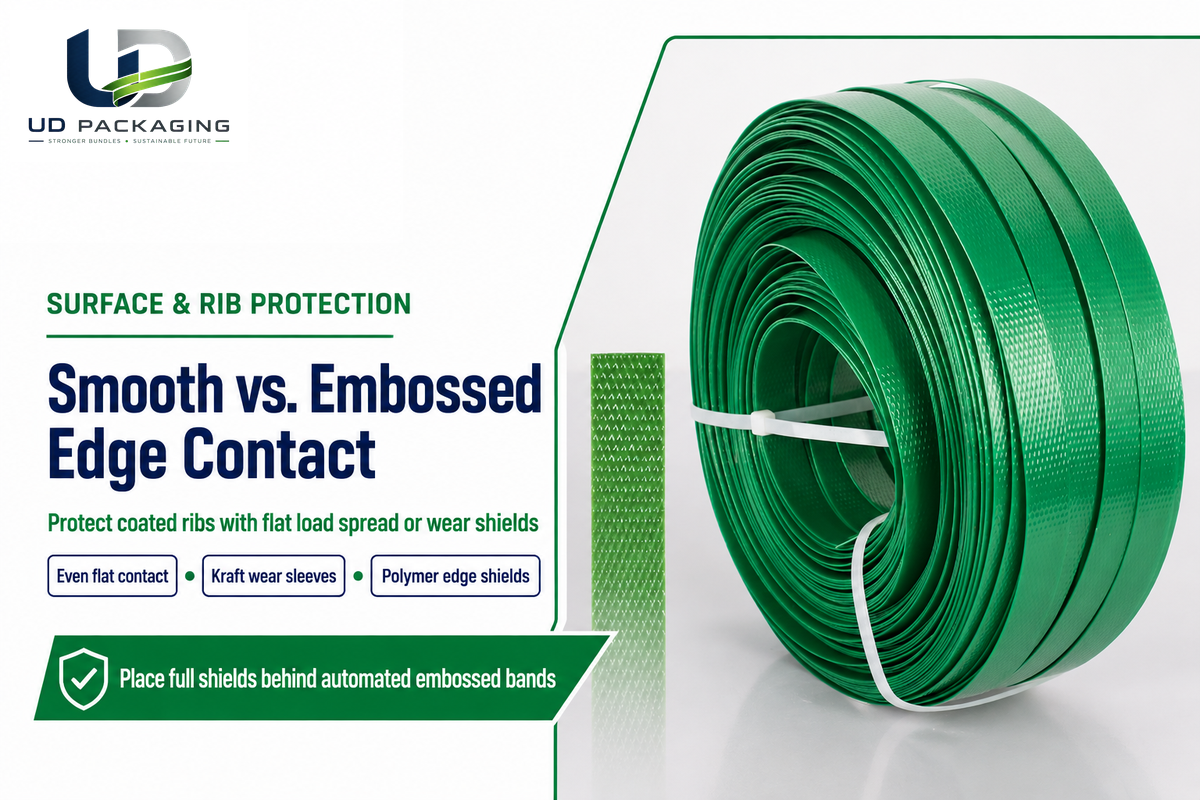
Flat, unpatterned polyester bands contact extruded and coated geogrid ribs far more evenly than textured bands. JUHONG testing shows smooth PET delivers higher breaking load while sparing soft coatings from concentrated pressure ridges. To cut damaged-coil packaging cost, place full kraft sleeves or rigid shields behind an automated embossed band.
Online packaging summaries often assume embossed polyester strapping cushions delicate rolls better than flat bands. Tensile testing shows flat strap preserves more usable cross-section. Side-by-side JUHONG tensile testing evaluated 18.7 mm by 1.0 mm specimens at 13% recorded maximum strain. Smooth PET reached 7,230 N (386 MPa) versus 6,417 N (343 MPa) for embossed PET, a 12.7% break-strength edge for flat polymer.
Cross-section geometry helps explain the difference in break load: mechanical embossing presses textured pockets into the extruded strap band, thinning load-bearing polymer between raised diamond peaks. Green embossed PET strap provides feed traction for automatic strapping machines and fully automatic arch heads running high-volume machine grade coils. However, pressing raised ridges straight onto PVC, bitumen, or polyolefin ribs concentrates contact pressure unless protected per ASTM D4675-14a(2022).
Relieved-angle polymer edge-guard patent engineering shows why stiff 90-degree corners still dig into round coils. When strap tension pulls a square edge guard open, its sharp inner tips bite the outer grid wrap. In expired third-party edge-protector engineering (DE19904843C5), a pre-angled (<90°) polymer shield pairs an interior relieved curved cove with outer reinforcing ribs and an optional inner elastomeric cushion pad to distribute pressure evenly across coil edges. Review protective shields in our edge protectors and strapping contact shields guide.
| Interface Element | Primary Mechanical Function | Specification Benchmark & Evidence | Geogrid Application Rule |
|---|---|---|---|
| Smooth PET Surface Profile | Maximizes flat band footprint and tensile cross-section | 7,230 N vs. 6,417 N embossed at 18.7 by 1.0 mm (JUHONG test) | First choice for direct bare-grid or thin-wrap trials |
| Controlled-Wax Smooth PET | Reduces feed-track drag while preserving smooth contact | Confirm wax or surface treatment against friction-weld head grip | Ideal for high-cycle automatic arch dispensers on clean coils |
| Embossed PET Surface | Boosts tool gripper bite and lowers linear strap cost | Evaluated emboss profile (PEFilmPack / JUHONG) | Mandatory pair with full sleeves or shields on coated geogrids |
| Full Kraft / Corrugated Wrap Sleeve | Bridges open mesh apertures to distribute hoop load | Blocks strap cut-in across vulnerable ribs (ROLL Packaging) | Required under bare bands on bitumen-coated glass or open meshes |
| Polymer Relieved-Cove Angle Guard | Spreads radial bend stress across ID core rims & roll edges | Plastic & fiberboard shields distribute tension per Grip Strapping and relieved-cove patent geometry | Place at every core-rim bend on axial eye-to-sky loops |
| Factory Selvedge / Overlap Pathing | Routes strap over reinforced longitudinal border zone | Wider 9–32 mm strap geometry distributes surface compression (PEFilmPack) | Position outer bands neatly inboard of uneven cut ends |
| Tool-Head Sacrificial Wear Pad | Prevents hot weld flash and soleplate marks on top ribs | Protects top grid face during friction-weld heat dwell (250–260 °C) | Insert under battery or manual tensioner shoe on single-roll packs |
Sizing PET Strap Width, Thickness, Break Strength, and Joint Efficiency for Outdoor Yard and Transit Storage
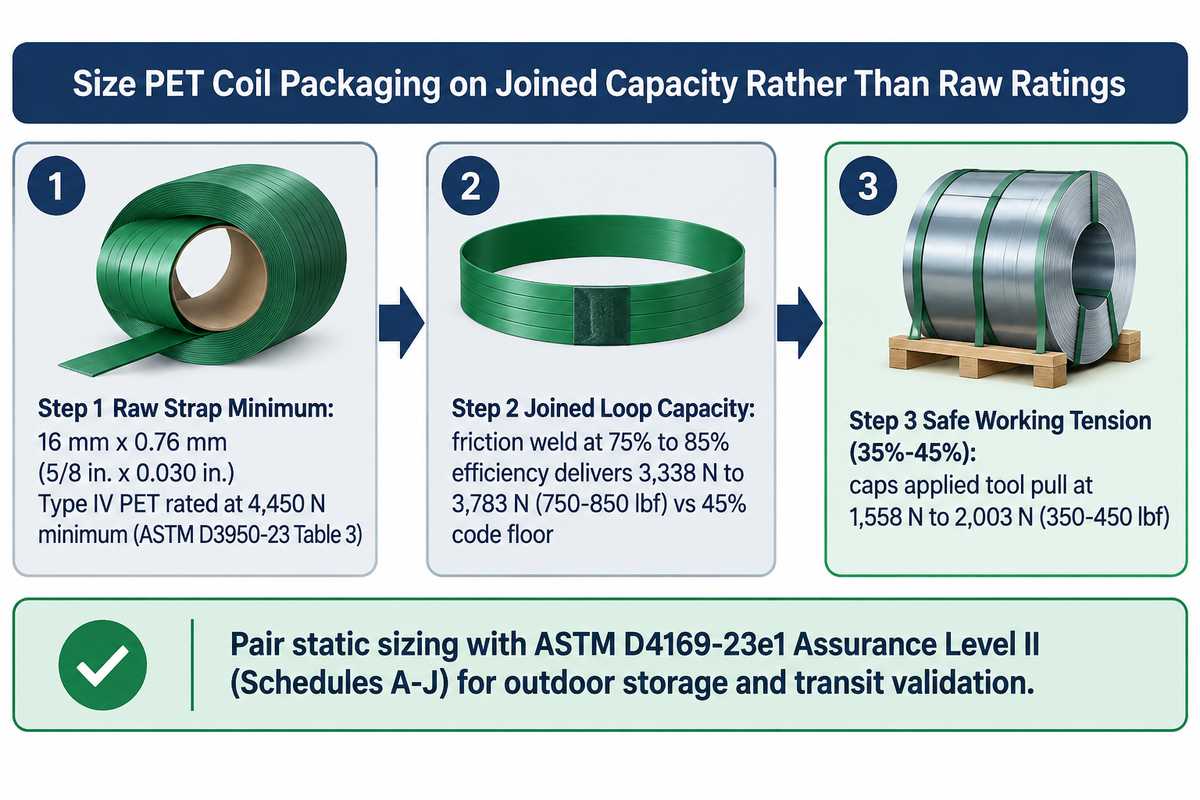
Size PET coil packaging on joined break strength rather than raw ratings. Specify 16 mm (5/8 in.) machine grade PET strapping or hand grade Type IV; ASTM D3950-23 Table 3 starts at 3,115 N (700 lbf) for 0.51 mm (0.020 in.) gauge. Keep working tension in outdoor storage below a ceiling of 40% to 60% of the strap’s rated break strength; the applied tool tensions in the sizing table below sit under that range.
Engineers matching machine grade polyester strapping and checking seal compatibility on supplier datasheets should convert Newtons to kgf or lbf before comparing ratings. For heavy outdoor coils, UV-stabilized smooth PET ranks among the most reliable nonmetallic strapping packaging materials. Divide Newtons by 9.80665 for kilograms-force (kgf), or by 4.44822 for pounds-force (lbf). A 4,450 N strap equals 454 kgf or 1,000 lbf, never 4,450 kgf. Under ASTM D3950-23 Section 7.2.3, standards set just a 45% minimum joint strength floor. Friction welds (~75%–85%) or serrated crimps (~60%–70%) plus shock margins dictate real holding power. Sizing solely on unjoined tensile numbers invites seal snaps.
Worked Example, Sizing Effective Joined Capacity Under Outdoor Warm Creep:
Assumed inputs: Select heavy duty 16 mm by 0.76 mm (5/8 in. by 0.030 in.) Type IV smooth PET strap rated at 4,450 N minimum under ASTM D3950-23 Table 3. Join with a battery friction weld reaching 75% to 85% joint efficiency. Validate the packed coil under ASTM D4169-23e1 Assurance Level II using the single distribution cycle (selected from 18 cycles, Schedules A–J) matching its actual shipment route.
Calculation: Multiplying 4,450 N by 0.75–0.85 gives an effective joined loop capacity of 3,338 N to 3,783 N (750–850 lbf) per band. Keeping continuous working tension at 35%–45% caps applied tool pull at 1,558 N to 2,003 N (350–450 lbf). That keeps a 1.67-to-2.43 reserve between applied tension and friction-weld joint capacity on each individual loop.
Scope of this arithmetic: This calculation compares strap-plus-joint margins statically and is not a dynamic transport certification. Pair it with warm summer container checks and cold-handling limits below –10 °C (14 °F polypropylene glass-transition threshold in Tensar’s TriAx Installation Guide). When moving from light 12 mm strap to heavy 16 mm and 19 mm high tensile strength bands under harsh packaging conditions, use our PET strapping manufacturer comparison and break strength guide to evaluate candidate strap grades.
| Nominal Size (Width & Gauge) | Grade & Standard Minimum (ASTM D3950-23 Table 3 / Catalogs) | Joined Capacity @ 75% Friction Weld | Joined Capacity @ 60% Serrated Crimp | Recommended Applied Tool Range (35%–45%) | Recommended Geogrid Duty & Yard Envelope |
|---|---|---|---|---|---|
| 12 mm, 0.51–0.60 mm gauge (1/2 in., 0.020–0.024 in.) | 1,870–2,700 N (~420–607 lbf / 191–275 kgf) | 1,403–2,025 N | 1,122–1,620 N | 655–1,120 N (147–252 lbf) | Light indoor utility sample coils (~39.0 kg 3 m class) |
| 12 mm, 0.76 mm gauge (1/2 in., 0.030 in.) | 3,780 N min (850 lbf / 385 kgf) | 2,835 N (637 lbf) | 2,268 N (510 lbf) | 1,323–1,701 N (297–382 lbf) | Single 3 m biaxial PP rolls with 2–3 hoop bands |
| 16 mm, 0.51–0.64 mm gauge (5/8 in., 0.020–0.025 in.) | 3,115–3,870 N min (700–870 lbf / 318–395 kgf) | 2,336–2,903 N | 1,869–2,322 N | 1,090–1,742 N (245–392 lbf) | Medium 3 m–4 m biaxial coils in cradle pallets |
| 16 mm, 0.76–0.80 mm gauge (5/8 in., 0.030–0.031 in.) | 4,450 N ASTM D3950-23 Table 3 min (4,230 N JUHONG embossed field case) | 3,173–3,338 N | 2,538–2,670 N | 1,481–2,003 N (333–450 lbf) | Primary trial baseline for standard 4 m–5 m geogrid rolls |
| 16 mm, 0.89–0.90 mm gauge (5/8 in., 0.035 in.) | 5,780 N min (1,300 lbf / 589 kgf) | 4,335 N (975 lbf) | 3,468 N (780 lbf) | 2,023–2,601 N (455–585 lbf) | Dense uniaxial HDPE rolls & eye-to-sky core loops |
| 16 mm, 1.02 mm gauge (5/8 in., 0.040 in.) | 6,670 N min (1,500 lbf / 680 kgf) | 5,003 N (1,125 lbf) | 4,002 N (900 lbf) | 2,335–3,002 N (525–675 lbf) | Heavy 100 m rolls in outdoor multi-month yards |
| 16 mm, 1.14 mm gauge (5/8 in., 0.045 in.) | 7,120 N min (1,600 lbf / 726 kgf) | 5,340 N (1,200 lbf) | 4,272 N (960 lbf) | 2,492–3,204 N (560–720 lbf) | High-memory rolls & multi-tier pallet cross-ties |
| 19 mm, 0.80–1.02 mm gauge (3/4 in., 0.031–0.040 in.) | 7,785 N+ (1,750 lbf+, ASTM D3950-23 heavy PET) | 5,839 N+ (1,313 lbf+) | 4,671 N+ (1,050 lbf+) | 2,725–3,503 N (613–788 lbf) | 5 m jumbo coils (88.9–135.6 kg) & severe shock routes |
| 19–32 mm, 1.27 mm gauge (Extra-Heavy Flat PET) | Up to 18,850 N (4,238 lbf per Signode TENAX catalog) | Up to ~14,138 N | Serrated steel crimp or heavy buckle | Tool-head & machine rated only | Rigid export timber cradles and steel alternative unitizing |
Environmental and testing limits bound every sizing row above. Tensar’s TriAx Installation Guide permits storing coils above –29 °C (–20 °F) with up to six months uncovered sunlight exposure. Avoid handling coils below –10 °C (14 °F), while ASTM D4675 and D4169 Level II govern strap pairing and transport testing.
Curved-Roll Tensioning Tools, Serrated Seals, and Friction-Weld Setup on Geosynthetic Packaging Lines
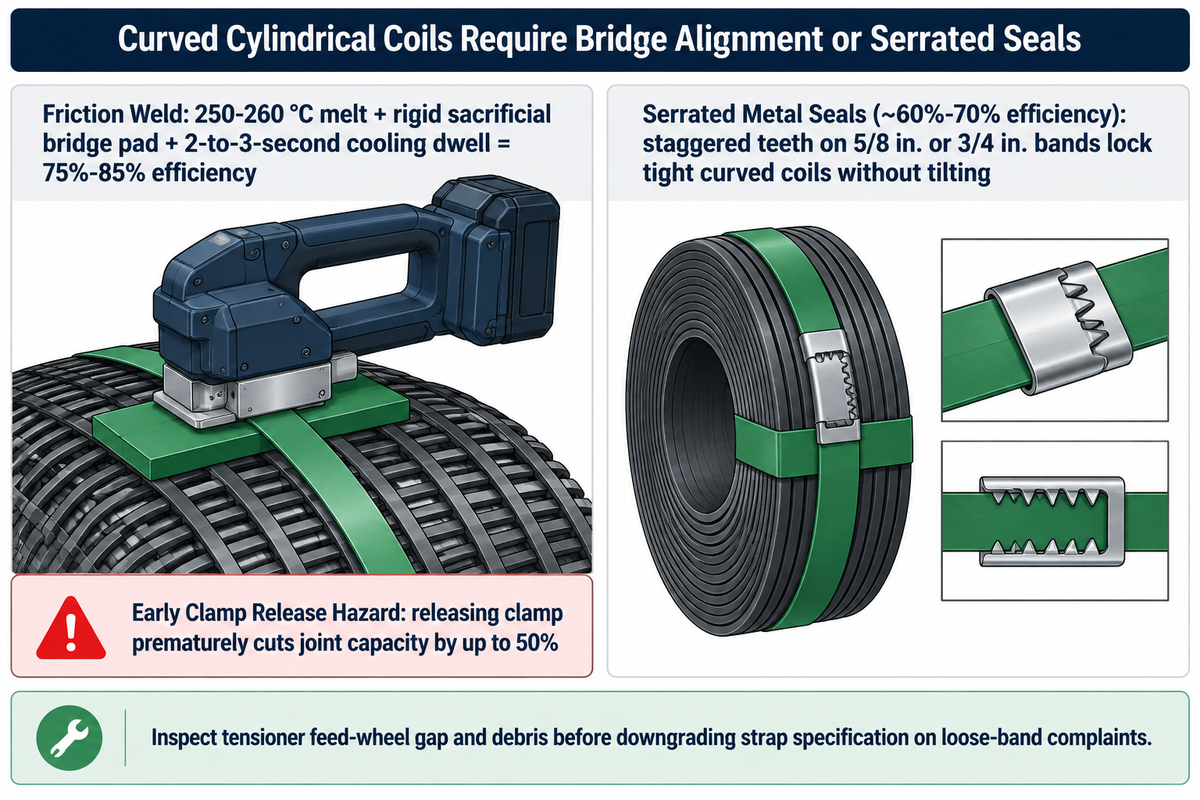
Even when PET strap width and joint strength are sized correctly, curved cylindrical coils destabilize wide flat friction-weld heads unless seated on a broad wear pad. Tight small-diameter coils often favor serrated metal seals instead. Maintain a 2-to-3-second clamp cooling dwell after 250–260 °C melting to reach 75% to 85% joint efficiency per PetPackingStrap vendor troubleshooting guidance.
When used on small, horizontal rolls, a wide battery tool shoe bridges two curved ribs. With the start of vibration heating, asymmetric contact tilts the shoe, resulting in partial fusion or scorching of the ribs below. A rigid sacrificial bridge pad under the weld footprint restores flat alignment. While automatic high-speed strappers in expired Ovalstrapping patent architectures apply dual-roller slip sensing to stabilize strap feeding, confirm head-control specs on semi-automatic and fully automatic strapping machines via UD Packaging’s automatic and semi-automatic coil strapping integration guide.
Real-world plant diagnostics prove tool mechanics often mimic strap failure. A 2024 JUHONG plant field investigation tested a 16 mm by 0.8 mm PET strap slip complaint. The intact strap passed at 4.23 kN (4,230 N) break force, 314 MPa tensile strength, and 16% elongation. An oversized tensioner gap and debris caused the slip. Regularly auditing PET strapping tensioner sizing and loose-strap diagnosis prevents costly strap downgrades.
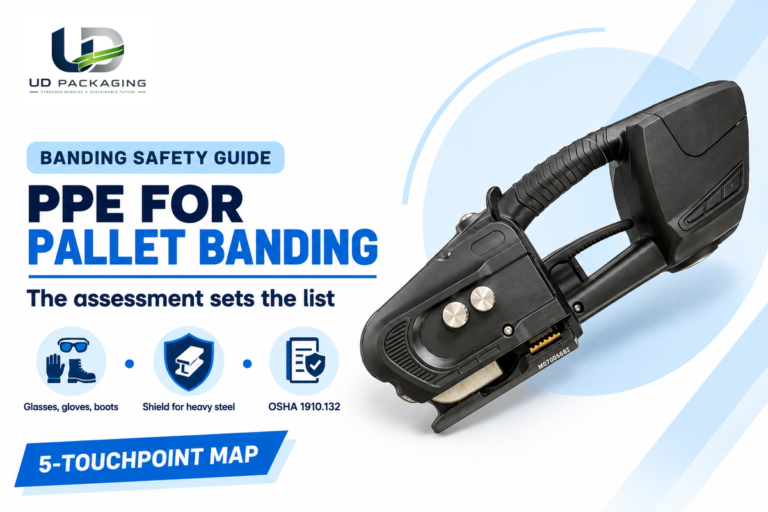
- Friction-weld cooling lockout (75%–85% efficiency): Brushless 14.4 V or 18 V battery heads (manual, battery, and pneumatic strapping tool breakdown) heat PET to 250–260 °C. Releasing the clamp prematurely can cut joint capacity by up to 50% per PetPackingStrap vendor guidance.
- Serrated metal strap seals (~60%–70% efficiency): Manual strapping crews match 5/8 in. or 3/4 in. strap with internal serrated strapping seals and wire buckle pairing. Staggered teeth lock onto hard polyester without slicing edges, unlike smooth PP seals per Strap Solutions FAQ.
Common Mistake: Over-Welding vs. Early Tension Release on Battery Tools
A 1,000 lb (4,448 N) band delivers 750 to 850 lb when fused properly. Lifting a battery tool before the 2–3 s cooling timer finishes shears the hot interface and cuts capacity by up to 50% per PetPackingStrap. Check weld bead edges for slight melt bleed without charring before release.
Line Trial Protocol, Incoming ASTM D3950 Tolerances, and Safe Jobsite Coil Unbanding Sequence
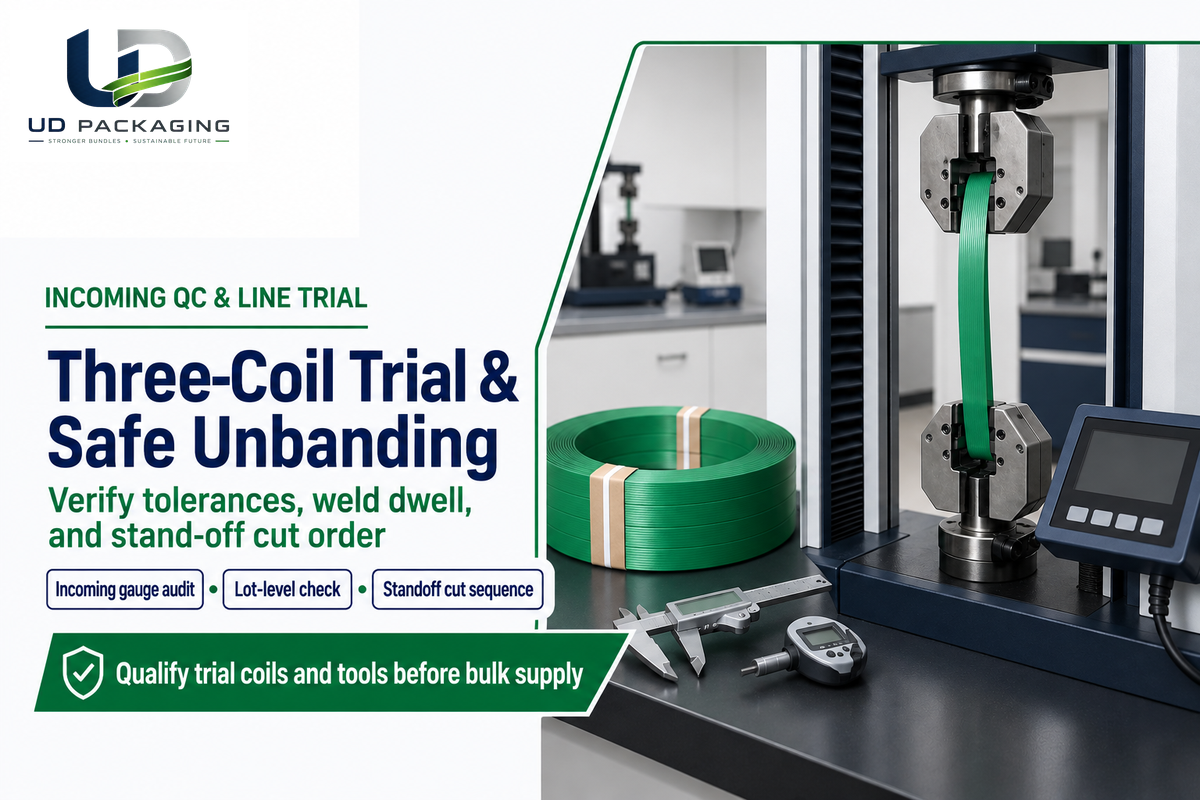
Start a controlled 3-coil line trial using nominal 5/8 in. (0.8 mm gauge) smooth specification-matched PET packing strap. UD Packaging holds manufacturing and engineering tolerance limits at ±0.5 mm width, ±0.05 mm thickness, and ±2.5% roll length. Those targets stay tighter than ASTM D3950-23 test method allowances of ±0.76 mm width and ±0.06 mm thickness (maximum one splice per coil).
Request stock-size trial samples prepared in a 5–7 business day lead time through UD Packaging’s PET strapping manufacturer supply desk (confirm courier and sample terms on quotation). Stock runs start at 1 pallet (56–99 rolls) in 7–15 business days, while custom production begins at 2 tonnes in 10–20 business days.
Worked Example, Incoming Dimensional Acceptance Check:
Assumed inputs: Audit a trial 16.0 mm by 0.80 mm PET strapping coil at start, middle, and inner wraps per PEFilmPack multi-point dimensional inspection.
Calculation: Applying UD Packaging’s tolerance bounds sets an incoming width window of 15.5 mm to 16.5 mm (0.610–0.650 in.). Acceptable thickness runs from 0.75 mm to 0.85 mm (0.0295–0.0335 in.).
Purchasing boundary: UD Packaging supplies extruded PET strapping coils, serrated seals, wire buckles, and compatible manual, semi-automatic, and automatic machinery, not geogrids or roll winders. On request, written procurement quotations reference SGS quality and substance-screening reports for the tested sample, or batch inspection records, tied to the exact sample identity. Payment terms use a 30% T/T deposit with 70% before shipment, or full upfront settlement under USD 1,500. Name GB/T 1040.3-2026 on orders from its December 1, 2026 effective date per UD technical notices.
3-Gate Geogrid PET Strap Qualification & Unbanding Sequence
- Gate 1 — Incoming Coil & Tool Check: Measure strap dimensions across multiple wrap depths against ±0.76 mm ASTM width and ±0.06 mm smooth thickness limits (≤1 splice per coil). Check dispenser fit from 20 kg reels up to 75–300 kg jumbo coils. Clean feed wheels and confirm gripper gap tolerances before tensioning.
- Gate 2 — Worst-Case 3-Coil Packaging Trial: Strap three test coils across horizontal hoop, eye-to-sky axial, and cradle cross-tie setups. Run 16mm PET smooth/waxed bands or sleeved embossed coils. Inspect ribs under shields and verify loop snugness after pallet stabilization.
- Gate 3 — Controlled Jobsite Unbanding Safety: Per Geoworks installation guidance, installers should be provided with safety eyewear and cut-resistant gloves against sharp grid edges. Keep coils blocked and stand clear of the tangent unwind path ( warehouse diagonal cut guide). Hold the free tail with one gloved hand and cut diagonally away from face and legs so “roll memory” opens safely along the ground.
Frequently Asked Questions
What makes packaging geogrid coils with PET strap different from strapping cartons or bricks?
Geogrid rolls lack flat 90-degree brick corners and store continuous radial clock-spring unwind energy around hollow cores (Tensar installation guide). Cool storage days heighten sudden “roll memory” snapback when bands are cut, and settling layers invert under-tensioned PP. Unblocked cylindrical rolls spin beneath bare straps (ROLL Packaging), requiring timber cradles and Type IV polyester recovery.
Should you use smooth or embossed PET strapping to prevent rib notching on geogrid coils?
Pick smooth or controlled-wax PET strap for direct contact with extruded or coated geogrid ribs. Flat profiles eliminate sharp ridge concentration, and JUHONG tensile testing on 18.7 by 1.0 mm strips hit 7,230 N smooth versus 6,417 N embossed. Whenever automated tools need embossed grip, shield the coil with full kraft sleeves or rigid edge protectors.
When should you trial circumferential hoop straps versus axial eye-to-sky straps on geogrid rolls?
Match strap pattern to roll width and mass across the 39.0 kg (3 m) to 135.6 kg (5 m) Tensar TX weight range. Run two or three spaced perimeter hoop loops inside cradles for the lighter 3 m horizontal rolls. Add center hooping and cradle cross-ties for 4 m – 5 m rolls. Go for 2 – 4 axial through-core straps with rim shields for eye-to-sky rolls or heavy uniaxial rolls (ROLL Packaging).
What PET strap width and thickness should be trialled first for heavy uniaxial or coated geogrid coils?
Begin trials with 5/8 in. by 0.76–0.80 mm smooth Type IV PET (~4,230–4,450 N). Upgrade to heavier 5/8 in. gauges (6,670–7,120 N) or 3/4 in. strap on 88.9–135.6 kg 5 m coils.
How do you size friction-weld cooling hold time and working tension so PET straps do not peel on curved coils?
Hold clamp compression for an unbroken 2 to 3 second cooling timer and set working tension at 35% to 45% of nominal break strength. Seat the tensioner base on a sacrificial wear pad so curved ribs can’t tilt the weld shoe during 250–260 °C melting per PetPackingStrap weld guidance. Never lift the weld head before solidification finishes; releasing early can drop a 75%–85% friction weld below the ~60%–70% efficiency of serrated metal seals.
Why does polypropylene (PP) strapping loosen on geogrid coils stored outdoors or in shipping containers?
ASTM D3950 Type II polypropylene strap relaxes quickly in warm storage yards and hot shipping containers. Sunlight also weakens unstabilized PP strap per Signode guidance.
What coil details should buyers send UD Packaging for a specification-matched PET strap sample trial?
Share strap width, thickness, core ID, roll face width, weight, exposure temperatures, grid coating, tool model, and seal preference via UD Packaging’s buyer’s guide. Trial sample rolls ship in 5–7 business days for stock sizes, with buyers confirming courier terms on the quote. Written quotes confirm order tolerances, sample-specific SGS quality reports, and GB/T 1040.3-2026 tensile documentation (alongside ASTM D3950-23).
References & Sources
- ASTM International / iTeh Standards — ASTM D3950-23 Standard Specification for Strapping, Nonmetallic (and Joining Methods)
- ASTM International / iTeh Standards — ASTM D4675-14a(2022) Standard Guide for Selection and Use of Flat Strapping Materials
- ASTM International / iTeh Standards — ASTM D3953-15(2022) Standard Specification for Strapping, Flat Steel and Seals
- U.S. Occupational Safety and Health Administration (OSHA) — 29 CFR 1918.81(f) Slinging and Unitized Band Hoisting Restrictions
- Tensar International Corporation Tensar TriAx (TX) Geogrids Installation Guide: Roll Dimensions, Stacking, Temperature & Roll Memory
- Geoworks Eco Geogrid Installation, Transportation, and Storage Guide (5-Roll Stack & Forklift Core Boom Rules)
- ROLL Packaging How to Secure Rolls and Reels for Transport (Cradles, Wedges, Eye-to-Sky & Edge Protectors)
- Grip Strapping Technologies — Industrial Edge Protectors for Wound Coils and Strapping Tension Distribution
- JUHONG Packing Materials Smooth vs. Embossed PET Strapping Tensile Comparison (7,230 N vs. 6,417 N) & 16×0.8 mm Slip Case
- PetPackingStrap Why PET Strap Breaks at the Seal Point: 250–260 °C Friction Welding, Cooling Dwell & Serrated Crimps
- Strap Solutions PET vs. PP Tension Retention & 60% Crimp vs. 85% Battery Friction-Weld Efficiency FAQs
- PEFilmPack PET Strapping Band Buyer’s Guide: 9–32 mm Width Spread & Multi-Point Coil Inspection
- Signode Packaging Systems — Tenax Polyester Strapping Technical Brochure & PET vs. PP Engineering Guidance
- FROMM Packaging Systems STARstrap PET Specifications (9–32 mm Range & Coil Configurations)
- European & German Patent Records — DE19904843C5 Relieved-Cove Edge Protection Angle & EP1059234A1 Dual-Stage Slip-Monitored Strapper
- Bentley World-Packaging — ASTM D4169 Distribution Cycles, Assurance Level II, and Test Schedules Overview