Get in touch with UD Packaging Company

Updated November 2026
UV resistant stretch wrap is pallet polyethylene film formulated to slow sunlight-related degradation. Use it for palletized loads with exposure to UV throughout outdoor storage, then verify the grade against the storage period and wrapping method. The performance specification describes how the film performs after exposure and its ability to keep the load contained.
A pallet of printed cartons requires a different packaging arrangement from a pile of masonry. The cartons also require protection from water and unwanted light; the masonry has sharp contact points that can puncture the film. The clear film allows workers to see the labels, while an opaque film conceals the contents.
Those decisions happen in the purchase brief ahead of when the roll price comes up.
Before comparing quotes
Specify the film grade, storage location and season, uncovered time, load shape, hand or machine application, and the properties that must remain acceptable. Keep film durability, product light screening and rain protection as separate requirements.
What UV Resistant Stretch Wrap Actually Protects
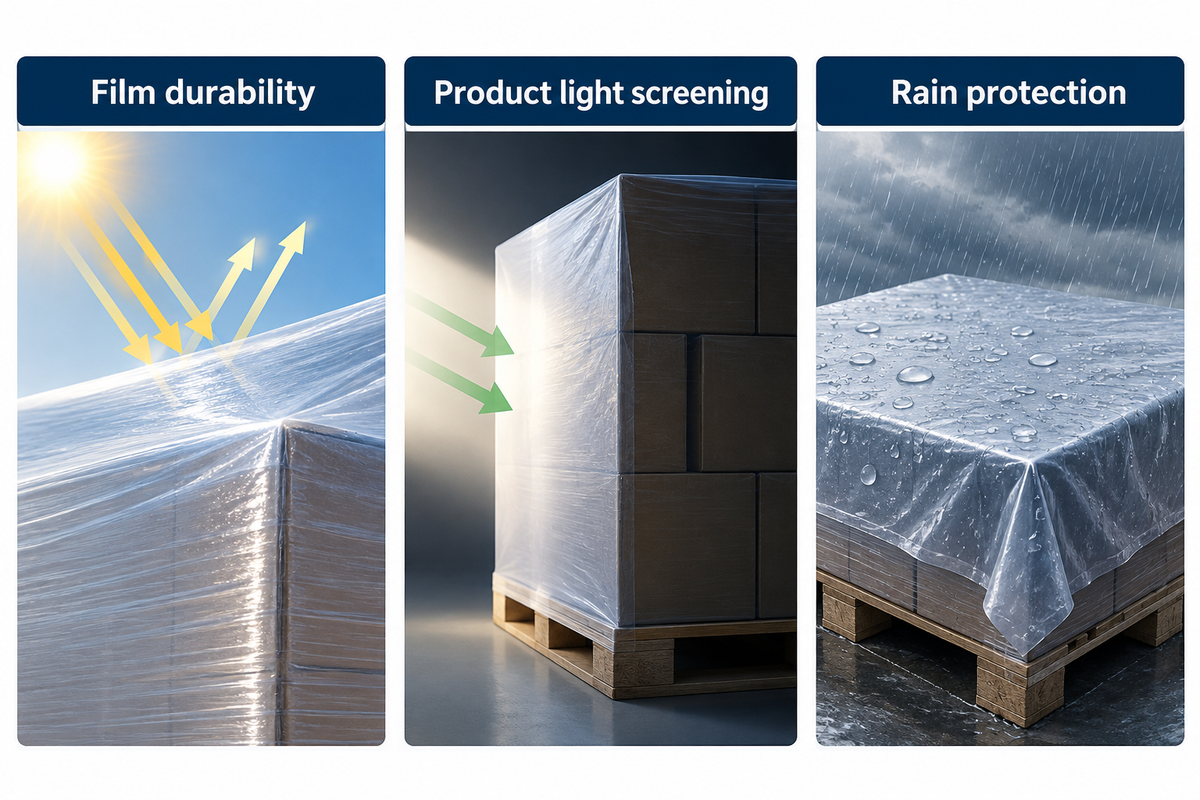
UV inhibitors aid plastic film in resisting the effects of UV radiation; protection of the products also depends on the film’s optical properties and package coverage. A durable clear wrap can leave the contents visible to sunlight, while a dark film can conceal them without establishing how long that particular film will survive outside.
Think of stabilization as preserving the wrapping material itself. UV rays can initiate photo-oxidation, causing the polymer to degrade and eventually become brittle or crack. UV absorbers take up UV light; hindered amine light stabilizers interrupt radical reactions. A manufacturer can combine these mechanisms in the formulation, as discussed in this review of solar UV damage to materials.
The terms UVI stretch film, UV inhibited film and UV stabilized stretch wrap films describe this stabilization purpose. The next purchasing question is what level of protection the finished wrap offers at its applied thickness. Extension, overlap and colour make a difference to the package the sun reaches.
Maintain three acceptance items on the specification: the film continues to be mechanically usable, the goods receive the necessary protection against UV reaching sensitive surfaces, and the final package withstands the anticipated water exposure.
How Long Can UV Stretch Film Last in Outdoor Storage?
UV stretch film has no general outdoor service life; its applicable storage period is specific to the named film grade under the given exposure conditions. Determine a storage period, location, season and allowable end condition and specify them before making comparisons between monthly ratings. For prolonged outdoor exposure, your decision should take into account residual mechanical properties and the complete wrapped load, rather than appearance alone.
Mention whether the pallet receives direct sunlight all day and how rain can get to the top. A covered loading bay and an open yard put varying strain even if the period on the calendar is the same. Keep waiting pallets away from direct sunlight, if storage permits it, to minimise their exposure.
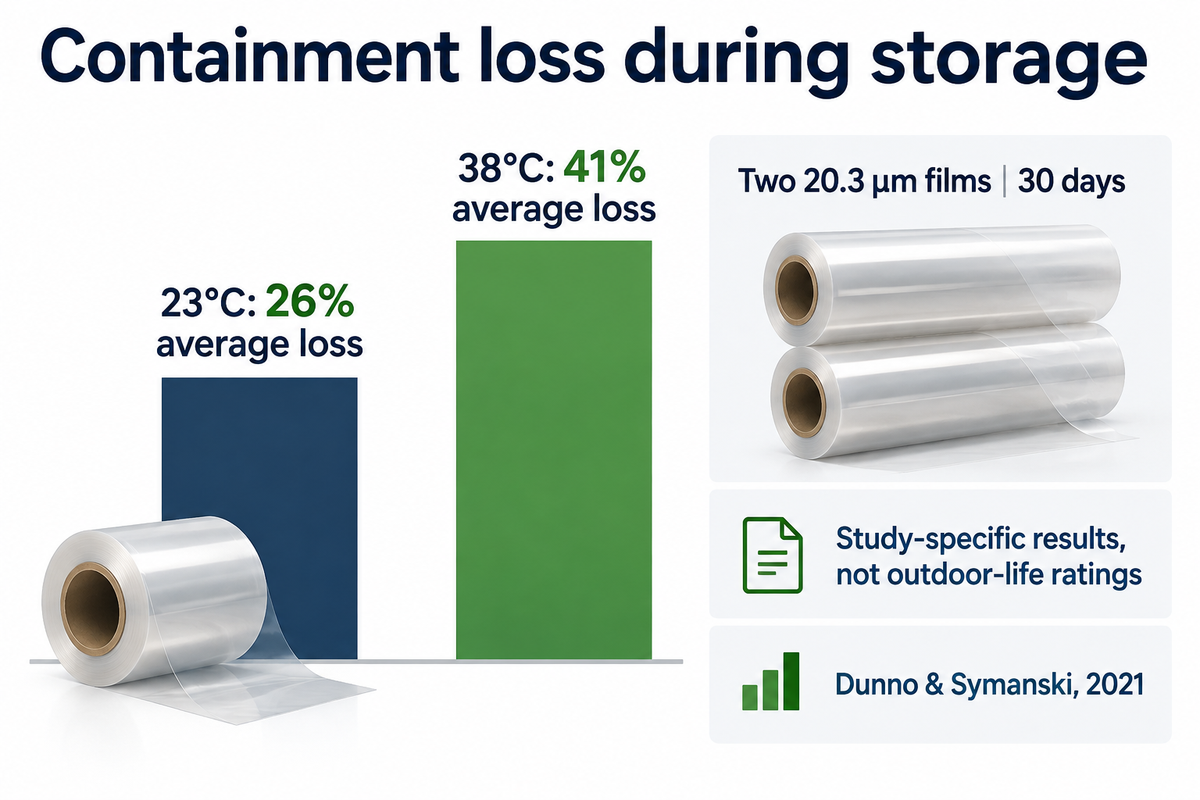
Storage temperature matters even before UV damage is isolated. In Dunno and Symanski’s 2021 machine-film study, two 20.3 µm films were applied to simulated loads and stored for 30 days. Average containment loss was 26% at 23°C and 41% at 38°C. These are results for the tested films and storage conditions, not outdoor-life ratings. They show why a UV claim and a load-holding requirement need separate attention.
Can accelerated test hours be converted into months outside?
No universal conversion exists from chamber hours to outdoor months. A meaningful correlation must relate to the material, the weather condition and property of interest. NIST’s weathering research develops service-life models using controlled light, temperature and moisture conditions; that is a different basis from multiplying a test duration by an arbitrary factor.
When a quote gives a time for storage, write the grade and the exposure description underneath it. Then identify the endpoint: tearing, loss of elongation, reduced load containment or damaged goods. A report showing an apparently intact specimen after exposure answers a different question from a report that has evaluated retained strength.
Clear, White or Black Stretch Film: Choose by the Load
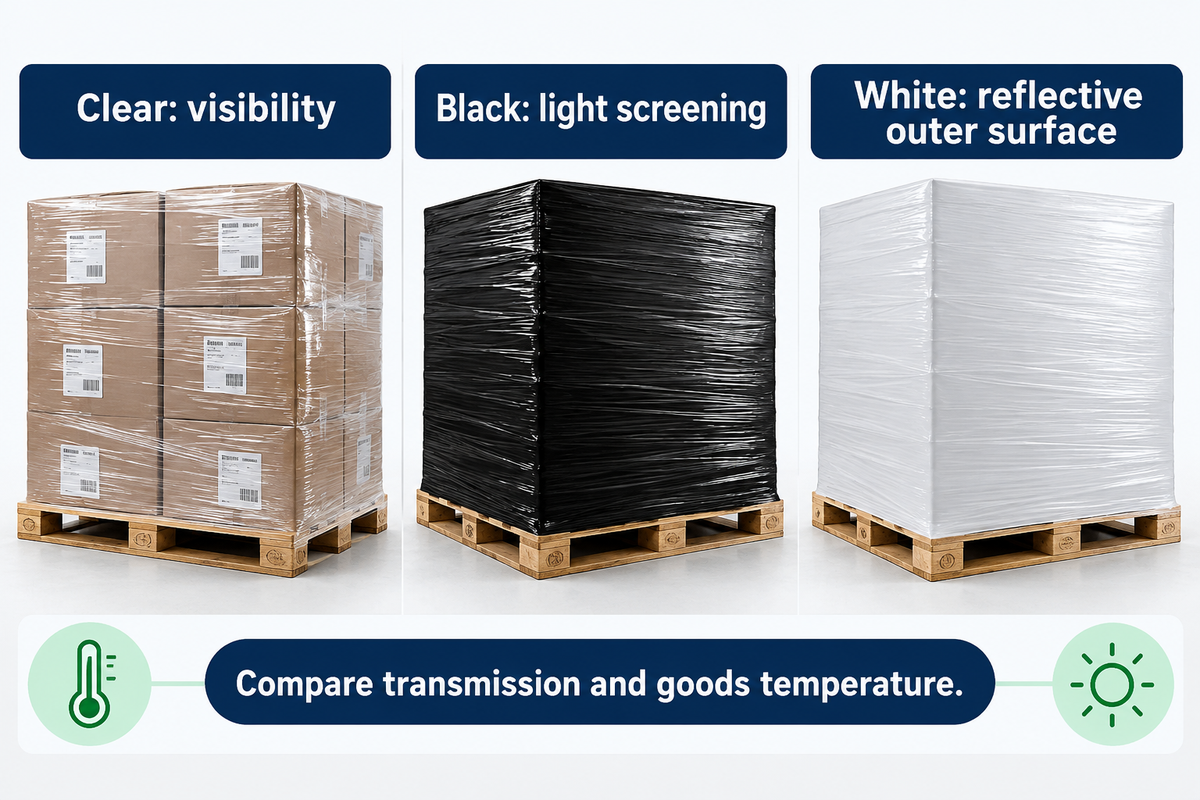
Clear stretch film is good for loads that require the labels and contents to remain revealed. Opaque black or white grades work for a light-screening criterion where the actual transmission will then be tested for the goods being packaged. The colors impact solar absorption and reflection too, so temperature-sensitive items need a package-level thermal comparison.
| Film option | Useful purchasing reason | Property to compare |
|---|---|---|
| Clear UV grade | Read labels and inspect the load through the wrap | Light transmission at applied stretch and overlap |
| Opaque black UV grade | Conceal contents and screen incoming light | Opacity, film temperature and goods temperature |
| Opaque white UV grade | Combine light screening with a reflective outer surface | Transmission, reflectance and the wrapped product’s temperature |
Is black pallet wrap always the better outdoor choice?
No. Black stretch film is good for opacity, but the product’s heat resistance and the film’s own stabilization are still significant. Regular colored stretch film and an outdoor grade are two separate purchasing specifications.
Ask for the grade name and exposure conditions before treating color as an indicator of outdoor performance.
UConn’s explanation of polyethylene mulch shows why contact matters: absorbed heat can transfer through good contact, while air gaps alter that transfer. For a wrapped product, compare the film surface and the goods separately, including their contact, air spaces and exposure to transmitted sunlight.
Match Outdoor Stretch Wrap to Rain, Corners and Wrapping Equipment
Outdoor stretch wrap forms part of a load-specific packaging arrangement in various industries and applications. Add top coverage where rain can get in, add edge protection where the load cuts the film, add a wrapping style that keeps it all together. The film is designed for a particular application method, so hand wrap and machine stretch wrap should be evaluated in their actual use.
Three-Job Outdoor Wrap Selector
This purchasing guide distinguishes film durability, product protection from light and load protection from rain.
| Load or storage condition | Priority beyond film UV stability | Packaging decision |
|---|---|---|
| Bagged powders | Rain entry at top and bag closures | Compare top-cover overlap and the bag’s own moisture barrier |
| Absorbent cartons | Wet-board damage | Protect the top and check water paths after handling |
| Sharp masonry | Corner punctures and tears | Evaluate corner protection and applied-film puncture behavior |
| Timber packs | Protrusions and moisture management | Match coverage and ventilation to the timber’s storage requirement |
| Metal parts | Condensation and corrosion | Select moisture and corrosion protection alongside the outer wrap |
| Printed packaging | Fading or label readability | Choose screening or visibility according to the printed surface |
| Goods sensitive to sunlight | Product response to transmitted wavelengths | Compare optical performance of the complete wrapped arrangement |
| Loads needing airflow | Trapped moisture or heat | Compare a ventilated arrangement with the rain-exclusion requirement |
| Mixed-height pallets | Uneven coverage and top exposure | Adjust the cover and wrap pattern around the actual load profile |
Is stretch wrap waterproof around a pallet?
Rain can enter through an uncovered top, overlaps, punctures or openings around the base. ASTM D951’s shipping-container spray test distinguishes resistance of the container itself from protection of its contents.
For bagged material waiting in a yard, start with the route water takes. The side wrap may remain intact while the upper bag seams become wet. Choose a top-cover arrangement that sheds water past the vulnerable surfaces, and inspect the overlap after the pallet has been handled. Keep bag moisture performance in the same purchasing discussion as the outer film. A heavier side wrap does little for an exposed top. The pallet top-sheet guide helps compare that additional protection. Record the condition of both the bags and the plastic when reviewing the trial.
For masonry with rough edges, the first comparison is how the applied film crosses the corners. A tear that starts at a protrusion can spread during handling even while the rest of the pallet wrap looks sound. Compare edge protection, wrap placement and candidate film together. ASTM D5748-26 measures stretch-film puncture behavior using a low-speed probe, including force, penetration distance and energy to break. Use that information to compare materials, then inspect the actual corner geometry. Photograph where a puncture starts rather than recording every torn pallet simply as a failure of UV protection.
For moisture-sensitive metal goods, an intact outer wrap is only one part of storage planning. Consider condensation, the condition in which the goods are packed, and any separate corrosion-control requirement. Water trapped inside a package creates a different problem from rain entering from above. Keep the chosen moisture-control arrangement consistent across candidate films so the comparison remains useful. If inspection shows moisture inside an otherwise intact package, revise the enclosure and storage method before adding more layers.
For a wrapping machine, note the stretch you’re applying, tension, overlap, top/bottom passes and load condition. The machine stretch film qualification guide applies to the application side of the comparison. When comparing hand stretch films, include the operator’s technique in the trial record.
Compare Weathering Reports Before Comparing UV Claims
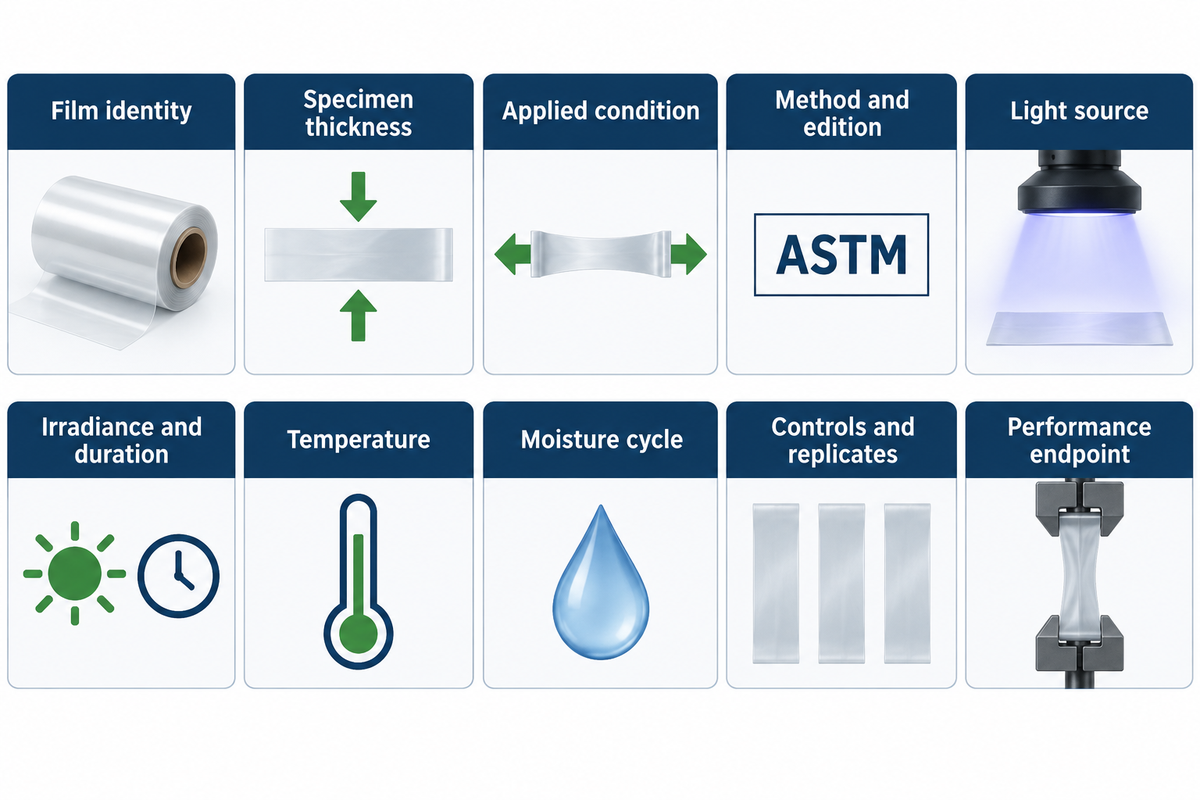
For example, a good weathering report details the film and test method used, then compares what changed. Compare candidate wrap films only after matching specimen preparation, light source, evaluation method, moisture cycle and temperature.
ASTM D4649-20(2025) provides guidance for indoor stretch-film use; assess outdoor-exposure performance separately.
For plastics weathering, ASTM D4329-26 handles exposure to fluorescent UV and water, preparation of tested material and assessment of the results. A report claiming use of this method must include the specific test conditions.
| Report item | What to match | Decision it supports |
|---|---|---|
| Film identity | Grade, formulation reference, color and batch | Connect the report to the quoted material |
| Specimen thickness | Tested thickness and how it was measured | Compare like material states |
| Applied condition | Unstretched or stretched specimen; stretch direction | Relate the specimen to the wrapped film |
| Method and edition | Standard, revision and selected procedure | Identify technical differences between reports |
| Light source | Lamp type and spectral conditions | Understand the radiation used |
| Irradiance and duration | Reported irradiance and exposure time | Compare the defined exposure, not time alone |
| Temperature | Reported control and specimen-temperature conditions | Separate heat effects from other variables |
| Moisture cycle | Condensation, spray and dry phases | Recognize different weathering stresses |
| Controls and replicates | Reference material and repeat specimens | Assess repeatability and relative performance |
| Performance endpoint | Before/after tensile, elongation or other agreed property | Judge retained function against the purchase requirement |
ASTM D4329 recommends a known-performance control and at least three replicates of each material. That recommendation concerns laboratory specimens. For the finished load, add the application checks that matter to the goods, such as containment after storage, damage at corners and water reaching the contents.
If a supplier offers only a summary certificate, request the grade reference, exposure conditions and measured endpoint behind it. For a premium stretch grade, compare the measured endpoint with the lower-priced candidate using the same test conditions.
Run a Yard Trial and Watch for Loss of Performance

A yard trial should compare complete wrapped loads using a consistent application recipe and inspection schedule. Record the condition immediately after wrapping, at agreed time intervals and after handling. Isolate tears, moisture penetration, product damage and loss of containment so a problem results in a valuable modification to the packing layout.
Initial film relaxation makes inspection timing important. In the machine-film study discussed above, most groups lost containment fastest during the initial 2 hours; the high-performance film at 38°C continued relaxing for 7 days. Use the same measurement interval for each candidate and insert a matching sheltered-control to distinguish storage relaxation from outdoor weathering.
“The relaxation curves developed from each test indicate the relaxation rate of the films varied based on the storage condition.”
- Fix the starting arrangement. Record the grade, load, wrapper settings, covers and edge protection.
- Apply the acceptance criteria. Assess the trial against the film, load and goods requirements agreed before testing.
- Record exposure and elapsed time. Log storage location, weather, handling events and the time of each measurement.
- Inspect the failure location. Distinguish general embrittlement from a corner tear, open overlap or wet contents.
- Review before scaling the order. Change the relevant film or packaging variable and preserve the comparison record.
Loose film, whitening, cracks, punctures and tears merit inspection, but visual evaluation is only one aspect of the assessment. Keep measurements tied to the same locations and method. When damage is around an edge, go to that place of contact; when contents are wet, follow the water flow.
One observation should suggest a specific check, rather than a blanket rejection of all UV resistant grades.
Recheck Performance When the Film Specification Changes
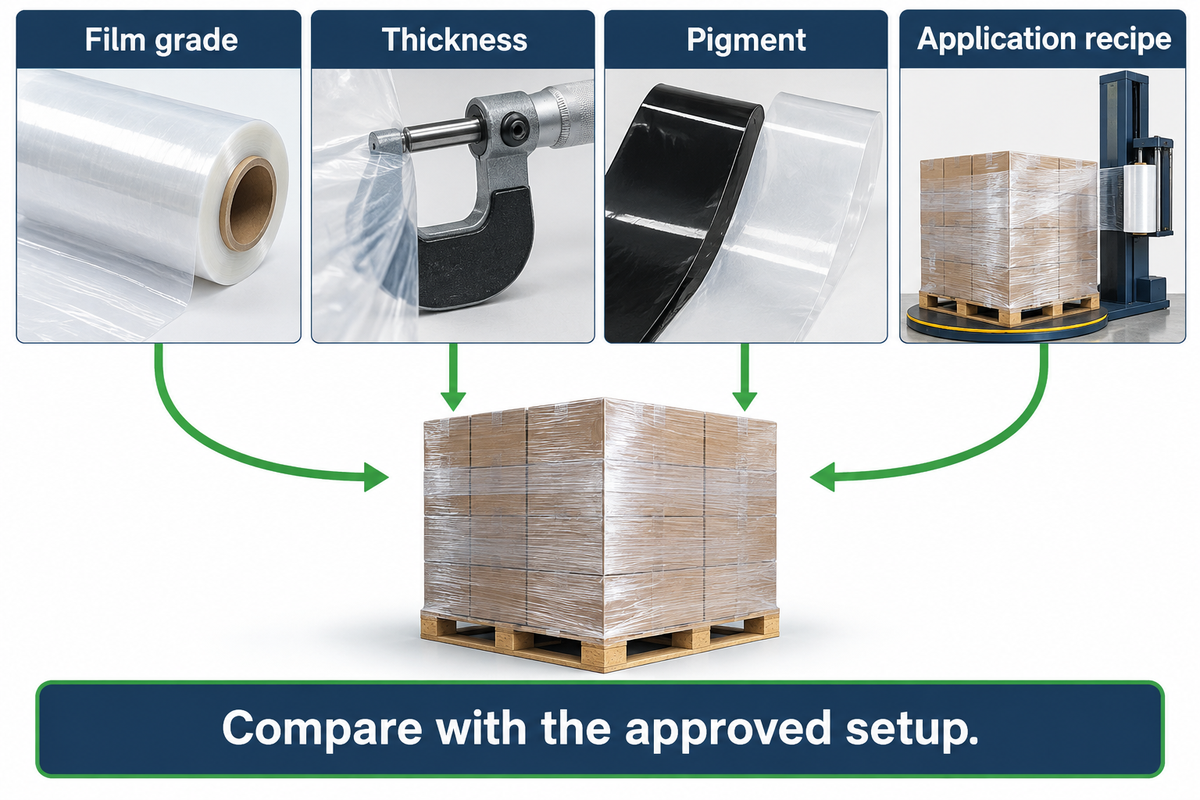
Alteration of film grade, thickness, pigment or application recipe requires comparison with the former approved setup. Leave test-report identity as part of the supplied specification. Adjustments to the weathering technique are significant: reports carrying similar established standard names might be showing divergent exposure scenarios.
ISO 4892-3:2024 is the current fifth edition for fluorescent UV lamp exposure of plastics. Its revision distinguishes instrument types more clearly. ASTM D4329 also states that it and ISO 4892-3 address the same subject but differ in technical content. Keep the edition and procedure in the record when comparing an older report with a new offer.
For a cost-saving idea, compare the new film in the wrap configuration before changing several conditions at once. That keeps useful context for the result. Introducing a thinner film, alternative pigment package and different machine recipe at once is less clear than trying each one.
Specify the Job Before Ordering UV Stretch Wrap
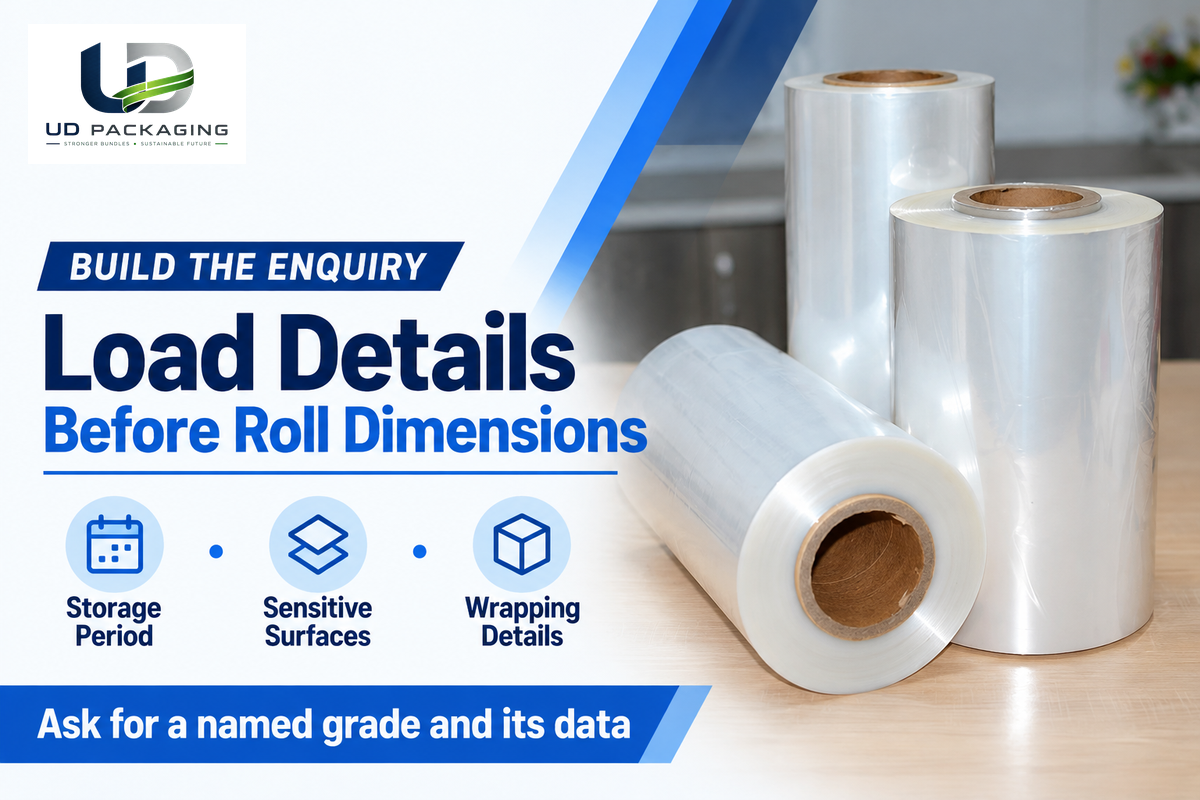
An outdoor-film enquiry should be able to specify the types of items, exposure and the method of application before requesting a roll specification. Send the proposed storage period, location, load size, sensitive surfaces and wrapping details. Request the stretch film manufacturer or supplier to associate the suggested grade with the corresponding performance data and sample.
Western Plastics offers Weather Wrap UVI pallet wrap and describes accelerated-aging weatherometer testing for the clear product. It’s a good reference for first time ordering an outdoor grade; ask for the grade-specific test report behind the offer. For other candidates, compare the same test fields rather than treating a catalogue description as the full report.
UD Packaging supplies industrial stretch film. For a UV-specific enquiry, list the outdoor grade and exposure requirements separately from ordinary roll dimensions. Include whether labels must remain visible, whether the goods are sensitive to sunlight, and what additional protection is used at the top and corners.
Compare suppliers against the same brief; the stretch film manufacturers overview can support the shortlist. Keep price comparison tied to the accepted packaging arrangement and the amount of usable film per load.
Key takeaway
Buy the film grade together with its exposure conditions and wrapping arrangement. The acceptance decision belongs to the stored load and goods, as well as the film.
Preparing an outdoor pallet-wrap enquiry? Send UD Packaging your load details, storage conditions and hand or machine application requirements.
Frequently Asked Questions
What is UVI stretch film?
UVI stretch film is pallet wrap formulated with an ultraviolet inhibitor system to slow sunlight-related degradation of the polyethylene. The term helps identify a film intended for UV exposure. A useful purchasing description also names the grade, application method, exposure period and retained properties, so the supplier can match the proposed roll to the load and storage arrangement.
Can UV-stabilized film protect light-sensitive goods?
Yes, with a grade and wrapping arrangement selected for the product’s light sensitivity. For goods that need screening, compare transmission through the applied film and its overlaps, then choose an opaque or covered arrangement where appropriate. Keep label visibility in the same decision. The relevant property is the light reaching the product, rather than the appearance of the roll alone.
Can a standard hand-wrapping roll be used outside?
Use a specified outdoor grade for planned outside storage. Match the hand-applied film to the load shape and the operator’s wrapping method, including overlap, tension and edge protection. If the pallet will stand in a harsh outdoor position, include the cover arrangement and expected handling in the enquiry so the sample trial represents the package that will actually be stored.
Does thicker stretch film always last longer in sunlight?
No. Compare thickness together with the stabilizer formulation, applied stretch and exposure conditions. Thickness alone doesn’t establish an outdoor service period.
Is shrink-wrap outdoor life transferable to stretch wrap?
No. A shrink-wrap rating belongs to that product and application. Shrink film is tightened with heat, while plastic stretch wrap is elongated around the load. Their starting thickness, formulation, seams and coverage can differ. Keep boat shrink wrap, agricultural bale film and industrial pallet wrapping as separate product categories when comparing offers.
Useful questions can carry across those categories: what exposure was used, which property was measured, and what counted as failure? The actual material specification and acceptance result must remain attached to the product tested. For storing products outside, compare candidate stretch grades in the intended packaging arrangement instead of borrowing another category’s month rating.
Where can I buy an outdoor grade for a machine wrapper?
Start with industrial film suppliers that can match a named outdoor grade to your wrapping machine. Send the machine settings, load profile and exposure brief, then compare the proposed sample and performance information against the same purchasing requirements.
Related Reading
References & Sources
- Review of Solar UV Radiation and Materials Photodegradation
- ASTM D4649-20(2025): Use of Stretch Films and Wrapping Application
- ASTM D4329-26: Fluorescent UV Lamp Apparatus Exposure of Plastics
- ISO 4892-3:2024: Fluorescent UV Lamp Exposure
- Dunno and Symanski: Stretch-Film Behavior During Storage, 2021
- NIST: Metrology for Accelerated Laboratory Weathering
- ASTM D5748-26: Protrusion Puncture Resistance of Stretch Wrap Film
- ASTM D951-17(2024): Water Resistance of Shipping Containers
- UConn Extension: Color, Transmission and Heat Transfer in Polyethylene Mulch