Get in touch with UD Packaging Company

Biodegradable Stretch Film: What Buyers Should Ask Before Replacing PE Wrap

Packaging buyer guide
A “biodegradable” label doesn’t tell a warehouse where used film can go. Before you replace your conventional PE stretch film program, make sure you examine the breakdown environment, confirm the scope of the certificate, investigate local facility acceptance and review pallet performance.
Short answer: consider biodegradable stretch film as a claim to be investigated, not as a disposal instruction. Biodegradable stretch film is film marketed to break down, or degrade over time, through biological action under stated conditions. Where is the film expected to biodegrade, under what conditions and in what time? Then match that answer to an appropriate composting or recycling route and perform the same pallet test you would perform on any new wrapping film.
This guide employs a simple decision framework of Claim, Certificate, Facility, Load Trial. A product should pass all four tests to warrant a change to your standard PE wrap specification used for traditional stretch film in the packaging industry.
Read the claim and name the disposal environment
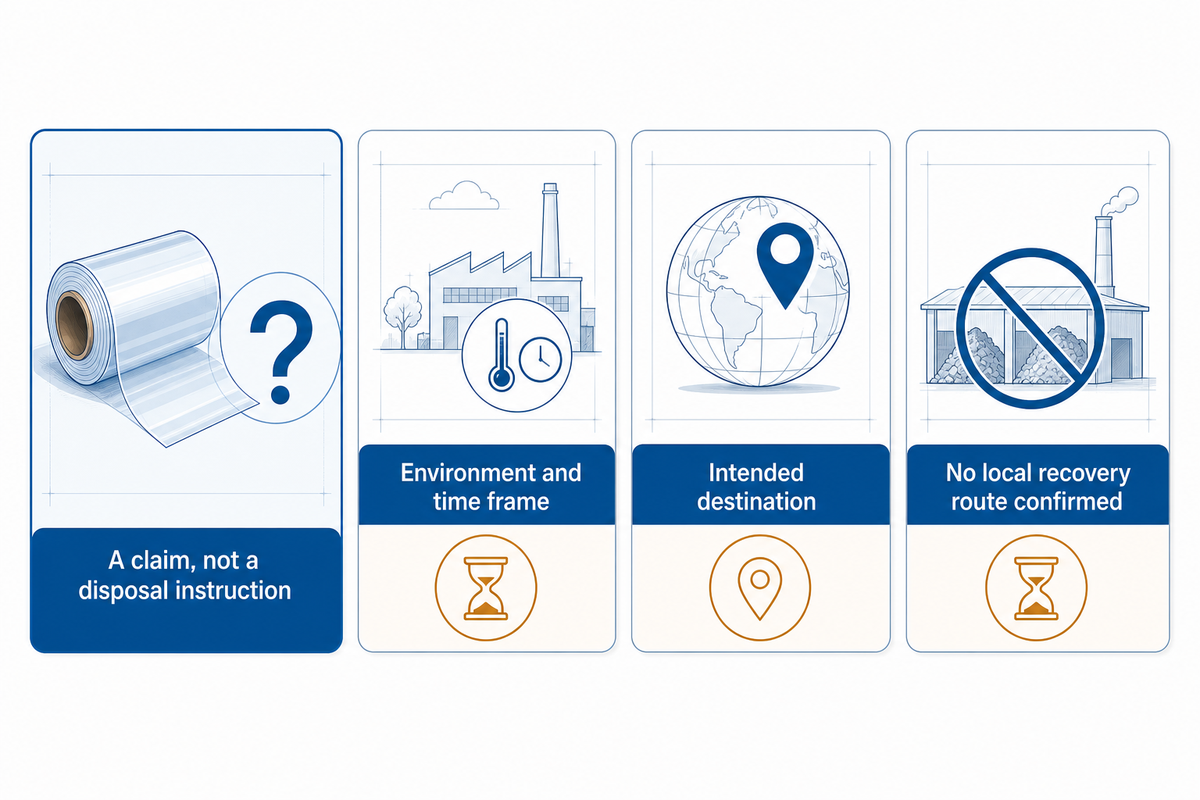
A biodegradable claim is incomplete without a stated environment and time frame, since degradation depends on the conditions. Biodegradation requires microorganisms to break down or decompose the material; heat, light or fragmentation alone do not establish biological conversion or true biodegradability. That label doesn’t tell a warehouse where the film should go; should it go to a landfill, an industrial composting facility, a home compost pile, a plastic-film collection stream or to ordinary waste?
The Federal Trade Commission’s (FTC) Green Guides explain that an unqualified degradable claim needs evidence that the entire product completely breaks down and returns to nature after customary disposal; for solid waste products, this must happen within one year. The current FTC guidance should be used for the claim review, alongside the Green Guides summary; leaving a package in a landfill, incinerator or recycling stream does not meet that condition; unqualified biodegradable claims should not be made for products customarily sent to these destinations. Use the FTC guidance to request a qualified, product-specific claim rather than using “eco-friendly” as a guarantee.
For all film selling statements of biodegradation or compostability, include the intended destination in the buying record, whether it is composting, recycling or waste in landfills. Examples include, but aren’t limited to, “industrial composting only, accepted by Facility X” or “Specialist PE-film recycling only.” Also include “no local recovery route confirmed” when that is the documented result. This prevents the assumption that biodegradable stretch wrap can go in any green bin.
Separate biodegradation, composting and recycling
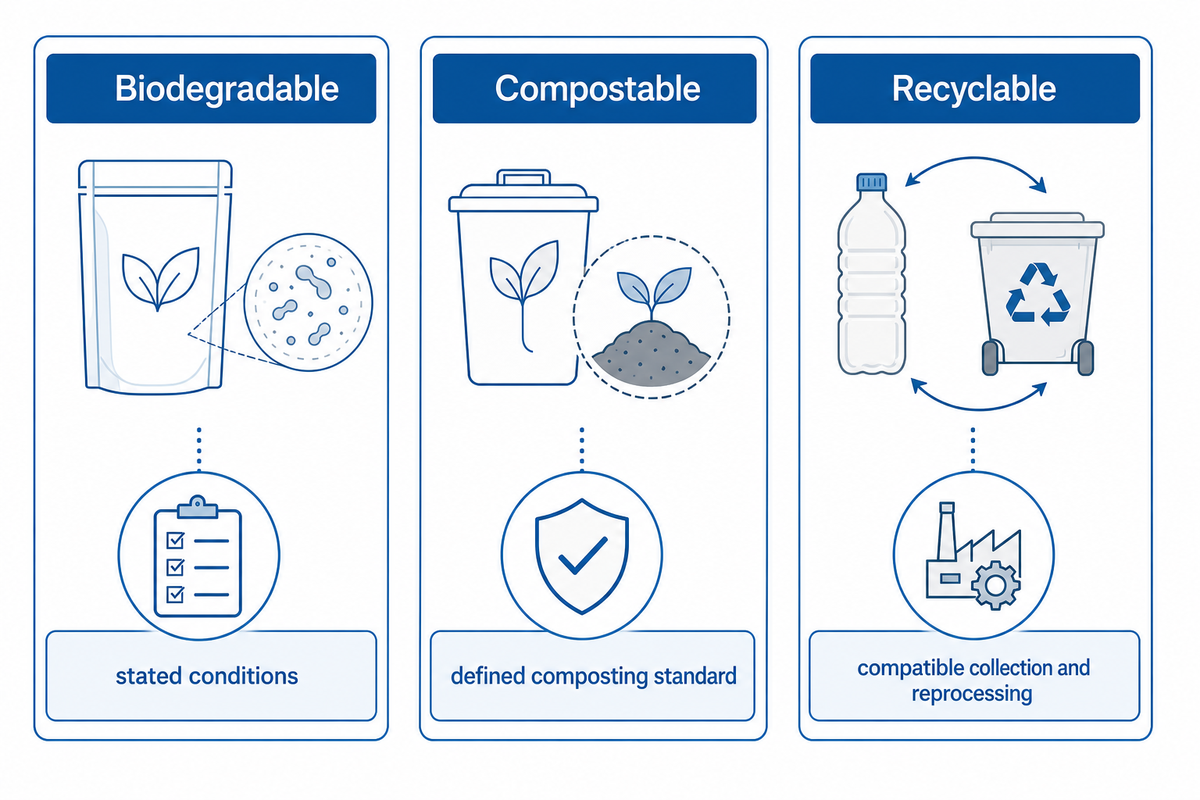
Biodegradation, compostability and recyclability are different things. For something to be biodegradable, it must be able to break down to basic components through the action of living organisms. To be compostable, something must disintegrate to a large extent and biodegrade to an acceptable level in a reasonable amount of time, and leave behind residue that does not harm compost quality or plant growth under the specified test conditions. Something is recyclable if a downstream party is able to sort, process, and sell the used material into a compatible stream, which makes recyclable plastics a question about the receiving route.
| Term | What it can establish | What it cannot establish | Buyer question |
|---|---|---|---|
| Biodegradable | Breakdown under stated biological or environmental conditions | A universal route, a time limit or complete conversion to harmless end products | Where and how quickly is the exact film tested? |
| Compostable | Performance under a defined composting standard and facility condition | Acceptance by every municipal or home-compost program | Which standard, certificate and facility conditions apply? |
| Recyclable | A compatible collection and reprocessing route may exist | That a local hauler accepts the film or that it becomes new film | Who accepts this exact film, in what condition and quantity? |
The current ASTM D6400-26 is the active edition for plastics designed for aerobic composting; ASTM D6400-21 is a historical edition whose certificate version should be checked. ISO 17088:2021 covers disintegration, ultimate aerobic biodegradation, no adverse effects of compost on terrestrial organisms and control of constituents under well-managed industrial composting. Neither standard is to be read to imply home composting, litter breakdown or acceptance by a given recycling operator.
Keep a certified compostable film out of a conventional plastic film-recycling bale unless the receiver has specifically approved it. Likewise, do not call a recyclable PE film compostable just because it is thin, plant-based or derived from renewable resources. The route has to match the documented material and the facility’s written rules.
Check certificate scope and product identity
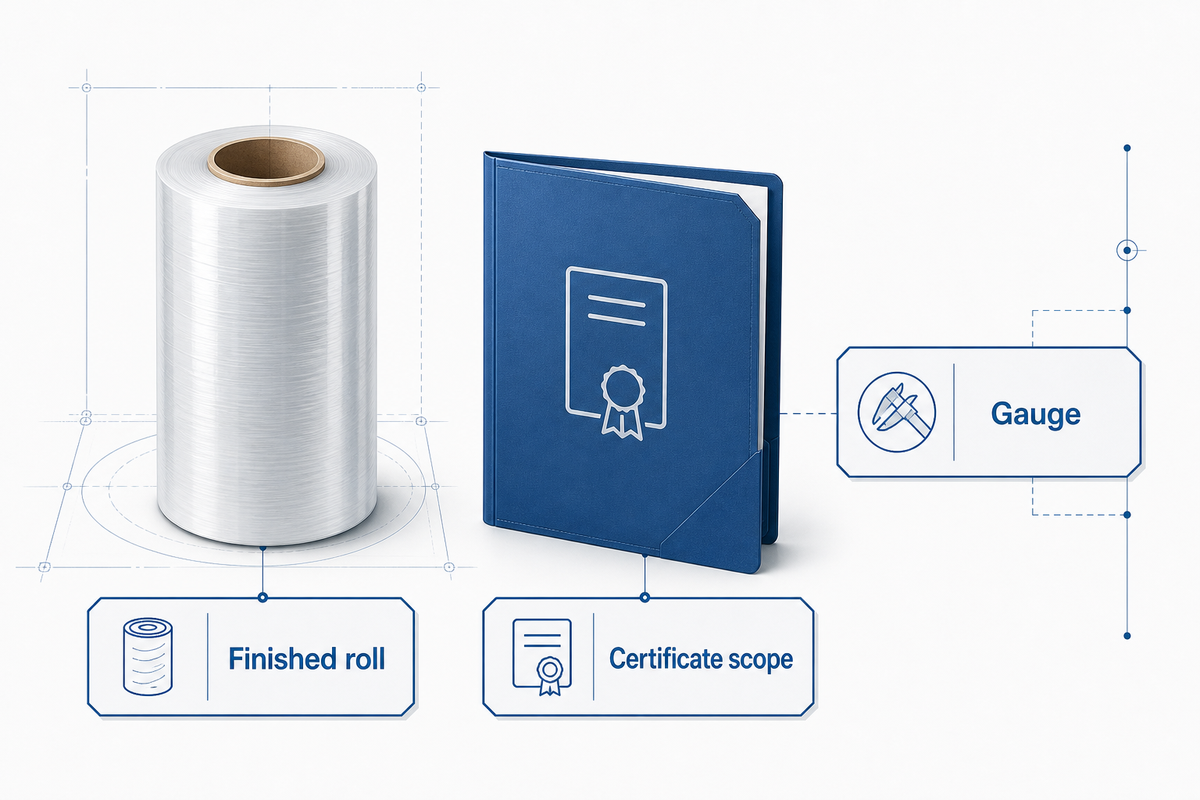
You will need to ask for evidence that covers the finished roll you are going to buy for your packaging needs. A resin brochure, factory certificate, or a product page logo may describe a family of materials without covering the exact stretch film, gauge or additive package. Use the applicable ASTM D6400 edition as a scope check rather than as proof for an unmatched roll.
- Product identity: record the supplier, brand, SKU, film construction, gauge, width, roll length, core and color.
- Is the film mono PE? Is it a blend? Is it bio based? Is it treated with additives? Formulation: ask whether the film is mono-PE, a blend, bio-based, additive-treated, oxo-biodegradable or a compostable polymer system, and whether that polymer system is PBAT or another polymer sold as bioplastics, or a blend of them.
- What test standard was used? What laboratory and sample description was provided? What were the test conditions? What was the time window? What is the end point of the test? A certificate covering a different gauge or a different finished product may not apply.
- What are the limits of the certificate? Capture the certificate number, who it was issued to, the issued and expiration dates. Were there any restrictions to the ink, labels, adhesives, and/or multilayer components?
- Use limits: request separate food-contact, chemical, temperature and regulatory declarations where the application needs them, such as food packaging use and regulatory requirements in your market. “Bio” does not guarantee food contact safety.
Be very cautious with oxo-biodegradable. A fragmentation additive isn’t a verified compostable film. Smaller fragments don’t imply biological conversion. If the supplier mentions “biodegradable pallet wrap,” or sells a packing wrap or film wrap as biodegradable, without declaring a test environment, put the claim on hold until the missing information is supplied.
Confirm that the local facility accepts the material
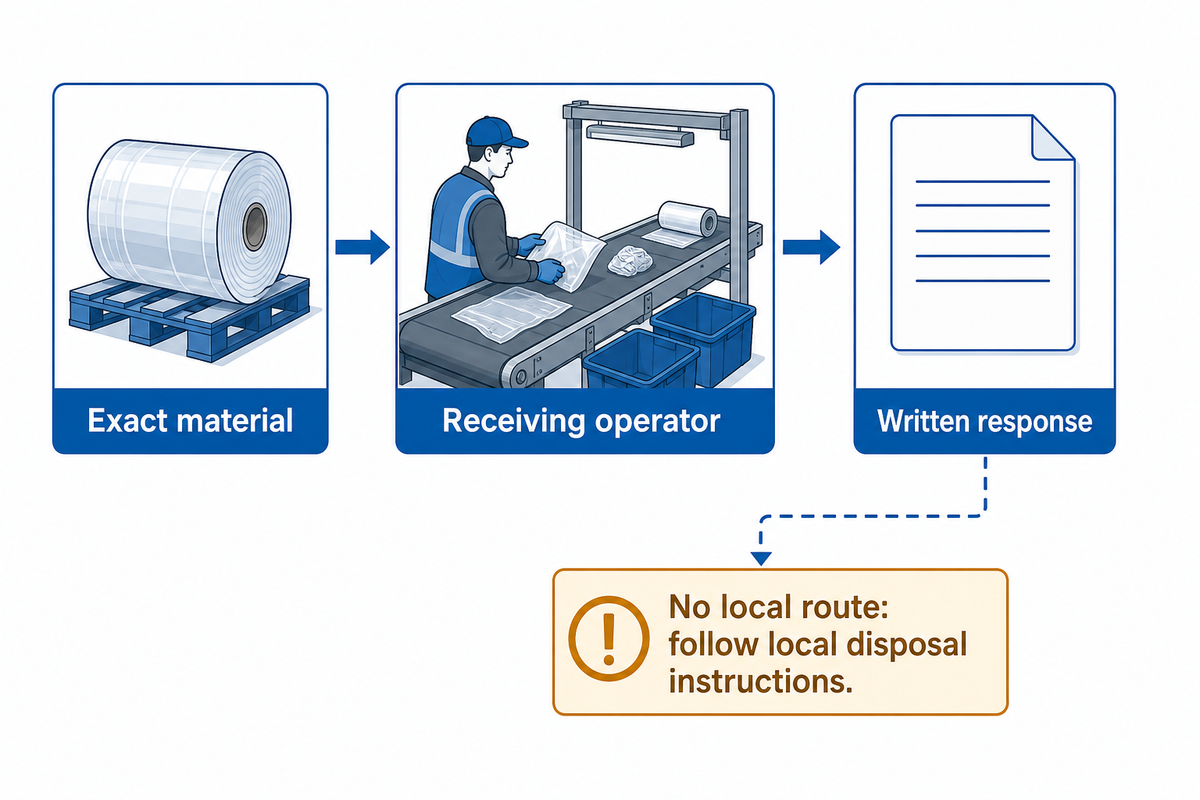
A compostability certificate does not establish a local collection route. Before issuing a production order, call the operator that would actually receive the used film. Ask for a written response. The EPA waste-management hierarchy also supports checking the actual route for the material and facility. Keep this with the purchased specification. Use the UD Packaging contact page to request formulation, supply and certificate information; the receiving operator must confirm acceptance of the route.
- Does the facility accept flexible film from commercial warehouses?
- Would the receiving operator accept this exact material, including additives, inks, labels and cores?
- Is the route industrial composting, specialist film recycling, a brokered take-back stream or disposal?
- What contamination, moisture and color limits apply? What are the bale or bag limits?
- Is there a minimum shipment quantity? Is there an approved carrier or service-area restriction?
- What records will the receiving operator provide for accepted, rejected and processed material?
Do not use a household drop-off locator to prove a distribution center can ship commercial quantities. A retail program may accept clean shopping bags, while excluding compostable film or a mixed warehouse load. If no local route accepts the material, follow local disposal instructions and record the limitation rather than contaminating another stream with plastic waste.
Compare pallet performance before substitution
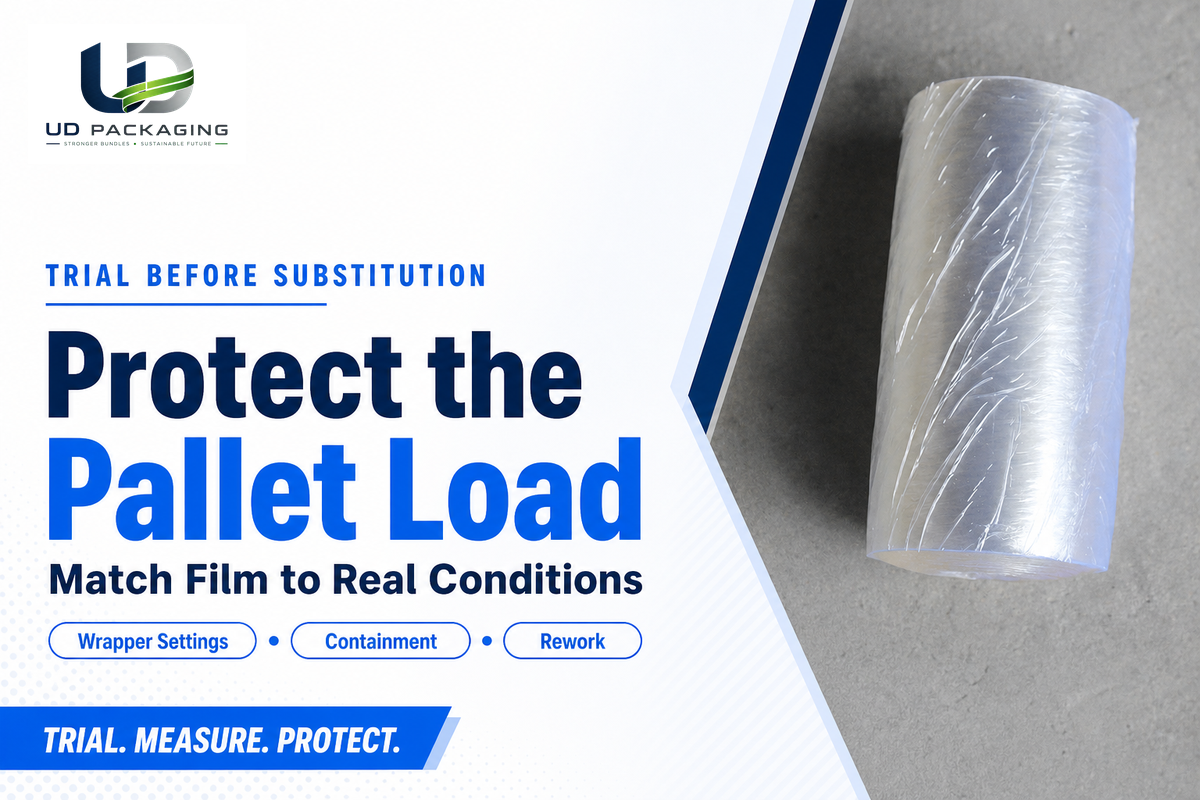
Environmental intent can’t make up for an unstable load. Run the proposed film next to the current film on representative pallets using the same wrapper, settings, handling route and storage conditions. For load-containment variables, use this published stretch-wrap containment study as background reading only, verify its methods in the original publication, and use your own trial record for the decision.
- Application: Record pre-stretch ratio, carriage tension, wrap count, speed, film width, core and gauge.
- Containment: Check holding force at the base, middle and top of the load. Look for leaning, rocking and movement of cartons and/or loose tails.
- Film integrity: Count breaks, punctures, edge splits, corner failures and rewraps. Note whether the film clings as expected.
- Handling: Move pallets through normal forklift, conveyor, staging and loading steps. Inspect after vibration, temperature changes, and dwell time where those storage and transport conditions could affect the product.
- Consumption: weigh film used per pallet and compare pallets per roll. A lower nominal gauge is not always a lower material footprint if breakage is higher.
Set rules for pass/fail before the trial. Rules include no unacceptable load shifts, no repeated machine stoppages, no increase in damage or rework, and a documented film-use result. Prior to the trial, ask the supplier for data on tensile strength, tear strength, puncture strength, cling and containment force, along with storage and transportation guidance. Treat the warehouse trial as the acceptance decision, since it shows whether the film keeps products secure. Do not publish a performance percentage unless the test record supports it.
Build a buyer RFQ that exposes unsupported claims
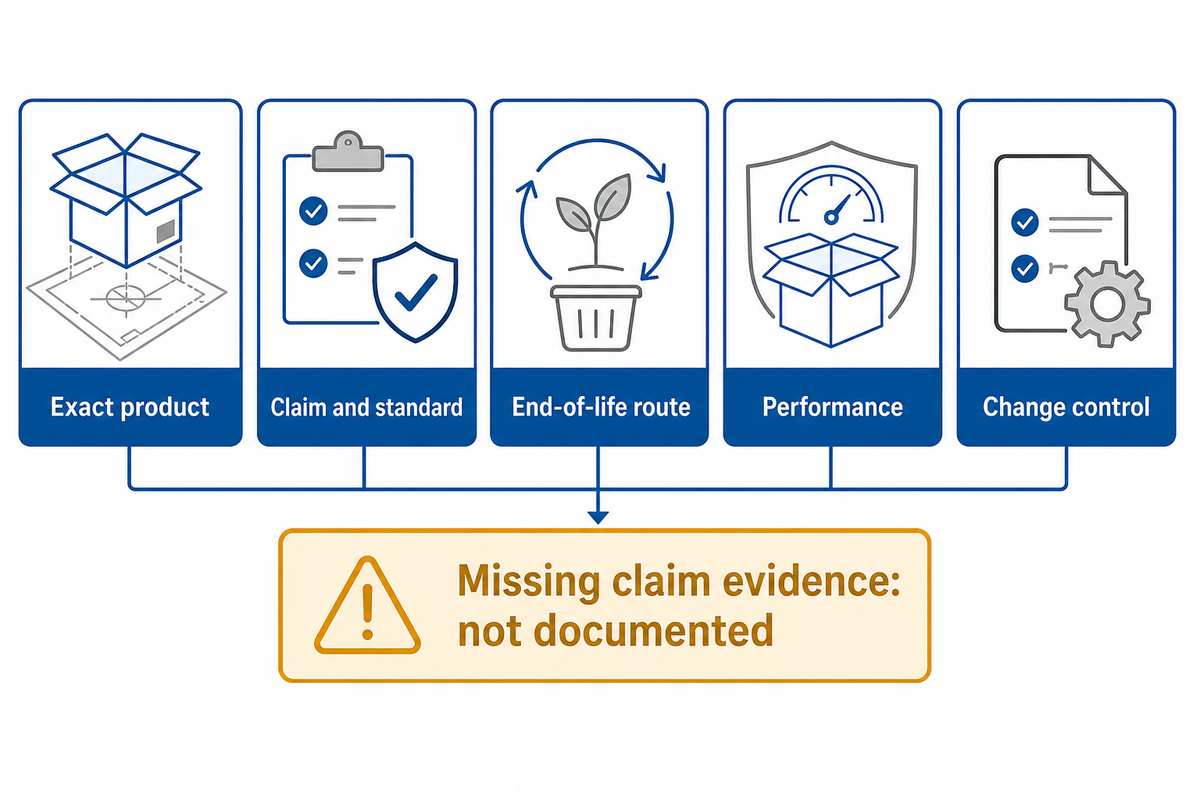
Use the following fields when requesting a quote from a stretch film manufacturer or supplier for biodegradable stretch film, or for a compostable stretch film alternative to traditional stretch wrap. If the order also includes PET strapping, compare the related PET strapping product line separately. The FTC Green Guides are a useful check against unsupported environmental wording in that request.
| RFQ field | Evidence to request | Decision if missing |
|---|---|---|
| Exact product | SKU, construction, gauge, width, roll length, core and lot traceability | Do not compare prices across unmatched rolls |
| Claim and standard | Certificate, registration number, test method, facility conditions and time window | Rewrite the claim as “not documented” |
| End-of-life route | Named composting or recycling operator and written acceptance rules | Do not promise recovery to internal stakeholders |
| Performance | Technical data plus sample rolls for the same load and machine trial | Hold approval until the trial is recorded |
| Change control | Notice period for resin, additive, gauge or certificate changes | Require a new review before substitution |
Ask for a sample and written answer to “what happens after use in our location?” A supplier that can only give a broad statement on the environment or brand image hasn’t supplied a purchase-ready specification. Share the documented review of the packaging material with procurement, operations and the receiving facility before approving it as a packaging solution.
| RFQ implementation check | Evidence to retain | Release decision |
|---|---|---|
| Material identity | Finished roll SKU, construction and lot | Hold unmatched samples |
| Gauge and dimensions | Gauge, width, length and core record | Reject incomparable quotes |
| Additive disclosure | Resin, additive and ink declaration | Escalate missing formulation |
| Certificate holder | Certificate number and named holder | Check transferability |
| Test conditions | Laboratory method and facility conditions | Keep claim qualified |
| Receiver route | Written operator acceptance | Do not promise recovery |
| Load trial | Same wrapper, settings and representative pallet | Record pass or hold |
| Change control | Notice for resin or certificate changes | Trigger re-review |
| Review owner | Approver, date and next review | Close the purchasing record |
Keep supplier scope accurate
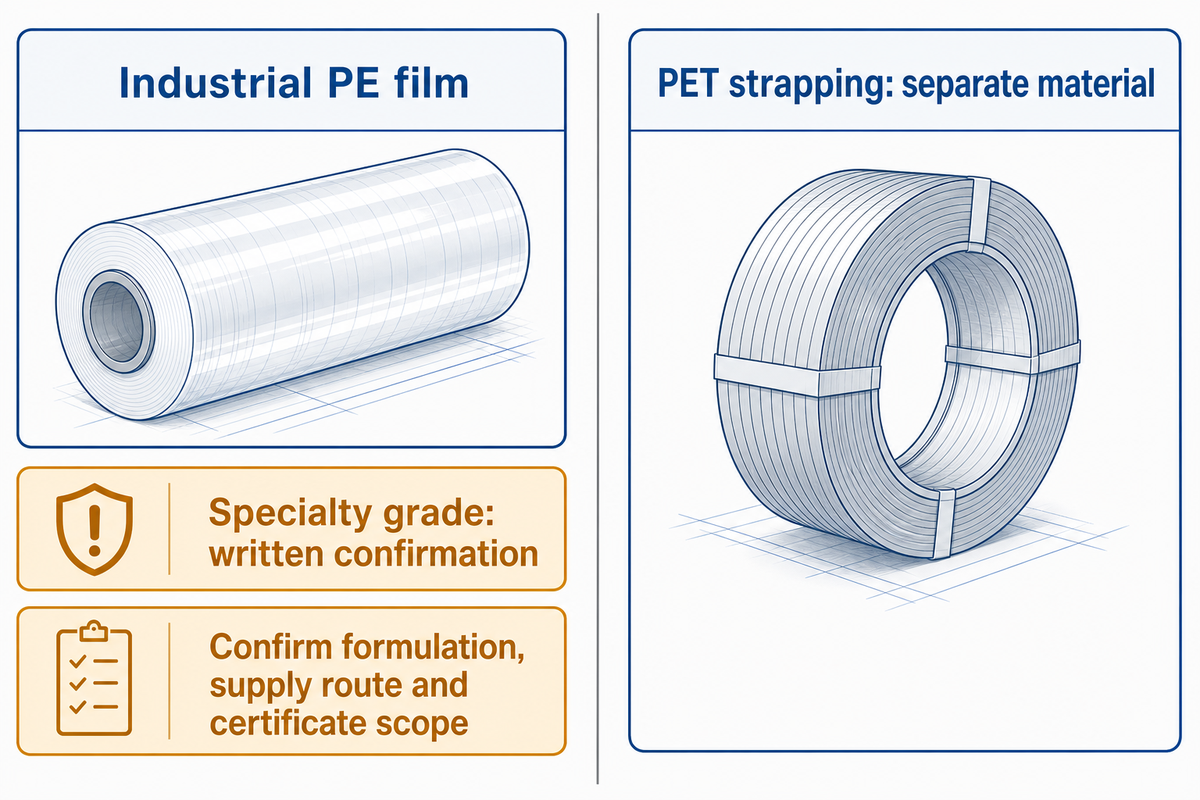
UD Packaging’s stretch film page is the right place to access a standard industrial PE film route and to request a grade-specific quotation. Public PET strapping information should be treated as a separate material discussion. It doesn’t show that UD produces a specialty biodegradable stretch film.
For a specialty grade of biodegradable or compostable film, contact UD Packaging for written confirmation regarding the exact formulation, supply route, certificate scope and performance data. Treat that conversation as an evaluation step; it does not establish that specialty grades are stocked or made in-house.
Record the decision and review the route
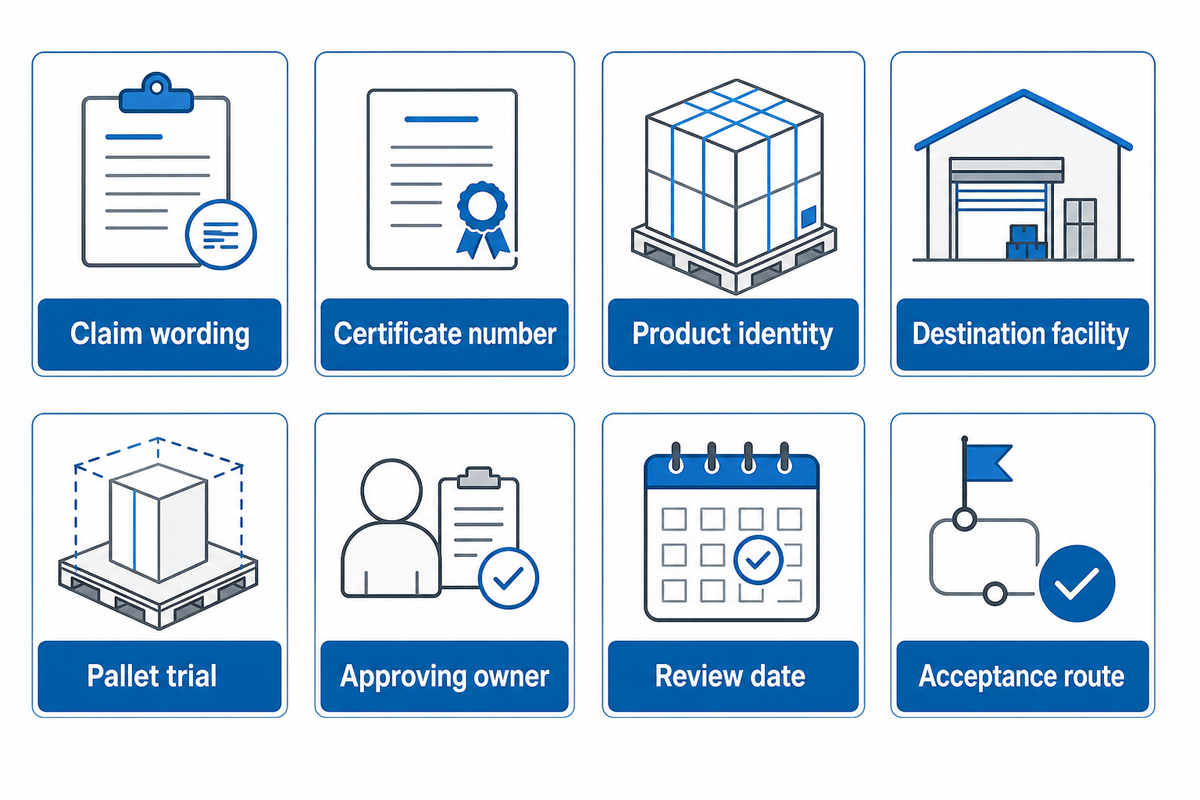
Close the project with a one-page decision record: claim wording, certificate number, exact product identity, destination facility, acceptance conditions, pallet trial result, approving owner and review date. Recheck the facility route when the film formulation, supplier, hauler or local program changes. If the project also needs machine stretch-film specifications, see UD Packaging’s machine stretch-film route as a separate scope.
For conventional PE stretch film recovery, see the separate stretch-wrap recycling guide after checking that the receiver’s rules match your site. Recycling, composting and biodegradation should be treated as separate workstreams in the warehouse procedure, and a circular economy claim needs its own evidence.
Frequently Asked Questions
What is biodegradable film?
Biodegradable film is marketed as capable of biological breakdown, given certain conditions. The label alone doesn’t identify the environment, time frame or end products, nor does it say how the film is to be disposed. For a claim to be an instruction for warehouse procedures, the exact test scope should be verified against a facility.
Is biodegradable stretch film recyclable?
The label alone does not establish recyclability; only proceed when the exact film is accepted by a compatible receiver. A compostable or additive-treated film may contaminate a PE-film stream. Confirm the formulation and obtain written acceptance before adding it to a bale or film collection bin.
Which is better, biodegradable or compostable?
The choice depends on the available facility route and the pallet trial result. Select the claim that corresponds to a real facility and the load-performance requirement. If the local route runs through industrial composting facilities, then a certified compostable product may apply; on the other hand, if a specialist receiver accepts clean PE film, then a recyclable PE route, as for traditional plastic wraps, may apply.
Is biodegradable stretch film safe?
Safety depends on the formulation, intended use, contact conditions, temperature and applicable regulatory declaration. You can’t assume “bio,” “green,” or “eco-friendly” mean food contact or worker safety. Request supporting documentation for the claim. The review should also record the intended application, temperature range, contact conditions, certificate limits, receiving route and owner responsible for approving the film. If any of those fields is unknown, keep the claim qualified and do not treat the label as a safety or disposal instruction.
How does biodegradable stretch film work?
The mechanism depends on the formulation and the claimed environment. Some products marketed as biodegradable use a biodegradable polymer system; others use additives or a compostable blend. Ask the supplier to name the chemistry, test method, conditions and time window, then verify that the result matches the facility available to your warehouse.
References & Sources
- Environmental Claims: Summary of the Green Guides Provides qualified degradable-claim guidance.
- Green Guides summary FTC environmental marketing guidance. Use the current page above when reviewing environmental claims.
- ASTM D6400-26, Standard Specification for Labeling of Plastics Designed to be Aerobically Composted – ASTM International.
- ISO 17088:2021, Plastics, Organic recycling, Specifications for compostable plastics International Organization for Standardization.