Get in touch with UD Packaging Company

Updated November 2026 · Reviewed by the UD Packaging Technical Team
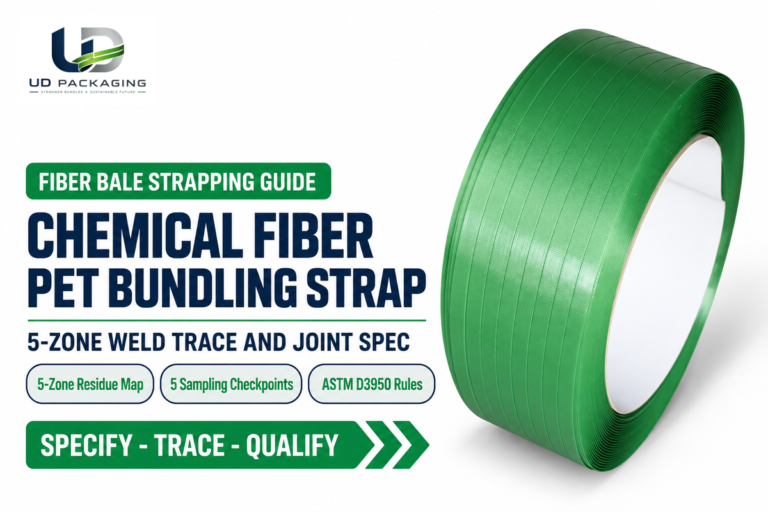
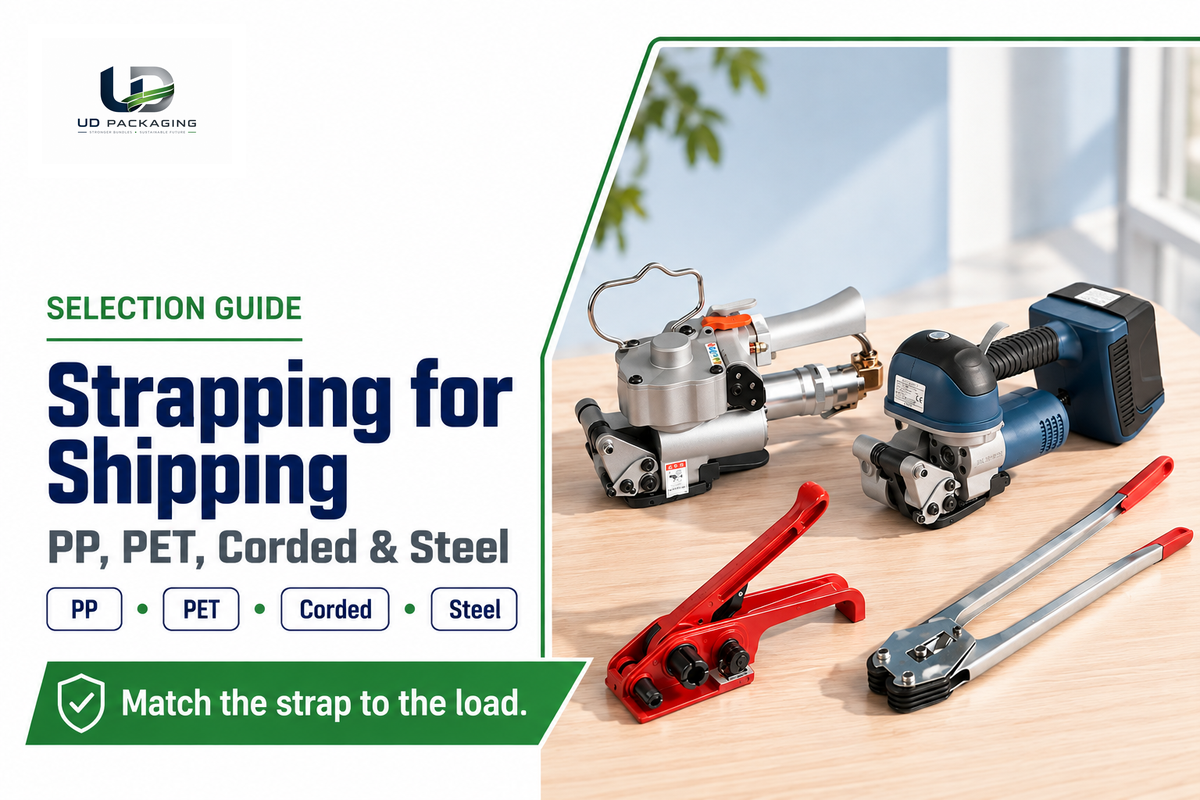
Strapping for shipping is flat or corded tensioning material, polypropylene (PP), polyester (PET), corded polyester, or carbon steel, looped and sealed around cartons, bundles, or pallets to unitize freight during transit. Under ASTM D3950-23 Standard Specification for Strapping, Nonmetallic and ASTM D3953-13 Standard Specification for Strapping, Flat Steel, light carton bundling commonly uses PP (110 lbs to 600 lbs commercial break strength), settling pallet loads use PET (300-1,350 kg break force across UD Packaging’s 9.0 mm to 25.0 mm widths and 0.5 mm to 1.3 mm thicknesses, and up to 1,400 Kgf in specialty grades) or corded polyester, and hot or sharp metal coils use flat carbon steel.
Selecting the right plastic strapping for shipping or heavy metal banding requires looking beyond bare catalog tensile numbers when evaluating your plant’s packaging needs. According to the Grand View Research Packaging Strapping Materials Market Report, global demand was valued at USD 9.8 billion in 2025 and is projected to grow from USD 10.4 billion in 2026 to USD 15.7 billion by 2033 at a 6.0% compound annual growth rate as warehouses replace legacy steel with high-tensile polymer bands for securing large loads. In practice, a strap’s retained tension during wood pallet shrinkage and the tested efficiency of its specific joint, from the 45% minimum floor under ASTM D3950-23 to over 75% for friction welds, dictate whether a unit load arrives intact or shifts when a truck brakes hard at 90 km/h.
Quick Specs: Shipping Strapping Material Envelope
| ASTM Nonmetallic Classes | ASTM D3950-23 5 types (Type I, IA, II, III, IV): Type I rayon cord, Type IA polyester cord, Type II PP, Type III nylon, Type IV PET |
| ASTM Flat Steel Classes | ASTM D3953-13 covers 2 types of carbon steel flat strapping and seals for bundling, unitizing, palletizing, and carloading |
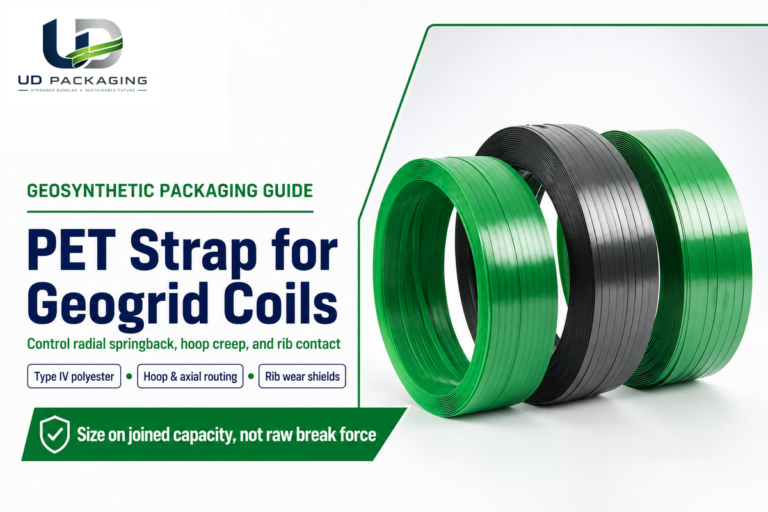
| UD Packaging PET Range | 9.0 mm to 25.0 mm widths and 0.5 mm to 1.3 mm thicknesses with 300-1,350 kg break force on 200 mm (8 in) and 406 mm (16 in) cores |
| Standard Industrial Core Sizes | 8×8, 9×8, 11×8, and 16×6 inch cores (200 mm / 8 in and 406 mm / 16 in inner diameters; 0.1 to 0.2 in spindle clearance) |
| Joint Strength Benchmarks | 45% minimum joint floor (ASTM D3950 Types II/III/IV) and 55% (Type IA Grades 3–7) vs over 75% for friction welds |
What Is Strapping for Shipping and How Do the Four Material Families Differ?
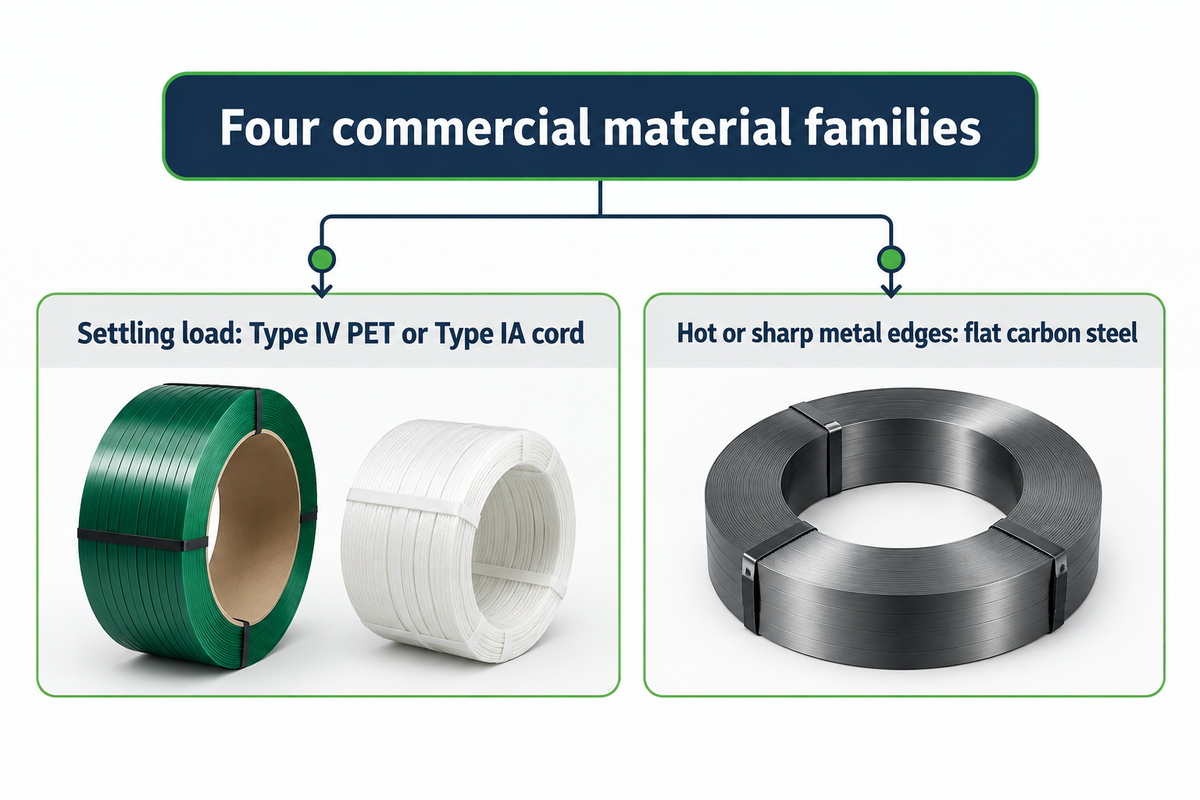
Industrial strapping and banding fall into four commercial material families governed by two foundational standards: ASTM D3950-23 classifies nonmetallic strapping into 5 types (Type I, IA, II, III, IV) (specifically Type I bonded rayon cord, Type IA bonded or woven polyester cord, Type II polypropylene (PP) plastic, Type III nylon plastic, and Type IV polyester (PET) plastic) while ASTM D3953-13 covers 2 types of flat carbon steel strapping and seals. If a unit load settles or shrinks in transit, choose Type IV PET or Type IA corded polyester; if surface temperatures exceed polymer thermal limits or sheared metal edges are unguarded, choose flat carbon steel.
Distributor catalogs frequently group polypropylene and polyester together under generic poly strapping, yet their polymer chains behave oppositely under sustained tension. Polypropylene (ASTM D3950 Type II, with 7 to 35% elongation at break and 110 lbs to 600 lbs commercial break strength per the John Maye Strapping Core Size Guide) is an economical polyolefin designed for short-cycle carton closure and lightweight bundle unitization, whereas extruded polyester (ASTM D3950 Type IV, with 5 to 20% standard elongation or 10 to 25% high elongation) provides high tensile modulus and elastic recovery that holds heavy palletized freight tight over ocean or rail journeys. Within UD Packaging’s published PET lineup, standard bands span 9.0 mm to 25.0 mm widths and 0.5 mm to 1.3 mm thicknesses with 300-1,350 kg break force on 200 mm (8 in) and 406 mm (16 in) cores, while specialty commercial lines reach 1,400 Kgf across 19 PET variants and 2,680 Kgf (2,700 lbs) in polyester cord strapping per Greenstrix’s PET Strapping Grade Guide. Note that UD Packaging’s 9.0 mm to 25.0 mm width, 0.5 mm to 1.3 mm thickness, and 300-1,350 kg break force figures apply specifically to its extruded PET product line; other manufacturers using different draw ratios or recycled flake blends produce different break strengths at the same nominal gauge.
| Material Family | ASTM Classification | Published Width & Break Strength Envelope | Elongation at Break & Creep Profile | Primary B2B Shipping Application |
|---|---|---|---|---|
| Polypropylene (PP) | ASTM D3950 Type II (flat polypropylene plastic) | 5 mm to 19 mm commercial widths; 110 lbs to 600 lbs (350 lbs for 1/2 in × 0.025 in PP) | 7 to 35% elongation at break; relaxes rapidly under sustained load creep | Corrugated carton closure, newspaper bundles, light warehouse pallets |
| Polyester (PET) | ASTM D3950 Type IV (flat polyester plastic); Type III is the nylon category. UD Packaging lists PET at 9.0–25.0 mm width, 0.5–1.3 mm thickness, and 300–1,350 kgf break force, with specialty grades up to 1,400 kgf. | 9.0-25.0 mm width (up to 32 mm heavy-duty), 0.5-1.3 mm thick; 300-1,350 kg (up to 1,400 Kgf) | 5 to 20% standard / 10 to 25% high elongation; low creep with elastic recovery | Lumber, brick, beverage, can, and export pallet unitization |
| Corded & Woven Polyester | ASTM D3950 Type IA (bonded/composite/woven polyester cord; Type I covers rayon at 10 to 15%) | High-tenacity textile yarn bands up to 2,680 Kgf (composite) and 2,700 lbs (3/4 in HD woven) | 9 to 15% elongation at break; shock-absorbing and retensionable via wire buckles | Irregularly shaped machinery, timber, bricks, and loads that settle in transit |
| Flat Carbon Steel | ASTM D3953-13 flat carbon steel strapping is available for seal-joint and sealless joining systems; the applicable strap grade and joint method must match the tool and load. | Cataloged commercial carbon steel widths and thicknesses for carloading and lashing | Near-zero creep and minimal elongation; zero elastic recovery if load shrinks | Hot-rolled steel coils, sharp metal stampings, rigid unyielding ingots |
How Do You Match Shipping Strapping to Pallet vs Box Loads and Transit Modes?
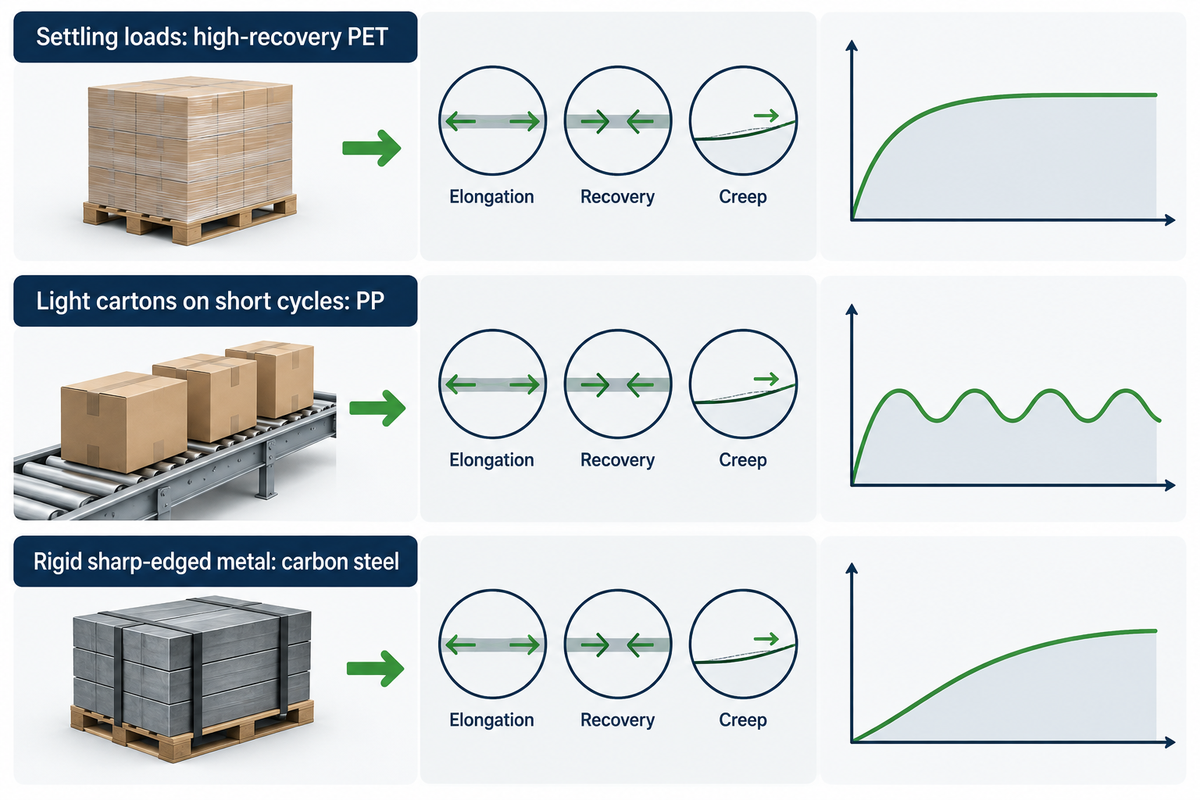
Matching strapping to a shipment depends on how the load deforms during transit rather than static scale weight alone: per the ASTM D4675-14a (2022) Guide for Flat Strapping Material Selection and Use and EAM-Mosca’s Technical Analysis of Elongation, Recovery and Creep, loads that settle or compress under vibration require high-recovery polyester (PET), light cartons shipped on short delivery cycles fit polypropylene (PP) and rigid, sharp-edged, metal loads require carbon steel. When sourcing strapping for pallets, engineers consider three interdependent properties: elongation (how much the strap stretches when tensioned), recovery (its ability to return to its original length after stretching), and creep (long-term loss of tension under constant stress).
Based on 7 PET strapping Mistakes by CustomPack, failure to take into account the behavior of the heaviest load at 90 km/h with a truck braking hard, and instead selecting strap by the average warehouse pallet weight, is the main reason for mid-transit band failure. Kiln-dried timber, stacked corrugated cases, and bagged polymers settle as truck-suspension vibration expels air voids; a zero-stretch steel band goes slack once the stack perimeter shrinks, whereas tensioned PET combines strength and flexibility to contract with the load and hold pallets securely. A steel band goes slack as the load settles. In contrast, PET combines strength and flexibility to contract with the load and hold the pallets securely.
The Transit-Mode Strap Selector (9-Scenario Matrix)
Choose high-recovery PET or corded polyester for loads that settle or compress under vibration, PP for light cartons on short delivery cycles, and carbon steel for rigid, sharp-edged metal loads by consulting our Transit-Mode Strap Selector (our 9-Scenario Strap Selection Matrix) below before issuing a purchase order.
| Load Profile & Transit Mode | Recommended Strap Material | Target Width & Closure Method | Required Elastic / Creep Behavior | Primary Failure Risk if Mismatched |
|---|---|---|---|---|
| 1. Individual corrugated cartons (parcel / courier) | Polypropylene (PP, ASTM D3950 Type II) | 5 mm to 12 mm smooth or embossed; tabletop heat weld | Low initial tension so double-wall flute edges do not crush | Excessive tension or missing edge protection can crush carton corners or cut flaps, especially when PET or steel is applied to cartons. |
| 2. Light uniform box pallets (short regional LTL truck) | Polypropylene (PP) or Light PET | 9 mm to 12 mm × 0.5–0.6 mm; friction weld or serrated seal | Moderate working tension paired with horizontal stretch wrapping | Unwrapped upper carton tiers slide laterally during dock braking |
| 3. Settling lumber, brick, or paver pallets (flatbed / rail) | Extruded Polyester (PET, ASTM D3950 Type IV) | 16 mm to 19 mm × 0.8–1.0 mm; battery friction weld | High elastic recovery to contract as timber dries or bricks settle | Steel bands can lose clamping force when timber or brick pallets settle and their perimeter shrinks, while PET can recover tension with the load when properly specified. |
| 4. Multi-tier beverage bottles & metal cans (automated line) | Machine-Grade Polyester (PET, Type IV) | 9 mm to 16 mm embossed PET; double-tensioning arch head | Low creep during extended warehouse stack storage | PP creeps and loses clamping force, allowing bottle tiers to telescope |
| 5. Expanding compressed fiber, textile, or recycling bales | High-Tensile PET (Type IV) or Corded Polyester (Type IA) | 19 mm to 25 mm PET friction weld or composite cord + buckle | High break strength (up to 1,350 kg / 1,400 Kgf PET or 2,680 Kgf cord) | Smooth metal clip seals slip open when baled material rebounds |
| 6. Export ocean container pallets (humid marine transit) | Extruded PET (Type IV) or Woven/Corded Polyester (Type IA) | 16 mm to 19 mm PET or 3/4-in HD woven cord strapping roll | Moisture-resistant, rust-free tension retention across thermal swings | Uncoated steel corrodes in marine salt air and stains customer goods |
| 7. Fragile, painted, or irregularly shaped industrial crating | Corded or Woven Polyester (ASTM D3950 Type IA) | High-tenacity textile band + phosphate wire buckle | Soft non-metallic weave that conforms to contours and allows re-tensioning | Rigid steel or sharp plastic edges gouge painted machinery surfaces |
| 8. Cold-rolled metal bars, pipes, and structural bundles | High-Tensile Steel or Heavy PET with Edge Protectors | 19 mm to 25 mm PET (up to 1,350 kg) + corner guards or steel | High shear resistance at contact edges and zero loop slippage | Unguarded polymer bands shear instantly against burred steel corners |
| 9. Hot-rolled steel coils & foundry castings above polymer limits | Flat Carbon Steel (ASTM D3953-13 Type 1) | Heavy carbon steel strap + double-notch or crimp Class H seal | — | PP and PET melt or lose molecular orientation on hot metal surfaces |
How do I know if strapping is the better choice instead of shrink wrap or banding for my shipments?
Use strap when your load requires structural vertical clamping to the pallet deck, high tensile containment for dense items for shipping, or individual bundle integrity after the outer film is removed; use shrink wrap or stretch-wrapping when dust protection, moisture sealing, and lateral stabilization of light uniform cartons are the primary goals. In B2B terminology, banding typically refers to flat metal strapping or unitizing bands, whereas industrial strapping secures heavy palletized freight against vertical bounce and deck separation.
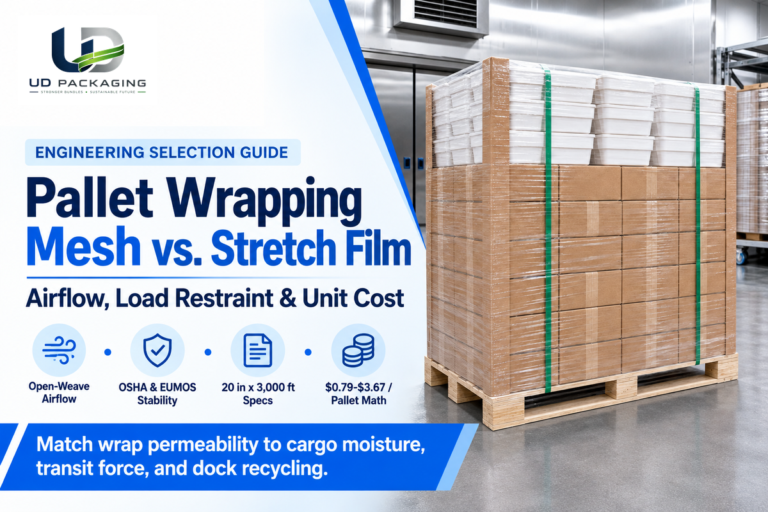
For tall and mixed multi-tier shipments, polyester straps and stretch film work best as a team. Vertical polyester straps anchor the load mass through the pallet stringer voids so the stack cannot slide off the timber deck when a truck brakes at 90 km/h, while spiral-applied stretch film unitizes the individual carton rows against wind, rain, and forklift corner scuffs.
Polypropylene (PP) vs Polyester (PET) Plastic Strapping for Shipping
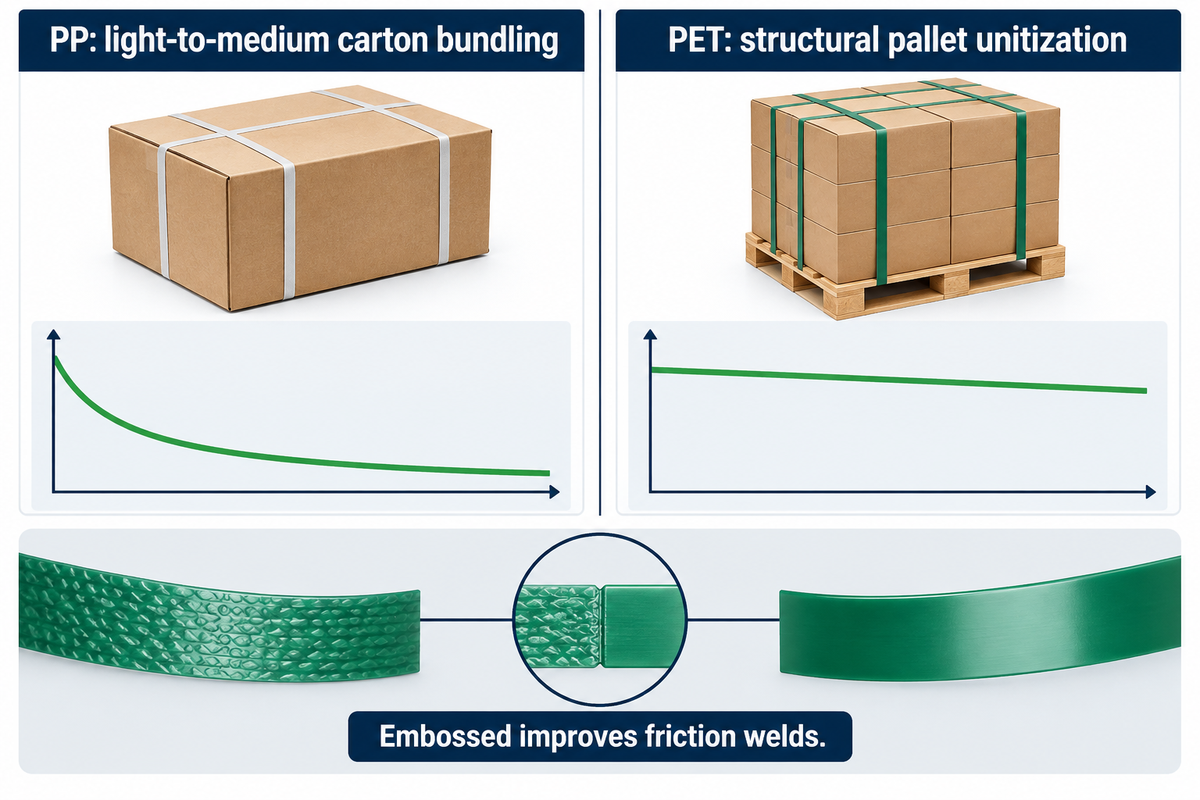
Polypropylene (PP, ASTM D3950 Type II) strapping suits light-to-medium carton bundling and short-dwell pallets with commercial break strengths of 110 lbs to 600 lbs (such as 350 lbs for 1/2-inch × 0.025-inch PP strapping on 8×8, 9×8, and 16×6 cores), whereas polyester (PET, ASTM D3950 Type IV) strapping is engineered for structural pallet unitization with break strengths spanning 300-1,350 kg across UD Packaging’s 9.0-25.0 mm widths and 0.5-1.3 mm thicknesses (and up to 1,400 Kgf across the 19 commercial PET variants documented by Greenstrix’s PET Strapping Grade Guide). Upgrade from PP to PET strapping specifications whenever pallet loads settle in transit, require multi-week warehouse storage, or travel in unconditioned trailers.
As detailed in EAM-Mosca’s polymer comparison, pp strapping exhibits higher initial elongation (7 to 35% at break under ASTM D3950 Table 1) when tensioned but suffers rapid creep relaxation, losing a substantial portion of its applied clamping force over time as polymer chains slide past one another. Polyester strapping maintains exceptional tension retention over weeks of warehouse storage and absorbs sudden transit shocks without snapping. High-speed pallet lines, such as the EAM-Mosca SMV-2000 strapping system reported by Packaging World, whose strapping head indexes pneumatically up to 18 inches to meet incoming loads, can run either PET or PP strap across plastic strapping widths from 5 mm to 19 mm (with heavy-duty polyester reaching up to 32 mm), allowing plants to match polymer grade to load density on the same conveyor.
“Plastic strapping widths typically range from 5mm to 19mm. However, polyester straps can go up to 32mm for heavy-duty applications.”
EAM-Mosca Corp., Elongation, Recovery, and Creep in Load Security
While deciding between purchasing strapping for boxes and heavy export pallets, buyers must consider embossed (textured) and smooth finishes as well. As Greenstrix’s grade specification guide indicates, an embossed surface helps in friction reduction in automated arch chutes and improves friction welds in automatic and battery tools, whereas smooth PET helps pack more linear footage on a standard 406 mm (16 in) core and has higher break strength in an equivalent cross-sectional dimension.
When Do Heavy-Duty Shipments Require Steel, Corded, or Woven Strapping?
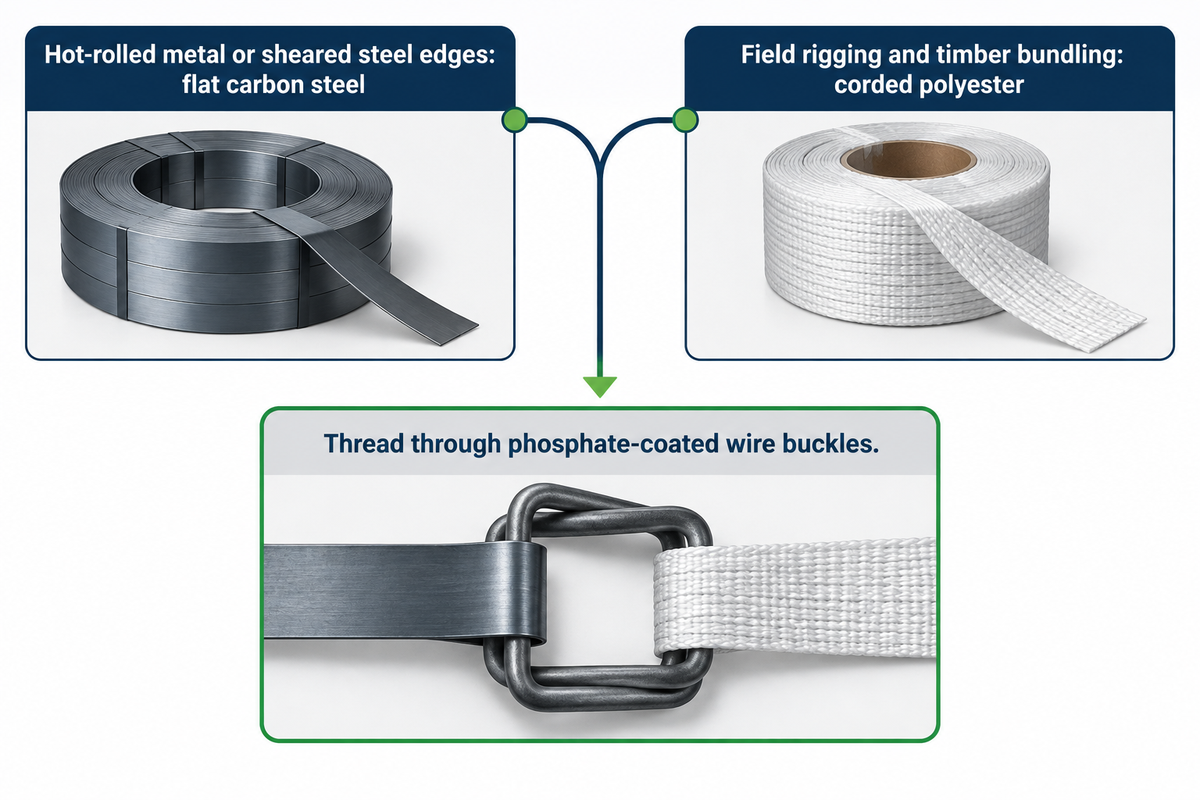
Specify flat carbon steel strapping under ASTM D3953-13 (Type 1 for notch or crimp seals, Type 2 for sealless joints) only when loads involve hot-rolled metal above polymer softening temperatures, unguarded sheared steel edges, or rigid coils demanding zero creep; for all other heavy-duty applications, Fromm Packaging’s polyester welding guide notes that high-tensile polyester or ASTM D3950 Type IA corded and woven polyester bands secure heavy loads with superior shock absorption and zero recoil or rust risk. Note that ASTM D3953-13 covers standard cold-rolled carbon steel flat strapping and Class R or Class H seals across Styles I through V and specifically excludes specialty alloy metal bands.
Where flat extruded PET stands in for steel on automated or battery-tool pallet lines, corded and woven polyester strapping (ASTM D3950-23 Type IA, with 9 to 15% elongation at break and minimum joined strength of 45% for Grades 1-2 and 55% for Grades 3-7) fills a niche in applications requiring field rigging, timber bundling, bricks, and ocean flat-rack cargo. A woven cord strapping roll can reach up to 2,700 lbs in 3/4 inch heavy-duty woven grades, per John Maye, and up to 2,680 Kgf in composite cord strap per Greenstrix, using high-tenacity polyester yarns either bonded in a polymer coating or interlaced in a lengthwise and crosswise weave or braid to provide a durable, non-abrasive restraint. Because textile bands offer high flexibility and do not crease when bent around tight corners, operators thread them through heavy-duty phosphate-coated wire buckles and pull them tight with a manual ratcheting tensioner.
📐 Engineering Note: Retensioning Settling Flatbed and Ocean Cargo
Unlike heat-welded plastic or notched metal strapping, which must be cut and discarded if a timber or machinery load settles mid-journey, corded and woven polyester bands fitted with self-locking wire buckles can be re-engaged with a hand tensioner at transit checkpoints to pull out slack without replacing the strap.
Head-to-Head Comparison: PP vs PET vs Steel vs Corded Shipping Strapping
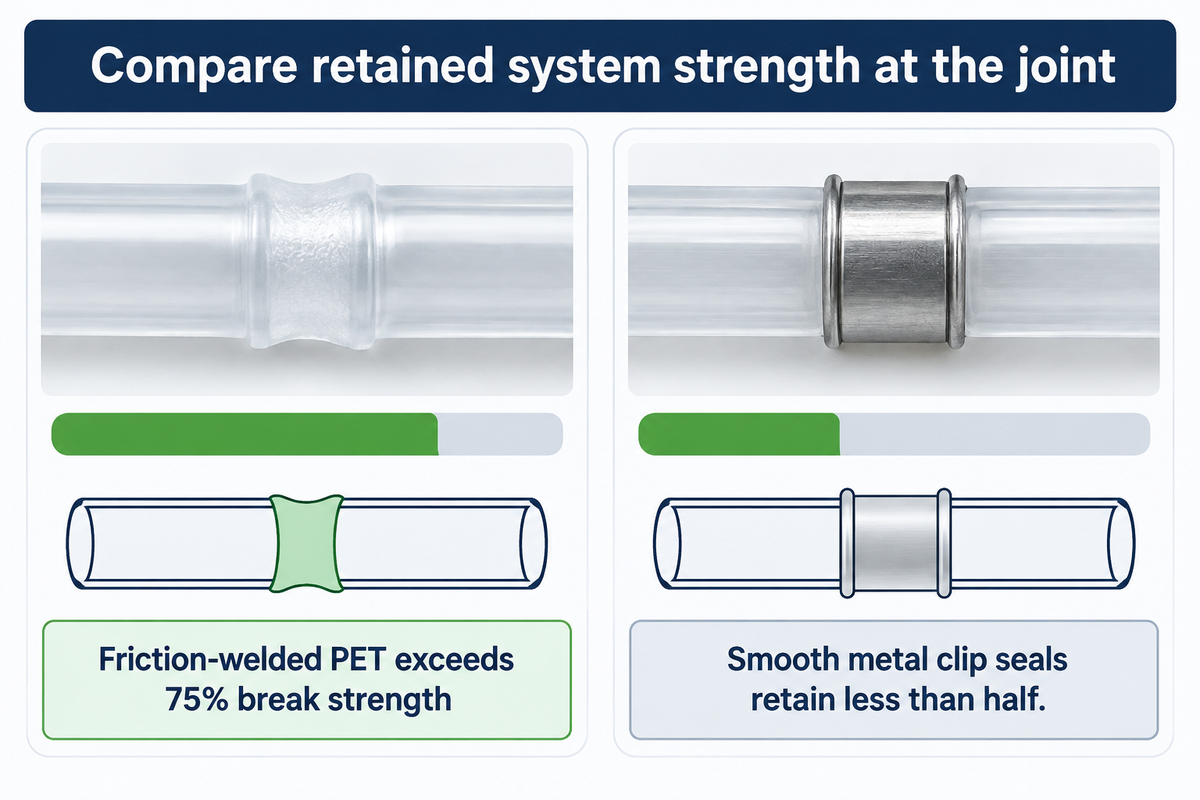
When deciding between plastic or metal bands, engineering teams must compare retained system strength at the joint rather than bare ribbon tensile strength: ASTM D3953-13 evaluates flat carbon steel across breaking strength, elongation, seal joint strength, and camber straightness, while Fromm Packaging’s joint analysis demonstrates that friction-welded PET exceeds 75% of polyester strapping’s break strength, whereas smooth metal clip seals retain less than half of base material strength (with ASTM D3950-23 Section 7.2.3 setting a 45% minimum joint floor for Types II, III, and IV). For rigid cold loads up to 1,350 kg per band with edge protection installed, extruded PET matches steel’s usable restraint at lower material weight and without dock recoil hazards.
High-Tensile PET Strapping (ASTM D3950 Type IV)
- Absorbs dynamic transit shock (5 to 20% standard / 10 to 25% high elongation) and contracts as pallets settle
- Friction-welded joints exceed 75% joint efficiency without separate metal seals, avoiding smooth-clip slippage
- Weatherproof polymer resists rust staining and moisture degradation across humid ocean container voyages
- Low recoil energy when cut with a safety cutter manual tool, reducing receiving dock injury claims
Flat Carbon Steel Strapping (ASTM D3953-13 Type 1 & 2)
- Steel has minimal elongation and limited elastic recovery, so a settling pallet can lose restraint tension if its perimeter decreases.
- Requires Class R or Class H metal seals (Styles I–V) or sealless die-cut punch tooling
- Withstands hot-rolled metal surfaces and sharp sheared burrs that slice through polymer bands
- High stored spring recoil when sheared; requires galvanized or painted coating to slow outdoor rust
Extruded PET (300 to 1,350 kgf break force) and corded polyester (up to 2,680 Kgf/2,700 lbs) offer high elastic recovery and rust-free durability, while PP (110 lbs to 600 lbs) serves light carton closure and carbon steel handles hot-rolled metal surfaces across nine parameters.
| Evaluation Parameter | Polypropylene (PP) | Extruded Polyester (PET) | Corded / Woven Polyester | Flat Carbon Steel |
|---|---|---|---|---|
| 1. Governing ASTM Standard | ASTM D3950-23 Type II | ASTM D3950-23 Type IV | ASTM D3950-23 Type IA (and Type I rayon) | ASTM D3953-13 Type 1 & Type 2 |
| 2. Typical Width & Thickness | 5 mm to 19 mm (e.g., 1/2 in × 0.025 in) | 9.0-25.0 mm (up to 32 mm); 0.5-1.3 mm (UD Packaging) | High-tenacity textile band (e.g., 3/4 in HD) | Standard commercial carbon steel gauges |
| 3. Break Strength Ceiling | 110 lbs to 600 lbs (350 lbs at 1/2 × 0.025 in) | 300-1,350 kg (up to 1,400 Kgf / 19 variants) | Up to 2,680 Kgf (composite) / 2,700 lbs (woven) | High-tensile & heavy coil duty per D3953 tables |
| 4. Elongation & Recovery Profile | 7 to 35% elongation; high creep loss | 5 to 20% (std) / 10 to 25% (high); low creep | 9 to 15% elongation; buckle retensionable | Minimal stretch; zero contraction |
| 5. Preferred Joint & Efficiency | Heat weld, buckle, or seal (≥45% D3950 floor) | Friction weld (>75% per Fromm) or serrated seal | Wire buckle (≥45% Gr 1–2; ≥55% Gr 3–7) | Notch or crimp Class R/H seal, or sealless |
| 6. Shear & Hot-Surface Tolerance | Low; requires corner boards on sharp edges | Moderate; requires edge protectors on metal | High abrasion tolerance; soft on paint | Highest; mandatory for hot-rolled steel |
| 7. Moisture, Rust & UV Durability | Rust-free; degrades under prolonged outdoor UV | Rust-free; high moisture stability | Rust-free band; use coated buckle outdoors | Prone to rust unless painted or galvanized |
| 8. Standard Coil Core Geometry | 8×8, 9×8, 11×8, and 16×6 in (200 mm & 406 mm) | 406 mm (16×6 in) & 200 mm (8×8 in) | 200 mm (8 in) portable dispenser coils | 406 mm (16 in) ribbon or oscillated coils |
| 9. Receiving Dock Recoil Risk | Minimal recoil energy | Controlled release; no razor steel burrs | Safe release; can be untensioned at buckle | High whip hazard; requires safety cutter |
How to Size Shipping Strapping Width, Thickness, and Strap Count per Load
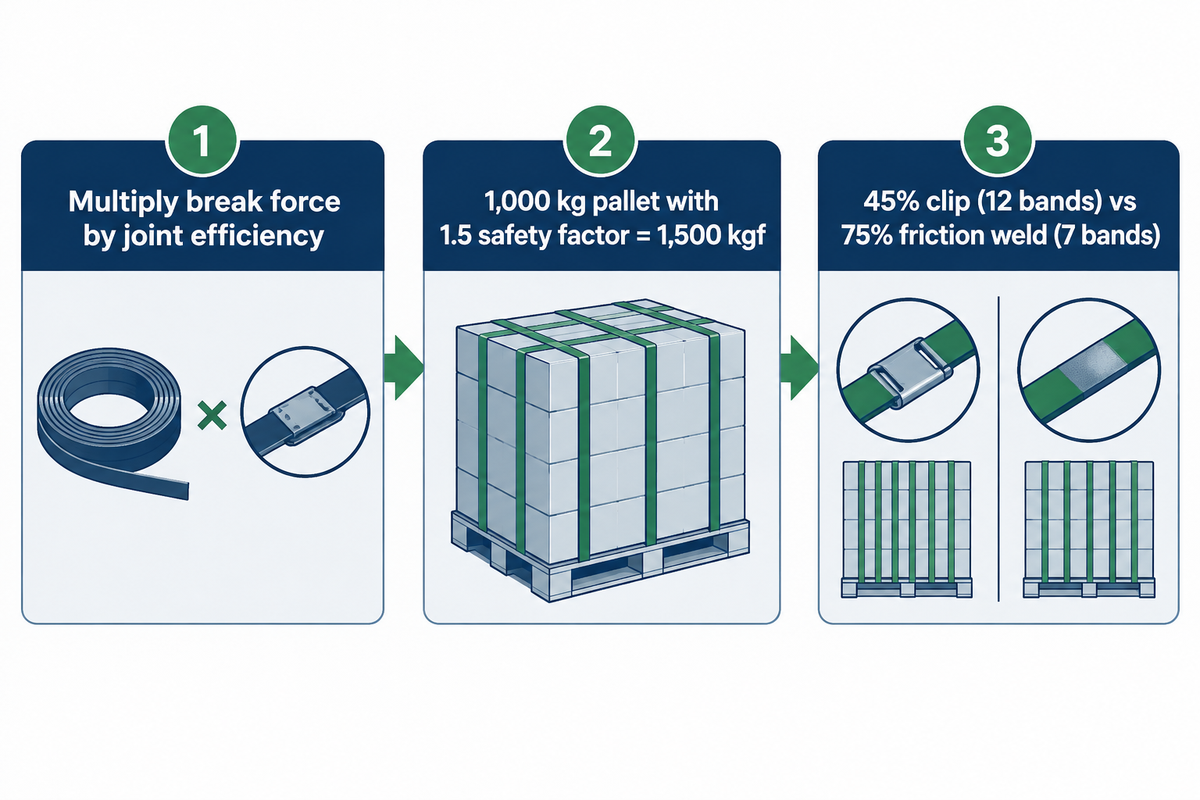
To size strapping width, thickness, and strap count per load, multiply the single-strap catalog break force by the verified joint efficiency percentage and divide the target containment force (load weight in kgf × transit safety factor) by that usable per-strap capacity—never divide pallet weight directly by bare catalog break force. Never divide pallet weight directly by bare catalog break force. As Fromm Packaging notes, a strap loop is only as strong as the point where its ends are joined together, and CustomPack’s field guidelines recommend matching the strap to the heaviest pallet weight rather than a fleet average.
In commercial B2B operations, plastic strapping widths typically run from 5 mm to 19 mm per EAM-Mosca (with common PET widths running from 9 mm to 19 mm and above per Greenstrix, 9.0-25.0 mm in UD Packaging’s extruded PET catalog, and up to 32 mm for heavy-duty polyester applications). Remember that the pallet strap sizing calculation below is a unit-load packaging engineering check based on assumed pallet mass, safety factor, and joint efficiency; it doesn’t replace statutory highway, rail, or marine vehicle tiedown calculations under DOT, FMCSA, or AAR regulations, nor does it qualify packaging strapping for overhead lifting.
Worked example: Pallet Strap Count & Usable Joint Tension Calculation
In this worked example, an export shipper unitizes a 1,000 kg pallet of dense building materials with a 1.5 transit containment safety factor, requiring 1,500 kgf of total usable loop restraint. The plant selects a lower-end 300 kgf break-force PET strap from UD Packaging’s 9.0-25.0 mm (300-1,350 kg) lineup. The table below contrasts sizing that pallet at the 45% minimum joint strength floor specified in ASTM D3950-23 Section 7.2.3 (consistent with Fromm’s observation that metal clip seals on PET yield less than half of base material strength) versus a battery friction-weld tool achieving the 75% efficient joint benchmark documented by Fromm Packaging.
| Calculation Step | Formula / Engineering Rule | Option A: 300 kgf PET + Metal Clip Seal (45%) | Option B: 300 kgf PET + Battery Friction Weld (75%) |
|---|---|---|---|
| 1. Illustrative Maximum Pallet Mass | Match to actual worst-case pallet weight (CustomPack rule) | 1,000 kg illustrative unit load | 1,000 kg illustrative unit load |
| 2. Target Dynamic Restraint Force | Pallet Mass × 1.5 Illustrative Safety Factor | 1,000 × 1.5 = 1,500 kgf required | 1,000 × 1.5 = 1,500 kgf required |
| 3. Candidate Strap Catalog Break Force | Entry PET grade in UD Packaging 300-1,350 kg range | 300 kgf per strap (bare ribbon rating) | 300 kgf per strap (bare ribbon rating) |
| 4. Joint Efficiency Factor | 45% floor (ASTM D3950 Sec 7.2.3) vs 75% weld (Fromm) | 0.45 (45% usable joint retention) | 0.75 (75% usable joint retention) |
| 5. Usable Restraint per Strap Loop | Catalog Break Force × Joint Efficiency Factor | 300 kgf × 0.45 = 135 kgf per strap | 300 kgf × 0.75 = 225 kgf per strap |
| 6. Minimum Strap Count Required | Ceiling(1,500 kgf ÷ Usable Restraint per Strap) | 1,500 ÷ 135 = 11.1 → 12 straps required | 1,500 ÷ 225 = 6.67 → 7 straps required |
| 7. Resulting Total Usable Restraint | Strap Count × Usable Restraint per Strap | 12 × 135 kgf = 1,620 kgf total usable restraint | 7 × 225 kgf = 1,575 kgf total usable restraint |
As the calculation proves, switching from a 45% efficiency metal clip joint to a 75% efficiency friction-weld joint cuts the required 300 kgf strap count on that 1,000 kg pallet from 12 bands down to 7 bands, or allows a standard 4-strap pattern if the plant selects a mid-range 500 kgf PET strap within UD Packaging’s 300-1,350 kg range (where 4 × 500 kgf × 0.75 = 1,500 kgf).
How much tension control do I actually need for my cartons?
Corrugated cartons require adjustable, low-to-moderate tension control that snugs the band flush against the box face without indenting or crushing the vertical flute walls. According to CustomPack’s tensioning guidance, applying excessive tension crushes product edges, deforms corrugated packaging, or snaps the band before the truck leaves the yard, whereas insufficient tension lets the load shift the moment a trailer brakes hard at 90 km/h.
On automated packaging lines handling compressible or unstable loads such as PET bottles and metal cans, Packaging World’s review of the EAM-Mosca SMV-2000 highlights the use of a double-tensioning strapping head that applies evenly distributed force around the entire perimeter rather than pulling from a single corner. For handheld battery tools and tabletop semi-automatic machines, operators should dial the clutch or electronic tension setting to the lowest level that holds the band snug along the flat carton side without creasing the corner board.
Joint Methods, Seals, Buckles, and Edge Protection in Shipping Strapping
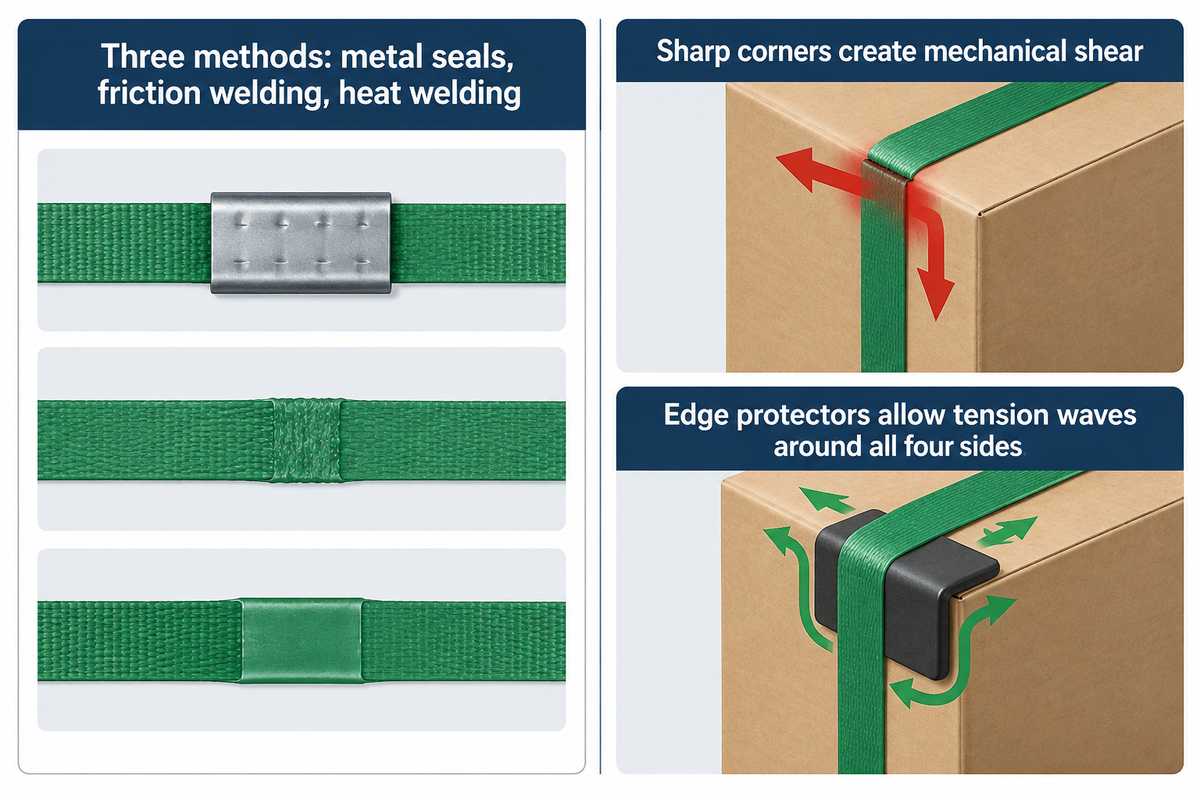
Closing polyester strapping relies on three primary methods—metal seals, friction welding, or heat welding—as categorized by Fromm Packaging’s engineering comparison, alongside wire buckles for corded bands and notch or crimp joints for flat steel under ASTM D3953-13. Because standard smooth metal clip seals on slick polyester retain less than half of the strap’s break strength (with ASTM D3950-23 Section 7.2.3 setting a 45% minimum floor), high-load pallets use either serrated strapping seals or battery friction-weld tools where a single motor tensions in a first rotational direction and reverses to drive the friction welder at 250-350 Hz frequency and 300-350 N pressing pressure over 1.5 seconds to 2 seconds as described in U.S. Patent Application US20230150703A1.
The Joint-Method Usable-Load Table (9-Method Matrix)
Actual joint efficiency is determined by the weld cycle, cool-down time, and the surface of the strap. Base material performance is tested by pull-peel and other testing, as mentioned in ASTM D3950-23 (Section 7.2.3). The table below shows the Joint-Method Usable-Load for all nine closure methods and strapping accessories.
| Joint / Closure Method | Compatible Strap Material | Joint Strength / Efficiency Benchmark | Required Tooling & Hardware | Primary Field Failure Mode & Inspection Check |
|---|---|---|---|---|
| 1. Smooth Open Metal Clip Seal | Polypropylene (PP, Type II) & Light PET (Type IV) | 45% minimum floor (ASTM D3950 Sec 7.2.3); less than half on smooth PET per Fromm | Manual windlass tensioner + two-handle side-action sealer | Strap slips through smooth metal clip under shock; switch to serrated seal |
| 2. Serrated Metal Seal (Grit / Tooth Inner Surface) | Embossed or Smooth PET & Heavy PP | Exceeds smooth clips; up to 75% efficient seal benchmark per Fromm | Heavy-duty manual sealer matched to strap width (9 mm to 19 mm) | Incomplete jaw closure allows tooth slip; verify full lever stroke |
| 3. High-Frequency Friction Weld | Extruded PET & PP (250-350 Hz, 300-350 N, 1.5–2 s per US20230150703A1) | Often exceeds 75% of polyester break strength per Fromm Packaging | Portable battery or pneumatic friction-weld strapping tool | Premature release before weld cools; peel test must tear base polymer |
| 4. Thermoelectric Hot-Knife / Heat Weld | Machine-Grade PP & PET (plus factory splices ≥50% per ASTM D3950) | Consistent automated fusion across both strap interfaces (≥45% D3950 floor) | AC-powered semi-automatic tabletop or automatic arch machine | Carbon buildup on heater blade weakens weld; wipe blade on PM schedule |
| 5. Phosphate-Coated Steel Wire Buckle | ASTM D3950 Type IA Corded & Woven Polyester (and Type I Rayon) | ≥45% minimum (Grades 1–2) and ≥55% minimum (Grades 3–7) per ASTM D3950 Sec 7.2 | Manual cord strapping tensioner + heavy wire buckle | Incorrect threading loop unwinds under load; train dock crew on S-loop |
| 6. Molded Plastic Buckle (Hand Pull) | Light Polypropylene (PP, 110 lbs to 600 lbs range) | Light-duty hand bundling only | Self-dispensing portable strapping kit (no tool or hand puller) | Buckle fractures if over-tensioned with mechanical ratchet |
| 7. Single-Notch Steel Seal (ASTM D3953 Style I, V) | ASTM D3953-13 Type 1 Flat Carbon Steel | Standard mechanical notch joint per ASTM D3953-13 seal tables | Steel tensioner + single-notch sealer + open or closed seals | Notch cuts into strap edge; verify seal class matches strap gauge |
| 8. Double-Notch or Crimp Steel Seal | ASTM D3953-13 Type 1 Regular & High-Tensile Steel | High-load carloading and lashing joint per ASTM D3953-13 | Double-notch or pneumatic crimp sealer + Class R or Class H seal | Worn crimper jaws reduce friction wave depth; gauge crimp monthly |
| 9. Sealless Punch-Lock Steel Joint | ASTM D3953-13 Type 2 Flat Carbon Steel | Interlocking die-cut joint under ASTM D3953-13; zero seal consumable cost | Combination sealless steel strapping tool (interlocking die keys) | Interlocking keys can unhook if compressible load goes slack |
The Joint-Method Usable-Load Table below compares all nine industrial closure methods and strapping accessories.
Regardless of the strength of the welds, sharp corners create the primary point of mechanical shear. As CustomPack documents, without an edge protector a tensioned strap does not fail gradually—it snaps at the exact point of corner contact mid-transit without warning. Tensioned straps need edge protectors to prevent cutting into the carton edges and to allow tension waves to travel around all four sides of the pallet.
Matching Shipping Strapping to Manual Tools, Dispensers, and Strapping Machines
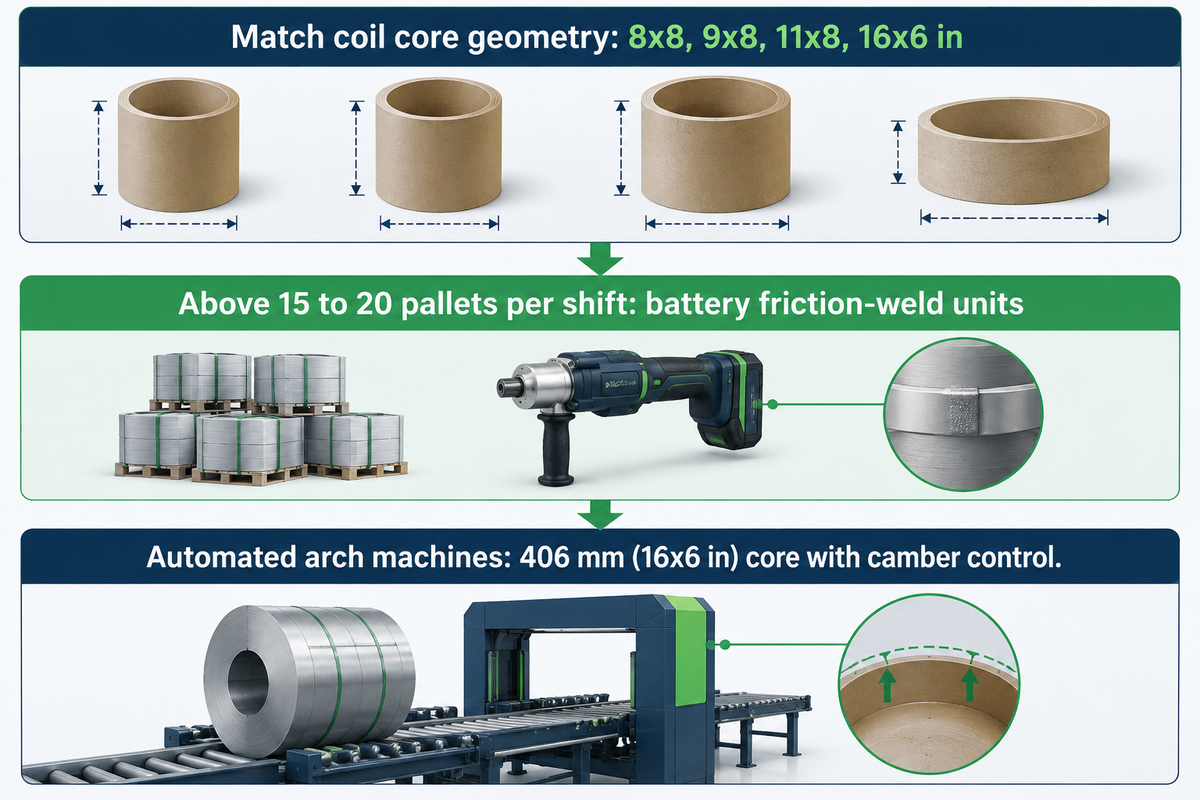
Before ordering bulk strapping coils, match two physical interfaces to your existing strapping tools and machines: coil core geometry, standardized at 8×8, 9×8, 11×8, and 16×6 inches with a required core inner diameter 0.1 to 0.2 inches larger than the spindle outer diameter per the John Maye Strapping Core Size Guide (corresponding to 200 mm / 8 in and 406 mm / 16 in inner core diameters in UD Packaging and Greenstrix specs), and tooling weld technology, where Fromm Packaging confirms that all portable battery-operated strapping tools use friction welding because thermoelectric hot blades are only feasible in AC-powered semi-automatic and automatic strapping equipment. As John Maye notes, a one-inch difference in core diameter makes a roll incompatible with the wrong machine, halting packing operations until an external dispenser cart is sourced.
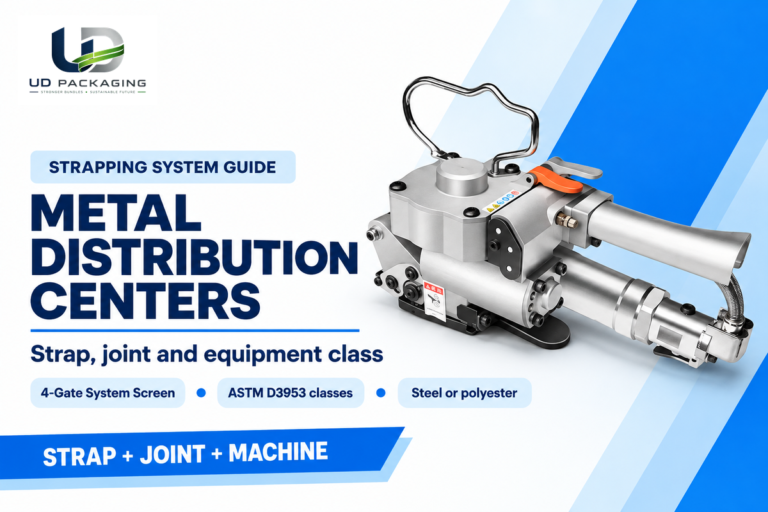
For low-volume shipping desks, small businesses, or occasional home use, a self-contained banding strapping kit is a good starting point. Each portable dispenser box or wheeled cart is paired with manual strapping tools, specifically a windlass or feed-wheel poly strapping tensioner and a matched crimper, to perform manual banding without requiring drops in compressed air or power. Once throughput rises above 15 to 20 pallets per shift, plants upgrade from hand tools such as tensioners and separate sealers to one-button battery friction-weld units, where each packaging strapping tool tensions and fuses the overlap in a single 1.5 to 2 second cycle at 250-350 Hz and 300-350 N pressing pressure per patent publication US20230150703A1 . Patent publication US20230150703A1 states that prior art teaches a similar band-welding mechanism, but lacks detail on implementation. When feeding automated arch machines, always specify machine-grade strap on a 406 mm (16×6 in) core with strict camber (straightness) control per Greenstrix’s machine-grade guidelines so the band does not jam the arch track.
What strap widths will a tabletop strapping machine handle?
Most open-cabinet and closed-cabinet semi-automatic tabletop strapping machines handle polypropylene (PP) plastic strapping widths from 5 mm to 16 mm, with 9 mm and 12 mm serving as the standard factory configurations for corrugated cartons. Moving between 9 mm and 12 mm typically requires adjusting the mechanical strap guide blocks along the feed track and matching the tension roller groove width.
Tabletop machines use an AC-powered thermoelectric hot-knife blade to melt and fuse overlapping PP faces in 1.5 to 2 seconds and carry a 200 mm (8×8 in or 9×8 in) inner-diameter coil core holder underneath the stainless steel tabletop. They aren’t engineered to tension or friction-weld heavy 16 mm to 25 mm pallet-grade polyester strapping, which requires either a handheld battery friction-weld tool or a heavy-duty pallet arch machine mounted on a 406 mm (16×6 in) core dispenser.
Pallet and Box Strapping Patterns: Combining Strapping with Stretch Film
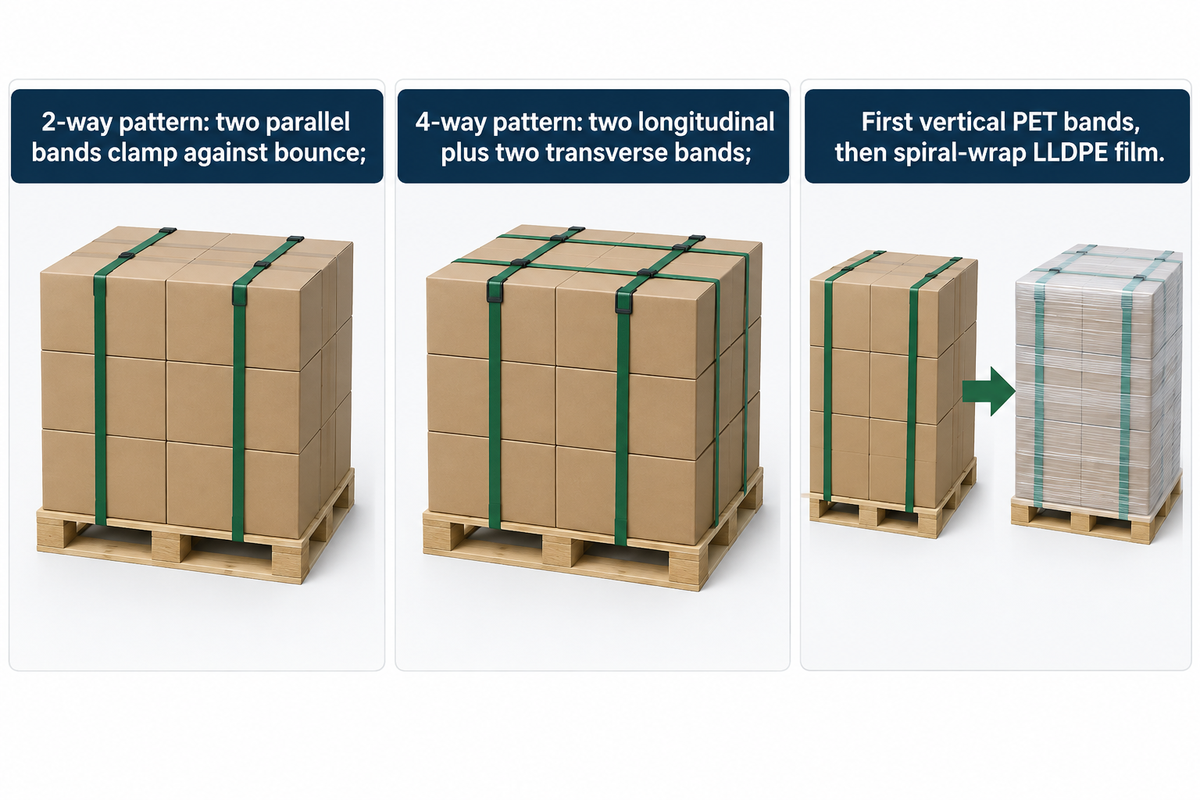
Use standalone strapping for rigid, self-supporting bundles (lumber packs, metal extrusions, heavy master cartons), standalone stretch film for light uniform box pallets on local routes, and a combined system, vertical PET strapping plus horizontal linear low-density polyethylene (LLDPE) stretch film (12-30 um thickness, 150-300% pre-stretch, 250-500 mm widths in UD Packaging’s integrated unit-load lineup ), for tall, multi-tier, or export pallets. See our operational walkthrough on how to strap a pallet for guidance on threading pallet stringer voids.
On a standard wood or plastic shipping pallet, a 2-way vertical strapping pattern routes two parallel bands under the top deck boards and over the top cap to clamp the load down against vertical road bounce. Heavy, dense, or cubic loads require a 4-way pattern, utilizing two longitudinal bands plus two transverse bands intersecting with rigid corner boards along all four vertical edges. When strapping is used along with stretch wrapping, first apply the vertical PET bands to lock the load to the pallet base, then spiral-wrap pre-stretched LLDPE film over the outside to unitize loose carton tiers and shield the bands from forklift snagging.
| Unit-Load Configuration | Strapping Pattern | Stretch Film Pairing | Edge & Top Protection | Mechanical Securement Role |
|---|---|---|---|---|
| Single heavy corrugated carton | 2 parallel 9–12 mm PP bands (or 2+2 cross pattern) | Not applicable | Plastic corner clips on thin single-wall boxes | Prevents bottom-flap burst and acts as reinforced closure |
| Rigid timber, pipe, or aluminum extrusion bundle | Circumferential 16–19 mm PET or corded polyester bands | Optional top weather sheet only | Timber dunnage bunks + molded corner protectors | High hoop tension binds individual lengths into one friction beam |
| Multi-layer stacked box pallet | 2-way or 4-way 12–16 mm vertical PET through pallet deck | 12-30 um LLDPE stretch film (150-300% pre-stretch) | Full-height vertical V-board corner protectors | PET anchors stack vertically to pallet; film stops horizontal tier slip |
| Beverage bottles, cans, or masonry pallet | 4-way 16–19 mm embossed PET + horizontal tier bands | Heavy-gauge overwrap or top-sheet + spiral wrap (250-500 mm widths) | Rigid tier slip-sheets + top perimeter frame + corner boards | Maintains structural cube under warehouse double-stacking and LTL vibration |
ASTM Standards, Common Failure Modes, and B2B Procurement Checklist
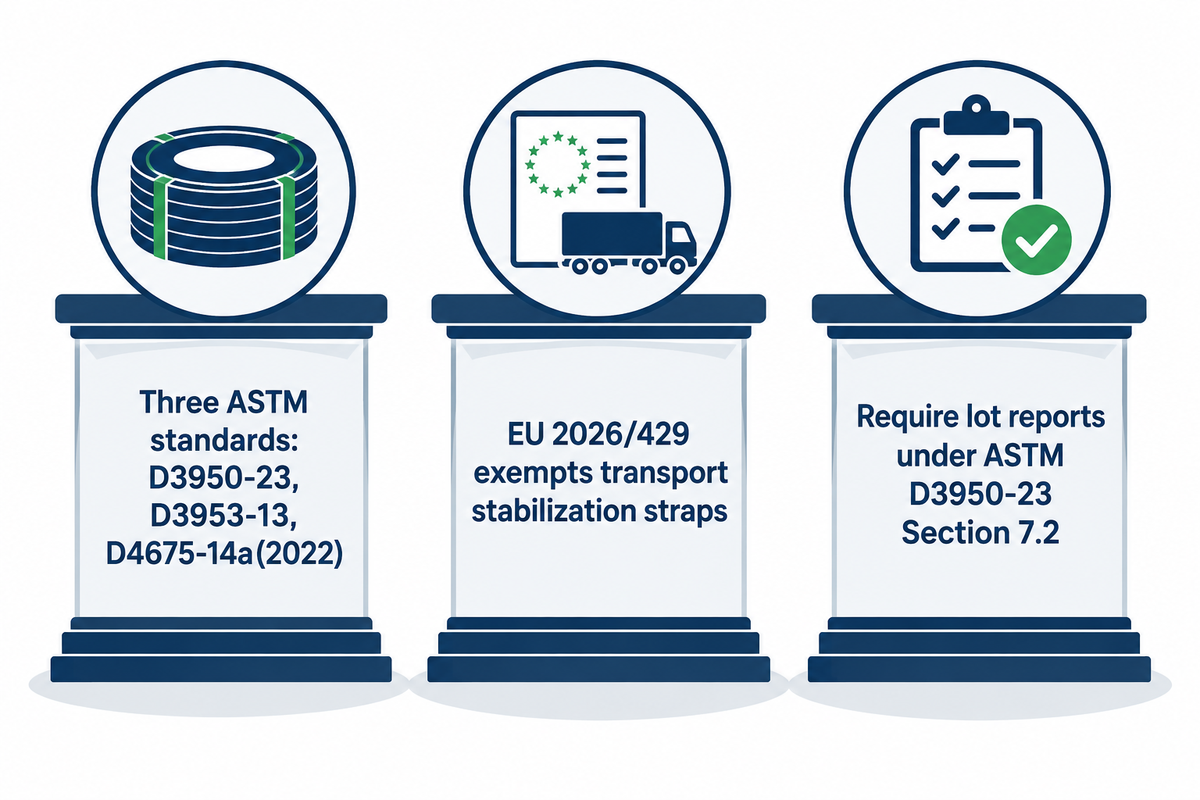
Industrial buyers specify shipping strapping against three ASTM International standards ASTM D3950-23 (nonmetallic), ASTM D3953-13 (flat carbon steel), and ASTM D4675-14a(2022) (selection and use guide), while exporters shipping into the European Union should note that European Commission Delegated Decision (EU) 2026/429 exempts economic operators using pallet wrappings and straps for stabilization and protection during transport from the 100% reuse targets under Article 29(2) and (3) of Regulation (EU) 2025/40. According to Grand View Research, Asia Pacific accounted for 35.5% of global packaging strapping revenue in 2025 and Transportation & Logistics held a 34.4% share, making clear purchase-order tolerances essential when qualifying domestic and international extruders.
Do
- Specify exact width × thickness in millimeters, minimum break strength in kgf or lbs, surface finish (embossed vs smooth), and coil core size (8×8, 9×8, 11×8, or 16×6 in) on every purchase order
- Install rigid fiberboard or molded plastic edge protectors on sharp load corners before tensioning PET, PP, or steel bands
- Friction-weld dwell, frequency, and tension are set to the tool and strap manufacturer’s specifications, and joint strength is verified with a controlled test method.
- Require lot-specific tensile and joint-strength test reports sampled and retested in accordance with ASTM D3950-23 or ASTM D3953-13
Don’t
- Order generic half-inch poly strap without stating polymer type (Type II PP vs Type IV PET), thickness gauge, and hand-grade versus machine-grade camber tolerance
- Use a matched seal or friction-weld system whose documented joint strength meets the required load; do not select a smooth open clip merely because joint efficiency is below 50%.
- Size pallet strap count by the heaviest actual load and how it behaves when a truck brakes hard at 90 km/h, rather than by average warehouse pallet mass.
- Accept unverified catalog sheets in place of lot-specific break-strength and joint-efficiency test reports referenced to ASTM D3950-23 or ASTM D3953-13
When auditing supplier documentation for effective packaging procurement, require mechanical test reports for each lot of base ribbon and joined strap, as evaluated under ASTM D3950-23 Section 7.2 (≥45% for Types II, III, and IV; ≥55% for Type IA Grades 3–7; ≥50% for factory splices) or ASTM D3953-13. Copy the eight-point procurement checklist below into your request for quotation (RFQ) when comparing a wide selection of high-quality strapping suppliers:
8-Point B2B Shipping Strapping RFQ Specification Checklist
- List the exact polymer or steel classification in ASTM D3950-23 (Type I rayon cord, Type IA polyester cord, Type II PP, Type III nylon, or Type IV PET) or ASTM D3953-13 (Type 1 or Type 2 carbon steel).
- Define nominal width and thickness tolerances in millimeters or inches, such as 16.0 mm × 0.8 mm PET within UD Packaging’s 9.0-25.0 mm × 0.5-1.3 mm range.
- Provide the minimum single strap break force and elongation for the polymer, thickness, and grade in kgf or lbf as opposed to nominal gauge alone.
- Choose a smooth or embossed surface finish for plastic strapping (embossed improves automatic friction welds per Greenstrix); or a painted vs. zinc-coated finish for steel.
- Lock in the coil core inner diameter and face width, 8×8, 9×8, 11×8, or 16×6 inches (200 mm or 406 mm ID with 0.1 to 0.2 inch spindle clearance), so rolls fit existing dispensers and arch machines without adapters.
- Require machine-grade camber straightness and factory splice strength of at least 50% per ASTM D3950-23 for automated arch chutes instead of hand-grade coils for portable carts.
- Pair strap thickness with the matching closure accessory or tool (serrated seals, Class R/H steel seals, phosphate wire buckles, or 250-350 Hz battery friction-weld tools).
- Reports on joint-efficiency tests and batch tensile tests are based on the relevant ASTM specifications, while EU packaging obligations constitute a separate legal requirement.
Frequently Asked Questions
Q: Is strapping alone enough, or should I pair it with another sealing method for certain items?
Self-supporting rigid bundles such as lumber or metal extrusions or heavy corrugated master cartons which need only vertical clamping or closure reinforcement can be held with strapping.
Lateral shift and strap pressure distribution are achieved through a combination of vertical polyester strapping, stretch film, and rigid corner boards; moisture protection is added when required. Moisture protection is added when necessary.
Q: What is the difference between manual, semi-automatic, and fully automatic strapping machines?
Manual strapping uses separate or combination hand tensioners and sealers where an operator feeds, tensions, and seals each band around pallets or boxes.
Semi-automatic tabletop machines tension, heat-weld, and cut polypropylene strapping automatically after the operator loops the band over the carton, whereas fully automatic arch machines feed the strap around the package via a powered chute, tension, weld, and eject without operator threading.
Q: How do you use a manual strapping tool and sealer for shipping boxes and pallets?
Pull the strap around the load and place both overlapping layers into the tensioner per the feed guide, and make sure the bottom tail is secured under the foot of the gripper.
Ratchet the tensioner until the band sits against the edge protectors, making sure it doesn’t crush the wall of the carton. Seal with a matched metal crimp or trigger the friction weld and then cut the feed tail.
Q: Is strapping for shipping containers and rail cars subject to specific carrier rules?
Yes, standard carton and pallet banding is unit-load packaging rather than vehicle tiedown.
Rail loads must comply with the rail carrier’s securement rules; ocean containers must meet carrier and container-loading requirements, and flatbed loads must follow road-cargo securement rules.
Q: When should a warehouse buy a portable poly strapping kit instead of bulk machine coils?
A portable self-dispensing poly strapping kit with a hand tensioner and wire buckles or metal seals is suited for low-volume shipping work desks, maintenance cribs or field job sites banding fewer than 15 to 20 pallets or oversized crates per shift.
Once a packing station straps dozens of uniform cartons or pallets per shift, bulk 16×6 inch or 8×8 inch coils mounted on a wheeled dispenser cart with a battery friction-weld tool cut both consumable cost per foot and operator cycle time.
Q: Can plastic strapping be reused after a shipment arrives at the receiving dock?
Heat-welded and metal-sealed polypropylene or polyester straps cannot be reused because cutting destroys loop length and tensioning permanently stretches the polymer.
Only corded or woven polyester straps, fastened with wire buckles, can be re-threaded for light bundling.
Q: How should receiving teams safely cut high-tension steel or polyester shipping straps?
PPE eye protection and cut-resistant gloves should be worn. Straps should be cut from a position away from the band’s path. A spring-loaded cutter with a hold-down foot should be used.
Never strike tensioned steel or heavy polyester strapping with a claw hammer, crowbar, or standard box knife, as stored elastic energy can whip the sheared end across the dock.
References & Sources
- ASTM D3950-23 Standard Specification for Strapping, Nonmetallic (and Joining Methods) ASTM International / iTeh Standards
- ASTM D3953-13 Standard Specification for Strapping, Flat Steel and Seals ASTM International
- ASTM D4675-14a(2022) Standard Guide for Flat Strapping Material Selection and Use ASTM International / iTeh Standards
- Commission Delegated Decision (EU) 2026/429 Supplementing Regulation (EU) 2025/40 on Pallet Wrappings and Straps Official Journal of the European Union (EUR-Lex)
- US20230150703A1 Power Strapping Tool with Single-Motor Tensioner and Friction Welder United States Patent and Trademark Office (Google Patents)
- Packaging Strapping Materials Market Size, Share & Trends Analysis Report (2026–2033) Grand View Research
- EAM-Mosca SMV-2000 Pallet Strapping System Technical Coverage Packaging World
About This Analysis
This engineering selection guide was compiled by matching ASTM D3950-23, ASTM D3953-13, and ASTM D4675-14a(2022) strapping standards against UD Packaging’s extruded PET strapping specifications (9.0 mm to 25.0 mm widths, 0.5 mm to 1.3 mm thicknesses, 300-1,350 kg break force) and LLDPE stretch film parameters (12-30 um thickness, 150-300% pre-stretch, 250-500 mm widths). Reviewed by the UD Packaging technical team.
Request Samples or Custom PET & PP Shipping Strapping Quotes
Need machine-grade or hand-grade polyester and polypropylene strapping matched to your 200 mm (8 in) or 406 mm (16 in) dispensers and friction-weld tools? Send your pallet weight, strap width × thickness and coil core to UD Packaging for factory-direct specifications and lot test reports.