Get in touch with UD Packaging Company

Updated November 2026
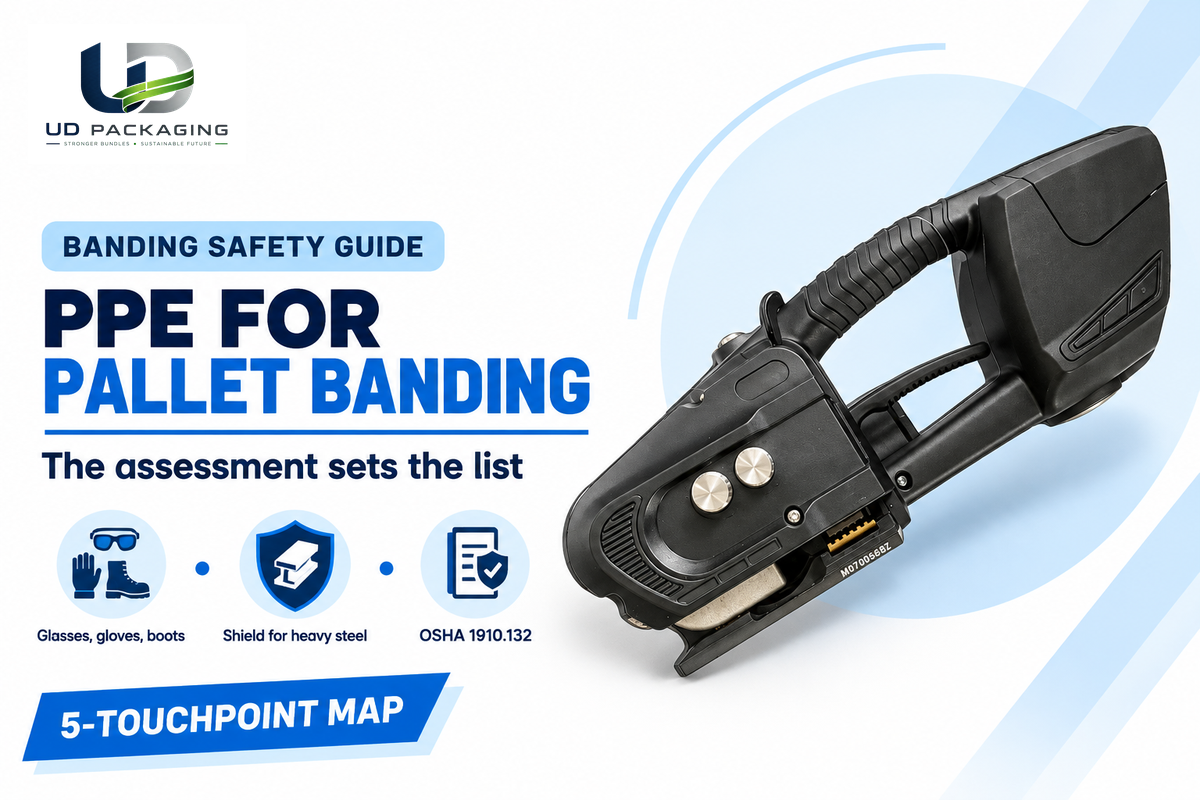
No OSHA clause specifies what personal protective equipment (PPE) is required when using banding equipment to secure items to a pallet, meaning the employer’s PPE assessment under 29 CFR 1910.132 determines it. The usual outcome is impact-rated safety glasses with side shields, cut-resistant gloves and safety-toe footwear, as well as a face shield, sleeves or hearing protection when the task calls for them.
The list changes with each step. Oregon DOT’s steel-strapping tailgate talk lists safety glasses, a hard hat and safety shoes against recoiling bands, and NGWA’s steel strapping removal guide says steel-studded gloves and a face shield may be needed, in addition to goggles, for heavier straps. Two tools sort the answer: the 3-Source Requirement Check (rule, tool manual or site policy) and the 5-Touchpoint PPE Map, which pairs each banding step with an item.
What PPE Is Required When Using Banding Equipment? The Rule Behind the Quiz Answer
Eye, hand and foot protection are the usual starting set for pallet banding. The employer sets the final list under 29 CFR 1910.132, which gives duties instead of an item list: assess the task, select PPE that fits each affected worker, certify the assessment in writing, train each user and, with listed exceptions, pay for the equipment. There are exceptions to the employer covering the cost of the PPE.
“…the protective equipment, including personal protective equipment (PPE), used to comply with this part, shall be provided by the employer at no cost to employees.”
Paragraphs (h)(2) to (h)(6) list exceptions, such as non-specialty safety-toe footwear, for which the employer isn’t required to pay, if the employer permits workers to wear it off the job site. The Occupational Safety and Health Administration (OSHA) places each of the other duties in its own paragraph: the assessment in (d)(1), fit in (d)(1)(iii), the written certification in (d)(2), and training in (f)(1). The certification identifies the work place evaluated, the person certifying it and the date, and states that it’s a certification of hazard assessment.
| Source | What it sets | Banding example |
|---|---|---|
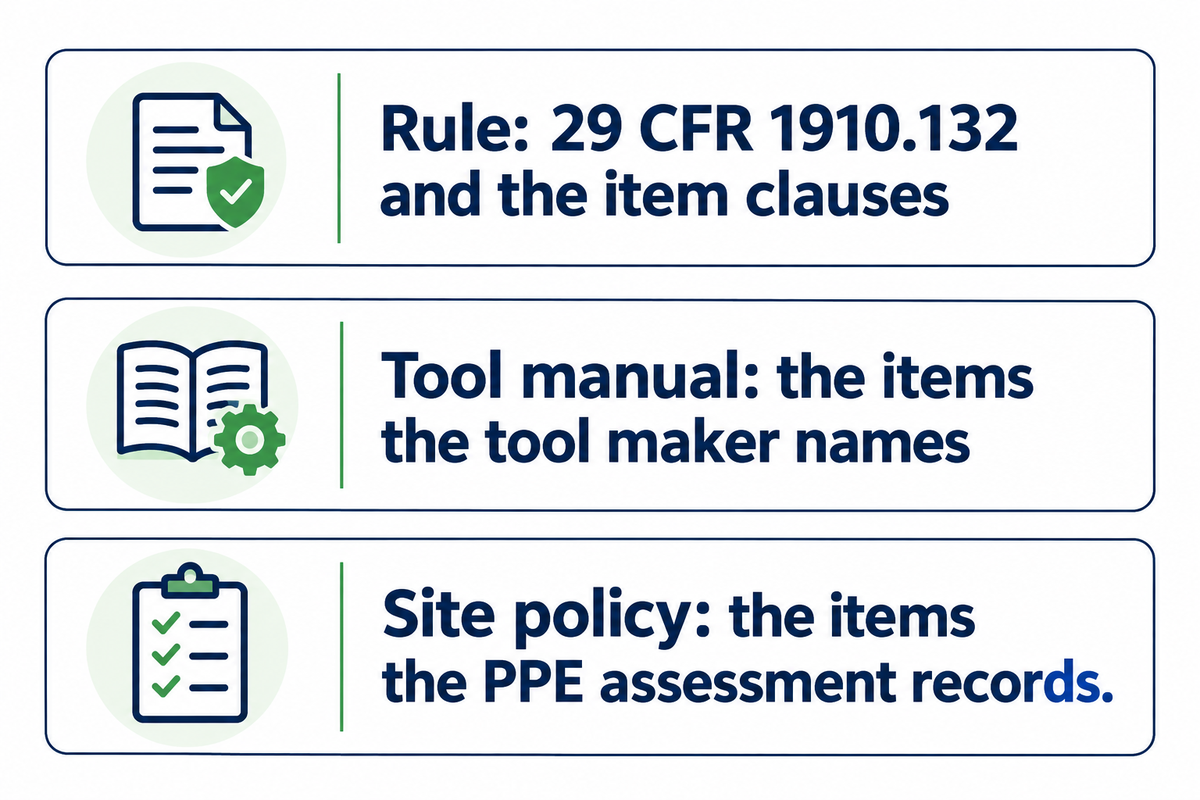
| Rule: 29 CFR 1910.132 and the item clauses 1910.133, 1910.136, 1910.138 and 1910.95 | Who assesses, certifies, trains and pays; item clauses apply once the assessment finds the exposure | Side protection on eye protection where flying objects are an exposure (1910.133(a)(2)) |
| Tool manual | The items the tool maker names for that tool | Whatever eye and hand items the strapping tool’s instruction sheet names |
| Site policy | The items the site’s PPE assessment records for each step, strap and tool | A face shield added at the cut step for heavier steel strap |
The quiz version offers four options (select all that apply): face shield, dust mask, abrasion-resistant work gloves and safety glasses. The glasses-and-gloves answer is a starting point for the assessment, not the rule. Safety glasses and gloves match the touchpoint map in the next section, the face shield joins only at the steps that call for it, and the dust mask joins none of the nine steps by default.
Under OSHA standards the employer is required to decide where the use of personal protective equipment is necessary, and each worker must show how to use it before the work starts (1910.132(f)(2)). For the procedure itself, see how to strap a pallet and verify it before release.
What PPE must always be worn?
Eye protection with side protection comes the closest to always-on protection because, according to 29 CFR 1910.133(a)(2), side protection is required if there’s a potential for flying objects. Every other item follows the PPE assessment for the step being done.
As the task shifts from feeding to cutting to removal, the items change as well. Each item must also fit: 29 CFR 1910.132(d)(1)(iii) requires PPE that properly fits each affected employee, and a glove that slips or a frame that sits crooked fails that test even when the label is right. Gear that fits comfortably is the gear the crew keeps on.
PPE by Touchpoint: The 5-Touchpoint Map for Using Banding Equipment to Secure Items to a Pallet
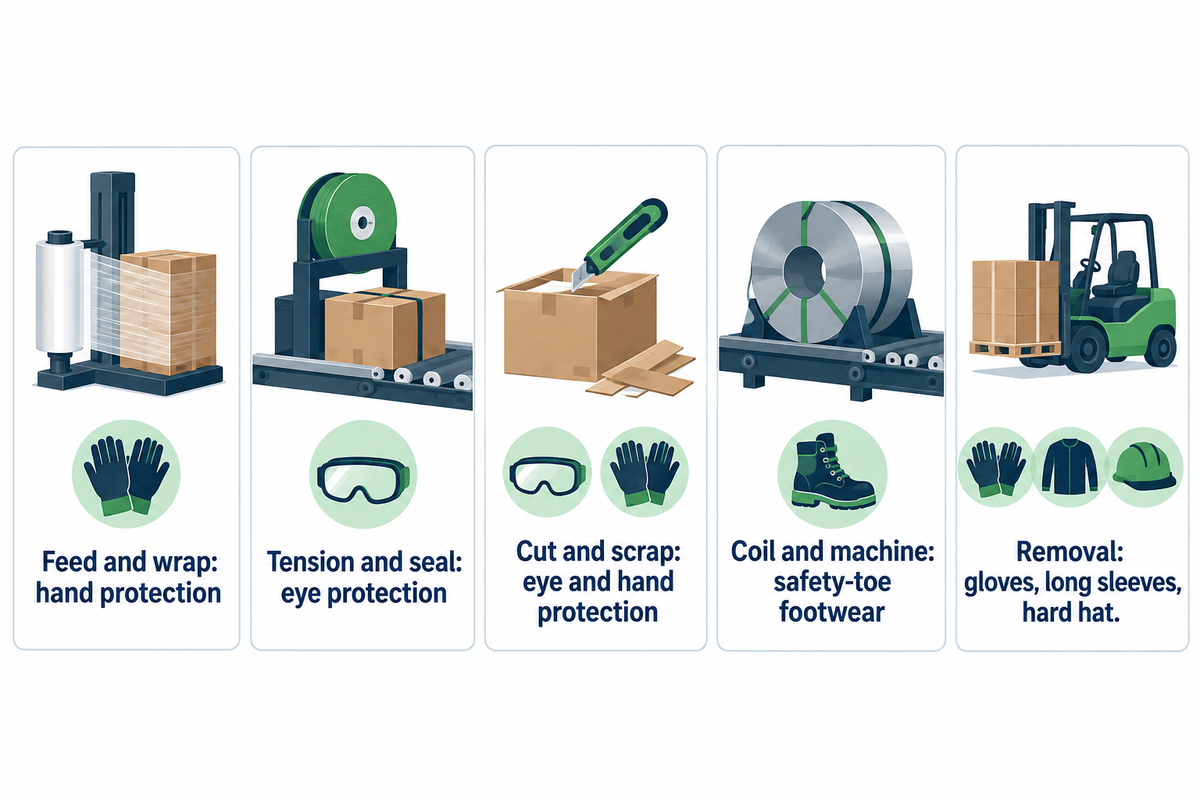
A strap that’s either tightened or cut creates an injury at five touchpoints: feed and wrap, tension and seal, cut and scrap, coil and machine, and removal. Each calls for a different item: eye protection at tension and cut, hand protection at feed, scrap and removal, safety-toe footwear at the coil. The map below lists the nine steps behind those five.
Wearing appropriate PPE here means gloves at the feed step, eye protection at tension and cut, and safety-toe footwear at the coil, because the necessary PPE follows the risks associated with each step. The last column identifies who sets each line.
| Touchpoint and step | Injury route | Item | Set by |
|---|---|---|---|
| 1 · Feed and unreel | The edge drags across palm and fingers: cuts, lacerations, abrasions | Cut-resistant gloves | Rule: 29 CFR 1910.138(a) |
| 1 · Wrap and position | A free end swings loose as the strap is drawn around a corner | Safety glasses with side shields, plus the gloves above | Rule: 29 CFR 1910.133(a)(2) |
| 2 · Tension | A strap, seal or tool part can fly free if the strap slips or the joint fails | Z87+ safety glasses with side shields; face shield over them for steel | Tool manual, site policy |
| 2 · Seal | A crimp or buckle edge catches the glove; a seal or strap end can fly if the joint lets go | Cut-resistant gloves and safety glasses | Tool manual |
| 3 · Cut | The cut band springs back; a cut that is not square leaves a sharp pointed end | Goggles or safety glasses, leather palm gloves; face shield and steel-studded gloves for heavier steel straps | NGWA and Oregon DOT for steel; site policy for plastic strap |
| 3 · Scrap and offcut handling | Offcuts with pointed ends cut the hand; loose scrap on the floor is a trip | Gloves; goggles too when the scrap container is emptied by hand | NGWA for steel; site policy |
| 4 · Coil handling | A coil rolls or drops onto the foot; its edge scrapes the hand | Safety-toe footwear and gloves | Rule: 29 CFR 1910.136(a) |
| 4 · Jam clearing on a machine | A jammed strap springs free when it is pulled out or the machine restarts | Gloves and safety glasses, after the machine is locked out | Tool manual, site policy |
| 5 · Removal at the receiving dock | A tensioned band strikes the body when cut; compressed contents such as springs recoil when released | Safety glasses or goggles, hard hat, safety shoes, leather palm gloves, long pants and sleeves as protective clothing; face shield for heavier straps | Oregon DOT and NGWA for steel; site policy |
There are two rows that depend on the tool in your hand. The tension row follows how to use a strapping tensioner and the seal row follows choosing seals for PET strap; the coil row starts with handling a PET strapping coil off the pallet.
Let’s say a crew bands PET with a battery tool at one station and removes steel banding at the receiving dock. The assessment record, with the written certification under 29 CFR 1910.132(d)(2), lists the following safety equipment by location:
- Workplace, Certifier, Date: The banding station and the receiving dock, the Shift Supervisor, the day of the walk-through
- Station: Z87+ safety glasses with side shields, cut-resistant gloves, safety toe footwear
- Dock: Goggles, Leather palm gloves, long sleeves, hard hat, safety shoes, and a face shield for heavier straps
One set for every step is the mistake this record prevents: the right PPE at the station is the wrong set at the dock, since the equipment worn there has no sleeves or a face shield.
Safety Glasses and Face Shields: What Z87+ Certifies and When a Shield Goes Over Them
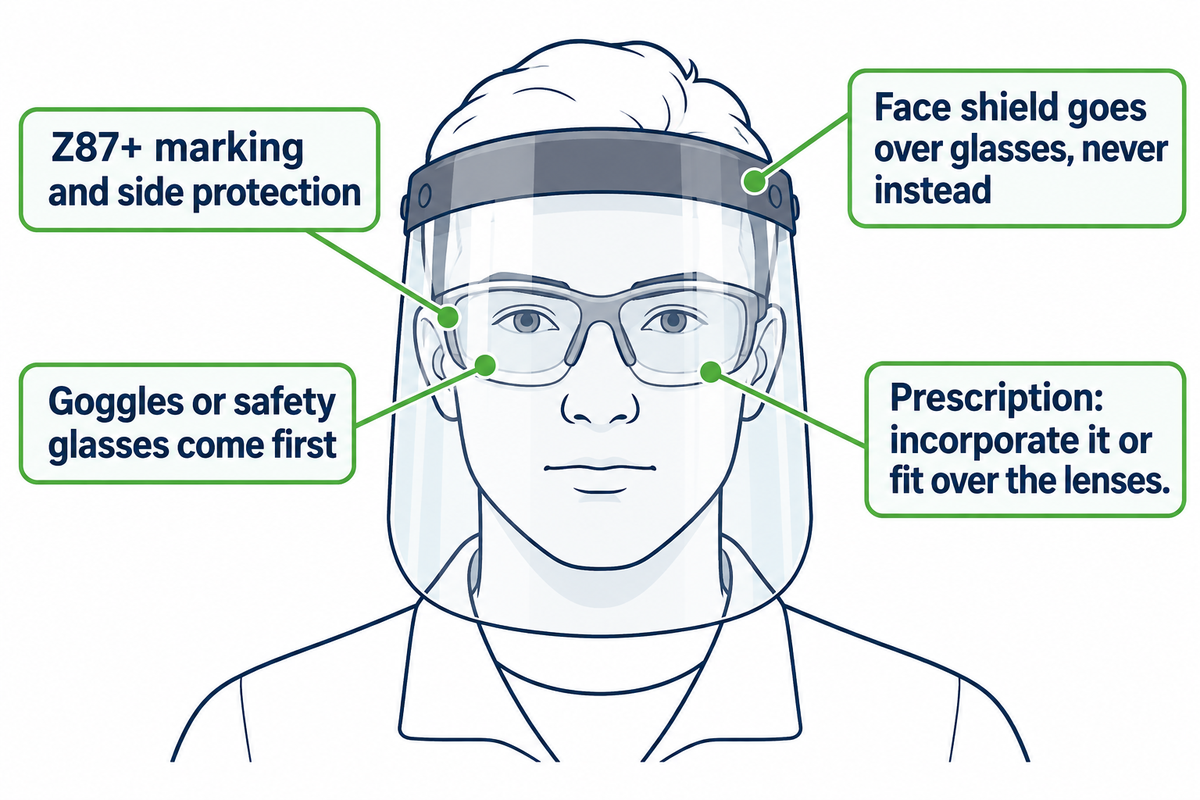
Safety glasses for banding should carry the Z87+ marking and side protection, and a face shield is added over them for heavier steel strap, never worn in their place. The + in Z87+ is the impact mark, and 29 CFR 1910.133(a)(2) requires side protection when flying objects are an exposure.
The OSHA clause points to ANSI/ISEA Z87.1-2010 as the consensus standard (1910.133(b)(1)(i)) and per ANSI’s marking list, a protector with the permanent marking Z87 satisfies the requirements of Z87.1. For workers who wear prescription lenses, the protection must either incorporate the prescription or fit over the lenses without moving either set of lenses (1910.133(a)(3)).
| Item | What it stops | Mark or duty to look for |
|---|---|---|
| Safety glasses with side shields | Flying debris from the front and the sides | Z87+ marking and side protection |
| Goggles | Cut ends and metal at the cut step; NGWA names goggles with palm gloves for steel removal | Z87+ marking |
| Face shield over glasses or goggles | Face exposure on heavier steel strap (NGWA) | Marked to ANSI/ISEA Z87.1 for impact (+); worn in addition to eye protection |
| Cover over prescription glasses | The same exposures as the item it covers | Incorporates the prescription, or fits over the lenses without moving them (1910.133(a)(3)) |
Would a face shield be needed or goggles?
Goggles or safety glasses come first, and for a heavier steel strap a face shield may become the add-on, which NGWA words as “may be necessary” in addition to goggles. A face shield worn alone leaves the eyes without their own protection.
During assessment of light PET feed, the assessment can stop at glasses with side shields. When the cut step moves to a tensioned band, the assessment adds the shield and records why. For workers with prescription lenses, the eye protection either incorporates the prescription or fits over the prescription lenses. Splash goggles are a separate item, covered along with the other equipment that banding doesn’t call for by default.
Cut-Resistant Gloves and Sleeves for Strapping: Reading the ANSI/ISEA 105 Level
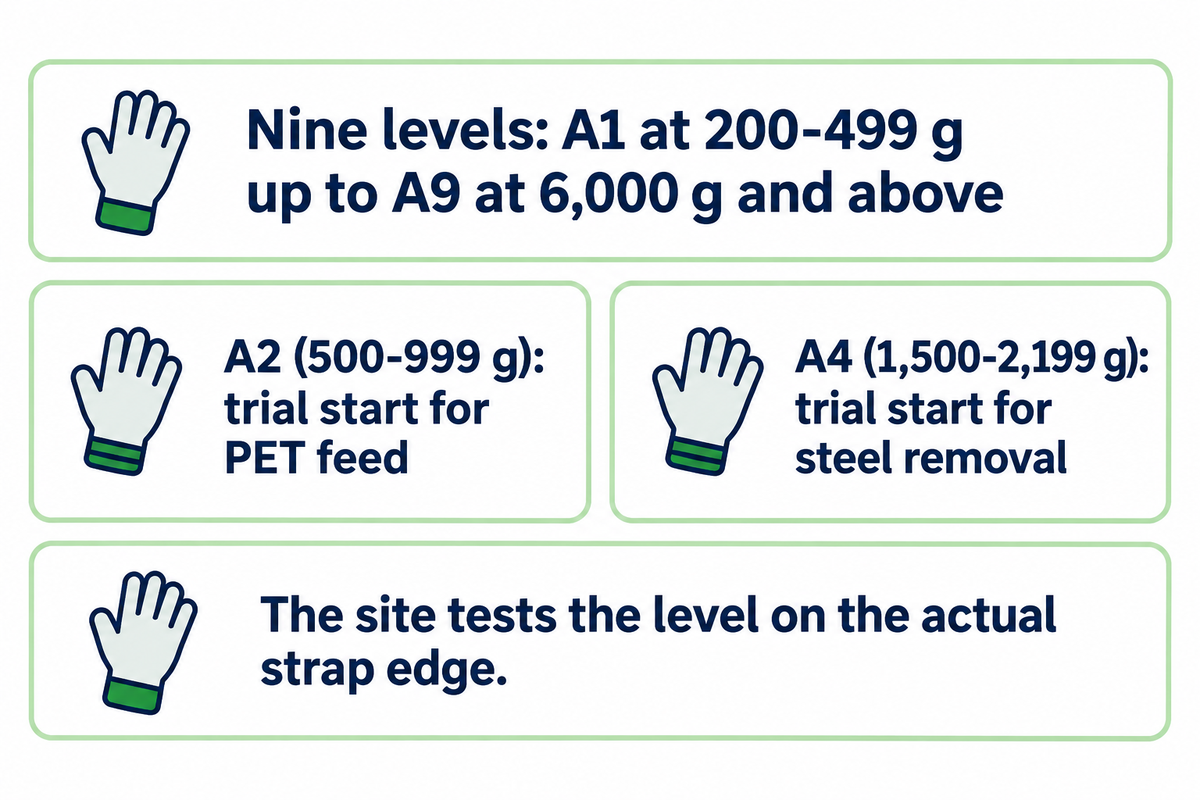
A2 gloves (500-999 g) and A4 gloves (1,500-2,199 g) are trial starts for PET feed and steel removal, respectively. No standard assigns a cut level to a strap material. ANSI/ISEA 105 rates the gloves in grams, so the cut level for a strap is a choice the site tests. The scale has nine levels, A1 at 200-499 g, up to A9 at 6,000 g and above. OSHA’s hand clause, 29 CFR 1910.138(a), lists severe cuts and lacerations as an exposure and doesn’t specify a level.
The levels below are ANSI’s own example uses, not a ruling for strapping.
| Level | Cut test result | ANSI’s example use |
|---|---|---|
| A1 | 200–499 g | Light-duty: cardboard handling, packaging, light assembly |
| A2 | 500–999 g | General-purpose, warehouse and light automotive tasks |
| A3 | 1,000–1,499 g | Automotive shops and small parts with rough edges |
| A4 | 1,500–2,199 g | Construction, packaging, handling glass or metal |
| A5 | 2,200–2,999 g | HVAC, electrical work, metal fabrication |
| A6 | 3,000–3,999 g | Sharp metals and, in some cases, food processing |
| A7 | 4,000–4,999 g | Metal stamping, recycling sorting, automotive assembly |
| A8 | 5,000–5,999 g | Heavy duty, high-risk tasks: sharp steel, glass manufacturing, oil and gas |
| A9 | 6,000 g and above | Extremely sharp, heavy duty industrial items |
ANSI/ISEA 105 covers sleeves as well, so one scale applies to gloves and forearm protection.
The nearest ANSI example for A2 is warehouse tasks and for A4 is handling metal, and the A4 floor of 1,500 grams is three times the A2 floor of 500 grams. The crew from the touchpoint map wears each pair for a shift on the actual strap edge; if the strap scores the palm, the crew moves up one level, and the tool maker’s manual settles ties.
Cut-resistant gloves protect your hands from cuts at sharp edges, whether strap, seal or cutter; cutters for receiving docks covers the blade side of handling materials at the dock.
Steel, PET and Polypropylene Strap: How the Strap Changes the Protective Equipment
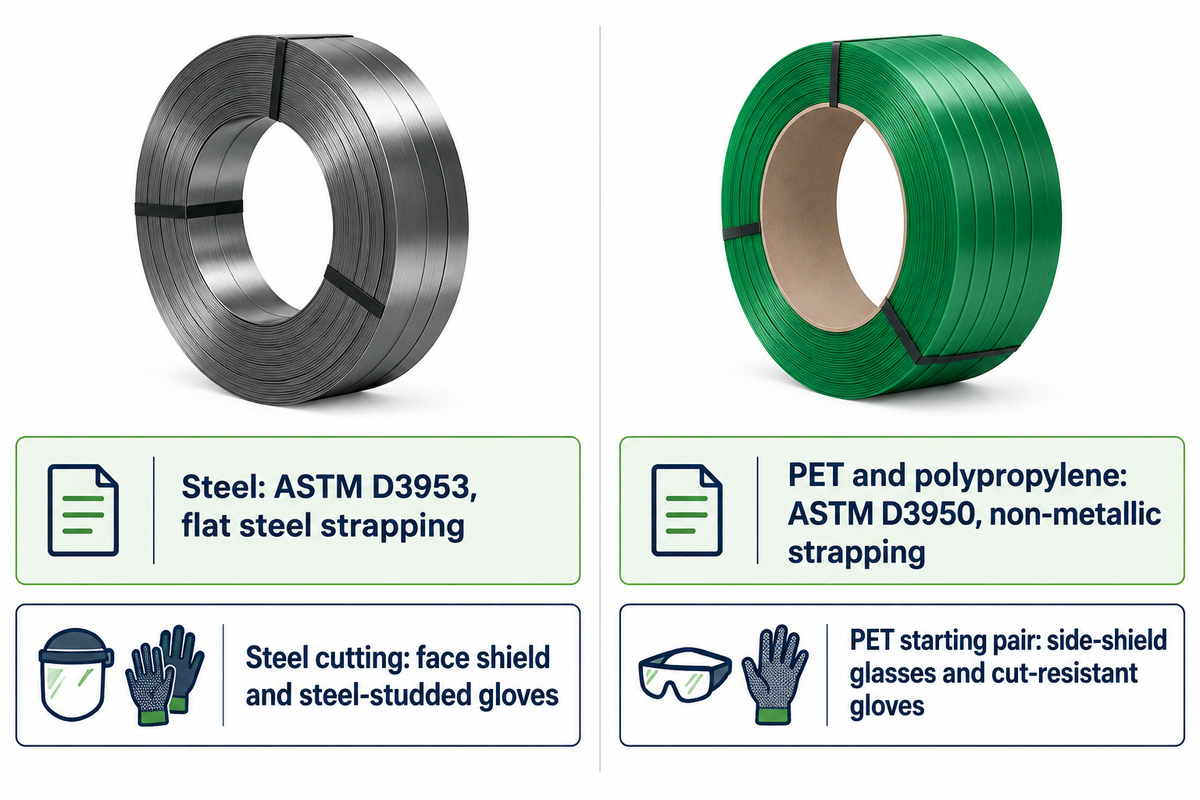
Steel has the most guidance, and Oregon DOT and the NGWA both reference recoiling bands and sharp cut ends at removal. ASTM D3953 covers flat steel strapping, and ASTM D3950 covers non-metallic strapping, so PET and polypropylene are in a different specification.
| Strap class | ASTM specification | Guidance behind the PPE | What changes in the set |
|---|---|---|---|
| Steel | ASTM D3953 | Oregon DOT and NGWA removal guidance | Face shield and steel-studded gloves join for heavy-strap cutting; leather-palm gloves, hard hat, long sleeves and long pants join for removal |
| PET and polypropylene (nonmetallic) | ASTM D3950 | Tool manual and the site’s PPE assessment | Set by the assessment of the tool and the task |
Oregon DOT’s talk and the NGWA’s guide are the safety guidelines behind the steel row. They’re in agreement with regard to the technique. Cut squarely so no sharp point forms, stay out of the line of the end that springs loose, and keep other people clear; NGWA adds holding the strap down with one gloved hand. Leather gloves can help protect the hands through all of it, in Oregon DOT’s words.
For PET and polypropylene strap, glasses with side shields and cut-resistant gloves are the starting pair, and the tool maker’s manual and the site’s PPE assessment settle the rest; the cut-and-removal guidance above was written for steel strap. Moving from steel to PET alters the task, so the assessment is redone, and 29 CFR 1910.132(f)(3) lists changes in the workplace or the types of PPE as reasons to retrain. A buyer wishing to compare the two materials can start with comparing PET and steel strap. A strap that snaps during tensioning belongs in the troubleshooting log as well as the assessment: this troubleshooting guide for PET strap covers snap and failure causes.
Footwear, Hearing and Other Personal Protective Equipment Banding Does Not Call For by Default
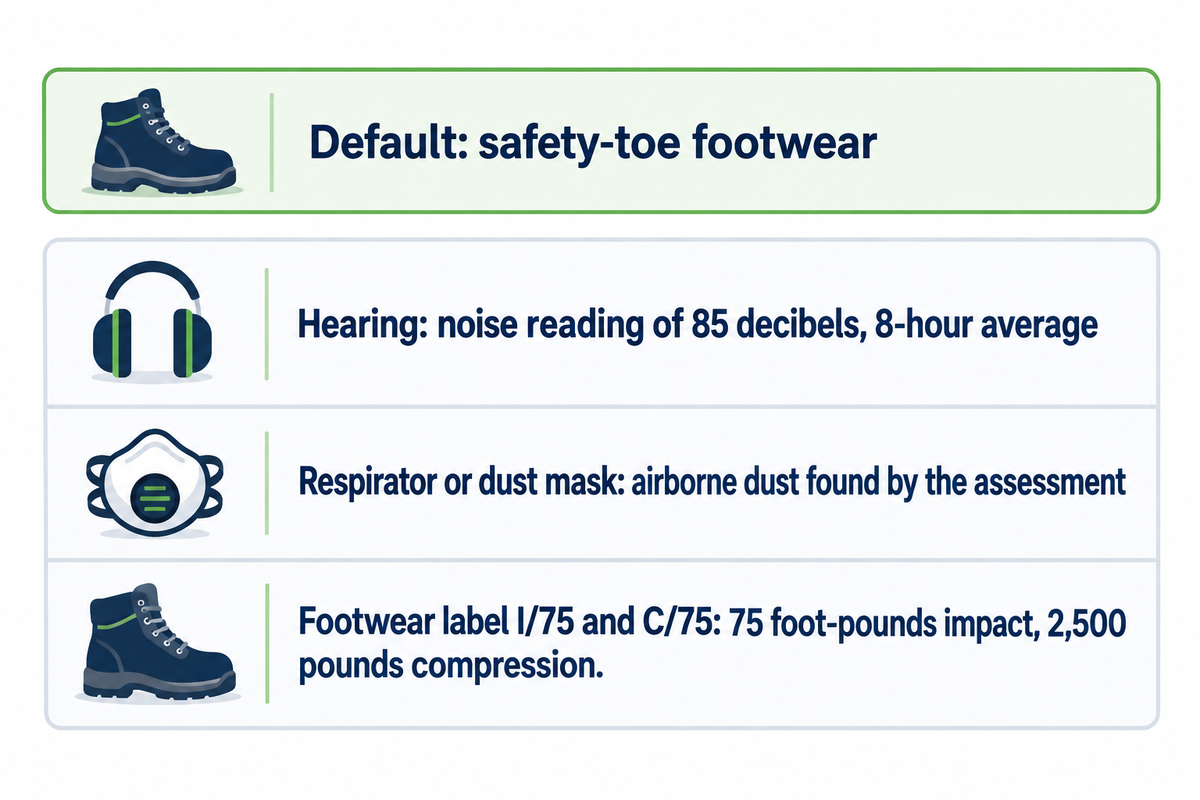
Safety-toe footwear is the third usual item. Hearing protection depends on a noise reading of 85 decibels as an 8-hour average. A respirator, dust mask or splash goggles won’t be on the banding list unless the PPE assessment finds dust or liquid exposure in the work environment.
| Item | On the list by default | What puts it there |
|---|---|---|
| Safety-toe footwear | Yes | Falling or rolling objects such as coils and loads (29 CFR 1910.136(a)); rated I/75 and C/75 under ASTM F2413 |
| Hearing protection | No | A noise reading of 85 decibels or greater, 8-hour average (29 CFR 1910.95) |
| Respirator or dust mask | No | Airborne dust found by the assessment |
| Splash goggles | No | Liquid splash found by the assessment |
| Hard hat | No at the station | Listed by Oregon DOT for removing steel banding |
ASTM F2413 impact ratings are 75, 50 or 30 foot-pounds, and compression ratings of 75, 50 and 30 correspond to 2,500, 1,750 and 1,000 pounds, per a University of Washington facilities summary of the standard. A label reading I/75 and C/75 means 75 foot-pounds of impact resistance and 2,500 pounds of compression.
Hearing protectors must be made available at no cost to employees exposed to an 8-hour average of 85 decibels or greater (29 CFR 1910.95). A battery tool or strapping machine requires hearing protectors at the station only when the reading there reaches that level.
A respirator brings in 29 CFR 1910.134: the employer provides a medical evaluation before the worker is fit tested or required to use it, so a respirator added by habit starts a program with no exposure behind it. Voluntary use of a dust mask needs no written respiratory protection program (1910.134(c)(2)(ii)). Airborne dust and particulate are the exposures that would justify either one, and inhalation is the injury route the assessment looks for.
What PPE Does Not Replace: Tool Guarding, Safe Position and Training
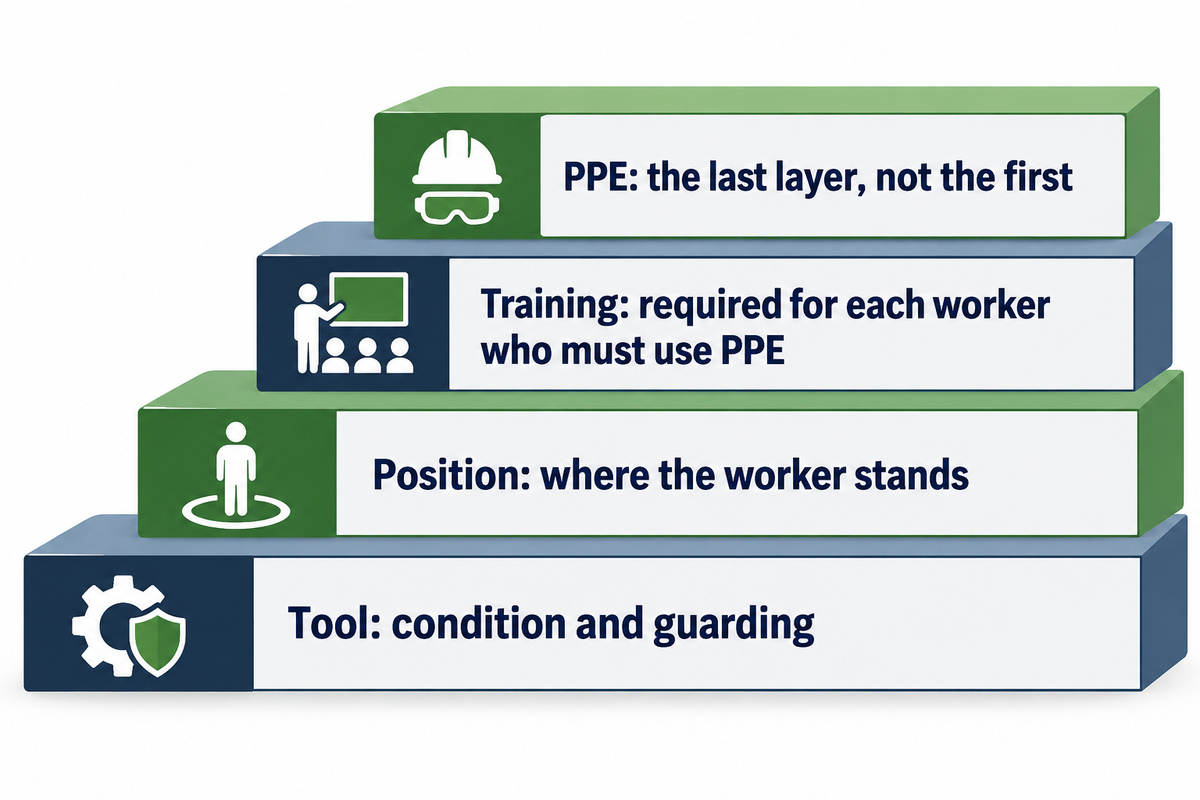
PPE sits behind three controls it does not replace: the condition and guarding of the tool, the position where the worker stands, and training. OSHA’s PPE overview says employers must provide PPE and ensure its proper use when engineering, work practice and administrative controls aren’t feasible or don’t provide sufficient protection, which makes PPE the last layer, not the first.
For a strapping machine, guarding and lockout come before gloves: the strapping machine risk assessment covers both. Damaged straps are an inspection item too, so the checks to inspect strap damage before reuse belong in the same routine.
Position is the second control. Where the cutter stands matters as much as what the cutter wears, and Oregon DOT adds an order for several straps: cut the one farthest from you first. Position and training come before equipment in workplace safety, and the workplace hazards that remain are what the PPE assessment covers. Training is the third: 29 CFR 1910.132(f) requires it for each worker who must use PPE, including the use of PPE and its limits.
Why is PPE important for workers?
PPE is the layer that remains when a strap slips, springs or breaks despite the controls in front of it: it keeps a recoiling band or a cut end from reaching the eyes, hands and feet. The rule places a duty on the employer to provide the PPE, fit the PPE, and train employees on how to use it.
Controls cut how often a strap gets the chance to hurt someone; proper PPE limits what it does when it does. Controls and gear together prevent injuries, where no single layer can ensure safety. At the cut and removal steps, the assessment shows which control or gear covers which step.
What Changed in 2024 and 2025: Glove Labels and the Construction Fit Rule
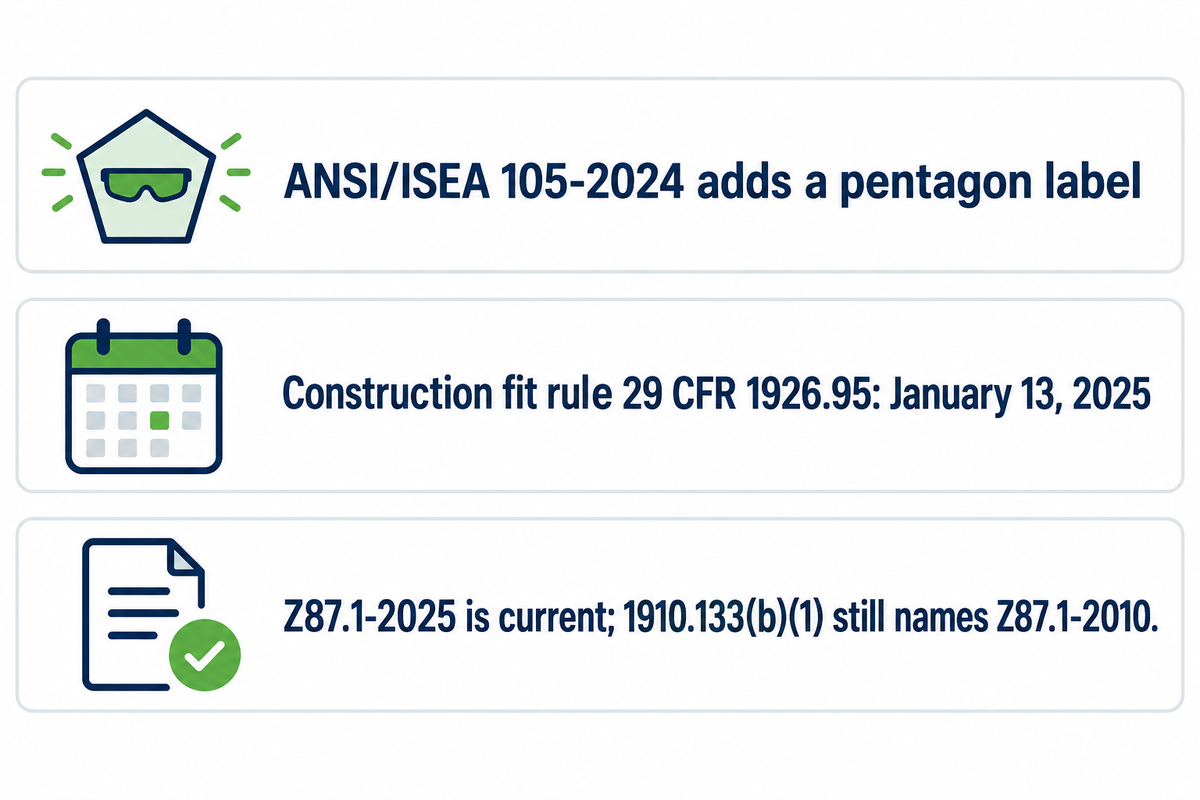
OSHA’s final rule on PPE fit took effect on January 13, 2025 and applies to construction (29 CFR 1926.95) only; a general-industry packing floor stays under 29 CFR 1910.132, which carries its own fit duty in paragraph (d)(1)(iii). On the glove side, ANSI/ISEA 105-2024 is the sixth edition of the hand and arm protection classification, first published in 1999.
| What changed | Who it affects | What to do |
|---|---|---|
| ANSI/ISEA 105-2024 adds a pentagon pictogram that shows cut, abrasion and puncture ratings together on one label | Buyers of cut-resistant gloves and sleeves | Read the pentagon: cut at the top center, abrasion at the left, puncture at the right |
| OSHA’s construction PPE fit rule, 29 CFR 1926.95, effective January 13, 2025 | Construction employers | A packing floor applies the 1910.132(d)(1)(iii) fit duty it already has |
| ANSI/ISEA Z87.1-2025 is the most recent edition; OSHA’s 1910.133(b)(1) still names Z87.1-2010 | Buyers of safety glasses and goggles | Order by the Z87+ marking and put the edition the supplier names in the quote |
This article contains the nine-level gram scale found in the 2024 edition. The OSHA final rule aligned the construction standard with the general-industry fit wording.
A Banding Station Kit: Purchase Specification by Task and What to Ask a Supplier
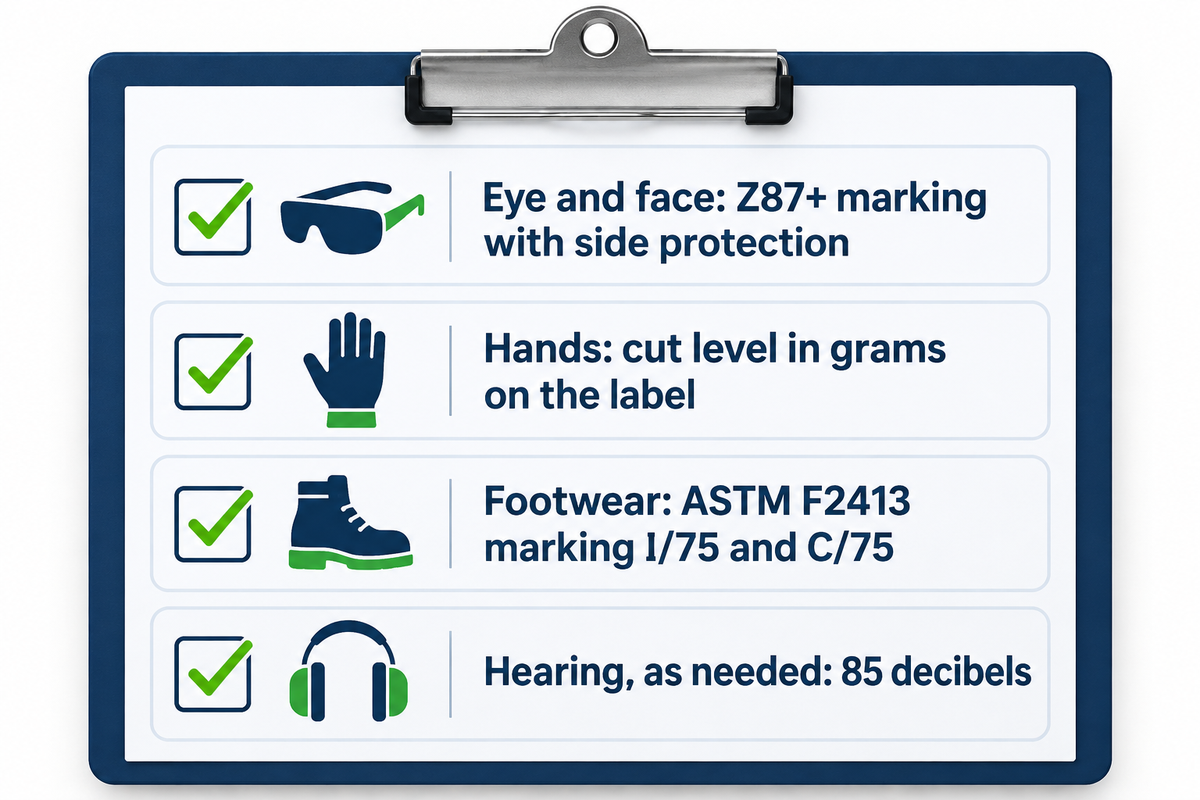
A banding station order line has six entries: eye and face protection, hands, forearms, footwear, a cutting tool and, only where a noise reading calls for it, hearing protection. Below each entry is a mark or rating that a supplier is confirming.
RFQ checklist: copy these lines into the quote request:
| Parameter | Recommended range | Why it matters | How to verify |
|---|---|---|---|
| Eye and face | Z87+ marking with side protection; face shield over glasses or goggles for heavier steel strap | Impact mark and side protection, as set out in the eye and face table | Marking on the frame and the shield, written into the quote |
| Hands | Cut level in grams on the label: start the trial at A2 (500–999 g) for PET feed and A4 (1,500–2,199 g) for steel removal | The level is a glove test result, shown on the ANSI/ISEA 105-2024 label | One trial pair worn for a shift on the actual strap edge |
| Forearms | Sleeves on the same ANSI/ISEA 105 scale; long sleeves fastened at the wrists for steel removal | The standard covers sleeves as well as gloves | Cut level printed on the label |
| Footwear | ASTM F2413 marking I/75 and C/75 | The marks explained in the footwear section | Both ratings on the label or the safety data for the boot |
| Cutting tool | Duck-billed shears with long handles for steel strap; a cutter made for the strap in use for PET | A crowbar or claw hammer raises the chance of injury | Tool manual names the strap type it cuts |
| Hearing, as needed | Hearing protectors where the 8-hour average reaches 85 decibels | Required at no cost at the action level | Noise reading taken at the station |
Ask each supplier to put every marking, level and rating in the quote.
UD Packaging supplies PET and plastic strapping tools, machines and accessories; safety apparel and steel banding are outside that range. The tool side of this specification, for PET and plastic strap, sits on the strapping tools for PET and plastic packaging page, with fittings and add-ons under strapping accessories.
Frequently asked questions
Q: Is a face shield required when cutting or tensioning strapping?
A face shield goes on over glasses or goggles when tensioning steel strap or cutting and removing heavier steel strap; no OSHA clause requires one by name, so the PPE assessment decides for each step.
It never replaces them. For PET, the tool manual and the site assessment determine whether the cut and tension steps call for one.
Q: Do I need safety-toe boots to band a pallet?
Yes where the assessment identifies falling or rolling objects which includes coils and loads moved at the station.
29 CFR 1910.136(a) requires protective footwear in those areas. On the label, I/75 and C/75 show the impact and compression ratings the boot was made to meet under ASTM F2413. A coil that rolls off a pallet or a dropped load is the case the clause covers.
Q: What are the OSHA construction PPE requirements, and do they apply to banding on a packing floor?
No: the construction standard, 29 CFR 1926.95, has required PPE that fits properly since January 13, 2025 and covers construction work, while a packing floor stays under 29 CFR 1910.132.
A banding crew already has the fit duty through 1910.132(d)(1)(iii), so nothing in the construction rule adds an item to the banding list.
Q: Does OSHA require employers to train workers on PPE?
Yes: 29 CFR 1910.132(f)(1) requires the employer to train each employee who must use PPE.
The training includes when and what PPE is necessary, how to don and doff it, adjust it and wear it, its limitations, its care and maintenance, its useful life, and how to dispose of it. Each worker must show an understanding of the training and the ability to use PPE properly before being allowed to do the work, and retraining is required when changes in the workplace or in the types of PPE render the previous training obsolete.
Q: Is a dust mask or respirator needed for pallet banding?
No: a dust mask or respirator isn’t part of a banding set unless the PPE assessment finds airborne dust.
Respiratory rules add a medical evaluation and fit testing, so a respirator is a step the assessment has to justify.
Q: What are the 7 types of personal protective equipment?
Lists of seven types group the equipment as eye and face, head, hearing, respiratory, hand, foot and body protection. OSHA’s own wording in 29 CFR 1910.132(a) names equipment for the eyes, face, head and extremities, protective clothing, respiratory devices, and protective shields and barriers.
A banding job draws on up to six of these seven types: eye and face (29 CFR 1910.133), hand (1910.138), foot (1910.136) and body protection such as long sleeves at removal, with hearing (1910.95) where a noise reading calls for it and head protection (a hard hat, per Oregon DOT) at steel removal. Respiratory protection enters only when the assessment finds airborne dust.
About This Analysis
This explainer reads 29 CFR 1910.132 and the item clauses against nine banding steps. The 5-Touchpoint PPE Map and the station specification are from clause text, the ANSI/ISEA 105-2024 gram scale and two steel strap removal guides; OSHA pages were checked on November 17, 2026. This is general safety information and not site-specific information.
References & Sources
- 29 CFR 1910.132, General requirements, OSHA
- 29 CFR 1910.133, Eye and face protection, OSHA
- 29 CFR 1910.138, Hand protection, Electronic Code of Federal Regulations
- 29 CFR 1910.95, Occupational noise exposure, OSHA
- Personal Protective Equipment overview, OSHA
- Personal Protective Equipment in Construction, final rule, OSHA
- ANSI/ISEA 105-2024 hand protection classification, ANSI
- ANSI/ISEA Z87.1-2025 eye protection, ANSI
- ASTM D3953, Strapping, Flat Steel and Seals, ASTM
- Performance requirements for protective footwear, University of Washington
- Steel Strapping Safety, tailgate talk, Oregon DOT
- Steel Strapping Removal, safety resource, NGWA