Get in touch with UD Packaging Company

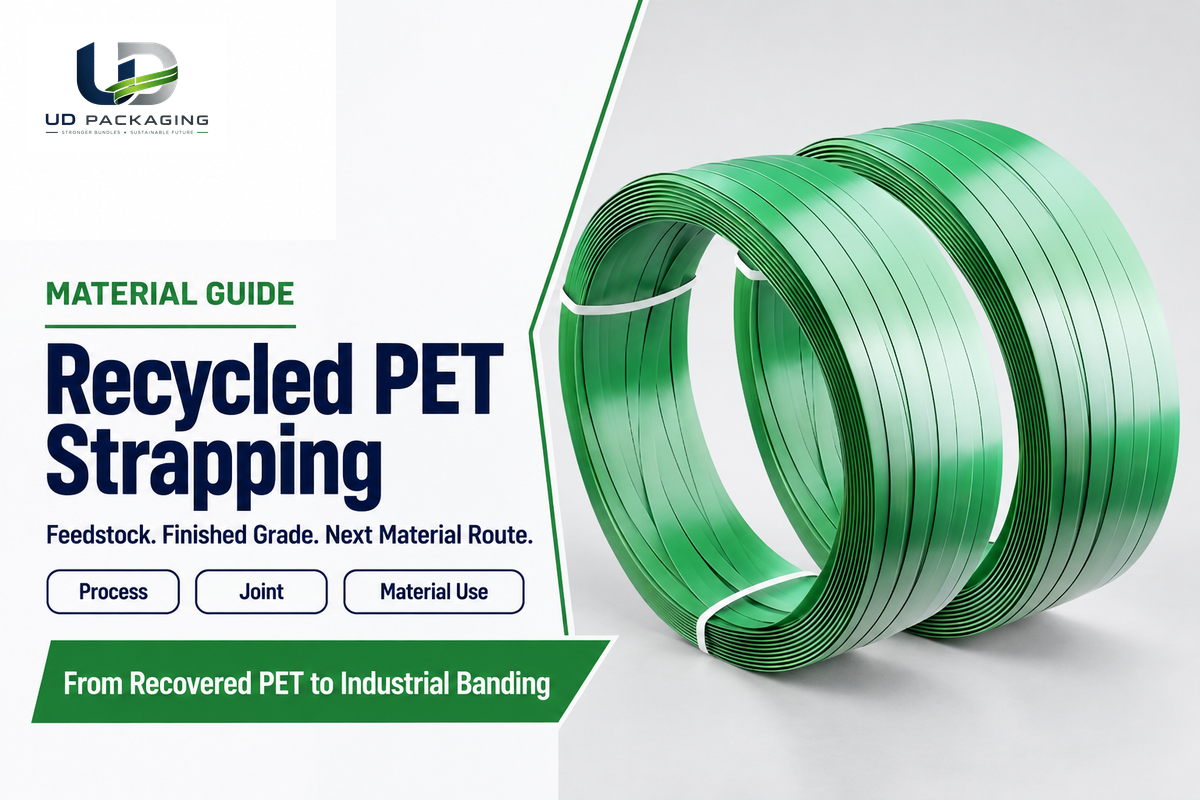
Recycled PET strapping turns polyester into banding for bundles and palletized items. Banding made from recycled PET can reduce waste when the completed grade conforms to the package and used material meets an accepting recycler. A green coil alone tells you little about its recycled content, joint performance, and next recycling fate.
By Karry · Updated October 2026
Material at a glance
- Polymer: polyethylene terephthalate, a polyester.
- Feedstock: recovered PET, including suitable post-consumer bottles or diverted manufacturing waste.
- Performance language: dimensions in mm, breaking force in N, elongation in %, and completed-joint results.
- After use: separate collection for an accepting PET recycler.
Recycled PET strapping is polyester banding made from recovered PET. Feedstock control, extrusion and drawing shape its performance. Compare finished grades and joints and decide on a collection route of used strap.
Key points
- Recycled content and acceptance for recycling answer different questions.
- Moisture control can happen before extrusion or within a suitable melt-processing system.
- Straight-strap breaking force and welded-joint strength describe different test objects.
- Cost per accepted pallet uses total consumed metres, including waste and rework.
What Is Recycled PET Strapping?
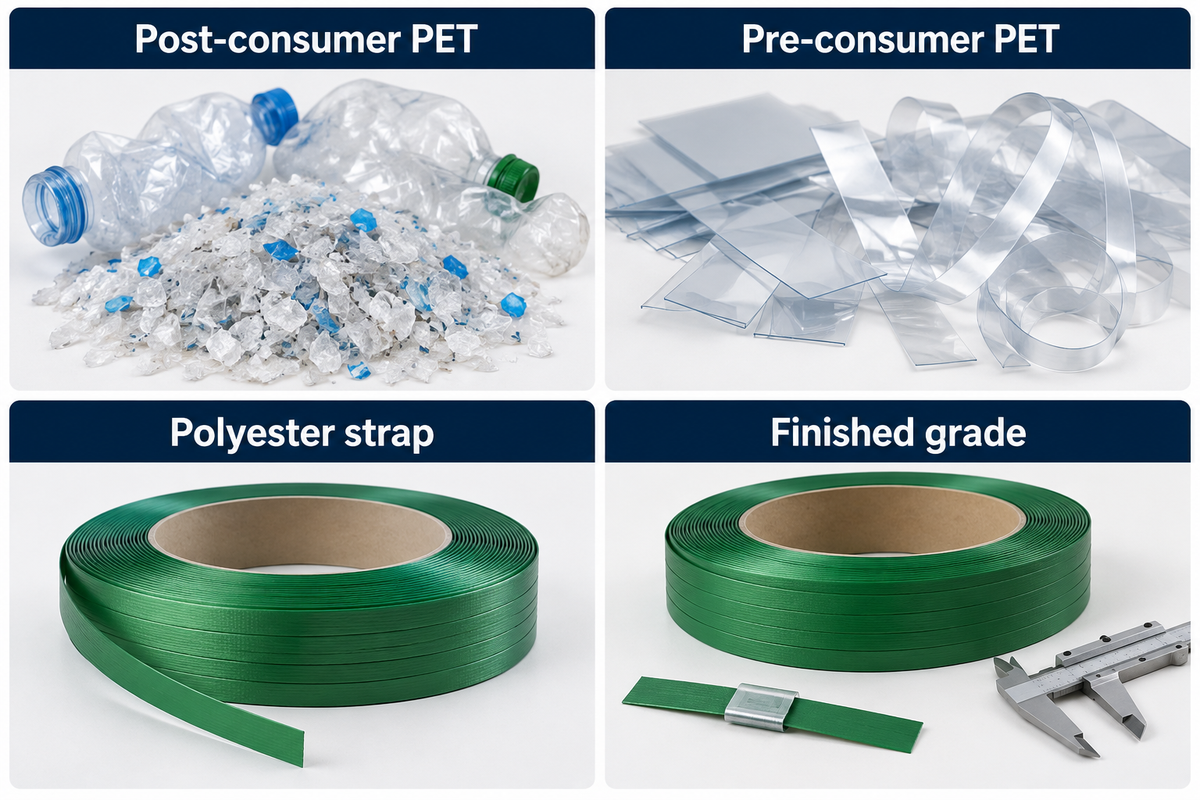
Recycled PET strapping is polyester strap containing recovered polyethylene terephthalate. Strapping manufacturers can use suitable bottle flakes, reprocessed pellets, and qualified mixtures of recovered and virgin PET resin. The recycled percentage describes material origin; width, thickness, drawing and the finished grade determine how the resulting band behaves in a packaging system.
Is recycled PET the same as polyester?
Yes. PET is a type of polyester, so recycled PET strap is polyester strapping made with recovered PET material. While recycling changes the history and source of a material, the polymer remains PET. Other polyester products can use different formulations and structures, so the word polyester alone does not identify an industrial strap grade.
A used bottle is rigid because of its shape and manufacturing history. Tension is intended to be distributed along the length of a narrow draw band. Reprocessing links them through their raw material, but a finished strap doesn’t inherit all of the properties of a bottle. Also, PET and HDPE are two different plastics; polyethylene terephthalate shouldn’t be combined with high-density polyethylene in the same collection.
Post-consumer material has served its purpose, for example a beverage bottle. Pre-consumer recycled material comes from manufacturing material diverted from the waste stream. The material used in the finished product needs to be accounted for with a definite basis. In general, miscellaneous scraps, which are normally reused in the original manufacturing process, should be excluded from recycled-content claims. The US Federal Trade Commission Green Guides, section 260.13, make that distinction and describe partial recycled-content claims by weight of the finished product or package.
A receiving warehouse may observe green PET, white polypropylene, and loose stretch film, in the same unloading area. A joint collection bin makes identification and separation difficult. In the packaging supplies, a polymer’s identity, source and collection declaration should be provided. Color can be a good sorting aid, after material has been identified.
How Recycled Bottles Become Oriented PET Strap
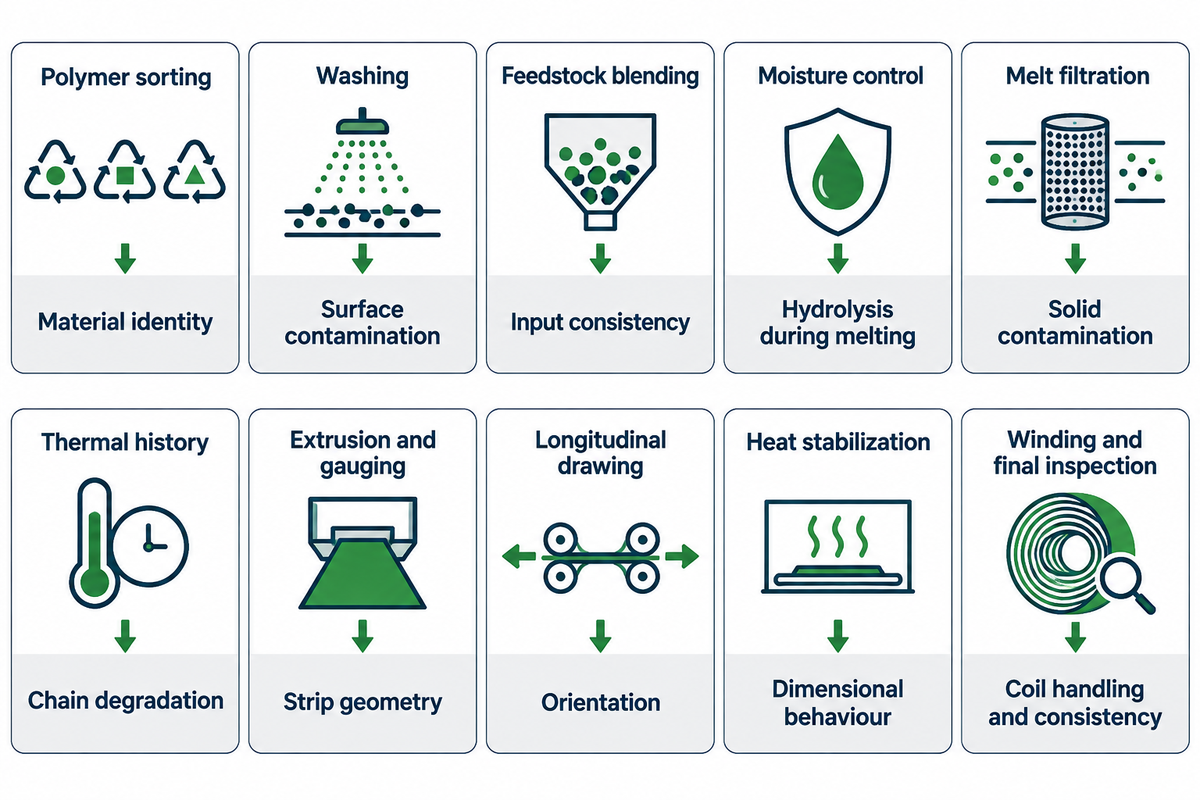
Bottle-to-strap uses feedstock preparation and melt processing with longitudinal drawing. Moisture management curtails hydrolytic degradation during melting. Extrusion creates a strip from which the structure is drawn to align with the direction of pulling. Production lines can change the arrangement of these operations; for example, degassing the melt can replace a predrying step. Quality control integrates process controls with finished-coil inspection.
How is PET recycled?
PET is mechanically recycled by collecting suitable material, sorting and cleaning it, reducing its size, and melting it for another product. Chemical recycling uses a different route to break polymer chains into small constituent building blocks. This isn’t the name for flake washing, melting, extruding and other related unit operations.
Some strapping production lines use PET flakes directly, while others employ reprocessed pellets. Fine filtration removes solid contamination from the melt, while moisture management addresses a different problem: water can help break PET chains at processing temperatures. Neither cleaner-looking flakes nor a higher recycled percentage replaces control of the manufacturing process. Equipment-specific settings belong to the line and the resin combination.
In a 2026 controlled bottle-grade PET experiment, Mária Straková and colleagues reported intrinsic viscosity falling from about 0.80 to 0.65 dL/g after four extrusion cycles with 8 minutes of cumulative residence. The study illustrated the effect of processing history on a polymer. The values from the processed PET resin don’t set a specification limit for finished straps or establish a universal recycling-cycle limit.
“final quality of rPET strongly depends on proper control of processing parameters”
Process-to-Property Map
Process-to-Property Map links each material or manufacturing control to the finished-strap behavior it helps explain.
| Control | What changes | Why the finished strap feels the effect |
|---|---|---|
| Polymer sorting | Material identity | Unwanted polymers disrupt a consistent PET feedstock. |
| Washing | Surface contamination | Dirt and residues add processing and filtration burdens. |
| Feedstock blending | Input consistency | A stable blend reduces variation entering the extruder. |
| Moisture control | Hydrolysis during melting | Water management helps preserve polymer chain length. |
| Melt filtration | Solid contamination | Filtration targets particles rather than replacing moisture control. |
| Thermal history | Chain degradation | Temperature and residence time affect the polymer during processing. |
| Extrusion and gauging | Strip geometry | Width and thickness contribute to cross-sectional area. |
| Longitudinal drawing | Orientation | Drawing changes tensile behaviour along the strap. |
| Heat stabilization | Dimensional behaviour | Stabilization is part of the selected manufacturing route. |
| Winding and final inspection | Coil handling and consistency | A finished roll must feed and perform as the intended grade. |
There’s a published Gneuss installation at CONSENT Plastic in Dubai that uses melt degassing with non-dried flakes. This process flow shows that moisture control is the underlying requirement and a separate drying machine is one way to do it. When a buyer of recycled material asks how the supplier controls the input and verifies the finished product, this is the useful question.
Recycled PET, Virgin PET, PP and Steel: What Changes?
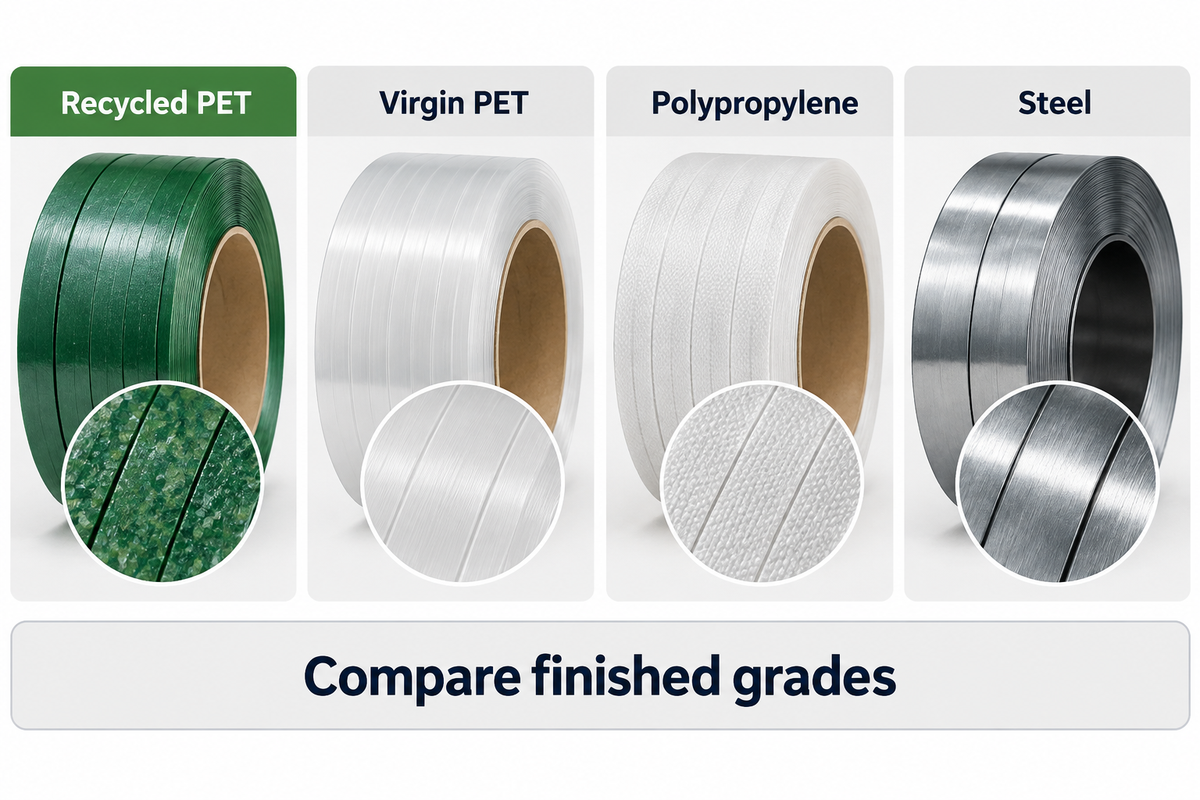
Recycled and virgin PET share a polymer family, while polypropylene and steel have different material behaviour. Feedstock alone doesn’t give a ranking of two finished PET grades. A useful comparison holds the package and joining system constant, then compares dimensions, breaking force, elongation and tension behaviour alongside handling, disposal and material use.
How strong is PET strapping compared with PP strapping?
PET strapping is generally used for firmer, more demanding bundling than light-duty PP strapping, but the actual strength comparison is from the two finished grades. Width and thickness change the section carrying the force. Joint performance and retained tension also play a role, so a material name alone can’t give a strength ratio.
When lighter carton bundling and packages can tolerate its tension behaviour, polypropylene can be used. PET is widely used for pallet banding and industrial bundles, including appropriate heavy-duty applications. It doesn’t rust, although contact edges and surface damage require attention. Steel remains relevant where the package, temperature, edges or the specified restraint system requires it. PET becomes an alternative to steel when the selected grade and the complete package meet the requirement of the application. Therefore, a move to PET is a grade and system change rather than a promise that one plastic replaces every steel strap.
Recycled PET feedstock
- Uses recovered PET material.
- Requires input and processing control.
- Finished properties belong to the selected grade.
Virgin PET feedstock
- Uses newly produced PET resin.
- Also requires processing control.
- Finished properties belong to the selected grade.
Cusano and colleagues’ 2023 PET rheology review describes the connection between degradation, molecular weight and melt behaviour. Recycled feedstock can have a different history, and manufacturers can use different recovery or modification routes. A simple recycled-versus-virgin label leaves those differences hidden.
Consider a hypothetical switch from a light carton strap to a pallet strap. Changing only the purchase description from PP to PET leaves the machine path, gripping system and joint settings unresolved. Treat the new polymer, grade and tool combination as a package change. The existing plastic strapping construction and tool guide covers the construction and tool-selection question.
Read the Strap Specification Before Comparing Strength
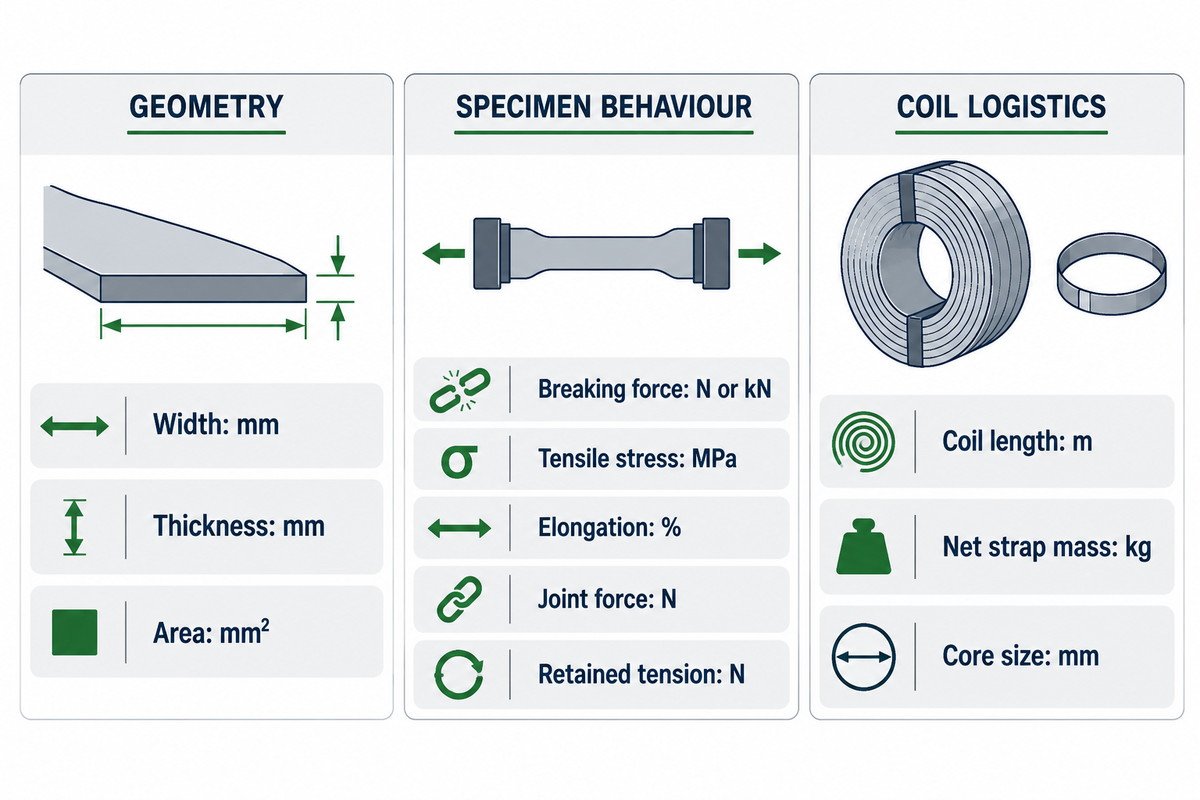
A strap specification separates its geometry from the forces and movements recorded during testing. Tensile strength needs its stated unit and specimen definition. Width and thickness describe a section. A tested strip breaks at a force, which describes breaking force. Extension describes elongation. Completed joint strength and tension retention add further information. Compare similar units, specimens and conditions before comparing headline figures.
The active ASTM D3950-23 specification covers nonmetallic strapping and joining methods. Its public summary identifies breaking strength and elongation and, where applicable, transverse and joint strength. Those separate test objects explain why a single strong strip is only part of a complete packaging system.
| Specification item | Typical expression | Decision it supports |
|---|---|---|
| Width | mm | Strap path and tool compatibility |
| Thickness | mm | Section geometry and machine fit |
| Cross-sectional area | mm² | Force-to-stress interpretation |
| Breaking force | N or kN | Force sustained by the tested specimen |
| Tensile stress | N/mm² or MPa | Force normalized by defined cross-section |
| Elongation | % at a stated condition | Extension behaviour during the test |
| Completed-joint force | N with joining method | Performance across the actual joint |
| Retained tension | N after a stated interval | Change in loop tension over time |
| Coil length | m | Material available for measured production use |
| Net strap mass | kg excluding core | Material accounting and consistent price comparison |
| Core size | mm with defined dimensions | Dispenser and machine compatibility |
Unit conversion helps expose unlike comparisons: 1 kN equals 1,000 N, and 1 MPa equals 1 N/mm². A force in N and a stress in MPa describe different quantities. For an embossed strap, the defined section and test method can impact the interpretation of a thickness measurement. Avoid deriving a tested minimum from nominal dimensions alone.
Example: two quotations use 2.5 kN and 2,500 N for breaking force. The two numbers describe the same force, so the second number is not larger physically. A third line states 250 MPa, which is stress rather than force. It requires a defined specimen section before any force comparison. Keep the product code, surface, nominal dimensions, tolerance and test condition with each result. A purchase comparison will only be useful when values for the same item are provided. For an actual approval program, the PET strapping guide to grade approval tests explains the next stage.
Why the Tool and Joint Change the Result
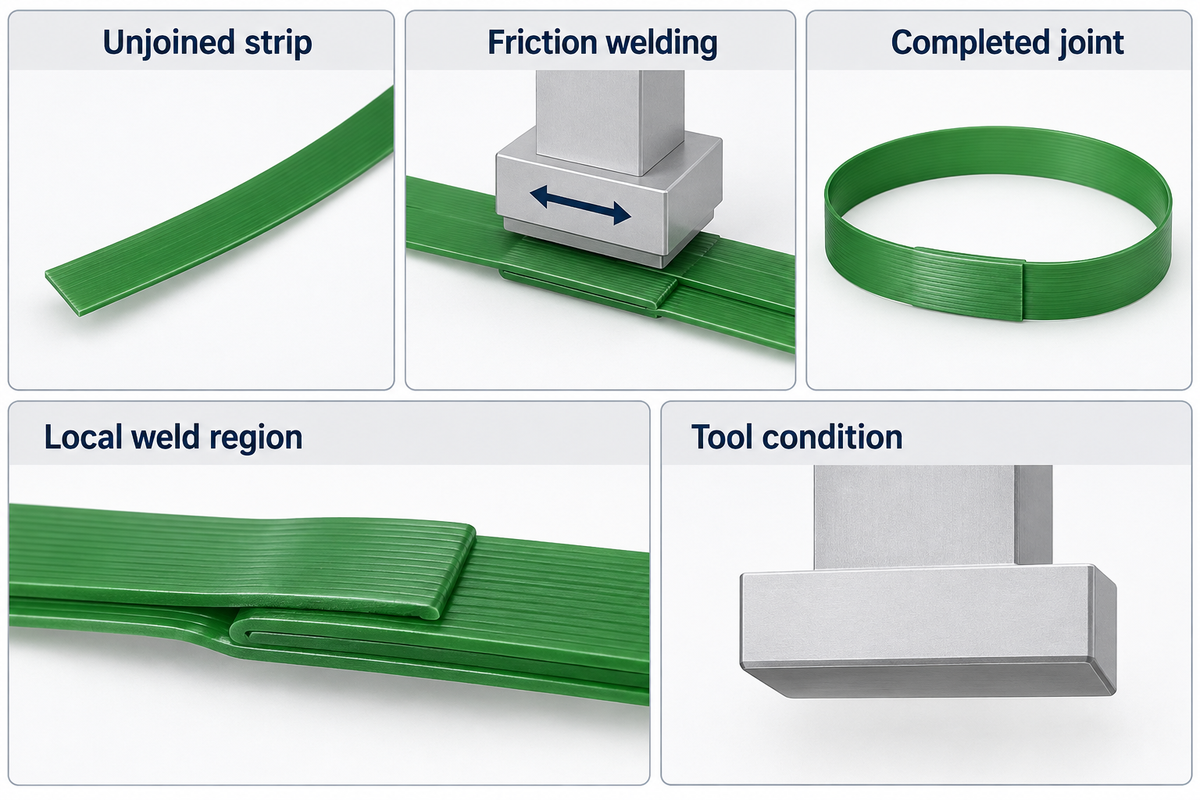
A closed PET loop carries force through its joint as well as through the unjoined strip. Friction welding, hot-blade joining and compatible seal systems form different connections. Strap surface and grade interact with tool condition and settings, so a higher unjoined breaking force does not automatically produce a stronger completed loop. The breaking force of the unjoined strips doesn’t necessarily mean a closed loop with a stronger connection.
Longitudinal orientation helps the band carry tension along its length. The connection introduces a localized region of different thermal and mechanical history. Factors including quality of contact, peel resistance and the transition around the connection can affect the failure of a closed loop. Increasing the tension setting cannot repair a poorly formed weld.
An example from history can be found in US6210769B1, which lists Samuel Manu Tech as the assignee. The 2001 invention focuses on an oriented PET core and surface, with an emphasis on tensile behavior, weldability and corners. The example formulation is part of the patent; the broad engineering lesson is to assess joined strap rather than deduce the outcome from a straight strip.
For a repeated split near the joint, record where the failure initiates prior to changing material. A damaged edge, a slipping gripper, and a short or contaminated weld usually indicate different causes. Retain the failed piece and the corresponding strap code. Replacing a coil and increasing weld time makes finding the root cause more difficult.
Tensioning and weld settings are associated with a specific tool, strap and operating procedure. Tool maintenance, consumable wear and the cooling step also affect repeatability. Use the approved combination and its manufacturer’s instructions. For determining the tension measurement itself, see the strap tension meter reading guide.
Match the Strap to the Load and Its Journey
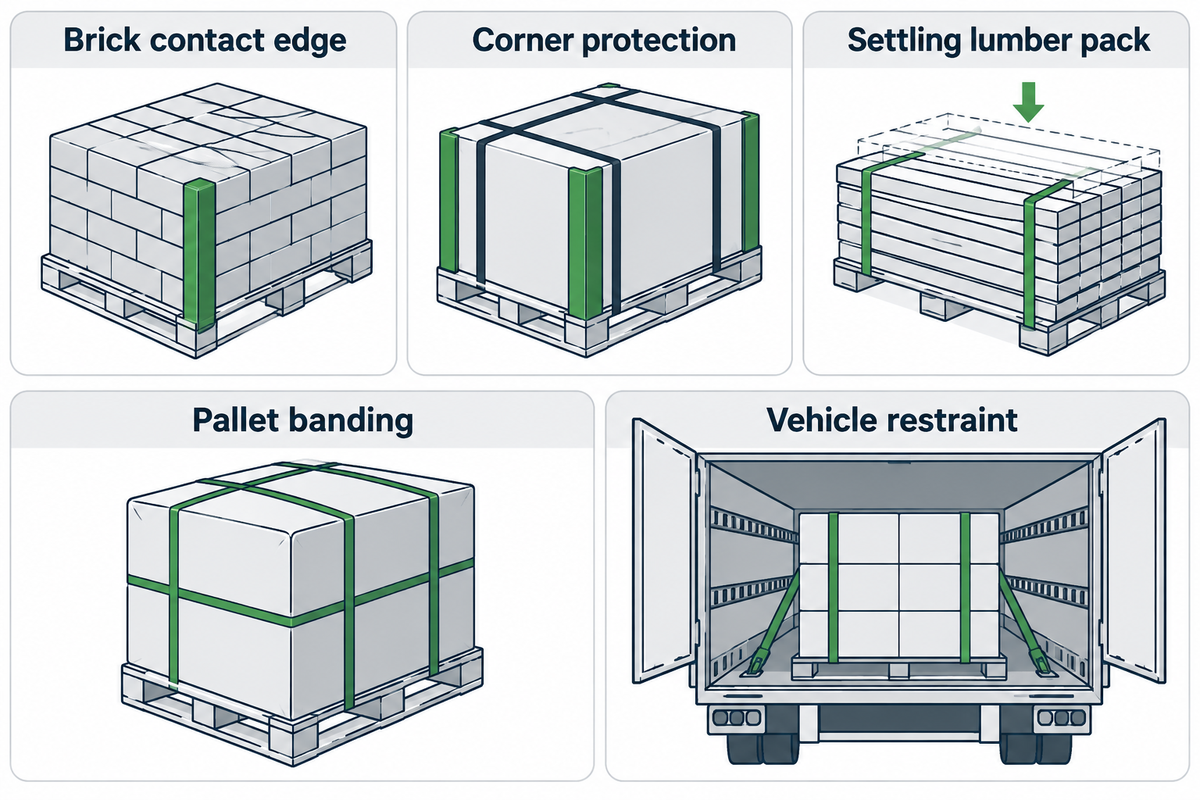
A useful recycled strap grade should work with the edges of the package, and the movements and transfers along the package’s distribution route. Sharp contact points on the package can result in localized strain, and settling may alter the loop geometry. Handling can also introduce forces not present on a straight strip. Grouping goods on a pallet is also a different task from securing that pallet inside a vehicle.
Let’s imagine a bundle of brick awaiting forklift transport. A strap rounds a rough edge before arriving at its joint on the top face. The first issue is the contact zone: a nominally stronger band still bends around the same edge. Protection of the corner changes the contact situation, and bundle pattern determines the position of the band. In the case of the strap, the contacts and the behavior of the joint should be evaluated and compared while the bundle pattern remains the same. It can be difficult to gauge the impact of bundle geometry and strap grade simultaneously. A more complete look at this situation can be found in the brick strapping guide.
A lumber pack poses another question. As the pack settles, its perimeter can change. The initial tool reading captures the application moment, while later loop behaviour concerns the package after movement or storage. Solar components, metal products and paper bundles bring different surface and compression concerns; a familiar polymer does not make their packaging requirements identical.
For covered US commercial road transport, 49 CFR 393.100 addresses preventing cargo loss and stability-threatening movement on or within the vehicle. Pallet banding groups the goods; the vehicle restraint addresses the loaded transport system. Keep these responsibilities separate when allocating the shipment.
Calculate Use and Cost per Accepted Pallet
Cost per accepted pallet is a measure of the materials consumed compared to the unique pallets that meet a specified acceptance point. Begin with a delivered price per meter that’s consistent, and include strap lost in setup and rework, and add other operating costs. Divide by the accepted output. In this way, a lower nominal coil price can be made to represent a higher applied cost.
Roll-to-Pallet Yield Comparison
This procedure links purchased metres, totally consumed metres and unique accepted pallets within a specified production period.
The method follows the material-flow distinction in the US Environmental Protection Agency’s value-stream mapping guidance: material consumed includes both material in useful output and material wasted. Waste strap already included in consumption carries its material cost there. Separate treatment or disposal costs may be charged as a separate service.
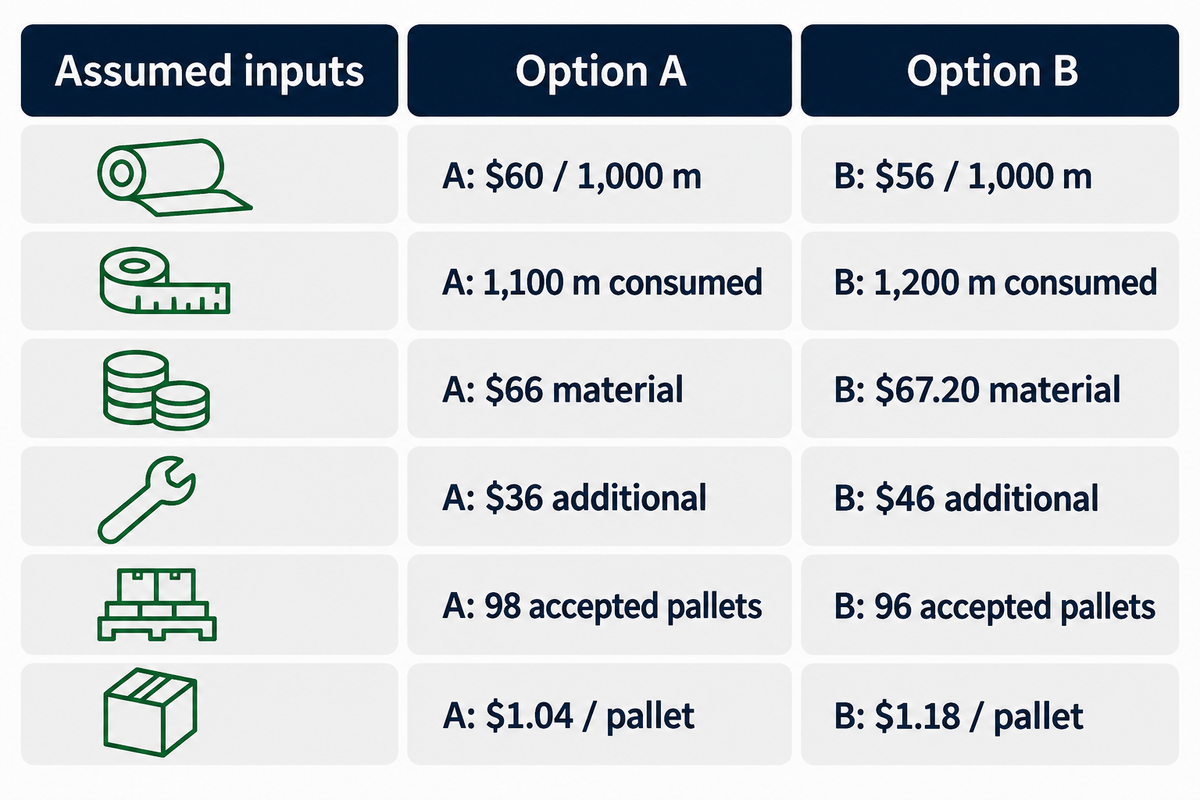
Assumed inputs: two otherwise acceptable packaging trials use the same pallet configuration and assessment point. Option A costs $60 per 1,000 m and consumes 1,100 m for 98 unique accepted pallets. Option B costs $56 per 1,000 m and consumes 1,200 m for 96 unique accepted pallets. Consumed lengths include setup waste and all restrapping. Additional scoped costs are $36 for A and $46 for B.
| Accounting item | Option A | Option B |
|---|---|---|
| Price basis | $60 / 1,000 m | $56 / 1,000 m |
| Price per metre | $0.060 / m | $0.056 / m |
| Total consumed | 1,100 m | 1,200 m |
| Material cost | $66.00 | $67.20 |
| Additional scoped costs | $36.00 | $46.00 |
| Total included cost | $102.00 | $113.20 |
| Unique accepted pallets | 98 pallets | 96 pallets |
| Consumed length per accepted pallet | 11.22 m / pallet | 12.50 m / pallet |
| Material cost per accepted pallet | $0.67 / pallet | $0.70 / pallet |
| Total included cost per accepted pallet | $1.04 / pallet | $1.18 / pallet |
For A, 1,100 m × $0.060/m = $66; adding $36 gives $102. Dividing $102 by 98 accepted pallets gives $1.04 per pallet after rounding. For B, 1,200 m × $0.056/m = $67.20; adding $46 gives $113.20. Dividing by 96 gives $1.18 per pallet. The lower rate per metre has lost its advantage because consumption and additional cost differ.
Count a pallet once upon meeting a chosen acceptance criterion, regardless of whether it was restrapped. Capture any extra distance and labor during rework. Dividing again by a yield percentage would also count a loss already reflected in consumed material and accepted output. Comparing $/kg requires net strap mass, and comparing a coil requires its actual usable length.
Key takeaway
In the assumed comparison, $56 per 1,000 m produces $1.18 per accepted pallet, while $60 per 1,000 m produces $1.04. Measured consumption changes the purchasing conclusion.
Include the same cost categories in both options: delivered material, seals where used, incremental labour and agreed handling charges. Keep excluded costs visible in the trial record. Used plastic removed during setup is still consumed material, even if it later becomes a recovered stream. Engineering acceptance is prior to economic acceptance; an economical strap that doesn’t fulfill the package requirement isn’t an accepted saving option.
What to Confirm Before Ordering Recycled Strap
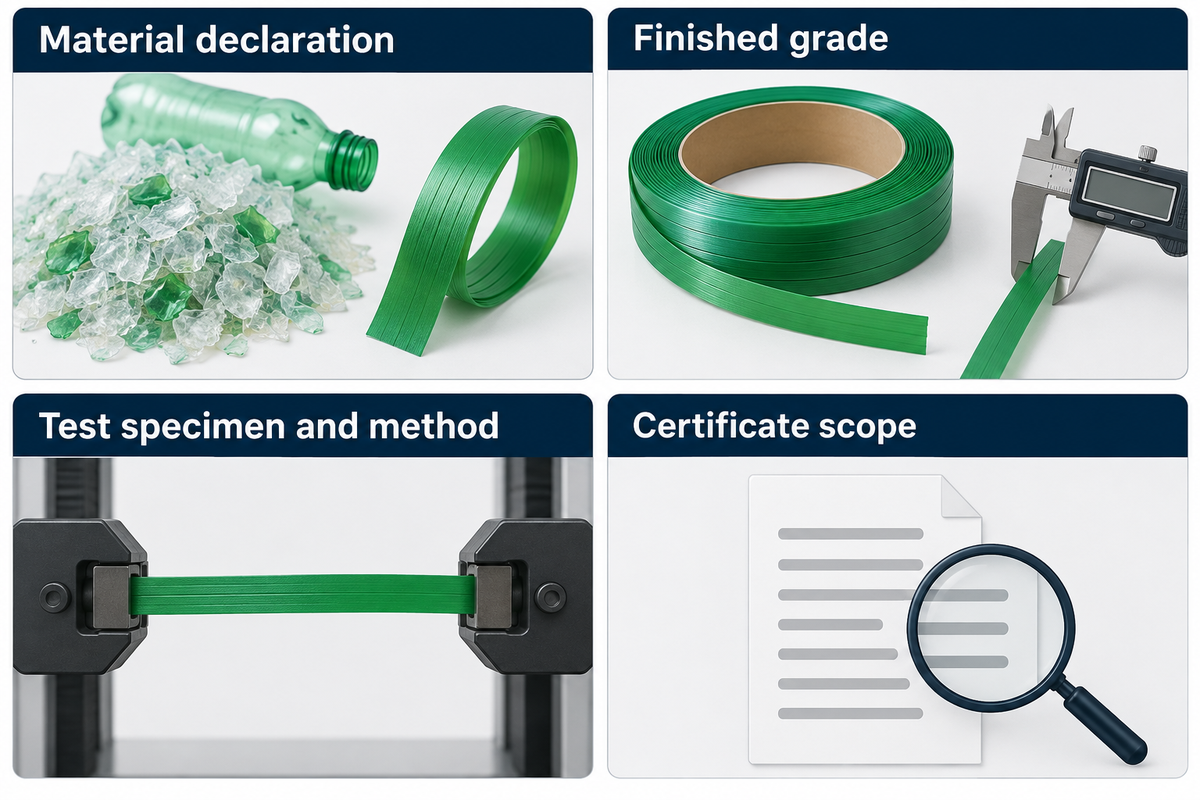
Ordering recycled strap requires a material declaration and a defined finished grade. Separate the recycled content from results of inspection, dimensions, mechanical properties and tool compatibility. A laboratory report concerns its stated specimen and test method; a site or management certificate concerns its own scope. Procurement works best when each document corresponds to the question being asked.
Inspect product codes, declared recycled percentages and basis, post-consumer or pre-consumer breakdowns (if mentioned), dimensional tolerances, coil length and core dimensions. Verification should correspond to any test report relating to the grade and relevant lot. A third-party SGS report should identify what was tested; an ISO certificate should identify the certified entity and scope. Don’t transfer a company-level credential to all strapping products of a company.
Sample and repeat order references should be kept together. A change in width, thickness, surface, raw-material recipe or intended joining method can alter the package evaluation. A quotation is more useful if it mentions the same grade that will be delivered at the warehouse, rather than an unspecified product category.
UD Packaging supplies industrial packaging materials from Jiangyin, Jiangsu Province. For the commercial range and product discussion, use the existing recycled PET strapping options page.
Can Used PET Strapping Be Recycled Again?
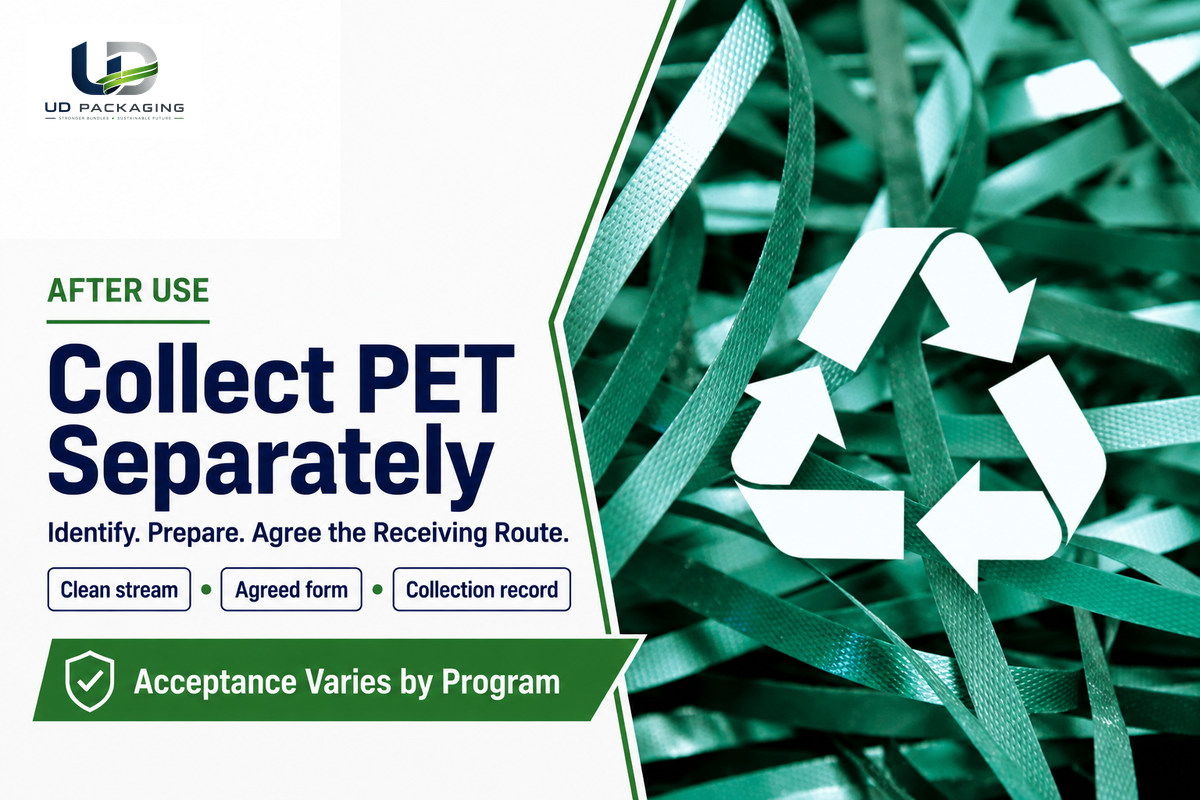
Used PET strapping can enter a suitable recycling process when an accepting operator receives the required polymer, color, and condition. Separate collection keeps other plastics and metal closures out of the stream. Recyclable PET needs a receiving process to handle the item. Preparation, storage and freight arrangements determine if a technically recoverable material has a workable route from the user’s site.
Is PET plastic 100% recyclable?
Mechanical recycling of PET is feasible, but collection systems don’t accept all PET articles in all forms. A PET bottle collection system may refuse to take long, fouled and mixed-polymer industrial straps. The useful recycling answer lies in identifying the actual article and the receiving system, as it may not be the case that the polymer is named and collected everywhere.
Recycled content describes the raw material used in the product. Recyclability describes a possible next material route, and recovery records describe what actually happened. Under the Green Guides of the FTC in the US, the term “recyclable” in advertising reflects established programs and their accessibility. A broad eco-friendly claim may mask these other claims.
Two owners’ instructions illustrate practical differences. Signode’s published program accepts green PET, specifies clean prepared material, and places freight to its collection point on the shipper. X-Pak described an Australian service of chopped, separated PET with the provider arranging collection and consolidation. Neither program is a general rule or a UD collection service.
At unpacking stations, follow the handling procedure to release strap and keep cut lengths contained. Identify PET and place in the stream designated for that material. Separate PP, stretch film, seals and general waste. Use the receiving operator’s required preparation method; loose long lengths, chopped chips and bales have different handling requirements.
ISO 18604:2013, confirmed in 2024, sets assessment requirements for packaging recoverable through material recycling, with its application procedure in ISO 18601. A workable site program also needs an accepting destination and transport arrangements. Reuse is a separate decision: the guide to reusing plastic strapping explains damage and joint considerations.
- Identify the stream. Separate known PET from other packaging materials.
- Agree acceptance. Establish the receiver’s colour, contamination and preparation requirements.
- Contain the material. Store it in the agreed form and keep the collection area clear.
- Document collection. Retain weights and destination records for the material actually sent.
What Is Changing in Recycled Strapping?
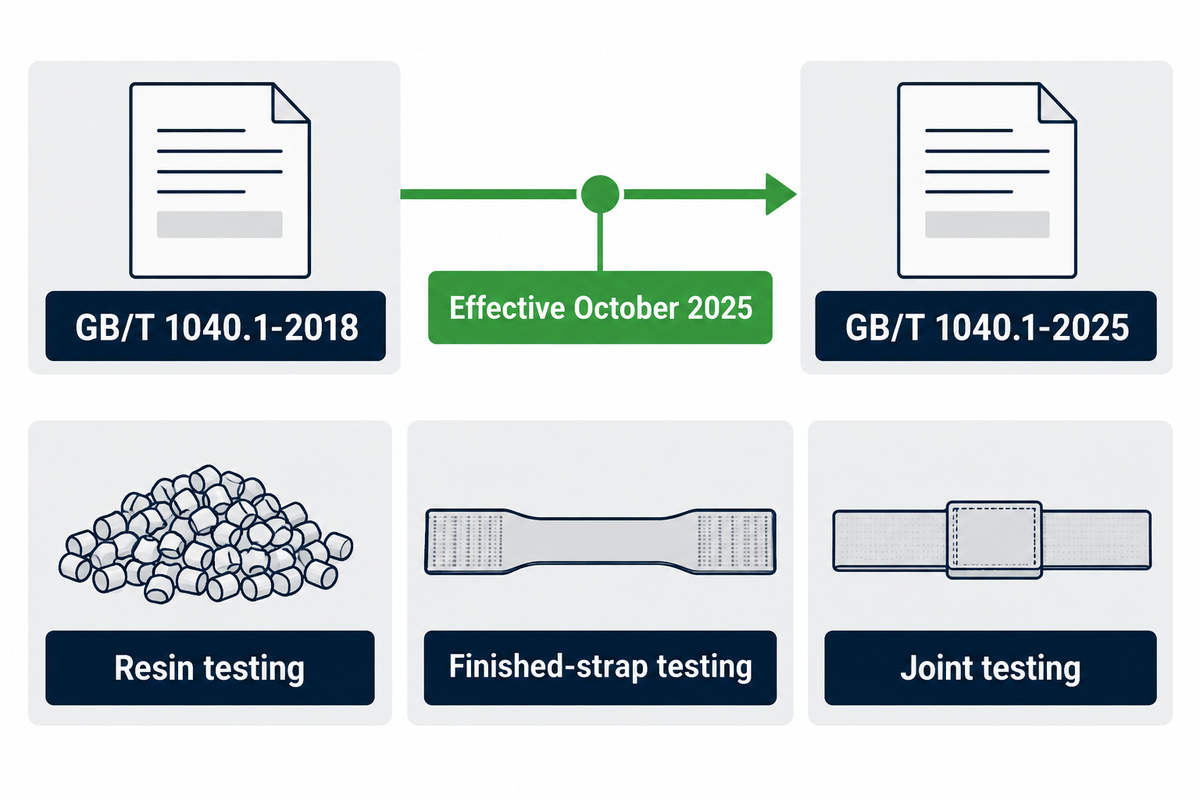
Current recycled-strapping procurement needs clearer links between material claims, test editions and actual collection. The change to China’s general plastics tensile testing standard in October 2025 provides buyers an opportunity to update their old specifications. Processing research also continues to examine how repeated melting changes PET, without establishing one universal performance limit for all strap grades.
As of October 2025, the GB/T 1040.1-2025 is the latest version of the general requirements for determination of the tensile properties of plastics. It replaced GB/T 1040.1-2018. A test specification for a given grade should state the intended test method and edition and name the specimen and state the reported results.
For procurement in 2026, we’ll need to evaluate legacy test references prior to making a new award. In the interim, keep resin testing, finished-strap testing, joint testing and package evaluation, separate. That structure allows interpretation of a changed material recipe or test report, without turning every document change into an assumption of performance change.
Research into intrinsic viscosity, contamination management and molecular degradation adds detail to the processing side. The 2026 bottle-grade experiment highlights cumulative thermal history, while the older melt-degassing installation shows that equipment routes already differ. We should evaluate the outcome of technical improvements via the finished grade and its use, rather than via a production line label.
Commercial circularity also needs a physical destination for used materials. A higher declared recycled percentage can increase the use of recovered feedstock, but the next collection step still needs separation, aggregation and an accepting operator. Keep a record of kilograms collected and the receiving route, as documenting material consumption is more effective to support a packaging sustainability program than assuming each green coil will prevent landfill.
Choosing a recycled grade therefore brings together polymer processing and practical material management. The best purchasing decision is to evaluate the end product, its performance and the next material route while prioritizing package acceptance over price.
Frequently Asked Questions
Does green PET strapping prove recycled content?
Green colour does not identify the recycled percentage.
Pigments and feedstock colour can both influence a strap’s appearance. A recycled-content declaration identifies the claimed amount and its basis. Finished grade and batch information then connect that declaration to the supplied product. Keep colour sorting as a receiving instruction, rather than using it to calculate the share of recovered material.
Can rPET strapping replace steel strapping?
Yes, for a package and joining system suited to the selected PET grade.
Edges, temperature, settling and transport conditions shape the choice. Steel and PET have different elasticity and handling behaviour, so changing materials also changes the evaluation of the complete packaging system and its response to movement. Compare the finished loop and package outcome instead of using an unjoined force value as a universal steel-replacement ratio or a pallet-weight rating.
Is PET strapping more expensive than PP strapping?
The useful comparison is cost per accepted package.
Purchase rates differ by grade, quantity and delivery basis. A lower roll price can require more consumed length or rework for the same accepted output. Compare eligible materials on the same package, use a consistent price per metre, and count waste and restrapping within total consumption before adding separately scoped labour or handling charges.
What are the plastic straps on pallets called?
They are usually called plastic strapping or plastic banding.
PET and PP are common polymer types. The name describes the packaging function, while the material and grade identify its behaviour. Keep that identification with the coil or package specification, particularly when sorting used strap for collection.
Can used PET strap enter a local recycling program?
Yes, when that program specifically accepts the item and its prepared condition.
Industrial strap may need a separate commercial stream rather than a household bottle bin. Acceptance can include polymer identity, colour, contamination limits and preparation as chopped material or properly formed bales. Arrange the receiving destination and freight before accumulating waste. Record the actual weight collected and retain the destination information; the recycled percentage of the original coil and the recovered weight after use are different measures. Rejected material also needs a recorded destination.
Why can a PET strap joint fail to weld correctly?
Material mismatch, dirty contact, worn tooling or unsuitable settings can weaken the weld.
The completed joint needs its own evaluation. Record the failure location and retain the sample before changing several settings together. A higher tension setting doesn’t repair a poor weld or damaged strap edge.
What should support a GRS certified PET strapping claim?
The claim needs the applicable certification documents for the named entity, product and supply scope.
A material test, a recycled-content declaration and a certification answer different questions. Procurement should match the certificate holder and scope to the offered product and obtain any chain-of-custody documentation required for the transaction. A certificate held by a resin supplier or another manufacturer can’t simply be presented as the strap seller’s own. No particular certification is implied by the material name rPET. Keep the supplied grade and transaction references attached to the document record.
Discuss your recycled strap application
UD Packaging supplies PET strapping and supporting industrial packaging materials. Share the package, joining equipment and material requirements with the team.
Research reports on technologies were reviewed in October 2026. Published resin studies, historical patents and named recycling programs are attributed to their owners. The cost comparison uses hypothetical inputs. Its accounting rationale is explained in the illustrative example.
References & Sources
- Federal Trade Commission: Guides for Environmental Marketing Claims, sections 260.12 and 260.13.
- Straková and colleagues: controlled repeated processing of bottle-grade PET, Polymers, 2026; hosted by the National Library of Medicine.
- Cusano and colleagues: PET rheology review, Materials, 2023; hosted by the National Library of Medicine.
- ASTM International: D3950-23, Nonmetallic Strapping and Joining Methods, public scope and summary.
- US6210769B1: Plastic strapping with modified surface characteristics, Samuel Manu Tech, 2001; public patent record.
- Federal Motor Carrier Safety Administration: 49 CFR 393.100, cargo securement applicability and general requirements.
- United States Environmental Protection Agency: Lean and Environment Toolkit, Chapter 3, material use versus need.
- International Organization for Standardization: ISO 18604:2013, public abstract and confirmation history.
- State Administration for Market Regulation: GB/T 1040.1-2025, current status and implementation date.