Get in touch with UD Packaging Company

Updated October 2026
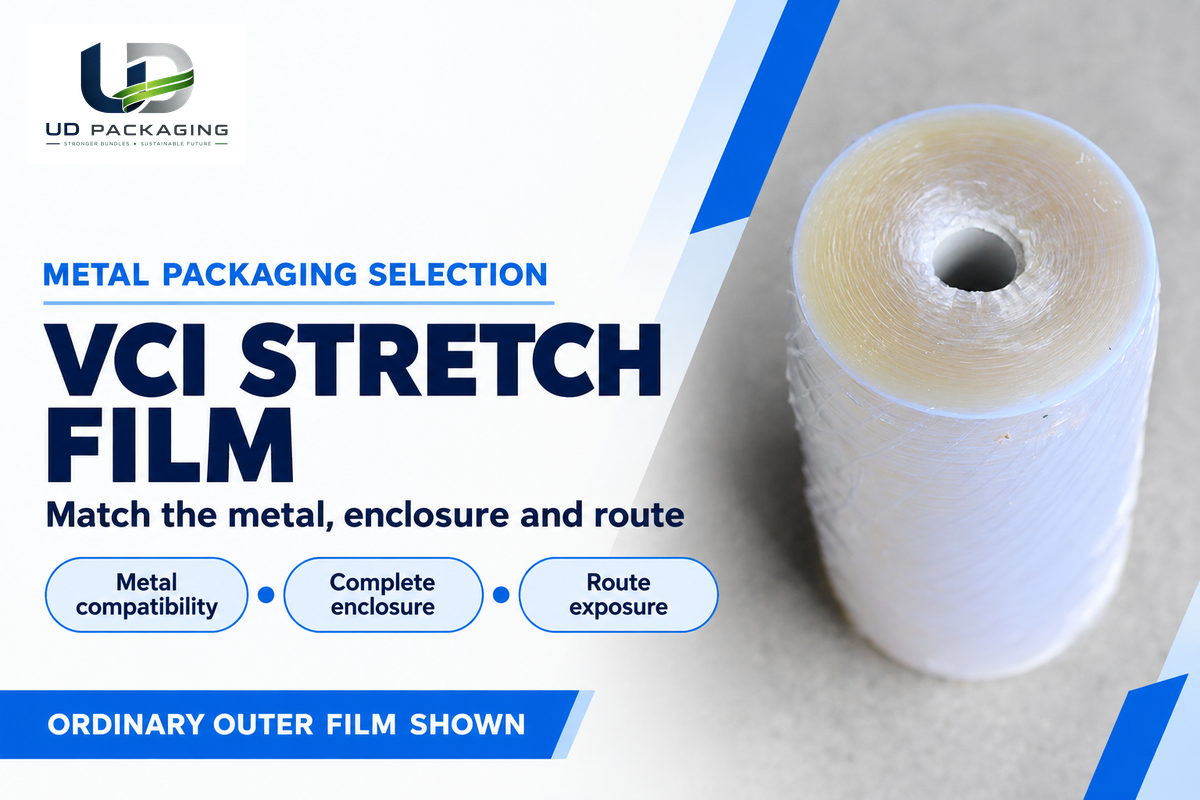
VCI stretch film restrains a load while releasing corrosion inhibitors around compatible metal surfaces. Choose it by the metal, enclosure and shipping route. A fully wrapped pallet may still need closed inner bags, edge protection or other preservation systems for its journey.
Quick selection checks
- Match the named formulation to every exposed metal and finish.
- Separate the corrosion enclosure from the outer load restraint.
- Keep unused-roll shelf life separate from packaged-part protection.
- Compare complete-pack cost after checking supplied roll dimensions.
VCI stretch film is polyethylene wrapping film containing vapor corrosion inhibitors. It combines wrapping tension with protection for compatible metal inside the specified enclosure. Select the grade and closure for the parts, storage period and route.
What is VCI stretch film used for?
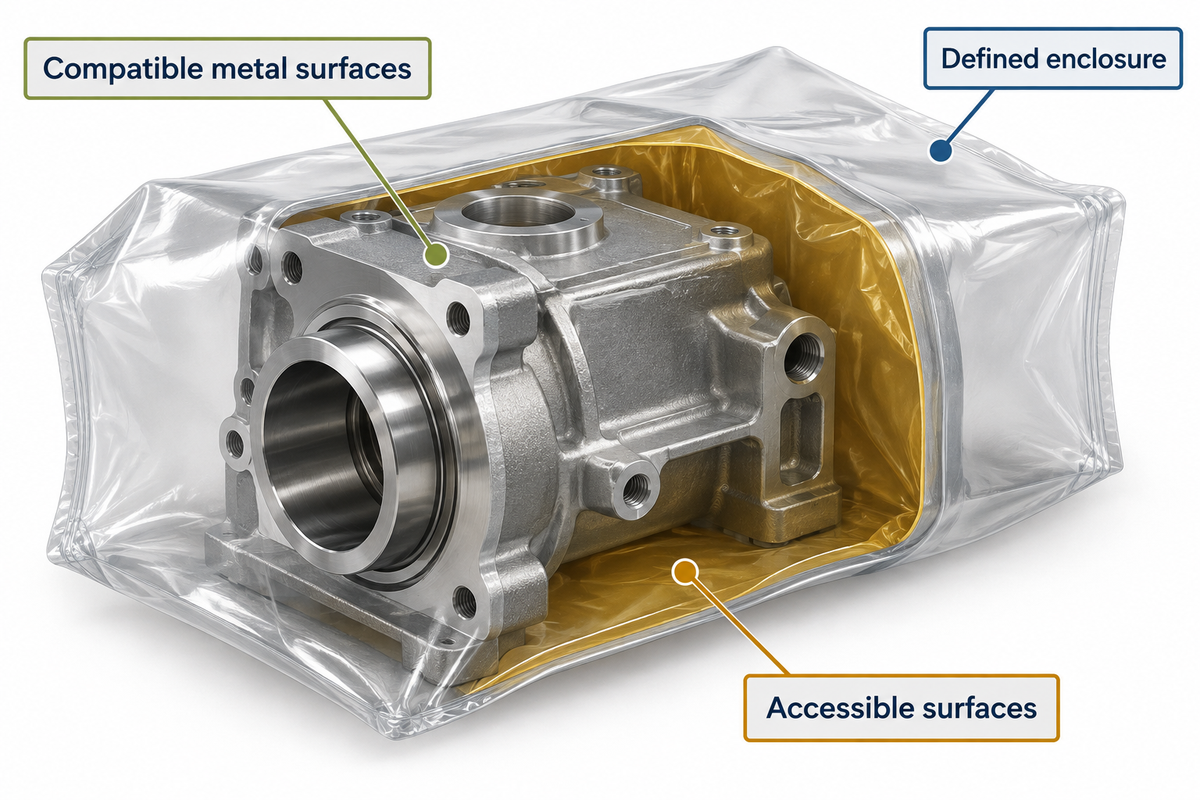
VCI stretch film is used to protect metal parts from corrosion while wrapping bundles or palletized loads for storage and transportation. Steel components, machined parts and mixed-metal assemblies need various formulation checks. Ordinary stretch film provides physical wrapping; the inhibitor adds protection against corrosion within the designed package.
How Does VCI Film Work?
Think of a scent spreading through a closed container. A vapor corrosion inhibitor also travels through the surrounding air, but its job is to interact with metal surfaces. The AMPP-published review of vapor-phase inhibitors describes some protection of ferrous and non-ferrous metals with this approach. The particular corrosion inhibiting compound is also significant.
In VCI poly packaging, the polyethylene packaging material carries the active ingredient. Each released molecule must contact an accessible surface before it can contribute to the protective molecular layer. The invisible layer is different from a thick oil coating. An enclosed outer surface and a sealed inner cavity are distinct spaces; vapor outside a closed cavity can’t simply pass through its wall.
A machined steel housing can be VCI-preserved between manufacture and assembly. Keep the housing clean before packing, and make sure that the package design allows for the internal passages of the housing to be preserved as well. Parts destined for downstream painting or bonding need a compatible surface-preparation process after VCI preservation. In general, it’s claimed that VCI keeps metal parts clean; however, proper surface preparation has to be done for the downstream process.
VCI stretch wrap, shrink film or bags: choose the enclosure
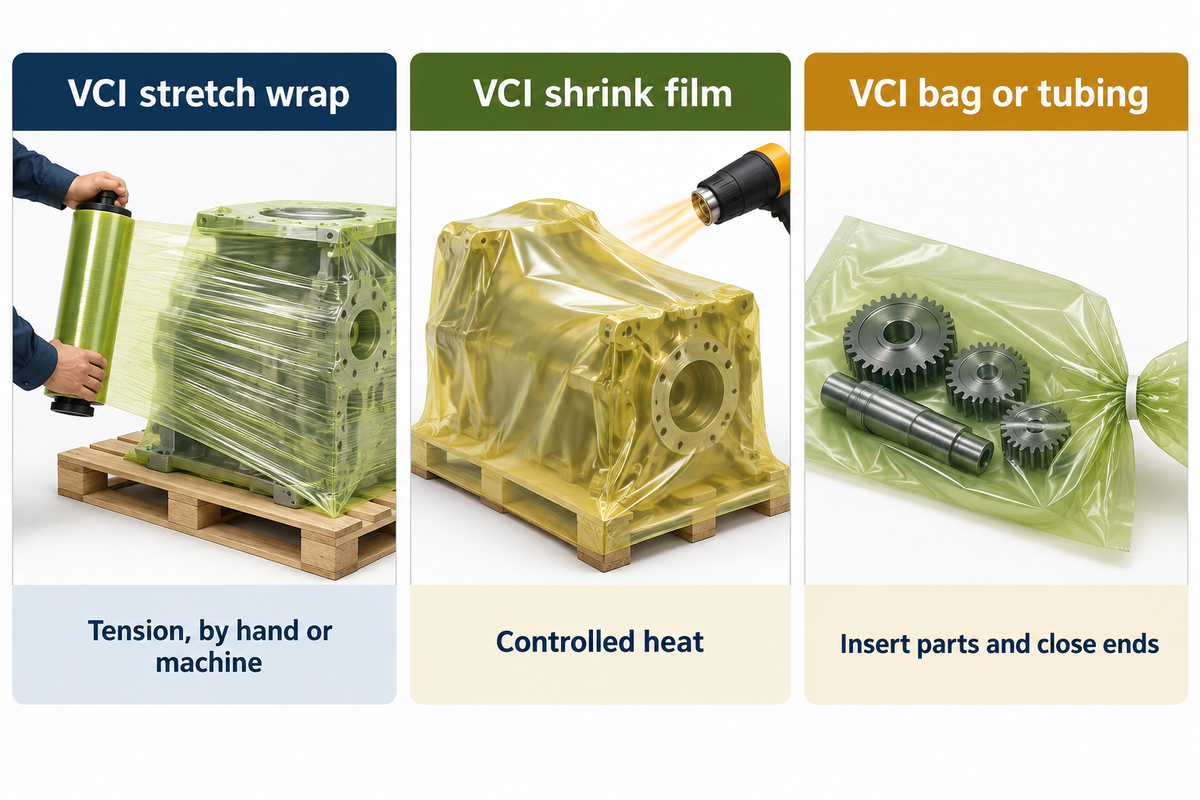
Choose VCI stretch wrap for tension-based wrapping, a VCI bag for a defined closable enclosure, and shrink film where controlled heating suits the part and packing process. A VCI bag in common outer stretch wrap is another arrangement; the bag creates the protective atmosphere and the outer film restrains the load.
What is the Difference Between VCI Shrink and VCI Stretch Wrap?
Stretch wrap surrounds the load; shrink film covers the load and contracts upon heating. Their equipment, closure, and usage differ. Neither determines suitability for outdoor storage. Heat sensitivity of a part favors a packing method without heat; an unwieldy assembly may require a fitted enclosure prior to pallet wrapping.
| Format | Application | Best starting use | Packaging limitation |
|---|---|---|---|
| VCI stretch wrap | Tension, by hand or machine | Wrapped metal bundles and unit loads | Side wrapping leaves top and bottom closure to resolve |
| VCI shrink film | Controlled heat | Fitted covers around suitable assemblies | Heat-sensitive surfaces and seams need attention |
| VCI bag or tubing | Insert parts and close ends | Individual parts, bins or pallet enclosures | Sharp edges can puncture the enclosure; outer restraint may still be needed |
IPG offers VCI2000 for hand and machine application; confirm the grade for automatic equipment. The manual application format offers a versatile choice for repetitive pallet wrapping. Separate bag and shrink product formats of VCI show why product families need comparison grade by grade. Our Hand-applied Pallet film page covers ordinary outer wrapping. When a closed VCI bag performs preservation, the outer layer can be selected for load restraint without duplicating the bag’s chemistry.
Match the film to every exposed metal
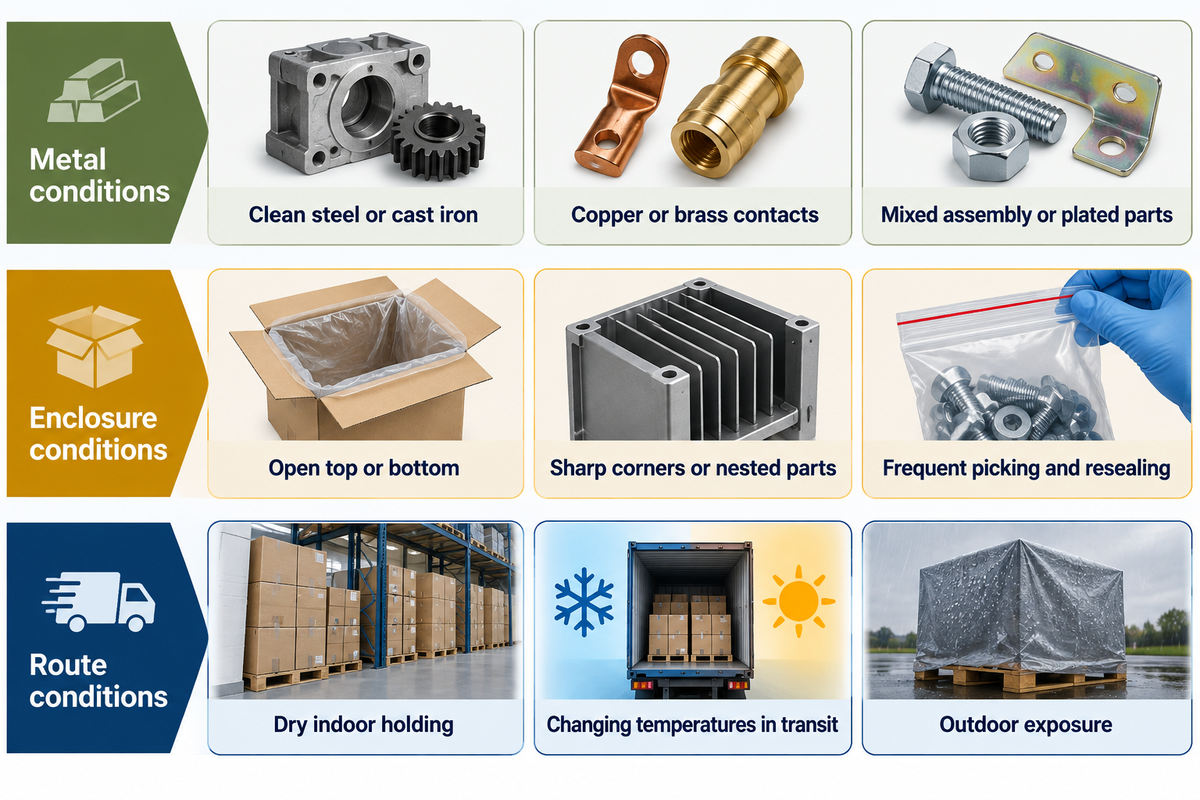
For parts with only ferrous metals, use a ferrous formulation specified for those metals. For assemblies containing different metals, use a suitable multimetal formulation. Watch out for copper, brass, aluminum and plated surfaces as well as steel. For example, Zerust offers ICT510-SM in ferrous and multimetal versions, while IPG lists a specific metal range for VCI2000.
3-Part Metal–Enclosure–Route Selector
Check the exposed metals, close the protective space, and match the package to the route, before adjusting the wrapping settings.
| Check | Condition | Starting decision | What changes the choice |
|---|---|---|---|
| Metal | Clean steel or cast iron | Start with a grade listed for that ferrous surface | Process residue, coatings or additional metals |
| Metal | Copper or brass contacts | Use a formulation covering the exposed non-ferrous metal | A steel-only grade is an unsuitable assumption |
| Metal | Mixed assembly or plated parts | List each exposed material and finish | Hidden cavities and downstream bonding |
| Enclosure | Open top or bottom | Add the specified cover, liner or inner bag | Loose overlap can leave a vapor-loss path |
| Enclosure | Sharp corners or nested parts | Protect edges and provide inhibitor access | Punctures or obstructed internal surfaces |
| Enclosure | Frequent picking and resealing | Use a closure intended for the access pattern | Repeated opening changes the protected atmosphere |
| Route | Dry indoor holding | Match the named grade’s indoor period | Wet parts or unconditioned storage |
| Route | Changing temperatures in transit | Include condensation and packaging moisture in the design | Warm parts, wet wood or humid trapped air |
| Route | Outdoor exposure | Select a system explicitly intended for that exposure | Indoor-only film cannot be extended by adding more turns |
Say you have a steel frame with brass fittings. Buying a ferrous-only film leaves the brass question unresolved, even if most of the weight is steel. The packing list should identify brass surfaces and any oil used after machining. A thick oil layer can restrict vapor access. A compatible light oil may remain. Zerust’s oil guidance states this as a formulation-specific issue. The starting choice is a multimetal grade that covers the assembly, followed by a trial with the same finish and oil. Increasing wrap tension won’t resolve a mismatch.
Close the package before relying on corrosion protection
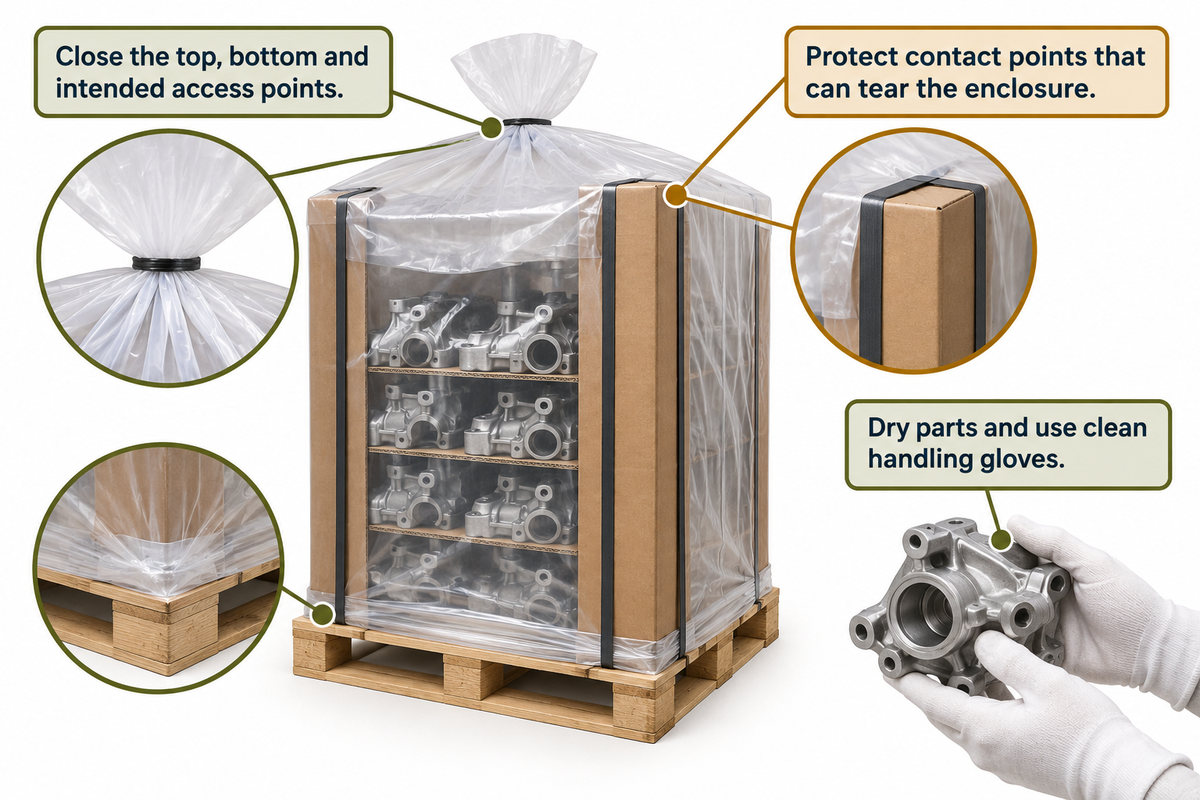
Wrap dry, clean parts near ambient temperature in film and enclose them as specified for the package. Keep sensitive metals away from damp cardboard or wood. Stretching the outer wrap tightly can provide better restraint, but the top, bottom and/or inner vapor path may be inadequate.
Do VCI bags need to be sealed?
Yes, close the bag per its design method. That may be a heat seal, an adhesive closure, or a prescribed fold and tape closure. Draping film over the load leaves openings. Closure of the bag also needs to withstand lifting, handling, and planned access to the bag’s contents.
Moisture control begins before the bag is closed. Zerust explains that before the protective layer is fully stabilized, liquid droplets may create local corrosion. VCI doesn’t absorb standing water. Covering the pallet top may help with physical covering, but the cover must be part of the chosen enclosure; a loose sheet doesn’t seal all routes for air exchange.
Protection also takes time to establish within a pack. In their 2006 study of inhibitor gas transport, Pieterse and co-authors distinguish between equilibrium vapor concentration and movement across an air gap. Leave access to recessed surfaces and follow the grade’s interleaving instructions for closely packed parts. Use the conditioning period specified for the selected grade and package before dispatch.
Do
- Dry parts and use clean handling gloves.
- Close the top, bottom and intended access points.
- Protect contact points that can tear the enclosure.
Don’t
- Trap wet parts inside the package.
- Leave sharp corners bearing directly on film.
- Substitute extra wrap tension for a specified closure.
How long does VCI protection last in storage and shipping?
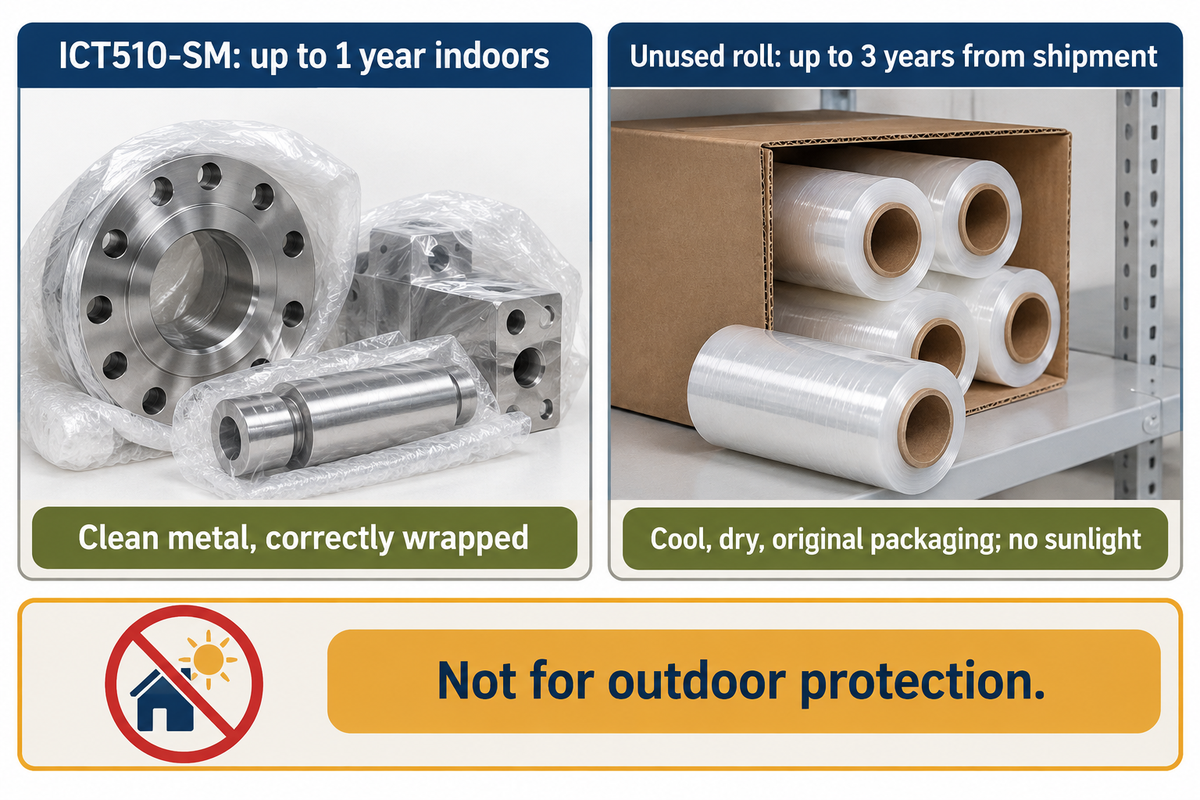
Zerust gives up to 1 year of indoor protection for clean metal wrapped correctly with ICT510-SM, and up to 3 years of unused film storage from shipment. The periods refer to various conditions. Their sheet also states not to use the grade for outdoor protection; therefore the indoor period isn’t an allowance for outdoor shipping.
For the unused roll, the conditions stated for storage are cool and dry, away from sunlight, in the original packaging. For the packed parts, the condition and integrity of the package and the route of exposure govern the application. Separately track the shipment date of the roll and the date the parts were packed.
A shipment can spend the vast majority of its journey indoors and still spend time outdoors during a transfer. Consider a steel parts pallet stored in a dry warehouse, transported through an uncovered loading yard and held outside at the destination. The storage plan for that shipment has now been extended outdoors. The buyer would need to select a preservation package for that leg, or change the handling arrangement to keep the steel parts pallet within the grade limits. Take rain protection, temperature changes and the potential for repacking into account for that leg. Calling the job “warehouse storage” on the purchase order would omit the exposure during the loading yard transfer.
Be sure to log each opening and sealing for repeated access. A torn cover, wet dunnage or a changed destination would require a new packing arrangement. Keeping rust and corrosion during storage at bay requires intact packaging, and a suitable storage period.
Read the data sheet: gauge, stretch and puncture resistance
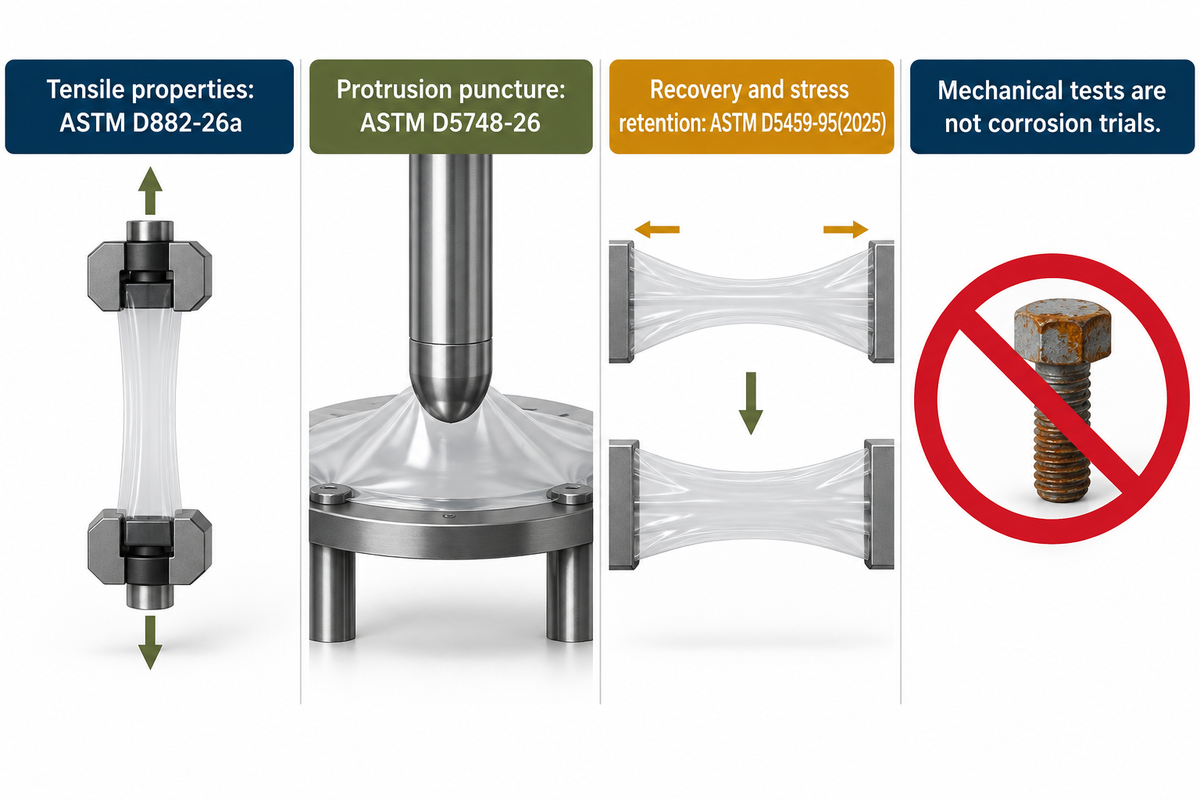
Start with the exact film grade and distinguish thickness, operating stretch and elongation at break. Zerust’s ICT510-SM sheet indicates that 100 gauge is 1 mil or 25.4 micrometers. A greater break-elongation value describes a tensile endpoint; it isn’t an instruction to run the wrapper at that value.
| Property or format | Published example | How to use it |
|---|---|---|
| Thicker listed film | 125 gauge / 1.25 mil | Compare the named grade, not gauge alone |
| Pre-stretch | Up to 250% | Published typical value; validate the wrapper/load combination |
| MD tensile, 100 gauge | 45.0 MPa | Machine-direction value from the grade sheet |
| TD tensile, 100 gauge | 28 MPa | Transverse-direction value, a different test orientation |
| MD tensile, 125 gauge | 47.57 MPa | Do not substitute it for the thinner film’s value |
| TD tensile, 125 gauge | 39.99 MPa | Retain specimen direction in comparisons |
| Multimetal machine roll | 20 in × 4,500 ft, 100 gauge | Match roll width and wrapper capacity |
| Ferrous machine roll | 20 in × 4,000 ft, 125 gauge | Different formulation and supplied length |
| Ferrous hand roll | 4 in × 667 ft, 125 gauge | Narrow wrapping format; not a full-pallet enclosure by itself |
Source: Zerust ICT510-SM technical data sheet, read October 2026. The manufacturer identifies the physical-property figures as typical values, not specifications.
ASTM D882-26a addresses tensile properties of thin plastic sheeting. ASTM D5748-26 addresses protrusion puncture resistance under its test conditions. ASTM D5459-95(2025) measures recovery, permanent deformation and stress retention of stretch wrap. Compare like test conditions before treating a claimed strength advantage as useful on your load.
“Stress retention is related to the tightness or snugness of a package.”
Mechanical results can be utilized for load-containment testing. Corrosion trials evaluate a different outcome: the state of the protected metal. A film that resists punctures still needs compatible chemistry and a proper enclosure. Thus, claims of superior strength should be evaluated for measured results on the pack, not for presumed protection.
How much does VCI stretch film cost per usable load?
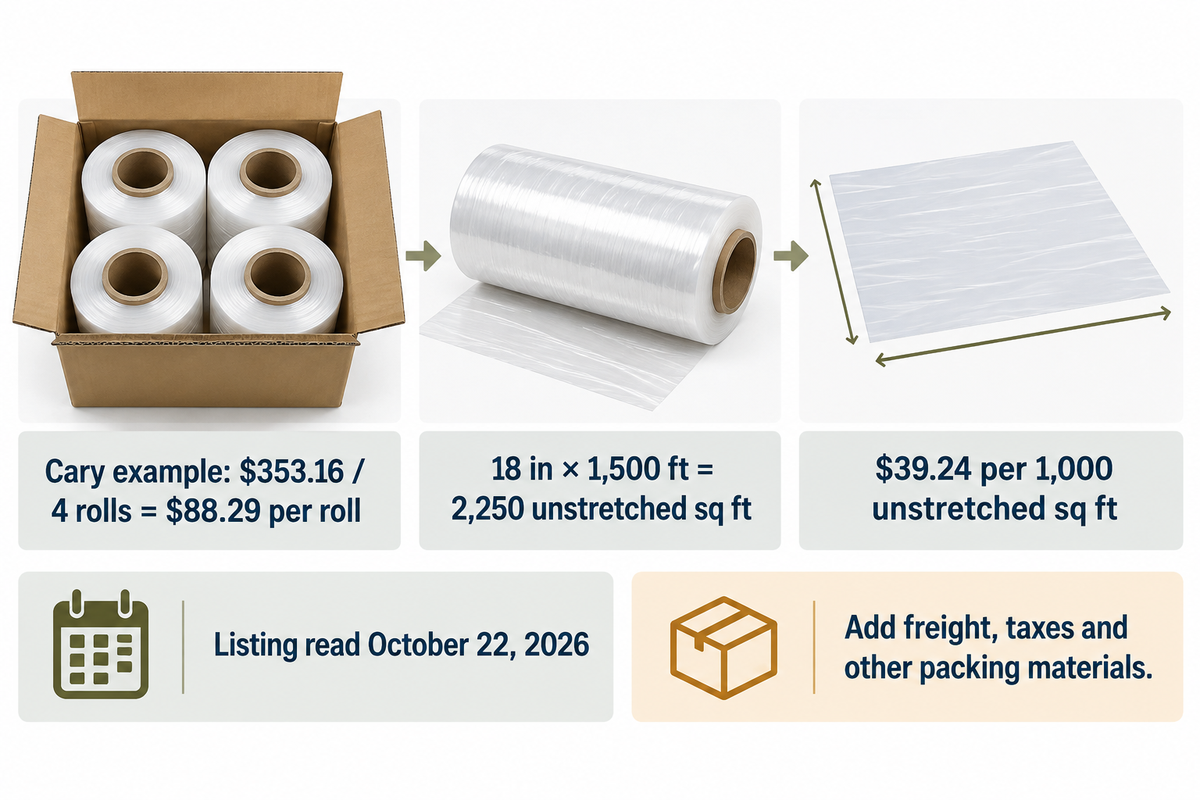
One US retail example is $88.29 per roll: Cary’s listed $353.16 case price divided by four rolls, each 18 in × 1,500 ft at 100 gauge. The listing was read on October 22, 2026. Prices can change; freight, taxes and the other materials in a complete pack must be added separately.
The area of one unstretched roll is 18 ÷ 12 × 1,500 = 2,250 sq ft. Dividing the price of a roll by this area gives $39.24 per 1,000 unstretched sq ft. This compares purchased material, not how many protected pallets the roll will produce.
| Cost item | Calculation or record | Include in trial total |
|---|---|---|
| Film | Measured roll consumption × purchased unit cost | Yes, including used scrap |
| Enclosure components | Bag, top/bottom covers, closures and edge protection | Yes |
| Packing labor | Recorded time × applicable labor rate | Yes |
| Receiving work | Opening, inspection and any required cleaning | Yes, when comparing the same scope |
| Rework | Actual additional material and labor | Count once; do not charge consumed scrap twice |
Suppose the packing team records consumption in rolls while procurement receives a case quote. The case quote looks expensive until both quantities are expressed in the same unit. After conversion, the team needs to account for measured consumption of the selected wrapper. Overlap, stretching, tails, and rejected wrap all affect consumption. A lower roll price can also come with fewer supplied feet, so retain both width and length beside the price. Use the film use comparison worksheet to aid in consistent wrapping. Divide the total cost of the batch used in the trial by its accepted loads; don’t promise yield from an unstretched sheet.
Choose a VCI supplier and test the complete pack
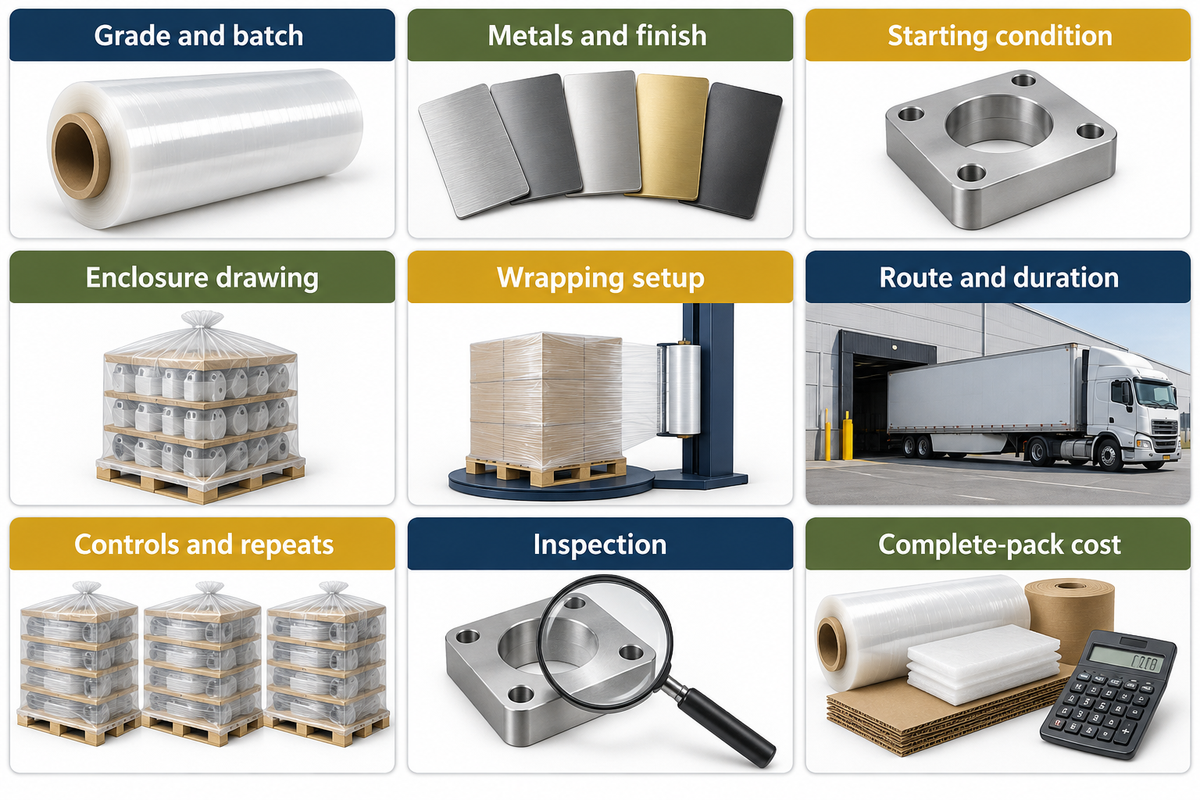
Start with a named stretch-film grade along with its manufacturer instructions, and trial the same metals, packing arrangement and route planned for production. Zerust’s ICT510-SM and IPG’s VCI2000 are identifiable specialty offerings; Cary is a distributor. Compare their support and products separately rather than consider every VCI-family brochure the same film.
The packing team’s Trial-to-Order comparisons should be included in procurement’s purchase order discussion. Procurement is responsible for product identity and cost, operations for the packing method, and quality for the outcome of inspection. To prevent rust using VCI in production, transfer the accepted trial arrangement into a repeatable packing instruction.
| Record | Trial starting point | Order requirement |
|---|---|---|
| Grade and batch | Exact product name and batch identity | Same approved grade; controlled substitutions |
| Metals and finish | Actual alloy, plating, oils and residues | Same preparation and compatibility scope |
| Starting condition | Photographs of accessible and recessed surfaces | Defined incoming surface condition |
| Enclosure drawing | Bag or wrap, top/bottom closure and interleaving | Repeatable packing arrangement |
| Wrapping setup | Actual wrapper settings and measured film use | Recorded operating setup |
| Route and duration | Storage, transit, handling and access events | Exposure within the approved application |
| Controls and repeats | Matched controls and repeated specimens for chemistry comparison | Agreed test design, not a single anecdotal result |
| Inspection | Predefined surfaces and inspection points | Written acceptance and escalation rules |
| Complete-pack cost | Film, other materials, labor and rework | Cost per accepted load using the same scope |
When studying the effect of the inhibitor, use matched packaging lacking the inhibitor, as a control. Repeat samples, and record the initial state of the surface. The exposure must challenge the control meaningfully. Otherwise, a rust-free trial might have simply encountered benign conditions. A route trial can establish practical handling suitability without isolating the chemistry; keep those two purposes separate. For the outer wrapping trial, the ASTM stress-retention method connects stress retention with package tightness; corrosion performance requires separate evidence.
- Define the pack. Fix the grade, metals, closure and intended exposure.
- Run the trial. Record packing conditions, inspections and film consumption.
- Release the instruction. Transfer the accepted arrangement and handling limits to production.
Ask the supplier for the grade data sheet, metal/finish compatibility, closure and interleaving instructions, applicable corrosion test conditions and other relevant documentation. Explain acceptance criteria and repeat count before the trial. Generic chemical family names or patent numbers aren’t substitutes for product instructions.
Recycled-content VCI film: keep the grade-specific proof
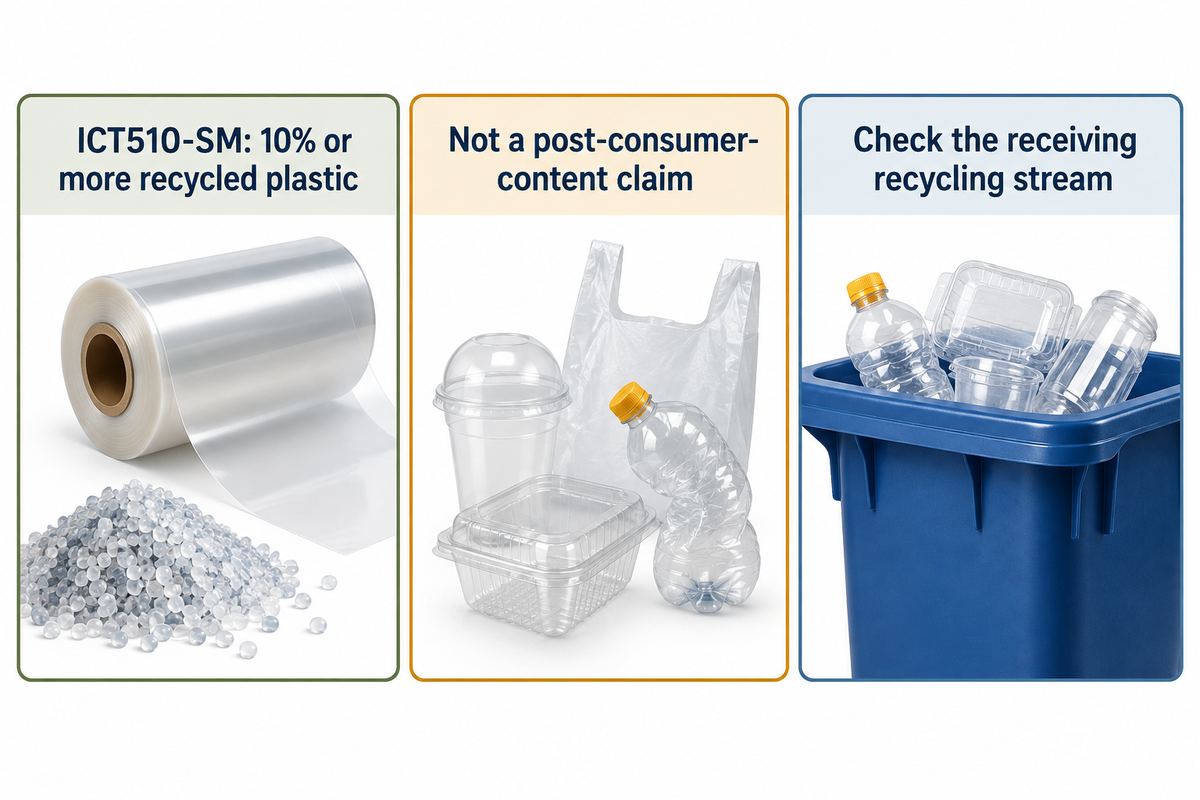
Recycled content should be specified for the exact grade; for example, Zerust mentions 10% or more recycled plastic for ICT510-SM. That is different from a claim about post-consumer content, and it does not describe every VCI film. Reducing use of materials also changes the wrapping trial; check punctures and containment when you down-gauge.
During 2026, the packaging industry’s mechanical-test references include the D5748-26 puncture edition and D882-26a tensile edition. When evaluating a reformulated film against an existing grade, purchasing teams should maintain the test version and state the conditions alongside the result. Changes to the feedstock, thickness or coextruded layer structure should be recorded on the product change notice.
According to the Federal Trade Commission’s Green Guides, recyclability and recycled content are distinct product claims. For industrial film, the practical disposal question is whether the receiving recycling stream is likely to accept the used film. Recycled content, compostability, and local recyclability shouldn’t be combined into a single environmental promise.
For a cost-effective reduction in film, start with the existing accepted package and specify the condition of film being proposed. Record the new consumption and inspection result, using the same comparison sheet. Lower thickness improves material efficiency only when the package continues to meet its handling and preservation requirements.
Frequently asked questions
Do VCI bags really work?
Yes, for compatible metals in the specified closed package.
VCI bags release inhibitors into the enclosed space around metal parts. Reliable use begins with the correct formulation, clean and dry surfaces, and the prescribed closure. Punctures, wet packaging aids or repeated opening can disrupt this anti-corrosion system. For an unfamiliar assembly, include its exact finish and handling route in the trial, then carry the accepted packing method into production.
What does the acronym VCI stand for?
VCI means volatile corrosion inhibitor or vapor corrosion inhibitor.
In packaging, the term describes compounds released into the surrounding enclosed space to help prevent rust and corrosion on compatible metals. The film carries the active material; its mechanical wrapping properties are a separate part of the package. Ferrous-only and multimetal grades can use different formulations. Select the named product for the exposed surfaces rather than choosing by the abbreviation alone.
What happens when VCI film is removed?
The protective enclosure opens, so manage the next handling or storage step.
Use the parts according to the next production process and the inhibitor supplier’s instructions. Continued preservation after removal is grade- and condition-specific. For parts returning to storage, use the prescribed repacking method instead of assuming the previous wrap remains effective. Painting, bonding and assembly each have their own surface requirements, including any cleaning specified for that particular finish and formulation.
Is stretch wrap the same as saran wrap?
No. Industrial pallet wrap and household food wrap have different uses.
Use the specified industrial preservation material for metal shipments. Household food wrap isn’t a replacement for a VCI package, and a VCI product needs applicable approval before food-contact use.
Can VCI stretch film be reused?
Reuse it only when the exact grade and handling instructions allow it.
Removal can stretch or tear the material, introduce dirt and moisture, or make the next closure difficult to reproduce. Its color and feel don’t reveal the remaining inhibitor activity. Follow the manufacturer’s reuse instructions for that product and keep its exposure history with the packing record. A damaged or contaminated wrap shouldn’t be returned to the preservation process. For parts picked repeatedly from storage, a purpose-designed resealable enclosure may be more practical than removing and reapplying pallet film. Include the opening pattern in the original selection so operations can preserve the approved package between access events.
Plan the outer load restraint with UD Packaging
UD Packaging supplies standard industrial stretch film and PET strapping for pallet packaging. Share the load dimensions, edge conditions and wrapping method when selecting machine stretch film for load containment or PET strapping for unitized loads. Safeguard the specified preservation conditions by keeping the specialist VCI enclosure and its instructions separate from outer-restraint settings.
Product examples use published manufacturer instructions and a dated distributor listing. The selection tables are aids to the purchasing team and shouldn’t be reported as UD Packaging laboratory tests.
Related Articles and Resources
References & Sources
- An Overview: Vapor Phase Corrosion Inhibitors, Subramanian and colleagues, CORROSION, 2000. Public abstract.
- Estimating the gas permeability of commercial volatile corrosion inhibitors at elevated temperatures with thermo-gravimetry, Pieterse and colleagues, Corrosion Science, 2006.
- ASTM D882-26a: Tensile Properties of Thin Plastic Sheeting, ASTM International, public scope.
- ASTM D5748-26: Protrusion Puncture Resistance of Stretch Wrap Film, ASTM International, public scope.
- ASTM D5459-95(2025): Elastic Recovery, Permanent Deformation and Stress Retention of Stretch Wrap Film, ASTM International, public scope and significance.
- Green Guides, Federal Trade Commission.