Get in touch with UD Packaging Company

![Plastic Strapping Types: PP vs PET [Buyer Guide]](https://udpackaging.com/wp-content/uploads/2026/08/plastic-strapping-types-featured.png)
Updated August 2026 · By XCX
Plastic strapping types are commonly grouped first into two main extruded families: polypropylene and polyester, usually called PP and PET. Nylon or high-recovery strap is another industry-specific route. Woven and composite polyester products use different constructions, so buyers should identify resin, form, grade and joint before treating catalog labels as equivalent.
Standards anchor: ASTM D3950-23 treats breaking strength, elongation, transverse strength and joint strength as separate test areas for nonmetallic strapping. A resin name alone is therefore not a complete specification.
Use this guide to make one decision
Decode the product label, screen the package and route, verify the tool and joint, then approve only a representative-package trial. This article does not assign a universal load rating, price tier or steel-replacement rule.
What Are the Main Plastic Strapping Catalog Categories?
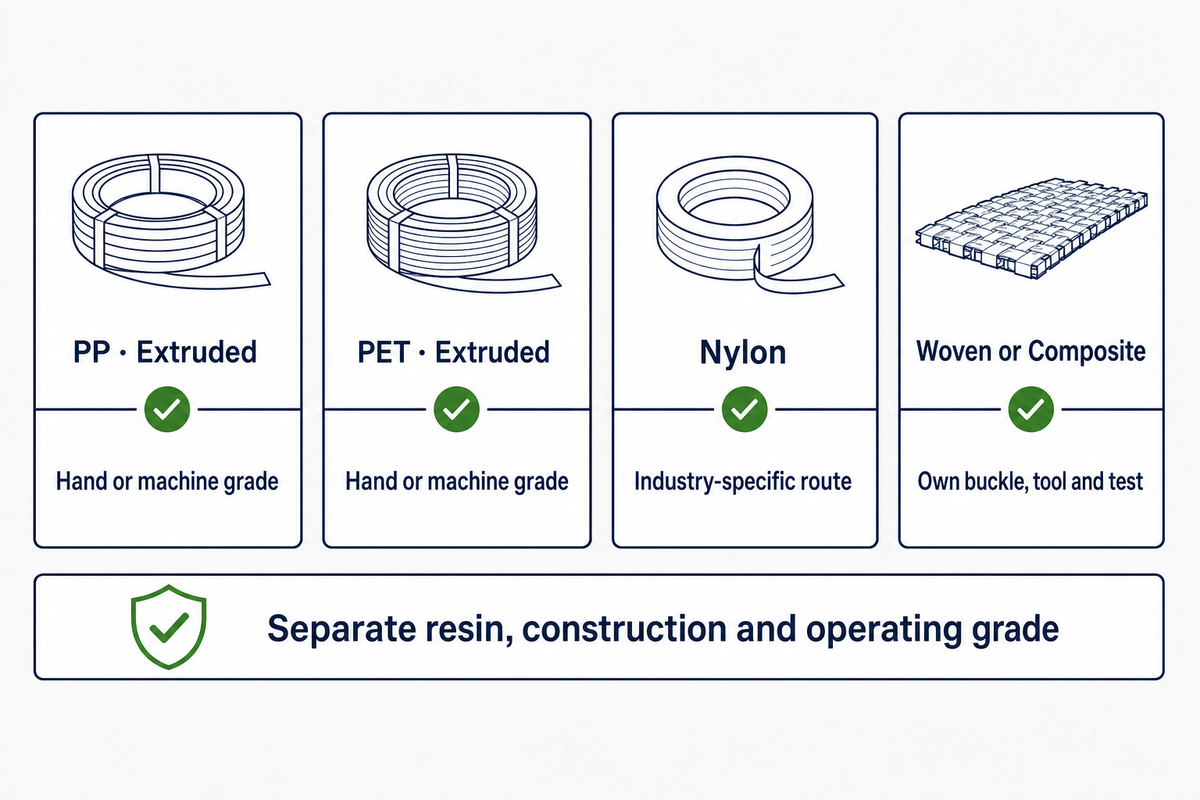
For general industrial buying, start with two extruded families: polypropylene strap and polyester or PET strapping. Nylon appears in some industry rules and supply programs. Woven and composite products may also use polyester, but their filament-based construction, joining method and applicable tests keep them outside a simple extruded-PET grade comparison.
PP, extruded
Hand or machine grade; verify dimensions, surface, core and joint.
Hand or machine grade; verify dimensions, surface, core and joint.
PET, extruded
Hand or machine grade; verify finished-lot properties and equipment fit.
Hand or machine grade; verify finished-lot properties and equipment fit.
Nylon
A real route whose prevalence and approval requirements vary by industry.
A real route whose prevalence and approval requirements vary by industry.
Woven or composite
Different constructions that require their own buckle, tool, test and approval checks.
Different constructions that require their own buckle, tool, test and approval checks.
These are plastic-strap catalog categories, not a flat specification list. Catalogs sometimes group the common types of strapping and the different types of strapping available without separating resin, construction and operating grade. When comparing plastic strapping types, separate those three fields before requesting joint, tool and package evidence.
What are the different types of plastic straps available?
Catalogs may list PP strap, PET strap, nylon, woven polyester, composite cord strapping, hand strapping and machine grade strapping as if these were parallel choices. They are not all the same kind of label. Some identify a polymer, some a construction, and some an operating grade. Begin with the material family, then ask how the strap is made and applied.
Strapping is used to unitize, reinforce or contain a package, but that shared purpose does not make every material or grade interchangeable. The package and distribution evidence decide whether a specific strap route is acceptable.
ASTM D3950-23 describes five material-based nonmetallic strapping types on its public page but does not publish their five labels there. This buyer taxonomy therefore is not presented as the ASTM classification.
Intent boundary: broad questions about types of strapping materials, including metal strapping, cross-material load selection and joint-adjusted usable load belong in the industrial strapping and load-selection guide. This page only decodes plastic-strap catalog labels and the evidence needed to move a quoted grade into a controlled package trial.
The Resin-Form-Grade Stack: Why Catalog Labels Conflict
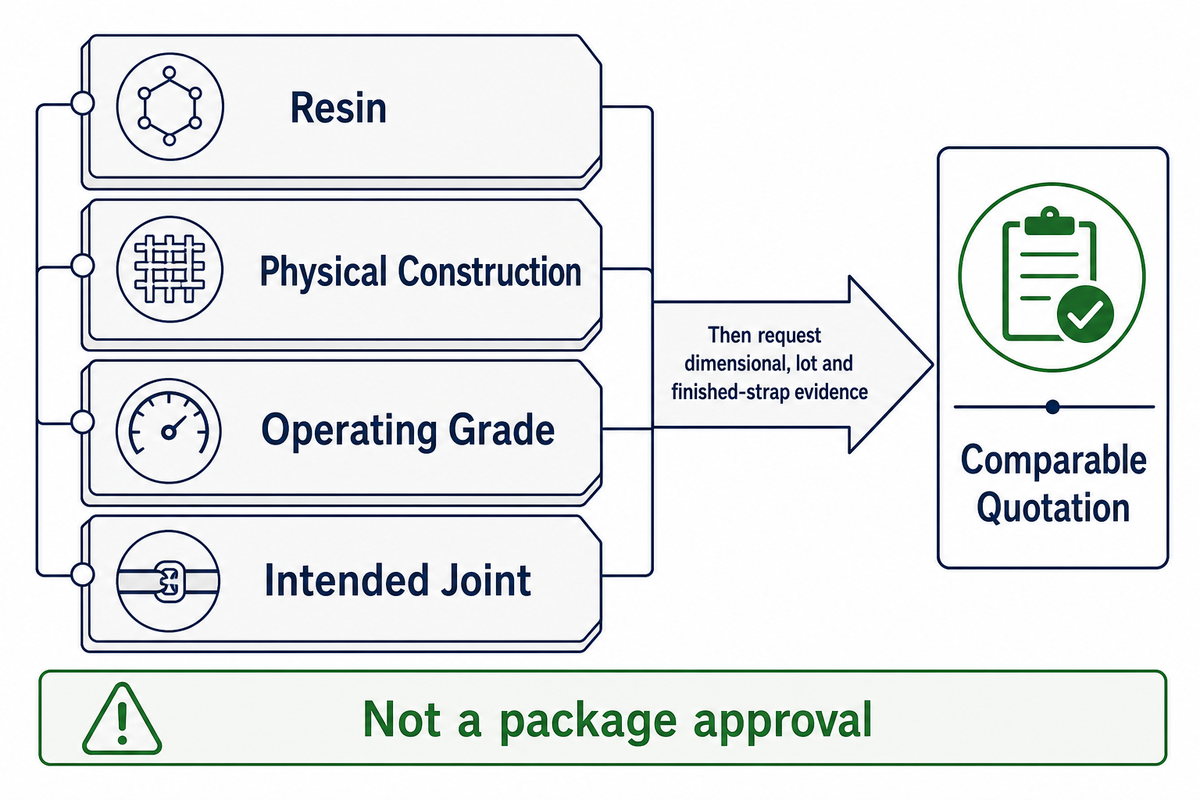
The Resin-Form-Grade Stack decodes a listing in four passes: identify the resin, the physical construction, the operating grade and the intended joint. Then request dimensional, manufacturing-lot and finished-strap evidence. The stack makes quotations comparable, but it does not replace carrier rules, package geometry, distribution conditions or testing.
4-Layer Resin-Form-Grade Matrix
Search language exposes the problem. In this research run, “plastic banding” showed 1,900 reported monthly searches and “plastic strapping” 1,600, while the exact focus phrase had no reported volume. Those are keyword-tool observations, not market size; they show that buyers and catalogs use overlapping strapping terms.
| Catalog type label | Resin / form | Grade and joint to identify | Lot evidence to request | Still unknown from the label |
|---|---|---|---|---|
| PP hand grade | Polypropylene / extruded | Manual strapping; buckle or seal route | Width, thickness, camber, break and elongation method | Package retention and corner response |
| PP machine grade | Polypropylene / extruded | Machine model; heat or friction joint | Core, surface, feed tolerance and joint trial | Line reliability at production speed |
| PP fully automatic grade | Polypropylene / extruded | Automatic strapping machine and track | Coil build, curvature, edge and cut behavior | Jam rate and restart behavior |
| PET hand grade | Polyester / extruded | Tensioner plus seal or weld route | Finished-lot tensile, elongation and joint data | Fit to the actual load and route |
| PET machine grade | Polyester / extruded | Machine settings and joint protocol | Core, dimensional tolerance and feed/joint trial | Compatibility with current wear state |
| Embossed PET | Polyester / extruded, textured surface | Tool and joining route | Surface description plus finished-joint result | Whether emboss improves this application |
| High-recovery nylon | Nylon / supplier-defined form | Industry rule, tool and closure | Current specification and named test method | Availability and route acceptance |
| Woven polyester | Polyester fiber / woven web | Buckle, tensioner and approval route | Construction and applicable webbing test | Equivalence to any extruded grade |
| Composite polyester | Polyester filaments / coated composite | Metal buckles and compatible tool | Filament/coating definition and joint trial | Interchangeability with woven or PET strap |
A university study of recycled-PET packaging strap found process-history effects on splice tendency and shrinkage, especially from post-extrusion annealing. It also reported that the examined pre-extrusion conditioning steps did not significantly change properties when the maximum moisture condition was met. The useful buying rule is narrower: compare finished lots under a named method, not resin names alone.
How to Read a Polypropylene Strapping Label
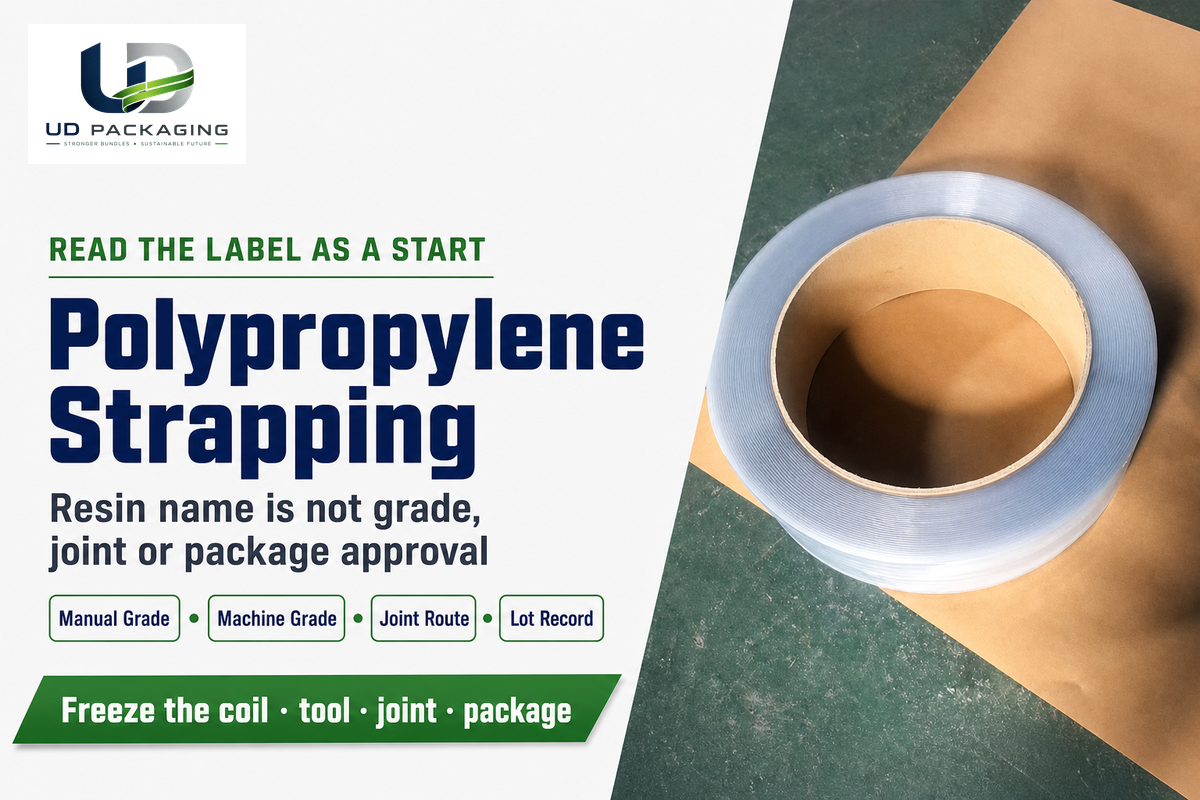
A polypropylene strapping label identifies an extruded PP packaging strap, but it does not by itself specify the manual or machine grade, joint, equipment fit or package boundary. A PP route is worth trialing only after those fields are defined. Do not approve it from the words “light duty” or “low cost” because those labels do not define retention or package acceptance.
Use when
The current package trial shows adequate containment without corner damage, joint failure or unacceptable loss of tension.
The current package trial shows adequate containment without corner damage, joint failure or unacceptable loss of tension.
Verify first
Grade, width, thickness, core, camber, elongation method, joint route and machine settings.
Grade, width, thickness, core, camber, elongation method, joint route and machine settings.
Reject the shortcut
Do not infer suitability from package weight, color, nominal width or PP resin alone.
Do not infer suitability from package weight, color, nominal width or PP resin alone.
Elongation at break, elastic recovery and retained tension are different measurements. Vendor ranges reviewed for this article used different grade and test contexts, so no material-wide percentage is published here. Procurement should ask the supplier to name the test method and conditioning, while quality records what happens to the bundle after dwell, handling, transit and storage.
Hand strapping also does not prove automatic strapping compatibility. A machine grade must feed, tension, seal and cut repeatably through the actual track. The correct acceptance record belongs to the chosen coil, strapping machine, joint process and representative carton or bundle.
When polypropylene strap is used as the selected method of strapping, record the strap lot and the package result together. “High-quality strapping” is not an operating grade or acceptance record. PP strapping can be used only within that proven boundary; a visually similar strap from another lot is a new input, not automatic approval.
How to Read a PET Strapping Label
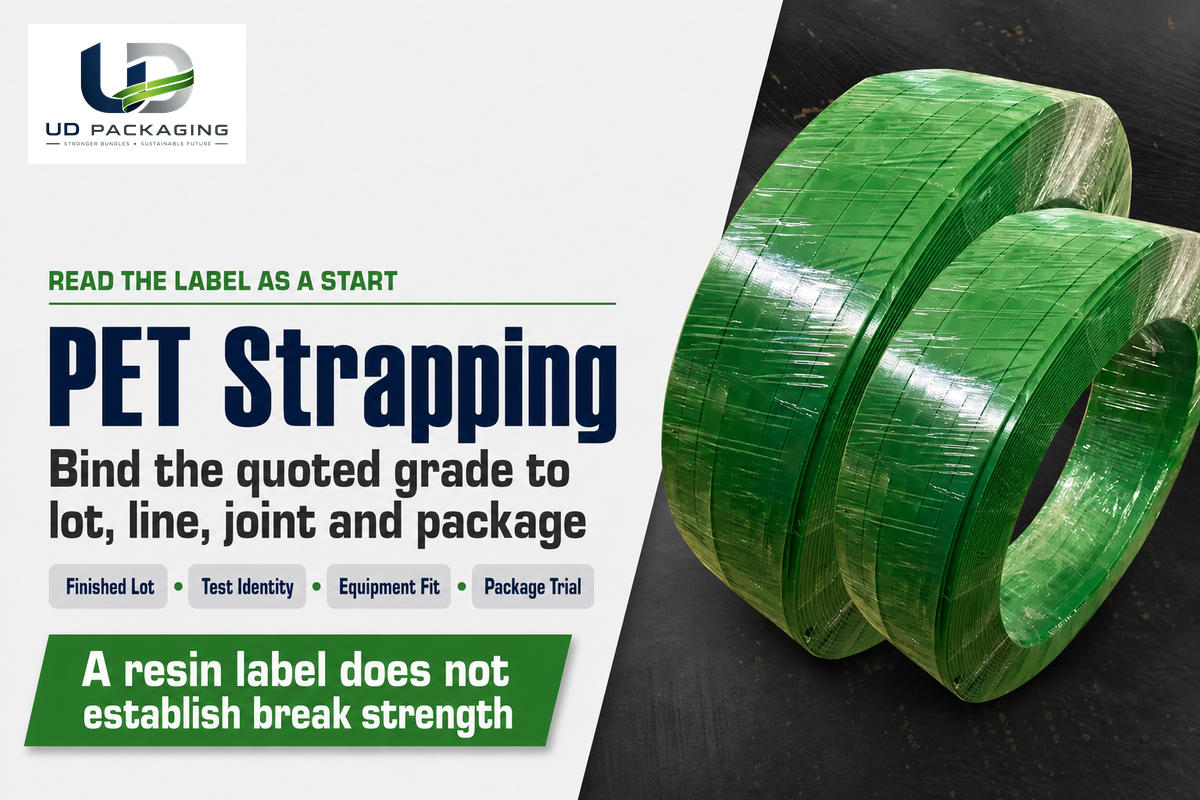
A PET strapping label identifies extruded polyester, but it does not establish the hand or machine grade, finished-lot properties, joint route or equipment fit. Those catalog fields must be matched to the package and distribution record before trial approval. PET is not a universal replacement for steel, nor does a resin label establish break strength.
For an actual purchase, compare the supplier’s PET strapping specifications with the buyer’s package, tool and route. UD Packaging states that its PET production scope runs from granulation to finished strap; that is first-party manufacturing context, not independent proof of a particular roll’s performance or production capacity.
PET trial record
Coil
Resin/feedstock declaration, grade, dimensions, core and lot.
Resin/feedstock declaration, grade, dimensions, core and lot.
Property
Named tensile, elongation and joint methods with conditioning.
Named tensile, elongation and joint methods with conditioning.
System
Tool or machine model, settings, seal or weld and wear state.
Tool or machine model, settings, seal or weld and wear state.
Package
Geometry, edges, settlement, dwell, handling, transit and storage.
Geometry, edges, settlement, dwell, handling, transit and storage.
ASTM D4675-14a(2022) is useful because its selection scope extends beyond material and strength to carrier requirements, strap count, load geometry, friction, handling, transit, storage and user testing. That is why a heavy-load label or a claim of replacement for steel cannot close the decision.
For polypropylene and polyester strapping alike, separate tensile strength from joint strength and from package retention. A buyer comparing polyester and polypropylene should also keep steel strap requirements visible whenever the route or customer specification still names steel strap as the controlling boundary.
Company-claim boundary: UD Packaging states that its products undergo SGS product quality testing and that it uses GB/T 1040.1-2018 and GB/T 1040.3-2006 in testing. This article does not convert that statement into factory certification, lot approval or a claim that those editions govern every order; confirm the required edition and evidence in the purchase specification.
Where Nylon Appears in Plastic-Strap Specifications
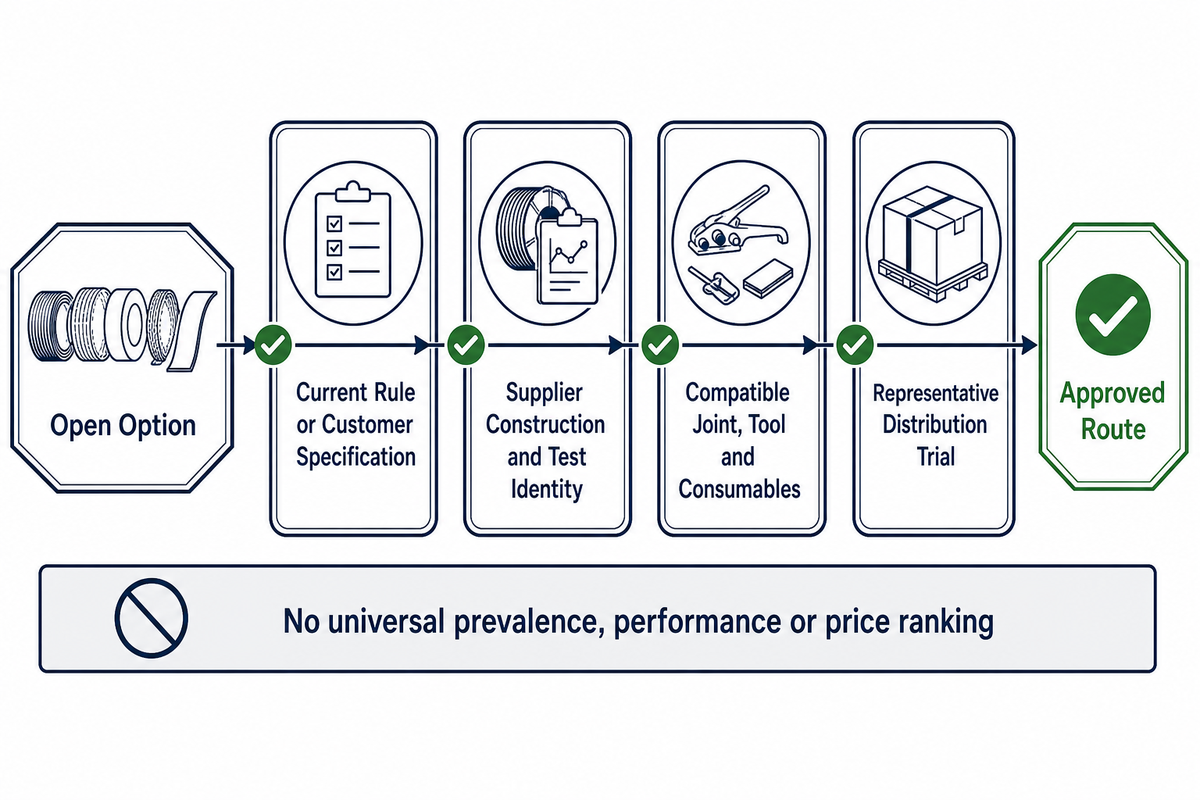
Nylon strapping is a real packaging route, but its prevalence and suitability are industry-specific. Buyers should confirm a current supplier specification, compatible joint and tool, applicable carrier or customer rule, and a representative-package result. Do not assume nylon is universally rare, universally mainstream or interchangeable with PP or PET.
The RailCIS packaging manual names polypropylene, polyester and nylon as three commonly used plastic strappings in its rail context. It publishes no market-share measurement, so that evidence establishes an industry route rather than global prevalence.
- Ask which rule or customer specification permits the strap.
- Freeze the supplier’s construction, width, thickness, joint and test identity.
- Confirm tool and closure availability at every plant that will apply it.
- Trial package movement, recovery and joint behavior under the actual distribution cycle.
If those records are unavailable, nylon should remain an open option rather than receive a performance or price ranking. Supply continuity and compatible consumables can be as decisive as the material behavior.
How Woven and Composite Polyester Labels Differ
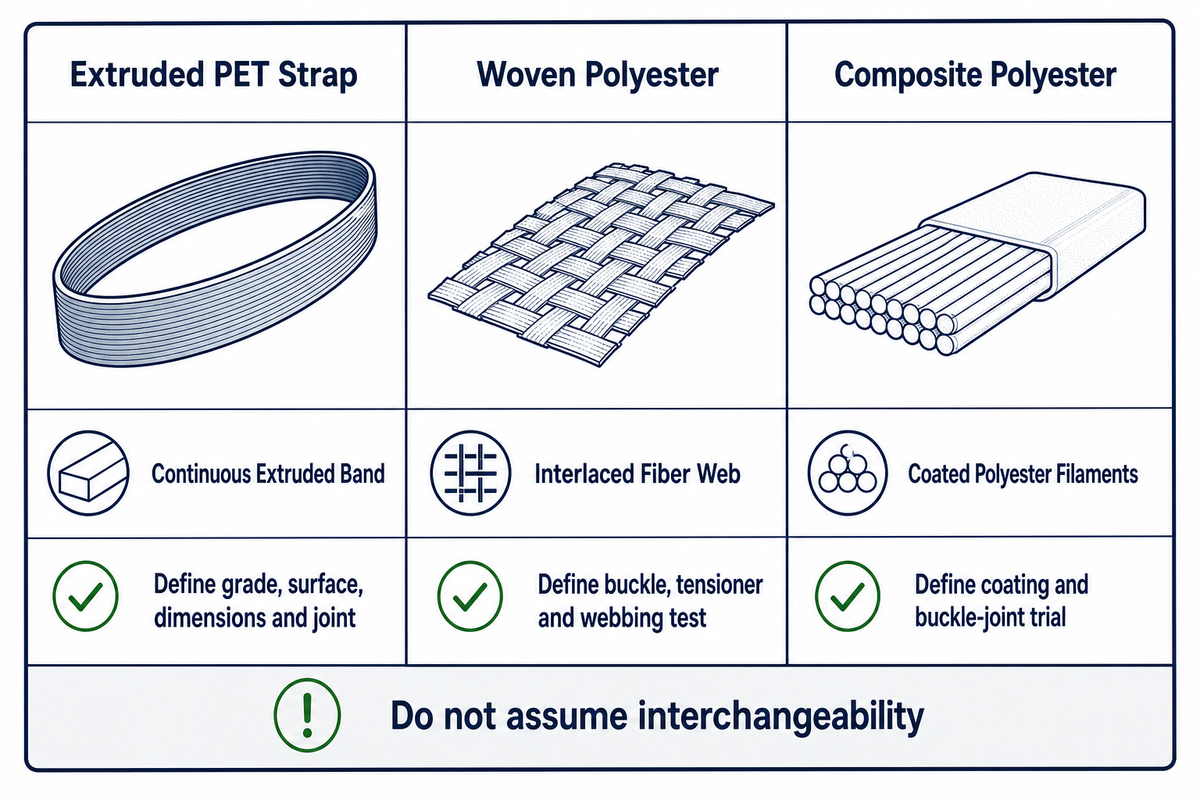
Woven polyester is a textile web construction; composite polyester commonly uses polyester filaments held in a coating. Neither label should be treated as another extruded PET grade. Compare construction, buckle, tensioner, edge response, test identity and approval route before substituting woven, composite or extruded products for one another.
Extruded PET strap
Continuous extruded band; grade, surface, dimensions, machine/tool and welded or sealed joint must be defined.
Continuous extruded band; grade, surface, dimensions, machine/tool and welded or sealed joint must be defined.
Woven polyester
Interlaced fiber web; buckle, tensioner, construction and webbing test route must be defined.
Interlaced fiber web; buckle, tensioner, construction and webbing test route must be defined.
Composite polyester
Polyester filaments with a coating; filament/coating definition and buckle-joint trial must be defined.
Polyester filaments with a coating; filament/coating definition and buckle-joint trial must be defined.
The Association of American Railroads approval index separates polyester strap types and grades, PET metal-seal systems, webbing companies and web assemblies or tensioning devices. The list is route-specific approval evidence; it does not make every listed construction interchangeable.
ASTM D6775-13(2024) covers breaking-strength and elongation testing for textile webbing, tape and braided material. It supplies a test identity, not a classification for every woven or composite strapping product. Ask the supplier which exact standard, specimen and joint method applies.
PP vs PET Quote Fields: Normalize Before the Package Trial
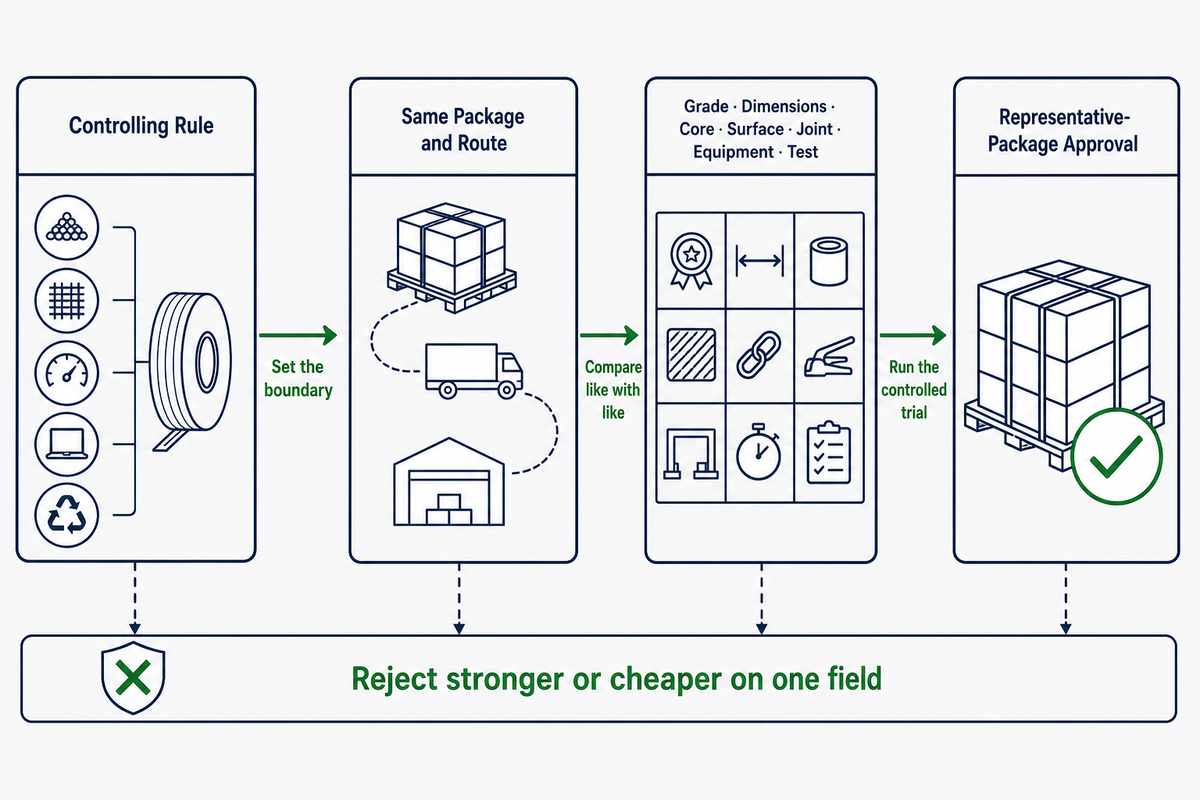
Normalize a PP and PET quotation only after the controlling carrier or customer rule is known. Compare grade, dimensions, core, surface, joint process, equipment and test identity before package behavior. The quotation that looks stronger or cheaper on one field is not an approved strapping route until the same representative-package boundary is applied.
A buyer choosing polypropylene or polyester should begin with the same package and route definition. Otherwise the team is comparing two strap descriptions rather than two controlled strapping systems, and the apparent “right strapping” may simply have received the easier trial.
What is the difference between poly strapping and polyester strapping?
“Poly strapping” is ambiguous and is often used for polypropylene, while polyester strapping usually means extruded PET. Both resin families can be sold in hand and machine grades. The meaningful difference is how the specified grade behaves in the buyer’s system. Separate elongation at break from elastic recovery and retained tension, then verify width, thickness, core, surface, joint and equipment.
A PP strap may be appropriate for one carton cycle, while PET may justify a trial for another settling pallet load. Neither choice is approved until the carrier rule, package response and distribution test agree.
| Behavior to verify | PP route | PET route | Evidence needed | Trial observation |
|---|---|---|---|---|
| Controlling rule | Permitted grade and joint? | Permitted grade and joint? | Carrier, contract or customer document | Compliant strap count and pattern |
| Package stability | Screen on stable and crush-sensitive packs | Screen where settlement changes containment | Geometry and settlement record | Movement after dwell and handling |
| Edge contact | Check corner compression and abrasion | Check corner compression and abrasion | Edge map and protector definition | No cut, split or unacceptable crush |
| Temperature | Test actual exposure | Test actual exposure | Temperature and dwell profile | Dimensions and containment remain accepted |
| Feed and tension | Use PP-qualified settings | Use PET-qualified settings | Machine/tool model and wear state | Repeatable feed, tension, cut and restart |
| Joint | Prove selected seal, weld or buckle | Prove selected seal, weld or buckle | Named joint method and test | Joint survives the route without slip or fracture |
| Distribution cycle | Trial handling, transit and storage | Trial handling, transit and storage | Representative route profile | Package meets acceptance at destination |
| Strap pattern and count | Prove the approved pattern with the PP grade | Prove the approved pattern with the PET grade | Drawing, count and placement tolerance | Every strap remains in the intended load path |
| Acceptance ownership | Name the PP trial approver | Name the PET trial approver | Signed trial record and deviation disposition | Release or rejection is traceable |
The decision table is intentionally symmetrical. It prevents marketing shorthand such as “PP for light loads” and “PET for heavy loads” from replacing the actual strapping application. The test plan may end with PP, PET or another strapping option, but the input boundary stays the same.
The Four-Record Purchase Handoff: Catalog, Lot, Line, Package
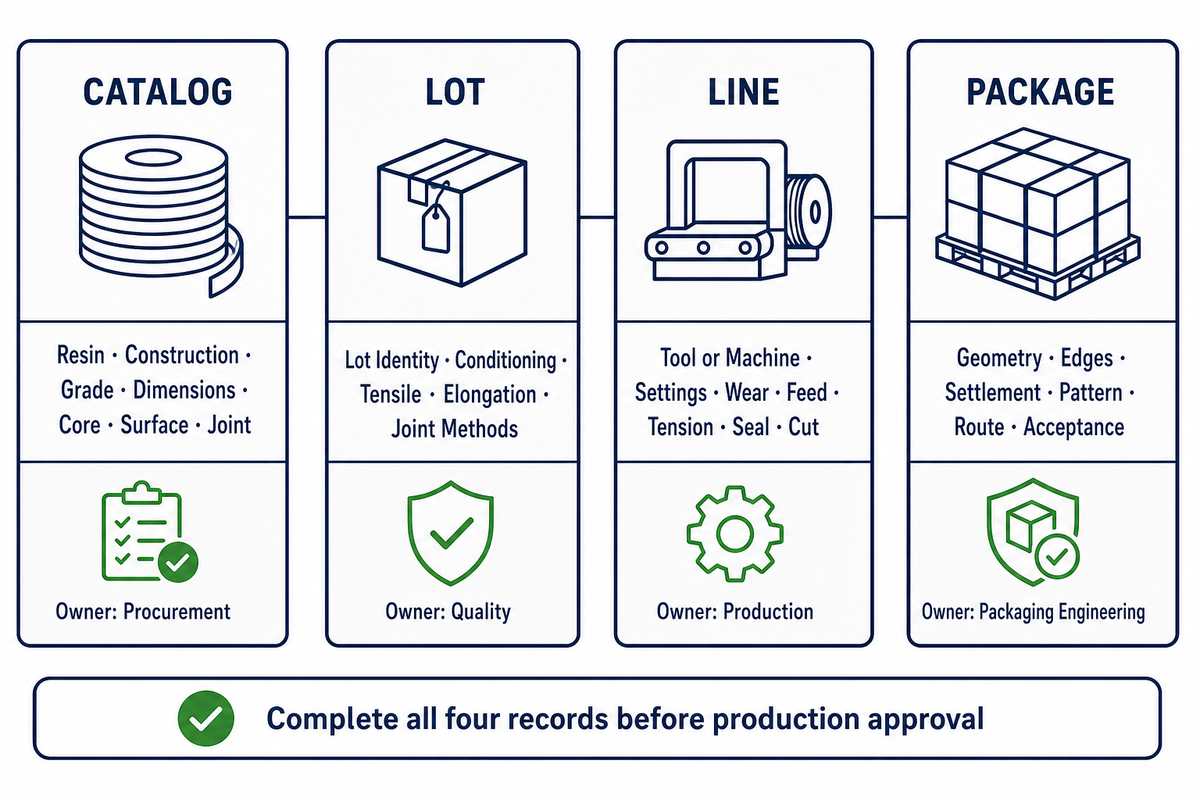
The Four-Record Purchase Handoff turns a plastic-strap quotation into four reviewable records: catalog identity, manufacturing-lot evidence, line and joint fit, and representative-package approval. It is a procurement handoff, not a load formula or fault map. Each record must be complete before a quoted grade becomes an approved production input.
4-Record Purchase Handoff
Four-Record Purchase Handoff
1 · CATALOG
Resin, construction, grade, dimensions, core, surface and intended joint.
Resin, construction, grade, dimensions, core, surface and intended joint.
2 · LOT
Lot identity, conditioning and named tensile, elongation and joint methods.
Lot identity, conditioning and named tensile, elongation and joint methods.
3 · LINE
Tool or machine model, settings, wear state, feed, tension, seal and cut.
Tool or machine model, settings, wear state, feed, tension, seal and cut.
4 · PACKAGE
Geometry, edges, settlement, pattern, route, acceptance and approver.
Geometry, edges, settlement, pattern, route, acceptance and approver.
Procurement owns the comparable catalog fields, quality owns the lot and joint evidence, maintenance or production owns the line record, and packaging engineering owns the representative-package boundary. This division prevents a supplier label from silently standing in for four different approvals.
The material used in a proposed strapping solution is only the first field. Record the intended strapping use as well as the quoted grade, delivered lot, production setup and package result so a later substitution can be reviewed without reconstructing the trial from memory.
When moving to a different coil or material, document the exact strapping tools and compatible strapping seals. A generic statement that strapping can be applied manually or by automatic strapping machines is not a compatibility record.
Switch-trial and request-for-quotation checklist
- Carrier, contract and customer rules
- Package drawing, load geometry and strap pattern
- Strap count, width, thickness and edge finish
- Construction, grade, surface and core size
- Machine or tensioner model and current wear state
- Feed, tension, seal, cut and restart settings
- Seal, weld or buckle specification
- Joint method, specimen conditioning and acceptance
- Corner protector and friction interfaces
- Dwell, handling, transit and storage profile
- Representative-package pass criteria
- Owner and disposition for every failed trial
Blank record format: capture strap width, thickness, core and coil mass; package dimensions and mass; corner-protector definition; specimen conditioning; dwell, handling, transit and storage conditions; joint method; acceptance limit; and approver. Populate every field from the quoted product, named test method and representative route. Do not carry example values into an order or machine setting.
ASTM D4675 supports the wider system boundary: transport mode, applicable rules, package shape and weight distribution, rough handling, friction and environmental conditions all affect selection. The handoff keeps those selection inputs attached to the quote, lot, line and package records.
Plastic Strapping for Boxes: Protect the Package Before Raising Tension
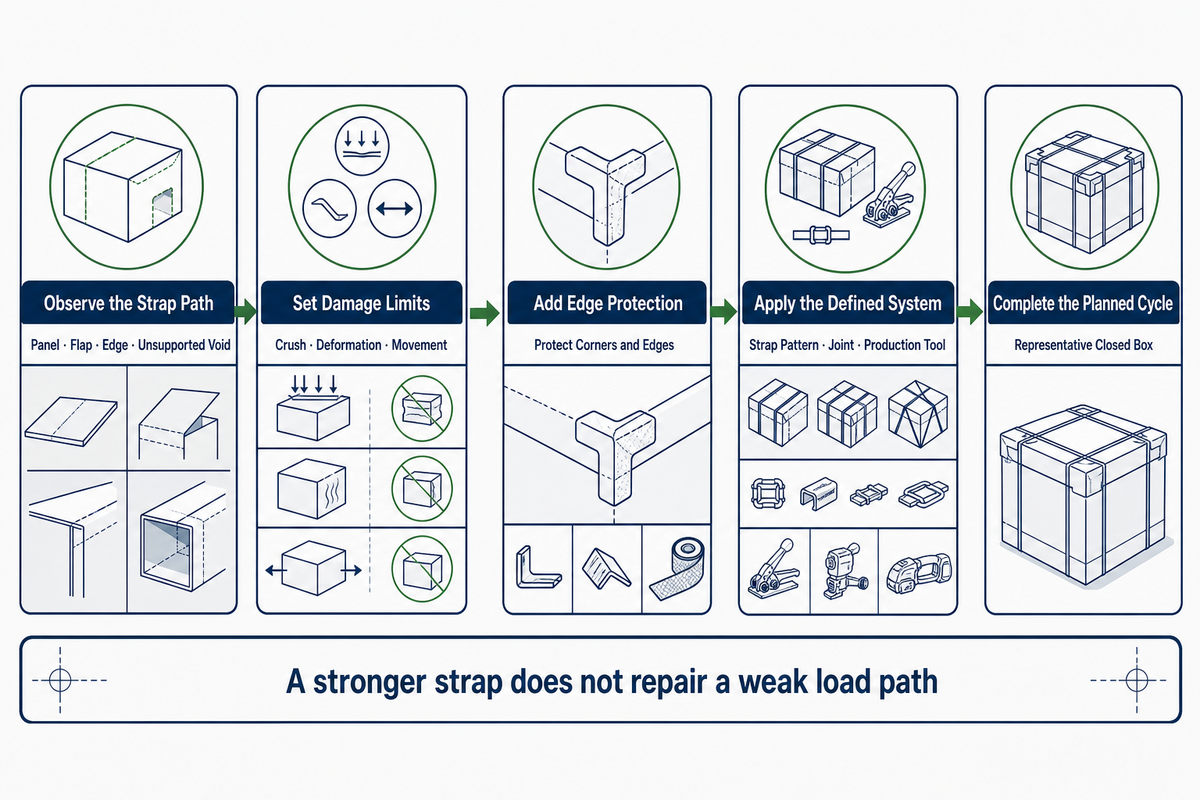
For corrugated boxes, the package surface can fail before the strap reaches its own limit. Define the board, box geometry, corners, strap path, protector and acceptable compression damage before increasing tension. Then test the closed package through handling and transit, because a stronger strap does not repair a weak load path.
Box-routing principle
- Observe where the strap crosses a panel, flap, edge or unsupported void.
- Set the acceptable crush, deformation and movement limits.
- Add corner or edge protection where the package design requires it.
- Apply the defined strap pattern and joint with the production tool.
- Accept the route only after the representative box completes the planned cycle.
Use the dedicated plastic strapping for boxes page for the application decision, and the broader guide to plastic strapping for the parent product route. This article keeps only the taxonomy and switch-diagnostic intent so the box page can own package-specific selection across different types of plastic strapping.
For bundle products or cartons, procurement should not ask only for “the best strapping material for a 20-kilogram carton.” The useful request names the box construction, dimensions, contents, closure, pallet pattern, edge protection, handling route and damage limit. Packaging engineering can then select a trial tension and strap count without treating packed weight as a universal rule.
How to Read Recycled and Recyclable Claims on Plastic Strap
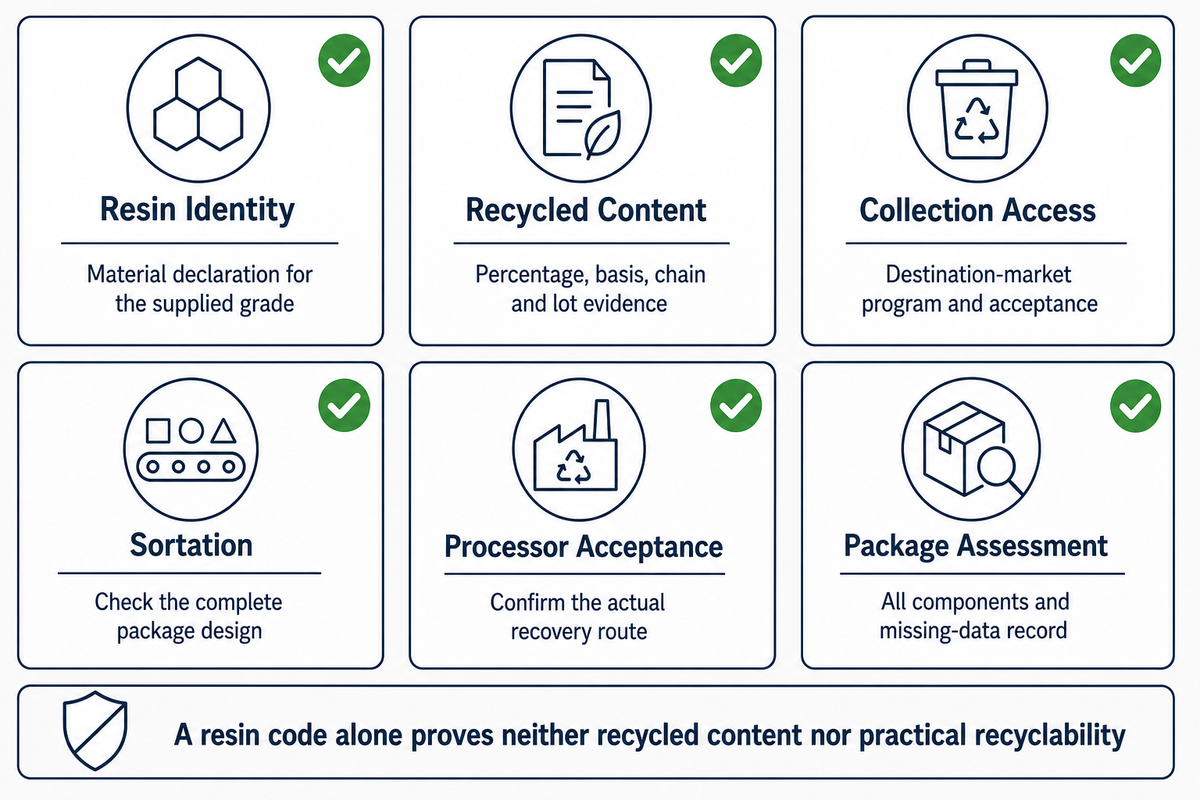
A resin code does not prove recycled content or practical recyclability. In 2026, buyers should separate polymer identity, recycled-content evidence, collection access, sortation, processor acceptance and the complete package design. Claims should state their scope and limitations so procurement, sustainability and legal reviewers can trace what is known for the specific product and market.
The Federal Trade Commission’s Green Guides summary says broad environmental claims should be qualified and explains limits around recyclable and recycled-content statements. This is claim-substantiation guidance, not evidence that any UD Packaging product meets a particular recycling outcome.
| Claim element | Evidence to collect | What it does not prove | Owner |
|---|---|---|---|
| Resin identity | Material declaration for the supplied grade | Collection or processor acceptance | Supplier and quality |
| Recycled content | Percentage, basis, chain and lot evidence | Finished performance or recyclability | Supplier and procurement |
| Collection access | Destination-market program and acceptance | Actual recovery of each strap | Sustainability and operations |
| Package assessment | All components, attachments and missing-data record | A universal claim across markets | Packaging and legal review |
ISO 18604:2013 remains current after confirmation in 2024 and addresses packaging-level material-recycling assessment. The Association of Plastic Recyclers announced a full-package assessment platform for Q1 2026 that flags missing data; this is a verification-method trend, not a change in strap performance.
The United States Environmental Protection Agency’s April 2026 procurement page limits its recovered-content strapping designation to manual-grade PP, PET and steel. That grade boundary is the lesson: a public recommendation cannot be reassigned to an automatic grade or a specific roll without matching evidence.
UD Packaging’s mission of promoting renewable-resource utilization is company positioning. Buyers evaluating recycled PET strapping evidence should still request the content basis, lot documents, finished-strap test results and destination-market recovery route.
Frequently Asked Questions
What are plastic straps called?
Answer
Plastic straps are commonly called plastic strapping, plastic banding, poly strapping or packaging strap. Those names are incomplete specifications. Ask whether the product is extruded polypropylene, extruded PET, nylon, woven polyester or composite polyester, then add the hand or machine grade and the seal, weld or buckle route. The supplier’s exact label should remain on the trial record.
Which is better, polyester or polypropylene?
Answer
Neither label is universally better. This guide compares the quote fields needed to distinguish PP and PET grades; the cross-material industrial strapping guide owns load selection across plastic and steel. For a PP or PET quote, normalize grade, dimensions, core, surface, test identity, equipment and joint, then trial the specified product on a representative package.
What is polypropylene strapping?
Answer
Polypropylene strapping is an extruded PP band used for unitizing or reinforcing packages. It is available in manual and machine grades, so the resin name alone does not establish compatibility. A useful specification includes dimensions, core, camber, surface, joint route, property test method, machine or tool, and package acceptance criteria. Keep the supplier lot and representative-package result together in the approval record.
Is plastic strapping recyclable?
Answer
Some plastic strapping can enter an appropriate recycling route, but the word “recyclable” needs a defined market and evidence. Identify the resin and construction, remove or account for seals and buckles, confirm local collection and processor acceptance, and check whether the complete package design affects sortation. Ask who collects the separated strap, which processor accepts it, whether attachments or contamination change acceptance, and how those conditions are communicated at the destination. Recyclable also does not mean recycled content: request the percentage, calculation basis, chain-of-custody or supplier evidence, and lot scope separately. Keep resin identity, recovered-content evidence and actual recovery outcomes as three different records. Qualify public claims when access or acceptance is limited.
What is the difference between woven and composite strapping?
Answer
Woven strapping is a textile web made by interlacing fibers. Composite strapping generally uses parallel polyester filaments held in a coating. Product definitions vary, so confirm the supplier’s construction rather than relying on the label. For each option, record fiber or filament form, coating where present, width, compatible buckle, tensioner, edge behavior, applicable test, customer rule and package trial. A current approval may apply to a named company, assembly or device rather than to every product using a similar label. The two routes can therefore require different buckles, tensioners, handling practices, test methods and approvals. Neither should be treated automatically as an extruded PET grade or as interchangeable with the other.
Are there multiple grades of PET strap?
Answer
Yes. PET strapping products can differ by hand or machine use, dimensions, core, surface, camber, feedstock, manufacturing history and joint route. Compare finished-lot tensile, elongation and joint results under named methods, then validate feed, tension, sealing, cutting and package performance on the intended equipment and route. The grade name and color do not replace that record.
Need to compare PP, PET or another plastic strapping option for a real package? Send the package drawing, route, strap pattern, equipment, joint and acceptance criteria so UD Packaging can review the trial inputs within the disclosed product scope.
About UD Packaging
UD Packaging describes itself as an integrated industrial and trade enterprise in plastic packaging materials, with a manufacturing base in Jiangyin, Wuxi, Jiangsu Province. Its supplied portfolio includes PET strapping, industrial stretch film, seals and buckles, and manual, semi-automatic and fully automatic strapping equipment.
The company states that its PET scope covers granulation through finished goods and that it serves metal manufacturing, solar photovoltaic, building materials, wood, paper, chemical fiber, textiles, agriculture, food, electronics and tobacco applications. These are company-supplied scope statements, not third-party performance rankings or proof for an individual shipment.
About This Article
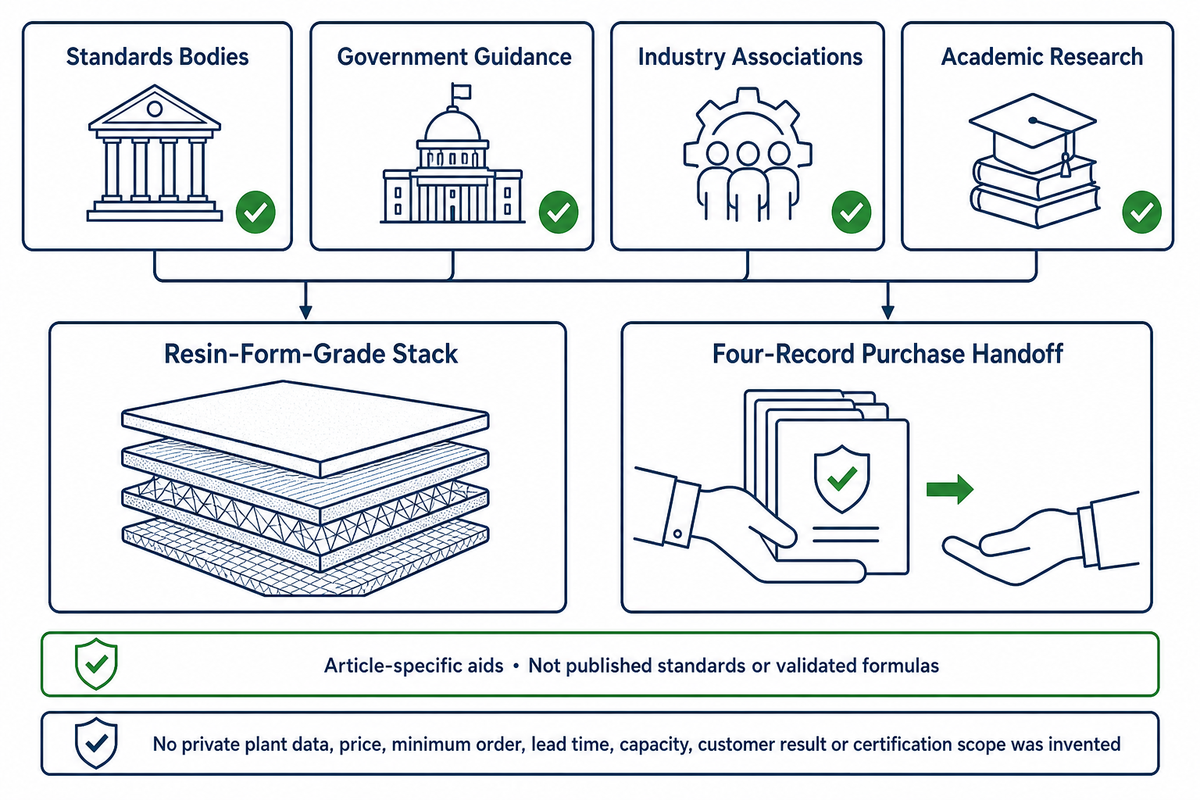
This guide uses current standards-body, government, association and academic sources for classification, selection and environmental-claim boundaries. Commercial competitor pages were used only to find terminology and decision gaps; they do not carry the article’s critical claims.
Method note: the Resin-Form-Grade Stack and Four-Record Purchase Handoff are article-specific working aids derived from this run’s Firecrawl research. They decode catalog fields and organize procurement records; they are not published standards, validated formulas or substitutes for carrier rules and representative-package testing.
No private UD Packaging plant dataset, price, minimum order, lead time, capacity, customer result, universal failure rate or independently verified certification scope was supplied or invented. Search-volume values describe the research language only. The article is prepared for UD Packaging technical-team review; the WordPress author requested for publication is XCX.
References & Sources
- ASTM D3950-23, Standard Specification for Strapping, Nonmetallic · ASTM International
- ASTM D4675-14a(2022), Standard Guide for Selection and Use of Flat Strapping Materials · ASTM International
- ASTM D6775-13(2024), Standard Test Method for Breaking Strength and Elongation of Textile Webbing · ASTM International
- ISO 18604:2013, Packaging and the environment — Material recycling · International Organization for Standardization
- Environmental Claims: Summary of the Green Guides · United States Federal Trade Commission
- Comprehensive Procurement Guidelines for Miscellaneous Products · United States Environmental Protection Agency
- APR unveils full-packaging recyclability assessment tool · Association of Plastic Recyclers
- Standards and compliance packaging guidelines · Railinc Committee on Freight Claims and Damage Prevention
- Current Open Top Loading Rules approvals · Association of American Railroads
- PET packaging-strap properties in relation to process steps · Montanuniversität Leoben