Get in touch with UD Packaging Company


Updated September 2026
PET vs PP strapping is a choice between two different plastics, polyethylene terephthalate and polypropylene, extruded into flat strap. At equal width and thickness, PET strap carries higher tensile strength and lower elongation, while PP strap suits lighter bundles and carton work. Break force alone doesn’t settle the choice, because the completed joint usually sets the limit.
Every page-one result for this comparison makes the same three statements: PET is stronger, PP is cheaper, pick by load weight. Those statements aren’t wrong, and they aren’t enough to qualify a strapping material for a real packing line. A comparison that decides anything has to read four properties together and name the specification that actually governs plastic strap. It also has to publish tension figures with the scope they were measured in, and finish with a package trial, not a datasheet.
What follows compares PET and PP strap on that basis. The uncomfortable part, which almost nobody writing about PET vs PP strapping mentions, is that two lines running identical polyester strap can hold very different loads, because their seal method differs. Break force is the number the market argues about. Joint strength is the number that fails.
PP and PET are two of the most commonly used plastic strapping materials in industrial packaging, and understanding the differences between them saves more than negotiating on price does. Learn how PP and PET straps behave under tension, on your pallets and your tooling, and the packaging material used to unitise a load stops being a default.
Quick Specs
| Materials compared | Polyethylene terephthalate (PET, polyester) against polypropylene (PP) |
|---|---|
| Properties that decide it | Break force, elongation at break, retained tension, completed-joint strength |
| Governing specification | ASTM D3950-23, strapping, nonmetallic and joining methods |
| Joint strength for a D3950 conformity claim | At least 45% of the strap’s minimum breaking strength, Types II, III and IV (value read in the D3950-01 edition text) |
| Wrong document for plastic strap | ASTM D3953-15 (2022), which covers flat steel strapping only |
| Retained tension, with its scope | No universal figure exists; measure it on your own strap, tool and package, and state dimension, applied tension and elapsed time |
| US road securement duty | 0.8 g forward, 0.5 g rearward, 0.5 g lateral; aggregate working load limit at least half the article weight (vehicle tiedowns, not unitising straps); §393.102(a)(2) sets separate, lower working load limit criteria and (b) adds a 20% downward-force duty |
| Tensile test method family | GB/T 1040 series; part 1 current edition GB/T 1040.1-2025, effective 1 October 2025 (per commercial standards catalogue listings; confirm against the SAC record) |
PET Strap and PP Strap: What the Two Plastic Strapping Materials Actually Are
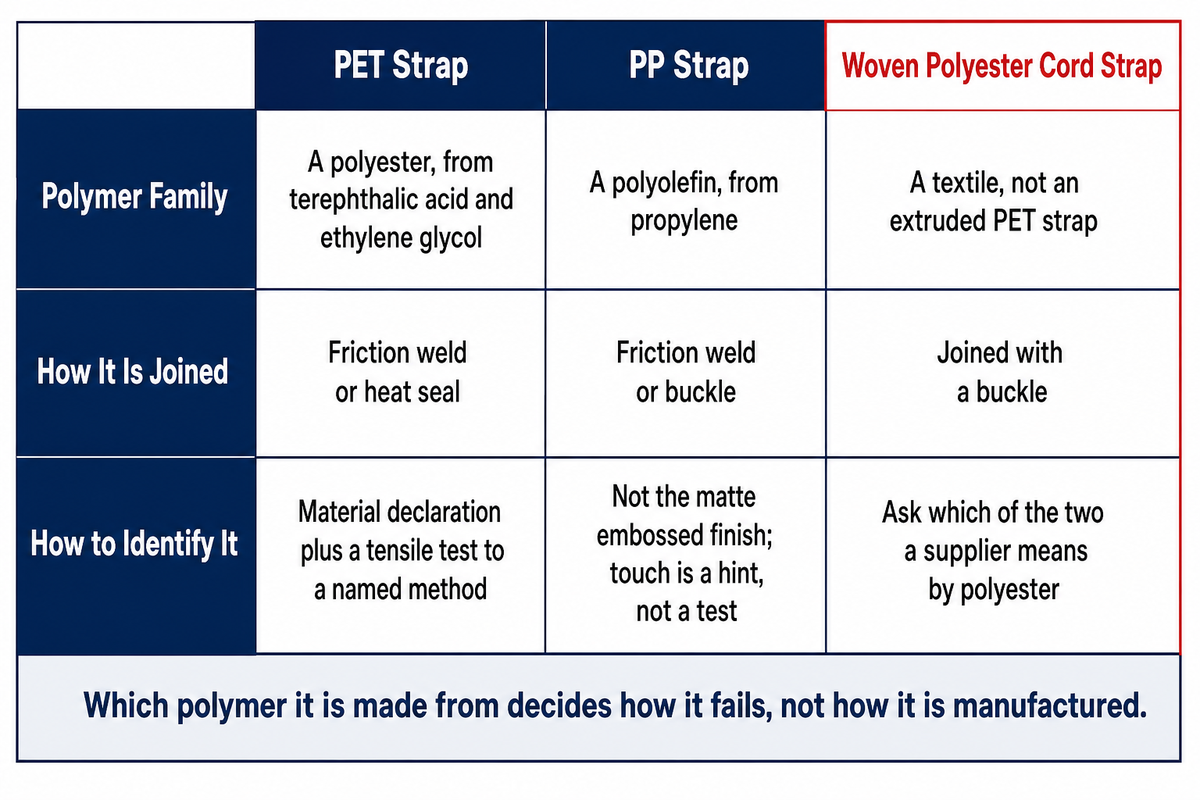
Polyethylene terephthalate and polypropylene sit in different polymer families, and the two most widely used plastic strapping materials behave differently because of it. PET strap is a polyester. PP strap is a polyolefin. Polypropylene strapping and PET strapping are made the same way in outline: melt the resin, extrude flat strap, then draw it. Which type of strapping is made from which polymer decides how it fails, not how it’s manufactured. Both are melt-extruded into flat strap and then drawn, which stretches the molecular chains along the strap axis and is what converts soft resin into a load-bearing product.
Orientation, not the resin name, does most of the work. A polypropylene resin extruded and drawn heavily produces a very different strap from the same resin drawn lightly, which is one reason two rolls with identical material declarations can perform very differently on the same machine. Polyester gains its high tensile strength through the same route, with the added constraint that the finished surface has to weld cleanly to itself.
A third product category confuses this comparison constantly. Woven and composite polyester cord strap is also sold as “polyester strapping”, but it’s a textile, joined with a buckle, and it isn’t an extruded PET strap. When a supplier quotes “polyester”, ask which of the two they mean. UD Packaging covers the extruded route end to end, from PET granulation through to the finished PET strapping band.
Is PET the Same as Polypropylene?
No. Polyethylene terephthalate is a polyester built from terephthalic acid and ethylene glycol; polypropylene is a polyolefin built from propylene. They differ in melting behaviour, moisture uptake, stiffness and how they join. PET strap is normally friction-welded or heat-sealed; PP strap is friction-welded or held with a buckle.
A widespread shortcut says you can tell them apart by touch: PP strap is embossed and matte, polyester strap smooth and glossy. Treat that as a hint rather than a test. Embossing is a process option on polyester extrusion lines as well, and a polyester strap can arrive embossed for tool grip. The reliable identification is the supplier’s material declaration and a tensile test to a named method, not the finish. ASTM D3950 is the specification behind those declarations: it sets the types, grades, breaking strength, elongation and joint strength for nonmetallic strapping, so a declaration that names it is checkable and one that does not is not.
The Four Properties That Decide a Strapping Comparison
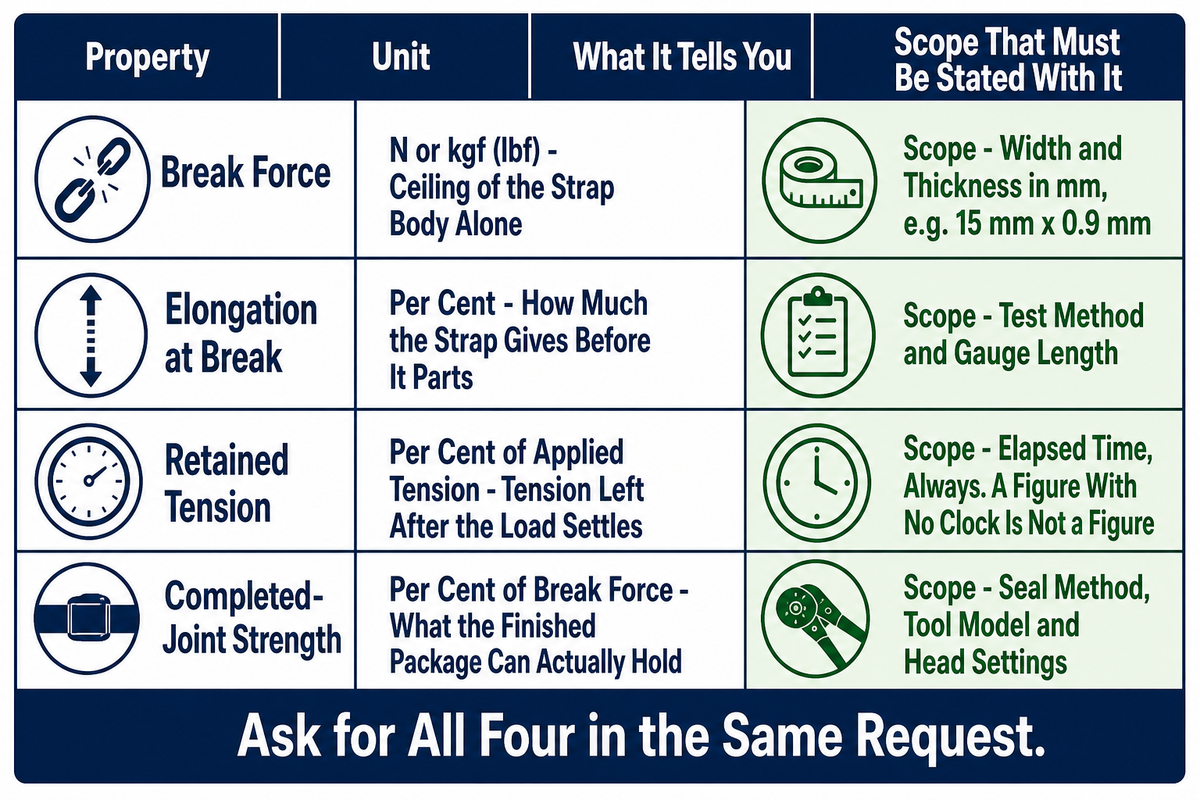
Four measured properties decide a plastic strap comparison: break force, elongation at break, retained tension and completed-joint strength. Ask for all four in the same request and two quotes become comparable. Break force is sometimes reported as ultimate tensile strength on a resin datasheet, which is a material property rather than a rating for a finished strap. Ask for break force alone and they stay incomparable, because a strap that wins on break force can still make the weaker package.
ASTM D3950, the specification for nonmetallic strapping, treats breaking strength, elongation, transverse strength and joint strength as four separate tested properties rather than one headline figure. ASTM D3950-23 is the current edition. For selection language and the vocabulary of flat strapping in general, ASTM D4675-14a (2022) is the document to quote.
| Property | Unit | What it tells you | Scope that must be stated with it |
|---|---|---|---|
| Break force | N or kgf (lbf) | Ceiling of the strap body alone | Width and thickness, both stated in mm, e.g. 15 mm x 0.9 mm |
| Elongation at break | % | How much the strap gives before it parts | Test method and gauge length |
| Retained tension | % of applied tension | Tension left in the strap after the load settles | Elapsed time, always. A figure with no clock is not a figure |
| Completed-joint strength | % of strap break force | What the finished package can actually hold | Seal method, tool model and head settings |
Property definitions and test vocabulary from ASTM D3950-23 and ASTM D4675-14a (2022).
Strength and durability are the two words sales copy pairs most often, and durability is the vaguer of the pair: it can mean UV life, abrasion resistance or tension over time depending on who wrote the sheet. Steel strapping is often quoted as the reference point for both, which is why comparisons of steel strapping and polyester strapping keep surfacing in plastic-strap datasheets where they don’t belong.
Tensile testing of the strap body itself runs to the GB/T 1040 series in much of the Asian supply base, and UD Packaging names that family as its tensile method alongside SGS product quality testing. One correction is worth carrying into your own paperwork, because supplier brochures repeat the error often: GB/T 1040.3 sets test conditions for films and sheets, so it is the right reference for stretch film and the wrong one for strap joint strength. Joint strength is an ASTM D3950 property. Note also that GB/T 1040.1-2018 has been superseded by GB/T 1040.1-2025, effective 1 October 2025, so ask which edition any tensile certificate cites.
PET vs PP Strapping: The 10-Point Property Divide
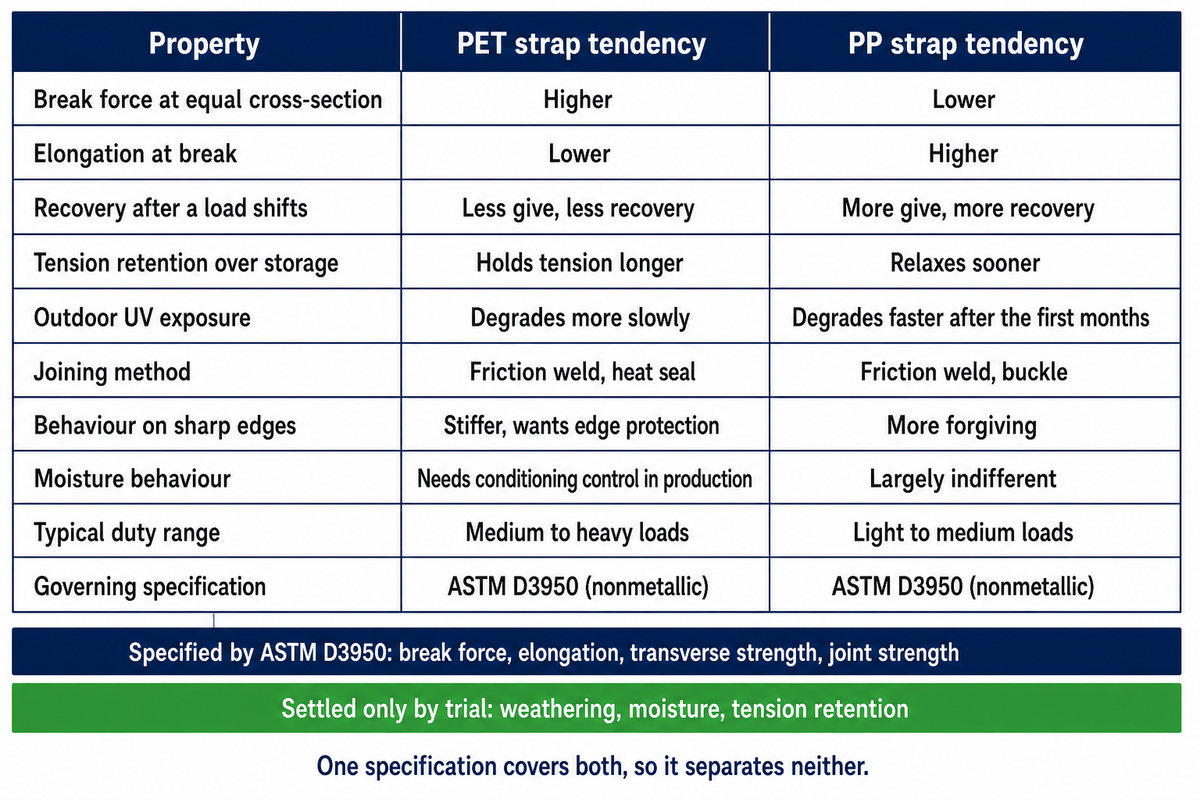
Across the properties that matter for unitising a load, PET strap leads on tensile strength, tension retention and heat tolerance, while PP strap leads on flexibility, tool tolerance and low-tension work. Each of the key differences below carries a limitation column, because several of them are tendencies of typical commercial products rather than constants of the polymer itself. Four of the rows below — break force, elongation, transverse strength and joint strength — are properties ASTM D3950-23 specifies, so a supplier can quote those against a named document; the weathering, moisture and tension-retention rows sit outside any strapping specification and have to be settled by trial.
| Property | PET strap tendency | PP strap tendency | How to verify | Limitation of the comparison |
|---|---|---|---|---|
| Break force at equal cross-section | Higher | Lower | Tensile certificate to a named method | Not valid across different widths or thicknesses |
| Elongation at break | Lower | Higher | Same certificate, elongation line | Draw ratio can move either material a long way |
| Recovery after a load shifts | Less give, less recovery | More give, more recovery | Trial on a settling load | Useful only where the load actually settles |
| Tension retention over storage | Holds tension longer | Relaxes sooner | Timed tension measurement on your own package | No universal figure exists for either material |
| Outdoor UV exposure | Degrades more slowly | Degrades faster after the first months | Stabiliser and pigment specification | The additive package can outweigh the polymer |
| Joining method | Friction weld, heat seal | Friction weld, buckle | Tool and head compatibility list | Joint quality is a machine property, not a resin property |
| Behaviour on sharp edges | Stiffer, wants edge protection | More forgiving | Inspect strap at corners after transit | Edge protection is required by rule for road tiedowns |
| Moisture behaviour | Needs conditioning control in production | Largely indifferent | Ask how the line conditions resin | A production concern more than a warehouse one |
| Typical duty range | Medium to heavy loads | Light to medium loads | Duty-class ladder below | Duty class depends on pallet and route, not material alone |
| Governing specification | ASTM D3950 (nonmetallic) | ASTM D3950 (nonmetallic) | Ask which edition the certificate cites | One specification covers both, so it separates neither |
Property scope and joint terminology from ASTM D3950-23 and ASTM D4675-14a (2022); edge-protection duty from 49 CFR 393 subpart I.
PP vs PET strapping is how this decision usually gets written down, and the phrasing hides the problem. PP vs PET compares two polymers; PP strap vs PET strap compares two products. Reading the differences between PP strap and PET strap, rather than the differences between PET and PP as resins, is what turns a preference into a specification. The key differences between PP and PET strap reduce to four measured properties, and knowing which differences can help narrows a catalogue before you ask for a quote. The single largest difference between PP and PET strap in practice isn’t break force: it’s what the completed joint keeps.
Choosing between PP and PET strap gets easier once the load is described. Compared to PP strap, PET strap gives less and holds tension longer; PET strap provides higher break force at equal cross-section, while PP strap provides more recovery when a load settles. Saying PET is the stronger material is true at equal cross-section and still doesn’t settle which strap is the better buy. For most buyers the common options are PP strap and PET strap, and whether PP or PET strap is right for your application depends on the load, the pallet and the route. Which strapping depends on those three inputs, not on a ranking of polymers.
✔ Where PET strap earns its place
- Higher break force for an equal cross-section, so fewer straps per package
- Holds tension across weeks of storage rather than days
- Degrades more slowly under sustained sunlight over multi-month exposure
- Welds to itself, so no metal seal is consumed on the joint
⚠ Where PP strap is the better answer
- Recovers better when a load settles or a bale expands
- More forgiving on tool tension, so operator variation costs less
- Kinder to carton edges at the tension levels light bundling needs
- Lower resin cost basis in most quotes, which still matters where strap consumption is equal
Which Is Better, PP or PET?
Neither, as materials. A resin label ranks two polymers, and what you buy is a finished product whose performance depends on draw ratio, additive package, width, thickness and the seal your tooling produces. The question that has an answer is narrower: for this load, this pallet, this route and this sealing head, which strap holds?
Two habits make that question answerable. First, compare like cross-sections, because a heavier PP strap can out-hold a lighter polyester one and the material comparison then tells you nothing. Second, ask for joint strength as a percentage of break force, measured on the tooling you actually run. If a supplier can give break force but not joint strength, you have half a specification. PP strap is generally the right choice for carton bundling and light to medium pallet work; PET strap earns its place where the load is dense, the storage is long or the journey is rough.
Why the Joint, Not the Strap, Usually Sets the Limit
ASTM D4675 frames strapping as a system: strap properties, joint properties, applied tension, load interaction, friction and package geometry all act together. Within that system the completed joint is the most common weak link, not a universal law of failure. Call it The Joint-First Reading: between polyester and polypropylene, the joint efficiency your own tooling produces routinely erases the break-force gap that separates the two materials. Check the joint first, though not only the joint.
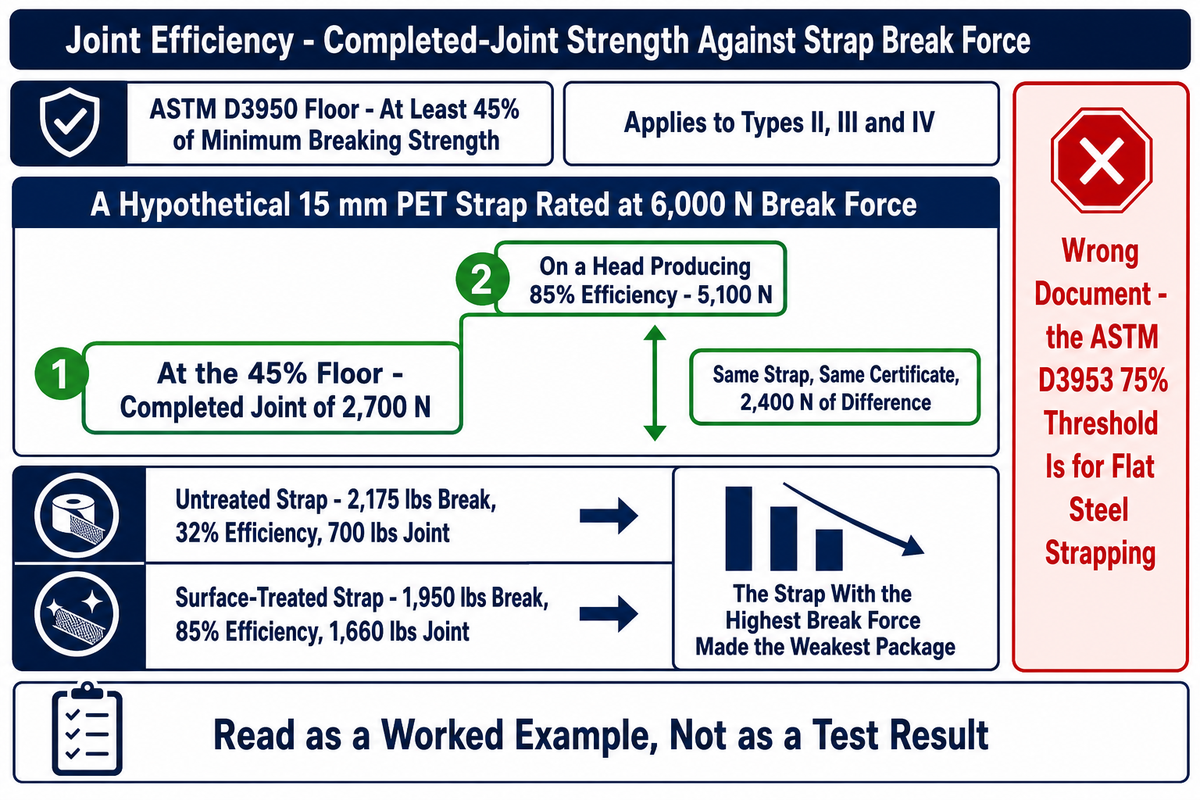
Joint efficiency is the ratio of completed-joint strength to strap break force, and the specification puts a floor under it. To be sold as meeting ASTM D3950 — 45% in the D3950-01 text read for this article — joined nonmetallic strapping of Types II, III and IV must reach at least 45% of the strap’s minimum breaking strength. A sub-45% joint is not “unsafe” in the abstract; it is a product that cannot be sold as conforming to that specification. Steel strapping is governed elsewhere. ASTM D3953 sets its own separate threshold, 75% at section 8.4.2, for manufacturers’ process welds in flat steel strapping, which is why quoting that 75% figure against a plastic strap joint is an error you will see repeated across this topic.
Worked example. A hypothetical 15 mm PET strap rated at 6,000 N break force, joined at the D3950 floor of 45%, gives a completed joint of 2,700 N. The same strap on a head producing 85% efficiency gives 5,100 N. Same strap, same certificate, and 2,400 N of difference that never appears on any datasheet.
The clearest published illustration comes from patent literature. US Patent 6210769B1 (Samuel Manu-Tech Inc., inventors Sandra DiPede and Russell J. Gould, granted 2001, now expired) tabulates a worked example in which an untreated high-strength polyester strap measured 2,175 lbs break strength with 32% joint efficiency, giving a 700 lbs joint, while a surface-treated strap of the same family measured 1,950 lbs break strength with 85% joint efficiency, giving a 1,660 lbs joint. Read the first column and then the last: the strap with the highest break force in the table made the weakest package, by a factor of more than two. The disclosure explains the mechanism directly.
“The presence of peaks can result in welds that possess voids and other interface variations which result in lower joint strength.”
— US Patent 6210769B1, Sandra DiPede and Russell J. Gould, Samuel Manu-Tech Inc.
That same document reports holding thickness variation to plus or minus 0.0001 inch against plus or minus 0.0005 inch for conventional strand strap, a five-fold tightening pursued so the two faces meet flat enough to weld without voids. Patent examination establishes patentability rather than reproduced performance, so read these as worked examples, not as test results. A stakeholder submission to the European Commission’s public consultation on the packaging reuse obligations under the Packaging and Packaging Waste Regulation points the same way for strap on its second cycle. Sebastian Köster of Techem Energy Services GmbH filed it, citing an April 2025 Fraunhofer IMWS study, and it reports an average drop of 47% to 60% of breaking strength at the welding area across all tapes tested, with used tapes retaining 40% to 53%. Those figures come from tapes measured after reuse, not from new joints. The submitter was also arguing for an exemption, so read it as a caution about re-tensioning used strap rather than as a joint-efficiency figure. Equipment still carries as much of the outcome as the strap does, which is why your strapping machine and its head settings deserve as much specification attention as the strap itself.
Equipment decides more of this than most datasheets admit. Automatic strapping machines apply consistent tension and repeatable weld cycles, which is why a joint efficiency measured on a bench rarely matches what a line produces, while manual strapping tools vary with the operator. Before concluding that a strap is suitable for a duty class, qualify the joint on the head that will actually run it. The test controls for that qualification, from specimen preparation to reading the failure location, belong to our article on strapping joint strength rather than to this comparison.
📐 Engineering Note
In the prior art as US Patent 6210769B1 characterises it, strand-extruded polyester is thicker at its edges than at its centre, and the two faces have to meet flat to weld without voids. The process disclosed in US Patent 6210769B1 holds thickness variation to plus or minus 0.0001 inch against plus or minus 0.0005 inch for conventional strand strap. Where a friction weld or heat seal carries the load, put a thickness-tolerance line in the specification next to break force, and hold the completed joint to at least the 45% of minimum breaking strength that ASTM D3950 requires of Types II, III and IV for a conformity claim, at section 7.3.3 of the D3950-01 edition text read for this article; confirm the clause number against the current D3950-23 before quoting it in a contract.
Common Failure Modes That Have Nothing to Do With the Strap
Four field failures recur even when the strap specification is entirely correct, and none of them is fixed by buying a stronger strap.
- ✔The pallet itself. When the outer boards of a pallet are pulled in, the strap goes slack with them. Steel strapping does exactly the same thing on the same pallet.
- ✔Edge abrasion and cutting. FMCSA rules require edge protection wherever a tiedown is subject to abrasion or cutting at the point it touches the cargo, and the protection itself must resist abrasion, cutting and crushing.
- ✔Tension decay in storage. A load strapped tight in June and shipped in August hasn’t been strapped tight in August.
- ✔Load interaction. Cases that compress, reels that telescope and ingots that shift all change the geometry the strap was tensioned around.
10 Duty Classes: Matching Strapping Material to Load, Pallet and Route
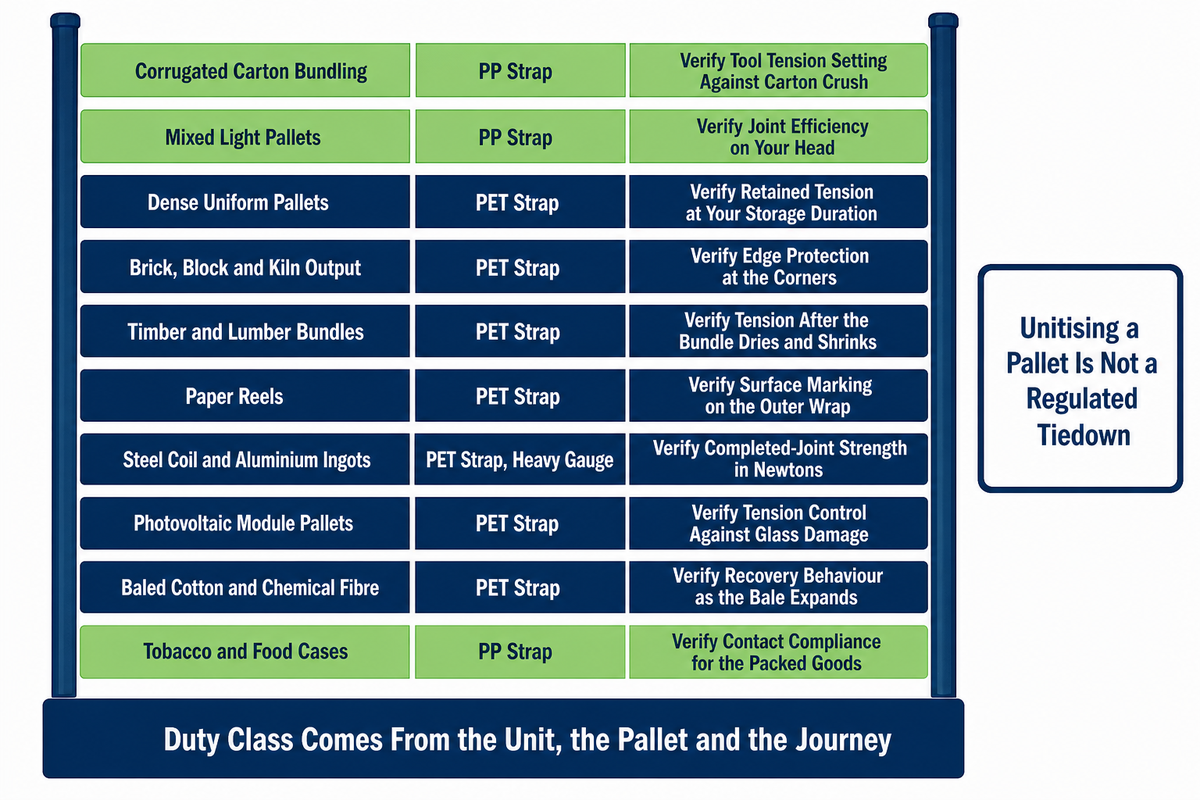
For a specific product and route, duty class comes from three inputs rather than one: the weight and density of the unit, the rigidity of the pallet or bundle underneath it, and the journey it faces. Joint efficiency then decides how much of that class the finished pack actually keeps. Locate your load in the ladder below, then verify the single property named in the last column before committing to a strapping for shipping specification. This ladder sorts loads for a two-material decision only; the eleven-load-class index we published for industrial strapping runs the same load types across five strapping materials, so start there while steel, composite or film is still in scope.
Two framing rules keep this honest. FMCSA cargo securement rules (49 CFR 393 subpart I) govern road transport in the United States. They require a securement system to withstand 0.8 g forward deceleration, 0.5 g rearward and 0.5 g lateral acceleration, set an aggregate working load limit of at least half the article’s weight, and assign unmarked tiedowns the lowest working load limit for their type. Those rules govern securing cargo to a vehicle. Unitising a pallet is adjacent to that and not identical with it, so don’t describe a unitising strap as a regulated tiedown. The IMO/ILO/UNECE CTU Code is the reference for packing cargo transport units, and it’s a non-mandatory code of practice rather than law.
When the conversation turns to securing dense pallets, duty class governs and material follows. One strapping solution rarely covers the wide range of packaging formats across several packaging lines, so heavy-duty classes and light bundling classes are worth specifying separately rather than standardising on a single roll for the whole plant. Specifiers put PP strapping at the lighter end: PP strap typically handles carton bundling and light to medium pallets, while PET strap covers loads that are dense, heavy or stored long. Read that split as a starting point, not a verdict: the quote-field comparison in our plastic strapping types guide keeps the two columns deliberately symmetrical so that “PP for light loads, PET for heavy loads” never stands in for the duty class, the pallet and the route.
| Duty class | Indicated material | Verify this first | Not suitable for |
|---|---|---|---|
| Corrugated carton bundling | PP strap | Tool tension setting against carton crush | Any load that settles or is stored outdoors |
| Mixed light pallets | PP strap | Joint efficiency on your head | Dense uniform loads above the tool’s range |
| Dense uniform pallets | PET strap | Retained tension at your storage duration | Loads needing recovery after heavy settling |
| Brick, block and kiln output | PET strap | Edge protection at the corners | Hot product still above the strap’s service range |
| Timber and lumber bundles | PET strap | Tension after the bundle dries and shrinks | Green timber with large moisture-driven movement |
| Paper reels | PET strap | Surface marking on the outer wrap | Reels where any strap witness mark is rejected |
| Steel coil and aluminium ingots | PET strap, heavy gauge | Completed-joint strength in newtons, not percent | Loads with unprotected cut edges |
| Photovoltaic module pallets | PET strap | Tension control against glass damage | Any tool without repeatable tension limiting |
| Baled cotton and chemical fibre | PET strap | Recovery behaviour as the bale expands | Bales released before tension is verified |
| Tobacco and food cases | PP strap | Contact compliance for the packed goods | Long outdoor staging before despatch |
Securement duties from FMCSA 49 CFR 393 subpart I and 49 CFR 393.102; packing practice from the IMO/ILO/UNECE CTU Code. Duty classes are ordered by mechanical demand; the industry rows follow UD Packaging’s stated application areas.
Where the pallet is the variable rather than the load, the same ladder applies to strapping for pallets, with pallet rigidity read as part of the duty class rather than as a separate question.
Environment, Storage Time and Tension Retention
Outdoors and over time, the question worth asking isn’t which polymer but what’s in it. Additive packages move weathering performance further than the resin label does, and a well-stabilised black PP strap can outlast a poorly stabilised alternative. State your storage duration and exposure in the enquiry, not only your load weight, and say whether the yard is humid, because humidity and ultraviolet exposure act on the two materials differently.
The clearest demonstration is a controlled one. Lopes and Carneiro, in Geosynthetics International 24(6):544-553, weathered four structurally identical nonwoven polypropylene geotextiles in Portugal for up to three years, where the only variable was the additive package. Their finding was that behaviour “was highly dependent on their chemical composition”, with resistance strongly enhanced by a hindered amine light stabiliser and by carbon black; raising the stabiliser from 0.2% to 0.4% w/w improved resistance, and 1.08% w/w carbon black with 0.2% w/w stabiliser gave the best protection of the four.
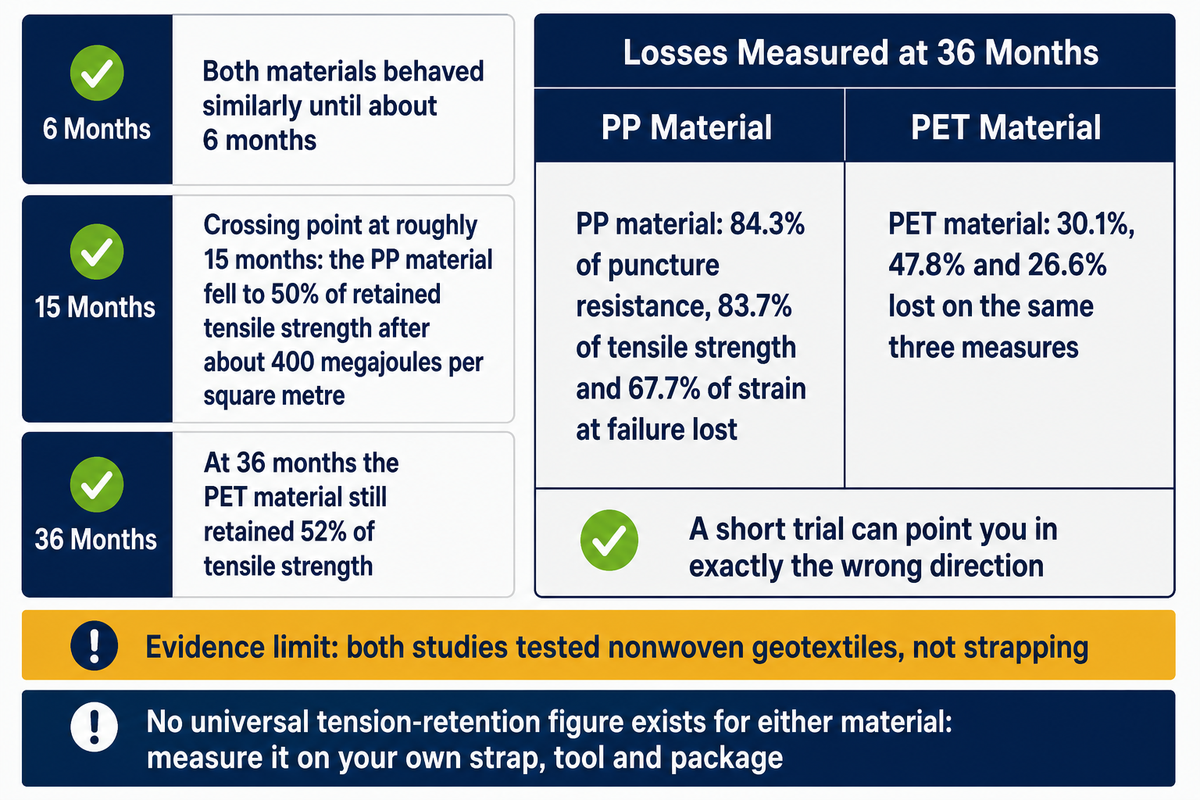
Polymer family still matters over long exposure. A three-year natural weathering study of commercial nonwoven PP and PET geotextiles on a 22-degree inclined panel, run to ISO 877-1 and 877-2, found the PP material had lost 84.3% of puncture resistance, 83.7% of tensile strength and 67.7% of strain at failure at 36 months, against 30.1%, 47.8% and 26.6% for the PET material, which still retained 52% of tensile strength at 36 months. Both behaved similarly until about 6 months, after which the PP declined rapidly, so a short trial can point you in exactly the wrong direction. The same study puts the crossing point at roughly 15 months, where the PP material fell to 50% of retained tensile strength after about 400 megajoules per square metre of accumulated ultraviolet exposure, a retention level the PET material never reached in three years.
Read that as evidence about resistance to UV over years rather than weeks. Polyester holds strength longer under sustained sunlight, which makes it ideal for loads that stand in a yard for months. That advantage holds only where the stabiliser and pigment package is specified rather than assumed.
⚠️ Evidence limit, stated plainly
Both weathering studies above tested nonwoven geotextiles, not strapping, and both are really measuring additive packages as much as polymers. Neither is a strapping test and neither should be quoted as one. A published study of industrial PP straps under artificial UV at 200 to 1000 hours confirmed brittle surface formation but found the carbonyl index unreliable for tracking that degradation.
On tension retention, no independently published figure holds up at the scope a buyer needs. The one value I could trace comes from a manufacturer’s patent filing, tied to one strap dimension, one composition family and one elapsed time, which is precisely what a universal constant is not. This article therefore claims no universal tension-retention figure for either material: measure retained tension on your own strap, tool and package, and publish it with its scope or not at all.
Which Standards Actually Apply, and Which Do Not
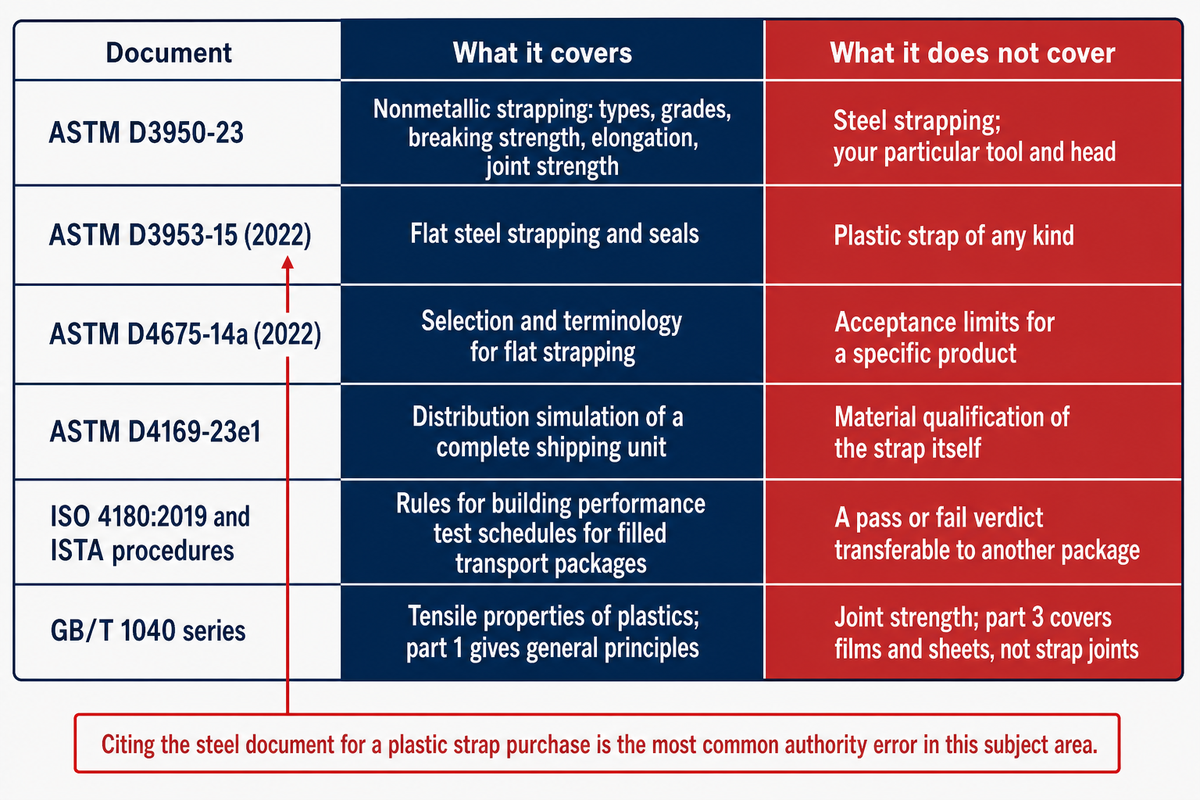
ASTM D3950 covers nonmetallic strapping and ASTM D3953 covers steel strapping, so citing D3953 for a plastic strap purchase references the wrong standard. The retention and weathering figures above only carry weight when a named test method backs them, and those methods split by material. That single substitution is the most common authority error in this subject area, and it survives because both numbers look alike in a specification line.
| Document | What it covers | What it does not cover |
|---|---|---|
| ASTM D3950-23 | Nonmetallic strapping: types, grades, breaking strength, elongation, joint strength | Steel strapping; your particular tool and head |
| ASTM D3953-15 (2022) | Flat steel strapping and seals | Plastic strap of any kind |
| ASTM D4675-14a (2022) | Selection and terminology for flat strapping | Acceptance limits for a specific product |
| ASTM D4169-23e1 | Distribution simulation of a complete shipping unit | Material qualification of the strap itself |
| ISO 4180:2019 and ISTA procedures | Rules for building performance test schedules for filled transport packages | A pass or fail verdict transferable to another package |
| GB/T 1040 series | Tensile properties of plastics; part 1 gives general principles | Joint strength — part 3 covers films and sheets, not strap joints |
Scope statements from the current editions listed at ASTM, ISO and the GB/T catalogue entries cited in this article.
One more demarcation line is worth noting in your procurement notes: carrier associations, and not general law, are what select strap type, minimum size or strength, joint type and strap count for a given shipment, and D4675 advises users to check with the carriers on exactly those details. Mechanical specifications here have been stable, with D3950-23 and D3953-15 (2022) both current and unamended, while the regulatory environment changed twice inside eighteen months. If steel must also be weighed in, the PET, PP or steel selector handles that three-way comparison.
Cost: Reading Total Value Instead of Price Per Roll
PP strap is usually quoted lower per roll, and that comparison stops being useful the moment strap consumption per package differs between the two options. Once the correct standard is named, cost is the argument that remains. Model cost per secured load unit instead: strap width and thickness, straps per package, metres consumed, waste, plus rework and claims. Two rolls at different prices can produce identical cost per pallet.
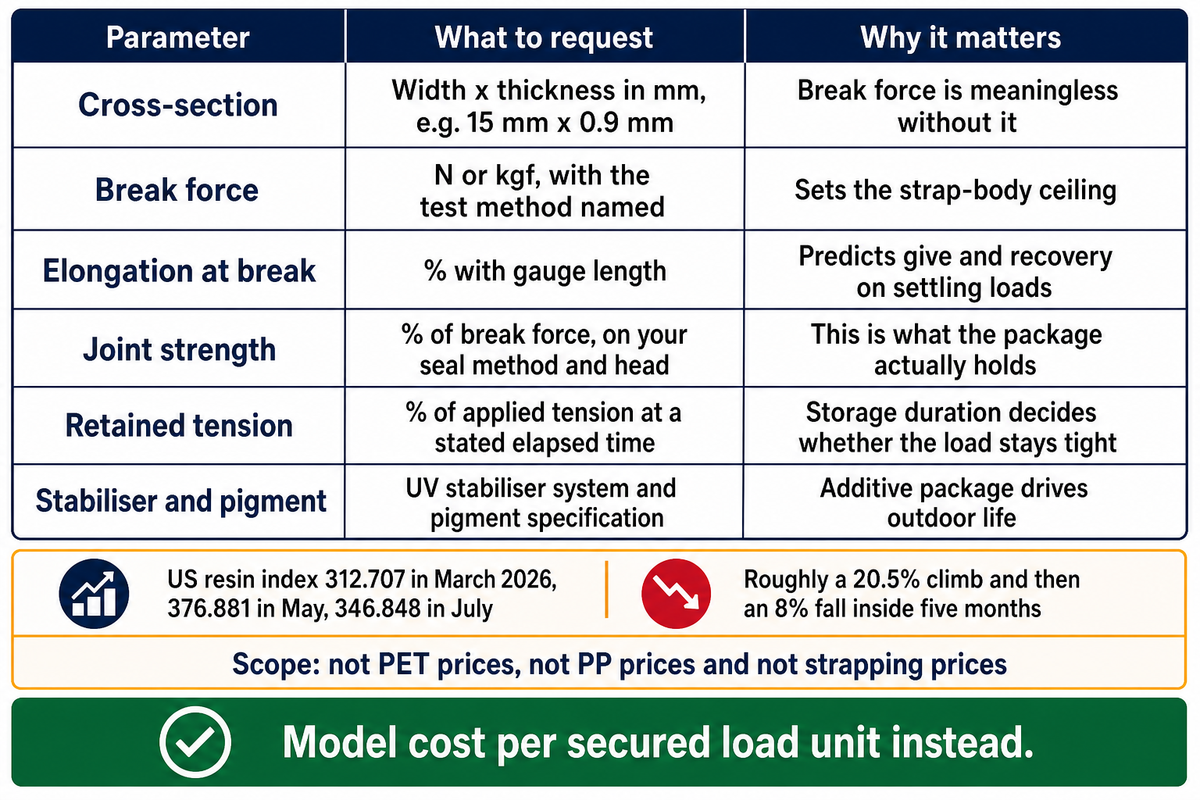
Quoted prices move too fast to anchor a comparison, and the upstream index shows why. The US Producer Price Index for plastics material and resin manufacturing ran 312.707 in March 2026, 376.881 in May and 346.848 in July, roughly a 20.5% climb and then an 8% fall inside five months. Over twelve months, BLS reported plastic resins and materials up 10.7% and plastic packaging products up 7.5%. These are commodity-group indices for US plastics manufacturing, not PET prices, not PP prices and not strapping prices; read them as evidence of input volatility only. The procurement response is a resin-index escalator in the contract rather than a chase after a quoted price per roll.
Copy the lines below into your quote request for comparison, so two offers can be compared on the same basis.
RFQ checklist for comparable strapping quotes:
| Parameter | What to request | Why it matters | How to verify |
|---|---|---|---|
| Cross-section | Width x thickness in mm, e.g. 15 mm x 0.9 mm | Break force is meaningless without it | Micrometer check on arrival |
| Break force | N or kgf, with the test method named | Sets the strap-body ceiling | Third-party tensile certificate |
| Elongation at break | % with gauge length | Predicts give and recovery on settling loads | Same certificate |
| Joint strength | % of break force, on your seal method and head | This is what the package actually holds | Trial joints pulled on your own tooling |
| Retained tension | % of applied tension at a stated elapsed time | Storage duration decides whether the load stays tight | Timed measurement on a representative package |
| Stabiliser and pigment | UV stabiliser system and pigment specification | Additive package drives outdoor life | Supplier declaration plus your own exposure trial |
Is PET Strapping More Expensive Than PP Strapping?
Per kilogram of resin, polyester is generally quoted above polypropylene, a direction to confirm across your own two offers rather than a published index figure, and it decides less than buyers expect. Cost per secured load unit is the comparison that governs, and three things move it independently of resin price.
Strap consumption per package differs when a higher-strength strap lets you drop from four straps to three, or step down a thickness. Rework cost differs when joints fail in transit and a pallet arrives needing re-strapping or a claim. Consumable and equipment cost differs when one material needs seals and the other welds without them.
Build the comparison as metres consumed per package multiplied by the delivered cost of a metre, and add the rework rate you actually see. No per-roll, per-metre or per-kilogram price appears in this article, because open-market strapping pricing is quoted by sellers rather than published by any independent body, and a number without an independent source is a number worth nothing to a procurement file.
Recyclability and Recycled Content: What the Evidence Supports
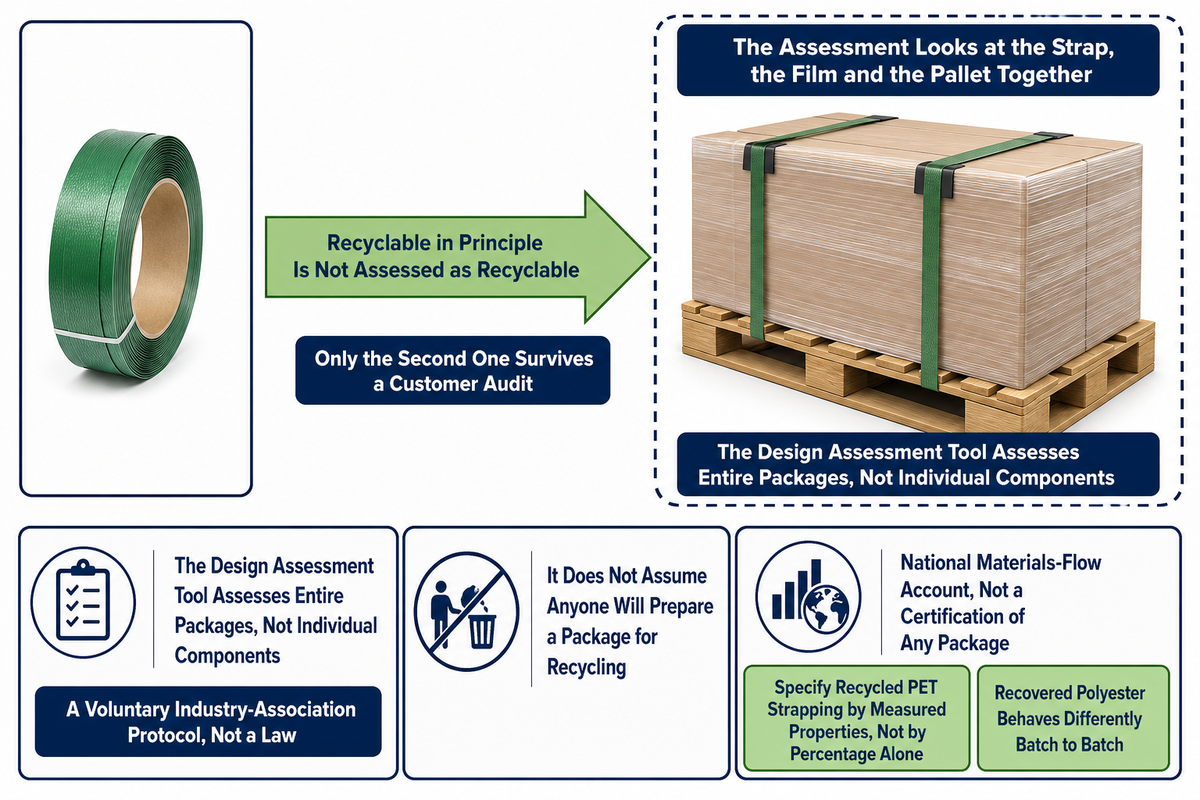
Recyclable in principle and assessed as recyclable are two different statements, and only the second one survives a customer audit or a sustainability report. Plastic recycling of industrial strapping runs through commercial back-of-store and industrial streams rather than kerbside collection. Both PET and PP strapping are technically recyclable; whether a given package is treated as recyclable depends on assessment against a published protocol, not on the resin identity code.
Two developments matter for what a supplier can be asked to produce. The APR Design Guide, a voluntary industry-association protocol, asks that every design feature of a package be assessed. It explicitly doesn’t assume that anyone will remove components or otherwise prepare a package for recycling. Its Design Assessment Tool is built to assess entire packages rather than individual components. A strap is a component of a package, so the assessment your customer runs will look at the strap, the film and the pallet together.
Scope limits are worth knowing before quoting national figures. The EPA’s materials and waste data is a national materials-flow account, not a certification of any particular package. On recycled content, processing variability is the real constraint: recovered polyester behaves differently batch to batch. That is why buyers specify recycled PET strapping by measured properties rather than by recycled percentage alone. UD Packaging gives renewable-resource utilisation as its mission and states that it controls the chain from PET granulation onward. No unqualified environmental claim is made here for either material.
Validating the Choice on Your Own Packages
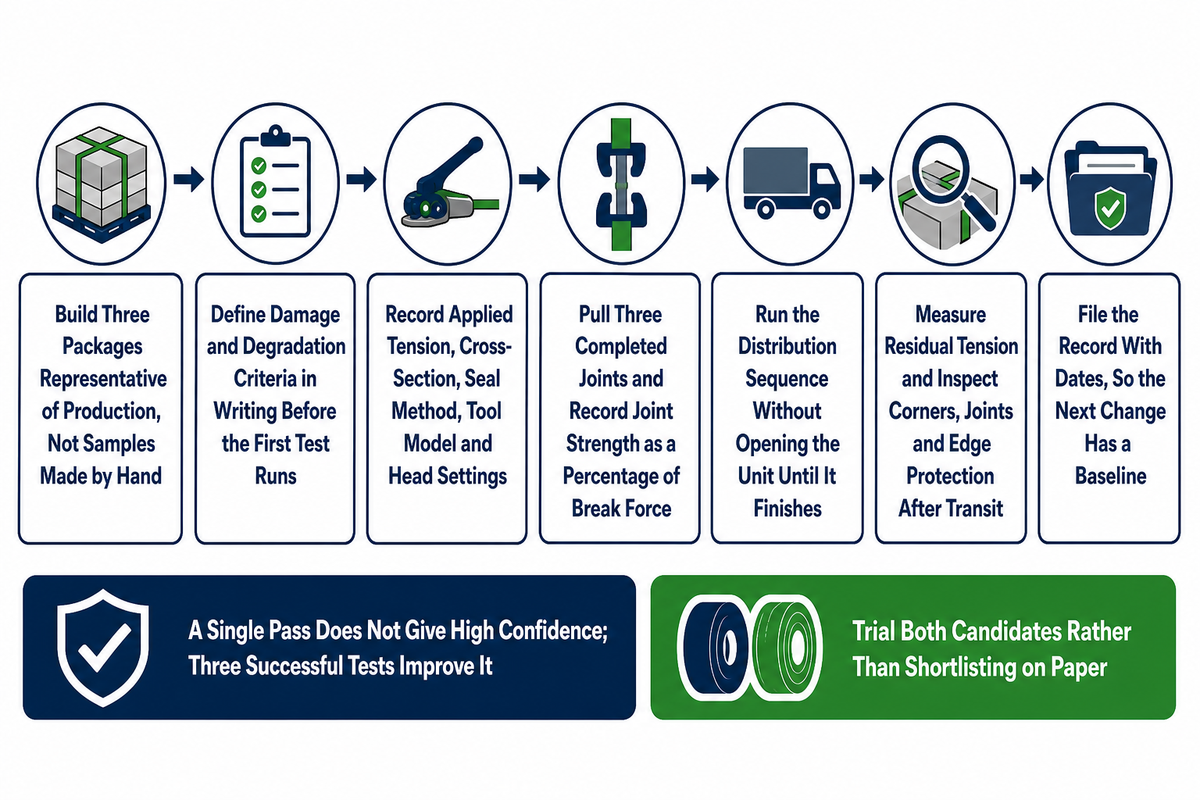
Confirm the material by running a representative package through a distribution simulation and recording the result, rather than by comparing datasheets. Selection guidance gives a starting point; a documented trial gives an answer you can defend to a customer or an insurer.
ISTA states the limitation directly: a single pass does not give high confidence that other seemingly identical packaged products will also pass, because of inherent variation in materials, components and contents, and three successful tests improve confidence. ISTA also requires representative samples and damage criteria defined before testing begins. ASTM D4169-23e1 evaluates a shipping unit through a sequential test plan of anticipated distribution hazards, with the same unit kept unopened until the sequence completes, and ISO 4180:2019 sets the rules for compiling those schedules.
Package trial procedure and record fields
- Build three packages that are representative of production, not samples made by hand.
- Define damage and degradation criteria in writing before the first test runs.
- Record the applied tension, strap cross-section, seal method, tool model and head settings on every unit.
- Pull three completed joints from the same run and record joint strength as a percentage of break force.
- Run the distribution sequence without opening the unit until it finishes.
- Measure residual tension and inspect corners, joints and edge protection after transit.
- File the record with dates, so the next specification change has a baseline to compare against.
Trial both candidates rather than shortlisting on paper. Comparing strapping to find the best result for your packaging needs is how you make the right choice defensible to a customer, and the best strapping for a plant is the one that survived that plant’s own distribution sequence. Choose the right strapping by duty class first, then use the trial to find the best cross-section and tension setting; the strap that’s the best fit for your packaging needs is the one with a record behind it.
Skipping the trial is the recurring field mistake, and it’s the reason two plants running the same purchase specification report different failure rates. This is first-time selection; requalifying a package after a strapping change that has already been approved is a separate procedure with its own retest triggers. A joint and tool qualification pass belongs in the same file as the trial record.
Industry Outlook: What Is Changing in Plastic Strapping
Regulation is moving faster than the mechanical specifications, and the first question a strapping buyer now has to answer is a scope and evidence question rather than a target question. The trial protocol above settles the mechanical half of that decision; the regulatory half moves on its own schedule. Whether your strapping is inside or outside a given obligation turns on documentation you may not currently hold. Published estimates of the global strapping materials market disagree with one another by a wide margin, so none is quoted here; the regulatory picture is both firmer and more consequential for a buyer.
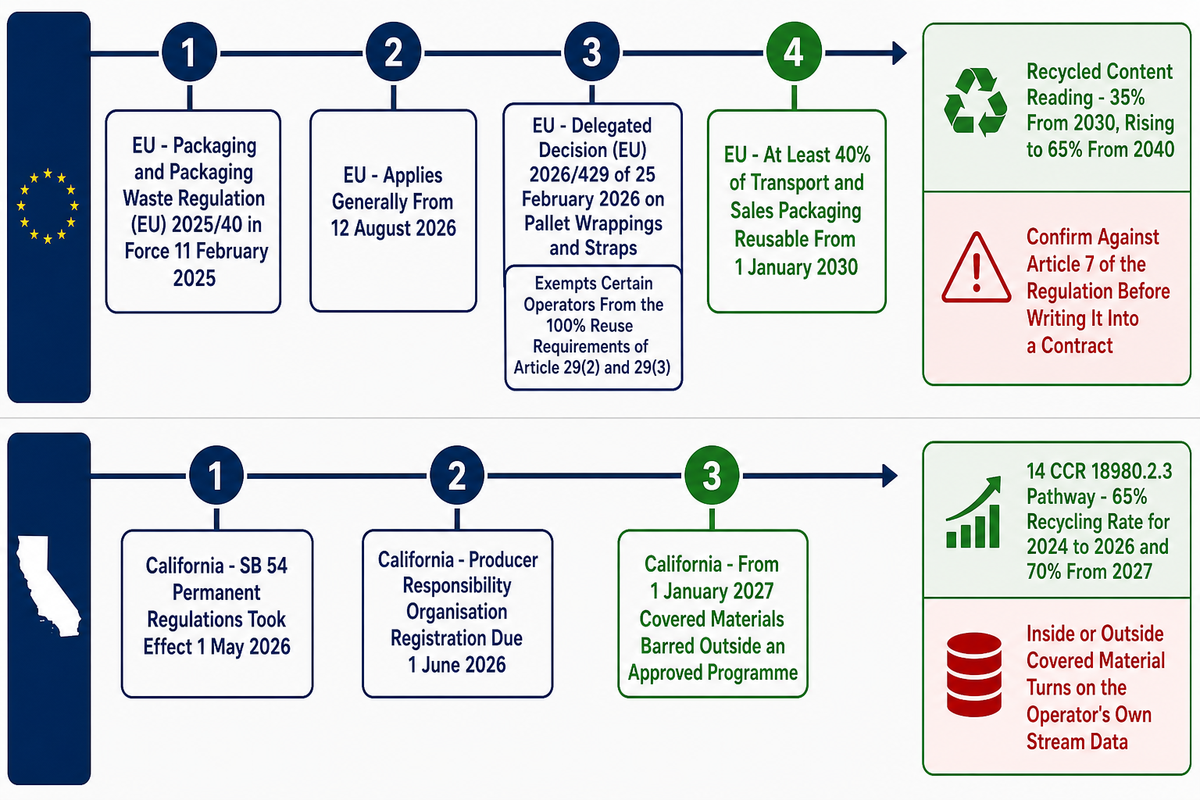
In the European Union, the Packaging and Packaging Waste Regulation (EU) 2025/40 entered into force on 11 February 2025 and applies generally from 12 August 2026. Commission Delegated Decision (EU) 2026/429 of 25 February 2026 then exempted certain operators using pallet wrappings and straps from the 100% reuse requirements of Article 29(2) and 29(3). Read the boundary carefully rather than as blanket relief: the decision lifts the 100% reuse requirements of Article 29(2) and (3) for those uses, while its Recital (2) and the Article 29(1) target that at least 40% of transport and sales packaging be reusable from 1 January 2030, calculated per calendar year per operator, have to be read together before anyone assumes the 40% quota still catches the same flows. Recyclability grading and recycled-content rules are unaffected either way. On the recycled-content side, the German Packaging Institute’s reading of Article 7 puts the minimum post-consumer recycled content for plastic stretch films and strapping bands at 35% from 2030, rising to 65% from 2040. Confirm that against Article 7 of the Regulation itself before writing it into a contract; either way it is a number to raise with a supplier now rather than in 2029.
In California, SB 54 permanent regulations took effect on 1 May 2026, with producer responsibility organisation registration due 1 June 2026 and, from 1 January 2027, covered materials barred from sale in California outside an approved programme. For industrial transport packaging the decisive mechanism is 14 CCR 18980.2.3, which sets out a documented-recycling-rate pathway requiring all of: a 65% recycling rate for 2024 to 2026 and 70% from 2027, no curbside collection, no commingling with unsorted curbside material, and acceptance at responsible end markets. That pathway exists. Whether any particular industrial strapping falls inside or outside “covered material” turns on the operator’s own stream data and CalRecycle approval, so it isn’t something a supplier can assert for you. Recyclability has become a supply chain documentation problem, which is why the evidence question in the previous section now belongs in the enquiry.
Frequently Asked Questions
What does PET strapping mean?
PET strapping is flat strap extruded from polyethylene terephthalate, the same polyester family used for beverage bottles, then drawn to align its molecular chains and build tensile strength.
PET strapping is flat strap extruded from polyethylene terephthalate, the same polyester family used for beverage bottles, then drawn to align its molecular chains and build tensile strength. Suppliers also call it polyester strapping or PET band. It is joined by friction weld or heat seal rather than by a metal seal in most modern applications, and it falls under ASTM D3950, the specification for nonmetallic strapping, rather than under the steel strapping specification.
Can PP and PET strapping be used with the same tools?
Sometimes, but never assume it. Tension range, weld time and pressure differ between the two materials, and a head tuned for polypropylene will usually produce a poor joint on polyester.
Sometimes, but never assume it. Tension range, weld time and pressure differ between the two materials, and a head tuned for polypropylene will usually produce a poor joint on polyester. Check the tool’s rated material list and its strap thickness range before switching. Then qualify the change by pulling completed joints from your own line rather than trusting the specification sheet, because joint efficiency is a property of the machine and settings as much as of the strap.
Which strapping type is more eco-friendly or recyclable?
Both polyester and polypropylene strap are technically recyclable, so the honest answer depends on your recovery route and your documentation rather than on the resin you pick.
Both polyester and polypropylene strap are technically recyclable, so the honest answer depends on your recovery route and your documentation rather than on the resin you pick. The APR Design Guide assesses whole packages rather than components, and its guidance does not assume anyone will separate a strap before recycling. Ask your supplier for recycled-content evidence and measured properties, and ask your waste contractor where the strap actually ends up.
What are the disadvantages of PET strapping?
PET strap gives less than polypropylene, so it recovers less when a load settles, and it is stiffer to handle and more demanding of weld quality and edge protection.
PET strap gives less than polypropylene, so it recovers less when a load settles, and it is stiffer to handle and more demanding of weld quality and edge protection. On sharp-cornered cargo it wants corner protectors, and a poorly tuned weld punishes it harder than it punishes PP: a worked example in US Patent 6210769B1 (Samuel Manu-Tech Inc., now expired) tabulates an untreated polyester strap of 2,175 lbs break strength producing a joint of only 700 lbs, a 32% joint efficiency, while a surface-treated strap of lower break strength reached 85%. A patent filing establishes patentability rather than reproduced performance, so read it as a worked example. Its resin cost basis is generally higher, and it needs moisture conditioning control during production. None of these rule it out for heavy or long-stored loads, but they are the reasons a heavier PP strap sometimes remains the better choice for light carton work.
How strong is PET strapping compared with PP strapping?
At equal width and thickness, polyester strap carries a higher break force than polypropylene strap and stretches less before parting, which is what lets it hold tension on a load that settles in transit.
At equal width and thickness, polyester strap carries a higher break force than polypropylene strap and stretches less before parting, which is what lets it hold tension on a load that settles in transit. Compare like cross-sections, and compare completed-joint strength rather than break force alone.
What quality standards should a plastic strapping supplier comply with?
Ask for ASTM D3950 for the nonmetallic strapping itself, ASTM D4675 for the selection terminology, and a named tensile test method quoted with its current edition year.
Ask for ASTM D3950 for the nonmetallic strapping itself, ASTM D4675 for the selection terminology, and a named tensile test method quoted with its current edition year. Third-party testing such as SGS product quality testing adds independent verification of what the certificate claims.
Specify strapping for shipping →
About This Comparison
We wrote this because most PET versus PP strapping comparisons stop at break force and never reach joint efficiency, retained tension or the question of which ASTM specification governs plastic strap at all. Several of the duty classes above map to industries we actually supply, among them brick kilns and photovoltaic module pallets, baled cotton and paper reels, and the standards positions were rechecked against current editions in September 2026, including the GB/T 1040.1 revision that supersedes the 2018 edition.
References & Sources
- ASTM D3950-23, Standard Specification for Strapping, Nonmetallic and Joining Methods — ASTM International
- ASTM D3953-15 (2022), Standard Specification for Strapping, Flat Steel and Seals — ASTM International, publisher catalogue entry
- ASTM D4675-14a (2022), Standard Guide for Selection and Use of Flat Strapping Materials — ASTM International
- ASTM D4169-23e1, Standard Practice for Performance Testing of Shipping Containers and Systems — ASTM International
- ISO 4180:2019, Packaging — Complete, filled transport packages — General rules for the compilation of performance test schedules — International Organization for Standardization
- Differences Between ISTA Procedures and ASTM Standards — International Safe Transit Association
- Getting Started with Package Design and Testing — International Safe Transit Association
- Cargo Securement Rules (49 CFR 393 subpart I) — Federal Motor Carrier Safety Administration
- 49 CFR 393.102, Minimum performance criteria for cargo securement devices and systems — Electronic Code of Federal Regulations
- IMO/ILO/UNECE Code of Practice for Packing of Cargo Transport Units (CTU Code) — United Nations Economic Commission for Europe
- Lopes & Carneiro, Natural weathering of polypropylene geotextiles treated with different chemical stabilisers, Geosynthetics International 24(6):544-553 — Geosynthetics International, ICE Publishing (DOI 10.1680/jgein.17.00020); record via University of Porto
- Natural weathering of commercial nonwoven PP and PET geotextiles over 36 months — International Journal of Polymer Science, Wiley
- Case report on virgin and recycled polypropylene industrial straps under artificial UV exposure — ScienceDirect, open access
- US Patent 6210769B1, Plastic strap (DiPede and Gould, Samuel Manu-Tech Inc., expired) — United States Patent and Trademark Office
- Feedback F33363139 on exemptions from the reuse obligations for plastic wrappings and straps, citing an April 2025 Fraunhofer IMWS study — Sebastian Köster, Techem Energy Services GmbH, via the European Commission Have your say platform
- Packaging and Packaging Waste Regulation (EU) 2025/40 — European Commission, DG Environment
- Commission Delegated Decision (EU) 2026/429 of 25 February 2026 on pallet wrappings and straps — European Commission, DG Environment
- Load Unit Securing within the PPWR Framework, reporting the German Packaging Institute (dvi) guidance paper — Packaging Strategies, BNP Media
- SB 54 Plastic Pollution Prevention and Packaging Producer Responsibility Act programme — CalRecycle
- Extensions, Exemptions and Exclusions under SB 54, including 14 CCR 18980.2.3 — CalRecycle
- APR Design Guide overview — Association of Plastic Recyclers
- APR Design Assessment Tool — Association of Plastic Recyclers
- Advancing Sustainable Materials Management: Facts and Figures — United States Environmental Protection Agency
- Producer Price Index by Industry: Plastics Material and Resin Manufacturing (PCU325211325211) — US Bureau of Labor Statistics via FRED
- Producer Price Index news release, Table 2 — US Bureau of Labor Statistics
- GB/T 1040.1-2025, Plastics — Determination of tensile properties — Part 1: General principles — Chinese national standard catalogue
Related Articles
- how to choose strapping material — the pre-quotation selection sequence this comparison feeds into
- PET vs steel strapping — the third material, with the change-control evidence a steel-to-plastic switch needs