Get in touch with UD Packaging Company

Updated September 2026
Quick specs
- Inputs: roll outside diameter, core outside diameter and total material thickness.
- Metric combination: diameters in mm, thickness in microns, estimated length in meters.
- Worked example: 200 mm roll, 80 mm core, 20 microns gives about 1,319.5 m.
- Scope: uniform material and winding; the result is an estimate, not a delivered-length certificate.
Roll length is the length of wound material; knowing how to calculate roll length gives you the edge when you’re faced with a situation where a roll has been partially used and is missing the label or when you have to make a quick dimensional check for a film order. You can estimate the remaining material without unwinding it. The outcome will be appropriate only if the diameter of the core is measured accurately, and if you know which layers the thickness includes.
Roll length is estimated by subtracting the squared core outside diameter from the squared roll outside diameter, multiplying by pi and dividing by four times material thickness. With diameters in mm and thickness in microns, the numerical result is in meters.
Estimated wound-roll length from outside diameter, core and total caliper
For a uniformly wound roll, the material cross-section is the annulus between the core outside diameter and the roll outside diameter. Its length is L[m] = pi x (D[mm]^2 – coreOD[mm]^2) / (4 x t[µm]), with the millimetre-to-metre conversion applied in the calculation.
Estimated roll length
m
Estimate only: use the core OUTSIDE diameter and total caliper, including liners. Assumes even, void-free winding; not for exact shipped length or part counts.
Estimate only: use the core OUTSIDE diameter and total caliper, including liners. Assumes even, void-free winding; not for exact shipped length or part counts.
Enter every value to see the result.
This entry is ambiguous. Use a comma only as the decimal mark, for example 1,5, and do not type thousands separators.
- A core’s inside bore fits the holder; its outside surface determines the film calculation.
- Width cancels only in the ideal model of a uniform web.
- Half the outside diameter doesn’t mean half the film remains.
- More displayed decimal places don’t prove a more accurate measurement.
Roll length calculator
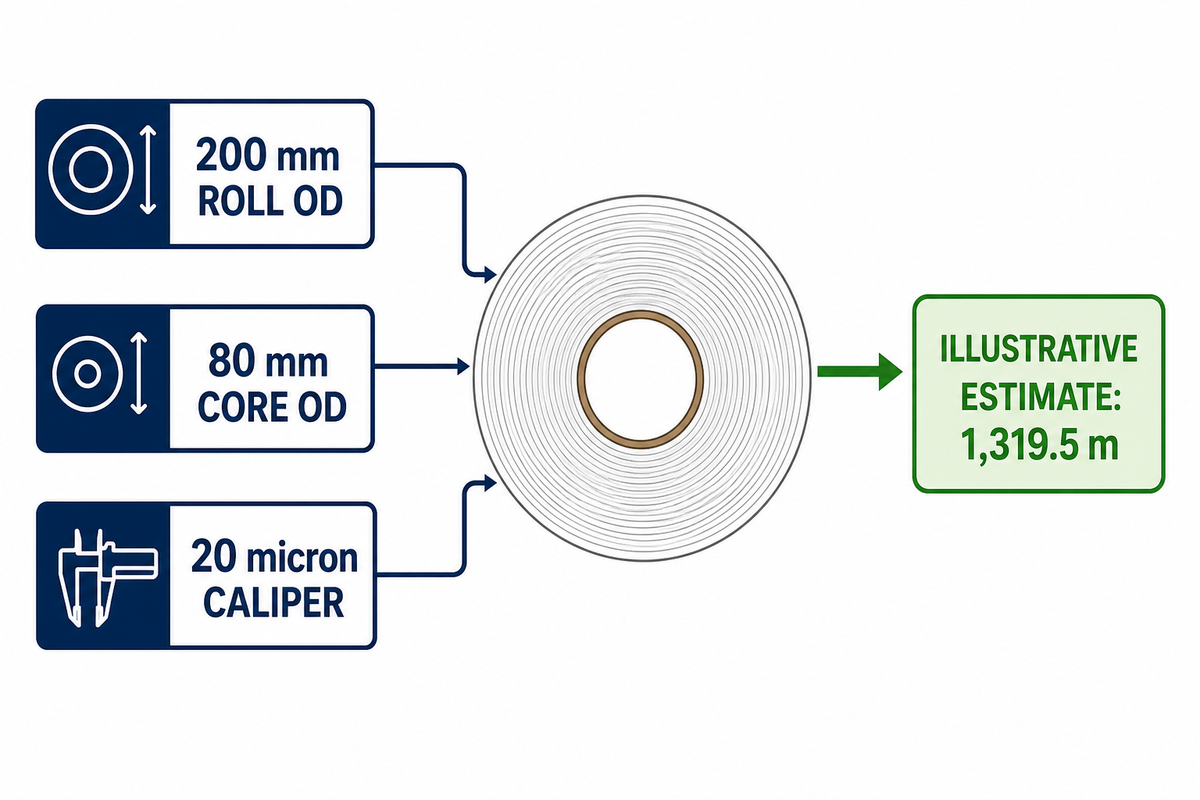
The roll length calculator estimates the length of a roll from the outside diameter of the material, the outside diameter of its core and the full material thickness. This roll calculator uses millimeters for both diameters and microns for caliper. Its output is a geometric estimate in meters.
Suppose you start with the illustrative 200 mm, 80 mm and 20 micron inputs, then the final answer is 1,319.5 m. You can also think of an empty roll as having equal diameters. However, in this case, the answer will be zero. Inputs are invalid when the roll diameter is smaller than the core or thickness is zero. If the caliper is unknown, then you shouldn’t rely on that value and measure it first.
This calculator can help you find the length of stock with a missing warehouse label without the need to manually unroll the stock. Measure each input parameter. For flexible materials that compress, the physical roll of material may differ from the ideal model. A stable reading on the screen doesn’t resolve this measurement problem.
How do you calculate roll length from diameter?
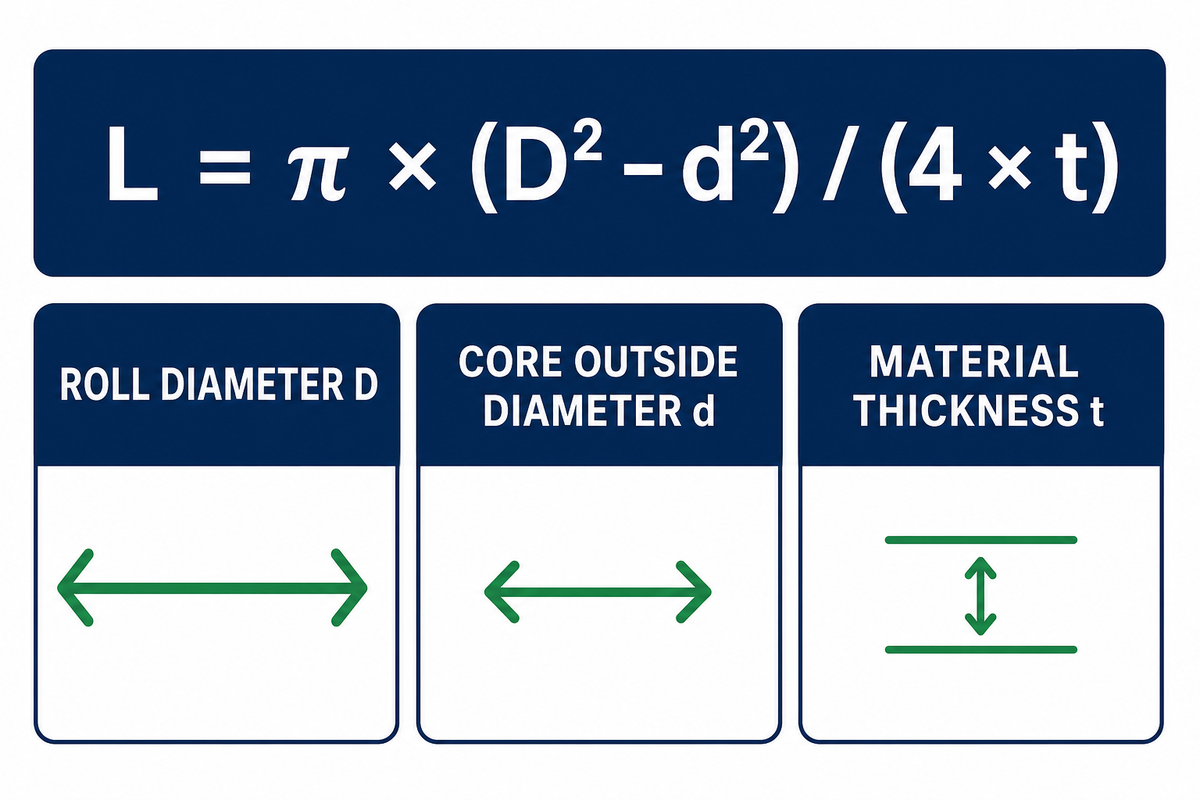
Calculate roll length by dividing the material’s annular cross-sectional area by its thickness. An annulus is a ring. In this case, it’s the ring between the external surface of the core and the outer diameter of the roll. This calculation assumes a circular roll with a uniform thickness and very little, if any, space between layers.
Using one common unit: L = π × (D² − d²) / (4 × t).
Here, ‘D’ is the diameter of the roll, ‘d’ is the core outside diameter and ‘t’ is the thickness of the material. If all three measurements are in mm, then L will also be in mm. Divide by 1,000 to convert the result to meters.
For diameters in mm and thickness in microns: L (m) = π × (D² − d²) / (4 × t). Converting microns to mm introduces a factor of 1,000, which cancels when the resulting length is converted from mm to meters. Keep those units attached to the formula.
Karl Hahn’s calculus lesson hosted at Shippensburg University explains the underlying area relationship: when looking at a strip edge-on, each strip contributes thickness multiplied by length. After subtracting the core’s circular area, this relationship can be applied to a roll.
“And the area of that rectangle is thickness times length”
Roll width cancels from the volume calculation because it multiplies both sides of the equation. Width still plays an essential role when considering the area, mass and machine fit. Tapered rolls and webs with different thicknesses across their faces don’t meet the assumption of a uniform web.
This roll length formula also applies to paper roll length: think of a long sheet of paper rolled around a core. In the ideal case, its edge-on area remains the same. The formula for calculating the length thus uses the cross-section of the rolled material, rather than its width.
For a uniform roll, a 500 mm web and a 450 mm web can have the same geometric length with both diameters and calipers matched. Width alters the amount of material by area and mass. Therefore, a purchase comparison needs width even though the length equation doesn’t.
Which diameters and thickness should you measure?
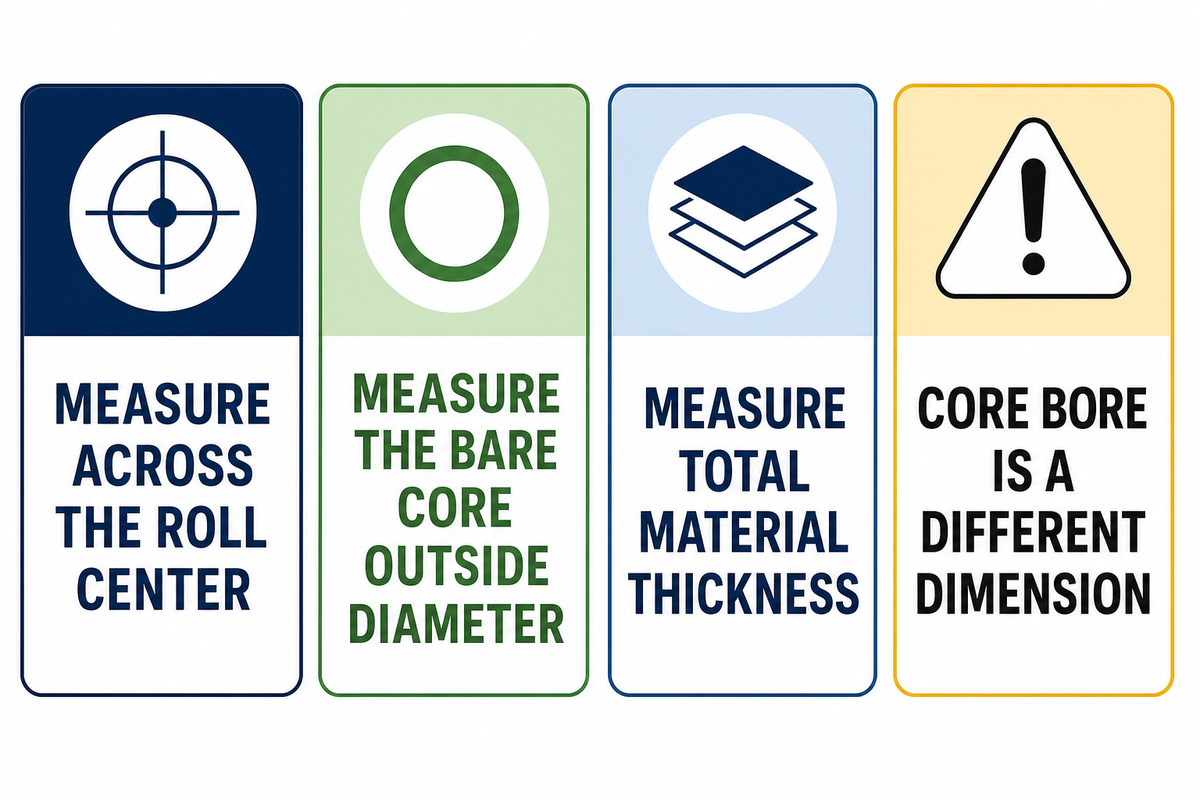
Measure across the center of the wound roll, then measure the outside of the bare core and determine the full caliper of one layer. The core’s center hole is of a different dimension. For adhesive laminates or pressure-sensitive label stock, include every layer wound together, including a release liner.
With a stationary, accessible roll, check diameter at more than one orientation and across its face. Loose tails, damaged edges and out-of-round profiles can distort a single reading. Record the readings rather than selecting whichever one agrees with the label. Follow the safe access procedure before measuring material on equipment.
UD Packaging’s hand stretch film enquiry specifications cite 50 or 76 mm as possible core inner diameters. Those are holder-fit dimensions. The page doesn’t provide the corresponding core outer diameter, so neither value should be entered into the calculator without checking the core.
Do
- Measure the outside winding surface of the core.
- Include the complete wound construction in caliper.
- Write units beside every input.
Don’t
- Substitute the core bore for its outside diameter.
- Enter only face-film thickness when a liner is present.
- Treat a nominal specification as a measured value.
ISO 4593:1993 describes mechanical scanning for plastics film and sheeting thickness. Its public scope excludes embossed film. The edition was reviewed and confirmed in 2025; that confirmation did not create a new 2025 edition. Choose the most appropriate thickness method for the material.
It’s impossible to solve a roll-length estimate with a 76 mm core bore as that leaves space for the cardboard wall. Measure the core outside diameter separately and record the total caliper in microns. If either value is missing, leave the estimate unsolved. It’s better to leave gaps for unknown dimensions than to assume familiar nominal sizes.
Metric and inch worked examples
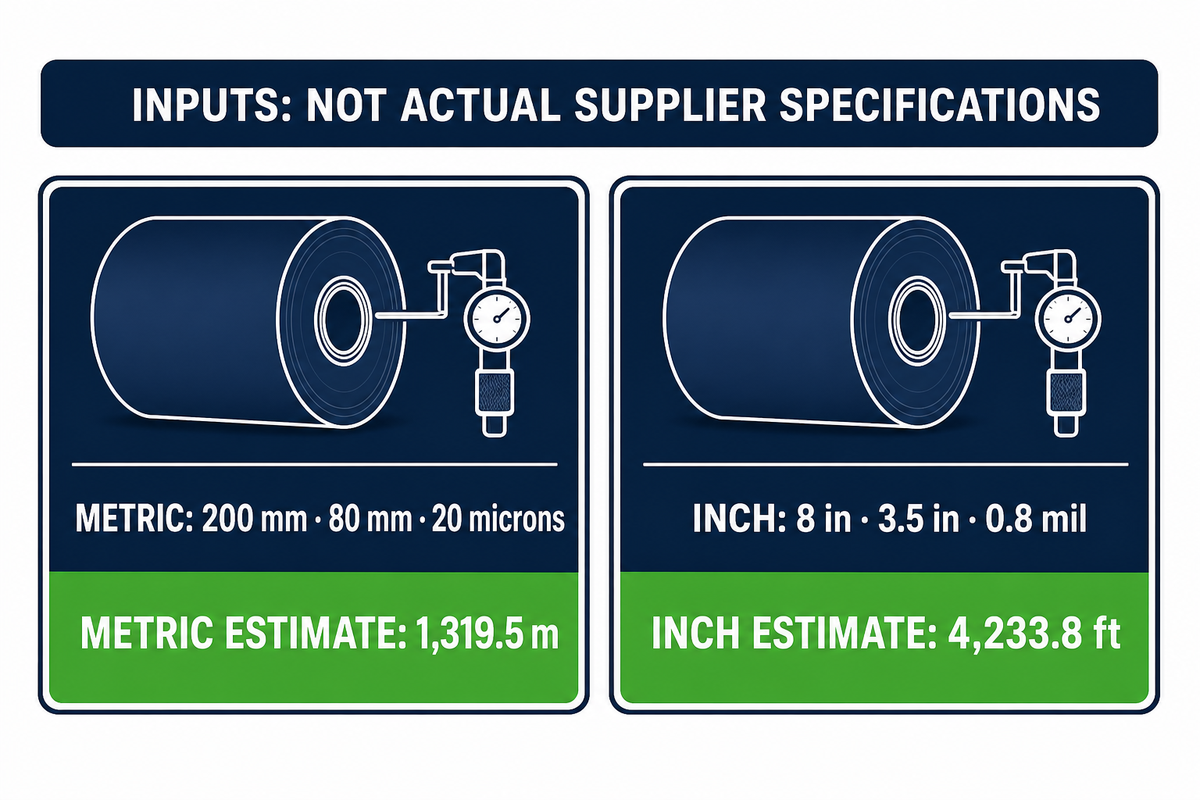
The metric example uses a 200 mm outside diameter, an 80 mm core outside diameter and 20 micron material. It gives approximately 1,319.5 m. The inch example uses an 8 in roll, a 3.5 in core and 0.8 mil material. These input values are not actual supplier specifications.
Metric: π × (200² − 80²) / (4 × 20) = 1,319.4689… m. Retain the unrounded result internally; display about 1,319.5 m. To calculate the length of the material in Excel, put D in cell A2, core outside diameter in B2 and micron thickness in C2, then enter =PI()*(A2^2-B2^2)/(4*C2).
How to calculate roll length in inches
Inches: 0.8 mil is 0.0008 in. Calculate π × (8² − 3.5²) / (4 × 0.0008), then divide by 12. The estimated length is 4,233.8 ft. For metric conversion, the National Institute of Standards and Technology’s length reference confirms that one inch is exactly 25.4 mm.
Don’t put 0.8 into an equation expecting inches. That unit error makes the result 1,000 times too small. Likewise, the shortcut with mm diameters already returns meters when t is in microns; dividing by another 1,000 would be wrong.
As stated in NIST’s GLP 9 rounding guidance, it’s necessary to keep intermediate precision and relate reported measurement digits to uncertainty. The one-decimal display here is presentation precision. It doesn’t imply a ±0.1 m accuracy or a calibrated uncertainty for a finished roll.
An 8 in roll with a 3.5 in core and 0.8 mil caliper gives about 4,233.8 ft under ideal geometry. Converting 0.8 mil to 0.0008 in is essential. A spreadsheet should label every input column and distinguish its calculated output from the supplier’s stated length and tolerance.
How much film remains on a partly used roll?
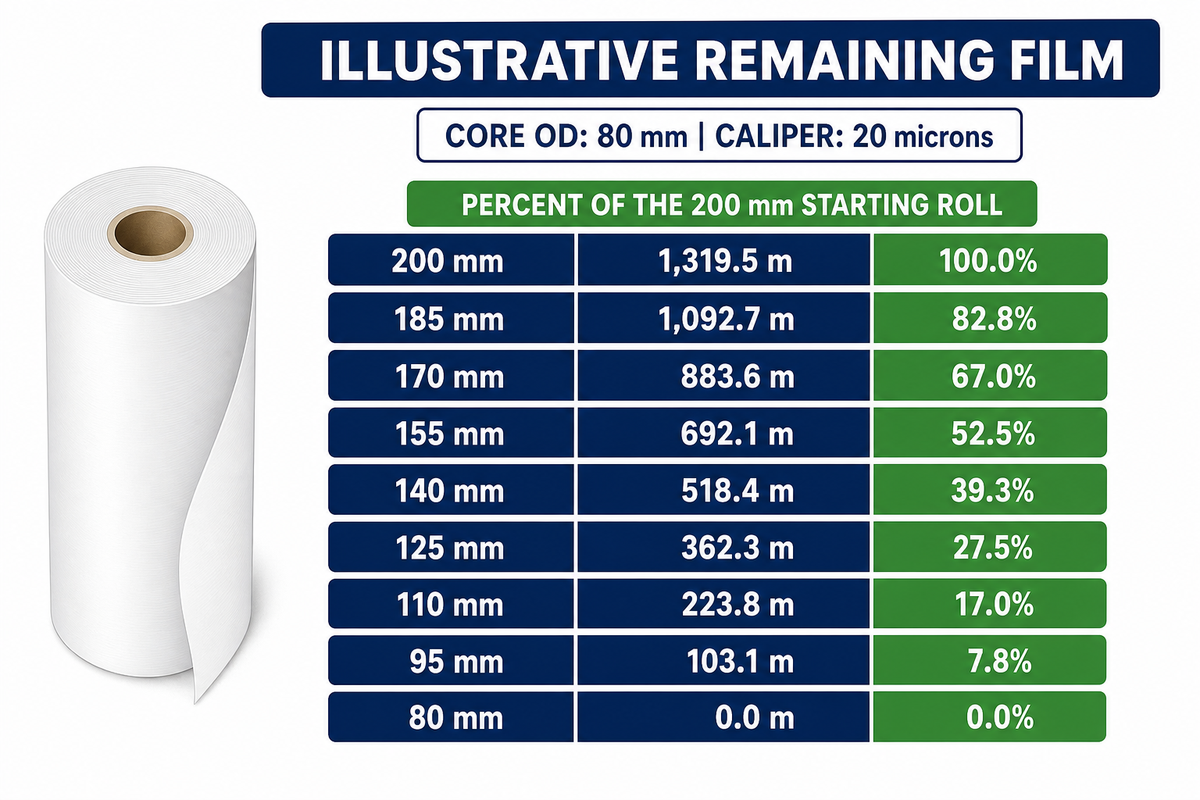
Estimate a partially used roll with its current outside diameter, a core outside diameter that hasn’t changed, and a verified caliper. The remaining length is approximated by the difference of squared diameters. Comparing outside diameters alone will underestimate the space taken up by the core and overestimate the amount of material remaining in a roll.
9-Step Remaining-Length Ladder
A Remaining-Length Ladder transforms the measured roll diameter to estimated residual length while keeping the core diameter and the caliper constant.
| Current roll diameter | Estimated length | Share of 200 mm starting roll |
|---|---|---|
| 200 mm | 1,319.5 m | 100.0% |
| 185 mm | 1,092.7 m | 82.8% |
| 170 mm | 883.6 m | 67.0% |
| 155 mm | 692.1 m | 52.5% |
| 140 mm | 518.4 m | 39.3% |
| 125 mm | 362.3 m | 27.5% |
| 110 mm | 223.8 m | 17.0% |
| 95 mm | 103.1 m | 7.8% |
| 80 mm | 0.0 m | 0.0% |
Diameter readings become more sensitive near the core. In this model, changing a 95 mm reading to 96 mm changes estimated length from 103.1 m to 110.6 m. That’s about a 7.3% difference from a 1 mm change. It’s a sensitivity example, not an instrument error specification.
Length alone can’t determine or predict the number of remaining parts on the roll. A converter needs the repeat or pitch, usable width, waste allowance and any damaged portion to estimate remaining parts on the roll. There’s a need for a separate application measurement for film supply for a pallet wrapper.
A partly used 140 mm roll in the 80 mm core, 20 micron example holds about 518.4 m, or 39.3% of the starting length. For a stock check, retain the original inputs alongside that estimate and follow NIST’s rounding guidance when displaying results. Diameter-only percentages can’t establish usable parts, operating time or the number of accepted pallets.
When does geometric roll length become unreliable?
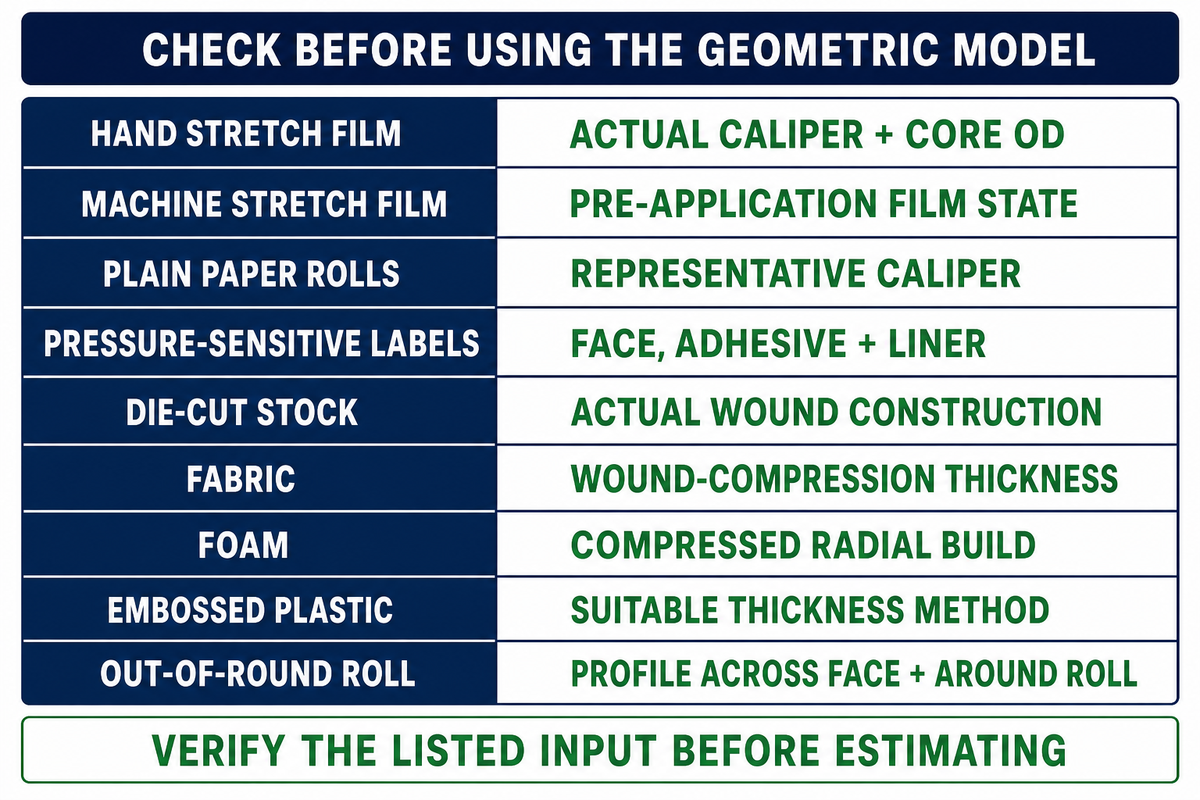
Geometric length becomes unreliable when a single diameter and caliper can’t define the wound material. Gaps, compression, uneven winding and variable thickness change radial build. Although a calculation can produce a precise-looking number, delivery verification also requires an agreed measurement method and product tolerance.
Thickness has an inverse effect. With both diameters unchanged, replacing 20 microns with 22 microns reduces estimated length from 1,319.5 m to 1,199.5 m. The 10% higher thickness produces about 9.1% less length. Do not try to compensate for a nominal thickness error by adding an unrelated fixed allowance to every roll.
| Material or roll condition | Input to establish | Reason to pause the estimate |
|---|---|---|
| Hand stretch film | Actual caliper and core outside diameter | Only core-bore or nominal thickness data available |
| Machine stretch film | Film state before application stretch | Applied, stretched thickness substituted for wound caliper |
| Plain paper rolls | Representative paper caliper | Softness or uneven winding changes radial build |
| Pressure-sensitive labels | Face stock, adhesive and liner together | Only the face material is measured |
| Die-cut stock on a carrier | Actual repeated wound construction | Missing material makes a full-sheet assumption unsuitable |
| Fabric | Thickness representative of wound compression | Pile or air makes the unloaded thickness misleading |
| Foam | Compressed radial build | Unloaded caliper differs from the wound condition |
| Embossed plastic sheet | Suitable thickness method and winding model | Mechanical scan scope or surface structure is ignored |
| Telescoped or out-of-round roll | Profile across the face and around the roll | One diameter cannot represent the cross-section |
ISO 4592:1992 identifies a reference method for the free length of plastic-film rolls up to 100 m. That limited scope is different from estimating a 1,319.5 m wound roll. The published abstract is not a substitute for the full method or the agreed longer roll measurement method.
ISO 4591:1992 covers gravimetric thickness using sample mass, area and density, with particular value for embossed material when mechanical scanning is insufficiently precise. Gravimetric average thickness is still not a substitute for the effective radial build of a loosely wound roll.
A 1,319.5 m estimate shouldn’t become an accepted delivered length without measured inputs and an agreed method. The example drops to 1,199.5 m when caliper changes from 20 to 22 microns. Investigate the measurement basis before accepting a discrepancy with the label as evidence of undersupply.
Match the estimate to your film order
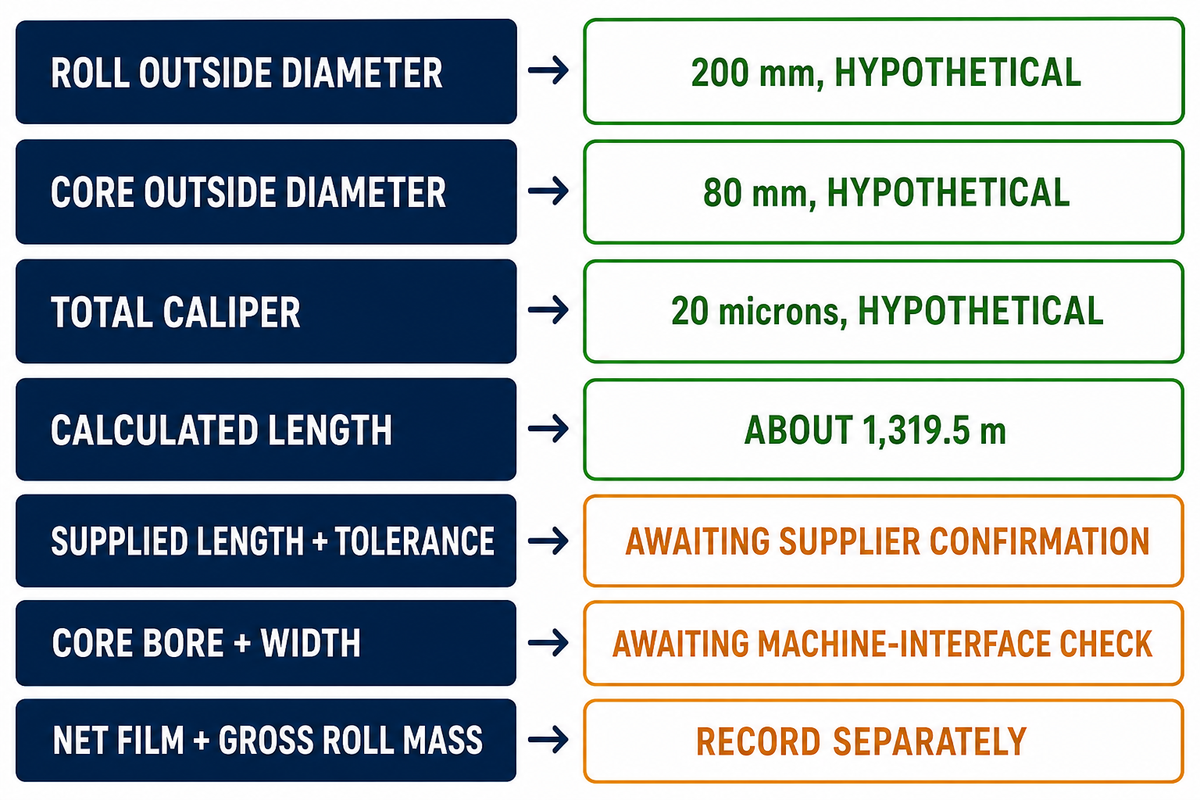
Matching a film order requires separating observed dimensions, calculated length, and the terms of the quoted supply. Roll geometry can be recorded by warehouse staff, while caliper and machine interfaces can be checked by the technical staff. The purchasing team can verify the supplied length and tolerance. The following handoff sheet is an example of that separation, not a supplier test record.
7-Field Roll Measurement Handoff Sheet
A Roll Measurement Handoff Sheet separates measured inputs, modeled output, and supplier-confirmed delivery terms before a film order is approved.
| Field | Filled example | Next verification |
|---|---|---|
| Roll outside diameter | 200 mm, hypothetical | Record actual readings across the roll |
| Core outside diameter | 80 mm, hypothetical | Measure the winding surface |
| Total caliper | 20 microns, hypothetical | Confirm material and measurement method |
| Calculated length | About 1,319.5 m | Retain as an estimate |
| Supplied length and tolerance | Awaiting supplier confirmation | Record written quotation and acceptance basis |
| Core bore and width | Awaiting machine-interface check | Confirm holder fit and roll-width limits |
| Net film and gross roll mass | Record separately | Exclude core and packaging from net film mass |
UD Packaging’s hand-film page indicates possible widths of 450 or 500 mm and thicknesses of 12–25 microns, while leaving roll length and tolerance for quotation. These enquiry choices don’t capture all machine stretch film supply. Before comparing bulk quantities, confirm the selected construction with the supplier.
The stretch film specification converter, which UD Packaging provides, is a good starting point for normalizing units. Use the film-per-pallet comparison worksheet for observed film usage and accepted pallet output. Length by itself doesn’t define wrapping efficiency or load containment.
When the length of the roll conflicts with a purchasing record, first confirm that the records describe net film, the same core and the same measurement basis. Ask the material manufacturer or supplier to resolve the discrepancy in writing. Don’t approve a larger order where the thickness has been changed to agree with the numbers.
A 20 micron film estimate and a quoted 20 micron description answer different questions when the measurement basis is missing. Record the measured core outside diameter and calculated meters in the handoff sheet and ask the supplier for written length tolerance and the net film mass. Similar quotes will require these distinctions before buying approval.
How do you calculate roll diameter from length?
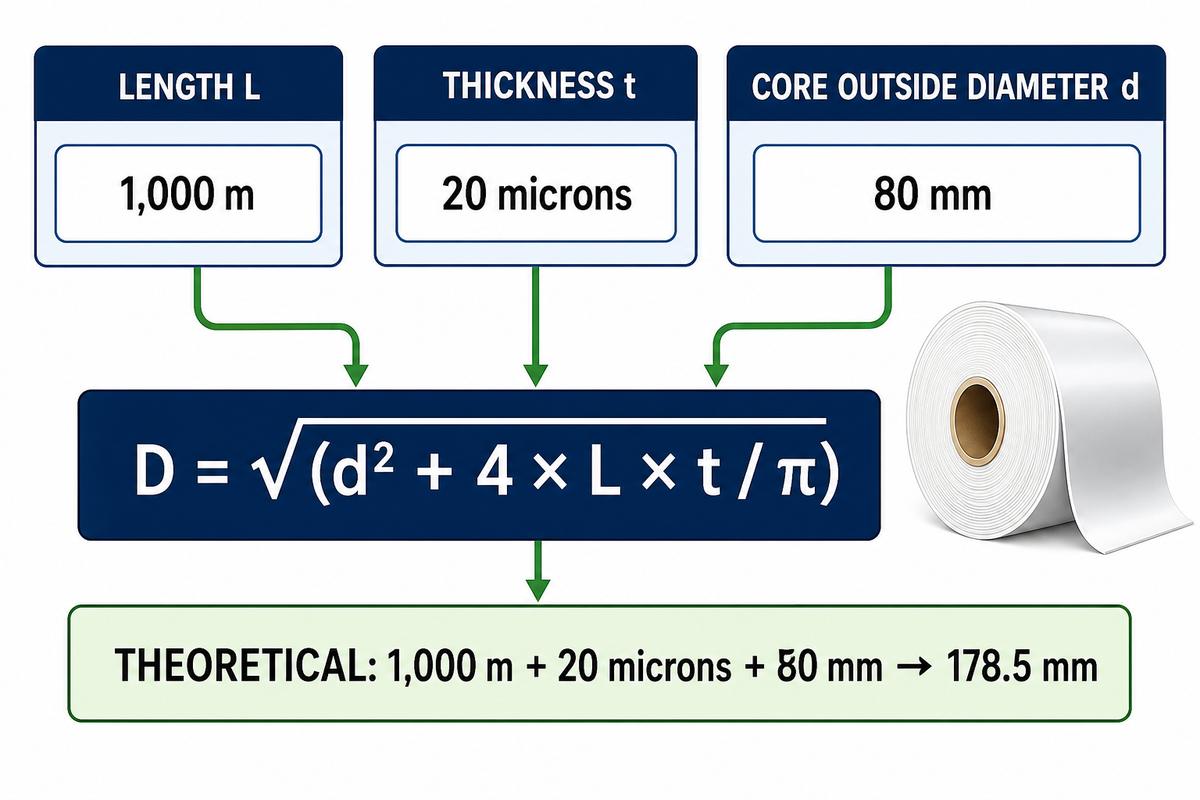
A roll diameter calculator reverses the same annular equation. With length in meters, thickness in microns and core outside diameter in mm, calculate D = √(d² + 4 × L × t / π) to obtain the estimated outside diameter in mm. The metric unit conversions cancel in this particular combination.
For 1,000 m of 20 micron material on an 80 mm core, √(80² + 4 × 1,000 × 20 / π) gives about 178.5 mm. This roll length and diameter relationship assumes the same uniform winding as the forward equation.
Printers, slitters and wrappers can all have a specified maximum roll diameter, width and holder interface. Check these dimensions against the relevant machine documentation. The theoretical 178.5 mm result doesn’t approve machine fit; leave the machine’s maximum unresolved until it’s confirmed.
Frequently asked questions
How do I calculate the length of a roll?
See answer
Measure the outside diameter of the wound material, the outside diameter of its core, and the full material thickness. Use the same length unit in the annular-area formula, then convert the result to meters or feet. The calculation estimates a uniformly wound roll. It does not verify the supplied length, replace a calibrated length measurement, or account automatically for gaps and compression.
How do you calculate fabric roll length?
See answer
The same geometric equation can estimate fabric length if the fabric has a reasonably uniform effective thickness and the roll is wound consistently. Compression, pile and entrained air can make a fabric roll depart substantially from the ideal model. Use thickness representative of its wound condition, or compare with a known-length roll under the same conditions. A flat, unloaded thickness measurement may not represent the radial build.
How do you calculate roll length in inches?
See answer
Enter the roll and core outside diameters in inches and convert the thickness to inches before applying the equation. One mil is one thousandth of an inch, so divide a thickness in mils by one thousand first. The resulting length is in inches; divide that value by twelve for feet. Do not enter a mil value directly into a formula that expects inches.
Can I find roll length without knowing thickness?
See answer
Not from the two diameters alone. You need another independent measurement, such as verified effective caliper, a measured length, or net material mass with a suitable mass-per-length basis. Each alternative brings its own assumptions.
Does a larger roll always contain more material?
See answer
Only compare diameter that way when the core outside diameter, material thickness and winding conditions are comparable. A larger paper core occupies more of the roll cross-section without adding film. Thicker material builds diameter faster, while loose winding adds space between layers. Even a roll that looks larger can therefore contain less useful length than a smaller, tightly wound roll of thinner material. Width is a separate quantity: it changes total sheet area and mass, but it cancels from the ideal length-from-diameter equation when the wound sheet has uniform width. For a purchase comparison, record the actual roll and core dimensions, the quoted thickness and its measurement basis, and the supplier’s length tolerance. Keep net film mass separate from gross roll mass. If the estimate conflicts with the label, investigate the inputs and agreed measurement method before treating the difference as proof of short delivery.
Key takeaway
A 200 mm roll on an 80 mm core with 20 micron material gives about 1,319.5 m by ideal geometry. Measure the core outside diameter, verify total caliper and keep the output labeled as an estimate.
Are you planning on taking measurements? Send us the roll dimensions that you measured, the current film construction, and the application. Request confirmation on the length and the tolerance. Take a look at our Range of Packaging Stretch Film to identify the relevant supply route.
Method note: Calculations and filled worksheets are examples that are theoretical. The public standard abstracts set the methods’ limits; no complete standard procedure, factory trial, calibrated accuracy or product certification is claimed.
References & Sources
- Karl’s Calculus Tutor: Related Rates Karl Hahn; hosted at Shippensburg University.
- ISO 4593:1993: Thickness by mechanical scanning International Organization for Standardization.
- SI Units: Length National Institute of Standards and Technology.
- GLP 9: Rounding Expanded Uncertainties and Calibration Values National Institute of Standards and Technology.
- ISO 4592:1992: Determination of length and width International Organization for Standardization.
- ISO 4591:1992: Gravimetric thickness International Organization for Standardization.