Get in touch with UD Packaging Company


Updated September 2026
Stretch film is an extensible packaging film applied under tension to help unitize a load; its selection begins with the wrapping process, load, route, and evidence that will count as acceptance. The film type and gauge will be relevant, but neither will be a universal load rating.
Key takeaway
Describe one representative pallet, how it is wrapped, what happens before and during transport, and what result the buyer will accept. Only then compare construction, gauge, roll price, or a supplier’s performance claim.
One roll that appears on a product sheet may perform poorly on the floor. Another film may appear to be more expensive per roll, yet use less material per accepted pallet. Those two examples are complementary. They illustrate that stretch wrap operates as part of a load-containment system as opposed to an isolated plastic sheet.
Buyer rule: Treat gauge as an input. Release a film only after the application, load, route, and acceptance evidence agree.
This guide helps packaging engineers, warehouse teams, procurement managers and distributors define the system. It does not prescribe a universal number of wraps, pre-stretch setting, tension, load weight, or savings percentage. Product configurations, samples and quotations are available on the industrial stretch film page. The goal here is to make the buying evidence comparable.
1. What Stretch Film Is, and What the Label Does Not Prove

Stretch film is a plastic film wrapped around a group of products that is commonly a palletized load. The film is stretched during application, but stretching alone does not explain the inward force; recovery helps apply it to the load. Industrial buyers also use the stretch wrap and pallet wrap terms. These terms describe a product family and not a qualified shipping result.
Many films in industry rely on linear low-density polyethylene. However, even the polyethylene family creates gaps. Things like layer design, resin blend, additives, manufacturing method, cling, nominal thickness, width, length, winding, and application grade may differ. “Machine grade,” “high performance,” or “80 gauge” still does not identify the wrapper, load geometry, route, test method, or acceptance criterion.
ASTM D4649 is useful because its published scope addresses selection, specification, and use of stretch films for indoor unitizing and palletizing. The scope also notes that extreme temperatures can affect performance and that outdoor exposure sits outside the guide. That is a boundary, not a certification that a named roll will secure every pallet.
Stretch film isn’t heat shrink film. Stretch wrap is mechanically extended during application. Shrink film is heated for contraction. The processes, equipment, hazards, and validation questions differ; food cling film also has a different use and compliance context.
Before treating a roll label as a specification, ask for:
- film construction and intended application grade;
- nominal thickness, width, length, roll or lot identity;
- the test method and condition behind each performance value;
- the representative load and wrapping process;
- the route or exposure represented by the evidence.
Decision boundary: if the film identity, application, test method, or load is unknown, state that the claim is unverified. An assumption of a gauge shouldn’t be used to fill the gap.
2. Start With the Four-Question Film Fit Filter
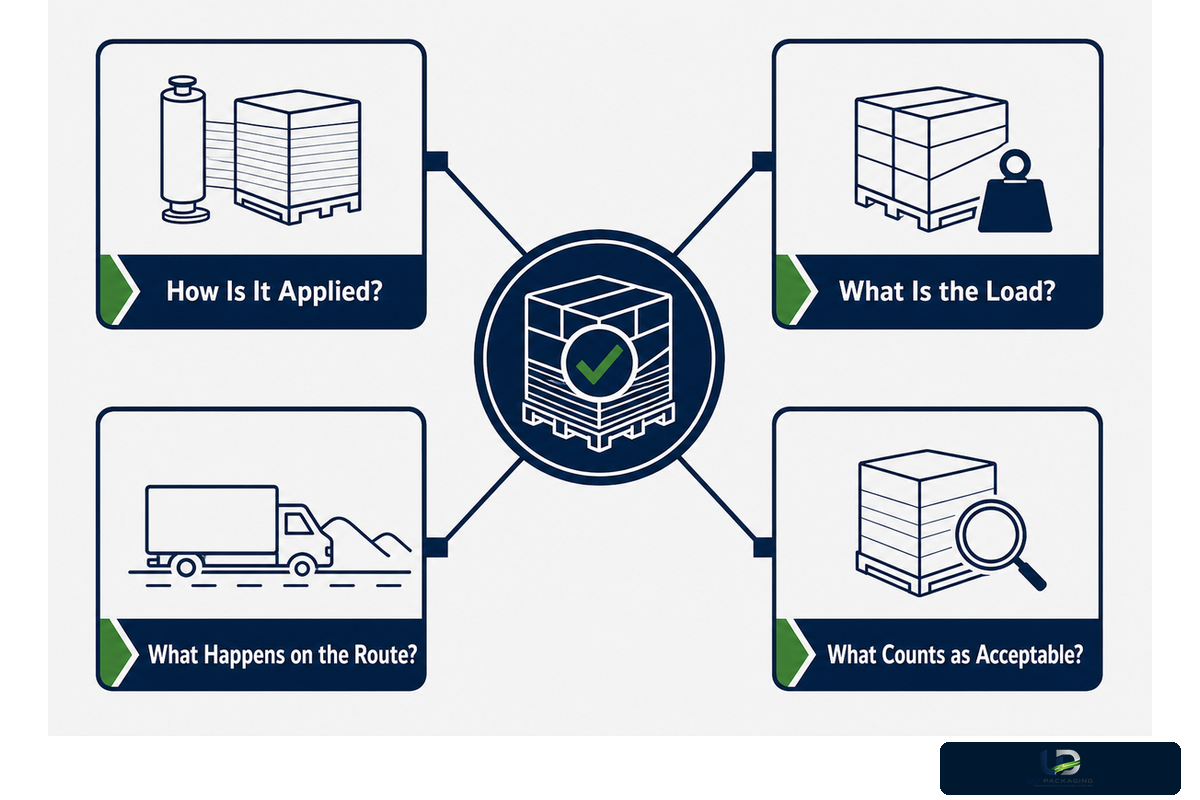
The fastest way to find a stretch-film trial is to answer the following 4 questions: how the film is applied, what the load is like, what the route is like, and what evidence will meet the criteria for acceptance. This is the 4-Question Film Fit Framework.
| Question | Record | Wrong shortcut | Evidence or escalation |
|---|---|---|---|
| 1. How is it applied? | Hand, semi-automatic, or automatic; wrapper model, roll limits, controls, operator method | “Machine film” fits every wrapper | Maker’s operating range, repeated cycles, safe-work review |
| 2. What is the load? | Footprint, height, mass distribution, stack, pallet, sharp edges, compression, movement | Load weight alone selects gauge | Representative pallet, photos, failure location, controlled sample |
| 3. What happens on the route? | Dwell time, handling, transfers, temperature, moisture, UV, ventilation, storage | One dock-side pass proves the shipment | Later-state checks and route-representative observation |
| 4. What counts as acceptable? | Breaks, tails, film used, cycle time, load movement, damage, measured force, decision owner | “Looks tight” closes the trial | Written pass/fail rule and exceptions before testing |
The filter eliminates a common purchasing mistake. “We use 80 gauge today” describes the current input, not the job the replacement must perform. It does not reveal whether the current film breaks at a corner, whether an operator overwraps to compensate for poor anchoring, whether a machine exceeds the useful stretch window, or whether a pallet loosens after staging.
Temperature and time require their own input fields. A Virginia Tech undergraduate research project found that heat and elapsed time significantly affected containment force under its bounded conditions. The largest reported decrease was 55% after 12 hours at a higher starting force. The researchers stated that further research was needed, so the reported loss factor should not be treated as universal. From an operational perspective, this means that the film state seen in a first read may differ from the film state seen in a subsequent route-state read.
Manual application adds another boundary. Official WorkSafe Victoria guidance notes poor postures, repeated movement, and high force in manual pallet wrapping. An ergonomic exposure should be part of the hand wrap method, and shouldn’t slip into a simple cost-benefit analysis.
Stop rule: don’t ask for a thinner, stronger, or cheaper film until the current film, process, load, route, failure signal, and acceptance owner have been documented.
3. Choose a Film Family Before You Compare Gauge
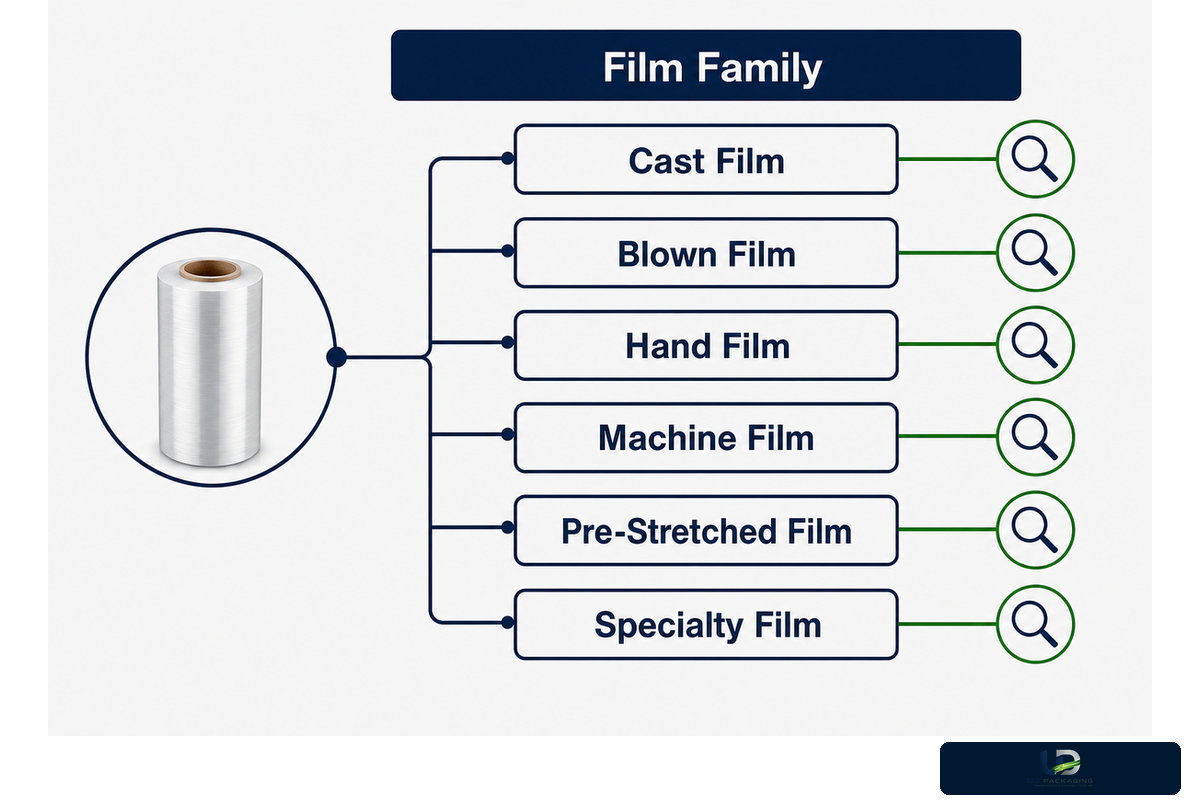
Construction, application grade, and specialty function do not by themselves prove equipment compatibility; they can change how a film unwinds, stretches, clings, tears, and runs through equipment. Films with similar stated gauges can still perform differently across trials. First, narrow down the family and then compare candidates within that family and process.
| Family | Useful screening question | Verify on the actual process |
|---|---|---|
| Cast film | Do clarity, quiet unwind, or consistent presentation matter? | Puncture, tear propagation, cling, useful stretch, and wrapper fit |
| Blown film | Does the load have irregular geometry or demanding contact points? | Unwind, optics, cling, tear behavior, and process repeatability |
| Hand film | Can the manual method be repeated safely across operators and shifts? | Applied pattern, film use, operator exposure, anchoring, and tail control |
| Machine film | Is the roll inside the wrapper’s dimensional and stretch capability? | Carriage, controls, film path, useful stretch window, breaks, and cycles |
| Pre-stretched film | Would lower application effort or a different force profile help? | Load fit and method; it is not automatically a machine-film substitute |
| Specialty film | Is there a real UV, opacity, ventilation, color, or VCI need? | Exposure, product compatibility, duration, and bounded claim evidence |
| Extended-core hand film | Does the handle format improve control for this operator and pattern? | Grip, overlap, tension consistency, fatigue, and film use |
| Vented stretch film | Must air movement or moisture escape remain available through the wrap? | Vent pattern, load containment, edge behavior, and route exposure |
A manufacturer explanation of blown and cast processing reveals why we should think about names as trade-offs rather than a rigid order. Variations in process can impact film characteristics such as optics, unwind, cling, and tear- and puncture-resistance, but these don’t demonstrate equal-thickness superiority across all loads.
This guide to stretch film groups the main types of stretch film as cast stretch film, blown stretch film, hand film, machine film, prestretch film, and specialty stretch film. A cast extrusion forms a flat web, while blown extrusion inflates a tube; both may use a multi-layer structure, and suppliers can extrude different constructions for different packaging needs.
Application grade is also of great significance. Hand stretch film for manual application has to be assessed in the context of the operator’s method and exposure. Machine stretch film for wrapper-based application must fit the equipment and function across multiple cycles. The same applies to a box, bag, drum, or irregular item: a feature that helps one package branch may shift the failure to another.
Machine-side fit varies too. Common stretch wrappers include turntable, rotary-arm, and rotary-ring systems. Blown machine film or cast machine film still has to fit the carriage and control range. Hand formats may use an extended core, while specialty constructions may vent a load or address other packaging products. In every case, a highly stretchable plastic film is not automatically a qualified film for the route.
Decision boundary: move to product evidence and a controlled sample trial if the choice now relies on a specific SKU, roll dimension, machinery control, or a verified specialty function.
4. Read Gauge and Thickness Without Treating Them as Strength Ratings
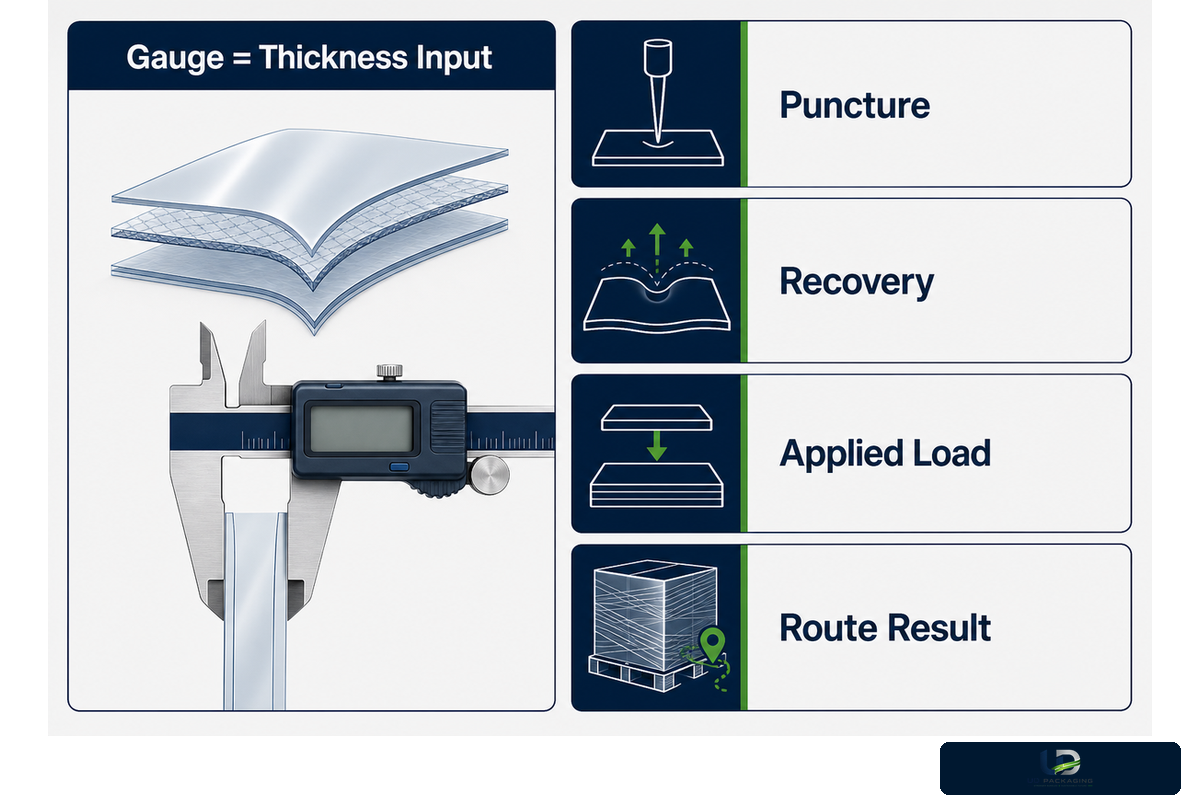
In common film language, gauge is an expression of thickness. In common film language, 100 gauge is approximately 1 mil, and 1 mil equals 25.4 micrometres. This conversion is handy for aligning units. It does not convert thickness into puncture resistance, holding force, useful stretch, or load capacity.
Two films of the same nominal thickness can also differ in the resin formulation, layer design, orientation, gauge consistency, cling system, stretch window, and tear propagation. Different thicknesses do not guarantee different results; two films can reach similar accepted outcomes through different property and application combinations. That’s why “equivalent gauge” and “equivalent performance” are separate claims.
ISO 527-3 provides conditions for assessing the tensile properties of plastic film and sheeting below a defined thickness. This method can support a material comparison under a particular set of conditions. The method, however, does not define a tensile value as the rating of pallet. Evidence for the film, the load, and the route must be provided.
A controlled downgauging example
Rolls A and B may be candidate rolls for the same repeating pallet. Roll B shouldn’t be declared the better roll because it’s thinner. Keep the pallet family, wrapper, and the operator or program, wrap pattern, staging interval, route, and pass/fail criteria the same. Note the roll identity, the measured film per load, film breaks, rewraps, cycle time, later state of the load, and accepted loads.
| Measurement type | Roll A record | Roll B record | Control or tolerance example |
|---|---|---|---|
| Nominal thickness | 23 μm | 20 μm | Record method to 1 μm |
| Film width | 500 mm | 500 mm | Hold within 5 mm |
| Starting roll mass | 16 kg | 14 kg | Scale resolution 0.1 kg |
| Representative load mass | 800 kg | 800 kg | Hold within 10 kg |
| Load height | 1500 mm | 1500 mm | Hold within 20 mm |
| Staging interval | 12 hours | 12 hours | Hold within 15 min |
| Ambient checkpoint | 23°C | 23°C | Record within 2°C |
| Applied-force checkpoint | 10 lbs | 10 lbs | Same tool within 1 lb |
| Application time | 45 sec | 47 sec | Same method within 3 sec |
| Film used per load | 0.42 kg | 0.38 kg | Scale resolution 0.01 kg |
| Break observation | 0% of 50 loads | 2% of 50 loads | Same 8-hour window |
| Accepted-load result | 100% of 50 loads | 96% of 50 loads | Written threshold 98% |
The thinner candidate fails the trial if breaks, rework, inconsistent containment, damage, or process instability rises beyond the agreed limit, even when apparent film use falls. The thicker candidate also fails if it solves no recorded problem and increases total material without improving the accepted outcome.
Stop rule: don’t publish a universal downgauging ratio. Match the film, process, load, observation window, and route before stating equivalence.
5. Apply Film as a Load-Containment System
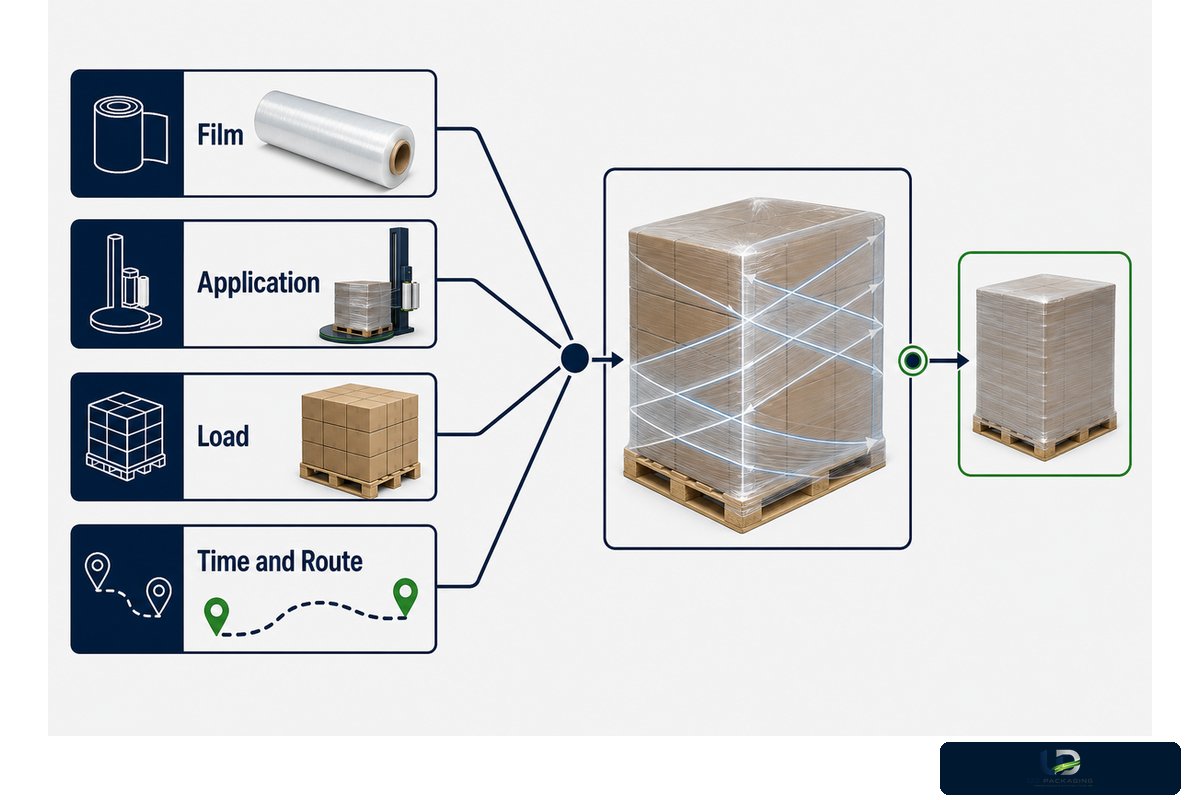
An acceptable roll may fail due to problems with anchoring, overlap, film path, force distribution, reinforcement, or poor cut-and-seal. The load itself may also settle, lean, bridge, or become compressed and present a smaller perimeter. For this reason, film and load should be observed simultaneously.
Control during a comparison
- representative load build and pallet;
- film roll and lot;
- wrapper, carriage, or operator method;
- anchoring, pattern, overlap, and reinforcement zones;
- staging time and ambient condition;
- repeat cycles and inspection points.
Do not hide with extra wraps
- unstable stacking;
- sharp or protruding contact points;
- worn rollers or poor film tracking;
- weak load-to-pallet connection;
- loose or dragging tails;
- an unrepresented route condition.
Containment isn’t the same thing as tightness. A manufacturer technical discussion on wrap force, film layers, throughput, and cost illustrates that similar containment can be achieved by different combinations, which can influence film usage and cycle time. The example isn’t a target for your pallet; rather, it illustrates that one input shouldn’t dominate the decision.
More pre-stretch isn’t always better. Film can be stretched beyond a useful operating range or applied in a manner that causes breaks, neck-down, or poor force distribution. Use the film and equipment maker’s verified limits, then prove the condition on the load. Never consider a setting from another film, wrapper, or pallet as a constant and transfer it to the load.
Manual wrapping involves a safety-related job review and a film trial. Semi-automatic or automatic equipment may minimize worker exposure in some cases. When deciding to purchase equipment, a risk assessment and a determination of the best-fit equipment based on the actual process shouldn’t be based on an arbitrary pallets-per-day rule.
Once process variables are captured, please review options for stretch film for that load. The commercial page holds the configuration decision, and this document holds the evidence to support it.
6. Use the Roll-to-Route Proof Ladder
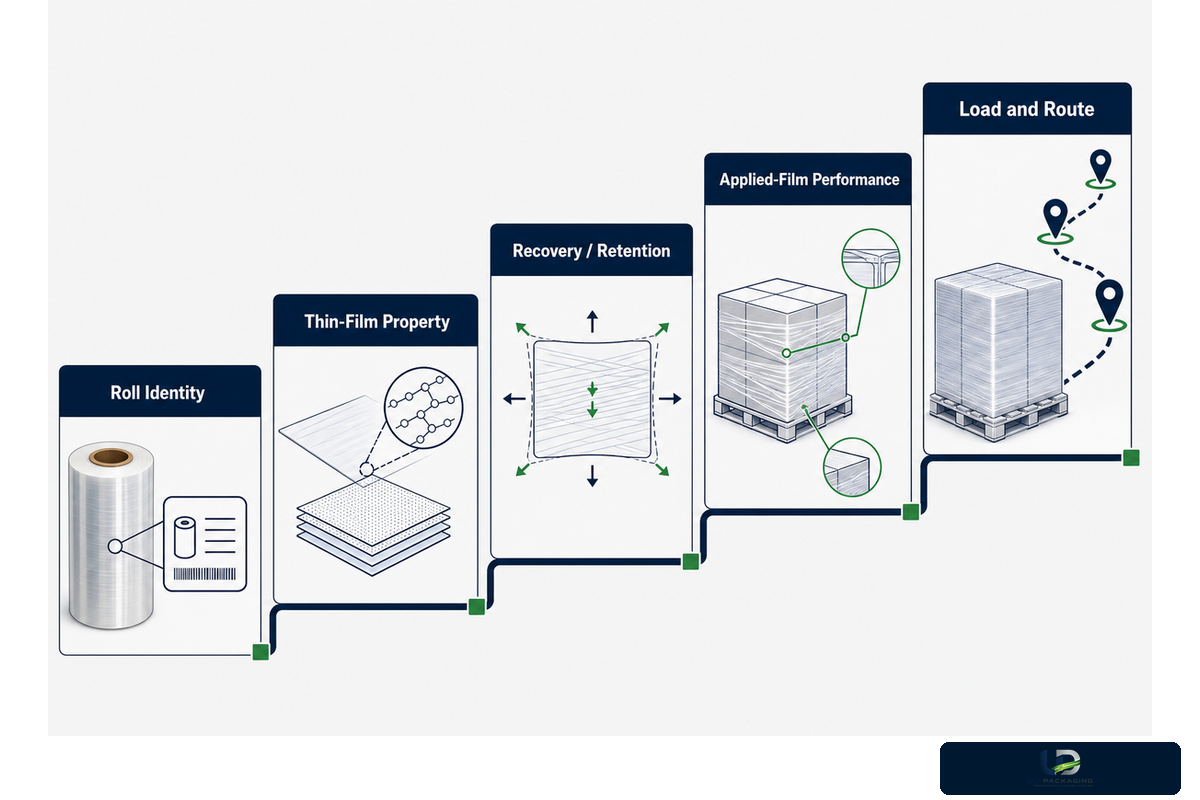
A stretch-film statement becomes more meaningful as the evidence moves from a roll identity to clearly specified material test, recovery behavior, performance after application, and wrapped load observation under the customer’s scope. Each step provides an opportunity to respond to a unique question. Higher steps don’t eliminate lower steps. They connect them.
| Rung | Object | Question answered | Output | Still unproven |
|---|---|---|---|---|
| 1. Roll identity | Named roll and lot | What exactly was supplied? | Specification, dimensions, traceability | Material result or load fit |
| 2. Thin-film property | Conditioned specimen | How did the film behave in the named material test? | Method, units, specimens, repeat result | Applied pattern or route result |
| 3. Recovery/retention | Film under defined extension and time | What recovery or stress remains under the method? | Elastic recovery, permanent deformation, retention | Load interaction and distribution |
| 4. Applied-film performance | Film on a unit load or test structure | What happened after the wrapper applied the film? | Defined applied-film measurements | Every dwell, climate, and route hazard |
| 5. Load and route | Representative wrapped pallet | Did the system meet the buyer’s release criteria? | Checkpoint, later-state, and distribution evidence | Unrepresented loads or routes |
The named methods define the ladder. ISO 527-3 addresses tensile properties of film and sheet specimens. ASTM D5459 covers machine-direction elastic recovery, permanent deformation, and stress retention of stretch-wrap film. ASTM D8314 addresses performance testing after stretch film has been applied to a unit load or test structure. ASTM D4649 provides selection and application guidance within its published boundary.
This shouldn’t be presented as a complete shipping certification. A credible report should not omit the standard and version, specimen or load, conditioning, method, units, repeat count, acceptance criterion, or responsible reviewer. When any of these changes, the answer is more restricted.
Dwell and temperature checks belong between applied-film measurement and route release when the shipment will experience them. A point-in-time reading is advantageous, but can’t be relied upon to be the value at dispatch or after a hot staging interval. Pallet stiffness, package build, and handling equipment continue to be part of the system, so be sure to record these even when the only change in the trial is the film.
This procedure is for broader distribution simulation. Select a corresponding method from the International Safe Transit Association’s test-procedure framework or another transport method-specific protocol. The selected method must address the expected outcome and the represented hazard. A screening test should be reported as a screening test.
Stop rule: don’t consider a result as a guarantee if the route, specimen, conditioning, or acceptance criteria are different from the evidence provided.
7. Compare Cost per Accepted Load, Not Price per Roll
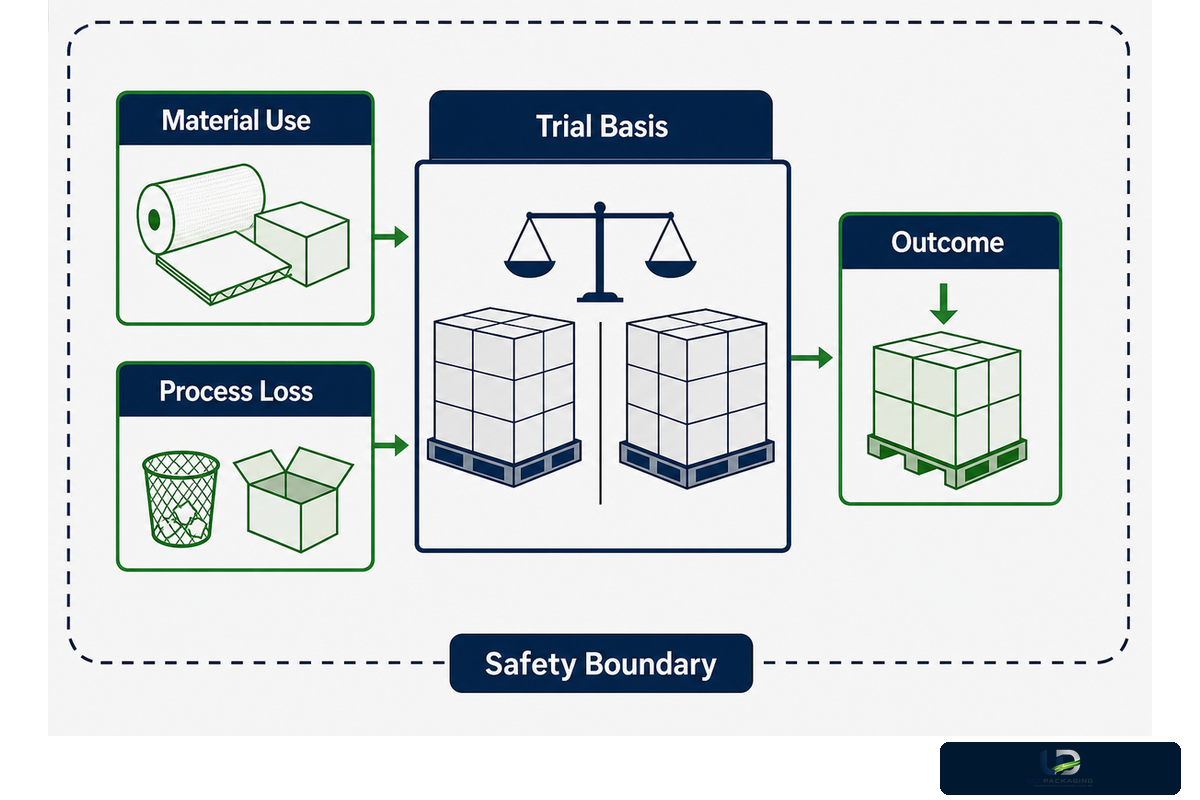
The best cost basis is the cost to produce an accepted load. The roll price is one input. Film use, breaks, rewrapping, application time, downtime, product damage, and rejected loads all influence the outcome.
An objective worksheet is provided to encourage an honest comparison. The same representative load family and the same application process, observation window, route exposure, and acceptance criteria are provided to each candidate. Then evidence is recorded as opposed to estimating it from a roll label.
| Field | Keep constant or measure | Why it matters |
|---|---|---|
| Trial basis | Load family, wrapper/operator, route, acceptance owner | Prevents a changed assumption from posing as improvement |
| Material use | Measured film per load on one unit basis | Roll length and gauge can distort price-only comparisons |
| Process loss | Breaks, rewraps, tails, downtime, cycle time | Cheap material can be expensive to run |
| Outcome | Accepted loads, movement, damage, exceptions | Only accepted output belongs in the denominator |
| Safety boundary | Manual-handling and equipment risks | Worker exposure is not a hidden productivity adjustment |
To determine the cost of each accepted load for internal analysis, the cost of the film that was actually consumed is added to the measured rework and process costs, then divided by the accepted loads. Keep the damage exposure visible rather than forcing an approximate value into the equation. If sample sizes, routes, or exclusions differ, label the comparison preliminary.
Stop rule: don’t report a savings percentage or a return-on-investment without client-specific data that’s verifiable. An honest worksheet is preferable to an exact number that’s the result of dissimilar analyses.
8. Read Failure Signals Before You Change Film
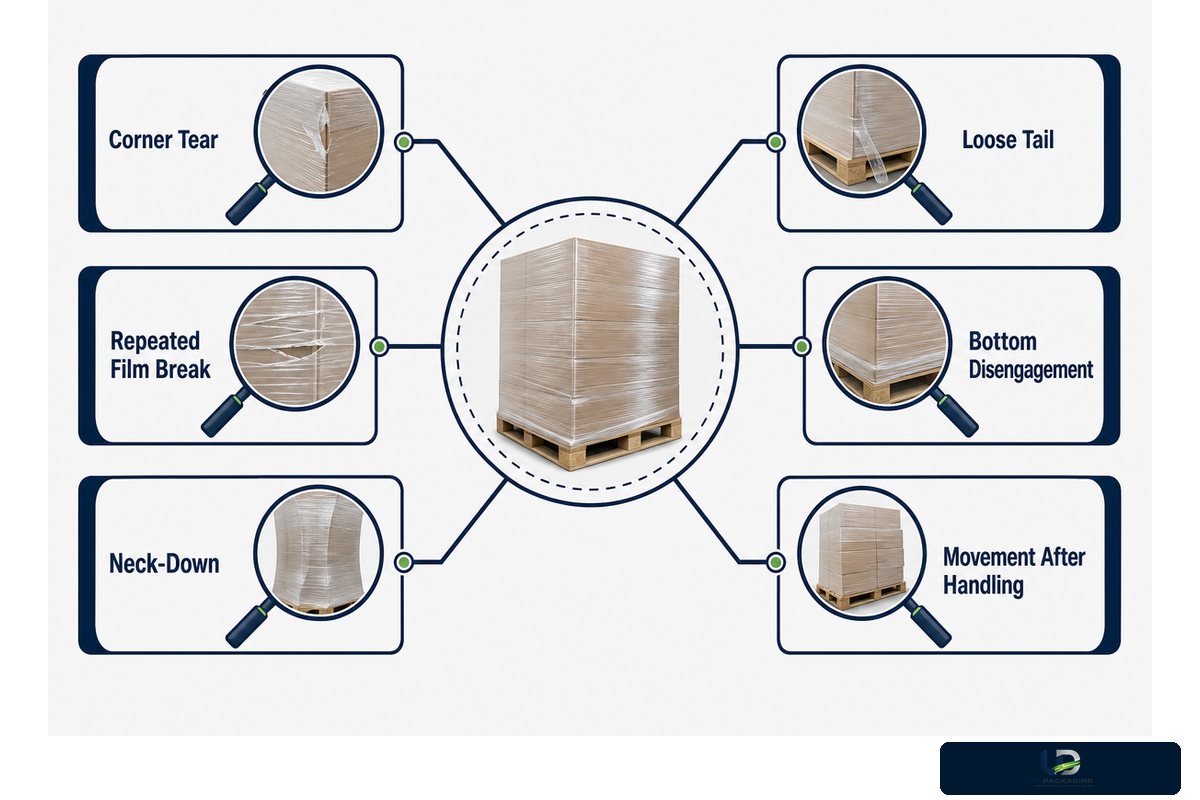
A thicker roll is not the best solution to every failure. Preserving the failed condition, classifying the signal, and changing one controlled variable at a time are better trial methods. Film, application, load, and route causes can produce similar symptoms.
| Signal | Check first | Preserve | Escalate when |
|---|---|---|---|
| Corner tear or puncture | Edge geometry, contact, film path, tension, tear direction | Failed film, roll/lot, load photo, location | Load is unstable or failure repeats under control |
| Repeated film break | Roll damage, rollers, carriage, useful stretch, burrs, alignment | Machine condition, setting, break point, control roll | Personnel enter a hazard zone or cause is unexplained |
| Neck-down or narrow coverage | Film behavior, tension, carriage path, overlap | Applied width by load level and cycle | Coverage no longer meets the written pattern |
| Loose or dragging tail | Cut, wipe, seal, cling surface, contamination | Tail location and finish condition | Tail can catch equipment or traffic |
| Bottom disengagement | Anchoring, load-to-pallet bond, pattern, pallet clearance | Bottom wraps and handling checkpoint | Load can separate from pallet |
| Movement after staging/handling | Load build, settling, time, temperature, pallet, route event | Before/after geometry and timeline | Release criteria fail or safety is involved |
One laboratory study of palletized-cargo stability published in a peer-reviewed journal reinforces the system boundary. Load stability is evaluated through defined dynamic conditions and measurements, not inferred from the presence of film. A pallet that looks organized can still have untested behavior.
If multiple factors change following a failure, the result may address the symptom without addressing the cause. Maintain the original roll, lot, load photos, wrapper or operator, pattern, setting or procedure, ambient condition, and the time of failure; do not substitute a vague label for the actual roll and lot identifiers. A thicker film could be a valid candidate, but it should be proposed as a hypothesis rather than a diagnosis.
Stop rule: quarantine and escalate an unstable load, a personnel-safety issue, repeated unexplained failure, or operation outside verified equipment or supplier limits.
9. What Current Stretch-Film Trends Mean for Buyers
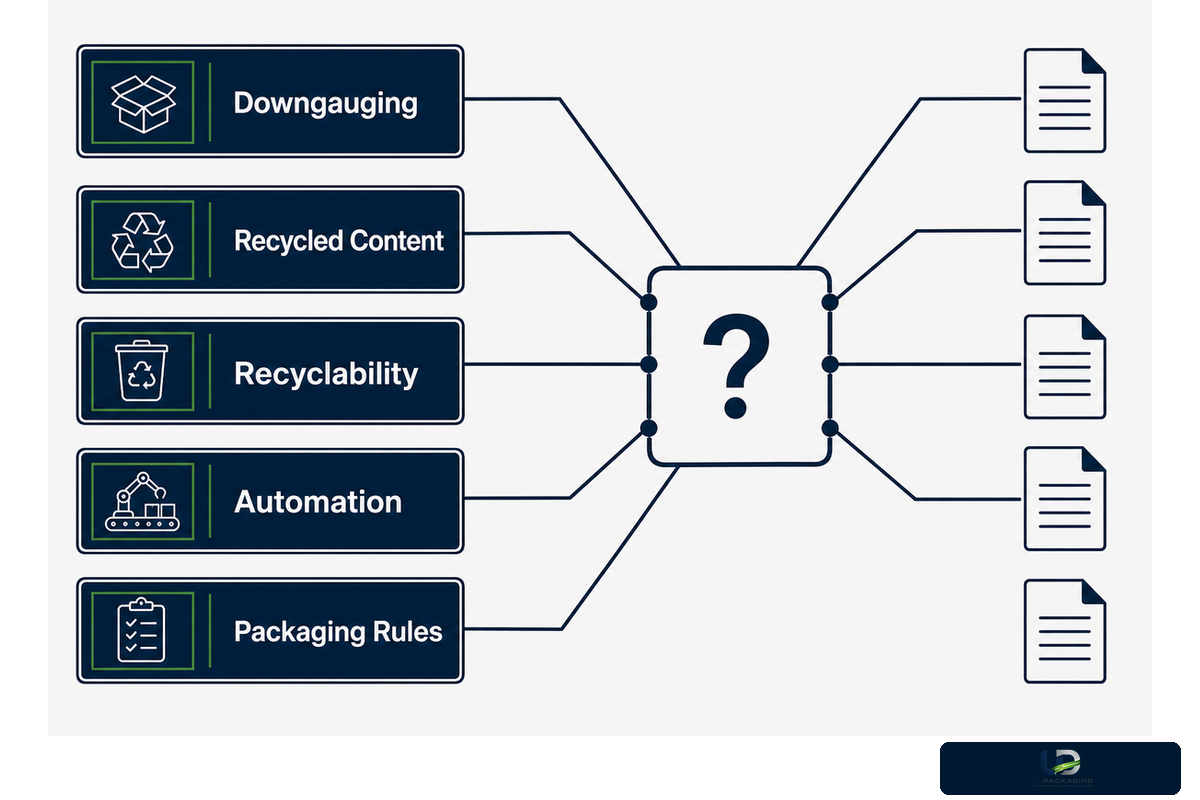
Packaging decisions increasingly account for material reduction, recycled-content pressure, automation, and changing local regulations. The buyer’s response isn’t to repeat trend language. It’s to ask what claim is being made and what evidence would support that claim for the actual load and the market.
| Trend | Buyer question | Proof to request | Claim to avoid |
|---|---|---|---|
| Downgauging | Does total film use fall for the same accepted load? | Controlled use, breaks, rewrap, time, and route result | Thinner always means less material overall |
| Recycled content | What percentage and material boundary is verified? | Declaration/certificate, covered product, lot, test evidence | Recycled content proves lower total impact |
| Recyclability | Is this film form accepted in the buyer’s real collection path? | Jurisdiction, collection, sorting, contamination, current acceptance | One resin code proves practical recycling |
| Automation | Will this roll and load run safely and repeatedly on the equipment? | Operating range, guarded process, repeated cycles, maintenance plan | One volume threshold proves automation fit |
| Packaging rules | Which format, operator, jurisdiction, article, and date apply? | Current legal text and qualified market-specific review | One global reuse or recycled-content rule |
The European Commission’s packaging waste resources suggest that, in packaging policy, format-specific details matter. A Commission delegated decision of 25 February 2026 exempts specified economic operators using pallet wrappings and straps from the 100% reuse requirements in Article 29(2) and (3). This delegated decision doesn’t repeal the wider Regulation (EU) 2025/40. Buyers need the actual law, format, and circumstance in which “reusable pallet wrap” is used, rather than the vague statement that “Europe requires reusable pallet wrap.”
Discipline should also be applied to packaging design. The FTC’s environmental-claims guidance discourages general, unsupported environmental-benefit claims. “Contains recycled content,” “uses less virgin resin,” “is recyclable,” and “is collected locally” are different statements. A buyer should ask for evidence for the particular statement in question.
Patent activity can suggest design interest without verified use. In this context, a 2024-granted load-wrapping patent covers packaging materials that include recycled content. This patent doesn’t describe any competitive advantage for UD Packaging, market dominance, or packaging improvement.
Stop rule: treat market forecasts and sustainability labels as background until they change a documented buyer decision and survive a claim-specific evidence check.
10. Turn the Decision Into a Supplier Handoff
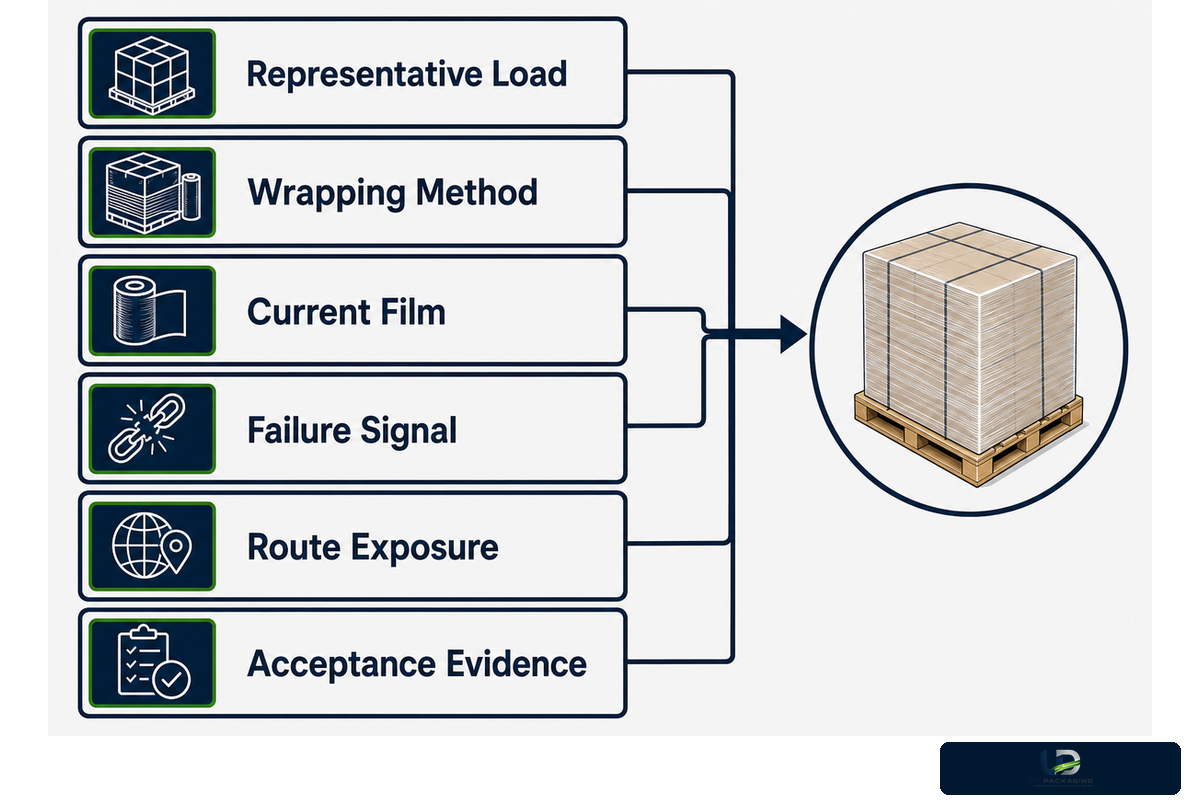
A stretch-film request for quotation usefully starts with a documented load and a specific acceptance problem. Width, length, and gauge should be included in the brief, but shouldn’t replace the application context. If every supplier is presented with a different assumption, their quotations won’t be useful or comparable.
One-page stretch-film RFQ brief
- Representative product, pallet footprint, height, and mass distribution
- Stack pattern, compressibility, protrusions, edges, and pallet condition
- Hand, semi-automatic, or automatic method; equipment make/model and limits
- Current film construction, gauge, dimensions, roll/lot, and measured use
- Current pattern, controls or procedure, failure signal, and when it occurs
- Staging time, handling, route, temperature, moisture, UV, or ventilation exposure
- Manual-wrapping ergonomic owner or equipment-safety owner where relevant
- Evidence requested: specification, material test, recovery, applied-load, or route trial
- Sample plan, repeat count, checkpoints, pass/fail criteria, and exceptions
- Buyer, operations, safety, quality, and release decision owners
Baseline vs Request. The baseline describes the current state: film, breaks, rewrap, time, movement, damage, and fields that are left incomplete. The request defines what a candidate must improve, without losing ground against a different requirement. “Stronger film” isn’t a complete request. The film may need to be stronger, but the “strength” of the film describes one of its many variable properties and may not address the recorded failure. This clearly doesn’t address the reason for the failure.
Ask the supplier to label each value with its object, method, unit, and conditions. A value of raw film shouldn’t ever be expressed as a value of applied load. A sample deemed acceptable in an on-the-spot assessment might not be considered “Route Proven” if transfer or handling checkpoints, dwell time, or temperature exposure were absent. The unknowns should remain visible until the end of the trial.
Once the brief is ready, review stretch film options for the documented load. UD Packaging describes itself as an integrated plastic packaging manufacturing and export company; the company background is on the About UD Packaging page. Only the commercial handoff is supported by this first-party identity; independent technical claims rely on the cited external evidence.
Have one representative pallet and a clear acceptance problem?
Share the load, wrapping method, route, current film, failure signal, and evidence you need. UD Packaging can review the appropriate film and sample branch without guessing at your process, while any unknown setting or acceptance field remains visible until the sample trial closes it.
11. Frequently Asked Questions
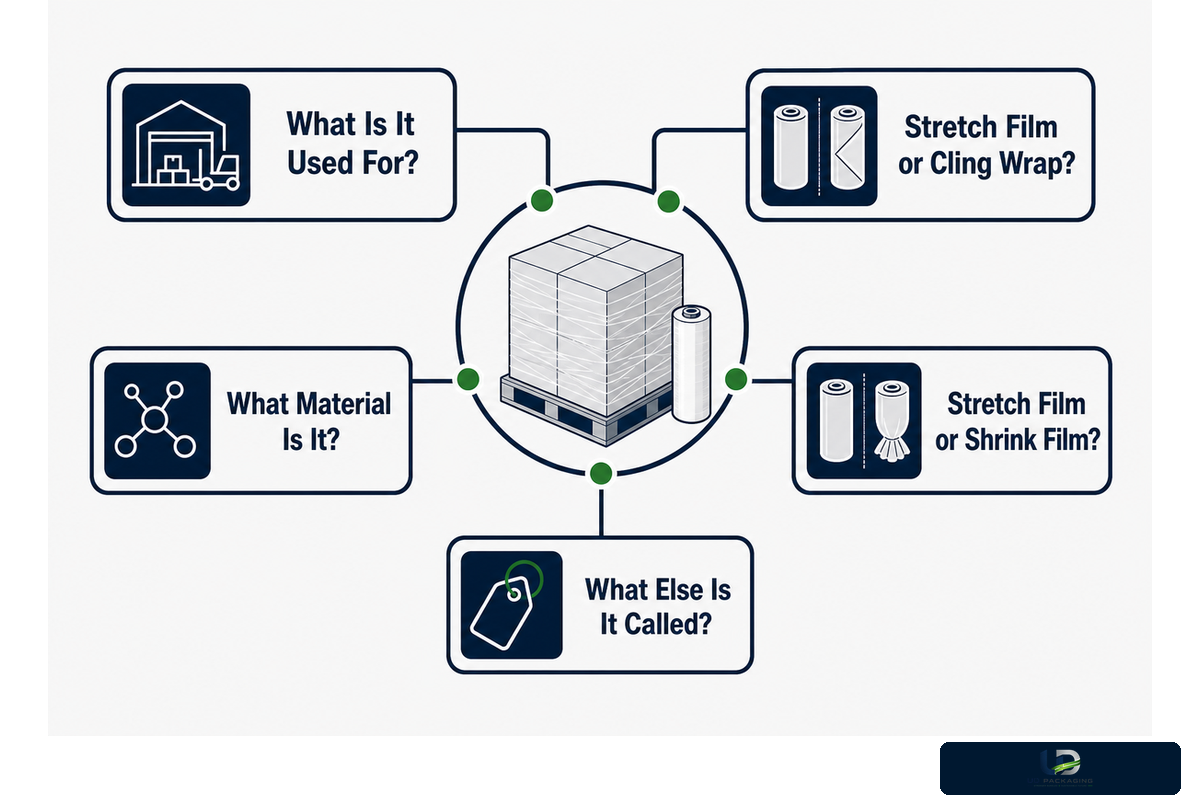
These answers provide a good base. A real film decision still needs the application, load, route, and evidence boundary described above.
What is stretch film used for?
Stretch film is commonly used to unitize palletized goods and protect grouped packaging products during storage and handling, but the load and route still govern final suitability.
Stretch film is commonly wrapped around palletized cartons, bundled products, furniture, and other grouped items to help keep them together and protect surfaces from dust or light moisture during storage and handling. That general use does not qualify every film for every load. Match the application method, load geometry, edge condition, route, and acceptance test before treating a film as suitable.
Is stretch film the same as cling wrap?
Not in normal industrial use; both can cling, but industrial stretch film and food cling wrap serve different applications, exposures, processes, and compliance requirements entirely.
Not in normal industrial use. Both films can cling, but industrial stretch film is designed around unitizing or protecting goods and is supplied in hand, machine, pre-stretched, and specialty formats. Food cling wrap is selected for food-contact and household use under different requirements. Do not substitute one for the other based only on the word “cling” or visual similarity.
What material is stretch wrap film made of?
Many industrial stretch films use polyethylene formulations, commonly LLDPE-based structures, but the material name alone does not define every layer, additive, process, or load result.
Many industrial stretch films are made from polyethylene formulations, commonly LLDPE-based structures, but “polyethylene” does not describe every layer, additive, process, thickness, or performance result. Ask for the actual construction and test basis when load performance, recycled content, UV exposure, corrosion protection, or food-contact suitability matters. The material family is a starting point, not a complete specification.
Is stretch film the same as shrink film?
No; stretch film is mechanically extended during wrapping, while shrink film contracts when heated, so shrink wrap and plastic wrap should not be treated as the same application.
No. Stretch film is mechanically extended and wrapped so recovery helps restrain the load. Shrink film is heated so it contracts around a product or group. Their materials may overlap, but the equipment, process hazards, load interaction, and qualification methods differ. Do not select one from the other’s settings or performance evidence.
What is another name for stretch film?
Common names include stretch wrap and pallet wrap, but buyers should add application grade, dimensions, load, route, wrapper, and required evidence to avoid an ambiguous specification.
Common names include stretch wrap and pallet wrap. For purchasing, add application grade, dimensions, load, route, and required evidence.
How This Guide Frames the Decision
UD Packaging supplies industrial packaging materials. This article deliberately separates film labels and material tests from application, load, route, and acceptance evidence. It doesn’t replace a load-specific trial or publish invented company performance data. The UD Packaging team can review a documented load through the commercial handoff.
References & Sources
- ASTM D4649, Standard Guide for Use of Stretch Films and Wrapping Application ASTM International
- ISO 527-3:2018, Test Conditions for Films and Sheets International Organization for Standardization
- ASTM D5459, Elastic Recovery, Permanent Deformation, and Stress Retention of Stretch Wrap Film ASTM International
- ASTM D8314, Performance Testing of Applied Stretch Films and Stretch Wrapping ASTM International
- Pilot Study of Stretch Film for Securing Palletized Loads peer-reviewed open-access research
- Study of the Stability of Palletized Cargo by Dynamic Test Method peer-reviewed open-access research
- Effect of Time and Temperature on Stretch Wrap Virginia Tech Center for Packaging and Unit Load Design
- ISTA Test Procedures International Safe Transit Association
- Stretch-Wrapping Pallets in Food Manufacturing WorkSafe Victoria
- Packaging Waste European Commission
- 2026 Delegated Decision on Pallet Wrappings and Straps European Commission
- Environmental Claims: Summary of the Green Guides U.S. Federal Trade Commission