Get in touch with UD Packaging Company

Updated November 2026 | Technical Incoming Inspection & Procurement Guide
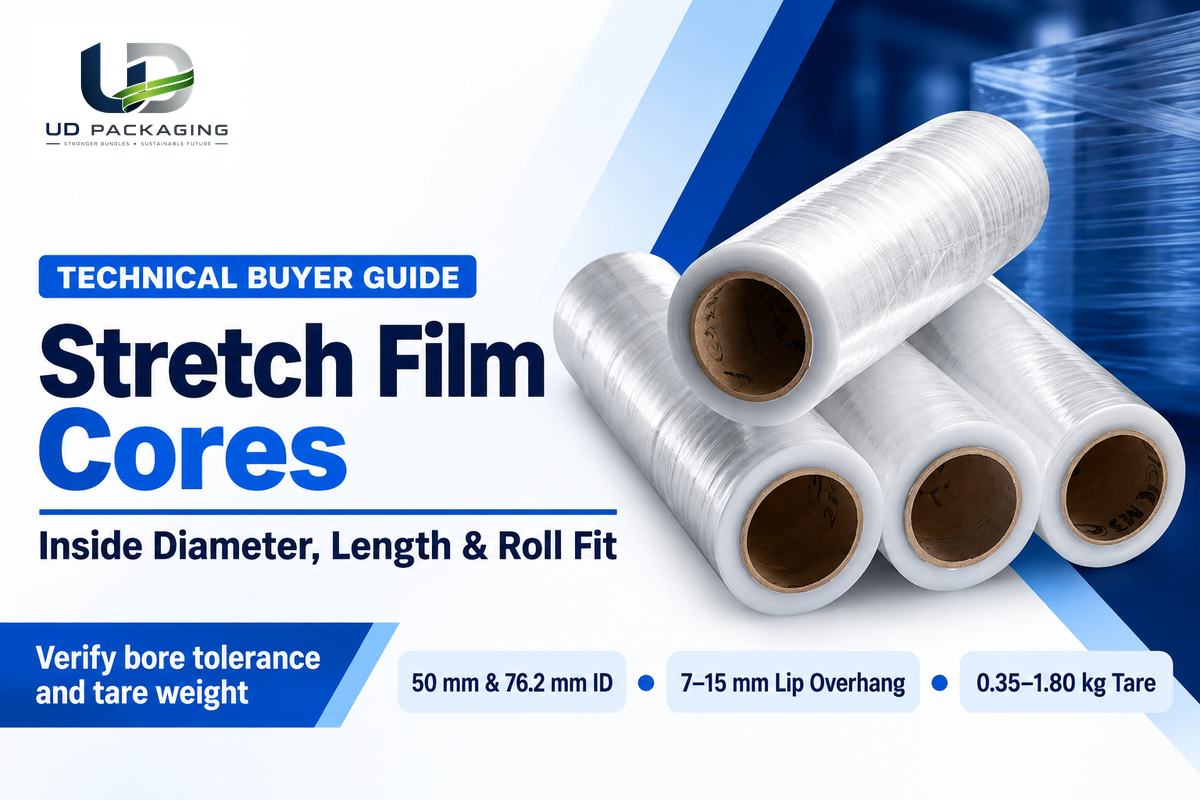
A stretch film core is the spiral-wound paperboard tube that supports linear low-density polyethylene film during winding, transit, and dispensing. North American hand rolls and global machine rolls typically use a 76.2 mm (3 in) inside diameter. European hand rolls commonly use a 50 mm (2 in) bore with 450 mm or 500 mm film width. Narrow bundling rolls use 38 mm (1.5 in) cores, while machine tubes add 7 to 15 mm of overhang per side.
On a 2.0 kg net hand roll, standard cores weigh 0.35 to 0.55 kg and heavy-wall tubes reach 0.70 kg. Machine roll cores typically weigh 1.1 kg to 1.8 kg depending on wall thickness and wrapper torque demands. Reviewing industrial stretch film roll specifications alongside ISO 11093 standards helps teams verify bore tolerance, radial crush, and net film weight.
Direct Answer: Standard machine stretch film cores use a 76.2 mm (3 in) inside diameter with a ±0.5 mm bore tolerance. Hand wrap cores measure 76.2 mm (3 in) in North America or 50 mm (2 in) in Europe and weigh 0.35 to 0.55 kg (up to 0.70 kg for heavy walls). Cored machine rolls typically include 7 to 15 mm of lip overhang per side.
| Parameter | Hand Stretch Film Roll | Machine Stretch Film Roll | Narrow Bundling / Extended Core |
|---|---|---|---|
| Nominal Inside Diameter (ID) | 50 mm / 50.8 mm (2 in) or 76.2 mm (3 in) | 76 mm / 76.2 mm (3 in, ±0.5 mm tolerance) | 38 mm (1.5 in) to 76.2 mm (3 in) |
| Standard Film Width | 450 mm or 500 mm (18 in US) | 500 mm (20 in US) | Custom bundling width or 450–500 mm web |
| Core Overhang / Extension | Flush edge or 7–15 mm lip per side | 7 to 15 mm lip per side (14–30 mm total) | 1 in to 5 in (25–127 mm) extended handle |
| Typical Core Tare Weight | 0.35 to 0.55 kg (up to 0.70 kg heavy wall) | 1.10 kg to 1.80 kg (varies by wall thickness) | Varies by handle extension and wall ply |
| Typical Wall Thickness | 3.5 mm to 4.5 mm light kraft wall | 6.0 mm to 12.0 mm high-stiffness wall | Matched to manual grip or bundling tension |
Key Engineering Takeaways
- Testing by ROLL Lab shows flat crush under ISO 11093-9 and CCTI T-108 correlates poorly with radial crush. Specify minimum radial crush in bar (method T-158 or T-159) with a margin over line pressure.
- A June 2026 peer-reviewed study in PubMed Central (PMC12656129) evaluated a 23 um roll. The paperboard tube accounts for about 1.5% of total climate impact.
- In empirical testing conducted by ROLL Lab, each one-percentage-point increase in moisture was found to reduce radial crush resistance by about 7.1%. It reduced inside diameter stiffness by 12.3%, and flat crush by 3.6%.
- On a 2.0 kg net hand roll, a 0.35 kg to 0.70 kg core is 14.9% to 25.9% of gross weight. Two 15.0 kg gross machine rolls with 1.1 kg versus 1.8 kg cores differ by 8% to 12% in usable film footage.
Standard Stretch Film Core Dimensions: Inside Diameter, Length, and Tare Weight
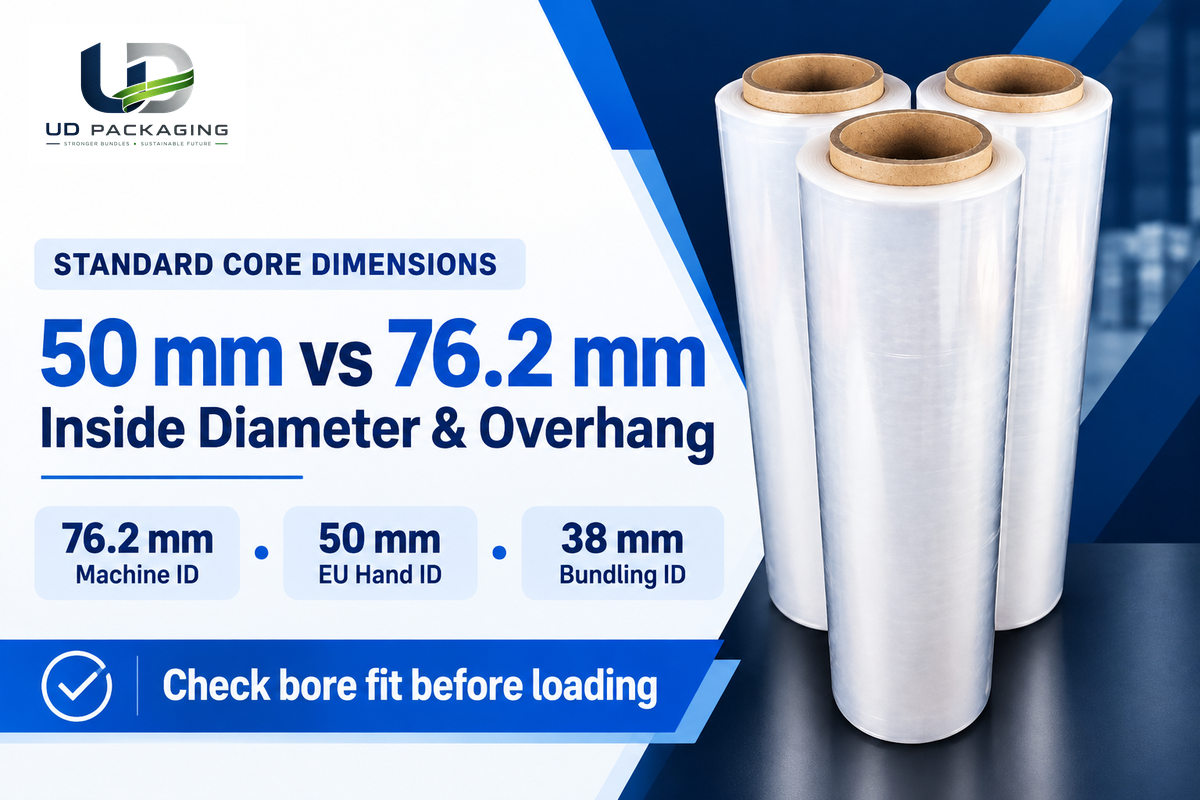
Standard machine stretch film cores use a 76.2 mm (3 in) inside diameter with ±0.5 mm tolerance. They also include 7 to 15 mm of overhang per side. Hand rolls use 76.2 mm in North America or 50 mm in Europe. Those hand cores weigh 0.35 to 0.55 kg, reaching 0.70 kg for thick walls.
Per iTeh’s summary of ISO 11093-4:2022 (ISO 11093-4), the standard specifies dimensional test methods for paper and board cores. It covers internal diameter, external diameter, wall thickness, and length. Specs from Western Container Corp show converters build spiral-wound film cores in 2 inch (50.8 mm) and 3 inch (76.2 mm) inside diameters. Hanpak notes that US hand wrap uses 18 inch width on 3 inch (76 mm) cores. European plants use 450 mm or 500 mm film width on 50 mm hand cores and 76 mm machine cores.
A core with an actual 76.0 mm bore has 0.2 mm diametral interference on a rigid 76.2 mm shaft. An undersized 76.0 mm cardboard core forced onto a 76.2 mm solid steel mandrel binds on packaging equipment. Conversely, excessive bore clearance slips on mechanical cones during carriage acceleration. Regional inside diameter preferences (76.2 mm in North America versus 50.8 mm in Europe) vary by dispenser fleet and converter tooling.
| Roll Format & Source Benchmark | Inside Diameter (Metric / Imperial) | Film Width | Core Length / Overhang | Core Tare Weight | Wall / Film Gauge |
|---|---|---|---|---|---|
| North American Hand Wrap (Hanpak / Western Container) | 76.2 mm (3.0 in) | 18 in (457 mm) or 20 in | Flush or +7 to 15 mm lip/side | 0.35 kg to 0.55 kg (0.70 kg heavy) | 3.5–4.5 mm wall; 60–120 gauge |
| European Hand Stretch Film (Hanpak Benchmark) | 50 mm / 50.8 mm (2.0 in) | 450 mm or 500 mm | Flush or +7 to 15 mm lip/side | 0.35 kg to 0.55 kg standard | 15 um to 30 um film thickness |
| 2.0 kg Net Hand Roll (Teagolpack Specification) | 76 mm (3.0 in) | 500 mm | Matched to 500 mm web | 0.35 kg to 0.70 kg paper core | 20 um (80 gauge) LLDPE film |
| Machine Stretch Film Roll (Hanpak / Sonoco RCS) | 76 mm / 76.2 mm (3.0 in, ±0.5 mm) | 500 mm (20 in) | 514 mm to 530 mm (+7–15 mm/side) | 1.10 kg to 1.80 kg core mass | 6.0–12.0 mm wall; 15–30 um film |
| Extended Core Bundling Roll (Castle Industrial) | 38 mm (1.5 in) or 76.2 mm (3 in) | Bundling or hand width | +1 in to 5 in (25–127 mm) extension | Includes extended handle mass | 15 um to 23 um LLDPE wrap |
When sourcing manual hand stretch film rolls with 50 mm and 76 mm cores, be sure to align the inside diameter of the core tube first to your hand brake dispensers. Switching from a 76 mm core to a 50 mm lighter core reduces core tube diameter when film weight, wall thickness, and carton packing remain comparable. Confirm first that your floor dispensers have a 50 mm hub cone for pallet wrapping.
Flush Core vs. Extended Core vs. Coreless Stretch Film Rolls: Dispenser Fit and Waste Trade-Offs
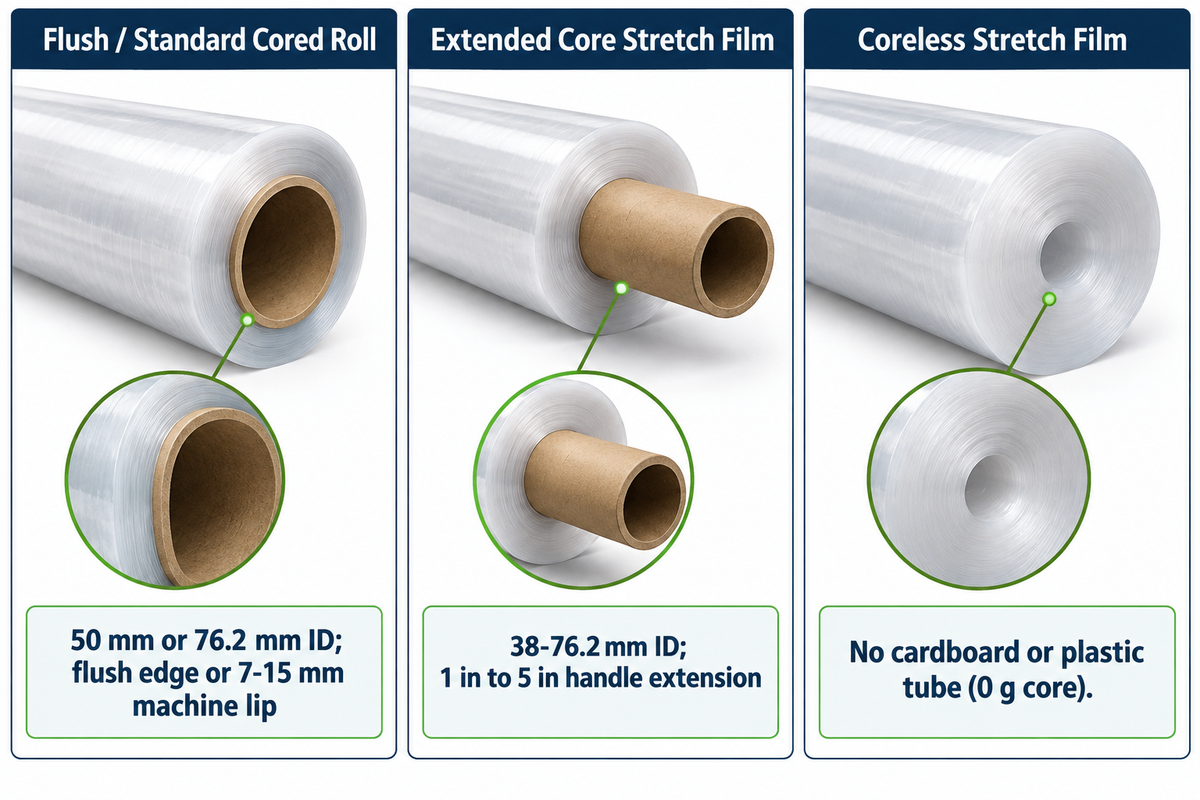
Choose flush core rolls when core bore and outside diameter of the roll match your dispensers or pallet wrappers. According to Castle Industrial, extended core stretch film uses a 1 inch handle extension on hand rolls or a 5 inch extension on machine rolls. Use coreless stretch films with compatible reusable hand adapters or expanding mandrels.
A flush paperboard core ends approximately level with the film edges. Some cored machine rolls leave an exposed cardboard lip where carriage chucks need edge clearance. Per Castle Industrial, extended core pallet wrap uses a cardboard core that protrudes 1 inch on hand rolls or 5 inches on machine rolls beyond the film width. On hand rolls, that 1 inch extension acts as a built-in core handle. Extended core films let operators grip the tube directly when bundling multiple boxes into a single bundle. Teams also use them to secure irregularly shaped items or wrap bulky products in tight staging aisles. Bare cardboard handles generate friction against operator gloves. High-volume lines insert reusable plastic core plugs (as warehouse operators note in packaging forum discussions) to improve ergonomics and simplify manual wrapping.
| Comparison Dimension | Flush / Standard Cored Roll | Extended Core Stretch Film | Coreless Stretch Film |
|---|---|---|---|
| Core Tube Geometry | 50 mm or 76.2 mm ID; flush edge or 7–15 mm machine lip | 38–76.2 mm ID; 1 in to 5 in handle extension | No cardboard or plastic tube (0 g core) |
| Dispenser Hardware Required | Matched hand dispenser cone or machine chuck | Built-in paper handle or optional spinning plug | Reusable hand adapter or expanding mandrel (e.g., US9212022B2) |
| Cardboard Waste per Roll | 0.35–0.55 kg (hand, up to 0.70 kg) or 1.1–1.8 kg (machine) | Paperboard tube plus 1–5 in protruding handle section | 0 kg paperboard tube waste (reduced waste) |
| Stretching Application | Powered pre-stretch (such as 250% gear ratio) or hand brake | Manual pull; stretch depends on film and operator | Manual adapters or specialized coreless unwinders |
| Risk to Inner Film Layers | Low when radial crush exceeds wound film pressure | Extended handle bending if dropped during staging | Inner layer tearing or bore deformation without internal support |
Many companies believe switching to coreless stretch wraps would instantly reduce their carbon footprint. A June 2026 peer-reviewed life-cycle assessment published in PubMed Central (PMC12656129) studied the impact of a traditional 23 um stretch wrap. The assessment found that the cardboard core accounts for only roughly 1.5% of the roll’s total climate impact. LLDPE resin makes up the vast majority of the roll’s impact. If a coreless roll snags on an unsuited shaft and requires additional wraps, higher film consumption can offset the 1.5% core impact shown in that study.
Right-sizing cores is also in accordance with European packaging waste rules. According to the European Commission, and EUR-Lex summary of Regulation (EU) 2025/40, the EU Packaging and Packaging Waste Regulation became effective in February 2025. Both the UK government PPWR guidance and Baker McKenzie note the regulation comes into force on August 12, 2026. The regulation’s extended producer responsibility framework establishes progressive per-capita packaging waste reduction targets for 2030, 2035 and 2040. It also extends producer responsibility. The use of lighter rolls with right-sized cores supports sustainable packaging and corporate sustainability goals without compromising load stability.
Incoming Quality Control: Checking Inside Diameter Tolerance, Lip Overhang, and Radial Crush
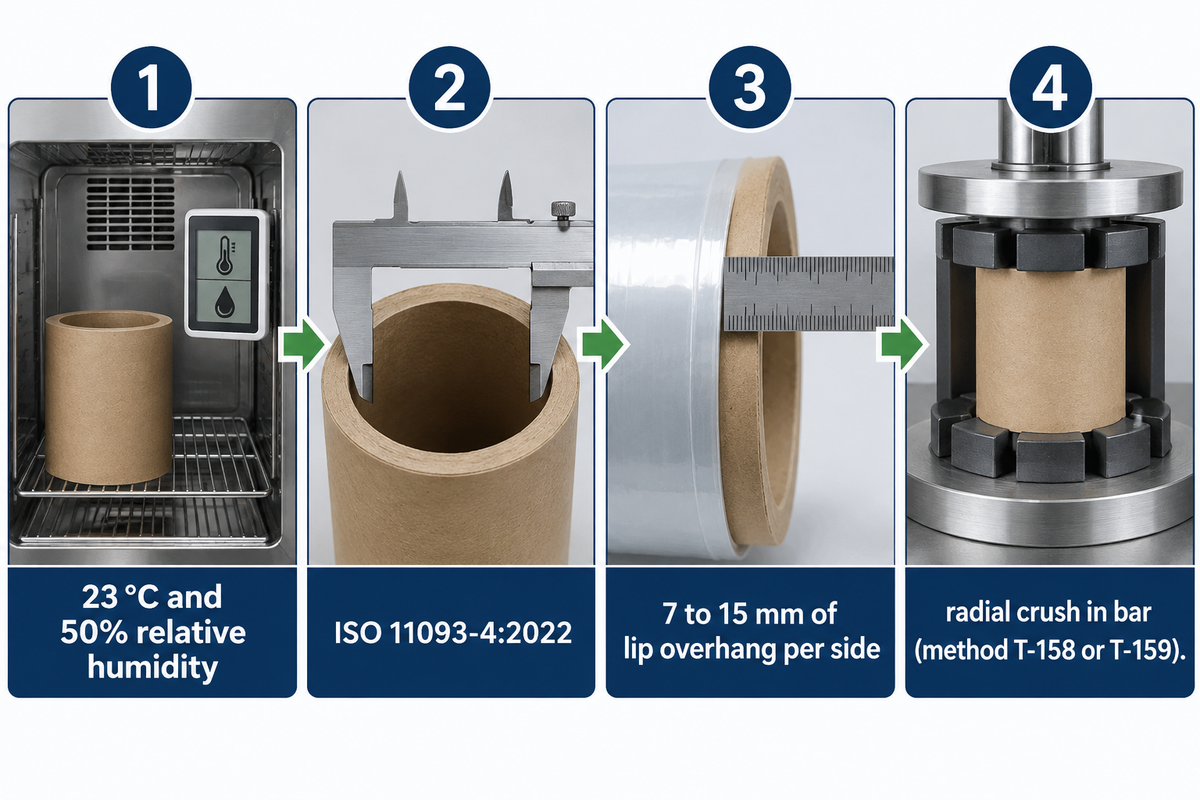
Condition laboratory core samples at 23 °C and 50% RH per ISO 11093-2:2025 until two weighings at least 48 hours apart differ by 0.1% or less of mass. Measure inside diameter, wall thickness, and length per ISO 11093-4:2022, verify carriage lip clearance, and specify minimum radial crush in bar (T-158 or T-159) plus ID stiffness.
Bore, Lip & Crush Protocol for Receiving Dock Verification
This receiving protocol integrates laboratory conditioning with dimensional measurement, lip extension verification, and radial crush testing.
- Prerequisite laboratory conditioning (ISO 11093-2 / iTeh ISO 11093-2:2025 summary) replaces the 1994 edition. It prepares core specimens at 23 °C and 50% relative humidity. Moisture equilibrium is reached when two consecutive weighings at least 48 hours apart differ by 0.1% or less of mass.
- Per iTeh, ISO 11093-4:2022 specifies test methods for internal diameter, external diameter, wall thickness, and length of paper and board cores. At receiving, internal caliper readings across multiple angles at both tube ends check bore roundness (
Ovality = D_max - D_min), while a Go/No-Go plug gauge checks pass/fail bore limits. - When machine film carriages or chuck jaws require axial edge clearance, verify the exposed paperboard lip overhang per side to match your carriage support plate. On equipment where the film edge can contact the bottom support plate, a zero-overhang or recessed core can allow rubbing and edge damage during wrapping pallets.
- Testing by ROLL Lab shows flat crush under ISO 11093-9:2019 (and CCTI T-108) is a platen production check. Meanwhile, Pacorr notes that ASTM D2659 evaluates vertical platen compressive strength of paper cores and ASTM D2412 covers plastic tubes and cores. Specify minimum radial crush in bar with the test method stated (T-158 or T-159) and a safety margin over line pressure. Pair that target with inside diameter stiffness in bar per 0.1 mm of ID reduction.
” Flat crush (crushing between plates, kN/m), radial crush (uniform pressure, bar) and ID stiffness (bar per 0.1 mm of ID reduction) are three different values. For film rolls the last two matter, and flat crush does not predict them.”
Specify radial crush and inside diameter stiffness separately from flat crush when evaluating thin-wall cores. According to Hanpak, a wrapper set to 250% pre-stretch needs a film and roll assembly that handles that gear ratio without breaking. Consider an illustrative beverage warehouse scenario using 20 um machine rolls on a 250% pre-stretch rotary arm wrapper. Dropped cartons with nicked core lips and zero overhang let the bottom film edge rub the carriage plate. Specifying a 76.2 mm (±0.5 mm) core with 7 to 15 mm of lip overhang per side prevents edge rubbing. Adding a radial crush rating per T-158 or T-159 also avoids unplanned roll-change downtime.
Core Tare Weight vs. Net Film Weight: Auditing Real Film Cost per Kilogram
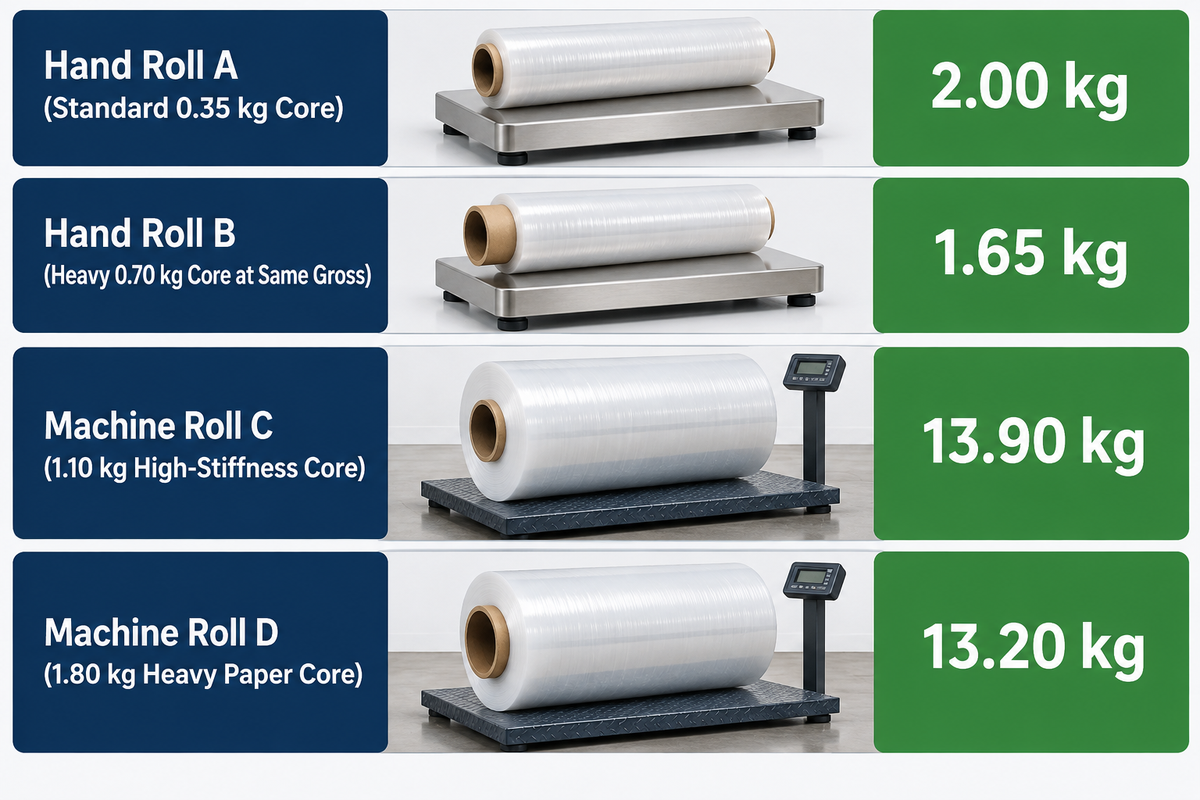
Cardboard core tare weight reduces usable plastic on every roll sold by gross weight. Buyers must deduct core mass (Net Film Weight = Gross Roll Weight - Core Tare Weight) from every shipment. That step determines verified net film weight and estimates linear roll length from nominal width, thickness, and density.
Net-Film Tare Audit Equation for Gross vs. Net Roll Billing
Subtracting core tare weight from gross roll weight gives the net LLDPE film mass, which is then used to approximate linear meters per roll.
Assumed inputs: First, consider a 2.0 kg net hand stretch film roll (500 mm width, 20 um thickness, 0.92 g/cm3 LLDPE density). A standard 0.35 kg core yields a 2.35 kg gross roll (14.9% core share of gross weight). A heavy 0.70 kg core yields a 2.70 kg gross roll (25.9% core share of gross weight). If that 2.70 kg gross roll is billed at net-film rates, the 0.35 kg extra paperboard creates a 17.5% to 35.0% film-weight penalty. Second, in the fixed-gross-weight table below, Supplier A and Supplier B both ship a 2.35 kg gross hand roll. Machine Roll C and Machine Roll D both ship a 15.0 kg gross machine roll. In the hand-roll comparison, the core is 14.9% of Roll A’s gross weight and 29.8% of Roll B’s. At an illustrative $5.00 per roll, Roll B costs 21.2% more per net kilogram of film.
| Roll Billing Scenario (Assumed Inputs) | Gross Roll Weight | Core Tare Weight (Share of Gross) | Verified Net Film Weight | Estimated Length (500 mm x 20 um) | Net Film Difference |
|---|---|---|---|---|---|
| Hand Roll A (Standard 0.35 kg Core) | 2.35 kg | 0.35 kg (14.9% of gross) | 2.00 kg | 217.4 m | Baseline ($2.50/net kg at $5.00/roll) |
| Hand Roll B (Heavy 0.70 kg Core at Same Gross) | 2.35 kg | 0.70 kg (29.8% of gross) | 1.65 kg | 179.3 m (-38.1 m) | $3.03/net kg (+21.2% unit film cost) |
| Machine Roll C (1.10 kg High-Stiffness Core) | 15.00 kg | 1.10 kg (7.3% of gross) | 13.90 kg | 1,510.9 m | Baseline 15.00 kg gross machine roll |
| Machine Roll D (1.80 kg Heavy Paper Core) | 15.00 kg | 1.80 kg (12.0% of gross) | 13.20 kg | 1,434.8 m (-76.1 m) | -0.70 kg net film (8%–12% footage gap across gauges) |
Two 500 mm machine rolls labeled 15.0 kg gross weight can differ by 8% to 12% in usable film footage. That gap occurs when one supplier substitutes a 1.8 kg paper core for a 1.1 kg high-stiffness core. High pre-stretch machine rolls still need sufficient wall thickness and radial crush resistance to prevent collapse. For thickness unit conversions during incoming audits, see our guide on converting stretch film gauge and mils to microns.
Paperboard core costs have also risen across the packaging industry in 2026. Data from Towards Packaging projects the global paper cores market to grow from USD 5.13 billion in 2026 to USD 7.55 billion by 2035 (4.37% CAGR). Meanwhile, a market report vendor (DataIntelo) values the 2025 market at $4.8 billion and projects $7.6 billion by 2034 (5.2% CAGR). According to Sonoco Investor Relations and market consultancy Prismane Consulting, Sonoco announced an 8% price increase on converted tubes and cores effective April 2026. That April notice also added $70 per ton on URB in the US and Canada (€80 per ton in EMEA) amid sustained inflation and high mill utilization. Sonoco followed with a 7% converted products increase and $60 per ton on URB effective 8 July 2026.
In the United Kingdom, core manufacturer Just Paper Tubes implemented a 10% price increase on cardboard tubes and paper cores effective 1 October 2026. In Just Paper Tubes’ 2026 energy and material cost analysis, domestic OCC 1.04 recovered paper prices rose from £65–£80 to £84–£98 per tonne between June and October 2026. That shift represents an approximately 25.5% increase in the range midpoint. The same manufacturer reported that European TTF gas stood at €94.20/MWh on 2 November 2026, roughly 199% above the pre-war level of €31.51/MWh on 27 February 2026. UK average diesel pump prices also rose 19.2% from 167.12p per litre (week of 29 June 2026) to 199.22p per litre (week of 26 October 2026).
Matching Core Specifications to Hand Dispensers, Turntables, and Rotary Arm Stretch Wrappers
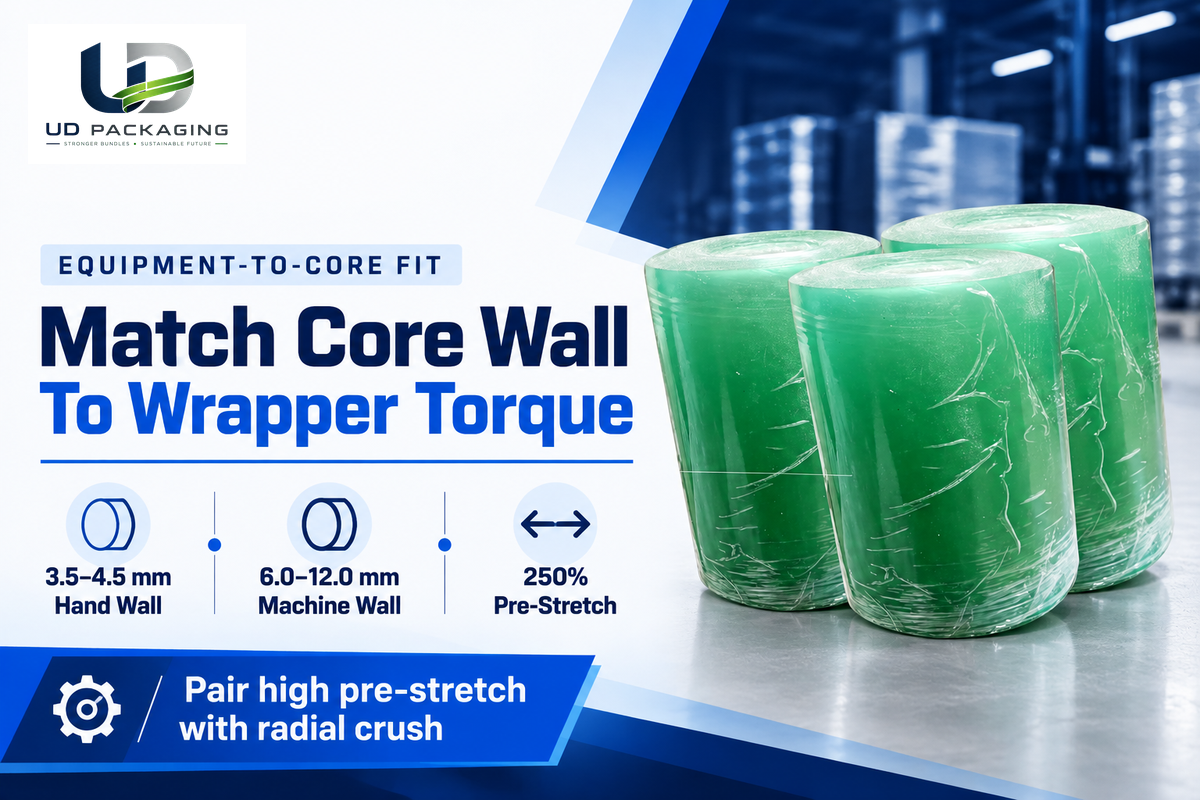
Match 50 mm (2 in) or 76.2 mm (3 in) thin-wall cores (3.5 to 4.5 mm wall) to manual hand dispensers. Use 76.2 mm (±0.5 mm) cores with 6.0 to 12.0 mm wall thickness and verified radial crush resistance on turntable, rotary arm, and ring stretch wrappers.
When film is wound onto a paperboard sleeve and mounted on a stretch wrapper, the carriage pre-stretch gears and mandrel chuck load the tube. High-speed winders and automatic ring wrappers apply high torque during acceleration and deceleration. Product data from Sonoco indicate their Radial Crush Strength (RCS) cores support high-tension film winding. Sonoco’s T2 Torque Transmission film cores are designed to improve torque transfer at the chuck-to-core interface. For facilities that use both cored and coreless rolls, USPTO Patent US9212022B2 discusses an adjustable cylindrical mandrel. It uses 45-degree slanted-plane segments that expand radially to evenly distribute the grip on the bore. Radially expanding slanted-plane mandrels are one type of engineering design for coreless or rolls with thin sidewalls. Pneumatic and mechanical friction chucks are the standard chucks for cored pallet wrappers.
| Wrapping Equipment Type | Tension / Pre-Stretch Mode | Nominal Core ID | Core End Geometry | Mandrel / Chuck Interface | Recommended Core Construction |
|---|---|---|---|---|---|
| 1. Dispenser-Free Manual Wrapping | Manual operator hand tension | 38 mm (1.5 in) to 76.2 mm (3 in) | 1 in to 5 in extended handle | Direct hand grip on core extension | Spiral paperboard extended core |
| 2. Plastic Core-Plug Hand Wrapping | Manual pull with spinning inserts | 50.8 mm (2 in) or 76.2 mm (3 in) | Flush edge or standard lip | Snap-in rotating polymer core plugs | 3.5–4.5 mm wall (0.35–0.55 kg) hand core |
| 3. Two-Handed Tension Brake Dispenser | Mechanical hand-brake tension | 50 mm (EU) or 76.2 mm (US) | Flush edge or 7–15 mm lip | Threaded top cone and base hub plate | 0.35–0.55 kg (up to 0.70 kg) kraft core |
| 4. Coreless Manual or Expanding Mandrel | Manual or light unwind tension | 50.8 mm or 76.2 mm boreless eye | No paperboard tube (0 g core) | Reusable hand rod or expanding mandrel | Coreless wound LLDPE roll |
| 5. Core-Brake Turntable Pallet Wrapper | Mechanical brake carriage tension | 76 mm / 76.2 mm (3 in, ±0.5 mm) | 7 mm to 15 mm lip per side | Top friction cone + bottom carriage plate | 6.0–12.0 mm wall (1.1–1.8 kg) machine core |
| 6. Powered Pre-Stretch Turntable Wrapper | Powered gear pre-stretch (e.g., 250%) | 76 mm / 76.2 mm (3 in, ±0.5 mm) | 7 mm to 15 mm lip per side | Spring-loaded top cone + bottom mandrel | High radial-crush core (T-158 / T-159 rated) |
| 7. High-Speed Rotary Arm Wrapper | Powered carriage pre-stretch (e.g., 250%) | 76.2 mm (3 in, ±0.5 mm tolerance) | Matched to rotary carriage clearance | Pneumatic or mechanical expanding chuck | Radial-crush rated core (e.g., Sonoco RCS) |
| 8. High-Speed Automatic Ring Wrapper | High-acceleration ring winding & braking | 76.2 mm (3 in) precision bore | Matched to ring shuttle chuck width | High-torque expanding mandrel lugs | Torque-transmission core (e.g., Sonoco T2) |
| 9. Slanted-Plane Expanding Mandrel System | Cored or coreless roll dispensing | Adjustable cylindrical bore grip | Flush cored or coreless roll edge | 45-degree slanted-plane radial segments (US9212022B2) | Standard paperboard core or coreless roll |
When using machine stretch film rolls for automated pallet wrappers, check your carriage housing clearance and the diameter of your mandrels first. Jumbo rolls are able to feed an appropriately rated unwind system or a rewinder; the roll support must be able to accommodate the mass, outside diameter, and core bore of the rolls.
Preventing Core Collapse, Chuck Slippage, and Edge Nicking in Humid Warehouses
Prevent stretch film core failures on the warehouse floor by storing palletized rolls off damp concrete in conditioned areas. Verify ±0.5 mm machine bore tolerance before loading. Also maintain 7 to 15 mm of undamaged cardboard lip per side where required by the wrapper carriage.
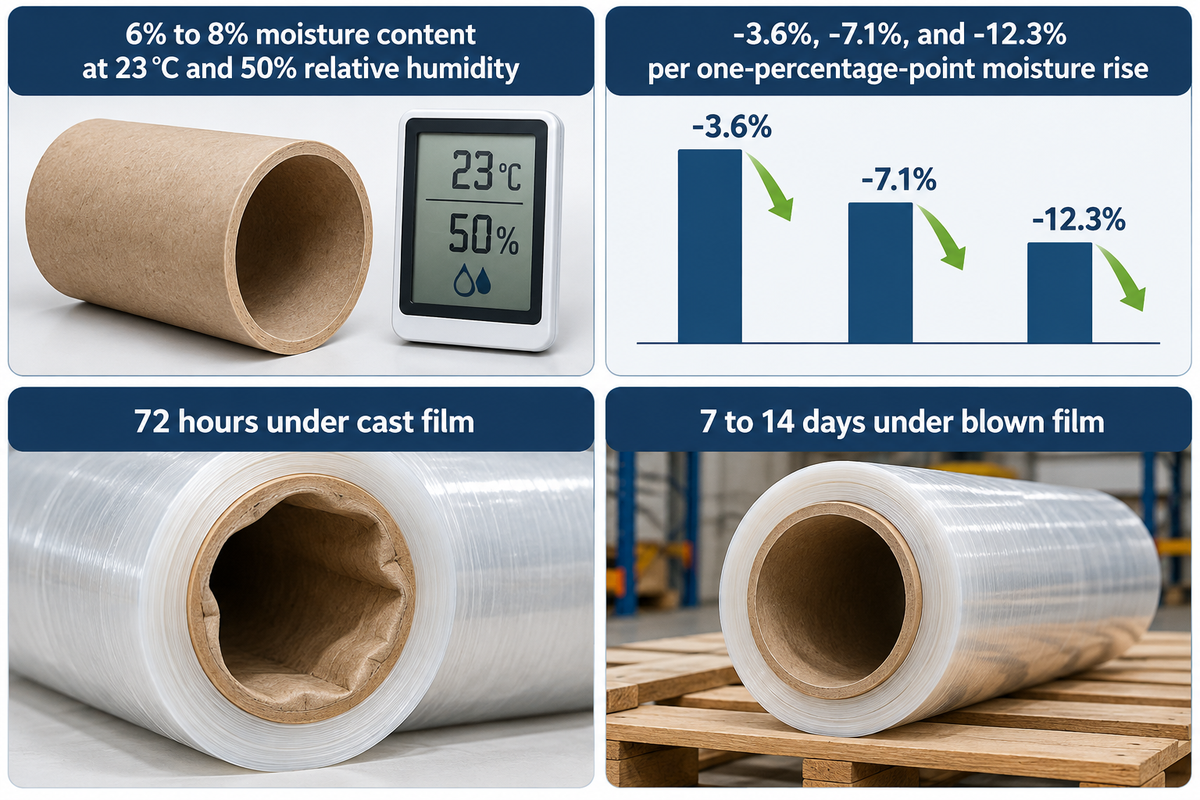
High ambient humidity in transit and storage rapidly weakens spiral-wound paperboard. Under ISO 11093-2:2025, laboratory moisture equilibrium occurs when two weighings at least 48 hours apart differ by 0.1% or less of mass. ROLL Lab’s empirical testing shows paper cores typically equilibrate at 6% to 8% moisture content at 23 °C and 50% relative humidity. In ROLL Lab’s empirical testing, each extra 1 percentage point of moisture content costs about 3.6% of flat crush. That same moisture gain also reduces radial crush by 7.1% and inside diameter stiffness by 12.3%. ROLL Lab reports that under-specified cores carrying cast stretch film can fail within 72 hours under its tested winding and storage conditions. Blown film failures appeared within 7 to 14 days. Empirical failure windows (72 hours under cast film and 7 to 14 days under blown film) vary by board grade and winding tension. Moisture stiffness-loss coefficients (-3.6%, -7.1%, and -12.3% per one-percentage-point moisture rise) also depend on specific adhesive systems.
| Failure Mode on Line | Observable Floor Symptom | Primary Root Cause | Inspection Metric / Benchmark | Corrective Engineering Action |
|---|---|---|---|---|
| 1. Post-Winding Bore Collapse (Cast Film) | Core buckles inward during staging | Hoop stress exceeds radial crush rating | ROLL Lab 72 h cast film failure window | Specify radial crush in bar (T-158 / T-159) and ID stiffness |
| 2. Delayed Bore Creep (Blown Film) | Roll fits initially but binds after storage | Gradual radial pressure buildup on tube | ROLL Lab 7–14 day blown film window | Upgrade core wall (6.0–12.0 mm) and ID stiffness (bar/0.1 mm) |
| 3. Humidity Softening & Stiffness Loss | Soft core ends on lower pallet tier | Core moisture rises above 6%–8% equilibrium | -12.3% ID stiffness & -7.1% radial crush per +1% pt | Store pallets off damp concrete near 23 °C / 50% RH |
| 4. Spindle Binding at Roll Change | Spent core jams on wrapper shaft | 76.0 mm bore forced on 76.2 mm shaft (0.2 mm interference) | ISO 11093-4:2022 caliper check (±0.5 mm tolerance) | Specify 76.2 mm (±0.5 mm) bore matched to mandrel |
| 5. Chuck Spin-Out & Chew-Out | Inner paper ply shreds during acceleration | High carriage torque or worn chuck jaws | Chuck lug slip under high-speed winding | Use torque-enhanced cores (e.g., Sonoco T2) and service jaws |
| 6. Bottom Film Edge Rubbing & Snapping | Web tears from bottom roll edge on carriage | Recessed core or nicked lip lets film rub plate | Carriage support plate edge clearance check | Protect roll ends and maintain required carriage overhang |
| 7. Excess Revolutions per Pallet | Operators apply extra wraps to hold loads | Low-grade film with poor puncture resistance | Allied Packaging cost-per-pallet containment check | Audit net film cost per wrapped pallet, not per roll |
| 8. Extended Core Handle Crushing | Protruding paperboard handle bends in carton | Axial impact on 1 in or 5 in core extension | Visual receiving check of protruding handle ends | Insert reusable plastic core plugs for hand grip support |
Consider an illustrative coastal warehouse scenario where pallets of 23 um cast machine stretch film sit on unsealed concrete. In this scenario, moisture migrating into the lower tiers raises core moisture content above an assumed equilibrium moisture content of 6-8%. Per ROLL Lab’s empirical coefficient of -12.3% inside diameter stiffness per extra percentage point of moisture, damp tubes constrict on 76.2 mm mandrels. Constriction increases roll-change labor costs and adversely affects operational efficiency on busy production lines using this packaging material. For efficient packaging, during outdoor staging, pair sealed pallet hoods with outdoor, UV-resistant, stretch wrap storage practices, and protect sharp load corners with reinforced edge protectors for pallet corners and strap securement.
How to Specify Stretch Film Core Parameters on Your Purchase Order
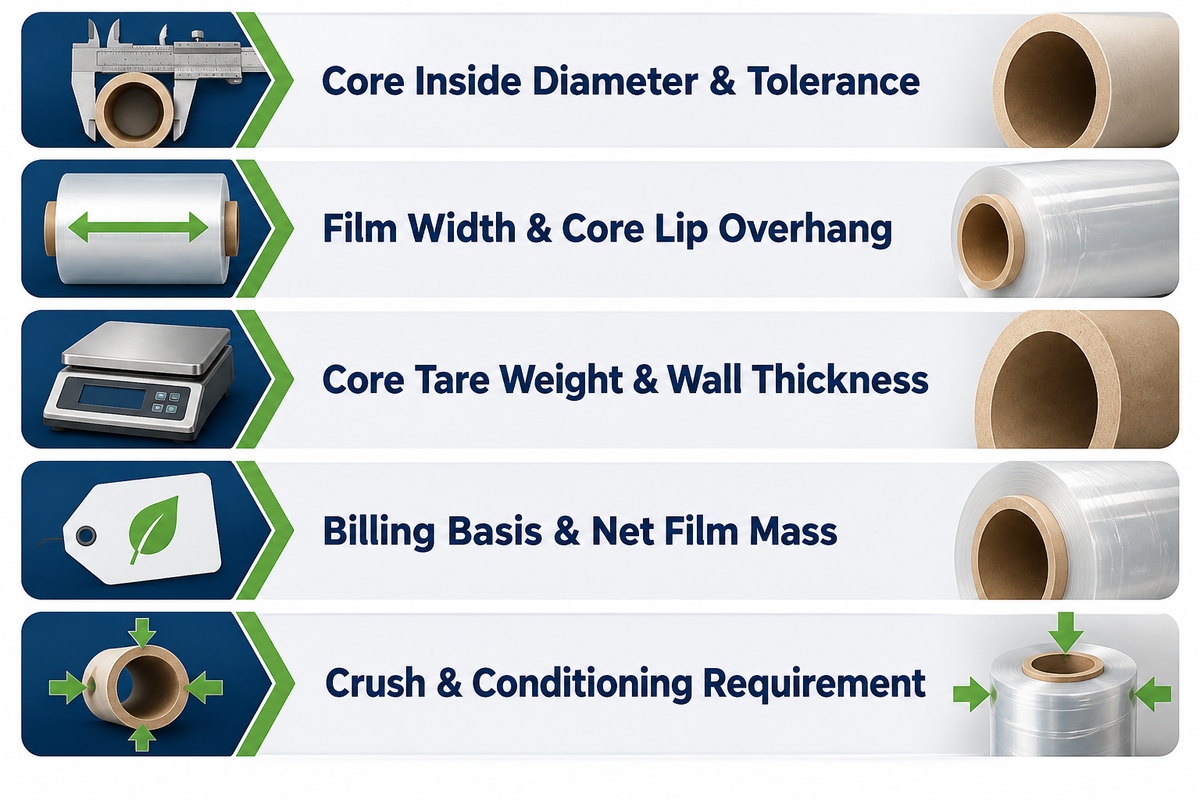
Lock in five core parameters for every industrial stretch film purchase order so stretch film offers reliable load containment. Specify the core inside diameter and tolerance, the required core lip overhang for your carriage, and the core tare weight in kilograms. Also, specify guaranteed net film weight and radial crush testing (T-158 or T-159).
Procurement guidance from Allied Packaging states the cheapest film per roll can cost significantly more per pallet. A low-grade film may require additional wraps to meet your load containment standard. When sourcing traditional stretch film and core products for your packaging process, stretch film offers excellent cohesion only when roll specs match the line. Whether your facility uses cardboard or plastic dispenser adapters, explicit dimensional tolerances on the purchase order eliminate disputes over short rolls. Clear specs also improve production efficiency.
| PO Line Item Field | Recommended Hand Roll Target | Recommended Machine Roll Target | Verification Standard / Method |
|---|---|---|---|
| Core Inside Diameter & Tolerance | 50 mm / 50.8 mm (2 in) or 76.2 mm (3 in) | 76.2 mm (3 in) with ±0.5 mm bore tolerance | ISO 11093-4:2022 internal caliper & plug gauge |
| Film Width & Core Lip Overhang | 450/500 mm (EU) or 18 in (US); flush or 1 in handle | 500 mm web; flush, carriage lip, or 5 in extension | ISO 11093-4:2022 length & carriage clearance check |
| Core Tare Weight & Wall Thickness | 0.35 to 0.55 kg (up to 0.70 kg); 3.5–4.5 mm wall | 1.10 to 1.80 kg stated on tag; 6.0–12.0 mm wall | Digital bench scale on stripped paperboard tube |
| Billing Basis & Net Film Mass | Net LLDPE weight (e.g., 2.0 kg net) billed separately | Net LLDPE weight billed separately from core tare | Net Mass = Gross Mass - Core Tare |
| Crush & Conditioning Requirement | Unblemished lip; conditioned per ISO 11093-2:2025 | Minimum radial crush in bar (T-158 / T-159) + ID stiffness | ROLL Lab T-158 / T-159 & ISO 11093-9:2019 check |
Across global supply chains, Hanpak lists 50 mm European hand cores and 76 mm machine cores in 450 mm and 500 mm widths. Hanpak also notes 18 inch US hand rolls on 3 inch (76 mm) cores. Western Container Corp manufactures 2 inch (50.8 mm) and 3 inch (76.2 mm) spiral-wound film cores, while Sonoco supplies RCS and T2 film cores. Teagolpack lists 20 um x 500 mm x 2.0 kg net LLDPE hand rolls on 76 mm cores (0.35 to 0.70 kg paper core). Clear carton labeling provides easy identification of roll width, film thickness, core bore size, and net weight across busy packaging operations requiring excellent cohesion. If you’re comparing regional converters and OEM plants, review our guide to evaluating global stretch film manufacturers.
Frequently Asked Questions About Stretch Film Cores
What is the standard size of a stretch film core?
A standard industrial stretch film core uses a 3-inch (76 mm or 76.2 mm) inside diameter with a ±0.5 mm machine bore tolerance. European hand-wrap lines frequently use 2-inch (50 mm or 50.8 mm) cores with 450 mm or 500 mm film widths. Narrow bundling rolls use 1.5-inch (38 mm) cores, while some cored machine tubes add 7 to 15 mm of overhang per side.
How much does a cardboard stretch film core weigh, and how does it affect roll price?
On a 2.0 kg net hand roll, a standard 76 mm cardboard core weighs 0.35 to 0.55 kg. Heavy-wall hand tubes reach 0.70 kg, which equals 14.9% to 25.9% of gross weight. Machine roll cores weigh 1.1 to 1.8 kg. Subtracting core tare weight from gross roll weight reveals verified net film weight for cost effective comparisons.
What is the difference between flush core, extended core, and coreless stretch wrap?
Flush core stretch wrap uses a paperboard tube, cut level with the film edge, to fit hand dispensers and wrapper chucks. Extended core stretch wrap protrudes 1 inch on hand rolls or 5 inches on machine rolls beyond the film width. Coreless stretch wrap eliminates the paperboard tube and uses a reusable mandrel.
Why do stretch film cores crush or bind on automated pallet wrappers?
Stretch film cores crush or bind when wound film pressure exceeds radial crush resistance or humidity softens kraft plies. Specifying minimum radial crush in bar (method T-158 or T-159) and testing conditioned samples per ISO 11093-2:2025 helps prevent collapse. Matching the bore tolerance to the spindle reduces core-related jamming, though spindle wear and chuck damage can also cause jams.
How does film thickness (such as 60 gauge vs. 80 gauge) interact with stretch film core selection?
An 80-gauge (20 um) stretch film is thicker than a 60-gauge (15 um) film across common 15 to 30 um industrial ranges. Radial pressure on paperboard cores depends on winding tension, roll diameter, and film relaxation, among other factors, and not just the gauge. High-tension machine rolls use 6.0 to 12.0 mm wall cores rated for radial crush in bar and ID stiffness.
Request Custom 50 mm & 76 mm Core Stretch Film Roll Specifications
Need hand or machine stretch wrap matched to your exact dispenser cones and wrapper mandrels? Explore our complete LLDPE stretch film product line to request roll samples with custom 50 mm (2 in) or 76.2 mm (3 in) core inside diameters. We also confirm 450 mm or 500 mm film widths and net film weight billing on every order.
References & Sources
- ISO 11093-4, Paper and board, Testing of cores, Part 4: Measurement of dimensions International Organization for Standardization (ISO)
- ISO 11093-4:2022, Paper and board, Testing of cores, Part 4: Measurement of dimensions iTeh Standards
- ISO 11093-2, Paper and board, Testing of cores, Part 2: Conditioning of test samples International Organization for Standardization (ISO)
- ISO 11093-2:2025, Paper and board, Testing of cores, Part 2: Conditioning of test samples (Third Edition Summary) iTeh Standards
- ISO 11093-9:2019, Paper and board, Testing of cores, Part 9: Determination of flat crush resistance International Organization for Standardization (ISO)
- Paper Core Crush Strength: Flat Crush, Radial Crush, and ID Stiffness ROLL Lab
- Comparative Life Cycle Assessment of Coreless and Conventional Stretch Film Packaging (PMC12656129) PubMed Central / National Library of Medicine
- New Packaging Rules: Less Waste and Easier Recycling (12 August 2026 Application) European Commission
- Regulation (EU) 2025/40, Packaging and Packaging Waste from 2026 Summary EUR-Lex / Publications Office of the European Union
- EU Packaging and Packaging Waste Regulation (EU PPWR) Guidance UK Department for Business and Trade
- Sonoco Implementing Price Increases for Uncoated Recycled Paperboard and Converted Paperboard Products (2026) Sonoco Investor Relations
- Paper Cores Market Sizing and Forecast 2026–2035 Towards Packaging
- US Patent US9212022B2, Mandrel for Cored and Coreless Rolls of Stretch Film United States Patent and Trademark Office (via Google Patents)