Get in touch with UD Packaging Company

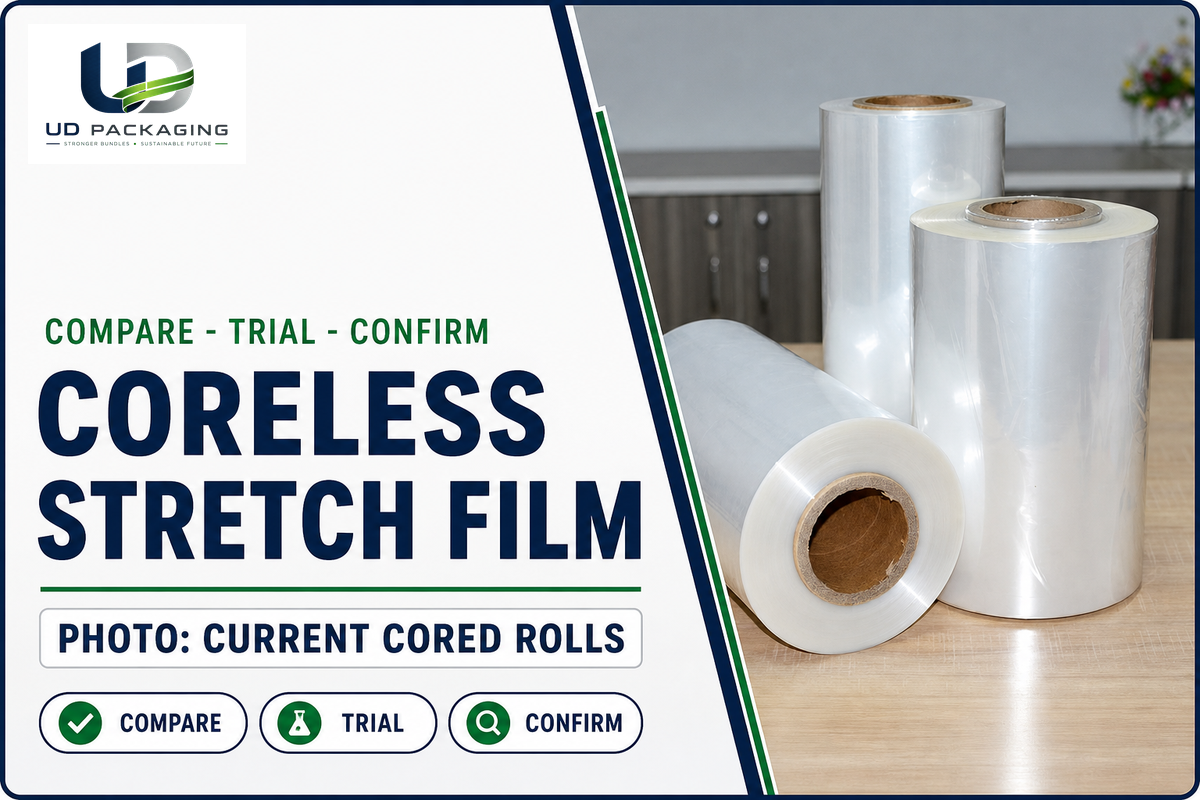
Coreless stretch film is supplied without a disposable roll core. That removes one packaging item, but the buying decision still depends on dispenser fit, film use and load performance. A roll that feels lighter can cost more to use if it slips on the holder or leaves more rejected loads.
Coreless stretch film omits the disposable core. Match the roll to its dispenser, measure net film consumed, and compare cost only after both options meet the same load-acceptance criteria.
Quick Specs: examples to check against your system
- EngineeringCC dispenser: published film-width range of 400–530 mm.
- POLIFILM premium coreless machine film: published thickness range of 15–23 µm with a matching reusable adapter.
- Coreless supply format doesn’t specify pre-stretch or recycled content.
- Compare net film mass, actual consumption and accepted loads; gross roll weight alone is insufficient.
Use the five checks below before changing a warehouse supply order. The examples identify what suppliers document; the trial sheets are proposed buyer methods. None of the worked figures is a UD Packaging test result or a market-price quotation.
What coreless stretch film changes, and what it does not
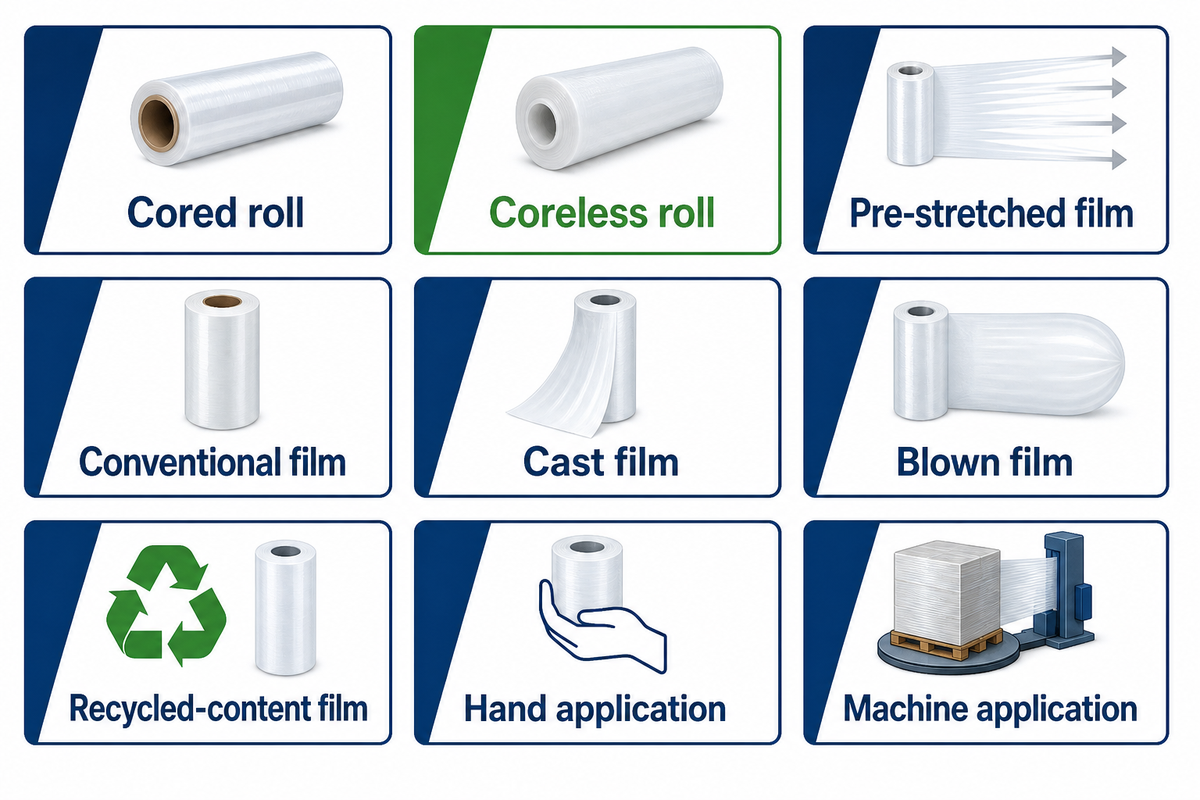
A core-less roll changes how stretch wrap is supported and dispensed. The format doesn’t, by itself, specify polyethylene formulation, cast or blown construction, pre-stretch level, or recycled content. Ask for those fields separately so a comparison doesn’t give credit to core removal for a different film recipe.
How does coreless stretch film work?
Coreless stretch film unwinds from a roll made without a disposable paper core using the support arrangement specified for that product. Some systems use a reusable dispenser or adapter. Film tension and cling help form the wrapped load, while the holder controls how the roll feeds. The missing cardboard tube doesn’t tell you what the required tension is, the pre-stretch setting or how well a particular load will travel. Record the roll and hardware identities before installation. Follow the supplier’s loading instruction and compare the wrapped result with your approved process. A supplier’s core-less designation describes the roll format; the practical advantage must be demonstrated on the application you intend to run.
Supplier terms may combine several features into one product name. The classification matrix splits them at the quotation stage and before a trial order is placed.
| Type or attribute | What it identifies | Evidence to request |
|---|---|---|
| Cored roll | Disposable support remains inside the roll | Core material and inner diameter |
| Coreless roll | Disposable core omitted | Exact loading and support arrangement |
| Pre-stretched film | Film stretched before use | Declared construction and application instructions |
| Conventional film | Supplier’s standard application grade | Stretch and tension recommendations |
| Cast film | Film-production process | Product data sheet |
| Blown film | Alternative film-production process | Product data sheet |
| Recycled-content film | Declared recycled material fraction | Percentage, material origin and claim scope |
| Hand application | Manual wrapping route | Roll, dispenser and user instructions |
| Machine application | Powered wrapping route | Wrapper, carriage and adapter approval |
On the POLIFILM coreless film page, POLIFILM lists a 15-23 µm premium machine-film range and separately describes recycled-content options. When evaluating machine film against another roll, consider thickness and material content, as well as adapters. “Coreless” doesn’t answer any of those questions.
Check dispenser fit before buying a trial roll
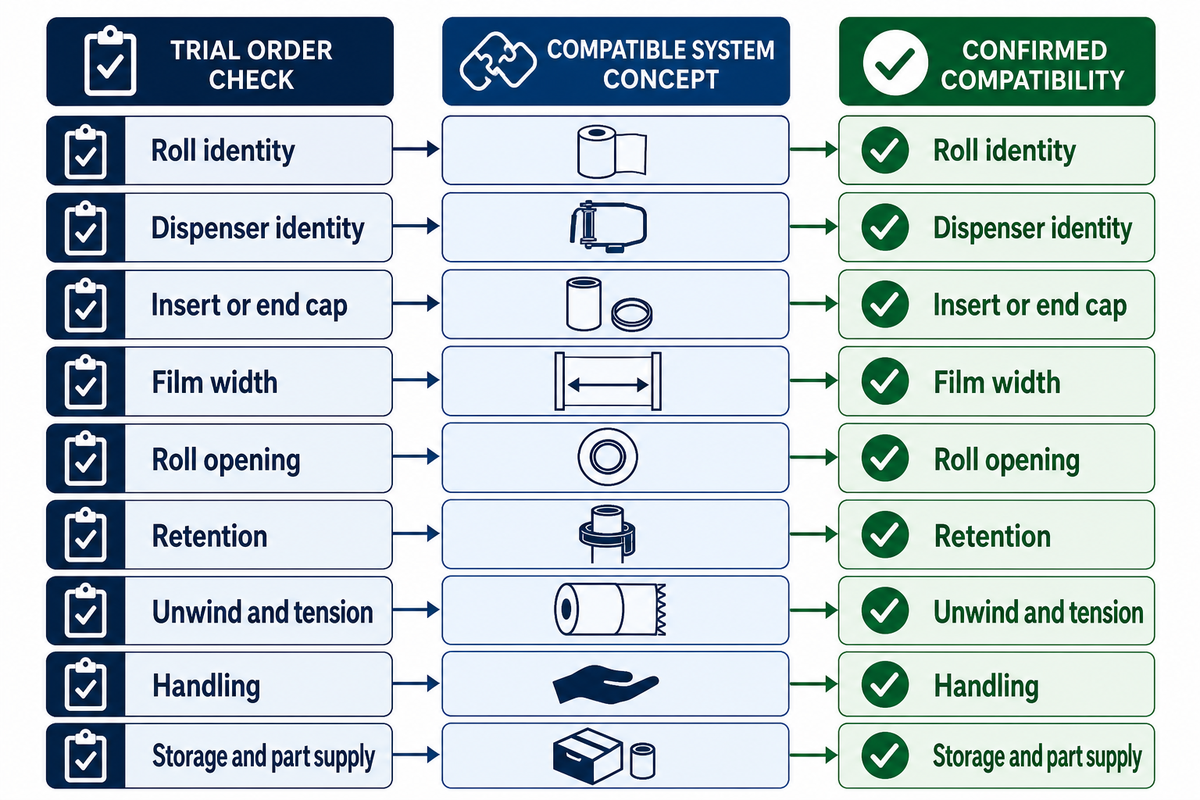
Dispenser fit requires demonstrated compatibility between the roll and the supporting parts. The product examples here come from suppliers’ own descriptions, not independent compatibility tests. Confirm the roll SKU, dispenser model and any insert or end-cap identity together before placing a trial order.
3-Part Roll Match
List the three identities on the purchase request form and the trial record. If the design doesn’t use an insert, indicate that as well. A similar width or opening doesn’t mean that there’s grip, retention or tension control.
Consider a buyer replacing a 500 mm cored hand roll. The proposed coreless roll is also 500 mm wide, so the quotation looks interchangeable. But the existing holder’s 76 mm core interface says nothing about how it retains the new roll. The buyer asks for the proposed dispenser model and its loading instructions, then obtains the specified sample combination. If the supplier can only confirm width, the trial order stays on hold. No one has proved a defect; the missing information simply prevents a fit decision. This approach keeps a low-cost sample purchase from turning into an unplanned hardware change at every packing station.
| Check | Evidence | Decision | Limitations / Not suitable for |
|---|---|---|---|
| Roll identity | SKU and batch label | Proceed when sample matches order | An unlabelled substitute |
| Dispenser identity | Named model and instructions | Confirm the supplier’s match | Appearance-only matching |
| Insert or end cap | Part identity or explicit no-insert design | Include required parts | Improvised retention parts |
| Film width | Actual width against holder range | Check clearance | Width alone does not prove fit |
| Roll opening | Specified interface geometry | Check seating as instructed | Assuming a 76 mm cored holder fits |
| Retention | Installed roll stays seated | Hold if the roll slips or migrates | Ad hoc shims without approval |
| Unwind and tension | Controlled feed through the roll | Compare start and end behavior | A brief free-spinning demonstration |
| Handling | Operator trial with complete assembly | Record comfort and control | Film-only mass used as handling mass |
| Storage and part supply | Written storage and replacement route | Confirm before a bulk switch | Invented universal storage orientation |
EngineeringCC publishes a 400–530 mm dispenser width range and describes two adjustment rings. This supports its own product. A 500 mm roll falls within the stated width range, but opening, retention and operating instructions need to be confirmed. Width is only one dimension of fit.
Hand dispensers and machine adapters are different systems
Manual and powered wrapping require separate qualification because their support and tension arrangements differ. A film may be approved for both applications, but a successful hand trial does not approve a machine carriage. Confirm the exact roll, adapter and operating setup from the supplier and the equipment provider.
All lightweight hand dispensers must remain controllable as the operator moves around the load. A powered wrapper also needs the roll to work with its specified mounting and film path. Check that retention parts secure the roll as directed. Plans to automate palletizing should include that interface review before the production line receives trial material.
Hand application
- Confirm dispenser and retention parts.
- Weigh the complete handling assembly.
- Observe control through the roll.
Machine application
- Confirm wrapper and carriage models.
- Use the specified adapter and film path.
- Trial the approved operating settings.
Keep an approved cored system in service if the proposed coreless arrangement lacks a documented fit. “Innovative” is a product description, not a reason to bypass an equipment check. The machine-film specification questions help organize the enquiry without assuming that a coreless option is available.
A POLIFILM 15–23 µm machine-film example belongs to its matching adapter system. Moving from a 20 µm candidate to a 15 µm candidate also changes the film comparison, even when the adapter stays the same. Note each change so that the equipment result is not attributed solely to the absence of the core.
Compare net film yield and waste on the same basis
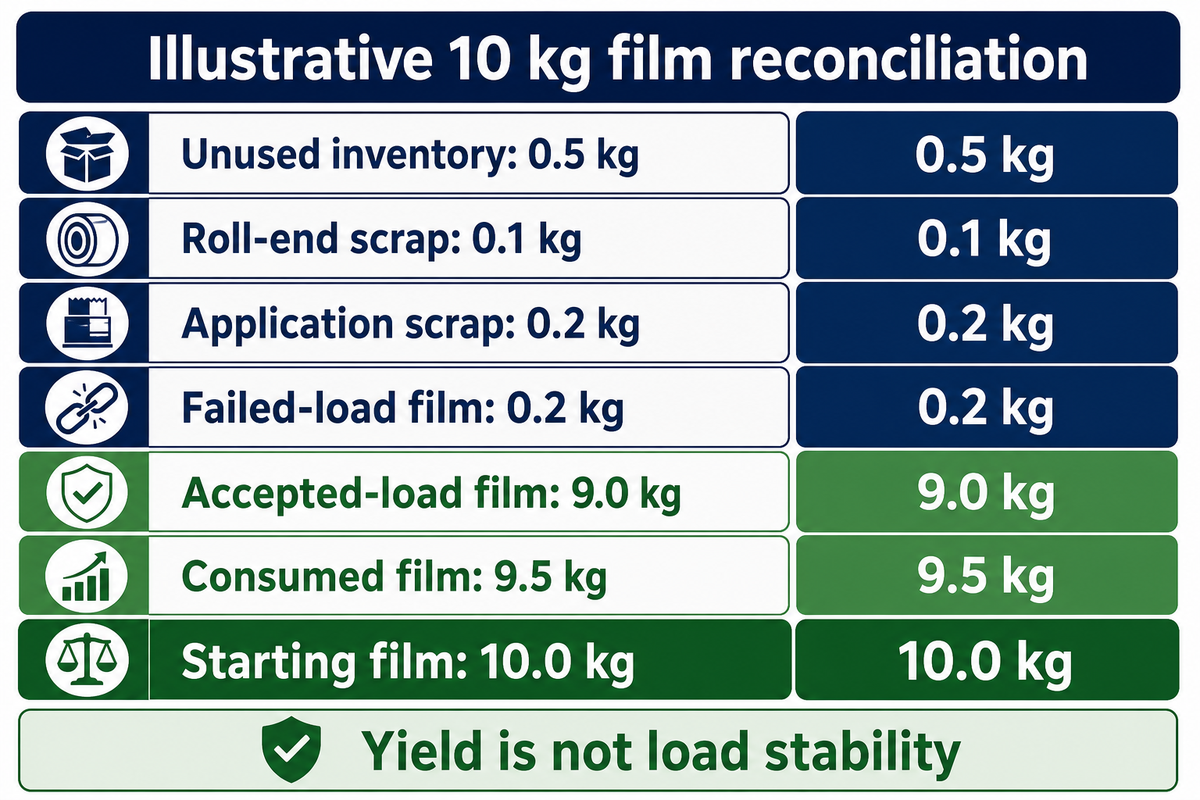
Net film yield measures where the purchased film goes, excluding core and outer packing. Weigh the film used for a defined batch and separate the saleable inventory from the waste. Considering a lighter gross roll as a material saving may mask a difference in net film mass or accepted output.
5-Stream Roll Mass Balance
Balance the starting net film against unused inventory, roll-end scrap, application scrap, film removed from failed loads and film remaining on accepted loads. Assign each portion only once. The film removed from a load that’s successfully rewrapped later, belongs to the failed load stream. The film finally remaining on the accepted loads forms the output.
| Destination | Film mass | Treatment |
|---|---|---|
| Unused film still on rolls | 0.5 kg | Inventory, available for later use |
| Roll-end scrap | 0.1 kg | Consumed film loss |
| Application scrap | 0.2 kg | Consumed film loss |
| Removed film from failed loads | 0.2 kg | Consumed film loss |
| Film on accepted loads | 9.0 kg | Accepted-output film |
| Total accounted for | 10.0 kg | Equals starting net film |
In this hypothetical batch, 10.0 kg enters the record and 0.5 kg remains unused, so consumption is 9.5 kg. The 9.0 kg left on accepted loads is about 94.7% of consumed film: 9.0 ÷ 9.5 × 100. It’s 90% of starting inventory, a different denominator. Neither percentage measures load stability. The missing 0.5 kg between consumption and accepted-output film is the combined scrap, not an invisible paper-core saving. A buyer repeating the same accounting for the current roll can compare actual loss streams without promising that every coreless roll delivers 100% usable film.
Keep roll-length estimates separate from weighed consumption. You can estimate film length from roll dimensions, but a theoretical length doesn’t reveal damaged edges, discarded tails or rewraps. Crown Packaging’s gauge-selection case also illustrates why fewer micrometres alone need not mean lower use: its customer account describes changing from 39 to 80 gauge with fewer passes, without audited savings.
Run a trial from the first wrap to the last usable film
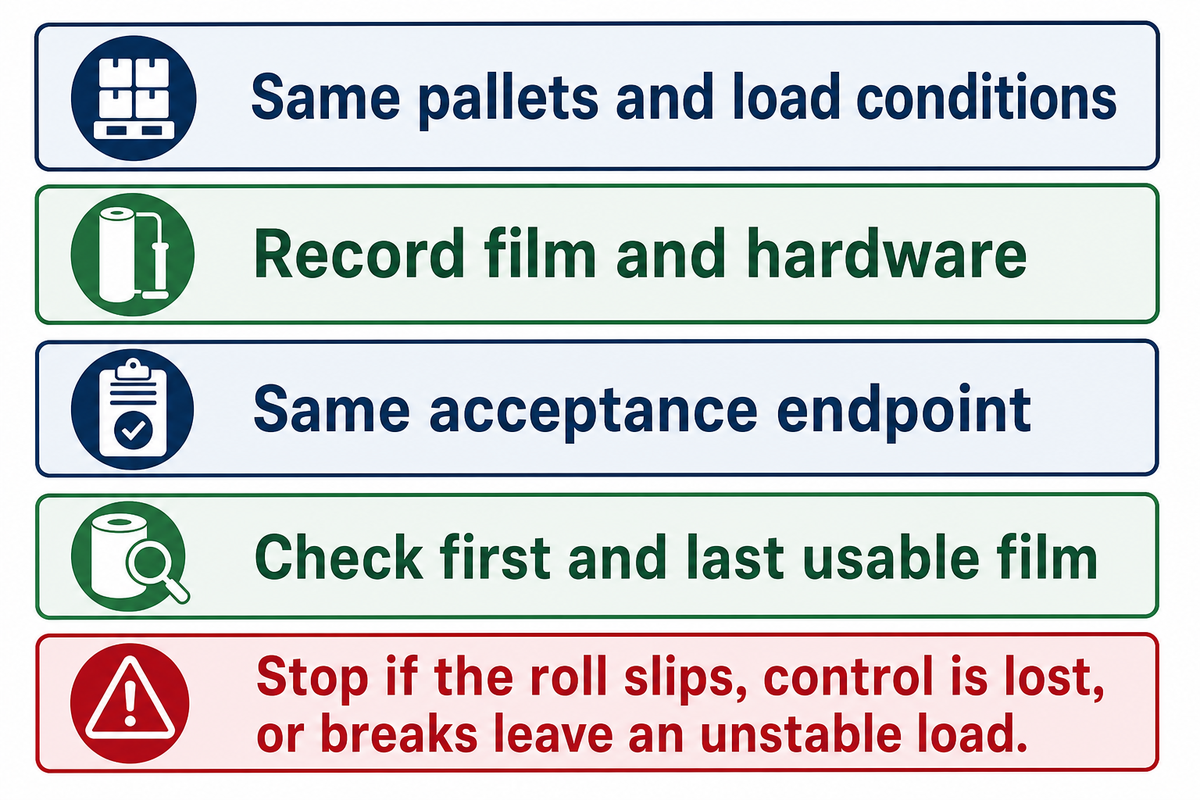
A wrapping system trial, with coreless film, keeps the load and acceptance conditions the same, and captures what changes in the system. Agree the rejection criteria and endpoint of the inspection prior to any wrapping. Acceptance immediately after wrapping is a narrower condition than acceptance following the same storage, handling and distribution conditions.
“It may be used between the buyer and seller to arrive at purchase specifications.”
Use the same types and conditions of pallets. Also, be consistent with case dimensions, stack patterns, and load weights. Record the batch of film, hardware, wrap patterns, stretch settings and the name of the operator. Research by Park and colleagues on load bridging shows why pallet stiffness and package size belong in that record: packaging components interact with the supported load.
Check for film breaks, puncture, tail retention, load movement and carton damage at the agreed points. Virginia Tech’s containment research found changes with time and temperature. A quick unwind demonstration therefore leaves part of the storage question unanswered. The customer and packaging specialist should set application-specific limits; this guide supplies no universal force threshold.
When not to buy a replacement roll yet
Suppose a distribution team compares two 500 mm rolls on similar-looking cartons. The candidate unwinds smoothly, but the trial uses a different pallet and checks the load only at the wrapping station. The current process is normally accepted after storage and handling. Those results can’t establish equal protection. Repeat the comparison with the same pallet construction and acceptance endpoint, and retain the current approved material until the candidate passes. If the roll slips, an operator loses control, or film breaks leave an unstable load, stop the trial and follow the site’s isolation procedure. Adjustments need the equipment provider’s instructions; a makeshift insert isn’t a validated solution.
OSHA’s pallet-wrapping guidance identifies hazards such as bending and contact with fingers and discusses options for mechanical aids or lightweight rolls with handles. Record the whole assembly’s handling burden. Minimal effort requires an operator check, and a faster cycle time requires a timed observation. Film qualification also leaves the transport operator’s vehicle-load restraint assessment in place.
For the illustrative 10 kg batch, record 0.1 kg of roll-end scrap separately from 0.2 kg of application scrap. Inspect the first and last usable film under the same acceptance plan. Less waste is useful only when the remaining film still produces the required protective load wrap.
Compare cost per accepted pallet
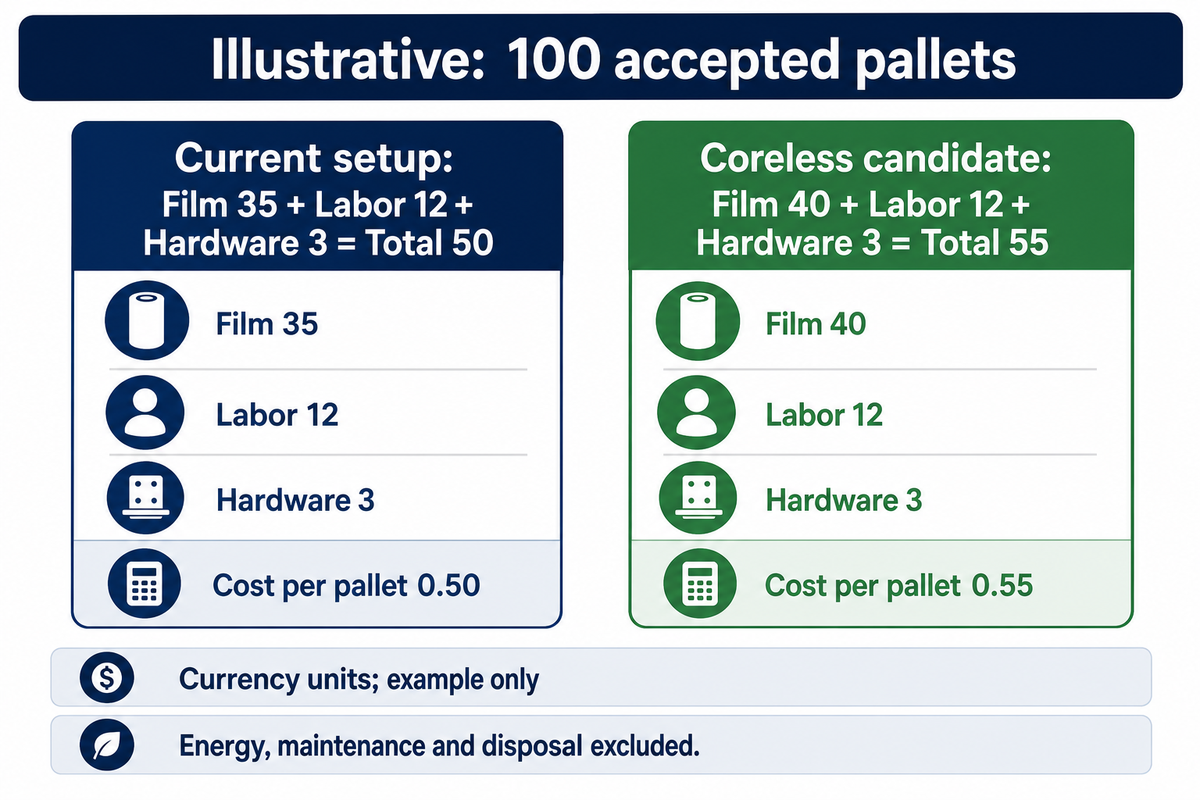
Divide the agreed operating costs by loads passing the same acceptance endpoint to find the cost per accepted pallet. Include consumed film and wrapping as well as rework labor. Add the dispenser or adapter allocation, and consider energy, maintenance and disposal costs. For energy, maintenance and disposal costs that are material, use the same basis for both options.
| Included cost | Current setup | Coreless candidate |
|---|---|---|
| Delivered film consumed | 35 currency units | 40 currency units |
| Wrapping and rework labor | 12 currency units | 12 currency units |
| Hardware allocation | 3 currency units | 3 currency units |
| Included total | 50 currency units | 55 currency units |
| Included cost per accepted pallet | 0.50 currency units/pallet | 0.55 currency units/pallet |
In the example provided, the candidate removes core waste but costs more on the stated basis: (40 + 12 + 3) ÷ 100 = 0.55 currency units per pallet, versus (35 + 12 + 3) ÷ 100 = 0.50. Energy, maintenance and disposal are excluded from this example, not assumed to be free. Purchased film that remains unused is retained in inventory. Rewrap film that’s included in consumption must not be charged again.
Is coreless stretch film worth it?
Coreless stretch film is an option if the matched system leads to the desired result and improves a cost or waste measure that’s important to the buyer. The benefit could mean fewer disposable cores, easier handling, or a better measured operating cost, but these would need different checks. Use the same accepted-load definition for both trials, include rework, and spread reusable hardware cost over a stated service-life assumption. A lower cost roll can contain less film; a higher roll cost can still be cost-effective if verified consumption or labor falls enough. Keep the approved conventional setup if the candidate can’t provide reliable handling and comparable load protection.
For your own numbers, compare film use per pallet for a documented batch. To improve productivity means to measure time and accepted output together; a quick cycle that produces more rework isn’t an efficient result.
Separate paper-core reduction from film recycling
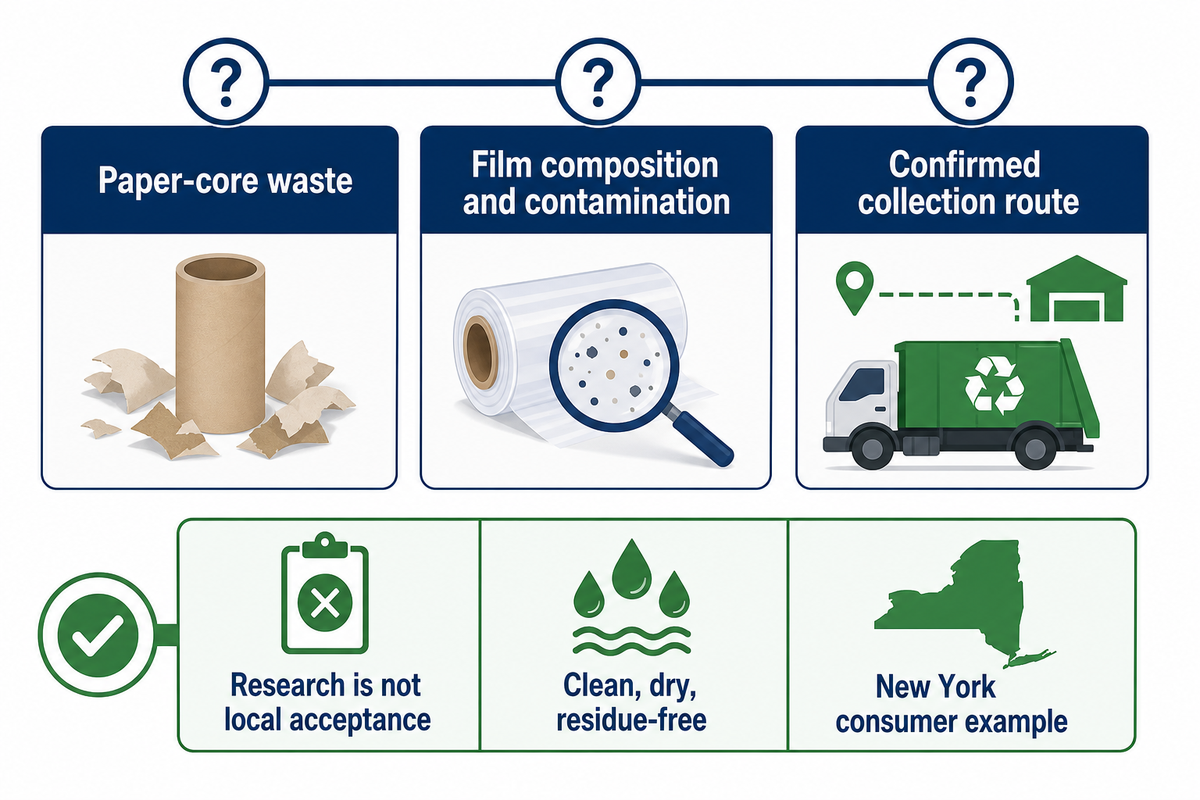
The removal of a paper core alters one waste stream. Recycling the remaining plastic depends on its composition, contamination and the accepting entity’s rules. Record avoided cores separately from film scrap and confirm a collection route for the actual material before calling the change an environmental improvement.
A 2026 life-cycle study by Stefanini and colleagues assigned about 1.5% of its traditional 23 µm film baseline’s modeled climate impact to the paper core. Larger differences involved changes in thickness, stretch ratio and recycled material. HIPAC funded the study and employed three co-authors. The comparison used a square metre after stretching and assumed performance equivalence; it was not a matched warehouse transport trial.
The films work by the Association of Plastic Recyclers addresses compatibility of constituent materials and contamination. New York’s retail film collection guidance includes clean, dry, residue-free pallet stretch wrap. That example of film collection from consumers doesn’t signify acceptance of a bulk, warehouse volume, or all film formulations.
Ask the receiver about segregation, labels, residues, and collection quantities. Removing cores can reduce a waste stream; losses of film require separate measurement. Keep the environment claim specific: industry work on material design doesn’t justify your collection route. A high-quality wrap film can help accomplish its packaging goal and still require a separately agreed disposal route.
Write a comparable quotation request
A comparative quote identifies the roll, operating configuration, quantity and acceptance basis in the same request. Insist the supplier distinguish quoted values from enquiry ranges and identify required hardware. Separate the price of a coreless system from a standard film quote so availability and compatibility aren’t implied.
The logistics team’s transportation and storage conditions should also be included in the request. A supplier can’t pick a meaningful trial setup from roll dimensions alone.
UD Packaging’s hand-applied film evaluation page lists 450 or 500 mm widths, 12-25 µm thickness and 50 or 76 mm core inner diameters as enquiry possibilities. Those are cored-film inputs. They don’t confirm a UD coreless offer, a dispenser match, or in-house coreless manufacturing.
Copy this checklist to the request and replace the input fields with the current process and proposed trial. No recommended roll dimensions are given.
RFQ checklist — copy these into your quote request:
| Parameter | Recommended range | Why it matters | How to verify |
|---|---|---|---|
| Film width and thickness | Enter required mm and µm; no universal range | Sets the sample comparison | Quoted values and tolerances |
| Roll mass and length | Enter net kg and m separately from gross kg | Prevents unequal roll comparisons | Weighing and declared length basis |
| Roll and hardware | Exact models; dimensional limits in mm | Controls fit and retention | Written compatibility confirmation |
| Film construction | Declared stretch and recycled fraction in % | Separates material changes | Product data and claim scope |
| Trial load and conditions | Your load kg, dimensions and hold duration | Defines comparable acceptance | Agreed trial record and endpoint |
| Commercial basis | Your rolls/order and delivery basis | Aligns shipping and hardware cost | Quotation inclusions and exclusions |
A 450 mm enquiry and a 500 mm enquiry should remain distinct quoted options. Likewise, 12 µm and 25 µm are ends of UD’s public hand-film range, not interchangeable performance grades. Request the manufacturer’s product instructions and a written supply specification prior to treating any candidate as approved.
Key takeaway
Use coreless stretch film when the exact dispensing system and accepted-load trial support the change. Core removal, film consumption and total operating cost need separate evidence.
Frequently asked questions
Which coreless stretch film is best?
The best candidate is the one that passes your matched trial.
Choose by the confirmed roll-and-dispenser combination, the load requirement and measured use. A thickness or brand name alone can’t establish the best option for every warehouse. Compare the current approved film and candidate at the same acceptance endpoint, then evaluate consumed film, rework and handling. Keep the exact sample identity in the purchase specification so the bulk order matches the trial.
Can coreless stretch film be repaired?
A damaged roll needs supplier guidance rather than an improvised repair.
Separate a damaged film edge or distorted roll from a replaceable dispenser part. Stop using a roll that can’t feed or stay retained correctly, identify its batch and ask the supplier for disposition instructions. A reusable handle may have approved replacement parts, but repairing hardware doesn’t restore damaged film. Don’t describe a patched roll as equivalent to the approved sample without another check.
Is coreless stretch film still used?
Suppliers currently publish coreless hand and machine product information.
The EngineeringCC dispenser and POLIFILM machine-film pages are examples of publicly described systems reviewed for this guide. Their existence doesn’t measure market share or confirm stock in your region. Ask about the exact film, reusable parts, supply continuity and replacement support. An available sample is only the starting point; compatibility and load performance still need an application-specific trial before a larger purchase.
Can I cut a cardboard core out of an ordinary roll?
Removing a core does not turn an ordinary roll into an approved coreless product.
The supplied roll and its holder were specified together. Cutting or pulling out the support can damage film or change retention. Obtain a purpose-made candidate with loading instructions instead, and keep the original roll within its intended handling arrangement.
What should I do with partly used trial rolls?
Label and weigh usable remainder separately from scrap.
Record the film batch, remaining net mass and approved storage instructions. Keep reusable remainder in the inventory stream of the mass balance. Material rejected because of damage or contamination belongs in a separate loss stream, with its disposal route confirmed rather than assumed.
Prepare a film enquiry that can be compared
Send UD Packaging the current roll specification, operating method and intended load trial. Start with the standard stretch-film supply range and ask for written confirmation of any requested coreless system and hardware.
Scope: This guide uses public supplier descriptions, published research and summarized standards. The examples and methods described are editorial and don’t represent published UD Packaging test results. Supplier technology and research remain attributed to their owners.
References & Sources
- ASTM D4649-20(2025), public scope and significance ASTM International.
- The influence of stretch wrap containment force on load bridging in unit loads Park et al., 2018; US Forest Service research record.
- Temperature and stretch-wrap containment research Virginia Tech, 2019.
- Grocery Warehousing: Packaging Occupational Safety and Health Administration.
- 2026 stretch-film life-cycle comparison Stefanini et al., Sustainability; HIPAC-funded research.
- Films Technical Committee Association of Plastic Recyclers.
- Plastic Bag and Film Plastics Recycling New York State Department of Environmental Conservation.