
Get in touch with UD Packaging Company


Before you order
- Measure the loaded top, including overhang.
- Specify unfolded sheet width and length separately.
- Match thickness, core and roll format to the applicator.
- Agree on handling and exposure checks before comparing prices.
A cover can span a pallet, leaving an edge exposed. An order will create this condition when it uses the pallet’s nominal size to define the load’s actual footprint. Choosing pallet top sheets means checking coverage on both axes, then checking how the side wrap holds the sheet after handling.
Pallet top sheets are flexible covers placed over palletized goods. A centered 60 × 60-inch sheet over a flat 48 × 40-inch load has ideal margins of 6 and 10 inches. Select the size and wrapping sequence together; top coverage alone does not establish waterproof protection.
Key takeaways
- A sheet equal to the load length leaves no margin on that axis.
- Dust, rain entry and condensation require different checks.
- Folded roll width is not the same as open sheet width.
- Compare consumed material per accepted pallet, with rework counted.
What Pallet Top Sheets Cover
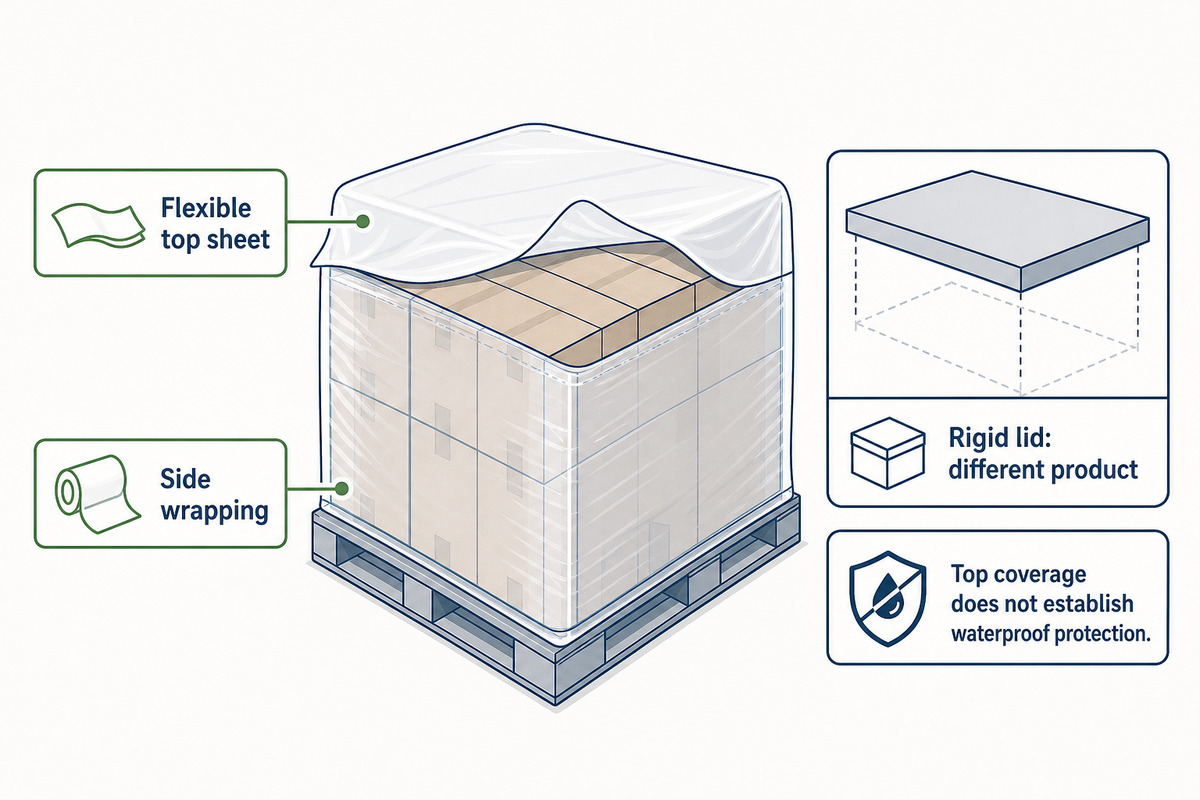
Pallet top sheets cover the upper face of a load, typically as part of a wrap. Flexible polyethylene film can help shield goods from the dust or moisture exposure specified for that product. The sheet doesn’t provide a rigid stacking surface, and the surrounding package determines what remains exposed.
Interplas’s product PTS1256060 is described as a low-density polyethylene (LDPE) top sheet and states it isn’t waterproof. That qualification matters when a purchasing description simply says “pallet top covers.” A loose film cover, a fitted bag and a rigid lid are different products.
What are polyethylene sheets used for?
Polyethylene sheets act as flexible lining materials in packaging. For palletized goods, a sheet may cover the top, separate surfaces, or line a container, depending on what’s specified. The material name alone does not establish strength, cleanliness, water resistance or compatibility with the equipment applying it.
For example, dust covers and drop cloths may use polyethylene, but a general-purpose roll isn’t automatically a suitable machine-fed top sheet. The intended function and converted dimensions should be specified. The supplier should identify the grade being offered rather than lean on a familiar material description.
Size the Sheet From the Load, Not the Pallet
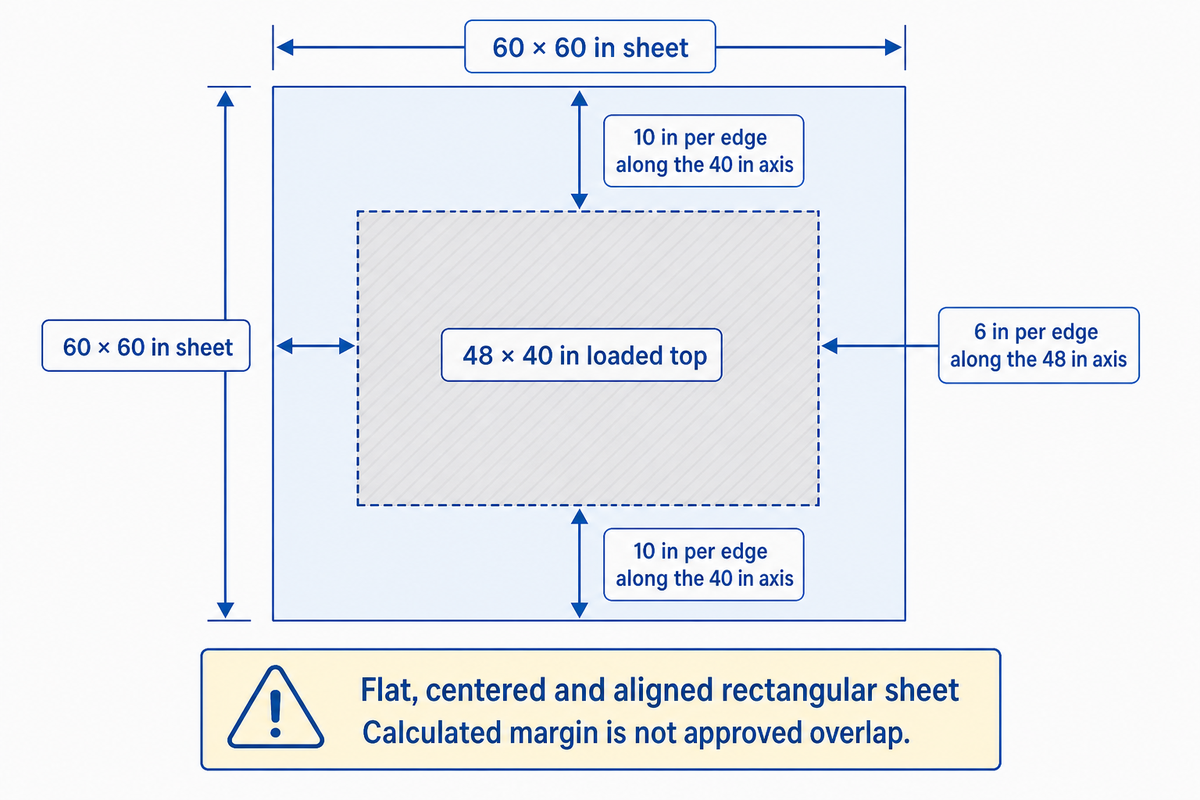
Consider sheet dimensions after measuring the longest and widest parts of the loaded top. Cartons, corner protection or irregular stacking can extend beyond the pallet deck. The University of Florida IFAS guide, written for perishables, also notes the importance of load arrangement and avoiding overhang. For a flat, centered and aligned rectangular sheet, subtract loaded dimension from sheet dimension and divide by two on both axes.
48 × 40 in
Example loaded top
Example loaded top
60 × 60 in
Open sheet dimensions
Open sheet dimensions
6 / 10 in
Ideal margin on each axis
Ideal margin on each axis
The length margin is (60 – 48) / 2 = 6 inches per edge. The width margin is (60 – 40) / 2 = 10 inches per edge. Given a 48 × 48 inch sheet over that load, the length margin would be 0 and the width margin would be 4 inches. One axis has no spare material even though the top appears covered.
Centering also affects the amount of material retained. Moving a 60” x 60” sheet 2” along the 48” axis of the load results in the opposing margins being 4” and 8”. Raised cartons, loose folds and an uneven top consume material differently. Flat-sheet arithmetic also can’t predict the amount of skirt retained under side wraps. For a custom size, provide both unfolded dimensions and their tolerances in the order.
Size-check takeaway: A calculated 6-inch margin is an initial layout result. Record the shortest actual skirt on the wrapped load, including off-center placement and raised corners. Approve the configuration against the chosen handling and exposure checks; no universal minimum overlap follows from the arithmetic.
Top Sheets, Pallet Covers and Hoods Compared
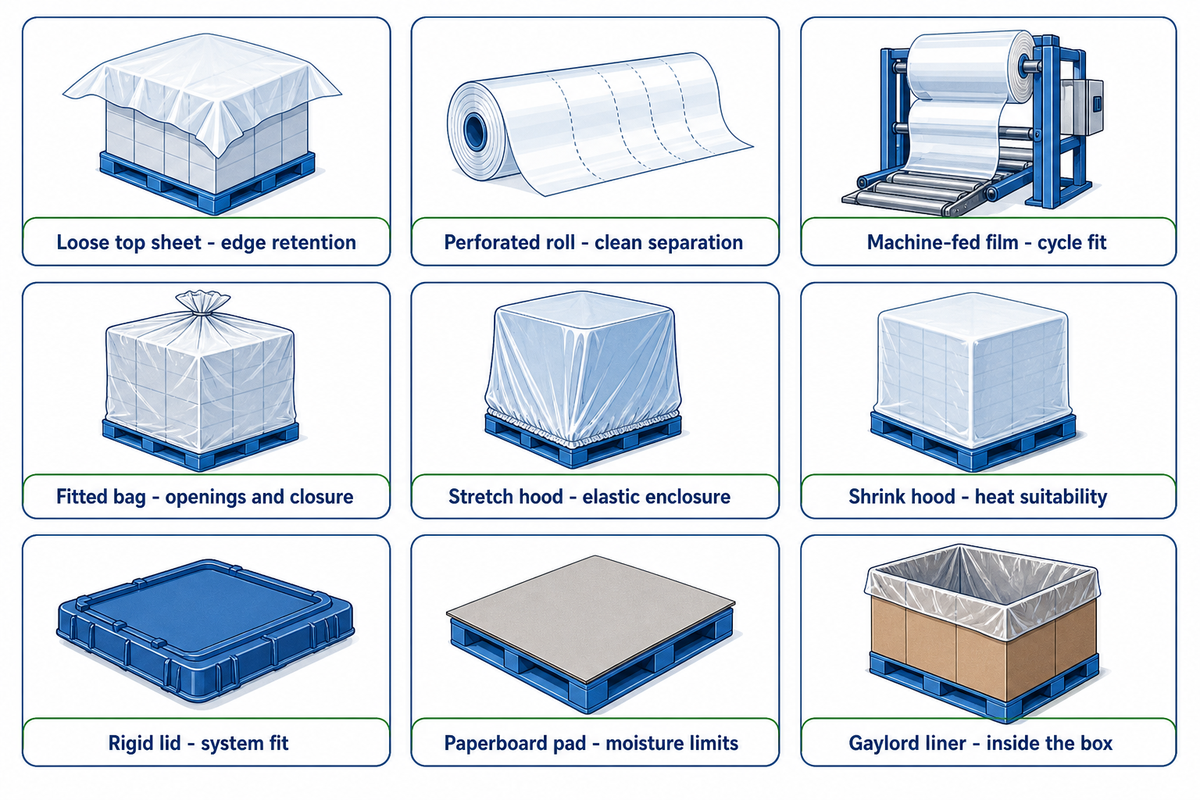
Select the cover family to cover the surface and exposure you need to address. A top sheet adds upper coverage to a wrapping system; a hood extends down the sides. Neither description indicates a sealed bottom. Rigid covers and paper pads address different structural and separation problems and require different specifications.
Packaging Digest has compared stretch wrapping, shrink hoods and stretch hoods in a discussion authored by a supplier. The comparison below identifies topics to discuss with a supplier. It doesn’t provide a protective rating to an entire product family. Keep general side-film selection with the stretch-film selection guide; top coverage is an additional decision.
| Candidate | Useful starting point | Check before approval |
|---|---|---|
| Loose top sheet | Manual top coverage | Placement and edge retention |
| Perforated top-sheet roll | Repeated tear-off application | Separation without torn corners |
| Machine-fed top-sheet film | Automatic application | Feed, cutting and wrap sequence |
| Fitted pallet bag | Top and side coverage | Fit, openings and closure method |
| Stretch hood | Elastic top-and-side enclosure | Load geometry and equipment match |
| Shrink hood | Heat-shrunk top-and-side cover | Heat suitability and package integrity |
| Rigid pallet lid | Compatible reusable container system | System fit and declared load rating |
| Paperboard top pad | Surface separation or specified top protection | Grade and moisture limitations |
| Gaylord liners | Inside a compatible bulk box | Internal lining needs, not external top-sheet fit |
For a returnable distribution loop, reusable pallet wrapping may be another system to compare. Return logistics and cleaning matter there. A reusable side wrap still requires an answer to the top-exposure question.
Secure the Top-Sheet and Side-Wrap Interface
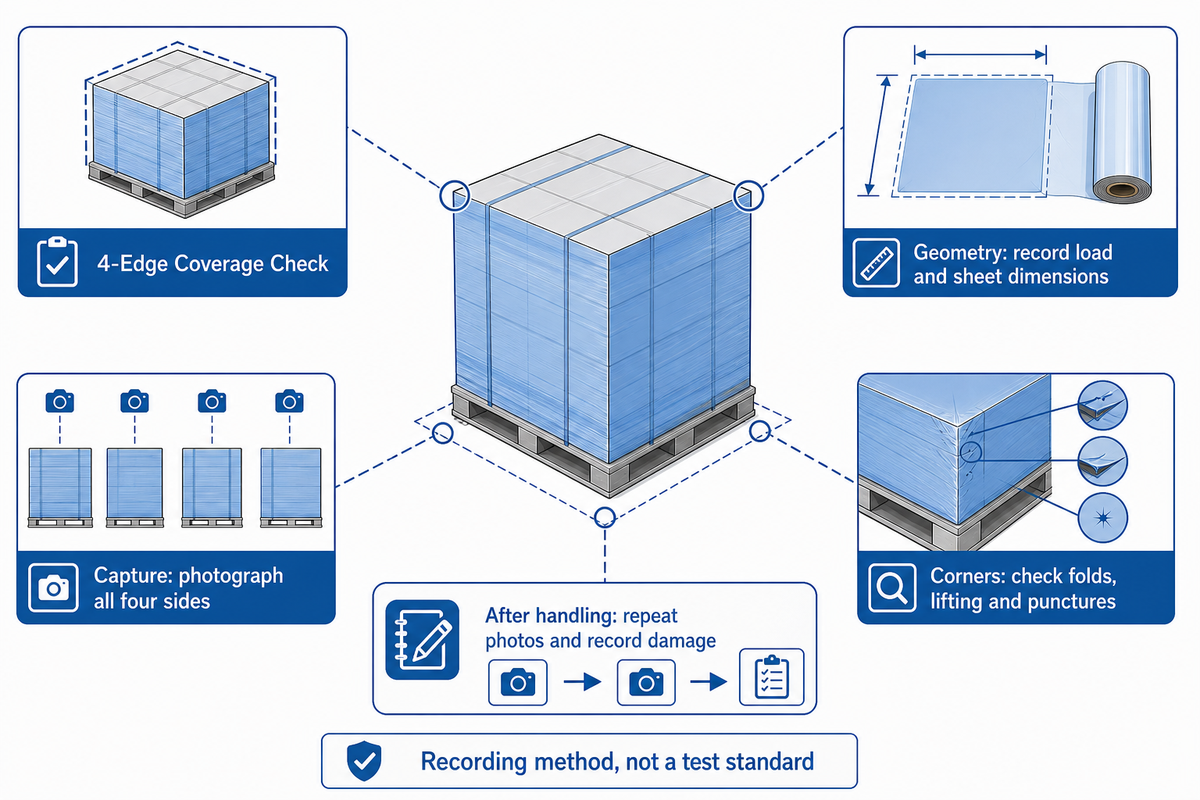
The application sequence must retain the top cover securely, in particular, through handling. Leaving a sheet over a completed pallet, in the absence of a retention step, creates a different package than one in which the skirt is captured during wrapping. Review the actual machine cycle or a work instruction to verify top exposure before approving the film or its dimensions.
Lantech’s S Automatic page distinguishes inline top-sheet application from a mid-wrap option that creates five-sided coverage. A historical Packaging World case also shows top-sheet application before wrapping. The focus is on the type of wrap, not the attainment of a watertight package. For machine-applied stretch film, check a complete cycle, and for a manual operation, determine the operator’s placement and capture sequence.
Use the 4-Edge Coverage Check
- Geometry: record the loaded footprint and unfolded sheet size.
- Capture: photograph the retained skirt on all four sides.
- Corners: inspect folds, lifting edges and punctures.
- After handling: repeat the photographs and record displacement or damage.
For the 48 × 40-inch example, enter 60 × 60 inches as the sheet size and 6/10 inches as the calculated margins. Leave actual retained skirt and post-handling condition for the trial. Filling those cells with values from the calculations would mean making assumptions during an inspection.
Retention takeaway: The 4-Edge Coverage Check is a practical recording method, not a test method standard. Compare before and after photos for the same pallet. An intact top, viewed from above, doesn’t show if the skirt lifted along a side or a corner tore during movement.
Rain, Dust and Condensation Need Different Checks
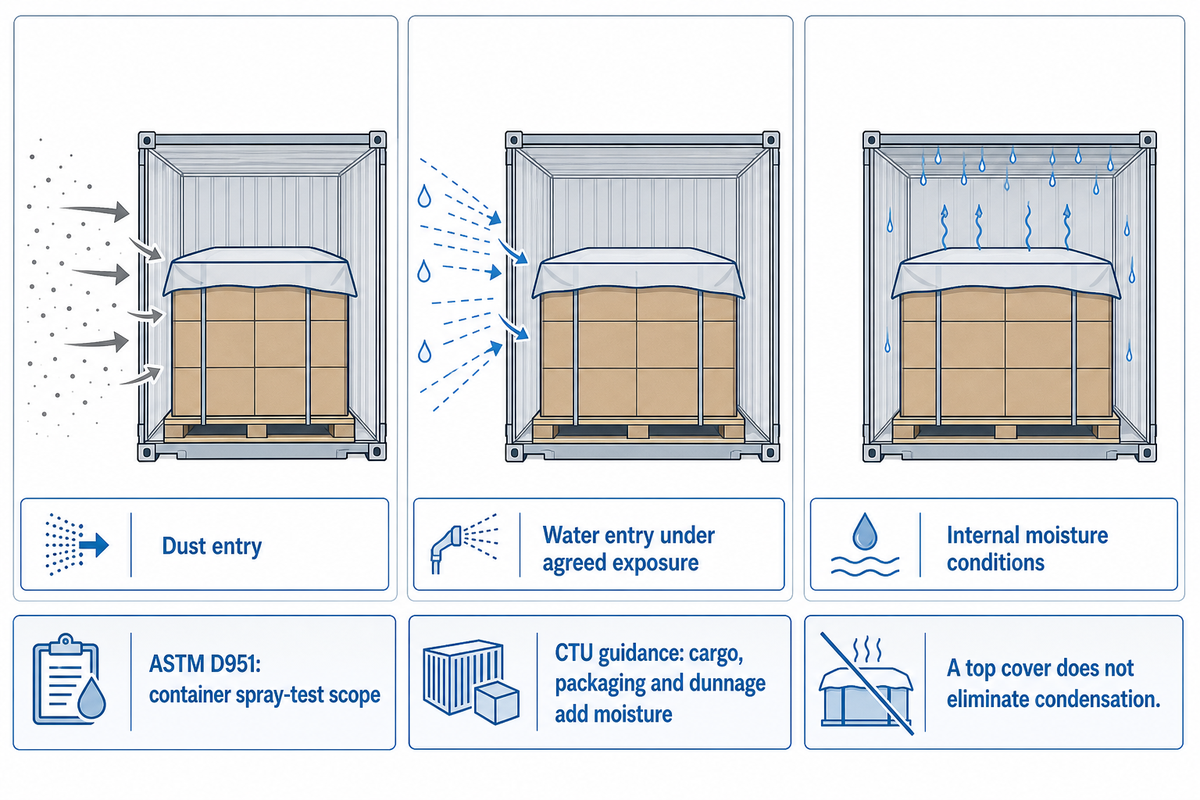
Separate outside water entry from internal moisture. A retained top sheet may address a specific dust or splash exposure, leaving condensation risks unresolved. Cartons can change physical properties with humidity and temperature even if no one sees a puddle or visible leak.
“This test method covers the determination of the water resistance of shipping containers.”
ASTM D951 concerns container water resistance under spray. Its public scope does not establish that a particular top sheet passes, nor supply a universal rain rating. Agree on the complete package configuration, exposure and acceptable outcome with the responsible test provider.
The joint CTU Code is non-mandatory guidance. The CTU Code guidance on condensation explains how cargo, packaging and dunnage introduce moisture, and how cooling can cause water to condense on container surfaces. Covering the top of the carton doesn’t eliminate moisture or condensation. Identify moisture sources and temperature routes as well as the film.
ASTM D4332 addresses the issue of conditioning for comparable packaging tests. Keep the test conditions with the result rather than comparing unlike trials. Its scope directs standard-atmosphere box-compression work to ASTM D685. Where ventilation is pertinent, review airflow needs around the load and do not assume that ventilation will resolve condensation.
Moisture takeaway: Keep 3 separate observations: external dust entry, water entry during the agreed exposure, and internal moisture conditions. A dry top after warehouse handling only addresses a specific, limited question. Approval for a new route or extended exposure will require evidence from the intended packaging arrangement.
Specify Thickness and Roll Format
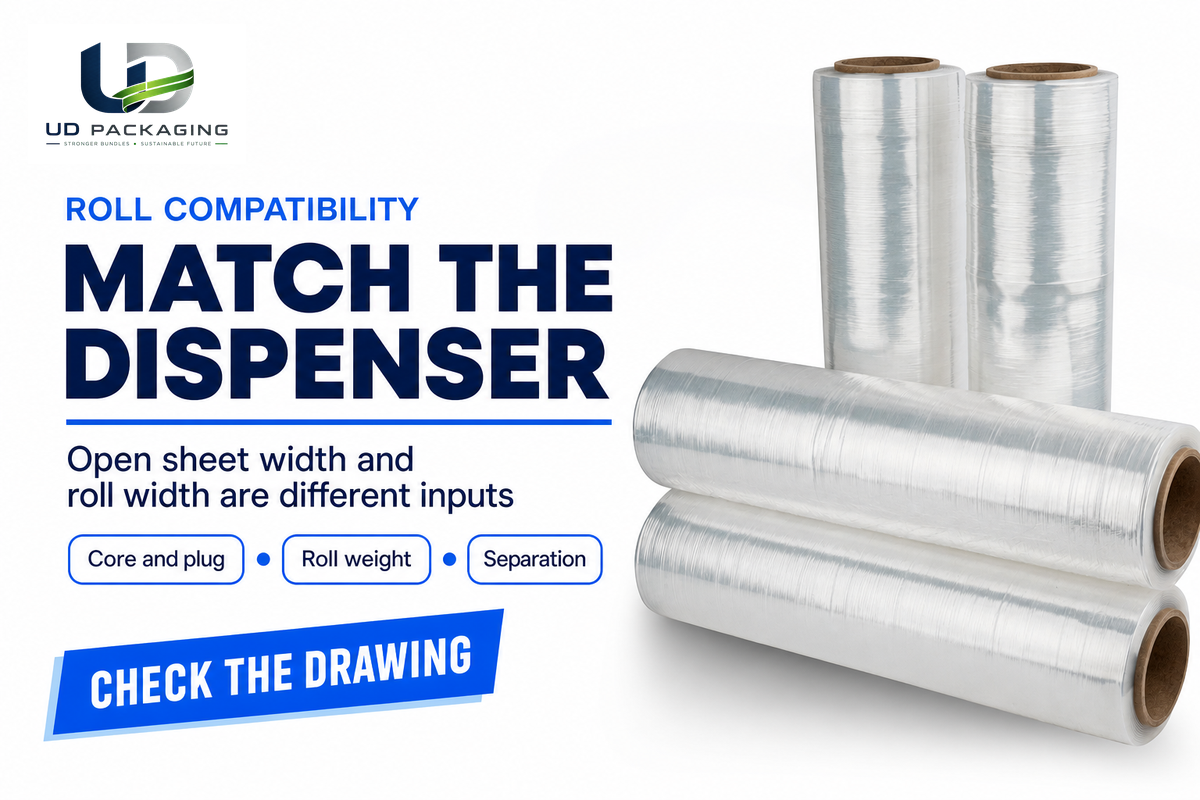
Provide the open dimensions of the sheet, the film thickness and the dispensing system, together. Thickness alone can’t verify separation or protection. A folded roll may be narrower than the sheet it produces, and an automatic applicator may impose its own roll width, weight and film thickness.
Interplas lists a 60” x 60” sheet at 1.25 mil low density polyethylene, with 250 sheets to a roll. Its related-product table lists a 1.5 mil pallet top sheet in the same dimensions at 250 and a 2 mil option at 175. These catalog examples are supplier-specific, and don’t represent interchangeable grades or UD Packaging specifications.
Poly Bag Central describes centerfolded poly sheeting with a roll width half the open sheet width. Its range includes 1 mil film and products available in clear or white. Clear poly sheeting can aid visual inspection. However, clarity won’t indicate puncture or weatherability. A buyer should stipulate the exposure the pallet top sheeting must protect against.
Lantech lists 2–4 mil film, 80 inches wide, for its S Automatic top-sheet option. This example shows why a manually dispensed catalog sheet can’t be assumed to fit an automatic application. Request the current machine specification before substituting a roll.
| Input | Record | Decision or hidden cost |
|---|---|---|
| Loaded footprint | Maximum length and width | Reject undersized coverage |
| Open sheet size | Width × cut length | Calculate both axis margins |
| Folded roll width | Actual supplied width | Confirm feed-path clearance |
| Thickness | Nominal value and agreed tolerance | Compare the specified grade |
| Core and plug | Core bore and fitted plug diameter | Avoid an unusable roll |
| Roll envelope | Outside diameter and maximum weight | Check handling and changeover |
| Separation | Perforation pitch or cutting method | Record jams and torn sheets |
| Sheet quantity | Confirmed usable sheets per roll | Normalize quoted material cost |
| Release check | Damage and rework criteria | Count accepted output consistently |
Perforated rolls should separate sheets easily, without damaging the next cover. A tear-off perforation isn’t the same as ventilation holes. Ask if the supplier will perforate the separation line, the film’s surface, or both.
Hillas lists a core measuring 3 inches with a 1-inch diameter core plug for its LAD-5984 sheet roll. When verifying a dispenser spindle, both dimensions should be noted. The core bore and the opening through an installed plug are two different interfaces.
One Poly Bag Central 72 × 72-inch, 2 mil listing illustrates a purchasing trap: its heading says 150 sheets per roll while the body says 175. Resolve the conflict on the quotation before figuring the unit cost. A contradiction in the catalog isn’t a reason to choose the more favorable number.
Specification takeaway: An 80-inch machine requirement and a 60-inch open sheet describe different purchasing inputs. Match the dispenser drawing first. Thickness measurement also needs the right method: ASTM D6988-26 concerns test specimens and explicitly excludes commercial classification and quality-control sampling from its scope.
Compare Cost per Accepted Pallet
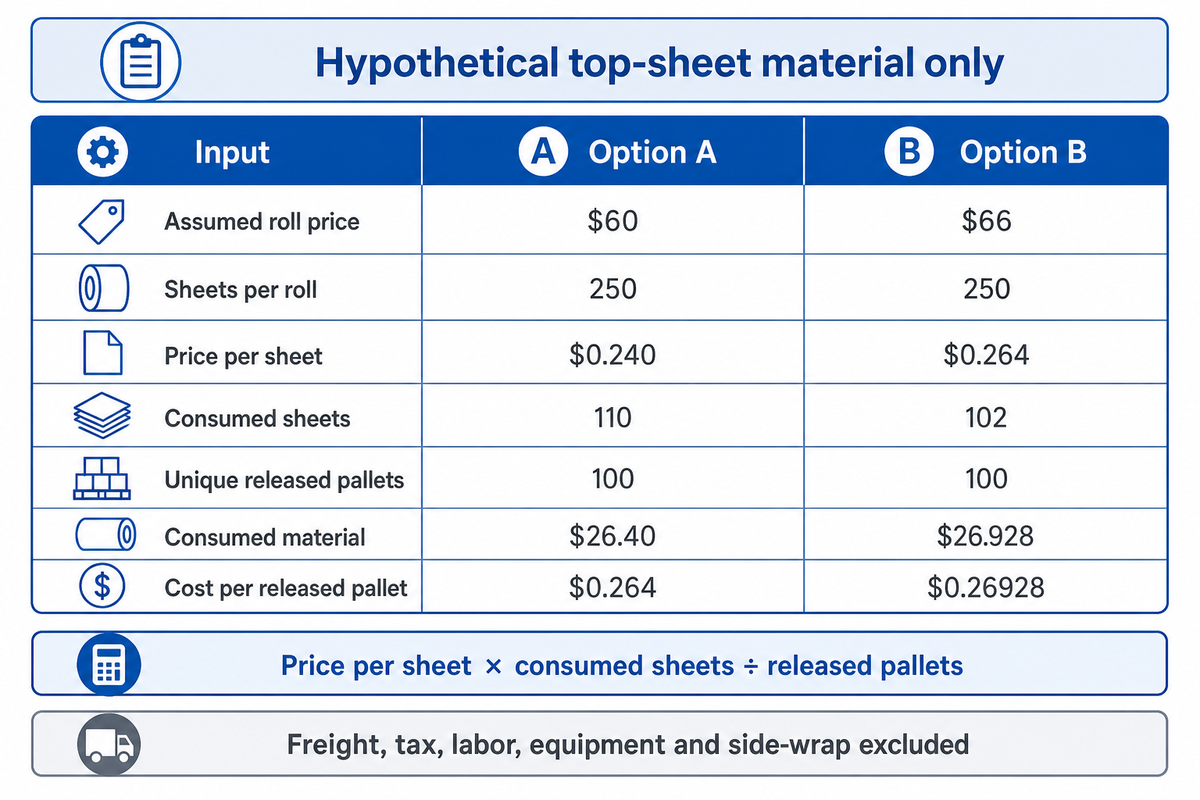
Compare top-sheet cost at a defined release point, with material actually consumed. An accepted pallet means one released from the packing line after any rework, and is counted only once. Arrival condition is a different measure. For this trial, purchased rolls left in inventory shouldn’t be counted against the consumed sheet.
A supplier-authored Packaging Digest comparison also identifies film-change intervals and operator application choices as operating-cost considerations. That supports recording actual consumption and changeover behavior, rather than treating the roll price as the whole cost.
How much does pallet wrap cost?
Pallet wrap cost is dependent on several variables including the purchased film, the amount of film used per load, and the method of wrapping. A roll price cannot give a reliable cost per pallet without those inputs. For a top-sheet decision, determine the added sheet cost first, then compare the side-wrap consumption and rework on the same basis.
Cheaper rolls can cost more per released pallet if torn sheets or repeated application consume the difference. Measure that possibility; don’t assume it. The following hypothetical example of a worksheet compares only top sheet material, excluding freight, tax, labor, equipment and side-wrap film.
| Input or result | Option A | Option B |
|---|---|---|
| Assumed roll price | $60 | $66 |
| Confirmed sheets per roll | 250 | 250 |
| Price per sheet | $0.240 | $0.264 |
| Sheets consumed, including waste and rework | 110 | 102 |
| Unique pallets released after rework | 100 | 100 |
| Consumed top-sheet material cost | $26.40 | $26.928 |
| Material cost per released pallet | $0.264 | $0.26928 |
In this example, B remains slightly more expensive for material despite using fewer sheets. The calculation is price per sheet × consumed sheets ÷ released pallets. Finance can add measured labor separately: every additional $10 allocated to a 100-pallet trial adds $0.10 per pallet. No savings claim follows without those operating records.
Cost takeaway: Follow the bottleneck chain from roll fit to separation, damaged sheets, rework and released output. In this case, the 100-pallet denominator is fixed. Actual consumed sheets vary. Keep inspection labor and delayed release visible in a separate operating cost comparison rather than blending it with roll cost.
What to Confirm Before Changing a Top Sheet
Approve replacement against the purchased grade and actual load, not a broad material description. Changes in the resin blend, thickness or recycled content can impact behavior during application. Keep coverage and acceptance criteria the same during a comparison and determine if the substitute meets the same job.
Trioworld lists its Loop80 top-and-bottom sheet offering with 80% post-consumer recycled content and Loop30 with 30% recycled content. Those statements pertain to named Trioworld products only. They do not establish recycled content for other suppliers’ sheets or prove equivalent performance in your packaging system.
The April 2026 release from Trioworld provides more information on recycling and film development, which is evidence of one supplier’s activities and shouldn’t be interpreted as a market growth indicator. For the purchase team, the next important piece of information is a grade-specific declaration, and a repetition of the load trial.
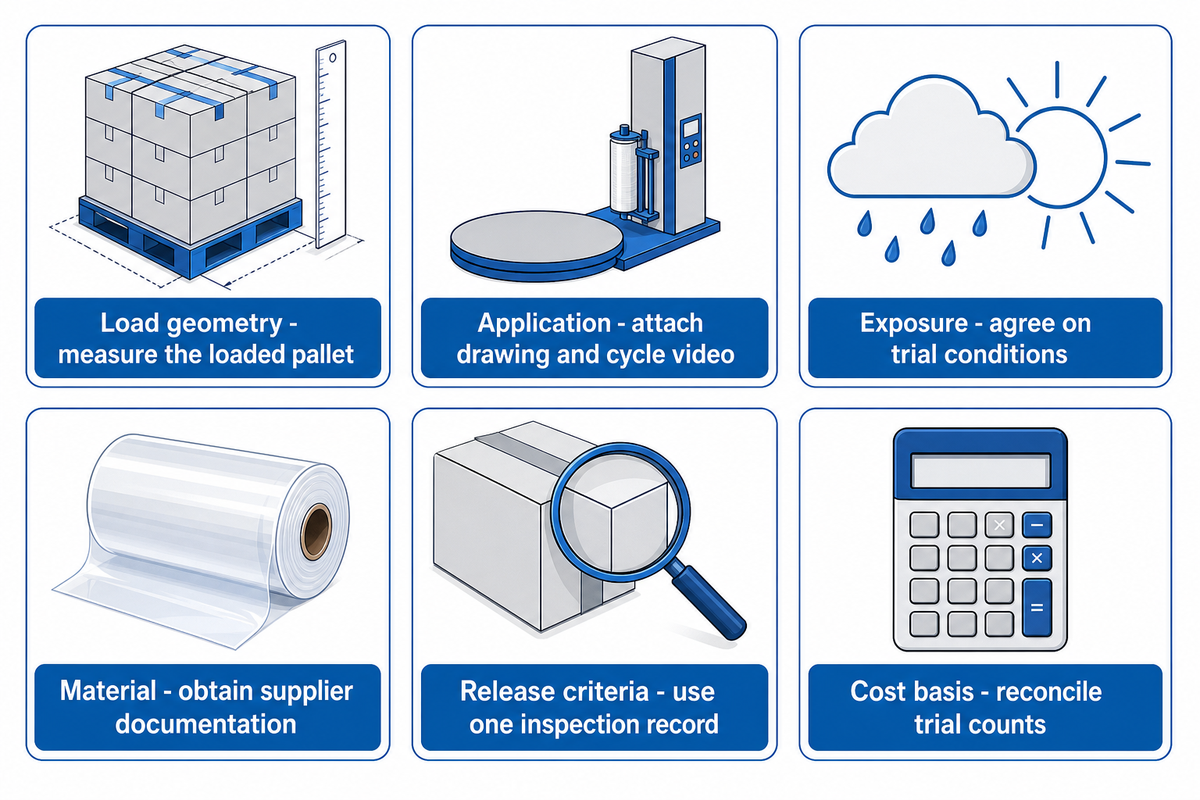
Send these six items with a sample request
| Parameter | Recommended range or input | Why it matters | How to verify |
|---|---|---|---|
| Load geometry | Actual maximum footprint | Determines coverage | Measure a loaded pallet |
| Application | Machine model or manual sequence | Determines roll fit and capture | Attach drawing and cycle video |
| Exposure | Named handling and transport route | Defines the protection question | Agree on trial conditions |
| Material | Exact grade and declared content | Keeps claims product-specific | Obtain supplier documentation |
| Release criteria | Agreed damage and rework limits | Defines accepted output | Use one inspection record |
| Cost basis | Consumed sheets and unique pallets | Makes quotes comparable | Reconcile trial counts |
For a review of an existing industrial polyethylene-film wrapping arrangement, send UD Packaging the load footprint, application sequence and exposure conditions. Begin with its stretch-film systems options. Any specialty top-sheet supply requirement should be evaluated separately.
Frequently Asked Questions
What is a pallet topper?
A pallet topper is a cover placed over the upper face of a palletized load.
The term can mean flexible plastic film, a paperboard pad or a rigid reusable cap. Before ordering, identify the material and function: a loose plastic top sheet isn’t a stacking support or a complete weather enclosure. Ask for a drawing if the supplier’s description leaves the construction unclear, especially when replacing a different cover type.
What is a pallet lid?
A pallet lid is usually a rigid cover used with a compatible pallet, sleeve or container system.
Its fit and any stacking rating belong to that system. A thin polyethylene top sheet performs a different job: it covers the load’s top surface and must be retained by an appropriate wrapping or covering arrangement. Confirm the lid’s mating dimensions and declared use with the system supplier instead of applying the rating to an unrelated package.
What is a pallet cap?
A pallet cap is a broad packaging term rather than a single material specification.
Suppliers may use it for flexible film, corrugated covers or molded lids. Ask for a drawing, material description and intended function. The name alone doesn’t establish water resistance, load-bearing capacity or compatibility with an automatic top-sheet dispenser. Put those requirements in the purchase specification so a familiar product name doesn’t conceal a change in construction.
Which pallet top sheets should I use?
Start with the actual loaded footprint, the required exposure protection and the application method.
Compare unfolded dimensions and roll specifications next. A catalog size remains a candidate until the wrapped load passes your agreed handling and exposure checks.
How are pallet top sheets made?
Plastic top sheets are supplied as converted film, either as individual sheets or in roll formats.
The exact resin blend, folding arrangement and separation method depend on the product. For an automatic applicator, obtain the supplier’s drawing and the machine maker’s film requirements together. A familiar material name doesn’t establish the correct core, roll weight, friction or cutting behavior for your equipment. Confirm those items before approving a substitute material or supplier, and inspect the supplied format during the sample run.
Do pallet top sheets work?
Pallet top sheets can cover the upper surface against the exposure stated for a particular product and packaging arrangement.
Results depend on coverage, retention, tears and handling. Treat dust protection, rain resistance and condensation control as separate acceptance questions.
Have pallet top sheets changed over time?
Current offers vary in thickness, recycled content, format and application compatibility.
Those differences don’t prove a universal market shift. Compare a proposed replacement with the grade you actually use. Keep load geometry and acceptance criteria fixed while recording handling behavior, failures and consumed material. A lighter or recycled-content grade should earn approval through the same relevant checks; the label alone doesn’t establish equivalent performance. Keep the evidence attached to the specific purchased product grade, including its drawing revision and supplier declaration.
About the Evidence: This guide uses publicly available supplier specifications, standards scopes and packaging guidance, and was reviewed in October 2026. Dimensions used in the worked example are geometric, and prices and trial counts are explicitly fictitious. No private UD Packaging top-sheet trial data was used. Supplier product claims remain attributed to their owners.
References & Sources
- ASTM International: D951-17(2024) water resistance of shipping containers.
- United Nations Economic Commission for Europe: mechanisms of condensation CTU Code guidance.
- ASTM International: D4332-22 conditioning containers, packages and components for testing.
- ASTM D6988-26: thickness of plastic film test specimens method scope and commercial-sampling limitation.
- IMO: Code of Practice for Packing of Cargo Transport Units context for the non-mandatory CTU Code.
- University of Florida IFAS: palletizing and load stabilization load geometry and package arrangement, in a perishables context.
- Packaging Digest: pallet unitizing options comparison of wrap and hood systems; supplier-authored trade discussion.
- Packaging World: achieving efficiency through automation historical example of a top-sheet application sequence.